TS Inter 1st Year Physics Notes Chapter 2 Units and Measurements

Here students can locate TS Inter 1st Year Physics Notes 2nd Lesson Units and Measurements to prepare for their exam.

TS Inter 1st Year Physics Notes 2nd Lesson Units and Measurements

→ Fundamental Quantity : A fundamental quantity is one which is unique and freely existing. It does not depend on any other physical quantity. Ex: Length (L), Time (T), Mass (M) etc.

→ Fundamental quantities in SI System : In SI system length, mass, time, electric current, thermodynamic temperature, amount of substance and luminous intensity are taken as fundamental quantities.

→ Derived quantity: A derived quantity is pro-duced by the combination of fundamental quantities (i.e., by division or by multiplica-tion of fundamental quantities).
Ex: Velocity = \(\frac{\text { displacement }}{\text { time }}=\frac{\mathrm{L}}{\mathrm{T}}\) or LT-1
Acceleration = \(\frac{\text { change in velocity }}{\text { time }}\)
= \(\frac{\mathrm{LT}^{-1}}{\mathrm{~T}}\) = LT2

→ Unit: The standard which is used to measure the physical quantity is called the Unit’.

→ Fundamental unit: The units of the funda-mental quantities are called the “fundamental units”.
Ex : Length → Meter (m), Mass → Kilogram (kg), Time Second (sec) etc.

→ Basic units or fundamental units of SI system : The basic units in S.I. system are Length → metre (L), Mass → kilogram (kg), Time second (s); electric current → ampere (amp), Thermodynamic temperature → Kelvin (K); Amount of substance → mole (mol); Luminous intensity → candela (cd); Auxilliary units : Plane angle → Radian (rad); Solid angle → steradian (sr)

→ Derived units: The units of derived quantities are known as “derived units”.
Ex: Area → square meter (m2),
Velocity → meter/sec (m/s) etc.

→ International system of units (S.I. units) :
S.I. system consists of seven fundamental quantities and two supplementary quantities. To measure these quantities S.I. system consists of seven fundamental or basic units and two auxiliary units.

→ Accuracy: Accuracy indicates the closeness of a measured value to the true value of the quantity. If we are very close to the true value then our accuracy is high.

TS Inter 1st Year Physics Notes Chapter 2 Units and Measurements

→ Precision : Precision depends on the least measurable value of the instrument. If the least measurable value is too less, then precision of that instrument is high.
Ex : Least measured value of vernier callipers is 0.1 mm
Least count of screw gauge is 0.01 mm.
Among these two, the precision of the screw gauge is high.

→ Error: The uncertainty of measurement of a physical quantity is called “error”.
→ Systematic errors : Systematic errors always tend to be in one direction i.e., positive or negative. For systematic errors, we know the reasons for the error. They can be reduced by proper correction or by proper care. Ex:

  • Zero error in screw gauge and
  • A faulty calibrated thermometer

Note :
Systematic errors are classified as

  • Instrumental errors
  • Imperfection of experimental technique
  • Personal errors.

1) Instrumental errors: These errors arise due to the imperfect design or faulty calibration of instruments.
Ex : Zero error in screw gauge.

2) Imperfection of experimental technique: These errors are due to the procedure followed during experiment or measurements. Ex : 1) Measurement of body temperature at armpit 2) Simple pendulum oscillations with high amplitude.

3) Personal errors: These errors arise due to an individual’s approach or due to lack of proper setting of apparatus.
Ex : Parallax error is a personal error.

→ Methods To Reduce Systematic Errors :
Systematic errors can be minimized by improving experimental techniques, by selecting better instruments and by removing personal errors.

→ Random errors :
These errors will occur irregularly. They may be positive (or) negative in sign. We cannot predict the presence of these errors.
Ex:

  • Voltage fluctuations of power supply
  • Mechanical vibrations in experimental set up.

→ Least count error: This is a systematic error. It depends on the smallest value that can be measured by the instrument.
Least count error can be minimized by using instruments of highest precision.

→ Arithmetic mean: The average value of all the measurements is taken as arithmetic mean.
Let the number of observations be a1, a2, a3 ……….. an

Then the arithmetic mean
amean = \(\frac{\mathbf{a}_1+\mathbf{a}_2+\mathbf{a}_3+\ldots \ldots \ldots .+\mathbf{a}_{\mathbf{n}}}{\mathbf{n}}\)
or amean = \(\sum_{i=1}^n \frac{a_i}{n}\)

→ Absolute error (|Δa|): The magnitude of the difference between the individual measurement and true value of the quantity is called absolute error of the measurement. It is denoted by |Δa|
Absolute error
|Δa| = |amean – ai|
= |True value – measured value|

→ Mean absolute error ( Aa[nrnnl: The arithmetic mean value of all absolute errors is known as mean absolute error.
Let ‘n’ measurements are taken, then their absolute errors are, say |Δa1|, |Δa2|, |Δa3| …….. ||Δan|, then
|Δamean| = \(\frac{\left|\Delta a_1\right|+\left|\Delta a_2\right|+\left|\Delta a_3\right|+\ldots \ldots \ldots+\left|\Delta a_n\right|}{n}\)
or
Δamean = \(\frac{1}{n} \sum_{i=1}^n \Delta a_i\)

→ Relative error: Relative error is the ratio of the mean absolute error A amean to the mean value a mean of the quantity measure.
Relative error = \(\frac{\Delta \mathbf{a}_{\text {mean }}}{\mathbf{a}_{\text {mean }}}\)

TS Inter 1st Year Physics Notes Chapter 2 Units and Measurements

→ Percentage error (δa): When relative error is expressed in percent then it is called percentage error.
Percentage error (δa) = \(\frac{\Delta \mathbf{a}_{\text {mean }}}{\mathbf{a}_{\text {mean }}}\) × 100

→ Significant figures: The scientific way to report a result must always have all the reliably known (measured) values plus one uncertain digit (first digit). These are known as “significant figures”.
This additional digit indicates the uncertainty of measurement.
Ex: In a measurement, the length of a body is reported as 287.5 cm. Then, in that measu-rement, the length is believable up to 287 cm
i. e., the digits 2, 8 and 7 are certain. The first digit (5) is uncertain. Its value may change.

→ Rules in determining significant numbers

  • All the non-zero digits are significant.
  • All the zeros in between two non-zero digits are significant.
  • If the number is less than one, the zeros on the right of decimal point to the first nonzero digit are not significant.
    Ex : In a result 0.002308 the zeros before the digit ‘2’ are non significant.
  • The terminal or trailing zeros in a number without decimal point are not significant. Ex: In the result 123 m = 12300 cm = 123000 mm the zeros after the digit ‘3’ are not significant.
  • The trailing zeros in a number with a decimal point are significant.
    Ex : In the result 3.500 or 0.06900 the last zeros are significant. So number of significant figures are four in each case.

→ Rules for arithmetic operation with sig-nificant figures
1. In multiplication or division, the final result should retain as many significant figures as are there in the original number with the least significant figures.
Ex : In the division \(\frac{4.237}{2.51}\) the significant figures are 4 and 3, so least significant figures are ‘3’.
\(\frac{4.237}{2.51}\) = 1.69 i.e., final answer must have only ‘3’ significant digits.

2. In addition or subtraction, the final result should retain as many decimal places as are there in the number with the least decimal places.
Ex: 436.26g + 227.2 g Here least number of significant figures after decimal point is one.
436.26 + 272.2 = 708.46 must be expressed as 708.5 (after rounding off the last digit).

→ Rounding off the uncertain digits Rules for rounding off procedure : In rounding off the numbers to the required number of significant digits the following rules are followed.

  • The preceding significant digit is raised by one if the first non-significant digit is more than 5.
  • The preceding significant digit is left unchanged if the first non-significant digit is less than 5.
  • If the first non-significant figure is 5 then
    (a) If the preceding significant figure is an odd number then add one to it.
    (b) If the preceding significant figure is an even number then it is unchanged and 5 is discarded.

→ Dimension: The power of a fundamental quantity in the given derived quantity is called
dimension.
Ex: Force dimensional formula MLT-2 Here dimensions of Mass → 1, Length → 1, Time → 2

→ Dimensional formula: It is a mathematical expression giving relation between various fundamental quantities of a derived physical quantity.
Ex : Momentum (P),MLT-1,
Energy ML2T-2 etc.

→ Uses of dimensional methods :

  • To convert units from one system to another system.
  • To check the validity of given physical equations. For this purpose, we will use homogeneity of dimensions on L.H.S and on R.H.S.
  • To derive new relations between various physical quantities.

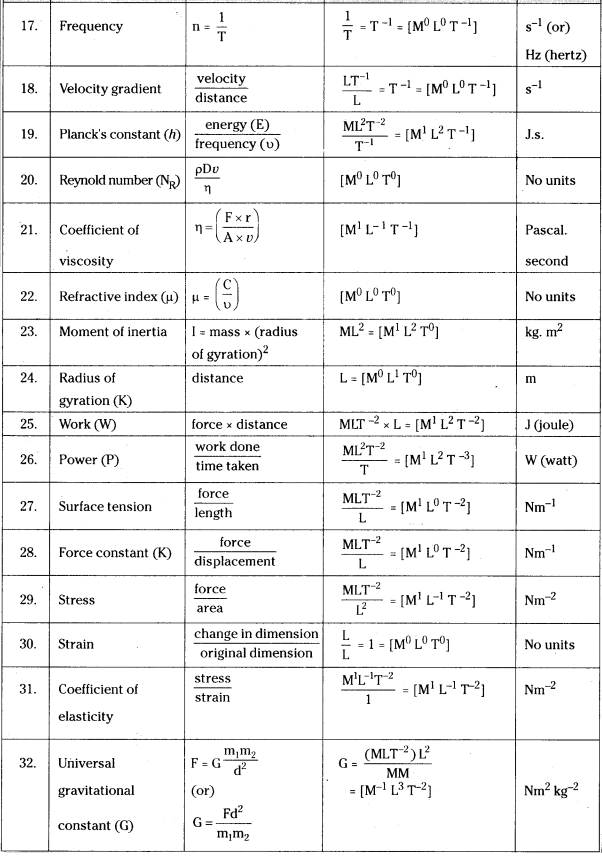
→ Dimensional formulae of physical quantities:
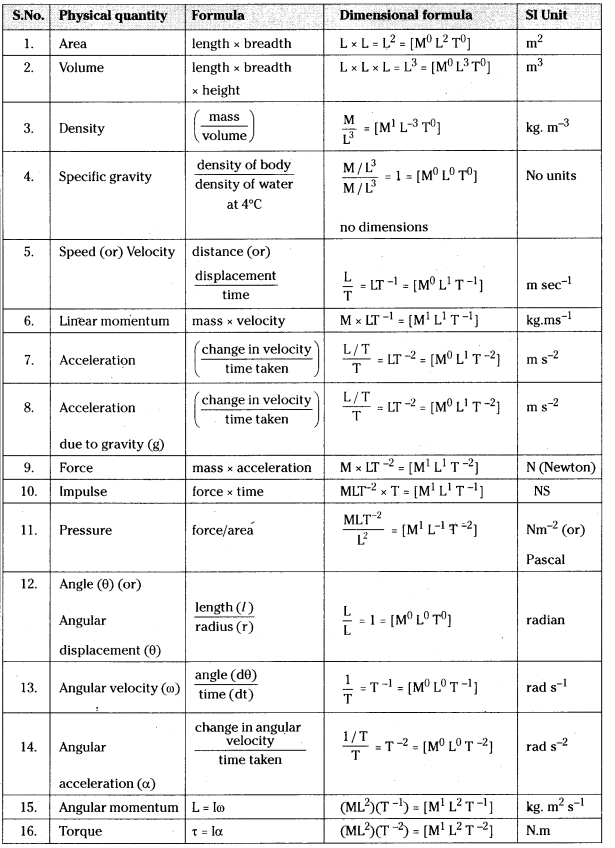
TS Inter 1st Year Physics Notes Chapter 2 Units and Measurements 1
TS Inter 1st Year Physics Notes Chapter 2 Units and Measurements 2
TS Inter 1st Year Physics Notes Chapter 2 Units and Measurements 3

TS Inter 1st Year Physics Study Material Telangana | TS Intermediate 1st Year Physics Textbook Solutions Pdf

Here you will find Telangana TSBIE State Board Syllabus TS Inter 1st Year Physics Study Material Pdf free download, TS Intermediate 1st Year Physics Textbook Solutions Questions and Answers in English Medium and Telugu Medium according to the latest exam curriculum. The chapter-wise TS Inter 1st Year Study Material will help the students in understanding the concept behind each question in a detailed way.

Students can check the TS Inter 1st Year Physics Syllabus & TS Inter 1st Year Physics Important Questions for strong academic preparation. Students can use TS Inter 1st Year Physics Notes as a quick revision before the exam.

TS Intermediate 1st Year Physics Study Material Pdf Download | TS Inter 1st Year Physics Textbook Solutions Telangana

TS Inter 1st Year Physics Study Material in Telugu Medium

  • Chapter 1 భౌతిక ప్రపంచం
  • Chapter 2 ప్రమాణాలు, కొలత
  • Chapter 3 సరళరేఖాత్మక గమనం
  • Chapter 4 సమతలంలో చలనం
  • Chapter 5 గమన నియమాలు
  • Chapter 6 పని, శక్తి, సామర్ధ్యం
  • Chapter 7 కణాల వ్యవస్థలు, భ్రమణ గమనం
  • Chapter 8 డోలనాలు
  • Chapter 9 గురుత్వాకర్షణ
  • Chapter 10 ఘనపదార్ధాల యాంత్రిక ధర్మాలు
  • Chapter 11 ప్రవాహుల యాంత్రిక ధర్మాలు
  • Chapter 12 పదార్ధ ఉష్ణ ధర్మాలు
  • Chapter 13 ఉష్ణోగతిక శాస్త్రం
  • Chapter 14 అణుచలన సిద్ధాంతం

TS Inter 1st Year Physics Study Material in English Medium

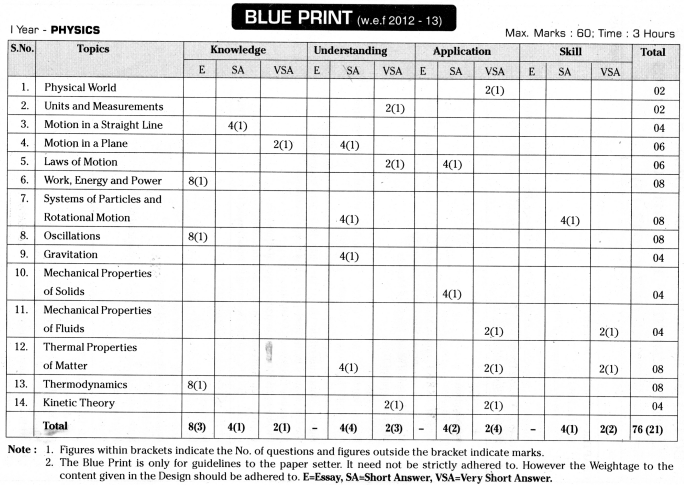
TS Inter 1st Year Physics Weightage Blue Print 2022-2023

TS Inter 1st Year Physics Weightage Blue Print

TS Inter 1st Year Physics Syllabus

Telangana TS Intermediate 1st Year Physics Syllabus

TELANGANA STATE BOARD OF INTERMEDIATE EDUCATION, HYDERABAD
Physics-I
Syllabus (w.e.f. 2012-13)

Chapter 1 PHYSICAL WORLD
1.1. What is Physics ? 1.2. Scope and excitement of physics 1.3. Physics, technology and society 1.4. Fundamental forces in nature 1.5. Nature of physical laws.

Chapter 2 UNITS AND MEASUREMENTS
2.1 Introduction 2.2 The International system of units 2.3 Measurement of length, Measurement of Large Distances, Estimation of Very Small Distances: Size of Molecule, Range of Lengths 2.4 Measurement of Mass, Range of Mass 2.5 Measurement of Time
2.6 Accuracy, precision of instruments and errors in measurement, Systematic errors, random errors, least count error, Absolute Error, Relative Error and Percentage Error, Combination of Errors 2.7 Significant Figures, Rules for Arithmetic Operations with Significant Figures, Rounding off the Uncertain Digits, Rules for Etermining the Uncertainly in the Results of Arithmatic Calculations 2.8 Dimensions of Physical Quantities 2.9 Dimensional Formulae and dimensional equations 2.10 Dimensional Analysis and its Applications, Checking the Dimensional Consistency of Equations, Deducting Ration among the Physical Quantities.

Chapter 3 MOTION IN A STRAIGHT LINE
3.1 Introduction 3.2 Position, Path Length and Displacement 3.3 Average Velocity and Average Speed 3.4 Instantaneous Velocity and Speed 3.5 Acceleration 3.6 Kinematic equations for uniformly accelerated motion 3.7 Relative velocity – Elements of Calculus.

Chapter 4 MOTION IN A PLANE
4.1 Introduction 4.2 Scalars and Vectors, Position and Displacement Vectors, Equality of Vectors 4.3 Multiplication of Vectors by real members 4.4 Addition and Subtraction of Vectors – graphical method 4.5 Resolution of vectors 4.6 Vector addition Analytical method 4.7 Motion in a plane, Position Vector and Displacement, Velocity, Acceleration 4.8 Motion in a plane with constant acceleration 4.9 Relative velocity in two dimensions 4.10 Projectile Motion, Equation of path of a projectile, Time of Maximum height, Maximum height of a projectile, Horizontal range of projectile 4.11 Uniform circular motion.

Chapter-5: LAWS OF MOTION
5.1 Introduction 5.2 Aristotle’s fallacy 5.3 The law of inertia 5.4 Newton’s first law of Motion 5.5 Newton’s second law of Motion 5.6 Newton’s third law of Motion, Impulse 5.7 Conservation of momentum 5.8 Equilibrium of a particle 5.9 Common forces in Mechanics, Friction 5.10 Circular Motion, Motion of a car on a level road, Motion of a car on a banked road 5.11 Solving problems in Mechanics.

Chapter 6 WORK, ENERGY AND POWER
6.1 Introduction 6.2 Notions of Work and Kinetic Energy: The work-energy theorem. 6.3 Work 6.4 Kinetic Energy 6.5 Work done by a variable force 6.6 The work-energy theorem for a variable force 6.7 The concept of Potential Energy 6.8 The conservation of Mechanical Energy 6.9 The Potential Energy of a spring 6.10 Various forms of energy: the law of conservation of Energy. Heat, Chemical Energy, Electrical Energy, The Equivalence of a Mass and Energy, Nuclear Energy, The Principle of Conservation of Energy. 6.11 Power 6.12 Collisions, Elastic and Inelastic Collisions, Collisions in one dimension, Coefficent – Power consumption in walking

Chapter 7 SYSTEM OF PARTICLES AND ROTATIONAL MOTION
7.1 Introduction, What kind of motion can a rigid body have? 7.2 Centre of mass. Centre of gravity 7.3 Motion of Centre of Mass 7.4 Linear momentum of a System of particles 7.5 Vector product of Two Vectors 7.6 Angular Velocity and its relation with linear velocity, Angular acceleration, kinematics of Rotational motion about a fixed axis. 7.7 Torque and angular Momentum, Moment of force (Torque), Angular momentum of a particle, Torque and angular momentum for a system of a particles, conservation of angular momentum 7.8 Equilibrium of a Rigid Body, Principle of moments 7.9 Moment of Inertia 7.10 Theorems of perpendicular and parallel axis, Theorem of perpendicular axes, Theorem of parallel axes 7.11 Dynamics of Rotational Motion about a Fixed Axis. 7.12 Angular momentum in case of rotations about a fixed axis, Conservation of angular momentum 7.13 Rolling Motion, Kinetic Energy of Rolling Motion.

Chapter 8 OSCILLATIONS
8.1 Introduction 8.2 Periodic and Oscillatory Motions, Period and frequency, Displacement 8.3 Simple Harmonic Motions (SHM) 8.4 Simple Harmonic Motion and Uniform Circular Motion 8.5 Velocity and Acceleration in Simple Harmonic Motion 8.6 Force Law for Simple Harmonic Motion 8.7 Energy in Simple Harmonic Motion 8.8 Some systems executing Simple Harmonic Motion, Oscillations due to a Spring, The Simple Pendulum 8.9 Damped Simple Harmonic Motion 8.10 Forced Oscillations and Resonance.

Chapter 9 GRAVITATION
9.1 Introduction 9.2 Kepler’s Laws 9.3 Universal Law of Gravitation 9.4 The Gravitational Constant 9.5 Acceleration due to Gravity of the Earth 9.6 Acceleration due to gravity below and above the surface of Earth 9.7 Gravitational Potential Energy 9.8 Escape Speed 9.9 Earth Satellite 9.10 Energy of an orbiting satellite 9.11 Geostationary and Polar satellites 9.12 Weightlessness.

Chapter 10 MECHANICAL PROPERTIES OF SOLIDS
10.1 Introduction 10.2 Elastic behavior of Solids 10.3 Stress and Strain 10.4 Hook’s law 10.5 Stress – strain curve 10.6 Elastic Moduli, Young’s Modulus, Determination of Yong’s Modulus of the Material of a Wire, Shear Modulus Bulk Modulus, Poisson’s Ratio. 10.7 Applications of elastic behaviour of Materials.

Chapter 11 MECHANICAL PROPERTIES OF FLUIDS
11.1 Introduction 11.2 Pressure, Pascal’s Law, Variation of Pressure with Depth, Atmospheric Pressure and Gauge Pressure, Hydraulic Machines 11.3 Streamline flow 11.4 Bernoulli’s principle, Speed of Efflux, Torricelli’s Law, Venturi-meter, Blood Flow and Heart Attack, Dynamic Lift 11.5 Viscosity, Variation of Viscosity of fluids with temperature, Stoke’s Law 11.6 Reynolds number 11.7 Surface Tension, Surface Energy, Surface Energy and Surface Tension, Angle of Contact, Drops and Bubbles, Capillary Rise, Detergents and Surface Tension; What is blood pressure.

Chapter 12 THERMAL PROPERTIES OF MATTER
12.1 Introduction 12.2 Temperature and Heat 12.3 Measurement of Temperature 12.4 Ideal – Gas Equation and Absolute Temperature 12.5 Thermal Expansion 12.6 Specific Heat Capacity 12.7 Calorimetry 12.8 Charge of State, Regelation, Latent Heat 12.9 Heat transfer, Conduction, thermal conductivity, Convection, Radiation, Blackbody Radiation, Greenhouse Effect 12.10 Newton’s Law of Cooling.

Chapter 13 THERMODYNAMICS:
13.1 Introduction 13.2 Thermal Equilibrium 13.3 Zeroth Law of Thermodynamics 13.4 Heat, Internal Energy and Work 13.5 First Law of Thermodynamics 13.6 Specific Heat Capacity 13.7 Thermodynamic State Variables and Equation of State 13.8 Thermodynamic Processes, Quasi-static Isothermal Process, Adiabatic Process, Irochoric Process, Cyclic Process. 13.9 Heat Engines 13.10 Refrigerators and Heat Pumps 13.11 Second Law of Thermodynamics 13.12 Reversible and Irreversible Processes 13.13 Carrot Engine, Carnot’s Theorem.

Chapter 14 KINETIC THEORY
14.1 Introduction 14.2 Molecular Nature of Matter 14.3 Behaviour of Gases 14.4 Kinetic Theory of an Ideal Gas, Pressure of an Ideal Gas 14.5 Laws of equipartition of energy 14.6 Specific Heat Capacity, Monatomic Gases, Diatomic Gases, Polyatomic Gases, Specific Heat Capacity of Solids, Specific Heat Capacity of Water 14.7 Mean Free Path.

We hope this TS Intermediate 1st Year Physics Study Material Pdf Download in English Medium and Telugu Medium will be useful for students to attain the right approach for precisely answering the textbook questions. If there is any trouble in grasping the concepts related to TS Inter 1st Year Physics Textbook Solutions Telangana, drop your questions in the comment and we will get back to you with a solution in time.

TS Inter 1st Year Physics Notes Chapter 1 Physical World

Here students can locate TS Inter 1st Year Physics Notes 1st Lesson Physical World to prepare for their exam.

TS Inter 1st Year Physics Notes 1st Lesson Physical World

→ Physics: Physics is the study of nature and natural phenomena.

→ Fundamental forces in nature : In physics

  • Gravitational force
  • Electromagnetic force
  • Strong nuclear force
  • Weak nuclear force.

→ Gravitational force : It is the force of attraction between any two objects by virtue of their masses.
These are very weak forces. They are very long distance forces. For heavy bodies like planets and stars etc. the magnitude of these forces is high. These forces are very important in planetary motion, and in formation of Stars and Galaxies.

→ Electromagnetic forces : It is the force between two charged particles.
Between like charges they are “repulsive forces” and between unlike charges they are “attractive forces”. These forces are very strong forces. These are long distance forces.

→ Strong nuclear forces: Strong nuclear forces bind protons and neutrons in a nucleus.
These are very strong attractive forces. They are 100 times stronger than electromagnetic forces. They are short range forces. Their effect is upto very few fermi.

→ Weak nuclear forces: Weak nuclear forces will appear only in certain nuclear processes such as β – decay of nucleus where nucleus emits electron and neutrino. These are weak forces, their range is upto few fermi.

→ Conserved quantities: In physics any physical phenomenon is governed by certain forces. Si.oeral physical quantities will change with time but some special physical quantities will remain constant with time. Such physical quantities are called conserved quantities of nature.
Ex : For motion under an external conser-vative force such as gravitational field the total mechanical energy (i.e., P.E + K.E) is constant or energy is conserved.

TS Inter 1st Year Physics Notes Chapter 1 Physical World

→ Some physicists and their major contributions

NameMajor contribution/ Discovery
1. ArchimedesPrinciple of buoyancy, Principle of the lever
2. Galileo GalileiLaw of inertia
3. Isaac NewtonUniversal law of gravitation; Laws of motion, Corpus­cular theory of light; Reflecting telescope.
4. C.V.RamanInelastic scattering of light by molecules.
5. Edwin HubbleExpanding universe
6. Hideki YukawaTheory of nuclear forces
7. S. ChandrasekharChandrasekhar limit, structure and evolution of stars
8. Michael FaradayElectromagnetic induction laws
9. James Clark MaxwellElectromagnetic theory – light – electromagnetic waves
10. J.J.ThomsonElectron
11. Albert EinsteinExplanation of photoelectric effect and theory of rela­tivity
12. R.A.MillikanMeasurement of charge of electron.
13. Ernest RutherfordNuclear model of atom
14. John BardeenTransistors; Theory of super conductivity.

→ Fundamental forces of nature

NameRelative strength (N)
l. Gravitational force10-39
2. Weak nuclear forces10-13
3. Electromagnetic forces10-2
4. Strong nuclear forces1

→ Fundamental constants of Physics

Physical constantSymbolValue
1. Speed of light in vacuumc3 × 108 meter/sec
2. Planck’s constanth6.63 × 10-34 joule.sec
3. Molar gas constantR8.31 joule/mole.K
4. Avogadro’s numberNA6.02 × 1023/ mol
5. Boltzmann’s constantK1.38 × 10-23/mol
6. Gravitational constantG6.67 × 10-11 Newton.m2/kg2
7. Mechanical equivalent of heatJ4.185 joule/cal.
8. Triple point of waterTtr273.16 K
9. Density of water at 20° Cdw103kg/m3
10. Density of mercurydm13.6 × 103 kg/m3
11. Density of dry air at N.T.P.da1.293 kg /m3
12. Specific heat of watersw1 cal./gm/°C
13. Latent heat of iceLf80 cal./gm
14. Latent heat of steamLv540 cal/gm (or 539)
15. √5 = 2.236, √3 = 1.732, √10 = 3.162, loge 10 = 2.3026
16. π = 3.14, π2 = 9.87, √π = 1.7772, √2 = 1.414

→ Conversion factors:

1 metre100 cm
1 millimeter10-3m
1 inch2.54 × 102 m
1 micron (p)10-4cm
1 Angstrom (A0)10-8cm
1 fermi (f)10-13 cm
1 kilometer103 m
1 light year9.46 × 1015 m
1 litre103 cm3
1 kilogram1000 gm
1 metric ton1000 kg
1 pound453.6 gm
1 atomic mass unit (a.m.u)1.66 × 10⁻²⁷ kg
1 a.m.u931 MeV
1 day8.640 × 104 seconds
1 km/hour\(\frac{5}{8}\)m/sec (or) 0.2778 meter/sec
1 Newton105 dynes
1 gm wt980.7 dynes
1 kg.wt9.807 Newton
1 Newton/meter21 pascal
1 atmospheric1.0133 × 105
pressurepascal (N/m2)
1 atmospheric76 cm of Hg
pressure
1 Pascal10 dyne/cm2
1 Joule107erg
1 kilo watt hour3.6 × 106 joule
1 electro volt (ev)1.602 × 10⁻¹⁹ joule
1 watt1 joule / sec
1 horse power (HP)746 watt
1 degree (° )60 minute (‘)
1 Radian57.3 degree ( ° )
1 Poise1 dyne . sec / cm2
1 Poiseuille10 poise
(Newton, sec/m2 (or) Pascal sec.)

TS Inter 1st Year Physics Notes Chapter 1 Physical World

→ Important Prefixes:

PrefixSymbolMultiplier
ExaE1018
PetaP1015
TeraT1012
GigaG109
MegaM106
Kilok103
Hectoh102
Decada101
decid10-1
centic10-2
millim10-3
micro010-6
nanon10-9
picoP10-12
femtof10-15
attoa10-18

→ The Greek Alphabet:

Alphaα
Betaβ
Gammaγ
Delta (A)δ
Epsilonε
Rhoρ
Lambdaλ
Muμ
Nuν
Xiξ
Piπ
Thetaθ
Tauτ
Chiχ
PsiΨ
Omegaω
Etaη
Sigma(Σ)σ

→ Formulae of geometry :

  • Area of triangle = \(\frac{1}{2}\) × base × height
  • Area of parallelogram = base × height
  • Area of square = (length of one side)2
  • Area of rectangle = length × breadth
  • Area of circle = πr2 (r = radius of circle)
  • Surface area of sphere = πr2 (r = radius of sphere)
  • Volume of cube = (length of one side of cube)3
  • Volume of parallelopiped = length x breadth x height
  • Volume of cylinder = πr2l
  • Volume of sphere = \(\frac{4}{3}\)πr3
  • Circumference of square = 41
  • Volume of cone = \(\frac{1}{3}\)πr2h
  • Circumference of circle = 2πr

→ Formulae of algebra:

  • (a + b)2 = a2 + b2 + 2ab
  • (a – b)2 = a2 + b2 – 2ab
  • (a2 – b2) = (a + b) (a – b)
  • (a + b)3 = a3 + b3 + 3ab (a + b)
  • (a – b)3 = a3 – b3 – 3ab (a – b)
  • (a + b)2 – (a – b)2 = 4ab
  • (a + b)2 + (a – b)2 = 2(a2 + b2)

TS Inter 1st Year Physics Notes Chapter 1 Physical World

→ Formulae of differentiation:

  • \(\frac{d}{d x}\) (constant) = 0 differentiation with respect to x = \(\frac{d}{d x}\)
  • \(\frac{d}{d x}\) (xn) = n xn-1
  • \(\frac{d}{d x}\) (sin x) = cos x
  • \(\frac{d}{d x}\)(cos x) = – sin x dx

→ Formulae of Integration:
Integration with respect to x = ∫dx

  • ∫dx = x
  • ∫xn dx = \(\frac{x^{n+1}}{n+1}\)
  • ∫sin x dx = cos x + c
  • ∫cos x dx = sin x + c

→ Formulae of logarithm :

  • log mn = (log m + log n)
  • log(\(\frac{m}{n}\)) = (log m – log n)
  • log mn = n log m

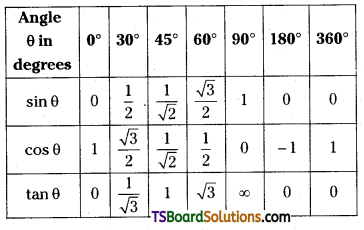
→ Value of trigonometric functions :
TS Inter 1st Year Physics Notes Chapter 1 Physical World 1

→ Signs of trigonometrical ratios :

  • sin (90° – θ) = cos θ ; sin (180° – θ) = sin θ
  • cos (90° – θ) = sin θ ; cos (180° – θ) = – cos θ
  • tan (90° – θ) = cot θ ; tan (180° – θ) = – tan θ

→ According to Binomial theorem :
(1 + x)n ≈ (1 + nx) if x < < 1

→ Quadratic equation:
ax2 + bx + c = 0
x = \(\left(\frac{-b \pm \sqrt{b^2-4 a c}}{2 a}\right)\)

TS Inter 1st Year Physics Notes

Students can make use of TSBIE Telangana TS Inter 1st Year Physics Notes Pdf Download in English Medium and Telugu Medium to revise the chapters easily without having to worry about reading the textbooks. To understand all the crucial topics and concepts, nothing can be better than TS Intermediate 1st Year Physics Notes made by expert teachers as per the latest syllabus.

Students can also check the TS Inter 1st Year Physics Study Material and TS Inter 1st Year Physics Important Questions for strong academic preparation.

TS Intermediate 1st Year Physics Notes

AP Inter 1st Year Physics Notes in Telugu Medium

TS Inter 1st Year Physics Notes in English Medium

TS Inter 1st Year Physics Weightage Blue Print

Students can study the TS Intermediate 1st Year Physics Notes to improve their knowledge about all the important topics and concepts in their curriculum. By strictly following TS Inter 1st Year Physics Notes students can clear all their doubts and proceed with their preparation process for the exam.

TS Inter 1st Year Chemistry Notes

Students can make use of TSBIE Telangana TS Inter 1st Year Chemistry Notes Pdf Download in English Medium and Telugu Medium to revise the chapters easily without having to worry about reading the textbooks. To understand all the crucial topics and concepts, nothing can be better than TS Intermediate 1st Year Chemistry Notes made by expert teachers as per the latest syllabus.

Students can also check the TS Inter 1st Year Chemistry Study Material and TS Inter 1st Year Chemistry Important Questions for strong academic preparation.

TS Intermediate 1st Year Chemistry Notes

TS Inter 1st Year Chemistry Notes in Telugu Medium

TS Inter 1st Year Chemistry Notes in English Medium

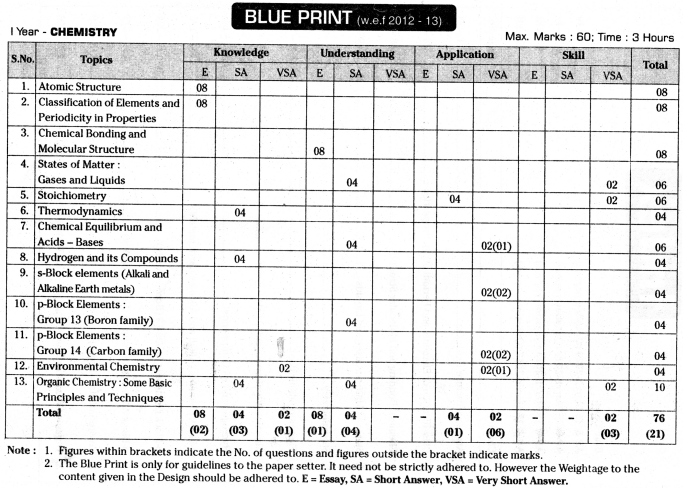
TS Inter 1st Year Chemistry Weightage Blue Print

Students can study the TS Intermediate 1st Year Chemistry Notes to improve their knowledge about all the important topics and concepts in their curriculum. By strictly following TS Inter 1st Year Chemistry Notes students can clear all their doubts and proceed with their preparation process for the exam.

TS Inter 1st Year Botany Notes Chapter 13 Ecological Adaptation, Succession and Ecological Services

Here students can locate TS Inter 1st Year Botany Notes 13th Lesson Histology and Anatomy of Flowering Plants to prepare for their exam.

TS Inter 1st Year Botany Notes 12th Lesson Histology and Anatomy of Flowering Plants

→ The essence of biological understanding is to know how organisms while remaining an individual interact with other organisms and physical habitats as a group and hence behave like organised wholes,
i. e., population, community, ecosystem or even as the whole biosphere.

→ Ramdeo Misra
Ramdeo Misra is revered as the Father of Ecology. His research laid the foundations for understanding of tropical communities and their succession, environmental responses of plant populations and productivity and nutrient cycling in tropical forest and grassland ecosystems.

→ Study of reciprocal relationship between plants and their environment is called ecology.

→ Father of Ecology in India is Ramdeo Misra.

→ Ecology is basically concerned with four levels of biological organisation- organisms, populations, communities and biomass.

→ Warming classified plant communities into xerophytes, mesophytes and hydrophytes.

→ Hydrophytes grow in water or very wet places. They are 5 types.
(a) Free floating hydrophytes
(b) Rooted hydrophytes with floating leaves
(c) Submerged suspended hydrophytes
(d) Submerged rooted hydrophytes
(e) Amphibious plants.

TS Inter 1st Year Botany Notes Chapter 12 Histology and Anatomy of Flowering Plants

→ Hydrophytes show morphological and anatomical adaptations depending upon the environment.

→ Xerophytes grow in habitats where water supply in deficient or soil is physiologically dry – They are 3 types.
(a) Ephemerals or drought evaders
(b) Succulents or drought avoiders
(c) True xerophytes or non succulents

→ Hydrophytes and Xerophytes have many ecological adaptations to suit their surroundings.

→ The gradual and fairly predictable change in the species composition of a given area is called ecological succession.

→ Succession that starts where no living organisms are found is called primary succession.

→ Succession that processes in an area where all the organisms lost that existed there is called secondary succession.

TS Inter 1st Year Botany Notes Chapter 11 Cell Cycle and Cell Division

Students can go through TS Inter 1st Year Botany Notes 11th Lesson Cell Cycle and Cell Division will help students in revising the entire concepts quickly.

TS Inter 1st Year Botany Notes 11th Lesson Cell Cycle and Cell Division

→ Cell division is a process by which a cell duplicates for growth and reproduction of an organism.

→ Virchow proposed that new cells arise from pre-existing cells by division. This is i called cell lineage theory.

→ Somatic cells divide by a process of mitosis while the germ cells divide by a process called meiosis (reduction division).

→ In mitosis daughter cells have exactly the same number of chromosomes of the parent cell.

→ Duplication of DNA molecules and doubling of chromosomal constituents are observed during S – phase of interphase.

TS Inter 1st Year Botany Notes Chapter 11 Cell Cycle and Cell Division

→ Mitosis includes karyokinesis and cytokinesis. Karyokinesis occurs in four stages.

→ During prophase nucleolus and nuclear membrane disappear. Chromatin condenses into chromosomes, each having two chromatids.

→ During metaphase, spindle fibres are formed. Spindle fibres attach to the centromere of chromosomes. Chromosomes move to the centre of the spindle.

→ In Anaphase centromere divides. Daughter chromosomes move to opposite poles.

→ In Telophase nucleolus and nuclear membrane reappear. Chromosomes J decondense into chromatin. Two daughter nuclei are formed.

→ Cytokinesis, is by cell plate method. Two daughter cells are formed.

→ In meiosis, karyokinesis and cytokinesis occur two times.

→ Meiosis I is a reductional division.

→ Prophase t is the longest stage and is divided into 5 stages.
(a) In leptotene, chromosomes become distinct being quite long and uncoiled.
(b) In zygotene, pairing of homologous chromosomes – synapsis occurs.
(c) In pachytene, exchange of genetic material (crossing over) occurs between non sister chromatids of the bivalent.
(d) In diplotene, repulsion starts between homologous. Chiasmata show terminalisation process.
(e) In diakinesis, nucleolus and nuclear membrane disappear.

→ In Metaphase I, the bivalénts come to be at the equator.

→ In Anaphase I, homologous..chromosomes separate. Each chromosome of a pair moves to opposite poles of the spindle.

TS Inter 1st Year Botany Notes Chapter 11 Cell Cycle and Cell Division

→ In Telophase I, reappearance of nuclide and nudear membrane results in the formation of two haploid nuclei.

→ The events of meiosis Il are similar to mitotic divisioñ. Thus it is an equational division. Four haploid cells are formed. Daughter cells produced are called gametes br spores.

→ Crossing over results in exchange of genetic information between individuals of spores and evolution of species.

TS Inter 1st Year Botany Notes Chapter 10 Biomolecules

Here students can locate TS Inter 1st Year Botany Notes 10th Lesson Biomolecules to prepare for their exam.

TS Inter 1st Year Botany Notes 10th Lesson Biomolecules

→ Even though there is a wide diversity in living organisms, all living organisms are made up of the same chemicals.

→ The elemental composition of living and non-living matter appears similar when analysed qualitatively.

→ Analysis reveals that the relative abundance of carbon and hydrogen with respect to other elements is higher in any living organism than in earth crust.

→ The most abundant chemical in living organism is water.

→All the carbon compounds that we get from living tissues can be called “biomolecules”.

→ He There are thousands of carbon compounds that we get from living tissues. They are called biomolecules.

→ Proteins, nucleic acids, polysaccharide’s are three types of macro molecules found in living systems.

TS Inter 1st Year Botany Notes Chapter 10 Biomolecules

→ Lipids are small molecular weight compounds and are present not only as such but also arranged into structures like cell membrane and other membrane.

→ Proteins are polypeptide and polymer of amino acids.

→ He Polysaccharides are long chains of sugar containing different monosaccharides as building blocks.

→ Nucleic acids are made of nucleotides.

→ Nucleotide has three components-heterocyclic compounds, monosaccharides and phosphoric acid.

→ He Biomolecules have hierarchy of structures-primary, secondary, teritiary and quaternary.

→ He All the chemical reactions that occur is called metabolism. The metabolic flow is called the dynamic state of body constituents.

→ The most important form of energy currency in living systems is the bo, .d energy in a chemical called adenosine triphosphate (ATP)

→ He Living process is a constant effort to prevent falling into equilibrium.

TS Inter 1st Year Botany Notes Chapter 9 Cell: The Unit of Life

Here students can locate TS Inter 1st Year Botany Notes 9th Lesson Cell: The Unit of Life to prepare for their exam.

TS Inter 1st Year Botany Notes 9th Lesson Cell: The Unit of Life

→ Cell theory laid emphasis on the unity underlying in the diverse forms, i.e., the cellular organisation of all life forms

→ The physico chemical approach to study and understand living organisms is called ‘Reductionist biology’.

→ G.N. Ramachandran

  • G.N. Ramachandran, an outstanding figure in the field of protein structure, was the founder of the Madras school of conformational analysis of biopolymers.
  • His discovery of the triple helical structure of collagen published in Nature in 1954 and his analysis of the allowed conformations of proteins through the use of the ‘Ramachandran plot’ rank among the most outstanding contributions in structural biology.

→ Cell is the basic unit of life in all living organisms.

→ Cytology is the study of structure and functions of cell and cell organelles.

→ Cell theory was proposed by Schleiden and Schwann and later by Rudolf Virchow.

→ Cells that have membrane bound nuclei are called eukaryotic cells.

→ In prokarytic cells genetic material is basically naked, not enveloped by a nuclear membrane.

→ Plasma membrane or cell membrane is lipoproteinaceous. Unit membrane (Sandwitch model) and Fluid mosaic models explain the structure and properties of plasma membrane.

→ Part of protoplasm except nucleus is called cytoplasm. It exhibits active movements. It shows cytoskeleton formed of microtubules and microfilaments.

TS Inter 1st Year Botany Notes Chapter 9 Cell: The Unit of Life

→ Plastids, mitochondria and ER are double membraned cell organelles. Lysosomes, dictyosomes, glyoxisomes and peroxisomes are single membraned. Ribosomes are amembranous.

→ Plastids are 2 types – Leucoplasts and Chromoplasts.

→ Chloroplasts are green plastids concerned with photosynthesis.

→ Mitochondria are also called ‘power houses of cell’. Cellular respiration occurs in these cell organelles.

→ Endoplasmic reticulum consists of tubules, vesicles and cisternae. It is concerned with protein and lipid synthesis. It is an intracellular transportation channel.

→ Ribosomes are nucleoprotein particles. They are sites of protein synthesis.

→ Golgi complex (dictyosomes) consist of cisternae, vacuoles and tubules. They help in synthesis of cell wall materials and formation of cell plate during cell division.

→ Lysosomes are single membrane bound organelles with enzymatic matrix. They help in intracellular digestion. They also cause autolysis of cell contents (suicidal bags of cells).

→ Peroxisomes are involved in photorespiration and oxidation of fatty acids. Glyoxysomes contain enzymes related to glyoxalate cycle.

→ Fluid filled sacs of cell having sap bound by tonoplast are called vacuoles. Vacuole acts as a ‘store house of cell’ or ‘repository of cell’. It helps in osmoregulatory processes of cell.

→ Nucleus Is dynamic centre of cell or cell brain. It plays an important role in heredity.

→ Chromosomes are composed of coils of DNA bound to basic proteins – histones.

TS Inter 1st Year Botany Notes Chapter 9 Cell: The Unit of Life

→ Choromatids are vertical halves of a chromosome attached to each other attached at centromere.

→ Basing on the position of centromere chromosomes are 4 types – metacentric, submetacentric, acrocentric and telocentric.

→ Chromosomes are physical basis of heredity.

TS Inter 1st Year Botany Notes Chapter 8 Taxonomy of Angiosperms

Here students can locate TS Inter 1st Year Botany Notes 8th Lesson Taxonomy of Angiosperms to prepare for their exam.

TS Inter 1st Year Botany Notes 8th Lesson Taxonomy of Angiosperms

→ Systematic Botany or Taxonorm deals with the identification nomenclature and classification of plants into related groups on the basis of information obtained from different fields of Botany.

→ Carl Linnaeus:

  • Carl Linnaeus is “Father of Taxonomy”.
  • He popularised the Binomial Nomenclature system and also proposed the sexual system of classification.
  • His system of classification was simple enough to allow most of the people to key out a plant.

→ Plant taxonomy deals with characterisation, identification, nomenclature and classification of plants.

→ Grouping of plants based on their structural similarities and their relationships refers classification of plants.

→ Taxonomy purely based on the description of morphological characteristics is called Alpha Taxonomy.

→ Taxonomy in which information from other branches of science is also considered is called Omega Taxonomy.

→ Carl Linnaeus is considered as Father of Taxonomy.

→ Reproductive characters related to flower are of more stable and form basis of classification.

→ Artificial systems of classification are based on one or few superficial characters.

→ Natural systems are based on many similarities and differences in the floral and other related morphological characters.

TS Inter 1st Year Botany Notes Chapter 8 Taxonomy of Angiosperms

→ Phylogenetic systems are based on evolutionary relationships of plants.

→ The latest phylogenetic classification is APG (Angiospermic Phylogenetic Group) system.

→ Numerical taxonomy uses mathematical methods to evaluate observable differences are similarities between taxonomic groups.

→ According to Bentham and Hooker classification, flowering plants are grouped into 202 natural orders now called as families.

→ The branch of taxonomy that uses the cytological characters like chromosome number, structure in solving taxonomic problems is Cytotaxonomy.

→ The branch of taxonomy that uses the phytochemical data to solve the problems of taxonomy is Chemotaxonomy.

→ Floral formula is represented by symbols of floral parts.

→ Floral diagram is the diagrammatic representation of floral parts and their arrangement.

→ In Fabaceae, the corolla is Papilionaceous corolla.

→ Pollination in Fabaeceae is entemophily and occurs by piston mechanism.

→ Biological nitrogen fixation is affected since root nodules of Fabaceae plants consist of symbiotic nitrogen fixing bacteria – Rhizobia.

→ The stems of Solanaceae plants consist of bicollateral vascular bundles.

TS Inter 1st Year Botany Notes Chapter 8 Taxonomy of Angiosperms

→ Gynoecium in Solanaceae plants is bicarpellary and syncarpous ovary is bilocular with numerous ovules on axile placentation on swollen placenta. Ovary is oblique.

→ Perianth in liliaceae is homochlamydeous (tepals) and trimerous.

TS Inter 1st Year Botany Notes Chapter 7 Sexual Reproduction in Flowering Plants

Here students can locate TS Inter 1st Year Botany Notes 7th Lesson Sexual Reproduction in Flowering Plants to prepare for their exam.

TS Inter 1st Year Botany Notes 7th Lesson Sexual Reproduction in Flowering Plants

→ The branch which deals with the study of flowers is called Floriculture.

→ The two most important units of sexual reproduction in a flower are Androecium and Gynoecium.

→ Embryology is the study of formation of gametes, fertilization and embryo development.

→ Each stamen has two parts filament and anther.

→ Each dithecous anther has four microsporangia whereas monothecous anther has two microsporangia.

→ Each microsporangium is generally surrounded by four wall layers – epidermis, endothecium, middle layers and tapetum.

→ The sporogenous cells of microsporangium produce microspore mother cells.

→ These cells produce tetrads of haploid microspores or pollen grains by meiosis.

TS Inter 1st Year Botany Notes Chapter 7 Sexual Reproduction in Flowering Plants

→ Microspore or pollen grain represents male gametophyte.

→ Pollen grain contains two cells

  • Vegetative cell
  • Generative cell.

→ Ovules are present in the ovary of gynoecium. Ovule is the megasporangium.

→ Ovule has integuments, nucellus, chalaza, stalk or funiculus and microphyle.

→ Orthotropous ovule – Micropyle, funiculus and chalaza are in the a straight line,

→ Anatropous ovule – Ovule inverted. Funiculus and micropyle lie side by side.

→ Campylotropous ovule – Body of the ovule is at right angles to the funicules.

→ One cell of the nucellus develops into megaspore mother cell.

→ Development of megaspore from megaspore mother cell is called megasporogenesis.

→ Megaspore mother cell produces 4 haploid megaspores by meiosis. Upper degenerate and lower one develops into embryo sac.

→ Embryosac represents female gametophyte. It is 7 celled and 8 nucleated.

→ The process of transfer of pollen grain from anther to stigma is called pollination, It is of two types.
(a) Self pollination : Pollen grains transferred to stigma of same flower,

(b) Cross pollination : Pollination between 2 flowers – 2 kinds.

  • Geitonogamy : Cross pollination between 2 flowers of same plant.
  • Xenogamy: Cross pollination between 2 flowers of different plants of same species.

→ Contrivances of cross pollination
(a) Dichogamy – Androecium and gynoecium of a bisexual flower mature at different timings.
(b) Herkogamy – Male and female parts of a bisexual flower arranged at different levels.
(c) Heterostyly – Presence of styles in different lengths in the flower of the same species.
(d) Self sterile – Pollen fail to germinate on the stigma of the same flower.
(e) Decliny – Flowers unisexual.

→ External agents that help in pollination i.e. transfer of pollen to the stigma are called ‘agents’.

→ Water and wind are abiotic agents.

→ Pollination that occurs through wind is called anaemophily. Eg : Rice.

TS Inter 1st Year Botany Notes Chapter 7 Sexual Reproduction in Flowering Plants

→ Pollination that occurs in hydrophytes with the help of water is called Hydrophily. – They are Epihydrophily & Hypohydrophily.

→ Pollination favoured by animals is called zoophily. Based on animals they are – Ornithophiiy, Chiropterophily, Entamophily, Malacophily.

→ The fusion of male and female gamete is called fertilisation.

→ Entry of pollen tube into the ovule is 3 types – They are

  • porogamy,
  • chalazogamy and
  • mesogamy.

→ Pollen tube reaches the embryosac only through micropylar end by destroying one of the synergids.

→ Pollen tube releases two male gametes.
(a) One male gamete (x) + egg (x) → Zygote (2x) – Syngamy.
(b) Second male gamete (x) + secondary nucleus (2x) → Primary endosperms jj nucleus (PEN) (3x) – Triple fusion.

→ As two fusion processes are occuring in angiousperms it is called – Double fertilisation.

→ All the floral parts except ovary wither and fail off.

→ Ovary forms fruit. Ovule forms seeds. Zygote develops into embryo. Integuments becomes seed coats.

→ Primary endosperm nucleus develops into nutritive tissue – Endosperm.

→ In some seeds some amount of nucellus is left out, it is called perisperm.

→ Many fruits have evolved mechanisms for seed dispersal.

→ Seeds without fertilisation is called Apomixis.

→ Fruits without fertilisation is called parthenocarpy.

→ Occurrence of more than one embryo in a seed is referred on polyembryony.

TS Inter 1st Year Botany Notes Chapter 4 Plant Kingdom

Here students can locate TS Inter 1st Year Botany Notes 4th Lesson Plant Kingdom to prepare for their exam.

TS Inter 1st Year Botany Notes 4th Lesson Plant Kingdom

→ Plant kingdom is divided into five groups : Algae, Bryopbytes, Reridophytes, Gymnosperms and Angiosperms.

→ Algae, Bryophytes, and Pteridophytes are non-flowering plants or Cryptogams. m Gymnosperms and Angiosperms are flowering plants or Phanerogams or Spermatophytes (seed-bearing plants).

→ Algae are simple, thalioid, autotrophic and aquatic plants.

→ Algae show vegetative, asexual and sexual methods of reproduction.

→ Algae are divided into three main Classes Chlorophyceae (Green algae)

→ Phaeophyceae (Brown algae) and Rhodophyceae (Red algae)

→ Bryophytes are primitive land plants.

→ Bryophytes are called amphibians of the plant kingdom because these plants live in moist soil and are dependent on water for sexual reproduction.

→ BryophytesInclude liverworts, hornworts and mosses.

TS Inter 1st Year Botany Notes Chapter 4 Plant Kingdom

→ In Bryophytes the plant body is thallus like and erect and attached to the substratum by unicellular or multicellular rhizoids.

→ The plant body in haploid and possesses root-like, leaf-like or stem-like structures. m The Bryophytes show haplontic type of life cycles.

→ The Pteridophytes are the first land plants having vascular bundles. m The Pteridophytes include club mosses, horsetails, ferns etc.

→ In Pteridophytes, the main plant body is a sporophyte which is differentiated into true roots, stem and leaves.

→ Gametophytes are small, inconspicuous, multicellular, photosynthetic thalioid called thallus.

→ Majority of plants are homosporous. Some plants like selaginella and salvinia are heterosporous.

→ The development of zygotes into young embryos takes place within the female gametophyte. This has led to the seed habit during the course of evolution.

→ The Gymnosperms are naked seeded plants.

→ Ginkgo is considered to be as living fossil.

→ The roots are generally tap roots – Mycorrhiza roots .(Pinus) and Coralloid roots (Cycas) are present.

→ Anatomically stem shows eustele.

→ The sporophylls (microsporophyll and megasporophyll) are arranged spirally on the axis to form male and female cones respectively.

→ Microspores are produced from microsporophyll.

→ Microspores develop into a male gametophytic generation which is highly reduced.

→ It is called pollen grain.

→ Megasporophyll with ovules are called megasporangiate (similar to female flower) Pollen grain germinates and the pollen tube releases male gamete in the ovule. Union of male gamete with female egg cell results in diploid zygote.

→ Zygote develops into embryo, and the ovules into seeds.

→ Angiosperms are embryophytic, non-archegoniate, vascular, fruit-bearing phanerogams or spermatophytes.

→ Angiosperms are large group of plants occurring in wide range of habitats. Angiosperms develop flowers. ‘

→ Male sex organs are called stamens and female sex organs are called pistil or the carpels.

TS Inter 1st Year Botany Notes Chapter 4 Plant Kingdom

→ Pollination is indirect in Angiosperms.

→ Pollen tube enters the embryo sac and discharges two male gametes. One male gamete unites with the egg resulting zygote. Other male gamete unites with the secondary nucleus to form primary endosperm nucleus. .

→ During the life cycle of any sexually reproducing plant, there is an alternation of generations between gametophyte and sporophyte.

→ Haplontic, diplontic or diplo-haplontic life cycles can be observed in different groups.