TS Inter 1st Year Maths 1A Functions Important Questions Long Answer Type

Students must practice these Maths 1A Important Questions TS Inter 1st Year Maths 1A Functions Important Questions Long Answer Type to help strengthen their preparations for exams.

TS Inter 1st Year Maths 1A Functions Important Questions Long Answer Type

Question 1.
If f : A → B, g : B → C are two bijective functions, then prove that gof : A → C is also a bijective function. [Mar. 18, 16 (AP), 09 ; May 13, 12, 10, 08, 06, 04 00, 96, 92]
Answer:
Since f: A →B is a bijective function
o f: A → B is both one-one and onto functions.
Since f: A → B is a one-one function
⇔ a1, a2 ∈ A, f(a1) = f(a2) ⇒ a1 = a2
Since f: A → B is a onto function ⇔ ∃ one element a ∈ A such that f(a) = b, ∀ b ∈ B.
Since g: B → C is a bijective function
⇔ g: B → C is both one-one and onto functions.
Since g: B → C is a one-one function
⇔ b1, b2 ∈ B, g (b1) = g (b2) ⇒ b1 = b2
Since g: B → C is an onto function ⇔ ∃ one element b e B such that g(b) = c, ∀ c ∈ C.
If f: A → B, g : B → C ⇒ gof: A → C.

To prove that gof: A → C is a one-one function:
If gof: A → C is a one-one function
⇔ a1, a2 ∈ A, (gof) (a1) = (gof) (a2) ⇒ a1 = a2
Now (gof) (a1) = (gof) (a2)
g [f(a1)] = g [ f(a2)] [∵ g is one-one]
f(a1) = f(a2) [∵ f is one-one]
a1 = a2
Hence, gof: A → C is a one-one function.

To prove that gof: A → C is an onto function:
Let c ∈ C
If gof: A → C is an onto function ⇔ ∃ one element a ∈ A, such that
(gof) (a) = c, ∀ c ∈ C.
Now (gof) (a) = g [f(a)] = g(b) = c
Thus for any element c ∈ C, there is an element a ∈ A such that (gof) (a) = c.
∴ gof: A → C is an onto function.
Since gof: A → C is both one-one function and onto function then
gof: A → C is a bijective function.

TS Inter First Year Maths 1A Functions Important Questions Long Answer Type

Question 2.
If f : A → B, g : B → C are two bijective functions, then prove that (gof)-1 = f-1og-1. [Mar. ’16 (TS), 14, 11, 10, 06, 04, 02, 00, 92; May 15 (AP) 14, 11, 09, 02, 98, 94 Mar. 19 (AP) ]
Answer:
Since f: A → B, g : B → C are bijections
⇒ gof: A → C is a bijection
⇒ (gof)-1: C → A is also a bijection
Since f: A → B is a bijective function
then f-1: B → A is also a bijective function
Since g: B → C is a bijective function
then g-1: C → B is also a bijective function
⇒ f-1og-1: C → A is also a bijection
Since the two functions (gof)-1, f-1og-1 are from C → A their domains are same.
Let c ∈ C
Since f : A → B is onto ⇔ ∃ one element
a ∈ A such that
f(a) = b, ∀ b ∈ B
f(a) = b ⇒ f-1 (b) = a
Since g : B → C is onto ⇔ ∃ one element be B such that g(b) = c, ∀ c ∈ C
g(b) = c ⇒ g-1(c) = b
Now (gof) (a) = g[f(a)] = g (b) = c ⇒ a = (gof)-1(c)
⇒ (gof)-1(c) = a ………………. (1)
Also (f-1og-1) (c) = f-1 [g-1(c)] = f-1(b) = a ……………… (2)
∴ From (1) and (2)
(gof)-1(c) = (f-1og-1) (c)
∴ (gof)-1 = f-1og-1.

Question 3.
Let f : A → B, is a function and IA, IB are identity functions on A and B respectively. Then prove that foIA = f = IBof. [Mar. 18 (TS); Mar. 13, 08, 05; May 92]
Answer:
If f: A → B is a function.
If IA and IB are identity functions on A and B respectively.
i.e., IA : A → B, IB : B → B

(i) IA: A → A, f: A → B ⇒ f o IA : A → B
Hence, functions f o IA and f are defined on same domain A.
Let a ∈ A
(f o IA) (a) = f[IA (a)] = f(a)
∴ f o IA = f

(ii) f: A → B, IB: B → B ⇒ IB o f: A → B
The functions (IB o f) and f are defined on the same domain A.
Let a ∈ A
Now (IB o f)(a) = IB[f(a)] = f(a)
∴ IB o f = f ………………. (2)
From (1) and (2) we get
f o IA = IB o f = f

Question 4.
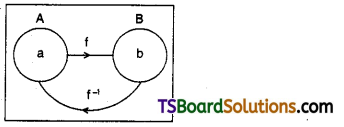
If f: A → B is a bijection, then prove that fof-1 = IB and f-1 o f = IA. [Mar. 17, 15 (AP); Mar. 12, 07, 03, 02; May 07, 05, 01 Mar. 19 (TS)]
Answer:
TS Inter First Year Maths 1A Functions Important Questions Long Answer Type 1

(i) Since f: A → B is a bijection ⇒ f-1: B → A is also a bijection
IA; f: A → B, f-1: B → A ⇒ f-1 o f: A → A is also bijection
Clearly IA: A → A such that IA(a) = a, ∀ a ∈ A
Let a ∈ A
Since f-1: B → A is onto function ⇔ ∃ one element b ∈ B,
such that
f-1(b) = a, ∀ a ∈ A
f-1 (b) = a ⇒ f(a) = b
Now (f-1of) (a) = f-1[f(a)] = f-1(b) = a = IA(a)
∴ f-1of = IA

TS Inter First Year Maths 1A Functions Important Questions Long Answer Type

(ii) Since f: A → B is a bijection ⇒ f-1: B → A is also bijection
IB: f-1:B → A, f: A → B = fof-1:B → B is also a bijection
Clearly IB: B → B such that IB(b) = b, ∀ b ∈ B
Let b ∈ B
Since f-1: B → A is an onto function ⇔ ∃
one element b ∈ B such that f-1(b) = a, ∀ a ∈ A
f-1(b) = a ⇒ f(a) = b
Now (fof-1) (b) = f[f-1(b)] = f(a) = b = IB(b)
∴ fof-1 = IB

Question 5.
If f:A → B, g:B → A are two functions such that gof = IA and fog = IB, then prove that f is a bijection and g = f-1. [May 15 (TS); Mar. 08, 01; May 03]
Answer:

TS Inter First Year Maths 1A Functions Important Questions Long Answer Type 2
(i) To prove that f is one-one
Let a1, a2 ∈ A and since f : A → B, f(a1), f(a2) ∈ B
Now f(a1) = f(a2 ) ⇒ g[f(a1)] = g[f(a2)]
⇒ (gof) (a1) = (gof) (a2)
⇒ IA(a1) = IA(a2)
∴ a1 = a2
∴ f is one-one

(ii) To prove that f is onto
Let b be an element of B
IB (b) = (fog) (b)
⇒ b = f[g(b)] ⇒ f(g(b)) = b
i.e., there exists a pre-image g(b) ∈ A for b, under the mapping f.
∴ f is onto
Thus ‘f’ is one-one and onto hence, f-1: B → A exists and is also one-one onto.

(iii) To prove g = f-1
Now g:B → A and f-1:B → A
Let a ∈ A and b be the f – image of a where b ∈ B
∴ f(a) = b ⇒ a = f-1 (b)
Now g(b) = g[f(a)] (gof) (a) = IAA(a) = a
⇒ a = f-1 (b)
∴ g = f-1

Question 6.
If f:A → B, g: B → C and h: C → D are three functions then prove that ho(gof) = (hog) of. That is composition of functions is associative. [May ‘99, ‘95]
Answer:
f:A → B, g:B → C, h:C → D be three functions.
f:A → B, and g:B → C = gof: A → C
Now gof: A → C and h:C → D ⇒ ho(gof): A → D
g:B → C and h:C → D = (hog):B → D
Now f: A → B ⇒ hog: B→D
(hog)of: A → D
Thus ho(gof) and (hog)of both exist and have the same domain A and co-domain D.
Let a ∈ A,
Hence ho(gof) = (hog) of ∈ A
Now [ho(gof)] (a) = h [(gof) (a)] = h[g(f(a))]
= (hog) [f(a)] = [(hog) of] (a)
∴ [ho(gof)] (a) = [(hog) of] (a)

TS Inter First Year Maths 1A Functions Important Questions Long Answer Type

Question 7.
If f: A → B, g: B → C be surjections, then show that gof: A → C is a surjection. [May 98, 97, 96, 94, 93, 91]
Answer:
Let c ∈ C
Since f: A → B is a onto ⇔ ∃ one element
a ∈ A such that f(a) = b,∀ b ∈ B
Since g: B → C is a onto ⇔ ∃ one element
b ∈ B such that g(b) = c, ∀ c ∈ C.
If f: A → B, g:B → C = gof: A → C
To prove that gof : A → C is a onto
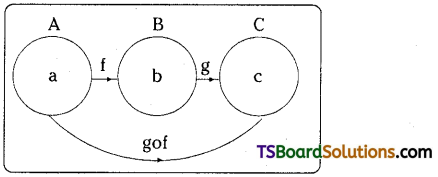
TS Inter First Year Maths 1A Functions Important Questions Long Answer Type 3
If gof : A → C is a onto ⇔ ∃ one element a ∈ A
such that
(gof) (a) = c, ∀ c ∈ C.
Now (gof) (a) = g[f(a)] = g(b) = c
Thus for any element c € C, there is an
element a ∈ A such that (gof) (a) = c.
∴ gof: A → C is an onto function.

Question 8.
If f = ((1, a), (2, c), (4, d), (3, b)} and g-1 = {(2, a), (4, b), (1, c), (3, d)}, then show that (gof)-1 = f-1og-1. {Mar. 15 (TS); May 07, 93}
Answer:
Given
f = {(1, a), (2, c), (4, d), (3, b))
f-1 = ((a, 1), (c, 2), (d, 4), (b, 3))
g = ((a, 2), (b, 4), (c, 1), (d, 3))
g-1 = {(2, a), (4, b), (1, c), (3, d)}

gof:
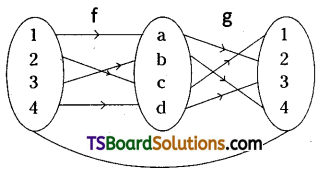
TS Inter First Year Maths 1A Functions Important Questions Long Answer Type 4

∴ gof = {(1, 2), (2, 1), (3, 4), (4, 3)}
(gof)-1 = {(2, 1), (1, 2), (4, 3), (3, 4)}
f-1og-1
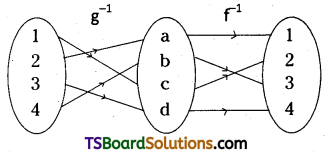
TS Inter First Year Maths 1A Functions Important Questions Long Answer Type 5
f-1og-1 = {(1, 2), (2, 1), (3, 4), (4, 3)}
∴ (gof)-1 = f-1og-1

TS Inter First Year Maths 1A Functions Important Questions Long Answer Type

Question 9.
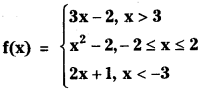
If the function f is defined by
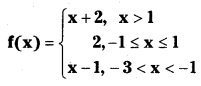
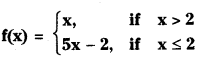
TS Inter First Year Maths 1A Functions Important Questions Long Answer Type 6
then find the values of
(i) f(3)
(ii) f(0)
(iii) f(-1.5)
(iv) f(2) + f(- 2)
(v) f(- 5).
Answer:
Given
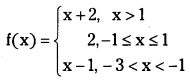
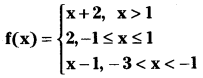
TS Inter First Year Maths 1A Functions Important Questions Long Answer Type 7
(i) For x > 1; f(x) = x + 2; f(3) = 3 + 2 = 5
(ii) For – 1 ≤ x ≤ 1; f(x) = 2, f(0) = 2
(iii) For – 3 < x < – 1; f(x) = x – 1 ∴ f(- 1.5) = – 1.5 – 1 = – 2.5 (iv) For x > 1, f(x) = x + 2
f(2) = 2 + 2 = 4
For – 3 < x < – 1, f(x) = x – 1
∴ f(- 2) = – 2 – 1 = – 3
f(2) + f(- 2) = 4 – 3 = 1
(v) f(- 5) is not defined.

Question 10.
If A = {- 2, – 1, 0, 1, 2) and f: A → B is a surjection defined by f(x) = x2 + x + 1 find B.
Answer:
Given, A = {- 2, – 1, 0, 1, 2)
f(x) = x2 + x + 1
Since f : A → B is a surjection then f(A) = B
f(-2) = (- 2)2 – 2 + 1 = 4 – 2 + 1 = 3
f(-1) = (- 1)2 – 1 + 1 = 1 – 1 + 1 = 1
f(0) = 02 + 0 + 1 = 1
f(1) = 12 + 1 + 1 = 1 + 1 + 1 = 3
f(2) = 22 + 2 + 1 = 4 + 2 + 1 = 7
∴ B = f(A) = {3. 1, 7}

Question 11.
If A = {1, 2, 3, 4} and f:A → R is a function defined by f(x) = \(\frac{x^2-x+1}{x+1}\), then find the range of f.
Answer:
Given A = {1, 2, 3, 4) and f(x) = \(\frac{x^2-x+1}{x+1}\)
Since f: A → R is a function, then
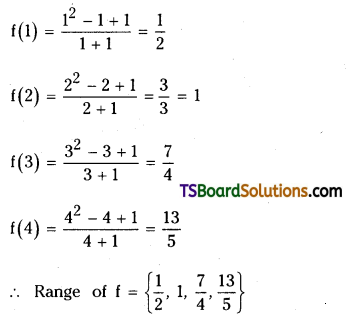
TS Inter First Year Maths 1A Functions Important Questions Long Answer Type 8

Question 12.
If f: Q → Q, is defined by f(x) = 5x + 4 for all x ∈ Q, find f-1. [Mar. 17 (TS)]
Answer:
Let y = f(x) = 5x + 4
y = f(x) ⇒ x = f-1(y) ……………… (1)
y = 5x + 4 ⇒ y – 4 = 5x
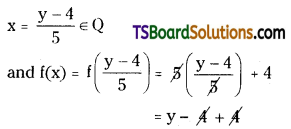
x = \(\frac{y-4}{5}\) ………………… (2)
From (1) and (2),
f-1(y) = \(\frac{y-4}{5}\) ⇒ f(x) = \(\frac{x-4}{5}\), ∀ x ∈ Q

TS Inter First Year Maths 1A Functions Important Questions Long Answer Type

Question 13.
If f(x) = \(\frac{x+1}{x-1}\) (x ≠ ± 1), then find (fofofof) (x).
Answer:
Given f(x) = \(\frac{x+1}{x-1}\) (x ≠ ± 1)
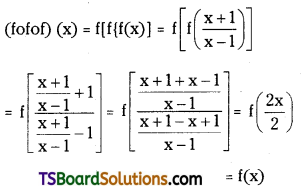
Now (fofofof) (x) = f[f[f{f(x)}]]
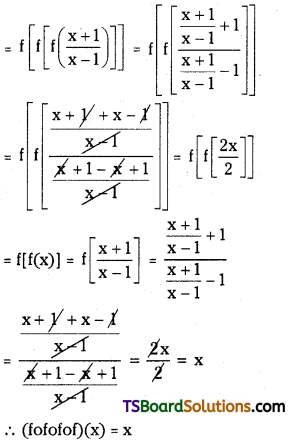
TS Inter First Year Maths 1A Functions Important Questions Long Answer Type 9

Question 14.
Find the domain of the real valued function f(x) = \(\sqrt{16-x^2}\).
Answer:
Given f(x) = \(\sqrt{16-x^2}\) ∈ R
⇒ 16 – x2 ≥ 0
⇒ x2 – 16 ≤ 0
⇒ (x + 4) (x – 4) ≤ 4
⇒ x ∈ [- 4, 4]
∴ Domain of ‘f’ is [- 4, 4]

Question 15.
Find the domain of the real valued function f(x) = \(\sqrt{9-x^2}\).
Answer:
Given f(x) = \(\sqrt{9-x^2}\) ∈ R
⇒ 9 – x2 ≥ 0
⇒ x2 – 9 ≤ 0
⇒ (x + 3) (x – 3) ≤ 0
⇒ x ∈ [- 3 ,3]
∴ Domain of f’ is [- 3, 3]

Question 16.
Find the domain of the real valued function f(x) = \(\frac{1}{6 x-x^2-5}\).
Answer:
Given f(x) = \(\frac{1}{6 x-x^2-5}\) ∈ R
⇒ 6x – x2 – 5 ≠ 0
⇒ x2 – 6x + 5 ≠ 0
⇒ x2 – 5x – x + 5 ≠ 0
⇒ x(x – 5) – 1 (x – 5) ≠ 0
⇒ x – 1 ≠ 0 or x – 5 ≠ 0
⇒ x ≠ 1 or x ≠ 5
∴ x ≠ 1, 5
∴ Domain of ‘f’ is R – {1, 5}

Question 17.
Find the domain of the real valued function f(x) = \(\frac{2 x^2-5 x+7}{(x-1)(x-2)(x-3)}\).
Answer:
Given f(x) = \(\frac{2 x^2-5 x+7}{(x-1)(x-2)(x-3)}\) ∈ R
⇒ (x – 1) (x – 2) (x – 3) ≠ 0
⇒ x – 1 ≠ 0, x – 2 ≠ 0, x – 3 ≠ 0
⇒ x ≠ 1, x ≠ 2, x ≠ 3
∴ x ≠ 1, 2, 3
∴ Domain of ‘f’ is R – {1, 2, 3}

TS Inter First Year Maths 1A Functions Important Questions Long Answer Type

Question 18.
Find the domain of the real valued function f(x) = \(\frac{\sqrt{2+x}+\sqrt{2-x}}{x}\).
Answer:
Given f(x) = \(\frac{\sqrt{2+x}+\sqrt{2-x}}{x}\) ∈ R
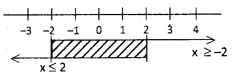
TS Inter First Year Maths 1A Functions Important Questions Long Answer Type 10
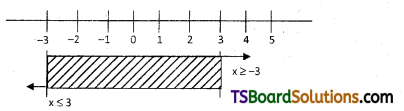
⇒ 2 + x ≥ 0, 2 – x ≥ 0 and x ≠ 0
x ≥ – 2, 2 ≥ x and x ≠ 0
x ≤ 2 and x ≠ 0
⇒ x ∈ [- 2, 0) ∪ (0, 2]
∴ Domain of ‘f’ is [- 2, 0) ∪ (0, 2]

Question 19.
If f = {(1, 2), (2, – 3), (3, – 1)}, then find
(i) 2f
(ii) 2 + f
(iii) f2
(iv) √f
Answer:
Given f = {(1, 2), (2, – 3), (3, – 2)}
Domain of ‘f’ is A = {1, 2, 3}
f(1) = 2f(2) = – 3, f(3) = – 1

(i) (2f) (x) = 2f(x)
(2f) (1) = 2f(1) = 2(2) = 4
(2f) (2) = 2f(2) = 2(- 3) = – 6
(2f) (3) = 2f(3) = 2(- 1) = – 2
∴ 2f = {(1, 4), (2, – 6),(3, – 2)}

(ii) (2 + f) (x) = 2 + f(x)
(2 + f) (1) = 2 + f(1) = 2 + 2 = 4
(2 + f) (2) = 2 + f(2) = 2 – 3 = – 1
(2 + f) (3) = 2 + f(3) = 2 – 1 = 1
∴ 2 + f = {(1, 4), (2, – 1), (3, 1)}

(iii) (f2) (x) = [f(x)]2
(f2) (1) = [f(1)]2 = 22 = 4
(f2) (2) = [f(2)]2 = (- 3)2 = 9
(f2) (3) = (f(3)]2 = (- 1)2 = 1
∴ f2 = {(1, 4), (2, 9), (3, 1)}

(iv) (√f)(x) = √f(x)
(√f) (1) = √f(1) = √2
(√f) (2) = √f(2) = √- 3 (not valid)
(√f) (3) = √f(3) = √- 1 (not valid)
∴ √f = {(1, √2)}

Some More Maths 1A Functions Important Questions

Question 1.
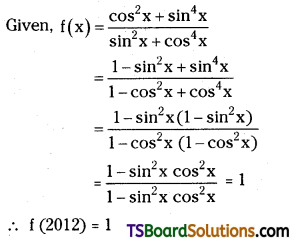
If f(x) = \(\frac{\cos ^2 x+\sin ^4 x}{\sin ^2 x+\cos ^4 x}\), ∀ x ∈ R then show that f(2012) = 1.
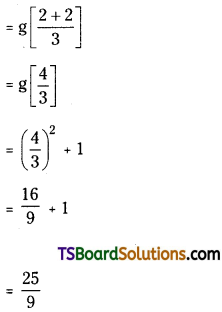
Answer:
TS Inter First Year Maths 1A Functions Important Questions Long Answer Type 11

Question 2.
If f: R → R is defined by f(x) = \(\frac{1-x^2}{1+x^2}\), then show that f(tan θ) = cos 2θ.
Answer:
Given f: R → R, f(x) = \(\frac{1-x^2}{1+x^2}\)
LHS = f(tan θ)
= \(\frac{1-\tan ^2 \theta}{1+\tan ^2 \theta}\) = cos 2θ + RHS
∴ f(tan θ) = cos 2θ

TS Inter First Year Maths 1A Functions Important Questions Long Answer Type

Question 3.
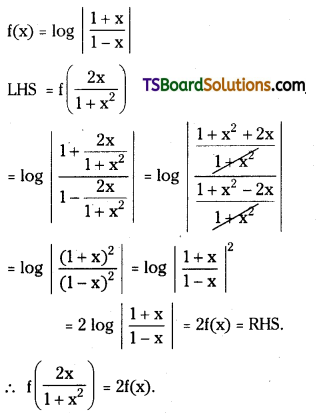
If f: R – {±1} → R is defined by f(x) = log \(\left|\frac{1+x}{1-x}\right|\), then show that f(\(\left(\frac{2 x}{1+x^2}\right)\)) = 2f(x)
Answer:
Given f: R – {±1} → R
TS Inter First Year Maths 1A Functions Important Questions Long Answer Type 12

Question 4.
If A = {x/ – 1 ≤ x ≤ 1}, f(x) = x2, g(x) = x3 which of the following are surjections?
(i) f : A → A
(ii) g: A → A
Answer:
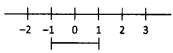
(i) Given A = {x/ – 1 ≤ x ≤ 1}
∴ A = {- 1, 0, 1}
f(x) = x2
f(- 1) = (- 1)2 = 1
f(0) = (0)2 = 0
f(1) = (1)2 = 1
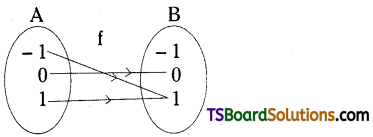
∴ f = (- 1, 1), (0 , 0), (1, 1))

f: A → A
TS Inter First Year Maths 1A Functions Important Questions Long Answer Type 13
Range of f(A) = {0, 1) ≠ A (co-domain)
∴ f : A → A is not a surjection.

(ii) Given A = {x/ – 1 ≤ x ≤ 1}
∴ A = {- 1, 0, 1}
g(x) = x3
g(- 1) = (- 1)3 = – 1
g(0) = (0)3 = 0
g(1) = (1)3 = 1
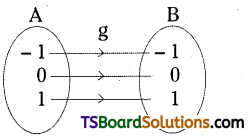
∴ g = {(- 1, -1), (0, 0), (1, 1)}
g: A → A
TS Inter First Year Maths 1A Functions Important Questions Long Answer Type 14
Range of g(A) = {- 1, 0, 1} = A (co-domain)
∴ g is a surjection.

TS Inter First Year Maths 1A Functions Important Questions Long Answer Type

Question 5.
If f(x) = cos (log x) then show that
\(f\left(\frac{1}{x}\right) \cdot f\left(\frac{1}{y}\right)-\frac{1}{2}\left[f\left(\frac{x}{y}\right)+f(x y)\right]\) = 0
Answer:
Given f(x) = cos (log x)
f\(\left(\frac{1}{x}\right)\) = cos\(\left(\log \frac{1}{x}\right)\) = cos (log x-1)
= cos (- log x) = cos (log x)
Similarly f\(\left(\frac{1}{y}\right)\) = cos (log y)
f\(\left(\frac{x}{y}\right)\) = cos \(\left(\log \left(\frac{x}{y}\right)\right)\)
= cos (log x – log y)
f(xy) = cos (log xy)
= cos (log x + log y)
L.H.S: f\(\left(\frac{1}{x}\right) \cdot f\left(\frac{1}{y}\right)-\frac{1}{2}\left(f\left(\frac{x}{y}\right)+f(x y)\right)\)
= cos (log x) . cos (log y) – \(\frac{1}{2}\) [cos (log x – log y) + cos (log x + log y)]
= cos (log x) . cos (log y)
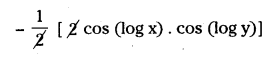
TS Inter First Year Maths 1A Functions Important Questions Long Answer Type 15
= cos (log x) . cos (log y) – cos (log x) . cos (log y) = 0
= R.H.S

Question 6.
Find the inverse function of f(x) = log2x.
Answer:
Given f: (0, ∝) → R, f(x) = log2x
Let y = f(x) = log2x
y = f(x) = x = f-1(y) ……………. (1)
y = log2x ⇒ x = 2y (2)
From (1) & (2)
f-1(y) = 2y
⇒ f-1(x) = 2x

Question 7.
If f(x) = 1 + x + x2 +…….. for |x| < 1, then show that f-1(x) = \(\frac{\mathbf{x}-1}{\mathbf{x}}\).
Answer:
Given that f(x) = 1 + x + x2 + ………….
f(x) = \(\frac{1}{1-\mathrm{x}}\)
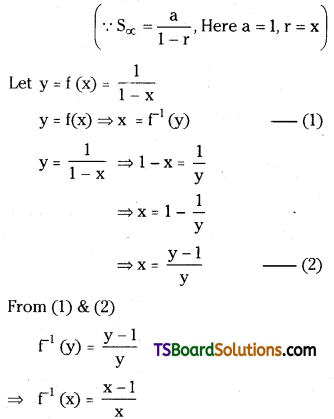
TS Inter First Year Maths 1A Functions Important Questions Long Answer Type 16

Question 8.
Find the domain of the real valued function f(x) = \(\frac{1}{\sqrt{\mathbf{x}^2-a^2}}\) (a >0). [Mar.15 (AP)]
Answer:
Given f(x) = \(\frac{1}{\sqrt{x^2-a^2}}\) ∈ R
⇒ x2 – a2
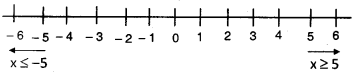
⇒ (x + a) (x – a) > 0
⇒ x < – a or x > a
⇒ x ∈ (- ∝, – a) ∪ (a, ∝)
∴ Domain of f’ is (- ∝, – a) ∪ (a, ∝)

TS Inter First Year Maths 1A Functions Important Questions Long Answer Type

Question 9.
Find the domain of the real valued function f(x) = \(\sqrt{(\mathbf{x}-\alpha)(\beta-\mathbf{x})}\) (0 < α < β).
Answer:
Given f(x) = \(\sqrt{(\mathbf{x}-\alpha)(\beta-\mathbf{x})}\) ∈ R
⇒ (x – α) (x – β) ≥ 0
⇒ (x – α) (x – β) ≤ 0
⇒ α ≤ x ≤ β
⇒ x ∈ [α, β]
∴ Domain of ‘f’ is [α, β]

Question 10.
Find the domain of the real valued function f(x) = \(\sqrt{2-x}+\sqrt{1+x}\).
Answer:
Given f(x) = \(\sqrt{2-x}+\sqrt{1+x}\) ∈ R
⇒ 2 – x ≥ 0 and 1 + x ≥ 0
⇒ 2 ≥ x and x ≥ – 1
⇒ x ≤ 2 and x ≥ – 1
⇒ x ∈ [- 1, 2]
∴ Domain of ‘f’ is [-1, 2]
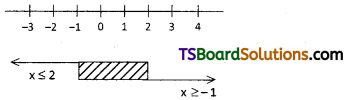
TS Inter First Year Maths 1A Functions Important Questions Long Answer Type 17

Question 11.
Find the domain of the real valued function f(x) = \(\sqrt{|\mathbf{x}|-\mathbf{x}}\)
Answer:
Given f(x) = \(\sqrt{|\mathbf{x}|-\mathbf{x}}\) ∈ R
⇒ |x| – x ≥ 0
⇒ |x| ≥ x
⇒ x ∈ R
∴ Domain of ‘f’ is ‘R.

Question 12.
Find the domain and range of the real valued function f(x) = \(\frac{2+x}{2-x}\)
Answer:
Given f(x) = \(\frac{2+x}{2-x}\) ∈ R
⇒ 2 – x ≠ 0 ⇒ x ≠ 2
Domain of T is R – { 2 }.
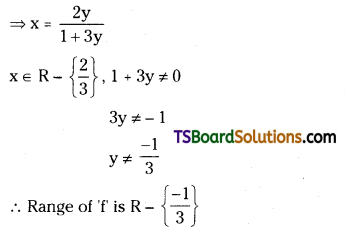
Let y = f(x) = \(\frac{2+x}{2-x}\)
y = \(\frac{2+x}{2-x}\)
2yx – xy = 2 + x
2y – 2 = x + xy
2y – 2 = x(1 + y)
x ∈ R – {2}, y + 1 ≠ 0
y ≠ – 1
∴ Range of ‘f’ is R – {- 1}.

Question 13.
Find the domain and range of the real valued function f(x) = \(\sqrt{9-x^2}\) [Mar. 15 (TS)]
Answer:
Given f(x) = \(\sqrt{9-x^2}\) ∈ R
⇒ 9 – x2 ≥ 0
⇒ x2 – 9 ≤ 0
⇒ (x + 3) (x -3) ≤ 0
⇒ x ∈ [- 3, 3]
∴ Domain of ‘f’ is [- 3, 3]
Let y = f(x) = \(\sqrt{9-x^2}\)
y = \(\sqrt{9-x^2}\)
y2 = 9 – x2
x2 = 9 – y2
x = \(\sqrt{9-y^2}\) ∈ R
⇒ 9 – y2 ≥ 0
⇒ y2 – 9 ≤ 0
⇒ (y + 3) (y – 3) ≤ 0
⇒ y ∈ [- 3, 3]
But f(x) attains only non-negative values.
∴ Range of f = [0, 3].

TS Inter First Year Maths 1A Functions Important Questions Long Answer Type

Question 14.
Determine whether the function f(x) = x\(\left(\frac{e^x-1}{e^x+1}\right)\) is even or odd.
Answer:
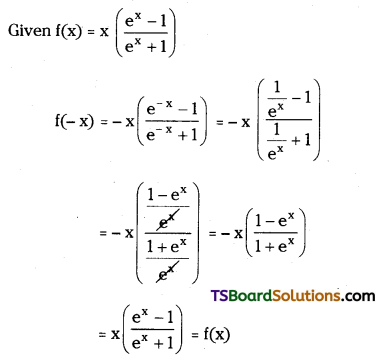
TS Inter First Year Maths 1A Functions Important Questions Long Answer Type 18
Since f(- x) = f(x) then f is an even function.

Question 15.
Determine whether the function f(x) = log(x + \(\sqrt{x^2+1}\)) is even or odd.
Answer:
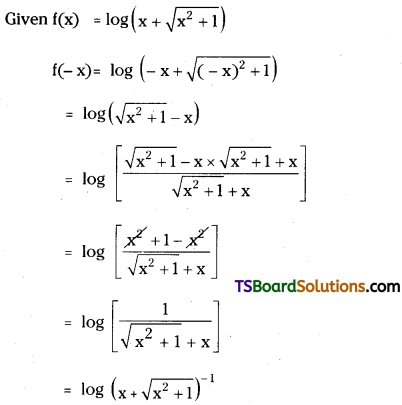
TS Inter First Year Maths 1A Functions Important Questions Long Answer Type 19
Since f(- x) = – f(x) then f(x) is an odd function.

Question 16.
Find the domain of the real valued function f(x) = log [x – (x)].
Answer:
Given f(x) = log [x – (x)] ∈ R
⇒ x – (x)> 0
⇒ x > (x)
Then x is a non – integer.
∴ Domain of ‘f’ is R – Z.

Question 17.
Find the domain of the real valued function f(x) = \(\frac{1}{\log (2-x)}\).
Answer:
Given f(x) = \(\frac{1}{\log (2-x)}\) ∈ R
⇒ log (2 – x) ≠ 0 and 2 – x > 0
⇒ log (2 – x) ≠ log 1 and 2 > x
⇒ 2 – x ≠ 1 and x < 2
⇒ x ≠ 1
∴ Domain of ‘f’ is (- ∝, 1) ∪ (1, 2)

Question 18.
Find the domain of the real valued function f(x) = \(\sqrt{\mathbf{x}-[\mathbf{x}]}\).
Answer:
Given f(x) = \(\sqrt{\mathbf{x}-[\mathbf{x}]}\) ∈ R
⇒ [x] – x ≥ 0 ⇒ x ≥ [x] ⇒ x ∈ R
∴ Domain of ’f is Z.

TS Inter First Year Maths 1A Functions Important Questions Long Answer Type

Question 19.
Find the domain of the real valued function f(x) = \(\sqrt{[\mathbf{x}]-\mathbf{x}}\).
Answer:
Given f(x) = \(\sqrt{[\mathbf{x}]-\mathbf{x}}\) ∈ R
⇒ [x] – x ≥ 0 ⇒ [x] ≥ x ⇒ x ∈ Z
∴ Domain of ‘f’ is Z.

Question 20.
If f and g are real valued functions defined by f(x) = 2x – 1 and g(x) = x2 then find
(i) (3f – 2g)(x)
(ii) (fg) (x)
(iii) \(\left(\frac{\sqrt{f}}{g}\right)\)(x)
(iv) (f + g + 2) (x)
Answer:
Given f(x) = 2x – 1 and g(x) = x2
Domain of f = domain of g R
Hence the domain of all the functions is R.
(i) (3f – 2g) (x) = 3f(x) – 2g(x)
= 3(2x – 1) – 2(x2)
= 6x – 3 – 2x2
= – 2x2 + 6x – 3

(ii) (fg)(x) f(x) . g(x)
= (2x – 1)(x2) = 2x3 – x2.

(iii) \(\left(\frac{\sqrt{f}}{g}\right)\) (x) = \(\frac{\sqrt{f(x)}}{g(x)}\) = \(\frac{\sqrt{2 x-1}}{x^2}\)

(iv) (f + g + 2) (x) = f(x) .g(x) + 2
= 2x – 1 + x2 + 2
= x2 + 2x + 1 = (x + 1)2

Question 21.
Find the domain of the real valued function f(x) = \(\sqrt{x^2-3 x+2}\).
Answer:
Given f(x)= \(\sqrt{x^2-3 x+2}\) ∈ R
⇒ x2 – 3x + 2 ≥ 0
⇒ x2 – 2x – x + 2 ≥ 0
⇒ x(x – 2) – 1(x – 2) ≥ 0
⇒ (x – 1) (x – 2) ≥ 0
⇒ x ≤ 1 or x ≥ 2
⇒ x ∈ (- ∝, 1] ∪ [2, ∝)
∴ Domain of ‘f’ is (- ∝, 1] ∪ [2, ∝)

Question 22.
f:R → R defined by f(x) = \(\frac{2 x+1}{3}\), then this function Is injection or not ? Justify. (Mar. 15 (TS)
Answer:
Given that f(x) = \(\frac{2 x+1}{3}\)
Let x1, x2 ∈ R.
Take f(x1) = f(x2) ⇒ \(\frac{2 x_1+1}{3}=\frac{2 x_2+1}{3}\)
⇒ 2x1 + 1 = 2x2 + 1 ⇒ 2x1 = 2x2 = x1 = x2
∴ f(x1) = f(x2) ⇒ x1 = x2
⇒ f is one – one.

TS Inter First Year Maths 1A Functions Important Questions Long Answer Type

Question 23.
If f = {(4, 5), (5, 6),(6, – 4)} and g = ((4, – 4), (6, 5), (8, 5)) then find f + g and fg. [Mar. ‘17(TS)]
Answer:
Given f = {(4, 5), (5, 6), (6, – 4)} and
g = {(4, – 4), (6, 5), (8, 5’)) then domain of f = {4, 5, 6) and Range of f = {4, 6, 8}
Domain of f + g = A ∩ B = {4, 6}
= (domain of f) ∩ (domain of g)
(i) f.g={(4, 5, – 4), (6, – 4 + 5)}
= {(4, 1), (6, 1)}

(ii) Domain of fg = (domain of f) ∩ (domain of g)
= A ∩ B = (4, 6)
= {(4, 5 × – 4).(6, – 4 × 5)}.
= {(4, – 20), (6, – 20)}

Question 24.
If f(x) = 2x – 1, g(x) = \(\frac{x+1}{2}\) for all x ∈ R, are two functions, then find,
(i) (gof) (x)
(ii) (fog) (x) [Mar. 19(TS)]
Answer:
Given f(x) = 2x – 1, g(x) = \(\frac{x+1}{2}\)

(i) (gof) (x) = g[ f(x) ]
= g[2x – 1] = \(\frac{2 x-1+1}{2}\) = \(\frac{2 x}{2}\) = x

(ii) (fog) (x) = f [g(x)]
= \(f\left(\frac{x+1}{2}\right)\) = 2\(\left(\frac{\mathrm{x}+1}{2}\right)\) – 1 = x + 1 – 1 = x
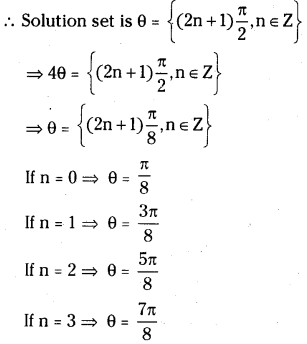
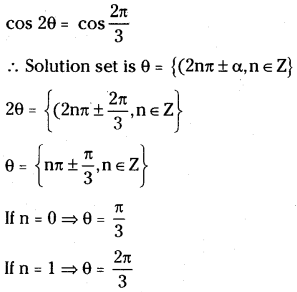
TS Inter 1st Year Maths 1A Trigonometric Equations Important Questions

Students must practice these Maths 1A Important Questions TS Inter 1st Year Maths 1A Trigonometric Equations Important Questions to help strengthen their preparations for exams.

TS Inter 1st Year Maths 1A Trigonometric Equations Important Questions

Question 1.
Solve 2 cos2θ – √3 sin θ + 1 = 0. [May ’09; B.P]
Answer:
Given equation is 2 cos2 θ – √3 sin θ + 1 = 0
⇒ 2(1 – sin2 θ) – √3 sin θ + 1 = 0
⇒ 2 – 2sin2 θ – √3 sin θ + 1=0
⇒ 2 sin2 θ + √3 sin θ – 3 = 0
⇒ 2 sin2 θ + 2 √3 sin θ – √3 sin θ – 3 = 0
⇒ 2 sin θ (sin θ + √3 ) – + √3 (sin θ + √3 ) = 0
⇒ (sin θ + √3)- (2 sin θ – √3) = 0
⇒ sin θ + √3 = 0 (or) 2 sin θ – √3 = 0
⇒ sin 0θ = – J3 (or) sin θ = \(\frac{\sqrt{3}}{2}\)

Case -1: sin θ = -√3 ∉ [- 1, 1 ]
∴ There is no solution set.

Case – II : sin θ = \(\frac{\sqrt{3}}{2}\) ⇒ sin θ = sin \(\)
∴ Solution set is θ = {nπ + (-1)n α, n ∈ Z} ⇒
θ = {nπ + (-1)n\(\frac{\pi}{3}\) α, n ∈ Z}
∴ The solution of the given equation is
θ = {nπ + (-1)n\(\frac{\pi}{3}\) α, n ∈ Z}

Question 2.
Find all values of x ≠ 0 in (-π, π) satisfying the equation 81+cosx+cos2x+…………….. = 43. [Mar. ’09]
Answer:
Given 81+cosx+cos2x+…………….. = 43
8\(\frac{1}{1-\cos x}\) = 43 [∵ s = \(\frac{a}{1-r}\)]
(23)\(\frac{1}{1-\cos x}\) = 26
2\(\frac{1}{1-\cos x}\) = 26
\(\frac{1}{1-\cos x}\) = 6
1 – cos x = \(\frac{1}{2}\)
⇒ cos x = \(\frac{1}{2}\)
⇒ x = ±\(\frac{\pi}{3}\)
∴ x = \(\frac{\pi}{3}\) (or) –\(\frac{\pi}{3}\) [∵x ∈ (-π, π)]

TS Inter First Year Maths 1A Trigonometric Equations Important Questions

Question 3.
Solve tan θ + 3 cot θ = 5 sec θ. [Mar. ’02; May ’99, ’84]
Answer:
Given tan θ + 3 cot θ = 5 sec θ
⇒ \(\frac{\sin \theta}{\cos \theta}+3 \cdot \frac{\cos \theta}{\sin \theta}=\frac{5}{\cos \theta}\)
⇒ \(\frac{\sin ^2 \theta+3 \cos ^2 \theta}{\cos \theta \cdot \sin \theta}=\frac{5}{\cos \theta}\)
⇒ sin2 θ + 3 cos2θ = 5 sin θ
⇒ sin2 θ + 3 (1 – sin2θ) = 5 sin θ
⇒ sin2 θ + 3 – 3 sin2θ = 5 sin θ
⇒ 2 sin2θ + 5 sin θ – 3 = 0
⇒ 2 sin2θ + 6 sin θ – sin θ – 3 = 0
⇒ 2 sin θ(sin θ + 3) – 1 (sin θ + 3) = 0
⇒ (sin θ + 3) (2 sin θ – 1) = 0
⇒ sin θ + 3 = 0 (or) 2 sin θ – 1 = 0
⇒ sin θ = -3 (or) sin θ = \(\frac{1}{2}\)

Case – I: sin θ = -3 ∈ [-1, 1]
There is no solution set.

Case – II: sin θ = \(\frac{1}{2}\)
⇒ sin θ = sin \(\frac{\pi}{6}\)
∴ Solution set is θ = {nπ + (-1)n α, n ∈ Z}
⇒ θ = {nπ + (-1)n \(\frac{\pi}{6}\), n ∈ Z}

∴ The solution set of the given equation is
θ = {nπ + (-1)n \(\frac{\pi}{6}\), n ∈ Z}

Question 4.
Solve 1 + sin2θ = 3sin θ. cos θ. [Mar.(AP & TS) ’17, ’11; May ’00]
Answer:
Given 1 + sin2θ = 3sin θ. cos θ
On dividing both sides with cos2θ, we get
⇒ \(\frac{1}{\cos ^2 \theta}+\frac{\sin ^2 \theta}{\cos ^2 \theta}=\frac{3 \sin \theta \cos \theta}{\cos ^2 \theta}\)
⇒ sec2θ + tan2θ = 3 tanθ
⇒ 1 + tan2θ + tan2θ = 3 tan θ
⇒ 2 tan2θ – 3 tan θ + 1 = 0
⇒ 2 tan2θ – 2 tan θ – tan θ + 1 = 0
⇒ 2 tan θ (tan θ – 1) – l(tan θ – 1) = 0
⇒ (tan θ – 1) (2 tan θ – 1) = 0
⇒ tan θ – 1=0 (or) 2 tan θ – 1 = 0
⇒ tan θ = 1 (or) 2 tan θ = \(\frac{1}{2}\)

Case – I: tan θ = 1 ⇒ tan θ = tan \(\frac{\pi}{4}\)
∴ Solution set is θ = {nπ + α, n ∈ Z}
⇒ θ = {nπ + \(\frac{\pi}{4}\), n ∈ z}

Case – II: tan θ = 1 ⇒ tan θ = 0.5
⇒ tan θ = tan 26°. 34′
Solution set is θ =
⇒ θ = {nπ + 26°.34′, n ∈ Z)
∴ The solution set of the given equation is
θ = {nπ + \(\frac{\pi}{4}\), n ∈ z} ∪ {nπ + 26°.34′, n ∈ Z}

Question 5.
Solve √2(sin x + cos x) = √3. [Mar. ’16(AP), Mar. 15(AP); May ’12, ’08]
Answer:
Given equation is √2(sin x + cos x) = √3
⇒ sin x + cos x = \(\frac{\sqrt{3}}{\sqrt{2}}\)
On dividing Both sides with \(\sqrt{a^2+b^2}\)
= \(\sqrt{1^2+1^2}\) = , we get
⇒ \(\frac{1}{\sqrt{2}}\)sin x + \(\frac{1}{\sqrt{2}}\)cos x = \(\frac{1}{\sqrt{2}}\)
⇒ cos x.cos\(\frac{\pi}{4}\) + sin x sin\(\frac{\pi}{4}=\frac{\sqrt{3}}{2}\)
⇒ cos(x – \(\frac{\pi}{4}\)) = cos\(\frac{\pi}{6}\)

∴ Solution set is θ = {2nπ ± α, n ∈ Z}
⇒ x – \(\frac{\pi}{4}\) = {2nπ + \(\frac{\pi}{6}\), n ∈ Z}

Case – I: x – \(\frac{\pi}{4}\) = 2nπ + \(\frac{\pi}{6}\), n ∈ Z
x = 2nπ + \(\frac{\pi}{6}\) + \(\frac{\pi}{4}\)
x = 2nπ + \(\frac{5\pi}{12}\)
x = {(24n + 5)\(\frac{\pi}{12}\)}, n ∈ Z

Case – II: x – \(\frac{\pi}{4}\) = 2nπ – \(\frac{\pi}{6}\), n ∈ Z
x = 2nπ – \(\frac{\pi}{6}\) + \(\frac{\pi}{4}\)
x = 2nπ + \(\frac{\pi}{12}\)
x = {(24n + 1)\(\frac{\pi}{12}\)}, n ∈ Z

∴ The solution set of the given equation is
x = {(24n + 5)\(\frac{\pi}{12}\)} ∪ {(24n + 1)\(\frac{\pi}{12}\)}, n ∈ Z

TS Inter First Year Maths 1A Trigonometric Equations Important Questions

Question 6.
If θ1, θ2 are solutions of the equation a cos 2θ + b sin 2θ = c, tan θ1 ≠ tan θ2 and a + c ≠ 0, then find the values of
(i) tan θ1 + tan θ2
(ii) tan θ1. tan θ2.
Answer:
Given equation is a cos 2θ + b sin 2θ = c
⇒ a\(\left[\frac{1-\tan ^2 \theta}{1+\tan ^2 \theta}\right]\) + b\(\left[\frac{2 \tan \theta}{1+\tan ^2 \theta}\right]\) = c
⇒ \(\frac{\mathrm{a}-\mathrm{a} \tan ^2 \theta+2 b \tan \theta}{1+\tan ^2 \theta}\) = c
⇒ a – a tan2θ + 2b tan θ = c + c tan2θ
⇒ c + c tan2θ – a + a tan2θ – 2b tan θ = 0
⇒ (a + c) tan2θ – 2b tan θ + (c – a) = 0 ……… (1)
This is a quadratic equation in tan θ since θ1, θ2 are the roots of the given equation.

tan θ1, tan θ2 are the roots of the equation (1).
i) Sum of the roots = tan θ1 + tan θ2
= \(\frac{-b}{a}=\frac{-(-2 b)}{a+c}\)
tan θ1 + tan θ2 = \(\frac{2 b}{a+c}\)

ii) Product of the roots = tan θ1 . tan θ2
= \(\frac{c}{a}=\frac{c-a}{a+c}\)
tan θ1 . tan θ2 = \(\frac{c}{a}=\frac{c-a}{a+c}\)

Question 7.
Solve : 4 sin x. sin 2x. sin 4x = sin 3x.
Answer:
Given sin 3x = 4 sin x . sin 2x. sin 4x
= 2 sin x (2 sin 2x sin 4x)
= 2 sin x (cos 2x – cos 6x)
⇒ sin 3x = 2 cos 2x sin x – 2 cos 6x sin x
⇒ sin 3x = sin 3x – sin x – 2 cos 6x sin x
⇒ 2 cos 6x sin x + sin x = 0
⇒ sin x (2 cos 6x + 1) = 0
⇒ sin x = 0 or cos 6x = – \(\frac{1}{2}\)

Case (1): sin x = 0 ⇒ x = nπ, n ∈ Z is the general solution.

Case (2): cos 6x = –\(\frac{1}{2}\)
Principal solution is α = \(\frac{2 \pi}{3}\)
General solution is 6x = 2nπ ± \(\frac{2 \pi}{3}\)
⇒ x = \(\frac{\mathrm{n} \pi}{3} \pm \frac{\pi}{9}\), n ∈ Z.
∴ The solution set of the given equation is x = {nπ, n ∈ Z} ∪ {\(\frac{\mathrm{n} \pi}{3} \pm \frac{\pi}{9}\), n ∈ Z}

Question 8.
If θ < 0 < π, solve cos θ cos 2θ cos 3θ = \(\frac{1}{4}\).
Answer:
Given equation is cos θ cos 2θ cos 3θ = \(\frac{1}{4}\)
⇒ 4 cos θ cos 2θ cos 3θ = 1
⇒ 2 cos 2θ (2 cos 3θ cosθ) = 1
⇒ 2 cos 2θ [cos (3θ + θ) + cos(3θ – θ)] = 1
⇒ 2 cos 2θ (cos 4θ + cos 2θ) = 1
⇒ 2 cos 4θ cos 2θ + 2 cos2 2θ – 1 = 0
⇒ 2 cos 4θ cos 2θ + cos 4θ = 0
⇒ cos 4θ (2 cos 2θ + 1) = 0
⇒ cos4θ = 0 (or) ⇒ 2 cos 2θ + 1 = 0
cos 2θ = –\(\frac{1}{2}\)

Case – I: cos 4θ = 0
TS Inter First Year Maths 1A Trigonometric Equations Important Questions 1
∴ The solutions of the case – I in (0, π) are \(\frac{\pi}{8}, \frac{3 \pi}{8}, \frac{5 \pi}{8}, \frac{7 \pi}{8}\)

Case – II: cos 2θ = –\(\frac{1}{2}\)
TS Inter First Year Maths 1A Trigonometric Equations Important Questions 2

∴ The solutions of the case – II in (0, π) are \(\frac{\pi}{3}, \frac{2 \pi}{3}\)
∴ The solutions of the given equation in (0, π) are \(\frac{\pi}{8}, \frac{\pi}{3}, \frac{3 \pi}{8}, \frac{5 \pi}{8}, \frac{2 \pi}{3} \frac{7 \pi}{8}\)

TS Inter First Year Maths 1A Trigonometric Equations Important Questions

Question 9.
Solve sin 2x – cos 2x = sin x – cos x [Mar. ’99]
Answer:
Given equation is
(sin 2x – sin x) – (cos 2x – cos x) = 0
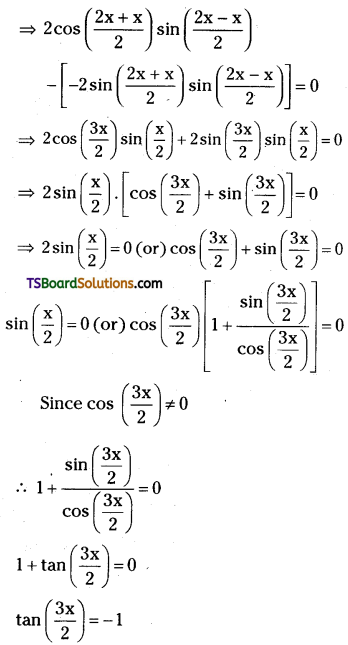
TS Inter First Year Maths 1A Trigonometric Equations Important Questions 3
Case – I: sin\(\left(\frac{x}{2}\right)\) = 0
Solution set is θ = {nπ, n ∈ Z}
\(\frac{x}{2}\) = {nπ, n ∈ Z}
x = {2nπ, n ∈ Z}

Case – II: tan\(\left(\frac{3 \mathrm{x}}{2}\right)\) = -1
tan\(\left(\frac{3 \mathrm{x}}{2}\right)\) = tan\(\left(\frac{-\pi}{4}\right)\)
∴ The solution set is θ = {nπ + α, n ∈ Z}
\(\frac{3 x}{2}\) = {n – \(\frac{\pi}{4}\), n ∈ Z}
x = {\(\frac{2 n \pi}{3}-\frac{\pi}{6}\), n ∈ Z}
∴ The solution set of the given equation is x = {2nπ, n ∈ Z} ∪ {\(\frac{2 n \pi}{3}-\frac{\pi}{6}\), n ∈ Z}

Question 10.
Solve 2 cos2θ + 11 sin θ = 7.
Answer:
Given equation is 2 cos2θ + 11 sin θ = 7
⇒ 2(1 – sin2 θ) + 11 sin θ = 7
⇒ -2 sin2 θ + 11 sin θ = 5
⇒ 2 sin2 θ – 11 sin θ + 5 = 0
⇒ 2 sin2 θ – 10 sin θ – sin θ + 5 = 0
⇒ 2 sin θ (sin θ – 5) – 1 (sin θ – 5) = 0
⇒ (2 sin θ – 1) (sin θ – 5) = 0

If sin θ – 5 = 0 then sin θ = 5 is not admissible.
If 2 sin θ – 1 = 0 ⇒ sin θ = \(\frac{1}{4}\) and the principal solution is α = \(\frac{\pi}{6}\)
∴ General solution is θ = nπ + (-1)n\(\frac{\pi}{6}\), n ∈ Z.

Question 11.
Solve sin x + √3 cos x = √2. [Mar. ’18(TS); Mar. ’10; May ’98, ’93]
Answer:
Given equation is sin x + √3 cos x = √2
On dividing both sides with \(\sqrt{a^2+b^2}\)
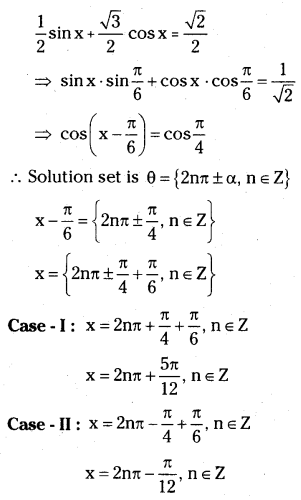
TS Inter First Year Maths 1A Trigonometric Equations Important Questions 4
Hence the solution set of the given equation is x = {2nπ + \(\frac{5\pi}{12}\), n ∈ Z} ∪ {2nπ – \(\frac{\pi}{12}\), n ∈ Z}

Question 12.
Solve cot 2x – (√3 + 1)cot x + √3 = 0. [Mar. ’14, ’12]
Answer:
Given cot 2x – (√3 + 1)cot x + √3 = 0
⇒ cot 2x – √3 cot x – cot x + √3 = 0
⇒ cot x(cot x – √3) – 1(cot x – √3) = 0
⇒ (cot x – √3) (cot x – 1) = 0
⇒ cot x – √3=0 (or) cot x – 1 = 0
⇒ cot x = √3 (or) cot x = 1
⇒ cot x = cot 30° (or) cot x = cot 45°
⇒ x = 30° (or) x = 45°

General solutions:
x = nπ + 30°, n ∈ Z
Let n = 0 ⇒ x = 30°

General solution:
x = nπ + 45°, n ∈ Z
Let n = 0 ⇒ x = 45°
∴ Solutions set = {30°, 45°}

Question 13.
If x + y = \(\frac{2 \pi}{3}\) and sin x + sin y = \(\frac{3}{2}\), find x and y. [Mar. ’97]
Answer:
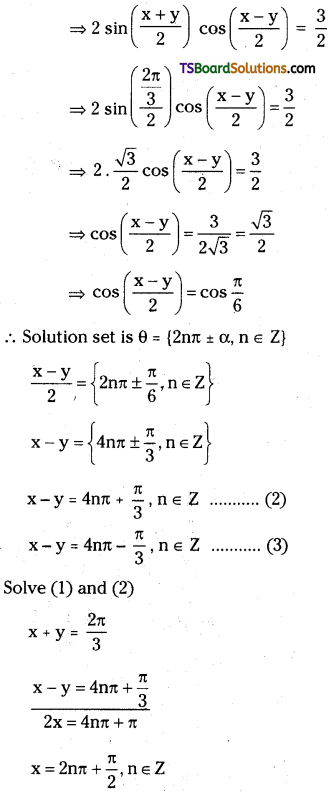
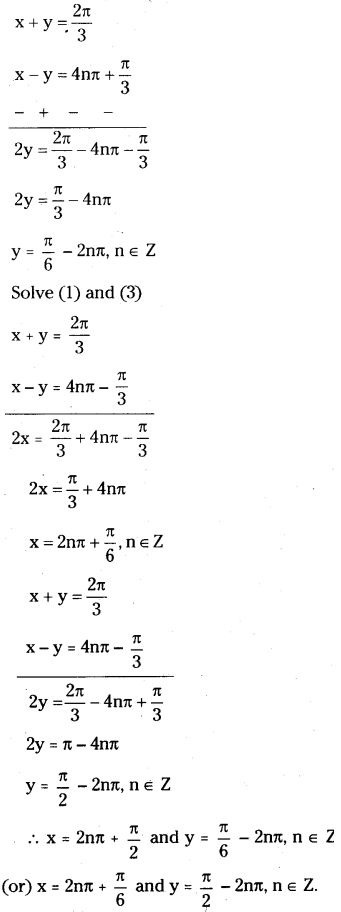
Given x + y = \(\frac{2 \pi}{3}\) …………(1)
sin x + sin y = \(\frac{3}{2}\)
TS Inter First Year Maths 1A Trigonometric Equations Important Questions 5
TS Inter First Year Maths 1A Trigonometric Equations Important Questions 6

TS Inter First Year Maths 1A Trigonometric Equations Important Questions

Some More Maths 1A Trigonometric Equations Important Questions

Question 1.
If x is acute and sin (x + 10°) = cos (3x – 68°) find x in degrees.
Answer:
Given sin (x + 10°) = cos (3x – 68°)
⇒ sin(x + 10°) = sin[90° + (3x – 68°)]
= sin (22° + 3x)
⇒ x + 10°= nπ + (-1)n (22° + 3x)

If n = 2k (even) k ∈ Z then
x + 10° = 2k7t + (-1)” (22° + 3x)
⇒ 2kπ + (-1)2k (22° + 3x) = 2kπ + 22° + 3x
⇒ 2x = -k(2π) – 12°
⇒ x = \(θ\) = -k(180°) – 6°

If n = 2k + 1 then
x + 10° = (2k + 1) 180° – (22° + 3x)
⇒ 4x = (2k +1) 180° – 32°
⇒ x = (2k + 1)45° – 8°
When k = 0 we get x = 37°
If we take k = 1, 2, ………… the value of x is not acute.
Hence the value of x is 37°.

Question 2.
Solve 5 cos2θ + 7 sin2θ = 6.
Answer:
Given 5 cos2θ + 7 sin2θ = 6
Dividing by cos2θ we get,
5 + 7 tan2θ = 6 sec2θ
⇒ 5 + 7 tan2θ = 6(1 + tan2θ)
⇒ tan2θ – 1 = 0 ⇒ tan2θ = 1 ⇒ tan θ = ±1
θ = nπ ± \(\frac{\pi}{4}\),n ∈ Z is the general solution.

Question 3.
Solve 2 sin2θ – 4 = 5 cos θ.
Answer:
2 sin2θ – 4 = 5 cos θ
⇒ 2(1 – cos2θ) – 5 cos θ – 4 = 0
⇒ 2cos2θ + 5cos θ + 4-2 = 0
⇒ 2cos2θ + 5cos θ + 2 = 0
⇒ 2cos2θ + 4cos θ + cos θ + 2 = 0
⇒ 2cos θ(cos θ + 2) + 1(cos θ + 2) = 0
⇒ (cos θ + 2)(2cos θ + 1) = 0
cos θ + 2 = 0 is not admissible.
Consider 2cos θ + 1 = 0 ⇒ cos θ = –\(\frac{1}{2}\), the principal solution is α = \(\frac{2 \pi}{3}\)
∴ General solution is θ = 2nπ ± \(\frac{2 \pi}{3}\),n ∈ Z.

Question 4.
Solve 4cos2θ + √3 = 2(√3 + 1)cos θ.
Answer:
4cos2θ – 2(√3 + 1)cosθ + √3 = 0
⇒ 4cos2θ – 2√3cos θ – 2cos θ + √3 =0
⇒ 2cosθ(2cosθ – √3)- 1(2cos θ – √3) = 0
⇒ (2cosθ – 1)(2cosθ – √3) = 0
If cos θ = \(\frac{1}{2}\) then θ = 2nπ ± \(\frac{\pi}{3}\), n ∈ Z is the general solution.
If 2cos θ – √3 = 0 then cos θ = \(\frac{\sqrt{3}}{2}\)
Hence the general solution in this case is
θ = 2nπ ± \(\frac{\pi}{6}\) ,n ∈ Z.

TS Inter First Year Maths 1A Trigonometric Equations Important Questions

Question 5.
Solve √3 sin θ – cos θ = √2. [May ’14, Mar. ’18(AP)]
Answer:
Given √3 sin θ – cos θ = √2
Divide both sides by
\(\sqrt{3+1}\) = 2, \(\frac{\sqrt{3}}{2}\)sin θ – \(\frac{1}{2}\)cos θ = \(\frac{1}{\sqrt{2}}\)

∴ The principal solution for θ – \(\frac{\pi}{6}\) is α = \(\frac{\pi}{4}\)
∴General soIutio is θ – \(\frac{\pi}{6}\) = nπ + (-1)n \(\frac{\pi}{4}\)
⇒ θ = \(\frac{\pi}{6}\) + nπ + (-1)n \(\frac{\pi}{4}\)

Question 6.
Solve cos 2θ + cos 8θ = cos 5θ.
Answer:
Given cos 2θ + cos 8θ = cos 5θ
⇒ 2 cos 5θ cos 3θ = cos 5θ
⇒ cos 5θ(2 cos 3θ – 1) = 0
Case (i): cos 5θ = 0
⇒ 5θ = (2n + 1)\(\frac{\pi}{2}\) ⇒ θ = (2n + 1)\(\frac{\pi}{10}\), n ∈ Z

Case (ii): 2cos 3θ – 1 = 0 ⇒ cos 3θ = \(\frac{1}{2}\)
Principal solution is α = \(\frac{\pi}{3}\)

∴ General Solution is
3θ = 2nπ ± \(\frac{\pi}{3}\) ⇒ θ = \(\frac{2 \mathrm{n} \pi}{3} \pm \frac{\pi}{9}\), n ∈ Z

∴ General Solutions are
{(2n + 1)\(\frac{\pi}{10}, \frac{2 \mathrm{n} \pi}{3} \pm \frac{\pi}{9}\), n ∈ Z}

Question 7.
Solve cos θ – cos 7θ = sin 4θ.
Answer:
2sin\(\left(\frac{\theta+7 \theta}{2}\right)\) sin\(\left(\frac{7 \theta-\theta}{2}\right)\) = sin 4θ
⇒ 2sin4θ sin 3θ = sin 4θ
⇒ sin 4θ(2 sin 3θ – 1) = 0

Case (i): sin 4θ = 0 ⇒ 4θ = nθ ⇒ \(\frac{\mathrm{n} \pi}{4}\), n ∈ Z

Case (ii): 2sin 3θ – 1 = 0 ⇒ sin 3θ = \(\frac{1}{2}\)
Principal solution is α = \(\frac{\pi}{6}\)

∴ General solution is 3θ = nπ + (-1)n\(\frac{\pi}{6}\)
⇒ θ = \(\frac{\mathrm{n} \pi}{3}\) + (-1)n\(\frac{\pi}{18}\), n ∈ Z

TS Inter First Year Maths 1A Trigonometric Equations Important Questions

Question 8.
If tan(π cos θ) = cot (π sin θ), then prove that cos(θ – \(\frac{\pi}{4}\)) = ±\(\frac{1}{2 \sqrt{2}}\). [Mar ’15(TS)]
Answer:
Given that tan(π cos θ)
= cot(π sin θ) = tan(\(\frac{\pi}{2}\) – π cos θ)
∴ π cos θ = ±\(\frac{\pi}{2}\) – π sin θ
⇒ cos θ = ±\(\frac{1}{2}\) – sin θ ⇒ cos θ + sin θ = ±\(\frac{1}{2}\)
⇒ cos θ\(\frac{1}{\sqrt{2}}\) + sin θ\(\frac{1}{\sqrt{2}}=\pm \frac{1}{2 \sqrt{2}}\)
⇒ cos θ cos\(\frac{\pi}{4}\) + sin θ sin\(\frac{\pi}{4}\) = \(\pm \frac{1}{2 \sqrt{2}}\)

Question 9.
If α, β are the solutions of the equation a cos θ + b sin θ = c, where a, b, c ∈ R and if a2 + b2 > 0, cos α ≠ cos β and sin α ≠ sin β then show that
(i) sin α + sin β = \(\frac{2 b c}{a^2+b^2}\)
(ii) cos α + cos β = \(\frac{2 a c}{a^2+b^2}\)
(iii) cos α. cos β = \(\frac{c^2-b^2}{a^2+b^2}\)
(iv) sin α. sin β = \(\frac{c^2-a^2}{a^2+b^2}\)
Answer:
Given acos θ + bsin θ = c ⇒ acos θ = c – bsin θ ⇒ a2cos2θ = c2 – 2bcsinθ + b2sin2θ
⇒ a2 (1 – sin2θ) = c2 – 2bcsinθ + b2 sin2θ
⇒ (a2 + b2)sin2θ – 2bcsinθ + (c2 – a2) = 0
This is a quadratic equation in sin θ and let the roots be sin α and sin β. Then
sin α + sin β = \(\frac{2 b c}{a^2+b^2}\); sin α . sin β = \(\frac{c^2-a^2}{a^2+b^2}\)
Also b sin θ = c – acos θ ⇒ b2sin2θ = c2 -2accos θ + a2cos2θ
⇒ b2(1 – cos2θ) = c2 – 2ac cosθ + a2 cos2θ
⇒ (b2 + a2)cos2θ – 2ac cosθ + (c2 – b2) =0
This is a quadratic equation in cos θ and let cos α, cos β be the roots. Then
cos α + cos β = \(\frac{2 a c}{a^2+b^2}\) and cos α. cos β = \(\frac{c^2-b^2}{a^2+b^2}\)

Hence from above we have
(i) sin α + sin β = \(\frac{2 b c}{a^2+b^2}\)
(ii) cos α + cos β = \(\frac{2 a c}{a^2+b^2}\)
(iii) cos α. cos β = \(\frac{c^2-b^2}{a^2+b^2}\)
(iv) sin α . sin β = \(\frac{c^2-a^2}{a^2+b^2}\)

Question 10.
Give p ≠ ± q, show that the solutions of cos p0 + cos q0 = 0 form two series each of which is in A.P. Also find the common difference of each A.P. [Mar. ’19(AP)]
Answer:
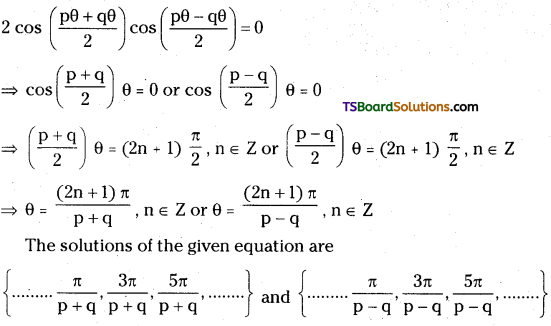
Given equation is cos pθ + cos qθ = 0

which are two A.P.’s is with common differences

TS Inter 1st Year Physics Study Material Chapter 7 Systems of Particles and Rotational Motion

Telangana TSBIE TS Inter 1st Year Physics Study Material 7th Lesson Systems of Particles and Rotational Motion Textbook Questions and Answers.

TS Inter 1st Year Physics Study Material 7th Lesson Systems of Particles and Rotational Motion

Very Short Answer Type Questions

Question 1.
Is it necessary that a mass should be present at the centre of mass of any system? [AP May. ’16; May ’14]
Answer:
No. It is not necessary to present some mass at centre of mass of the system.
Ex: At the centre of ring (or) bangle, there is no mass present at centre of mass.

Question 2.
What is the difference in the positions of a girl carrying a bag in one of her hands and another girl carrying a bag in each of her two hands?
Answer:
i) a) When she carries a bag in one hand her centre of mass will shift to the side of the hand that carries the bag.
b) When a bag is in one hand some unbalanced force will act on her and it is difficult to carry.

ii) If she carries two bags in two hands then her centre of mass remains unchanged. Force on two hands are equal i.e. balanced so it is easy to carry the bags.

Question 3.
Two rigid bodies have same moment of inertia about their axes of symmetry. Of the two, which body will have greater kinetic energy?
Answer:
Relation between angular momentum and kinetic energy is, KE = \(\frac{L^2}{2I}\)

Because moment of inertia is same the body with large angular momentum will have larger kinetic energy.

Question 4.
Why are spokes provided in a bicycle wheel? [AP May ’14]
Answer:
The spokes of cycle wheel increase its moment of inertia. The greater the moment of inertia, the greater is the opposition to any change in uniform rotational motion. As a result the cycle runs smoother and speeder. If the cycle wheel had no spokes, the cycle would be driven in jerks and hence unsafe.

Question 5.
We cannot open or close the door by applying force at the hinges. Why? [AP May ’16]
Answer:
To open or close a door, we apply a force normal to the door. If the force is applied at the hinges the perpendicular distance of force is zero. Hence, there will be no turning effect however large force is applied.

TS Inter 1st Year Physics Study Material Chapter 7 Systems of Particles and Rotational Motion

Question 6.
Why do we prefer a spanner of longer arm as compared to the spanner of shorter arm?
Answer:
The turning effect of force, τ = \(\overline{\mathrm{r}}\times\overline{\mathrm{F}}\). When arm of the spanner is long, r is larger. Therefore smaller force (F) will produce the same turning effect. Hence, the spanner of longer arm is preferred as compared to the spanner of shorter arm.

Question 7.
By spinning eggs on a table top, how will you distinguish an hard boiled egg from egg? [AP Mar. ’13]
Answer:
To distinguish between a hard boiled egg and a raw egg, we spin each on a table top. The egg which spins at a slower rate shall be a raw egg. This is because in a raw egg, liquid matter inside tries to get away from the axis of rotation. Therefore, its moment of inertia ‘I’ increases. As τ = Iα = constant, therefore, α decreases i.e., raw egg will spin with smaller angular acceleration.

Question 8.
Why should a helicopter necessarily have two propellers?
Answer:
If the helicopter had only one propeller, then due to conservation of angular momen¬tum, the helicopter itself would turn in the opposite direction. Hence, the helicopter should necessarily have two propellers.

Question 9.
If the polar ice caps of the earth were to melt, what would the effect of the length of the day be?
Answer:
Earth rotates about its polar axis. When ice of polar caps of earth melts, mass concen¬trated near the axis of rotation spreads out. Therefore, moment of inertia ‘I’ increases.

As no external torque acts, L = Iω = I(\(\frac{2 \pi}{T}\)) = constant

with increase of I, T will increase i.e., length of the day will increase.

TS Inter 1st Year Physics Study Material Chapter 7 Systems of Particles and Rotational Motion

Question 10.
Why is it easier to balance a bicycle in motion?
Answer:
A bicycle in motion is in rotational equilibrium. From principles of Dynamics of rotational bodies is that the forces that are perpendicular to the axis of rotation will try to turn the axis of rotation but necessary forces will arise it cancel these forces due to inertia of rotation and fixed position of axis is maintained. So it is easy to balance a rotating body.

Short Answer Questions

Question 1.
Distinguish between centre of mass and centre of gravity. [AP Mar. 18, 17, 16, 15, 14, 13, May 17; June 15 : TS Mar. 16. 15, May 18, 17]
Answer:

Centre of massCentre of gravity
1) A point inside a body at which the whole mass is supposed to be concentrated.
A force applied at this point produces translatory motion.
1) A point inside a body through which the weight of the body acts.
2) It pertains (or) contain to mass of the body.2) It refers to weight acting on all particles of the body.
3) In case of small bodies centre of mass and centre of gravity coincide. (Uniform gravitational field)3) In case of a huge body centre of mass and centre of gravity may not coincide. (Non uniform gravitational field)
4) Algebraic sum of moments of masses about centre of mass is zero.4) Algebraic sum of moments of weights about centre of gravity is zero.
5) Centre of mass is used to study translatory motion of a body when it is in complicated motion.5) Centre of gravity is used to know the stability of the body where it is to be supported.

TS Inter 1st Year Physics Study Material Chapter 7 Systems of Particles and Rotational Motion

Question 2.
Show that a system of particles moving under the influence of an external force, moves as if the force is applied at its centre of mass. [AP May ’18]
Answer:
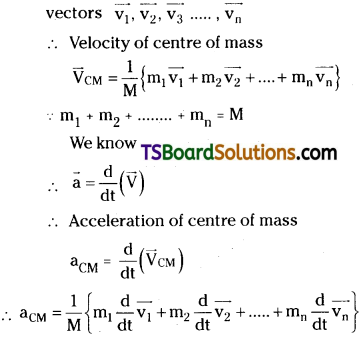
Consider a system of particles of masses m1, m2, ……….. mn moves with velocity
TS Inter 1st Year Physics Study Material Chapter 7 Systems of Particles and Rotational Motion 1
But Force (F) = ma, so total force on the body is
F = MaC.M = m1a1 + m2a2 + m3a3 + ……….. + mn an
or Total Force F = MaC.M = F1 + F2 + F3 + ……… + Fn

Hence, total force on the body is the sum of forces on individual particles and it is equals to force on centre of mass of the body.

Question 3.
Explain about the centre of mass of earth-moon system and its rotation around the sun.
Answer:
The interaction of earth and moon does not effect the motion of centre of mass of earth and moon system around the sun. The gravitational force between earth and moon is internal force. Internal forces cannot change the position of centre of mass.

The external force acting on the centre of mass of earth and moon system is force between the sun and C.M. of earth, moon system. Motion of centre of mass depends on external force. Hence, earth moon system continues to move in an elliptical path around the sun. It is irrespective of rotation of moon around earth.

Question 4.
Define vector product. Explain the properties of a vector product with two examples. [AP Mar. ’17, ’15 ; TS Mar. ’17, ’16, ’15; APMay ’18. ’17; TS May ’18. ’16]
Answer:
Vector product (or) cross product :
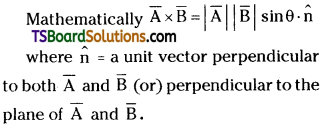
If the product of two vectors (say \(\overline{\mathrm{A}}\) and \(\overline{\mathrm{B}}\)) gives a vector then that multiplication of vectors is called cross product or vector product of vectors.
TS Inter 1st Year Physics Study Material Chapter 7 Systems of Particles and Rotational Motion 2

Properties of cross product:
1. Cross product is not commutative i.e.
TS Inter 1st Year Physics Study Material Chapter 7 Systems of Particles and Rotational Motion 3
2. Cross product obeys distributive law i.e.,
TS Inter 1st Year Physics Study Material Chapter 7 Systems of Particles and Rotational Motion 4
3. If any vector is represented by the combination of \(\overline{\mathrm{i}},\overline{\mathrm{j}}\) and \(\overline{\mathrm{k}}\) then cross product will obey right hand screw rule.
4. The product of two coplanar perpendicular unit vectors will generate a unit vector perpendicular to that plane
TS Inter 1st Year Physics Study Material Chapter 7 Systems of Particles and Rotational Motion 5
5. Cross product of parallel vectors is zero
TS Inter 1st Year Physics Study Material Chapter 7 Systems of Particles and Rotational Motion 6

Examples of cross product:
1) Torque (or) moment of force (\(\overline{\mathrm{\tau}}\)) :
It is defined as the product of force and perpendicular distance from the point of application.
∴ Torque τ = \(\overline{\mathrm{r}}\times\overline{\mathrm{F}}\)

2) Angular momentum and angular velocity :
For a rigid body in motion, Angular momentum (\(\overline{\mathrm{L}}\)) = radius (\(\overline{\mathrm{r}}\)) x momentum (\(\overline{\mathrm{P}}\))
∴ Angular momentum (\(\overline{\mathrm{L}}\)) = \(\overline{\mathrm{r}}\) × (m\(\overline{\mathrm{v}}\)) = m(\(\overline{\mathrm{r}}\times\overline{\mathrm{v}}\))

Question 5.
Define angular velocity. Derive v = r ω. [TS Mar. 19,’ 17, 16; AP Mar. 19, May. 16; May 14]
Answer:
Angular velocity (ω) :
Rate of change of angular displacement is called angular velocity.

Relation between linear velocity (v) and angular velocity (ω) :
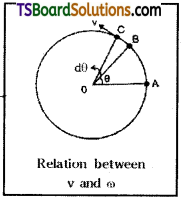
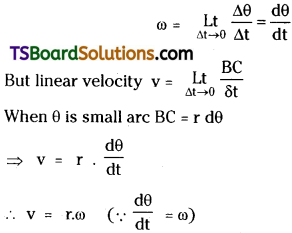
Let a particle P is moving along circumference of a circle of radius r1 with uniform speed v. Let it is initially at the position A, during a small time ∆t it goes to a new position say C from B. Angle subtended during this small interval is say dθ.
TS Inter 1st Year Physics Study Material Chapter 7 Systems of Particles and Rotational Motion 7

By definition angular velocity,
TS Inter 1st Year Physics Study Material Chapter 7 Systems of Particles and Rotational Motion 8

Question 6.
State the principle of conservation of angular momentum. Give two examples.
Answer:
Law of conservation of angular momentum:
When no external torque is acting on a body then the angular momentum of that rota-ting body is constant.
i.e., I1ω1 = I2ω2 (when τ = 0)

Example -1:
A boy stands over the centre of a horizontal platform which is rotating freely with a speed ω1 (n1revolutions/sec.) about a vertical axis passing through the centre of the platform and straight up through the boy. He holds two bricks in each of his hands close to his body. The combined moment of inertia of the system is say I1. Let the boy stretches his arms to hold the masses far away from his body. In this position the moment of inertia increases to I2 and let ω2 is his angular speed.

Here ω2 < ω1 because moment of inertia increases.
TS Inter 1st Year Physics Study Material Chapter 7 Systems of Particles and Rotational Motion 9

Example – 2 :
An athlete diving off a high spring board can bring his legs and hands close to the body and performs Somersault about a horizontal axis passing through his body in the air before reaching the water below it. During the fall his angular momentum remains constant.

TS Inter 1st Year Physics Study Material Chapter 7 Systems of Particles and Rotational Motion

Question 7.
Define angular acceleration and torque. Establish the relation between angular acceleration and torque. [TS Mar. ’18, ’17; TS May ’17, June ’15; AP Mar. ’19, June ’15]
Answer:
Angular acceleration (α) :
Rate of change of angular velocity is called angular acceleration.

Torque :
It is defined as the product of the force and the perpendicular distance of the point of application of the force from that point.

Relation between angular acceleration and Torque:
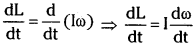
We know that, L = Iω

On differentiating the above expression with respect to time ‘t’
TS Inter 1st Year Physics Study Material Chapter 7 Systems of Particles and Rotational Motion 10

But \(\frac{dL}{dt}\) is the rate of change of angular momentum called ‘Torque (τ)”.

and \(\frac{d \omega}{dt}\) is the rate of change of angular velocity called “angular acceleration (α)”

∴ The relation between Torque and angular acceleration is, τ = lα

Question 8.
Write the equations of motion for a particle rotating about a fixed axis.
Answer:
Equations of rotational kinematics :
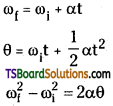
If ‘θ’ is the angular displacement, Wj is the initial angular velocity, ωf is the final angular velocity after a time ‘t’ seconds and ‘α’ is the angular acceleration, then the equations of rotational kinematics can be written as,
TS Inter 1st Year Physics Study Material Chapter 7 Systems of Particles and Rotational Motion 11

Question 9.
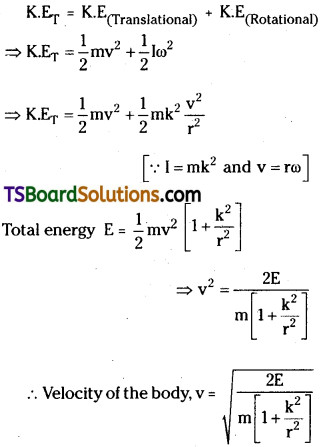
Derive expressions for the final velocity and total energy of a body rolling without slipping.
Answer:
A rolling body has both translational kinetic energy and rotational kinetic energy. So the total K.E energy of a rolling body is,
TS Inter 1st Year Physics Study Material Chapter 7 Systems of Particles and Rotational Motion 12

Long Answer Questions

Question 1.
(a) State and prove parallel axis theorem.
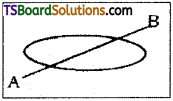
(b) For a thin flat circular disk, the radius of gyration about a diameter as axis is k. If the disk is cut along a diameter AB as shown into two equal pieces, then find the radius of gyration of each piece about AB.
TS Inter 1st Year Physics Study Material Chapter 7 Systems of Particles and Rotational Motion 13
Answer:
a) Parallel axis theorem :
The moment of inertia of a rigid body about an axis passing through a point is the sum of moment of inertia about parallel axis passing through centre of mass (IG) and mass of the body multiplied by Square of distance (MR²) between the axes i.e.,
I = IG + MR²

Proof :
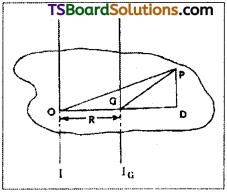
Consider a rigid body of mass M with ‘G’ as its centre of mass. Iq the moment of inertia about an axis passing through centre of mass. I = The moment of inertia about an axis passing through the point ’O’ in that plane.

Let perpendicular distance between the axes is OG = R (say)

Consider point P in the given plane. Join OP and GP. Extend the line OG and drop a normal from ’P’ on to it as shown in figure.
TS Inter 1st Year Physics Study Material Chapter 7 Systems of Particles and Rotational Motion 14

The moment of inertia about the axis passing through centre of mass G.
(IG) = ∑mGP² ……….. (1)

M.O.I. of the body about an axis passing through ‘O’ (I) = ∑mOP² ………… (2)
From triangle OPD
OP² = OD² + DP²
⇒ OD = OG + GD
∴ OD² = (OG + GD)² = OG² + GD² + 2OG. GD ………….. (3)
From Equations (2) and (3)
I = ∑mOP² = Em [ (OG² + GD² + 2OG. GD) + DP²]
∴ I = ∑m {GD² + DP² + OG² + 20G. GN}
But GD² + DP² = GP²
∴ I = ∑m {GP² + OG² + 20G. GD}
∴ I = ∑m GP² + ∑mOG² + 20G ∑mGD ………. (4)

But the terms ∑mGP² = IG
∑mOG² = MR² (∵ ∑m = M and OG = R)
The term 20G ∑mGD = 0. Because it represents sum of moment of masses about centre of mass. Hence its value is zero.
∴ I = IG + MR²

Hence parallel axis theorem is proved.

b) Moment of inertia of a disc of mass ‘M’ and radius ‘R’ about its diameter is,
I = \(\frac{MR^2}{4}\)

If ‘k’ is radius of gyration of disc then, I = Mk²
∴ Mk² = \(\frac{MR^2}{4}\) ⇒ k = R/2

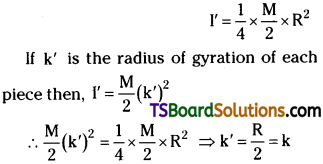
After cutting along the diameter, mass M of each piece = \(\frac{M}{2}\)
Moment of inertia of each piece,
TS Inter 1st Year Physics Study Material Chapter 7 Systems of Particles and Rotational Motion 15

Question 2.
(a) State and prove perpendicular axis theorem.
(b) If a thin circular ring and a thin flat circular disk of same mass have same moment of inertia about their respective diameters as axis. Then find the ratio of their radii.
Answer:
a) Perpendicular axis theorem :
The moment of inertia of a plane lamina about an axis perpendicular to its plane is equal to the sum of the moment of inertia about two perpendicular axis concurrent with perpendicular axis and lying in the plane of the body.
∴ Iz = Ix + Iy

Proof :
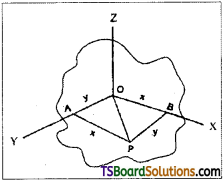
Consider a rectangular plane lamina. X and Y are two mutually perpendicular axis in the plane. Choose another perpendicular axis Z passing through the point ‘O’.
TS Inter 1st Year Physics Study Material Chapter 7 Systems of Particles and Rotational Motion 16

Consider a particle P in XOY plane.
Its co-ordinates are (x, y).
Moment of inertia of particle about
X-axis is IX = ∑my².
M.O.I about Y-axis is IY = ∑mx²
M.O.I about Z axis is IZ = ∑ m . OP²
From triangle OAP,
OP² = OA² + AP² = y² + x²
∴ Iz = ∑ mOP² = ∑ m (y² + x²)
∴ Iz = X my² + ∑ mx²
But ∑ my² = Ix and ∑ mx² = Iy

∴ Moment of Inertia about a perpendicular axis passing through ‘O’ is IZ = IX + IY
Hence perpendicular axis theorem is proved.

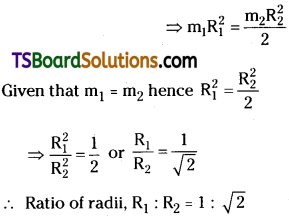
b) Moment of inertia of a thin circular ring about its diameter is, I1 = m11

Moment of inertia of a flat circular disc about its diameter is, I2 = \(\frac{m_2R^{2}_{2}}{2}\)
Given that two objects having same moment of inertia i.e., I1 = I2

TS Inter 1st Year Physics Study Material Chapter 7 Systems of Particles and Rotational Motion 17

TS Inter 1st Year Physics Study Material Chapter 7 Systems of Particles and Rotational Motion

Question 3.
State and prove the principle of conservation of angular momentum. Explain the principle of conservation of angular momentum with examples. [AP Mar. ’16]
Answer:
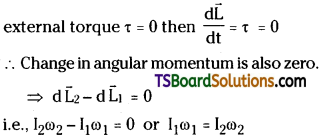
Law of conservation of angular momentum: When no external torque is acting on a body then the angular momentum of that rotating body is constant.
i.e., I1ω1 = I2ω2 (when τ = 0)

Explanation:
Here I1 and I2 are moment of inertia of rotating bodies and ω1 and ω2 are their initial and final angular velocities. If
TS Inter 1st Year Physics Study Material Chapter 7 Systems of Particles and Rotational Motion 18

Example -1 :
A boy stands over the centre of a horizontal platform which is rotating freely with a speed ω1 (n1 revolutions/sec.) about a vertical axis passing through the centre of the platform and straight up through the boy. He holds two bricks in each of his hands close to his body. The combined moment of inertia of the system is say I1. Let the boy stretches his arms to hold the masses far away from his body. In this position the moment of inertia increases to I2 and let ω2 is his angular speed.

Here ω2 < ω1 because moment of inertia increases.
TS Inter 1st Year Physics Study Material Chapter 7 Systems of Particles and Rotational Motion 19

Example – 2 :
An athlete diving off a high spring board can bring his legs and hands close to the body and performs Somersault about a horizontal axis passing through his body in the air before reaching the water below it. During the fall his angular momentum remains constant.

Position of centre of mass of some symmetrical bodies :

Shape of the bodyPosition of centre of mass
1. Hollow sphere (or) solid sphereAt the centre of sphere
2. Circular ringAt the centre of the ring
3. Circular discAt the centre of disc
4. Triangular plateAt the centroid
5. Square plateAt the point of intersection of diagonals
6. Rectangular plateAt the point of intersection of diagonals
7. ConeAt \(\frac{3h}{4}\) th of its height from its apex on its own axis
8. CylinderAt the midpoint of its own axis.

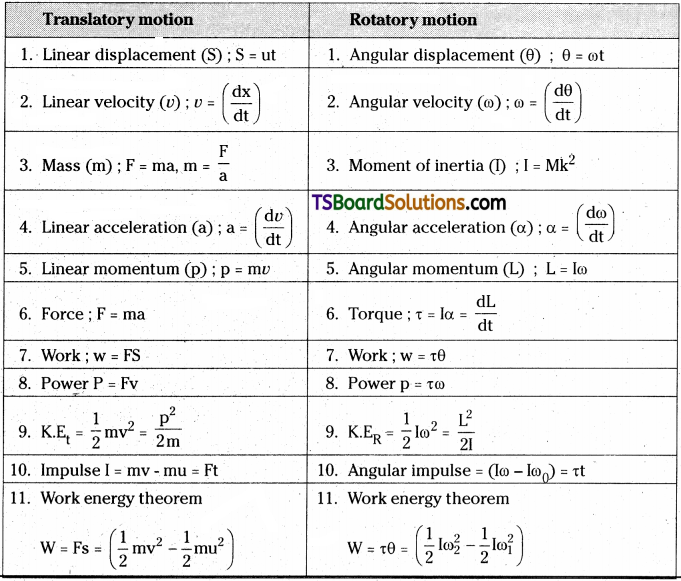
Comparison of translatory and rotatory motions :
TS Inter 1st Year Physics Study Material Chapter 7 Systems of Particles and Rotational Motion 20

Problems

Question 1.
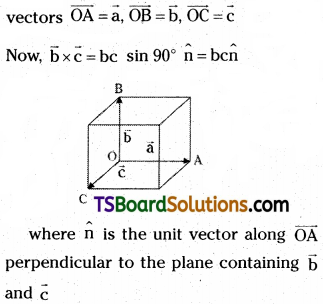
Show that a • (b × c) is equal in magnitude to the volume of the parallelopiped formed on the three vectors a, b and c. (IMP)
Solution:
Let a parallelopiped be formed on three
TS Inter 1st Year Physics Study Material Chapter 7 Systems of Particles and Rotational Motion 21
Now \(\hat{a}\) • (\(\hat{b}\times\hat{c}\) x c) = \(\hat{a}\) • be \(\hat{n}\) = (a) (be) cos 0° – abc

Which is equal in magnitude to the volume of parallelopiped.

TS Inter 1st Year Physics Study Material Chapter 7 Systems of Particles and Rotational Motion

Question 2.
A rope of negligible mass is wound round a hollow cylinder of mass 3 kg and radius 40 cm. What is the angular acceleration of the cylinder if the rope is pulled with a force of 30 N? What is the linear acceleration of the rope ? Assume that there is no slipping.
Soution:
Here M = 3 kg ; R = 40 cm = 0.4 m
Moment of inertia of the hollow cylinder about its axis, I = MR² = 3(0.4)² = 0.48 kg m²
Force applied, F = 30 N
∴ Torque, τ = F × R = 30 × 0.4 = 12 N – m

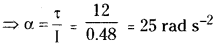
If α is angular acceleration produced, then from τ = Iα
TS Inter 1st Year Physics Study Material Chapter 7 Systems of Particles and Rotational Motion 22
Linear acceleration, a = Ra = 0.4 × 25
= 10 ms-2.

Question 3.
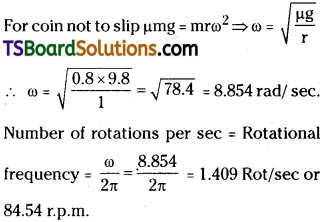
A coin is kept a distance of 10 cm from the centre of a circular turn table. If the coefficient of static friction between the table and the coin is 0.8. Find the frequency or rotation of the disc at which the coin will just begin to slip.
Solution:
Distance of coin = r = 10 cm = 0.1 m.
Coefficient of friction µ = 0.8.
Frequency of rotation = number of rotations per second.
TS Inter 1st Year Physics Study Material Chapter 7 Systems of Particles and Rotational Motion 23

Question 4.
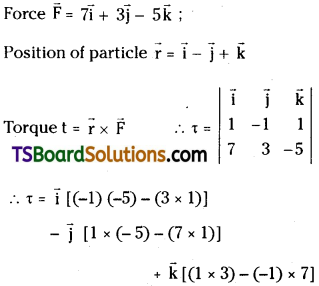
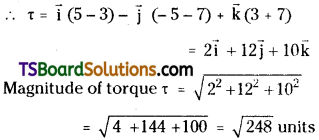
Find the torque of a force \(\mathbf{7} \overrightarrow{\mathbf{i}}+\mathbf{3} \overrightarrow{\mathbf{j}}-5 \overrightarrow{\mathbf{k}}\) about the origin. The force acts on a particle whose position vector is \(\overrightarrow{\mathbf{i}}-\overrightarrow{\mathbf{j}}+\overrightarrow{\mathbf{k}}\). [AP Mar. ’14, ’13; May ’13]
Answer:
TS Inter 1st Year Physics Study Material Chapter 7 Systems of Particles and Rotational Motion 24
TS Inter 1st Year Physics Study Material Chapter 7 Systems of Particles and Rotational Motion 25

Question 5.
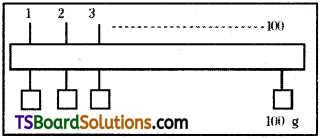
Particles of masses 1g, 2g, 3g….., 100g are kept at the marks 1 cm, 2 cm, 3 cm…, 100 cm respectively on a meter scale. Find the moment of inertia of the system of particles about a perpendicular bisector of the meter scale.
Solution:
Given Masses of 1g, 2g, 3g 100 g are 1, 2, 3 ……….. 100 cm on a scale.
TS Inter 1st Year Physics Study Material Chapter 7 Systems of Particles and Rotational Motion 26
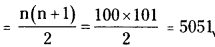
i) Sum of masses 2m = \(\sum_{i=1}^n\)ni
Sum of n natural numbers S
TS Inter 1st Year Physics Study Material Chapter 7 Systems of Particles and Rotational Motion 27
∴ Total mass M = 5051 gr = 5.051 kg → (1)

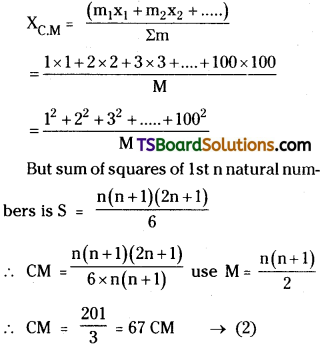
ii) Centre of mass of all these masses is given by
TS Inter 1st Year Physics Study Material Chapter 7 Systems of Particles and Rotational Motion 28

iii) M.O.I. = I
TS Inter 1st Year Physics Study Material Chapter 7 Systems of Particles and Rotational Motion 29
Sum of cubes of 1st n natural numbers is
TS Inter 1st Year Physics Study Material Chapter 7 Systems of Particles and Rotational Motion 30

M.O.I. about C.M. = IG = I – MR²
= 2.550 – 5.05 × 0.67 × 0.67 = 2.550 – 2.267 = 0.283 kg.m2

iv) Perpendicular bisector is at 50 CM.
So shift M.O.I from centre of mass to
x1 = 50cm point from x = 67 CM
∴ Distance between the axis
R = 67 – 50 = 17cm = 0.17M
M.O.I. about this axis I = IG + MR²
= 0.283 + 5.05 × 0.17 × 0.17
= 0.283 + 0.146 = 0.429 kgm²
∴ M.O.I. about perpendicular bisector of scale = 0.429 kg – m²

TS Inter 1st Year Physics Study Material Chapter 7 Systems of Particles and Rotational Motion

Question 6.
Calculate the moment of inertia of a fly wheel, if its angular velocity is increased from 60 r.p.m. to 180 r.p.m. when 100 J of work is done on it. [TS May ’16]
Solution:
W = 100 J, ω1 = 60 RPM = 1 R.P.S = 2π Rad.
ω2 = 180 R.P.M. = 3 R.P.S = 6π Rad.
TS Inter 1st Year Physics Study Material Chapter 7 Systems of Particles and Rotational Motion 31

Question 7.
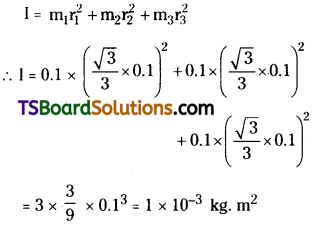
Three particles each of mass 100 g are placed at the vertices of an equilateral triangle of side length 10 cm. Find the moment of inertia of the system about an axis passing through the centroid of the triangle and perpendicular to its plane.
Solution:
Mass of each particle m = 100 g; side of equilateral triangle = 10 cm.
In equilateral triangle height of angular bisector CD = \(\frac{\sqrt{3}}{2}\)l
TS Inter 1st Year Physics Study Material Chapter 7 Systems of Particles and Rotational Motion 32

Centroid will divide the angular bisector in a ratio 2 : 1

So X distance of each mass from vertex to centroid is 2.\(\frac{\sqrt{3}}{2}\)l = \(\frac{\sqrt{3}}{2}\)l
Moment of Inertia of the system
TS Inter 1st Year Physics Study Material Chapter 7 Systems of Particles and Rotational Motion 33

Question 8.
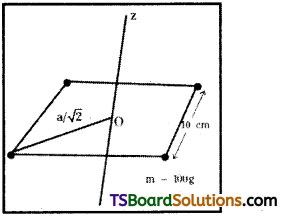
Four particles each of mass 100g are placed at the corners of a square of side 10 cm. Find the moment of inertia of the system about an axis passing through the centre of the square and perpendicular to its plane. Find also the radius of gyration of the system.
Solution:
Mass of each particle, m = 100 g = 0.1 kg.
Length of side’of square, a = 10 cm = 0.1 m
In square distance of corner from centre of square = \(\frac{1}{2}\) diagonal = \(\frac{\sqrt{2}a}{2}=\frac{a}{\sqrt{2}}\)
TS Inter 1st Year Physics Study Material Chapter 7 Systems of Particles and Rotational Motion 34
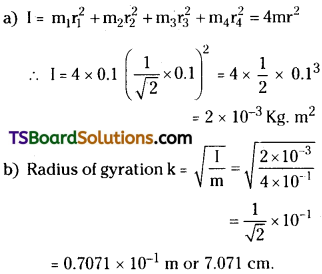
∴ Total moment of Inertia
TS Inter 1st Year Physics Study Material Chapter 7 Systems of Particles and Rotational Motion 35

Question 9.
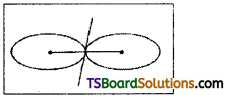
Two uniform circular discs, each of mass 1 kg and radius 20 cm, are kept in contact about the tangent passing through the point of contact. Find the moment of inertia of the system about the tangent passing through the point of contact.
Solution:
Mass of disc = M = 1 kg.
Radius of disc = 20 cm = 0.2 m
TS Inter 1st Year Physics Study Material Chapter 7 Systems of Particles and Rotational Motion 36
They are in contact as shown.
M.O.I of a circular disc about a tangent parallel to its plane = \(\frac{5}{4}\) MR²
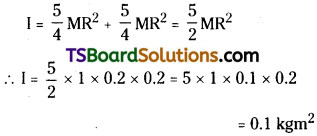
Total M.O.I. of the system
TS Inter 1st Year Physics Study Material Chapter 7 Systems of Particles and Rotational Motion 37

Question 10.
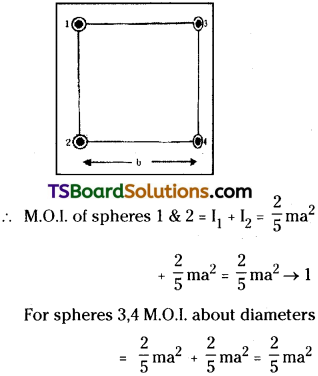
Four spheres each diameter 2a and mass ‘m’ are placed with their centres on the four corners of a square of the side b. Calculate the moment of inertia of the system about any side of the square.
Solution:
Diameter of sphere = 2a ⇒ radius = a.
Side of square = b.
For spheres 1 and 2 axis of rotation is same and passing through diameters. M.O.I. of solid sphere about any diameter = \(\frac{2}{5}\)MR² (put M = m and R = a)
TS Inter 1st Year Physics Study Material Chapter 7 Systems of Particles and Rotational Motion 38

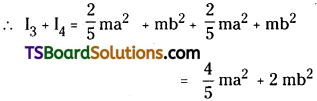
Transfer this M.O.I. on to the axis using
Parallel axis theorem.
TS Inter 1st Year Physics Study Material Chapter 7 Systems of Particles and Rotational Motion 39
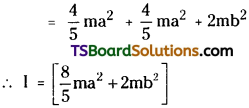
Total M.O.I. of the system
TS Inter 1st Year Physics Study Material Chapter 7 Systems of Particles and Rotational Motion 40

Question 11.
To maintain a rotor at a uniform angular speed or 200 rad s-1, an engine needs to transmit a torque of 180 Nm. What is the power required by the engine? (Note : uniform angular velocity in the absence of friction implies zero torque. In practice, applied torque is needed to counter frictional torque). Assume that the engine is 100% efficient.
Solution:
Given uniform angular speed (ω) = 200 rad s-1
Torque, τ = 180 N – m ; But power p = τω
∴ P =180 × 200 = 36000 watt = 36 kW

TS Inter 1st Year Physics Study Material Chapter 7 Systems of Particles and Rotational Motion

Question 12.
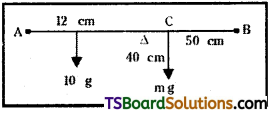
A metre stick is balanced on a knife edge at its centre. When two coins, each of mass 5g are put one on top of the other at the 12.0 cm mark, the stick is found to be balanced at 45.0 cm. What is the mass of the metre stick?
Solution:
Let m be the mass of the stick concentrated at C, the 50 cm mark
TS Inter 1st Year Physics Study Material Chapter 7 Systems of Particles and Rotational Motion 41
For equilibrium
about C’, i.e. at the 45 cm mark,
10g (45 – 12) = mg (50 – 45)
10g × 33 = mg × 5
m = \(\frac{10\times33}{5}\) = 66 grams

Question 13.
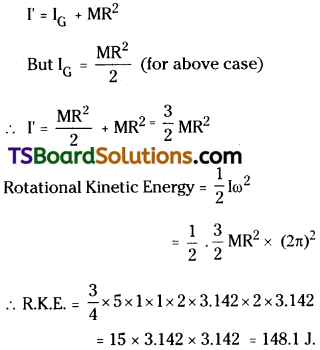
Determine the kinetic energy of a circular disc rotating with a speed of 60 rpm about an axis passing through a point on its circumference and perpendicular to its plane. The circular disc has a mass of 5 kg and radius 1 m.
Solution:
Mass of disc, M = 5 kg; Radius R = 1 m.
Angular velocity, co = 60 RPM = \(\frac{60\times 2\pi}{60}\) = 2πRad/sec

M.O.I. of disc about a point passing through circumference and perpendicular to the plane.
TS Inter 1st Year Physics Study Material Chapter 7 Systems of Particles and Rotational Motion 42

Question 14.
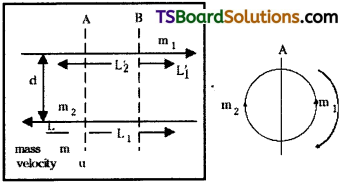
Two particles, each of mass m and speed u, travel in opposite directions along para¬llel lines separated by a distance d. Show that the vector angular momentum of the two particle system is the same whatever be the point about which the angular momemtum is taken.
Solution:
Angular momentum, L = mvr
Choose any axis say ‘A’
Let at any given time distance between m1 & m2 = L = L1 + L2
About the axis ‘A’ both will rotate in same direction See fig.
TS Inter 1st Year Physics Study Material Chapter 7 Systems of Particles and Rotational Motion 43
∴ Total angular momentum
L = L1 + L2 = muL1 + muL2 = mu (L1 + L2) = muL

about any new axis say B distance of m1 and m2
are say L’1 and L’2
Total angular momentum,
L = mu L’1 + mu L’2
or L = mu(L’1 + L’2) = muL (∵ L’1 + L’2 = L)
Hence, total angular momentum of the system is always constant.

Question 15.
The moment of inertia of a fly wheel making 300 revolutions per minute is 0.3 kgm². Find the torque required to bring it to rest in 20s.
Solution:
M.O.I, I = 0.3 kg. ; time, t = 20 sec.,
ω1 = 300 R.P.M. = \(\frac{300}{60}\) = 5. R.P.S.; ω2 = 0

Torque, τ = Iα = 0.3 × \(\frac{5\times 2\pi}{20}\) = 0.471 N – m.

Question 16.
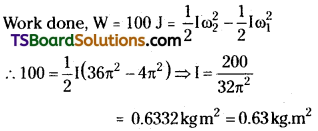
When 100J of work is done on a fly wheel, its angular velocity is increased from 60 rpm to 180 rpm. What is the moment of inertia of the wheel?
Solution:
W=100J, ω1 = 60 RPM = 1 R.PS = 2π Rad.
ω2 =180 R.P.M. = 3 R.P.S = 6π Rad.
TS Inter 1st Year Physics Study Material Chapter 7 Systems of Particles and Rotational Motion 44

TS Inter 1st Year Physics Study Material Chapter 7 Systems of Particles and Rotational Motion

Question 17.
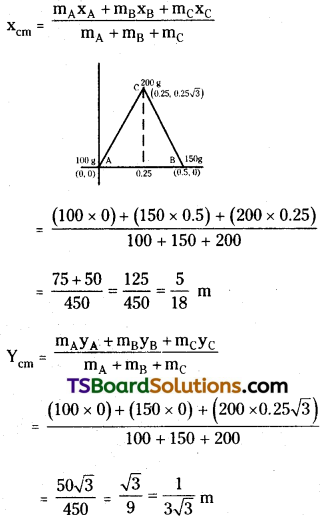
Find the centre of mass of three particles at the vertices of an equilateral triangle. The masses of the particles are lOOg, 150g and 200g respectively. Each side of the equilateral triangle is 0.5 m long, lOOg mass is at origin and 150g mass is on the X-axis. [TS Mar. 18, June 15; AP Mar. ’18]
Solution:
Mass at A = 100g ; Coordinates = 0, 0
Mass at B = 150 g; Coordinates = (0.5, 0)
Mass at C = 200g; Coordinates (0.25,0.25 √3 )
Coordinates xcm
TS Inter 1st Year Physics Study Material Chapter 7 Systems of Particles and Rotational Motion 45

TS Inter 1st Year Maths 1A Inverse Trigonometric Functions Important Questions

Students must practice these Maths 1A Important Questions TS Inter 1st Year Maths 1A Inverse Trigonometric Functions Important Questions to help strengthen their preparations for exams.

TS Inter 1st Year Maths 1A Inverse Trigonometric Functions Important Questions

Question 1.
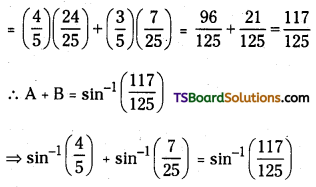
Prove that sin-1\(\frac{4}{5}\) + sin-1\(\frac{7}{25}\) = sin-1\(\frac{117}{125}\). [Mar. ’16(TS), ’13]
Answer:
Let sin-1\(\frac{4}{5}\) = A and sin-1\(\frac{7}{25}\) = B
Then sin A = \(\frac{4}{5}\) and sin B = \(\frac{7}{25}\)
∴ cos A = \(\frac{3}{5}\) and cos B = \(\frac{24}{25}\)
∴ sin (A + B) = sin A cos B + cos A sin B
TS Inter First Year Maths 1A Inverse Trigonometric Functions Important Questions 1

Question 2.
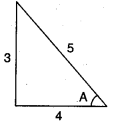
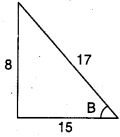
Prove that sin-1\(\frac{3}{5}\) + sin-1\(\frac{8}{17}\) = cos-1\(\frac{36}{85}\). [Mar. ’19(TS); May ’12, ’09]
Answer:
Let sin-1\(\left(\frac{3}{5}\right)\)
TS Inter First Year Maths 1A Inverse Trigonometric Functions Important Questions 2
sin A = \(\frac{3}{5}\);
cot A = \(\frac{4}{5}\)

Let sin-1\(\left(\frac{8}{17}\right)\) = B
sin B = \(\frac{8}{17}\);
cos B = \(\frac{15}{17}\)
TS Inter First Year Maths 1A Inverse Trigonometric Functions Important Questions 3
Let cos-1\(\left(\frac{36}{85}\right)\) = C
cos C = \(\frac{36}{85}\)
∴ A + B = C
cos (A + B) = cos C
L.H.S = cos (A + B) = cos A cos B – sin A sin B
= \(\frac{4}{5} \cdot \frac{15}{17}-\frac{3}{5} \cdot \frac{8}{17}=\frac{60}{85}-\frac{24}{85}=\frac{36}{85}\)
= RHS
∴ sin-1\(\left(\frac{3}{5}\right)\) + sin-1\(\left(\frac{8}{17}\right)\) = cos-1\(\left(\frac{36}{85}\right)\)

TS Inter First Year Maths 1A Inverse Trigonometric Functions Important Questions

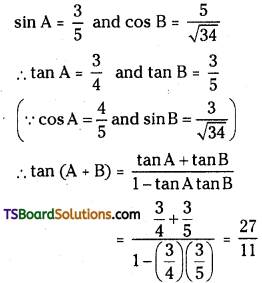
Question 3.
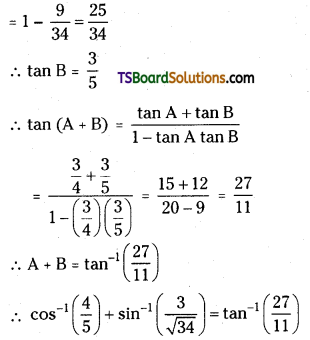
Prove that cos-1\(\left(\frac{4}{5}\right)\) + sin-1\(\left(\frac{3}{\sqrt{34}}\right)\) = tan-1\(\left(\frac{27}{11}\right)\). [May ’13]
Answer:
Let cos-1\(\left(\frac{4}{5}\right)\) = A and sin-1\(\left(\frac{3}{\sqrt{34}}\right)\) = B
Then cos A = \(\frac{4}{5}\) and
sin B = \(\left(\frac{3}{\sqrt{34}}\right)\)

tan A = \(\sqrt{\sec ^2 A-1}=\sqrt{\frac{25}{16}-1}\)
= \(\frac{3}{4}\)
and
cos2B
TS Inter First Year Maths 1A Inverse Trigonometric Functions Important Questions 4

Question 4.
Find the value of
tan \(\left(\sin ^{-1}\left(\frac{3}{5}\right)+\cos ^{-1}\left(\frac{5}{\sqrt{34}}\right)\right)\). [Mar. ’13]
Answer:
Let sin-1\(\left(\frac{3}{5}\right)\) = A and
cos-1\(\left(\frac{5}{\sqrt{34}}\right)\)
TS Inter First Year Maths 1A Inverse Trigonometric Functions Important Questions 5

Question 5.
Find the value of cos(sin-1\(\frac{3}{5}\) + sin-1\(\frac{5}{13}\)).
Answer:
Let sin-1\(\left(\frac{3}{5}\right)\) = A and sin-1\(\left(\frac{5}{13}\right)\) = B then
sin A = \(\frac{3}{5}\) and sin B = \(\frac{5}{13}\)

∴ cos A = \(\frac{4}{5}\) and
cos B = \(\frac{12}{13}\)

∴ cos (A + B) = cos A cos B – sin A sin B
= \(\left(\frac{4}{5}\right)\left(\frac{12}{13}\right)-\left(\frac{3}{5}\right)\left(\frac{5}{13}\right)\)
= \(\frac{33}{65}\)

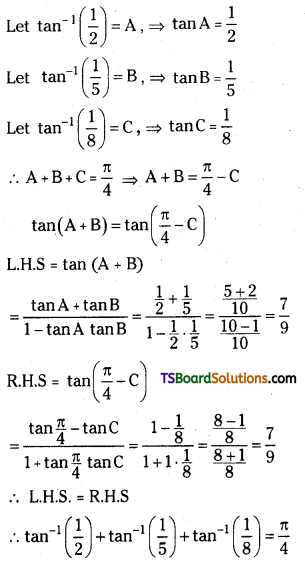
Question 6.
Prove that tan-1\(\left(\frac{1}{2}\right)\) + tan-1\(\left(\frac{1}{5}\right)\) + tan-1\(\left(\frac{1}{4}\right)\) = \(\frac{\pi}{4}\). [Mar. ’18(TS); Mar. ’19, ’17, ’15 (AP), May ’15(AP); May ’11, ’10, ’06, ’03; Mar. ’11]
Answer:
TS Inter First Year Maths 1A Inverse Trigonometric Functions Important Questions 6

TS Inter First Year Maths 1A Inverse Trigonometric Functions Important Questions

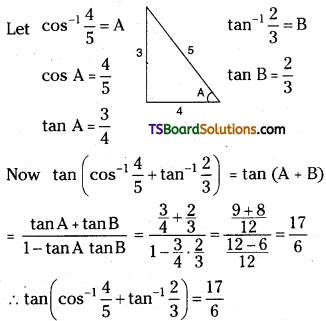
Question 7.
Find the value of tan(cos-1\(\frac{4}{5}\) + tan-1\(\frac{2}{3}\)). [Mar. ’12]
Answer:
TS Inter First Year Maths 1A Inverse Trigonometric Functions Important Questions 7

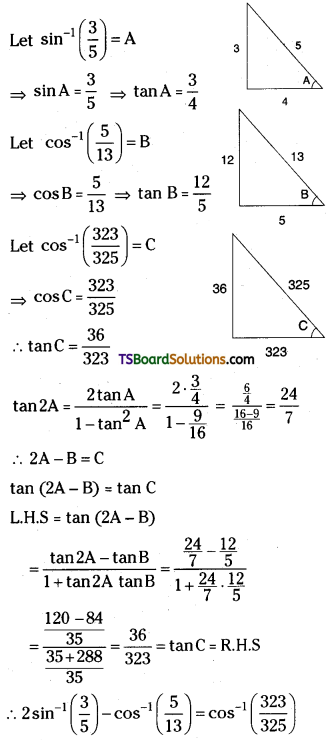
Question 8.
Prove that 2sin-1\(\left(\frac{3}{5}\right)\) – cos-1\(\left(\frac{5}{13}\right)\) = cos-1\(\left(\frac{323}{325}\right)\). [May, ’14; Mar. ’14, ’08]
Answer:
TS Inter First Year Maths 1A Inverse Trigonometric Functions Important Questions 8

Question 9.
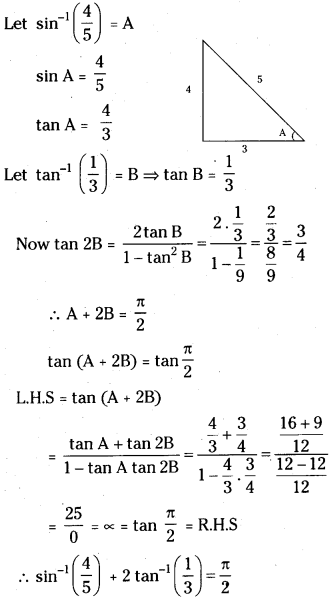
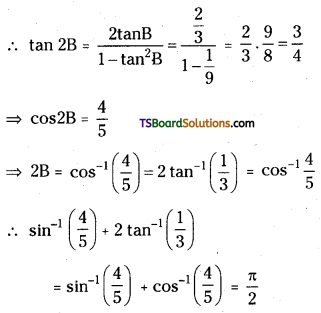
Prove that sin-1\(\frac{4}{5}\) + 2tan-1\(\frac{1}{3}\) = \(\frac{\pi}{2}\). [Mar. ’10, Mar. ’15(TS)]
Answer:
TS Inter First Year Maths 1A Inverse Trigonometric Functions Important Questions 9

Question 10.
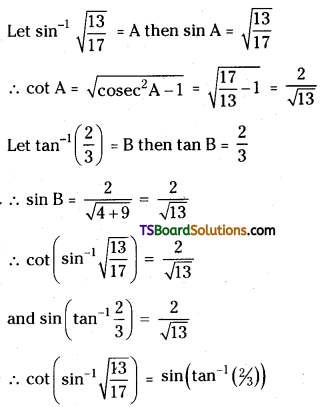
Show that cot (sin-1\(\sqrt{\frac{13}{17}}\)) = sin(tan-1\(\left(\frac{2}{3}\right)\))). [Mar. ’17(TS); May ’97]
Answer:
TS Inter First Year Maths 1A Inverse Trigonometric Functions Important Questions 10

Question 11.
Prove that
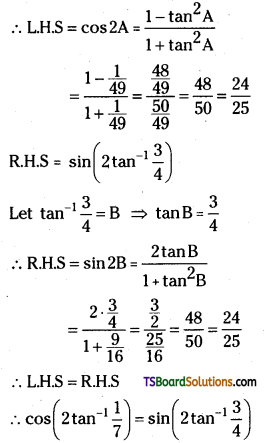
cos(2stan-1\(\frac{1}{7}\)) = sin(3tan-1\(\frac{3}{4}\)). [B.P]
Answer:
L.H.S = cos(2stan-1\(\frac{1}{7}\))
Let tan-1\(\frac{1}{7}\) = A
⇒ tan A = \(\frac{1}{7}\)
TS Inter First Year Maths 1A Inverse Trigonometric Functions Important Questions 11

Question 12.
Prove that [Mar. ’04]
sin[cot-1\(\left(\frac{2 x}{1-x^2}\right)\) + cos-1\(\left(\frac{1-x^2}{1+x^2}\right)\)] = 1
Answer:
Put x = tan θ then
= sin[cot-1\(\left(\frac{2 \tan \theta}{1-\tan ^2 \theta}\right)\) + cos-1\(\left(\frac{1-\tan ^2 \theta}{1+\tan ^2 \theta}\right)\)]
= sin[cot-1(tan 2θ) + cos-1(cos 2θ)]
= sin[cot-1(cot(\(\frac{\pi}{2}\) – 2θ)) + cos-1(cos 2θ)]
= sin[\(\frac{\pi}{2}\) – 2θ + 2θ] = sin\(\frac{\pi}{2}\) = 1 = R.H.S

Question 13.
If cos-1p + cos-1q + cos-1r = π then prove that p2 + q2 + r2 + 2pqr = 1. [Mar ’04; Mar. ’01, ’99]
Answer:
Given cos-1p + cos-1q + cos-1r = π
Let cos-1p = A ⇒ cos A = p
Let cos-1q = B ⇒ cos B = q
Let cos-1r = C ⇒ cos C = r
A + B + C = π ⇒ A + B = π – C
cos(A + B) = cos (π – C)
⇒ cos A. cos B – sin A . sin B = – cos C
cos A cos B – \(\sqrt{1-\cos ^2 \mathrm{~A}} \cdot \sqrt{1-\cos ^2 \mathrm{~B}}\) = -cos C
pq – \(\sqrt{1-p^2} \sqrt{1-q^2}\) = -r
pq + r = \(\sqrt{1-p^2} \sqrt{1-q^2}\)

Squaring on both sides
(pq + r)2 = (1 – p2)(1 – q2)
p2q2 + r2 + 2pqr = 1 – q2 – p2 + p2q2
∴ p2 + q2 + r2 + 2pqr = 1.

TS Inter First Year Maths 1A Inverse Trigonometric Functions Important Questions

Question 14.
If sin-1\(\left(\frac{2 p}{1+p^2}\right)\) – cos-1\(\left(\frac{1-q^2}{1+q^2}\right)\) = tan-1\(\left(\frac{2 x}{1-x^2}\right)\) then prove that x = \(\frac{\mathbf{p}-\mathbf{q}}{1+\mathbf{p q}}\). [May ’98]
Answer:
TS Inter First Year Maths 1A Inverse Trigonometric Functions Important Questions 12

Question 15.
If sin-1x + sin-1y + sin-1z = π, then prove that x\(\sqrt{1-x^2}\) + y\(\sqrt{1-y^2}\) + z\(\sqrt{1-z^2}\) = 2xyz. [Mar. ’06; May ’05, ’97]
Answer:
Given sin-1x + sin-1y + sin-1z = π
Let sin-1x = A ⇒ sin A = x
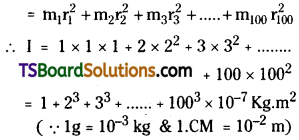
sin-1y = B ⇒ sin B = y
sin-1z = C ⇒ sin C = z
∴ A + B + C = π
= 2sin\(\left(\frac{2 \mathrm{~A}+2 \mathrm{~B}}{2}\right)\) cos\(\left(\frac{2 \mathrm{~A}-2 \mathrm{~B}}{2}\right)\) + sin 2C

= 2 sin (A + B) cos (A – B) + sin 2C
= 2 sin (π – C) cos (A – B) + sin 2C
= 2 sin C cos (A – B) + 2 sin C cos C
= 2 sin C [cos (A – B) + cos C]
= 2 sin C [cos(A – B) + cos (π – (A + B))]
= 2 sin C [cos (A – B) – cos (A + B)]
= 2 sin C (2 sin A. sin B)
= 4 sin A sin B sin C
∴ sin 2A + sin 2B + sin 2C = 4 sin A sin B sin C
⇒ 2 sin A cos A + 2 sin B cos B + 2 sin C cos C = 4 sin A sin B sin C
⇒ sin A cos A + sin B cos B + sin C cos C = 2 sin A sin B sin C
⇒ sin\(\sqrt{1-\sin ^2 \mathrm{~A}}\) + sin B\(\sqrt{1-\sin ^2 \mathrm{~B}}\) + sin C\(\sqrt{1-\sin ^2 \mathrm{~C}}\) = 2sin A sin B sin C
∴ x\(\sqrt{1-x^2}\) + y\(\sqrt{1-y^2}\) + z\(\sqrt{1-z^2}\) = 2xyz

Question 16.
If tan-1x + tan-1y + tan-1z = π, then prove that x + y + z = xyz. [Mar. ’03]
Answer:
Given tan-1x + tan-1y + tan-1z = π
Let tan-1x = A ⇒ tan A = x
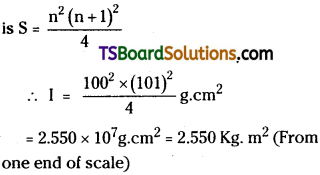
Let tan-1y = B ⇒ tan B = y
Let tan-1z = C ⇒ tan B = y
∴ A + B + C = π ⇒ A + B = π – C
tan (A + B) = tan(π – C) ⇒ \(\frac{\tan A+\tan B}{1-\tan A \tan B}\)
= -tan C
\(\frac{x+y}{1-x y}\) = -z ⇒ x + y = -z + xyz
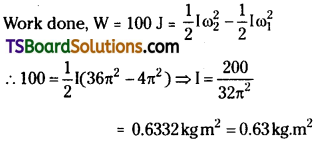
∴ x + y + z = xyz
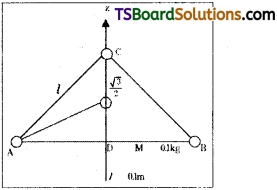
Question 17.
Solve tan-1\(\left(\frac{x-1}{x-2}\right)\) + tan-1\(\left(\frac{x+1}{x+2}\right)=\frac{\pi}{4}\).
Answer:
TS Inter First Year Maths 1A Inverse Trigonometric Functions Important Questions 13

Question 18.
Solve 3sin-1\(\left(\frac{2 x}{1+x^2}\right)\) – 4cos-1\(\left(\frac{1-x^2}{1+x^2}\right)\) + 2tan-1\(\left(\frac{2 x}{1-x^2}\right)=\frac{\pi}{3}\). [Mar. ’09]
Answer:
TS Inter First Year Maths 1A Inverse Trigonometric Functions Important Questions 14
3sin-1(sin 2θ) – 4cos-1(cos 2θ) + 2tan-1(tan 2θ) = \(\frac{\pi}{3}\)
3(2θ) – 4(2θ) + 2(2θ) = \(\frac{\pi}{3}\)
⇒ 6θ – 8θ + 4θ = \(\frac{\pi}{3}\)
2θ = \(\frac{\pi}{3}\) ⇒ θ = \(\frac{\pi}{6}\)
⇒ tan θ = tan \(\frac{\pi}{6}\)
∴ x = \(\frac{1}{\sqrt{3}}\)

TS Inter First Year Maths 1A Inverse Trigonometric Functions Important Questions

Some More Maths 1A Inverse Trigonometric Functions Important Questions

Question 1.
Prove that sin-1\(\left(\frac{4}{5}\right)\) + sin-1\(\left(\frac{5}{13}\right)\) + sin-1\(\left(\frac{16}{65}\right)=\frac{\pi}{2}\). [Mar ’18(AP)]
Answer:
Let sin-1\(\left(\frac{4}{5}\right)\) = A and sin-1\(\left(\frac{5}{13}\right)\) = B
∴ sin A = \(\frac{4}{5}\) and sin B = \(\frac{5}{13}\)
∴ cos A = \(\frac{3}{5}\) and cos B = \(\frac{12}{13}\)

Also cos (α + β) = cos α cos β – sin α sin β
= \(\frac{3}{5} \cdot \frac{12}{13}-\frac{4}{5} \cdot \frac{5}{13}=\frac{16}{65}\)
∴ α + β = cos-1\(\left(\frac{16}{65}\right)\) ⇒ sin-1\(\left(\frac{4}{5}\right)\) + sin-1\(\left(\frac{5}{13}\right)\) = cos-1\(\left(\frac{16}{65}\right)\)

L.H.S = sin-1\(\left(\frac{4}{5}\right)\) + sin-1\(\left(\frac{5}{13}\right)\) + sin-1\(\left(\frac{16}{65}\right)\) = cos-1\(\left(\frac{16}{65}\right)\) + sin-1\(\left(\frac{16}{65}\right)\) = \(\frac{\pi}{2}\)

Question 2.
Prove that cot-19 + cosec-1\(\frac{\sqrt{41}}{4}=\frac{\pi}{4}\).
Answer:
Let cot-19 = α
Let cosec-1\(\frac{\sqrt{41}}{4}\) = β
⇒ cot α = 9 ⇒ cosec β = \(\frac{\sqrt{41}}{4}\)
⇒ tan α = \(\frac{1}{9}\) ⇒ tan β = \(\frac{4}{5}\)
TS Inter First Year Maths 1A Inverse Trigonometric Functions Important Questions 15
From the figure
Take tan (α + β) = \(\frac{\tan \alpha+\tan \beta}{1-\tan \alpha \cdot \tan \beta}\)
TS Inter First Year Maths 1A Inverse Trigonometric Functions Important Questions 16

Question 3.
Prove that sin-1\(\left(\frac{4}{5}\right)\) + 2tan-1\(\left(\frac{1}{3}\right)=\frac{\pi}{2}\)
Answer:
Let sin-1\(\left(\frac{4}{5}\right)\) = A then sin A = \(\frac{4}{5}\) and
tan-1\(\left(\frac{1}{3}\right)\) = B then tan B = \(\frac{1}{3}\)
TS Inter First Year Maths 1A Inverse Trigonometric Functions Important Questions 17

TS Inter First Year Maths 1A Inverse Trigonometric Functions Important Questions

Question 4.
If cos-1\(\frac{p}{a}\) + cos-1\(\frac{q}{b}\) = α, then prove that \(\frac{p^2}{a^2}-\frac{2 p q}{a b}\)cos α + \(\frac{q^2}{b^2}\) = sin2α
Answer:
Given cos-1\(\frac{p}{a}\) + cos-1\(\frac{q}{b}\) = α
TS Inter First Year Maths 1A Inverse Trigonometric Functions Important Questions 18
TS Inter First Year Maths 1A Inverse Trigonometric Functions Important Questions 19

Question 5.
Solve sin-1\(\left(\frac{5}{x}\right)\) + sin-1\(\left(\frac{12}{x}\right)=\frac{\pi}{2}\), (x > 0)
Answer:
Let sin-1\(\left(\frac{5}{x}\right)\) = A and sin-1\(\left(\frac{12}{x}\right)\) = B then
sin A = \(\frac{5}{x}\) and sin B = \(\frac{12}{x}\)(x > 0)
∴ Now α + β = \(\frac{\pi}{2}\) ⇒ sin α = sin(\(\frac{\pi}{2}\) – β)
= cos β ⇒ \(\frac{5}{x}=\sqrt{1-\frac{144}{x^2}}\)

⇒ \(\frac{25}{x^2}=1-\frac{144}{x^2} \Rightarrow \frac{169}{x^2}\) = 1 ⇒ x2 = 169
⇒ x = ±13 But x = 13(∵ x > 0)

Question 6.
Prove that sin-1\(\left(\frac{3}{5}\right)\) + cos-1\(\left(\frac{12}{13}\right)\) = cos-1\(\left(\frac{33}{65}\right)\).
Answer:
Let sin-1\(\left(\frac{3}{5}\right)\) = A and cos-1\(\left(\frac{12}{13}\right)\) = B then
A + B ∈ (0, π)
∴ sin A = \(\frac{3}{5}\) and cos B = \(\frac{12}{13}\)
cos A = \(\frac{4}{5}\) and sin B = \(\frac{5}{13}\)

Consider cos(A + B) = cos A cos B – sin A sin B
= \(\left(\frac{4}{5}\right)\left(\frac{12}{13}\right)-\left(\frac{3}{5}\right)\left(\frac{5}{13}\right)=\frac{48}{65}-\frac{15}{65}=\frac{33}{65}\)
A + B = cos-1\(\left(\frac{33}{65}\right)\)
⇒ sin-1\(\left(\frac{3}{5}\right)\) + cos-1\(\left(\frac{12}{13}\right)\) = cos-1\(\left(\frac{33}{65}\right)\)

Question 7.
Find the values of sin(cos-1\(\frac{3}{5}\) + cos-1\(\frac{12}{13}\)).
Answer:
Let cos-1\(\left(\frac{3}{5}\right)\) = A and cos-1\(\left(\frac{12}{13}\right)\) = B then
cos A = \(\frac{3}{5}\) and cos B = \(\frac{12}{13}\)
∴ sin A = \(\frac{4}{5}\) and sin B = \(\frac{5}{13}\)
∴ sin(A + B) = sin A cos B + cos A sin B
= \(\left(\frac{4}{5}\right)\left(\frac{12}{13}\right)+\left(\frac{3}{5}\right)\left(\frac{5}{13}\right)=\frac{63}{65}\)
∴ sin(cos-1\(\frac{3}{5}\) + cos-1\(\frac{12}{13}\))

Question 8.
Prove that cos(2tan-1\(\frac{1}{7}\)) = sin(2tan-1\(\frac{3}{4}\))
Answer:
Let α = tan-1(\(\frac{1}{7}\)) then tan α = \(\frac{1}{7}\)
TS Inter First Year Maths 1A Inverse Trigonometric Functions Important Questions 20

TS Inter First Year Maths 1A Inverse Trigonometric Functions Important Questions

Question 9.
Prove that tan-1\(\frac{1}{7}\) + tan-1\(\frac{1}{13}\) – tan-1\(\frac{2}{9}\) = 0
Answer:
L.H.S = (tan-1\(\frac{1}{7}\) + tan-1\(\frac{1}{13}\)) – tan-1\(\frac{2}{9}\)
[we have x > 0, y > 0, xy > 1 then tan-1x + tan-1y + tan-1z = tan-1\(\left(\frac{x+y}{1-x y}\right)\)]
TS Inter First Year Maths 1A Inverse Trigonometric Functions Important Questions 21

Question 10.
Prove that tan-1\(\frac{3}{4}\) + tan-1\(\frac{3}{5}\) – tan-1\(\frac{8}{19}\) = \(\frac{\pi}{4}\)
Answer:
LHS = tan-1\(\frac{3}{4}\) + tan-1\(\frac{3}{5}\) – tan-1\(\frac{8}{19}\)
TS Inter First Year Maths 1A Inverse Trigonometric Functions Important Questions 22

Question 11.
Show that tan-1\(\frac{1}{7}\) + tan-1\(\frac{1}{8}\) = cot-1\(\frac{201}{43}\) + cot-118.
Answer:
TS Inter First Year Maths 1A Inverse Trigonometric Functions Important Questions 23

Question 12.
Show that sec2 (tan-12) + cosec2 (cot-12) = 10.
Answer:
Let a = tan-12 ⇒ tan α = 2
sec2α = 1 + tan2α = 1 + 4 = 5
Let β = cot-12 ⇒ cot β = 2
∴ cosec2β = 1 + cot2β = 1 + 4 = 5
∴ sec2 (tan-12) + cosec2 (cot-12)
= sec2α + cosec2β = 5 + 5 = 10

TS Inter First Year Maths 1A Inverse Trigonometric Functions Important Questions

Question 13.
If α = tan-1\(\left[\frac{\sqrt{1+x^2}-\sqrt{1-x^2}}{\sqrt{1+x^2}+\sqrt{1-x^2}}\right]\), then prove that x2 = sin 2α.
Answer:
TS Inter First Year Maths 1A Inverse Trigonometric Functions Important Questions 24

Question 14.
If tan-1x + tan-1y + tan-1z = \(\frac{\pi}{2}\), prove that xy + yz + zx = 1.
Answer:
Given tan-1x + tan-1y + tan-1z = \(\frac{\pi}{2}\)
tan-1x + tan-1y = \(\frac{\pi}{2}\) – tan-1z
tan-1\(\left[\frac{x+y}{1-x y}\right]\) = \(\frac{\pi}{2}\) – tan-1z
TS Inter First Year Maths 1A Inverse Trigonometric Functions Important Questions 25
⇒ (x + y)z = 1 – xy
⇒ xz + yz = 1 – xy
⇒ xy + yz + zx = 1

TS Inter 1st Year Maths 1A Functions Important Questions Very Short Answer Type

Students must practice these Maths 1A Important Questions TS Inter 1st Year Maths 1A Functions Important Questions Very Short Answer Type to help strengthen their preparations for exams.

TS Inter 1st Year Maths 1A Functions Important Questions Very Short Answer Type

Question 1.
If the function f is defined by
TS Inter First Year Maths 1A Functions Important Questions Very Short Answer Type 1
then find the 2x +1, x < -3 values if exist of f(4), f(2.5), f(- 2), f(- 4), f(0), f(- 7). [Mar 14]
Answer:
(i) f(4) For x > 3, f(x) = 3x – 2
f(4) = 3 (4) – 2 = 12 – 2 = 10

(ii) f(2.5) is not defined.

(iii) f(-2)
For – 2 ≤ x ≤ 2, f(x) = x2 – 2
f(- 2) = (- 2)2 – 2 = 4 – 2 = 2

(iv) f(-4)
For x < – 3, f(x) = 2x + 1
f(- 4) = 2(- 4) + 1 = – 8 + 1 = – 7

(v) f(0)
For – 2 ≤ x ≤ 2, f(x) = x2 – 2
f(0) = 02 – 2 = – 2

(vi) f(- 7)
For x < – 3, f(x) = 2x + 1
f(- 7) = 2 (- 7) + 1 = – 14 + 1 = – 13

TS Inter First Year Maths 1A Functions Important Questions Very Short Answer Type

If the function f is defined by
TS Inter First Year Maths 1A Functions Important Questions Very Short Answer Type 2
then find the values of
(i) f(3)
(ii) f(0)
(iii) f(-1.5)
(iv) f(2) + f(-2)
(v) f(- 5).
Answer:
(i) 5
(ii) 2
(iii) – 2.5
(iv) 1
(v) not defined

Question 2.
If A = \(\left\{0, \frac{\pi}{6}, \frac{\pi}{4}, \frac{\pi}{3}, \frac{\pi}{2}\right\}\) and f: A → B is a surjection defined by f(x) = cos x then find B. [Mar. (TS) 17, 16 (AP), 11 May 15 (AP), 15 (TS), 11]
Answer:
Given A = \(\left\{0, \frac{\pi}{6}, \frac{\pi}{4}, \frac{\pi}{3}, \frac{\pi}{2}\right\}\)
f(x) = cos x
Since f: A → B is a surjection then f(A) = B
f(0) = cos 0 = 1
TS Inter First Year Maths 1A Functions Important Questions Very Short Answer Type 3
∴ B = Range . f(A) = {1, \(\frac{\sqrt{3}}{2}, \frac{1}{\sqrt{2}}, \frac{1}{2}\), o}

If A = {- 2, – 1, 0, 1, 2} and f: A → B is a surjection defined by f(x) = x2 + x + 1, then find B. [Mar. (AP) 19, 17] [Mar 16 (TS): May 14, 10]
Answer:
{3, 1, 7}

If A = {1, 2, 3, 4} and f: A → R is a function defined by f(x) = \(\frac{x^2-x+1}{x+1}\), then find the range of f.
Answer:
\(\left\{1, \frac{1}{2}, \frac{7}{4}, \frac{13}{5}\right\}\)

Question 3.
Determine whether the function f: R → R defined by
TS Inter First Year Maths 1A Functions Important Questions Very Short Answer Type 4
is an injection or a surjection or a bijection.
Answer:
Given f: R → R
TS Inter First Year Maths 1A Functions Important Questions Very Short Answer Type 5
If x = 3 > 2 then f(3) = 3
If x = 1 <2 then f(1) = 5(1) – 2 = 5 – 2 = 3
∴ 1 and 3 have same f image,
∴ f is not an injection.
If y ∈ R (co-domain) then y = x
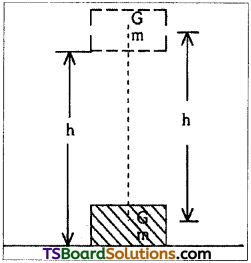
x = y
then f (x) = x
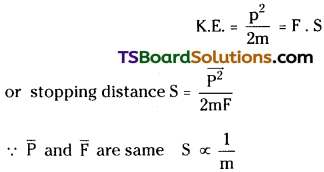
f(x) = y
If y ∈ R (co-domain) then y = 5x – 2
y + 2 = 5x
x = \(\frac{y+2}{5}\)
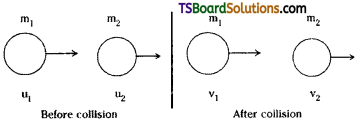
then f (x) = 5x – 2
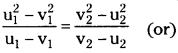
TS Inter First Year Maths 1A Functions Important Questions Very Short Answer Type 6
= y + 2 – 2 = y
∴ f is a surjection since f is not an injection then it is not a bijection.

TS Inter First Year Maths 1A Functions Important Questions Very Short Answer Type

Question 4.
If f: R → R, g : R → R are defined by f(x) = 4x – 1 and g(x) = x2 + 2 then find [May 09. Mar. 05, 04]
(i)(gof) (x)
(ii) (gof) \(\left(\frac{a+1}{4}\right)\)
(iii) (fof) (x)
(iv) [go (fof)] (0)
Answer:
Given f: R → R, g: R → R
f(x) = 4x – 1 and g(x) = x2 + 2

(i) (gof) (x) = g [f(x)] = g[4x – 1]
= (4x – 1)2 + 2
= 16x2 + 1 – 8x + 2
= 16x2 – 8x + 3

(ii) (gof) \(\left(\frac{a+1}{4}\right)\) = g \(\left[\mathrm{f}\left(\frac{\mathrm{a}+1}{4}\right)\right]\)
= g\(\left[4\left(\frac{a+1}{4}\right)-1\right]\)
= g[a + 1 – 1 ]
= g(a) = a2 + 2

(iii) (fof) (x) = f [f(x)] = f[4x – 1]
= 4 (4x – 1) – 1
= 16x – 4 – 1
= 16x – 5

(iv) [go (fof)] (0)
Now (fof) (0) = f[f(0)] = f[4(0) – 1] = f(- 1)
= 4( – 1) – 1 = – 4 – 1 = – 5
[go (fof)] (0) = go [(fof)(0)]
= g [- 5] = (- 5)2 + 2
= 25 + 2 = 27

Question 5.
If f: Q → Q is defined by f(x) = 5x + 4 for all x ∈ Q, show that ‘f is a bijection and find f-1. [Mar. 17 (TS). 16 (AP)]
Answer:
Given f: Q → Q, f(x) = 5x + 4, ∀ x ∈ Q
Let a1, a2 ∈ Q
f(a1) = f(a2)
5a1 + 4 = 5a2 + 4
5a1 = 5a2
a1 = a2
∴ f: Q → Q is an one – one function.
Let y ∈ Q (co-domain) then y = 5x + 4
y – 4 = 5x
TS Inter First Year Maths 1A Functions Important Questions Very Short Answer Type 7
f(x) = y
∴ f: Q → Q is an onto function.
∴ f: Q → Q is a bijection.
∴ f-1: Q → Q is a bijection.

Question 6.
If f : R → R, g : R → R are defined by f(x) = 3x – 1, g(x) = x2 + 1, then find (fog) (2). [Mar. 18 (AP) May 13; Mar 13]
Answer:
Given f: R → R and g : R → R defined by
f(x) = 3x – 1 ; g(x) = x2 + 1
(fog) (2) = f[g(2)] = f(22 + 1)
= f(5) = 3(5) – 1 = 14

TS Inter First Year Maths 1A Functions Important Questions Very Short Answer Type

Question 7.
If f(x) = \(\frac{1}{x}\), g (x) = √x for all x ∈ (0, ∞), x then find (gof) (x).
Answer:
Given
f(x) = \(\frac{1}{x}\), g(x) = √x ∀ x ∈ (0, ∞)
Now (gof) (x) = g[f(x)] = g \(\left[\frac{1}{x}\right]\) = \(\sqrt{\frac{1}{x}}=\frac{1}{\sqrt{x}}\)

Question 8.
If f(x) = 2x – 1, g(x) = \(\frac{x+1}{2}\) for all x ∈ R, then find (gof) (x). [Mar 19 (AP); Sep 92]
Answer:
Given f(x) = 2x – 1, g(x) \(\frac{x+1}{2}\) ∀ x ∈ R
Now (gof) (x) = g[f(x)] = g(2x – 1)
= \(\frac{2 \mathrm{x}-1+1}{2}\) = \(\frac{2 x}{2x}\) = x

Question 9.
If f(x) = 2, g(x) = x2, h(x) = 2x for all x ∈ R, then find [fo(goh)] (x). [Mar. 17 (TS); July 01]
Answer:
Given f(x) = 2, g(x) = x2, h(x) = 2x ∀ x ∈ R.
Now (goh) (x) = g[h(x)] = g[2x] = (2x)2 = 4x2
[fo(goh)](x) = f[(goh) (x)] = f[4x2] = 2

Question 10.
Find the inverse function of f(x) = ax + b, (a ≠ 0); a, b ∈ R [Mar. 18 (TS); Mar. 13]
Answer:
Given, a, b ∈ R, f: R → R and
f(x) = ax + b
Let y = f(x) = ax + b
y = f(x) ⇒ x = f -1 (y) …………….. (1)
y = ax + b ⇒ ax = y – b ⇒ x = \(\frac{\mathrm{y}-\mathrm{b}}{\mathrm{a}}\) ……………… (2)
From (1) and (2)
f-1(y) = \(\frac{y-b}{a}\) ⇒ f-1(x) = \(\frac{x-b}{a}\)

If f: Q → Q is defined by f(x) = 5x + 4, for all x ∈ Q, find f-1. [Mar. 12, 10]
Answer:
\(\frac{x-4}{5}\)

Question 11.
Find the inverse function of f(x) = 5x [Mar. 15 (AP); Mar. ’11’, 06]
Answer:
Given f(x) = 5x
Let y = f(x) = 5x
y = f(x) ⇒ x = f-1(y) …………………. (1)
y = 5x ⇒ x = log5y ……………………. (2)
From (1) and (2),
f-1(y) = log5y ⇒ f-1 (x) = log5x

Question 12.
If f: R → R, g: R → R defined by f(x) = 3x – 2, g(x) = x2 + 1, then find (i) (gof-1) (2) (ii) (gof) (x – 1). [Mar. 08; May 06]
Answer:
Given f: R → R, g: R → R, f(x) = 3x – 2, g(x) = x2 – 1
Let y = f(x) = 3x – 2
y = f(x) ⇒ x = f-1 ……………. (1)
y = 3x – 2 ⇒ y + 2 = 3x
x = \(\frac{\mathrm{y}+2}{3}\) ………………….. (2)
From (1) & (2)
f-1(y) = \(\frac{\mathrm{y}+2}{3}\)
⇒ f-1 (x) = \(\frac{\mathrm{x}+2}{3}\)

TS Inter First Year Maths 1A Functions Important Questions Very Short Answer Type

(i) (gof-1) (2)
= g[f-1 (2)]
TS Inter First Year Maths 1A Functions Important Questions Very Short Answer Type 8

(ii) (gof) (x – 1)
= g[f(x -1)]
= g[3(x – 1) – 2]
= g[3x – 3 – 2]
= g(3x – 5)
= (3x – 5)2 + 1
= 9x2 + 25 – 30x + 1
= 9x2 – 30x + 26

Question 13.
If f(x) = \(\frac{x+1}{x-1}\) (x ≠ ± 1), then find (fofof) (x) [Mar. 05]
Answer:
Given f(x) = \(\frac{x+1}{x-1}\) (x ≠ ± 1)
TS Inter First Year Maths 1A Functions Important Questions Very Short Answer Type 9

If f(x) = \(\) (x ≠ ± 1), then find (fofofof) (x)
Answer:
x

Question 14.
Find the domain of the real valued function f(x) = \(\sqrt{a^2-x^2}\) [June 04]
Answer:
Given f(x) = \(\sqrt{a^2-x^2}\) ∈ R
⇒ a2 – x2 ≥ 0
⇒ x2 – a2 ≤ 0
⇒ (x + a) (x – a) ≤ 0
– a ≤ x ≤ a
TS Inter First Year Maths 1A Functions Important Questions Very Short Answer Type 10
⇒ x ∈ [-a, a]
∴ Domain of ‘f is [-a, a]

Find the domain of the real valued function f(x) = \(\sqrt{16-x^2}\).
Answer:
[- 4, 4]

Find the domain of the real valued function f(x) = \(\sqrt{9-x^2}\).
Answer:
[-3, 3]

TS Inter First Year Maths 1A Functions Important Questions Very Short Answer Type

Question 15.
Find the domain of the real valued function
f(x) = \(\frac{1}{\left(x^2-1\right)(x+3)}\). [May 14, 93; Mar. 14]
Answer:
Given f(x) = \(\frac{1}{\left(x^2-1\right)(x+3)}\)
f(x) = \(\frac{1}{\left(x^2-1\right)(x+3)}\) ∈ R
⇒ (x2 – 1) (x + 3) ≠ 0
x2 – 1 ≠ 0, x + 3 ≠ 0
x2 ≠ 1, x ≠ – 3
x ≠ ± 1
∴ x ≠ -3, -1, 1
∴ Domain of ‘f is R – {-3, -1, 1}

Find the domain of the real valued function f(x) = \(\frac{1}{6 x-x^2-5}\).
Answer:
R – {1, 5}

Find the domain of the real valued function f(x) = \(\frac{2 x^2-5 x+7}{(x-1)(x-2)(x-3)}\)
Answer:
R- {1, 2, 3}

Question 16.
Find the domain of the real valued function f(x) = \(\sqrt{4 x-x^2}\). [May 12, 10] [Mar; 18 (TS)]
Answer:
Given, f(x) = \(\sqrt{4 x-x^2}\) ∈ R
⇒ x(4 – x) ≥ 0
TS Inter First Year Maths 1A Functions Important Questions Very Short Answer Type 11
⇒ x(4 – x) ≥ 0
⇒ x(x-4) ≤ 0
⇒ (x – 0) (x – 4) ≤ 0
⇒ 0 ≤ x ≤ 4
∴ Domain of ‘f’ is [0, 4].

Question 17.
Find the domain of the real valued function f(x) = \(\frac{1}{\sqrt{1-x^2}}\)
Answer:
Given f(x) = \(\frac{1}{\sqrt{1-x^2}}\) ∈ R
TS Inter First Year Maths 1A Functions Important Questions Very Short Answer Type 12
⇔ 1 – x2 > 0 “
⇔ (1 + x) (1 – x) > 0
⇔ x ∈ (-1, 1)
∴ Domain of T = {x/x ∈ (-1, 1)}

Question 18.
Find the domain of the real valued function f(x) = \(\sqrt{\mathbf{x}^2-25}\) [May 15 (AP); Mar. 12]
Answer:
Given f(x) = \(\sqrt{x^2-25}\) ∈ R
⇒ x2 – 25 ≥ 0
⇒ (x + 5) (x – 5) ≥ 0
⇒ x < -5 or x > 5
⇒ x ∈ (- α, -5] ∪ [5, α)
∴ Domain of T is (-α, -5] ∪ [5, α).
TS Inter First Year Maths 1A Functions Important Questions Very Short Answer Type 13

TS Inter First Year Maths 1A Functions Important Questions Very Short Answer Type

Question 19.
Find the domain of the real valued function f(x) = log (x2 – 4x + 3) [Mar. 16 (TS), 10, ‘08 ; May 11, 07]
Answer:
Given f(x) = log (x2 – 4x + 3) ∈ R
⇒ x2 – 4x + 3 > 0
⇒ x2 – 3x – x + 3 > 0
⇒ x (x – 3) – 1 (x – 3) > 0
⇒ (x – 1) (x – 3) > 0
⇒ x < 1 or x > 3
⇒ x ∈ (- α, 1) ∪ (3, α)
TS Inter First Year Maths 1A Functions Important Questions Very Short Answer Type 14

Question 20.
Find the domain of the real valued function f(x) = \(\frac{\sqrt{3+x}+\sqrt{3-x}}{x}\)
Answer:
Given f(x) = \(\frac{\sqrt{3+x}+\sqrt{3-x}}{x}\) ∈ R
⇒ 3 + x ≥ 0 and 3 – x ≥ 0, x ≠ 0
x ≥ – 3 and 3 ≥ x, x ≠ 0, x ≤ 3
x ∈ [- 3, ∝) ∩ (-∝, 3) – {0}
⇒ x ∈ [- 3, 3] – {0}
(or)
⇒ x ∈ [- 3, 0) ∪ (0, 3]
∴ Domain of ‘f is [- 3, 3] – {0}
TS Inter First Year Maths 1A Functions Important Questions Very Short Answer Type 15

Find the domain of the real valued function f(x) = \(\frac{\sqrt{2+x}+\sqrt{2-x}}{x}\).
Answer:
[- 2, 0) ∪ (0, 2]

Question 21.
Find the range of the reed valued function, log |4 – x2|.
Answer:
Let y = f(x) = log |4 – x2|
f(x) ∈ R ⇒ 4 – x2 ≠ 0
x2 ≠ 4 ⇒ x ≠ ± 2
∴ Domain of ‘f is R – {- 2, 2}
∴ y = loge |4 – x2|
|4 – x2| = ey
⇒ ey > 0, ∀ y ∈ R
∴ Range of T is R.

Question 22.
Find the range of the real valued function. \(\frac{x^2-4}{x-2}\) [May 03, 97]
Answer:
Let y = f(x) = \(\frac{x^2-4}{x-2}\)
f(x) ∈ R ⇒ x – 2 ≠ 0 ⇒ x ≠ 2
∴ Domain of ‘f is R – {2}
Let y = \(\frac{x^2-4}{x-2}\), if x ≠ 2 then y = x + 2
If x = 2, then y = 2 + 2 = 4
y is not defined at x = 2, then y cannot be equal to 4.
∴ Range of T is R – {4}.

TS Inter First Year Maths 1A Functions Important Questions Very Short Answer Type

Question 23.
Find the domain and range of the function f(x) = \(\frac{x}{2-3 x}\)
Answer:
Given f(x) = \(\frac{x}{2-3 x}\) ∈ R
⇒ 2 – 3x ≠ 0
⇒ 2 ≠ 3x
⇒ x ≠ \(\frac{2}{3}\)
∴ Domain of ‘f’ is R – \(\left\{\frac{2}{3}\right\}\)
Let y = f(x) = \(\frac{x}{2-3 x}\)
∴ y = \(\frac{x}{2-3 x}\)
2y – 3xy = x ⇒ 2y = x + 3x ⇒ 2y = x(1 + 3y)
TS Inter First Year Maths 1A Functions Important Questions Very Short Answer Type 16

Question 24.
If f = {(4, 5), (5, 6), (6, – 4)} and g = {(4, -4), (6, 5), (8, 5)}, then find
(i) f + 4
(ii) fg
(iii) √f
(iv) f2.
Answer:
(i) f + 4
Domain of f + 4 = A = {4, 5, 6}
(f + 4) (x) = f(x) + 4
(f + 4) (4) = f(4) + 4 = 5 + 4 = 9
(f + 4) (5) = f(5) + 4 = 6 + 4= 10
(f + 4) (6) = f(6) + 4 = -4 + 4 = 0
∴ f + 4 = {(4, 9), (5, 10), (6, 0)}

(ii) fg
Domain of fg = A ∩ B = {4, 6}
(fg) (x) = f(x) . g(x)
(fg) (4) = f(4) . g(4) = 5(-4) = -20
(fg) (6) = f(6) . g(6) = (-4) (5) = -20
∴ fg = {(4, -20), (6, – 20)}

(iii) √f
Domain of √f = {4, 5, 6} = A
√f (x) = √f(x)
√f(4) = √f(4) = √5
√f (5) = √f(5) = √6
√f (6) = √f(6) = √-4 (does not exist)
∴ √f = {(4, √5), (5, √6)}

(iv) f2
Domain of f2 = A = {4, 5, 6}
f2(x) = [f(x)]2
f2(4) = [f(4)]2 = (5)2 = 25
f2(5) = [f(5)]2 = (6)2 = 36
f2(6) = [f(6)]2 = (- 4)2 = 16
∴ f2 = {(4, 25), (5, 36), (6, 16)}

TS Inter First Year Maths 1A Functions Important Questions Very Short Answer Type

If f = {(1, 2), (2, -3), (3, -1)}, then find
(i) 2f [Mar. 12; 94, 90; May 94]
(ii) 2 + f [Mar. 12; May 08]
(iii) f2 [Mar. 08, May. 95, 90]
(iv) √f
Answer:
(i) {(1, 4), (2, -6), (3, -2)}
(ii) {(1, 4), (2, -1), (3, 1)}
(iii) {(1, 4), (2, 9), (3, 1)}
(iv) {(1, √2)}

TS Inter 1st Year English Study Material Telangana | TS Intermediate 1st Year English Textbook Solutions Pdf

Here you will find Telangana TSBIE State Board Syllabus TS Inter 1st Year English Study Material, Keep Going Interactive English Intermediate 1st Year English Textbook Solutions Pdf Download according to the latest exam curriculum. The chapter-wise TS Inter 1st Year Study Material will allow students to practice a wide range of questions, which will help them gain more knowledge and develop control over the subject.

TS Intermediate 1st Year English Study Material Pdf Download | TS Inter 1st Year English Textbook Solutions Telangana

Here, the students can access the links of chapter-wise Keep Going Interactive English Intermediate First Year English Textbook Solutions Pdf Download provides answers to all the textbook questions in simple language with the main aim of helping students ace the examinations.

TS Inter 1st Year English Textbook Answers

TS Intermediate 1st Year English Textbook Solutions – Poetry

Inter 1st Year English Textbook Answers Telangana – Prose

TS Inter 1st Year English Short Stories

TS Inter 1st Year English Reading Comprehension

TS Inter 1st Year English Grammar with Answers

TS Inter 1st Year English Revision Tests I-V

  • Revision Test-I
  • Revision Test-II
  • Revision Test-III
  • Revision Test-IV
  • Revision Test-V

We hope this TS Intermediate 1st Year English Textbook Solutions Pdf Download will be useful for students to get an idea of answering textbook questions efficiently. If there is any trouble in grasping the concepts related to TS Inter 1st Year English Textbook Answers Telangana, drop your questions in the comment and we will get back to you with a solution in time.

TS Inter 1st Year Physics Study Material Chapter 6 Work, Energy and Power

Telangana TSBIE TS Inter 1st Year Physics Study Material 6th Lesson Work, Energy and Power Textbook Questions and Answers.

TS Inter 1st Year Physics Study Material 6th Lesson Work, Energy and Power

Very Short Answer Type Questions

Question 1.
If a bomb at rest explodes into two pieces, the pieces must travel in opposite directions. Explain.
Answer:
Explosion is due to internal forces. In law of conservation of linear momentum internal forces cannot change the momentum of the system. So after explosion m1v1 + m2v2 = 0 or m1v1 = – m2v2 ⇒ they will fly in opposite directions.

Question 2.
State the conditions under which a force does no work.
Answer:

  1. When force (F) and displacement (S) are mutually perpendicular then work done is zero.
    ∵ W = \(\overline{\mathrm{F}}.\overline{\mathrm{S}}\) = |F| |S| cos θ when θ = 90° work W = 0
  2. Even though force is applied if displacement is zero then work done W = 0.

Question 3.
Define Work, Power and Energy. State their S.I. units.
Answer:
Work :
The product of force and displacement along the direction of force is called work.
Work done W = \(\overline{\mathrm{F}}.\overline{\mathrm{S}}\)
= \(|\overline{\mathrm{F}}||\overline{\mathrm{S}}|\) cos θ
S.I. unit of work is Joule.
Dimensional formula : ML²T-2.

Power :
The rate of doing work is called power.
TS Inter 1st Year Physics Study Material Chapter 6 Work, Energy and Power 1
S.I. unit: Watt;
D.F. : ML²T-3

Energy :
It is the capacity or ability of the body to do work. By spending energy we can do work or by doing work energy contentment of the body will increase.
S.I. unit: Joule ; D.F. : MML²T-2

Question 4.
State the relation between the kinetic energy and momentum of a body.
Answer:
Kinetic energy K.E = \(\frac{1}{2}\)mv² ;
momentum \(\overline{\mathrm{p}}\) = mv
Relation between P and KE is
K.E = p²/2m. ⇒ P = \(\sqrt{K.E.2m}\)

TS Inter 1st Year Physics Study Material Chapter 6 Work, Energy and Power

Question 5.
State the sign of work done by a force in the following.
a) Work done by a man in lifting a bucket out of a well by means of a rope tied to the bucket.
b) Work done by gravitational force in the above case.
Answer:
a) When a bucket is lifted out of well work is done against gravity so work done is negative.

b) Work done by gravitational force is positive.

Question 6.
State the sign of work done by a force in the following.
a) work done by friction on a body sliding down an inclined plane.
b) work done gravitational force in the above case.
Answer:
a) Work done by friction while sliding down is negative. Because it opposes downward motion of the body.

b) Work done by gravitational force when a body is sliding down is positive.

Question 7.
State the sign of work done by a force in the following.
a) work done by an applied force on a body moving on a rough horizontal plane with uniform velocity.
b) work done by the resistive force of air on a vibrating pendulum in bringing it to rest.
Answer:
a) Work done against the direction of motion of a body moving on a horizontal plane is negative.

b) In pendulum a∝ – y. So work done by air resistance to bring it to rest is considered as positive.

Question 8.
State if each of the following statements is true or false. Give reasons for your answer.
a) Total energy of a system is always conserved, no matter what internal and external forces on the body are present
b) The work done by earth’s gravitational force in keeping the moon in its orbit for its one revolution is zero.
Answer:
a) Law of conservation of energy states that energy can be neither created nor destroyed. This rule is applicable to internal forces and also for external forces when they are conservative forces.

b) Gravitational forces are conservative forces. Work done by conservative force around a closed path is zero.

Question 9.
Which physical quantity remains constant (i) in an elastic collision (ii) in an inelastic collision?
Answer:
In elastic collision :
P and K.E. are conserved, (remains constant)

In inelastic collision :
only momentum is conserved, (remains constant)

Question 10.
A body freely falling from a certain height ‘h’, after striking a smooth floor rebounds and h rises to a height h/2. What is the coefficient of restitution between the floor and the body?
Answer:
Given that, h1 = h and h2 = \(\frac{h}{2}\)
We know that coefficient of restitution.
TS Inter 1st Year Physics Study Material Chapter 6 Work, Energy and Power 2

Question 11.
What is the total displacement of freely falling body, after successive rebounds from the same place of ground, before it comes to stop? Assume that V is the coefficient of restitution between the body and the ground.
Answer:
Total displacement of a freely falling body after successive rebounds from the same place of ground, before it comes to stop is equal to height (h) from which the body is dropped.

Short Answer Questions

Question 1.
What is potential energy? Derive an expression for the gravitational potential energy.
Answer:
Potential energy :
It is the energy possessed by a body by the virtue of its position.
Ex: Energy stored in water a over head tank, wound spring.
TS Inter 1st Year Physics Study Material Chapter 6 Work, Energy and Power 3

Equation for potential energy :
Let a body of mass m is lifted through a height ‘h’ above the ground. Where ground is taken as refe-rence. In this process we are doing some work.

Work done against gravity W = m.g.h.
i. e., Force × displacement along the direction of force applied. This work done is stored in the body in the form of potential energy. Because work and energy can be interchanged.
∴ Potential Energy P.E. = mgh.

TS Inter 1st Year Physics Study Material Chapter 6 Work, Energy and Power

Question 2.
A lorry and a car moving with the same momentum are brought to rest by the application of brakes, which provide equal retarding forces. Which of them will come to rest in shorter time? Which will come to rest in less distance?
Answer:
Momentum (\(\overline{\mathrm{P}}\) = mv) is same for both lorry and car.
Work done to stop a body = Kinetic energy stored
∴ W = F. S = \(\frac{1}{2}\) mv² = K.E. But force applied by brakes is same for lorry and car.
Relation between \(\overline{\mathrm{P}}\) on K.E. is
TS Inter 1st Year Physics Study Material Chapter 6 Work, Energy and Power 4

So lighter body (car) will travel longer distance when P, F are same.
Then mS = constant.
∴ So car travels longer distance than lorry before it is stopped.

Question 3.
Distinguish between conservative and non-conservative forces with one example each.
Answer:
i) Conservative forces :
If work done by the force around a closed path is zero and it is independent of the path then such forces are called conservative forces.

Example:

  1. Work done in lifting a body in gravitational field. When the body returns to its original position work done on it is zero.
    So gravitational forces are conservative forces.
  2. Let a charge ‘q’ is moved in an electric field on a closed path then change in its electric potential i.e., static forces are conservative forces.

ii) Non-conservative forces :
For non-conservative forces work done by a force around a closed path is not equal to zero and it is dependent on the path.
Ex: Work done to move a body against friction. While taking a body between two points say A & B. We have to do work to move the body from A to B and also work is done to move the body from B to A. As result, the work done in moving the body in a closed path is not equals to zero. So frictional forces are non-conservative forces.

Question 4.
Show that in the case of one dimensional elastic collision, the relative velocity of approach of two colliding bodies before collision is equal to the relative velocity of separation after collision.
Answer:
To show relative velocity of approach of two colliding bodies before collision is equal to relative velocity of separation after collision.

Let two bodies of masses m1, m2 are moving with velocities u1, u2 along the straight line in same direction collided elastically.

Let their velocities after collision be v1 and v2.
TS Inter 1st Year Physics Study Material Chapter 6 Work, Energy and Power 5

According to the law of conservation of linear momentum
m1u1 + m2u2 = m1v1 + m2v2 or m1(u1 – v1) = m2(v2 – u2) ………… (1)

According to law of conservation of kinetic energy
\(\frac{1}{2}\)m11 + \(\frac{1}{2}\)m2u²2 = \(\frac{1}{2}\)m12 + \(\frac{1}{2}\)m22
m1(u²1 – v²1) = m2(v²2 – u²2) ………. (2)
Dividing eqn. (2) by (1)
TS Inter 1st Year Physics Study Material Chapter 6 Work, Energy and Power 6
u1 + v1 = v2 + u2 ⇒ u1 – u2 = v2 – v1 ……. (3)
i.e., relative velocity of approach of the two bodies before collision = relative velocity of separation of the two bodies after collision. So coefficient of restitution is equal to ‘1’.

Question 5.
Show that two equal masses undergo oblique elastic collision will move at right angles after collision, if the second body initially at rest.
Answer:
Consider two bodies possess equal mass (m) and they undergo oblique elastic collision.

Let the first body moving with initial velocity ‘u’ collides with the second body at rest.
TS Inter 1st Year Physics Study Material Chapter 6 Work, Energy and Power 7

In elastic collision, momentum is conserved. So, conservation of momentum along X-axis yields.
mu = mv1 cos θ1 + mv2 cos θ2.
(i.e.) u = v1 cos θ1 + v2 cos θ2 ……. (1)
along Y-axis
0 = v1 sin θ1 – v2 sin θ2 ……… (2)
squaring and adding eq. (1) and (2) we get
u² = v²1 + v²2 + 2v1v2 cos (θ1 + θ2) …. (3)
As the collision is elastic,
Kinetic Energy (K.E.) is also conserved.

From eq. (3) and (4) 2v1v2 cos(θ1 + θ2) = 0
As it is given that v1 ≠ 0 and v2 ≠ 0
∴ cos(θ1 + θ2) = 0 or θ1 + θ2 = 90°.
The two equal masses undergoing oblique elastic collision will move at right angles after collision, if the second body initially at rest.

TS Inter 1st Year Physics Study Material Chapter 6 Work, Energy and Power

Question 6.
Derive an expression for the height attained by a freely falling body after ‘n’ number of rebounds from the floor.
Answer:
Let a small ball be dropped from a height ‘h’ on a horizontal smooth plate. Let it rebounds to a height ‘h1‘.
TS Inter 1st Year Physics Study Material Chapter 6 Work, Energy and Power 8

Velocity with which it strikes the plate u1 = \(\sqrt{2gh}\)
Velocity with which it leaves the plate v1 = \(\sqrt{2gh_1}\)

The velocity of plate before and after collision is zero i.e., u2 = 0, v2 = 0
Coefficient of restitution,
TS Inter 1st Year Physics Study Material Chapter 6 Work, Energy and Power 9
For 2nd rebound it goes to a height
h2 = e²h1 = e²e²h = e4h

For 3rd rebound it goes to a height
h3 = e²h2 = e²e4h = e6h

For nth rebound height attained
hn = e2nh.

Question 7.
Explain the law of conservation of energy.
Answer:
Law of conservation of energy:
Wien forces doing work on a system are conservative then total energy of the system is constant i.e., energy can neither be created nor destroyed.
i.e., Total energy = (K + u) = constant form.

Explanation :
Consider a body undergoes small displacement ∆x under the action of conservative force F. According to work energy theorem.
Change in K.E = work done
∆K = F(x)∆x ………….. (1)
but Potential energy Au = -F(x)∆x ………….. (2)
from (1) and (2) = ∆K = – ∆u
⇒ ∆(K + u) = 0
Hence (K + u) = constant
i.e., sum of the kinetic energy and potential energy of the body is a constant

Since the universe may be considered as an isolated system, the total energy of the universe is constant.

Long Answer Questions

Question 1.
Develop the notions of work and kinetic energy and show that it leads to work- energy theorem. State the conditions under which a force does no work. [AP Mar. I 7, 15, May 1 7; TS Mar. 15]
Answer:
Work :
The product of component of force in the direction of displacement and the magnitude of displacement is called work.
W = \(\overline{\mathrm{F}}.\overline{\mathrm{S}}\)
When \(\overline{\mathrm{F}}\) and \(\overline{\mathrm{S}}\) are parallel W = \(|\overline{\mathrm{F}}|\times|\overline{\mathrm{S}}|\)
When \(\overline{\mathrm{F}}\) and \(\overline{\mathrm{S}}\) has some angle 6 between them
W = \(\overline{\mathrm{F}}.\overline{\mathrm{S}}\) cos θ
TS Inter 1st Year Physics Study Material Chapter 6 Work, Energy and Power 10

Kinetic energy :
Energy possessed by a moving body is called kinetic energy (k)

The kinetic energy of an object is a measure of the work that an object can do by the virtue of its motion.

Kinetic energy can be measured with equation K = \(\frac{1}{2}\)mv²
Ex : All moving bodies contain kinetic energy.

Work energy theorem (For variable force):
Work done by a variable force is always equal to the change in kinetic energy of the body.
Work done W = \(\frac{1}{2}\)mV² – \(\frac{1}{2}\)mV²0? = Kf – Ki

Proof :
Kinetic energy of a body K = \(\frac{1}{2}\)mv²
Time rate of change of kinetic energy is
TS Inter 1st Year Physics Study Material Chapter 6 Work, Energy and Power 11

When force is conservative force F = F(x)
∴ On integration over initial position (x1) and final position x2
TS Inter 1st Year Physics Study Material Chapter 6 Work, Energy and Power 12

i.e., work done by a conservative force is equal to change in kinetic energy of the body.
Condition for Force not to do any work.

When Force (\(\overline{\mathrm{F}}\)) and displacement (\(\overline{\mathrm{S}}\)) are perpendicular work done is zero, i.e., when
θ = 90° then W = \(\overline{\mathrm{F}}.\overline{\mathrm{S}}\) = 0

TS Inter 1st Year Physics Study Material Chapter 6 Work, Energy and Power

Question 2.
What are collisions? Explain the possible types of collisions? Develop the theory of one dimensional elastic collision. [TS Mar.’ 18; AF Mar. 19. May 14]
Answer:
A process in which the motion of a system of particles changes but keeping the total momentum conserved is called collision.

Collisions are two types :

  1. elastic
  2. inelastic.

To show relative velocity of approach before collision is equal to relative velocity of separation after collision.

Let two bodies of masses m1, m2 are moving with velocities u1, u2 along the same line in same direction collided elastically.

Let their velocities after collision are v1 and v2.
TS Inter 1st Year Physics Study Material Chapter 6 Work, Energy and Power 13

According to the law of conservation of linear momentum
m1u1 + m2u2 = m1v1 + m2v2
or m1 ( u1 – v1 ) = m2 ( v2 – u2 ) ……… (1)

According to law of conservation of kinetic energy
TS Inter 1st Year Physics Study Material Chapter 6 Work, Energy and Power 14

i.e., In elastic collisions relative velocity of approach of the two bodies before collision = relative velocity of separation of the two bodies after collision.

Velocities of two bodies after elastic collision:
TS Inter 1st Year Physics Study Material Chapter 6 Work, Energy and Power 15

Question 3.
State and prove law of conservation of energy in case of a freely falling body. [TS Mar. ’19, ’17, ’16, May ’18, ’17, ’16, June ’15; AP Mar. ’18, ’16, ’15, May ’18, ’16, June ’15, May ’13]
Answer:
Law of conservation of energy :
Energy can neither be created nor destroyed. But it can be converted from one form into the another form so that the total energy will remains constant in a closed system.

Proof : In case of a freely fidling body :
Let a body of mass is dropped from a height H’ at point A.

Forces due to gravitational field are conservative forces, so total mechanical energy (E = P.E + K.E.) is constant i.e., neither destroyed nor created.
TS Inter 1st Year Physics Study Material Chapter 6 Work, Energy and Power 16

The conversion of potential energy to kinetic energy for a ball of mass ra dropped from a height H

1. At point H : Velocity of body v = 0
⇒ K = 0
Potential energy (u) = mgH
where H=height above the ground
T.E = u + K = mgH (1)

2. At point 0 :
i.e., just before touching the ground :
A constant force is a special case of specially dependent force F(x) so mechanical energy is conserved.
So energy at H = Energy at 0 = mgH

Proof:
At point ‘0’ height h = 0 ⇒
⇒ v = \(\sqrt{2gH}\) ; u = 0
K0 = \(\frac{1}{2}\) mv² = \(\frac{1}{2}\) m2gH = mgH
Total energy E = mgH + 0 = mgH ………….. (2)

3. At any point h:
Let height above ground = h
u = mgh, Kh = \(\frac{1}{2}\)mV²
where v = \(\sqrt{2g(h – x)}\)
∴ Velocity of the body when it falls through a height (h – x) is \(\sqrt{2g(h – x)}\)
∴ Total energy =mgh + \(\frac{1}{2}\)m2g(H – h)
⇒ E = mgh + mgH – mgh = mgH ………… (3)
From eq. 1, 2 & 3 total energy at any point is constant.
Hence, law of conservation of energy is proved.

Conditions to apply law of conservation of energy:

  1. Work done by internal forces is conservative.
  2. No work is done by external force.

When the above two conditions are satisfied then total mechanical energy of a system will remain constant.

Problems

Question 1.
A test tube of mass 10 grams closed with a cork of mass 1 gram contains some ether. When the test tube is heated the cork flies out under the presssure of the ether gas. The test tube is suspended horizontally by a weight less rigid bar of length 5 cm. What is the minimum velocity with which the cork should fly out of the tube, so that test tube describing a full vertical circle about the point O. Neglect the mass of ether.
Solution:
Length of bar, L = 5 cm, = \(\frac{5}{100}\), g = 10m/s²
For the cork not to come out minimum velocity at lowest point is, v = \(\sqrt{5gL}\). At this condition centrifugal and centripetal forces are balanced.
TS Inter 1st Year Physics Study Material Chapter 6 Work, Energy and Power 17

Question 2.
A machine gun fires 360 bullets per minute and each bullet travels with a velocity of 600 ms-1. If the mass of each bullet is 5 gm, find the power of the machine gun? [AP May ’16, ’13, June ’15, Mar. ’14; AP Mar. ’18. ’16; TS May ’18]
Solution:
Number of bullets, n = 360
Time, t = 1 minute = 60s
Velocty of the bullet, v = 600 ms-1 ; Mass of each bullet, m = 5gm = 5 × 10⁻³ kg
TS Inter 1st Year Physics Study Material Chapter 6 Work, Energy and Power 18
⇒ P = 5400W = 5.4KW

TS Inter 1st Year Physics Study Material Chapter 6 Work, Energy and Power

Question 3.
Find the useful power used in pumping 3425 m³ of water per hour from a well 8 m deep to the surface, supposing 40% of the horse power during pumping is wasted. What is the horse power of the engine?
Solution:
Mass of water pumped, m = 3425 m³
= 3425 × 10³ kg.
Mass of lm³ water = 1000 kg
Depth of well d = 8 m., Power wasted = 40%
∴ efficiency, η = 60%
time, t = 1 hour = 3600 sec.
TS Inter 1st Year Physics Study Material Chapter 6 Work, Energy and Power 19

Question 4.
A pump is required to lift 600 kg of water per minute from a well 25m deep and to eject it with a speed of 50 ms-1. Calculate the power required to perform the above task? (g = 10 m sec-2) [TS Mar. ’19, ’16; AP May 18, Mar. 15, June 15]
Solution:
Mass of water m = 600 kg; depth = h = 25 m
Speed of water v = 25 m/s; g = 10 m/s², time t = 1 min = 60 sec.
Power of motor P = Power to lift water (P1) + Kinetic energy of water (K.E) per second.
Power to lift water
TS Inter 1st Year Physics Study Material Chapter 6 Work, Energy and Power 20
∴ Power of motor P = 2500 + 3125 = 5625 watt 5.625 K.W.

Question 5.
A block of mass 5 kg initially at rest at the origin is acted on by a force along the X-positive direction represented by F=(20 + 5x)N. Calculate the work done by the force during the displacement of the block from x = 0 to x = 4m.
Solution:
Mass of block, m = 5 kg
Force acting on the block, F = (20 + 5x) N
If ‘w’ is the total amount of work done to displace the block from x = 0 to x = 4m then,
TS Inter 1st Year Physics Study Material Chapter 6 Work, Energy and Power 21

Question 6.
A block of mass 5 kg is sliding down a smooth inclined plane as shown. The spring arranged near the bottom of the inclined plane has a force constant 600 N/m. Find the compression in the spring at the moment the velocity of the block is maximum?
TS Inter 1st Year Physics Study Material Chapter 6 Work, Energy and Power 22
Solution:
Mass of the block, m = 5kg
Force constant, K = 600 N m-1
From figure, sin θ = \(\frac{3}{5}\)
Force produced by the motion in the block,
F = mg sin0 ⇒ F = 5 × 9.8 × \(\frac{3}{5}\) = 29.4 N
But force constant K = \(\frac{F}{x}\) x
∴ x = \(\frac{F}{K}=\frac{29.5}{600}\) = 0.05m = 5cm

Question 7.
A force F = – \(\frac{K}{x^2}\) (x ≠ 0) acts on a particle along the X-axis. Find the work done by the force in displacing the particle from x = + a to x = + 2a. Take K as a positive constant.
Solution:
Force acting on the particle, F = –\(\frac{K}{x^2}\)
Total amount of work done to displace the particle from x = + a to x = + 2a is,
TS Inter 1st Year Physics Study Material Chapter 6 Work, Energy and Power 23

TS Inter 1st Year Physics Study Material Chapter 6 Work, Energy and Power

Question 8.
A force F acting on a particle varies with the position x as shown in the graph. Find the work done by the force in displacing the particle from x = – a to x = + 2a?
TS Inter 1st Year Physics Study Material Chapter 6 Work, Energy and Power 24
Solution:
Average force acting on the particle, F = \(\frac{F}{K}\)

Amount of work done by the force to displace the particle from x = -a to x = +2a is,
TS Inter 1st Year Physics Study Material Chapter 6 Work, Energy and Power 25

Question 9.
From a height of 20 m above a horizontal floor, a ball is thrown down with initial velocity 20 m/s. After striking the floor, the ball bounces to the same height from which it was thrown. Find the coefficient of restitution for the collision between the ball and the floor? (g = 10 m/s²)
Solution:
Initial velocity = u¹ = 20 m/s, h – 20 m,
g = 10 m/s²

Velocity of approach,
u² = u = u +2as = 400+ 2 × 10 × 20
⇒ u² = 400 + 400 = 800 ⇒ u = 20√2
Height of rebounce = h = 20 m.
∴ Velocity of separation
TS Inter 1st Year Physics Study Material Chapter 6 Work, Energy and Power 26

Question 10.
A ball falls from a height of 10 m on to a hard horizontal floor and repeatedly bounces. If the coefficient of restitution is \(\frac{1}{\sqrt{2}\), then what is the total distance travelled by the ball before it ceases to rebound?
Solution:
Height from which the ball is allowed to fall, h = 10 m
Coefficient of restitution between the hard horizontal floor and the ball, e = \(\frac{1}{\sqrt{2}\)
∴ Total distance travelled by the ball before it ceases to rebound,
TS Inter 1st Year Physics Study Material Chapter 6 Work, Energy and Power 27

Question 11.
In a ballistics demonstration, a police officer fires a bullet of mass 50g with speed 200 msr1 on soft plywood of thickness 2 cm. The bullet emerges with only 10% of its initial kinetic energy. What is the emergent speed of the bullet?
Answer:
Mass of bullet m = 50g = 0.05 kg
Initial velocity V0 = 200 m/s
TS Inter 1st Year Physics Study Material Chapter 6 Work, Energy and Power 28

TS Inter 1st Year Physics Study Material Chapter 6 Work, Energy and Power

Question 12.
Find the total energy of a body of 5 kg mass, which is at a height of 10 in from the earth and foiling downwards straightly with a velocity of 20 m/s. (Take the acceleration due to gravity as 10 m/s²) [TS May ’16]
Answer:
Mass m = 5 kg; Height h = 10 m ; g = 10 m/s²
Velocity v = 20 m/s.
TS Inter 1st Year Physics Study Material Chapter 6 Work, Energy and Power 29

TS Inter 1st Year Maths 1A Hyperbolic Functions Important Questions

Students must practice these Maths 1A Important Questions TS Inter 1st Year Maths 1A Hyperbolic Functions Important Questions to help strengthen their preparations for exams.

TS Inter 1st Year Maths 1A Hyperbolic Functions Important Questions

Question 1.
Show that sin h(x + y) = sin x cos hy + cos hx sin hy. [Mar ’98]
Answer:
R.H.S = sin x cos hy + cos hx sin hy
TS Inter First Year Maths 1A Hyperbolic Functions Important Questions 1
∴ sin h(x + y) = sin hx cos hy – cos hx. sinhy

Question 2.
Show that cos h(x + y) = cos hx cos hy + sin hx sin hy. [Mar. ’98, ’92]
Answer:
R.H.S = cos hx cos hy + sin hx sin hy
TS Inter First Year Maths 1A Hyperbolic Functions Important Questions 2
∴ cos h(x + y) = cos hx cos hy + sin hx sin hy.

Question 3.
Prove that sinh 2x = \(\frac{2 \tan h x}{1-\tan h^2 x}\). [May ’00]
Answer:
TS Inter First Year Maths 1A Hyperbolic Functions Important Questions 3

Question 4.
Show that cosh 2x – 1 = 2sinh2x. [Mar. ’08]
Answer:
L.H.S = cosh 2x – 1 = \(\frac{\mathrm{e}^{2 x}+\mathrm{e}^{-2 x}}{2}\) – 1
= \(\frac{\mathrm{e}^{2 x}+\mathrm{e}^{-2 \mathrm{x}}-2}{2}=\frac{\left(\mathrm{e}^{\mathrm{x}}-\mathrm{e}^{-\mathrm{x}}\right)^2}{2}\)
= \(2\left[\frac{\mathrm{e}^{\mathrm{x}}-\mathrm{e}^{-\mathrm{x}}}{2}\right]^2\) = 2sinh2x = RHS

TS Inter First Year Maths 1A Hyperbolic Functions Important Questions

Question 5.
Show that sinh-1x = loge(x + \(\sqrt{x^2+1}\)) [May ’03, ’97, ’95, ’91; Mar. ’95]
Answer:
Let sinh-1x = y
sinh y = x ⇒ \(\frac{e^y-e^{-y}}{2}\) = x
⇒ ey – e-y = 2x
⇒ ey – \(\frac{1}{\mathrm{e}^{\mathrm{y}}}\) = 2x
⇒ (ey)2 – 1 = 2xey
⇒ (ey)2 – 2xey – 1 = 0

This is a quadratic equation in ey then
x = \(\frac{-b \pm \sqrt{b^2-4 a c}}{2 a}\)
⇒ e = \(\frac{-(-2 x) \pm \sqrt{(-2 x)^2-4(1)(-1)}}{2.1}=\frac{2 x \pm \sqrt{4 x^2+4}}{2}\)
= x ± \(\sqrt{x^2+1}\)

Since ey > 0 then, ey = x + \(\sqrt{x^2+1}\)
y = loge(x + \(\sqrt{x^2+1}\)
∴ sinh-1x = loge(x + \(\sqrt{x^2+1}\))

Question 6.
Show that cosh-1x = loge(x + \(\sqrt{x^2-1}\)) [Mar. ’03; May. ’96]
Answer:
Let cosh-1x = y
cosh y = x ⇒ \(\frac{\mathrm{e}^{\mathrm{y}}+\mathrm{e}^{-\mathrm{y}}}{2}\) = x
⇒ ey + e-y = 2x
⇒ ey + \(\frac{1}{\mathrm{e}^{\mathrm{y}}}\) = 2x
⇒ (ey)2 + 1 = 2xey
⇒ (ey)2 – 2xey + 1 = 0

This is a quadratic equation in ey then
x = \(\frac{-b \pm \sqrt{b^2-4 a c}}{2 a}\) ey
= \(\frac{-(-2 \mathrm{x}) \pm \sqrt{(-2 \mathrm{x})^2-4(1)(1)}}{2.1}=\frac{2 \mathrm{x} \pm \sqrt{4 \mathrm{x}^2-4}}{2}\)
= x ± \(\sqrt{x^2-1}\)

Since ey > 0 then ey = x + \(\sqrt{x^2-1}\)
y = loge (x + \(\sqrt{x^2-1}\))
∴ cosh-1x = loge(x + \(\sqrt{x^2-1}\))

Question 7.
Show that tanh-1x = \(\frac{1}{2}\)loge\(\left(\frac{1+x}{1-x}\right)\). [May ’97, ’93]
Answer:
Let tanh-1x = y
TS Inter First Year Maths 1A Hyperbolic Functions Important Questions 4

Question 8.
If cosh x = \(\frac{5}{2}\), find the values of (i) cosh (2x) (ii) sinh (2x). [Mar. ’19, ’17 (TS), 16′ (AP), ’11, ’10, ’01; May ’15(TS), ’11, ’06]
Answer:
Given cosh x = \(\frac{5}{2}\)
(i) cosh (2x) = 2 cosh2x – 1 = 2\(\left(\frac{5}{2}\right)^2\) – 1
= 2\(\left(\frac{25}{4}\right)\) – 1 = \(\frac{25-2}{2}=\frac{23}{2}\)
∴ cosh (2x) = \(\frac{23}{2}\)

(ii) We know that cosh2(2x) – sinh2(2x) = 1
\(\left(\frac{23}{2}\right)^2\) – sinh2(2x) = 1
⇒ \(\frac{529}{4}\) – sinh2 (2x) = 1
⇒ sinh2(2x) = \(\frac{529}{4}\) – 1
= \(\frac{525}{4}\) sinh (2x) = \(\pm \sqrt{\frac{525}{4}}=\pm \frac{5 \sqrt{21}}{2}\)

Question 9.
If cos hx = \(\frac{3}{2}\), then prove that tanh2\(\frac{x}{2}\) = tan2 \(\frac{θ}{2}\). [May ’13; Mar. ’13]
Answer:
Given cosh x = sec θ
LHS = tanh2(\(\frac{x}{2}\)) = \(\frac{\cosh x-1}{\cosh x+1}=\frac{\sec \theta-1}{\sec \theta+1}=\frac{1-\cos \theta}{1+\cos \theta}\) = tan2(\(\frac{θ}{2}\)) = RHS

Question 10.
If sinh x = \(\frac{3}{4}\), find cosh (2x) and sinh (2x) [Mar. ’14; ’12; May ’14, ’09]
Answer:
Given sinh x = \(\frac{3}{4}\)
(i) cosh (2x) = 1 + 2 sinh2x = 1 + 2\(\left(\frac{3}{4}\right)^2\)
= 1 + 2\(\left(\frac{9}{16}\right)=\frac{8+9}{8}=\frac{17}{8}\)
∴ cosh (2x) = \(\frac{17}{8}\)

(ii) We know that cosh2(2x) – sinh2(2x) = 1
\(\left(\frac{17}{8}\right)^2\) – sinh(2x) = 1 ⇒ \(\frac{289}{64}\) – sinh2(2x) = 1
sinh2(2x) = \(\frac{289}{64}-1=\frac{289-64}{64}=\frac{225}{64}\)
∴ sinh2(2x) =±\(\frac{15}{8}\)

Question 11.
If sinh x = 3, then show that x = loge(3 + \(\sqrt{10}\)) [May ’10; B.P]
Answer:
Given sin hx = 3 ⇒ x = sinh-1(3) = loge(3 + \(\sqrt{3^2+1}\)) [∵ sinh-1x = loge(x + \(\sqrt{\mathrm{x}^2+1}\))]
∴ x = loge(3 + \(\sqrt{10}\))

Question 12.
Show that tanh-1(\(\frac{1}{2}\)) = \(\frac{1}{2}\)loge 3. [Mar. ’19, ’17, ’15(AP), ’08, ’05, ’02 May ’15(AP), ’07, ’05]
Answer:
L.H.S = tanh-1(\(\frac{1}{2}\))
We know that tanh-1(x) = \(\frac{1}{2}\)loge\(\left(\frac{1+\mathrm{x}}{1-\mathrm{x}}\right)\)
Put x = \(\frac{1}{2}\)
⇒ tanh-1(\(\frac{1}{2}\)) = \(\frac{1}{2}\)loge\(\left(\frac{1+\frac{1}{2}}{1-\frac{1}{2}}\right)\) = \(\frac{1}{2}\)loge\(\left(\frac{2+1}{2-1}\right)\)
∴ tanh-1(\(\frac{1}{2}\)) = \(\frac{1}{2}\)loge (3)

TS Inter First Year Maths 1A Hyperbolic Functions Important Questions

Question 13.
Prove that (cosh x – sinh x)n = cosh (nx) – sinh (nx). [Mar. ’15(TS); Mar. ’07, ’06]
Answer:
TS Inter First Year Maths 1A Hyperbolic Functions Important Questions 5
∴ L.H.S = R.H.S
∴ (cosh x – sinh x)n = cosh (nx) – sinh (nx).

Question 14.
Find the domain and range of the function y = tanh x. [May . ’04]
Answer:
Domain = R
Range = (-1, 1)

Question 15.
Show that f(x) = cosh x is an even function. [Mar. ’04]
Answer:
Given f(x) = cosh x = \(\frac{e^x+e^{-x}}{2}\)
Now, f(x) = \(\frac{\mathrm{e}^{-\mathrm{x}}+\mathrm{e}^{-(-\mathrm{x})}}{2}=\frac{\mathrm{e}^{-\mathrm{x}}+\mathrm{e}^{\mathrm{x}}}{2}\) = f(x)
∴ f(x) is an even function.

Some More Maths 1A Hyperbolic Functions Important Questions

Question 1.
Show that sinh (x – y) = sinh x cosh y – cosh x sinh y
Answer:
RHS = sinh x cosh y – cosh x sinh y
TS Inter First Year Maths 1A Hyperbolic Functions Important Questions 7
∴ sinh (x – y) = sinh x cosh y – cosh x sinh y

Question 2.
Show that cosh(x – y) = cosh x cosh y – sinh x sinh y
Answer:
RHS = cosh x cosh y – sinh x sinh y = \(\left[\frac{\mathrm{e}^{\mathrm{x}}+\mathrm{e}^{-\mathrm{x}}}{2}\right]\left[\frac{\mathrm{e}^{\mathrm{y}}+\mathrm{e}^{-\mathrm{y}}}{2}\right]-\left[\frac{\mathrm{e}^{\mathrm{x}}-\mathrm{e}^{-\mathrm{x}}}{2}\right]\left[\frac{\mathrm{e}^{\mathrm{y}}-\mathrm{e}^{-\mathrm{y}}}{2}\right]\)
TS Inter First Year Maths 1A Hyperbolic Functions Important Questions 8
∴ cosh(x – y) = cosh x cosh y – sinh x sinh y

Question 3.
If cosh x = \(\frac{3}{2}\), then find the values of
(i) cosh 2x
(ii) sinh 2x
Answer:
Given cosh x = \(\frac{3}{2}\)
i) cosh 2x = 2cosh2x – 1 = 2\(\left(\frac{3}{2}\right)^2\) – 1 = 2.\(\frac{9}{4}\) – 1 = \(\frac{9}{2}\) – 1 = \(\frac{7}{2}\)
∴ cosh 2x = \(\frac{7}{2}\)

ii) We know that cosh22x – sinh22y = 1
\(\left(\frac{7}{2}\right)^2\) – sinh22x = 1 = \(\frac{49}{4}\) = sinh22x = \(\frac{49}{4}\) – 1 = \(\frac{45}{4}\)
⇒ sinh 2x = \(\frac{3 \sqrt{5}}{2}\)

Question 4.
If sin hx = 5, then show that x = loge(5 + \(\sqrt{26}\))
Answer:
Given sin hx = 5 ⇒ x = sinh-1x ⇒ sinh-1(5)
We know that sinh-1x = loge(x + \(\sqrt{\mathrm{x}^2+1}\))
⇒ sinh-1(5) = loge(5 + \(\sqrt{5^2+1}\))
⇒ x = loge(5 + \(\sqrt{25+1}\)) = log (5 + \(\sqrt{26}\))
∴ x = loge(5 + \(\sqrt{26}\))

TS Inter First Year Maths 1A Hyperbolic Functions Important Questions

Question 5.
If tan hx = \(\frac{1}{4}\), then prove that x = \(\frac{1}{2}\)loge\(\left(\frac{5}{3}\right)\)
Answer:
Given tan hx = \(\frac{1}{4}\)
⇒ x = tan h-1\(\left(\frac{1}{4}\right)\)
We know that tan h-1x = \(\frac{1}{2}\)loge\(\left(\frac{1+\mathrm{x}}{1-\mathrm{x}}\right)\) ⇒ tan h-1\(\left(\frac{1}{4}\right)\) = \(\frac{1}{2}\)loge\(\left(\frac{1+\frac{1}{4}}{1-\frac{1}{4}}\right)\)
⇒ x = \(\frac{1}{2}\)loge\(\left(\frac{4+1}{4-1}\right)\) = \(\frac{1}{2}\)loge\(\left(\frac{5}{3}\right)\)
∴ x = \(\frac{1}{2}\)loge\(\left(\frac{5}{3}\right)\)

Question 6.
Prove that (cosh x + sinh x)n = cosh(nx) + sinh (nx)
Answer:
TS Inter First Year Maths 1A Hyperbolic Functions Important Questions 9
∴ L.H.S = R.H.S
∴ (cosh x + sinh x)n = cosh(nx) + sinh (nx)

Question 7.
Prove that cosh2x – sinh2x = 1
Answer:
L.H.S = cosh2x – sinh2x
TS Inter First Year Maths 1A Hyperbolic Functions Important Questions 10

Question 8.
For any x ∈ R show that cosh 2x = 2cosh2x – 1.
Answer:
LHS = cosh 2x = \(\frac{\mathrm{e}^{2 \mathrm{x}}+\mathrm{e}^{-2 \mathrm{x}}}{2}\)
RHS = 2cosh2x – 1
TS Inter First Year Maths 1A Hyperbolic Functions Important Questions 11
∴ LHS = RHS
∴ cosh 2x = 2cosh2x – 1

Question 9.
Prove that sinh (3x) = 3sin hx + 4 sinh3x
Answer:
RHS = 3sin hx + 4 sinh3x
TS Inter First Year Maths 1A Hyperbolic Functions Important Questions 12
= sinh (3x) = LHS
∴ sinh (3x) = 3sin hx + 4 sinh3x

Question 10.
Prove that cos h(3x) = 4cos h3x – 3 cos hx
Answer:
RHS = 4cos h3x – 3 cos hx
TS Inter First Year Maths 1A Hyperbolic Functions Important Questions 13
= cos h(3x) = LHS
∴ cos h(3x) = 4cos h3x – 3 cos hx

TS Inter First Year Maths 1A Hyperbolic Functions Important Questions

Question 11.
Prove that tanh 3x = \(\frac{3 \tanh x+\tanh ^3 x}{1+3 \tanh ^2 x}\)
Answer:
TS Inter First Year Maths 1A Hyperbolic Functions Important Questions 14

Question 12.
Prove that tanh(x – y) = \(\frac{\tanh x-\tanh y}{1-\tanh \times \tanh y}\)
Answer:
LHS = tanh(x – y)
TS Inter First Year Maths 1A Hyperbolic Functions Important Questions 15
Dividing numerator and denominator by cos hx cos hy we get = \(\frac{\tanh x-\tanh y}{1-\tanh \times \tanh y}\) = RHS
∴ tanh(x – y) = \(\frac{\tanh x-\tanh y}{1-\tanh \times \tanh y}\)

Question 13.
Prove that coth(x – y) = \(\frac{{coth} x \cdot {coth} y-1}{{coth} y-{coth} x}\)
Answer:
LHS = coth(x – y)
TS Inter First Year Maths 1A Hyperbolic Functions Important Questions 16
Dividing by sinh x sinh y we get = \(\frac{{coth} x {coth} y-1}{{coth} y-{coth} x}\) = RHS
∴ coth(x – y) = \(\frac{{coth} x \cdot {coth} y-1}{{coth} y-{coth} x}\)

TS Inter 1st Year Telugu Study Material Telangana | TS Intermediate 1st Year Telugu Textbook Solutions Pdf

Here you will find Telangana TSBIE State Board Syllabus TS Inter 1st Year Telugu Study Material Pdf free download  నవోదయం & కథాలహరి, TS Intermediate 1st Year Telugu Textbook Solutions Questions and Answers according to the latest exam curriculum. The chapter-wise TS Inter 1st Year Study Material will allow students to practice a wide range of questions, which will help them gain more knowledge and develop control over the subject.

TS Intermediate 1st Year Telugu Study Material Pdf Download | TS Inter 1st Year Telugu Textbook Solutions Telangana

Here, the students can access the links of chapter-wise TS Inter 1st Year Telugu Study Material నవోదయం & కథాలహరి provides answers to all the textbook questions in simple language with the main aim of helping students ace the examinations.

TS Inter 1st Year Telugu Poems పద్య భాగం

TS Inter 1st Year Telugu Textbook Lessons గద్య భాగం

TS Inter 2nd Year Telugu Non-Detailed ఉపవాచకం : కథాలహరి

TS Inter 1st Year Telugu Grammar వ్యాకరణాంశాలు

We hope this TS Intermediate 1st Year Telugu Study Material Pdf Download నవోదయం & కథాలహరి will be useful for students to get an idea of answering textbook questions efficiently. If there is any trouble in grasping the concepts related to TS Inter 1st Year Telugu Textbook Solutions Telangana, drop your questions in the comment and we will get back to you with a solution in time.

TS Inter 1st Year Physics Study Material Chapter 5 Laws of Motion

Telangana TSBIE TS Inter 1st Year Physics Study Material 5th Lesson Laws of Motion Textbook Questions and Answers.

TS Inter 1st Year Physics Study Material 5th Lesson Laws of Motion

Very Short Answer Type Questions

Question 1.
Why are spokes provided in a bicycle wheel? [AP May ’14. ’13]
Answer:
The spokes of cycle wheel increase its moment of inertia. The greater the moment of inertia, the greater is the opposition to any change in uniform rotational motion. As a result the cycle runs smoother and steadier. If the cycle wheel had no spokes, the cycle would be driven with jerks and hence unsafe.

Question 2.
What is inertia? What gives the measure of inertia? [TS ‘Mar. 17; AP Mar. 19, 14]
Answer:
The inability of a body to change its state by itself is known as inertia.

Mass of a body is a measure for its Inertia.
Types of inertia

  1. Inertia of rest
  2. Inertia of motion
  3. Inertia of direction.

Question 3.
According to Newton’s third law, every force is accompanied by an equal and opposite force. How can a movement ever take place? [AP May 17, June 15]
Answer:
From Newton’s third law action = – reaction. But action and reaction are not working on the same system. So they will not cancel each other. Hence, motion is possible.

Question 4.
When a bullet is fired from a gun, the gun gives a kick in the backward direction. Explain. [AP Mar. ’15]
Answer:
Firing of a gun is due to internal forces. Internal forces do not change the momentum of the system. Before firing m1u1 + m2u2 = 0. Since system is at rest after firing m1v1 + m2v2 = 0 (or) m1v1 = – m2v2. So gun and bullet will move in opposite directions to satisfy law of conservation of linear momentum.

Question 5.
Why does a heavy rifle not recoil as strongly as a light rifle using the same cartridges?
Answer:
Velocity (or) recoil v = \(\frac{mv}{M}\) i.e., ratio of momentum of bullet to mass of gun. If mass of gun is high then velocity of recoil is less with same cartridge.

TS Inter 1st Year Physics Study Material Chapter 5 Laws of Motion

Question 6.
If a bomb at rest explodes into two pieces, the pieces must travel in opposite directions. Explain. [TS Mar. 16, 15, June 15]
Answer:
Explosion is due to internal forces. From law of conservation of linear momentum, internal forces cannot change the momentum of the system. So after explosion m1v1 + m2v2 = 0 (or) m1v1 = – m2v2. According to law of conservation of linear momentum they will fly in opposite directions.

Question 7.
Define force. What are the basic forces in nature?
Answer:
Force is that which changes (or) tries to change the state of a body.

The basic forces in nature are :

  1. Gravitational forces,
  2. Electromagnetic forces,
  3. Nuclear forces.

Question 8.
Can the coefficient of friction be greater than one?
Answer:
Yes. Generally coefficient of friction between the surfaces is always less than one. But under some special conditions like on extreme rough surfaces coefficient of friction may be greater than one.

Question 9.
Why does the car with a flattened tyre stop sooner than the one with inflated tyres?
Answer:
Due to flattening of tyres, frictional force increases. Because rolling frictional force between the surfaces is proportional to area of contact. Area of contact increases for flattened tyres. So rolling frictional force increases and the car will be stopped quickly.

Question 10.
A horse has to pull harder during the start of the motion than later. Explain. [AP Mar. 18, May 16, Mar. 13]
Answer:
To start motion in a body we must apply force to overcome static friction (Fs = µsmg). When once motion is started between the bodies then kinetic frictional force comes into act. Kinetic friction (Fk = µkmg) is always less than static friction. So it is tough to start a body from rest than to keep it in motion.

TS Inter 1st Year Physics Study Material Chapter 5 Laws of Motion

Question 11.
WHat happens to the coefficient of friction if the weight of the body is doubled? [TS Mar. 19; AP Mar. 16, May 14]
Answer:
When weight of the body is doubled still then there is no change in coefficient of friction. Because frictional force cc normal reaction. So when weight of a body is doubled then frictional force and normal reaction will also becomes doubled and coefficient of friction remains constant.

Short Answer Questions

Question 1.
A stone of mass 0.1 kg is thrown vertically upwards. Give the magnitude and direction of the net force on the stone (a) during its upward motion, (b) during its downward motion, (c) at the highest point, where it momentarily comes to rest.
Answer:
Mass of stone, m = 0.1 kg.
a) During upward motion force acts downwards due to acceleration due to gravity.
Magnitude of force F = mg = 0.1 × 9.8
= 0.98 N (↓)
b) During downward motion force acts downward. Magnitude of force F = mg
= 0.1 × 9.8 = 0.98N (↓)

c) At highest point velocity v = 0. But still g will act on it only in downward motion so resultant force F = 0.98 N. downward.
Note : In the entire journey of the body force due to gravitational pull acts only in downward direction.

d) If the body is thrown with an angle of 30° with horizontal then vertical component of gravitational force does not change, hence in this case downward force F = mg = 0.1 × 9.8
= 0. 98 newton.

Question 2.
Define the terms momentum and impulse. State and explain the law of conservation of linear momentum. Give examples. [TS May 18, June 15]
Answer:
Momentum (\(\overline{\mathrm{P}}\)) : It is the product of mass and velocity of a body.

Momentum (\(\overline{\mathrm{P}}\)) = mass (m) × velocity (v)
∴ (\(\overline{\mathrm{P}}\)) = m\(\overline{\mathrm{v}}\)

Impulse (J) :
When a large force (F) acts on a body for small time (t) then the product of force and time is called Impulse.
Impulse (J) = Force (F) × time (t)
∴ Impulse (J) = F × t

Law of conservation of linear momentum:
There is no external force act on the system. The total linear momentum of the isolated system remains constant.

Proof :
Let two bodies of masses say A and B are moving with initial momenta PA and PB collided with each other. During collision they are in contact for a small time say ∆t. During this time of contact they will exchange their momenta. Let final momenta of the bodies are P¹A and P¹B. Let force applied by A on B is FAB and force applied by B on A is FBA.

From Newton’s 3rd Law FAB = FBA or FAB ∆t = FBA ∆t

From 2nd Law FAB∆t = P¹A – PA change in momentum of A.
FBA ∆t = P¹B – PB change in momentum of B.
∴ P¹B – PA = P¹B – PB or PA + PB = P¹B + P¹B
i. e., sum of momentum before collision is equals to sum of momentum after collision.

Question 3.
Why are shock absorbers used in motor cycles and cars? [AP June ’15]
Answer:
When vehicles are passing over the vertocies and depressions of a rough road they will collides with them for a very short period. This causes impulse effect. Due to large mass and high speed of the vehicles the magnitude of impulse is also high. Impulse may cause damage to the car or even to the passengers in it.

The bad effects of impulse is less if time of contact is more. Impulse J = F.t. For the same magnitude of impulse (change in momentum) if time of contact is high force acting on the vehicle is less. Shock absorbers will absorb the impulse and releases the same force slowly. This is due to large time constant of the springs.

So shock absorbers are used in vehicles to reduce impulse effects.

Question 4.
Explain the terms limiting friction, dynamic friction and rolling friction.
Answer:
Limiting friction :
Frictional forces always oppose relative motion between the bodies. These forces are self adjusting forces. Their magnitude will increase upto some extent with the value of applied force.

The maximum frictional force between the bodies at rest is called “limiting friction”.

Dynamic (or) kinetic friction :
When applied force is equal to or greater than limiting friction then the body will move. When once motion is started then frictional , force will abruptly falls to a minimum value.

Frictional force between moving bodies is called dynamic (or) kinetic friction. Kinetic friction is always less than limiting friction.

Rolling friction :
The resistance encountered by a rolling body on a surface is called rolling friction.

TS Inter 1st Year Physics Study Material Chapter 5 Laws of Motion

Question 5.
Explain the advantages and disadvantages of friction. [TS Mar. ’17, ’15; AF Mar. ’15]
Answer:
Advantages of friction :

  1. We are able to walk because of friction.
  2. It is impossible for a car to move on a slippery road.
  3. Breaking system of vehicles works with the help of friction.
  4. Friction between roads and tyres provides the necessary external force to accelerate the car.
  5. Transmission of power to various parts of a machine through belts is possible by friction.

Disadvantages of friction:

  1. In many cases we will try to reduce friction because it dissipates energy into heat.
  2. It causes wear and tear to machine parts which causes frequent replacement of machine parts.

Question 6.
Explain Friction. Mention the methods used to decrease friction. [TS May, ’17, ’16; Mar. ’19, ’16; AP Mar. ’18. ’14; May ’18, ’14)
Answer:
Friction :
It is a contact force parallel to the surfaces in contact Friction will always oppose relative motion between the bodies.

Friction is a necessary evil. Friction is a must at some places and it must be reduced at some places.

Methods to reduce friction :
1) Polishing :
Friction causes due to surface irregularities. So by polishing friction can be reduced to some extent.

2) Lubricants :
By using lubricants friction can be reduced. Lubricants will spread as an ultra thin layer between the surfaces in contact and in friction decreases.

3) A thin cushion of air maintained between solid surfaces reduces friction.
Ex : Air pressure in tyres.

4) Ball bearings :
Ball bearings are used to reduce friction between machine parts.

Ball bearings will convert sliding motion into rolling motion. As a result friction is reduced.

Question 7.
State the laws of rolling friction.
Answer:
When a body is rolling over the other, then friction between the bodies is known as rolling friction.

Rolling friction coefficient,
TS Inter 1st Year Physics Study Material Chapter 5 Laws of Motion 1

Laws of rolling friction :

  1. Rolling friction will develop a point contact between the surface and the rolling sphere. For objects like wheels line of contact will develop.
  2. Rolling friction(fr) has least value for given normal reaction when compared with static friction (fs) or kinetic friction (fk)
  3. Rolling friction is directly proportional
    to normal reaction, fr ∝ N.
  4. In rolling friction the surfaces in contact will get momentarily deformed a little.
  5. Rolling friction depends on area of contact. Due to this reason friction increases when air pressure is less in tyres (Flattened tyres).
  6. Rolling friction is inversely proportional to radius of rolling body µr ∝ \(\frac{1}{r}\)

Question 8.
Why is pulling the lawn roller preferred to pushing it?
Answer:
Let a lawn roller is pulled by means of a force F with some angle θ to the horizontal. By resolving the force into two components.

  1. Horizontal component F cos θ is useful to pull the body.
  2. The vertical component F sin θ opposes the weight

So N.R. = mg – F sin θ
But frictional force = µ. N.R.
∴ Frictional force [µ(mg – F sin θ)] decreases.
TS Inter 1st Year Physics Study Material Chapter 5 Laws of Motion 2
So it is easier to pull the body.
When the lawn roller is pushed by a force, the vertical component F sin θ causes the apparent increase of weight of the object. So the normal reaction N.R. = mg + F sin θ.
∴ Frictional force [µ(mg + F sin θ)] increases and it will be difficult to pull the body.

Long Answer Questions

Question  1.
a) State Newton’s second law of motion. Hence, derive the equation of motion F = ma from it. [AP Mar. ’19, ’17, ’16; AP May ’17. ’16; May ’13]
b) A body is moving along a circular path such that its speed always remains constant. Should there be a force acting on the body?
Answer:
a) Newton’s 2nd law :
The rate of change of momentum of a body is proportional to external force and acts along the direction of force applied.
i.e., \(\frac{dp}{dt}\) ∝ F

Derivation of equation F = ma:
According Newton’s 2nd law.
We know
TS Inter 1st Year Physics Study Material Chapter 5 Laws of Motion 3
TS Inter 1st Year Physics Study Material Chapter 5 Laws of Motion 4
Here, k = constant.
The proportional constant is made equal to one, by properly selecting the unit of force.
∴ F = ma

b) Force on a body moving in a circular path :
Let a body of mass’m’ is moving in a circular path of radius V with constant speed. The velocity of the body is given by the tangent drawn at that point. Since velocity is changing continuously the body will have acceleration.

So the body will experience some acceleration. This is called normal acceleration (or) centripetal acceleration.

TS Inter 1st Year Physics Study Material Chapter 5 Laws of Motion

Question 2.
Define Angle of friction and Angle of repose. Show that angle of friction is equal to angle of repose for a rough inclined plane.
A block of mass 4 kg is resting on a rough horizontal plane and is about to move when a horizontal force of 30 N is applied on it. If g = 10 m/s². Find the total contact force exerted by the plane on the block.
Answer:
Angle of friction :
The angle made by the resultant of the Normal reaction and the limiting friction with Normal reaction is called angle of friction (Φ).

Angle of reppse :
Let a body of mass m is placed on a rough inclined plane. Let the angle with the horizontal ‘θ’ is gradually increased then fora particular angle of inclination (say α) the body will just slide down without acceleration. This angle θ = α is called angle of repose. At this stage the forces acting on the body are in equilibrium.

Equation for angle of repose :
Force acting on the body in vertically downward direction = W = mg.
By resolving this force into two components.

  1. Force acting along the inclined plane in downward direction = mg sin θ.
    This component is responsible for downward motion.
  2. The component mg cos θ . which is balanced by the normal reaction.

TS Inter 1st Year Physics Study Material Chapter 5 Laws of Motion 5
If the body slides down without acceleration resultant force on the body is zero, then
mg sin θ = Frictional force (fk)
mg cos θ = Normal reaction (N.R.)
But coefficient friction
TS Inter 1st Year Physics Study Material Chapter 5 Laws of Motion 6
Hence θ = α is called angle of repose.
∴ µk = tan α

Hence tangent of angle of repose (tan θ) is equal to coefficient of friction (fk) between the bodies.

b) When the block rests on the horizontal surface, it is in equilibrium under the action of four forces. They are
i) Normal reaction (N)
ii) Weight of the block (mg)
iii) Horizontal force (30 N)
iv) Limiting frictional force (fL)
TS Inter 1st Year Physics Study Material Chapter 5 Laws of Motion 7

If the applied horizontal force is equal to the limiting frictional force, then only the block will be ready to move on the rough horizontal surface, i.e., fL = horizontal force applied.
∴ Total contact force = 30 N.

Problems

Question 1.
The linear momentum of a particle as a function of time ‘t’ is given by, p = a + bt, where a and b are positive constants. What is the force acting on the particle?
Solution:
Linear momentum of a particle, p = a + bt
We know that force acting on a particle is equal to rate of change of linear momentum.
TS Inter 1st Year Physics Study Material Chapter 5 Laws of Motion 8

Question 2.
Calculate the time needed for a net force of 5 N to change the velocity of a 10 kg mass by 2 m/s. [TS May ’16]
Solution:
Force, F = 5N
Change in velocity, v – u = 2ms -1
Mass, m= 10 kg
From Newton’s second law of motion,
TS Inter 1st Year Physics Study Material Chapter 5 Laws of Motion 9

Question 3.
A ball of mass ‘m’ is thrown vertically upward from the ground and reaches a height ‘h’ before momentarily coming to rest, If ‘g’ is acceleration due to gravity. What is the impulse received by the ball due to gravity force during its flight?
Solution:
Impulse, J = force × time
TS Inter 1st Year Physics Study Material Chapter 5 Laws of Motion 10

Question 4.
A constant force acting on a body of mass 3.0 kg changes its speed from 2.0 m s-1 to 3.5 m s-1 in 25 s. The direction of motion of the body remains unchanged. What is the magnitude and direction of the force?
Solution:
Mass of the body, m = 3.0 kg ;
Initial velocity of the body, u = 2.0 ms-1
Final velocity of the body, v = 3.5 ms-1
Time, t = 25 s
From Newton s second law of motion,
TS Inter 1st Year Physics Study Material Chapter 5 Laws of Motion 11
∴ Magnitude of force acting on the body, F = 0.18 N. The direction of force acting on the body is along the direction of motion of the body because force is positive.

Question 5.
A man in a lift feels an apparent weight ‘W’ when the lift is moving up with a uniform acceleration of 1/3rd of the acceleration due to gravity. If the same man was in the same lift now moving down with a uniform acceleration that is 1/2 of the acceleration due to gravity, then what is his apparent weight?
Solution:
Case (i) :
When lift is moving upwards :
Apparent weight of the man = W
Acceleration, a = g/3
Apparent weight of the man when the lift is moving upwards is,
TS Inter 1st Year Physics Study Material Chapter 5 Laws of Motion 12

Case (ii) : When lift is moving downwards:
Let W’ be the apparent weight of the man Acceleration, a = g/2
Apparent weight of the man when the lift is moving downwards is,
W’ = m(g – a) = m (g – g/2)
TS Inter 1st Year Physics Study Material Chapter 5 Laws of Motion 13

Question 6.
A container of mass 200 kg rests on the back of an open truck. If the truck accelerates at 1.5 m/s², what is the minimum coefficient of static friction between the container and the bed of the truck required to prevent the container from sliding off the back of the truck?
Solution:
Mass of the container, m = 200 kg
Acceleration of truck, a = 1.5 ms-2
Coefficient of static friction, µs = \(\frac{a}{g}\)
\(\frac{1.5}{9.8}\) = 0.153

Question 7.
A bomb initially at rest at a height of 40 m above the ground suddenly explodes into two identical fragments. One of them starts moving vertically downwards with an initial speed of 10m/s. If acceleration due to gravity is 10m/s², What is the separation between the fragments 2s after the explosion?
Solution:
Case (i): (for downward moving fragment)
Initial velocity, u = 10 ms-1
Acceleration, a = +g = 10 ms-2
Time, t = 2s
From the equation of motion, s = ut + \(\frac{1}{2}\) at²
the distance moved in downward direction is,
s1 = 10 × 2 + \(\frac{1}{2}\) × 10 × (2)² = 40 m

Case (ii) (for upward moving fragment)
Given that two fragments are identical hence, after explosion the fragments move in opposite directions. Here the first fragment moves in downward direction, hence, second fragment moves upward direction.
Again from s = ut = \(\frac{1}{2}\)at² we can write,
s2 = – 10 × 2 + \(\frac{1}{2}\) × 10 × 4 = -20 + 20 = 0m
∴ Separation between the fragments 2s after the explosion = S1 ~ S2 = 40 – 0 = 40m

TS Inter 1st Year Physics Study Material Chapter 5 Laws of Motion

Question 8.
A fixed pulley with a smooth grove has a light string passing over it with a 4 kg attached on one side and a 3 kg on the other side. Another 3 kg is hung from the other 3 kg as shown with another light string. If the system is released from rest, find the common acceleration? (g = 10 m/s²)
TS Inter 1st Year Physics Study Material Chapter 5 Laws of Motion 14
Solution:
Here, m1 = 3 + 3 = 6 kg; m2 = 4 kg ;
g = 10 ms-2

Acceleration of the system,
TS Inter 1st Year Physics Study Material Chapter 5 Laws of Motion 15

Question 9.
A block of mass of 2 kg slides on an inclined plane that makes an angle of 30° with the horizontal. The coefficient of friction between the block and the surface is √3/2.
a) What force should be applied to the block so that it moves down without any acceleration?
b) What force should be applied to the block so that it moves up without any acceleration?
Solution:
Mass of the block, m = 2kg
Angle of inclination, θ = 30°
Coefficient of friction between the block and the surface, µ = \(\frac{\sqrt{3}}{2}\)

a) The required force to move the block down without acceleration is,
TS Inter 1st Year Physics Study Material Chapter 5 Laws of Motion 16
b) The required force to move the block up without any acceleration is,
TS Inter 1st Year Physics Study Material Chapter 5 Laws of Motion 17

Question 10.
A block is placed on a ramp of parabolic shape given by the equation y = x²/20, sec Figure.
TS Inter 1st Year Physics Study Material Chapter 5 Laws of Motion 18
If µs = 0.5, what is the maximum height above the ground at which the block can be placed without slipping?
(tan θ = µs = \(\frac{dy}{dx}\))
Solution:
For the body not to drop
mg cos θ = µ mg sin θ
⇒ tan θ = µ given µ = 0.5 dy
But tan θ = \(\frac{dy}{dx}\) slope of parabolic region
⇒ \(\frac{dy}{dx}\) = µ = 0.5 …………… (1)
TS Inter 1st Year Physics Study Material Chapter 5 Laws of Motion 19

Question 11.
A block of metal of mass 2 kg on a horizontal table is attached to a mass of 0.45 kg by a light string passing over a frictionless pulley at the edge of the table. The block is subjected to a horizontal force by allowing the 0.45 kg mass to fall. The coefficient of sliding friction between the block and table is 0.2.
Calculate (a) the initial acceleration, (b) the tension in the string, (c) the distance the block would continue to move if, after 2 s of motion, the string should break.
TS Inter 1st Year Physics Study Material Chapter 5 Laws of Motion 20
Solution:
Mass of first block, m1 = 0.45kg
Mass of second block, m2 = 2 kg
coefficient of slidding friction between the block and table, µ = 0.2

TS Inter 1st Year Physics Study Material Chapter 5 Laws of Motion 21
b) Tension in the string
TS Inter 1st Year Physics Study Material Chapter 5 Laws of Motion 22

c) Velocity of string after 2 sec = u in this case; u’ = 0
∴ u = u’ + at = 0 + 0.2 × 2 = 0.4 m/s
TS Inter 1st Year Physics Study Material Chapter 5 Laws of Motion 23

Question 12.
On a smooth horizontal surface, a block A of mass 10 kg is kept. On this block, a second block B of mass 5 kg is kept. The coefficient of friction between the two blocks is 0.4. A horizontal force of 30 N is applied on the lower block as shown. The force of friction between the blocks is (take g = 10 m/s²)
TS Inter 1st Year Physics Study Material Chapter 5 Laws of Motion 24
Solution:
Mass of block ‘A’ is, mA = 10 kg
Mass of block ‘B’ is, mB = 5 kg
Applied horizontal force, F = 30 N
Coefficient of friction between two blocks, µ = 0.4

Frictional force of block ‘B’ is f = µmg
⇒ f = 0.4 × 5 × 10 = 20N
∴ The frictional force acting between the two blocks, = F – f = 30 – 20 = 10 N

TS Inter 1st Year Physics Study Material Chapter 5 Laws of Motion

Question 13.
A batsman hits back a ball straight in the direction of the bowler without changing its initial speed of 12 ms-1. If the mass of the ball is 0.15 kg., determine the impulse imparted to the ball. (Assume linear motion of the ball). [AP Mar. ’17]
Solution:
Impulse = change in momentum
= (0.15 × 12) – (- 0.15 × 12) = 3.6 NS
in the direction from the batsman to the bowler.

Question 14.
A force \(2\overline{\mathrm{i}}+\overline{\mathrm{j}}-\overline{\mathrm{k}}\) Newton acts on a body which is initially at rest. At the end of 20 seconds the velocity of the body is \(4\overline{\mathrm{i}}+2\overline{\mathrm{j}}-2\overline{\mathrm{k}}\) m/s. What is the mass of the body? [AP May ’16]
Answer:
Force F = \(2\overline{\mathrm{i}}+\overline{\mathrm{j}}-\overline{\mathrm{k}}\), time t = 20 sec.
Initial velocity u0 = 0.
Final velocity U = \(4\overline{\mathrm{i}}+2\overline{\mathrm{j}}-2\overline{\mathrm{k}}\)
TS Inter 1st Year Physics Study Material Chapter 5 Laws of Motion 25

Additional Problems

Question 1.
A constant retarding force of 50 N is applied to a body of mass 20 kg moving initially with a speed of 15 ms-1. How long does the body take to stop?
Solution:
Here, F = – 50N, m = 20 kg
u = 15 ms-1, v = 0, t = ?
TS Inter 1st Year Physics Study Material Chapter 5 Laws of Motion 26

Question 2.
A body of mass 5 kg is acted upon by two perpendicular forces 8 N and 6 N. Give the magnitude and direction of the acceleration of the body.
Solution:
TS Inter 1st Year Physics Study Material Chapter 5 Laws of Motion 27
This is the direction of resultant force and hence the direction of acceleration of the body as shown in figure.
TS Inter 1st Year Physics Study Material Chapter 5 Laws of Motion 28

Question 3.
The driver of a three-wheeler moving with a speed of 36 km / h sees a child standing in the middle of the road and brings his vehicle to rest in 4.0 s just in time to save the child. What is the average retarding force on the vehicle ? The mass of the three wheeler is 400 kg and the mass of the driver is 65 kg.
Solution:
Here, u = 36 km/h = 10 m/s, v = 0, t = 4s
m = 400 + 65 = 465 kg
TS Inter 1st Year Physics Study Material Chapter 5 Laws of Motion 29

Question 4.
A rocket with a lift-off mass 20,000 kg is blasted upwards with an initial acceleration of 5.0 ms-2. Calculate the initial thrust (force) of the blast.
Solution:
Here, m = 20000 kg = 2 × 10⁴ kg
Initial acceleration, a = 5 ms-2;
Thrust, F = ?

Clearly, the thrust should be such that it overcomes the force of gravity besides giving it an upward acceleration of 5 ms-2.

Thus the force should produce a net acceleration of 9.8 + 5.0 = 14.8 ms-2.
As thrust = force = mass × acceleration
∴ F = 2 × 104 × 14.8 = 2.96 × 10⁵N

Question 5.
A man of mass 70 kg stands on a weighing scale in a lift which is moving
a) upwards with a uniform speed of 10 ms-1,
b) downwards with a uniform acceleration of 5 ms-2,
c) upwards with a uniform acceleration of 5 ms-2,
What would be the readings on the scale in each case?
d) What would be the reading if the lift mechanism failed and it hurtled down freely under gravity?
Solution:
Here, m = 70 kg, g = 10 m/s²
The weighing machine in each case measures the reaction R i.e., the apparent weight.
a) When the lift moves upwards with a uniform speed, its acceleration is zero.
R = mg = 70 × 10 = 700 N

b) When the lift moves downwards with a = 5 ms-2
R = m(g – a) = 70 (10 – 5) = 350 N

c) When the lift moves upwards with a = 5 ms-2
R = m (g + a) = 70 (10 + 5) = 1050 N

d) If the lift were to come down freely under gravity, downward acceleration. a = g
∴ R = m (g – a) = m (g – g) = Zero.

Question 6.
Two bodies of masses 10 kg and 20 kg respectively kept on a smooth, horizontal surface are tied to the ends of a light string, a horizontal force F = 600 N is applied to (i) A, (ii) B along the direction of string. What is the tension in the string in each case?
Solution:
Here, F = 600 N m1= 10 kg, m2 = 20 kg
TS Inter 1st Year Physics Study Material Chapter 5 Laws of Motion 30

Let T be the tension in the string and a be the acceleration of the system, in the direction of force applied.
∴ a = \(\frac{F}{m_1+m_2}=frac{600}{10+20}\) = 20 m/s²

i) When force is applied on lighter block A, Fig (i).
T = m2 a = 20 × 20 N’= 400 N

ii) When force is applied on heavier block B, Fig (ii).
T = m1a = 10 × 20 NT = 200 N
Which is different from value of T in case (i). Hence our answer depends on which mass end, the force is applied.

Question 7.
Two masses 8 kg and 12 kg are connected at the two ends of a light in extensible string that goes over a frictionless pulley. Find the acceleration of the masses, and the tension in the string when the masses are released.
TS Inter 1st Year Physics Study Material Chapter 5 Laws of Motion 31
Solution:
Here, m2 = 8kg, ; m1 = 12 kg
TS Inter 1st Year Physics Study Material Chapter 5 Laws of Motion 32

Question 8.
A nucleus is at rest in the laboratory frame of reference. Show that if it disintegrates into two smaller nuclei the products must move in opposite directions.
Solution:
Let m1, m2 be the masses of products and \(\overrightarrow{\mathrm{v_1}},\overrightarrow{\mathrm{v_2}}\) be their respective velocities. Therfore, total linear momentum after disintegration = \(m_1\overrightarrow{\mathrm{v_1}}+m_2\overrightarrow{\mathrm{v_2}}\). Before disintegra-tion, the nucleus is at rest. Therefore, its linear momentum before disintegration is zero.

According to the principle of conservation of linear momentum,
TS Inter 1st Year Physics Study Material Chapter 5 Laws of Motion 33

TS Inter 1st Year Physics Study Material Chapter 5 Laws of Motion

Question 9.
Two billiard balls each of mass 0.05 kg moving in opposite directions with speed 6 ms-1 collide and rebound with the same speed. What is the impulse imparted to each ball due to the other?
Solution:
Here, initial momentum of the ball
A = 0.05 (6) = 0.3 kg ms-1

As the speed is reversed on collision, final momentum of the ball A = 0.05 (-6)
= – 0.3 kg ms-1

Impulse imparted to ball A = change in momentum of ball A = final momentum – initial momentum = – 0.3 – 0.3 = – 0.6 kg ms-1.

Question 10.
A shell of mass 0.02 kg is fired by a gun of mass 100 kg. If the muzzle speed of the shell is 80 ms-1, what is the recoil speed of the gun?
Solution:
Here, mass of shell, m = 0.02 kg
mass of gun, M = 100 kg
muzzle speed of shell, V = 80 ms-1
recoil speed of gun, v = ?
According to the principle of conservation of linear momentum, mV + Mυ = 0
TS Inter 1st Year Physics Study Material Chapter 5 Laws of Motion 34

Question 11.
A stone of mass 0.25 kg tied to the end of a string is whirled round in a circle of radius 1.5 m with a speed of 40 rev./min in a horizontal plane. What is the tension in the string? What is the maximum speed with which the stone can be whirled around if the string can withstand a maximum tension of 200 N?
Solution:
Here, m = 0.25 kg, r = 1.5 m ;
TS Inter 1st Year Physics Study Material Chapter 5 Laws of Motion 35

Question 12.
Explain why
a) a horse cannot pull a cart and run in empty space,
b) passengers are thrown forward from their seats when a speeding bus stops suddenly,
c) it is easier to pull a lawn mover than to push it,
d) a cricketer moves his hands backwards while holding a catch.
Solution:
a) While trying to pull a cart, a horse pushes the ground backwards with a certain force at an angle. The ground offers an equal reaction in the opposite direction, on the feet of the horse. The forward component of this reaction is responsible for motion of the cart. In empty space, there is no reaction and hence, a horse cannot pull the cart and run.

b) This is due to “inertia of motion”.
When the speeding bus stops suddenly, lower part of the bodies in contact with the seats stop. The upper part of the bodies of the passengers tend to maintain the uniform motion. Hence, the passengers are thrown forward.

c) While pulling a lawn mover, force is applied upwards along the handle. The vertical component of this force is upwards and reduces the effective weight of the mover, Fig (a). While pushing a lawn mover, force is applied downwards along the handle. The vertical component of this force is downwards and increases the effective weight of the mover, Fig (b). As the effective weight is lesser in case of pulling than in case of pushing, therefore, “pulling is easier than pushing”.
TS Inter 1st Year Physics Study Material Chapter 5 Laws of Motion 36

d) While holding a catch, the impulse received by the hands, F × t = change in linear momentum of the ball is constant. By moving his hands backwards, the cricketer increases the time of impact (t) to complete the catch. As t increases, F decreases and as a reaction, his hands are not hurt severely.

Question 13.
A stream of water flowing horizontally with a speed of 15 ms-1 pushes out of a tube of cross-sectional area 10-2 m², and hits a vertical wall nearby. What is the force exerted on the wall by the impact of water, assuming it does not rebound?
Solution:
Here, v = 15 ms-1
Area of cross section, a = 10-2
Volume of water pushing out/sec = a × v
= 10-2 × 15 m³ s-1

As density of water is 10³ kg/m³, therefore, mass of water striking the wall per sec.
m = (15 × 10-2) × 10³ = 150 kg/s.
TS Inter 1st Year Physics Study Material Chapter 5 Laws of Motion 37

Question 14.
Ten one-rupee coins are put on top of each other on a table. Each coin has a mass m.
Give the magnitude and direction of
a) the force on the 7th coin (counted from the bottom) due to all the coins on its top,
b) the force on the 7th coin by the eighth coin,
c) the reaction of the 6th coin on the 7th coin.
Solution:
a) The force on 7th coin is due to weight of the three coins lying above it. Therefore,
F = (3 m) kgf = (3 mg) N
where g is acceleration due to gravity. This force acts vertically downwards.

b) The eighth coin is already under the weight of two coins above it and it has its own weight too. Hence force on 7th coin due to 8th coin is sum of the two forces i.e.
F = 2m + m = (3m) kgf = (3 mg) N
The force acts vertically downwards.

c) The sixth coin is under the weight of four coins above it.
Reaction, r = -F = -4m (kgf) = – (4 mg) N

Minus sign indicates that the reaction acts vertically upwards, opposite to the weight.

Question 15.
An aircraft executes a horizontal loop at a speed of 720 km/h with its wings banked at 15°. What is the radius of the loop?
Solution:
Here θ = 15°
TS Inter 1st Year Physics Study Material Chapter 5 Laws of Motion 38

Question 16.
A train runs along an unbanked circular track of radius 30 m at a speed of 54 km/h. The mass of the train is 106 kg. What provides the centripetal force required for this purpose – The engine or the rails? What is the angle of banking required to prevent wearing out of the rail?
Solution:
The centripetal force is provided by the lateral thrust exerted by the rails on the wheels. By Newton’s 3rd law, the train exerts an equal and opposite thrust on the rails causing its wear and tear.

Obviously, the outer rail will wear out faster due to the larger force exerted by the train on it.
TS Inter 1st Year Physics Study Material Chapter 5 Laws of Motion 39

Question 17.
A block of mass 25 kg is raised by a 50 kg man in two different ways as shown in Fig. What is the action on the floor by the man in the two cases? If the floor yields to a normal force of 700 N, which mode should the man adopt to lift the block without the floor yielding?
TS Inter 1st Year Physics Study Material Chapter 5 Laws of Motion 40
Solution:
Here, mass of block, m = 25 kg
Mass of man, M = 50 kg
Force applied to lift the block
F = mg = 25 × 9.8 = 245 N
Weight of man W = Mg = 50 × 9.8 = 490 N.

a) When block is raised by man as shown in Fig. (a), force is applied by the man in the upward direction. This increases the apparent weight of the man. Hence action on the floor.
W’ = W + F = 490 + 245 = 735 N

b) When block is raised by man as shown in Fig. (b), force is applied by the man in the downward direction. This decreases the apparent weight of the man. Hence, action on the floor in this case would be W’ = W – F = 490 – 245 = 245 N.

As the floor yields to a normal force 700 N, the mode (b) has to be adopted by the man to lift the block.

TS Inter 1st Year Physics Study Material Chapter 5 Laws of Motion

Question 18.
A monkey of mass 40 kg climbs on a rope (Fig) which can stand a maximum tension of 600 N. In which of the following cases will the rope break : the monkey {LAWS OF MOTION )
a) climbs up with an acceleration of 6 ms-2
b) climbs down with an acceleration of 4 ms-2
c) climbs up with a uniform speed of 5 ms-1
d) falls down the rope nearly freely under gravity?
(Ignore the mass of the rope).
Solution:
Here, mass of monkey, m = 40 kg
Maximum tension the rope can stand, T = 600 N.
In each case, actual tension in the rope will be equal to apparent weight of monkey (R), The rope will break when R exceeds T.
a) When monkey climbs up with a = 6 ms-2,
R = m (g + a) = 40 (10 + 6) = 640 N (which is greater than T).
Hence the rope will break.

b) When monkey climbs down with a = 4 ms-2
R = m (g – a) = 40 (10 – 4) = 240 N, which is less than T
∴ The rope will not break.

c) When monkey climbs up with a uniform speed v = 5 ms-1,
its acceleration a = 0 ∴ R = mg = 40 × 10 = 400 N, which is less than T
∴ The rope will not break.

d) When monkey falls down the rope nearly freely under gravity, a = g
∴ R = m (g – a) = m (g – g) = 0 (Zero.)
Hence the rope will not break.

Question 19.
A 70 kg man stands in contact against the inner wall of a hollow cylindrical drum of radius 3 in rotating about its vertical axis with 200 rev/min. The coefficient of friction between the wall and his clothing is 0.15. What is the minimum rotational speed of the cylinder to enable the man to remain stuck to the wall (without falling) when the floor is suddenly removed?
Solution:
Here, m = 70 kg, r = 3 m
n = 200, rpm = \(\frac{200}{60}\) rps, p = 0.15, ω = ?

The horizontal force N by the wall on the man provides the necessary centripetal force = m r ω². The frictional force (f) in this case is vertically upwards opposing the weight (mg) of the man.

After the floor is removed, the man will remain stuck to the wall, when mg = f < µ N, i.e. mg < µ m r ω² or g < µ r ω²
∴ Minimum angular speed of rotation of
TS Inter 1st Year Physics Study Material Chapter 5 Laws of Motion 41

TS Inter 1st Year Physics Study Material Chapter 5 Laws of Motion

Question 20.
A thin circular loop of radius R rotates about its vertical diameter with an angular frequency ω. Show that a small bead on the wire loop remains at its lowermost point for to ω ≤ √g/R. What is the angle made by the radius vector joining the centre to the bead with the vertical downward direction for to ω = √2g/R? Neglect friction.
Solution:
In Figure we have shown that radius vector joining the bead to the centre of the wire makes an angle 0 with the verticle downward direction. If N is normal reaction, then as is clear from the figure,
mg = N cos θ —- (i)
m r ω² = N sin θ —- (ii)
or m (R sin θ) ω² = N sin θ or m R ω² = N
from (i), mg = m R ω² cos θ or
TS Inter 1st Year Physics Study Material Chapter 5 Laws of Motion 42

TS Inter 1st Year Maths 1A Properties of Triangles Important Questions Long Answer Type

Students must practice these Maths 1A Important Questions TS Inter 1st Year Maths 1A Properties of Triangles Important Questions Long Answer Type to help strengthen their preparations for exams.

TS Inter 1st Year Maths 1A Properties of Triangles Important Questions Long Answer Type

Question 1.
In ΔABC, show that b2 = c2 + a2 – 2ca cos B. [Mar. ’02]
Answer:
LHS = b2 = (2R sin B)2 = 4R2 sin2 B = 4R2[sin (A + C)]2 = 4R2 (sin A cos C + cos A sin C)2
= 4R2 (sin2 A cos2 C + cos2 A sin2 C + 2 sin A sin C cos A cos C)
= 4R2 [sin2 A (1 – sin2 C) + (1 – sin2 A) sin2C + 2 sin A sin C cos A cos C]
= 4R2 (sin2 A – sin2A sin2C + sin2C – sin2A sin2C + 2 sin A sin C cos A cos C)
= 4R2 (sin2A + sin2C – 2 sin2 A sin2 C + 2 sin A sin C cos A cos C)
= 4R2 [sin2A + sin2C + 2 sin A sin C (cos A cos C – sin A sin C)]
= 4R2 [sin2 A + sin2 C + 2 sin A sin C cos (A + C)]
= 4R2 sin2 A + 4R2 sin2 C – 8R2 sin A sin C cos B = a2 + c2 – 2ac cos B = RHS.

Question 2.
In ΔABC, show that [Mar ’94]
(i) sin\(\frac{A}{2}=\sqrt{\frac{(s-b)(s-c)}{b c}}\)
Answer:
TS Inter First Year Maths 1A Properties of Triangles Important Questions Long Answer Type 1

(ii) cos\(\frac{A}{2}=\sqrt{\frac{s(s-a)}{b c}}\)
Answer:
TS Inter First Year Maths 1A Properties of Triangles Important Questions Long Answer Type 2

(iii) tan\(\frac{A}{2}=\sqrt{\frac{(s-b)(s-c)}{s(s-a)}}\)
Answer:
TS Inter First Year Maths 1A Properties of Triangles Important Questions Long Answer Type 3

TS Inter First Year Maths 1A Properties of Triangles Important Questions Long Answer Type

Question 3.
If a = (b – c)sec θ, prove that tan θ = \(\frac{2 \sqrt{b c}}{b-c}\)sin\(\frac{A}{2}\). [Mar; ’18(AP); Mar. ’16(TS); ’11]
Answer:
Given a = (b – c) sec θ
sec θ = \(\frac{a}{b-c}\)
tan2θ = sec2θ – 1 = \(\left(\frac{a}{b-c}\right)^2\) – 1 = \(\frac{a^2}{(b-c)^2}\) – 1 = \(\frac{a^2-(b-c)^2}{(b-c)^2}\)
= \(\frac{(a+b-c)(a-b+c)}{(b-c)^2}=\frac{(2 s-2 c)(2 s-2 b)}{(b-c)^2}=\frac{4 .(s-b)(s-c)}{(b-c)^2}\) = 4.\(\frac{(s-b)(s-c)}{(b-c)^2} \cdot \frac{b c}{b c}\)
tan2θ = 4.\(\frac{b c}{(b-c)^2}\)sin2\(\frac{A}{2}\)
tan θ = \(\frac{2 \sqrt{b c}}{b-c}\)sin\(\frac{A}{2}\)

Question 4.
Show that a cos2\(\frac{A}{2}\) + b cos2\(\frac{B}{2}\) + c cos2\(\frac{C}{2}\) = s + \(\frac{\Delta}{R}\) [May ’15(TS); Mar. ’03, ’00]
Answer:
L.H.S = a cos2\(\frac{A}{2}\) + b cos2\(\frac{B}{2}\) + c cos2\(\frac{C}{2}\)
= a\(\left[\frac{1+\cos A}{2}\right]\) + b\(\left[\frac{1+\cos B}{2}\right]\) + c\(\left[\frac{1+\cos C}{2}\right]\)
= \(\frac{\mathrm{a}}{2}+\frac{\mathrm{a}}{2}\) cos A + \(\frac{\mathrm{b}}{2}+\frac{\mathrm{b}}{2}\) cos B + \(\frac{\mathrm{c}}{2}+\frac{\mathrm{c}}{2}\) cos C
= \(\frac{\mathrm{a}}{2}+\frac{\mathrm{b}}{2}+\frac{\mathrm{c}}{2}+\frac{1}{2}\)(a cos A + b cos B + c cos C)
= \(\frac{a+b+c}{2}+\frac{1}{2}\)[2R sin A cos A + 2R sin B cos B + 2R sin C cos C]
= \(\frac{\mathrm{a}}{2}+\frac{\mathrm{b}}{2}+\frac{\mathrm{c}}{2}+\frac{1}{2}\)[sin 2A + sin 2B + sin 2C] = s + \(\frac{\mathrm{R}}{2}\)[sin 2A + sin 2B + sin 2C] …………(1)
Now sin 2A + sin2B + sin2C
= 2sin\(\left(\frac{2 \mathrm{~A}+2 \mathrm{~B}}{2}\right)\) cos \(\left(\frac{2 \mathrm{~A}-2
\mathrm{~B}}{2}\right)\) + sin2C
= 2 sin (A + B) cos (A – B) + sin 2C
= 2sin(180° – C)cos(A – B) + sin2C
= 2sin C cos (A – B) + 2sin C cos C
= 2sin C[cos(A – B) + cos C]
= 2sinC[cos(A – B) + cos[180° – (A + B)]
= 2sinC[cos(A – B) – cos(A + B)]
= 2sinC [2sin A sin B]
= 4 sin A sin B sin C
From (1) ⇒ s + \(\frac{\mathrm{R}}{2}\)[4sinA sinB sinC]
= s + 2R sin A sin B sin C
= s + \(\frac{2 \mathrm{R}^2}{\mathrm{R}}\) sin A sin B sin C = s + \(\frac{\Delta}{R}\) = R.H.S.

Question 5.
Prove that a3cos(B – C) + b3cos (C – A) + c2cos(A – B) = 3abc. [Mar. ’08; May ’00, ’98]
Answer:
L.H.S = a3 cos (B – C) + b3 cos (C – A) + c3 cos (A – B)
= Σa3 cos (B – C) = Ea2. a cos (B – C) = Σa2.2R sin A . cos (B – C)
= Σa2 .2R sin (180° – (B + C)) cos (B – C) = Σa2.2R sin(B + C) cos (B – C)
= Σa2 . R[sin (B + C + B – C) + sin (B + C – B + C)] = Σa2. R(sin 2B + sin 2C)
= Σa2 . R (2 sin B cos B + 2 sin C cos C) = Σa2 (2R sin B cos B + 2R sin C cos
= Σa2 (b cos B + c cos C) = Σ(a2b cos B + a2c cos C)
= ab cos B + a c cos C + bc cos C + b a cos A + ca cos A + cb cos B
= ab(a cos B + b cos A) + bc(b cos C + c cos B) + ac (a cos C + c cos A)
= ab(c) + bc(a) + ac(b) = 3abc = RHS.

Question 6.
Prove that cot\(\frac{A}{2}\) + cot\(\frac{B}{2}\) + cot\(\frac{C}{2}\) = \(\frac{s^2}{\Delta}\). [Mar. ’09]
Answer:
TS Inter First Year Maths 1A Properties of Triangles Important Questions Long Answer Type 4

Question 7.
Prove that tan\(\frac{A}{2}\) + tan\(\frac{B}{2}\) + tan\(\frac{C}{2}\) = \(\frac{b c+c a+a b-s^2}{\Delta}\). [May ’98, ’97]
Answer:
L.H.S = tan\(\frac{A}{2}\) + tan\(\frac{B}{2}\) + tan\(\frac{C}{2}\)
TS Inter First Year Maths 1A Properties of Triangles Important Questions Long Answer Type 5

Question 8.
If sin θ = \(\frac{a}{b+c}\), then show that cos θ = \(\frac{2 \sqrt{b c}}{b+c}\)cos\(\frac{A}{2}\). [Mar. ’16(AP), ’12; May ’14]
Answer:
Given sin θ = \(\frac{a}{b+c}\)
TS Inter First Year Maths 1A Properties of Triangles Important Questions Long Answer Type 6

Question 9.
If a = (b + c)cos θ, then prove that sin θ = \(\frac{2 \sqrt{b c}}{b+c}\)cos\(\frac{A}{2}\). [Mar. ’19(AP); May ’11]
Answer:
Given cos θ = \(\frac{a}{b+c}\)
TS Inter First Year Maths 1A Properties of Triangles Important Questions Long Answer Type 7
sin θ = \(\frac{2 \sqrt{b c}}{b+c}\)cos\(\frac{A}{2}\)

TS Inter First Year Maths 1A Properties of Triangles Important Questions Long Answer Type

Question 10.
If a2 + b2 + c2 = 8R2, then prove that the triangle Is right angled. [Mar ’01]
Answer:
Given a2 + b2 + c2 = 8R2
(2R sin A)2 + (2R sin B)2 + (2R sin C)2 = 8R2
4R2 sin2 A + 4R2 sin2 B + 4R2 sin2C = 8R2
sin2A + sin2B + sin2C = 2
1 – cos2A + sin2B + sin2C = 2
1 – (cos2A – sin2B) + sin2C = 2
1 – cos (A + B). cos (A – B) sin2C = 2
1 – cos(180°- C)cos(A – B) + sin2C = 2
1 + cos C cos(A – B) + 1 – cos2C = 0
cos C [cos (A – B) – cos C] = 0
cosC[cos(A – B) – cos(180° – (A + B)] = 0
cos C [cos (A – B) + cos (A + B)] = 0
cos C (2 cos A cos B) = 0
2 cos A cos B cos C = 0
cos A. cos B cos C = 0
cos A = 0 or cos B = 0 or cos C = 0
A = 90° or B = 90° or C = 900
∴ The triangle is right angled.

Question 11.
Show that \(\frac{r_1}{b c}+\frac{r_2}{c a}+\frac{r_3}{a b}=\frac{1}{r}-\frac{1}{2 R}\). [May; 14, ’09, ’07, ’01, ’99, ’95; Mar. ’99, ’95, ’93]
Answer:
TS Inter First Year Maths 1A Properties of Triangles Important Questions Long Answer Type 8
TS Inter First Year Maths 1A Properties of Triangles Important Questions Long Answer Type 9

Question 12.
Show that (r1 + r2)sec2\(\frac{C}{2}\) = (r2 + r3)sec2\(\frac{A}{2}\) = (r3 + r1)sec2\(\frac{B}{2}\). [Mar. ’01]
Answer:
TS Inter First Year Maths 1A Properties of Triangles Important Questions Long Answer Type 10

Question 13.
In ΔABC, if r1 = 8, r2 = 12, r3 = 24; Find a, b and c. [Mar. ’17(AP). ’02; May ’15(AP), ’13]
Answer:
We have \(\frac{1}{\mathrm{r}}=\frac{1}{\mathrm{r}_1}+\frac{1}{\mathrm{r}_2}+\frac{1}{\mathrm{r}_3} \Rightarrow \frac{1}{\mathrm{r}}=\frac{1}{8}+\frac{1}{12}+\frac{1}{24}=\frac{3+2+1}{24}=\frac{6}{24}=\frac{1}{4}\) = r = 4
Also \(\sqrt{\mathrm{rr}_1 \mathrm{r}_2 \mathrm{r}_3}=\sqrt{4(8)(12)(24)}\) = 96
Since s = \(\frac{\Delta}{r}=\frac{96}{4}\) = 24
r1 = \(\frac{\Delta}{s-a}\) ⇒ s – a = \(\frac{\Delta}{r_1}=\frac{96}{8}\) = 12 ⇒ a = s – 12 = 24 – 12 = 12
r2 = \(\frac{\Delta}{s-b}\) ⇒ s – b = \(\frac{\Delta}{r_2}=\frac{96}{12}\) = 8 ⇒ b = s – 8 = 24 – 8 = 16
r3 = \(\frac{\Delta}{s-c}\) ⇒ s – c = \(\frac{\Delta}{r_3}=\frac{96}{24}\) = 4 ⇒ b = s – 4 = 24 – 4 = 20
∴ The required values are a = 12, b = 16, c = 20

Question 14.
Show that \(\frac{a b-r_1 r_2}{r_3}=\frac{b c-r_2 r_3}{r_1}=\frac{c a-r_3 r_1}{r_2}\). [Mar. ’08]
Answer:
TS Inter First Year Maths 1A Properties of Triangles Important Questions Long Answer Type 11

TS Inter First Year Maths 1A Properties of Triangles Important Questions Long Answer Type

Question 15.
Prove that 4(r1r2 + r2r3 + r3r1) = (a + b + c)2. [Mar. ’97]
Answer:
L.H.S = 4(r1r2 + r2r3 + r3r1) = 4\(\left[\frac{\Delta}{s-a} \cdot \frac{\Delta}{s-b}+\frac{\Delta}{s-b} \cdot \frac{\Delta}{s-c}+\frac{\Delta}{s-c} \cdot \frac{\Delta}{s-a}\right]\)
= 4\(\left[\frac{\Delta^2}{(s-a)(s-b)}+\frac{\Delta^2}{(s-b)(s-c)}+\frac{\Delta^2}{(s-c)(s-a)}\right]\)
= 4\(\left[\frac{s(s-a)(s-b)(s-c)}{(s-a)(s-b)}+\frac{s(s-a)(s-b)(s-c)}{(s-b)(s-c)}+\frac{s(s-a)(s-b)(s-c)}{(s-c)(s-a)}\right]\)
= 4s[s – c + s – a + s – b] = 4s[3s – (a + b + c)] = 4s(3s – 2s) = 4s.s = 4s2 = (2s)2
= (a + b + c)2 = R.H.S

Question 16.
Show that cos2\(\frac{A}{2}\) + cos2\(\frac{B}{2}\) + cos2\(\frac{C}{2}\) = 2 + \(\frac{r}{2R}\). [Mar ’15(TS); Mar. ’05]
Answer:
TS Inter First Year Maths 1A Properties of Triangles Important Questions Long Answer Type 12

Question 17.
If P1, P2, P3 are altitudes drawn from vertices A, B, C to the opposite sides of a triangle respectively, then show that
(i) \(\frac{1}{P_1}+\frac{1}{P_2}+\frac{1}{P_3}=\frac{1}{r}\) [Mar. ’18(TS); Mar. ’10]
(ii) P1P2P3 = \(\frac{(a b c)^2}{8 R^3}=\frac{8 \Delta^3}{a b c}\). [Mar. ’10. ’91]
Answer:
Since P1, P2, P3 are altitudes drawn from the vertices A, B, C to the opposite sides of a triangle respectively, then
TS Inter First Year Maths 1A Properties of Triangles Important Questions Long Answer Type 13
Area of triangle ABC is Δ = \(\frac{1}{2}\) BC.AD = \(\frac{1}{2}\)aP1 ⇒ P1 = \(\frac{2 \Delta}{a}\)
AreaoftriangleABCls Δ = \(\frac{1}{2}\)AC.BE = \(\frac{1}{2}\)bP2 ⇒ P2 = \(\frac{2 \Delta}{b}\)
AreaoftriangleAßCls Δ = \(\frac{1}{2}\)AB.CF = \(\frac{1}{2}\)cP3 ⇒ P3 = \(\frac{2 \Delta}{c}\)
TS Inter First Year Maths 1A Properties of Triangles Important Questions Long Answer Type 14

Question 18.
If a = 13, b = 14, c = 15, show that R = \(\frac{65 }{8}\), r = 4, r1 = \(\frac{21}{2}\), r2 = 12 and r3 = 14. [Mar. ’19, ’16(AP), ’15(AP), ’14, ’04; May ’12, ’11, ’10; B.P]
Answer:
Given a = 13, b = 14, c = 15
s = \(\frac{\mathrm{a}+\mathrm{b}+\mathrm{c}}{2}=\frac{13+14+15}{2}=\frac{42}{2}\) = 21
TS Inter First Year Maths 1A Properties of Triangles Important Questions Long Answer Type 15

Question 19.
If r1 = 2, r2 = 3, r3 = 6 and r = 1, then prove that a = 3 b = 4 and c = 5
Answer:
Given r = 1, r1 = 2, r2 = 3, r3 = 6
We have Δ = \(\) = 6
Δ = 6
r = 1 ⇒ \(\frac{\Delta}{\mathrm{s}}\) = 1 ⇒ \(\frac{6}{s}\) = 1 ⇒ s = 6
r1 = 2 ⇒ \(\frac{\Delta}{\mathrm{s-a}}\) = 2 ⇒ \(\frac{6}{6-a}\) = 2 ⇒ 6 – a = 3 ⇒ a = 3
r2 = 3 ⇒ \(\frac{\Delta}{s-b}\) = 3 ⇒ \(\frac{6}{6-b}\) = 3 ⇒ 6 – b = 2 ⇒ b = 4
r3 = 6 ⇒ \(\frac{\Delta}{s-c}\) = 6 ⇒ \(\frac{6}{6-c}\) = 6 ⇒ 6 – c = 1 ⇒ c = 5

TS Inter First Year Maths 1A Properties of Triangles Important Questions Long Answer Type

Some More Maths 1A Properties of Triangles Important Questions

Question 1.
In a ΔABC, prove that \(\frac{a}{\sin A}=\frac{b}{\sin B}=\frac{c}{\sin C}\) where R is the circum radius.
Answer:
Case -I:
∠A is acute
‘s’ is the centre of the circumcircle and CD is its diameter then CS = SD = R and CD = 2R. Join BD then ∠DBC = 90° and DBC is a right angled triangle then ∠BAC = ∠BDC [ v angles in the same segment]
TS Inter First Year Maths 1A Properties of Triangles Important Questions Long Answer Type 16
sin ∠BAC = sin ∠BDC ⇒ sin A = \(\frac{B C}{C D}=\frac{a}{2 R} \Rightarrow \frac{a}{\sin A}\) = 2R
Similarly \(\frac{b}{\sin B}\) = 2R, \(\frac{b}{\sin C}\) = 2R
∴ \(\frac{a}{\sin A}=\frac{b}{\sin B}=\frac{c}{\sin C}\) = 2R

Case – II:
∠A is right angled then a = BC = 2R = 2R.1 = 2R sin 90° = 2R sin A
TS Inter First Year Maths 1A Properties of Triangles Important Questions Long Answer Type 17
\(\frac{a}{\sin A}\) = 2R
Similarly \(\frac{b}{\sin B}\) = 2R, \(\frac{c}{\sin C}\) = 2R
∴ \(\frac{a}{\sin A}=\frac{b}{\sin B}=\frac{c}{\sin C}\) = 2R

Case – III:
∠A is obtuse
∠DBC is right angled (∵ angle in the semi circle)
TS Inter First Year Maths 1A Properties of Triangles Important Questions Long Answer Type 18
In cyclic quadrilateral BACD
∠BDC + ∠BAC = 180° ⇒ ∠BDC = 180° – ∠BAC
∠BDC = 180° – A
sin ∠BDC = sin(180° – A) ⇒ \(\frac{\mathrm{BC}}{\mathrm{CD}}\) = sin A
sin A = \(\frac{a}{2 R} \Rightarrow \frac{a}{\sin A}\) = 2R ⇒ Similarly \(\frac{b}{\sin B}\) = 2R, \(\frac{c}{\sin C}\) = 2R
\(\frac{a}{\sin A}=\frac{b}{\sin B}=\frac{c}{\sin C}\) = 2R

Question 2.
Show that a2 cot A + b2 cot B + c2 cot C = \(\frac{abc}{R}\). [Mar. ’14]
Answer:
L.H.S. = Σ a2 cot A = Σ 4R2 sin2A = Σ4R2sin A cos A = 2R2Σsin 2A
= 2R2 (sin 2A + sin 2B + sin 2C) = 2R2 [sin 2A + 2 sin (B + C) cos (B – C]
= 2R2[2 sin A cos A + 2 sin A cos (B – C)] = 4R2 sin A [cos A + cos (B – C)]
= 4R2 sin A [cos (B – C) – cos (B + C)] = 4R2 sin A (2 sin B sin C)
= 2R2 (4 sin A sin B sin C) = 8R2\(\frac{a}{2 R} \frac{b}{2 R} \frac{c}{2 R}=\frac{a b c}{R}\) = R.H.S

Question 3.
In ΔABC, if \(\frac{1}{a+c}+\frac{1}{b+c}=\frac{3}{a+b+c}\) show that C = 60°
Answer:
\(\frac{1}{a+c}+\frac{1}{b+c}=\frac{3}{a+b+c} \Rightarrow \frac{b+c+a+c}{(a+c)(b+c)}=\frac{3}{a+b+c}\)
⇒ 3(a + c)(b + c) = (a + b + 2c)(a + b + c)
⇒ 3(ab + ac + bc + c2) = a2 + b2 + 2ab + 3c(a + b) + 2c2
TS Inter First Year Maths 1A Properties of Triangles Important Questions Long Answer Type 19
⇒ ab = a2 + b2 – c2 = ab = 2ab cos C (from cosine rule)
⇒ cos c = \(\frac{1}{2}\) ⇒ C = 60

Question 4.
In ΔABC, show that (a + b + c)(tan\(\frac{A}{2}\) + tan\(\frac{B}{2}\)) = 2c cot\(\frac{C}{2}\)
Answer:
LHS = (a + b + c)(tan\(\frac{A}{2}\) + tan\(\frac{B}{2}\)) = 2s\(\left[\frac{\Delta}{s(s-a)}+\frac{\Delta}{s(s-b)}\right]\) = 2Δ\(\left[\frac{1}{s-a}+\frac{1}{s-b}\right]\)
TS Inter First Year Maths 1A Properties of Triangles Important Questions Long Answer Type 20

Question 5.
Show that b2 sin 2C + c2 sin 2B = 2bc sin A.
Answer:
L.H.S. = b2 (2 sin C cos C) + c2 (2sin B cos B)
= 2b2 \(\frac{c}{2 R}\) cos C + 2c2 \(\frac{b}{2 R}\) cos B = \(\frac{1}{R}\) (b2c cos C + c2b cos B)
= \(\frac{bc}{R}\) (b cos C + c cos B) = \(\frac{abc}{2}\) = 4Δ = 4 (\(\frac{1}{2}\)bc sin A) = 2bc sin A = R.H.S.

TS Inter First Year Maths 1A Properties of Triangles Important Questions Long Answer Type

Question 6.
The angle of elevation of the top point P of the vertical tower PQ of height h from a point A is 45° and from a point B is 60°, where B is a point at a distance 30 meters from the point A measured along the line AB which makes an angle 30° with AQ. Find the height of the tower.
Answer:
Let the height of the tower PQ = h
TS Inter First Year Maths 1A Properties of Triangles Important Questions Long Answer Type 21
∠PAQ = 45°, ∠BAQ = 30° and ∠PBC = 60°
Given AB = 30 mts.
∴ ∠BAP = ∠APB = 15°
Hence BP = AB = 30 and h = PC + CQ
sin 60° = \(\frac{\mathrm{PC}}{\mathrm{PB}}=\frac{\mathrm{PC}}{30}\) and sin30° = \(\frac{B D}{A B}=\frac{B D}{30}\)
∴ PC = 30 sin 60° = 30.\(\left(\frac{\sqrt{3}}{2}\right)\) = 15√3 and BD = 30.sin30° = 30.\(\left(\frac{1}{2}\right)\) = 15
∴ Height of the tower h = PC + CQ = 15(√3 + 1) mts.

Question 7.
Two trees A and B are on the same side of a river. From a point C in the river the distances of the trees A and B are 250 m and 300 m respectively. If the angle C is 45°, find the distance between the trees (use √2 = 1.414).
Answer:
Given AC = 300 m and BC = 250.m and in the ΔABC, using cosine rule
TS Inter First Year Maths 1A Properties of Triangles Important Questions Long Answer Type 22
AB2 = AC2 + BC2 – 2AC.BC.cos 45° = (300)2 + (250)2 – 2 (300) (250)\(\frac{1}{\sqrt{2}}\)
= 46450
∴ AB = 215.5 m (approximately)

Question 8.
Prove that \(\frac{1+\cos (A-B) \cos C}{1+\cos (A-C) \cos B}=\frac{a^2+b^2}{a^2+c^2}\)
Answer:
TS Inter First Year Maths 1A Properties of Triangles Important Questions Long Answer Type 23

Question 9.
If C = 60°, then show that \(\frac{b}{c^2-a^2}+\frac{a}{c^2-b^2}\) = 0.
Answer:
C = 60° ⇒ c2 = a2 + b2 – 2ab cos C = a2 + b2 – 2ab(cos 60°) = a2 + b2 – 2ab(1/2)
= a2 + b2 – ab …………..(1)
TS Inter First Year Maths 1A Properties of Triangles Important Questions Long Answer Type 24

Question 10.
Prove that \(\frac{\cot \frac{A}{2}+\cot \frac{B}{2}+\cot \frac{C}{2}}{\cot A+\cot B+\cot C}=\frac{(a+b+c)^2}{\left(a^2+b^2+c^2\right)}\).
Answer:
TS Inter First Year Maths 1A Properties of Triangles Important Questions Long Answer Type 25

Question 11.
If \(\frac{a^2+b^2}{a^2-b^2}=\frac{\sin C}{\sin (A-B)}\), prove that ΔABC is either isosceles or right angled.
Answer:
Given \(\frac{a^2+b^2}{a^2-b^2}=\frac{\sin C}{\sin (A-B)} \Rightarrow \frac{a^2+b^2}{a^2-b^2}=\frac{\sin (A+B)}{\sin (A-B)}\)
By componendo and dividedo
⇒ \(\frac{a^2+b^2+a^2-b^2}{a^2+b^2-\left(a^2-b^2\right)}=\frac{\sin (A+B)+\sin (A-B)}{\sin (A+B)-\sin (A-B)} \Rightarrow \frac{2 a^2}{2 b^2}=\frac{2 \sin A \cos B}{2 \cos A \sin B}\)
⇒ \(\frac{a^2}{b^2}=\frac{2 R \sin A \cos B}{2 R \cos A \sin B}=\frac{a \cos B}{b \cos A} \Rightarrow \frac{a}{b}=\frac{\cos B}{\cos A}\)
⇒ 2R sin A cos A = 2R sin B cos B ⇒ R sin 2A = R sin 2B
⇒ sin 2A – sin 2B = 0 ⇒ A = B
∴ ΔABC is isosceles. (or) 2A = 180° – 2B ⇒ A + B = 90°
Hence A ≠ B ⇒ ΔABC is a right angled triangle.
∴ ΔABC is either isosceles or right angled.

Question 12.
If cos2A + cos2B + cos2C = 1, then show that AABC is right angled.
Answer:
Given cos2A + cos2B + cos2C = 1 …. (1)
∴ cos2A + cos2B + cos2C = cos2A + cos2B + 1 – sin2C = 1 + cos2A + cos (B + C) cos (B – C)
= 1 + cos2A – cos A cos (B – C) = 1 + cos A [cos A – cos (B – C)] = 1 – cos A [cos (B + C) + cos (B – C)] = 1 – 2cos A cos B cos C (∵ A + B + C = π, cos (B + C) = – cos A)
∴ 1 – 2 cos A cos B cos C = 1 ⇒ 2 cos A cos B cos C = 0 ⇒ A = 90° or B = 90° or C = 90°
∴ ΔABC is right angled.

Question 13.
If cot\(\frac{A}{2}\), cot\(\frac{B}{2}\), cot\(\frac{C}{2}\) are in A.P., then prove that a, b, c are in A.P.
Answer:
cot\(\frac{A}{2}\), cot\(\frac{B}{2}\), cot\(\frac{C}{2}\) are in A.P.
⇒ \(\frac{s(s-a)}{\Delta}, \frac{s(s-b)}{\Delta}, \frac{s(s-c)}{\Delta}\) are in A.P.
⇒ (s – a), (s – b), (s – c) are in A.P ⇒ -a, -b, -c are in A.P ⇒ a, b, c are in A.P.

TS Inter First Year Maths 1A Properties of Triangles Important Questions Long Answer Type

Question 14.
If sin2\(\frac{A}{2}\), sin2\(\frac{B}{2}\), sin2\(\frac{C}{2}\) are in H.P., then show that a, b, c are in H.P.
Answer:
Given sin2\(\frac{A}{2}\), sin2\(\frac{B}{2}\), sin2\(\frac{C}{2}\) are in H.P.
TS Inter First Year Maths 1A Properties of Triangles Important Questions Long Answer Type 26
⇒ \(\frac{s-a}{a}, \frac{s-b}{b}, \frac{s-c}{c}\) are in A.P. ⇒ \(\frac{s}{a}, \frac{s}{b}, \frac{s}{c}\) are in A.P ⇒ \(\frac{1}{\mathrm{a}}, \frac{1}{\mathrm{~b}}, \frac{1}{\mathrm{c}}\) are in A.P
∴ a, b, c are in H.P.

Question 15.
Two ships leave a port at the same time. One goes 24 km per hour in the direction N 45° E and other travel 32 kms per hour in the direction S 75° E. Find the distance between the ships at the end of 3 hours.
Answer:
The first ship goes 24 km/hr.
∴ After 3 hrs. first ship goes 72 kms.
TS Inter First Year Maths 1A Properties of Triangles Important Questions Long Answer Type 27
The second ship goes 32 km/hr.
∴ After 3 hrs. second ship goes 96 kms.
Let AB = x be the distance between the ships.
From the geometry of the figure ∠AOB = 60°
Using cosine rule in ΔAOB we have
cos 60° = \(\frac{(72)^2+(96)^2-x^2}{2(72)+(96)} \Rightarrow \frac{1}{2}=\frac{5184+9216-x^2}{13824}\)
⇒ 13824 = 28800 – 2x2 ⇒ 2x2 = 14976 ⇒ x2 = 7488 ⇒ x = 86.4 (approximately)
At the end of 3 hours the difference between the ships is 86.4 kms.

Question 16.
The upper 374th portion of a vertical pole subtends an angle tan-13/5 at a point in the horizontal plane through its foot and at a distance of 40 m from the foot. Given that the vertical pole is at a height less than 100 m from the ground, find its height.
Answer:
From the figure AB is the vertical pole of height h’.
TS Inter First Year Maths 1A Properties of Triangles Important Questions Long Answer Type 28
∠BCD = θ, suppose ∠DCA = α and ∠BCA = β.
tan α = \(\frac{h / 4}{40}=\frac{h}{160}\)
tan β = \(\frac{h}{40}\)
Also β = θ + α ⇒ θ = β – α

∴ tan θ = tan(β – α) = \(\frac{\tan \beta-\tan \alpha}{1+\tan \beta \tan \alpha}=\frac{\frac{h}{40}-\frac{h}{160}}{1+\frac{h}{40} \cdot \frac{h}{160}}=\frac{120 \mathrm{~h}}{6400} \cdot \frac{6400}{6400+\mathrm{h}^2}=\frac{120 \mathrm{~h}}{6400+\mathrm{h}^2}\)
⇒ \(\frac{3}{5}=\frac{120 h}{6400+h^2}\) ⇒ 3h2 + 19200 = 600h ⇒ 3h2 – 600h + 19200 = 0
⇒ h2 – 200h + 6400 = 0 ⇒ h2 – 160h – 40h + 6400 = 0
⇒ h(h – 160) – 40(h – 160) = 0 ⇒ (h – 40)(h – 160) = 0 ⇒ h = 40 or h = 160
Given that vertical pole is a height less than 100 m, from the ground we take h = 40 m as the height of the pole.

Question 17.
AB is a vertical pole with B at the ground level and A at the top. A man finds that the angle of elevation of the point A from a certain point C on the ground is 60°. He moves away from the pole along the line BC to a point D such that CD = 7 m. From D, the angle of elevation of the point A is 45°. Find the height of the pole.
Answer:
Let AB = ‘h’ be the height of the pole.
TS Inter First Year Maths 1A Properties of Triangles Important Questions Long Answer Type 29
Given CD = 7
∠ACB = 60°, ∠ADB = 45° and line BC = x.
In the ΔABC, tan 60° = \(\frac{h}{x}\) ⇒ √3 = \(\frac{h}{x}\) ⇒ x = \(\frac{h}{\sqrt{3}}\)
In the ΔABC, tan 45° = \(\frac{h}{x+7}\) ⇒ x + 7 = h ⇒ \(\frac{h}{\sqrt{3}}\) + 7 = h ⇒ h\(\left(\frac{\sqrt{3}-1}{\sqrt{3}}\right)\) = 7
⇒ h = \(\frac{7 \sqrt{3}}{\sqrt{3}-1}=\frac{7 \sqrt{3}(\sqrt{3}+1)}{(\sqrt{3}-1)(\sqrt{3}+1)}=\frac{7 \sqrt{3}(\sqrt{3}+1)}{3-1}=\frac{21+7 \sqrt{3}}{2}\)

Question 18.
Let an object he placed at some height h cm and let P and Q be two points of observation which are at a distance of 10 cm apart on a line Inclined at angle 15° to the horizontal. If the angles of elevation of the object from P and Q are 300 and 600 respectively then find h.
Answer:
Let AB h cm be the height of the tower P and Q are points of observation.
From the geometry of the figure ∠BPA = 30° given ∠BPQ = 15°. Also ∠PQB = 135.
∴ ∠PBQ = 30°, PQ = 10 cm (given).
TS Inter First Year Maths 1A Properties of Triangles Important Questions Long Answer Type 30
In the PQB, applying sine rule,
\(\frac{\mathrm{PQ}}{\sin \angle \mathrm{PBQ}}=\frac{\mathrm{BP}}{\sin \angle \mathrm{PQB}} \Rightarrow \frac{10}{\sin 30^{\circ}}=\frac{\mathrm{BP}}{\sin 135^{\circ}}\)
BP = \(\frac{\left(\sin 135^{\circ}\right)(10)}{\sin 30^{\circ}}=\frac{1}{\sqrt{2}}\) (10) × 2 = √2.(10)
Also in the ΔPAB,
sin 30° = \(\frac{A B}{P B}=\frac{h}{\sqrt{2} \cdot 10}\)
h = √2.(10)sin 30° = √2.(10)\(\frac{1}{2}\) = \(\frac{10}{\sqrt{2}}\) = 5√2 cm.

TS Inter First Year Maths 1A Properties of Triangles Important Questions Long Answer Type

Question 19.
If A = 90°, show that 2(r + R) = b + c.
Answer:
L.H.S = 2(r + R) = 2r + 2R = 2(s – a)tan\(\frac{A}{2}\) + 2R . 1 = 2(s – a)tan 45° + 2R sin A (A = 90°)
= (2s – 2a) + a = 2s – a = a + b + c – a = b + c = R.H.S

Question 20.
Prove that \(\frac{r_1\left(r_2+r_3\right)}{\sqrt{r_1 r_2+r_2 r_3+r_3 r_1}}\) = a.
Answer:
TS Inter First Year Maths 1A Properties of Triangles Important Questions Long Answer Type 31

Question 21.
If r : R: r1 = 2 : 5 : 12, then prove that the triangle is right angled at A.
Answer:
Given r : R : r1 = 2 : 5 : 12
∴ r1 – r = 12k – 2k = 10k = 2(5k) = 2R
⇒ 4R sin\(\frac{A}{2}\)(cos\(\frac{B}{2}\)cos\(\frac{C}{2}\) – sin\(\frac{B}{2}\)sin\(\frac{C}{2}\)) = 2R ⇒ 2sin\(\frac{A}{2}\) cos\(\left(\frac{\mathrm{B}+\mathrm{C}}{2}\right)\) = 1
⇒ 2sin\(\frac{A}{2}\)sin\(\frac{A}{2}\) = 1 ⇒ sin2\(\frac{A}{2}=\frac{1}{2}\) ⇒ sin\(\frac{A}{2}=\frac{1}{\sqrt{2}}\) = sin 45°
⇒ \(\frac{A}{2}\) = 45° ⇒ A = 90°
Hence the triangle is right angled at A.

Question 22.
In ΔABC, if AD, BE, CF are the perpendiculars drawn from the vertices A, B, C to the opposite sides show that
(i) \(\frac{1}{\mathrm{AD}}+\frac{1}{\mathrm{BE}}+\frac{1}{\mathrm{CF}}=\frac{1}{\mathrm{r}}\)
(ii) \(\frac{(a b c)^2}{8 R^3}\)
Answer:
In ΔABC, if AD, BE, CF are the perpendiculars drawn from the vertices A, B, C to the opposite sides.
TS Inter First Year Maths 1A Properties of Triangles Important Questions Long Answer Type 32
Area of ΔABC is A = \(\frac{1}{2}\)BC . AD = \(\frac{1}{2}\). a . AD
∴ AD = \(\frac{2 \Delta}{a}\)

Area of ΔABC is A = \(\frac{1}{2}\) AC . BE = \(\frac{1}{2}\) b . BE
∴ BE = \(\frac{2 \Delta}{b}\)

Area of ΔABC is A = \(\frac{1}{2}\) AB . CF = \(\frac{1}{2}\). c . CF
∴ CF = \(\frac{2 \Delta}{c}\)
TS Inter First Year Maths 1A Properties of Triangles Important Questions Long Answer Type 33

Question 23.
Prove that \(\left(\frac{1}{r}-\frac{1}{r_1}\right)\left(\frac{1}{r}-\frac{1}{r_2}\right)\left(\frac{1}{r}-\frac{1}{r_3}\right)=\frac{a b c}{\Delta^3}=\frac{4 R}{r^2 s^2}\)
Answer:
TS Inter First Year Maths 1A Properties of Triangles Important Questions Long Answer Type 34
Since Δ = \(\frac{a b c}{4 R}\)
we have abc = 4RΔ
∴ \(\frac{\mathrm{abc}}{\Delta^3}=\frac{4 \mathrm{R} \Delta}{\Delta^3}=\frac{4 \mathrm{R}}{\Delta^2}=\frac{4 \mathrm{R}}{\mathrm{r}^2 \mathrm{~s}^2}\) (∵ Δ = RS)
∴ \(\left(\frac{1}{r}-\frac{1}{r_1}\right)\left(\frac{1}{r}-\frac{1}{r_2}\right)\left(\frac{1}{r}-\frac{1}{r_3}\right)=\frac{a b c}{\Delta^3}=\frac{4 R}{r^2 s^2}\) = R.H.S

Question 24.
Prove that r(r1 + r2 + r3) = ab + bc + ca = s2.
Answer:
L.H.S = r(r1 + r2 + r3) = \(\frac{\Delta}{s}\left(\frac{\Delta}{s-a}+\frac{\Delta}{s-b}+\frac{\Delta}{s-c}\right)=\frac{\Delta^2}{s}\left(\frac{1}{s-a}+\frac{1}{s-b}+\frac{1}{s-c}\right)\)
= \(\frac{\Delta^2[(s-b)(s-c)+(s-a)(s-c)+(s-a)(s-b)]}{s(s-a)(s-b)(s-c)}\)
= \(\frac{\Delta^2}{\Delta^2}\)[(s2 + s2 + s2) – s(b + c) – s(a + c) – s(a + b) + bc + ca + ab]
= [3s2 – 2s(a + b + c) + bc + ca + ab] = 3s2 – 2s(2s) + ab + bc + ca
= ab + bc + ca – s2 = R.H.S

TS Inter First Year Maths 1A Properties of Triangles Important Questions Long Answer Type

Question 25.
Show that cos A + cos B + cos C = 1 + \(\frac{r}{R}s\).
Answer:
L.H.S = cos A + cos B + cos C = cos A + 2 cos \(\left(\frac{\mathrm{B}+\mathrm{C}}{2}\right)\) cos\(\left(\frac{\mathrm{B}-\mathrm{C}}{2}\right)\)
TS Inter First Year Maths 1A Properties of Triangles Important Questions Long Answer Type 35

Question 26.
Show that sin2\(\frac{A}{2}\) + sin2\(\frac{B}{2}\) + sin2\(\frac{C}{2}\) = 1 – \(\frac{r}{2R}\).
Answer:
L.H.S = sin2\(\frac{A}{2}\) + sin2\(\frac{B}{2}\) + sin2\(\frac{C}{2}\) = sin2\(\frac{A}{2}\) + sin2\(\frac{B}{2}\) + 1 – cos2\(\frac{C}{2}\)
TS Inter First Year Maths 1A Properties of Triangles Important Questions Long Answer Type 36

Question 27.
Prove that r12 + r22 + r32 + r2 = 16R2 – (a2 + b2 + c2).
Answer:
(r1 + r2 + r3 – r)2 = [(r1 + r2 + r3) – r]2 = (r1 + r2 + r3)2 – 2(r1 + r2 + r3)r + r2
But using results r1 + r2 + r3 – r = 4R and r1r2 + r2r3 + r3r1 = s2
We have 16R2 = (r12 + r22 + r32 + r2) – 2r(r1 + r2 + r3) + 2s2 ………..(1)
TS Inter First Year Maths 1A Properties of Triangles Important Questions Long Answer Type 37
∴ From (1)
r12 + r22 + r32 + r2 = 16R2 + 2(ab + bc + ca – s2) – 2s2 = 16R2 + 2(ab + bc + ca) – 4s2
= 16R2 = [4s – 2(ab + bc + ca)] = 16R2 – {(a + b + c)2 – 2(ab + bc + ca)}
= 16R2 – (a2 + b2 + c2)

TS Inter First Year Maths 1A Properties of Triangles Important Questions Long Answer Type

Question 28.
In a ΔABC show that \(\frac{b^2-c^2}{a^2}=\frac{\sin (B-C)}{\sin (B+C)}\).
Answer:
TS Inter First Year Maths 1A Properties of Triangles Important Questions Long Answer Type 38

TS Inter 1st Year Maths 1A Properties of Triangles Important Questions Short Answer Type

Students must practice these Maths 1A Important Questions TS Inter 1st Year Maths 1A Properties of Triangles Important Questions Short Answer Type to help strengthen their preparations for exams.

TS Inter 1st Year Maths 1A Properties of Triangles Important Questions Short Answer Type

Question 1.
In ΔABC, show that a = b cos C + c cos B. [May ’09]
Answer:
R.H.S = b cos C + c cos B
TS Inter First Year Maths 1A Properties of Triangles Important Questions Short Answer Type 1
∴ a = b cos C + c cos B

Question 2.
In a ΔABC, show that tan\(\left(\frac{B-C}{2}\right)=\frac{b-c}{b+c}\)cot\(\frac{\mathrm{A}}{2}\). [Mar ’08; B.P]
Answer:
R.H.S = \(\frac{b-c}{b+c}\)cot\(\frac{\mathrm{A}}{2}\)
TS Inter First Year Maths 1A Properties of Triangles Important Questions Short Answer Type 2
∴ tan\(\left(\frac{B-C}{2}\right)=\frac{b-c}{b+c}\)cot\(\frac{\mathrm{A}}{2}\)

Question 3.
In a ΔABC, if a = 3, b = 4 and sin A = \(\frac{3}{4}\), find the angle B. [May ’99]
Answer:
Given a = 3, b = 4, sin A = \(\frac{3}{4}\)
By sine rule, \(\frac{a}{\sin A}=\frac{b}{\sin B}\) ⇒ sin B = \(\frac{\mathrm{b} \sin \mathrm{A}}{\mathrm{a}}=\frac{4 \times 3 / 4}{3}\) = 1 ⇒ sin B = 1 ⇒ B = 90°

TS Inter First Year Maths 1A Properties of Triangles Important Questions Short Answer Type

Question 4.
If the lengths of the sides of a triangle are 3, 4, 5, find the circumradius of the triangle. [May ’98]
Answer:
Since 32 + 42 = 52 the triangle is right angled and hypotenuse = 5 = circum diameter.
∴ Circum radius = \(\frac{5}{2}\) cm.

Question 5.
If a = 6, b = 5, c = 9, then find the angle A. [May ’10]
Answer:
Given a = 6, b = 5, c = 9
Since cos A = \(\frac{b^2+c^2-a^2}{2 b c}=\frac{5^2+9^2-6^2}{2(5)(9)}=\frac{25+81-36}{90}=\frac{70}{90}=\frac{7}{9}\)
∴ A = cos-1\(\left(\frac{7}{9}\right)\)

Question 6.
In a ΔABC, if (a + b + c) (b + c – a) = 3bc, find A. [May ’08]
Answer:
Given (a + b + c) (b + c – a) = 3bc
⇒ (2s) 2(s – a) = 3bc ⇒ \(\frac{s(s-a)}{b c}=\frac{3}{4}\) ⇒ cos2\(\frac{\mathrm{A}}{2}=\frac{3}{4}\) ⇒ cos\(\frac{\mathrm{A}}{2}=\frac{\sqrt{3}}{2}\)
⇒ \(\frac{A}{2}\) = 30° ⇒ A = 60° (∵ cos\(\frac{A}{2}=\sqrt{\frac{s(s-a)}{b c}}\))

Question 7.
If a = 4, b = 5, c = 7, find cos\(\frac{B}{2}\). [May ’12, ’09; Mar. ’90]
Answer:
Given a = 4, b = 5, c = 7
2s = a + b + c = 4 + 5 + 7 = 16 ⇒ s = 8
∴ s – b = 8 – 5 = 3 and cos\(\frac{B}{2}=\sqrt{\frac{s(s-b)}{a c}}=\sqrt{\frac{8 \times 3}{4 \times 7}}=\sqrt{\frac{6}{7}}\)

Question 8.
If tan\(\frac{A}{2}=\frac{5}{6}\) and tan \(\frac{C}{2}=\frac{2}{5}\), determine the relation between a, b, c. [May ’05]
Answer:
Given tan\(\frac{A}{2}=\frac{5}{6}\) and tan \(\frac{C}{2}=\frac{2}{5}\), tan\(\frac{A}{2}\).tan\(\frac{C}{2}\) = \(\frac{C}{2}=\left(\frac{5}{6}\right)\left(\frac{2}{5}\right)=\frac{1}{3}\)
∴ \(\sqrt{\frac{(s-b)(s-c)}{s(s-a)}} \sqrt{\frac{(s-b)(s-a)}{s(s-c)}}=\frac{1}{3}\)
⇒ \(\frac{s-b}{s}=\frac{1}{3}\) ⇒ 3s – 3b = s ⇒ 2s – 3b ⇒ a + b + c = 3b ⇒ a + c = 2b ⇒ a, b, c are in A.P

Question 9.
Show that (b – c)2cos2 + (b + c)2sin2 = a2. [May ’08, ’90]
Answer:
L.H.S = (b – c)2cos2 + (b + c)2sin2 = (b2 – 2bc + c2)cos2\(\frac{A}{2}\) + (b2 + 2bc + c2)sin2\(\frac{A}{2}\)
= (b2 + c2)(cos2\(\frac{A}{2}\) + sin2\(\frac{A}{2}\)) + 2bc(sin2\(\frac{A}{2}\) – cos2\(\frac{A}{2}\))
= (b2 + c2)(1) – 2bc(cos2\(\frac{A}{2}\) – sin2\(\frac{A}{2}\))
= b2 + c2 – 2bc cos A = a2 = R.H.S

Question 10.
Prove that a(b cos C – c cos B) = b2 – c2. [Mar. ’07]
Answer:
L.H.S = a(b cos C – c cos B) = ab cos C – ac cos B
TS Inter First Year Maths 1A Properties of Triangles Important Questions Short Answer Type 3

Question 11.
Prove that cot A + cot B + cot C = \(\frac{a^2+b^2+c^2}{4 \Delta}\). [Mar. ’18, ’15 (TS); May ’12, ’97; Mar. ’10]
Answer:
L.H.S = cot A + cot B + cot C = \(\frac{\cos A}{\sin A}+\frac{\cos B}{\sin B}+\frac{\cos C}{\sin C}\)
TS Inter First Year Maths 1A Properties of Triangles Important Questions Short Answer Type 4

Question 12.
In ΔABC, if a cos A = b cos B, prove that the triangle is either isosceles or right angled. [Mar ’93]
Answer:
Given a cos A = b cos B
2R sin A cos A = 2R sin B cos B ⇒ sin 2A = sin 2B = sin (180° – 2B)
Hence 2A = 2B or 2A = 180° – 2B
⇒ A = BorA = 90°- B ⇒ a = borA + B = 90° ⇒ a = b or C = 90°
∴ The triangle is isosceles or right angled.

Question 13.
If cot\(\frac{A}{2}\): cot\(\frac{B}{2}\) : cot\(\frac{C}{2}\) = 3 : 5 : 7, show that a : b : c = 6 : 5 :4. [Mar. ’17 (A.P); May ’03]
Answer:
Given cot\(\frac{A}{2}\): cot\(\frac{B}{2}\) : cot\(\frac{C}{2}\) = 3 : 5 : 7
TS Inter First Year Maths 1A Properties of Triangles Important Questions Short Answer Type 5
s – a = 3k ……(1)
s – b = 5k …..(2)
s – c = 7k …….(3)

Now (1) + (2) + (3)
s – a + s – b + s – c = 3k + 5k + 7k ⇒ 3s – (a + b + c) = 15k ⇒ 3s – 2s = 15k ⇒ s = 15k
From (1) ⇒ 15k – a – 3k ⇒ a = 12k
From (2) ⇒ 15k – b = 5k ⇒ b = 10k
From (3) ⇒ 15k – c = 7k ⇒ c = 8k
a : b : c = 12k : 10k : 8k ⇒ a : b : c = 6 : 5 : 4

TS Inter First Year Maths 1A Properties of Triangles Important Questions Short Answer Type

Question 14.
If p1, p2, p3 are the altitudes of ΔABC, then show that
\(\frac{1}{p_1^2}+\frac{1}{p_2^2}+\frac{1}{p_3^2}=\frac{\cot A+\cot B+\cot C}{\Delta}\) [Mar. ’13]
Answer:
Since p1, p2, p3 are the altitudes of ΔABC, we have Δ = \(\frac{1}{2}\)ap1 = \(\frac{1}{2}\)bp2 = \(\frac{1}{2}\)cp3
∴ p1 = \(\frac{2 \Delta}{a}\), p2 = \(\frac{2 \Delta}{b}\), p3 = \(\frac{2 \Delta}{c}\)
TS Inter First Year Maths 1A Properties of Triangles Important Questions Short Answer Type 6
L.H.S = \(\frac{1}{p_1^2}+\frac{1}{p_2^2}+\frac{1}{p_3^2}=\frac{a^2}{4 \Delta^2}+\frac{b^2}{4 \Delta^2}+\frac{c^2}{4 \Delta^2}=\frac{1}{4 \Delta^2}\)(a2 + b2 + c2) ……….(1)
R.H.S = \(\frac{1}{\Delta}\)(cot A + cot B + cot C)
Since cot A + cot B + cot C = cot A = \(\sum \frac{\cos A}{\sin A}=\sum \frac{b^2+c^2-a^2}{2 b c \sin A}=\frac{1}{4 \Delta} \Sigma\left(b^2+c^2-a^2\right)\)
= \(\frac{1}{4 \Delta}\)(b2 + c2 – a2 + c2 + a2 – b2 + a2 + b2 – c2)
= \(\frac{1}{4 \Delta}\)(a2 + b2 + c2) ………..(2)
From (1) & (2) \(\frac{1}{\mathrm{p}_1^2}+\frac{1}{\mathrm{p}_2^2}+\frac{1}{\mathrm{p}_3^2}=\frac{\cot \mathrm{A}+\cot \mathrm{B}+\cot \mathrm{C}}{\Delta}\)

Question 15.
If a = 26 cm, b = 30 cm and cos C = \(\frac{63}{65}\) then find ‘c’. [Mar. ’11, ’98]
Answer:
Given a = 26 cm, b = 30 cm, cos C = \(\frac{63}{65}\). By the formula c2 = a2 + b2 – 2ab cos C
c2 = (26)2 + (30)2 – 2(26)(30)(\(\frac{63}{65}\)) = 676 + 900 – 1512 = 1576 – 1512 = 64
c = 8 cm

Question 16.
Prove that 2(bc cos A + ca cos B + ab cos C) = a2 + b2 + c2. [Mar. ’05; May. ’97, 90]
Answer:
L.H.S. = Σ2bc cos A = Σ2bc \(\left(\frac{b^2+c^2-a^2}{2 b c}\right)\) = Σ2bc (b2 + c2 – a2)
= b2 + c2 – a2 + c2 + a2 – b2 + a2 + b2 – c2 = a2 + b2 + c2 = R.H.S.

Question 17.
Prove that (b + c) cos A + (c + a) cos B + (a + b) cos C = a + b + c. [Mar. ’98]
Answer:
L.H.S. = (b + c) cos A + (c + a) cos B + (a + b) cos C
= (b cos A + a cos B) + (c cos A + a cos C) + (b cos C + c cos B)
= c + b + a = a + b + c = R.H.S (Use projrction Formula)

Question 18.
Prove that (b – a cos C) sin A = a cos A sin C. [Mar. ’98]
Answer:
L.H.S. = (b – a cos C) sin A
= (a cos C + c cos A – a cos C) sin A
= c cos A sin A = 2R sin C cos A sin A
= (2R sin A) cos A sin C = a cos A sin C = R.H.S.

Question 19.
Show that b cos2\(\frac{C}{2}\) + cos2\(\frac{B}{2}\) = s. [Mar. ’12, ’10; May ’03]
Answer:
L.H.S = b cos2\(\frac{C}{2}\) + cos2\(\frac{B}{2}\) = b\(\left(\frac{s(s-c)}{a b}\right)\) + c\(\left(\frac{s(s-b)}{a c}\right)\) = \(\frac{s(s-c)}{a}+\frac{s(s-b)}{a}\)
= \(\frac{s}{a}\)(2s – b – c) = \(\frac{s}{a}\)(a) = s = R.H.S

Question 20.
If \(\frac{a}{\cos A}=\frac{b}{\cos B}=\frac{c}{\cos C}\), then show that ΔABC is an equilateral. [Mar. ’09]
Answer:
Given that \(\frac{a}{\cos A}=\frac{b}{\cos B}=\frac{c}{\cos C} \Rightarrow \frac{2 R \sin A}{\cos A}=\frac{2 R \sin B}{\cos B}=\frac{2 R \sin C}{\cos C}\)
⇒ \(\frac{\sin A}{\cos A}=\frac{\sin B}{\cos B}=\frac{\sin C}{\cos C}\) = tan A = tan B = tan C
⇒ A = B = C ⇒ ΔABC is an equilateral triangle

TS Inter First Year Maths 1A Properties of Triangles Important Questions Short Answer Type

Question 21.
If C = 60°, then show that \(\frac{a}{b+c}+\frac{b}{c+a}\) = 1. [May ’93]
Answer:
C = 60° ⇒ c2 = a2 + b2 – 2ab cos C = a2 + b2 – 2ab (cos 60°)
= a2 + b2 – 2ab(1/2) = a2 + b2 – ab ………….(1)
∴ \(\frac{a}{b+c}+\frac{b}{c+a}=\frac{a^2+a c+b^2+b c}{b c+c^2+a b+a c}=\frac{a^2+a c+b^2+b c}{a b+a c+b c+a^2+b^2-a b}=\frac{a^2+a c+b^2+b c}{a^2+b^2+a c+b c}\) = 1

Question 22.
If a : b : c = 7 : 8 : 9, find cos A : cos B : cos C. [May ’15 (AP); May ’13]
Answer:
Given \(\frac{a}{7}=\frac{b}{8}=\frac{c}{9}\) = k
∴ a = 7k, b = 8k, c = 9k
TS Inter First Year Maths 1A Properties of Triangles Important Questions Short Answer Type 7
∴ cos A : cos B : cos C = \(\frac{2}{3}: \frac{11}{21}: \frac{2}{7}\) ⇒ 14 : 11 : 6

Question 23.
Show that \(\frac{\cos A}{a}+\frac{\cos B}{b}+\frac{\cos C}{c}=\frac{a^2+b^2+c^2}{2 a b c}\). [May. ’10]
Answer:
L.H.S = \(\frac{\cos \mathrm{A}}{\mathrm{a}}+\frac{\cos \mathrm{B}}{\mathrm{b}}+\frac{\cos \mathrm{C}}{\mathrm{c}}=\frac{\mathrm{b}^2+\mathrm{c}^2-\mathrm{a}^2}{2 \mathrm{abc}}+\frac{\mathrm{c}^2+\mathrm{a}^2-\mathrm{b}^2}{2 \mathrm{abc}}+\frac{\mathrm{a}^2+\mathrm{b}^2-\mathrm{c}^2}{2 \mathrm{abc}}=\frac{\mathrm{a}^2+\mathrm{b}^2+\mathrm{c}^2}{2 \mathrm{abc}}\)

Question 24.
Express a sin2\(\frac{C}{2}\) + c sin2\(\frac{A}{2}\) in terms of s, a, b, c.
Answer:
We have sin\(\frac{C}{2}\) = \(\sqrt{\frac{(s-a)(s-b)}{a b}}\)
sin \(\frac{\mathrm{A}}{2}=\sqrt{\frac{(\mathrm{s}-\mathrm{b})(\mathrm{s}-\mathrm{c})}{\mathrm{bc}}}\)
∴ a sin2\(\frac{C}{2}\) + c sin2\(\frac{A}{2}\)
= a\(\frac{(s-a)(s-b)}{b}+\frac{(s-b)(s-c)}{b}\) + c\(\frac{(s-b)(s-c)}{b c}\) = \(\frac{(s-a)(s-b)}{b}+\frac{(s-b)(s-c)}{b}\)
= \(\frac{1}{b}\)(s – b)[s – a -s – c] = \(\frac{1}{b}\)(s – b)[a + b + c – a – c]
= \(\frac{b}{b}\)(s – b) = (s – b)

Question 25.
In ΔABC, show that r = 4R sin\(\frac{A}{2}\) sin\(\frac{B}{2}\) sin\(\frac{C}{2}\) where ‘r’ is the incircie radius. [May ’00]
Answer:
RHS = 4R sin\(\frac{A}{2}\) sin\(\frac{B}{2}\) sin\(\frac{C}{2}\)
TS Inter First Year Maths 1A Properties of Triangles Important Questions Short Answer Type 8
∴ r = 4R sin\(\frac{A}{2}\) sin\(\frac{B}{2}\) sin\(\frac{C}{2}\)

TS Inter First Year Maths 1A Properties of Triangles Important Questions Short Answer Type

Question 26.
In ΔABC, Prove that \(\frac{1}{r_1}+\frac{1}{r_2}+\frac{1}{r_3}=\frac{1}{r}\). [Mar. ’97, ’96, ’94]
Answer:
TS Inter First Year Maths 1A Properties of Triangles Important Questions Short Answer Type 9

Question 27.
Show that rr1r2r3 = Δ2
Answer:
LHS = rr1r2r3 = \(\frac{\Delta}{s} \cdot \frac{\Delta}{s-a} \cdot \frac{\Delta}{s-b} \cdot \frac{\Delta}{s-c}=\frac{\Delta^4}{s(s-a)(s-b)(s-c)}=\frac{\Delta^4}{\Delta^2}\) = Δ2 = RHS
∴ rr1r2r3 = Δ2

Question 28.
In an equilateral triangle, find the value of \(\frac{r}{R}\).
Answer:
TS Inter First Year Maths 1A Properties of Triangles Important Questions Short Answer Type 10

Question 29.
The perimeter of ΔABC is 12 cm and its in radius is 1 cm. Then find the area of the triangle.
Answer:
Given that the perimeter of ΔABC = 12
2s = 12 ⇒ s = 6
In radius = 1
r = 1
∴ The area of the triangle = Δ = rs = (1)(6) = 6 sq.cm

Question 30.
Show that rr1 cot\(\frac{A}{2}\) = Δ. [May’96; Mar. ’79]
Answer:
TS Inter First Year Maths 1A Properties of Triangles Important Questions Short Answer Type 11

Question 31.
If rr2 = r1r3, then find B. [May ’97]
Answer:
Given that rr2 = r1r3
⇒ \(\frac{\Delta}{s} \cdot \frac{\Delta}{s-b}=\frac{\Delta}{s-a} \cdot \frac{\Delta}{s-c}\) ⇒ (s – a)(s – c) = s(s – b) ⇒ \(\frac{(s-c)(s-a)}{s(s-b)}\) = 1
⇒ tan2\(\frac{B}{2}\) = 1 ⇒ tan\(\frac{B}{2}\) = 1 ⇒ \(\frac{B}{2}\) = 45° ⇒ B = 90°

Question 32.
In a ΔABC, show that the sides a, b, c are in AP, if and only if r1, r2, r3 are in HP. [Mar ’94]
Answer:
Given that rr2 = r1r3
⇒ \(\frac{1}{r_1}, \frac{1}{r_2}, \frac{1}{r_3}\) are in AP ⇒ \(\frac{\mathrm{s}-\mathrm{a}}{\Delta}, \frac{\mathrm{s}-\mathrm{b}}{\Delta}, \frac{\mathrm{s}-\mathrm{c}}{\Delta}\) are in AP ⇒ s – a, s – b, s – c are in A.P
⇒ -a, -b, -c are in AP ⇒ a, b, c are in AP.

Question 33.
Show that \(\frac{1}{\mathbf{r}^2}+\frac{1}{\mathbf{r}_1^2}+\frac{1}{\mathbf{r}_2^2}+\frac{1}{\mathbf{r}_3^2}=\frac{\mathbf{a}^2+b^2+c^2}{\Delta^2}\). [Mar. ’19, ’17(TS), ’98, ’86; May ’93]
Answer:
L.H.S = \(\frac{\mathrm{s}^2}{\Delta^2}+\frac{(\mathrm{s}-\mathrm{a})^2}{\Delta^2}+\frac{(\mathrm{s}-\mathrm{b})^2}{\Delta^2}+\frac{(\mathrm{s}-\mathrm{c})^2}{\Delta^2}=\left(\frac{\left.\mathrm{s}^2+\mathrm{s}^2-2 \mathrm{as}+\mathrm{a}^2+\mathrm{s}^2-2 \mathrm{bs}+\mathrm{b}^2+\mathrm{s}^2-2 \mathrm{cs}+\mathrm{c}^2\right)}{\Delta^2}\right)\)
= \(\frac{1}{\Delta^2}\)[4s2 – 2s(a + b + c) + a2 + b2 + c2]
= \(\frac{1}{\Delta^2}\)[4s2 – 2s(2s) + a2 + b2 + c2] = \(\frac{1}{\Delta^2}\)(a2 + b2 + c2) = R.H.S

Question 34.
Show that r + r3 + r1 – r2 = 4R cos B in a triangle ABC. [Mar. ’18(AP); Mar. ’13, ’97, ’00]
Answer:
TS Inter First Year Maths 1A Properties of Triangles Important Questions Short Answer Type 12
∴ r + r3 + r1 – r2 = 4R cos B

TS Inter First Year Maths 1A Properties of Triangles Important Questions Short Answer Type

Question 35.
If A, A1, A2, A3 are the areas of Incircie and excircles of a triangle respectively, then prove that \(\frac{1}{\sqrt{\mathrm{A}_1}}+\frac{1}{\sqrt{\mathrm{A}_2}}+\frac{1}{\sqrt{\mathrm{A}_3}}=\frac{1}{\sqrt{\mathrm{A}}}\). [Mar, ’91]
Answer:
If r, r1, r2, r3 are the inradius and exradll of the circles whose areas are A, A1, A2, A3 respectively, then A = πr2, A1 = πr12, A2 = πr22 A3 = πr32
TS Inter First Year Maths 1A Properties of Triangles Important Questions Short Answer Type 13

Question 36.
Express Σr1 cot\(\frac{A}{2}\) in terms of s. [May ’11, ’06; Mar. ’99]
Answer:
We have r1 = s tan\(\frac{A}{2}\)
Σr1cot\(\frac{A}{2}\) = Σs tan(\(\frac{A}{2}\))cot\(\frac{A}{2}\) = Σs = s + s + s = 3s

Question 37.
Show that Σa cot A = 2(R + r). [Mar ’98]
Answer:
L.H.S = Σa cot A = Σ2R sin A\(\frac{\cos A}{\sin A}\) = Σ2R cos A = 2R(cos A + cos B + cos C)
= 2R(1 + 4sin\(\frac{A}{2}\)sin\(\frac{B}{2}\)sin\(\frac{C}{2}\))
= 2R + 2R(4 sin\(\frac{A}{2}\)sin\(\frac{B}{2}\)sin\(\frac{C}{2}\)) = 2R + 2r (∵r = 4R sin\(\frac{A}{2}\)sin\(\frac{B}{2}\)sin\(\frac{C}{2}\))
=2(R + r)

Question 38.
In ΔABC, Prove that r1 + r2 + r3 – r = 4R. [Mar. ’06; Mar ’02, 92]
Answer:
r1 + r2 = \(\frac{\Delta}{s-a}+\frac{\Delta}{s-b}\) = Δ\(\left(\frac{1}{s-a}+\frac{1}{s-b}\right)\) = Δ\(\left(\frac{2 s-a-b}{(s-a)(s-b)}\right)\) = \(\frac{\Delta(a+b+c-a-b)}{(s-a)(s-b)}=\frac{\Delta c}{(s-a)(s-b)}\)

r3 – r = \(\frac{\Delta}{s-c}-\frac{\Delta}{s}\) = Δ\(\left(\frac{s-s+c}{s(s-c)}\right)=\frac{\Delta c}{s(s-c)}\)
∴ L.H.S = r1 + r2 + r3 – r
= Δc\(\left(\frac{1}{(s-a)(s-b)}+\frac{1}{s(s-c)}\right)=\frac{\Delta c}{\Delta^2}\)[s(s – c) + (s – a) (s – b)]
= \(\frac{\mathrm{c}}{\Delta}\)(s2 – cs + s2 – as – bs + ab) = \(\frac{\mathrm{c}}{\Delta}\)[2s2 – s(a + b + c) + ab)
= \(\frac{\mathrm{c}}{\Delta}\)[2s2 – s(2s) + ab] = \(\frac{\mathrm{abc}}{\Delta}\) = 4R

Question 39.
In ΔABC, prove that r1 + r2 + r3 – r = 4R cos C. [Mar. ’12, May ’06]
Answer:
TS Inter First Year Maths 1A Properties of Triangles Important Questions Short Answer Type 14

Question 40.
Prove that 4(r1r2 + r2r3 + r3r1) = (a + b + c)2. [Mar. ’97]
Answer:
r1r2 + r2r3 + r1r1 = \(\left(\frac{\Delta}{s-a}\right)\left(\frac{\Delta}{s-b}\right)+\left(\frac{\Delta}{s-b}\right)\left(\frac{\Delta}{s-c}\right)+\left(\frac{\Delta}{s-c}\right)\left(\frac{\Delta}{s-a}\right)\)
= \(\frac{\Delta^2}{(s-a)(s-b)}+\frac{\Delta^2}{(s-b)(s-c)}+\frac{\Delta^2}{(s-c)(s-a)}\)
= s(s – c) + s(s – a) + s(s – b) [∵ Δ2 = s(s – a)(s – b)(s – c)]
= 3s2 – s(a + b + c) = 3s2 – 2s2 = s22 = \(\left(\frac{a+b+c}{2}\right)^2=\frac{(a+b+c)^2}{4}\)
∴ 4(r1r2 + r2r3 + r3r1) = (a + b + c)2

TS Inter First Year Maths 1A Properties of Triangles Important Questions Short Answer Type

Question 41.
If ΔABC, if \(\frac{1}{a+c}+\frac{1}{b+c}=\frac{3}{a+b+c}\), show that C = 60°. [Mar. ’19, ’17 (TS)]
Answer:
Given that \(\frac{1}{a+c}+\frac{1}{b+c}=\frac{3}{a+b+c}\)
= \(\frac{a+c+b+c}{(a+c)(b+c)}=\frac{3}{a+b+c}\)
⇒ (a + b + 2c)(a + b + c) = 3(a + c)(b + c)
TS Inter First Year Maths 1A Properties of Triangles Important Questions Short Answer Type 15
⇒ a2 + b2 – c2 = ab ⇒ 2ab cos C = ab ⇒ \(\frac{1}{2}\) cos C = \(\frac{1}{2}\) C = 60°