TS Inter 1st Year English Grammar Articles

Telangana TSBIE TS Inter 1st Year English Study Material Grammar Articles Exercise Questions and Answers.

TS Inter 1st Year English Grammar Articles

Q.No. 10 (8 × 16 = 4 Marks)

  • A, an and the ‘ are called articles.
    They are basically adjectives.
    ‘A/an’ is the ‘Indefinite Article’.
    The’ is the Definite Article.

A. THE USE OF THE INDEFINITE ARTICLE

The basic meaning of the Indefinite Article is ‘one’. Thererfore, it can be used only before the singular countable nouns The Definite Article, on the other hand, can be used before the singular or plural countable nouns and even before the uncountable nouns.

When to use ‘a’ or ‘an’ depends on the sound, not the letter that begins the following word. ‘An’ is used before words that begin with a vowel sound ‘A’ is used before words that begin with a consonant sound Pronunciation plays the key role in deciding the use of ‘a’ / ‘an’. Both of them are used with the same basic meaning, i.e. one.

Some examples of the use of ‘a’ and ‘an’ :

TS Inter 1st Year English Grammar Articles 1

1. in the sense of ‘a certain’.
(ఏదో ఒక అనే అర్ధంతో )
A man came to see my dad.
There is an apple on the table.

2. to represent ‘a class’.
(ఒక వర్గాన్ని తెలుపుటకు)
’ peacock is a colourful bird.
An ant is a social animal.

3. in its basic sense of ‘one’.
Three feet make a yard.
She needs a one hundred rupee note.
(Note that ‘o’ in ‘one’ is a vowel letter but here sounds as a consonant. Hence ‘a’, not ‘an’.)

4. in the sense of ‘every, at the rate of, in the ratio of, etc.
(ప్రతి, ఈ లెక్కన, ఈ నిష్పత్తిలో అనే అర్థాలతో)
He pays as rent Rs. 3,000 a month.
The machine purifies 10 litres of water an hour. three times a month, ten rupees a piece, five kilometers a minute

5. before a proper noun to show that the speaker knows that man only by name.
(మాట్లాడేవారికి ఆ వ్యక్తి పేరు తప్ప ఇంక ఏమీ తెలియదనుటకు proper noun ముందు)
A Mr. Raghu is on phone. (చెబుతున్న వ్యక్తికి రఘు గురించి ఏమీ తెలియదు.)

6. in the sense of the same (ఒకటే అనే అర్థంతో)
Birds of a feather flock together.

TS Inter 1st Year English Grammar Articles

7. before a proper noun used as a common noun. (ఒక proper noun లక్షణములు గల’ అనే అర్థంతో common noun గా వాడినప్పుడు.)
She thinks she is a Shakuntala Devi.
(Note : ఇదే అర్థంతో ‘time’, ‘space’ specifications ఉన్నట్లయితే అక్కడ ‘the’ వాడాలి. Indefinit article కాదు)
He feels he is a Sachin, (No ‘time’ or ‘space’ modification)
He is the Sachin of our college, (of – college – space specification. Hence the.

8. before the name of a profession, a trade, an occupation, a class, a religion. (వృత్తి, వ్యాపార, వ్యాపక, వర్గ, మత మొదలగువాని పేర్ల ముందు) a clerk, a lawyer, an actor, a farmer, a Hindu

9. in exclamations like (ఆశ్చర్యార్థకాలలో)
what a beautiful sight!

10. idiomatically
a little, a few (to make them mean positive)
many an accident, such a person

B. THE USE OF THE DEFINITE ARTICLE

The Definite Article is used before .
1. a noun whose identity is clear.
e.g. : The weather is fine.
What is the time ?

2. a singular noun representing the whole class.
(మొత్తం జాతిని సూచించే ఏకవచన నామవాచకాలకు ముందు)
e.g. : The cow is a useful animal.
The lion is the king of all animals.

3. a noun which is unique or one of its kind.
(ఒకే ఒకటిగా నున్న పేర్లముందు)
e.g. : the earth
the sky

TS Inter 1st Year English Grammar Articles

4. the names of rivers.
(నదుల పేర్ల ముందు)
e.g. : the Godavari, the Nile, the Mississippi, etc.

5. the names of oceans and seas.
(మహాసముద్రాలు, సముద్రాల పేర్ల ముందు)
e.g. : the Arabian sea, the Indian ocean

6. the names of gulfs and canals.
(అగాధముల, కాలువల పేర్ల ముందు)
e.g. : the Persian gulf; the Panama canal

7. the names of mountain ranges.
(పర్వత వరుసల పేర్ల ముందు)
e.g. : the Alps, the Himalayas, the Vindhyas

8. the names of holy books.
(పవిత్ర గ్రంథాల పేర్ల ముందు)
e.g. : the Bible, the Ramayana, the Koran

9. the names of musical instruments.
(సంగీత వాయిద్యాల పేర్ల ముందు)
e.g. : the violin, the guitar, the drum, the harmonium.

10. a Proper Noun when it is qualified by an adjective.
(విశేషణముచే నిర్దేశింపబడిన నామవాచకాల ముందు)
e.g- : the great Shakespeare

11. the names of inventions, human body, articles of clothing.
(కనిపెట్టబడిన, మానవ శరీర అంగాల మరియు దుస్తుల ముందు)
e.g. : Who invented the microscope ?
He was hit on the head.
The shirt is blue in colour.

TS Inter 1st Year English Grammar Articles

12. the names of groups of islands.
(దీవుల సముదాయాల పేర్లముందు)
e.g. : the Maldives, the Andamans

13. comparatives when they are used in a special way.
(ప్రతేక్యమైన Comparative degree లోని పదాల ముందు)
e.g : The higher you climb, the better is the view.

14. the superlative degree.
(Superlative degree లో)
e.g. : Sarala is the tallest girl in the class.

15. Comparative degree when one of the items is singled out.
(Comparative degree లో రెండు విషయాలలో ఒకదాని గురించి ప్రత్యేకంగా చెప్పేటప్పుడు)
e.g. : Of Bengaluru and Hyderabad, Bengaluru is the cooler.

16. nouns denoting units of measurement.
(తూనికల విషయంలో)
e.g. : Now we are buying water by the litre.

17. Adjectives used as Nouns.
(విశేషణాలను నామవాచకాలుగా వాడినప్పుడు)
e.g. : The brave deserve the praise.

18. abbreviations.
(సంకేతాక్షరాల ముందు)
e.g. : The C.B.I., the U.S.A.

TS Inter 1st Year English Grammar Articles

19. the names of ships, public buildings, aeroplanes, hotels,
e.g. : Ships : the Viceroy, the Vikranth
Public buildings : the Secretariat,
the Parliament House
Hotels : the Oberio Sheraton, the Taj
Aeroplanes : the Kanishka, the Ashoka

20. words like middle, top, end, first, next, centre, etc.
e g. : the middle order the top floor
at the end the first child
the next train in the centre

C. WHERE NO ARTICLE IS USED

1. No article is used before the branches of knowledge.
(విద్య లేక జ్ఞాన సంబంధ విషయాలముందు ఎటువంటి article నుపయోగించరాదు)
e.g. : English (not the English)

2. No article is used before the names of days, months and seasons.
(దినముల, నెలల, ఋతువుల పేర్ల ముందు article నుపయోగించరాదు)
e.g. : Sunday is a holiday.'(Not the Sunday)
If winter comes, can spring be far behind ?

3. No article is used before nouns in certain phrases.
(కొన్ని phrases లోని నామవాచకాల ముందు article నుపయోగించరాదు)
e.g. by air (not by the air)
over hill and dale (not over the hill or the dale)

4. Don’t use any article before the names of games.
(ఆటల పేర్ల ముందు ఏ విధమైన article నుపయోగించరాదు)
e.g. I play hockey. (not the hockey)

TS Inter 1st Year English Grammar Articles

5. No article is used before collective nouns.
(సామూహిక నామవాచకాల ముందు ఏ విధమైన article నుపయోగించరాదు.)
e.g. Mankind loves nature. (not the mankind)
We are members of society. (not the society)

6. No article is used before a Common Noun used in the vocative case.
(సంబోధనాత్మక నామవాచకాల ముందు ఎటువంటి article నుపయోగించరాదు. )
e.g. King Arthur … (not the King Arthur)
General Ajay… (not the General Ajay)

7. In certain phrases consisting of a preposition, no article is placed.
(కొన్ని phrases లో విభక్తి ప్రత్యయముల ముందు ఏ విధమైన article నుపయోగింపరాదు. )
e.g. on foot (not on the foot)
by train… (not by the train)

8. Don’t use any article before the names of substances.
(పదార్థాల పేర్ల ముందు ఏ విధమైన article నుపయోగింపరాదు)
e.g. Gold is a precious metal. (not the gold)

9. No article is used before nouns like school, college, hospital, prison when they are used for their primary purpose.
(school, college, hospital, prison మొదలగు పదాలు వాటి ఆశయాన్ని నిర్దేశిస్తుంటే ఏ విధమైన article ను ఆ పదాల ముందు వాడరాదు)
e.g. He likes to go to school. (not the school)
She went to hospital. (not the hospital)

10. Don’t use any article before the names of diseases.
(వ్యాధుల పేర్ల ముందు ఏ విధమైన article నుపయోగింపరాదు)
e.g. She has diabetes. (not the diabetes)

TS Inter 1st Year English Grammar Articles

Study the following and notice die contrast.

  1. It took us an hour to reach a hospital.
  2. He is an M.L.A. and a man of principles.
  3. He is an honest man and hasn’t got a house of his own.
  4. We have to take an umbrella to go to a university in some countries.
  5. Interacting with an MP is a memorable experience.

MORE EXAMPLES

1. A surgeon should be very careful, during an operation.
2. An engineer supervises the construction of a building.
3. We can take a decision.
4. Ramu and Srinu are of a size.
5. Birds of a feather flock together.
6. Tomatoes cost Rs. 40/- a kilo.
7. The Rajdhani express runs at a speed of 140 km an hour.
8. They killed a snake there.
9. There is a swimming pool in our town.
10. a piece of paper, a cup of tea, a packet of salt, a bundle of grass, a cake of soap, an item of furniture, a piece of information, etc.
11. A rose is a beautiful flower.
12. An elephant is a big animal.
13. Prathibha is a doctor.
14. Sandeep is an architect.
15. Did you order a hundred chairs for our college ?

TS Inter 1st Year English Grammar Articles

16. Ravali faced a lot of trouble to reach her home in the rain.
17. A Mr. Bharani has come to meet my father. (Bharani is ununknown to me)
18. A Miss. Sana is waiting outside.
19. a barracks, an innings.
20. A knowledge of history is always useful.
21. It took us an hour to reach a hospital.
22. He is an M.L.A. and a man of principles.
23. He is an honest man and hasn’t got a house of his own.
24. We have to take an umbrella to go to a university in some countries.
25. Interacting with an MP is a memorable experience.
26. the Sun, the Moon, the earth, the sea, the weather, the Pyramids, the North Pole, the Charminar, the Warangal Fort, the Church of South India, the silent film era, the film industry, the Victorian era.
27. the railway station, the Commissioner, the Mayor.
28. Lord Krishna played the flute.
29. A.R. Rahman has impressed everyone with his composition of music on the guitar.
30. The camel is the ship of the desert.
31. The lion is the king of the jungle.
32. The heart is a very important organ of our body.
33. The tongue decides the taste factor.
34. The blind are very active, (the blind = blind persons)
35. We have to help the poor, (the poor = poor persons)

TS Inter 1st Year English Grammar Articles

36. The minister is arriving in the morning.
37. We will go and meet them in the evening.
38. I met a girl and a boy at a railway station. The girl is about ten years old and the boy is about five years old.
39. The student whom I motivated became a doctor.
40. The novel I bought yesterday is interesting.
41. R.K. Naryan is one of the greatest Indian writers in English.
42. Honesty is the best policy.
43. Vishwanathan Anand is one of the most famous Chess players in the world.
44. Rakesh Sharma was the first Indian to go into the space.
45. The Padma Shri is the fourth highest civilian award in India.
46. My parents will celebrate the 25th wedding anniversary next year.
47. Vijay was the only student who raised a doubt about articles.
48. Abdul Kalam is the only President who was also a scientist.
49. the Pacific ocean, the Himalayas, the Andamans, the Niagara, the Kuntala Waterfalls, the Godavari, the Persian Gulf, the Kakatiya Canal.
50. the United States of America; the United Kingdom; the United Arab Emirates, the Republic of Germany, the Netherlands.
51. the Gita, the Bible, the Quran, the Guru Granth Sahib
52. the Mahabharata – but – Vyasa’s Mahabharata
53. The breakfast served at Taj Hotel is very tasty.
54. The more you concentrate, the more you understand.
55. The less you work, the less you get.

TS Inter 1st Year English Grammar Articles

56. Kumar is the Sachin of their team.
57. High – Tech city is the Silicon Valley of Telangana State.
58. The English ruled India for more than two centuries.
59. The Birlas established Kesoram Cement Factory.
60. The Tatas are pioneers in Steel Industry.

Exercises

I. Fill in the blanks with ‘a’/an

1. ………………. ant is ………………. industrious creature.
2. We can’t live without ………………. fan nowadays.
3. ………………. apple ………………. day keeps the doctor away.
4. ………………. ATM is ………………. useful machine.
5. ………………. honest man is always respected.
6. Amitabh Bacchan is ………………. famous actor.
7. Are you ………………. vegetarian ?
8. It is ………………. absurd story indeed.
9. I don’t believe him. He is ………………. liar.
10. What ………………. lovely Villa !
11. It is ………………. one-man show !
12. I never witnessed such ………………. long queue for Covaxin.
13. He is ………………. United Nations exployee.
14. We have quite ………………. few books on Yoga.
15. I saw ………………. accident this morning.
Answer:
1) An, an
2) a
3) An, a
4) An, a
5) An
6) a
7) a
8) an
9) a
10) a
11) a
12) a
13) a
14) a
15) an

TS Inter 1st Year English Grammar Articles

II. Fill in the blanks with a, an or the and laugh out loudly.

(1) ………………. vegetable seller’s wife gave birth to (2) ………………. son. (3) ………………. customer
who heard (4) ………………. good news, congratulated (5) ………………. vegetable seller and enquired about (6) ………………. state of (7) ………………. health of (8) ………………. newly-born child.
Then he said. “Sir, it’s very fresh.”
Answers:
1) A
2) a
3) A
4) the
5) the
6) the
7) the
8) the

III. Fill in the blanks with ‘a’, ‘an’ or ‘the’ and enjoy the joke.

In ………………. accident person who lost his legs was crying. At that time, ………………. man who came there said, “Why do you cry like ………………. child ?” and said, “See that man who lost his head and ………………. hand and still not crying.”
Answer:
In an accident a person who lost his legs was crying. At that time, a man who came there said, “Why do you cry like a child ?” and said, “See that man who lost his head and the/a hand and still not crying.”

TS Inter 1st Year English Grammar Articles

IV. Fill in the blanks with ‘a’, ‘an’ or ‘the’ in the following riddle.

Q : ………………. truck driver is going in ………………. opposite direction in ………………. one-way street. ………………. police officer sees him but doesn’t stop him. Why doesn’t ………………. police officer stop him ?
A: ………………. truck driver is walking.
Answer:
Q : A truck driver is going in the opposite direction in a one-way street. A police officer sees him but doesn’t stop him. Why doesn’t the police officer stop him ?
A : The truck driver is walking.

V. Fill in the blanks with a, an or the.

1. I bought ………………. pair of new shoes.
2. I saw ………………. movie last night.
3. It’s raining. Do you need ………………. umbrella ?
4. Look at ………………. woman over there ! She is my mother.
5. ……………….night is quiet. Let’s take a walk.
6. ………………. spider has eight legs.
7. Peter is ………………. Italian.
8. I read ………………. amazing story last Sunday.
9. ………………. tiger is in danger of dying out.
10. She has got ……………….long hair.
11. blind, ………………. deaf and ………………. dumb lead ………………. miserable life.
12. My sister is married to ………………. farmer.
13. We spent ………………. whole week in Hawaii.
14. They met ………………. Minister yesterday.
15. It was ………………. hottest day ever.
16. I put ………………. unopened letters over there.
17. Is ………………. clock slow, or is it me ?
18. Keeravani is ………………. music composer and also ………………. singer.
19. I was moved by ………………. kindness that he showed.
20 I did not know that ………………. dictionary belonged to you.
Answer:
1) a
2) a
3) an
4) the
5) The
6) A/The
7) an
8) an
9) The
10) no article
11) The,The,the,a
12) a
13) the/a
14) the
15) the
16) the
17) the
18) a ; a
19) the
20) the

TS Inter 1st Year English Grammar Articles

VI. Fill in the blanks with a, an or the.

1. I can’t play ………………. piano.
2. You are ………………. first person to arrive here.
3. Our swimming costumes were dry, but ………………. children’s weren’t.
4. They live in ………………. old house.
5. Rajesh is ………………. enterprising businessman.
6. Our plane was delayed. We had to wait at ………………. airport for three hours.
7. ………………. idea can change your life.
8. ………………. more you learn, ………………. more you benefit.
9. Mukesh Ambani is ………………. Bill Gates of India.
10. Is there ………………. AC theatre in your town ?
11. Panaji is ………………. capital of Goa state.
12. ………………. moon is ………………. symbol of pleasantness.
13. I have given ………………. one rupee coin to ………………. beggar.
14. ………………. rabbit runs very fast.
15. Is there ………………. bank near here ?
16. ……………….talent of ……………….writer can’t be underestimated.
17. ………………. simplicity which Gandhi followed is taken as ………………. example everywhere.
18. I interviewed ………………. M.R in ………………. evening.
19. Did you get married after leaving ………………. university ?
20. Would you like to be ………………. actor ?
Answer:
1) the
2) the
3) the
4) an
5) an
6) the
7) an
8) The, the
9) the
10) an
11) the
12) The, the
13) a, the (a)
14) The/A
15) a
16) The, a / the
17) The, an
18) an, the
19) the
20) an

TS Inter 1st Year English Grammar Articles

VII. Fill in the blanks with a, an or the.

Two Sides of Life

Question 1.
There are quite __________(1)__________ number of divisions into which life can be divided, but for __________ (2)__________ purposes of this evening I am going to speak of two; __________ (3)__________ bright side of life and __________ (4)__________ dark side.
Answer:
1) a
2) the
3) the
4) the

Question 2.
You will not accomplish __________ (1) __________ task which we expect of you go with __________ (2) __________ moody, discouraged, fault-finding disposition.
Answer:
1) the
2) a

TS Inter 1st Year English Grammar Articles

Father, Dear, Father

Question 3.
Yes, my first rank slipped to __________ second.
Answer:
1) the

Question 4.
Do you think literacy is __________ harbinger of restlessness, fear, frustration ?
Answer:
1) a

Question 5.
From his talk, it seems studies were __________(1)__________ ancillary subject; and living and experiencing, __________(2)__________ major subject. Father, is he fibbing ? Or is it possible that __________(3)__________ world turned topsy-turvy in just about 70 years ?
Answer:
1) an
2) the
3) the

Question 6.
You know just like that boy, Vinu, in that award winning film. He prattles on __________(1)__________ Hibiscus is red __________ (2)__________ hundred times, but in his book, he colours it yellow. Are we missing out on __________(3)__________ essence of life ? Papa, that’s what happens in my craft and drawing class. My imagination wants to soar like __________(4)__________ rockets to Jupiter and Mars. To traverse new worlds, new fields.
Answer:
1) the
2) a
3) the
4) a

TS Inter 1st Year English Grammar Articles

The Green Champion – Thimmakka

Question 7.
Thimmakka could not go to school due to poverty and lack of facilities. At __________(1)__________ early age, she had to take up grazing of sheep and cattle and also work as __________(2)__________ coolie.
Answer:
1) an
2) a

Question 8.
Thimmakka (she) has been recognized by __________(1)__________ Government of India and was recently conferred with __________(2)__________ Padma Shri award in 2019, which is __________(3)__________ fourth highest civilian award in __________(4)__________ Republic of India.
Answer:
1) the
2) the
3) the
4) the

The First Four Minutes

Question 9.
Failure is as exciting to watch as success, provided __________(1)__________ effort is absolutely genuine and complete. But __________(2)__________ spectators fail to understand – and how can they know __________(3)__________ mental agony through which __________(4)__________ athlete must pass before he can give his maximum effort.
Answer:
1) a
2) the
3) the
4) an

TS Inter 1st Year English Grammar Articles

Question 10.
If I faltered, there would be no arms to hold me and __________(1) __________ world would be __________(2)__________ cold, forbidding place, because I had been so close. 1 leapt at __________(3 __________ tape like __________(4)__________ man taking his last spring to save himself from __________(5)__________ chasm that threatens to engulf him.
Answer:
1) the
2) a
3) the
4) a
5) the

Box and Cox

Question 11.
I can’t say I did, Mrs. B. I should feel obliged to you, if you could accommodate me with __________(1)__________ more protuberant bolster, Mrs. B. The one I’ve got now seems to me to have about __________(2)__________ handful and __________(3)__________ half of feathers at each end, and nothing what¬ever in (4) middle.
Answer:
1) a
2) a
3) a
4) the

Question 12.
It is not __________(1)__________ case only with __________(2)__________ coals, Mrs. Bouncer, but I’ve lately observed __________(3) __________ gradual and steady increase of evaporation among my candles, wood, sugar and matches.
Answer:
1) the
2) the
3) a

TS Inter 1st Year English Grammar Articles

Question 13.
Why __________(1)__________ gentleman who has got __________(2)__________ attic is hardly ever without __________(3)__________ pipe in his mouth and there he sits with his feet upon __________(4)__________ mantelpiece. From __________(5)__________ appearance of his outward man, I should unhesitatingly set him down as __________(6)__________ gentleman connected with __________(7)__________ printing interest.
Answer:
1) the
2) the
3) a
4) the
5) the
6) a
7) the
TS Inter 1st Year Physics Study Material Chapter 11 Mechanical Properties of Fluids

Telangana TSBIE TS Inter 1st Year Physics Study Material 11th Lesson Mechanical Properties of Fluids Textbook Questions and Answers.

TS Inter 1st Year Physics Study Material 11th Lesson Mechanical Properties of Fluids

Very Short Answer Type Questions

Question 1.
Define average pressure. Mention it’s unit and dimensional formula. Is it a scalar or a vector? [AP Mar. ’17]
Answer:
Average pressure (Pav) :
The normal force acting per unit is called average pressure.
⇒ Pav = \(\frac{F}{A}\)
Units : In SI = Nm-1
The dimensional formula : ML-1T-2
It is a scalar quantity.

Question 2.
Define Viscosity. What are its units and dimensions? [AP May ’16, ’13; TS May ’18, June ’15)
Answer:
Viscosity :
The property of a fluid which opposes the relative motion between the layers is called viscosity.

Units in SI:
Coefficient of viscosity Nm-2 s (or) Pa – s. (or) Poiseuille
Units in C.G.S : Coefficient of viscosity = poise.
The dimensional formula = ML-1 T-1.

Question 3.
What is the principle behind the carburetor of an automobile? [TS Mar. ’18, ’17; AP Mar. ’19, ’15; June ’15]
Answer:
Carburetor of an automobile is based on the principle of “Bernoulli’s theorem”.

Question 4.
What is magnus effect? [AP May ’18, ’17, Mar. ’15; TS Mar. ’19, ’16]
Answer:
Magnus effect :
When a spinning ball is thrown it deviates from its usual path in flight. This effect is called Magnus effect.

Question 5.
Why are drops and bubbles spherical? [AP Mar. ’18, ’17, ’16, ’14, May ’18, ’17, ’16, ’14, ’13; TS May ’18, ’17, ’16]
Answer:
Due to property of surface tension, the surface of liquid behaves like a stretched membrane and has a tendency to acquire minimum surface area. The sphere has minimum surface area when compared to other shapes of same volume.

Therefore, drops and bubbles acquire spherical shape in order to have the minimum surface area.

TS Inter 1st Year Physics Study Material Chapter 11 Mechanical Properties of Fluids

Question 6.
Give the expression for the excess pressure in a liquid drop. [TS Mar. ’17]
Answer:
Excess of pressure in a liquid drop is,
p = \(\frac{2s}{r}\) where ‘s’ = surface tension and ‘r’ = the radius of the liquid drop.

Question 7.
Give the expression for the «<cess pressure in an air bubble inside the iquid. [AP Mar. ’19]
Answer:
Excess of pressure in an air buble inside the liquid is, P = \(\frac{2S}{R}\)
where S = Surface Tension, R = Radius of air bubble of liquid.

Question 8.
Give the expression for the excess pressure in a soap bubble in air. [TS Mar. ’16]
Answer:
Excess of pressure in a soap bubble is, p = \(\frac{4s}{r}\) where
‘s’ = surface tension and
‘r’ = radius of the drop.

Question 9.
What are water proofing agents and water wetting agents? What do they do?
Answer:
Water proofing agents :
The substances which are used to increase the angle of contact are called “water proofing agents”.

Wetting agents:
The substances which are used to decrease the angle of contact are called “wetting agents”.
Ex: Soaps, detergents and dying substances.

Question 10.
Why water droplets wet the glass surface and does not wet lotus leaf? [TS Mar. ’15]
Answer:
Angle of contact between water drop and glass is less than 90° so water drop will wet glass surface.
Angle of contact between water and lotus leaf is greater than 90°. So water drops cannot wet lotus leaf.

Question 11.
What is angle of contact? [AP May ’14, Mar. 16]
Answer:
Angle of contact: It is the angle between the walls of the container and the tangent drawn over the surface of the liquid. This angle must be. measured in the interior side of the liquid.

TS Inter 1st Year Physics Study Material Chapter 11 Mechanical Properties of Fluids

Question 12.
Mention any two examples (or) applications that Obey Bernoullis theorem and justify them. [AP Mar. ‘ 18; TS Mar. 15]
Answer:
Applications of Bernoulli’s theorem :

  1. Dynamic lift on the wings of an aeroplane
  2. Swinging of a spinning cricket ball is a consequence of Bernoulli’s theorem.
  3. During cyclones, the roof of thatched houses will fly away. This is a consequence of Bernoulli’s theorem.

Question 13.
When water flows through a pipe, which of the layers moves fastest and slowest? [TS June ’15]
Answer:
When water is flowing through a pipe water layers in contact with bottom layers of pipe will have lowest velocity and water layer just below the top of inner layer of pipe will have highest velocity.

Question 14.
“Terminal velocity is more if surface area of the body is more.” Give reasons in support of your answer.
Answer:
Yes, Terminal velocity of a body is more when surface area of a body is more.

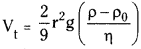
According to Stokes formula, terminal velocity of a smooth spherical body is,
TS Inter 1st Year Physics Study Material Chapter 11 Mechanical Properties of Fluids 1

The surface area of a spherical body A = 4πr². So when surface increases, ‘r²’ value increases. Hence from Stoke’s formula, Teminal velocity increases.

Short Answer Questions

Question 1.
What is atmospheric pressure and how is it determined using Barometer?
Answer:
The atmospheric pressure at any point is equal to the weight of a vertical column of air of unit cross-sectional area extending from that point to the top of tfie earth’s atmosphere.
TS Inter 1st Year Physics Study Material Chapter 11 Mechanical Properties of Fluids 2

Determination of atmospheric pressure using Barometer :
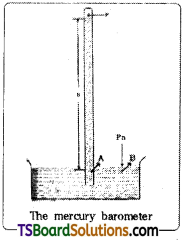
A long tube closed at one end and filled with mercury is inverted into a trough of mercury. This device is known as mercury barometer. The space above the mercury column in the tube contains only mercury vapour whose pressure p is so small that it may be neglected. Otherwise there is a perfect vacuum, which is called Torricellian vacuum.

The pressure inside the column at point A must equal the pressure at point B, which is at the same level.

‘P’ at A = Pressure at B = atmospheric pressure = Pa
Pa = ρgh …………. (1)
where ρ = density of mercury
h = height of mercury column

In this experiment, it is found that the mercury column in the barometer has a height of about 76 cm at sea level equivalent to one atmosphere (1 atm).

At sea level, atmospheric pressure is the pressure exerted by 0.76 m of mercury column, i.e., h = 0.76 m
ρ = 13.6 × 10³ kg m-3 And g = 9.8 ms-2.
∴ Atmospheric pressure, Pa = hρg
= 0.76 × (13.6 × 10³) × 9.8
= 1.013 × 10⁵ Nn-2 (or) Pa

A common way of stating pressure is in terms of cm or mm of mercury (Hg). A pressure equivalent to 1 mm is called a torr.
1 torr = 133 Pa.

TS Inter 1st Year Physics Study Material Chapter 11 Mechanical Properties of Fluids

Question 2.
State Dalton’s law of partial pressures. [AP Mar. ’14]
Answer:
Dalton’s law of partial pressures :
For a mixture of non interacting ideal gases at same temperature and volume total pressure in the vessel is the sum of partial pressures of individual gases.
i.e. P = P1 + P2 + ……….. total pressure
P1, P2, ……… etc. are individual pressures of each gas.

Question 3.
What is gauge pressure and how is a manometer used for measuring pressure differences?
Answer:
Gauge Pressure :
The pressure p, at depth below the surface of a liquid open to the atmosphere is greater than atmospheric pressure by an amount ρgh. The excess pressure (P – Pa), at depth h is called as “gauge pressure at that point.”

Measurement of pressure difference using a Manometer :
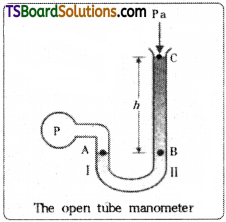
An open tube manometer is a useful instrument for measuring pressure differences. It consists of a U-tube containing a suitable liquid i.e., a low density liquid (such as oil) for measuring small pressure differences and high density liquid (such as mercury) for large pressure differences. One end of the tube is open to the atmosphere and other end is connected to the system whose pressure to be measured.
TS Inter 1st Year Physics Study Material Chapter 11 Mechanical Properties of Fluids 3

The pressure P at A is equal to pressure at point B. If the pressure in the vessel is more than the earth’s atmospheric pressure, then the level of liquid in arm-I of U-tube will go down upto point A and the level of liquid in arm-II of U-tube will rise up to point C. Then the pressure of air in vessel is equal to pressure at point A. Let ‘h’ be the difference of liquid levels in the two arms of U-tube. Let ρ be the density of liquid in U-tube and Pa be the atmospheric pressure.

Since, the pressure is same at all points, at the same level, so pressure at point A,
PA = pressure at point B
= pressure at C + pressure due to column of liquid of height ‘h’.
So, PA = PC + hρg or PA – PC = hρg ………… (1)
Here, PC = Pa = atmospheric pressure.
If PA = P, then from eq ………. (1)
P – Pa = hρg
Here, P – Pa = Pg = gauge pressure = hρg.

Question 4.
State Pascal’s law and verify it with the help of an experiment.
Answer:
Pascal’s law:
It states that “the pressure in a fluid at rest is the same at all points if they are at the same height”.

Proof of Pascal’s law:
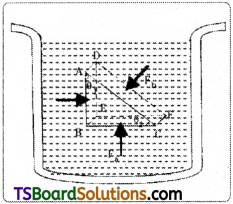
Consider an element in the interior of a fluid at rest as shown in the figure. The element ABC – DEF is in the form of a right-angled prism.

In principle, this prismatic element is very small so that every part of it can be considered at the same depth from the liquid surface and therefore, the effect of gravity is the same at all these points.

The forces on this element are those exerted by the rest of the fluid and they must be normal to the surfaces of the element.
TS Inter 1st Year Physics Study Material Chapter 11 Mechanical Properties of Fluids 4

Thus, the fluid exerts pressures Pa, Pb and Pc on this element of area corresponding to the normal forces Fa, Fb and Fc as shown in fig. on the faces BEFC, ADFC and ADEB denoted by Aa, Ab and Ac respectively. Then,
Fb sin θ2 = Fc and Fb cos θ2 = Fa (by equilibrium)
Ab sin θ2 = Ac and Ab cos θ2 = Aa (by geometry)
Thus, \(\frac{F_b}{A_b}=\frac{F_c}{A_c}=\frac{F_a}{A_a}\) ⇒ Pb = Pc = Pa
Hence, pressure exerted is same in all directions in a fluid at rest.

This proves the Pascal’s law.

Question 5.
Explain hydraulic lift and hydraulic brakes.
Answer:
Hydraulic lift and Hydraulic brakes are based on the Pascal’s law. The principle states that “whenever external pressure is applied on any part of a fluid contained in a vessel, it is transmitted undiminished and equally in all directions

Hydralic lift:
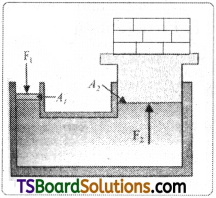
In a hydraulic lift, two pistons are separated by the space filled with a liquid as shown in fig.

A piston of small cross-section A1 is used to exert a force F, directly on the liquid.

The pressure, P = \(\frac{F_1}{A_1}\) is transmitted throughout the liquid to the larger cylinder attached with a larger piston of area A2, which results in an upward force of P × A2.
TS Inter 1st Year Physics Study Material Chapter 11 Mechanical Properties of Fluids 5

Therefore, the piston is capable of supporting large force.
F2 = PA2 = \(\frac{F_1A_2}{A_1}\)

By changing the force at A1, the platform can be moved up or down. Thus, the applied force has been increased by a factor of \(\frac{A_2}{A_1}\) and this factor is the mechanical advantage of the device.

Hydraulic brakes :
Hydraulic brakes in automobiles also work on Pascal’s principle. When we apply a little force on the pedal with our foot, the master piston moves inside the master cylinder, and the pressure caused is transmitted through the brake oil to act on a piston of larger area. A large force acts on the piston and is pushed down expanding the brake shoes against brake lining. In this way, a small force on the pedal produces a large retarding force on the wheel.

An important advantage of the system is that the pressure set up by pressing pedal is transmitted equally to all cylinders attached to the four wheels so that the braking effort is equal on all wheels.

TS Inter 1st Year Physics Study Material Chapter 11 Mechanical Properties of Fluids

Question 6.
What is hydrostatic paradox?
Answer:
Hydrostatic paradox :
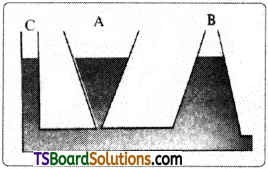
This is useful to prove that the liquid pressure is the same at all points at the same horizontal level.
TS Inter 1st Year Physics Study Material Chapter 11 Mechanical Properties of Fluids 6

Consider three vessels A, B and C of different shapes as shown in the figure. They are connected at the bottom by a horizontal pipe. On filling with water, the level in the three vessels is the same though they hold different amounts of water. This is so, because water at the bottom has the same pressure below each section of the vessel.

Thus, it proves that the height of the fluid column is independent of the cross sectional or base area and the shape of the container

Question 7.
Explain how pressure varies with depth.
Answer:
Variation of pressure with depth:
Consider a fluid at rest in a container. Let point 1 is at a height h’ above a point 2 as shown in the figure. Consider a cylindrical element of fluid having area of base ‘A’ and height ‘h’. As the fluid is at rest, the resultant horizontal forces should be zero and the resultant vertical forces should balance the weight of the element. The forces acting in the vertical direction are due to the fluid pressure at the top (P1A) acting downward, at the bottom (P2A) acting upward.
TS Inter 1st Year Physics Study Material Chapter 11 Mechanical Properties of Fluids 7

If ‘mg’ is weight of the fluid in the cylinder, we have
(P2 – P1) A = mg …………. (1)
Now, if ρ is the mass density of the fluid, then mass of fluid, m = ρv
⇒ m = ρhA …………. (2)
∴ From (1) and (2)
P2 – P1 = ρgh …………. (3)

Pressure difference depends on the vertical distance ‘h’ between the points (1 and 2), mass density of the fluid p and acceleration due to gravity ‘g’.

If the point 1 under discussion is shifted to the top of the fluid, which is open to the atmosphere, P1 may be replaced by atmospheric pressure (Pa) and we replace P2 by P2 then eq.(2) becomes
P – Pa = ρgh ⇒ P = Pa + ρgh

Thus, the pressure P, at depth below the surface of a liquid open to the atmosphere is greater than atmospheric pressure by an amount ρgh.

Question 8.
What is Torricelli’s law? Explain how the speed of efflux is determined with an experiment.
Answer:
Torricelli’s law :
Torricelli discovered that the speed of efflux from an open tank is given by a formula identical to that of a freely falling body. The word efflux means ‘fluid outflow’.
TS Inter 1st Year Physics Study Material Chapter 11 Mechanical Properties of Fluids 8

Determination of speed of Efflux:
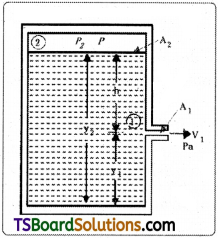
Consider a tank containing a liquid of density ‘ρ’ with a small hole at a height ‘y1‘, from the bottom as shown in the figure.

The air above the liquid, whose surface is at height ‘y2‘, is at pressure, P.

From the equation of continuity, we have
V1 A1 = V2A2 ⇒ V2 = \(\frac{A_1}{A_2}\)V1 …….. (1)

It the cross sectional area of the tank, A2 is much larger than that of the hole (i.e., A2 >> A1), then we may consider the fluid to be approximately at rest at the top. i.e., V2 = o.

Now, applying the Bernoulli equation at points (1) and (2) and noting that, at the hole P1 = Pa, the atmospheric pressure, we get.
Pa + \(\frac{1}{2}\)ρv²1 + ρgy1 = P + ρgy2
Taking y2 – y1 = h, we have
TS Inter 1st Year Physics Study Material Chapter 11 Mechanical Properties of Fluids 9

When P > > Pa and 2gh may be ignored, the speed of efflux is determined by the container pressure. Such a situation occurs in rocket propulsion. On the other hand if the tank is open to the atmosphere, then P = Pa and from eq (2), we get
V1 = \(\sqrt{2gh}\) ………….. (3)

This is the speed of a freely falling body, at any point of height ‘h’ during its fall. This equation is known as “Torricelli’s law”.

Question 9.
What is Venturimeter? Explain how it is used.
Answer:
Venturi-meter :
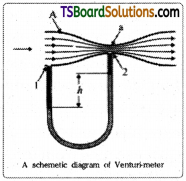
The venturi meter is a device to measure the flow speed of incompressible fluid.

It consists of a tube with a broad diameter and a small constriction at the middle as shown in the figure.
TS Inter 1st Year Physics Study Material Chapter 11 Mechanical Properties of Fluids 10

The manometer contains a liquid of density ρm. The speed ν1 of the liquid flowing through the tube at the broad neck area A is to be measured. From equation of continuity, the speed at the constriction, ν2 = \(\frac{A}{a}\) ν1
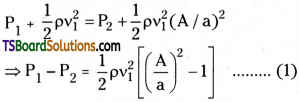
According to Bernoulli’s equation,
TS Inter 1st Year Physics Study Material Chapter 11 Mechanical Properties of Fluids 11

This pressure difference causes the fluid in the U-tube connected at the narrow neck to rise in comparison to the other arm.

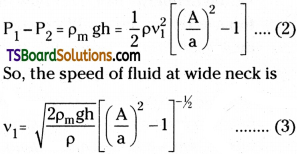
The difference in height h measures the pressure difference.
TS Inter 1st Year Physics Study Material Chapter 11 Mechanical Properties of Fluids 12

Uses: Venturi meter is used for measuring the speed of incompressible liquid and rate of flow of liquid through pipes.

TS Inter 1st Year Physics Study Material Chapter 11 Mechanical Properties of Fluids

Question 10.
What is Reynold’s number? What is its significance?
Answer:
Reynold’s number Re :
Reynold’s number is a pure number which determines the nature of flow of liquid through a pipe.
Re = \(\frac{\rho v d}{\eta}\)
where
η = coefficient of viscosity of the liquid.
ρ = density of liquid
ν = critical velocity of the liquid flowing through the pipe.
d = diameter of the pipe.

Significance :
Re is dimensionless number and therefore, it remains same in any system of units.

The critical Reynold’s number for the onset of turbulence is in the range 1000 to 10000, depending on the geometry of the flow. For most cases

Re < 1000 signifies laminar flow.
1000 < Re < 2000 is unsteady flow.
Re < 2000 implies turbulent flow.

Reynold’s number describes the ratio of the inertial force per unit area to the viscous force per unit area for a flowing fluid.

Question 11.
Explain dynamic lift with examples.
Answer:
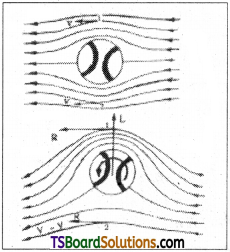
Dynamic lift on a spinning ball :
Consider the motion of a spinning ball. Its motion consists of two parts 1) Translatory motion 2) Self rotation called spinning.

1) Translatory motion:
Due to translatory motion it passes through the medium air with a velocity say (V). Due to translatory motion the number of streamlines on the top of the ball and at the bottom of the ball are equal. So there is no resultant force on the ball due to translatory motion through the fluid. Hence dynamic lift is zero.
TS Inter 1st Year Physics Study Material Chapter 11 Mechanical Properties of Fluids 13

2) For spinning motion :
Let the ball rotates about its axis with a velocity say ∆V in clockwise direction since surface of ball is not perfectly smooth it will drag air molecules with it. So at the top layers the velocity of air is V + ∆V due to air drag. At bottom layers the velocity of air is V – ∆V.

As velocity is more at top layers pressure is less and velocity is less at bottom layers, so pressure is high at bottom layers. This is due to Bernoulli’s theorem.

Due to the pressure difference at bottom layers and top layers some upward thrust will act on the ball. So some dynamic lift will act on a spinning ball. As a result the path of a spinning ball is curved.

Question 12.
Explain Surface Tension and Surface energy. [AP Mar. ’13]
Answer:
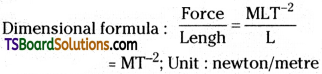
Surface tension the force per unit length on an imaginary line drawn on the surface of the liquid and acting perpendicular to it.
TS Inter 1st Year Physics Study Material Chapter 11 Mechanical Properties of Fluids 14

Surface energy:
The work done to increase the surface area of a liquid is called surface energy.
Surface energy = Surface tension × Increase in surface area.

Question 13.
Explain how surface tension can be measured experimentally.
Answer:
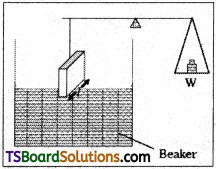
To find surface tension of a liquid in laboratory torsional balance is used. It is as shown in figure. It consists of a movable metallic rod fixed on a stretched wire. The position of rod can be adjusted. A glass plate is attached at one end of the rod and weight’s pan is connected at the other end of the rod.
TS Inter 1st Year Physics Study Material Chapter 11 Mechanical Properties of Fluids 15

Procedure :
A cleaned glass plate is taken. Its length ‘l’ and thickness ‘t’ is measured. Since thickness ‘l’ is very small when compared with length t, thickness ‘t’ is ignored.

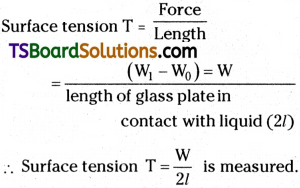
Glass plate is fixed to metallic rod. Necessary weights are placed in the pan and glass plate is made horizontal to the table. Weights in pan W0 is measured. Pure liquid whose surface tension is to be determined is taken in a glass beaker. The liquid is poured until it just touches the glass plate. Now plate is pulled down with some force due to surface tension of liquid. Weights in the pan are gradually increased until the glass plate is just escaped from forces of surface tension. Weights W1 are noted. The experiment is repeated for three to four times and average weight W1 is noted.
TS Inter 1st Year Physics Study Material Chapter 11 Mechanical Properties of Fluids 16

Long Answer Questions

Question 1.
State Bernoulli’s principle. From conservation of energy in a fluid flow through a tube, arrive at Bernoulli’s equation. Give an application of Bernoulli’s theorem.
Answer:
Bernoulli’s theorem :
Bernoulli’s theorem states that “when a non viscous liquid flows between two points then the sum of pressure energy, kinetic energy and potential energy per unit mass is always constant at any point in the path of that liquid”.
TS Inter 1st Year Physics Study Material Chapter 11 Mechanical Properties of Fluids 17

Bernoulli’s theorem is applicable to non viscous, incompressible and irrotational liquids in streamline flow only.

Proof :
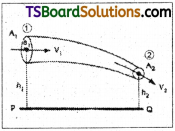
Let us consider that a liquid of density ‘ρ’ is flowing through a pipe of different area of cross sections A1 and A2 as shown.
TS Inter 1st Year Physics Study Material Chapter 11 Mechanical Properties of Fluids 18

Let the liquid enters at A1 with a velocity V1 and with a pressure P1, density of liquid at A1 is say ρ. Let the liquid leaves the pipe through A2 with a velocity V2 and pressure P2. Density of liquid at A2 is say ρ.

Since liquid is incompressible, p is con-stant.

At region 1 the liquid will move a distance of V1 ∆t where ∆t is very small time interval. Similarly at region 2 the liquid will move through a distance V2 ∆t.
Work done on fluid at region 1 = W1 = P1 A1
V1 ∆t = P1∆V

Work done on fluid at region 2 = W2 = P2 A2 V2 ∆t = P2 ∆V

Since same volume of liquid pass through the pipe, ∆ is constant.

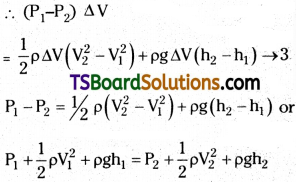
∴ Work done by fluid = W1 – W2 = (P1 – P2) ∆V → 1

∵ Liquid is uncompressible ‘ρ’ is constant.

So mass of liquid entering the pipe and leaving the pipe ∆m is given by
∆m = ρA1V1∆t = ρ∆V
Change in potential energy of liquid
∆U = ρg∆v(h2 – h1) → 2
Change in kinetic energy of liquid
∆K = \(\frac{1}{2}\)ρ∆v(V²1 – V²2)
From work energy theorem work done = change in energy
∴ ∆W = ∆U + ∆K
TS Inter 1st Year Physics Study Material Chapter 11 Mechanical Properties of Fluids 19

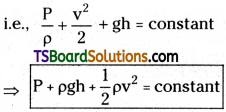
i.e., sum of pressure energy, potential energy and kinetic energy of the fluid is always constant.

Limitations :
Bernoulli ‘s theorem is applicable to non-viscous and uncompressible liquids only.

Applications of Bernoulli’s theorem :

  1. Dynamic lift on the wings of an aeroplane is due to Bernoulli’s theorem.
  2. Swinging of a spinning cricket ball is a consequence of Bernoulli’s theorem.
  3. During cyclones, the roof of thatched houses will fly away. This is a consequence of Bernoulli’s theorem.

TS Inter 1st Year Physics Study Material Chapter 11 Mechanical Properties of Fluids

Question 2.
Define coefficient of viscosity. Explain Stoke’s law and explain the conditions under which a rain drop attains terminal velocity, υt. Give the expression for υt.
Answer:
Coefficient of viscosity (η) :
The viscous force acting tangentially on unit area of the liquid when there is a unit velocity gradient in the direction perpendicular to the flow is defined as “Coefficient of viscosity.”

Coefficient of viscossity η = \(\frac{-F}{A}\frac{dx}{dv}\)
Unit Nm-2 – s (or) pascal – second.

According to Stoke’s law, the viscous force acting on a freely falling, smooth spherical body of radius ‘a’ is proportional to the coefficient of viscosity η, radius ‘a’ and velocity ‘υ’ of the body.
∴ F ∝ ηav or F = 6 π η av, where 6π is the proportionality constant.
TS Inter 1st Year Physics Study Material Chapter 11 Mechanical Properties of Fluids 20

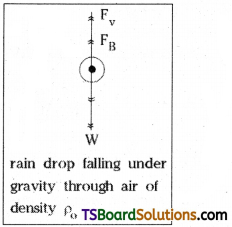
A rain drop of radius ‘ω’, density ρ falling under gravity through air of density a experiences a force of buoyancy equal to the weight of displaced air which is (\(\frac{1}{2}\)πa³) σg.

The weight of the rain drop acting downwards = (\(\frac{1}{2}\)πa³) ρg.

∴ Resultant force acting downwards = \(\frac{1}{2}\)πa³ρg – \(\frac{1}{2}\)πa³σg

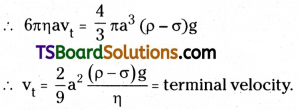
When this force is equal to the viscous drag acting upwards, then the rain drop acquires a constant velocity called terminal velocity, vt.

At terminal velocity viscous drag = 6πηav.
TS Inter 1st Year Physics Study Material Chapter 11 Mechanical Properties of Fluids 21

Definition:
Terminal velocity of a body falling through a liquid is defined as that constant velocity which the body acquires when it falls in a fluid.

Problems

Question 1.
Find the excess pressure inside a soap bubble of radius 5 mm. (Surface tension is 0.04 N/m). [TS May ’16]
Solution:
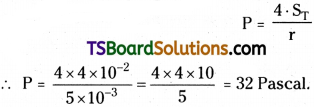
Radius r = 5 mm = 5 × 10⁻³ m.
Surface tension ST = 0.04 N/m
= 4 × 10⁻² N/m.
Excess pressure inside soap bubble
TS Inter 1st Year Physics Study Material Chapter 11 Mechanical Properties of Fluids 22

Question 2.
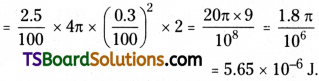
Calculate the work done in blowing a soap bubble of diameter 0.6 cm. against the surface tension force. (Surface tension of soap solution = 2.5 × 10⁻² Nm-1)
Solution:
Work done = Surface tension (S) × increase of area (2 × 4πr²)
∴ W = S ( 4πr² ) × 2
(since the bubble has two surfaces)
TS Inter 1st Year Physics Study Material Chapter 11 Mechanical Properties of Fluids 23

Question 3.
How high does methyl alcohol rise in a glass tube of diameter 0.06 cm? (Surface tension of methyl alcohol = 0.023 Nm-1 and density = 0.8 gmcm-3. Assume that the angle of contact is zero)
Solution:
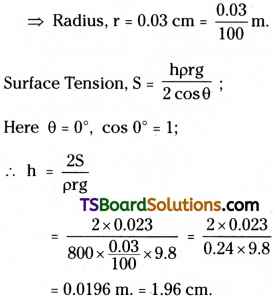
Surface tension of methyl alcohol (S) = 0.023 N/m.
Density, ρ = 0.8 gr/cm³ = 800 kg/m³
Diameter of tube, D = 0.06 cm
TS Inter 1st Year Physics Study Material Chapter 11 Mechanical Properties of Fluids 24

TS Inter 1st Year Physics Study Material Chapter 11 Mechanical Properties of Fluids

Question 4.
What should be the radius of a capillary tube if water has to rise to a height of 6 cm in it ? (Surface tension of water – 7.2 × 10⁻² Nm-1)
Solution:
Surface Tension of water,
S = 7.2 × 10⁻² N/m
Height of water, h = 6 cm = \(\frac{6}{100}\) m
Radius of capillary tube r = ?
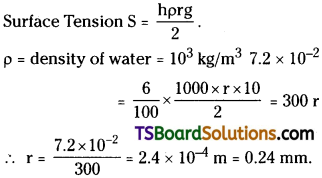
TS Inter 1st Year Physics Study Material Chapter 11 Mechanical Properties of Fluids 25

Question 5.
Find the depression of the meniscus in the capillary tube of diameter 0.4 mm dipped in a beaker containing mercury. (Density of mercury = 13.6 × 10³ Kg m-3 and surface tension of mercury = 0.49 Nm-1 and angle of contact = 135°).
Solution:
Diameter of tube = 0.4 mm ;
∴ Radius, r = 0.2 mm = \(\frac{0.2}{10^3}\) m
Density of mercury = 13.6 × 10³ kg/m³
Angle of contact, 0 = 135°
Surface tension of mercury, S = 0.49 N/m.
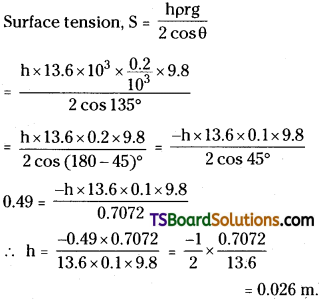
TS Inter 1st Year Physics Study Material Chapter 11 Mechanical Properties of Fluids 26

Question 6.
If the diameter of a soap bubble is 10 mm and its surface tension is 0.04 Nm-1, find the excess pressure inside the bubble. [TS Mar. ’18, My ’16; AP June ’15; Mar. ’14]
Answer:
Diameter of soap bubble =10 mm
Radius, r = 5 mm = 5 × 10⁻³m
Surface tension, S = 0.04 Nm-1
Excess pressure inside the soap bubble, P = \(\frac{4S}{r}\)
TS Inter 1st Year Physics Study Material Chapter 11 Mechanical Properties of Fluids 27

Question 7.
If work done by an agent to form a bubble of radius R is W, then how much energy is required to increase its radius to 2R?
Solution:
Energy required to form soap bubble of radius, R = W .
∴ w = 8πR²
Work done to blow a bubble of Radius 2R = 8π(2R)² = 4w
∴ Work done to increase the radius from R to 2R = 4w – w = 3w

TS Inter 1st Year Physics Study Material Chapter 11 Mechanical Properties of Fluids

Question 8.
If two soap bubbles of radii R1 and R2 (in vacuum) coalasce under isothermal conditions, what is the radius of the new bubble. Take T as the surface tension of soap solution.
Solution:
When joined in isothermal condition change in temperature of system is zero. So change in internal energy of the system is zero.
Let
Surface energy of 1st bubble U1 = 8πR2S
Surface energy of 2nd bubble U2 = 8πR²1S
Surface energy of new bubble U = 8πR²2S
But 8πR²S= 8πR²1S + 8πR²2S
⇒ R² = R²1 +R²2
Radius of new bubble R² = \(\sqrt{\mathrm{R}_1^2+\mathrm{R}_2^2}\)

TS Inter 1st Year English Grammar Parts of Speech

Telangana TSBIE TS Inter 1st Year English Study Material Grammar Parts of Speech Exercise Questions and Answers.

TS Inter 1st Year English Grammar Parts of Speech

Q.No. 9 (8 × 1/2 = 4 Marks)

In our conversation we use different words. Each word has a specific function. The words are divided into various classes, according to their use. All the words in English can be classified into eight classes which are called parts of speech. They are:

  1. Noun
  2. Pronoun
  3. Adjective
  4. Preposition
  5. Verb
  6. Adverb
  7. Conjunction
  8. Interjection.

1. NOUN

A noun is a naming word.
e.g. : boy, tree, king, Hyderabad, rose, happiness, etc.
Kinds of nouns : Nouns are divided into four kinds. They are :
1. Proper Nouns : A proper noun is the name of a particular person, place, river, country, mountain, etc.
Kumar (person), Delhi (place), Godavari (river), Sri Lanka (country), Vmdhyas (mountains)

2. Common Nouns : A common noun refers to a kind or class of things.
e g. : tiger, sugar, wall, bag, building, etc.
Common Nouns are again classified into countable nouns and uncountable nouns.
Countable Nouns : These can be counted.
Eg : boys (ten boys), flowers (three flowers, etc.)
Uncountable Nouns : These cannot be counted. They remain in mass, e.g. : Copper, rice, water.

3. Collective Nouns : They are the groups of the same class.
e.g. : crowd, herd, government, army, family, parliament, etc.

4. Abstract Nouns : They are the names of quality or state.
e.g. : Kindness, childhood, youth, fear, etc.

TS Inter 1st Year English Grammar Parts of Speech

2. PRONOUN

A pronoun is a word used instead of a noun.
e.g. : he, she, it, we, mine, those, etc.
Personal pronouns : I, me, you, he him, etc.
Reflexive pronouns : myself, herself, himself, themselves, itself, etc.

3. ADJECTIVE

An adjective is a qualify defining word.
e.g. : beautiful (Mar. ’19), clever, neat, enough, red, pure, etc.
Kinds of Adjectives :

  1. Adjectives of Quality : honest, good, clever, etc.
  2. Adjectives of Quantity : little, some, all, no, half, etc.
  3. Adjectives of Number : five, few, second, most, etc.
  4. Demonstrative Adjectives : this, these, those, such, etc.
  5. Interrogative Adjectives : what, which, whose, etc.

4. PREPOSITIONS

A preposition is a word placed before a noun or a pronoun to show in what relation the person or thing denoted by it stands in regard to something else.
Kinds of Prepositions :

  1. Simple Prepositions : to, up, with, at, by, from, in, of (Mar. ’19)) off, etc.
  2. Compound Prepositions : across, above, beyond, underneath, without, etc.
  3. Phrase Prepositions : jn front of, by means of, with regard to, in favour of, etc.

5. VERB

A verb shows action, state, possession, change in state.
e.g. : laugh, say, sing, gather, kill, etc.
Kinds of verbs :

  1. Transitive Verb : It has an object.
    e.g. : The boys are playing football.
    I have done my homework.
  2. Intransitive Verb : It has no object.
    e.g. : She sleeps.
    The moon shines.
    Ants fight.

TS Inter 1st Year English Grammar Parts of Speech

6. ADVERB

An Adverb modifies the meaning of a verb, an adjective or another adverb.
e.g. : She writes neatly.
Kinds of Adverbs :

  1. Adverbs of Time : before, now, yesterday, never, etc.
  2. Adverbs of Frequency : again, twice, always, seldom, etc.
  3. Adverbs of Place : out, near, here, there, etc.
  4. Adverbs of Manner : well, thus, sadly, so, etc.
  5. Adverbs of Degree : too, almost, better, clever, partly, fully, etc.
  6. Adverbs of Reason : hence, so, therefore, etc.

7. CONJUNCTION

A joining word is a conjunction.
e.g. : and; or; but; if
Kinds of Conjuctions :

  1. Correlative Conjunctions : both … and, not only … but also, either … or, neither … nor, etc.
  2. Compound Conjunctions : even if, so that, as well as, etc.
  3. Subordinating Conjunctions : after, because, if, unless, as, when, while, etc.

8. INTERJECTION

The words which express sudden feeling or emotion are Interjections.
e.g. : Oh ! Hurrah ! Alas ! Hello ! Ooch ! Hey !, etc.
Sing a song about the parts of speech in English.
A noun is the name of a thing.
As a school, a garden, a kite, or a king;
Adjectives tell the kind of noun,
As great, small, pretty, white, or brown;
Instead of nouns the pronouns stand,
He, she, it, I, you, we, they-all in hand;
Verbs tell us of something being done,
To read, count, laugh, cry, or run;
How things are done the adverbs tell,
As slowly, quickly, very, or well;
Conjunctions join the words together,
As men and women, wind and weather,
The preposition stands before Ac noun, as in near or through a door;
The interjection shows surprise,
As-Oh ! Ow ! Aha ! Ah ! How wise !
These are the eight parts of English speech,
Which reading, writing, speaking teach.

TS Inter 1st Year English Grammar Parts of Speech

Remember that the part of speech of a given word is decided by the part that word plays in a sentence. The same word may function in various ways in different sentences. Look at the examples Carefully.

a. We water plants regularly, (water – verb – నీరు పోయుట)
water is precious, (water – noun – నీరు)

b. There is a man waiting for you. (man – noun)
Two persons man our gates round the clock, (man – కాపలకాయుట – v)

c. He is a fast bowler, (fast – adjective – వేగ)
She drives cars very fast. (fast – adverb వేగంగా )

d. Heat expand metals, (heat = $» – i5& – noun)
Don’t heat it. It gets damaged (heat = i§&i5cfto – verb)

e. Hard work always pays, (hard = కష్ట – adjective)
She works very hard. (hard = £కష్టపడి – adverb)

Exercises

I. Read the following passage and identify the part of speech of the each underlined word.

There was a farmer (1) who grew (2) superior (3) quality rice. Every year, his rice won prizes in the state competition (4). Once a newspaper reporter interviewed (5) him and discovered that the farmer shared his seed rice with his neighbours (6). “How can you afford to share your best seed rice with (7) your neighbors when they are entering their own produce (8) in competition with yours, each year ?” The reporter asked. The farmer replied, “Didn’t you know ? The wind (9) picks up pollen grains from (10) the ripening paddy and swirls (11) it from field to field. If my neighbors grow inferior, substandard and poor (12) quality rice, cross-pollination will steadily (13) degrade the quality (14) of my produce. If I have to grow good rice I must help (15) my neighbors to grow good rice.”
Answer:
1) farmer n noun
2) grew n verb
3) superior n adjective
4) competition n noun
5) interviewed n verb
6) neighbours n noun
7) with n preposition
8) produce n noun
9) wind n noun
10) from n preposition
11) swirls n verb
12) poor n adjective
13) steadily n adverb
14) quality n noun
15) help n verb

TS Inter 1st Year English Grammar Parts of Speech

II. Identify the parts of speech of the underlined words.

1. Hyderabad is a historical city.
2. Children are a source of joy to the parents.
3. Honesty is the best policy.
4. We learn many firings through observation.
5. Since it was raining, he took an umbrella with him.
6. Alas ! Abdul Kalam is dead.
7. They themselves interfered in the dispute.
8. The boy ran into the park joyfully.
9. Music draws the attention of everyone.
10. Cricket match is watched by lakhs of people.
Answer:
1) adjective
2) noun
3) noun
4) verb
5) since n conjunction; with n preposition
6) interjection
7) pronoun
8) adverb
9) pronoun
10) noun

TS Inter 1st Year English Grammar Parts of Speech

III. Identify the part of speech of the bold words in the following sentences.

1. Several writers wrote about education.
2. The hungry dogs are howling.
3. People eat vegetables across the world.
4. An idea can change a life.
5. Food is a necessity for life.
6. I invited him to the party.
7. She is interested in painting.
8. He completed the whole work successfully.
9. The woman beside David is my cousin.
10. She has two children.
11. Treatment heals wounds.
12. Ah ! don’t say you don’t agree with me.
13. Since he was tired, he went to bed early.
14. I love singing because it is interesting.
15. I can’t be at ease until I wash my face.
16. Eureka ! I got it.
17. I like salt and pepper. ,
18. Have you passed ? Congratulations !
19. Make hay while the sun shines.
20. Wake up early so that you can study.
Answer:
1) several – adjective ; about – preposition
2) hungry – adjective
3) vegetables – noun ; world – noun
4) an – adjective (article, determiner)
5) food – noun ; life – noun
6) him – pronoun
7) interested – adjective
8) whole – adjective
9) beside – preposition
10) two – adjective (numeral)
11) treatment – noun ; wounds – noun
12) Ah ! – interjection
13) since – conjunction
14) because – conjunction
15) until – conjunction
16) Eureka ! – interjection
17) and – conjunction
18) Congratulations ! – noun
19) while – conjunction
20) early – adverb

TS Inter 1st Year English Grammar Parts of Speech

IV. Identify the part of speech of the following underlined words.

Two Sides of Life

Question 1.
It is a very (1) bad habit (2) to get into (3), that of being continually (4) moody (5) and discouraged, and (6) of (7) making the atmosphere (8) uncomfortable for everybody who comes (9) within ten (10) feet of you.
Answer:
1) very n adverb
2) habit n noun
3) into – preposition
4) continually – adverb
5) moody – adjective
6) and – conjunction
7) of – preposition
8) atmosphere – noun
9) comes – verb
10) ten – adjective (numeral)

Father, Dear Father

Question 2.
Do you (1) think, literacy (2) is a harbinger (3) of restlessness, fear (4), frustration ? Is it (5) Adam (6) and (7) Eve eating the Tree (8) of (9) knowledge, all (10) over again ?
Answer:
1) you – pronoun
2) literacy – noun
3) harbinger – noun
4) fear – noun
5) It – pronoun
6) Adam – noun
7) and – conjunction
8) tree – noun
9) of – preposition
10) all – adverb

TS Inter 1st Year English Grammar Parts of Speech

Green Champion –

Question 3.
Although (1) Thimmakka did not receive (2) formal (3) education, her (4) work (5) has been honoured (6) with (7) the National (8) Citizen’s Award (9) of (10) India.
Answer:
1) although – conjunction
2) receive – verb
3) formal – adjective
4) her – possessive pronoun (adjective)
5) work – noun
6) honoured – verb
7) with – preposition
8) national – adjective
9) award – noun
10) of – preposition

The First Four Minutes

Question 4.
I had (1) a moment (2) of (3) mixed joy (4) and anguish, when (5) my mind (6) took over. It (7) faced well (8) ahead of mu body and (9) drew mu body compellingly (10) forward.
Answer:
1) had – verb
2) moment – noun
3) of – preposition
4) joy – noun
5) when – pronoun
6) mind – noun
7) it – pronoun
8) well – adverb
9) and – conjunction
10) compelling – adverb

TS Inter 1st Year English Grammar Parts of Speech

Box and Cox

Question 5.
Box : Stop ! (1) Can you (2) inform (3) me who (4) the individual (5) is that I invariably (6) encounter (7) going downstairs when I’m coming up (8), and (9) coming upstairs (10) when I’m going down ?
Answer:
1) stop – verb
2) you – pronoun
3) inform – verb
4) who – pronoun
5) individual – noun
6) invariably – adverb
7) encounter – verb
8) up – adverb
9) and – conjunction
10) upstairs – adverb

Question 6.
Ah (1), then you (2) mean to say that this (3) gentleman’s smoke (4), instead of emulating the example of all (5) other sorts of (6) smoke, and (7) going up the chimney, thinks (8) proper to affect a singularity (9) by taking the contrary (10) direction.
Answer:
1) Ah – interjection
2) you – pronoun
3) this – adjective (determiner)
4) smoke – noun
5) all – adverb
6) of – preposition
7) and – conjunction
8) thinks – verb
9) singularity – noun
10) contrary – adjective

TS Inter 1st Year English Grammar Parts of Speech

V. Identify the part of speech of the bold words in the following sentences.

1. What is the result of that kind of schooling ?
2. I cannot answer that question.
3. Each individual who wishes to succeed must get that kind of discipline.
4. Such persons are surely und esirable.
5. I asked my Biology teacher what I should do to save it.
6. From his talk it seems studies were an ancillary subject; and living and experiencing, the major subject.
7. And she was cross.
8. Papa, that’s what happens in my craft and drawing class.
9. Anyway, Papa, do you know where lost that quarter mark that brought about my fall ?
10. Thimmakka could not go to school due to poverty and lack of facilities.
11. The decision was mine alone.
12. The attempt was on.
13. My knowledge of pace deserted me
14. A voice shouting ‘Relax’ penetrated into me above the noise of the crowd.
15. There was no pain, only a great unity of movement and aim.
16. The world seemed to stand still or did not exist.
17. The noise in my ears was that of the faithful Oxford crowd.
18. There were only fifty yards more.
19. I felt like an exploded flashlight with no will to live.
20. Well wonders will never cease.
Answer:
1) schooling – noun
2) answer – verb
3) wishes – verb
4) purely – adverb
5) what – pronoun
6) talk – noun; ancillary – adjective
7) and – conjunction
8) what – pronoun fall – noun
9) where – adverb; quarter – noun;
10) lack – noun

TS Inter 1st Year English Grammar Parts of Speech

11) alone – adverb
12) attempt – noun
13) deserted – verb
14) above – preposition
15) only – adjective
16) still – adjective
17) that – pronoun
18) more – pronoun – determiner
19) will – noun
20) well – interjection

TS Inter 1st Year Maths 1A Ratios up to Transformations Important Questions Long Answer Type

Students must practice these Maths 1A Important Questions TS Inter 1st Year Maths 1A Ratios up to Transformations Important Questions Long Answer Type to help strengthen their preparations for exams.

TS Inter 1st Year Maths 1A Ratios up to Transformations Important Questions Long Answer Type

Question 1.
If A, B, Care the angles of a triangle, prove that sin 2A + sin 2B + sin 2C = 4 sin A sin B sin C.
Answer:
Given A + B + C = 180°
LHS = sin 2A + sin 2B + sin 2C
= 2sin\(\left(\frac{2 \mathrm{~A}+2 \mathrm{~B}}{2}\right)\) cos\(\left(\frac{2 \mathrm{~A}-2 \mathrm{~B}}{2}\right)\) + sin 2C
= 2 sin (A + B) cos (A – B) + sin 2C
= 2 sin (180° – C) cos (A – B) + sin 2C
= 2 sin C cos (A – B) + 2 sin C cos C
= 2 sin C [cos (A – B) + cos C]
= 2 sin C [cos (A – B) + cos [180° – (A + B)]
= 2 sin C[cos (A – B) – cos (A + B)]
= 2 sin C (2 sin A sin B)
= 4 sin A sin B sin C = RHS

Question 2.
If A, B, C are angles of a triangle, prove that cos 2A + cos 2B + cos 2C = – 4cos A cos B cos C – 1.
Sol. Given A + B + C = 180°
LHS = cos 2A + cos 2B + cos 2C
= 2cos\(\left(\frac{2 \mathrm{~A}+2 \mathrm{~B}}{2}\right)\) cos\(\left(\frac{2 \mathrm{~A}-2 \mathrm{~B}}{2}\right)\) + cos 2C
= 2 cos (A + B) cos (A – B) + cos 2C
= 2 cos (180° – C) cos (A – B) + cos 2C
= – 2 cos C cos (A – B) + 2 cos2C – 1
= – 2 cos C [cos (A – B) – cos C] – 1
= – 2 cos C [cos (A – B) – cos [180° – (A + B)]] -1
= -2 cos C [cos (A – B) + cos (A + B)] – 1
= – 2cos C (2 cos A cos B) – 1
= – 4 cos A cos B cos C – 1 = RHS

Question 3.
If A + B + C = \(\frac{3 \pi}{2}\), prove that cos 2A + cos 2B + cos 2C = 1 – 4sinA.sinB.sinC. [Mar. ’13, ’01]
Answer:
Given A + B + C = \(\frac{3 \pi}{2}\)
L.H.S. = cos 2A + cos 2B + cos 2C
= 2 cos (A + B) cos (A – B) + cos 2C
= -2 sin C cos (A – B) + 1 – 2 sin2C
[A + B = \(\frac{3 \pi}{2}\) ⇒ cos (A + B) = – sin C]
= 1 – 2 sin C [cos (A – B) + sin C]
= 1 – 2 sin C [cos (A – B) – cos (A + B)]
= 1 – 2 sin C (2 sin A sin B)
= 1 – 4 sin A sin B sin C = RHS
∴ cos 2A + cos 2B + cos 2C = 1 – 4 sin A sin B sin C

TS Inter First Year Maths 1A Ratios up to Transformations Important Questions Long Answer Type

Question 4.
If A + B + C = \(\frac{3 \pi}{2}\), prove that cos 2A + cos 2B + cos 2C = 1 + 4 sin A. sin B sin C.
Answer:
Given A + B + C = 90°
LHS = cos 2A + cos 2B + cos 2C
= 2 cos\(\left(\frac{2 \mathrm{~A}+2 \mathrm{~B}}{2}\right)\) cos\(\left(\frac{2 \mathrm{~A}-2 \mathrm{~B}}{2}\right)\) + cos 2C
= 2 cos (A + B) cos (A – B) + cos 2C
= 2 cos (90° – C) cos (A – B) + cos 2C
= 2 sin C cos (A – B) + 1 – 2 sin2C
= 1 + 2 sin C [cos (A – B) – sin C]
= 1 + 2 sin C [cos (A – B) – sin [90° – (A + B)]]
= 1 + 2 sin C [cos (A – B) – cos (A + B)]
= 1 + 2 sin C (2 sin A sin B)
= 1 + 4 sin A sin B sin C = RHS.

Question 5.
If A, B, C are angles in a triangle, then prove that cos A + cos B + cos C = 1 + 4 sin \(\frac{A}{2}\) sin \(\frac{B}{2}\) sin \(\frac{C}{2}\). [Mar. ’18(AP); May ’09]
Answer:
Given A + B + C = 180°
L.H.S = cos A + cos B + cos C
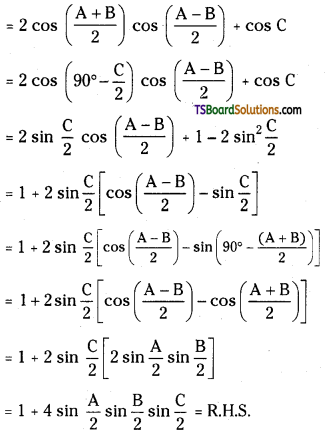
TS Inter First Year Maths 1A Trigonometric Ratios up to Transformations Important Questions Long Answer Type 1

Question 6.
If A, B, C are angles in a triangle, then prove that cos A + cos B – cos C = -1 + 4 cos \(\frac{A}{2}\) cos \(\frac{B}{2}\) sin \(\frac{C}{2}\). [Mar. ’19(TS); May ’06]
Answer:
Given A + B + C = 180°
L.H.S = cos A + cos B – cos C
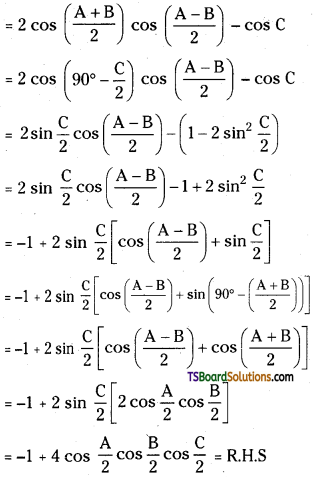
TS Inter First Year Maths 1A Trigonometric Ratios up to Transformations Important Questions Long Answer Type 2

Question 7.
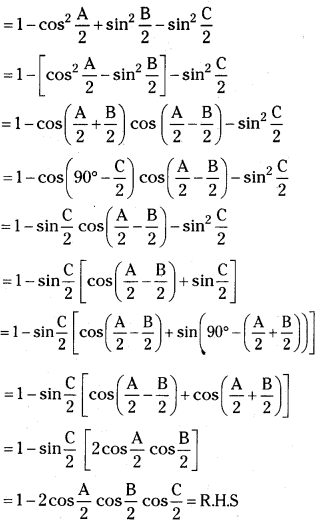
If A, B, C are angles in a triangle, then prove that sin2\(\frac{A}{2}\) + sin2\(\frac{B}{2}\) – sin2\(\frac{C}{2}\) = 1 – 2cos \(\frac{A}{2}\). cos \(\frac{B}{2}\). sin \(\frac{C}{2}\). [Mar. ’16(AP), ’06; May ’15(TS), ’11; B.P]
Answer:
Given A + B + C = 180°
L.H.S = sin2\(\frac{A}{2}\) + sin2\(\frac{B}{2}\) – sin2\(\frac{C}{2}\)
TS Inter First Year Maths 1A Trigonometric Ratios up to Transformations Important Questions Long Answer Type 3

TS Inter First Year Maths 1A Ratios up to Transformations Important Questions Long Answer Type

Question 8.
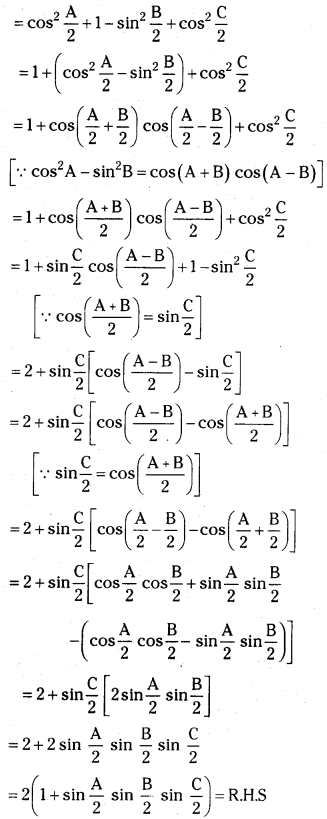
If A + B + C = π, then prove that cos2\(\frac{A}{2}\) + cos2\(\frac{B}{2}\) – cos2\(\frac{C}{2}\) = 2(1 + sin \(\frac{A}{2}\). sin \(\frac{B}{2}\). sin \(\frac{C}{2}\)). [Mar. ’12, Mar. ’15(AP & TS)]
Answer:
Given A + B + C = π
L.H.S = cos2\(\frac{A}{2}\) + cos2\(\frac{B}{2}\) – cos2\(\frac{C}{2}\)
TS Inter First Year Maths 1A Trigonometric Ratios up to Transformations Important Questions Long Answer Type 4

Question 9.
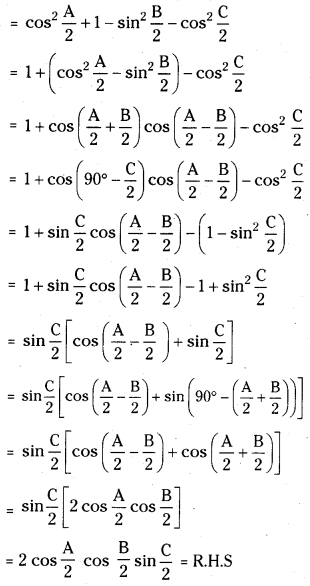
If A+ B + C = π, then prove that cos2\(\frac{A}{2}\) + cos2\(\frac{B}{2}\) – cos2\(\frac{C}{2}\) = 2 cos\(\frac{A}{2}\) cos\(\frac{B}{2}\) sin\(\frac{C}{2}\). [May ’10]
Answer:
Given A + B + C = π
L.H.S = cos2\(\frac{A}{2}\) + cos2\(\frac{B}{2}\) – cos2\(\frac{C}{2}\)
TS Inter First Year Maths 1A Trigonometric Ratios up to Transformations Important Questions Long Answer Type 5

Question 10.
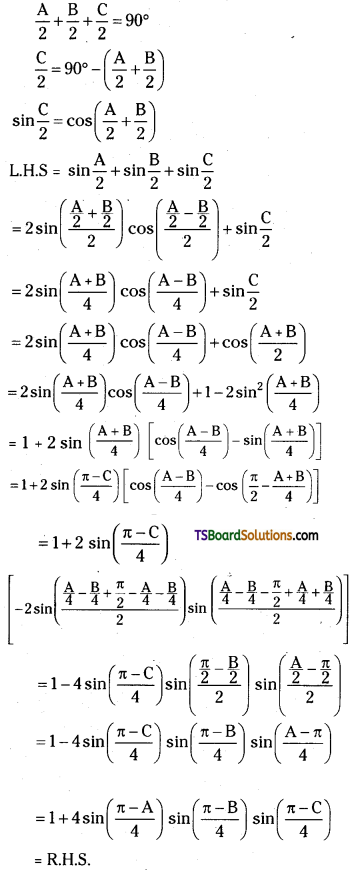
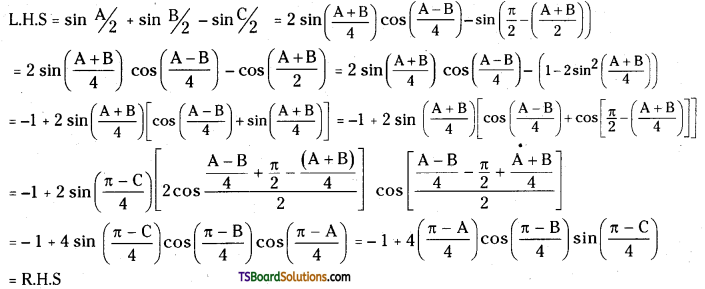
If A, B, C are the angles in a triangle, then prove that sin\(\frac{A}{2}\) + sin\(\frac{B}{2}\) + sin \(\frac{C}{2}\) = 1 + 4sin\(\left(\frac{\pi-A}{4}\right)\)sin\(\left(\frac{\pi-B}{4}\right)\)sin\(\left(\frac{\pi-C}{4}\right)\). [Mar. ’14, ’11, ’96]
Answer:
Given A + B + C = 180°
TS Inter First Year Maths 1A Trigonometric Ratios up to Transformations Important Questions Long Answer Type 6

Question 11.
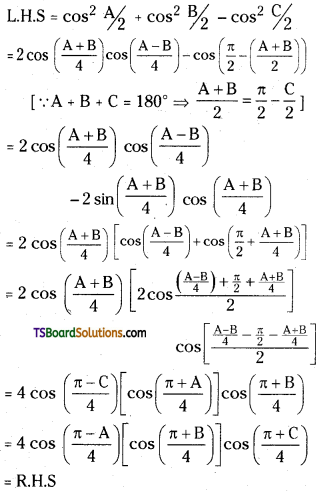
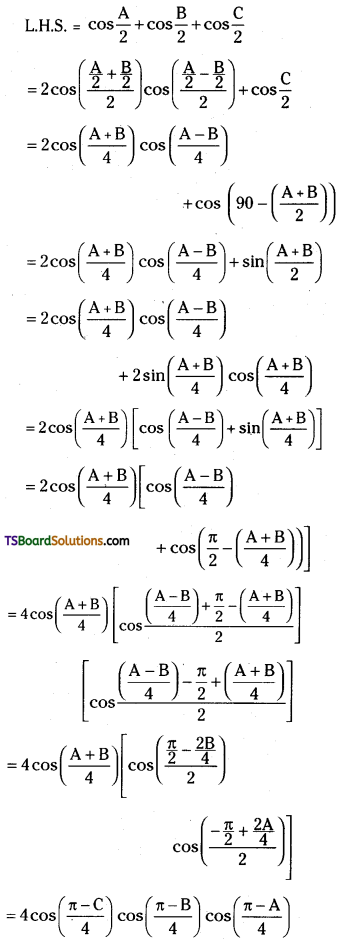
In triangle ABC, prove that cos\(\frac{1}{2}\) + cos\(\frac{B}{2}\) + cos\(\frac{C}{2}\) = 4 cos\(\left(\frac{\pi-A}{4}\right)\) cos\(\left(\frac{\pi-B}{4}\right)\) cos\(\left(\frac{\pi-C}{4}\right)\). [Mar ’14, ’13, ’07, ’97; Mar. ’10, ’07, ’05, ’03]
Answer:
In ΔABC, A + B + C = 180°
TS Inter First Year Maths 1A Trigonometric Ratios up to Transformations Important Questions Long Answer Type 7
∴ cos\(\frac{1}{2}\) + cos\(\frac{B}{2}\) + cos\(\frac{C}{2}\) = 4 cos\(\left(\frac{\pi-A}{4}\right)\) cos\(\left(\frac{\pi-B}{4}\right)\) cos\(\left(\frac{\pi-C}{4}\right)\)

TS Inter First Year Maths 1A Ratios up to Transformations Important Questions Long Answer Type

Some More Maths 1A Ratios up to Transformations Important Questions

Question 1.
If sin θ = \(\frac{4}{5}\) and θ is not in the first quadrant, find the value of cos θ.
Answer:
Given sin θ = \(\frac{4}{5}\)
Since θ is not in the first quadrant and sin θ > 0 we have 90° < θ < 180°
∴ cos θ = \(\sqrt{1-\sin ^2 \theta}=\sqrt{1-\frac{16}{25}}=\frac{-3}{5}\)

Question 2.
If cosec θ + cot θ = find cos θ and determine the quadrant In which θ lies.
Answer:
We have cosec2 θ – cot2 θ = 1
(cosec θ + cot θ) (cosec θ – cot θ) = 1
= cosec θ – cot θ = \(\frac{1}{{cosec} \theta+\cot \theta}\) = 3
= cosec θ + cot θ = 3 …………………… (1)

Given cosec θ + cot θ = \(\frac{1}{3}\) …………………. (2)
Solving(1)& (2)
∴ 2cosec θ = 3 + \(\frac{1}{3}=\frac{10}{3}\)
⇒ cosec θ = \(\frac{5}{4}\)
⇒ sin θ = \(\frac{3}{5}\)

Also 2 cot θ = \(\frac{1}{3}\) – 3 = \(\frac{-8}{3}\)
⇒ cot θ = \(\frac{-4}{3}\)
⇒ tan θ = \(\frac{-3}{4}\)

cos θ = cot θ.sinθ = \(\left(-\frac{4}{3}\right)\left(\frac{3}{5}\right)=-\frac{4}{5}\)
sin θ is positive and cos θ is a negative
⇒ θ lies in II quadrant.

Question 3.
If sec θ + tan θ = 5, find the quadrant in which θ lies and find the value of sin θ.
Answer:
We have sec2θ – tan2θ = 1
⇒ (sec θ + tan θ) (sec θ – tan θ) = 1
⇒ sec θ – tan θ = \(\frac{1}{5}\) ………….. (1)
Also given sec θ + tan θ = 5 ………………………. (2)

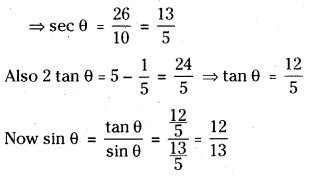
Adding (1) and (2), 2sec θ = 5 + \(\frac{1}{5}\) = \(\frac{26}{5}\)
TS Inter First Year Maths 1A Trigonometric Ratios up to Transformations Important Questions Long Answer Type 8
tan θ is +ve, sec θ is + ve
⇒ θ lies in first quadrant

Question 4.
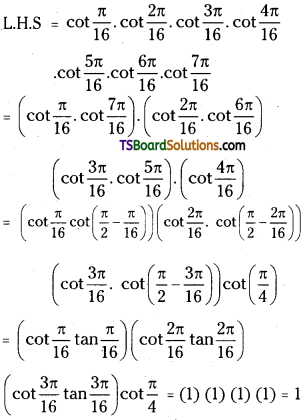
Prove that cot\(\frac{\pi}{16}\).cot\(\frac{2 \pi}{16}\).cot\(\frac{3 \pi}{16}\)………………cot\(\frac{7 \pi}{16}\) = 1.
Answer:
TS Inter First Year Maths 1A Trigonometric Ratios up to Transformations Important Questions Long Answer Type 9

Question 5.
If a cos θ – b sin θ = c, then show that a sin θ + b cos θ = ± \(\sqrt{\mathbf{a}^2+\mathbf{b}^2-\mathbf{c}^2}\).
Answer:
Given a cos θ – b sin θ
= c and let asin θ + b cos θ = x
squaring and adding, we get
(a cos θ – b sin θ)2 + (a sin θ + b cos θ) = c2 + x2
a2 (cos2 θ + sin2 θ)2 + b2 (sin2 θ + cos2 θ) = c2 + x2
⇒ a2 + b2 = c2 + x2 ⇒ x2 = a2 + b2 – c2
⇒ x = ±\(\sqrt{\mathbf{a}^2+\mathbf{b}^2-\mathbf{c}^2}\)

TS Inter First Year Maths 1A Ratios up to Transformations Important Questions Long Answer Type

Question 6.
If 3 sin A + 5 cos A = 5, then show that 5 sin A – 3 cos A = ± 3.
Answer:
Given that 3 sin A + 5 cos A = 5
Let 5 sin A – 3 cos A = x
Squaring and adding, we get
(3 sin A + 5 cos A)2 + (5 sin A – 3 cos A)2
⇒ 9 (sin2A + cos2A) + 25 (cos2A + sin2A) = 25 + x2
⇒ 34 = 25 + x2
⇒ x2 = 9
⇒ x = ± 3
∴ 5 sin A – 3 cos A = ± 3

Question 7.
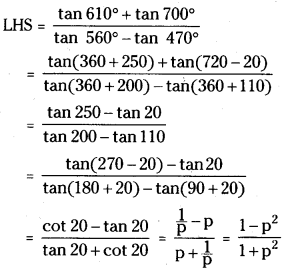
If tan 20° = p, Prove that \(\frac{\tan 610^{\circ}+\tan 700^{\circ}}{\tan 560^{\circ}-\tan 470^{\circ}}=\frac{1-p^2}{1+p^2}\).
Answer:
Given that tan 20° = p, then
TS Inter First Year Maths 1A Trigonometric Ratios up to Transformations Important Questions Long Answer Type 10

Question 8.
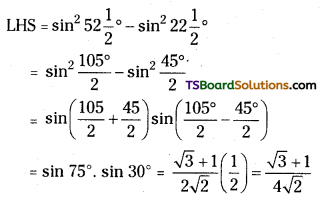
Evaluate sin282\(\frac{1}{2}^{circ}\) – sin2 22\(\frac{1}{2}^{circ}\).
Answer:
sin282\(\frac{1}{2}^{circ}\) – sin2 22\(\frac{1}{2}^{circ}\)
= sin[82\(\frac{1}{2}^{circ}\) + 22\(\frac{1}{2}^{circ}\)] + sin[82\(\frac{1}{2}^{circ}\) – 22\(\frac{1}{2}^{circ}\)]
= sin 105°. sin 60°
[∵ Use sin2A – sin2B] = sin(A +B) sin (A – B)
= sin 60° sin(60° + 45°)= sin 60°
[= sin 60° cos 45° + cos 60° sin 45°]
\(\frac{\sqrt{3}}{2}\left[\frac{\sqrt{3}}{2 \sqrt{2}}+\frac{1}{2 \sqrt{2}}\right]=\frac{\sqrt{3}(\sqrt{3}+1)}{4 \sqrt{2}}=\frac{3+\sqrt{3}}{4 \sqrt{2}}\)

Question 9.
Evaluate cos2112\(\frac{1}{2}^{circ}\) – sin252\(\frac{1}{2}^{circ}\).
Answer:
Use cos2A – sin2B = cos(A + B) cos (A – B)
= cos2112\(\frac{1}{2}^{circ}\) – sin252\(\frac{1}{2}^{circ}\)
= cos [112\(\frac{1}{2}^{circ}\) + 52\(\frac{1}{2}^{circ}\)] cos[112\(\frac{1}{2}^{circ}\) – 52\(\frac{1}{2}^{circ}\)]
= cos 165° . cos 60
= cos 60° cos(180 – 15) = – cos 60°. cos 15°
= \(-\frac{1}{2}\left[\frac{\sqrt{3}+1}{2 \sqrt{2}}\right]=-\frac{\sqrt{3}+1}{4 \sqrt{2}}\)

Question 10.
Prove that tan 72° = tan 18° + 2 tan 54°.
Answer:
We have cot A – tan A = \(\frac{1}{\tan A}\) – tan A
⇒ \(\frac{1-\tan ^2 \mathrm{~A}}{\tan \mathrm{A}}=\frac{2\left(1-\tan ^2 \mathrm{~A}\right)}{2 \tan \mathrm{A}}=\frac{2}{\tan 2 \mathrm{~A}}\) = 2 cot 2A
∴ cot A – tan A = 2 cot 2A
⇒ cot A = tan A + 2 cot 2A

Take A = 18°, then cot 18°
= tan 18° + 2 cot 36°
⇒ cot (90 – 72)
= tan 18° + 2 cot (90 – 54)
⇒ tan 72° = tan 18° + 2 tan 54°

Question 11.
Find the value of tan 56° – tan 11° -tan 56°. tan 11°.
Answer:
Consider 56° – 11° = 45°
⇒ tan (56° -11°) = tan 45° = 1
⇒ \(\frac{\tan 56^{\circ}-\tan 11^{\circ}}{1+\tan 56^{\circ} \tan 11^{\circ}}\) = 1
⇒ tan 56° – tan 110 – tan 56° tan 11° = 1.

Question 12.
If tan θ = \(\frac{\cos 11^{\circ}+\sin 11^{\circ}}{\cos 11^{\circ}-\sin 11^{\circ}}\) and θ is in the third quadrant, find θ.
Answer:
Given tan θ = \(\frac{\cos 11^{\circ}+\sin 11^{\circ}}{\cos 11^{\circ}-\sin 11^{\circ}}\)
= \(\frac{1+\tan 11^{\circ}}{1-\tan 11^{\circ}}\) = tan(45 + 11) = tan 56°
Since θ is in the third quadrant,
tan 56° = tan (180 + 56) = tan 236°
∴ θ = 236°

Question 13.
Show that cos 35° + cos 85° + cos 155° = 0.
Answer:
cos 35° + cos 85° + cos 155°
= cos 35° + 2cos\(\left(\frac{85+155}{2}\right)\) cos\(\left(\frac{85-155}{2}\right)\)
= cos 35° + 2 cos 120° cos (-35°)
= cos 35° – cos 35° = 0

Question 14.
Simplify cos 100°. cos 40° + sin 100°. sin 40°.
Answer:
Use cos A. cos B + sin A sin B = cos (A – B)
∴ cos 100°. cos 40° + sin 100° . sin 40°
= cos (100° – 40°) = cos 60° = \(\frac{1}{2}\)

Question 15.
Prove that sin 750°. cos 480° + cos 120°. cos 60° =\(\frac{1}{2}\)
Answer:
L.H.S = sin 750°. cos 480° + cos 120°. cos 60°
= sin [2.(360) + 30] cos [360 +120] + cos 120 cos 60
= sin 30 cos 120 + cos 120 cos 60
= \(\left(\frac{1}{2}\right)\left(-\frac{1}{2}\right)+\left(-\frac{1}{2}\right)\left(\frac{1}{2}\right)=\frac{-1}{2}\)

Question 16.
Prove that \(\frac{1}{\cos 290^{\circ}}+\frac{1}{\sqrt{3} \sin 250^{\circ}}=\frac{4}{\sqrt{3}}\).
Answer:
TS Inter First Year Maths 1A Trigonometric Ratios up to Transformations Important Questions Long Answer Type 11

TS Inter First Year Maths 1A Ratios up to Transformations Important Questions Long Answer Type

Question 17.
Prove that √3 cosec 20° – sec 20° = 4.
Answer:
L.H.S = √3 cosec 20° – sec 20°
TS Inter First Year Maths 1A Trigonometric Ratios up to Transformations Important Questions Long Answer Type 12

Question 18.
Find the period of cos (3x + 5) + 7.
Answer:
Let f(x) = cos (3x + 5) + 7
We have period of cos x is 2π ∀ x ∈ R.
∴ f (x) is periodic and period of f is \(\frac{2 \pi}{|3|}\)
\(\frac{2 \pi}{3}\) (or) f(x + p) = f(x)
⇒ cos (3x + 3p + 5) + 7 = cos (2π + 3x + 5) + 7
∴ 3x + 3p + 5 = 2π + 3x + 5
⇒ 3x = 2π
⇒ x = \(\frac{2 \pi}{3}\)

Question 19.
Find the maximum and minimum values of f(x) = 3 sin x – 4 cos x.
Answer:
Given f(x) = 3 sin x – 4 cos x
Comparing with a cos x + b sin x + c
We get a = – 4, b = 3, c = 0
Maximum value = c + \(\sqrt{a^2+b^2}\)
= 0 + \(\sqrt{16+9}=\sqrt{25}\) = 5
Minimum value = c – \(\sqrt{a^2+b^2}\)
= 0 – \(\sqrt{16+9}=\sqrt{25}\) = -5

Question 20.
Find the range of 7 cos x – 24 sin x + 5.
Answer:
Let f(x) = 7 cos x – 24 sin x + 5
a = – 24, b = 7, c = 5

Range = [c – \(\sqrt{a^2+b^2}\), c + \(\sqrt{a^2+b^2}\)]
=[5 – \(\sqrt{576+49}\), 5 + \(\sqrt{576+49}\)]
= [5 – \(\sqrt{625}\), 5 + \(\sqrt{625}\)]
= [5 – 25, 5 + 25] = [-20, 30]

Question 21.
If A – B = \(\frac{3 \pi}{4}\), then show that (1 – tan A)(1 + tan B) = 2.
Answer:
A – B = \(\frac{3 \pi}{4}\)
⇒ tan(A – B) = tan\(\frac{3 \pi}{4}\)
⇒ \(\frac{\tan A-\tan B}{1+\tan A \tan B}\) = -1
⇒ tan A – tan B = – 1 – tan A tan B
⇒ tan A – tan B + tan A tan B = -1
⇒ – tan A + tan B – tan A tan B = 1
⇒ (1 – tan A) + tan B (1 – tan A) = 1 + 1 = 2
⇒ (1 – tan A) (1 + tan B) = 2

Question 22.
If A, B, C are the angles of a triangle and if none of them is equal to \(\frac{\pi}{2}\) then prove that cot A cot B + cot B cot C + cot C cot A = 1.
Answer:
Given A + B + C = π, A + B = π – C
⇒ cot (A + B) = cot (π – C)
⇒ \(\frac{\cot A+\cot B-1}{\cot B+\cot A}\) = – cot C
⇒ cot A cot B – 1 = – cot B cot C – cot C cot A
⇒ cot A cot B + cot B cot C + cot C cot A = 1

Question 23.
If A + B + C = \(\frac{\pi}{2}\) and if none of A, B, C is n an odd multiple of \(\frac{\pi}{2}\), then prove that tan A tan B + tan B tan C + tan C tan A = 1.
Answer:
Given A + B + C = \(\frac{\pi}{2}\)
⇒ A + B = \(\frac{\pi}{2}\) – C
⇒ tan(A + B) = tan(\(\frac{\pi}{2}\) – C)
⇒ \(\frac{\tan A+\tan B}{1-\tan A \tan B}\) = cot C = \(\frac{1}{\tan C}\)
⇒ tan A tan C + tan B tan C = 1 – tan A tan B
⇒ tan A tan B + tan B tan C + tan C tan A = 1

Question 24.
Prove that cos A. cos(\(\frac{\pi}{2}\) + A) cos(\(\frac{\pi}{2}\) -A) = \(\frac{1}{4}\)cos 3A and hence deduce that cos\(\frac{\pi}{2}\)cos\(\frac{2 \pi}{2}\)cos\(\frac{3 \pi}{2}\).cos\(\frac{4 \pi}{2}\) = \(\frac{1}{16}\)
Answer:
L.H.S = cos A.cos(60 + A) cos(60 – A)
= cos A (cos2 60 – sin2 A)
TS Inter First Year Maths 1A Trigonometric Ratios up to Transformations Important Questions Long Answer Type 13

TS Inter First Year Maths 1A Ratios up to Transformations Important Questions Long Answer Type

Question 25.
Show that cos4\(\frac{\pi}{8}\) + cos4\(\frac{3 \pi}{8}\) + 4\(\frac{5 \pi}{8}\) + cos4\(\frac{7 \pi}{8}\) = \(\frac{3}{2}\)
Answer:
TS Inter First Year Maths 1A Trigonometric Ratios up to Transformations Important Questions Long Answer Type 14

Question 26.
Prove that tan α = \(\frac{\sin 2 \alpha}{1+\cos 2 \alpha}\) and hence deduce the values of tan 15° and tan 22\(\frac{1}{2}^{\circ}\)
Answer:
TS Inter First Year Maths 1A Trigonometric Ratios up to Transformations Important Questions Long Answer Type 15

Question 27.
If cos θ > θ, tan θ + sin θ = m and tan θ – sin θ = n then show that m2 – n2 = 4\(\sqrt{mn}\)
Answer:
Given that m = tan θ + sin θ, n = tan θ – sin θ
m + n = 2 tan θ, m – n = 2 sin θ and (m + n) (m -n)
TS Inter First Year Maths 1A Trigonometric Ratios up to Transformations Important Questions Long Answer Type 16

Question 28.
If 0° < A, B < 90°, cos A = \(\frac{5}{13}\) and sin B = \(\frac{4}{5}\), then find the value of sin(A+ B).
Answer:
0° < A, B < 90°, cos A = \(\frac{5}{13}\) ⇒ sin A = \(\frac{12}{13}\)
0° < A, B < 90°, sin B = \(\frac{4}{5}\) ⇒ cos B = \(\frac{3}{5}\)
∴ sin(A + B) = sin A cos B + cos A sin B
= \(\frac{12}{13} \cdot \frac{3}{5}+\frac{5}{13} \cdot \frac{4}{5}=\frac{36}{65}+\frac{20}{65}=\frac{56}{65}\)

Question 30.
If sin A = \(\frac{12}{13}\), cos B = \(\frac{3}{5}\) and neither A nor B is in the first quadrant, then find the quadrant in which A + B lies.
Answer:
Given sin A = \(\frac{12}{13}\)
A is not in the first quadrant then A lies in the Q2.
∴ cos A = \(\frac{-5}{13}\) ⇒ cos B = \(\frac{3}{5}\)

B is not in the Q1 then B lies in the Q4.
∴ sin B = \(\frac{-4}{5}\)
Now sin (A + B) = sin A cos B + cos A sin B
= \(\left(\frac{12}{13}\right)\left(\frac{3}{5}\right)+\left(\frac{-5}{13}\right)\left(\frac{-4}{5}\right)=\frac{36}{65}+\frac{20}{65}=\frac{56}{65}\)

cos (A + B) = cos A . cos B – sin A sin B
= \(\left(\frac{-5}{13}\right)\left(\frac{3}{5}\right)-\left(\frac{12}{13}\right)\left(\frac{-4}{5}\right)=\frac{-15}{65}+\frac{48}{65}=\frac{33}{65}\)
sin (A + B) > 0 & cos (A + B) > 0 then A + B lies in the first quadrant.

Question 31.
Let ABC be a triangle such that cot A + cot B + cot C = √3 then prove that ABC is an equilateral triangle.
Answer:
Given that A + B + C = 180°
We have Σ cot A cot B = 1 …………………(1)
Σ(cot A – cot B)2
= Σ(cot2 A + cos2 B – 2 cot A cot B)
= 2 cot2 A + 2 cot2 B + 2 cot2 C – 2 cot A cot B – 2 cot B cot C – 2 cot C cot A
= 2 [cot A + cot B + cot C]2 – 6 [cot A cot B + cot B cot C + cot C cot A]
= 2 [(√3 )2 ] – 6(1) = 6 – 6 = 0
∴ Σ (cot A – cot B)2 = 0
⇒ cot A = cot B = cot C
⇒ cot A = cot B = cot C = \(\frac{\sqrt{3}}{3}=\frac{1}{\sqrt{3}}\) (∵ cot A + cot B + cot C = 73 )
⇒ A = B = C = 60°
⇒ ΔABC is an equilateral triangle.

TS Inter First Year Maths 1A Ratios up to Transformations Important Questions Long Answer Type

Question 32.
Simplify tan[\(\frac{\pi}{4}\) + θ]. tan[\(\frac{\pi}{4}\) – θ]
Answer:
TS Inter First Year Maths 1A Trigonometric Ratios up to Transformations Important Questions Long Answer Type 17

Question 33.
Simplify tan 75° + cot 75°.
Answer:
(2 + √3)(2 – √3) = 4

Question 34.
Evaluate sin2\(\left[\frac{\pi}{8}+\frac{A}{2}\right]\) – sin2\(\left[\frac{\pi}{8}-\frac{A}{2}\right]\)
Answer:
[∵ sin2A – sin2B = sin (A + B)sin(A – B)
TS Inter First Year Maths 1A Trigonometric Ratios up to Transformations Important Questions Long Answer Type 18

Question 35.
If A + B, A are acute angles such that sin (A + B) = \(\frac{24}{25}\) and tan A = \(\frac{3}{4}\), then find the value of cos B.
Answer:
A + B, A are acute angles ⇒ B is also acute.
Given sin (A + B) = \(\frac{24}{25}\), we have
cos (A + B) = \(\frac{7}{25}\) and tan (A + B) = \(\frac{24}{7}\)
Also tan A = \(\frac{3}{4}\)
We have tan(A + B) = \(\frac{24}{7}\)
TS Inter First Year Maths 1A Trigonometric Ratios up to Transformations Important Questions Long Answer Type 19

Question 36.
In a ΔABC, A is obtuse. If sin A = \(\frac{3}{5}\) and sin B = \(\frac{5}{13}\) Bien show that sin C = \(\frac{16}{65}\).
Answer:
Given, A + B + C = 180°
⇒ A + B = 180° – C
∴ sin (A + B) = sin (180° – C) = sin C .. (1)
∴ A is obtuse angle and A lies in II quadrant.
sin A = \(\frac{3}{5}\) ⇒ cos A = –\(\frac{4}{5}\)
Also sin B = \(\frac{5}{13}\) ⇒ cos B = \(\frac{12}{13}\)
∴ sin C = sin (A + B) = sin A cos B + cos A
sin B = \(\frac{3}{5} \cdot \frac{12}{13}+\left(-\frac{4}{5}\right) \cdot \frac{5}{13}=\frac{36}{65}-\frac{20}{65}=\frac{16}{65}\)

Question 37.
Find the value of sin 22\(\frac{1}{2}^{\circ}\).
Answer:
22\(\frac{1}{2}^{\circ}\) lies in first quadrant and hence all ratios are positive.
TS Inter First Year Maths 1A Trigonometric Ratios up to Transformations Important Questions Long Answer Type 20

Question 38.
If cos θ = \(\frac{-5}{13}\) and \(\frac{\pi}{2}\) < θ < π find the value of sin 2θ.
Answer:
\(\frac{\pi}{2}\) < θ < π ⇒ sin θ > 0 and cos θ = \(\frac{-5}{13}\)
⇒ sin θ = \(\frac{12}{13}\)
∴ sin 2θ = 2sin θ cos θ

Question 39.
For what values of x in the first quadrant \(\frac{2 \tan x}{1-\tan ^2 x}\) is positive?
Answer:
\(\frac{2 \tan x}{1-\tan ^2 x}\) > 0 ⇒ tan 2x > 0 ⇒ 0 < 2x < \(\frac{\pi}{2}\)
⇒ 0 < x < \(\frac{\pi}{4}\)

Question 40.
If cos θ = -3/5 and π < θ < \(\frac{3 \pi}{2}\) find the value of tan \(\frac{\theta}{2}\).
Answer:
TS Inter First Year Maths 1A Trigonometric Ratios up to Transformations Important Questions Long Answer Type 21
∴ \(\frac{\theta}{2}\) lies in second quadrant.

TS Inter First Year Maths 1A Ratios up to Transformations Important Questions Long Answer Type

Question 41.
If 3A is not an odd multiple of \(\frac{\pi}{2}\), prove that tan A tan (60 + A) tan (60 – A) = tan 3A and hence find the value of tan 6° tan 42° tan 66° tan 78°.
Answer:
L.H.S = tan A tan (60 + A) tan (60 – A)
TS Inter First Year Maths 1A Trigonometric Ratios up to Transformations Important Questions Long Answer Type 22
Take A = 6° in above we get tan 6° tan 66° tan 54° = tan 18°
take A = 18° in above result tan 18° tan 78° tan 42° = tan 54°
tan 6° tan 18° tan 42° tan 54° tan 66° tan 78 = tan 18° tan 54°
⇒ tan 6° tan 42° tan 66° tan 78° = 1

Question 42.
If a, b, c are non-zero real numbers and α, β are solutions of the equation a cos θ + b sin θ = c then show that
(i) sin α + sin β = \(\frac{2 b c}{a^2+b^2}\)
(ii) sin α .sin β = \(\frac{c^2-a^2}{a^2+b^2}\)
Answer:
Given a cos θ + b sin θ = c
⇒ a cos θ = c – b sin θ
⇒ a2 cos2 θ = c2 – 2bc sin θ + b2 sin2 θ
⇒ a2 (1 – sin2θ) = c2 – 2bc sin θ + b2 sin2 θ
⇒ (b2 + a2) sin2 θ – 2bc sin θ + (c2 – a2) = 0
This is a quadratic equation in sin θ and suppose sin α, sin β are roots of the equation.
(∵ Given α, β are solutions of the equation)
∴ sin α + sin β = \(\frac{2 b c}{a^2+b^2}\) and sin α .sin β = \(\frac{c^2-a^2}{a^2+b^2}\)

Question 43.
Prove that \(\frac{\sin \theta+\sin 2 \theta}{1+\cos \theta+\cos 2 \theta}\) = tan θ
Answer:
TS Inter First Year Maths 1A Trigonometric Ratios up to Transformations Important Questions Long Answer Type 23

Question 44.
Prove that tan 3A tan 2A tan A = tan 3A – tan 2A – tan A.
Answer:
We have 3A = 2A + A
∴ tan 3A = tan (2A + A) = \(\frac{\tan 2 \mathrm{~A}+\tan \mathrm{A}}{1-\tan 2 \mathrm{~A} \tan \mathrm{A}}\)
⇒ tan 2A + tan A = tan 3A (1 – tan 2A tan A)
⇒ tan A tan 2A tan 3A = tan 3A – tan 2A – tan A

Question 45.
Express cos6A + sin6A in terms of sin 2A.
Answer:
cos6A + sin6A = (cos2A)3 + (sin2A)3
= (cos2A + sin2A)2 – 3 cos2 A sin2 A (cos2 A + sin2 A)
= 1 – 3 cos2A sin2A ……………….(1)
= 1 – \(\frac{3}{4}\) (4 cos2 A sin2 A) = 1 – \(\frac{3}{4}\) sin22A

Question 46.
If sin α = \(\frac{3}{5}\), where \(\frac{\pi}{2}\) < α < π, evaluate cos 3α.
Answer:
Given sin α = \(\frac{3}{5}\)
\(\frac{\pi}{2}\) < α < π ⇒ a lies in the Q2
TS Inter First Year Maths 1A Trigonometric Ratios up to Transformations Important Questions Long Answer Type 24

Question 47.
In a ΔABC, if tan\(\frac{A}{2}=\frac{5}{6}\) and tan \(\frac{B}{2}=\frac{20}{37}\), then show that tan \(\frac{A}{2}=\frac{2}{5}\).
Answer:
In ΔABC, A + B + C = 180°
TS Inter First Year Maths 1A Trigonometric Ratios up to Transformations Important Questions Long Answer Type 25

TS Inter First Year Maths 1A Ratios up to Transformations Important Questions Long Answer Type

Question 48.
If cos θ = \(\frac{5}{13}\) and 270° < θ < 360°, evaluate sin\(\left(\frac{\theta}{2}\right)\) and cos\(\left(\frac{\theta}{2}\right)\)
Answer:
Given cos θ = \(\frac{5}{13}\), where 270° < θ < 360° ⇒ 135° < \(\frac{\theta}{2}\) < 180° ⇒ \(\frac{\theta}{2}\) lies in second quadrant since cos θ = \(\frac{5}{13}\)
TS Inter First Year Maths 1A Trigonometric Ratios up to Transformations Important Questions Long Answer Type 26

Question 49.
Prove that cos\(\frac{2 \pi}{7}\) cos\(\frac{4 \pi}{7}\) cos\(\frac{8 \pi}{7}=\frac{1}{8}\)
Answer:
Let \(\frac{2 \pi}{7}\) = α and x = cos α cos 2α cos 4α and y = sin α sin 2α sin 4α(suppose)
TS Inter First Year Maths 1A Trigonometric Ratios up to Transformations Important Questions Long Answer Type 27

Question 50.
Prove that cos\(\frac{\pi}{11}\) cos\(\frac{2 \pi}{11}\) cos\(\frac{3 \pi}{11}\) cos\(\frac{4 \pi}{7}\) cos\(\frac{5 \pi}{7}=\frac{1}{32}\)
Answer:
Let \(\frac{\pi}{11}\) = α and x = cos α cos 2α cos 3α cos 4α cos 5α and y = sin α sin 2α sin 3α sin 4α sin 5α
xy = \(\frac{1}{2}\)(sin2α) \(\frac{1}{2}\)sin(4α) \(\frac{1}{2}\)sin(6α) \(\frac{1}{2}\)sin(8α) \(\frac{1}{2}\)sin(10α)
= \(\frac{1}{2^5}\)sin 2α sin 4α sin(11α – 5α) sin(11α – 3a) sin(11α – α)
= \(\frac{1}{2^5}\)sin 2α sin 4α sin(π – 5α) sin(π – 3a) sin(π – α)
= \(\frac{1}{2^5}\)sin α sin 2α sin 4α sin 5α = \(\frac{1}{2^5}\)y ⇒ x = \(\frac{1}{2^5}=\frac{1}{32}\)
∴ cos\(\frac{\pi}{11}\) cos\(\frac{2 \pi}{11}\) cos\(\frac{3 \pi}{11}\) cos\(\frac{4 \pi}{7}\) cos\(\frac{5 \pi}{7}=\frac{1}{32}\)

Question 51.
If O < A < B < \(\frac{\pi}{4}\) and sin (A + B) = \(\frac{24}{25}\) and cos(A – B) = \(\frac{4}{5}\) then find the value of tan 2A. [Mar. ’15(TS)]
Answer:
O < A < B < \(\frac{\pi}{4}\) ⇒ O < A + B < \(\frac{\pi}{2}\), –\(\frac{\pi}{2}\) < A – B < O
TS Inter First Year Maths 1A Trigonometric Ratios up to Transformations Important Questions Long Answer Type 28

Question 52.
In ΔABC, prove that cos\(\frac{A}{2}\) + cos\(\frac{B}{2}\) – cos\(\frac{B}{2}\) = 4 cos\(\left(\frac{\pi+A}{4}\right)\) cos\(\left(\frac{\pi+B}{4}\right)\) cos\(\left(\frac{\pi-C}{4}\right)\). [Mar. ’05]
Answer:
In ΔABC, A + B + C = 180°
TS Inter First Year Maths 1A Trigonometric Ratios up to Transformations Important Questions Long Answer Type 29

TS Inter First Year Maths 1A Ratios up to Transformations Important Questions Long Answer Type

Question 53.
In ΔABC, prove that sin\(\frac{A}{2}\) + sin\(\frac{B}{2}\) – sin\(\frac{C}{2}\) = -1 + 4cos\(\left(\frac{\pi+A}{4}\right)\)cos\(\left(\frac{\pi+B}{4}\right)\)cos\(\left(\frac{\pi-C}{4}\right)\).
Answer:
In ΔABC, A + B + C = 180° ………….(1)
TS Inter First Year Maths 1A Trigonometric Ratios up to Transformations Important Questions Long Answer Type 30

Question 54.
If A + B + C = 2S, then prove that sin (S – A) + sin(S – B) + sin C = 4 cos \(\left(\frac{S-A}{2}\right)\) cos\(\left(\frac{S-B}{2}\right)\) sin\(\left(\frac{C}{2}\right)\).
Answer:
Given A + B + C = 2S
L.H.S = sin(S – A) + sin (S – B) + sin C
TS Inter First Year Maths 1A Trigonometric Ratios up to Transformations Important Questions Long Answer Type 31

Question 55.
Eliminate ‘θ’ from x = a cos3θ, y = b sin3θ.
Answer:
Given x = a cos3θ, y = b sin3θ.
\(\frac{x}{a}\) = cos3θ, \(\frac{y}{b}\) = sin3θ
TS Inter First Year Maths 1A Trigonometric Ratios up to Transformations Important Questions Long Answer Type 32

Question 56.
If none of the denominators is zero, prove that \(\left(\frac{\cos A+\cos B}{\sin A-\sin B}\right)^n+\left(\frac{\sin A+\sin B}{\cos A-\cos B}\right)^n\) = 2cotn\(\left(\frac{A-B}{2}\right)\), if n is even 0, if n is odd. [Mar. ’16(TS)]
Answer:
TS Inter First Year Maths 1A Trigonometric Ratios up to Transformations Important Questions Long Answer Type 33
if n is odd, since (-1)n = 1
we have LHS = 0
if n is even and (- 1)n = 1
LHS = 2cotn\(\left(\frac{A-B}{2}\right)\)

Question 57.
If A + B + C = 2S, then prove that cos(S – A) + cos(S – B) + cos C = 1 + 4cos\(\left(\frac{S-A}{2}\right)\) cos\(\left(\frac{S-B}{2}\right)\) cos\(\left(\frac{C}{2}\right)\). [Mar. ’17(TS)]
Answer:
Given A + B + C = 2S
L.H.S = cos(S – A) + cos(S – B) + cos C
TS Inter First Year Maths 1A Trigonometric Ratios up to Transformations Important Questions Long Answer Type 34

Question 58.
Prove that: sin 50° – sin 70° + sin 10° = 0
Answer:
LHS = sin 50° – sin 70° r sin 10°
= (sin 50° – sin 70°) + sin 10°
= 2 cos \(\left(\frac{50+70}{2}\right)\) sin \(\left(\frac{50-70}{2}\right)\) + sin 10°
= 2 cos 60° . sin (- 10°) + sin 10°
= – 2(\(\frac{1}{2}\)) sin 10° + sin 10° = 0

TS Inter First Year Maths 1A Ratios up to Transformations Important Questions Long Answer Type

Question 59.
If A + B + C = 2s, then prove that cos(s – A) + cos (s – B) + cos (s – C) + cos s = 4 cos\(\frac{A}{2}\) cos \(\frac{B}{2}\) cos \(\frac{C}{2}\). [Mar. ’18(TS)]
Answer:
TS Inter First Year Maths 1A Trigonometric Ratios up to Transformations Important Questions Long Answer Type 35

Question 60.
If A + B + C = 0, then prove that sin 2A + sin 2B + sin 2C = -4 sin A sin B sin C
Answer:
Given A + B + C = 0
LHS = sin 2A + sin 2B + sin 2C
= 2 sin \(\left(\frac{2 \mathrm{~A}+2 \mathrm{~B}}{2}\right)\) cos \(\left(\frac{2 \mathrm{~A}-2 \mathrm{~B}}{2}\right)\) + sin C
= 2 sin (A + B) cos (A – B) + sin 2C
= 2 sin (-C) cos (A – B) + sin 2C
= -2 sin C cos (A – B) + 2 sin C cos C
= -2 sin C [cos (A-B) – cos C]
= – 2 sin C [cos (A – B) – cos [-(A + B)]]
= – 2 sin C [cos (A-B) – cos (A + B)]
= – 2 sin C [2 sin A sin B]
= -4 sin A sin B sin C = RHS.

TS Inter 1st Year English Grammar Matching Meanings

Telangana TSBIE TS Inter 1st Year English Study Material Grammar Matching Meanings Exercise Questions and Answers.

TS Inter 1st Year English Grammar Matching Meanings

Learning means skill that improves comprehension and communication fast.

While looking up the the word in a dictionary for its accurate meaning is the best possible way, doing so is not always possible.

It is sometimes possible to ‘guess’ the meaning of a new word from the context in which it *- is used and from its composition.

Going through glossaries helps to a great extent in mastering this aspect.

In the Intermediate Public Examinations words for this question are usually picked up from the prescribed pieces. Hence, noting down the meanings of important words from the prescribed lessons will help the student score maximum possible marks allotted for this question.

Improving Vocabulary (word power) can be done in innumerable ways. These many various ways are easy to practise and enjoyable as one follows them. Some of them are presented here with one or more examples each.

1) From your regular reading, (Textbooks or general books) select five words a day that you do not clearly understand. Note them in a book, find out the meanings, take tips to use them in your own sentences from a good dictionary and start using those words in your speech or writing. Following this technique every day is very useful.

2) Try to guess the meanings of words from the context. But be sure to check whether your guess is correct or not.
Ex :
a) I saw a woman carrying a pitcher on her head and when she reached her home, she put down the pitcher. I saw water to its brims in that pitcher.
pitcher = a pot, a vessel, a container ………….. you are right.

TS Inter 1st Year English Grammar Matching Meanings

b) Likhitha noticed her ten-month-old daughter was not closing her eyes even when she applied soap on her face. So, Likhitha took her baby to an oculist, who declared that the baby lost her power of vision and she was blind.
Oculist: guess. Yes, absolutely right: an ophthalmologist, an eye-doctor.

3) Study words with the help of their roots, parts, prefixes, suffixes, etc.
theo = god; logy = a systematic study
theology = a systematic study of god
zoo = animals; l0gy = study; zoology = study of animals
phi! = love; biblio = books; bibliophile = one who loves books
cide = kill or killing agent; or killing
pest = minute creatures; pesticide = that which kills pests

4) Study words in groups like :
a) Synonyms : words with similar (NOT THE SAME) meanings and belonging to the same parts of speech.
i) beautiful, handsome, cute, charming, pretty, attractive
ii) intelligent, brilliant, sharp, smart, bright, clever

b) Antonyms : words that have meanings opposite to one another. Like synonyms, any two antonyms should belong to the same part of speech.
i) good × bad
ii) small × big
iii) active × inactive; passive
iv) encourage × discourage
v) bright × dark; dull
vi) slow × fast

c) Homonyms : words with the same spelling; the same pronunciation but with different meanings.

  1. book (n) = పుస్తకము
    book (v) = నమోదుచేయుట
    book (v) = కేటాయించుట
  2. bank (n) = నీధి
    bank (v) = ఆధారపడి
    bank (n) = నదీ తీరము
  3. rest = విశ్రాంతి
    rest = మిగిలిన, ఇతర
  4. point = చుక్క
    point = విషయము

TS Inter 1st Year English Grammar Matching Meanings

d) Homophones : words with different spellings and meanings but with the same pronunciation :
1 – eye; son – sun; some – sum; sight – cite – site; see – sea; seen – scene

e) Homographs : words with the same spellings but with different pronunciation and meanings :
minute (మినిట్) = నిముషము
minute (మైన్యూట్) = అతి చిన్న
live (v) (లివ్) = నివసించు
live (adj) (లైవ్) = సజీవ; ప్రతక్ష్య
And there are many more play-way methods to enrich one’s vocabulary in an entertaining way.

Special Note : Make proper use of the sections WORD STUDY and WORD GAMES in the activities part, given after lessons.

Exercises

Question 1.
Match the following words in Column A with their meanings in Column B.
Two sides of life

Column AColumn B
i) accomplisha) read aloud
ii) overcastb) sadness, grief
iii) disconsolatec) character, nature, temperament
iv) unpalatabled) hard to accept, not tasting good
v) recitee) grab or catch hold of
vi) proportionf) nurture, foster, tend
vii) seizeg) a part or share of a whole
viii) woeh) cloudy, dark, gloomy
ix) cultivatei) achieve something
x) dispositionj) extremely sad, unhappy

Answer:
i) – i
ii) – h
iii) – j
iv) – d
v) – a
vi) – g
vii) – e
viii) – b
ix) – b
x) – c

TS Inter 1st Year English Grammar Matching Meanings

Question 2.
Match the following words in Column A with their meanings in Column B.
Father, Dear Father

Column AColumn B
i) musea) unyielding, inflexible
ii) ancillaryb) willing to obey, dutiful
iii) fibbingc) travel across
iv) topsy-turvyd) secondary, additional
v) crosse) great mental pain
vi) prattlef) telling a trivial lie
vii) traverseg) annoyed, angry
viii) obedienth) upside down
ix) adamanti) reflect, think over
x) anguishj) repeat meaninglessly

Answer:
i) – i
ii) – d
iii) – f
iv) – h
v) – g
vi) – j
vii) – c
viii) – b
ix) – a
x) – e

Question 3.
Match the following words in Column A with their meanings in Column B.
The Green Champion – Thimmakka

Column AColumn B
i) saplingsa) buckets
ii) conferb) adopted son
iii) foster sonc) exceptionally large
iv) tendingd) without fail
v) massivee) a beginning
vi) conceivef) award a degree, title etc.
vii) invariablyg) a particular aspect
viii) pailsh) young plants
ix) onseti) to become pregnant
x) facetj) caring for

Answer:
i) – h
ii) – f
iii) – b
iv) – j
v) – c
vi) – i
vii) – d
viii) – a
ix) – e
x) – g

TS Inter 1st Year English Grammar Matching Meanings

Question 4.
Match the following words in Column A with their meanings in Column B.
The Green Champion – Thimmakka

Column AColumn B
i) tremendouslya) forcefully
ii) propelb) observable
iii) pacec) goal
iv) barelyd) disappearance, loss, death
v) perceptiblee) greatly, extremely
vi) penetratef) tire
vii) ambitiong) enter or pass through
viii) exhausth) speed
ix) extinctioni) move, push forward
x) compellinglyj) to a very limited extent

Answer:
i) – e
ii) – i
iii) – h
iv) – j
v) – b
vi) – g
vii) – c
viii) – f
ix) – d
x) – a

Question 5.
Match the following words in Column A with their meanings in Column B.
Box and Cox

Column AColumn B
i) cropa) expressing anger, surprise, etc
ii) bolsterb) a narrow shell
iii) wobblec) deny; take away something from someone
iv) zoundsd) a type of small, oily fish
v) emulatinge) move unsteadily
vi) capitalf) a civil subdivision of a village
vii) ledgeg) a large round pillow
viii) parishh) limitating
ix) deprivei) cut
x) herringsj) excellent

Answer:
i) – i
ii) – g
iii) – e
iv) – a
v) – h
vi) – j
vii) – b
viii) – f
ix) – c
x) – d

TS Inter 1st Year English Grammar Matching Meanings

Question 6.
Match the following words in Column A with their meanings in Column B.
Two Sides of Life; Revision Test – I

Column AColumn B
i) dwell upona) repeatedly, all time
ii) considerationb) very unhappy or uncomfortable
iii) excellencec) depressed, nervous
iv) franknessd) the mixture of gases that surrounds the earth
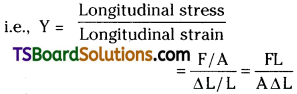
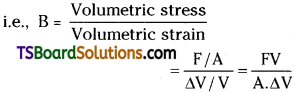
v) charminge) the act of thinking process

vi) miserablef) slightly wet, often in a way that is unpleasant
vii) constantlyg) openness, truthfulness
viii) damph) to think or talk a lot about something
ix) atmospherei) very pleasant or attractive
x) moodyj) superiority, distinction

Answer:
i) – h
ii) – e
iii) – j
iv) – g
v) – i
vi) – b
viii) – f
ix) – d
x) – c

Question 7.
Match the following words in Column A with their meanings in Column B.
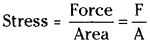
Father, Dear Father, Revision Test – II

Column AColumn B
i) transgressiona) irritation, disappointment
ii) philosopherb) nervous, rude
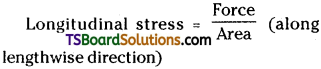
iii) pluckingc) real meaning
iv) harbingerd) identify, be familiar with
v) essencee) pulling something out
vi) frustrationf) skill
vii) recognizeg) doing wrong, violation of a code
viii) nervyh) at risk to be lost
ix) crafti) truth-seeker, logician
x) at stakej) indication

Answer:
i) – g
ii) – i
iii) – e
iv) – j
v) – c
vi) – a
vii) – d
viii) – b
ix) – f
x) – h

TS Inter 1st Year English Grammar Matching Meanings

Question 8.
Match the following words in Column A with their meanings in Column B.
The Green Champion-Thimmakka; Revision Test – III

Column AColumn B
i) stretcha) understand
ii) monsoonb) eating grass by animals
iii) capturec) clearly
iv) cherishd) huge, enormous
v) realizee) humble
vi) evidentlyf) unbelievable
vii) modestg) rainy season
viii) grazeh) an area of land
ix) incrediblei) value
x) massivej) catch hold of something

Answer:
i) – h
ii) – g
iii) – j
iv) – i
v) – a
vi) – c
vii) – e
viii) – b
ix) – f
x) – d

Question 9.
Match the following words in Column A with their meanings in Column B.
The First Four Minutes; Revision Test – IV

Column AColumn B
i) resistancea) silence
ii) pounceb) suffering, agony
iii) flutterc) surround, cover
iv) anguishd) natural, on the spot
v) havene) dared
vi) spontaneousf) refusal to obey; opposition
vii) lullg) confuse, puzzle
viii) venturedh) move lightly and quickly, tremble
ix) engulfi) safe place
x) bewilderj) jump, leap

Answer:
i) – f
ii) – j
iii) – h
iv) – b
v) – i
vi) – d
vii) – a
viii) – e
ix) – c
x) – g

TS Inter 1st Year English Grammar Matching Meanings

Question 10.
Match the following words in Column A with their meanings in Column B.
Box and Cox; Revision Test – V

Column AColumn B
i) acquainta) bottom parts of hats that stick out
ii) indignationb) flat, level
iii) confoundc) control, check
iv) loftd) revenge
v) frightfule) anger
vi) contemptiblef) confuse, surprise
vii) brimsg) a space, room just below the roof of a house
viii) vengeanceh) dreadful, awful
ix) curbi) inform, accustom
x) horizontalj) hate worthy, shameful

Answer:
i) – i
ii) – e
iii) – f
iv) – g
v) – h
vi) – j
vii) – a
viii) – d
ix) – c
x) – b

TS Inter 1st Year English Grammar Matching Meanings

Question 11.
Match the following words in Column A with their meanings in Column B.
Model Question Paper

Column AColumn B
i) appreciatea) convince
ii) bring aboutb) the quality of being kind, generous
iii) providec) beyond hope
iv) lightend) acceptance as true
v) chasme) dismiss, become free
vi) recognitionf) make something happen
vii) benevolenceg) gap, wide difference
viii) get rid ofh) give something to somebody
ix) persuadei) value something highly
x) desperatej) reduce the amount of worry

Answer:
i) – i
ii) – f
iii) – h
iv) – j
v) – g
vi) – d
vii) – b
viii) – e
ix) – a
k) – c

Note : Go through the section “MEANINGS AND EXPLANATIONS” given at the end of all the fifteen lessons. It helps you score 28 Marks in the Public Examination. That also helps in improving your language skills.

TS Inter 1st Year Maths 1A Matrices Important Questions Very Short Answer Type

Students must practice these Maths 1A Important Questions TS Inter 1st Year Maths 1A Matrices Important Questions Very Short Answer Type to help strengthen their preparations for exams.

TS Inter 1st Year Maths 1A Matrices Important Questions Very Short Answer Type

Question 1.
If A = \(\left[\begin{array}{ll}
1 & 2 \\
3 & 4
\end{array}\right]\), B = \(\left[\begin{array}{ll}
3 & 8 \\
7 & 2
\end{array}\right]\) and 2X + A = B, then find X. [Mar. 15 (AP); Mar. 13, 11; May 12]
Answer:
TS Inter First Year Maths 1A Matrices Important Questions Very Short Answer Type 1

TS Inter First Year Maths 1A Matrices Important Questions Very Short Answer Type

If A = \(\left[\begin{array}{ccc}
3 & 2 & -1 \\
2 & -2 & 0 \\
1 & 3 & 1
\end{array}\right]\), B = \(\left[\begin{array}{ccc}
-3 & -1 & 0 \\
2 & 1 & 3 \\
4 & -1 & 2
\end{array}\right]\) and X = A + B then find X. [Mar. 17 (TS)]
Answer:
\(\left[\begin{array}{ccc}
0 & 1 & -1 \\
4 & -1 & 3 \\
5 & 2 & 3
\end{array}\right]\)

Question 2.
If \(\left[\begin{array}{cc}
x-3 & 2 y-8 \\
z+2 & 6
\end{array}\right]\) = \(\left[\begin{array}{cc}
5 & 2 \\
-2 & a-4
\end{array}\right]\), then find the values of x, y, z and a. [May 14, 06 Mar. 19(AP)]
Answer:
Given \(\left[\begin{array}{cc}
x-3 & 2 y-8 \\
z+2 & 6
\end{array}\right]\) = \(\left[\begin{array}{cc}
5 & 2 \\
-2 & a-4
\end{array}\right]\)
From the equality of matrices,
x – 3 = 5
⇒ x = 8
2y – 8 = 2
2y = 10
y=5
z + 2 = – 2
z = – 4
a – 4 = 6
a = 10
∴ x = 8, y = 5, z = – 4, a = 10

If \(\left[\begin{array}{ccc}
x-1 & 2 & 5-y \\
0 & z-1 & 7 \\
1 & 0 & a-5
\end{array}\right]\) = \(\left[\begin{array}{lll}
1 & 2 & 3 \\
0 & 4 & 7 \\
1 & 0 & 0
\end{array}\right]\) then find the values of x, y, z and ‘a’.
Answer:
2, 2, 5, 5

If \(\left[\begin{array}{ccc}
x-1 & 2 & y-5 \\
z & 0 & 2 \\
1 & -1 & 1+a
\end{array}\right]\) = \(\left[\begin{array}{ccc}
1-x & 2 & -y \\
2 & 0 & 2 \\
1 & -1 & 1
\end{array}\right]\) then find the values of x, y, z and ‘a’.
Answer:
1, \(\frac{5}{2}\), 2, 0

TS Inter First Year Maths 1A Matrices Important Questions Very Short Answer Type

Question 3.
Find the trace of \(\left[\begin{array}{rrr}
1 & 3 & -5 \\
2 & -1 & 5 \\
2 & 0 & 1
\end{array}\right]\).
Answer:
Let A = \(\left[\begin{array}{rrr}
1 & 3 & -5 \\
2 & -1 & 5 \\
2 & 0 & 1
\end{array}\right]\)
∴ Tra A = 1 – 1 + 1 = 1
The elements of the principal diagonal = 1, – 1, 1

Fin the area of A if A = \(\left[\begin{array}{ccc}
1 & 2 & -1 / 2 \\
0 & -1 & 2 \\
-1 / 2 & 2 & 1
\end{array}\right]\)
Answer:
1

Question 4.
If A = \(\left[\begin{array}{lll}
1 & 2 & 3 \\
3 & 2 & 1
\end{array}\right]\) and B = \(\left[\begin{array}{lll}
3 & 2 & 1 \\
1 & 2 & 3
\end{array}\right]\), find 3B – 2A. [Mar, 19 (TS); Mar. 12]
Answer:
TS Inter First Year Maths 1A Matrices Important Questions Very Short Answer Type 2

If A = \(\left[\begin{array}{ccc}
0 & 1 & 2 \\
2 & 3 & 4 \\
4 & 5 & -6
\end{array}\right]\) and B = \(\left[\begin{array}{ccc}
-1 & 2 & 3 \\
0 & 1 & 0 \\
0 & 0 & -1
\end{array}\right]\) find B – A and 4A – 5B
Answer:
\(\left[\begin{array}{ccc}
-1 & 1 & 1 \\
-2 & -2 & -4 \\
-4 & -5 & -5
\end{array}\right],\left[\begin{array}{ccc}
5 & -6 & -7 \\
8 & 7 & 16 \\
16 & 20 & -19
\end{array}\right]\)

TS Inter First Year Maths 1A Matrices Important Questions Very Short Answer Type

If A = \(\left[\begin{array}{lll}
0 & 1 & 2 \\
2 & 3 & 4 \\
4 & 5 & 6
\end{array}\right]\) and B = \(\left[\begin{array}{ccc}
1 & -2 & 0 \\
0 & 1 & -1 \\
-1 & 0 & 3
\end{array}\right]\) find A – B and 4B – 3A
Answer:
\(\left[\begin{array}{ccc}
-1 & 3 & 2 \\
2 & 2 & 5 \\
5 & 5 & 3
\end{array}\right],\left[\begin{array}{ccc}
4 & -11 & -6 \\
-6 & -5 & -16 \\
-16 & -15 & -6
\end{array}\right]\)

Question 5.
If A = \(\left[\begin{array}{rrr}
1 & -2 & 3 \\
2 & 3 & -1 \\
-3 & 1 & 2
\end{array}\right]\) and B = \(\left[\begin{array}{lll}
1 & 0 & 2 \\
0 & 1 & 2 \\
1 & 2 & 0
\end{array}\right]\) then examine whether A and B commute with respect to multiplication of matrices. [Nov, 98]
Answer:
Given A = \(\left[\begin{array}{rrr}
1 & -2 & 3 \\
2 & 3 & -1 \\
-3 & 1 & 2
\end{array}\right]\), B = \(\left[\begin{array}{lll}
1 & 0 & 2 \\
0 & 1 & 2 \\
1 & 2 & 0
\end{array}\right]\)
Both A and B are square matrices of order 3.
Hence both AB and BA are defined and are matrices of order 3.
TS Inter First Year Maths 1A Matrices Important Questions Very Short Answer Type 3
which shows that AB ≠ BA
Therefore A and B do not commute with respect to multiplication of matrices.

TS Inter First Year Maths 1A Matrices Important Questions Very Short Answer Type

If A = \(\left[\begin{array}{rrr}
1 & -2 & 3 \\
-4 & 2 & 5
\end{array}\right]\) and B = \(\left[\begin{array}{ll}
2 & 3 \\
4 & 5 \\
2 & 1
\end{array}\right]\) do AB and BA exist ? If they exist find them. Do A and B commute with respect to multiplication.
Answer:
\(\left[\begin{array}{cc}
0 & -4 \\
10 & 3
\end{array}\right]\), \(\left[\begin{array}{ccc}
-10 & 2 & 21 \\
-16 & 2 & 37 \\
-2 & -2 & 11
\end{array}\right]\) & AB ≠BA

Question 6.
If A = \(\left[\begin{array}{cc}
\mathbf{i} & 0 \\
0 & -\mathbf{i}
\end{array}\right]\), then show that A2 = – 1. [Mar. 16 (AP), 08]
Answer:
TS Inter First Year Maths 1A Matrices Important Questions Very Short Answer Type 4

Find A2 where A = \(\left[\begin{array}{cc}
4 & 2 \\
-1 & 1
\end{array}\right]\).
Answer:
\(\left[\begin{array}{rr}
14 & 10 \\
-5 & -1
\end{array}\right]\)

If A = \(\left[\begin{array}{ll}
\mathbf{i} & \mathbf{0} \\
\mathbf{0} & \mathbf{i}
\end{array}\right]\), find A2.
Answer:
\(\left[\begin{array}{cc}
-1 & 0 \\
0 & -1
\end{array}\right]\)

TS Inter First Year Maths 1A Matrices Important Questions Very Short Answer Type

Question 7.
Find \(\left[\begin{array}{ccc}
\mathbf{0} & \mathbf{c} & -\mathbf{b} \\
-\mathbf{c} & \mathbf{0} & \mathbf{a} \\
\mathbf{b} & -\mathbf{a} & \mathbf{0}
\end{array}\right]\) \(\left[\begin{array}{lll}
\mathbf{a}^2 & \mathbf{a b} & \mathbf{a c} \\
\mathbf{a b} & \mathbf{b}^2 & \mathbf{b c} \\
\mathbf{a c} & \mathbf{b c} & \mathbf{c}^2
\end{array}\right]\) [Mar. 96; May 91]
Answer:
Let A = \(\left[\begin{array}{ccc}
\mathbf{0} & \mathbf{c} & -\mathbf{b} \\
-\mathbf{c} & \mathbf{0} & \mathbf{a} \\
\mathbf{b} & -\mathbf{a} & \mathbf{0}
\end{array}\right]\), B = \(\left[\begin{array}{lll}
\mathbf{a}^2 & \mathbf{a b} & \mathbf{a c} \\
\mathbf{a b} & \mathbf{b}^2 & \mathbf{b c} \\
\mathbf{a c} & \mathbf{b c} & \mathbf{c}^2
\end{array}\right]\)
The order of matrix, A is 3 × 3
The order of matrix, B is 3 × 3
The no. of columns in A = The no. of rows in B.
∴ AB is defined.
TS Inter First Year Maths 1A Matrices Important Questions Very Short Answer Type 5

Question 8.
If A = \(\left[\begin{array}{cc}
2 & 4 \\
-1 & k
\end{array}\right]\) and A2 = 0, then find the value of k. [Mar. 17 (AP), 14, 05, May. 11, Mar. 08(TS)]
Answer:
TS Inter First Year Maths 1A Matrices Important Questions Very Short Answer Type 6
From equality of matrices, – 2 – k = 0 ⇒ k = – 2

TS Inter First Year Maths 1A Matrices Important Questions Very Short Answer Type

Question 9.
If A = \(\left[\begin{array}{lll}
3 & 0 & 0 \\
0 & 3 & 0 \\
0 & 0 & 3
\end{array}\right]\) then find A4. [May 01]
Answer:
TS Inter First Year Maths 1A Matrices Important Questions Very Short Answer Type 7

If A = \(\left[\begin{array}{ccc}
1 & 1 & 3 \\
5 & 2 & 6 \\
-2 & -1 & -3
\end{array}\right]\) then find A3.
Answer:
\(\left[\begin{array}{lll}
0 & 0 & 0 \\
0 & 0 & 0 \\
0 & 0 & 0
\end{array}\right]\)

Question 10.
If A = \(\left[\begin{array}{lll}
1 & 4 & 7 \\
2 & 5 & 8
\end{array}\right]\) and B = \(\left[\begin{array}{rrr}
-3 & 4 & 0 \\
4 & -2 & -1
\end{array}\right]\), then show that (A + B)’ = A’ + B’ [May. 09]
Answer:
TS Inter First Year Maths 1A Matrices Important Questions Very Short Answer Type 8

TS Inter First Year Maths 1A Matrices Important Questions Very Short Answer Type

Question 11.
If A = \(\left[\begin{array}{rrr}
-2 & 1 & 0 \\
3 & 4 & -5
\end{array}\right]\) and B = \(\left[\begin{array}{cc}
1 & 2 \\
4 & 3 \\
-1 & 5
\end{array}\right]\), then find A + B’. [May. 08]
Answer:
TS Inter First Year Maths 1A Matrices Important Questions Very Short Answer Type 9

Question 12.
If A = \(\left[\begin{array}{ccc}
2 & -1 & 2 \\
1 & 3 & -4
\end{array}\right]\) and B = \(\left[\begin{array}{cc}
1 & -2 \\
-3 & 0 \\
5 & 4
\end{array}\right]\), then verify that (AB)’ = B’A’ [Mar. 13]
Answer:
TS Inter First Year Maths 1A Matrices Important Questions Very Short Answer Type 10

TS Inter First Year Maths 1A Matrices Important Questions Very Short Answer Type

Question 13.
If A = \(\left[\begin{array}{ccc}
2 & 0 & 1 \\
-1 & 1 & 5
\end{array}\right]\) and B = \(\left[\begin{array}{ccc}
-1 & 1 & 0 \\
0 & 1 & -2
\end{array}\right]\), then find (AB)’. [Mar. 19 (TS); May. 12]
Answer:
TS Inter First Year Maths 1A Matrices Important Questions Very Short Answer Type 11

Question 14.
If A = \(\left[\begin{array}{rr}
-2 & 1 \\
5 & 0 \\
-1 & 4
\end{array}\right]\) and B = \(\left[\begin{array}{rrr}
-2 & 3 & 1 \\
4 & 0 & 2
\end{array}\right]\) then find 2A + B’ and 3B’ – A. [Mar. 10]
Answer:
TS Inter First Year Maths 1A Matrices Important Questions Very Short Answer Type 12

TS Inter First Year Maths 1A Matrices Important Questions Very Short Answer Type

Question 15.
If A = \(\left[\begin{array}{rr}
2 & -4 \\
-5 & 3
\end{array}\right]\), then find A + A’ and AA’ [May 15 (AP); May 07, 02]
Answer:
TS Inter First Year Maths 1A Matrices Important Questions Very Short Answer Type 13

If A = \(\left[\begin{array}{cc}
-1 & 2 \\
0 & 1
\end{array}\right]\) then find AA’. Do A and A’ commute with respect to multiplication of matrices ? [Mar. 17(TS)]
Answer:
AA’ = \(\left[\begin{array}{ll}
5 & 2 \\
2 & 1
\end{array}\right]\), A’A = \(\left[\begin{array}{cc}
1 & -2 \\
-2 & 5
\end{array}\right]\); AA’ ≠ A’A

Question 16.
If A = \(\left[\begin{array}{ccc}
0 & 4 & -2 \\
-4 & 0 & 8 \\
2 & -8 & x
\end{array}\right]\) is a skew symmetric matrix, find the value of x. [Mar. 08]
Answer:
TS Inter First Year Maths 1A Matrices Important Questions Very Short Answer Type 14

Question 17.
If A = \(\left[\begin{array}{rrr}
-1 & 2 & 3 \\
2 & 5 & 6 \\
3 & x & 7
\end{array}\right]\) is a symmetric matrix, then find x. [Mar. 16 (AP), 05, 03, May. 15 (TS)]
Answer:
TS Inter First Year Maths 1A Matrices Important Questions Very Short Answer Type 15
From equality of matrices, x = 6.

TS Inter First Year Maths 1A Matrices Important Questions Very Short Answer Type

Question 18.
If A = \(\left[\begin{array}{rrr}
0 & 2 & 1 \\
-2 & 0 & -2 \\
-1 & x & 0
\end{array}\right]\) is a skew symmetric matrix, then find x. [May. 14, 13, 11]
Answer:
A matrix A is said to be skew symmetric if,
TS Inter First Year Maths 1A Matrices Important Questions Very Short Answer Type 16
From the equality of matrices, x = 2.
∴ x = 2

Question 19.
Is \(\left[\begin{array}{ccc}
0 & 1 & 4 \\
-1 & 0 & 7 \\
-4 & -7 & 0
\end{array}\right]\) symmetric or skew symmetric? [Mar. 09]
Answer:
TS Inter First Year Maths 1A Matrices Important Questions Very Short Answer Type 17
∴ A is a skew symmetric matrix since AT = – A.

Question 20.
If A = \(\left[\begin{array}{cc}
\cos \alpha & \sin \alpha \\
-\sin \alpha & \cos \alpha
\end{array}\right]\), show that AA’ = A’A = I. [Mar. 07]
Answer:
TS Inter First Year Maths 1A Matrices Important Questions Very Short Answer Type 18

TS Inter First Year Maths 1A Matrices Important Questions Very Short Answer Type

Question 21.
If ω is complex (non real) cube root of 1, then show that \(\left|\begin{array}{ccc}
1 & \omega & \omega^2 \\
\omega & \omega^2 & 1 \\
\omega^2 & 1 & \omega
\end{array}\right|\) = 0 [Mar. 14, 11; May. 92]
Answer:
1, ω, ω2 are the cube roots of unity.
Then, 1 + ω + ω2 = 0, ω3 = 1.
TS Inter First Year Maths 1A Matrices Important Questions Very Short Answer Type 19

Question 22.
Find the determinant of the matrix. [May. 95]
\(\left[\begin{array}{lll}
0 & 1 & 1 \\
1 & 0 & 1 \\
1 & 1 & 0
\end{array}\right]\)
Answer:
Let A = \(\left[\begin{array}{lll}
0 & 1 & 1 \\
1 & 0 & 1 \\
1 & 1 & 0
\end{array}\right]\)
det A = \(\left|\begin{array}{lll}
0 & 1 & 1 \\
1 & 0 & 1 \\
1 & 1 & 0
\end{array}\right|\) = 0(0 – 1) – 1 (0 – 1) + 1(1 – 0)
= 0(- 1) – 1 (- 1) + 1(1) = 0 + 1 + 1 = 2

Find the determinant of the matrix
\(\left[\begin{array}{lll}
\mathbf{a} & \mathbf{h} & \mathbf{g} \\
\mathbf{h} & \mathbf{b} & \mathbf{f} \\
\mathbf{g} & \mathbf{f} & \mathbf{c}
\end{array}\right]\).
Answer:
abc + 2fgh – af2 – bg2 – ch2

Find the determinant of the matrix
\(\left[\begin{array}{lll}
\mathbf{a} & \mathbf{b} & \mathbf{c} \\
\mathbf{b} & \mathbf{c} & \mathbf{a} \\
\mathbf{c} & \mathbf{a} & \mathbf{b}
\end{array}\right]\)
Answer:
3abc – a3 – b3 – c3

TS Inter First Year Maths 1A Matrices Important Questions Very Short Answer Type

Question 23.
Find the determinant of the matrix \(\left[\begin{array}{ccc}
1^2 & 2^2 & 3^2 \\
2^2 & 3^2 & 4^2 \\
3^2 & 4^2 & 5^2
\end{array}\right]\). [Mar. 10]
Answer:
Let A = \(\left[\begin{array}{ccc}
1^2 & 2^2 & 3^2 \\
2^2 & 3^2 & 4^2 \\
3^2 & 4^2 & 5^2
\end{array}\right]=\left[\begin{array}{ccc}
1 & 4 & 9 \\
4 & 9 & 16 \\
9 & 16 & 25
\end{array}\right]\)
det A = 1(225 – 256) – 4 (100 – 144) + 9 (64 – 81)
= – 31 + 176 – 153
= 176 – 184 = – 8.

Question 24.
If A = \(\left[\begin{array}{rrr}
1 & 0 & 0 \\
2 & 3 & 4 \\
5 & -6 & x
\end{array}\right]\) and det A = 45, then find x. [May 09, 03, 99, 96, Mar; 07, 03]
Answer:
Given A = \(\left[\begin{array}{rrr}
1 & 0 & 0 \\
2 & 3 & 4 \\
5 & -6 & \mathrm{x}
\end{array}\right]\) and det A = 45.
det A = 1 (3x + 24) – 0(2x – 20) + 0 (-12 – 15) = 3x + 24 – 0 + 0 = 3x + 24
Given, det A = 45 ⇒ 3x + 24 = 45 ⇒ 3x = 45 – 24 ⇒ 3x = 21 ⇒ x = 7.

Question 25.
Find the adjoint and inverse of the matrix \(\left[\begin{array}{rr}
2 & -3 \\
4 & 6
\end{array}\right]\). [Mar. 12]
Answer:
Let A = \(\left[\begin{array}{rr}
2 & -3 \\
4 & 6
\end{array}\right]\)
Cofactor of 2 is A1 = + (6) = 6
Cofactor of 4 is A2 = – (- 3) = 3
Cofactor of – 3 is B1 = – (4) = – 4
Cofactor of 6 is B2 = + (2) = 2
∴ Cofactor matrix of A is B = \(\left[\begin{array}{ll}
\mathrm{A}_1 & \mathrm{~B}_1 \\
\mathrm{~A}_2 & \mathrm{~B}_2
\end{array}\right]=\left[\begin{array}{cc}
6 & -4 \\
3 & 2
\end{array}\right]\)
Adj A = B’ = \(\left[\begin{array}{cc}
6 & 3 \\
-4 & 2
\end{array}\right]\)
det A = ad – bc = 12 – (- 12) = 12 + 12 = 24 ≠ 0
∴ A is invertiable.
A-1 = \(\frac{{adj} A}{{det} A}=\frac{1}{24}\left[\begin{array}{rr}
6 & 3 \\
-4 & 2
\end{array}\right]\)

TS Inter First Year Maths 1A Matrices Important Questions Very Short Answer Type

Find the adjoint and the Inverse of the matrix A = \(\left[\begin{array}{cc}
1 & 2 \\
3 & -5
\end{array}\right]\). [Mar. 18 (AP); May 06]
Answer:
\(\left[\begin{array}{cc}
-5 & -2 \\
-3 & 1
\end{array}\right],\left[\begin{array}{cc}
\frac{5}{11} & \frac{2}{11} \\
\frac{3}{11} & \frac{-1}{11}
\end{array}\right]\)

Question 26.
Find the adjoint and inverse of the matrix A = \(\left[\begin{array}{cc}
\cos \alpha & -\sin \alpha \\
\sin \alpha & \cos \alpha
\end{array}\right]\) [Mar. 13, 09]
Answer:
Let A = \(\left[\begin{array}{cc}
\cos \alpha & -\sin \alpha \\
\sin \alpha & \cos \alpha
\end{array}\right]\)

Cofactor of cos α is A1 = + (cos α) = cos α
Cofactor of sin α is A2 = – (- sin α) = sin α
Cofactor of – sin α is B1 = – (sin α) = – sin α
Cofactor of cos α is B2 = + (cos α) = cos
TS Inter First Year Maths 1A Matrices Important Questions Very Short Answer Type 20

Question 27.
Find the rank of the matrix\(\left[\begin{array}{lll}
1 & 1 & 1 \\
1 & 1 & 1 \\
1 & 1 & 1
\end{array}\right]\). [Mar. 18 (TS); May 10; Mar. 08]
Answer:
Let A = \(\left[\begin{array}{lll}
1 & 1 & 1 \\
1 & 1 & 1 \\
1 & 1 & 1
\end{array}\right]\)
det A = 1(1 – 1) – 1(1 – 1) + 1 (1 – 1) = 0 – 0 + 0 = 0
Since det A = 0, Rank [A] ≠ 3
Now, \(\left[\begin{array}{ll}
1 & 1 \\
1 & 1
\end{array}\right]\) is a submatrix of A, whose determinant is 1 – 1 = 0 ∴ Rank [A] ≠ 2.
Now. [1] is a submatrix of A, whose determinant is 1 ≠ 0. ∴ Rank [A] = 1

TS Inter 1st Year Physics Study Material Chapter 10 Mechanical Properties of Solids

Telangana TSBIE TS Inter 1st Year Physics Study Material 10th Lesson Mechanical Properties of Solids Textbook Questions and Answers.

TS Inter 1st Year Physics Study Material 10th Lesson Mechanical Properties of Solids

Very Short Answer Type Questions

Question 1.
State Hooke’s law of elasticity.
Answer:
Hooke’s law states that within elastic limit stress is proportional to strain.
TS Inter 1st Year Physics Study Material Chapter 10 Mechanical Properties of Solids 1
This constant is known as elastic modulus of the body.

Question 2.
State the units and dimensions of stress.
Answer:
TS Inter 1st Year Physics Study Material Chapter 10 Mechanical Properties of Solids 2
Dimensional formula ML-1 T-2

Question 3.
State the units and dimensions of modulus of elasticity.
Answer:
TS Inter 1st Year Physics Study Material Chapter 10 Mechanical Properties of Solids 3
Nm-2 (or) pascal
Dimensional formula ML-1 T-2

Question 4.
State the units and dimensions of Young’s modulus.
Answer:
TS Inter 1st Year Physics Study Material Chapter 10 Mechanical Properties of Solids 4
Dimensional formula ML-1

Question 5.
State the units and dimensions of modulus of rigidity.
Answer:
Modulus of rigidity,
TS Inter 1st Year Physics Study Material Chapter 10 Mechanical Properties of Solids 5
(or) pascal
Dimensional formula ML-1T².

TS Inter 1st Year Physics Study Material Chapter 10 Mechanical Properties of Solids

Question 6.
State the units and dimensions of Bulk modulus.
Answer:
TS Inter 1st Year Physics Study Material Chapter 10 Mechanical Properties of Solids 6
unit is Nm-2 (or) pascal
Dimensional formula ML-1 T-2

Question 7.
State the examples of nearly perfect elastic and plastic bodies.
Answer:
There is no perfectly elastic body. But behaviour of Quartz fiber is very nearer to perfectly elastic body.

Real bodies are not perfectly plastic, but behaviour of wet clay, butter etc., can be taken as examples for perfectly plastic bodies.

Short Answer Questions

Question 1.
Define Hooke’s law of elasticity, proportionality, permanent set, and breaking stress.
Answer:
Hooke’s Law :
It states that within elastic limit, stress is proportional to strain.
TS Inter 1st Year Physics Study Material Chapter 10 Mechanical Properties of Solids 7
This constant is called elastic constant (E).
TS Inter 1st Year Physics Study Material Chapter 10 Mechanical Properties of Solids 8

Proportionality limit:
When load is increased the elongation of the wire will also increases. The maximum load upto which the elongation is directly proportional to the load is called proportionality limit (A). The graph drawn between load and extension. It is a straight line OA’.

Permanent set :
If the load on the wire is increased beyond elastic limit, the elongation is not pro portional to load. On removal of the load the wire cannot regain its original length. The length of the wire increases permanently. In figure permanent set is given by OP. This is called permanent set.

Breaking stress :
If the load is increased beyond yield point the elongation is very rapid, even for small changes in load and wire becomes thinner and breaks. This is shown as E. The breaking force per unit area is called breaking stress.

Question 2.
Define modulus of elasticity, stress, strain and Poisson’s ratio.
Answer:
1) Stress:
Restoring force acting on unit area is called stress.
TS Inter 1st Year Physics Study Material Chapter 10 Mechanical Properties of Solids 9
Unit: N/m² (or) pascal;
Dimensional formula: ML-1T-2.

2) Strain :
The change in dimension per unit original dimension of a body is called strain.
TS Inter 1st Year Physics Study Material Chapter 10 Mechanical Properties of Solids 10
It is a ratio, so no units and dimensional formula.

3) Modulus of elasticity :
∴ From Hooke’s Law Stress x Strain or
TS Inter 1st Year Physics Study Material Chapter 10 Mechanical Properties of Solids 11
The ratio of stress to strain is called modulus of elasticity.
Unit: N/m².
Dimensional formula: ML-1T-2.

4) Poisson’s ratio :
It is defined as the ratio of lateral contraction strain to longitudinal elongation strain.
Poisson’s ratio
TS Inter 1st Year Physics Study Material Chapter 10 Mechanical Properties of Solids 12
It is a ratio, so no units and dimensional formula.

TS Inter 1st Year Physics Study Material Chapter 10 Mechanical Properties of Solids

Question 3.
Define Young’s modulus, Bulk modulus, and Shear modulus.
Answer:
1) Young’s Modulus Y:
Within elastic limit, the ratio of longitudinal stress to longitudinal strain is called Young’s modulus
TS Inter 1st Year Physics Study Material Chapter 10 Mechanical Properties of Solids 13

2. Bulk Modulus (B) :
Within elastic limit, the ratio of volumetric stress to volumetric strain is called Bulk modulus
TS Inter 1st Year Physics Study Material Chapter 10 Mechanical Properties of Solids 14

3) Shear Modulus or Rigidity Modulus (G):
Within elastic limit, the ratio of tangential or shearing stress to shearing strain is called Shear modulus or Rigidity modulus.
TS Inter 1st Year Physics Study Material Chapter 10 Mechanical Properties of Solids 15

Question 4.
Define stress and explain the types of stress. [AP War. 19; TS War. 16]
Answer:
Stress:
When a body is subjected to a deforming force, then restoring forces will develop inside the body. These restoring forces will oppose any sort of change in its original shape. The restoring force per unit area of the surface is called stress.

Stress:
Stress is defined as force applied per unit area.
TS Inter 1st Year Physics Study Material Chapter 10 Mechanical Properties of Solids 16
D.F. = ML-1T-2 ; Unit: N/m² (or) Pascal.

Types of stress :
It is of three types. They are : 1) Longitudinal stress 2) Tangential stress (or) Shear stress 3) Volumetric stress.

Longitudinal stress:
If the force applied on a body is along its lengthwise direction then it is called longitudinal stress. It produces deformation in length.
TS Inter 1st Year Physics Study Material Chapter 10 Mechanical Properties of Solids 17

Tangential stress (or) Shear stress:
Force applied per unit area parallel to the surface of a body trying to displace the upper layers of the body is called shearing stress.
TS Inter 1st Year Physics Study Material Chapter 10 Mechanical Properties of Solids 18
(Parallel to the surface layers)

Volumetric stress:
If force is applied on all the sides of a body or on the volume of a body then it is called volumetric stress.
TS Inter 1st Year Physics Study Material Chapter 10 Mechanical Properties of Solids 19

Question 5.
Define strain and explain the types of strain.
Answer:
Strain:
Strain is defined as deformation produced per unit dimension. It is a ratio. So no units.
TS Inter 1st Year Physics Study Material Chapter 10 Mechanical Properties of Solids 20

Types of strain :
Strain is of three types. They are: 1) Longitudinal strain 2) Tangential strain or Shear strain 3) Volumetric strain.

Longitudinal strain:
The ratio of elongation to original length along length wise direction is defined as longitudinal strain.
TS Inter 1st Year Physics Study Material Chapter 10 Mechanical Properties of Solids 21

Shearing strain :
If the force applied on a body produces a change in shape only it is called shearing force. The angle through which a plane originally perpendicular to the fixed surface shifts due to the application of shearing stress is called shearing strain or simply shear (θ).
TS Inter 1st Year Physics Study Material Chapter 10 Mechanical Properties of Solids 22

Question 6.
Define strain energy and derive the equation for the same. [TS Mar. ’19; May ’18; AP Mar. ’14; May ’14]
Answer:
Strain energy :
The energy developed in (string) a body when it is strained is called strain energy.

Let a force F be applied on lower end of wire, fixed at the upper end. Let the extension be dl.
∴ Work done = dW = Fdl
Total work done in stretching it from 0
TS Inter 1st Year Physics Study Material Chapter 10 Mechanical Properties of Solids 23

Question 7.
Explain why steel is preferred to copper, brass, aluminium in heavy-duty machines and in structural designs.
Answer:
For metals Young’s moduli are large. Therefore, these materials require a large force to produce small change in length. To increase the length of a thin steel wire of 0.1 cm² cross-sectional area by 0.1 %, a force of 2000 N is required. The force required to produce the same strain in aluminium, brass, and copper wire having the same cross-sectional area are 690 N, 900N, and 1100 N respectively. It means that steel is more elastic than copper, brass, and aluminium. It is for this reason that steel is preferred in heavy duty machines and in structural designs.

Question 8.
Describe the behaviour of a wire under gradually increasing load. [AP Mar. ’18, ’17, ’16, ’15, ’13, May ’16, ’13; TS Mar. 18, 17, 15; May 17,16; June 15]
Answer:
Behaviour of a wire under increasing load:
Let a wire is suspended at one end and loads are attached to the other end. When loads are gradually increased the following changes are noticed.

1) Proportionality limit (A) :
When load is increased the elongation of the wire gradually increases. The maximum load upto which the elongation is directly pro-portional to the load is called proportionality limit (A). The graph drawn between load and extension is a straight line. So point A is called proportionality limit. In this region Hooke’s Law is obeyed.

2) Elastic limit (B):
If the load is increased above the proportionality limit the elongation is not proportional to the load. Hooke’s law is not obeyed. But it exhibits elasticity which means that it regains the original length if load is removed. The maximum load on the wire upto which it exhibits elasticity is called elastic limit (B in the graph).
TS Inter 1st Year Physics Study Material Chapter 10 Mechanical Properties of Solids 24

3) Permanent set (C) :
If the load on the wire is increased beyond elastic limit say upto C, the elongation is not proportional to load. On removal of the load, the wire does not regain its original length. Length of wire increases perma-nently. In figure permanent set is given by OP. So OP is called permanent set.

4) Point of ultimate tensile strength (D) :
If the load is further increased, upto D’ then strain increases rapidly even though there is no increase in stress.

At this stage the restoring forces seems to be subdued to then deforming forces. Elongation without increase in load is called creeping. This behaviour of metal is called yielding.

5) Fracture point (E) :
If the load is increased beyond Yield point the elongation is very rapid, even for small changes in load the wire becomes thinner and breaks. This is shown as E. The breaking force per unit area is called breaking stress.

TS Inter 1st Year Physics Study Material Chapter 10 Mechanical Properties of Solids

Question 9.
Two identical solid balls, one of ivory and the other of wet clay are dropped from the same height on to the floor. Which one will rise to a greater height after striking the floor and why?
Answer:
We know that ivory ball is more elastic than wet-clay ball. Therefore, the ivory ball will tend to regain its original shape in a very short time after the collision. Due to it, there will be large energy and momentum transfer to the ivory ball in comparison to the wet-clay ball. As a result of it, the ivory ball will raise higher after the collision.

Question 10.
While constructing buildings and bridges a pillar with distributed ends is preferred to a pillar with rounded ends. Why?
Answer:
Use of pillars or columns is very common in buildings and bridges. A pillar with roun-ded-ends supports less load than that with a distributed shape at the ends. Hence, for this reason, while constructing buildings and bridges a pillar with distributed ends is preferred to a pillar with rounded ends.

Question 11.
Explain why the maximum height of a mountain on earth is approximately 10 km?
Answer:
A mountain base is not under uniform compression and this provides some shearing stress to the rocks under which they can flow. The stress due to all the material on the top should be less than the critical shearing stress at which the rocks flow.

At the bottom of a mountain of height ‘h’, the force per unit area due to the weight of the mountain is hpg where p is the density of the material of the mountain and g is the acceleration due to gravity. The material at the bottom experiences this force in the vertical direction and the sides of the mountain are free. There is a shear component, approximately hpg itself. Now the elastic limit for a typical rock is 3 × 10⁷ Nm-2. Equating this to hpg with ρ = 3 × 10³ kg m-3 gives
h = \(\frac{30\times10^{-7}}{3\times10^3\times10}\) = 10 km
Hence, the maximum height of a mountain on earth is approximately 10 km.

Question 12.
Explain the concept of Elastic Potential Energy in a stretched wire and hence obtain the expression for it. [AP May ’ 18, 17; AP June 15]
Answer:
When a wire is put under a tensile stress, work is done against the inter atomic forces. This work is stored in the form of “Elastic potential energy.”

Expression to elastic potential energy:
To stretch a wire, force is applied. As a result it elongates. So the force applied is useful to do some work. This work is stored in it as potential energy. When the deforming force is removed, this energy is liberated as heat. The energy developed in a body (string) when it is strained is called strain energy.

Let a force F be applied on a wire fixed at the upper end. Let the extension be dl.
∴ Work done = dW = Fdl
Total work done in stretching from
TS Inter 1st Year Physics Study Material Chapter 10 Mechanical Properties of Solids 25

Long Answer Questions

Question 1.
Define Hooke’s law of elasticity and describe an experiment to determine the Young’s modulus of the material of a wire.
Answer:
Hooke’s Law :
Within elastic limit, stress is directly proportional to strain.
strain ∝ stress
TS Inter 1st Year Physics Study Material Chapter 10 Mechanical Properties of Solids 26
where E constant called modulus of elasticity of the material of a body.

Determination of Young’s modulus of a wire:
The apparatus used to find Young s modulus of a wire consists of two long wires A and B of same length made with same material are used. These two wires are suspended from a rigid support and a vernier scale V’ is attached to them. Wire A is connected to the main scale (M). A fixed load is connected to this cord to keep tension in the wire. This is called reference wire. The second Wire B’ is connected to vernier scale V’. Adjustable load hanger is connected to this wire. This is called experimental wire.

Procedure :
Let a load M1 is attached to the weight hanger at vernier. Main scale reading (M.S.R) and vernier scale reading (V.S.R) are noted. Weights are gradually increased in the steps of \(\frac{1}{2}\) kg upto a maximum load of say 3 kg. Every time M.S.R and V.S.R are noted. They are placed in tabular form.

Now loads are gradually decreased in steps of \(\frac{1}{2}\) kg. While decreasing M.S.R and V.S.R are noted for every load, values are posted in tabular form.

Let 1st reading with mass M1 is e1 and 2nd reading with mass M2 is e2.

Change in load M = M2 – M1
elongation e = e2 – e1
‘M’ and ‘e’ values are calculated and a graph is plotted.
TS Inter 1st Year Physics Study Material Chapter 10 Mechanical Properties of Solids 27

Force on the wire = mg
Area of cross section of the wire = πr²
(r = radius of the wire)
Elongation = e
Original length = l
TS Inter 1st Year Physics Study Material Chapter 10 Mechanical Properties of Solids 28

A graph is between load (m) and elongation ‘e’, is straight line passing through the origin. The slope of the graph (tan θ) gives (\(\frac{m}{e}\)). The value is substituted in the above equation to find Young’s modulus of the material of the wire.

Precautions:

  1. The load applied should be much smaller than elastic limit.
  2. Reading is noted only after the air bubble is brought to centre of spirit level.

Problems

Question 1.
A copper wire of 1mm diameter is stretched by applying a force of 10 N. Find the stress in the wire.
Solution:
Diameter, d = 1mm
∴ radius, r = 0.5 mm = 0.5 × 10⁻³m
Force, F = 10N
TS Inter 1st Year Physics Study Material Chapter 10 Mechanical Properties of Solids 29

Question 2.
A tungsten wire of length 20cm is stretched by 0.1cm. Find the strain on the wire.
Solution:
Length of wire, l = 20cm = 0.2m
elongation, e = 0.1cm = 1 × 10⁻³m
TS Inter 1st Year Physics Study Material Chapter 10 Mechanical Properties of Solids 30

Question 3.
If an iron wire is stretched by 1%, what is the strain on the wire?
Solution:
TS Inter 1st Year Physics Study Material Chapter 10 Mechanical Properties of Solids 31

TS Inter 1st Year Physics Study Material Chapter 10 Mechanical Properties of Solids

Question 4.
A brass wire of diameter 1mm and of length 2m is stretched by applying a force of 20N. If the increase in length is 0.51mm, find i) the stress, ii) the strain and iii) the Young’s modulus of the wire.
Solution:
Length of wire, l = 2m;
L diameter, d = 1mm = 10-3 m
Force, F = 20N;
Increase in length, e = 0.51mm
TS Inter 1st Year Physics Study Material Chapter 10 Mechanical Properties of Solids 32
TS Inter 1st Year Physics Study Material Chapter 10 Mechanical Properties of Solids 33

Question 5.
A copper wire and an aluminium wire have lengths in the ratio 3: 2, diameters in the ratio 2 : 3 and forces applied in the ratio 4: 5. Find the ratio of increase in length of the two wires. (YCu = 1.1 × 10¹¹ Nm-2, YAl = 0.7 × 10¹¹Nm-2)
Solution:
Ratio of lengths, l1 : l2 = 3 : 2;
Ratio of diameters, d1 : d2 = 2 : 3
Ratio of forces, F1 : F2 = 4 : 5
Y1 = Y of copper = 1.1 × 10¹¹
Y2 = Y of Aluminium = 0.7 × 10¹¹;
Ratio of elongation, e1 : e2 = ?
TS Inter 1st Year Physics Study Material Chapter 10 Mechanical Properties of Solids 34

Question 6.
A brass wire of cross-sectional area 2mm² is suspended from a rigid support and a body of volume 100cm³ is attached to its other end. If the decrease in the length of the wire is 0.11mm, when the body is completely immersed in water, find the natural length of the wire.
(Ybrass = 0.91 × 10¹¹ Nm-2, ρwater = 10³kgm-3)
Solution:
Area of cross section, A = 2mm = 2 × 10⁻⁶
Volume of body, V = 100 cc = 100 × 10-6
Decrease in length, e’ = 0.11mm = 0.11 × 10⁻³m
Youngs modulus of brass, Y = 0.91 × 10¹¹ N/m²
Density of water, ρ = 1000 kg / m³
Use e’ = \(\frac{V\rho gl}{AY}\)
TS Inter 1st Year Physics Study Material Chapter 10 Mechanical Properties of Solids 35

Question 7.
There are two wires of same material. Their radii and lengths are both in the ratio 1 : 2. If the extensions produced are equal, what is the ratio of the loads?
Solution:
Ratio of lengths, l1 : l2 = 1 : 2
Ratio of radii, r1 : r2 = 1 : 2
Extensions produced are equal ⇒ e1 = e2;
Made of same material ⇒ Y1 = Y2
Ratio of loads m1 : m2 = ?
TS Inter 1st Year Physics Study Material Chapter 10 Mechanical Properties of Solids 36

TS Inter 1st Year Physics Study Material Chapter 10 Mechanical Properties of Solids

Question 8.
Two wires of different material have same lengths and areas of cross-section. What is the ratio of their increase in length when forces applied are the same? (Y1 = 0.90 × 10¹¹ Nm-2, Y2 = 3.60 × 10¹¹ Nm-2.)
Solution:
Lengths are same ⇒ l1 = l2 ;
Area of cross sections are same, A1 = A2
Y1 = 0.9 × 10¹¹ N/m²
Y2 = 3.60 × 10¹¹ N/m²
TS Inter 1st Year Physics Study Material Chapter 10 Mechanical Properties of Solids 37

Question 9.
A metal wire of length 2.5m and area of cross-section 1.5 × 10⁻⁶ m² is stretched through 2mm. If its Young’s modulus is 1.25 × 10¹¹ Nm-2, find the tension in the wire.
Solution:
Length of wire, l = 2.5m
Y = 1.25 × 10¹¹N/m²
Area of cross section, A = 1.5 × 10⁻⁶
Elongation, e = 2 m.m = 2 × 10⁻³m
Tension, T = mg = F = ?
TS Inter 1st Year Physics Study Material Chapter 10 Mechanical Properties of Solids 38

Question 10.
An aluminium wire and a steel wire of the same length and cross-section are joined end-to-end. The composite wire is hung from a rigid support and a load is suspended from the free end. If the increase in length of the composite wire is 1.35 mm, find the ratio of the (i) stress in the two wires and 0Q strain in the two wires. (YAl = 0.7 × 10¹¹ Nm-2, Ysteel = 2 × 10¹¹m-2)
Solution:
i) Length is same ⇒ l1 = l2
Area is same ⇒ A1 = A2
In composite wire same load will act on both wires.
∴ Ratio of stress = 1 : 1

ii) Total elongation, e = 1.35mm =eAl + es
Young’s modulus of aluminium = 7 × 10¹⁰ N/m²
Y of steel = 2 × 10¹¹ N/m²
Elongation, e = \(\frac{Fl}{AY}\)
But F, l and A are same
TS Inter 1st Year Physics Study Material Chapter 10 Mechanical Properties of Solids 39
∴ Ratio of strains in the wires is 20 : 7.

Question 11.
A 2 cm cube of some substance has its upper face displaced by 0.15cm due to a tangential force of 0.3 N while keeping the lower face fixed. Calculate the rigidity modulus of the substance.
Solution:
Side of cube, a = 2.0 cm = 2 × 10⁻² m
Area, A = 4 × 10⁻⁴
Displacement of upper layer = 0.15cm
= 0.15 × 10⁻²m
Tangential force, F = 0.30N
TS Inter 1st Year Physics Study Material Chapter 10 Mechanical Properties of Solids 40

Question 12.
A spherical ball of volume 1000 cm³ is subjected to a pressure of 10 atmosphere. The change in volume is 10-8 cm³. If the ball is made of iron, find its bulk modulus. (1 atmosphere = 1 × 10⁵ Nm-2)
Solution:
Volume of ball, V = 1000 cm³ = 10-3
(∵ 1M³ = 106 cm³)
Pressure, P = 10 atmospheres
= 10 × 105 pa ( v 1 atm = 105 pascal)
Change in volume, ∆V = 10-8 cm³
TS Inter 1st Year Physics Study Material Chapter 10 Mechanical Properties of Solids 41

Question 13.
A copper cube of side of length 1 cm is subjected to a pressure of 100 atmosphere. Find the change in its volume if the bulk modulus of copper is 1.4 × 10¹¹ Nm-2 (1 atm = 1 × 10⁵ Nm-2).
Solution:
Side of cube, a’ = 1cm = 10-2m
∴ Volume of cube = 10-6m
Pressure, P = 100 atm = 100 × 105 = 107 pa
Bulk modulus, K = 1.4 × 10¹¹ N/m²;
TS Inter 1st Year Physics Study Material Chapter 10 Mechanical Properties of Solids 42

Question 14.
Determine the pressure required to reduce the given volume of water by 2%. Bulk modulus of water is 2.2 × 10⁹ Nm-2
Solution:
TS Inter 1st Year Physics Study Material Chapter 10 Mechanical Properties of Solids 43

TS Inter 1st Year Physics Study Material Chapter 10 Mechanical Properties of Solids

Question 15.
A steel wire of length 20 cm is stretched to increase its length by 0.2 cm. Find the lateral strain in the wire if the Poisson’s’ ratio for steel is 0.19.
Solution:
Length of wire, l = 20, cm = 0.20m,
Poisson’s ratio, σ =0.19
Increase in length, ∆l = 0.2 cm = 2 × 10⁻³m
lateral strain = ?
Lateral strain = σ × longitudinal strain ‘e’
TS Inter 1st Year Physics Study Material Chapter 10 Mechanical Properties of Solids 44

TS Inter 1st Year Maths 1A Ratios up to Transformations Important Questions Short Answer Type

Students must practice these Maths 1A Important Questions TS Inter 1st Year Maths 1A Ratios up to Transformations Important Questions Short Answer Type to help strengthen their preparations for exams.

TS Inter 1st Year Maths 1A Ratios up to Transformations Important Questions Short Answer Type

Question 1.
Prove that \(\frac{\tan \theta+\sec \theta-1}{\tan \theta-\sec \theta+1}=\frac{1+\sin \theta}{\cos \theta}\). [Mar. ’14]
Answer:
TS Inter First Year Maths 1A Trigonometric Ratios up to Transformations Important Questions Short Answer Type 1

Question 2.
If A + B = \(\frac{\pi}{4}\), then prove that i) (1 + tan A) (1 + tan B) = 2. ii) (cot A – 1) (cot B -1) = 2. [Mar. 61′(TS), ’07 Ma
Answer:
(i) Given that A + B = 45°
⇒ tan (A + B) = tan 45°
⇒ \(\frac{\tan A+\tan B}{1-\tan A \tan B}\) = 1
⇒ tan A + tan B = 1 – tan A . tan B
⇒ tan A + tan B + tan A tan B = 1

L.H.S = (1 + tan A) (1 + tan B)
= 1 + tan B + tan A + tan A tan B
= 1 + (tan A + tan B + tan A tan B)
= 1 + 1 = 2 = RHS.
∴ (1 + tan A) (1 + tan B) = 2

(ii) Given that A + B = 45°
⇒ cot (A + B) = cot 45°
⇒ \(\frac{\cot A \cot B-1}{\cot B+\cot A}\) = 1
⇒ cot A. cot B – 1 = cot A + cot B
⇒ cot A cot B – cot A – cot B = 1
L.H.S = (cot A – 1) (cot B – 1)
= cot A cot B – cot A – cot B + 1 = (cot A cot B – cot A – cot B) + 1 = 1 + 1=2 = RHS.
∴ (cot A – 1) (cot B – 1) = 2

TS Inter First Year Maths 1A Ratios up to Transformations Important Questions Short Answer Type

Question 3.
Prove that sin2θ + sin2(θ + \(\frac{\pi}{3}\)) + sin2(θ – \(\frac{\pi}{3}\)) = \(\frac{\pi}{3}\)
Answer:
TS Inter First Year Maths 1A Trigonometric Ratios up to Transformations Important Questions Short Answer Type 2

Question 4.
If A, B, C are the angles of a triangle and if none of them is equal to \(\frac{\pi}{2}\) then prove that tan A + tan B + tan C = tan A tan B tan C.
Sol. If A, B, C are the angles of a triangle then
A + B + C = 180°
⇒ A + B = 180 0 – C
⇒ tan (A + B) = tan (180° – C)
⇒ \(\frac{\tan A+\tan B}{1-\tan A \tan B}\) = – tan C
⇒ tan A + tan B = – tan C (1 – tan A tan B)
⇒ tan A + tan B = – tan C + tan A tan B tan C
⇒ tan A + tan B + tan C = tan A tan B tan C

Question 5.
If 0 < A < B < \(\frac{\pi}{4}\) and sin(A +B) = \(\frac{24}{25}\) and cos(A – B) = \(\frac{4}{5}\), then find the value of tan 2a.
Answer:
0 < A < \(\frac{\pi}{4}\) and 0 < B < \(\frac{\pi}{4}\) ⇒ 0 < A < B < \(\frac{\pi}{4}\)
∴ (A + B) lies in first quadrant.
TS Inter First Year Maths 1A Trigonometric Ratios up to Transformations Important Questions Short Answer Type 3

Question 6.
If tan α – tan β = m and cot α – cot β = n, then prove that cot(α – β) = \(\frac{1}{m}-\frac{1}{n}\)
Answer:
We have tan α – tan β = m
TS Inter First Year Maths 1A Trigonometric Ratios up to Transformations Important Questions Short Answer Type 4

Question 7.
If \(\frac{\sin (\alpha+\beta)}{\sin (\alpha-\beta)}=\frac{a+b}{a-b}\) then prove that a tan β = b
Answer:
Given \(\frac{\sin (\alpha+\beta)}{\sin (\alpha-\beta)}=\frac{a+b}{a-b}\)
By using componendo and dividendo, we get
TS Inter First Year Maths 1A Trigonometric Ratios up to Transformations Important Questions Short Answer Type 5

Question 8.
If A + B + C = \(\frac{\pi}{2}\) and and if none of A, B, Cs an odd multiple of then prove that cot A + cot B + cot C = cot A cot B cot C.
Answer:
Given A + B + C = \(\frac{\pi}{2}\) ⇒ A + B = \(\frac{\pi}{2}\) – C
∴ cot(A + B) = c(\(\frac{\pi}{2}\) – C) = tanC = \(\frac{1}{\cot C}\)
⇒ \(\frac{\cot A \cot B-1}{\cot B+\cot A}=\frac{1}{\cot C}\)
⇒ cot A + cot B + cot C = cot A cot B cot C

Question 9.
Prove that sin 18° = \(\frac{\sqrt{5}-1}{4}\). [May ’10]
Answer:
Let A = 18°
5A = 90°
2A + 3A = 90°
2A = 90° – 3A
sin 2A = sin (90° – 3A)
sin 2A = cos 3A
2 sin A cos A = 4 cos3A – 3 cos A
2 sin A cos A = cos A (4 cos2A – 3)
2 sin A = 4 cos2A – 3
2 sin A = 4 (1 – sin2A) – 3
2 sin A = 4 – 4 sin2A – 3
2 sin A = 1 – 4 sin2A
4 sin2A + 2 sin A – 1 = 0
This is a quadratic equation in sin A.
Here a = 4,b = 2, c = -1
TS Inter First Year Maths 1A Trigonometric Ratios up to Transformations Important Questions Short Answer Type 6
Since A = 18°, it lies in first quadrant and hence sin A > 0.
sin A = \(\frac{-1+\sqrt{5}}{4}\) ⇒ sin A = \(\frac{\sqrt{5}-1}{4}\)
∴ sin 18° = \(\frac{\sqrt{5}-1}{4}\)

TS Inter First Year Maths 1A Ratios up to Transformations Important Questions Short Answer Type

Question 10.
If A is not an integral multiple of \(\frac{\pi}{2}\), prove that
(i) tan A + cot A = 2 cosec 2A,
(ii) cot A – tan A = 2 cot 2A. [B.P] [Mar. ’18(AP)]
Answer:
TS Inter First Year Maths 1A Trigonometric Ratios up to Transformations Important Questions Short Answer Type 7

Question 11.
If θ is not an integral multiple of \(\frac{\pi}{2}\), prove that tan θ + 2 tan 2θ + 4 tan 4θ + 8 cot 8θ = cot θ. [Mar. ’19(AP); May ’01]
Answer:
We know that cot A – tan A = 2 cot 2A
TS Inter First Year Maths 1A Trigonometric Ratios up to Transformations Important Questions Short Answer Type 8
cot A – tan A = 2 cot 2A
tan A = cot A – 2 cot 2A …………………(1)
Put A = 0 in (1)
tan θ = cot θ – 2 cot 2θ

Put A = 20 in (1)
tan 2θ = cot 2θ – 2 cot 4θ

Put A = 40 in (1)
tan 4θ = cot 4θ – 2 cot 8θ

L.H.S = tan θ + 2 tan 2θ + 4 tan 4θ + 8 cot 8θ = (cot θ – 2 cot 2θ) + 2 (cot 2θ – 2 cot 4θ) + 4 (cot 4θ – 2 cot 8θ) + 8 cot 8θ
= cot θ – 2 cot 2θ + 2 cot 2θ – 4 cot 4θ + 4 cot 4θ – 8 cot 8θ + 8 cot 8θ = cot θ = R.H.S
∴ tan θ + 2 tan 2θ + 4 tan 4θ + 8 cot 8θ = cot θ

Question 12.
Prove that sin A. sin(\(\frac{\pi}{3}\) + A) sin (\(\frac{\pi}{3}\) – A) = \(\frac{1}{4}\) sin 3A and hence deduce that sin 20°. sin 40°. sin 60°. sin 80° = \(\frac{3}{16}\). [May ’97, ’93]
Answer:
TS Inter First Year Maths 1A Trigonometric Ratios up to Transformations Important Questions Short Answer Type 9
Let A = 20° ⇒ sin 20°. sin (60° + 20°) sin (60° – 20°)
= \(\frac{1}{4}\) sin 3 (20°)
⇒ sin 20° . sin 80°. sin 40° = \(\frac{1}{4}\) sin 60°

Multiply with sin 60° on both sides then we get
sin 20° . sin 40° . sin 60° . sin 80°
= \(\frac{1}{4}\)sin 60 – \(\frac{1}{4} \cdot\left(\frac{\sqrt{3}}{2}\right)^2=\frac{1}{4} \cdot \frac{3}{4}=\frac{3}{16}\)

Question 13.
Prove that sin4\(\frac{\pi}{8}\) + sin4\(\frac{5 \pi}{8}\) + sin4\(\frac{5 \pi}{8}\) + sin4\(\frac{7 \pi}{8}=\frac{3}{2}\). [Mar ’13; Mar. ’00]
Answer:
TS Inter First Year Maths 1A Trigonometric Ratios up to Transformations Important Questions Short Answer Type 10

Question 14.
Show that sin A = \(\frac{\sin 3 A}{1+2 \cos 2 A}\). Hence find the value of sin 15°.
Answer:
TS Inter First Year Maths 1A Trigonometric Ratios up to Transformations Important Questions Short Answer Type 11

Prove that tan α = \(\frac{\sin 2 \alpha}{1+\cos 2 \alpha}\) and hence deduce the values of tan 15° and tan 22\(\frac{1}{2}\)°
Answer:
2 – √3, √2 – 1

TS Inter First Year Maths 1A Ratios up to Transformations Important Questions Short Answer Type

Question 15.
Prove that tan 9° – tan 27° – cot 27° + cot 9° = 4.
Answer:
We have tan A + cot A
= \(\frac{\sin A}{\cos A}+\frac{\cos A}{\sin A}=\frac{1}{\sin A \cos A}\) = 2 cosec 2A
Put A = 9°, we have tan 9° + cot 9° = 2 cosec 18°
Put A = 27°, we have tan 27° + cot 27° = 2 cosec 54°
L.H.S = tan 9° – tan 27° + cot 9° – cot 27° = 2 (cosec 17° – cosec 54°)
TS Inter First Year Maths 1A Trigonometric Ratios up to Transformations Important Questions Short Answer Type 12

Question 16.
Prove that cos2\(\frac{\pi}{8}\) + cos2\(\frac{3 \pi}{8}\) + cos2\(\frac{5 \pi}{8}\) + cos2\(\frac{7 \pi}{8}\) = 2.
Answer:
TS Inter First Year Maths 1A Trigonometric Ratios up to Transformations Important Questions Short Answer Type 13

Question 17.
Prove that sin\(\frac{\pi}{5}\). sin\(\frac{2 \pi}{8}\).sin\(\frac{3 \pi}{8}\).sin\(\frac{4 \pi}{5}=\frac{5}{16}\). [Mar. ’13]
Answer:
L.H.S = sin\(\frac{\pi}{5}\). sin\(\frac{2 \pi}{8}\).sin\(\frac{3 \pi}{8}\).sin\(\frac{4 \pi}{5}\)
= sin 36° . sin 72°. sin 108°. sin 144°
= sin 36° . sin 72°. sin (90° + 18°) sin (180° – 36°)
= sin 36° . sin (90° -18°). sin (90° +18°). sin (180° – 36°)
= sin 36° . cos 18°. cos 18°. sin 36°
= sin236° . cos218°
= \(\left(\frac{10-2 \sqrt{5}}{16}\right)\left(\frac{10+2 \sqrt{5}}{16}\right)\)
= \(\frac{100-20}{256}=\frac{80}{256}=\frac{5}{16}\)

Question 18.
Prove that \(\frac{1-\sec 8 \alpha}{1-\sec 4 \alpha}=\frac{\tan 8 \alpha}{\tan 2 \alpha}\).
Answer:
TS Inter First Year Maths 1A Trigonometric Ratios up to Transformations Important Questions Short Answer Type 14

Question 19.
Prove that [Mar. ’19 (AP) & TS]
(1 + cos\(\frac{\pi}{10}\))(1 + cos\(\frac{3 \pi}{8}\))(1 + cos \(\frac{7 \pi}{8}\))(1 + cos\(\frac{9 \pi}{8}\)) = \(\frac{1}{16}\)
Answer:
LHS = (1 + cos\(\frac{\pi}{10}\))(1 + cos\(\frac{3 \pi}{8}\))(1 + cos \(\frac{7 \pi}{8}\))(1 + cos\(\frac{9 \pi}{8}\)
(1 + cosl8) (1 + cos 54) (1 + cos 126) (1 + cos 162)
= (1 + cos 18) (1 + sin 36) (1 – sin 36) (1 – cos 18)
= (1 + cos 18) (1 – cos 18) (1 + sin 36) (1 – sin 36)
= (1 – cos218°) (1 – sin2 36°)
= sin218° cos236° = \(\left(\frac{\sqrt{5}-1}{4}\right)^2\left(\frac{\sqrt{5}+1}{4}\right)^2\)
= \(\frac{(5-1)^2}{256}=\frac{16}{256}=\frac{1}{16}\)

Question 20.
If A is not an integral multiple of t, prove that cos A. cos 2A. cos 4A . cos 8A = \(\frac{\sin 16 A}{16 \sin A}\) and hence deduce that cos\(\frac{2 \pi}{15}\).cos\(\frac{4 \pi}{15}\).cos\(\frac{8 \pi}{15}\).cos\(\frac{16 \pi}{15}=\frac{1}{16}\).
Answer:
L.H.S = cos A. cos 2A. cos 4A . cos 8A
TS Inter First Year Maths 1A Trigonometric Ratios up to Transformations Important Questions Short Answer Type 15

Question 21.
If \(\frac{\sin (\alpha+\beta)}{\cos (\alpha-\beta)}=\frac{1-m}{1+m}\), then prove that tan(\(\frac{\pi}{4}\) – α) = m tan(\(\frac{\pi}{4}\) + β). [Mar. ’95, ’83, ’82, ’81]
Answer:
Given \(\frac{\sin (\alpha+\beta)}{\cos (\alpha-\beta)}=\frac{1-m}{1+m}\)
By using componendo and dividendo we get
TS Inter First Year Maths 1A Trigonometric Ratios up to Transformations Important Questions Short Answer Type 16

TS Inter First Year Maths 1A Ratios up to Transformations Important Questions Short Answer Type

Question 22.
If sec (θ + α) + sec (θ – α) = 2 sec θ and cos α ≠ 1, then show that cos θ = ± √2 cos \(\frac{α}{2}\).
Answer:
Given sec (θ + α) + sec (θ – α) = 2 sec θ
TS Inter First Year Maths 1A Trigonometric Ratios up to Transformations Important Questions Short Answer Type 17
⇒ cos2θ cos α = cos2θ – sin2α
⇒ sin2α = cos2θ – cos2θ cos α
⇒ sin2α = cos2θ (1 – cos α)
⇒ 1 – cos2α = cos2θ (1 – cos α)
⇒ (1 – cos α) (1 + cos α) = cos2θ (1 – cos α)
⇒ cos2θ = 1 cos α ⇒ cos2θ = 2 cos2\(\frac{\alpha}{2}\)
⇒ cos θ = ± √2 cos \(\frac{α}{2}\)

Question 23.
If m sin B = n sin (2A + B), then prove that (m + n)tan A = (m – n)tan (A + B). [Apr. ’85]
Answer:
Given m sin B = n sin (2A + B)
⇒ \(\frac{m}{n}=\frac{\sin (2 A+B)}{\sin B}\)
By using componendo and dividendo we get
TS Inter First Year Maths 1A Trigonometric Ratios up to Transformations Important Questions Short Answer Type 18

TS Inter 1st Year Maths 1A Mathematical Induction Important Questions

Students must practice these Maths 1A Important Questions TS Inter 1st Year Maths 1A Mathematical Induction Important Questions to help strengthen their preparations for exams.

TS Inter 1st Year Maths 1A Mathematical Induction Important Questions

Question 1.
By using mathematical induction show that ∀ n ∈ N, 12 + 22 + 32 + ……………… + n2 = \(\frac{n(n+1)(2 n+1)}{6}\)
Answer:
Let S(n) be the statement that 12 + 22 + 32 + …………… + n2 = \(\frac{n(n+1)(2 n+1)}{6}\)
If n = 1, then
LHS = n2 = 12 = 1
TS Inter First Year Maths 1A Mathematical Induction Important Questions 1
∴ S(k + 1) is true.
By the principle of mathematical induction S(n) is true, ∀ n ∈ N.
∴ 12 + 22 + 32 + ……………… +n2 = \(\frac{n(n+1)(2 n+1)}{6}\), ∀ n ∈ N.

TS Inter First Year Maths 1A Mathematical Induction Important Questions

Question 2.
By using mathematical Induction show that ∀ n ∈ N, 13 + 23 + 33 + …………. + n3 = \(\frac{n^2(n+1)^2}{4}\). [May 97, 94, 93, 88, Mar. 87]
Answer:
Let S(n) be the statement that 13 + 23 + 33 + ……….. + n3 = \(\frac{n^2(n+1)^2}{4}\)
If n = 1, then
L.H.S = n3 = 13
R.H.S = \(\frac{n^2(n+1)^2}{4}\) = \(\frac{1^2(1+1)^2}{4}\) = \(\frac{1.4}{4}\) = 1
∴ L.H.S = R.H.S
∴ S(1) is true.
Assume that S(k) is true.
TS Inter First Year Maths 1A Mathematical Induction Important Questions 2
∴ S(k + 1) is true.
By the principle of mathematical induction S(n) is true, ∀ n ∈ N.
∴ 13 + 23 + 33 + ………… + n3 = \(\frac{n^2(n+1)^2}{4}\), ∀ n ∈ N

Question 3.
By using mathematical induction show that ∀ n ∈ N, 2.3 + 3.4 + 4.5 + …………. upto n terms = \(\frac{n\left(n^2+6 n+11\right)}{3}\)
Answer:
2, 3, 4 ……………………. are in A.P.
Here a = 2, d = 3 – 2 = 1
∴ tn = a + (n – 1)d = 2 + (n – 1)1 = 2 + n – 1 = n + 1.
3, 4, 5 …………………… are in A.P.
Here a = 3, d = 4 – 3 = 1
∴ tn = a + (n – 1) d = 3 + (n – 1) 1 = 3 + n – 1 = n + 2.
∴ The nth term of the given series is (n + 1) (n + 2).
Let S(n) be the statement that
2.3 + 3.4 + 4.5 + + (n + 1) (n + 2) = \(\frac{n\left(n^2+6 n+11\right)}{3}\)
If n = 1, then
LHS = (n + 1) (n + 2) = (1 + 1) (1 + 2) = 2.3 = 6
RHS = \(\frac{\mathrm{n}\left(\mathrm{n}^2+6 \mathrm{n}+11\right)}{3}\) = \(\frac{1\left(1^2+6(1)+11\right)}{3}\) = \(\frac{18}{3}\) = 6
∴ LHS = RHS
∴ S(1) is true.
Assume that S(k) is true.
TS Inter First Year Maths 1A Mathematical Induction Important Questions 3

Verification Method:
\(\frac{\mathrm{n}\left(\mathrm{n}^2+6 n+11\right)}{3}\)
Put n = k + 1
TS Inter First Year Maths 1A Mathematical Induction Important Questions 4
∴ S(k + 1) is true.
By the principle of mathematical induction, S(n) is true ∀ n ∈ N.
∴ 2.3 + 3.4 + 4.5 + ……………… + (n + 1) (n + 2) = \(\frac{\mathrm{n}\left(\mathrm{n}^2+6 \mathrm{n}+11\right)}{3}\), ∀ n ∈ N

TS Inter First Year Maths 1A Mathematical Induction Important Questions

Question 4.
By using mathematical induction show that ∀ n ∈ N,
\(\frac{1}{1.3}+\frac{1}{3.5}+\frac{1}{5.7}+\ldots+\frac{1}{(2 n-1)(2 n+1)}=\frac{n}{2 n+1}\) [Mar. 18 May 15 (AP): May 14, 97, 92]
Answer:
TS Inter First Year Maths 1A Mathematical Induction Important Questions 5

Question 5.
By using mathematical induction show that ∀ n ∈ N, \(\frac{1}{1 \cdot 4}+\frac{1}{4 \cdot 7}+\frac{1}{7 \cdot 10}+\) …………….. upto n terms = \(\frac{n}{3 n+1}\).
Answer:
1, 4, 7, ………………… are in A.P.
Here, a = 1, d = 4 – 1 = 3
tn = a + (n – 1) d = 1 + (n – 1)3 = 1 + 3n – 3 = 3n – 2
4, 7, 10, ………………. are in A.P.
Here, a = 4, d = 7 – 4 = 3
tn = a + (n – 1) d = 4 + (n – 1)3 = 4 + 3n – 3 = 3n + 1
∴ The nth term in the given series is \(\frac{1}{(3 n-2)(3 n+1)}\).
TS Inter First Year Maths 1A Mathematical Induction Important Questions 6

TS Inter First Year Maths 1A Mathematical Induction Important Questions

Question 6.
By using mathematical induction show that ∀ n ∈ N,
a + (a + d) + (a + 2d) + upto n terms = \(\frac{n}{2}\) [2a + (n – 1) d].
Answer:
a, a + d, a + 2d, ………………….. are in A.P
∴ tn = a + (n – 1) d
∴ n th term in the given series is a + (n – 1) d.
Let S(n) be the statement that
a + (a + d) + (a + 2d) + ………………. + a + (n – 1) d = \(\frac{\mathrm{n}}{2}\) [2a + (n – 1) d]
If n = 1 then
L.H.S = a + (n – 1)d = a + (1 – 1)d = a
R.H.S = \(\frac{\mathrm{n}}{2}\) [2a + (n – 1)d] = \(\frac{1}{2}\) [2a + (1 – 1)d] = \(\frac{1}{2}\) [2a] = a
∴ L.H.S = R.H.S
∴ S(1) is true.
[a + (n – 1)d
put n = k + 1
a + (k + 1 – 1)d
= a + kd]
Assume that S(k) is true.
a + (a + d) + (a + 2d) + ………………… + [a + (k- 1) d] = \(\frac{\mathrm{k}}{2}\) [2a + (k – 1)d]
Adding (a + kd) on both sides, we get
TS Inter First Year Maths 1A Mathematical Induction Important Questions 7
∴ S(k + 1) is true.
By the principle of Mathematical Induction, s(n) is true, ∀ n ∈ N
∴ a + (a + d) + (a + 2d) + ….+ a + (n- 1) d = \(\frac{n}{2}\) [2a + (n – 1) d], ∀ n ∈ N

Question 7.
By using mathematical induction show that ∀ n ∈ N,
a + ar + ar2 + ………. upto n terms = \(\frac{a\left(r^n-1\right)}{r-1}\), r ≠ 1. [Mar. 19 (AP); Mar. 11, 80; May 87]
Answer:
a + ar + ar2 + ………. are in G.P.
∴ tn = a . rn – 1
The n th term in the given series is a . r n – 1
Let S(n) be the statement that
a + ar + ar2 + …………. + a ∙ rn – 1 = \(\frac{a\left(r^n-1\right)}{r-1}\)
If n = 1, then
L.H.S = a ∙ rn – 1 = a ∙ r1 – 1 = a ∙ r0 = a ∙ 1 = a
R.H.S = \(\frac{a\left(r^n-1\right)}{r-1}=\frac{a\left(r^1-1\right)}{r-1}=\frac{a(r-1)}{r-1}\) = a
∴ L.H.S = R.H.S
∴ S(1) is true.
[a.rn – 1
Put n = k + 1
a.rk + 1 – 1
a.rk]
Assume that S(k) is true.
a + ar + ar2 + …….. + a.rk – 1 = \(\frac{a\left(r^k-1\right)}{r-1}\)
Adding ark on both sides we get,
TS Inter First Year Maths 1A Mathematical Induction Important Questions 8
∴ S(k + 1) is true.
By the principle of mathematical induction, S(n) is true ∀ n ∈ N.
∴ a + ar + ar2 + ………………. + a . rn – 1 = \(\frac{a\left(r^n-1\right)}{r-1}\)

TS Inter First Year Maths 1A Mathematical Induction Important Questions

Question 8.
By using mathematical induction show that ∀ n ∈ N, 1.2.3 + 2.3.4 + 3.4.5 + …………………. upto n terms = \(\frac{n(n+1)(n+2)(n+3)}{4}\)
Answer:
1, 2, 3 …………………. are in A.P.
Here a = 1, d = t2 – t1 = 2 – 1 = 1
tn = a + (n – 1)d = 1 + (n – 1)1 = 1 + n – 1 = n
2, 3, 4 ………………… are in A.P.
Here a = 2, d = 3 – 2 = 1
tn = a + (n – 1)d = 2 + (n – 1)1 = 2 + n – 1 = n + 1
3, 4, 5 …………….. are in A.P.
Here a = 3, d = 4 – 3 = 1
tn = a + (n – 1)d = 3 + (n – 1)1 = 3 + n – 1 = n + 2
∴ The nth term in the given series is n(n + 1) (n + 2).
Let S(n) be the statement that
1.2.3 + 2.3.4 + 3.4.5 + ……………….. + n (n + 1) (n + 2) = \(\frac{n(n+1)(n+2)(n+3)}{4}\)
If n = 1 then
L.H.S = n(n + 1) (n + 2) = 1(1 + 1) (1 + 2) = 1.2.3 = 6
R.H.S = \(\frac{n(n+1)(n+2)(n+3)}{4}\) = \(\frac{1(1+1)(1+2)(1+3)}{4}\) = \(\frac{1.2 .3 .4}{4}\) = 6
∴ L.H.S = R.H.S
∴ S(1) is true Assume that s(k) is true
1.2.3 + 2.3.4 + 3.4.5 + ……………….. + k (k + 1) (k + 2) = \(\frac{\mathrm{k}(\mathrm{k}+1)(\mathrm{k}+2)(\mathrm{k}+3)}{4}\)
Adding (k + 1) (k + 2) (k + 3) on both sides we get
1.2.3 + 2.3.4 + 3.4.5 + …………….. + k (k + 1) (k + 2) + (k + 1) (k + 2) (k + 3)
TS Inter First Year Maths 1A Mathematical Induction Important Questions 9
∴ S(k + 1) is true.
∴ By the principle of mathematical induction, S(n) is true ∀ n ∈ N.
∴ 1.2.3 + 2.3.4 + 3.4.5 + ……………… + n(n + 1) (n + 2) = \(\frac{n(n+1)(n+2)(n+3)}{4}\) ∀ n ∈ N.

Question 9.
By using mathematical induction show that ∀ n ∈ N,
\(\frac{1^3}{1}+\frac{1^3+2^3}{1+3}+\frac{1^3+2^3+3^3}{1+3+5}\) + ……………….. upto n terms = \(\frac{n}{24}\) [2n2 + 9n + 13]. [Mar. 14, 07, 05]
Answer:
Numerator: nth = 13 + 23 + 33 + …………. + n3 = Σn3 = \(\frac{n^2(n+1)^2}{4}\)

Denominator: 1 + 3 + 5 + ………………. are in A.P.
Here a = 1, d = 3 – 1 = 2
tn = a + (n – 1) d = 1 + (n – 1) 2 = 1 + 2n – 2 = 2n – 1
∴ nth term is
TS Inter First Year Maths 1A Mathematical Induction Important Questions 10
∴ L.H.S = R.H.S
∴ S(1) is true.
Assume that S(k) is true.
TS Inter First Year Maths 1A Mathematical Induction Important Questions 11

Verification Method: \(\frac{\mathrm{n}}{24}\) [2n2 + 9n + 13]
Put n = k + 1
= \(\frac{(\mathrm{k}+1)}{24}\) [2(k + 1)2 + 9 (k + 1) + 13] = \(\frac{(\mathrm{k}+1)}{24}\) [2k2 + 2 + 4k + 9k + 9 + 13]
= \(\frac{1}{24}\) [2k3 + 2k + 4k2 + 9k2 + 9k + 13k + 2k2 + 2 + 4k + 9k + 9 + 13] = \(\frac{1}{24}\) [2k3 + 15k2 + 37k + 24]
∴ S(k + 1) is true.
By the principle of mathematical induction S(n) is true, ∀ n ∈ N.
TS Inter First Year Maths 1A Mathematical Induction Important Questions 12

TS Inter First Year Maths 1A Mathematical Induction Important Questions

Question 10.
By using mathematical induction show that ∀ n ∈ N, 12 + (12 + 22) + (12 + 22 + 32) + ……….. upto n terms = \(\frac{n(n+1)^2(n+2)}{12}\).
Answer:
TS Inter First Year Maths 1A Mathematical Induction Important Questions 13

Question 11.
By using mathematical induction show that ∀ n ∈ N, 2 + 3.2 + 4.22 + ……… upto n terms
Answer:
2.1 + 3.2 + 4.22 + ………………… upto n terms = n . 2n
2, 3, 4 ………….. are in A.P.
Here a = 2, d = 3 – 2 = 1
tn = a + (n – 1)d = 2 + (n – 1)1 = 2 + n – 1 = n + 1
1, 2, 22, ……………… are in G.P.
Here a = 1, r = \(\frac{2}{1}\) = 2
tn = a . rn – 1 = 1 . 2n – 1 = 2n – 1
∴ The nth term in the given series is (n + 1) (2n – 1).
Let S(n) be the statement that
2.1 + 3.2 + 4.22 + ……….. + (n + 1) 2n – 1 = n . 2n
If n = 1, then
L.H.S. = (n + 1)2n – 1 = (1 + 1) 21 – 1 = 2.20 = 2.1 = 2
R.H.S. = n . 2n = 1.21 = 2
∴ LHS = RHS
∴ S(1) is true.
[(n + 1)2n – 1
put n = k + 1
(k + 1 + 1) 2k + 1 – 1
(k + 2) . 2k]
Assume that S(k) is true.
2.1 + 3.2 + 4.22 + ……….. + (k + 1)2k – 1 = k . 2k
Adding (k + 2) . 2k on both sides, we get
2.1 + 3.2 + 4.22 + ………… + (k + 1) 2k – 1 + (k + 2) 2k = k. 2k + (k + 2) . 2k = 2k (k + k + 2)
= 2k (2k + 2) = 2k . 2 (k + 1) = (k + 1) . 2k + 1
∴ S(k + 1) is true.
∴ By the principle of mathematical induction, S(n) is true, ∀ n ∈ N.
2.1 + 3.2 + 4. 22 + ……………… + (n + 1) 2n – 1 = n . 2n, ∀ n ∈ N.

TS Inter First Year Maths 1A Mathematical Induction Important Questions

Question 12.
By using mathematical induction show that ∀ n ∈ N, 49n + 16n – 1 is divisible by 64 for all positive integer n. [Mar. 18 (TS); Mar. 17 (AP); May 13, 05, 98, 93]
Answer:
Let S(n) be the statement that f(n) = 49n + 16n – 1 is divisible by 64.
If n = 1, then
f(1) = 491 + 16.1 – 1 = 49 + 16 – 1 = 49 + 15 = 64 = 64 × 1 is divisible by 64
∴ S(1) is true.
Assume that S(k) is true.
f(k) is divisible by 64 ⇒ 49k + 16k – 1 is divisible by 64
⇒ 49k + 16k – 1 = 64 M for some integer M ⇒ 49k = 64M – 16k + 1
Now
f(k + 1) = 49k + 1 + 16 (k + 1) – 1 = 49k. 49 + 16k + 16 – 1 = (64M – 16k + 1) 49 + 16k + 15
= 64.49M – 784k + 49 + 16k + 15 = 64.49M – 768k + 64
= 64(49M – 12k + 1) is divisible by 64. [ ∵ 49M – 12k + 1 is an integer]
∴ S(k + 1) is true.
By the principle of mathematical induction S(n) is true ∀ n ∈ N.
∴ 49n + 16n – 1 is divisible by 64, ∀ n ∈ N.

Question 15.
By using mathematical induction show that 3 ∙ 52n + 1 + 23n + 1 is divisible by 17 ∀ n ∈ N. [May 12, 10, 08, 01, ’96]
Answer:
Let S(n) be the statement that f(n) = 3 . 52n + 1 + 23n + 1 is divisible by 17.
If n = 1, then
f(1) = 3.52.1 + 1 + 23.1 + 1 = 3.53 + 24 = 3(125) + 16 = 375 + 16 = 391 = 17 × 23 is divisible by 17
∴ S(1) is true.
Assume that S(k) is true.
∴ f(k) is divisible by 17.
⇒ 3.52k + 1 + 23k + 1 is divisible by 17.
⇒ 3.52k + 1 + 23k + 1 = 17 M for some integer M.
⇒ 3.52k + 1 = 17M – 23k + 1
Now f (k + 1) = 3 . 52(k + 1) + 1 + 23(k + 1) + 1 = 3.52k + 2 + 1 + 23k + 3 + 1
= 3.52k + 1 . 52 + 23k + 1 . 23
= (17M – 23k + 1) 25 + 8 . 23k + 1 = 17.25 M – 25.23k + 1 + 8 . 23k + 1
= 17.25 M – 17.23k + 1
= 17 (25 M – 23k + 1) is divisible by 17. [∵ 25M – 23k + 1 is an integer]
∴ S(k + 1) is true.
By the principle of mathematical induction, S(n) is true ∀ n ∈ N.
∴ 3 . 52n + 1 + 23n + 1 is divisible by 17, ∀ n ∈ N.

Question 14.
By using mathematical induction show that ∀ n ∈ N, xn – yn is divisible by x – y. [May 04]
Answer:
Let S(n) be the statement that f(n) = xn – yn is divisible by (x – y).
If n = 1 then
f(1) = x1 – y1 = x – y = (x – y) × 1 is divisible by (x – y)
∴ S(l) is true.
Assume that S(k) is true.
f(k) is divisible by (x – y).
⇒ xk – yk is divisible by (x – y)
⇒ xk – yk = (x – y) M, for some integer M.
⇒ xk = (x – y) M + yk
Now
f(k + 1) = xk + 1 – yk + 1 = xk . x – yk . y = [(x – y) M + yk] x – yk . y = (x – y) . M x + yk . x – yk . y
= (x – y) M x + yk (x – y) = (x – y) [Mx + yk] is divisible by (x – y).
[Mx + yk] is an integer.
∴ S(k + 1) is true.
By the principle of mathematical induction S(n) is true, ∀ n ∈ N.
∴ xn – yn is divisible by (x – y), ∀ n ∈ N.

TS Inter First Year Maths 1A Mathematical Induction Important Questions

Some More Maths 1A Mathematical Induction Important Questions

Question 1.
By using mathematical induction show that ∀ n ∈ N, 43 + 83+ 123 + ……………. upto n terms = 16n2 (n + 1)2.
Answer:
4, 8, 12, are in A.P.
Here a = 4, d = t2 – t1 = 8 – 4 = 4
tn = a + (n – 1)d = 4 + (n – 1)4 = 4 + 4n – 4 = 4n
∴ The nth term in the given series is (4n)3 = 64n3
Let S(n) be the statement that 43 + 83 + 123 + …………….. + 64n3 = 16n2 (n + 1)2
If n = 1, then
LHS = 64n3 = 64(1)3 = 64
RHS = 16n2 (n + 1)2 = 16.12 (1 +!)2 = 16.1.4 = 64
∴ LHS = RHS
∴ S(1) is true.
Assume that S(k) is true.
43 + 83 + 123 + ………………….. + 64k3 = 16k2 (k + 1)2
Adding 64(k + 1)3 on both sides, we get
43 + 83 + 123 + …………….. + 64k3 + 64(k + 1)3 = 16k2 (k + 1)2 + 64 (k + 1)3 = 16(k + 1)2 [k2 + 4 (k + 1)]
= 16(k + 1)2 [k2 + 4k + 4] = 16(k + 1)2 (k + 2)2 = 16(k + 1)2 (k + 1 + 1)2
∴ S(k + 1) is true.
By the principle of mathematical induction, S(n) is true ∀ n ∈ N.
∴ 43 + 83 + 123 + ………………. + 64n3 = 16n2 (n + 1)2, ∀ n ∈ N.

Question 2.
By using mathematical induction show that ∀ n ∈ N. 2.42n + 1 + 33n + 1 is divisible by 11.
Answer:
Let S(n) be the statement that f(n) = 2.42n + 1 + 33n + 1 is divisible by 11.
If n = 1, then
f(1) = 2.42.1 + 1 + 33.1 + 1 = 2.43 + 34 = 2(64) + 81
= 128 + 81 = 209 = 11 × 19 is divisible by 11.
∴ S(1) is true.
Assume that S(k) is true.
∴ f(k) is divisible by 11.
⇒ 2.42k + 1 + 33k + 1 is divisible by 11
⇒ 2.42k + 1 + 33k + 1 = 11 M, for some integer M
⇒ 2.42k + 1 = 11 M – 33k + 1
Now f(k + 1) = 2.42(k + 1) + 1 + 33(k + 1) + 1 = 2.42k + 2 + 1 + 33k + 3 + 1 = 2.42k + 1 . 42 + 33k + 1 . 33
= (11 M – 33k + 1) 16 + 27. 33k + 1 = 11.16 M – 16. 33k + 1 + 27.33k + 1 = 11.16M + 11.33k + 1
= 11(16 M + 33k + 1) is divisible by 11 (∵ 16 M + 33k + 1 is an integer)
∴ S(k + 1) is true.
By the principle of mathematical induction S(n) is true, ∀ n ∈ N.
∴ 2.42n + 1 + 33n + 1 is divisible by 11, ∀ n ∈ N.

TS Inter First Year Maths 1A Mathematical Induction Important Questions

Question 3.
Using mathematical induction prove that statement for all ∀ n ∈ N,
\(\left(1+\frac{3}{1}\right)\left(1+\frac{5}{4}\right)\left(1+\frac{7}{9}\right) \ldots\left(1+\frac{2 n+1}{n^2}\right)\) = (n + 1)2
Answer:
Let S(n) be the statement that \(\left(1+\frac{3}{1}\right)\left(1+\frac{5}{4}\right)\left(1+\frac{7}{9}\right) \ldots\left(1+\frac{2 n+1}{n^2}\right)\) = (n + 1)2
If n = 1, then
LHS = 1 + \(\frac{2 n+1}{n^2}\) = 1 + \(\frac{2.1+1}{(1)^2}\) = 1 + \(\frac{2+1}{1}\) = 1 + 3 = 4
RHS = (n + 1)2 = (1 + 1)2 = (2)2 = 4
∴ LHS = RHS
∴ S(1) = is true
Assume that S(k) is true
TS Inter First Year Maths 1A Mathematical Induction Important Questions 14

TS Inter 1st Year Physics Study Material Chapter 9 Gravitation

Telangana TSBIE TS Inter 1st Year Physics Study Material 9th Lesson Gravitation Textbook Questions and Answers.

TS Inter 1st Year Physics Study Material 9th Lesson Gravitation

Very Short Answer Type Questions

Question 1.
State the unit and dimension of universal gravitational constant (G).
Answer:
Units of G = N-m² / kg².
Dimensional formula = M-1 L³ T-2.

Question 2.
State the vector form of Newton’s law of gravitation.
Answer:
Vector form of Newton’s Law of gravitation is \(\overline{\mathrm{F}}=\frac{\mathrm{Gm}_1 \mathrm{~m}_2 \overline{\mathrm{r}}}{\overline{\mathbf{r}}^3}\)

Question 3.
If the gravitational force of the Earth on the Moon is F. What is the gravitational force of the moon on the earth? Do these forces form an action-reaction pair?
Answer:
Gravitational force between earth and moon and moon and earth are same
i-e., FEM = – FME

Gravitational force between the bodies are treated as action-reaction pair.

Question 4.
What would be the change in acceleration due to gravity (g) at the surface, if the radius of Earth decreases by 2% keeping the mass of Earth constant?
Answer:
Acceleration due to gravity, g = \(\frac{GM}{R^2}\)
When mass is kept as constant and radius
is decreased by 2% then \(\frac{\Delta \mathrm{R}}{\mathrm{R}}\) × 100 = 2

From distribution of errors in multiplications and divisions \(\frac{\Delta \mathrm{g}}{\mathrm{g}}\) × 100 = -2\(\frac{\Delta \mathrm{R}}{\mathrm{R}}\) × 100

% Change in g = – 2 × 2 = – 4% – ve sign indicates that when R decreases ‘g’ increases.

Question 5.
As we go from one planet to another, how will a) the mass and b) the weight of a body change?
Answer:

  1. As we go from one planet to another planet mass of the body does not change. Mass of a body is always constant.
  2. As we move from one planet to another planet weight of the body gradually decreases. It become weightless. When we approaches the other planet the weight will gradually increases.

TS Inter 1st Year Physics Study Material Chapter 9 Gravitation

Question 6.
Keeping the length of a simple pendulum constant, will the time period to be the same on all planets? Support your answer with reason.
Answer:
Even though length of pendulum / is same the time period of oscillation T value changes from planet to planet.
Time period of pendulum, T = 2π\(\sqrt{\frac{l}{g}}\)
i.e., T depends on l and g.

Acceleration due to gravity, (g = \(\frac{GM}{R^2}\)) changes from planet to planet.

Hence Time period of pendulum changes even though length ‘l’ is same.

Question 7.
Give the equation for the value of g at a depth ‘d’ from the surface of Earth. What is the value of ‘g’ at the centre of Earth?
Answer:
Acceleration due to gravity at a depth ‘d’ below the ground is, gd = g(1 – \(\frac{D}{R}\))
Acceleration due to gravity at centre of earth is zero. (Since D = R)

Question 8.
What are the factors that make ‘g’ the least at the equator and maximum at the poles?
Answer:
‘g’ is least at equator due to
1) The equatorial radius of earth is maximum ∵ g = \(\frac{GM}{R^2}\) (∵ R = maximum)

2) Due to rotation of earth centrifugal force will act on the bodies. It opposes gravitational pull of earth on the bodies. At equator centrifugal force is maximum. So ‘g’ value is least at equator.
The g’ ⇒ maximum at poles due to

1) The polar radius of earth is minimum
(∵ g = \(\frac{GM}{R^2}\))

2) Centrifugal force due to rotation of earth is zero at poles. This centrifugal force reduces earth’s gravitational pull.

Since Centrifugal force is zero, ‘g’ value is maximum at poles.

Question 9.
“Hydrogen is in abundance around the sun but not around earth”. Explain.
Answer:
The escape velocity on the sun is very high compared to that on the earth. The gravitational pull of the sun is very large because of its larger mass compared to that of the earth. So it is very difficult for hydrogen to escape from the Sun’s atmosphere. Hence hydrogen is abundant on sun.

Question 10.
What is the time period of revolution of a geostationary satellite? Does it rotate from West to East or from East to West?
Answer:
Time period of geostationary satellite is equal to time period of rotation of earth.

∴ Time period of geostationary orbit T = 24 hours. Satellites in geostationary orbit will revolve round the earth in west to east direction in an equatorial plane.

Derive the relation between acceleration due to gravity (g) at the surface of a planet and Gravitational constant (G).

Question 11.
What are polar satellites?
Answer:
Polar satellite :
Polar satellites are low altitude satellites. They will revolve around the poles of the earth in a north-south direction. Time period of polar satellites is nearly 100 minutes.

Short Answer Questions

Question 1.
State Kepler’s Laws of planetary motion. [TS Mar. ’17]
Answer:
Kepler’s Laws :
Law of orbits (1st law):
All planets will move in elliptical orbits with the sun lies at one of its foci.

Law of areas (2nd law) :
The line that joins any planet to the sun sweeps equal areas in equal intervals of time, i.e., \(\frac{\Delta \mathrm{A}}{\Delta \mathrm{T}}\)= constant. i.e., planets will appear to move slowly when they are away from sun, and they will move fast when they are nearer to sun.

Law of periods (3rd law) :
The square of time period of revolution of a planet is proportional to the cube of the semi major axis of the ellipse traced out by the planet.
i.e., T² ∝ R³ or \(\frac{T^2}{R^3}\) = constant

TS Inter 1st Year Physics Study Material Chapter 9 Gravitation

Question 2.
Derive the relation between acceleration due to gravity (g) at the surface of a planet and Gravitational constant (G).
Answer:
Relation between g and G :
Each and everybody was attracted towards centre of earth with some force. This is called weight of the body,
W = mg …………. (1)

This force is due to gravitational pull on the body by the earth.

For small distances above earth from centre of earth is equal to radius of earth ‘R’.

According to Newton’s law of gravitation.
TS Inter 1st Year Physics Study Material Chapter 9 Gravitation 1

Question 3.
How does the acceleration due to gravity (g) change for the same values of height (h) and depth(d)?
Answer:
Variation of ‘g’ with altitude :
When we go to a height ‘h’ above the ground ‘g’ value decreases.
On surface of earth (g) = \(\frac{GM}{R^2}\)
At an altitude ‘h’ g(h) = \(\frac{GM}{(R+h)^{2}}\) because

R + h is the distance from centre of earth to the given point at ‘h’.
h << R ⇒ g(h) = g(1 – \(\frac{2h}{R}\))
So acceleration due to gravity decreases with height above the ground.

Variation of ‘g’ with depth :
When we go deep into the ground ‘g’ value decreases.

At a depth ‘d’ inside the ground mass of earth upto the point d from centre will exhibit force of attraction on the body. The remaining mass does not exhibit any influence. So effective radius is (R – d) only. Acceleration due to gravity ‘g’ at a depth ‘d’ is given by
TS Inter 1st Year Physics Study Material Chapter 9 Gravitation 2

So ‘g’ value decreases with depth below the ground.

Question 4.
What is orbital velocity? Obtain an expression for it. [AP Mar. 17, 14; May 18. 14]
Answer:
Orbital velocity (V0) :
Velocity of a satellite moving in the orbit is called orbital velocityog.

Let a satellite of mass m is revolving round the earth in a circular orbit at a height ‘h’ above the ground.

Radius of the orbit = R + h where R is radius of earth.

In orbital motion is “The centrifugal and centripetal forces acting on the satellite”.

Centrifugal force = \(\frac{mV^2}{r}=\frac{mV^{2}_{0}}{R+h}\) ……… (1)
(In this case V = V0 and r = R + h)

Centripetal force is the force acting towards the centre of the circle it is provided by gravitational force between the planet and satellite.
TS Inter 1st Year Physics Study Material Chapter 9 Gravitation 3

V0 = \(\sqrt{gR}\) is called orbital velocity. Its value is 7.92 km/sec.

TS Inter 1st Year Physics Study Material Chapter 9 Gravitation

Question 5.
What is escape velocity? Obtain an expression for it. [TS Mar. ’19, ’16; AP Mar. ’19. ’18, ’15, ’13. May ’17, ’16]
Answer:
Escape speed (v1)min :
It is defined as the minimum velocity required by a body to overcome gravitational field of earth is known as escape velocity.

For a body of mass ‘m’ gravitational potential energy on surface of earth PE = – \(\frac{G.m.M_E}{R_E}\)

For a body to escape from gravitational field of earth its kinetic energy must be equal or more than gravitational potential energy.
TS Inter 1st Year Physics Study Material Chapter 9 Gravitation 4

Question 6.
What is a geostationary satellite? State [AP Mar. ’16, June ’15; May ’13; TS Mar. ’18, ’15, May ’18, ’16, June ’15]
Answer:
A geostationary satellite will always appears to be stationary relative to earth.

The time period of geostationary satellite is equals to time perfod of rotation of earth.

∴ Time period of geostationary orbit t = 24 hours. Satellites in geostationary orbit will revolve round the earth in west to east direction in an equatorial plane.

Uses of geostationary satellites:

  1. For study of the upper layers of the atmosphere.
  2. For forecasting the changes in atmosphere and weather.
  3. For finding the size and shape of earth.
  4. For investigating minerals and ores present in the earth’s crust.
  5. For transmission of T.V. signals.
  6. For study of transmission of radio waves.
  7. For space research.

Question 7.
If two places are at the same height from the mean sea level; One is a mountain and other is in air. At which place will ‘g’ be greater? State the reason for your answer.
Answer:
‘g’ value on the mountain is greater than g’ value in air even though both are at same height.

For a point on mountain while deciding the ‘g’ value, mass of mountain is also considered which leads to change in ‘g’ value depending on local condition such as concentration of huge mass at a particular place. Whereas for a point in air no such effect is considered. Hence ‘g’ on the top of mountain is more.

Question 8.
The weight of an object is more at the poles than at the equator. At which of these can we get more sugar for the same weight? State the reason for your answer.
Answer:
If we are using common balance to measure sugar we will get some quantity of sugar both at equator and at poles.

Whereas if we are using spring balance to weigh sugar then weight of sugar at poles is more. So we will get less quantity.

Weight of sugar at equator is less. So we will get more quantity of sugar at equator.

Question 9.
If a nut becomes loose and gets detached from a satellite revolving around the earth, will it fall down to earth or will it revolve around earth? Give reasons for your answer.
Answer:
If a nut is detached from a satellite revolving in the orbit then its velocity is equals to orbital velocity. So it continues to revolve in the same orbit. It does not fall to earth.

TS Inter 1st Year Physics Study Material Chapter 9 Gravitation

Question 10.
An object projected with a velocity greater than or equal to 11.2 km.s-1 will not return to earth. Explain the reason.
Answer:
Escape velocity of earth is 11.2 km/sec. If any body acquires a velocity of 11.2 km/ sec. or more its kinetic energy is more than gravitational potential energy. So earth is not able to stop the motion of that body. So any body with a velocity 11.2 km/s or more will escape from gravitational field of earth and never comes back to earth.

Long Answer Questions

Question 1.
Define gravitational potential energy and derive an expression for it associated with two particles of masses m1 and m2.
Answer:
Gravitational potential energy of a body at a point in a gravitational field of another. It is defined as the amount of work done in brining the given body from infinity to that point in the field is called Gravitational potential energy.

Expression for gravitational potential energy :
Consider two particles of masses m, and m2 are placed at the points O’ and p respectively. Let the distance between the two particles is r’ i.e., OP = r.
TS Inter 1st Year Physics Study Material Chapter 9 Gravitation 5

Let us calculate the gravitational potential energy of the particle of mass m2 placed at point p in the gravitational field of m1. Join OP and extended it in forward direction. Consider two points A and B on this line such that OA = x and AB = dx.

The gravitational force of attraction on the particle at A is, F = \(\frac{\mathrm{Gm_1m_2}}{\mathrm{x^2}}\)

Small amount of work done in bringing the particle without acceleration through a very small distance AB is, dW = F dx
= \(\frac{\mathrm{Gm_1m_2}}{\mathrm{x^2}}\)

Total workdone in bringing the particle from infinity to the point P is,
TS Inter 1st Year Physics Study Material Chapter 9 Gravitation 6

Since, this work done is stored in the particle as its gravitational potential energy (U). Therefore, gravitational potential energy of the particle of mass m2 placed at point p’ in the gravitational field of particle of mass
m1 at distance r is, U = \(\frac{\mathrm{-Gm_1m_2}}{\mathrm{r}}\)

Here, negative sign shows that the potential energy is due to attractive gravitational force between two particles.

Question 2.
Derive an expression for the variation of acceleration due to gravity (a) above and (h) below the surface of the Earth.
Answer:
Variation of acceleration due to gravity above the surface of earth :
We know ‘g’ on planet, g = \(\frac{GM}{R^2}\). But on earth g’ value changes with height above the ground h’.

Variation of ‘g’ with altitude :
For a point h’ above the earth total mass of earth seems to be concentrated at centre of earth. Now distance from centre of earth is (R + h).
Acceleration due to gravity at ‘h’ = g(h)
= \(\frac{GM_E}{(R_E+h)^2}\)

For small values of ‘h’ i.e., h << R than
TS Inter 1st Year Physics Study Material Chapter 9 Gravitation 7

Variation of acceleration due to gravity below the surface of earth :
At a depth d’ inside the ground mass of earth upto the point d from centre will exhibit force of attraction on the body. The remaining mass does not exhibit any influence.
Mass of spherical body M ∝ R³

∴ MS/ME = (RE – d)³/ R³E where Ms is mass of earth’s shell upto a depth ‘d’ from centre. Gravitational force at depth ‘d’ is
TS Inter 1st Year Physics Study Material Chapter 9 Gravitation 8
So ‘g’ value decreases with depth below the ground.

TS Inter 1st Year Physics Study Material Chapter 9 Gravitation

Question 3.
State Newton’s Universal Law of Gravitation. Explain how the value of the Gravitational constant (G) can be determined by Cavendish method.
Answer:
Newton’s law of gravitation :
Every body in the universe attracts every other body with a force which is directly proportional to theproduct of their masses and inversely proportional to the square of the distance between them.
TS Inter 1st Year Physics Study Material Chapter 9 Gravitation 9

This is always a force of attraction and acts along the line joining the two bodies.

Cavendish experiment to find gravitational constant ‘G’ :
Cavendish experiment consists of a long metalic rod AB to which two small lead spheres of mass ‘m’ are attached.

This rod is suspended from a rigid support with the help of a thin wire. Two heavy spheres of mass M are brought near to these small spheres in opposite direction. Then gravitational force will act between the spheres.
TS Inter 1st Year Physics Study Material Chapter 9 Gravitation 10

Force between the spheres, r = \(\frac{GMm}{d^2}\)

Two equal and opposite forces acting at the two ends of the rod AB will develop force couple and the rod will rotate through an angle ‘θ’.
∴ Torque on the rod F × L = \(\frac{GM.m}{d^2}\) → (1)
Restoring force couple = τθ → (2)
Where τ = Restoring couple per unit twist
TS Inter 1st Year Physics Study Material Chapter 9 Gravitation 11
By measuring 0 we can calculate ‘G’ value when other parameters are known. Practical value of G is 6.67 × 10⁻¹¹ Nm²/kg².

Problems

(Gravitational Constant ‘G’ = 6.67 × 10⁻¹¹ Nm²kg-2; Radius of earth ‘R’ = 6400 km; Mass of earth ‘ME‘ = 6 × 1024 kg)

Question 1.
Two spherical balls each of mass 1 kg are placed 1 cm apart. Find the gravitational force of attraction between them.
Solution:
Mass of each ball, m = 1 kg;
Separation, r = 1 cm = 10-2 m
Gravitational force of attraction,
TS Inter 1st Year Physics Study Material Chapter 9 Gravitation 12

Question 2.
The mass of a ball is four times the mass of another ball. When these balls are separated by a distance of 10 cm, the gravitational force between them is 6.67 × 10⁻⁷ N. Find the masses of the two balls.
Solution:
Mass of 1st ball = m;
Mass of 2nd ball = 4m.
Separation, r = 10 cm = 0.1 m;
Mass of the 1st ball = m = ?
Gravitational force, F = 6.67 × 10⁻⁷ N
∴ Mass of the balls are 5 kg, 20 kg.
TS Inter 1st Year Physics Study Material Chapter 9 Gravitation 13

Question 3.
Three spherical balls of masses 1 kg, 2 kg and 3 kg are placed at the corners of an equilateral triangle of side 1 m. Find the magnitude of the gravitational force exerted by the 2 kg and 3 kg masses on the 1 kg mass.
Solution:
Side of equilateral triangle, a = lm.
Masses at corners = 1 kg, 2 kg, 3 kg.
Force between 1 kg, 2g = F1 = G.\(\frac{2\times1}{1^2}\) = 2 G
Force between I kg, 3kg = F2 = G.\(\frac{3\times1}{1^2}\)= 3G.
Now F1 & F2 act with an angle of 60°
∴ Resultant force
TS Inter 1st Year Physics Study Material Chapter 9 Gravitation 14

Question 4.
At a certain height above the earth’s surface, the acceleration due to gravity is 4% of its value at the surface of the earth. Determine the height.
Solution:
Acceleration due.to gravity at a height, h = 4% of g.
Radius of earth, R = 6400K.M. = 6.4 × 10⁶m.
TS Inter 1st Year Physics Study Material Chapter 9 Gravitation 15

TS Inter 1st Year Physics Study Material Chapter 9 Gravitation

Question 5.
A satellite orbits the earth at a height of 1000 km. Find its orbital speed.
Solution:
Radius of earth, R = 6,400 km = 6.4 × 10⁶ m;
Mass of earth, M = 6 × 1024
Height of satellite h = 1000 km;
G = 6.67 × 10¹¹ N – m² /kg²
TS Inter 1st Year Physics Study Material Chapter 9 Gravitation 16

Question 6.
A satellite orbits the earth at a height equal to the radius of earth. Find it’s (i) orbital speed and (ii) Period of revolution.
Solution:
Radius of earth, R = 6400 k.m.;
-height above earth, h = R.
Mass of earth, M = 6 × 1024
G = 6.67 × 10⁻¹¹ N – m²/kg²
TS Inter 1st Year Physics Study Material Chapter 9 Gravitation 17

Question 7.
The gravitational force of attraction between two objects decreases by 36% when the distance between them is increased by 4 m. Find the original distance between them.
Solution:
Let force between the objects = F;
Distance between them = r.
For Case II distance, r1 = (r + 4);
New force, F1 = 36% less than F
TS Inter 1st Year Physics Study Material Chapter 9 Gravitation 18
⇒ 100 r² = 64 (r + 4)² Take square roots on both sides.
10r = 8 (r + 4) ⇒ 10 r = 8r + 32
⇒ (10 – 8) r = 2r = 32
∴ r = 16 m.

Question 8.
Four identical masses m are kept at the corners of a square of side a. Find the gravitational force exerted on one of the masses by the other masses.
Solution:
Given all masses are equal
∴ m1 = m2 = m3 = m4
Force between m1, m4 = F1 = \(\frac{G.m^2}{a^2}\) ……… (1)
Force between m4, m3 = F2 = \(\frac{G.m^2}{a^2}\) ……… (2)
Forces F1 and F2 act perpendicularly.
TS Inter 1st Year Physics Study Material Chapter 9 Gravitation 19
Their magnitudes are equal.
TS Inter 1st Year Physics Study Material Chapter 9 Gravitation 20

Now forces FR and F3 are like parallel. So resultant is sum of these forces.
Total force at m4 due to other masses
TS Inter 1st Year Physics Study Material Chapter 9 Gravitation 21

Question 9.
Two spherical balls of 1 kg and 4 kg are separated by a distance of 12 cm. Find the distance of a point from the 1 kg mass at which the gravitational force on any mass becomes zero.
Solution:
Mass, m1 = 1 kg ; Mass, m2 = 4 kg ;
Separation, d = 12 cm
Mass of 3rd body m3 = ?
TS Inter 1st Year Physics Study Material Chapter 9 Gravitation 22
For m3 not to experience any force the condition is
Force between m1, m3 = Force between m2, m3.
TS Inter 1st Year Physics Study Material Chapter 9 Gravitation 23
Take square roots on both sides,
d – x = 2x ⇒ d = 3x or x = \(\frac{12}{3}\) = 4 cm
∴ Distance from 1 kg mass = 4 cm

Question 10.
Three uniform spheres each of mass m and radius R are kept in such a way that each touches the other two. Find the magnitude of the gravitational force on any one of the spheres due to the other two.
Solution:
Mass m and radius R are same for all spheres.
Force between 1, 3 spheres = F1 = \(\frac{G.m^2}{(2R)^2}\)
Force between 1, 2 spheres = F2 = \(\frac{G.m^2}{(2R)^2}\)
TS Inter 1st Year Physics Study Material Chapter 9 Gravitation 24
Now F1 and F2 will act with an angle θ = 60° between them so from Parallelogram law
TS Inter 1st Year Physics Study Material Chapter 9 Gravitation 25

TS Inter 1st Year Physics Study Material Chapter 9 Gravitation

Question 11.
Two satellites are revolving round the earth at different heights. The ratio of their orbital speeds is 2 : 1. If one of them is at a height of 100 km what is the height of the other satellite?
Solution:
Mass of earth, m = 6 × 10²⁰ kg ;
G = 6.67 × 10⁻¹¹ N-m² / kg²
Ratio of orbital velocities V01 : V02 = 2 : 1;
Height of one satellite, h = 100 k.m
TS Inter 1st Year Physics Study Material Chapter 9 Gravitation 26

4R + 4h2 = R + h1 ⇒ h1 = 3R + 4h2. ;
Put h2 = 100 km
∴ h1 = 3 × 6400 + 400 = 19600 km.

Question 12.
A satellite is revolving round in a circular orbit with a speed of 8 km/ s-1 at a height where the value of acceleration due to gravity is 8 m/s-2. How high is the satellite from the Earth’s surface? (Radius of planet 6000 km.).
Solution:
Orbital velocity of satellite, V0 = 8 km/s.
= 8 × 10³ m/s.
Acceleration due to gravity in the orbit = g
= 8 m/s²

Orbital velocity, V = \(\sqrt{gR}\)
where R is radius of the orbit and g is acceleration due to gravity in the orbit.
TS Inter 1st Year Physics Study Material Chapter 9 Gravitation 27

Height of satellite = 8000 – radius of earth ;
Radius of earth = 6000 km.
∴ Height above earth = 8000 – 6000
= 2000 km.

Question 13.
(a) Calculate the escape velocity of a body from the Earth’s surface, (b) If the Earth were made of wood, its mass would be 10% of its current mass. What would be the escape velocity, if the Earth were made of wood?
Solution:
Radius of earth, R = 6400 km = 6.4 × 10⁶ m.
Mass of earth, M = 6 × 1024 kg; g = 9.8 ms-2.
a) Escape velocity, Ve = \(\sqrt{2gR}\)
∴ Ve = \(\sqrt{2\times9.8\times6.4\times10^6}\) = 11.2 km/s

b) If earth is made of wood mass,
M1 = 10% of M = 6 × 10²³
TS Inter 1st Year Physics Study Material Chapter 9 Gravitation 28

Additional Problems

Question 1.
A comet orbits the Sun in a highly elliptical orbit. Does the comet have a constant (a) linear speed (b) angular speed (c) angular momentum (d) kinetic energy (e) potential energy (f) total energy throughout its orbit? Neglect any mass loss of the comet when it comes very close to the Sun.
Solution:
A comet while going on elliptical orbit around the Sun has constant angular momentum and total energy at all locations but other quantities vary with locations.

Question 2.
A Saturn year is 29.5 times the earth year. How far is the Saturn from the sun if the earth is 1.5 × 10⁸ km away from the sun? Solution:
Here, Ts = 29.5 Te; Re = 1.5 × 10⁸ km; Rs = ?
TS Inter 1st Year Physics Study Material Chapter 9 Gravitation 29

Question 3.
A body weighs 63 N on the surface of Earth. What is the gravitational force on it due to the Earth at a height equal to half the radius of the Earth?
Solution:
Weight of body = mg = 63 N
At height h, the value of g’ is given by,
TS Inter 1st Year Physics Study Material Chapter 9 Gravitation 30

TS Inter 1st Year Physics Study Material Chapter 9 Gravitation

Question 4.
Assuming the earth to be a sphere of uniform mass density, how much would a body weigh half way down to the centre of earth if it weighed 250 N on the surface?
Solution:
Weight of body at a depth, d = mg’
TS Inter 1st Year Physics Study Material Chapter 9 Gravitation 31

TS Inter 1st Year Maths 1A Ratios up to Transformations Important Questions Very Short Answer Type

Students must practice these Maths 1A Important Questions TS Inter 1st Year Maths 1A Ratios up to Transformations Important Questions Very Short Answer Type to help strengthen their preparations for exams.

TS Inter 1st Year Maths 1A Ratios up to Transformations Important Questions Very Short Answer Type

Question 1.
If cos θ = t(0 < t < 1) and θ does not lies in the first quadrant, find the values of sin θ and tan θ. [Mar. ’17(AP)]
Answer:
cos θ = t, (0< t < 1)
⇒ cos θ is positive and θ does not lie in first quadrant
⇒ θ lies in IVth quadrant
(a) sin θ = \(-\sqrt{1-\cos ^2 \theta}=-\sqrt{1-t^2}\)
(b) tan θ = \(-\sqrt{1-\cos ^2 \theta}=-\sqrt{1-t^2}\)

Question 2.
Find the value of sin2\(\frac{\pi}{10}\) + sin2\(\frac{4 \pi}{10}\) + sin2\(\frac{6 \pi}{10}\) + sin2\(\frac{9 \pi}{10}\)
Answer:
TS Inter First Year Maths 1A Trigonometric Ratios up to Transformations Important Questions Very Short Answer Type 1

Question 3.
If sin θ = –\(\frac{1}{3}\) and θ does not lie in the third quadrant, find the value of cos θ, cot θ. [Mar. ’19(TS); Mar. ’13]
Answer:
sin θ = –\(\frac{1}{3}\) and sin θ is negative and does not lie in third quadrant, ⇒ θ lies in fourth quadrant. In IV quadrant cos θ is positive.
cos θ = \(\sqrt{1-\sin ^2 \theta}=\sqrt{1-\frac{1}{9}}=\frac{2 \sqrt{2}}{3}\)
cot θ = \(\sqrt{1-\sin ^2 \theta}=\sqrt{1-\frac{1}{9}}=\frac{2 \sqrt{2}}{3}\)

If sin θ = \(\frac{4}{5}\) and θ Is not In the first quadrant, find the value of cos θ. [Mar. 19 (AP): Mar. ’17 (TS)]
Answer:
\(\frac{-3}{5}\)

TS Inter First Year Maths 1A Ratios up to Transformations Important Questions Very Short Answer Type

Question 4.
If sec θ + tan θ = \(\frac{2}{3}\), find the value of sin θ and determine the quadrant in which θ lies.
Answer:
sec θ + tan θ = \(\frac{2}{3}\) and sec2θ – tan2θ = 1
⇒ sec θ – tan θ = \(\frac{3}{2}\)
∴ 2sec θ = \(\frac{13}{6}\) ⇒ sec θ = \(\frac{13}{12}\)

Also 2 tan θ = \(\frac{2}{3}-\frac{3}{2}=-\frac{5}{6}\)
tan θ = \(-\frac{5}{6}\)

Now sin θ = \(\frac{\tan \theta}{\sec \theta}=\frac{-(5 / 12)}{13 / 12}=-\frac{5}{13}\)
Since tan θ is negative, sec is positive
∴ θ lies in fourth quadrant.

If cosec θ + cot θ = \(\frac{1}{3}\), find cos θ and determine the quadrant in which θ lies.
Answer:
\(\frac{-4}{5}\), Q2

If sec θ + tan θ = 5, find the quadrant in which θ lies and find the value of sin θ. [May ’00]
Answer:
\(\frac{12}{13}\), Q1

Question 5.
Show that cot\(\left(\frac{\pi}{20}\right)\).cot\(\left(\frac{3 \pi}{20}\right)\).cot\(\left(\frac{5 \pi}{20}\right)\).cot\(\left(\frac{7 \pi}{20}\right)\).cot\(\left(\frac{9 \pi}{20}\right)\) = 1. [Mar. ’05; May ’98]
Answer:
cot\(\left(\frac{\pi}{20}\right)\).cot\(\left(\frac{3 \pi}{20}\right)\).cot\(\left(\frac{5 \pi}{20}\right)\).cot\(\left(\frac{7 \pi}{20}\right)\).cot\(\left(\frac{9 \pi}{20}\right)\)
= cot 9°. cot 27°. cot 45°. cot 63°. cot 81°
= cot 9°. cot 27°. 1.cot (90 – 27) . cot (90 – 9)
= cot 9°. cot 27°. 1. tan 27°. tan 9° = 1

Question 6.
If 3 sin θ + 4 cos θ = 5, then find the value of 4sin θ – 3 cos θ. [Mar. ’12]
Answer:
Given 3 sin θ + 4 cos θ = 5 and suppose 4 sin θ – 3 cos θ = x
Squaring on adding
∴ (3sin θ + 4cosθ)2 + (4sin θ – 3cosθ)2 = 25 + x2
⇒ 9sin2θ + 24 sin θcos θ + 16 cos2θ + 16sin2θ – 24sinθcosθ + 9cos2θ = 25 + x2
⇒ 25 (sin2θ + cos2θ) = 25 + x
⇒ x = 0 ⇒ x = 0
∴ 4sin θ – 3cosθ = 0

Question 7.
If cos θ + sin θ = √2 cos θ , then show that cos θ – sin θ = √2 sin θ. [Mar ‘ 15(TS); May ’11; Mar. ’09, ’08]
Answer:
Given cos θ + sin θ = √2 cos θ
⇒ √2 cos θ – cos θ = sin θ
⇒ (√2 – 1)cos θ = sin θ
⇒ cos θ = \(\frac{\sin \theta}{\sqrt{2}-1}=\frac{\sqrt{2}+1}{(2-1)}\)sin θ
= (√2 + 1)sin θ = √2sin θ + sin θ
⇒ cos θ – sin θ = √2 sin θ

Question 8.
If tan 20° = λ tehn show that \(\frac{\tan 160^{\circ}-\tan 110^{\circ}}{1+\tan 160^{\circ} \tan 110^{\circ}}=\frac{1-\lambda^2}{2 \lambda}\). [Mar. ’05, Mar. ’16(AP)]
Answer:
TS Inter First Year Maths 1A Trigonometric Ratios up to Transformations Important Questions Very Short Answer Type 2

Question 9.
Find the value of sin 330°. cos 120° + cos 210°. sin 300°. [Mar. ’18(AP)]
Answer:
sin 330° cos 120° + cos 210° sin 300°
= sin (360 – 30) cos (180 – 60) + cos (180 + 30) sin (360 – 60)
= (-sin 30°) (-cos 600) + (-cos 30°) (-sin 600)
= sin 30° cos 60° + cos 30° sin 60°
= sin (30 + 60)
= sin 90° = 1

Question 10.
If sin α + cosec α = 2, find the value of sinnα + cosecnα; n ∈ Z.
Answer:
Given sin α + cosec α = 2
Squaring on both sides sin2 α + cosec2 α = 2
=4 ⇒ sin2α + cosec2α = 2

Cubing of both sides
sin3 α + cosec3 α + 3 sin α cosec α (sin α cosec α) = 8
sin3α cosec3α + 3(2) = 8
⇒ sin3α + cosec3α = 2
In the same way sinnα + cosec3α = 2(n ∈ Z)

TS Inter First Year Maths 1A Ratios up to Transformations Important Questions Very Short Answer Type

Question 11.
W Prove that sin 780°. sin 480° + cos 240°. cos 300° = \(\frac{1}{2}\)
Answer:
LHS = sin 780°. sin 480° + cos 240°. cos 300°
sin [2 × 360 + 60] sin [360 + 120] + cos [180 + 60] cos [360 – 60]
= sin 60 sin 120 – cos 60 cos 60
= sin 60 sin 60 – cos 60. cos 60
= \(\frac{\sqrt{3}}{2} \cdot \frac{\sqrt{3}}{2}-\frac{1}{2} \cdot \frac{1}{2}=\frac{3}{4}-\frac{1}{4}=\frac{1}{2}\)

Question 12.
Simplify: \(\frac{\sin \left(-\frac{11 \pi}{3}\right) \tan \left(\frac{35 \pi}{6}\right) \sec \left(-\frac{7 \pi}{3}\right)}{\cot \left(\frac{5 \pi}{4}\right) {cosec}\left(\frac{7 \pi}{4}\right) \cos \left(\frac{17 \pi}{6}\right)}\)
Answer:
sin\(\left(-\frac{11 \pi}{3}\right)\) = sin(-660)
= sin(-2 × 360° + 60°) = sin 60° = \(\frac{\sqrt{3}}{2}\)

tan \(\left(\frac{35 \pi}{6}\right)\) = tan(105)
= tan(3 × 360° – 30°) = -tan 30° = \(\frac{\sqrt{3}}{2}\)

sec\(\left(-\frac{7 \pi}{3}\right)\) = sec(-420°)
= sec 420° = sec(360 + 60) = sec 60° = 2

cot\(\left(\frac{5 \pi}{4}\right)\) = cot(225°)
= (cot (180 + 45) = cot 45° = 1

cosec\(\left(\frac{7 \pi}{4}\right)\) = cosec (315°)
= cosec(270 + 45) = -sec 45° = √2

cos\(\left(\frac{17 \pi}{6}\right)\) = cos(570)
= cosec(540 + 30) = -cos 30 = –\(\frac{\sqrt{3}}{2}\)
TS Inter First Year Maths 1A Trigonometric Ratios up to Transformations Important Questions Very Short Answer Type 3

Question 14.
If A, B, C, D are angles of a cyclic quadrilateral, then prove that cos A + cos B + cos C + cos D = 0.
Answer:
A, B, C, D are angles of a cyclic quadrilateral
⇒ A + C = 180° and B + D = 180° …………..(1)
C = 180 – A and D = 180° – B
LHS = cos A + cos B + cos C + cos D
= cos A + cos B + cos (180 – A) + cos (180 – B)
= cos A + cos B – cos A – cos B = 0 = RHS

Question 15.
Prove that cos4α + 2 cos2α(1 – \(\frac{1}{\sec ^2 \alpha}\)) = 1 – sin4α.
Answer:
LHS = cos4α + 2 cos2α(1 – \(\frac{1}{\sec ^2 \alpha}\))
= cos4α + 2cos2α(1 – cos2α)
= cos4α + 2 cos2α sin2α
=cos2α [cos2α + 2sin2α]
= (1 – sin2 a) [cos2α + sin2α + sin2α]
= (1 – sin2α)(1 + sin2α)= 1 – sin4α

Question 16.
If \(\frac{2 \sin \theta}{(1+\cos \theta+\sin \theta)}\) = x, then find the value of \(\frac{1-\cos \theta+\sin \theta}{1+\sin \theta}\)
Answer:
TS Inter First Year Maths 1A Trigonometric Ratios up to Transformations Important Questions Very Short Answer Type 4

Question 17.
Prove that sin252\(\frac{1}{2}^{\circ}\) + sin222\(\frac{1}{2}^{\circ}=\frac{\sqrt{3}+1}{4 \sqrt{2}}\)
Answer:
TS Inter First Year Maths 1A Trigonometric Ratios up to Transformations Important Questions Very Short Answer Type 5

Evaluate sin282\(\frac{1}{2}^{\circ}\) – sin222\(\frac{1}{2}^{\circ}\)
Answer:
\(\frac{\sqrt{3}(\sqrt{3}+1)}{4 \sqrt{2}}\)

Question 18.
Evaluate cos252\(\frac{1}{2}^{\circ}\) – sin222\(\frac{1}{2}^{\circ}\)
Answer:
[∵ cos2A – sin2B = cos(A + B) cos (A – B)]
cos252\(\frac{1}{2}^{\circ}\) – sin222\(\frac{1}{2}^{\circ}\)
= cos[52\(\frac{1}{2}^{\circ}\) + 22\(\frac{1}{2}^{\circ}\)]cos[52\(\frac{1}{2}^{\circ}\) – 22\(\frac{1}{2}^{\circ}\)]
= cos 75° cos 30°
= cos 30° cos(90 – 15) = cos 30° sin 15°
= \(\frac{\sqrt{3}}{2}\left(\frac{\sqrt{3}-1}{2 \sqrt{2}}\right)=\frac{3-\sqrt{3}}{4 \sqrt{2}}\)

Evaluate cos2112\(\frac{1}{2}^{\circ}\) – sin252\(\frac{1}{2}^{\circ}\).
Answer:
\(-\frac{\sqrt{3}+1}{4 \sqrt{2}}\)

TS Inter First Year Maths 1A Ratios up to Transformations Important Questions Very Short Answer Type

Question 19.
Prove that tan 70° – tan 20° = 2tan 50°
Answer:
TS Inter First Year Maths 1A Trigonometric Ratios up to Transformations Important Questions Very Short Answer Type 6

Question 20.
What is the value of tan 20° + tan 40° + √3 tan 20° tan 40°
Answer:
We have 20° + 40° = 60°
∴ tan(20° + 40°) = tan 60°
⇒ \(\frac{\tan 20^{\circ}+\tan 40^{\circ}}{1-\tan 20^{\circ} \tan 40^{\circ}}\) = √3
⇒ tan 20° + tan 40° = √3(1 – tan 20 tan 40)
⇒ tan 20° + tan 40° + √3 tan 20 tan 40) = √3

Question 21.
Prove that \(\frac{\cos 9^{\circ}+\sin 9^{\circ}}{\cos 9^{\circ}-\sin 9^{\circ}}\) = cot 36°. [May ’15(AP); Mar. ’15(AP); Mar. ’11; N.P]
Answer:
TS Inter First Year Maths 1A Trigonometric Ratios up to Transformations Important Questions Very Short Answer Type 7
= tan (90° – 36°) = cot 36° = RHS

Question 22.
Show that cos 42° + cos 78° + cos 162° = 0.
Answer:
L.H.S = cos 42° + cos 78° + cos 162°
= cos(60° – 18°) + cos (60° + 18°) + cos (180° – 18°)
= 2cos 60° cos 18° – cos 18°
= 2\(\left(\frac{1}{2}\right)\) cos 18° – cos 18° = cos 18° – cos 18°
= 0 = R.H.S

Question 23.
Simplify sin 1140°. cos 390° – cos 780° sin 750°.
Answer:
sin 1140°. cos 390° – cos 780° sin 750°
= sin[3(360) + 60°] cos [360 + 30°] – cos[2(360) + 60°]sin[2 × 360 + 30°]
= sin 60° cos 30° – cos 60° sin 30°
= sin(60° – 30°) = sin 30° = \(\frac{1}{2}\)

Question 24.
If sin(θ + α) = cos(θ + α), then express tan θ in terms of tan α.
Answer:
sin(θ + α) = cos(θ + α)
⇒ tan(θ + α) = 1
⇒ \(\frac{\tan \theta+\tan \alpha}{1-\tan \theta \tan \alpha}\) = 1
⇒ tan θ + tan α = 1 – tan θ tan α
⇒ tan θ + tan α + tan θ tan α = 1
⇒ tan θ[1 + tan α] = 1 – tan α
∴ tan θ = \(\frac{1-\tan \alpha}{1+\tan \alpha}\)

Question 25.
If cos θ = \(\frac{-5}{13}\) and \(\frac{\pi}{2}\) < θ < π find the value of sin 2θ.
Answer:
\(\frac{\pi}{2}\) < θ < π ⇒ sin θ > 0 and cos θ = \(\frac{-5}{13}\)
⇒ sin θ = \(\frac{12}{13}\)
∴ sin 2θ = 2sin θ cos θ
= 2\(\left(\frac{12}{13}\right)\left(-\frac{5}{13}\right)=-\frac{120}{169}\)

Question 26.
Express \(\frac{1-\cos \theta+\sin \theta}{1+\cos \theta+\sin \theta}\) in terms of tan\(\frac{\theta}{2}\).
Answer:
TS Inter First Year Maths 1A Trigonometric Ratios up to Transformations Important Questions Very Short Answer Type 8

Question 27.
If 0 < θ < \(\frac{\pi}{2}\), show that \(\sqrt{2+\sqrt{2+\sqrt{2+2 \cos 4 \theta}}}\) = 2cos(θ/2). [Mar. ’02]
Answer:
TS Inter First Year Maths 1A Trigonometric Ratios up to Transformations Important Questions Very Short Answer Type 9

TS Inter First Year Maths 1A Ratios up to Transformations Important Questions Very Short Answer Type

Question 28.
Prove that \(\frac{1}{\sin 10^{\circ}}-\frac{\sqrt{3}}{\cos 10^{\circ}}\) = 4. [Mar. ’18(TS), Mar. ’16(AP), ’03; May ’04]
Answer:
TS Inter First Year Maths 1A Trigonometric Ratios up to Transformations Important Questions Very Short Answer Type 10

Question 29.
If \(\frac{\sin \alpha}{a}=\frac{\cos \alpha}{b}\), then prove that a sin 2α + b cos 2α = b. [Mar. ’10, ’01; May 05]
Answer:
Given that \(\frac{\sin \alpha}{a}=\frac{\cos \alpha}{b}\)
⇒ b sin α = a cos α
L.H.S = a sin 2α + b cos 2α
= a(2 sinα cos α) + b(1 – 2sin2α)
= 2sin α(a cos α) + b – 2b sin2α
= 2 sin α(b sin α) + b – 2b sin2α
= 2b sin2α + b – 2b sin2α = b

Question 30.
Prove that sin 78° + cos 132° = \(\frac{\sqrt{5}-1}{4}\)
Answer:
sin 78° + cos 132° = sin 78° + cos (90 + 42)
= sin 78° – sin 42°
= 2 cos\(\left(\frac{78^{\circ}+42^{\circ}}{2}\right)\) sin\(\left(\frac{78^{\circ}-42^{\circ}}{2}\right)\)
= 2 cos 60° sin 18° = 2\(\left(-\frac{1}{2}\right)\left(\frac{\sqrt{5}-1}{4}\right)\)
= \(\frac{\sqrt{5}-1}{4}\) = R.H.S

Question 31.
Find the value of sin 34° + cos 64° – cos 4°. [May ’14]
Answer:
sin 34° + cos 64° – cos 4°
= sin 34° + 2sin \(\left(\frac{64+4}{2}\right)\) sin\(\left(\frac{4^{\circ}-64^{\circ}}{2}\right)\)
= sin 34° + 2sin 34° sin(-30°)
= sin 34° + 2sin 34°(-1/2) = 0

Question 32.
Prove that 4(cos 66° + sin 84°) = √3 + \(\sqrt{15}\). [May ’01]
Answer:
4(cos 66° + sin 84°) = 4[cos 66° + sin(90 – 6°)]
= 4[cos 66° + cod 6°]
TS Inter First Year Maths 1A Trigonometric Ratios up to Transformations Important Questions Very Short Answer Type 11

Question 33.
Prove that cos 48° cos 12° = \(\frac{3+\sqrt{5}}{8}\).
Answer:
TS Inter First Year Maths 1A Trigonometric Ratios up to Transformations Important Questions Very Short Answer Type 12

Question 34.
Find the period of f(x) = cos\(\left(\frac{4 x+9}{5}\right)\)
Answer:
The function f(x)
= cos x ∀ x ∈ R has the period 2π.
∴ f(x) = cos\(\left(\frac{4 x+9}{5}\right)\) is periodic and period of f is \(\frac{2 \pi}{\frac{4}{5}}=\frac{5 \pi}{2}\)

Question 35.
Find the period of f(x) = tan 5x.
Answer:
The function tan x is periodic with period π.
∴ f(x) = tan 5x is periodic and its period is \(\frac{\pi}{|5|}=\frac{\pi}{5}\)

Question 36.
Find the period of f(x) = |sin x|.
Answer:
The function sin x has period 2π ∀ x ∈ R.
But f(x) = |sin x| is periodic and its period is π.
[∵ f(x + π) = |sin(x + π)| = |- sin x| = sin x]

TS Inter First Year Maths 1A Ratios up to Transformations Important Questions Very Short Answer Type

Question 37.
Find the period of f(x) = tan(x + 4x + 9x + …………. + n2x) (n any positive integer). [B.P. Mar ’15(AP & TS)]
Answer:
Given f(x) = tan(x + 4x + 9x + …………. + n2x)
tan(1 + 22 + 32 + …………… + n2)x
TS Inter First Year Maths 1A Trigonometric Ratios up to Transformations Important Questions Very Short Answer Type 13

Question 38.
Find a sine function whose period is \(\frac{2}{3}\).
Answer:
\(\frac{2 \pi}{\mathrm{k}}=\frac{2}{3}\) ⇒ 3π = |k|
∴ sin kx = sin(3π x)

Question 39.
Find a cosine function whose period is 7.
Answer:
Let f(x) = cos kx
Period of cos kx = \(\frac{2 \pi}{|k|}\)
∴ \(\frac{2 \pi}{|k|}\) = 7 ⇒ |k| = \(\frac{2 \pi}{|k|}\)
∴ f(x) = cos[\(\frac{2 \pi}{|k|}\). x]

Question 40.
Find the period of cos4x.
Answer:
TS Inter First Year Maths 1A Trigonometric Ratios up to Transformations Important Questions Very Short Answer Type 14

Question 41.
Find the period of 2 sin \(\left(\frac{\pi \mathbf{x}}{4}\right)\) + 3 cos \(\left(\frac{\pi \mathbf{x}}{3}\right)\).
Answer:
TS Inter First Year Maths 1A Trigonometric Ratios up to Transformations Important Questions Very Short Answer Type 15

Question 42.
Find the minimum and maximum values of f(x) = 3 cos x + 4 sin x.
Answer:
Recall for a cos x + b sin x + c
Max value = c + \(\sqrt{a^2+b^2}\) and Min value
= c – \(\sqrt{a^2+b^2}\)
a = 3, b = 4, c = 0
∴ Max. value = \(\sqrt{9+16}\) =5
Min. value = –\(\sqrt{9+16}\) = – 5

Find the maximum and minimum values of f(x) = 3 sin x – 4 cos x.
Answer:
5, -5.

Question 43.
Find the maximum and minimum values of cos (x + \(\frac{\pi}{3}\)) + 22sin(x + \(\frac{\pi}{3}\)) – 3
Answer:
Let f(x) = cos(x + \(\frac{\pi}{3}\)) + 22sin(x + \(\frac{\pi}{3}\)) – 3
Comparing the given expression with
a sin x + b cos x + c, we get a = 2√2 , b = 1, c = – 3
∴ Maximum value of f(x) is
c + \(\sqrt{(2 \sqrt{2})^2+(1)^2}\) = -3 + \(\sqrt{(2 \sqrt{2})^2+(1)^2}\)
= -3 + \(\sqrt{8+1}\) = -3 + 3 = 0

∴ Minimum value of f(x) is
c – \(\sqrt{a^2+b^2}\) = -3 – \(\sqrt{(2 \sqrt{2})^2+(1)^2}\)
= – 3 – \(\sqrt{8+1}\) = -3 – 3 = -6

Question 44.
Find the range of 13 cos x + 3√3 sin x – 4.
Answer:
Let f(x) = 13 cos x + 3√3 sin x – 4.
a = 3√3, b = 13, c = -4
TS Inter First Year Maths 1A Trigonometric Ratios up to Transformations Important Questions Very Short Answer Type 16

Find the range of 7 cos x – 24 sin x + 5
Answer:
[-20, 30]

TS Inter First Year Maths 1A Ratios up to Transformations Important Questions Very Short Answer Type

Question 45.
Find the extreme values of cos 2x + cos2x.
Answer:
cos 2x + cos2x = 2cos2x – 1 + cos2x = 3cos2x – 1
and 0 ≤ cos2x ≤ 1
⇒ 0 ≤ 3 cos2x ≤ 3
⇒ -1 ≤ 3 cos2x – 1 ≤ 2

Maximum value = 2 and minimum value = -1
(or) cos 2x + cos2x = cos 2x + \(\left(\frac{1+\cos 2 x}{2}\right)\)
We have -1 ≤ cos 2x ≤ 1 ⇒ -3 ≤ 3cos 2x ≤ 3
-2 ≤ 3 cos 2x + 1 ≤ 4
-1 ≤ \(\frac{3 \cos 2 x+1}{2}\) ≤ 2

Maximum value = 2
Maximum value = -1 (or) a = \(\frac{3}{2}\), b = 0, c = \(\frac{1}{2}\)
Minimum value c – \(\sqrt{a^2+b^2}=\frac{1}{2}-\sqrt{9 / 4}\)
= \(\frac{1}{2}-\frac{3}{2}\) = -1
Maximum value : c + \(\sqrt{a^2+b^2}\) = \(\frac{1}{2}+\frac{3}{2}\) = 2

Question 46.
Find the extreme values of 3 sin2x + 5 cos2 x.
Answer:
TS Inter First Year Maths 1A Trigonometric Ratios up to Transformations Important Questions Very Short Answer Type 17

Question 47.
Sketch the graph of tan x between 0 and \(\frac{\pi}{4}\).
Answer:
TS Inter First Year Maths 1A Trigonometric Ratios up to Transformations Important Questions Very Short Answer Type 18

Question 48.
Sketch the graph of cos 2x in the interval [0, π]
Answer:
TS Inter First Year Maths 1A Trigonometric Ratios up to Transformations Important Questions Very Short Answer Type 19

Question 49.
Sketch the graph of sin 2x in the interval (0, π).
Answer:
TS Inter First Year Maths 1A Trigonometric Ratios up to Transformations Important Questions Very Short Answer Type 20

Question 50.
Sketch the graph of sin x in the interval [-π, + π] taking four values on X – axis.
Answer:
TS Inter First Year Maths 1A Trigonometric Ratios up to Transformations Important Questions Very Short Answer Type 21

Question 51.
Sketch the graph of cos2x in [0, π].
Answer:
TS Inter First Year Maths 1A Trigonometric Ratios up to Transformations Important Questions Very Short Answer Type 22

TS Inter First Year Maths 1A Ratios up to Transformations Important Questions Very Short Answer Type

Question 52.
Sketch the region enclosed by y = sin x, y = cos x and X – axis In the Interval [0, π].
Answer:
TS Inter First Year Maths 1A Trigonometric Ratios up to Transformations Important Questions Very Short Answer Type 23
TS Inter First Year Maths 1A Trigonometric Ratios up to Transformations Important Questions Very Short Answer Type 24

TS Inter 1st Year Physics Study Material Chapter 8 Oscillations

Telangana TSBIE TS Inter 1st Year Physics Study Material 8th Lesson Oscillations Textbook Questions and Answers.

TS Inter 1st Year Physics Study Material 8th Lesson Oscillations

Very Short Answer Type Questions

Question 1.
Give two examples of periodic motion which are not oscillatory.
Answer:

  1. Motion of seconds hand of a watch.
  2. Motion of fan blades which are rotating with constant angular velocity ‘w’.

For these two cases, they have constant centrifugal acceleration which does not change with rotation so it is not considered

Question 2.
The displacement in S.H.M. is given by y = a sin (20t + 4). What is the displacement when it is increased by2π/ω?
Answer:
Displacement :
Displacement remains constant ; \(\frac{2 \pi}{\omega}\) = time period T. After a time (0
period T, there is no change in equation of S.H.M.
i.e. Y = A sin (20t + 4) = Y = A sin (201 + 4 + T)
∴ There is no change in change in displacement.

Question 3.
A girl is swinging seated in a swing. What is the effect on the frequency of oscillation if she stands?
Answer:
The frequency of oscillation (n) will increase because in the standing position, the location of centre of mass of the girl shift upwards. Due to it, the effective length of the swing decreases. As n ∝ \(\frac{1}{\sqrt{l}}\), therefore, n increases.

Question 4.
The bob of a simple pendulum is a hollow sphere filled with water. How will the period of oscillation change, if the water begins to drain out of the hollow sphere?
Answer:
When water begins to drain out of the sphere, the centre of mass of the system will first move down and then will come up to the initial position. Due to this the equivalent length of the pendulum and hence time period first increases, reaches a maximum value and then decreases till it becomes equal to its initial value.

Question 5.
The bob of a simple pendulum is made of wood. What will be the effect on the time period if the wooden bob is replaced by an identical bob of aluminum?
Answer:
The time period of a simple pendulum does not change, if the wooden bob is replaced by an identical bob of aluminium because the time period of a simple pendulum is independent of the material of the bob.

TS Inter 1st Year Physics Study Material Chapter 8 Oscillations

Question 6.
Will a pendulum clock gain or lose time when taken to the top of a mountain?
Answer:
At higher altitudes i.e., on mountains the acceleration due to gravity is less as compared on the surface of earth. Since time period is inversely proportional to the square root of the acceleration due to gravity, the time period increases. The pendulum clock loses time on the top of a mountain.

Question 7.
What is the length of a simple pendulum which ticks seconds? (g = 9.8 ms-2) [AP Mar. ’18: TS Mar. ’15]
Answer:
In simple pendulum T = 2π\(\sqrt{\frac{l}{g}}\) or l = \(\sqrt{\frac{gt^2}{4\pi^2}}\)
For seconds pendulum T = 2s ⇒ t² = 4
∴ = \(\frac{9.8\times4}{4\pi^2}\) = 1 m (∴ π² nearly 9.8)

Question 8.
What happens to the time period of a simple pendulum if its length is increased upto four times?
Answer:
In simple pendulum Time period T ∝ √l
TS Inter 1st Year Physics Study Material Chapter 8 Oscillations 1
From the above equation time period is doubled.

Question 9.
A pendulum clock gives correct time at the equator. Will it gain or lose time if it is taken to the poles? If so, why?
Answer:
When a pendulum clock showing correct time at equator is taken to poles then it will gain time.

Acceleration due to gravity at poles is high. Time period of pendulum T = 2π\(\sqrt{\frac{l}{g}}\).

When g increases T decreases. So number of oscillations made in the given time increases hence clock gains time.

Question 10.
What fraction of the total energy is K.E when the displacement is one half of a amplitude of a particle executing S.H.M?
Answer:
Kinetic energy is equal to three fourth (i.e.,\(\frac{3}{4}\)) of the total energy, when the displacement is one-half of its amplitude.

Question 11.
What happens to the energy of a simple harmonic oscillator if its amplitude is doubled?
Answer:
Energy of a simple harmonic oscillator,
TS Inter 1st Year Physics Study Material Chapter 8 Oscillations 2
From the above equation, energy increases by four times.

TS Inter 1st Year Physics Study Material Chapter 8 Oscillations

Question 12.
Can a simple pendulum be used in an artificial satellite? Give the reason
Answer:
No, this is because inside the satellite, there is no gravity, i.e., g = 0. As T = 2π\(\sqrt{\frac{l}{g}}\) where T = ∞ for g = 0. Thus, the simple pendulum will not oscillate.

Short Answer Questions

Question 1.
Define simple harmonic motion? Give two examples.
Answer:
Simple Harmonic Motion :
A body is said to be in S.H.M, if its acceleration is directly proportional to its displacement, acts opposite in direction towards a fixed point.

Examples:

  1. Projection of uniform circular motion on a diameter.
  2. Oscillations of simple pendulum with small amplitude.
  3. Oscillations of a loaded spring.
  4. Vibrations of a liquid column in U – tube.

Question 2.
Present graphically the variations of displacement, velocity and acceleration with time for a particle in S.H.M.
Answer:
The variations of displacement, velocity and acceleration with time for a particle in S.H.M can be represented graphically as shown in the figure.
TS Inter 1st Year Physics Study Material Chapter 8 Oscillations 3

From the graph

  1. All quantities vary sinusoidally with time.
  2. only their maxima differ and the different plots differ in phase.
  3. Displacement x varies between – A to A; v(t) varies from – ωA to ωA and a (t) varies from – ω²A to ω²A.
  4. With respect to displacement plot, velocity plot has a phase difference of \(\frac{\pi}{2}\) and acceleration plot has a phase difference of π.

TS Inter 1st Year Physics Study Material Chapter 8 Oscillations

Question 3.
What is phase? Discuss the phase relations between displacement, velocity and acceleration in simple harmonic motion.
Answer:
Phase (θ) :
Phase is defined as its state or condition as regards its position and direction of motion at that instant.
In S.H.M phase angle, θ = ωt = 2π(\(\frac{t}{T}\))

a) Phase between velocity and displacement :
In S.H.M, displacement,
y = A sin (ωt – Φ)
Velocity, V = Aω cos (ωt – Φ)
So phase difference between displacement and velocity is 90°.

b) Phase between displacement and acceleration :
In S.H.M, acceleration ‘a’ = – ω²y
or y = A sin ωt and a = – ω² A sin ωt
– ve sign indicates that acceleration and displacement are opposite.

So phase difference between displacement and acceleration is 180°.

Question 4.
Obtain an equation for the frequency of oscillation of spring of force constant k to which a mass m is attached.
Answer:
Let a spring of negligible mass is suspended from a fixed point and mass m is attached as shown. It is pulled down by a small distance ‘x’ and allowed free it will execute simple harmonic oscillations.
TS Inter 1st Year Physics Study Material Chapter 8 Oscillations 4

Displacement from mean position = x.
The restoring forces developed are opposite to displacement and proportional to ‘x’. ∴ F ∝ – x or F = – kx where k is constant of spring, (-ve sign for opposite direction)
TS Inter 1st Year Physics Study Material Chapter 8 Oscillations 5

Question 5.
Derive expressions for the kinetic energy and potential energy of a simple harmonic oscillator.
Answer:
Expression for K.E of a simple harmonic oscillator :
The displacement of the body in S.H.M., X = A sin ωt
where A = amplitude, ωt = Angular displacement.

Velocity at any instant, v = \(\frac{dx}{dt}\) = Aω cos ωt
∴ K.E = \(\frac{1}{2}\) mv² = \(\frac{1}{2}\)mA²ω² cos² ωt
TS Inter 1st Year Physics Study Material Chapter 8 Oscillations 5
At mean position velocity is maximum and displacment x = 0
∴ K.Emax = \(\frac{1}{2}\)mA²ω²

Expression for P.E of a simple harmonic oscillator:
Let a body of mass m’ is in S.H.M with an amplitude A.
TS Inter 1st Year Physics Study Material Chapter 8 Oscillations 6

Let O is the mean position.
Equation of a body in S.H.M is given by, x = A sin ωt
For a body in S.H.M acceleration, a = – ω²Y
Force, F = ma = – mω²x
∴ Restoring force, F = mω²x

Potential energy of the body at any point say ‘x’ :
Let the body is displaced through a small distance dx
Work done, dW = F . dx = P.E.
This work done.
∴ P.E = mω²x. dx(where x is its displacement)
Total work done, W = ∫dW = \(\int_0^x m \omega^2 x\).dx
⇒ Work done, W = \(\frac{m\omega^2x^2}{2}\).
This work is stored as potential energy.
∴ P.E at any point = \(\frac{1}{2}\)mω²x²

Question 6.
How does the energy of a simple pendulum vary as it moves from one extreme position to the other during its oscillations?
Answer:
The total energy of a simple pendulum is,
E = \(\frac{1}{2}\)mA² (or) E = \(\frac{1}{2}\frac{mg}{l}\)A²

The above equation, shows that the total energy of a simple pendulum remains constant irrespective of the position at any time during the oscillation i.e., the law of conservation of energy is valid in the case of a simple pendulum. At the extreme positions P and Q the energy is completely in the form of potential energy and at the mean position 0 it is totally converted as kinetic energy.

At any other point the sum of the potential and kinetic energies is equal to the maximum kinetic energy at the mean position or maximum potential energy at the extreme position. As the bob of the pendulum moves from P to O, the potential energy decreases but appears in the same magnitude as kinetic energy. Similarly as the bob of the pendulum moves from 0 to P or Q, the kinetic energy decreases to the extent it is converted into potential energy, as shown in figure.
TS Inter 1st Year Physics Study Material Chapter 8 Oscillations 7

Question 7.
Derive the expressions for displacement, velocity and acceleration of a particle executes S.H.M.
Answer:
Displacement of a body in S.H.M.
X = A cos (ωt + Φ).

i) Displacement (x) :
At t = 0 displacement x = A i.e., at extreme position when ωt + Φ = 90° displacement x = 0 at mean position at any point x = A cos (ωt + Φ).

ii) Velocity (V): Velocity of a body in S.H.M.
TS Inter 1st Year Physics Study Material Chapter 8 Oscillations 8
When (ωt + Φ) = 0 then velocity v = 0. For points where (ωt + Φ) = 90°
Velocity V = – Aω i.e., velocity is maximum,

iii) Acceleration (a): Acceleration of a body in S.H.M. is a = \(\frac{dv}{dx}\)
= \(\frac{d}{dt}\)(-Aω sin(ωt + Φ) = -Aω²cos(ωt + Φ) = -ω²x)
amax = -ω²A

Long Answer Questions

Question 1.
Define simple harmonic motion. Show that the motion of projection of a particle performing uniform circular motion, on any diameter is simple harmonic. [TS May 18, Mar. 16, June 15; AP Mar. ;19, 18, AP May 16, 14]
Answer:
Simple harmonic motion :
A body is said to be in S.H.M, if its acceleration is directly proportional to its displacement, acts opposite in direction towards a fixed point.

Relation between uniform circular motion and S.H.M.:
Let a particle ‘P’ is rotating in a circular path of radius ‘ω’ with a uniform angular velocity ‘P’. After time ‘t’ it goes to a new position ‘P’. Draw normals from ‘P’ on to the X – axis and on to the Y – axis. Let ON and OM are the projections on X and Y axis respectively.

As the particle is in motion it will subtend an angle θ = ωt at the centre.
TS Inter 1st Year Physics Study Material Chapter 8 Oscillations 9

From triangle OPN
ON = OP cos θ
But OP = r and θ = ωt
∴ Displacement of particle P on X – axis at any time t is
X = r cos ωt ………… (1)
From triangle OPM
OM = Y = OP sin θ
But OP = r and θ = ωt
∴ Displacement of particle P on Y- axis is
Y = r sin ωt ………… (2)

As the particle rotates in a circular path the foot of the perpendiculars OM and ON will oscillate with in the limits X to X¹ and Y to Y¹.

At any point the displacement of particle P is given by OP² = OM² = ON²
Since OM = X = r cos ωt and ON = Y = r sin ωt.

So a uniform circular motion can be treated as a combination of two mutually perpendicular simple harmonic motions.

TS Inter 1st Year Physics Study Material Chapter 8 Oscillations

Question 2.
Show that the motion of a simple pendulum is simple harmonic and hence derive an equation for its time period. What is a seconds pendulum? [TS Mar. 18, 17, 15, May 17, 16; AP Mar. 17, 16. 15, 14, 13; AP May 18. 17. 13; June 15]
Answer:
Simple pendulum :
Massive metallic bob is suspended from a rigid support with the help of inextensable thread. This arrangement is known as simple pendulum.
TS Inter 1st Year Physics Study Material Chapter 8 Oscillations 10

So length of simple pendulum is ‘l’. Let the pendulum is pulled to a side by a small angle ‘θ’ and released it oscillate about the mean position.

Let the bob is at one extreme position B. The weight (W = mg) of body acts vertically downwards.

By resolving the weight into two perpendicular components :

  1. One component mg sin θ is responsible for the to and fro motion of pendulum.
  2. Other component mg cos θ will balance the tension in the string.

Force useful for motion F = mg sin θ = ma (From Newton’s 2nd Law)
From the above equations
∴ a = g sin θ

Since acceleration is proportional to displacement and acceleration is always directed towards a fixed point the motion of simple pendulum is “simple harmonic”.

Time period of simple pendulum :
TS Inter 1st Year Physics Study Material Chapter 8 Oscillations 11
TS Inter 1st Year Physics Study Material Chapter 8 Oscillations 12

Seconds pendulum :
A pendulum whose time period is 2 seconds is called “seconds pendulum.”

Question 3.
Derive the equation for the kinetic energy and potential energy of a simple harmonic oscillator and show that the total energy of a particle in simple harmonic motion is constant at any point on its path.
Answer:
Expression for K.E of a simple harmonic oscillator :
The displacement of the body in S.H.M, X = A sin ωt
where A = amplitude and ωt = Angular displacement.

Velocity at any instant, v = \(\frac{dx}{dt}\) = Aω cos ωt
TS Inter 1st Year Physics Study Material Chapter 8 Oscillations 13

At mean position velocity is maximum and displacement x = 0
∴ K.Emax = \(\frac{1}{2}\)mA²ω²

Expression for P.E of a simple harmonic oscillator :
Let a body of mass’m’ is in S.H.M with an amplitude A.
TS Inter 1st Year Physics Study Material Chapter 8 Oscillations 14

Let O is the mean position.
Equation of a body in S.H.M is given by, x = A sin ωt
For a body in S.H.M acceleration, a = – ω²Y
Force, F = ma = – mω²x
∴ Restoring force, F = mω²x

Potential energy of the body at any point say ‘x’:
Let the body is displaced through
a small distance dx
⇒ Work done, dW = F . dx
This work done = RE. in the body
∴ P.E = mω²x. dx(where x is its displacement)
Total work done, W = ∫dW = \(\int_0^x m \omega^2 x\).dx
work done, W = \(\frac{m\omega^2 x^2}{2}\)
This work is stored as potential energy.
∴ P.E at any point = \(\frac{1}{2}\)ω²x²
For conservative force total Mechanical Energy at any point = E= P.E + K.E
∴ Total energy,
E = \(\frac{1}{2}\)mω²(A² – x²) + \(\frac{1}{2}\)mω²x²
E = \(\frac{1}{2}\)mω²{A² – x² + x²} = \(\frac{1}{2}\)mω²A²

So for a body in S.H.M total energy at any point of its motion is constant and equals to \(\frac{1}{2}\)mω²A²

Problems

Question 1.
The bob of a pendulum is made of a hollow brass sphere. What happens to the time period of the pendulum, if the bob is filled with water completely? Why?
Solution:
If the hollow brass sphere is completely filled with water, then time period of simple pendulum does not change. This is because time period of a pendulum is independent of mass of the bob.

TS Inter 1st Year Physics Study Material Chapter 8 Oscillations

Question 2.
Two identical springs of force constant “k” are joined one at the end of the other On series). Find the effective force constant of the combination.
Solution:
When two springs of constant k each are joined together with end to end in series then effective spring constant k = \(\frac{k_1k_2}{k_1+k_2}\) in this case keq = \(\frac{k.k}{k+k}=\frac{k}{2}\)

In series combination, force constant of springs decreases.

Question 3.
What are the physical quantities having maximum value at the mean position in SHM?
Solution:
In S.H.M at mean position velocity and kinetic energy will have maximum values.

Question 4.
A particle executes SHM such that, the maximum velocity during the oscillation is numerically equal to half the maximum acceleration. What is the time period? [TS June ’15]
Solution:
Given maximum velocity, Vmax = \(\frac{1}{2}\) maximum acceleration (amax)
But Vmax = Aw and amax = ω² A
∴ Aω = \(\frac{1}{2}\) . Aω² ⇒ ω = 2
Time period of the body, T = \(\frac{2 \pi}{\omega}=\frac{2 \pi}{2}\)

Question 5.
A mass of 2 kg attached to a spring of force constant 260 Nm-1 makes 100 oscillations. What is the time taken?
Solution:
Mass attached, m = 2 kg ; Force constant, k = 260 N/m
∴ Time period of loaded spring, T = 2π\(\sqrt{\frac{m}{k}}\)
= 2π\(\sqrt{\frac{2}{260}}\) = 0.5509 sec
∴ Time for 100 oscillations = 100 × 0.551
= 55.1 sec

Question 6.
A simple pendulum in a stationary lift has time period T. What would be the effect on the time period when the lift (i) moves up with uniform velocity (ii) moves down with uniform velocity (iii) moves up with uniform acceleration ‘a’ (iv) moves down with uniform acceleration ‘a’ (v) begins to fall freely under gravity?
Solution:
i) When the lift moves up with uniform velocity i.e., a = 0, there would be no change in the time period of a simple pendulum.

ii) When the lift moves down with uniform velocity i.e., a = 0, there would be no change in the time period of a simple pendulum.

iii) When lift is moving up with acceleration ‘a’ then relative acceleration = g + a
∴ Time period, T = 2 π\(\sqrt{\frac{l}{g+a}}\) so when lift is moving up with uniform acceleration time period of pendulum in it decreases.

iv) When lift is moving down with acceleration ‘a’ time period, T = 2π\(\sqrt{\frac{l}{g-a}}\)
(g – a = relative acceleration of pendulum)
So time period of pendulum in the lift decreases.

v) If the lift falls freely, a = g then the time period of a simple pendulum becomes infinite.

TS Inter 1st Year Physics Study Material Chapter 8 Oscillations

Question 7.
A particle executing SHM has amplitude of 4cm, and its acceleration at a distance of 1cm from the mean position is 3cms-2. What will its velocity be when it is at a distance of 2cm from its mean position?
Solution:
Amplitude, A = 4cm = 4 × 10⁻²m
Acceleration, a = 3cm/s² = 3 × 10⁻² m/s²;
Displacement, y = 1cm = 10-2 m
∴ Angular velocity, ω = \(\sqrt{\frac{a}{y}}=\sqrt{\frac{3}{1}}=\sqrt{3}\)

To find velocity at a displacement of 2cm
TS Inter 1st Year Physics Study Material Chapter 8 Oscillations 15

Question 8.
A simple harmonic oscillator has a time period of 2s. What will be the change in the phase after 0.25 s after leaving the mean position?
Solution:
Time period, T = 2 sec; time, t = 0.25 sec
Phase difference after t sec = Φ = \(\frac{t}{T}\) × 2π
= \(\frac{0.25}{2}\) × 2π = \(\frac{2 \pi}{4}\) = 90°
For a phase of \(\frac{2 \pi}{4}\) starting from mean position the body will be at extreme position. (Phase difference between mean position and extreme position is \(\frac{2 \pi}{4}\) Rad or 90°)

Question 9.
A body describes simple harmonic motion with an amplitude of 5 cm and a period of 0.2 s. Find the acceleration and velocity of the body when the displacement is (a) 5 cm (b) 3 cm (c) 0 cm.
Solution:
Given that, A = 5 cm = 5 × 10⁻²m and T = 0.2 s
Angular velocity, ω = \(\frac{2 \pi}{T}=\frac{2 \pi}{0.2}\) = 10π rad s-1

a) Displacement, y = 5 cm = 5 × 10⁻² m
i) Acceleration of the body, a = – ω²y
= -(10π)² × 5 × 10-2 = -5π²ms-2
ii) Velocity of the body,
TS Inter 1st Year Physics Study Material Chapter 8 Oscillations 16

b) Displacement, y = 3 cm = 3 × 10⁻² m
i) Acceleration of the body, a = – ω²y
= -(10π)² × 3 × 10-2 = -3π²ms-2
ii) Velocity of the body, v = ω\(\sqrt{A^2 – y^2}\)
TS Inter 1st Year Physics Study Material Chapter 8 Oscillations 17
= 10π × 4 × 10-2 = 0.4π ms-1

c) Displacement, y = 0 cm
i) Acceleration of the body, a = – ω²y = 0
ii) Velocity of the body, v = ω\(\sqrt{A^2 – y^2}\)
= 10π^(5xl0’2)2-(0)2\(\sqrt{(5\times10^{-2})^2-(0)^2}\)
= 10π × 5 × 10-2 =0.5π ms-1

TS Inter 1st Year Physics Study Material Chapter 8 Oscillations

Question 10.
The mass and radius of a planet are double that of the earth. If the time period of a simple pendulum on the earth is T, find the time period on the planet.
Solution:
Mass of planet, MP = 2 Me ;
Radius of planet, RP = 2Re
Time period of pendulum on earth = T ;
Time period on planet = T’
TS Inter 1st Year Physics Study Material Chapter 8 Oscillations 18

Question 11.
Calculate the change in the length of a simple pendulum of length lm, when its period of oscillation changes from 2 s to 1.5 s. [TS Mar. ’18]
Solution:
For seconds pendulum T1 = 2 sec ;
Length l1 = 1 m.
New time period T2 = 1.5 sec; Length l2 = ?
TS Inter 1st Year Physics Study Material Chapter 8 Oscillations 19

Question 12.
A freely falling body takes 2 seconds to reach the ground on a plane, when it is dropped from a height of 8m. If the period of a simple pendulum is seconds on the planet. Calculate the length of the pendulum.
Solution:
Height, h = 8m;
Time taken to reach the ground, t = 2 sec
But for a body dropped, t = \(\sqrt{\frac{2h}{g}}\)
⇒ 2 = \(\sqrt{\frac{16}{g}}\) ⇒ g = \(\frac{16}{4}\) = 4m/s² on that planet
Time period of pendulum, T = 2π\(\sqrt{\frac{l}{g}}\) = π
∴ 2\(\sqrt{\frac{l}{g}}\) = 1 or \(\frac{l}{g}=\frac{1}{4}\) ⇒ l = \(\frac{g}{4}\)
Length of pendulum = \(\frac{4}{4}\) = 1m = 100cm on that planet

Question 13.
Show that the motion of a simple pendulum is simple harmonic and hence derive an equation for its time period.
Find the length of a simple pendulum which ticks seconds, (g = 9.8 ms-2) [AP Mar. ’18. ’16, ’15, May ’17, June ’15; TS Mar.’17, 15, May 17]
Solution:
Simple pendulum :
In a laboratory a heavy metallic bob is suspended from a rigid support with the help of a spunless thread. This arrangement is known as “simple pendulum”.

Let the length of simple pendulum is ‘l’ and the point of suspension is ‘S’. Let the pendulum is drawn to a side by a small angle ‘θ’ and allowed free to oscillate in the vertical plane. Then it will oscillate between the extreme positions A and B with a displacement say ‘x’ at any given time.

Let the bob is at one extreme position say B. The force vertically acting downwards is Weight W = mg.
TS Inter 1st Year Physics Study Material Chapter 8 Oscillations 20

By resolving the weight into two per-pendicular components:

  1. The component mg sin θ is responsible for the to and fro motion of the bob.
  2. The component mg cos θ will balance the tension in the string.

Force useful for motion F = mg sin θ
= ma (From Newton’s 2nd Law)
∴ a = g sin θ
TS Inter 1st Year Physics Study Material Chapter 8 Oscillations 21

Since acceleration is proportional to displacement and acceleration is always directed towards a fixed point the motion of simple pendulum is “simple harmonic”.

Time period of simple pendulum :
TS Inter 1st Year Physics Study Material Chapter 8 Oscillations 22

Problem:
In simple pendulum T = 2π\(\sqrt{\frac{l}{g}}\) or l = \(\frac{gt^2}{4\pi^2}\)
For seconds pendulum T = 2s ⇒ t² = 4
∴ l = \(\sqrt{\frac{9.8\times4}{4\pi^2}}\) = 1 m (∴ π² nearly 9.8)

Question 14.
The period of a simple pendulum is found to increase by 50% when the length of the pendulum is increased by 0.6 m. Calculate the initial length and the initial period of oscillation at a place where g = 9.8 m/s².
Solution:
a) Increase in length of pendulum = 0.6m ;
Increase in time period = 50% = 1.5T
Let original length of pendulum = 1
Original time period = T; g = 9.8 m/s².
For 1st case 9.8 = π² \(\frac{1}{T^2}\) → 1 ;
For 2nd case l1 = (l + 0.6), T1 = 1.5 T
TS Inter 1st Year Physics Study Material Chapter 8 Oscillations 23
But l1 = l + 0.6 ;
∴ l + 0.6 = 2.25l ⇒ 0.6 = 1.25l
∴ Length of pendulum l = \(\frac{0.6}{1.25}\) = 0.48 m
b) Time period T = 2π\(\sqrt{\frac{l}{g}}\)
= 2 × 3.142\(\sqrt{\frac{0.48}{9.8}}\) = 6.284 × 0.2213
= 1.391 sec.

Question 15.
A clock regulated by a seconds pendulum keeps correct time. During summer the length of the pendulum increases to 1.02m. How much will the clock gain or lose in one day?
Solution:
Time period of seconds pendulum,
T = 2 sec
Length of seconds pendulum,
L = gT² / 4π² = 0. 9927 m
Length of seconds pendulum during summer = 1.02 m
∴ Error in length, ∆l = 1.02 – 1 = 0.0273
In pendulum T × √l. From principles of error
TS Inter 1st Year Physics Study Material Chapter 8 Oscillations 24

Question 16.
The time period of a body suspended from a spring is T. What will be the new time period, if the spring is cut into two equal parts and (i) the mass is suspended from one part? (ii) the mass is suspended simultaneously from both the parts?
Solution:
Time period of spring, T = 2π\(\sqrt{\frac{m}{K}}\)
When a spring is cut into two equal parts force constant of each part K1 = 2K
TS Inter 1st Year Physics Study Material Chapter 8 Oscillations 25

ii) When mass is suspended simultaneously from two parts ⇒ they are connected in parallel. For springs in parallel Kp = K1 – K2 = 4K
TS Inter 1st Year Physics Study Material Chapter 8 Oscillations 26

TS Inter 1st Year Physics Study Material Chapter 8 Oscillations

Question 16.
What is the length of a seconds pendulum on the earth? [AP Mar. ’17, ’16; June ’15; TS Mar. ’17]
Solution:
TS Inter 1st Year Physics Study Material Chapter 8 Oscillations 27