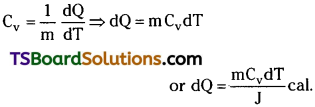
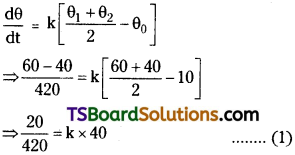
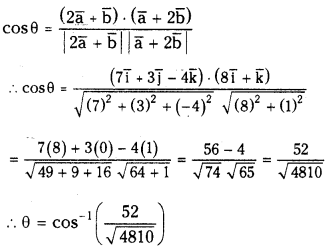
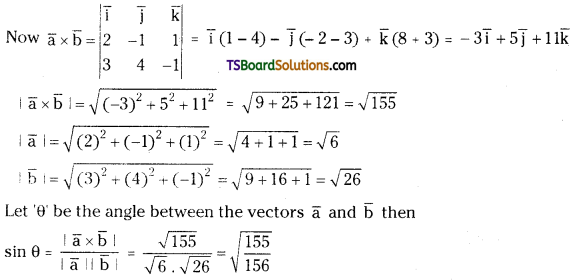
TS Inter 1st Year Physics Study Material Chapter 13 Thermodynamics

Telangana TSBIE TS Inter 1st Year Physics Study Material 13th Lesson Thermodynamics Textbook Questions and Answers.

TS Inter 1st Year Physics Study Material 13th Lesson Thermodynamics

Very Short Answer Type Questions

Question 1.
Define Thermal equilibrium. State the zeroth law of thermodynamics (or) How does it lead to Zeroth Law of Thermodynamics? [AP May ’13]
Answer:
Thermal Equilibrium:
Two systems are said to be in thermal equilibrium with each other if they are at same temperature.

Explanation :
If two different temperature of systems are kept in contact. Heat transfer from hot to cold body. If they are at same, then they are said to be in thermo equilibrium.

Generally at thermal equilibrium, the temperature of two systems is same. This concept leads to Zeroth law of thermodynamics.

Zeroth law of thermodynamics :
It states that if two systems say A & B are in thermal equilibrium with a third system ‘C’ separately then the two systems A and Bare also in thermal equilibrium with each other.

Question 2.
Define Calorie. What is the relation between calorie and mechanical equivalent of heat?
Answer:
Calorie:
The amount of heat required to rise the temperature of 1g of water by 1°C is called calorie.

Relation between calorie and Joule, 1 calorie = 4.2 J.

Question 3.
What thermodynamic variables can be defined by a) Zeroth Law b) First Law?
Answer:
Zeroth law refers temperature and first law refers internal energy.

Question 4.
Define specific heat capacity of the substance. On what factors does it depend?
Answer:
Specific heat capacity:
The quantity of heat required to rise the temperature of unit mass of the substance through 1 °C or IK is called the “specific heat capacity of the substance.”
S = \(\frac{dQ}{m.dT}\)
The specific heat capacity depends upon the factors like temperature and nature of the substance.

Question 5.
Define molar specific heat capacity. [AP May ’13]
Answer:
Molar specific heat capacity:
It is defined as the amount of heat required to rise the temperature of one mole of a gas through 1 °C or IK.

TS Inter 1st Year Physics Study Material Chapter 13 Thermodynamics

Question 6.
For a solid, what is the total energy of an oscillator?
Answer:
For a solid, the total energy of an oscillator can be expressed as the sum of its potential and kinetic energies.

Question 7.
Indicate the graph showing the variation of specific heat of water with temperature. What does it signify?
Answer:
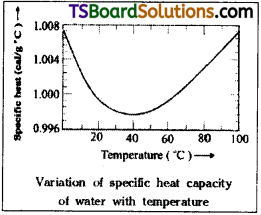
The variation of specific heat of water with the temperature is as shown in the graph.
TS Inter 1st Year Physics Study Material Chapter 13 Thermodynamics 1

From the graph, we find that at T = 15°C, specific heat of water, S = 1 calg-1 °C-1

At T = 0°C, S = 1.008 Calg-1 °C-1, the highest and at T = 30°C, s = 0.9976 Calg-1 °C-1, the lowest and beyond 30°C, specific heat of water increases slightly with rise in temperature.

At T = 100°C, specific heat of water is 1.0057 calg-1 °C-1.

It signifies that the specific heat of water decreases with increase in temperature from 0° to 30°C and increases from 30c – 100°C,

Question 8.
Define state variables and equation of state.
Answer:
State variables:
The variables which deter mine the thermodynamic behaviour of a sys tern are called “state variables.”

If the system is a gas, then P, V, and T (for a given mass) are called state variables.

Equation of state:
The general relationship between pressure, volume, and temperature for a given mass of the system (eg., gas) is called “equation of the state.”

For n moles of an ideal gas, the equation of state is, PV = nRT.

Question 9.
Why a heat engine with 100% efficiency can never be realised in practise?
Answer:
The efficiency of heat engine, η = 1 – \(\frac{T_2}{T_1}\)

The efficiency will be 100%, or 1, if T2 = OK or T1 = ∞.

Since, both these conditions cannot be attained practically, a heat engine cannot have 100% efficiency.

Question 10.
In summer, when the valve of a bicycle tube is opened, the escaping air appears cold. Why?
Answer:
This happens due to adiabatic expansion of the air in the tube of the bicycle. Hence the air cools.

TS Inter 1st Year Physics Study Material Chapter 13 Thermodynamics

Question 11.
Why does the brake drum of an automobile get heated up while moving down at constant speed?
Answer:
When an automobile moving down with constant speed its potential energy decreases. This decrease in potential energy is converted in the form of heat energy. As a result, the break drum of an automobile get heated.

Question 12.
Can a room be cooled by leaving the door of an electric refrigerator open?
Answer:
No. When a refrigerator is working in a closed room with its door closed, it is rejecting heat from inside to the air in the room. So, temperature of room increases gradually.

When the door of refrigerator is kept open, heat rejected by the refrigerator to the room will be more than the heat taken by the refrigerator from the room. Therefore, temperature of room will increase at a slower rate compared to the first case.

Hence, a room cannot be cooled by leaving the door of an electric refrigerator open.

Question 13.
Which of the two will increase the pressure more, an adiabatic or an isothermal process, in reducing the volume to 50%?
Answer:
In an adiabatic process, no exchange of heat is allowed between the system and surroundings. Hence, the work done during reducing the volume to 50% results in the increase in the temperature of the system thereby further increase in the pressure (∵ PV = RT). In case of isothermal compression, the excess heat is exchanged with the surroundings, maintaining constant temperature. Hence the increase in pressure is only due to decrease in volume obeying Boyle’s law.

Hence adiabatic compression increases the pressure more than isothermal compression.

Question 14.
A thermos flask containing a liquid is shaken vigorously. What happens to its temperature?
Answer:
Temperature of the liquid increases, because work is done in shaking the liquid. W ∝ Q.

Question 15.
A sound wave is sent into a gas pipe. Does its internal energy change?
Answer:
Yes, the internal energy changes when a sound wave is sent into a gas pipe. Because the sum of all the energies contained in the system in equilibrium is called its internal energy.

Question 16.
How much will be the internal energy change in
i)isothermal process ii) adiabatic process
Answer:
i) In an isothermal process,
T = constant i.e., dT = 0 ∴ dU = 0
So, in a isothermal process, the internal energy does not change.

ii) In an adiabatic process,
Q = constant i.e., dQ = 0 ∴ dU = -dW ≠ 0

So, in an adiabatic process, the change in internal energy is equal to the amount of work done.

Question 17.
The coolant in a chemical or a nuclear plant should have high specific heat. Why?
Answer:
“Specific heat of a substance is the amount of heat required to raise the temperature of unit mass of the substance through 1 °C or IK”. The coolant in a chemical or nuclear plant should be able to absorb more amount of heat released from the plant. Hence, the coolant should have high specific heat.

TS Inter 1st Year Physics Study Material Chapter 13 Thermodynamics

Question 18.
Explain the following processes i) Isochoric process ii) Isobaric process
Answer:
i) Isochoric process:
The process that occurs at constant volume is called “Isochoric process” or “Isovolumic process”.
∴ dV = 0.

ii) Isobaric process :
The process that occurs at constant pressure is called “Isobaric process.”
∴ dP = 0

Short Answer Questions

Question 1.
State and explain first law of thermodynamics.
Answer:
First law of thermodynamics :
The heat energy (dQ) supplied to a system is equal to the sum of the increase in the internal energy (dU) of the system and external work done (dW) by it
i.e., dQ = dU + dW ……….. (1)

If dV is the increase in the volume under constant pressure (P) then dW = PdV.
∴ dQ = dU + PdV ………….. (2)

The importance of this law is that it defines, the thermodynamic quantity, internal energy which has a fixed value in a state.

Increase in internal energy dU = nCvdT

Where n is the number of moles of the gas. This equation helps to calculate change of internal energy of the system when the temperature change by ∆T.

Limitations of 1st law of thermody namics:

  1. It does not tell about the direction of heat flow. That is it does not specify the conditions under which a body can use the heat energy to produce the work.
  2. It does not give any information about the efficiency with which heat can be converted into work.

Question 2.
Define two principal specific heats of a gas. Which is greater and why? [TS June ’15]
Answer:
i) Specific heat of a gas at constant vok ume (Cv) :
It is defined as the amount of heat energy required to raise the temperature of one gram of gas through 1°C of 1K, when volume of the gas is kept constant.

It is measured in cal.g-1.K-1 or J.g-1. K-1,

ii) Specific heat of a gas at constant pressure (Cp) :
It is defined as the amount of heat energy required to raise the temperature of one gram of gas through 1 °C or IK, when pressure of the gas is kept constant.
It is also measured in cal. g-1.K-1 or J.g-1.K-1.

Out of the two principal specific heats of a gas, Cp > Cv. This can be justified as follows:

a) When heat is given to a gas at constant volume, it is only used in increasing the internal energy of the gas, i.e., in raising the temperature of the gas, and no heat is spent in the expansion of the gas.

b) When heat is given to a gas at constant pressure, it is spent in two ways :

  1. Part of the heat is increasing the internal energy of the gas and hence the temperature of the gas.
  2. Remaining amount of heat is used in doing work i.e., in the expansion of the gas against the external pressure.

Therefore to raise the temperature of 1 mole of a gas through 1°C or 1K, more heat is required at constant pressure (Cp) than at constant volume (Cp).

Hence, Cp > Cv.

TS Inter 1st Year Physics Study Material Chapter 13 Thermodynamics

Question 3.
Derive a relation between the two specific heat capacities of gas on the basis of first law of thermodynamics. [TS June ’15]
Answer:
Relationship between the two specific heat capacities of gas:
To derive Cp – Cv = R:
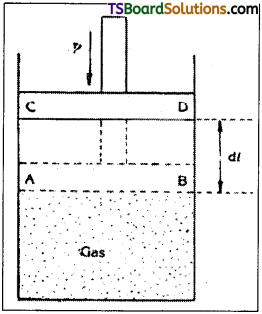
Let one gram mole of given mass of gas is enclosed within a cylinder with a frictionless air tight-piston. Let P, V be the pressure and volume of the gas at a temperature T.

i) In specific heat at constant volume :
The volume of the given mass of gas must remain constant. Hence, the piston is fixed in position AB.

Let Cv be the amount of heat energy supplied. It is utilised only to raise the temperature of the gas by 1°C.
∴ dU = CvdT
TS Inter 1st Year Physics Study Material Chapter 13 Thermodynamics 2

ii) In specific heat at constant pressure, the pressure must remain constant. Hence the piston is allowed to move freely. The amount of heat energy supplied is used not only to do external work but also to increase the temperature of the gas by 1°C.

In this case the piston moves forward and work is done against external pressure. Suppose by the time the piston moves from AB to CD, the temperature increases by 1 °C.

Let the work done in moving the piston through a distance ‘dl’ be dW = P dV.

The energy supplied has to increase the internal energy and to do external work.
∴ CpdT = dQ = dU + dW

From first law of thermodynamics
dQ = dU + dW
∴ CPdT = CvdT + dW
(CP – Cv) dT = dW = PdV
But work done, dW = F × S
= P × A × dl (where A is area of cross-section of the piston) = PdV
But PV = RT (for one mole of gas).

∴ dW = PdV = RdT OR (CP – Cv) dT = RdT
But change of temperature = dT = 1°C (from definition of specific heat)
∴ Cp – Cv = R

So difference of molar specific heats of the gas is equals to universal gas constant R.

Question 4.
Obtain an expression for the work done by an ideal gas during isothermal change.
Answer:
Work done during isothermal process:
Consider n mole of a perfect gas contained in a cylinder. When the piston moves through a small distance dx, then small work dW will be done by it
∴ dW = P A dx = P dV,
where ‘A’ = the area of cross-section of the piston.
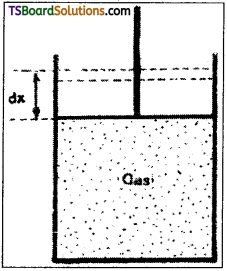
TS Inter 1st Year Physics Study Material Chapter 13 Thermodynamics 3

Therefore, when the system goes from initial state A (P1, V1) to the final state B (P2, V2), the amount of work done,
W = \(\int_{v_1}^{v_2} P d V\) ………….. (1)
But PV = nRT (or) P = \(\frac{nRT}{V}\)
Substitute P in equation (1),
W = \(\int_{v_1}^{v_2} \frac{n R T}{V} d V\)
During an isothermal process, temperature remains constant.
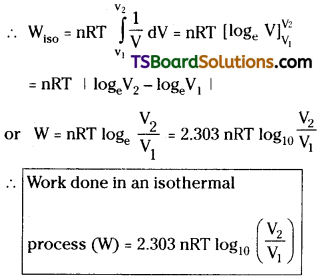
TS Inter 1st Year Physics Study Material Chapter 13 Thermodynamics 4

All the heat supplied to the gas is used only to do work since temperature remains constant, internal energy does not change.
∴ dQ = PdV

Question 5.
Obtain an expression for the work done by an ideal gas during adiabatic change and explain.
Answer:
Work done during Adiabatic process :
Consider n mole of perfect gas contained in a cylinder having insulating walls. When piston moves through a small distance dx, then small work (dW) will be done.
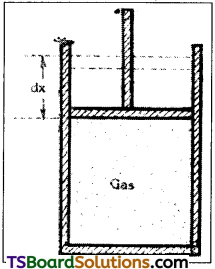
TS Inter 1st Year Physics Study Material Chapter 13 Thermodynamics 6
∴ dW = (Pa) dx = PdV,
where a is area of cross-section of the piston. Therefore, when the system goes from initial state A (P1, V1) to the final state B ( P2, V2) the amount of work done,
W = \(\int_{v_1}^{v_2} P d V\) ………….. (1)
For an adiabatic change,
PVγ = K (a constant ) or P = KV

Substituting for P in equation (1), the work done in an adiabatic process
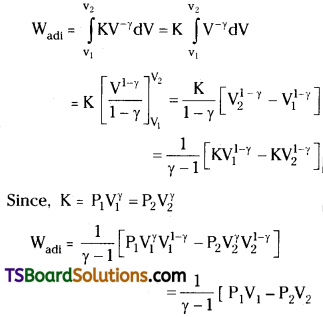
TS Inter 1st Year Physics Study Material Chapter 13 Thermodynamics 7

∴ Work done in adiabatic process,
TS Inter 1st Year Physics Study Material Chapter 13 Thermodynamics 8

∴ Work done in adiabatic change
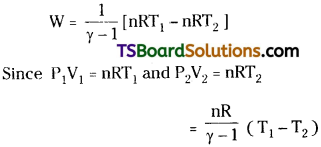
W = \(\frac{nR}{(\gamma -1)}\)(T1 – T2)

Since heat is not supplied to the gas, it can do work only by expanding its internal energy. dQ = 0 = dU + PdV or PdV = – dU.
So the gas cools in adiabatic expansion.

Question 6.
Compare isothermal and an adiabatic process.
Answer:

Isothermal changesAdiabatic changes
1. Temperature (T) remains constant,
i.e., ∆T = 0
1. Heat content (Q) remains constant,
i.e., ∆Q = 0.
2. System is thermally conducting to the surroundings.2. System is thermally insulated from the surroundings.
3. The changes occur slowly.3. The changes occur suddenly.
4. Internal energy (U) remains constant,
i.e., ∆U = 0.
4. Internal energy changes, i.e., U ≠ constant
∴ ∆U ≠ 0.
5. Specific heat becomes infinite.5. Specific heat becomes zero.
6. Equation of isothermal changes is PV = constant.6. Equation of adiabatic changes is PVγ = constant
7. Slope of isothermal curve, \(\frac{dP}{dV}\) = -(P/V)7. Slope of adiabatic curve, \(\frac{dP}{dV}\) = -γ(P/V)
8. Coefficient of Isothermal elasticity; Ei = P8. Coefficient of adiabatic elasticity; Ea = γP

TS Inter 1st Year Physics Study Material Chapter 13 Thermodynamics

Question 7.
Explain the following processes
i) Cyclic process with example
ii) Non-cyclic process with example
Answer:
i) Cyclic process :
A process in which the system after passing through various stages such as change in pressure, volume and temperature etc. returns to its initial state is defined as “cyclic process”.

For a thermodynamic system the internal energy of the system depends on thermodynamic variables such as pressure, volume, temperature, etc. In cyclic process the system finally returns to the initial state and it is in thermal equilibrium with surroundings. So change in internal energy of the system dU = 0.

Hence, in a cyclic process work done is equal to energy absorbed in the cyclic process.

So for cyclic process dU = 0 and dQ = dW.

Example:
Generally, all heat engines (or) refrigerators are operated in cyclic process.

ii) Non-cyclic process:
A non-cyclic process consists of a series of changes involved do not return the system back to its initial state.

Example:
Suppose a gas with variables P1, V1, T1 is taken through a series of different states subjecting to a number of changes including isothermal expansions and compressions. In the final state, if the system does not come back to P1V1T1, then the gas is said to be undergo a non-cyclic process.

Work done in a non-cyclic process depends upon the path chosen or the series of changes involved.

Question 8.
Write a short note on Quasistatic process.
Answer:
Quasi-static process:
A Quasistatic process can be defined as an infinitesimally show process in which at each and every intermediate stage the system remains in thermal and mechanical (thermodynamic) equilibrium with the surroundings through out the entire process.
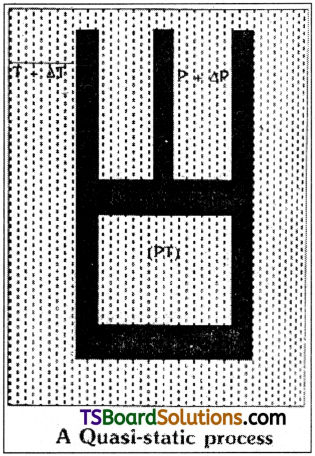
TS Inter 1st Year Physics Study Material Chapter 13 Thermodynamics 9

Explanation:
A non-equilibrium thermodynamic system can be treated as an idealized process in which at every stage the system is in equilibrium state.

In a thermodynamic system let the piston moves in a frictionless manner. Instead of sudden compression of piston imagine the piston moves very very slowly i.e., it appears almost static. Then the pressure inside the cylinder P + ∆P and temperature T + ∆T are almost equal to external pressure P and temperature T.

Since for extremely slow process the values of ∆P and ∆T are so small that we can treat P + ∆P = P and T + ∆T = T. Such type of process is called Quasi static process.

For Example, to take a gas from the state (P, T) to another state (P1, T1), via a quasistatic process, we change the external pressure / temperature by a very small amount and allow the system to equalise its pressure / temperature with the surroundings. Continue the process infinitely slowly till the final state (P1, T1) is attained.

A quasi-static process is a hypothetical construct. The process must be infinitely slow, should not involve large temperature differences or accelerated motion of the piston of the container.

Question 9.
Explain qualitatively the working of a heat engine.
Answer:
Heat engine :
A heat engine is a device used to convert heat energy into mechanical work.

Generally heat engines will work in a cyclic process. Heat engine consists of three important units.

1) Source :
Which is an object or system at high temperature. A heat engine will absorb heat energy Q1 from source.

2) Working substance :
Every heat engine requires a working substance to do work Generally the working substance is like steam or fuel vapour and air mixture etc. A part of heat energy of working substance is converted into mechanica work.

3) Sink :
In every heat engine heat, energy content of working substance is not converted into work totally. So some energy (Q2) is wasted or rejected by the engine. This rejected energy (Q2) is delivered to some other body or system at low temperature. This body with low temperature is called “sink”.

Efficiency of heat engine,
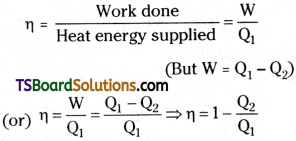
TS Inter 1st Year Physics Study Material Chapter 13 Thermodynamics 10

where
Q1 = heat energy supplied by source
Q2 = heat energy delivered to sink
Block diagram of heat engine is as shown.
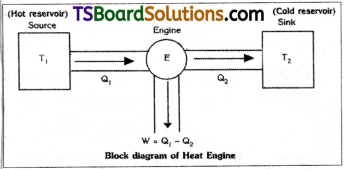
TS Inter 1st Year Physics Study Material Chapter 13 Thermodynamics 11

Long Answer Questions

Question 1.
Explain reversible and irreversible processes. Describe the working of Carnot engine. Obtain an expression for the efficiency. [AP Mar. ’18, ’17, ’16, ’14; May 18. 17, ’16; TS Mar. ’19, ’17, 15, May ’17]
Answer:
Reversible process :
In reversible process, a thermodynamic system can be retraced back in opposite direction to the changes that take place in the direct process or in forward process.

A reversible process is only an ideal concept.
Examples for reversible process :

  1. Peltier effect and Seebeck effect.
  2. Fusion of ice and vapourisation of water.

Irreversible process:
A thermodynamic process that cannot be taken back in opposite direction is called an “irreversible process.”

Examples:

  1. Work done against friction.
  2. Magnetization of materials.

Carnot’s Engine :
Carnot’s engine works on the principle of reversible process within the temperatures T1 and T2.

It consists of four continuous processes. The total process is known as Carnot Cycle.

Step 1 :
In Carnot cycle, the 1st step consists of isothermal expansion of gases. So temperature T is constant, P, V changes are
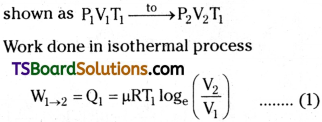
TS Inter 1st Year Physics Study Material Chapter 13 Thermodynamics 12

Step 2 :
In this stage gases will expand adiabatically. So energy to the system Q is constant.
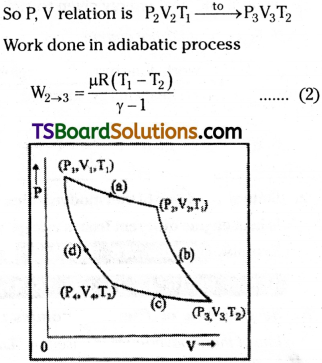
TS Inter 1st Year Physics Study Material Chapter 13 Thermodynamics 13

Step 3 :
In this stage gases will be compressed isothermally. So P1V change are
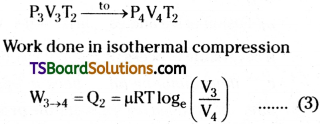
TS Inter 1st Year Physics Study Material Chapter 13 Thermodynamics 14

Step 4 :
In the fourth stage the gas suffers adiabatic compression and returns to original stage.
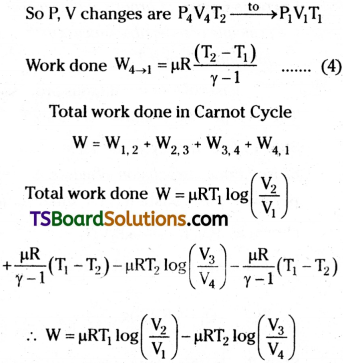
TS Inter 1st Year Physics Study Material Chapter 13 Thermodynamics 15

The total work done W = Q1 – Q2 i.e., the difference to heat energy absorbed from source and heat energy given to sink
Efficiency of Carnot engine
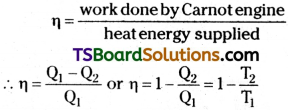
TS Inter 1st Year Physics Study Material Chapter 13 Thermodynamics 16

Question 2.
State second law of thermodynamics. How is heat engine different from a refrigerator? Explain. [TS Mar. ’18, ’16, May ’18, ’16; AP Mar. ’19, ’16, ’15, ’13; June ’15; May ’14]
Answer:
Second Law of Thermodynamics :
First law of thermodynamics is based on “Law of conservation of energy”, while second law of thermodynamics gives “information about the transformation of heat energy”.

So, there are two conventional statements of second law depending on common experience.

1) Kelvin-Plank statement:
It is impossible for an engine working in a cyclic process to extract heat from a hot body and to convert it completely into work.

2) Clausius Statement:
It is impossible for a self-acting machine, unaided by any external agency to transfer heat from a cold body to a hot reservoir. In other words, heat cannot by itself flow from a colder body to a hotter body.

Heat engine:
A heat engine is a device used to convert heat energy into mechanical work.

Generally heat engines will work in a cyclic process. Heat engine consists of three important units.

1) Source :
Which is an object or system at high temperature. A heat engine will absorb heat energy Q1 from source.

2) Working substance :
Every heat engine requires a working substance to do work. Generally, the working substance is like steam or fuel vapour and air mixture etc. A part of heat energy of working substance is converted into mechanical work.

3) Sink :
In every heat engine heat energy content of working substance is not converted into work totally. So some energy (Q2) is wasted or rejected by the engine. This rejected energy (Q2) is delivered to some other body or system at low temperature. This body with low temperature is called sink.

Efficiency of heat engine,
TS Inter 1st Year Physics Study Material Chapter 13 Thermodynamics 10

where
Q1 = heat energy supplied by source
Q2 = heat energy delivered to sink
Block diagram ot heat engine is as shown.
TS Inter 1st Year Physics Study Material Chapter 13 Thermodynamics 11

Refrigerator :
A refrigerator works in the reverse process of heat engine.

It extracts heat energy Q2 from sink i.e., from low temperature body with the help of external work and delivers heat energy Q1 to high temperature body called source.
Work done W = Q1 – Q2.
In refrigerators external work is done on working substance.
A block diagram of refrigerator is as shown.
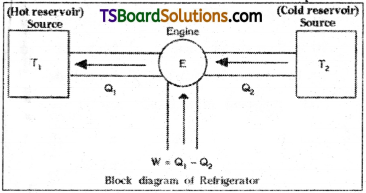
TS Inter 1st Year Physics Study Material Chapter 13 Thermodynamics 17

Difference between heat engine and refrigerator :
Refrigerator extracts heat energy from sink i.e., from low temperature body with the help of external work and delivers heat energy to high temperature body called source. A heat engine will absorb heat energy from source and reject heat energy to the sink. Heat engine will work in a reversible process but the refrigerator works in the reverse process of heat engine.

TS Inter 1st Year Physics Study Material Chapter 13 Thermodynamics

Question 3.
State second Saw of thermodynamics. Describe the working of Carnot engine. Obtain an expression for the efficiency. [AP Mar. ’16]
Answer:
Second Law of Thermodynamics :
First law of thermodynamics is based on Law of conservation of energy, while second law of thermodynamics gives information about the transformation of heat energy. So, there are two conventional statements of second law depending on common experience.

1) Kelvin-Plank statement:
It is impossible for an engine working in a cyclic process to extract heat from a hot body and to convert it completely into work.

2) Clausius Statement:
It is impossible for a self-acting machine, unaided by any external agency to transfer heat from a cold body to a hot reservoir. In other words, heat cannot by itself flow from a colder body to a hotter body.

Carnot’s Engine :
Carnot’s engine works on the principle of reversible process within the temperatures T1 and T2.

It consists of four continuous processes. The total process is known as Carnot Cycle.

Step 1 :
In Carnot cycle, the 1st step consists of isothermal expansion of gases. So temperature T is constant, P, V changes are

TS Inter 1st Year Physics Study Material Chapter 13 Thermodynamics 18
Work done in isothermal process
TS Inter 1st Year Physics Study Material Chapter 13 Thermodynamics 19

Step 2 :
In this stage gases will expand adiabatically. So energy to the system Q is constant.
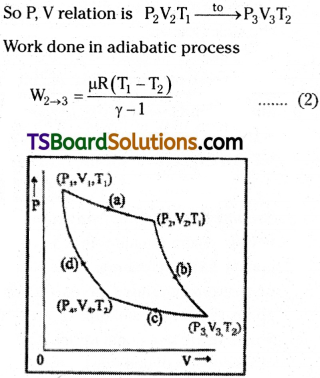
TS Inter 1st Year Physics Study Material Chapter 13 Thermodynamics 20

Step 3 :
In this stage gases will be compressed isothermally. So PjV changes are
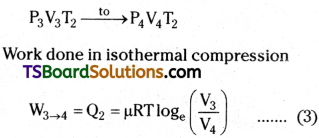
TS Inter 1st Year Physics Study Material Chapter 13 Thermodynamics 21

Step 4 :
In the fourth stage the gas suffers adiabatic compression and returns to original stage.
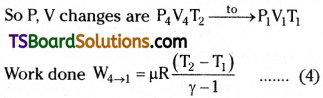
TS Inter 1st Year Physics Study Material Chapter 13 Thermodynamics 22
Total work done in Carnot Cycle
W = W1,2 + W2, 3 + W3, 4 + W4, 1
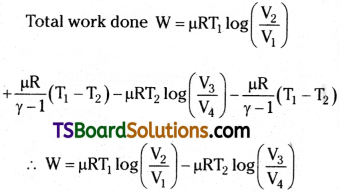
TS Inter 1st Year Physics Study Material Chapter 13 Thermodynamics 23
The total work done W = Q1 – Q2 i.e., the difference to heat energy absorbed from source and heat energy given to sink Efficiency of Carnot engine
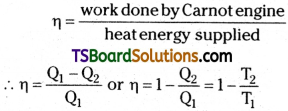
TS Inter 1st Year Physics Study Material Chapter 13 Thermodynamics 24

Question 4.
What is the difference between heat engine and refrigerator. [TS May. ’16]
Answer:
Differences between heat engine and refrigerator:
Refrigerator extracts heat energy from sink i.e., from low temperature body with the help of external work and delivers heat energy to high temperature body called source.

A heat engine will absorb heat energy from source and reject heat energy to the sink. Heat engine will work in a reversible process but the refrigerator works in the reverse process of heat engine.

Problems

Question 1.
If a monoatomic ideal gas of volume 1 litre at N.T.P. is compressed (I) adiabatically to half of its volume, find the work done on the gas. Also find (ii) the work done if the compression is isothermal. (γ = 5/3)
Solution:
i) During an adiabatic process T1V1γ-1 = T2V2γ-1

ii) Work done during isothermal compression is
W = 2.3026 nRT log10 \(\frac{V_2}{V_1}\)
n = number of moles = \(\frac{1}{22.4}\)
T = 273 K; R = 8.314 J mol-1K-1
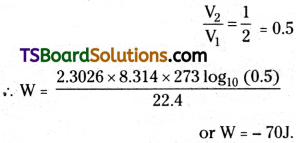
TS Inter 1st Year Physics Study Material Chapter 13 Thermodynamics 26

TS Inter 1st Year Physics Study Material Chapter 13 Thermodynamics

Question 2.
Five moles of hydrogen when heated through 20 K expand by an amount of 8.3 × 10⁻³m³ under a constant pressure of 105 N/m². If Cv = 20 J/mole K, find Cp.
Solution:
We know that Cp – Cv = R.
Multiplying throughout by n ∆ T
nCp ∆T – nCv ∆T = nR ∆T
n ∆ T (Cp – Cv) = P ∆ V
5 × 20 (Cp – 20) = 105 × 8.3 × 10-3 (∵ nR∆T = P∆V)
Cp – 20 = 8.3
Cp = 28.3 J/mole K.
(∵ n = 5, ∆T = 20 K, P = 1 × 10⁵N/m² & Cv = 20 J/mole K and ∆V = 8.3 × 10³ m³)
TS Inter 1st Year Maths 1A Matrices Important Questions Long Answer Type

Students must practice these Maths 1A Important Questions TS Inter 1st Year Maths 1A Matrices Important Questions Long Answer Type to help strengthen their preparations for exams.

TS Inter 1st Year Maths 1A Matrices Important Questions Long Answer Type

Question 1.
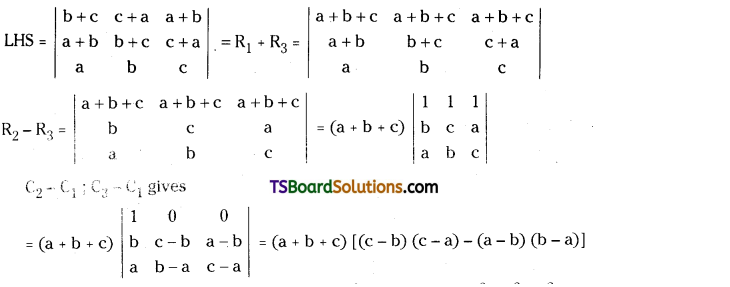
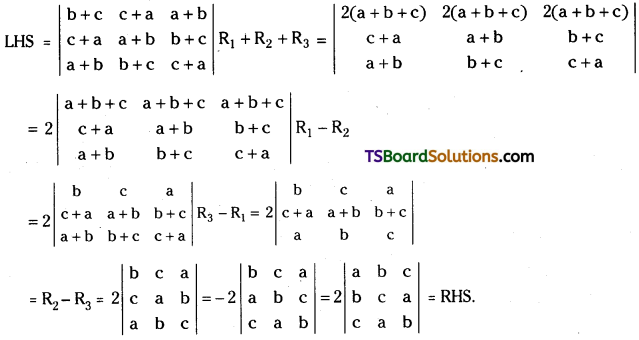
Without expanding the determinant show that \(\left|\begin{array}{lll}
\mathbf{b}+\mathbf{c} & \mathbf{c}+\mathbf{a} & \mathbf{a}+\mathbf{b} \\
\mathbf{c}+\mathbf{a} & \mathbf{a}+\mathbf{b} & \mathbf{b}+\mathbf{c} \\
\mathbf{a}+\mathbf{b} & \mathbf{b}+\mathbf{c} & \mathbf{c}+\mathbf{a}
\end{array}\right|\) = 2\(\left|\begin{array}{lll}
\mathbf{a} & \mathbf{b} & \mathbf{c} \\
\mathbf{b} & \mathbf{c} & \mathbf{a} \\
\mathbf{c} & \mathbf{a} & \mathbf{b}
\end{array}\right|\) [Mar. 15 (AP); May 98, 96, 91]
Answer:
TS Inter First Year Maths 1A Matrices Important Questions Long Answer Type 1

TS Inter First Year Maths 1A Matrices Important Questions Long Answer Type

Question 2.
Show that \(\left|\begin{array}{ccc}
1 & a^2 & a^3 \\
1 & b^2 & b^3 \\
1 & c^2 & c^3
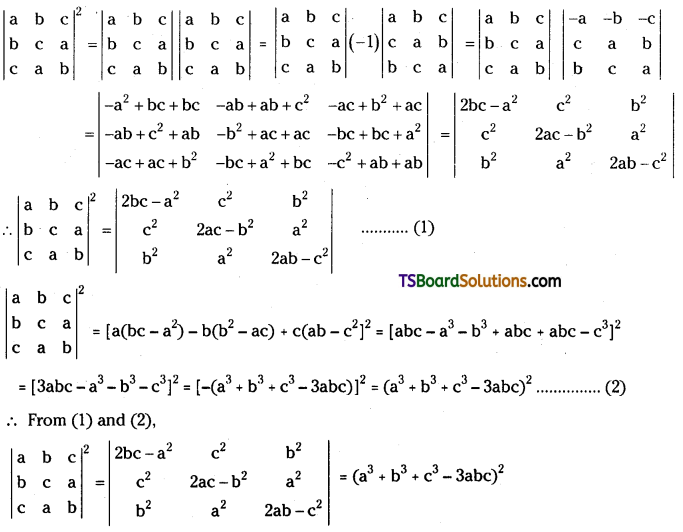
\end{array}\right|\) = (a – b) (b – c) (c – a) (ab + bc + ca). [Mar. 17(AP), 09: May 15 (AP); 02]
Answer:
TS Inter First Year Maths 1A Matrices Important Questions Long Answer Type 2
= (a – b) (b – c) (c – a) [0 (c3 – c2 (a + b + c) – (a + b) (0 – a – b – c) + (a2 + ab + b2) (0 – 1)]
= (a – b) (b – c) (c – a) [0 + a2 + ab + ac + ab + b2 + bc – a2 – ab – b2]
= (a – b) (b – c) (c – a) (ab + bc + ca) = RHS.

Question 3.
Show that \(\left|\begin{array}{ccc}
\mathbf{a}-\mathbf{b}-\mathbf{c} & \mathbf{2 a} & \mathbf{2 a} \\
\mathbf{2 b} & \mathbf{b}-\mathbf{c}-\mathbf{a} & \mathbf{2 b} \\
\mathbf{2 c} & \mathbf{2 c} & \mathbf{c}-\mathbf{a}-\mathbf{b}
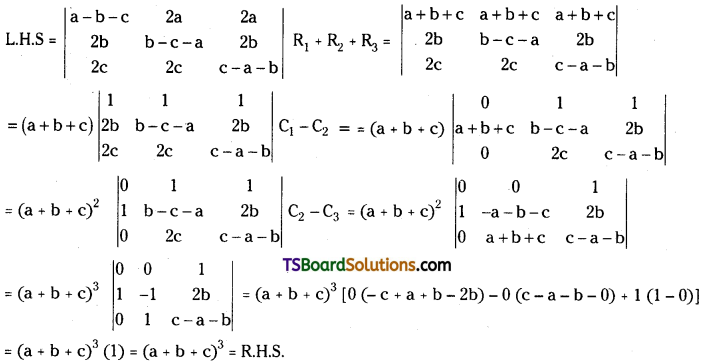
\end{array}\right|\) = (a + b + c)3. [Mar. 11; May 11]
Answer:
TS Inter First Year Maths 1A Matrices Important Questions Long Answer Type 3

Question 4.
Find the value of x if \(\left|\begin{array}{ccc}
x-2 & 2 x-3 & 3 x-4 \\
x-4 & 2 x-9 & 3 x-16 \\
x-8 & 2 x-27 & 3 x-64
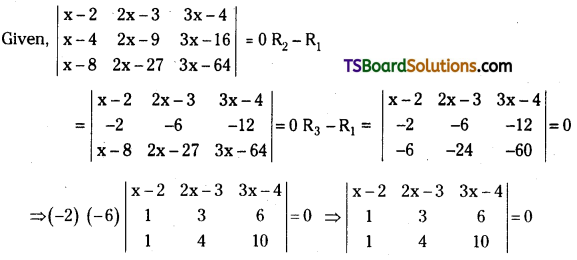
\end{array}\right|\) = 0 [Mar 15 (TS); Mar. 06]
Answer:
TS Inter First Year Maths 1A Matrices Important Questions Long Answer Type 4
⇒ (x – 2) (30 – 24) – (2x – 3) (10 – 6) + (3x – 4) (4 – 3) = 0
⇒ (x – 2)6 – (2x – 3)4 + (3x – 4)(1)
⇒ 6x – 12 – 8x + 12 + 3x – 4 = 0
⇒ x – 4 = 0
⇒ x = 4.

TS Inter First Year Maths 1A Matrices Important Questions Long Answer Type

Question 5.
Show that \(\left|\begin{array}{ccc}
a+b+2 c & a & b \\
c & b+c+2 a & b \\
c & a & c+a+2 b
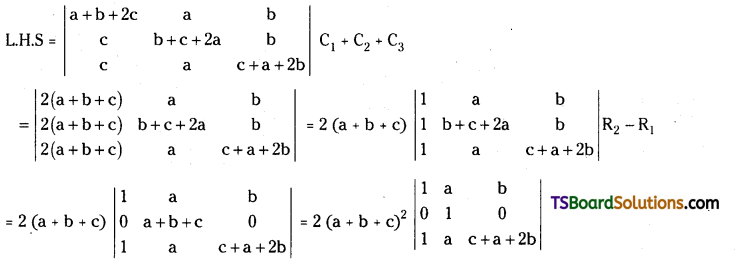
\end{array}\right|\) = 2 (a + b + c)3 [Mar. 18, 16 (AP); Mar. 16 (TS), 10 Mar.19 (TS), May 12, 10, 08, 03, 99]
Answer:
TS Inter First Year Maths 1A Matrices Important Questions Long Answer Type 5= 2 (a + b + c)2 [1{(c + a + 2b) – 0} – a (0 – 0) + b (0 – 1)]
= 2(a + b + c)2 [c + a + 2b – b]
= 2(a + b + c)2 (a + b + c) = 2(a + b + c)3

Question 6.
Show that \(\left|\begin{array}{lll}
a & b & c \\
b & c & a \\
c & a & b
\end{array}\right|^2=\left|\begin{array}{ccc}
2 b c-a^2 & c^2 & b^2 \\
c^2 & 2 a c-b^2 & a^2 \\
b^2 & a^2 & 2 a b-c^2
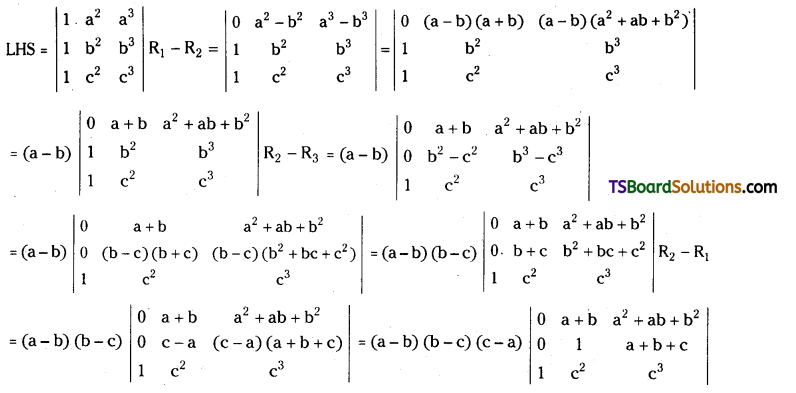
\end{array}\right|\) = (a3 + b3 + c3 – 3abc)2. [Mar. 19 (AP) Mar. 18 (TS): May 14. 09; Mar. 12, 01]
Answer:
TS Inter First Year Maths 1A Matrices Important Questions Long Answer Type 6

Question 7.
Show that \(\left|\begin{array}{ccc}
a^2+2 a & 2 a+1 & 1 \\
2 a+1 & a+2 & 1 \\
3 & 3 & 1
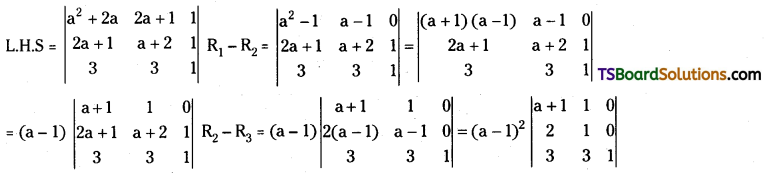
\end{array}\right|\) = (a – 1)3 [Mar. 13, 07]
Answer:
TS Inter First Year Maths 1A Matrices Important Questions Long Answer Type 7
= (a – 1)2 [(a + 1) (1 – 0) – 1 (2 – 0) + 0 (6 – 3)]
= (a – 1)2 [a + 1 – 2] = (a – 1)2 (a – 1) = (a – 1)3 = R.H.S.
TS Inter First Year Maths 1A Matrices Important Questions Long Answer Type

Question 8.
Show that \(\left|\begin{array}{ccc}
\mathbf{a} & \mathbf{b} & \mathbf{c} \\
\mathbf{a}^2 & \mathbf{b}^2 & \mathbf{c}^2 \\
\mathbf{a}^3 & \mathbf{b}^3 & \mathbf{c}^3
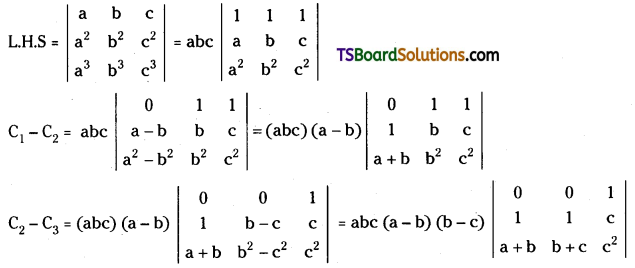
\end{array}\right|\) = abc (a – b) (b – c) (c – a). [May. 06]
Answer:
TS Inter First Year Maths 1A Matrices Important Questions Long Answer Type 8
= abc(a – b)(b – c) [0(c2 – bc – c2) – 0(c2 – ac – bc) + 1(b + c – a – b)]
= abc (a – b) (b – c) (c – a) = R.H.S

Question 9.
If A = \(\left[\begin{array}{lll}
\mathbf{a}_1 & \mathbf{b}_1 & \mathbf{c}_1 \\
\mathbf{a}_2 & \mathbf{b}_2 & \mathbf{c}_2 \\
\mathbf{a}_{\mathbf{3}} & \mathbf{b}_3 & \mathbf{c}_3
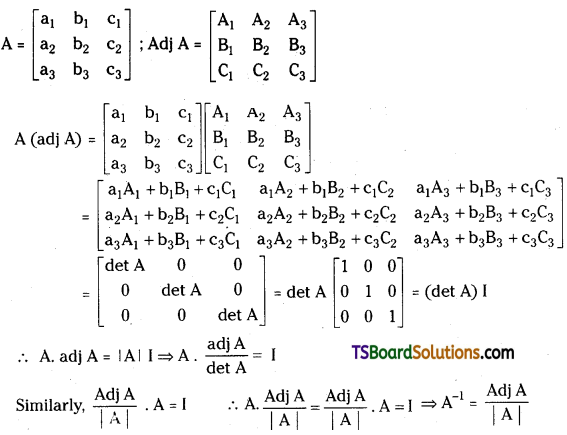
\end{array}\right]\) is a non-singular matrix, then show that A is invertiable and A-1 = \(\frac{{Adj} \mathbf{A}}{{det} \mathbf{A}}\). [Mar. 17 (AP). May 15 (AP). 13, 10, 07, 06, 02, Mar. 07, 02, 99, 94, 82, 80]
Answer:
TS Inter First Year Maths 1A Matrices Important Questions Long Answer Type 9

Question 10.
Solve the system of equations 3x + 4y + 5z = 18, 2x – y + 8z = 13, 5x – 2y + 7z = 20 by using Cramer’s rule. [Mar. 12, 03; May 09]
Answer:
Given system of linear equations are 3x + 4y + 5z = 18, 2x – y + 8z = 13, 5x – 2y + 7z = 20
Let A = \(\left[\begin{array}{rrr}
3 & 4 & 5 \\
2 & -1 & 8 \\
5 & -2 & 7
\end{array}\right]\), X = \(\left[\begin{array}{l}
x \\
y \\
z
\end{array}\right]\) and D = \(\left[\begin{array}{l}
18 \\
13 \\
20
\end{array}\right]\)
Then we can write the given equations in the form of matrix equation as AX = D.
Δ = det A = \(\left|\begin{array}{rrr}
3 & 4 & 5 \\
2 & -1 & 8 \\
5 & -2 & 7
\end{array}\right|\) = 3 (- 7 + 16) – 4 (14 – 40) + 5 (- 4 + 5)
= 3(9) – 4 (- 26) + 5 (1)
= 27 + 104 + 5 = 136 ≠ 0
Hence, we can solve the given equations by using Cramer’s rule.
Δ1 = \(\left|\begin{array}{rrr}
18 & 4 & 5 \\
13 & -1 & 8 \\
20 & -2 & 7
\end{array}\right|\) = 18(- 7 + 16) – 4(91 – 160) + 5(- 26 + 20) = 18(9) – 4(- 69) + 5(- 6) = 162 + 276 – 30 = 408
Δ2 = \(\left|\begin{array}{lll}
3 & 18 & 5 \\
2 & 13 & 8 \\
5 & 20 & 7
\end{array}\right|\) = 3(91 – 160) – 18(14 – 40) + 5(40 – 65) = 3(- 69) – 18(- 26) + 5(- 25) = – 207 + 468 – 125 = 136
Δ3 = \(\left|\begin{array}{rrr}
3 & 4 & 18 \\
2 & -1 & 13 \\
5 & -2 & 20
\end{array}\right|\) = 3(- 20 + 26) – 4(40 – 65) + 18(- 4 + 5) = 3(6) – 4(- 25) + 18(1)
= 18 + 100 + 18 = 136
Hence, by Cramer’s rule,
x = \(\frac{\Delta_1}{\Delta}=\frac{408}{136}\) = 3, y = \(\frac{\Delta_2}{\Delta}=\frac{136}{136}\) = 1, z = \(\frac{\Delta_3}{\Delta}=\frac{136}{136}\) = 1
∴ The solution of the giveñ system of equations is x = 3, y = 1, z = 1.

TS Inter First Year Maths 1A Matrices Important Questions Long Answer Type

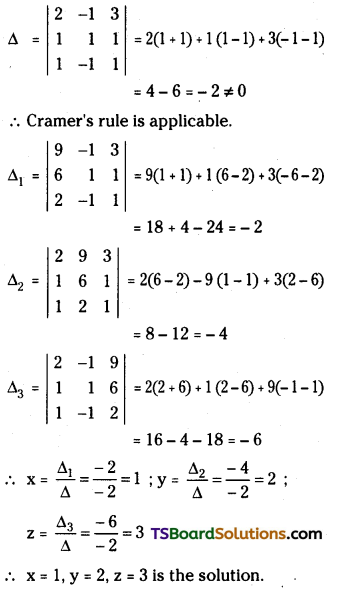
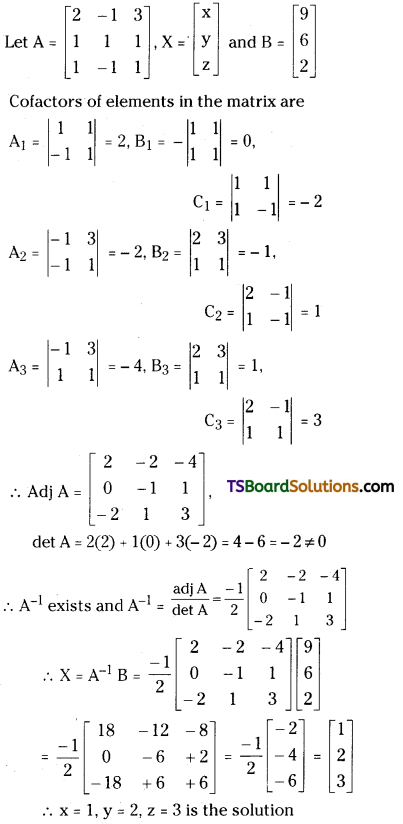
Solve the system of equations 2x – y + 3z =9, x + y + z = 6, x – y + z = 2 by using Cramer’s rule. [Mar. 17 (TS), 16 (AP), 02; May 13]
Answer:
x = 1, y = 2, z = 3

Question 11.
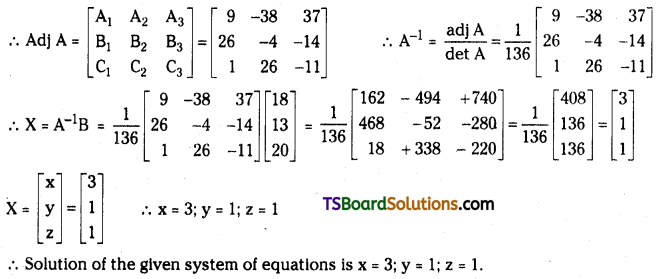
Solve: 3x + 4y + 5z = 18, 2x – y + 8z = 13 and 5x – 2y + 7z = 20 by using the matrix inversion method. [Mar. ‘19 (TS): Mar. ‘15 (AP) ; Mar. ‘13. ‘08, ‘01, ‘00, 96]
Answer:
Given system of linear equations are 3x + 4y + 5z = 18, 2x – y + 8z = 13, 5x – 2y + 7z = 20
Let A = \(\left[\begin{array}{rrr}
3 & 4 & 5 \\
2 & -1 & 8 \\
5 & -2 & 7
\end{array}\right]\), X = \(\left[\begin{array}{l}
x \\
y \\
z
\end{array}\right]\), D = \(\left[\begin{array}{l}
18 \\
13 \\
20
\end{array}\right]\)
This can be represented as AX = B and X = A1B is a solution.
∆ = det A = \(\left|\begin{array}{rrr}
3 & 4 & 5 \\
2 & -1 & 8 \\
5 & -2 & 7
\end{array}\right|\) = 3(- 7 + 16) – 4(14 – 40) + 5(- 4 + 5) = 3(9) – 4(- 26) + 5(1) = 27 + 104 + 5 = 136
Cofactor of 3 is A1 = +(- 7 + 16) = 9
Cofactor of 5 is A3 = +(32 + 5) = 37
Cofactor of -1 is B2 = +(21 – 25) = – 4
Cofactor of 5 is C1 = +(- 4 + 5) = 1
Cofactor of 7 is C3 = +(- 3 – 8) = – 11
Cofactor of 2 is A2 = – (28 + 10) = – 38.
Cofactor of 4 is B1 = – (14 – 40) = 26
Cofactor of -2 is B3 = – (24 – 10) = – 14
Cofactor of 8 is C2 = – (- 6 – 20) = 26
TS Inter First Year Maths 1A Matrices Important Questions Long Answer Type 10

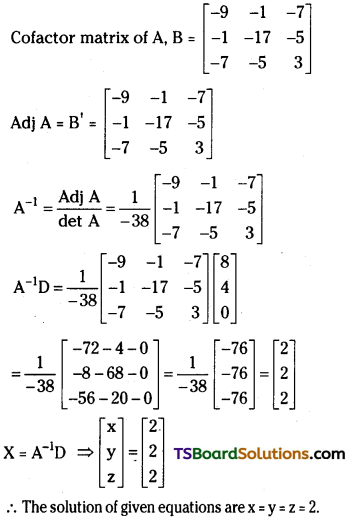
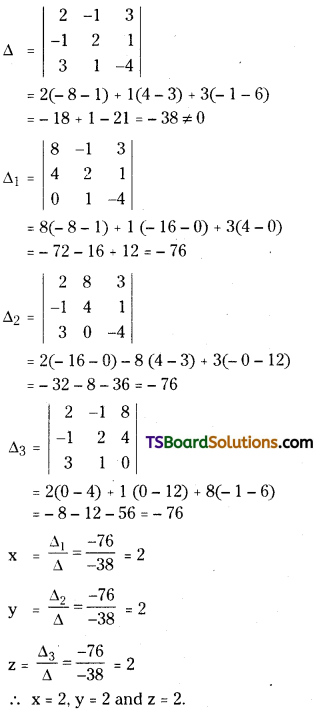
Solve 2x – y + 3z = 8, – x + 2y + z = 4, 3x + y – 4z = 0 by using matrix Inversion method. [May 15 (AP); May. 12]
Answer:
x = 2, y = 2, z = 2

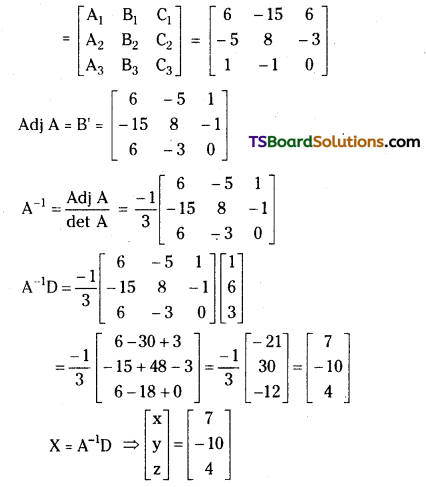
Solve x + y + z = 1, 2x + 2y + 3z = 6, x + 4y + 9z = 3 by using matrix Inversion method. [May 03, 93]
Answer:
x = 7, y = – 10, z = 4

Question 12.
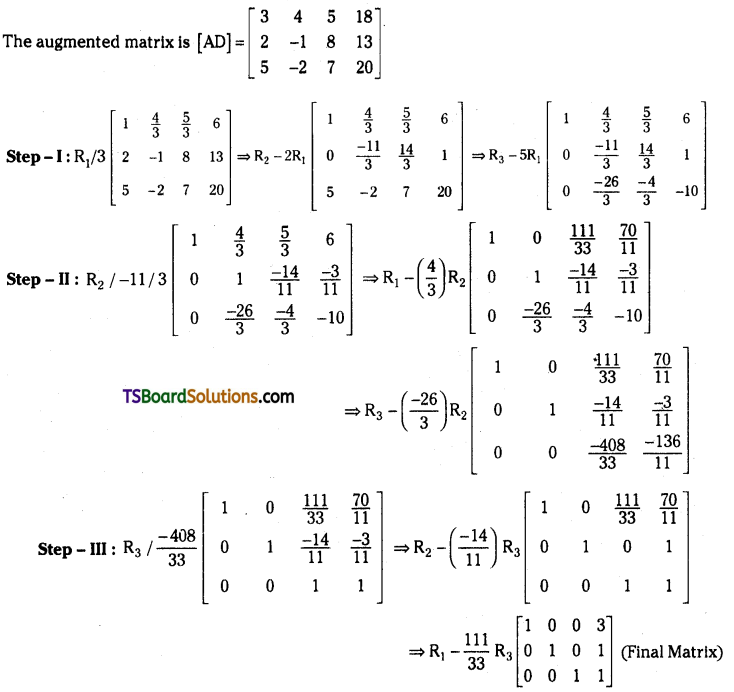
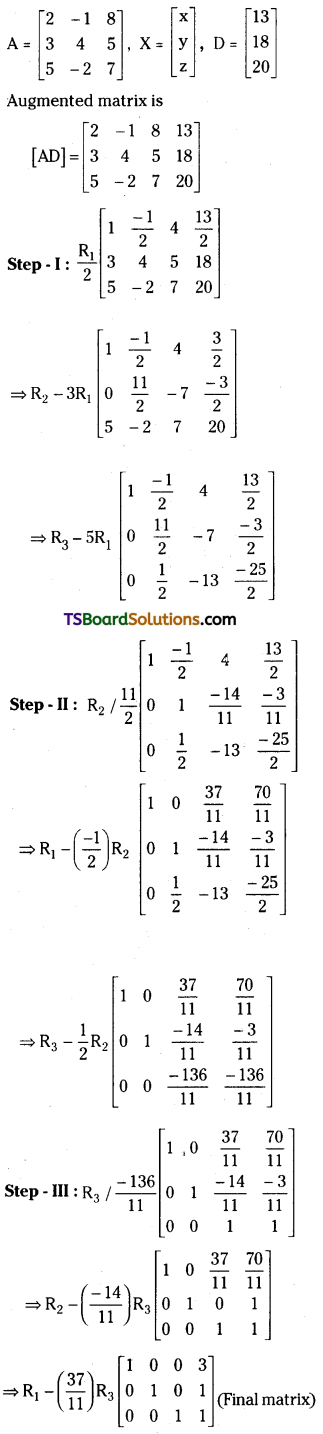
Solve the equations 3x + 4y + 5z = 18, 2x – y + 8z = 13 and 5x – 2y + 7z = 20 by Gauss-Jordan method. [May 15(TS): May 06, 01: Mar. 01]
Answer:
Given system of Linear equations are 3x + 4y + 5z = 18, 2x – y + 8z = 13 and 5x – 2y + 7z = 20
TS Inter First Year Maths 1A Matrices Important Questions Long Answer Type 11
In this case, system of equations have unique solution.
i.e., x = 3, y = 1, z = 1.
∴ The solution of the given system of equations is x = 3, y = 1, z = 1.

TS Inter First Year Maths 1A Matrices Important Questions Long Answer Type

Question 13.
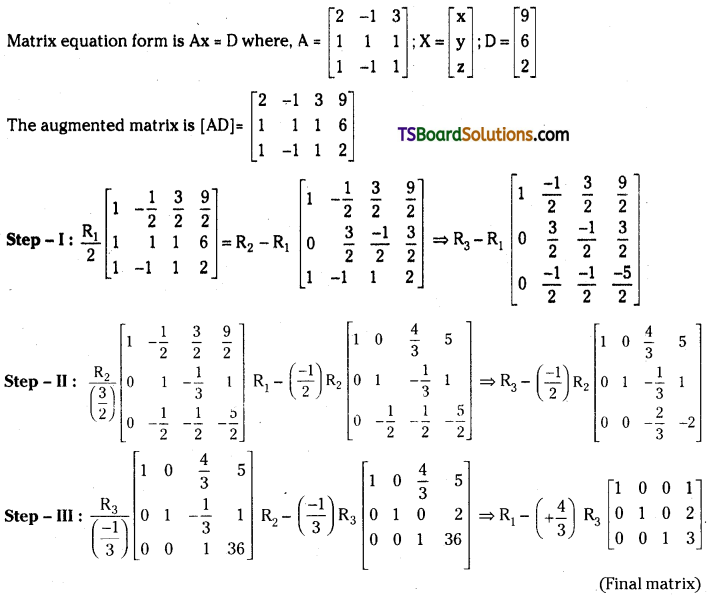
Solve the equation 2x – y + 3z = 9, x + y + z = 6, x – y + z = 2 by Gauss-Jordan method. [Mar. 18(AP): Mar. 11, 10; May 11]
Answer:
The given system of linear equations are 2x – y + 3z = 9, x + y + z = 6, x – y + z = 2
TS Inter First Year Maths 1A Matrices Important Questions Long Answer Type 12
In this case, system of equations has unique solution i.e., x = 1; y = 2; z = 3.
∴ The solution of given system of equations is x = 1; y = 2; z = 3.

Question 14.
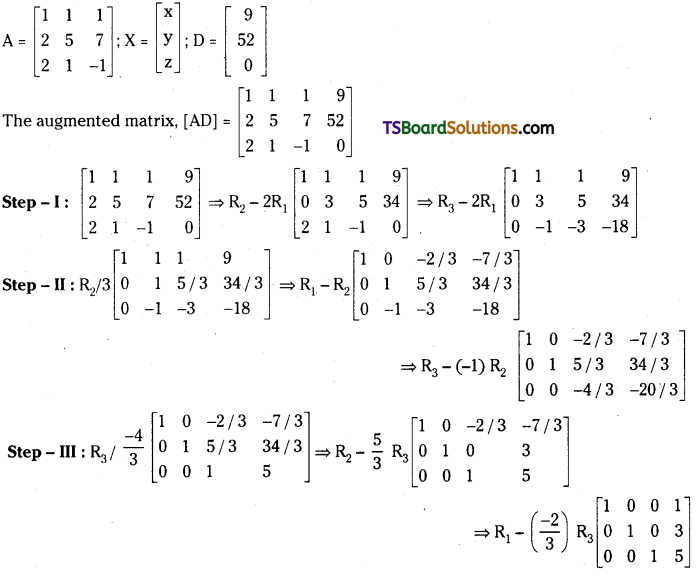
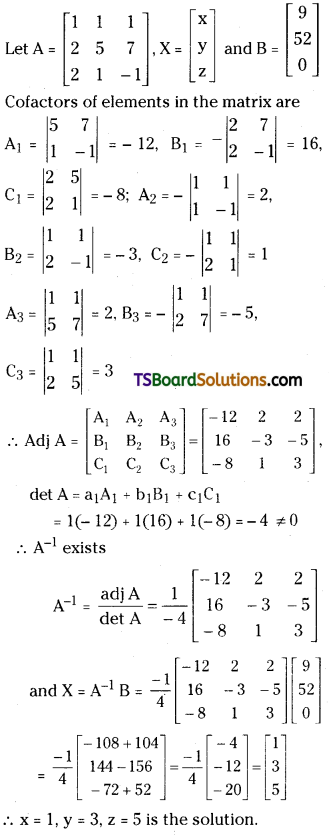
Solve the following system of equations by Gauss – Jordan method : x + y + z = 9, 2x + 5y + 7z = 52, 2x + y – z = 0. [May 10, 07; Mar. 09, 1, 99]
Answer:
Given system of linear equations are x + y + z = 9, 2x + 5y + 7z = 52; 2x + y – z = 0. The matrix form is AX = D
TS Inter First Year Maths 1A Matrices Important Questions Long Answer Type 13
In this case, the system of equations has unique solution i.e., x = 1; y = 3; z 5.
∴ The solution of given system of equations is x = 1; y = 3; z = 5.

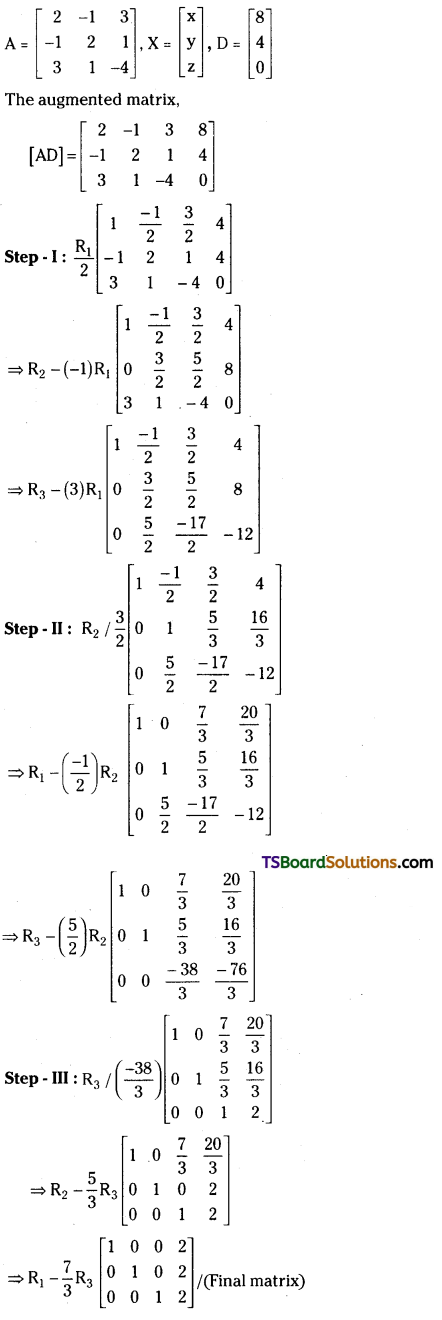
Solve the equations 2x – y + 3z = 8, – x + 2y + z = 4, 3x + y – 4z = 0 by Gauss-Jordan method. [Mar. 07]
Answer:
x = 2, y = 2, z = 2

TS Inter First Year Maths 1A Matrices Important Questions Long Answer Type

Solve the equations 2x – y + 8z = 13, 3x + 4y + 5z = 18, 5x – 2y + 7z = 20 by Gauss-Jordan method. [May 09; Mar. 03]
Answer:
x = 3, y = 1, z = 1

Question 15.
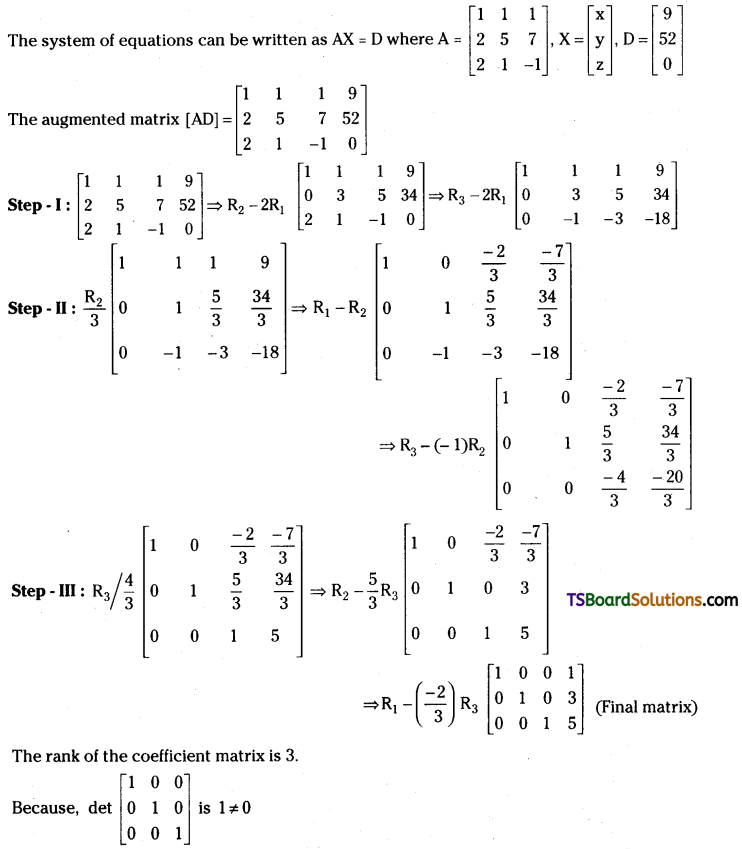
Examine whether the system of equations x + y + z = 9, 2x + 5y + 7z = 52, 2x + y – z = 0 are consistent or Inconsistent and If consistent, find the complete solution. [May 15(TS); May 11]
Answer:
The given system of linear equations are x + y + z = 9, 2x + 5y + 7z = 52, 2x + y – z = 0.
TS Inter First Year Maths 1A Matrices Important Questions Long Answer Type 14
∴ Rank [A] = 3
Now, Rank [AD] = 3
Since, the 3 × 3 sub matrix is \(\left[\begin{array}{lll}
1 & 0 & 0 \\
0 & 1 & 0 \\
0 & 0 & 1
\end{array}\right]\) whose det is 1 ≠ 0.
∴ Rank [A] = Rank [AD] = 3.
In this case, system of equations has unique solution. i.e., x = 1, y = 3, z = 5.
Hence, the given system is consistent.

TS Inter First Year Maths 1A Matrices Important Questions Long Answer Type

Question 16.
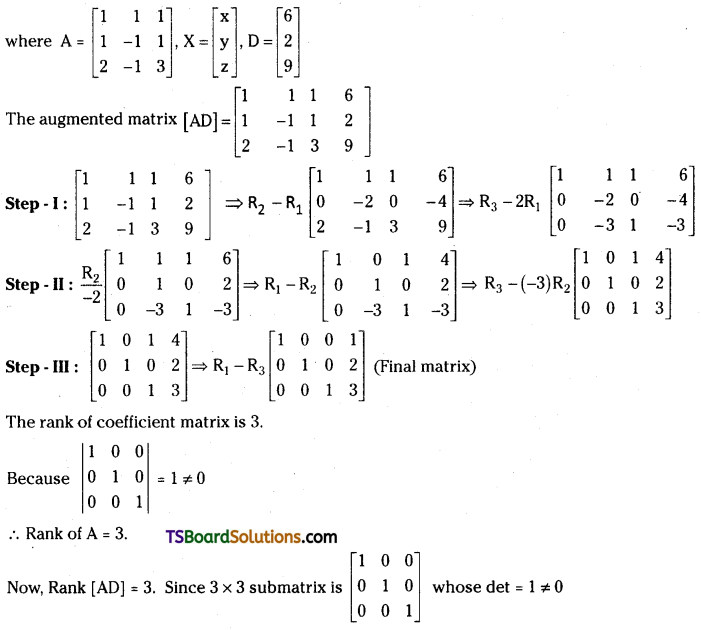
Examine whether the system of equations x + y + z = 6, x – y + z = 2, 2x – y + 3z = 9 are consistent or inconsistent and if consistent, find the complete solution. [Mar.11, 05]
Answer:
Given system of linear equations are x + y + z = 6, x – y + z = 2, 2x – y + 3z = 9
The given system of equations can be written as AX = D
TS Inter First Year Maths 1A Matrices Important Questions Long Answer Type 15
∴ Rank of AD = 3.
Rank [A] = Rank [AD] = 3.
In this case, system of equations has unique solution. i.e., x = 1, y = 2, z = 3.
Hence, given system is consistent.

Question 17.
Examine whether the system of equations x + y + z = 1, 2x + y + z = 2, x + 2y + 2z = 1 are consistent or Inconsistent and if consistent, find the complete solution. [Mar. 15 (TS); May 05]
Answer:
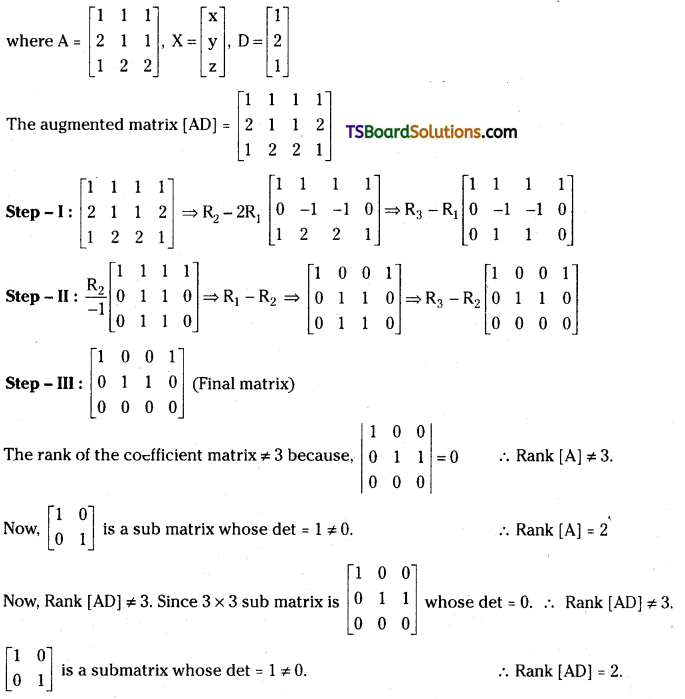
Given system of linear equations are x + y + z = 1; 2x + y + z = 2; x + 2y + 2z = 1
The system of equations can be written as AX = D
TS Inter First Year Maths 1A Matrices Important Questions Long Answer Type 16
∴ Rank [A] = Rank [AD]
In this case, system of equations has infinitely many solutions. x = 1; y + z = 0
∴ The solution of the given system of equations is x = 1, y + z = 0.
Hence, the given system is consistent.

TS Inter First Year Maths 1A Matrices Important Questions Long Answer Type

Question 18.
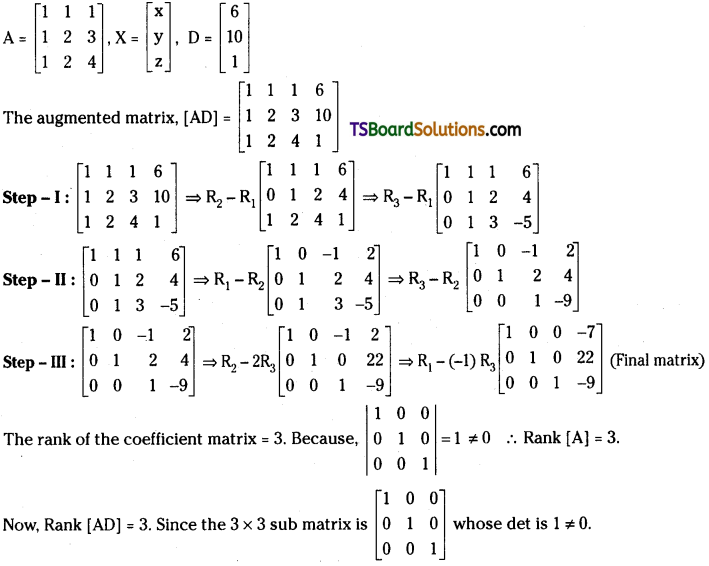
Examine whether the following system of equations x + y + z = 6, x + 2y + 3z = 10, x + 2y + 4z = 1 are consistent or Inconsistent and if consistent, find the complete solution. [May. 02]
Answer:
The given system of linear equations are x + y + z = 6; x – 2y + 3z = 10; x + 2y – 4z = 1
The system of equations can be written as AX = D
TS Inter First Year Maths 1A Matrices Important Questions Long Answer Type 17
∴ Rank [AD] = 3
∴ Rank [A] = Rank [AD] = 3
∴ In this case, system of equations has unique solution.
i.e., x = – 7; y = 22; z = – 9
Hence, the given system is consistent.

Question 19.
If A = \(\left[\begin{array}{ccc}
3 & 2 & -1 \\
2 & -2 & 0 \\
1 & 3 & 1
\end{array}\right]\), B = \(\left[\begin{array}{ccc}
-3 & -1 & 0 \\
2 & 1 & 3 \\
4 & -1 & 2
\end{array}\right]\) and X = A + B then find X.
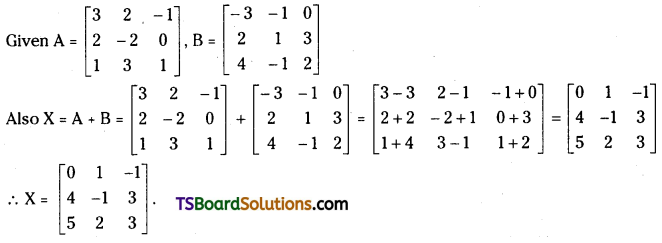
Answer:
TS Inter First Year Maths 1A Matrices Important Questions Long Answer Type 18

TS Inter First Year Maths 1A Matrices Important Questions Long Answer Type

Question 20.
If \(\left[\begin{array}{ccc}
x-1 & 2 & 5-y \\
0 & z-1 & 7 \\
1 & 0 & a-5
\end{array}\right]\) = \(\left[\begin{array}{lll}
1 & 2 & 3 \\
0 & 4 & 7 \\
1 & 0 & 0
\end{array}\right]\), then find the values of x, y, z and a.
Answer:
Given \(\left[\begin{array}{ccc}
x-1 & 2 & 5-y \\
0 & z-1 & 7 \\
1 & 0 & a-5
\end{array}\right]\) = \(\left[\begin{array}{lll}
1 & 2 & 3 \\
0 & 4 & 7 \\
1 & 0 & 0
\end{array}\right]\)
From equality of matrices
x – 1 = 1 ⇒ x = 2
5 – y = 3 ⇒ y = 2
z – 1 = 4 ⇒ z = 5
a – 5 = 0 ⇒ a = 5
∴ x = 2, y = 2, z = 5, a = 5

Question 21.
If \(\left[\begin{array}{ccc}
x-1 & 2 & y-5 \\
z & 0 & 2 \\
1 & -1 & 1+a
\end{array}\right]=\left[\begin{array}{ccc}
1-x & 2 & -y \\
2 & 0 & 2 \\
1 & -1 & 1
\end{array}\right]\) then find the values of x, y, z and a.
Answer:
Given
\(\left[\begin{array}{ccc}
x-1 & 2 & y-5 \\
z & 0 & 2 \\
1 & -1 & 1+a
\end{array}\right]=\left[\begin{array}{ccc}
1-x & 2 & -y \\
2 & 0 & 2 \\
1 & -1 & 1
\end{array}\right]\)
From the equality of matrices,
x – 1 = 1 – x ⇒ 2x = 2 ⇒ x = 1
y – 5 = – y ⇒ 2y = 5 ⇒ y = 5/2
z = 2
1 + a = 1 ⇒ a = 0
∴ x = 1, y = 5/2, z = 2, a = 0

Question 22.
find the trace of A
if A = \(\left[\begin{array}{ccc}
1 & 2 & -1 / 2 \\
0 & -1 & 2 \\
-1 / 2 & 2 & 1
\end{array}\right]\).
Answer:
Given A = \(\left[\begin{array}{ccc}
1 & 2 & -1 / 2 \\
0 & -1 & 2 \\
-1 / 2 & 2 & 1
\end{array}\right]\)
The elements of the principal diagonal of ‘A’ are 1, – 1, 1
Hence, the trace of A = 1 + (- 1) + 1
= 1 – 1 + 1 = 1

TS Inter First Year Maths 1A Matrices Important Questions Long Answer Type

Question 23.
If A = \(\left[\begin{array}{ccc}
0 & 1 & 2 \\
2 & 3 & 4 \\
4 & 5 & -6
\end{array}\right]\) and B = \(\left[\begin{array}{ccc}
-1 & 2 & 3 \\
0 & 1 & 0 \\
0 & 0 & -1
\end{array}\right]\) find B – A and 4A – 5B.
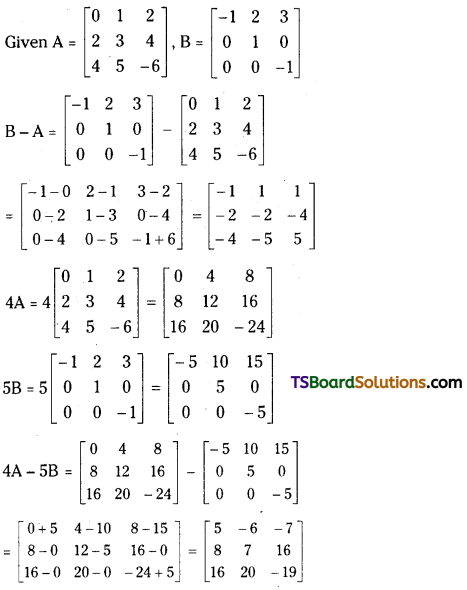
Answer:
TS Inter First Year Maths 1A Matrices Important Questions Long Answer Type 19

Question 24.
If A = \(\left[\begin{array}{lll}
0 & 1 & 2 \\
2 & 3 & 4 \\
4 & 5 & 6
\end{array}\right]\) and B = \(\left[\begin{array}{ccc}
1 & -2 & 0 \\
0 & 1 & -1 \\
-1 & 0 & 3
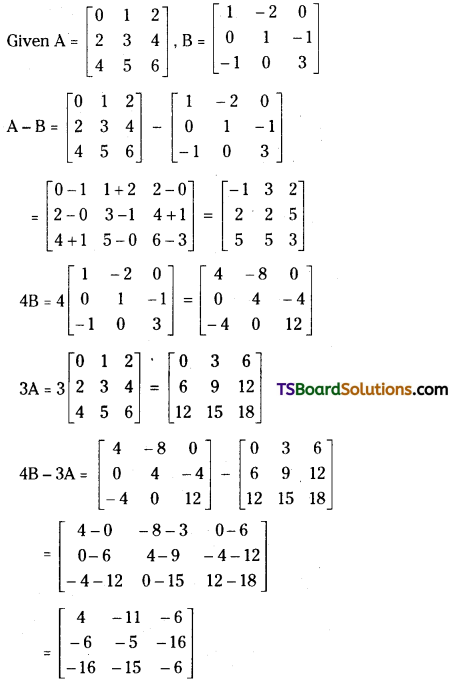
\end{array}\right]\) find A – B and 4B – 3A.
Answer:
TS Inter First Year Maths 1A Matrices Important Questions Long Answer Type 20

TS Inter First Year Maths 1A Matrices Important Questions Long Answer Type

Question 25.
If A = \(\left[\begin{array}{rrr}
1 & -2 & 3 \\
-4 & 2 & 5
\end{array}\right]\) and B = \(\left[\begin{array}{ll}
2 & 3 \\
4 & 5 \\
2 & 1
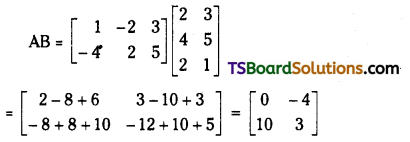
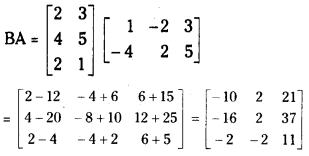
\end{array}\right]\) do AB and BA exist? If they exist find them. Do A and B commute with respect to multiplication?
Answer:
Given A = \(\left[\begin{array}{rrr}
1 & -2 & 3 \\
-4 & 2 & 5
\end{array}\right]\), B = \(\left[\begin{array}{ll}
2 & 3 \\
4 & 5 \\
2 & 1
\end{array}\right]\)
The order of matrix A is 2 × 3
The order of matrix B is 3 × 2
The no.of columns in A The no.of rows in B.
∴ AB is defined
TS Inter First Year Maths 1A Matrices Important Questions Long Answer Type 21
The no.of columns in B = The no.of rows in A.
∴ BA is defined.
TS Inter First Year Maths 1A Matrices Important Questions Long Answer Type 22
∴ AB ≠ BA
∴ A and B is not commute with respect to multiplication.

Question 26.
Find A2 where A = \(\left[\begin{array}{cc}
4 & 2 \\
-1 & 1
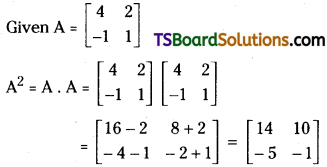
\end{array}\right]\).
Answer:
TS Inter First Year Maths 1A Matrices Important Questions Long Answer Type 23

TS Inter First Year Maths 1A Matrices Important Questions Long Answer Type

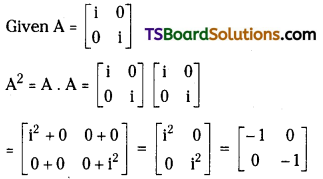
Question 27.
If A = \(\left[\begin{array}{ll}
\mathrm{i} & 0 \\
0 & \mathrm{i}
\end{array}\right]\) find A2.
Answer:
TS Inter First Year Maths 1A Matrices Important Questions Long Answer Type 24

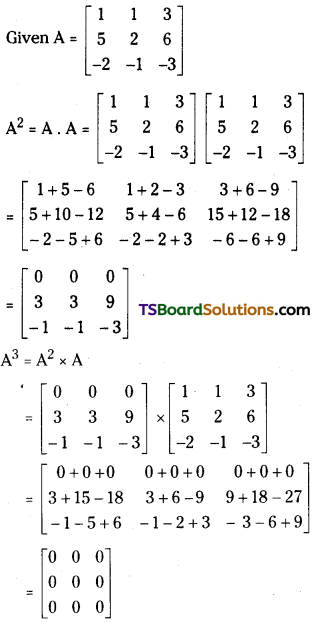
Question 28.
If A = \(\left[\begin{array}{ccc}
1 & 1 & 3 \\
5 & 2 & 6 \\
-2 & -1 & -3
\end{array}\right]\) then find A3.
Answer:
TS Inter First Year Maths 1A Matrices Important Questions Long Answer Type 25

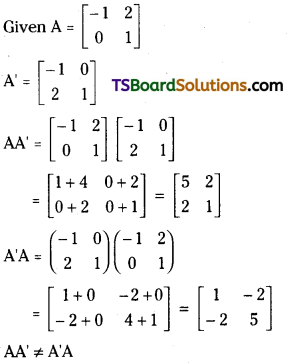
Question 29.
If A = \(\left[\begin{array}{cc}
-1 & 2 \\
0 & 1
\end{array}\right]\) then find AA’. Do A and A’ commute with respect to multiplication of matrices?
Answer:
TS Inter First Year Maths 1A Matrices Important Questions Long Answer Type 26
∴ A and A’ do not commute with respect to multiplication of matrices.

TS Inter First Year Maths 1A Matrices Important Questions Long Answer Type

Question 30.
Find the determinant of the matrix \(\left[\begin{array}{lll}
a & h & g \\
h & b & f \\
g & f & c
\end{array}\right]\).
Answer:
Let A = \(\left[\begin{array}{lll}
a & h & g \\
h & b & f \\
g & f & c
\end{array}\right]\)
det A = a(bc – f2) – h(ch – gf) + g(hf – bg)
= abc – af2 – ch2 + fgh + fgh – bg2
= abc + 2fgh – af2 – bg2 – ch2

Question 31.
Find the determinant of the matrix \(\left[\begin{array}{lll}
a & b & c \\
b & c & a \\
c & a & b
\end{array}\right]\).
Answer:
Let A = \(\left[\begin{array}{lll}
a & b & c \\
b & c & a \\
c & a & b
\end{array}\right]\)
det A = a(bc – a2) – b(b2 – ac) + c(ab – c2)
= abc – a3 – b3 + abc + abc – c3
= 3abc – a3 – b3 – c3

Question 32.
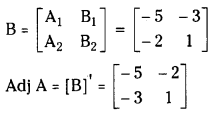
Find the adjoint and the inverse of the matrix A = \(\).
Answer:
Given A = \(\left[\begin{array}{cc}
1 & 2 \\
3 & -5
\end{array}\right]\)
Cofactor of 1 is A1 = + (- 5) = – 5
Cofactor of 2 is B1 = – (3) = – 3
Cofactor of 3 is A2 = – (2) = – 2
Cofactor of – 5 is B2 = +(1) = 1
∴ The cofactor matrix of A is
TS Inter First Year Maths 1A Matrices Important Questions Long Answer Type 27
Now det A = ad – bc = 1(- 5) – 2(3)
= – 5 – 6 = – 11 ≠ 0
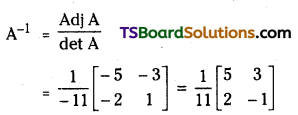
Hence A is invertiable.
TS Inter First Year Maths 1A Matrices Important Questions Long Answer Type 28

TS Inter First Year Maths 1A Matrices Important Questions Long Answer Type

Question 33.
If A = \(\left[\begin{array}{lll}
1 & 2 & 2 \\
2 & 1 & 2 \\
2 & 2 & 1
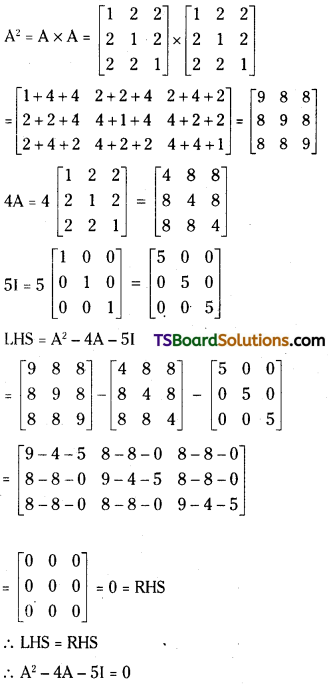
\end{array}\right]\) then show that A2 – 4A – 5I = 0. [Mar. 16(AP)]
Answer:
Given A = \(\left[\begin{array}{lll}
1 & 2 & 2 \\
2 & 1 & 2 \\
2 & 2 & 1
\end{array}\right]\)
TS Inter First Year Maths 1A Matrices Important Questions Long Answer Type 29

Question 34.
Find the adjoint and the inverse of the matrix \(\left[\begin{array}{lll}
1 & 0 & 2 \\
2 & 1 & 0 \\
3 & 2 & 1
\end{array}\right]\).
Answer:
Let A = \(\left[\begin{array}{lll}
1 & 0 & 2 \\
2 & 1 & 0 \\
3 & 2 & 1
\end{array}\right]\)
Cofactor of 1, A1 =+(1 – 0) = 1
Cofactor of 0, B1 = – (2 – 0) = – 2
Cofactor of 2, C1 = + (4 – 3) = 1
Cofactor of 2, A2 = – (0 – 4) = 4
Cofactor of 1, B2 = + (1 – 6) = – 5
Cofactor of 0, C2 = – (2 – 0) = – 2
Cofactor of 3, A3 = + (0 – 2) = – 2
Cofactor of 2, B3 = – (0 – 4) = 4
Cofactor of 1, C3 = + (1 – 0) = 1
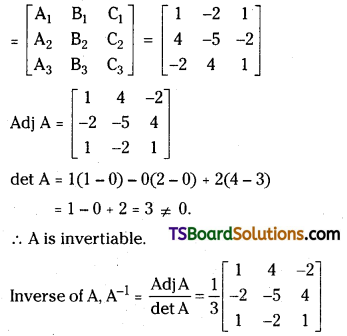
∴ Cofactor matrix of A = B
TS Inter First Year Maths 1A Matrices Important Questions Long Answer Type 30

TS Inter First Year Maths 1A Matrices Important Questions Long Answer Type

Question 35.
Find the adjoint and the inverse of the matrix \(\left[\begin{array}{lll}
2 & 1 & 2 \\
1 & 0 & 1 \\
2 & 2 & 1
\end{array}\right]\).
Answer:
Let A = \(\left[\begin{array}{lll}
2 & 1 & 2 \\
1 & 0 & 1 \\
2 & 2 & 1
\end{array}\right]\)
Cofactor of 2, A1 = + (0 – 2) = – 2
Cofactor of 1, B1 = – (1 – 2) = 1
Cofactor of 2, C1 = + (2 – 0) = 2
Cofactor of 1, A2 = – (1 – 4) = 3
Cofactor of 0, B2 = + (2 – 4) = – 2
Cofactor of 1, C2 = – (4 – 2) = —2
Cofactor of 2, A3 = + (1 – 0) = 1
Cofactor of 2, B3 = – (2 – 2) = 0
Cofactor of 1, C3 = + (0 – 1) = – 1
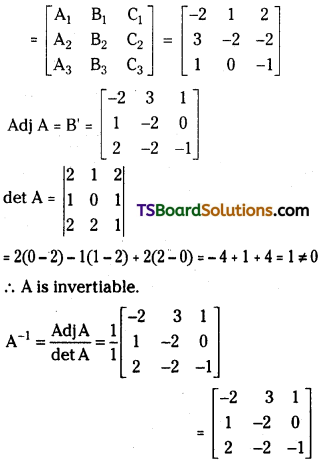
∴ Cofactor matrix of A = B
TS Inter First Year Maths 1A Matrices Important Questions Long Answer Type 31

Question 36.
Solve the system of equations
2x – y + 3z = 9, x + y + z = 6, x – y + z = 2 by using Cramer’s rule.
Answer:
TS Inter First Year Maths 1A Matrices Important Questions Long Answer Type 32

TS Inter First Year Maths 1A Matrices Important Questions Long Answer Type

Question 37.
Solve 2x – y + 3z = 8, – x + 2y + z = 4, 3x + y – 4z = 0 by using matrix inversion method.
Answer:
The given system of linear equations are
2x – y + 3z = 8, – x + 2y + z = 4, 3x + y – 4z = 0
Let A = \(\left[\begin{array}{crr}
2 & -1 & 3 \\
-1 & 2 & 1 \\
3 & 1 & -4
\end{array}\right]\), X = \(\left[\begin{array}{l}
x \\
y \\
z
\end{array}\right]\), D = \(\left[\begin{array}{l}
8 \\
4 \\
0
\end{array}\right]\)
Then we can write the given equations in the form of AX = D.
detA = 2(- 8 – 1) + 1(4 – 3) + 3(- 1 – 6)
= 2(- 9) + 1 (1) + 3(- 7)
= – 18 + 1 – 21 = – 38 ≠ 0
Hence, we can solve the given equations ¡n matrix inversion method.
Cofactor of 2 is A1 = + (- 8 – 1) = – 9
Cofactor of – 1 is B1 = – (4 – 3) = – 1
Cofactor of 3 is C1 = + (- 1 – 6) = – 7
Cofactor of – 1 is A2 = – (4 – 3) = – 1
Cofactor of 2 is B2 = + (- 8 – 9) = – 17
Cofactor of 1 is C2 = – (2 + 3) = – 5
Cot actor of 3 is A3 = + (- 1 – 6) = – 7
Cofactor of 1 is B3 = – (2 + 3) = – 5
Cofactor of – 4 is C3 = + (4 – 1) = 3
TS Inter First Year Maths 1A Matrices Important Questions Long Answer Type 33

Question 38.
Solve x + y + z = 1, 2x + 2y + 3z = 6, x + 4y + 9z = 3 by using matrix inversion method.
Answer:
Given system of linear equations are
x + y + z = 1, 2x + 2y + 3z = 6, x + 4y + 9z = 3
Let A = \(\left[\begin{array}{lll}
1 & 1 & 1 \\
2 & 2 & 3 \\
1 & 4 & 9
\end{array}\right]\), X = \(\left[\begin{array}{l}
x \\
y \\
z
\end{array}\right]\), D = \(\left[\begin{array}{l}
1 \\
6 \\
3
\end{array}\right]\)
Then we can write the given equations in the form of AX = D.
det A = \(\left|\begin{array}{lll}
1 & 1 & 1 \\
2 & 2 & 3 \\
1 & 4 & 9
\end{array}\right|\) = 1 (18 – 12) – 1 (18 – 3) + 1 (8 – 2) = 1(6) – 1(15) + 1(6)
= 6 – 15 + 6 = – 3 ≠ 0
Hence we can solve the given equations using matrix inversion method.
Cofactor of 1 is A1 = + (18 – 12) = 6
Cofactor of 1 is B1 = – (18 – 3) = – 15
Col actor of 1 is C1 = + (8 – 2) = 6
Cofactor of 2 is A2 = – (9 – 4) = – 5
Cofactor of 2 is B2 = + (9 – 1) = 8
Cofactor of 3 is C2 = – (4 – 1) = – 3
Cofactor of 1 is A3 = + (3 – 2) = 1
Cofactor of 4 is B3 = – (3 – 2) = – 1
Cofactor of 9 is C3 = + (2 – 2) = O
∴ Cofactor matrix of A = B
TS Inter First Year Maths 1A Matrices Important Questions Long Answer Type 34
∴ The solution of given system of equations is x = 7, y = – 10, z = 4.

TS Inter First Year Maths 1A Matrices Important Questions Long Answer Type

Question 39.
Solve the equations 2x – y + 3z = 8, – x + 2y + z = 4, 3x + y – 4z = 0 by Gauss – Jordan method.
Answer:
Given system of linear equations are 2x – y + 3z = 8; – x + 2y + z = 4; 3x + y – 4z = 0.
Matrix equation form is AX = D
TS Inter First Year Maths 1A Matrices Important Questions Long Answer Type 35
In this case, the system of equations has unique solution. i.e., x = y = z = 2
∴ The solution of given system of equations is x = 2; y = 2; z = 2.

TS Inter First Year Maths 1A Matrices Important Questions Long Answer Type

Question 40.
Solve the equations 2x – y + 8z = 13, 3x + 4y + 5z = 18, 5x – 2y + 7z = 20 by Gauss – Jordan method.
Answer:
Given system of linear equations are 2x – y + 8z = 13, 3x + 4y + 5z = 18, 5x – 2y + 7z = 20.
Matrix equation form is AX = D
TS Inter First Year Maths 1A Matrices Important Questions Long Answer Type 36
In this case, the system of equations has unique solution. i.e., x = 3, y = 1, z = 1.
∴ The solution of given system of equations is x = 3; y = 1; z = 1.

TS Inter First Year Maths 1A Matrices Important Questions Long Answer Type

Some More Maths 1A Matrices Important Questions

Question 1.
If A = \(\left[\begin{array}{ccc}
2 & 3 & 1 \\
6 & -1 & 5
\end{array}\right]\) and B = \(\left[\begin{array}{ccc}
1 & 2 & -1 \\
0 & -1 & 3
\end{array}\right]\) then find the matrix X such that A + B – X = 0. What is the order of the matrix X?
Answer:
Given A = \(\left[\begin{array}{ccc}
2 & 3 & 1 \\
6 & -1 & 5
\end{array}\right]\), B = \(\left[\begin{array}{ccc}
1 & 2 & -1 \\
0 & -1 & 3
\end{array}\right]\)
A and B are matrices of same order 2 × 3.
If A + B – X is to be defined the order of X also must also be 2 × 3.
Given A + B – X = 0 ⇒ X = A + B
TS Inter First Year Maths 1A Matrices Important Questions Long Answer Type 37
∴ Order of X is 2 × 3.

Question 2.
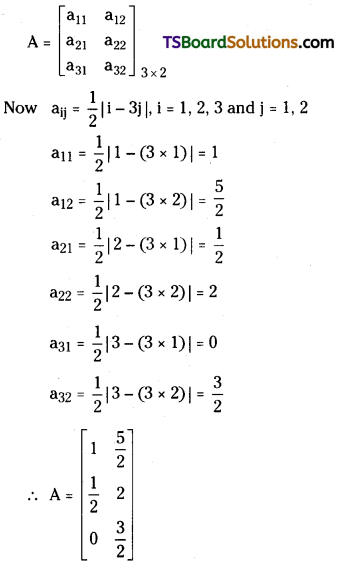
Construct a 3 × 2 matrix whose elements are defined by aij = \(\frac{1}{2}\) |i – 3j|.
Answer:
In general a 3 × 2 matrix is given by
TS Inter First Year Maths 1A Matrices Important Questions Long Answer Type 38

TS Inter First Year Maths 1A Matrices Important Questions Long Answer Type

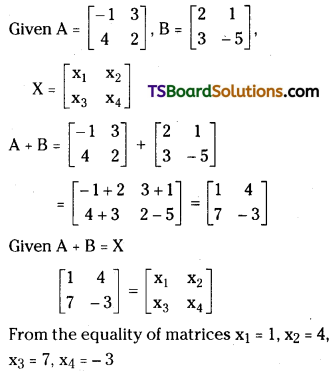
Question 3.
If A = \(\left[\begin{array}{cc}
-1 & 3 \\
4 & 2
\end{array}\right]\), B = \(\left[\begin{array}{cc}
2 & 1 \\
3 & -5
\end{array}\right]\), X = \(\left[\begin{array}{ll}
\mathbf{x}_1 & \mathbf{x}_2 \\
\mathbf{x}_3 & \mathbf{x}_4
\end{array}\right]\) and A + B = X, then find the values of x1, x2, x3 and x4.
Answer:
TS Inter First Year Maths 1A Matrices Important Questions Long Answer Type 39

Question 4.
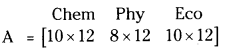
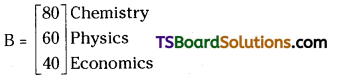
A certain book shop has 10 dozen chemistry books, 8 dozen physics books, 10 dozen economics books. Their selling prices are Rs. 80, Rs. 60 and Rs. 40 each respectively. Using matrix algebra, find the total value of the books in the shop.
Answer:
Number of 3 types of books is expressed by the row matrix A
TS Inter First Year Maths 1A Matrices Important Questions Long Answer Type 40
= [120 96 120]
Selling price of 3 types of books is expressed by the column matrix B
TS Inter First Year Maths 1A Matrices Important Questions Long Answer Type 41
Total value of the books in the shop is given by AB
AB = [120 96 120] \(\left[\begin{array}{l}
80 \\
60 \\
40
\end{array}\right]\)
= [120 × 80 + 96 × 60 + 120 × 40]
= [9600 + 5760 + 4800]
= [20160]
∴ Total value of the books = Rs. 20160

TS Inter First Year Maths 1A Matrices Important Questions Long Answer Type

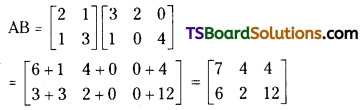
Question 5.
If A = \(\left[\begin{array}{ll}
2 & 1 \\
1 & 3
\end{array}\right]\) and B = \(\left[\begin{array}{lll}
3 & 2 & 0 \\
1 & 0 & 4
\end{array}\right]\), find AB and BA, if it exists.
Answer:
Given A = \(\left[\begin{array}{ll}
2 & 1 \\
1 & 3
\end{array}\right]\), B = \(\left[\begin{array}{lll}
3 & 2 & 0 \\
1 & 0 & 4
\end{array}\right]\)
The order of matrix A is 2 × 2
The order of matrix 13 is 2 × 3
The no.of columns in A = The no.of rows in B
∴ AB is defined
TS Inter First Year Maths 1A Matrices Important Questions Long Answer Type 42
The no.of columns in B ≠ The no.of rows in A
∴ BA is not defined.

Question 6.
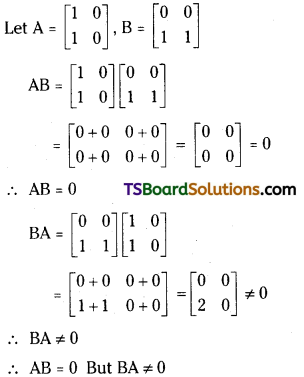
Give examples of two square matrices A and B of the same order for which AB = 0. But BA ≠ 0.
Answer:
TS Inter First Year Maths 1A Matrices Important Questions Long Answer Type 43

TS Inter First Year Maths 1A Matrices Important Questions Long Answer Type

Question 7.
If A = \(\left[\begin{array}{rr}
7 & -2 \\
-1 & 2 \\
5 & 3
\end{array}\right]\) and B = \(\left[\begin{array}{cc}
-2 & -1 \\
4 & 2 \\
-1 & 0
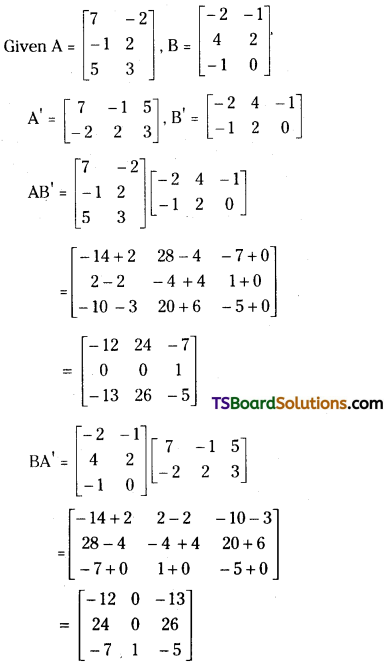
\end{array}\right]\) then find AB’ and BA’. [Mar. 18 (AP)]
Answer:
TS Inter First Year Maths 1A Matrices Important Questions Long Answer Type 44

Question 8.
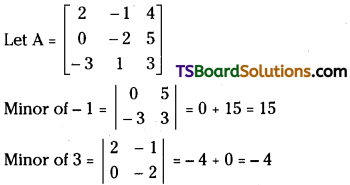
Find the minors of – 1 and 3 in the matrix \(\left[\begin{array}{ccc}
2 & -1 & 4 \\
0 & -2 & 5 \\
-3 & 1 & 3
\end{array}\right]\).
Answer:
TS Inter First Year Maths 1A Matrices Important Questions Long Answer Type 45

Question 9.
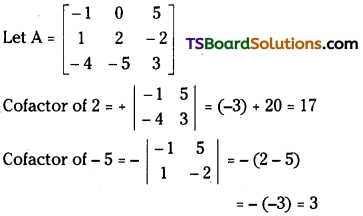
Find the cofactors of the elements 2, – 5 in the matrix \(\left[\begin{array}{ccc}
-1 & 0 & 5 \\
1 & 2 & -2 \\
-4 & -5 & 3
\end{array}\right]\).
Answer:
TS Inter First Year Maths 1A Matrices Important Questions Long Answer Type 46

TS Inter First Year Maths 1A Matrices Important Questions Long Answer Type

Question 10.
Show that the determinant of skew – symmetric matrix of order three is always zero.
Answer:
Let A = \(\left[\begin{array}{ccc}
0 & -c & -b \\
c & 0 & -a \\
b & a & 0
\end{array}\right]\) is a skew – symmetric matrix of order ‘3’.
det A = 0(0 + a2) + c(0 + ab) – b(ac – 0)
= 0 + abc – abc = 0 + 0 = 0
∴ The determinant of skew symmetric matrix of order 3 is always zero.

Question 11.
Show that \(\left[\begin{array}{ccc}
\mathbf{y}+\mathbf{z} & \mathbf{x} & \mathbf{x} \\
\mathbf{y} & \mathbf{z}+\mathbf{x} & \mathbf{y} \\
\mathbf{z} & z & \mathrm{x}+\mathbf{y}
\end{array}\right]\) = 4xyz.
Answer:
LHS = \(\left[\begin{array}{ccc}
\mathbf{y}+\mathbf{z} & \mathbf{x} & \mathbf{x} \\
\mathbf{y} & \mathbf{z}+\mathbf{x} & \mathbf{y} \\
\mathbf{z} & z & \mathrm{x}+\mathbf{y}
\end{array}\right]\)
= (y + z) [(z + x) (x + y) – yz] – x[y(x + y) – yz] + x[yz – z(z + x)]
= (y + z) [zx + xy + zy + x2 – yz] – x[xy + y2 – yz] + x[yz – z2 – zx]
= xyz + xy2 + zy2 + x2y – y2z + z2 x + xyz + z2y + x2z – yz2 – x2y – xy2 + xyz + xyz – xz2 – zx2
= 4xyz
= RHS.

Question 12.
If Δ1 = \(\left|\begin{array}{ccc}
1 & \cos \alpha & \cos \beta \\
\cos \alpha & 1 & \cos \gamma \\
\cos \beta & \cos \gamma & 1
\end{array}\right|\), Δ2 = \(\left|\begin{array}{ccc}
0 & \cos \alpha & \cos \beta \\
\cos \alpha & 0 & \cos \gamma \\
\cos \beta & \cos \gamma & 0
\end{array}\right|\) and Δ1 = Δ2, then show that cos2α + cos2β + cos2γ = 1.
Answer:
Δ1 = \(\left|\begin{array}{ccc}
1 & \cos \alpha & \cos \beta \\
\cos \alpha & 1 & \cos \gamma \\
\cos \beta & \cos \gamma & 1
\end{array}\right|\)
= 1(1 – cos2γ) – cos α(cos α – cos β cos γ) + cos β (cos α cos γ – cos β)
= 1 – cos2 γ – cos2 α + cos α cos β cos γ + cos α cos β cos γ – cos2β
= 1 – cos2 γ – cos2α – cos2β + 2 cos α cos β cos γ

Δ2 = \(\left|\begin{array}{ccc}
0 & \cos \alpha & \cos \beta \\
\cos \alpha & 0 & \cos \gamma \\
\cos \beta & \cos \gamma & 0
\end{array}\right|\)
= 0(0 – cos2γ) – cos α (0 – cos γ cos β) + cos β (cos α cos γ – 0)
= cos α cos β cos γ + cos α cos β cos γ
= 2 cos α cos β cos γ

Given Δ1 = Δ2
1 – cos2 α – cos2β – cos2γ + 2 cos α cos β cos γ = 2 cos α cos β cos γ
1 – cos2α – cos2β – cos2γ = 0
cos2α + cos2 β + cos2 γ = 1.

TS Inter First Year Maths 1A Matrices Important Questions Long Answer Type

Question 13.
Show that \(\left|\begin{array}{ccc}
1 & a & a^2-b c \\
1 & b & b^2-c a \\
1 & c & c^2-a b
\end{array}\right|\) = 0.
Answer:
LHS = \(\left|\begin{array}{ccc}
1 & a & a^2-b c \\
1 & b & b^2-c a \\
1 & c & c^2-a b
\end{array}\right|\)
= 1(bc2 – ab2 – b2c + c2a) – a(c2 – ab – b2 + ac) + (a2 – bc) (c – b)
= bc2 – ab2 – b2c + c2a – ac2 + a2b + ab2 – a2c + a2c – a2b – bc2 . cb2 = 0
= RHS.

Question 14.
Solve the following system of equations by using Cramer’s rule. [Mar. 15 (TS)]
x – y + 3z = 5, 4x + 2y – z = 0, – x + 3y + z = 5
Answer:
Given system of equations can be written as:
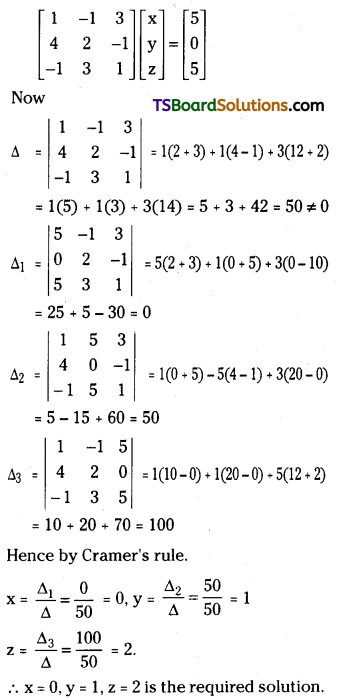
TS Inter First Year Maths 1A Matrices Important Questions Long Answer Type 47

TS Inter First Year Maths 1A Matrices Important Questions Long Answer Type

Question 15.
If A = \(\left[\begin{array}{lll}
0 & 1 & 1 \\
1 & 0 & 1 \\
1 & 1 & 0
\end{array}\right]\) and B = \(\frac{1}{2}\left[\begin{array}{lll}
\mathbf{b}+\mathbf{c} & \mathbf{c}-\mathbf{a} & \mathbf{b}-\mathbf{a} \\
\mathbf{c}-\mathbf{b} & \mathbf{c}+\mathbf{a} & \mathbf{a}-\mathbf{b} \\
\mathbf{b}-\mathbf{c} & \mathbf{a}-\mathbf{c} & \mathbf{a}+\mathbf{b}
\end{array}\right]\) then show that ABA-1 is a diagonal matrxi.
Answer:
Given A = \(\left[\begin{array}{lll}
0 & 1 & 1 \\
1 & 0 & 1 \\
1 & 1 & 0
\end{array}\right]\),
B = \(\frac{1}{2}\left[\begin{array}{lll}
\mathbf{b}+\mathbf{c} & \mathbf{c}-\mathbf{a} & \mathbf{b}-\mathbf{a} \\
\mathbf{c}-\mathbf{b} & \mathbf{c}+\mathbf{a} & \mathbf{a}-\mathbf{b} \\
\mathbf{b}-\mathbf{c} & \mathbf{a}-\mathbf{c} & \mathbf{a}+\mathbf{b}
\end{array}\right]\)
Cot actor of 0 is A1 = + (0 – 1) = – 1
Cofactor of ‘1’ is B1 = – (0 – 1) = 1
Cofactor of 1 is C1 = + (1 – 0) = 1
Cofactor of 1 is A2 = – (0 – 1) = 1
Cofactor of 0 is B2 = + (0 – 1) = – 1
Cofactor of 1 is C2 = – (0 – 1) = 1
Cofactor of 1 is A3 = + (1 – 0) = 1
Cofactor of 1 is B3 = – (0 – 1) = 1
Cofactor of 0 is C3 = +(0 – 1) = – 1
∴ Cofactor matrix of
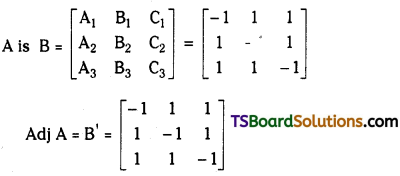
TS Inter First Year Maths 1A Matrices Important Questions Long Answer Type 48
det A = 0(0 – 1) – 1 (0 – 1) + 1 (1 – 0)
= 0 + 1 + 1 = 2 ≠ 0
∴ A is invertiable.
TS Inter First Year Maths 1A Matrices Important Questions Long Answer Type 44

TS Inter First Year Maths 1A Matrices Important Questions Long Answer Type

Question 16.
If A = \(\left[\begin{array}{rrr}
3 & -3 & 4 \\
2 & -3 & 4 \\
0 & -1 & 1
\end{array}\right]\) then show that A-1 = A3
Answer:
Given A = \(\left[\begin{array}{lll}
3 & -3 & 4 \\
2 & -3 & 4 \\
0 & -1 & 1
\end{array}\right]\)

Cofactor of 3 is A1 =+(- 3 + 4) = 1
Cofactor of – 3 is B1 = – (2 – 0) = – 2
Cofactor of 4 is C1 = (- 2 + 0) = – 2
Cofactor of 2 is A2 = – (- 3 + 4) = – 1
Cofactor of – 3 is B2 = + (3 – 0) = 3
Cofactor of 4 is C2 = – (- 3 + 0) =3
Cofactor of 0 is A3 = + (- 12 + 12) = 0
Cofactor of – 1 is B3 = – (12 – 8) = – 4
Cofactor of 1 is C3 = + (- 9 + 6) = – 3
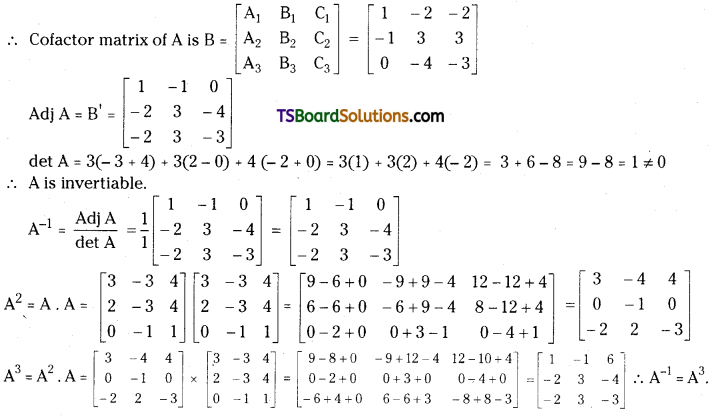
TS Inter First Year Maths 1A Matrices Important Questions Long Answer Type 50

Question 17.
For any square matrix A, show symmetric. [Mar. 15 (AP)]
Answer:
Let ‘A” be a square matrix
(AA’)’ = (A’)’ A’ = AA’
∴ (AA’)’ = AA’
⇒ AA’ is a symmetric matrix.

Question 18.
Find the rank of the matrix \(\left[\begin{array}{ccc}
1 & 4 & -1 \\
2 & 3 & 0 \\
0 & 1 & 2
\end{array}\right]\).
Answer:
Let A = \(\left[\begin{array}{ccc}
1 & 4 & -1 \\
2 & 3 & 0 \\
0 & 1 & 2
\end{array}\right]\)
det A = 1(6 – 0) – 4(4 – 0) – 1(2 – 0)
= 6 – 16 – 2 – 12 ≠ 0
∴ A is a non – singular.
Hence Rank (A) = 3.

TS Inter First Year Maths 1A Matrices Important Questions Long Answer Type

Question 19.
Find the rank of the matrix \(\left[\begin{array}{lll}
1 & 2 & 3 \\
2 & 3 & 4 \\
0 & 1 & 2
\end{array}\right]\). [Mar. 19 (AP), Mar. 15 (TS)]
Answer:
Let A = \(\left[\begin{array}{lll}
1 & 2 & 3 \\
2 & 3 & 4 \\
0 & 1 & 2
\end{array}\right]\)
det A = 1 (6 – 4) – 2 (4 – 0) + 3 (2 – 0) = 2 – 8 + 6 = 0
Since det A = 0, Rank (A) ≠ 3.
Now, \(\left[\begin{array}{ll}
1 & 2 \\
2 & 3
\end{array}\right]\) is a sub matrix of ‘A’ whose determinant is 3 – 4 = – 1 ≠ 0.
Hence Rank (A) = 2.

Question 20.
Solve the following system of homogeneous equations x – y + z = 0, x + 2y – z = 0, 2x + y + 3z = 0. [Mar.16 (TS)]
Answer:
The coefficient matrix is \(\left[\begin{array}{ccc}
1 & -1 & 1 \\
1 & 2 & -1 \\
2 & 1 & 3
\end{array}\right]\)
Its determinant is 1(6 + 1) + 1(3 + 2) + 1(1 – 4) = 1(7) + 1(5) + 1(- 3) = 7 + 5 – 3 = 9
Hence the system has the trivial solution x = y = z = 0 only.

Question 21.
Solve the following system of equations by using Matrix inversion method.
2x – y + 3z = 9, x + y + z = 6, x – y + z = 2. [Mar. 16 (TS)]
Answer:
TS Inter First Year Maths 1A Matrices Important Questions Long Answer Type 51

TS Inter First Year Maths 1A Matrices Important Questions Long Answer Type

Question 22.
Solve x + y + z = 9, 2x + 5y + 7z = 52 and 2x + y – z = 0 by using matrix inversion method. [Mar. 17 (AP)]
Answer:
TS Inter First Year Maths 1A Matrices Important Questions Long Answer Type 52

Question 23.
Solve the following system of equations by Cramer’s rule: 2x – y + k = 8, – x + 2y + z = 4, 3x + y – 4z = 0 [Mar. 18 (TS)]
Answer:
Given equations are
2x – y + 3z = 8,
– x + 2y + z = 4,
3x + y – 4z = 0
TS Inter First Year Maths 1A Matrices Important Questions Long Answer Type 53

TS Inter 1st Year English Grammar Phonetic Transcription

Telangana TSBIE TS Inter 1st Year English Study Material Grammar Phonetic Transcription Exercise Questions and Answers.

TS Inter 1st Year English Grammar Phonetic Transcription

Q.No. 17 (4 × 1 = 4 Marks)

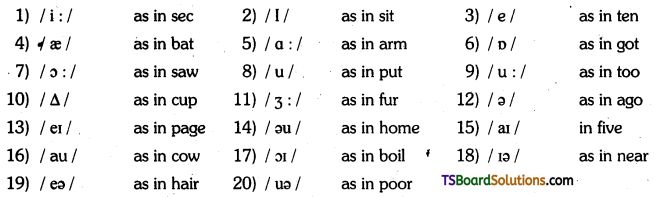
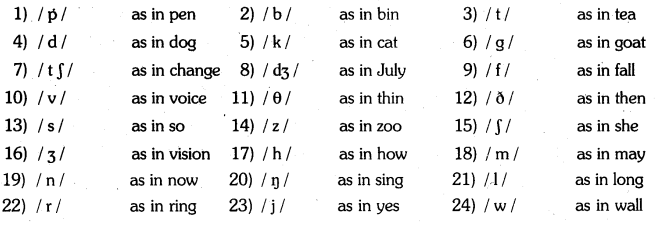
Meaningful speech sounds are the basic raw material for any language. These sounds are represented by symbols in writing. We refer to these symbols as ‘alphabet’.

Most of the Indian languages have a fixed relationship between the sounds and their symbols. In other words, one symbol always stands for one sound and vice versa. Therefore we find absolutely no problem while reading or writing Indian languages once we learn the alphabet of that language.

The same is not the case with English. One letter may stand for many sounds. Example Q as / k / in car, as / s / in century as /t/ in change. One sound is also represented by various letters. Ex : / f / is represented by ‘ph’ in philosophy, by ‘f in fan, by ‘gh’ in rough. This results in a lot of problems for the learners, particularly for foreign learners in writing the spelling and pronouncing the written words.

A way out of this problem is a set of forty four symbols, called phonetic symbols. Each of these symbols stands for one sourid only. Learning these symbols arms us with the necessary weapons to war against the problems in pronounciation and spelling.

Study the following forty four phonetic symbols carefully and learn to identify and use them. Phonetic symbols are always placed between two Slant lines.

Vowels

TS Inter 1st Year English Grammar Phonetic Transcription 1

Consonants

TS Inter 1st Year English Grammar Phonetic Transcription 2

Writing the symbols that represent the sounds in a word is called phonetic transcript. In many examinations phonetic transcription is given and the examinee is asked to write the spelling of those words.

TS Inter 1st Year English Grammar Phonetic Transcription

Exercises

Exercise – A

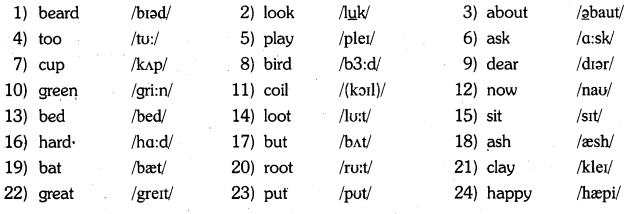
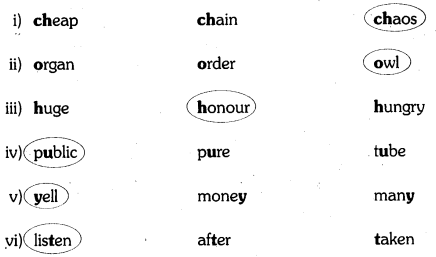
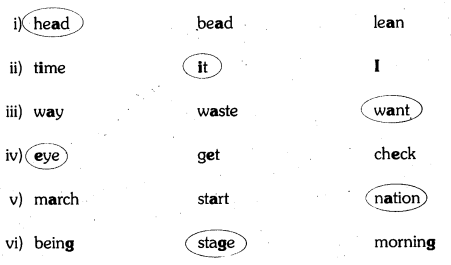
Read the words and fill in the spaces with the appropriate vowel symbol. The first one is done for you. If necessary, don’t hesitate to use a dictionary.
TS Inter 1st Year English Grammar Phonetic Transcription 3

Exercise – B

Read the words according to the vowel symbols mentioned.

/ɪ//i://u//u://ɒ//ɔ:/
bitbeatwoodwooedpotport
fitfeetlookflukewadward
richreachshouldshoedcodcord
filledfieldsootsuitdondawn

TS Inter 1st Year English Grammar Phonetic Transcription

Exercise – C

Go through the words and identify the sounds the end with. The first one is done for you.

Word/t/ /d/ /id/Word/s/ /z/ /iz/
rounded/id/rounds/z/
packed/t/packs/s/
wished/t/wishes/iz/
matched/t/matches/iz/
flogged/d/flogs/z/
played/d/plays/z/
planted/id/plants/s/
worked/t/works/s/

Exercise-D

Read the following words. You will notice that in some words the letters ‘th’ are pronounced as /θ/ and in some others, as /ð/ and in some others, as 161. Write the sound you noticed. The first one is done for you.
the /ð/ this /ð/ through /θ/ then /ð/
thus /ð/ thought /θ/ thick /θ/ mother /ð/

Exercise – E

We get confused with the sounds /w/ and /v/. The sound /w/ is pronounced with rounded lips. The sound /v/ is pronounced with the articulation of front upper teeth and lower lip and with more force.
Now, pronounce the words aloud.
wheel   ventilator
worst    verse
wet      veto

TS Inter 1st Year English Grammar Phonetic Transcription

Exercise – F

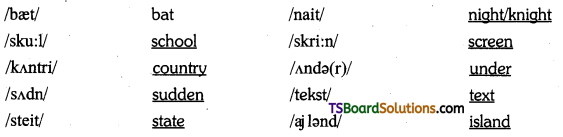
Read the following transcriptions and write the words in ordinary spelling. The first one is done for you.
TS Inter 1st Year English Grammar Phonetic Transcription 4

Exercise – G

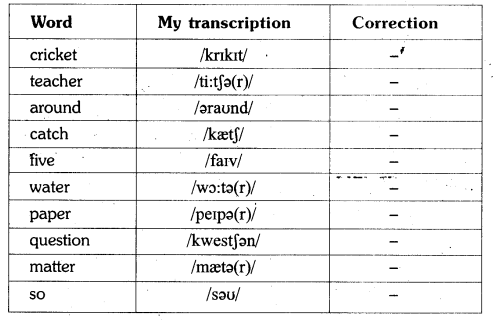
Pronounce the following words and transcribe them in the column my transcription Later, consult a dictionary and make necessary corrections.
TS Inter 1st Year English Grammar Phonetic Transcription 5

Exercise – H

Words with short vowels are entirely different from their long counterparts. Understanding the difference is vital for pronunciation. Read the words in the following table and write a few more words from your text.

/ɪ//i://ɪ//i://ɪ//i:/         ‘/ɪ//i:/
knitneathidheedrimreambidbead
killkeelridreadlidleaddindean
sitseatkinkeenbinbean/beenfillfeel
gritgreethitheatgridgreedchitcheat

TS Inter 1st Year English Grammar Phonetic Transcription

Write the following transcriptions using ordinary English spelling.

Exercise – 1

TS Inter 1st Year English Grammar Phonetic Transcription 6
Answer:
i) purpose
ii) accomplish
iii) beautiful
iv) question
v) faith
vi) miserable

Exercise – 2

TS Inter 1st Year English Grammar Phonetic Transcription 7
Answer:
i) speak
ii) constantly
iii) attention
iv) unfortunate
v) want
vi) individual

Exercise – 3

TS Inter 1st Year English Grammar Phonetic Transcription 8
Answer:
i) transgression
ii) nervy
iii) harbinger
iv) recognize
v) strive
vi) pesticide

TS Inter 1st Year English Grammar Phonetic Transcription

Exercise – 4

TS Inter 1st Year English Grammar Phonetic Transcription 9
Answers
i) provide
ii) literate
iii) frustration
iv) imagination
v) fear
vi) adamant

Exercise – 5

TS Inter 1st Year English Grammar Phonetic Transcription 10
Answer:
i) stretch
ii) incredible
iii) plant
iv) condition
v) hospital
vi) entire

Exercise – 6

TS Inter 1st Year English Grammar Phonetic Transcription 11
Answer:
i) education
ii) husband
iii) pension
iv) recently
v) mountain
vi) close

TS Inter 1st Year English Grammar Phonetic Transcription

Exercise – 7

TS Inter 1st Year English Grammar Phonetic Transcription 12
Answer:
i) desperate
ii) lull
iii) impelled
iv) resistance
v) pride
vi) faint

Exercise – 8

TS Inter 1st Year English Grammar Phonetic Transcription 13
Answer:
i) success
ii) effort
iii) excitement
iv) worry
v) previous
vi) athletic

Exercise – 9

TS Inter 1st Year English Grammar Phonetic Transcription 14
Answer:
i) acquaint
ii) attic
iii) horizontal
iv) gridiron
v) curb
vi) vengeance

TS Inter 1st Year English Grammar Phonetic Transcription

Exercise – 10

TS Inter 1st Year English Grammar Phonetic Transcription 15
Answer:
i) emphatic
ii) appearance
iii) mention
iv) gentleman
v) tremble
vi) sleep

TS Inter 1st Year Maths 1A Matrices Important Questions Short Answer Type

Students must practice these Maths 1A Important Questions TS Inter 1st Year Maths 1A Matrices Important Questions Short Answer Type to help strengthen their preparations for exams.

TS Inter 1st Year Maths 1A Matrices Important Questions Short Answer Type

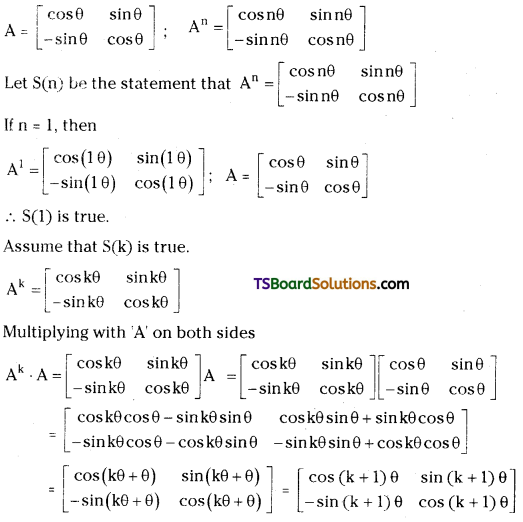
Question 1.
If A = \(\left[\begin{array}{cc}
\cos \theta & \sin \theta \\
-\sin \theta & \cos \theta
\end{array}\right]\), , then show that for all the positive integers n, An = \(\left[\begin{array}{cc}
\cos \theta & \sin \theta \\
-\sin \theta & \cos \theta
\end{array}\right]\) [May 98, 91]
Answer:
TS Inter First Year Maths 1A Matrices Important Questions Short Answer Type 1
∴ S(k + 1) is true.
∴ By the principle of mathematical induction, S(n) is true for all n ∈ N.
∴ An = \(\left[\begin{array}{cc}
\cos n \theta & \sin n \theta \\
-\sin n \theta & \cos n \theta
\end{array}\right]\), ∀ n ∈ N.

TS Inter First Year Maths 1A Matrices Important Questions Short Answer Type

Question 2.
If A = \(\left[\begin{array}{rrr}
1 & -2 & 1 \\
0 & 1 & -1 \\
3 & -1 & 1
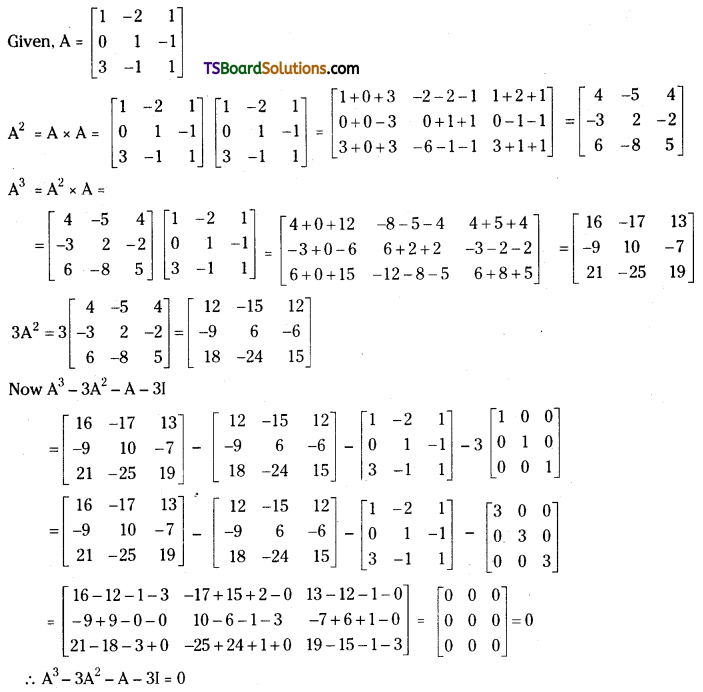
\end{array}\right]\), then find A3 – 3A2 – A – 3I, where I is unit matrix of order 3. [Mar. 19 (TS); Mar. 11, 98; May 98]
Answer:
TS Inter First Year Maths 1A Matrices Important Questions Short Answer Type 2

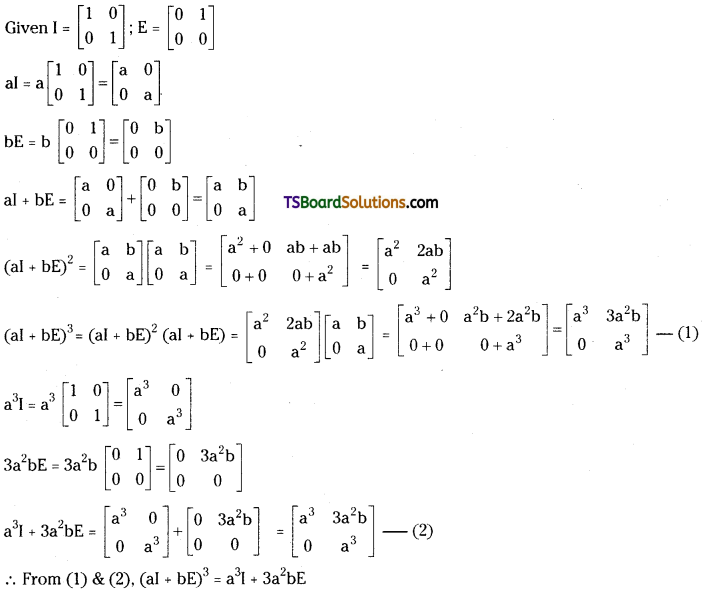
Question 3.
If I = \(\left[\begin{array}{ll}
1 & 0 \\
0 & 1
\end{array}\right]\) and E = \(\left[\begin{array}{ll}
0 & 1 \\
0 & 0
\end{array}\right]\), then show that (aI + bE)3 = a3I + 3a2bE, where I is unit matrix of order 2. [Mar. 16 (TS), 15(AP), 10; May 05]
Answer:
TS Inter First Year Maths 1A Matrices Important Questions Short Answer Type 3

TS Inter First Year Maths 1A Matrices Important Questions Short Answer Type

Question 4.
If θ – Φ = \(\frac{\pi}{2}\), then show that \(\left[\begin{array}{cc}
\cos ^2 \theta & \cos \theta \sin \theta \\
\cos \theta \sin \theta & \sin ^2 \theta
\end{array}\right]\left[\begin{array}{cc}
\cos ^2 \phi & \cos \phi \sin \phi \\
\cos \phi \sin \phi & \sin ^2 \phi
\end{array}\right]\) = 0 [May 15 (TS); May 11, 09, 96; Mar. 04]
Answer:
TS Inter First Year Maths 1A Matrices Important Questions Short Answer Type 4

Question 5.
If A = \(\left[\begin{array}{ll}
3 & -4 \\
1 & -1
\end{array}\right]\), then show that An = \(\left[\begin{array}{cc}
1+2 n & -4 n \\
n & 1-2 n
\end{array}\right]\) for any integer n ≥ 1, by using mathematical induction. [May 08, 02]
Answer:
TS Inter First Year Maths 1A Matrices Important Questions Short Answer Type 5
∴ S(k + 1) is true.
∴ By using the principle of mathematical Induction, S(n) is true for all n ∈ N.
∴ An = \(\left[\begin{array}{cc}
1+2 n & -4 n \\
n & 1-2 n
\end{array}\right]\) ∀ n ∈ N.

TS Inter First Year Maths 1A Matrices Important Questions Short Answer Type

Question 6.
For any n × n matrix A, prove that A can be uniquely expressed as a sum of a symmetric matrix and a skew symmetric matrix. (Mar. ‘03)
Answer:
Let A be a square matrix.
TS Inter First Year Maths 1A Matrices Important Questions Short Answer Type 6
∴ A can be expressed as a sum of a symmetric matrix and a skew symmetric matrix.

Question 7.
Show that \(\left|\begin{array}{ccc}
\mathbf{1} & \mathbf{a} & \mathbf{a}^2 \\
\mathbf{1} & \mathbf{b} & \mathbf{b}^2 \\
\mathbf{1} & \mathbf{c} & \mathbf{c}^2
\end{array}\right|\) = (a – b) (b – c) (c – a). [Mar. 17 (TS). 05]
Answer:
TS Inter First Year Maths 1A Matrices Important Questions Short Answer Type 7
= (a – b) (b – c) (c – a) [0(c2 – c) – 1(0 – 1) + (a + b) (0 – 0)]
= (a – b) (b – c) (c – a) (1) = (a – b) (b – c) (c – a) = RHS

Question 8.
Show that \(\left|\begin{array}{lll}
b c & b+c & 1 \\
c a & c+a & 1 \\
a b & a+b & 1
\end{array}\right|\) = (a – b) (b – c) (c – a). [Board Paper]
Answer:
TS Inter First Year Maths 1A Matrices Important Questions Short Answer Type 8
= (a – b) (c – a) [b (1 – 0) – 1 (c – 0) + 0 (ac + bc – ab)]
= (a – b) (c – a) [b – c] = (a – b) (b – c) (c – a) = R.H.S.

TS Inter First Year Maths 1A Matrices Important Questions Short Answer Type

Question 9.
Show that \(\left|\begin{array}{ccc}
b+c & c+a & a+b \\
a+b & b+c & c+a \\
a & b & c
\end{array}\right|\) = a3 + b3 + c3 – 3abc. [May 13, 07; Mar. 08]
Answer:
TS Inter First Year Maths 1A Matrices Important Questions Short Answer Type 9
= (a + b + c) [c2 – bc – ac + ab + a2 – 2ab + b2]
= (a + b + c) [a2 + b2 + c2 – ab – bc – ca]
= a3 + b3 + c3 – 3abc

Question 10.
If \(\left|\begin{array}{ccc}
a & a^2 & 1+a^3 \\
b & b^2 & 1+b^3 \\
c & c^2 & 1+c^3
\end{array}\right|\) = 0 and \(\left|\begin{array}{lll}
a & a^2 & 1 \\
b & b^2 & 1 \\
c & c^2 & 1
\end{array}\right|\) ≠ 0 then show that abc = – 1. [Mar. 14, 04; May. 98, 95]
Answer:
TS Inter First Year Maths 1A Matrices Important Questions Short Answer Type 10

TS Inter First Year Maths 1A Matrices Important Questions Short Answer Type

Question 11.
Show that \(\left|\begin{array}{lll}
a-b & b-c & c-a \\
b-c & c-a & a-b \\
c-a & a-b & b-c
\end{array}\right|\) = 0. [May. 08]
Answer:
TS Inter First Year Maths 1A Matrices Important Questions Short Answer Type 11

Question 12.
Let A and B be invertiable matrices then show that (AB)-1 = B-1 A-1. [May. 03]
Answer:
A is invertible matrix then A-1 exists and AA-1 = A-1 A = I
B is an invertible matrix then B-1 exists and BB-1 = B-1B = I
Now (AB) (B-1 A-1) = A(BB-1)A-1 = A(T)A-1 = AA-1 = I
∴ (AB) (B-1 A-1) = I ………………… (1)
(B-1 A-1) (AB) = B-1 (A-1 A) B = B-1 (I) B = B-1 B = 1
∴ (B-1 A-1) (AB) = I ………………….. (2)
From (1) & (2)
(AB) (B-1 A-1) = (B-1 A-1) (AB) = I
AB is invertiable and (AB)-1 = B-1 A-1.

Question 13.
Find the adjoint and the inverse of the matrix A = \(\left[\begin{array}{lll}
1 & 3 & 3 \\
1 & 4 & 3 \\
1 & 3 & 4
\end{array}\right]\) [May 14; Mar. 08]
Answer:
Given A = \(\left[\begin{array}{lll}
1 & 3 & 3 \\
1 & 4 & 3 \\
1 & 3 & 4
\end{array}\right]\)
Cofactor of 1 is A11 = +(16 – 9) = 7
Cofactor of 3 is A12 = – (4 – 3) = – 1
Cofactor of 3 is A13 = (3 – 4) = – 1
Cofactor of 1 is B11 = – (12 – 9) = -3
Cofactor of 4 is B12 = (4 – 3) = 1
Cofactor of 3 is B13 = – (3 – 3) = 0
Cofactor of 1 is C11 = (9 – 12) = – 3
Cofactor of 3 is C12 = – (3 – 3) = 0
Cot actor of 4 is C13 = (4 – 3) = 1
∴ Cofactor matrix,
TS Inter First Year Maths 1A Matrices Important Questions Short Answer Type 12
Now, det A = 1(16 – 9) – 3(4 – 3) + 3 (3 – 4)
= 1(7) – 3(1) + 3(- 1) = 7 – 3 – 3 = 1
Hence A is invertiable.
A-1
TS Inter First Year Maths 1A Matrices Important Questions Short Answer Type 13

TS Inter First Year Maths 1A Matrices Important Questions Short Answer Type

Question 14.
Show that A = \(\left[\begin{array}{lll}
1 & 2 & 1 \\
3 & 2 & 3 \\
1 & 1 & 2
\end{array}\right]\) is non-singular and find A-1. [Mar. 17 (TS). 12, 98; May 89]
Answer:
Given A = \(\left[\begin{array}{lll}
1 & 2 & 1 \\
3 & 2 & 3 \\
1 & 1 & 2
\end{array}\right]\)
det A = 1 (4 – 3) – 2 (6 – 3) + 1 (3 – 2)
= 1 – 6 + 1 = – 4 ≠ 0
∴ A is a non-singular matrix.
Cofactor of 1 is A1 = + (4 – 3) = 1
Cofactor of 2 is B1 = – (6 – 3) = – 3
Cofactor of 1 is C1 =+(3 – 2) = 1
Cofactor of 3 is A2 = – (4 – 1) = – 3
Cofactor of 2 is B2 = + (2 – 1) = 1
Cofactor of 3 is C2 = – (1 – 2) = + 1
Cofactor of 1 is A3 = + (6 – 2) = 4
Cofactor of 1 is B3 = – (3 – 3) = 0
Cofactor of 2 is C3 = + (2 – 6) = – 4
∴ Cofactor matrix of A is B
TS Inter First Year Maths 1A Matrices Important Questions Short Answer Type 14

Find the adjoint and the inverse of the matrix \(\left[\begin{array}{lll}
1 & 0 & 2 \\
2 & 1 & 0 \\
3 & 2 & 1
\end{array}\right]\). [Mar. 05; May 98]
Answer:
TS Inter First Year Maths 1A Matrices Important Questions Short Answer Type 15

Find the adjoint and the inverse of the matrix \(\left[\begin{array}{lll}
2 & 1 & 2 \\
1 & 0 & 1 \\
2 & 2 & 1
\end{array}\right]\). [Mar. 08, 89]
Answer:
\(\left[\begin{array}{rrr}
-2 & 3 & 1 \\
1 & -2 & 0 \\
2 & -2 & -1
\end{array}\right],\left[\begin{array}{rrr}
-2 & 3 & 1 \\
1 & -2 & 0 \\
2 & -2 & -1
\end{array}\right]\)

TS Inter First Year Maths 1A Matrices Important Questions Short Answer Type

Question 15.
If A = \(\left[\begin{array}{rrr}
-1 & -2 & -2 \\
2 & 1 & -2 \\
2 & -2 & 1
\end{array}\right]\), then show that the adjoint of A is 3A’. Find A-1. [Mar. 19 (AP), May 08]
Answer:
Given A = \(\left[\begin{array}{rrr}
-1 & -2 & -2 \\
2 & 1 & -2 \\
2 & -2 & 1
\end{array}\right]\)

Cofactor of – 1 is A1 = + (1 – 4) = – 3
Cofactor of – 2 is B1 = – (2 + 4) = – 6
Cofactor of – 2 is C1 = + (- 4 – 2) = – 6
Cofactor of 2 is A2 = – (- 2 – 4) = 6
Cofactor of 1 is B2 = + (- 1 + 4) = 3
Cofactor of – 2 is C2 = – (2 + 4) = – 6
Cofactor of 2 is A3 = + (4 + 2) = 6
Cofactor of – 2 is B3 = – (2 + 4) = – 6
Cofactor of 1 is C3 = + (- 1 + 4) = 3
∴ Cofactor matrix of
TS Inter First Year Maths 1A Matrices Important Questions Short Answer Type 16
∴ Adj A = 3A’
det A = – 1 (1 – 4) + 2 (2 + 4) – 2 (- 4 – 2)
= – 1 (- 3) + 2(6) – 2 (- 6) = + 3 + 12 + 12 = 27 ≠ 0
∴ A is invertiable.
A-1 = \(\frac{{adj} A}{{det} A}=\frac{1}{27}\left[\begin{array}{ccc}
-3 & 6 & 6 \\
-6 & 3 & -6 \\
-6 & -6 & 3
\end{array}\right]\)

Question 16.
If abc ≠ 0, find the inverse of \(\left[\begin{array}{lll}
a & 0 & 0 \\
0 & b & 0 \\
0 & 0 & c
\end{array}\right]\). [Mar. 06; Oct. 96]
Answer:
Let A = \(\left[\begin{array}{lll}
a & 0 & 0 \\
0 & b & 0 \\
0 & 0 & c
\end{array}\right]\)
Cofactor of a is A1 + (bc – 0) = bc
Cofactor of 0 is B1 = – (0 – 0) = 0
Cofactor of 0 is C1 = + (0 – 0) = 0
Cofactor of 0 is A2 = – (0 – 0) = 0
Cofactor of b is B2 = + (ac – 0) = ac
Cofactor of 0 is C2 = – (0 – 0) = 0
Cofactor of 0 is A3 = + (0 – 0) = 0
Cofactor of 0 is B3 = – (0 – 0) = 0
Cofactor of c is C3 = + (ab – 0) = ab
∴ Cofactor matrix of
TS Inter First Year Maths 1A Matrices Important Questions Short Answer Type 17

TS Inter First Year Maths 1A Matrices Important Questions Short Answer Type

Question 17.
If 3A = \(\left[\begin{array}{rrr}
1 & 2 & 2 \\
2 & 1 & -2 \\
-2 & 2 & -1
\end{array}\right]\), then show that A-1 = A’. [Mar. 14, 09; May. 12]
Answer:
TS Inter First Year Maths 1A Matrices Important Questions Short Answer Type 18

Question 18.
If A = \(\left[\begin{array}{ccc}
1 & -2 & 3 \\
0 & -1 & 4 \\
-2 & 2 & 1
\end{array}\right]\), then find (A’)-1. [Board Paper]
Answer:
Given A = \(\left[\begin{array}{ccc}
1 & -2 & 3 \\
0 & -1 & 4 \\
-2 & 2 & 1
\end{array}\right]\)
Cofactor of 1 is A1 = + (- 1 – 8) = – 9
Cofactor of 0 is A2 = – (- 2 – 6) = 8
Cofactor of – 2 is A3 = (- 8 + 3) = – 5
Cofactor of – 2 is B1 = – (0 + 8) = – 8
Cot actor of – 1 is B2 = + (1 + 6) = 7
Cofactor of 2 is B3 = – (4 – 0) = – 4
Cofactor of 3 is C1 = + (0 – 2) = – 2
Cofactor of 4 is C2 = – (2 – 4) = 2
Cofactor of 1 is C3 = (- 1 + 0) = – 1
TS Inter First Year Maths 1A Matrices Important Questions Short Answer Type 19

TS Inter 1st Year English Grammar Syllables

Telangana TSBIE TS Inter 1st Year English Study Material Grammar Syllables Exercise Questions and Answers.

TS Inter 1st Year English Grammar Syllables

Q.No. 19 (4 × 1 = 4 Marks)

A syllable is the next higher unit to a speech sound and forms a word or part of a word. It contains one (and only one) vowel sound (not letter). The number of consonant sounds in a syllable may be ‘Zero to Seven’.

A word may have one syllable or more.

  • Words with one syllable each are called monosyllabic words.
  • Words with two syllables each are called disyllabic words.
  • Words with three syllables each are called trisyllabic words.
  • Words with more than three syllables each are called polysyllabic words.

The, number of vowel sounds in a word gives us the number of syllables in that word. By noticing the vowel symbols in the phonetic transcript of a given word, we can arrive at the number of syllables in that word. Look at the following examples :

pen / pen only one vowel sound – one syllable – monosyllabic paper / peips (r) / two vowel sounds – two syllables – disyllabic gravity / graeviti / three vowel sounds – three syllables – trisyllabic.

discovery / dɪˈskʌvɚɹi / four vowel sounds – four syllables – poly (tetra) syllabic, organization / ˌɔːrɡənəˈzeɪʃən / five vowel sounds – five syllables – poly (penta) syllabic.

TS Inter 1st Year English Grammar Syllables

There are, however, certain words in which the number of vowel sounds is not equal to the number of syllables. Look at the following examples :
brittle / ˈbɹɪtl̩ / only ong vowel sound – but two syllables
prism / pnzm / only one vowel sound – but two syllables
mutton / mAtn / only one vowel sound – but two syllables

The reason for this variation is that the consonant sounds / l /, / m / and / n / help form a syllable. These sounds in such words are, therefore, called syllabic consonants.
Examine some more examples of this kind :
TS Inter 1st Year English Grammar Syllables 1
Careful observation of phonetic transcription or correct pronunciation of words will help students find out the number of syllables in a given word.

Exercise – A

In the following table four categories of words are given. Read them aloud paying attention to the syllabic division.

S.No.Words with one syllableWords with two syllablesWords with three syllablesWords with four or more syllables
1.lifeen-gagete-le-phonein-sti-tu-tion
2.pensuf-ferpo-ta-toclas-si-fi-cation
3.twoteach-erba-che-lore-du-ca-tion
4.trymat-teram-bu-lancecom-pe-ti-tion
5.hatspi-derin-va-lidmath-e-ma-tics
6.quiteto-daycom-pu-tercon-gra-tu-late
7.lightan-swercon-tem-platein-tel-li-gence
8.flyeng-lishde-scrip-tiveci-vi-li-za-tion
9.fewfa-therre-pre-senthe-li-co-pter
10.betdon-keyre-mem-berob-serv-a-to-ry

TS Inter 1st Year English Grammar Syllables

Exercise – B

Read the words in the table and write the number of syllables in the columns. Look up the words in a dictionary to check your answers. The first one has been done for you.

WordNumber of SyllablesWordNumber of SyllablesWordNumber of Syllables
Sunday2apology4examine3
question2history3bun1
fixation3manager3student2
college2paper2instrumental4
grammar2but1monday2
immoral3glass1doctor2
time1policy3intelligent4
feather2food1example3
near1present2bright1
go1phone1syllabus3
ugly2property3agitation4
create2persistent3criticism3
application4ant1resolution4
complain2particular4mother2
cricketer3bachelor3beautiful3
sorry2anaesthesia5discussion3
fate1honour2fan1
employee3amplification5fight1

Mention the number of syllables in the following words.

Exercise – 1

i) misery
ii) direction
iii) remember
iv) information
v) encourage
vi) excellent
Answer:
i) 3 trisyllabic
ii) 3 – trisyllabic
iii) 3 – trisyllabic
iv) 4 – polysyllabic
v) 3 – trisyllabic
vi) 3 – trisyllabic

TS Inter 1st Year English Grammar Syllables

Exercise – 2

i) person
ii) weakness
iii) dark
iv) thought
v) fact
vi) discipline
Answer:
i) 2 – disyllabic
ii) 2 – disyllabic
iii) 1 – monosyllabic
iv) 1 – monosyllabic
v) 1 – monosyllabic
vi) 3 – trisyllabic

Exercise – 3

i) lawyer
ii) literacy
iii) square
iv) harbinger
v) adamant
vi) muse
Answer:
i) 2 – disyllabic
ii) 4 – polysyllabic
iii) 1 – monosyllabic
iv) 3 – trisyllabic
v) 3 – trisyllabic
vi) 1 – monosyllabic

TS Inter 1st Year English Grammar Syllables

Exercise – 4

i) before
ii) doctor
iii) mother
iv) imagination
v) essence
vi) quarter
Answer:
i) 2 – disyllabic
ii) 2 – disyllabic
iii) 2 – disyllabic
iv) 5 – polysyllabic
v) 2 – disyllabic
vi) 2 – disyllabic

Exercise – 5

i) glance
ii) propel
iii) silence
iv) realize
v) excitement
vi) climax
Answers:
i) 1 – monosyllabic
ii) 2 – dissyllabic
iii) 2 – disyllabic
iv) 2 – disyllabic / 3 – tnsyllabic
v) 3 – trisyllabic
vi) 2 – disyllabic

TS Inter 1st Year English Grammar Syllables

Exercise – 6

i) understand
ii) decision
iii) shout
iv) supremely
v) encouragement
vi) flashlight
Answer:
i) 3 – trisyllabic
ii) 3 – trisyllabic
iii) 1 – monosyllabic
iv) 3 – trisyllabic
v) 4 – polysyllabic
vi) 2 – disyllabic

Exercise – 7

i) pension
ii) source
iii) confer
iv) captivate
v) modest
vi) contribution
Answer:
i) 2 – disyllabic
ii) 1 – monosyllabic
iii) 2 – disyllabic
iv) 3 – trisyllabic
v) 2 – disyllabic
vi) 4 – polysyllabic

TS Inter 1st Year English Grammar Syllables

Exercise – 8

1) popular
ii) today
iii) side
iv) plant
v) rainwater
vi) condition
Answer:
i) 3 – trisyllabic
ii) 2 – disyllabic
iii) 1 – monosyllabic
iv) 1 – monosyllabic
v) 3 – trisyllabic
vi) 3- trisyllabic

Exercise – 9

i) punctual
ii) increase
iii) room
iv) mantelpiece
v) breakfast
vi) gracious
Answer:
i) 2 – disyllabic
ii) 2 – disyllabic
iii) 1 – monosyllabic
iv) 3 – trisyllabic
v) 2 – disyllabic
vi) 2 – disyllabic

TS Inter 1st Year English Grammar Syllables

Exercise – 10

i) particular
ii) handful
iii) apearance
iv) often
v) apartment
vi) idea
Answer:
i) 4 – polysyllabic
ii) 2 – disyllabic
iii) 3 – trisyllabic
iv) 2 – disyllabic
v) 3 – trisyllabic
vi) 2 – disyllabic

TS Inter 1st Year Maths 1A Product of Vectors Important Questions Short Answer Type

Students must practice these Maths 1A Important Questions TS Inter 1st Year Maths 1A Product of Vectors Important Questions Short Answer Type to help strengthen their preparations for exams.

TS Inter 1st Year Maths 1A Product of Vectors Important Questions Short Answer Type

Question 1.
Prove that angle in a semi-circle is a right angle by using vector method. [MAR ’13, ’08, ’99]
Answer:
Let AB be a diameter of a circle with centre O.
Let OA = a, then OB = -a
Let P be a point on the circle and OP = r
OA = OB = OP
TS Inter First Year Maths 1A Product of Vectors Important Questions Short Answer Type 1
TS Inter First Year Maths 1A Product of Vectors Important Questions Short Answer Type 2
∠APB = 90°
∴ Angle in a semicircle is 90°.

Question 2.
If P, Q, R and S are points whose position vectors are i̅ – k̅, -i̅ + 2j̅, 2i̅ – 3k̅ and 3i̅ – 2j̅ – k̅ respectively, then find the component of RS on PQ. [Mar. ’98]
Answer:
The position vectors of the points P, Q, R and S with respect to the origin ‘O’ are
\(\overline{\mathrm{OP}}\) = i̅ – k̅,
\(\overline{\mathrm{OQ}}\) = -i̅ + 2j̅,
\(\overline{\mathrm{OR}}\) = 2i̅ – 3k̅,
\(\overline{\mathrm{OS}}\) = 3i̅ – 2j̅ – k̅
Now \(\overline{\mathrm{PQ}}=\overline{\mathrm{OQ}}-\overline{\mathrm{OP}}\) = -i̅ + 2j̅ -i̅ + k̅ = -2i̅ + 2j̅ + k̅
\(\overline{\mathrm{RS}}=\overline{\mathrm{OS}}-\overline{\mathrm{OR}}\) = 3i̅ – 2j̅ – k̅ – 2i̅ + 3k̅ = i̅ – 2j̅ + 2k̅
TS Inter First Year Maths 1A Product of Vectors Important Questions Short Answer Type 3

Question 3.
Prove that the angle ‘θ’ between any two diagonals of cube is given by cos θ = \(\frac{1}{3}\). [Mar ’12, ’11, ’10; Mar. ’10]
Answer:
Let \(\overline{\mathrm{OA}}\) = i̅, \(\overline{\mathrm{Ob}}\) = j̅ ,\(\overline{\mathrm{Oc}}\) = k̅
Let OA = OB = OC = 1 unit
In a cube, diagonals are OF, CD, BG, AE
TS Inter First Year Maths 1A Product of Vectors Important Questions Short Answer Type 4
TS Inter First Year Maths 1A Product of Vectors Important Questions Short Answer Type 5

TS Inter First Year Maths 1A Product of Vectors Important Questions Short Answer Type

Question 4.
Show that the points (5, – 1, 1), (7, – 4, 7), (1, – 6, 10) and (- 1, – 3, 4) are the vertices of a rhombus by vectors. [Mar. ’13]
Answer:
Let A(5, – 1, 1), B(7, – 4, 7), C(1, – 6, 10) and D(- 1, – 3, 4) are the given points.
TS Inter First Year Maths 1A Product of Vectors Important Questions Short Answer Type 6
∴ AB = BC = CD = DA = 7 units and AC ≠ BD.
∴ A, B, C, D are the points which are the vertices of a rhombus.

Question 5.
Find the area of the triangle whose vertices are A(1, 2, 3), B(2,3, 1) and C(3,1, 2). [Mar. ’14, ’06]
Answer:
Let the position vectors of A, B, C with respect to the origin are
\(\overline{\mathrm{OA}}\) = i̅ + 2j̅ + 3k̅, \(\overline{\mathrm{OB}}\) = 2i̅ + 3j̅ + k̅, \(\overline{\mathrm{OC}}\) = 3i̅ + j̅ + 2k̅
\(\overline{\mathrm{AB}}=\overline{\mathrm{OB}}-\overline{\mathrm{OA}}\) = 2i̅ + 3j̅ + k̅ – i̅ – 2j̅ – 3k̅ = i̅ + j̅ – 2k̅
\(\overline{\mathrm{AC}}=\overline{\mathrm{OC}}-\overline{\mathrm{OA}}\) = 3i̅ + j̅ + 2k̅ – i̅ – 2j̅ – 3k̅ = 2i̅ – j̅ – k̅

\(\overline{\mathrm{AB}} \times \overline{\mathrm{AC}}\) = \(\left|\begin{array}{ccc}
\overline{\mathbf{i}} & \overline{\mathrm{j}} & \overline{\mathrm{k}} \\
1 & 1 & -2 \\
2 & -1 & -1
\end{array}\right|\)
= i̅(-1 -2) – j̅(-1 + 4) + k̅(-1-2) = -3i̅ -3j̅ – 3k̅
TS Inter First Year Maths 1A Product of Vectors Important Questions Short Answer Type 7
∴ The area of triangle whose vertices are A, B, C is \(\frac{1}{2}|\overline{\mathrm{AB}} \times \overline{\mathrm{AC}}|\) = \(\frac{3 \sqrt{3}}{2}\)

Question 6.
If a̅ + b̅ + c̅ = 0, then prove that a̅ × b̅ = b̅ × c̅ = c̅ × a̅. [Mar. ’03; May ’98]
Answer:
Given a̅ + b̅ + c̅ = 0
⇒ a̅ = -b̅ – c̅
⇒ a̅ × b̅ = (-b̅ – c̅) × b̅
= -(b̅ × b̅) – (c̅ × c̅)
= -0 + b̅ × c̅

= a̅ × b̅ = b̅ × c̅ ………………(1)
⇒ a̅ + b̅ + c̅ = 0
b̅ = -a̅ – c̅

⇒ b̅ × c̅ = (-a̅ – c̅) × c̅ =-(a̅ × c̅) – (c̅ × b̅) = c̅ × a̅ – 0
b̅ × c̅ = c̅ × a̅ ……………………..(2)
From (1) & (2) ⇒ a̅ × b̅ = b̅ × c̅ = c̅ × a̅

Question 7.
Find the unit vector perpendicular to the plane passing through the points (1, 2, 3), (2,-1,1) and (1,2,-4). [Mar. ’17(AP) ’05; May ’10]
Answer:
Let the position vectors of the points A, B, C with respect to the origin ‘O’ are
\(\overline{\mathrm{OA}}\) = i̅ + 2 j̅ + 3k̅; \(\overline{\mathrm{OB}}\) = 2 i̅ – j̅ + k̅; \(\overline{\mathrm{OC}}\) = i̅ + 2 j̅ – 4k̅
\(\overline{\mathrm{AB}}=\overline{\mathrm{OB}}-\overline{\mathrm{OA}}\) = 2i̅ – j̅ + k̅ – i̅ – 2j̅ – 3k̅ = i̅ – 3 j̅ – 2k̅
\(\overline{\mathrm{AB}}=\overline{\mathrm{OB}}-\overline{\mathrm{OA}}\) = i̅ + 2j̅ – 4k̅ – i̅ – 2j̅ – 3k̅
TS Inter First Year Maths 1A Product of Vectors Important Questions Short Answer Type 8
The unit vector perpendicular to the plane passing through the points A, B and C is
\(\pm \frac{(\overline{\mathrm{AB}} \times \overline{\mathrm{AC}})}{|\overline{\mathrm{AB}} \times \overline{\mathrm{AC}}|}=\pm \frac{(21 \overline{\mathrm{i}}+7 \overline{\mathrm{j}})}{7 \sqrt{10}}=\pm \frac{(3 \overline{\mathrm{i}}+\overline{\mathrm{j}})}{\sqrt{10}}\)

Find a unit vector perpendicular to the plane determined by the points P(1, – 1, 2), Q(2, 0, – 1) and R (0, 2, 1).
Answer:
±\(\frac{1}{\sqrt{6}}\)(2i̅ + j̅ + k̅)

Question 8.
If a̅ = 2i̅ + 3j̅ + 4k̅, b̅ = i̅ + j̅ – k̅ and c̅ = i̅ – j̅ + k̅, then compute a̅ × (b̅ × c̅) and verify that it is perpendicular to a̅. [Mar. ’19(TS); May ’06; May ’03]
Answer:
Given vectors are a̅ = 2i̅ + 3j̅ + 4k̅, b̅ = i̅ + j̅ – k̅, c̅ = i̅ – j̅ + k̅
b̅ × c̅ = \(\left|\begin{array}{ccc}
\overline{\mathrm{i}} & \overline{\mathrm{j}} & \overline{\mathrm{k}} \\
1 & 1 & -1 \\
1 & -1 & 1
\end{array}\right|\)
= i̅(1 – 1) -j̅(1 + 1) + k̅(-1- 1) = 2i̅ – 2k̅

a̅ × (b̅ × c̅) = \(\left|\begin{array}{ccc}
\overline{\mathrm{i}} & \overline{\mathrm{j}} & \overline{\mathrm{k}} \\
2 & 3 & 4 \\
0 & -2 & -2
\end{array}\right|\)
= i̅(-6 + 8) – j̅(-4 – 0) + k̅(-4-0)
= 2i̅ + 4j̅ – 4k̅

Now [a̅ × (b̅ × c̅)].a̅ = (2i̅ + 4j̅ – 4k̅).(2i̅ + 3j̅ + 4k̅) = 4 + 12 – 16 = 0
a̅ × (b̅ × c̅) is perpendicular to a̅.

TS Inter First Year Maths 1A Product of Vectors Important Questions Short Answer Type

Question 9.
For any four vectors a, b, c and d show that (a̅ × b̅) . (c̅ × d̅) = \(\left|\begin{array}{cc}
\bar{a} \cdot \bar{c} & \bar{a} \cdot \bar{d} \\
\bar{b} \cdot \bar{c} & \bar{b} \cdot \bar{d}
\end{array}\right|\) and in particular \((\overline{\mathrm{a}} \times \overline{\mathrm{b}})^2=\overline{\mathrm{a}^2} \overline{\mathrm{b}^2}-(\overline{\mathrm{a}} \cdot \overline{\mathrm{b}})^2\). [Mar. ’02, ’00]
Answer:
LHS = (a̅ × b̅). (c̅ × d̅) = a̅. (b̅ × (c̅ × d̅)) = a̅. [(b̅. d̅) c̅ – (b̅. c̅) d̅]
= (a̅ . c̅)(b̅ . d̅) – (a̅ . d̅)(b̅ . c̅) = \(\left|\begin{array}{cc}
\bar{a} \cdot \bar{c} & \bar{a} \cdot \bar{d} \\
\bar{b} \cdot \bar{c} & \bar{b} \cdot \bar{d}
\end{array}\right|\)

In the above formula if c̅ = a̅ and d̅ = b̅, then
(a̅ × b̅) . (c̅ × d̅) = \(\left|\begin{array}{cc}
\bar{a} \cdot \bar{c} & \bar{a} \cdot \bar{d} \\
\bar{b} \cdot \bar{c} & \bar{b} \cdot \bar{d}
\end{array}\right|\) = (a̅.a̅)(b̅.b̅) – (a̅.b̅)(a̅.b̅) = \(\overline{\mathrm{a}^2} \overline{\mathrm{b}^2}-(\overline{\mathrm{a}} \cdot \overline{\mathrm{b}})^2\)

Question 10.
Let a̅, b̅ and c̅ be unit vectors such that b is not parallel to c and a̅ × (b̅ × c) = \(\frac{1}{2}\) b̅. Find the angles made by a̅ with each of b̅ and c̅. [May ’01]
Answer:
Since a̅, b̅ and c̅ be unit vectors then |a̅| = 1, |b̅| = 1, |c̅| = 1
Given a̅ × (b̅ × c̅) = -b̅
⇒ (a̅.c̅)b̅ – (a̅.b̅)c = \(\frac{1}{2}\)b̅
Since b̅ and c̅ are non-collinear vectors equating corresponding coefficients on both sides.
a̅.c̅ = \(\frac{1}{2}\)

|a||c| cos (a, c) = \(\frac{1}{2}\), -(a̅.b̅) = 0
1.1.cos(a̅, c̅) = \(\frac{1}{2}\), a̅.b̅ = 0
cos(a̅,c̅) = \(\frac{1}{2}\), a̅ ⊥ b̅
(a̅, c̅) = 60°, (a̅, b̅) = 90°

Question 11.
Let a̅ = i̅ + j̅ + k̅, b̅ = 2i̅ – j̅ + 3k̅, c = i̅ – j̅ and d̅ = 6i̅ + 2j̅ + 3k̅ . Express d̅ in terms of b̅ × c̅, c̅ × a̅ and a̅ × b̅. [May ’12]
Answer:
Given a̅ = i̅ + j̅ + k̅, b̅ = 2i̅ – j̅ + 3k̅, c̅ = i̅ – j̅, d̅ = 6i̅ + 2j̅ + 3k̅
= 1 (0 + 3) – 1 (0 – 3) + 1(-2 + 1) = 3 + 3 – 1 = 5
Now, d̅. a̅ = (6 i̅ + 2 j̅ + 3k̅). (i̅ + j̅ + k̅) = 11
d̅.b̅ = (6i̅ + 2j̅ + 3k̅).(2i̅ – j̅ + 3k̅) =19
d̅.c̅ = (6i̅ + 2j̅ + 3k̅).(i̅ – j̅) = 4
Take d̅ = x(b̅ x c̅) + y(c̅ x a̅) + z(a̅ x b̅), then we have x = \(\frac{\overline{\mathrm{d}} \cdot \overline{\mathrm{a}}}{\left[\begin{array}{lll}
\overline{\mathrm{a}} & \overline{\mathrm{b}} & \overline{\mathrm{c}}
\end{array}\right]}\), y = \(\frac{\overline{\mathrm{d}} \cdot \overline{\mathrm{b}}}{\left[\begin{array}{lll}
\overline{\mathrm{a}} & \overline{\mathrm{b}} & \overline{\mathrm{c}}
\end{array}\right]}\), z = \(\frac{\overline{\mathrm{d}} \cdot \overline{\mathrm{c}}}{\left[\begin{array}{lll}
\overline{\mathrm{a}} & \overline{\mathrm{b}} & \overline{\mathrm{c}}
\end{array}\right]}\)
∴ x = \(\frac{11}{5}\), y = \(\frac{19}{5}\), z = \(\frac{4}{5}\)
d̅ = \(\frac{11}{5}\) (3i̅ + 3j̅ – k̅) + \(\frac{19}{5}\)(-i̅ – j̅ + 2k̅) + \(\frac{4}{5}\)(4i̅ – j̅ – 3k̅)

Question 12.
For any four vectors a̅, b̅, c̅ and d̅, show that
(i) (a̅ × b̅) × (c̅ × d̅) = [a̅ c̅ d̅] b̅ – [b̅ c̅ d̅] a̅ and
(ii) (a̅ × b̅) × (c̅ × d̅) = [a̅ b̅ d̅]c̅ – [a̅ b̅ c̅]d̅. [Mar. ’18(AP); May ’99]
Answer:
(i) (a̅ × b̅) × (c̅ × d̅) = [(c̅ × d̅).a̅]b̅ – [(c̅ × d̅).b̅]a̅ = [a̅.(c̅ × d̅)]b̅ – [b̅.(c̅ × d̅)]a̅ = [a̅ c̅ d̅] b̅ – [b̅ c̅ d̅] a̅
(ii) (a̅ × b̅) × (c̅ × d̅) = [(a̅ × b̅). d̅]c̅ – [(a̅ × b̅). c̅]d̅ = [a̅ b̅ d̅]c̅ – [a̅ b̅ c̅]d̅

Question 13.
a, b, c are non-zero vectors and a is perpendicular to both b̅ and c̅. If |a̅| = 2, |b̅| = 3, |c̅| = 4 and (b̅, c̅) = \(\frac{2 \pi}{3}\), then find |[a̅ b̅ c̅]|. [May ’08]
Answer:
Given |a̅| = 2, |b̅| = 3, |c̅| = 4 and (b̅, c̅) = \(\frac{2 \pi}{3}\)
a is perpendicular to both b̅ and c̅.
Now b̅ × c̅ is a vector perpendicular to both b̅ & c̅.
a̅ is parallel to b̅ × c̅ (a̅, b̅ × c̅) = 0° or 180°

Now [a̅ b̅ c̅] = a̅. (b̅ × c̅) = |a̅| |b̅ × c̅| cos (a̅, b̅ × c̅) = |a̅| |b̅| |c̅| sin (b̅, c̅). cos (a̅, b̅ × c̅)
= 2.3.4.sin \(\frac{2 \pi}{3}\) . cos(0° or 180°) = 24. \(\frac{\sqrt{3}}{2}\)(±1) = 12√3 = |[a b c]| = 12√3

TS Inter First Year Maths 1A Product of Vectors Important Questions Short Answer Type

Question 14.
If [b̅ c̅ d̅] + [c̅ a̅ d̅] + [a̅ b̅ d̅] = [a̅ b̅ c̅], then show that the points with position vectors a̅, b̅, c̅ and d̅ are coplanar. [Mar ’14; Mar. ’00]
Answer:
Let the position vectors of the points A, B, C and D with respect to the origin O’ are \(\overline{\mathrm{OA}}\) = a, \(\overline{\mathrm{OB}}\) = b, \(\overline{\mathrm{OC}}\) = c, \(\overline{\mathrm{OD}}\) = d.
Given [b̅ c̅ d̅] + [c̅ a̅ d̅] + [a̅ b̅ d̅] = [a̅ b̅ c̅] ……………………(1)
Now \([\overline{\mathrm{AB}}  \overline{\mathrm{AC}}  \overline{\mathrm{AD}}]=[\overline{\mathrm{OB}}-\overline{\mathrm{OA}}  \overline{\mathrm{OC}}-\overline{\mathrm{OA}}  \overline{\mathrm{OD}}-\overline{\mathrm{OA}}]\)
= [b̅ – a̅ c̅ – a̅ d̅ – a̅]
= (b̅ – a̅). [(c̅ – a̅) × (d̅ – a̅)] (b̅ – a̅).[c̅ × d̅ – c̅ × a̅ – a̅ × d̅ + a̅ × a̅]
= (b̅ – a̅).[c̅ × d̅ + a̅ × c̅ + d̅ × a̅ + 0]
= b̅. (c̅ × d̅) + b̅. (a̅ × c̅) + b̅. (d̅ × a̅) – a̅ . (c̅ × d̅) – a̅. (a̅ × c̅) – a̅. (d̅ × a̅)
= [b̅ c̅ d̅] + [b̅ a̅ c̅] + [b̅ d̅ a̅] – [a̅ c̅ d̅] – [a̅ a̅ c̅] – [a̅ d̅ a̅]
= [b̅ c̅ d̅] – [a̅ b̅ c̅] – [b̅ a̅ d̅] + [c̅ a̅ d̅] – 0 – 0
= [b̅ c̅ d̅] – [a̅ b̅ c̅] + [a̅ b̅ d̅] + [c̅ a̅ d̅]
= [b̅ c̅ d̅] + [c̅ a̅ d̅] + [a̅ b̅ d̅] – [a̅ b̅ c̅]
= [a̅ b̅ c̅] – [a̅ b̅ c̅] = 0 (from (1))
∴ The vectors AB, AC, AD are coplanar.
∴ The four points A, B, C and D are coplanar.

Question 15.
Find the volume of the tetrahedron whose vertices are (1, 2, 1), (3, 2, 5), (2, – 1, 0) and (- 1, 0, 1). [Mar. ’15(TS); May ’07; Mar. ’04]
Answer:
Let the position vectors of the points A, B, C and D with respect to the origin ‘O’ are
\(\overline{\mathrm{OA}}\)= i̅ + 2j̅ + k̅, \(\overline{\mathrm{OB}}\) = 3i̅ +2j̅ +5k̅, \(\overline{\mathrm{OC}}\) = 2i̅ – j̅, \(\overline{\mathrm{OD}}\) = -i̅ + k̅
Now \(\overline{\mathrm{AB}}=\overline{\mathrm{OB}}-\overline{\mathrm{OA}}\)A
= 3i̅ + 2j̅ + 5k̅ – i̅ – 2j̅ – k̅
= 2i̅ + 4k̅

\(\overline{\mathrm{AC}}=\overline{\mathrm{OC}}-\overline{\mathrm{OA}}\)
=2i̅ – j̅ – i̅ – 2j̅ – k̅
= i̅ – 3j̅ – k̅

\(\overline{\mathrm{AD}}=\overline{\mathrm{OD}}-\overline{\mathrm{OA}}\)
= -i̅ + k̅ – i̅ – 2j̅ – k̅
= -2i̅ – 2j̅

The volume of the tetrahedron whose vertices are A, B, C and D is \(\frac{1}{6}\left[\begin{array}{lll}
\overline{\mathrm{AB}} & \overline{\mathrm{AC}} & \overline{\mathrm{AD}}
\end{array}\right]\)
\(\frac{1}{6}\left|\begin{array}{ccc}
2 & 0 & 4 \\
1 & -3 & -1 \\
-2 & -2 & 0
\end{array}\right|\)
= \(\frac{1}{6}\)|2(0 – 2) – 0(0 – 2) + 4(-2 – 6)|
= \(\frac{1}{6}\)|-4-32|
= \(\frac{36}{6}\) = 6
∴ Volume = 6 cubic units.

Question 16.
Prove that the four points 4i̅ + 5j̅ + k̅,-(j̅ + k̅), 3i̅ + 9j̅ + 4k̅ and -4i̅ + 4j̅ + 4k̅ are coplanar. [Mar. ’99]
Answer:
Let the position vectors of the points A, B, C and D with respect to the origin ‘O’ are \(\overline{\mathrm{OA}}\) = 4i̅ + 5j̅ + k̅,\(\overline{\mathrm{OB}}\) = -(j̅ + k̅), \(\overline{\mathrm{OC}}\) = 3i̅ + 9j̅ + 4k̅,\(\overline{\mathrm{OD}}\) = -4i̅ + 4j̅ + 4k̅
\(\overline{\mathrm{AB}}=\overline{\mathrm{OB}}-\overline{\mathrm{OA}}\) = -j̅ – k̅ – 4 i̅ – 5j̅ – k̅ = -4i̅ – 6j̅ – 2k̅
\(\overline{\mathrm{AC}}=\overline{\mathrm{OC}}-\overline{\mathrm{OA}}\) = 3i̅ + 9j̅ + 4k̅ – 4i̅ – 5j̅ – k̅ = -i̅ + 4j̅ + 3k̅
\(\overline{\mathrm{AD}}=\overline{\mathrm{OD}}-\overline{\mathrm{OA}}\) = – 4i̅ + 4j̅ + 4k̅ – 4i̅ – 5j̅ – k̅ = -8i̅ – j̅ + 3k̅

Now \([\overline{\mathrm{AB}} \overline{\mathrm{AC}} \overline{\mathrm{AD}}]=\left|\begin{array}{ccc}
-4 & -6 & -2 \\
-1 & 4 & 3 \\
-8 & -1 & 3
\end{array}\right|\)
= -4(15) + 6(21) – 2(33)
= -60 + 126 – 66
= 126 – 126
= 0
∴ The vectors AB, AC, AD are coplanar.
∴ The four points A, B, C and D are coplanar.

TS Inter First Year Maths 1A Product of Vectors Important Questions Short Answer Type

Question 17.
If a̅ = 2i̅ + j̅ – k̅, b̅ = – i̅ + 2j̅ – 4k̅ and c̅ = i̅ + j̅ + k̅, then find (a̅ × b̅).(b̅ × c̅). [Mar. ’19(AP); Mar. ’17(TS)]
Answer:
Given a̅ = 2 i̅ + j̅ – k̅; b̅ = – i̅ + 2j̅ – 4k̅; c̅ = i̅ + j̅ + k̅
Now a̅ × b̅ = \(\left|\begin{array}{ccc}
\overline{\mathrm{i}} & \overline{\mathrm{j}} & \overline{\mathrm{k}} \\
2 & 1 & -1 \\
-1 & 2 & -4
\end{array}\right|\)
= i̅ (-4 + 2) – j̅ (-8 – 1) + k̅ (4 + 1)
= -2i̅ + 9j̅ + 5k̅

b̅ × c̅ = \(\left|\begin{array}{ccc}
\overline{\mathrm{i}} & \overline{\mathrm{j}} & \overline{\mathrm{k}} \\
-1 & 2 & -4 \\
1 & 1 & 1
\end{array}\right|\)
= i̅ (2 + 4) – j̅ (-1 + 4) + k̅ (-1 – 2)
= 6i̅ – 3j̅ – 3k̅

(a̅ × b̅).(b̅× c̅) = (-2i̅ + 9j̅ + 5k̅ ).(6i̅ – 3j̅ – 3k̅) = -12 – 27 – 15 = -54

TS Inter 1st Year English Grammar Odd Sound Out

Telangana TSBIE TS Inter 1st Year English Study Material Grammar Odd Sound Out Exercise Questions and Answers.

TS Inter 1st Year English Grammar Odd Sound Out

Q.No. 18 (4 × 1 = 4 Marks)

A set of three words are given. One or two letters which are common in all the three words are underlined. The underlined letter stands for one sound in two of the given words and for a different sound in the other word. The word with a different sound is to be written as the response.

The pronunciation of English words is quite tricky and confusing. Some vowels and consonants are pronounced differently in different places. Learning all these varieties is necessary to master pronunciation. It is possible only with practice.

Look at the following words. Circle the word that sounds different with regards to the sound of the bold letters.
TS Inter 1st Year English Grammar Odd Sound Out 1
TS Inter 1st Year English Grammar Odd Sound Out 2
TS Inter 1st Year English Grammar Odd Sound Out 3

TS Inter 1st Year English Grammar Odd Sound Out

Circle the words that sound different with regard to the sound of the bold letters.

Exercise -1

TS Inter 1st Year English Grammar Odd Sound Out 4

Exercise – 2

TS Inter 1st Year English Grammar Odd Sound Out 5

Exercise – 3

TS Inter 1st Year English Grammar Odd Sound Out 6

TS Inter 1st Year English Grammar Odd Sound Out

Exercise – 4

TS Inter 1st Year English Grammar Odd Sound Out 7

Exercise – 5

TS Inter 1st Year English Grammar Odd Sound Out 8

TS Inter 1st Year English Grammar Odd Sound Out

Exercise – 6

TS Inter 1st Year English Grammar Odd Sound Out 9

Exercise – 7

TS Inter 1st Year English Grammar Odd Sound Out 10

Exercise – 8

TS Inter 1st Year English Grammar Odd Sound Out 11

Exercise – 9

TS Inter 1st Year English Grammar Odd Sound Out 12

TS Inter 1st Year English Grammar Odd Sound Out

Exercise – 10

TS Inter 1st Year English Grammar Odd Sound Out 13

TS Inter 1st Year English Grammar Information Transfer

Telangana TSBIE TS Inter 1st Year English Study Material Grammar Information Transfer Exercise Questions and Answers.

TS Inter 1st Year English Grammar Information Transfer

Q.No. 20 (1 × 4 = 4 Marks)

Information can be expressed through verbal (description) and non verbal (diagrams) modes. Some of the non-verbal modes are :

  1. Pie-charts,
  2. Bar graphs,
  3. Tree diagrams,
  4. Flow charts and
  5. Tables.

The process of changing a text from Verbal to Non-verbal mode or vice versa is called Information Transfer. This is a very useful and important skill for students. Acquiring this skill enables the students make notes quickly, understand various texts effectively and present ideas clearly and briefly.

Non-verbal expressions are remarkable for their brevity, clarity, simplicity, accessibility and provision for comparative, contrastive and analytical studies.

1. PIE-CHARTS

A pie-chart is a circle divided into parts. Each part represents a particular thing. And eah part is in proportion to the ratio of that thing to its total. Studying the given pie chart slowly helps one understand the information given there. Then the information can be presented in verbal mode. Once the mode of representing the given information in the form of a pie-chart is understood, verbal text can be transferred into a pie-chart.

In a pie charl; the information is presented in the form of a circle. The circle is divided into sections called sectors. The contribution of each unit in the chart is represented in percentages.

Example 1 :
The following pie chart depicts the results of a survey regarding distribution of different Blood Groups in a college.
Blood Groups in a College
TS Inter 1st Year English Grammar Information Transfer 1
From the figure we can see that 35% of the students of a college have 0 Group of Blood and these students form the largest group. The next largest group comprises students with B Group of Blood. 30% of students belong to this category. 25% of students have AB Group of Blood. Finally, we see that only 10% of students have A Group of Blood. Thus, from the piechart we can conclude that while many students have O Group of Blood. Very few have A Group.

Example 2 :
The following piechart depicts the favourite subject of students in a class. We can see from the figure that five subjects have been taken into consideration – Economics, Civics, Commerce, English and 2nd Language. Students who like Economics form the largest group. A quarter of the students of the class i.e 25% expressed preference for this subject. 20% of the students like English and the same percentage i.e 20% of the students like Commerce. Next in popularity is Civics, liked by 18% of the class. Finally, trailing closely behind Civics, comes 2nd Language, which is the favourite subject of 17% of the students.
Favourite Subjects of Students
TS Inter 1st Year English Grammar Information Transfer 2

TS Inter 1st Year English Grammar Information Transfer

Exercises and Activities

Question 1.
The following paragraph gives the information about the most widely spoken languages in India. Convert the passage into a pie chart.

Hindi is the most widely spoken language in India. The fact that 44% of Indians speak Hindi across India justifies its title as our National Language. 9% of Indians speak Bengali followed by Marathi which is spoken by 8%. Telugu comes next in the list with 7%, Tamil and Gujarati account for 6% and 5% respectively. All other languages together share the remaining percentage.
Answer:
Pie chart showing languages spoken in India
TS Inter 1st Year English Grammar Information Transfer 3
Hindi – 44%
Bengali – 9%
Marathi – 8%
Telugu – 7%
Tamil – 6%
Gujarathi – 5%
All other
languages – 21%

TS Inter 1st Year English Grammar Information Transfer

Question 2.
Read the following paragraph and convert the information into a pie chart.

There are seven continents in the world. Asia is the largest continent with an area of 30% followed by Antarctica with 28%. North America occupies 17% of the land on the earth. South America stands fourth in the list with 12% of land. Africa and Australia are the fifth and sixth largest ones with their respective shares of 6% and 5%. Europe is the last in the list which occupies 2% of the land only.
Answer:
Areas of Continents
TS Inter 1st Year English Grammar Information Transfer 4
Continents
Asia – 30%
Antarctica – 28%
North America – 17%
South America – 12%
Africa – 6%
Australia – 5%
Europe – 2%

Question 3.
Observe the pie chart given below. It contains information about the mode of transport used by students of a certain junior college. Write a small paragraph.
Mode of Transport of Students
TS Inter 1st Year English Grammar Information Transfer 5
Answer:
Mode of Transport of Students
The given pie chart presents the mode of transport used by students of a particular junior college. A major part of them 40% – use the public transport, i.e. bus. A half of the share of bus, that is 20% of them travel by autorickshaws. Two wheelers and cars carry 15% each of the students. Just 10% of them use the cleanest and the healthiest mode – walking.

TS Inter 1st Year English Grammar Information Transfer

Question 4.
The pie chart given below shows how people spend their time on smart phones. Convert the information into a paragraph.
Time spent on Smart. Phones
TS Inter 1st Year English Grammar Information Transfer 6
Answer:
Time spent on Smart Phones
Time spent on smart phones is presented in the given pie chart. The lion’s share, i.e. 35% of the time goes to games. Social networking follows games with its share of 29% of the time. Utilities Consume 20% time. The share of music and videos is 8%. Others take 5% time. News comes last with just 3% time.

2. BAR BRAPHS

A bar graph is a diagram in which values of variables are shown by the length of rectangular columns with equal width. It is another visual representation of data. It helps to compare the values presented in a group. The bars can be plotted vertically or horizontally. A vertical bar chart is sometimes called a column bar chart.

Example 1 :
Given below is the iar graph that shows the cost of certain vegetables over a period of 4 months. Let us now make a detailed analysis.

The bar graph given below shows the cost of carrots and potatoes over a period of four months – January, February, March and April. Carrots were more costly than potatoes during all the months. In January carrots cost Rs. 35 a kilo, while potatoes cost a little less, at Rs. 30 a kilo. The cost of carrots increased to Rs. 40 in February, while there was a sharp fall in the cost of potatoes.

There was a sharp rise in the cost of both the vegetables after that and in March the cost of carrots was Rs. 50 per kilo while that of potatoes was Rs. 40. In April once again there was a steep increase in the cost of carrots but the cost of potatoes remained the same as in March. Thus we observe that the cost of carrots kept increasing over the months but that of potatoes fluctuating.
COST OF VEGETABLES (in Rs per kg)
TS Inter 1st Year English Grammar Information Transfer 7

TS Inter 1st Year English Grammar Information Transfer

Example 2 :
The following bar graph represents the favourite sports of various group of students studying in a college. Students of four sections HEC, CEC, BPC and MPC were asked about their preferences in sports. The number of students in each section varied. Three sports were considered – football, cricket and kabaddi. HEC students expressed great interest in cricket. 50 out of 85 students, i.e. more than half liked cricket. Very few in that section, just 5, were fond , of football. 30 liked kabaddi.

In the CEC section, consisting of 100 students, an equal number of students, i.e. 40 liked kabaddi and cricket. 20 liked football. With regard to the science sections, cricket was more popular among BPC students. An equal number in both the sections, 30, were fond of football. The figures for kabaddi too were more or less the same. The BPC section consisted of 88 students while MPC students were 75 in number. On the whole, one can conclude that cricket is the most popular sport in the college, followed by kabaddi.
FAVOURITE SPORTS OF STUDENTS
TS Inter 1st Year English Grammar Information Transfer 8

Exercises And Activities

Question 1.
The passage below represents the data of improvement of English language skills due to Internet usage. Present it in a bar graph.

Internet plays an important role in improving Reading skills. 94% participants in this study agreed that they improved their Reading skills by using Internet while 91% opined that they improved Translation skills. Internet usage helped 87% of participants in enhancing their vocabulary skills. 80% of participants unanimously agreed that they improved their Writing skills, Speaking skills and Grammar.
Answer:
Bar Graph Showing Skills due to Internet Usage
TS Inter 1st Year English Grammar Information Transfer 9

Question 2.
The following passage shows the favourite sports of the students of a school. Represent the data in a bar graph.

Cricket is the most favourite sport of the students which is liked by 80 students. Tennis falls behind Cricket with a slight difference. It is the favourite of 75 students. Swimming and Football are liked by 40 and 45 students respectively while Badminton is the favourite of 30 students. Hockey is the least favouring sport of the students which is liked by 20 students only.
Answer:
Bar Graph Showing Favourite Sport of Students
TS Inter 1st Year English Grammar Information Transfer 10

TS Inter 1st Year English Grammar Information Transfer

Question 3.
Analyse the bar graph given below and write about it in a paragraph.
MARKS OF STUDENTS
TS Inter 1st Year English Grammar Information Transfer 11
Answer:
The bar chart presents marks of three students in three subjects. Meena scored 70 in Telugu, 65 in Maths and in English just 50. Mala scored 65 in Maths, 50 in Telugu and only 40 in English. Megha secured 70 each in English and Maths but scored 60 in Telugu.

Question 4.
The given below bar graph shows how much dietary fibre is found in certain fruits. Convert the information into a paragraph.
TS Inter 1st Year English Grammar Information Transfer 12
Answer:
Fibre Content in Fruits
The given bar graph presents the details of fibre content in various fruits. The guava stands tall with six (6) grams of dietary fibre per a serving of one cup. Next comes the pear with five (5) grams per unit. The third in the order is the apple with four (4) grams per a cup. The banana and the orange have almost the same quantity of dietary fibre – three (3) grams per cup.

TS Inter 1st Year English Grammar Information Transfer

3. TREE DIAGRAMS

A tree diagram is another way of representing information. It has a branching tree-like structure. It shows how its components are related to one another. It helps us understand the relevant information in a short time.

Example 1 :
There are three types of muscle in the human body. They are smooth, cardiac and skeletal muscles. Smooth muscles are controlled by involuntary responses. Examples of smooth muscles are muscles in the digestive tract and blood vessels. The second type of muscle is cardiac muscle. It is also an involuntary muscle. Muscles that cover the heart are examples of cardiac muscles. The third type of muscle is the skeletal muscle. It is controlled by voluntary response. All the muscles attached to the bones such as biceps, deltoid are examples of skeletal muscles.

The above paragraph can be depicted in the form of a tree diagram as follows.
TS Inter 1st Year English Grammar Information Transfer 13

Example 2 :
A man who managed a popular hotel was asked the secret of his success. He said that only when customers were happy with the dining experience would they keep returning to the hotel. Dining would be a pleasant experience only if the food served was of a high standard. Good service too was equally important. He elaborated that food should be tasty and fresh. Service should be prompt and courteous.
Given below is a tree diagram representing the man’s views.
TS Inter 1st Year English Grammar Information Transfer 14

Exercises And Activities

Question 1.
Read the following paragraph and transfer the information into a tree diagram.

The oldest musical instrument in the world is the drum, made initially in one of the three ways. First, frame drums were made by stretching the skin over bowl-shaped frames. Next, rattle drums were made by filling gourds or skins with dried grains, shells, or rocks. Finally, tubular drums were made from hollowed logs or bones covered with skins. Both frame and tubular drums were struck with the hand or with beaters to produce sounds. In contrast, rattle drums were shaken or scraped to make rhythmic sounds. For thousands of years, drums have been used to transmit messages to call soldiers to battle and make music.
Answer:
Tree Diagram showing Types of Drums
TS Inter 1st Year English Grammar Information Transfer 15

TS Inter 1st Year English Grammar Information Transfer

Question 2.
Read the following paragraph and transfer the information into a tree diagram.

There are so many species of animals that we find living on the earth. Scientists grouped these animals into different classes based on certain similarities they share. Animals are divided into vertebrates, ones with backbones and invertebrates, those without backbones. The vertebrates are basically divided into five classes. They are commonly known as mammals, birds, fish, reptiles and amphibians. Arachnids and insects are the two commonly known classes in the invertebrates group.
Answer:
Tree Diagram showing Species of Animals
TS Inter 1st Year English Grammar Information Transfer 16

Question 3.
The following tree diagram depicts the classification of Vitamins. Present the information in a paragraph.
TS Inter 1st Year English Grammar Information Transfer 17
Answer:
Classification of Vitamins
The given tree diagram presents the classification of vitamins. Vitamins are broadly of two types. They are : 1) Soluble vitamins in water and 2) Soluble in fats. Vitamin B and Vitamin C fall in the category of ‘Soluble in water’. Vitamins A, D, E and K (four) belong to the group of vitamins soluble in fat and Vitamin B is sub-divided into Bl, B2, B3, B6 and B12 (five) types.

Question 4.
Study the following tree diagram and write it in a paragraph.
TS Inter 1st Year English Grammar Information Transfer 18
Answer:
Types of Oils
The given tree diagram explains the types of oils. Based on the source, oils are of three categories. They are : 1) Oils from nuts, 2) Oils from vegetation (plants / flowers) and 3) Oils from minerals. Examples are 1) groundnut oil, 2) oils from flowers and 3) oils from the crust of the earth. Groundnut oil is used in cooking. Oils from flowers go into the making of soap, medicines and perfumes (scents). Mineral oil fuels machines and automobiles.

TS Inter 1st Year English Grammar Information Transfer

4. FLOW CHARTS

We draw flow charts when we present information in the form of a process. For instance, we construct flow charts to put the information of the industrial production from raw product to finished product in a logical order in successive steps. Flow charts are simple to construct and easy to understand. Each step in the sequence is written in a diagram shape. These successive stages or steps are linked by connecting directional arrows. They guide readers to understand flow charts logically and follow the process from beginning to end. In these flow charts we find elongated circles, rectangles and diamond shaped diagrams.

Example 1 :
Describe how the following passage is presented in a flow chart. The passage shows the time table for children in a boarding school. You are supposed to wake up at 5 am every day and lights – out time is 9.30 pm. Siesta time is between 1 and 2 in the afternoon. Assembly begins at 8 am sharp in the school hall. You have to report to your House Prefect by 7.30 am on all school days. You may play any game between 4 and 6 pm. You must not be late for study time which is between 6 and 8 in the evening. School timings are from 8.30 am to 3.30 pm with an hour-long lunch break at 1 pm. These details are shown in a flow chart.

Time table of children in a boarding school
TS Inter 1st Year English Grammar Information Transfer 19

TS Inter 1st Year English Grammar Information Transfer

Example 2 :
Read the following paragraph and transfer the information into a flow chart.

Rayon is a man-made fiber. It is a reconstituted natural fiber – cellulose. Rayon is made by dissolving cellulose in a solution of sodium hydroxide or caustic soda. The cellulose is obtained from shredded wood pulp. The dissolved cellulose is formed into threads by forcing it through a spinneret in a dilute sulphuric acid setting bath. The threads are drawn from the setting bath, wound on a reel, washed, dried on a heated roller, and finally wound onto a bobbin.

Process of Making Rayon
TS Inter 1st Year English Grammar Information Transfer 20

Exercises And Activities

Question 1.
The following paragraph describes how clothes are washed.

Draw a flow chart based on the information given. First, fill a bucket half full with water. Then, add a spoonful of washing powder. Stir vigorously till the power mixes with water and forms foam. Put the unwashed clothes into it. Wait for fifteen minutes. Take out clothes and scrub with a brush to remove stains. Now, rinse the clothes with clean water.

Wring out the clothes gently by twisting and compressing them. This removes excess water from the clothes. This saves the time of drying. Now dry the washed clothes by putting them on the clothes line. Collect the washed and dried clothes later.
Answer:
How to wash clothes ?
TS Inter 1st Year English Grammar Information Transfer 21

Question 2.
Convert the following paragraph into a flow chart.

Silver occurs in the ores of several metals. The frothing process of extracting silver accounts for about 75% of all silver recovered. Here the ore is ground to a powder, placed in large vats containing a water suspension of frothing agents, and thoroughly agitated by air jets. Depending on the agents used, either the silver-bearing ore or the gangue adhering to the bubbles of the foam is skimmed off and washed. The final refining is done using electrolysis.
Answer:
Flow Chart depicting Frothing Process of Extracting Silver
TS Inter 1st Year English Grammar Information Transfer 22

TS Inter 1st Year English Grammar Information Transfer

Question 3.
The following flow chart describes how paper is manufactured in a paper mill. Write the details in a paragraph.
Manufacture of paper
TS Inter 1st Year English Grammar Information Transfer 23
Answer:
The given flow chart describes the process of manufacturing paper. First, the raw materials like wood, grass, bamboo and rags are procured. Secondly they are cut into pieces, immersed in water and made into pulp. Then the pulp is mixed with lime for whitening. Later, the pulp is boiled and passed through wire meshes. At this stage, we obtain wet paper. Finally, it is passed over heated rollers. Then we get the end product, in the form of thin sheets of paper.

Question 4.
Draw a flow chart based on the information given below.

The following process is the description of how a post office transfers a letter from a sender to a receiver. First, the sender posts the letter in a post box. Next, the box is opened. Then the contents in it are sorted out. Then they are kept in a bag and the bag is tied. The destination is written on the bag. The bags are sent to the district post office. The district post office sends the bags to the destination village / town post offices. The destination post office receives the letters. The received letters are arranged and sorted out. The post man delivers the letters to the addressees.
Answer:
Flow Chart depicting the Process of Delivering Letters
TS Inter 1st Year English Grammar Information Transfer 24

TS Inter 1st Year English Grammar Information Transfer

5. TABLES

We can also represent information in the form of a table.
Example 1 :
Given below are the marks secured by Aravind, Akash and Ramesh in their half-yearly examinations of class X.

Name of the SubjectAravindAkashRamesh
Telugu818081
Hindi979797
English608899
Mathematics9997100
Science689198
Social Studies959893

After reading the information given in the table we can write a paragraph like this.

In this table, the marks secured by 3 students are compared. While all the three students scored equal marks in Hindi, there is a slight variation of marks in Mathematics and Social Studies. However, there is a great variation of marks in English. From the table it can be concluded that Aravind needs to concentrate more on English and Science, whereas Akash needs to focus on Telugu and English. Ramesh, who scored the highest marks among the three, needs to focus on Telugu.

Example 2 :
The following table shows the number of gold medals won by 8 participating countries in the XII South Asian games 2016. First read the data given in the table.

RankNationNo. of gold medals won
1India188
2Sri Lanka25
3Pakistan12
4Afghanistan7
5Bangladesh4
6Nepal3
7Maldives0
8Bhutan0


TS Inter 1st Year English Grammar Information Transfer

Now read the paragraph given below.

The above table gives the information of the number of gold medals won by 8 participating countries in the XII South Asian games 2016. India secured the first rank with 188 gold metals. It was far ahead of the other countries. Sri Lanka was ranked 2, securing only 25 gold medals. Pakistan got only 12 gold medals and was ranked 3. With 7 golds, Afghanistan is in the 4th place. Bangladesh won 4 golds while Nepal secured just 3 golds. Maldives and Bhutan which stood at the bottom of the table got no gold medals. This table shows the commendable performance of India in the XII South Asian Games.

Exercises And Activities

Question 1.
Read the following paragraph and transfer the information into a table.

A reading test assesses reading comprehension by employing multiple testing techniques, represented by eight main types of questions. Question types, such as Multiple-Choice, Matching, Diagram Labelling, Summary Completion, Sentence Completion, Short Answer Questions with percentage, i.e., 37.50%, 18.13%, 16.25%, 10%, 9.36%, and 8.76%, take place respectively. The number of questions for each of these questions types is variable. Basic English grammar, cloze summary, percentages are although with lower portions and are also considered in the reading test.
Answer:
Table Showing Types of Questions in Reading & Tests

S.No.Type of QuestionsPercentage
1.Multiple-Choice37.50
2.Matching18.13
3.Diagram Labelling16.25
4.Summary Completion10.00
5.Sentence Completion09.36
6.Short Answer Questions08.76
7.Basic English GrammarNegligible
8.Cloze SummaryNegligible

TS Inter 1st Year English Grammar Information Transfer

Question 2.
Convert the following paragraph into a table.

There are many elements in the earth’s crust. Oxygen occupies 46%; Silicon 28%; Aluminum 8%; Iron 5%; Calcium 3.6%; Sodium 2.8%; Potassium 2.6%; Magnesium 2%; certain other elements occupy 2% of the earth’s crust. This is what we mean by the abundance of elements in the earth’s crust.
Answer:
Table Showing Elements in Earth’s Crust

Sl.No.Name of the ElementPercentage
1.Oxygen46
2.Silicon28
3.Aluminum08
4.Iron05
5.Calcium3.6
6.Sodium2.8
7.Potassium2.6
8.Magnesium02
9.Other elements02

Question 3.
Study the table below showing a few Asian countries with their capitals and currencies. Write a paragraph containing all the information in the table.

CountryCapitalCurrency
AfghanistanKabulAfgani
China       ‘BeijingYuan
JapanTokyoYen
Saudi ArabiaRiyadhRiyal
SingaporeSingaporeSingapore dollar

Answer:
The table presents the capitals and their currencies of 5 Asian countries. Kabul is the capital of Afghanistan and their currency is Afgani. China’s capital is Beijing and their currency is Yuan. With Yen as their currency Japan administers the country from Tokyo, the capital city. Saudi Arabia’s capital is Riyadh and their currency is Riyal. Finally Singapore has as its capital Singapore city and their currency is Singapore dollar.

TS Inter 1st Year English Grammar Information Transfer

Question 4.
Look at the following table. It gives information about nutrients (in gms) present in 100 ml. of milk. Present the information in the form of a paragraph.

Nutrition information about MilkPer 100 ml approximately
Energy (kcal)78.0
Fat (g)5.0
Carbohydrates (g)4.4
As sugar (g)0.0
Protein (g)2.3
Calcium (mg)8.9
Minerals (g)0.8

Note : k stands for thousand; g stands grammes.
Answer:
The given table provides us information about tire nutrition value of milk. 100 ml of milk gives us 78 kcals of energy. Fat is 5.0 gms. Carbohydrates are 4.4 gms. Sugar Nil. Proteins 2.3 gms. Calcium 8.9 mg. and Minerals 0.8 grams.

TS Inter 1st Year Physics Study Material Chapter 12 Thermal Properties of Matter

Telangana TSBIE TS Inter 1st Year Physics Study Material 12th Lesson Thermal Properties of Matter Textbook Questions and Answers.

TS Inter 1st Year Physics Study Material 12th Lesson Thermal Properties of Matter

Very Short Answer Type Questions

Question 1.
Distinguish between heat and temperature. [TS Mar. ’15]
Answer:
Differences between heat and temperature :

HeatTemperature
1. Heat is a form of energy.1. It represents relative degree of hotness (or) Coldness of a body.
2. Unit: joule (or) calorie2. Unit: °C or °F
3. It is cause3. It is effect.
4. Heat is measured by calorimeter4. It is measured by thermometer.
5. Quantity of heat supplied Q = m st5. Change in temperature of a body ∆ t = \(\frac{Q}{ms}\)

Question 2.
Explain triple point of water.
Answer:
The temperature of a substance remains constant during its change of state.

A graph plotted between temperature (T) and pressure (P) of a substance during change of state is called “phase diagram”.
TS Inter 1st Year Physics Study Material Chapter 12 Thermal Properties of Matter 1

In phase diagram of water, the P – T plane is divided into three regions.

The line ‘AO’ is called fusion curve. It gives equilibrium temperature and pressure between solid and liquid states.

The line ‘CO’ is called vaporisation curve. It gives equilibrium temperature and pressure between liquid and vapour states.

The line ‘BO’ is called sublimation curve. It gives the relation between of temperature and pressure between solid and vapour states.

Triple Point:
At point ‘O’ the curves AO, BO and CO will intersect.

It gives the temperature and pressure at which solid, liquid and vapour states of water are in equilibrium.

Coordinate of triple point of water a temperature = 273.16 K, pressure = 0.006 atmos (or) 611 pascals.

Question 3.
What are the lower and upper fixing points in Celsius and Fahrenheit scales? [TS Mar. ’16; AP Mar. ’19, ’18 ’16, May ’14]
Answer:
Centigrade (Celsius) scale of temperature:
In centigrade scale of temperature lower fixed point is freezing point of water at one atmosphere pressure, as 0°C. The upper limit is boiling point of water at 1 atm pressure, as 100°C.

Fahrenheit scale of temperature :
In Fahrenheit scale, the lower fixed point is freezing point of water at one atmosphere pressure, as 32°F. The upper fixed point is boiling point of water at 1 atm pressure, as 212°F.

TS Inter 1st Year Physics Study Material Chapter 12 Thermal Properties of Matter

Question 4.
Do the values of coefficients of expansion differ, when the temperatures are measured on Centigrade scale or on Fahrenheit scale?
Answer:
Yes. Coefficients of expansion α, αa and αv are not same in Celsius scale and in Fahrenheit scale. In Fahrenheit scale values of α, αa and αv are less than those in Celsius scale.

Since magnitude of 1°C > magnitude of 1°F this change takes place. The values of Celsius scale are 1.8 times more than the values in Fahrenheit scale.
αF = 5/9 αc

Question 5.
Can a substance contact on heating? Give an example. [AP Mar. ’18, ’16, May ’16; TS May, ’18, ’16]
Answer:
Yes. Some substances will contact on heating. Ex: Leather, rubber, cast Iron type metal.

Question 6.
Why gaps are left between rails on a railway track? [TS Mar. ’19; AP Mar. ’19, ’17, ’16, ’09; May ’16; June ’15]
Answer:
To allow the linear expansion rails.

In summer temperature of atmosphere increases so rails will expand. If no gap is given between rails then the rails will bend it leads to accidents. If gap is given the rails will expand into that gap and that track is safe.

Question 7.
Why do liquids have no linear and areal expansions? [TS Mar. ’19]
Answer:
Liquids have only volume expansion. No linear expansion or areal expansion. Because liquids does not have any independent shape they must be taken in a container. So we will consider only volume of liquid.

Question 8.
What is latent heat of fusion? [AP & TS May ’17]
Answer:
Latent heat of fusion (melting):
It is defined as the amount of heat energy absorbed or rejected by unit mass of substance while converting from solid to liquid or from liquid to solid.

Question 9.
What is latent heat of vapourisation? [AP Mar. ’13]
Answer:
Latent heat of vapourisation :
It is defined as the amount of heat energy absorbed or rejected by unit mass of substance while converting from liquid to vapour or from vapour to liquid state.

Question 10.
Why are utensils coated black? Why is the bottom of the utensils made of copper? [AP May ’18; TS Mar. ’18]
Answer:
Lower portion of the utensils is in contact with fire. Black bodies are good heat absorbers. So, a black bottom will absorb more heat.

Copper is a good conductor of heat. So, copper is used at the bottom of cooking utensils.

TS Inter 1st Year Physics Study Material Chapter 12 Thermal Properties of Matter

Question 11.
What is triple point of Water? Mention the values of temperature and pressure at triple point of water. [TS June ’15]
Answer:
Triple point:
The temperature and pressure where a substance can coexist in all its three states is called the “triple point”.

i.e., The substance will exist as a solid, as liquid and as vapour at that particular temperature and pressure.

For water the triple point is at a temperature of 273.16 K and at a pressure of 6.11 × 10⁻³ atmospheres or nearly 610 pascals.

Question 12.
State Boyle’s law and Charles law. [AP June 15; TS Mar. 15]
Answer:
Boyle’s Law :
At constant temperature, the volume (V) of a given mass of a gas is inversely proportional to its pressure (P).
∴ V ∝ \(\frac{1}{P}\) ⇒ PV = constant = K.

Charles Law:
At constant pressure, the volume (V) of a given mass of a gas is directly proportional to its absolute temperature (T).
∴ V ∝ T ⇒ \(\frac{V}{T}\) = K (constant)

Question 13.
State Wein’s displacement law. [AP Mar. ’17]
Answer:
Wein’s Displacement Law :
The wavelength (Ain) of maximum intensity of emission of black body radiation is inversely proportional to absolute temperature (T) of the black body.
i.e., λm ∝ \(\frac{1}{T}\) (or) λm = \(\frac{b}{P}\)
where ‘b’ is called ‘Wein’s constant”.

Question 14.
Ventilators are provided in rooms just below the roof. Why?
Answer:
Density of hot air is less. So in a room hot air goes to top layers i.e., nearer to the roof.

When ventilators are provided nearer to the roof hot air will escape easily from room. So we feel that the room is cool and circulation of air will become easy.

Question 15.
Does a body radiate heat at 0 K? Does it radiate heat at 0°C?
Answer:
According to Precost’s theory, every body above zero Kelvin will radiate heat energy to the surroundings.
So, i) A body at O’ Kelvin does not radiate heat energy.
ii) A body at 0°C i.e., at 273Kwill radiate heat energy.

Question 16.
State the different modes of transmission of heat. Which of these modes require medium? [TS May ’18]
Answer:
Transmission of heat is of three types.
1) Conduction 2) Convection 3) Radiation

For propagation of heat energy medium is required in case of conduction and convection.

TS Inter 1st Year Physics Study Material Chapter 12 Thermal Properties of Matter

Question 17.
Define coefficient of thermal conductivity and temperature gradient.
Answer:
“The coefficient of thermal conductivity”
(K) it is the quantity of heat flowing normally per second through unit area of the substance per unit temperature gradient.
TS Inter 1st Year Physics Study Material Chapter 12 Thermal Properties of Matter 2

‘Temperature gradient” is defined as the change in temperature along the conductor per unit length.

Temperature gradient
Change in temperature
TS Inter 1st Year Physics Study Material Chapter 12 Thermal Properties of Matter 3

Question 18.
Define emissive power and emissivity.
Answer:
Emissive power:
The emissive power of a body is defined as the energy radiated by the body per second per unit area at a given temperature and wavelength.

Emissivity:
Emissivity is defined as the ratio of the emissive power of a body to that of a black body at the same temperature.

Question 19.
Is there any substance available in nature that contracts on heating? If so, give an example. [TS May ’16]
Answer:
Yes. Some substances will contact on heating.
Ex: Leather, rubber, cast Iron type metal.

Question 20.
What is greenhouse effect? Explain global warming. [AP Mar. ’15, ’13; TS Mar. & May ’16]
Answer:
Green house effect: Earth will absorb heat radiation and reradiate heat energy of longer wavelength. This longer wave length heat radiation is reflected back to earth due to green house gases such as Carbon dioxide [CO2], Methane (CH4) Chloroflurocarbons, Ozone (O3), etc. As a result temperature of earth’s atmosphere is gradually increasing. This is known as “green house effect.”

Global warming:
Earth receives heat energy during day time from sun. It reradiates heat energy in the form of longer electromagnetic waves.

But due to presence of green house gases the longer electromagnetic waves were reflected back to earth. As a result temperature of earth’s atmosphere is gradually increasing.

This process will increase with the increased content of green house gases in atmosphere. As a result temperature of earth’s atmosphere increases gradually.

Question 21.
Define absorptive power of a body. What is the absorptive power of a perfect black body?
Answer:
Absorptive power of a body is defined as the ratio of energy absorbed by the body within the wave length range of A and A + dA to the total energy flux following on the body.
Absorptive power,
TS Inter 1st Year Physics Study Material Chapter 12 Thermal Properties of Matter 4

Question 22.
State Newton’s law of cooling. [AP Mar. ’18, ’16, May ’18, ’17, June ’15; TS Mar. ’18, TS May ’16]
Answer:
Newton’s Law of cooling states that the rate of loss of heat of a hot body is directly pro-portional to the difference in temperature between the body and its surroundings pro-vided the difference in temperatures is small and the nature of the radiating surface remains same.
TS Inter 1st Year Physics Study Material Chapter 12 Thermal Properties of Matter 5
Where k is the proportionality constant

Question 23.
State the conditions under which Newton’s law of cooling is applicable. [AP May ’16; TS June ’15]
Answer:
Newton’s law of cooling is applicable

  1. loss of heat is negligible by conduction and only when it is due to convection.
  2. loss of heat occurs in a streamlined flow of air i.e., forced convection.
  3. temperature of the body is uniformly distributed over it.
  4. temperature difference between the body and surroundings is moderate i.e., upto 30 K.

TS Inter 1st Year Physics Study Material Chapter 12 Thermal Properties of Matter

Question 24.
The roofs of buildings are often painted white during summer. Why? [TS Mar. ’17, ’15; AP May ’16]
Answer:
When roofs of buildings are coated white we will feel relatively cold during summer.

Absorptive power of white surface is less. So roofs coated white will absorb less heat energy. So less quantity of heat is transmitted into the house. So we feel less hot or cold inside the house.

Question 25.
What is thermal expansion? [TS Mar. ’16]
Answer:
The increase in interatomic distance due to thermal energy is called “thermal expansion”.

As a result the length solids or volume of liquids or pressure of gases will increase.

Question 26.
Why is it easier to perform the skating on the snow? [TS Mar. ’16]
Answer:
Due to increase of pressure melting point decreases, So it is easier to perform the skating on the snow.

Short Answer Questions

Question 1.
Explain Celsius and Fahrenheit scales of temperature. Obtain the relation between Celsius and Fahrenheit scales of temperature.
Answer:
Celsius (Centigrade) scale of temperature :
In centigrade scale of temperature lower fixed point is freezing point of water at one atmosphere pressure, as 0°C. The upper limit is boiling point of water at 1 atm pressure, as 100°C.

The interval between lower limit and upper limit [100 – 0 = 100] is divided into 100 equal parts and each part is called 1°C.

Fahrenheit scale of temperature :
In Fahrenheit scale, the lower fixed point is freezing point of water at one atmosphere pressure, as 32°F. The upper fixed point is boiling point of water at 1 atm pressure, as 212°F.

The interval between upper fixed point and lower fixed point (212 -32 = 180) is divided into 180 equal parts and each part is called 1°F.

Relation between Fahrenheit and Celsius scale of temperatures:
In both scales, lower limit and upper limit are same. The only change is in numerical values of lower and upper limits.

In Fahrenheit lower limit = 32, upper limit = 212, difference of limits = 180

In Celsius scale lower limit = 0, upper limit = 100, difference of limits = 100
TS Inter 1st Year Physics Study Material Chapter 12 Thermal Properties of Matter 6
C = Temperature in Celsius scale.
F = Temperature in Fahrenheit scale.

Question 2.
Two identical rectangular strips one of copper and the other of steel, are riveted together to form a compound bar. What will happen on heating?
Answer:
When two dissimilar metals say copper and steel are riveted together that arrangement is called “bimetallic strip”.

When a bimetallic strip is heated copper strip will expand more than steel due to more expansion coefficient.
TS Inter 1st Year Physics Study Material Chapter 12 Thermal Properties of Matter 7

Since they are riveted they must expand as a common piece. As a result bimetallic strip will bend in the form of an arc. For the metallic strip with high a its length is more so it is on the outer side. For the strip with less a its length is less. It will be at the inner side of the arc.

TS Inter 1st Year Physics Study Material Chapter 12 Thermal Properties of Matter

Question 3.
Pendulum clocks generally go fast in winter and slow in summer. Why? [TS Mar. ’19, ’17]
Answer:
In summer due to increase in temperature of atmosphere length of pendulum will increase.

Time period of pendulum T = 2π\(\sqrt{\frac{l}{g}}\)

T ∝ √l. So it will make less number of oscillations per day. So clock will run slowly in summer.

In winter temperature of atmosphere decreases. So length of pendulum decreases.

Hence time period of oscillation will also decrease. As a result, pendulum will make more oscillations per day so clocks will run fast in winter.

Question 4.
In what way is the anomalous behaviour of water advantageous to aquatic animals? [AP Mar. ’18, 17, 14; May 18. 17, 14; TS May ’18]
Answer:
In cold countries and at polar region temperature falls below 0°C at winter. So surface of water will be frozen. Due to anomalous expansion of water even though the surface of lakes, and sea are frozen water will exist at bottom layers at 4°C.

Different layers in between ice and bottom will have different temperatures like 1°C, 2°C or 3°C. In these layers, aquatic animals are able to survive even in winter.

Anomalous expansion of water helps for the survival of aquatic life at polar region and in cold countries.

Question 5.
Explain conduction, convection and radiation with examples. [TS Mar. ’18, ’16, ’15, June ’15; AP Mar. ’19, ’15, May, ’16]
Answer:
Conduction :
It is a mode of transfer of heat from one part of the body to another, from particle to particle in the direction of fall of temperature without any actual movement of the heated particles.
Ex: When one end of a metal rod is heated, its other end becomes hot. Here, the heat goes from hot end of the metal rod towards cold end, by conduction.

Convection :
It is a mode of transfer of heat from one part of the medium to another part by the actual movement of the heated particles of the medium.
Ex : Seabreeze, Tradewind, etc.

Radiation :
It is a mode of transfer of heat from the source to the receiver without any actual movement of source or receiver and also without heating the intervening medium.
Ex : Heat from sun comes to us through radiation. On standing near fire, we feel hot as heat comes to us through radiation.

Long Answer Questions

Question 1.
Explain thermal conductivity and coefficient of thermal conductivity.
A copper bar of thermal conductivity 401 W (mK) has one end at 104°C and the other end at 24°C. The length of the bar is 0.10 m and the cross-sectional area is 1.0 × 10⁻⁶ m-2. What is the rate of heat conduction along the bar?
Answer:
The ability to conduct heat in solids is called ‘Thermal conductivity.”

Consider a bar with rectangular cross-section as shown in the figure. The faces ABCD and EFGH are maintained at θ1 and θ2 respectively (θ1 > θ2). Heat passes from one end to the other.
TS Inter 1st Year Physics Study Material Chapter 12 Thermal Properties of Matter 8

The amount of heat conducted (Q) depends on,

  1. Amount of heat conducted Q is proportional to area of cross-section A perpendicular to flow.
    ∴ Q ∝ A ………. (1)
  2. is proportional to temperature difference between the two ends.
    ∴ Q ∝ (θ2 – θ1) …………. (2)
  3. is proportional to the time of flow.
    Q ∝ t ………. (3) and
  4. is inversely proportional to the length of the conductor.
    Q ∝ \(\frac{1}{l}\) …………. (4)

TS Inter 1st Year Physics Study Material Chapter 12 Thermal Properties of Matter 9
where k = constant called coefficient of thermal conductivity.

Coefficient of thermal conductivity (k) :
It is defined as the amount of heat conducted normally per sec per unit area of cross-section per unit temperature gradient.
S.I. Unit w m k-1
Dimensional formula = [ M¹L¹T-3θ-1]

Problem:
Thermal conductivity of copper,
Kc = 401 W/m-k
Temperature at one end, θ2 = 104°C
Temperature of 2nd end, θ1 = 24°C
Length of copper bar, l = 0.1 m; Area,
A = 1.0 × 10⁻⁶ m-2
Rate of conduction,
TS Inter 1st Year Physics Study Material Chapter 12 Thermal Properties of Matter 10

TS Inter 1st Year Physics Study Material Chapter 12 Thermal Properties of Matter

Question 2.
State the explain Newton’s law of cooling. State the conditions under which Newton’s law of cooling is applicable.
A body cools down from 60°C to 50°C in 5 minutes and to 40°C in another 8 minutes. Find the temperature of the surroundings. [TS May ’17, ’16; AP May ’13]
Answer:
Newtons’ Law of cooling :
The rate of loss of heat of the body is directly proportional to the difference of temperature of the body and the surroundings.

Explanation :
The law holds good only for small difference of temperature. Also, the loss of heat by radiation depends upon the nature of the surface of the body and the area of the exposed surface. We can write
– \(\frac{dQ}{dt}\) = k (T2 – T1) (sign indicates loss) …….. (1)

where k is a positive constant depending upon the area and nature of the surface of the body. Suppose a body of mass ‘m’ and specific heat capacity ‘s’ is at temperature T2. Let T1 be the temperature of the surroundings. If the temperature falls by a small amount dT2 in time dt, then the amount of heat lost is
dQ = ms dT2
∴ Rate of loss of hfeat is given by
TS Inter 1st Year Physics Study Material Chapter 12 Thermal Properties of Matter 11
where K = k/ms

Conditions (under which Newton’s law of cooling is applicable):
Newton’s law of cooling is applicable

  1. loss of heat is negligible by conduction and only when it is due to convection.
  2. loss of heat occurs in a streamlined flow of air i.e., forced convection.
  3. temperature of the body is uniformly distributed over it.
  4. temperature difference between the body and surroundings is moderate i.e., upto 30 K.

PROBLEM :
Let ‘θo‘ be the temperature of the surroundings.

In first case :
Initial temperature, θ1 = 60°C
Final temperature, θ2 = 50°C
Time of cooling, t = 5 minutes = 5 × 60 = 300s
From Newton’s law of cooling we can write,

In secoend case :
Initial temperature, θ1 = 60°C
Final temperature, θ2 = 40°C
Time of cooling, t = 13 minutes = 13 × 60 = 780s
Again from Newton’s law of cooling we can write,
TS Inter 1st Year Physics Study Material Chapter 12 Thermal Properties of Matter 13
On solving equations (1) and (2) we get, θo = 33.33°C

Problems

Question 1.
What is the temperature for which the readings on Kelvin Fahrenheit scales are same?
Solution:
On the Kelvin and Fahrenheit scales
TS Inter 1st Year Physics Study Material Chapter 12 Thermal Properties of Matter 14
TS Inter 1st Year Physics Study Material Chapter 12 Thermal Properties of Matter 15

Question 2.
Find the increase in temperature of aluminium rod if it’s length is to be increased by 1%. (α for aluminium = 25 × 10-6/°C) [AP Mar. ’15; June ’15]
Solution:
Coefficient of linear expansion of aluminium, α = 25 × 10-6/°C
We know that percentage increase in length
TS Inter 1st Year Physics Study Material Chapter 12 Thermal Properties of Matter 16

Question 3.
How much steam at 100°C is to be passed into water of mass 100g at 20°C to raise its temperature by 5°C? (Latent heat of steam is 540 cal / g and specific heat of water is 1 cal / g°C)
Solution:
Latent heat of steam, Ls = 540 cal/g
Specific heat of water, Lw = 1 cal / g°C
Mass of water, mw = 100g

According to method of mixture or from the principle of calorimetry we can write, Heat lost by steam = heat gained by water
i.e., msLs + msSw(100 – t) = mwSw (t – 20)
∴ ms × 540 + ms × 1(100 – 25)
⇒ 100 × 1 × (25 – 20)
⇒ 615ms = 500(or)ms = \(\frac{500}{615}\) = 0.813 g

TS Inter 1st Year Physics Study Material Chapter 12 Thermal Properties of Matter

Question 4.
2 kg of air is heated at constant volume. The temperature of air is increased from 293 K to 313 K. If the specific heat of air at constant volume is 0.718 kJ/kg K, find the amount of heat absorbed in kJ and kcal. (J = 4.2 kJ/kcal.)
Solution:
Mass of air, m = 2 kg
Change in temperature, ∆T = 313 – 293 = 20K.
Specific heat at constant volume, Cv = 0.718 k.J/kg – K.
Heat mechanical equivalent, J = 4.2 kJ/k.cal.
TS Inter 1st Year Physics Study Material Chapter 12 Thermal Properties of Matter 17
∴ Heat energy absorbed,
Q = 2 × 0.718 × 10³ × 20. = 28.72 kJ
= 6.838 k calories.

Question 5.
A clock, with a brass pendulum, keeps correct time at 20°C, but loses 8.212 s per day, when the temperature rises to 30°C. Calculate the coefficient of linear expansion of brass.
Solution:
Temperature of correct time, t1 = 20°C
Loss or gain of time in seconds per day = 8.212 sec.
Final temperature, t2 = 30°C
∴ ∆t = 30 – 20 = 10
α of pendulum material = ?

In pendulum loss or gain of time in seconds per day = 43,200. α ∆t
TS Inter 1st Year Physics Study Material Chapter 12 Thermal Properties of Matter 18

Question 6.
A body cools from 60°C to 40°C in 7 minutes. What will be its temperature after next 7 minutes if the temperature of its surroundings is 10°C? [AP May ’13]
Solution:
In first case :
Initial temperature, θ1 = 60°C
Final temperature, θ2 = 40°C
Time of cooling, t1 = 7 minutes
= 7 × 60 = 420s
Temperature of surroundings, θ0 =10°C
From. Newton’s law of cooling, we can write,
TS Inter 1st Year Physics Study Material Chapter 12 Thermal Properties of Matter 19

In second case:
Initial temperature, θ1 = 40°C
Time of cooling, t2 = 7 minutes = 420s
Again, from Newton’s law of cooling we can write,
TS Inter 1st Year Physics Study Material Chapter 12 Thermal Properties of Matter 20
on solving equations (1) & (2) we get, 0 = 28°C

TS Inter 1st Year Physics Study Material Chapter 12 Thermal Properties of Matter

Question 7.
If the maximum intensity of radiation for a black body is found at 2.65 µ m, what is the temperature of the radiating body? (Wein’s constant = 2.9 × 10⁻³ mK)
Solution:
Wavelength corresponding to maximum intensity, λmax = 2.65 µm = 2.65 × 10⁻⁶ m.
Wein’s constant, b = 2.90 × 10⁻³ mK.
From Wein s Law, T = \(\frac{\mathrm{b}}{\lambda_{\mathrm{m}}}=\frac{2.90 \times 10^{-3}}{2.65 \times 10^{-6}}\)
= 1094 K.

TS Inter 1st Year English Grammar Tenses

Telangana TSBIE TS Inter 1st Year English Study Material Grammar Tenses Exercise Questions and Answers.

TS Inter 1st Year English Grammar Tenses

Q.No. 12 (4 × 1 = 4 Marks)

VERB :

A verb is a word that tells about an action, a state of being or existence, possession, or a change in state.
ఒక పనిని గురించి గాని, ఒక స్థితి గురించి గాని యాజమాన్యం గురించి గాని, స్థితిలో మార్పు గురించి గాని తెలిపేది verb.
e.g. : The boy cried, (action)
I have a watch, (possession)
She is a nurse, (a state of being)
He became weak, (change in state)
పై వాక్యాలలోని cried, have, is, became అను పదాలు పనిని గాని స్థితిని గాని తెలుపుతున్నాయి. అందుచే అవి verbs.

TENSE

Tense : Tense is the form of the verb. It shows the time of the action or event. There are three tenses. They are :

  1. Present Tense
  2. Past Tense
  3. Future Tense
TenseIndefinite Simple formContinuous formPerfectPerfect Continuous
Present Tense : Active
Passive
I call.
I am called.
I am calling.
I am being called.
I have called.
I have been called.
I have been calling. (No form)
Past Tense :
Active
Passive
I called.
I was called.
I was calling.
I was being called.
I had called.
I had been called.
I had been calling. (No form)
Future Tense :
Active
passive
I shall call.
I shall be called.
I shall be calling. (No form)I shall have called.
I shall have been called.
I shall have been calling. (No form)

THE USE OF THE TENSES

1. SIMPLE PRESENT OR PRESENT INDEFINITE TENSE :

  1. It is used to express what actually happens at the time of speaking,
    e.g. :

    • Here comes John.
    • Children do not sit quietly in one place.
  2. It is used to express habitual action :
    e.g. : I get up early in the morning.
  3. It is used to express general or universal truths :
    e.g. : The earth is round.
    Stars twinkle
    We grow paddy.
    Speed thrills but kills.
  4. It is used to express future action that has already been planned :
    e.g. : Our college reopens on 16th June.
    He sails for England next Monday.
  5. It is used to express historic present:
    e.g. :

    • Sivaji now sees the danger and immediately kills Afzul Khan with his lion-claws,
    • Birbal now seizes the chance and cracks a joke on his rivals.

TS Inter 1st Year English Grammar Tenses

2. PRESENT CONTINUOUS TENSE :

  1. It is used to express an action that is going on at the time of speaking :
    e.g. :She is dancing. They are writing.
  2. It is used to express an action that will happen in the future.
    e.g. : 1) I am going to Mysore tomorrow.
  3. It is used to show that some action is in the middle though it is not being done at that time.
    e.g. : I am reading a novel.

Note : The following verbs are not generally used in the Continuous Tense : (ఈ క్రింది verbs ను సామాన్యంగా continuous Tense లో ఉపయోగించరాదు )

Verbs of sense of perception :
hear, see, smell, notice, recognise, taste, feel.
Verbs of appearing : look, seem, appear.
Verbs of thinking :
Suppose, think, believe, realise, understand, know, imagine, mean, agree, consider, trust, remember, forget, expect, recall.
Verbs of emotions :
want, wish, desire, feel, like, love, hate, prefer, hope, refuse.
Miscellaneous :
own, possess, keep, concern, matter, owe etc.
e.g. : He is looking fine. (Wrong)
He looks fine. (Correct)
I am believing you. (Wrong)
I believe you. (Correct)
She is understanding me. (Wrong)
She understands me. (Correct)
I am hating you. (Wrong)
I hate you. (Correct)

TS Inter 1st Year English Grammar Tenses

3. PRESENT PERFECT TENSE :

i) It is used to denote an action that has just been completed.
e.g. : The train has arrived.
They have finished the work.

ii) It is used to express a past action the result of which continues :
e.g. : I have not seen Ravi for many months.
He has been ill since Monday.

iii) It is used to refer to a past action in a more general way :
e.g. : Have you ever been to Simla ?

iv) A few adverbs or adverbial phrases are used with the Present Perfect Tense :
just, never, ever, so far, till, yet, already, since, today, this week etc.
e.g. : I have just posted the letter.
So far he has not come.
He has not received the money yet.
This week there have been no rains.

4. PRESENT PERFECT CONTINUOUS TENSE :

It is used to refer to an action that begins in the past and continuous through a given period of time up to the present moment.
e.g. : I have been waiting here for Ramu for two hours.
I have been waiting here for Ramu since 3 p.m.

Note : ‘For’ denotes period of time.
‘Since’ denotes point of time.

Observe the following sentences :

  1. He has been painting the door for 2 p.m. (Wrong)
    He has been painting the door since 2 p.m. (Correct)
  2. The workers have been demanding more wages since ten days. (Wrong)
    The workers have been demanding more wages for ten days. (Correct)

TS Inter 1st Year English Grammar Tenses

5. SIMPLE PAST OR PAST INDEFINITE TENSE :

i) It is used to express the action completed in the past. Adverbs and adverbial phrases expressing Past time are often used with this tense.
(భూతకాలంలో పని పూర్తయినట్లయితే దానిని తెలుపుటకు Simple Past లేక Past Indefinite Tense ను వాడెదరు. భూతకాలాన్ని తెలిపే క్రియ విశేషణ పదాలు యీ tense లో ప్రయోగింపబడతాయి.)
e.g. : She met me yesterday.
The clerk did his work hurriedly.

ii) It is used to express a habitual action in the past.
(భూతకాలంలో అలవాటుగా చేసే పనులను విశదపరచుటకు Simple Past Tense వాడెదరు.)
e.g. : People performed child marriages in olden days. While I was in Chennai, I spoke to others in Tamil.

6. THE PAST CONTINUOUS TENSE :

It is used to express an action that was still going on in the past time.
(భూతకాలంలో పని కొనసాగింపును Past Continuous Tense తెలుపును.)
e.g. : I met Raghu while he was standing at the college gate.
We noticed some birds which were flying.

TS Inter 1st Year English Grammar Tenses

7. PAST PERFECT TENSE :

It is used to express an action which had been completed at some point in the past time before another action in the past. We use Past Perfect to refer to the earlier action and Simple Past to refer to the later action.
(భూతకాలంలో ముందు జరిగిన పనిని Past Perfect Tense లోను రెండవ పనిని Simple Past Tense లోను చెప్పాలి.)
e.g. : The train had left before they reached the station.
I had finished my work when Alfred came in.
పై వాక్యాలలోని మొదటి దానిని ఉదాహరణగా తీసుకుందాం. ఇందులో గతంలో జరిగిన రెండు పనులు సూచింపబడ్డాయి. The train left. They reached the station. ఇందులో ముందు జరిగినది The train left. దీనిని Past Perfect Tense లో చెప్పాలి. అప్పుడు వాక్యం The train had left before they reached the station. అయింది.)

8. PAST PERFECT CONTINUOUS TENSE :

It is used to show an action that had begun in the past and continued till some point of time in the past.
(భూతకాలంలో ఒక పని ఎప్పుడో ప్రారంభమై, అదే పని కొంత కాలము వరకు కొనసాగుతున్నదని Past Perfect Continuous Tense లో తెలపాలి. )
e.g. : I had been watching TV for an hour when my uncle came to see me.
We had been playing hockey for three hours when it started to rain.
She had been passing the information to the rivals for a long time before she was caught.

9. SIMPLE FUTURE (OR) FUTURE INDEFINITE TENSE :

It is used to express an action that will take place in the future.
(భవిష్యత్తు కాలంలో జరగబోయే పనిని Simple Future తెలుపును. )
e.g.: I shall meet you tomorrow.

10. FUTURE CONTINUOUS TENSE :
It is used to express an action going on at some point in future.
(భవిష్యత్తు కాలంలో జరగబోయే పనిని Future Continuous తెలుపును.)
e.g. : She will be sleeping then.
We will be playing the match at this time tomorrow.
I shall be writing a letter at this time on Monday.

TS Inter 1st Year English Grammar Tenses

11. FUTURE PERFECT TENSE :
It is used to express an action that will be completed at some point in the future :
(భవిష్యత్తులో ఒక నిర్ణీతకాలానికి పని పూర్తగునని Future Perfect Tense విశదపరచును.)
e.g. : I shall have done my work before you come.

12. FUTURE PERFECT CONTINUOUS TENSE :
It is used to refer to an action that will be in progress at a point in Future after continuing for a given period.
e.g. : I shall have been completing thirty years of service by next March.
I shall have been writing the examination for two hours by this time on Monday.

TENSES IN CONDITIONAL CLAUSES :

Clauses that show conditions are called conditional clauses. Sentences with conditional clauses use fixed patterns of Tenses.
Conditions are of four types :

  1. Real conditions
  2. Unreal or improbable conditions
  3. Past unfulfilled conditions and
  4. Zero conditions.

The tense forms used in a sentence are determined by the type of the condition in that sentence.

Look at the following examples :

  1. If it rains, I will not come to your home.
    (Real condition-Simple present in the conditional clause and Simple Future in the main clause)
  2. If I were a bird, I would fly high in the sky. (Unreal condition – Simple Past (were-even with I) in the conditional clause and ‘would+V’ in the main clause)
  3. If he had worked hard, he would have passed the examination.
    (Past unfulfilled condition-Past Perfect in the conditional clause and would + have + Past Participle of verb in the main clause).
  4. If you heat metals, they expand.
    (Zero conditions : The action certainly leads to the second action. Simple present is used in both the clauses).

TS Inter 1st Year English Grammar Tenses

The information may easily be noted in the table form.

s. No.Type of conditionTense in conditional clauseTense in main clause
1RealSimple Present
Ex : If you come early.
Simple Future we will go to our friends house.
2UrealSimple Past If I were youwould + V
I wouldn’t do that.
3Past UnfulfilledPast Perfect
If she had started early
would + have +
pp of verb she would have
4Zero conditionSimple Present If you go highercaught the train. Simple Present you see better.

ADDITIONAL EXAMPLES

1. SIMPLE PRESENT TENSE :

  1. Indians love cricket.
  2. He looks awful.
  3. My father works in the USA.
  4. South Indians eat a lot of rice.
  5. We play in the field every week.
  6. The train leaves at 5 pm.
  7. The sun rises in the east.
  8. Water boils at 100 degrees Celsius.
  9. He practises yoga daily in the morning.
  10. Heat evaporates water.
  11. What goes up must come down.
  12. Do you go for a walk every day ?
  13. A cobra hisses when it is disturbed.
  14. Cocks crow every morning.
  15. He doesn’t wake up early in the morning.

TS Inter 1st Year English Grammar Tenses

Look at the following examples.

Which do you like more ? Tea or coffee ?
I like coffee.
What channel does your mother, watch usually ?
My mother watches ETV, mostly serials.
Do you read any English newspaper ?
Yes, I do / No, I don’t.
Does your father allow you to use a mobile ?
Yes, he does / No, he doesn’t.
Do your parents check your studies ?
Yes, they do / No, they don’t.

2. PRESENT CONTINUOUS TENSE :

  1. I am reading an interesting novel.
  2. I am also learning English.
  3. We are going home late this week.
  4. Ravi : Why are you mewing like a cat ?
    Sonu : I am trying to learn mimicry.
    Ravi : Are you undergoing training in mimicry ?
    Sonu : No, I am learning on my own with the help of my brother. In fact he is going to an institute.
  5. Notice the difference.
    Where do you come from ? refers to your home town.
    Where’ are you coming from ? refers to the immediate place from where you are coming.
    • It is raining heavily. (Now actually happening) _
    • She is going to the market.
    • They are doing business.
    • He is trying for a job.
UnacceptableAcceptable
1. I am knowing the address.I know the address.
2. She is resembling her mother.She resembles her mother.
3. Is anyone here having a flat ?Does anyone here have a flat ?
4. They are belonging to Kerala.They belong to Kerala.
5. I am hating loud noise.I hate loud noise.

TS Inter 1st Year English Grammar Tenses

3. PRESENT PERFECT TENSE :

i) He has just entered the room.
ii) I have seen the movie.
iii) Pussy cat, pussy cat where have you been ?
iv) I have been to London to see the queen.
v) I have been to Kashmir four times.
vi) The shop has been open for a month.
vii) He has just finished his homework.
viii) They have just gone out.
ix) He has painted die door. (It is still wet) 5
x) She has received the mail. (She is yet to read and respond)
xi) They have learnt dance for two weeks.
xii) My niece has lived in Delhi for two years.
(over this two year period extends till the present moment)
xiii) It has rained heavily this morning. (It is morning still)
xiv) My parents have been to the USA ten times.
xv) Have you ever met a film star or a sports star?
xvi) Has your teacher ever praised you ?
xvii) Have you ever seen a horse flying ?
xviii) When have you met a famous person ? (wrong)
When did you meet a famous person ? (right)
xix) 1 have met him last year, (wrong)
I met him last year, (right)
xx) We have lived in Warangal for years.
xxi) The players have arrived.
xxii) The beauty parloUr has been closed.
xxiii) They have noticed some printing mistakes in the book.
xxiv) I haye repaired the bike, (activity completed)

xxv) Some expressions used with the present perfect tense :
just, recently, lately, already, before, so far, still, ever / never, today, this morning, for weeks / years, since 2000, etc.

xxvi) Husband : Have you packed die luggage ?
Wife : Yes. I have.
Husband : Have you informed the neighbours about our trip ?
Wife : Yes. I have.
Husband : Have you phoned our daughter about our visit ?
Wife : No, I haven’t. Let’s give her a surprise.
Husband : Have you locked the door properly ?
Wife : Yes, 1 have.
Husband : Have you checked all the doors ?
Wife : Oh ! God ! I have forgotten to bolt the back door.
Husband : What!

TS Inter 1st Year English Grammar Tenses

4. PRESENT PERFECT CONTINUOUS TENSE

  1. Harika has been reading a novel since morning.
  2. The ladies have been playing Holi for two hours.
  3. I have been repairing the bike for the last two hours.
    (the continuation of an activity is stressed)
  4. I have been repairing the bike for two hours. (How long have you been repairing it ?)
  5. We have been preparing seriously for the examination since 1st January.
  6. We have been living in Hyderabad since 2000/ for over twenty years.
  7. Keerthi : Hai Shravya ! So late ? I have been waiting here for an hour.
    Shravya : Oh ! Sorry Keerthi. But it has been raining for over an hour and my brother has been quarrelling with me for this umbrella. That’s why I am late.

Note :
Since refers to a point of time – since yesterday, since morning For refers to a period of time – for two days, for four weeks

5. SIMPLE PAST TENSE :

  1. We lived in Hyderabad for thirty years.
  2. Yesterday an accident took place near the railway station.
  3. I walked a lot when I lived on campus.
  4. They settled in Hyderabad ten years ago.
  5. They didn’t eat anything yesterday.
  6. Where did you go last week ?
  7. Did he participate in the last week’s meeting ?
  8. My brother completed degree last year.
  9. India had a glorious past.
  10. The player relaxed for ten minutes.
    (over that period in the past)
  11. I contacted the secretary this morning.
    (It is afternoon or evening)
  12. I attended all classes last week.
  13. They lived here for a long time.
  14. We went to school every day.

TS Inter 1st Year English Grammar Tenses

6. PAST CONTINUOUS TENSE :

  1. It was raining at that time.
  2. People were running all over the platform; they were pushing each other.
  3. Two women were walking when the bus came from the opposite direction.
  4. When I reached my home at eight, my daughter was playing the guitar and my parrot was singing the tunes. My son was eating a chocolate and my wife was relaxing in a chair.
  5. You were doing home work at 6 p.m. yesterday, (a past point of time)
  6. The children were playing cricket all the day yesterday.
    (over a period of time in the past)
  7. I was making tea when her friend came, (at the time of another past event)
  8. What were you doing when your father returned home ?
  9. What was your sister doing why your mother was reading a novel ?

7. PAST PERFECT TENSE :

  1. My friend had completed the homework by the time I went to his room.
  2. The bus had left before we reached the bus station.
  3. I had typed the letter before the officer came.
    (= First I typed the letter and then the officer came.)
  4. The chain snatcher had escaped before the police arrived.
    (= First the chain snatcher escaped and then the police arrived)
  5. We had already consulted a doctor before my father had an attack.
  6. He rushed to the station but the train had left.
  7. I realized that my pocket had been picked.
  8. I recognized the man as I had met him last week.
  9. Our trip was comfortable as we had made arrangements earlier.
  10. Reshma felt sleepy as she had stayed Up through the night.
  11. The student was punished as he had not done his homework.
  12. Srikanth had never seen skyscrapers before he went to New York.
  13. She did not see me till I had seen her.
    (= First I saw her and then she saw me)
  14. I had received your letter yesterday. (NOT acceptable)
    I received your letter yesterday. (When we talk about only ONE past action in a sentence, simple past is acceptable, Not past perfect.) (acceptable)

TS Inter 1st Year English Grammar Tenses

8. PAST PERFECT CONTINUOUS TENSE :

  1. He had been playing cricket since he was a boy but gave it up later when he took up a job.
  2. I had been singing a song for five minutes when my friend came.
  3. Sureshan had been doing research for two years when his sister joined the university.
  4. The murderer had been holding the knife for five minutes when the police entered the room. (Both activities happened in the past.)

9. SIMPLE FUTURE TENSE :

  1. Srihan and Srihith will come from the US next August.
    They will stay here for three weeks.
  2. I will conduct a quiz competition on spelling tomorrow.
  3. The President will stay in Hyderabad for a month.
  4. The Chief Minister will conduct a press meet.
  5. They will not start the road-work tomorrow.
  6. Will they plant the saplings ?
  7. When will you inform them ?
  8. Shall we have some coffee ?
  9. Shall we sit here ?

10. FUTURE CONTINUOUS TENSE :

  1. We will be spending our holidays in Shimla this summer.
  2. She will be sleeping when I reach home.
  3. Dinesh : Vijay, What’s your tomorrow’s programme ?
    Vijay : I will be washing my car at this time tomorrow.
    Dinesh : Don’t you have a driver ?
    Vijay : No, I myself do it every Sunday. What about you ?
    Dinesh : I will be spending my time in the library.
    Vijay, : Good. I like it.
  4. As tomorrow is a holiday they will be playing at this time.
  5. He will be meeting Venkat next week. (Perhaps, they are colleagues.)

TS Inter 1st Year English Grammar Tenses

11. FUTURE PERFECT TENSE :

  1. We will have cleared the entire loan amount in four years from now.
  2. She will have recovered from her illness by next week.
  3. Sloka : When are you going to start your medical practice ?
    Sneha : My medical course is not yet over.
    Sloka : Is it so ?
    Sneha : Yes, I will have completed the M.B.B.S. course by 2022.
    Sloka : Oh ! I will have put jn two years of experience in a software job by then.
    Sneha : Of course, but I want to serve the rural poor as a doctor.
    Sloka : Great! You are right. There are very few committed people like you.
    Sneha : In fact, my uncle serves as a doctor in a village in Karimnagar District. He will have served there for ten years by next year.
    Sloka : Great! A family of committed doctors !!
  4. We save Rs. 1000/- a month. We started saving in January last. We shall have saved Rs. 12,000/- by the end of the year.
  5. They boarded the train at 6 o’ clock in the evening. They will have reached Delhi tomorrow morning by 7.
  6. The teachers will have completed the lessons by the end of the acedemic year.

12. FUTURE PERFECT CONTINUOUS TENSE :

  1. They will have been travelling for 26 hours in the train when they reach Varanasi.
  2. I will have been teaching them grammar for five years when they leave school next year.
  3. He will have been staying in the USA for three years when I go there next month.

TS Inter 1st Year English Grammar Tenses

FUTURE TIME REPRESENTATION :
a) Using simple present tense :
The President visits Hyderabad tomorrow.
My examinations begin next week.
(These are events that are scheduled and are sure to happen. In such cases we use simple present to express a future action.)

b) Using present progressive tense : (Present continuous tense) We are planning an exhibition of paintings in December this year.
You are visiting Bali on your trip to Indonesia next month. (These are events that have been planned. Very likely these events will take place in the future, but there is a likelihood of these events being rescheduled. However, they are yet to happen.)

c) Using going to
I am going to buy a new car on the 1st of next month.
I am going to be a doctor in five years from now.
(The phrase going to is used to of talk actions that we intend to do or plan to achieve. To express a future possibility, this structure is used.)

d) Use of modal will / should :
I will buy a gift when you pass the examination.
You will join a good engineering college if you get a first class.
You should join the army if you choose to serve the country.
We shall be in touch and discuss this matter.
(Will and Shall are modal verbs that help us to express our desire or propositions.

Exercises

I. Fill in the blanks with the present simple or the present continuous of the verbs given in brackets.

1. Custard apple ………………….. (be) a tasty and healthy fruit.
2. The moon ………………….. (appear) at night.
3. I ………………….. (rain) now. We can’t go now.
4. A ray of the sun ………………….. (not, pass) through a wall.
5. Hyderabad ………………….. (be) the Capital of Telangana state.
6. All banks ………………….. (open) on the first and the third Saturday of the month.
7. People ………………….. (speak) Telugu all over AP and Telangana.
8. My English teacher usually ………………….. (speak) English in the classroom, but surprisingly she ………………….. (speak) Telugu now.
9. ………………….. North Indians ………………….. (eat) chapatis daily ?
10. ………………….. he ………………….. (do) any job at present ?
11. Usually I ………………….. (close) all doors before going to bed.
12. ………………….. you………………….. (believe) in ghosts ?
13. My father ………………….. (watch) a serial at the moment.
14. Water ………………….. (freeze) during winter in some parts of the Atlantic Ocean.
Answer:
1) is
2) appears
3) is raining
4) does not pass
5) is
6) open
7) speak
8) speaks, is speaking
9) Do, eat
10) Does do / is doing
11) close
12) Do, believe
13) is watching
14) freezes

TS Inter 1st Year English Grammar Tenses

II. Fill in the blanks with the present perfect or the present perfect continuous of the verbs given in brackets.

1. Aarthi ………………….. (act) in films since her marriage with Raghu, a film director.
2. She ………………….. (appear) in about twenty films so far.
3. I ………………….. just ………………….. (receive) a call.
4. She ………………….. (not, pay) the exam fee yet.
5. How ………………….. you ………………….. (watch) this TV programme.
Answer:
1) has been acting
2) has appeared
3) have, received
4) has not paid
5) have, watched

III. Fill in the blanks with the Simple Past, the Past Continuous, the Past Perfect or Past Perfect Continuous forms of the verbs given in brackets.

1. The tsunami ………………….. (break) while the sailors ………………….. (row) the boats.
2. How ………………….. you ………………….. (spend) your childhood ?
3. I ………………….. (browse) the internet when he came to our house.
4. The audience ………………….. (occupy) their seats before the cinema began.
5. The farmers ………………….. (sow) seeds for two hours when the sun set.
6. There was a stampede when the pilgrims suddenly ………………….. (rush) into the temple.
7. I wish I ………………….. (have) a car.
8. When ………………….. (be) you born ?
9. How long ………………….. your brother ………………….. (stay) in the US when you went there for MS ?
10. Gandhi ………………….. (pass away) in 1948.
Answer:
1) broke, were rowing
2) did, spend
3) was browsing
4) had occupied
5) had been sowing
6) rushed
7) had
8) were
9) had, been staying
10) passed away

TS Inter 1st Year English Grammar Tenses

IV. Fill in the blanks with the Simple Future, the Future Continuous, the Future Perfect or Future Perfect Continuous forms of the verbs given in brackets.

1. Telangana ………………….. (become) a developed state in two years.
2. The umpire ………………….. (resolve) the controversy within a few minutes.
3. At this point of time tomorrow the children ………………….. (watch) a cartoon film.
4 ………………….. you ………………….. (solve) all these problems by next week ?
5. If we follow A.RJ. Kalam’s advice, India ………………….. soon ………………….. (become) a superpower.
6. He ………………….. (do) the job for two years by next year.
Answer:
1) will become
2) will resolve
3) will be watching
4) will, have solved
5) will, become
6) will have been doing

TS Inter 1st Year English Grammar Tenses

V. Fill in the blanks with appropriate forms of the verbs given in brackets.

1. Surya Namaskar ………………….. (consist) of twelve postures.
2. Gandhi ………………….. (influence) by the writings of Tolstoy.
3. Bandla Sirisha ………………….. (be) the first Telugu woman (third Indian origin woman) to go into the space on July 11, 2021.
4. Rohit Sharma ………………….. (bat) for two hours when rain interrupted the match.
5. The meeting ………………….. (start) by 10.00 a.m. tomorrow.
6. Usually my father ………………….. (take) rice for lunch, But now he ………………….. (take) chapatis.
7. People ………………….. (speak) Telugu in Telangana and Andhra Pradesh.
8. Mary ………………….. (eat) her supper by 7.00 p.m.
9. Don’t disturb ! The child ………………….. (sleep)
10. If I ………………….. (be) a bird, 1 would fly high in the sky to have a beautiful view of the earth.
11. It is time we ………………….. (start) working hard.
12. If I were you, I ………………….. (construct) an independent house.
13. Don’t get off the train till it ………………….. (stop).
14. Listen ! Somebody ………………….. (scream).
15. A parrot ………………….. (repeat) our voice as soon as it listens to it.
16. Vinay ………………….. (lose) the job last year because of his misbehaviour.
17. Dhirubai Ambani ………………….. (not, live) in a costly house even when he was a famous industrialist.
18. ………………….. he ………………….. (play) tennis dally ?
19. While I ………………….. (teach) grammar, a student raised a doubt.
20. A philanthropist ………………….. (think) about the welfare of others.
21. My nephew ………………….. (do) business in Hyderabad for the last ten years.
22. The moon ………………….. (wax) and ………………….. (wane) during the cycle of a month.
23. I ………………….. (know, not) the right answer right now.
24. We ………………….. (have) hot coffee one hour ago.
25. The birds ………………….. just ………………….. (fly) away.
Answer:
1) consists
2) was influnced
3) is
4) had been batting
5) will have started
6) takes … is taking
7) speak
8) will have eaten
9) is sleeping
10) were
11) started
12) would construct
13) stops
14) is screaming
15) repeats
16) lost
17) did not live
18) Does … play
19) was teaching
20) thinks
21) has been doing
22) waxes … wanes
23) do not know
24) had
25) have … flown

TS Inter 1st Year English Grammar Tenses

VI. Rewrite the following sentences correcting the underlined parts :

1. He is doing homework since 8 o’ clock.
2. If they are going out, we will follow them.
3. If you will depend on others for everything, you will not learn anything.
4. If you have helped your mother, she would have felt happy.
5. He is trying for a job since last year.
6. Mukesh Ambani has constructed the world’s costliest house for his wife in Mumbai four years ago.
7. He has returned from Dubai a month ago.
8. He is not having any cash.
9. I am knowing them for the last many years.
10. Is he remembering our help ?
11. He has borrowed a thousand rupees from me yesterday.
12. Don’t disturb him. He reads.
13. Did you left for Hyderabad last year ?
14. Sangeetha joins us tomorrow.
15. Are you smelling anything bad ?
Answer:
1. He has been doing homework since 8 o’ clock.
2. If they go out, we will follow them.
3. If you depend on others for everything, you will not learn anything.
4. If you had helped your mother, she would have felt happy.
5. He has been trying for a job since last year.
6. Mukesh Ambani constructed the world’s costliest house for his wife in Mumbai four years ago.
7. He returned from Dubai a month ago.
8. He doesn’t have any cash.
9. I have known them for the last many years.
10. Does he remember our help ?
11. He borrowed a thousand rupees from me yesterday.
12. Don’t disturb him. He is reading.
13. Did you leave for Hyderabad last year ?
14. Sangeetha will join us tomorrow. (Sangetha is joining us tomorrow)
15. Do you smell anything bad ?

TS Inter 1st Year English Grammar Tenses

VII. Fill in the blanks with suitable forms of the verbs given in brackets.

Two Sides of Life

Question 1.
There …………………… (be) quite a number of divisions into which life …………………… (be + divide).
Answer:
are ……………………. can be divided

Question 2.
You …………………… …………………… (sometimes / find) two persons who …………………… (get up) in the morning, perhaps a morning that …………………… (be) overcast with shadows.
Answer:
will sometimes find … get up … is

Question 3.
A good teacher …………………… (say) frankly and dearly, “I …………………… (not know). I …………………… (not answer). that question.”
Answer:
will say; don’t know, cannot answer

TS Inter 1st Year English Grammar Tenses

Question 4.
I …………………… (hear) those tales so manytimes that I …………………… (not want) to get into the atmosphere of the people who …………………… (tell) them.
Answer:
had heard; didn’t want; told

Question 5.
In nine cases out of ten, the person who …………………… (cultivate) the habit of looking on the dark side of life …………………… (be) the little person, the miserable person, the one who …………………… (be) weak in mind, heart and purpose.
Answer:
cultivates; is; is

Question 6.
No teacher …………………… (know) everything about every subject.
Answer:
knows

Question 7.
They …………………… (be) the people who never …………………… (go) forward.
Answer:
are; go

Question 8.
You …………………… (not, accomplish) the task we expect of you if you go with a moody, discouraged,
fault-finding disposition.
Answer:
will not accomplish

TS Inter 1st Year English Grammar Tenses

Father, Dear Father

Question 9.
This …………………… (be) in answer to your letter about my transgression.
Answer:
is

Question 10.
The operating word ‘think’ …………………… (make) me muse.
Answer:
did make

Question 11.
Father, we’ve never really been close, and I can’t rightly say you …………………… ……………………(be) my friend, philosopher, guide etc.
Answer:
have been

Question 12.
…………………… you …………………… (apply) Pythagoras Theorem or Newton’s law of Gravity ?
Answer:
Do apply

Question 13.
My grandfather …………………… (speak) of a carefree and beautiful childhood.
Answer:
speaks

TS Inter 1st Year English Grammar Tenses

Question 14.
Father, …………………… he …………………… (fib) ?
Answer:
is… fibbing

Question 15.
She …………………… (be) at peace with her pots, pans and Bhagavad Geeta.
Answer:
is

Question 16.
…………………… it Adam arid Eve …………………… (eat) the Tree of knowledge, all over again ?
Answer:
is … eating

Question 17.
Last week my rose plant …………………… (die).
Answer:
died

Question 18.
I …………………… (ask) my Biology teacher what I …………………… (do) to save it.
Answer:
asked; should do

Question 19.
If I …………………… (be) to meet Newton face to face, I …………………… (fail) to recognise him, so busy am I learning about him !
Answer:
were; would fail

TS Inter 1st Year English Grammar Tenses

Question 20.
If he …………………… (say) George Bush is the president of India, it (have) to be so.
Answer:
says; will have

The Green Champion – Thimmakka

Question 21.
Every year, the count of these trees …………………… (keep) increasing.
Answer:
kept

Question 22.
Thimmakka (She) not only …………………… (plant) those trees but also …………………… (fence), …………………… (water) and …………………… (guard) them.
Answer:
planted; fenced; watered; guarded

Question 23.
Although Thimmakka …………………… (not receive) a formal education, her work …………………… (honour) with the National Citizen’s Award of India.
Answer:
did not receive; has been honoured

Question 24.
Saalumarada Thimmakka …………………… (be) an individual who …………………… (bring) worldwide recognition to the state of Karnataka through her incredible and massive environmental services.
Answer:
is … has brought

TS Inter 1st Year English Grammar Tenses

The First Four Minutes

Question 25.
If I …………………… (falter), there …………………… (be) no arms to hold me and the world …………………… (be) a cold, forbidding place, because I …………………… (be) so close.
Answer:
faltered; would be; would be; had been

Question 26.
Blood …………………… (surge) from my muscles and …………………… (seem) to fell me.
Answer:
surged; seemed

Question 27.
I …………………… (know) it would be some time before I …………………… (catch) up with myself.
Answer:
knew; caught

Question 28.
I felt that the moment of a lifetime …………………… (come).
Answer:
had come

Question 29.
The air I breathed …………………… (fill) me with the spirit of the track where I had run my first race.
Answer:
filled

Question 30.
I felt suddenly and gloriously free of the burden of athletic ambition that I …………………… (carry) for years.
Answer:
had been carrying

TS Inter 1st Year English Grammar Tenses

Box and Cox

Question 31.
At present I …………………… (be) entirely of your opinion because I …………………… (have) not the most distant particle of an idea what you …………………… (mean).
Answer:
am; have; mean

Question 32.
The gentleman who …………………… (get) the attic …………………… (be) hardly ever without a pipe in his mouth and there he …………………… (sit) with his feet upon the mantelpiece.
Answer:
has got; is; sits

Question 33.
I …………………… (be) so dreadfully puzzled to know what to say when Mr. Cox …………………… (speak) about it.
Answer:
was; spoke

Question 34.
Why …………………… (not) you …………………… (keep) your own side of the staircase, sir ?
Answer:
don’t; keep

TS Inter 1st Year English Grammar Tenses

Question 35.
She …………………… (think) to cook her breakfast while I …………………… (be) asleep with my coals.
Answer:
thought; was

TS Inter 1st Year Maths 1A Product of Vectors Important Questions Very Short Answer Type

Students must practice these Maths 1A Important Questions TS Inter 1st Year Maths 1A Product of Vectors Important Questions Very Short Answer Type to help strengthen their preparations for exams.

TS Inter 1st Year Maths 1A Product of Vectors Important Questions Very Short Answer Type

Question 1.
Find the angle between the vectors i̅ + 2j̅ + 3k̅ and 3i̅ – j̅ + 2k̅. [Mar. ’17(TS), ’14, ’10] [Mar. ’18(AP)]
Answer:
Let a̅ = i̅ + 2 j̅ + 3k̅ and b̅ = 3i̅ – j̅ + 2k̅

Let θ be the angle between the vectors a and b then cos θ = \(\frac{\bar{a} \cdot \bar{b}}{|\bar{a}||\bar{b}|}\)
TS Inter First Year Maths 1A Product of Vectors Important Questions Very Short Answer Type 1
∴ θ = 60°

If a̅ = 6i̅ + 2j̅ + 3k̅ and b̅ = 2i̅ – 9j̅ + 6k̅ then find a̅. b̅ and the angle between a̅ and b̅. [Mar ’98]
Answer:
12, cos-1\(\left(\frac{12}{77}\right)\)

Question 2.
If a̅ = i̅ + 2j̅ – 3k̅ and b̅ = 3i̅ – j̅ + 2k̅, then show that a̅ + b̅ and a̅ – b̅ are perpendicular to each other. [Mar. ’15(AP); Mar ’11; Mar. ’10, ’08; B.P]
Answer:
Given vectors are a̅ = i̅ + 2j̅ – 3k̅ and b̅ = 3i̅ – j̅ + 2k̅
Now a̅ + b̅ = i̅ + 2j̅ – 3k̅ + 3i̅ – j̅ + 2k̅ = 4i̅ + j̅ – k̅
a̅ – b̅ = i̅ + 2j̅ – 3k̅ – 3i̅ + j̅ – 2k̅ = -2i̅ + 3j̅ – 5k̅
Now, (a̅ + b̅) . (a̅ – b̅) = (4i̅ + j̅ – k̅) . (-2i̅ + 3 j̅ – 5k̅)
= -8 + 3 + 5 = -8 + 8 = 0
∴ a̅ + b̅ and a̅ – b̅ are perpendicular to each other.

TS Inter First Year Maths 1A Product of Vectors Important Questions Very Short Answer Type

Question 3.
Let a̅ and b̅ be non – zero, non-collinear vectors. If |a̅ + b̅| = |a̅ – b̅| then find the angle between a̅ and b̅. [Mar. ’94]
Answer:
Given |a̅ + b̅| = |a̅ – b̅|
Squaring on both sides ⇒ |a̅ + b̅|2 = |a̅ – b̅|2
⇒ a̅2 + b̅2 + 2a̅. b̅ = a̅2 + b̅2 – 2a̅.b̅
⇒ 4a̅.b̅ = 0
⇒ a̅.b̅ = 0
∴ Angle between a̅ and b̅ is 90°.

Question 4.
If the vectors 2i̅ + λj̅ – k̅ and 4i̅ – 2j̅ + 2k̅ are perpendicular to each other, then find λ. [Mar ’15(TS); May ’05; Mar. ’05]
Answer:
Let a̅ = 2i̅ + λj̅ – k̅; b̅ = 4i̅ – 2j̅ + 2k̅
Since the vectors a and b are perpendicular, then a̅ . b̅ = 0
(2i̅ + λj̅ – k̅) . (4i̅ – 2j̅ + 2k̅) = 0
8 – 2λ – 2 = 0
6 – 2λ = 0
⇒ 2λ = 6
⇒ λ = 3

For what values of λ, the vectors i̅ – λj̅ + 2k̅ and 8i̅ + 6 j̅ – k̅ are at right angles ?
Answer:
1

If the vectors λi̅ – 3j̅ + 5k̅ and 2λi̅ – λj̅ – k̅ are perpendicular to each other then find λ. [Mar. ’19(AP); Mar ’16(TS); May ’14]
Answer:
\(\frac{-5}{2}\) or 1.

Question 5.
Let a̅ = i̅ + j̅ + k̅ and b̅ = 2i̅ + 3j̅ + k̅, find projection vector of b̅ on a̅ and its magnitude.
Answer:
Orthogonal projection of vector b̅ on a̅ is
= \(\frac{(\bar{a} \cdot \bar{b}) \bar{a}}{|\bar{a}|^2}=\frac{[(\bar{i}+\bar{j}+\bar{k}) \cdot(2 \bar{i}+3 \bar{j}+\bar{k})]}{|\bar{i}+\bar{j}+\bar{k}|^2}\)
= \(\frac{(2+3+1)}{(\sqrt{3})^2}\)(i̅ + j̅ + k̅) = 2(i̅ + j̅ + k̅)
Magnitude = |2(i̅ + j̅ + k̅)| = 2\(\sqrt{1+1+1}\) = 2√3

If a̅ = i̅ – j̅ – k̅ and b̅ = 2i̅ – 3j̅ + k̅, then find the projection vector of b̅ on a̅ and its magnitude. [Mar ’17(AP), ’91]
Answer:
\(\frac{4}{3}\)(i̅ – j̅ – k̅); \(\frac{4}{\sqrt{3}}\)

Question 6.
If a̅ = 2i̅ + 2j̅ – 3k̅, b̅ = 3i̅ – j̅ + 2k̅, then find the angle between the vectors 2a̅ + b̅ and a̅ + 2b̅. [Mar ’02; Mar. ’02]
Answer:
Given that a̅ = 2i̅ + 2j̅ – 3k̅, b̅ = 3i̅ – j̅ + 2k̅
Now, 2a̅ + b̅ = 2(2i̅ + 2 j̅ – 3k̅) + 3i̅ – j̅ + 2k̅
= 7i̅ + 3 j̅ – 4k̅
a̅ + 2b̅ = 2i̅ + 2j̅ – 3k̅ + 2(3i̅ – j̅ + 2k̅)
= 8i̅ + k̅
If θ is the angle between 2a̅ + b̅ and a̅ + 2b̅ then
TS Inter First Year Maths 1A Product of Vectors Important Questions Very Short Answer Type 2

Question 7.
If a̅ = 2i – j̅ + k̅ and b̅ = i̅ – 3j̅ – 5k̅, then find a̅ × b̅. [Mar. ’13]
Answer:
a̅ = 2 i̅ – j̅ + k̅ and b̅ = i̅ – 3j̅ – 5k̅

a̅ × b̅ = \(\left|\begin{array}{rrr}
\overline{\mathrm{i}} & \overline{\mathrm{j}} & \overline{\mathrm{k}} \\
2 & -1 & 1 \\
1 & -3 & -5
\end{array}\right|\) = i̅ (5 + 3) – j̅ (-10 -1) + k̅ (- 6 +1) = 8i̅ +11j̅ – 5k̅
∴ |a̅ × b̅| = \(\sqrt{64+121+25}=\sqrt{210}\)

TS Inter First Year Maths 1A Product of Vectors Important Questions Very Short Answer Type

Question 8.
If 4i̅ + \(\frac{2p}{3}\) j̅ + pk̅ is parallel to vector i̅ + 2j̅ + 3k̅, find p.
Answer:
Let a̅ = 4i̅ + \(\frac{2p}{3}\) j̅ + pk̅, b̅ = i̅ + 2j̅ + 3k̅
Since the vector a̅ and b̅ are parallel then
⇒ \(\frac{4}{1}=\frac{2 p / 3}{2}=\frac{p}{3}\)
⇒ 4 = \(\frac{\mathrm{p}}{3}=\frac{\mathrm{p}}{3} \Rightarrow \frac{\mathrm{p}}{3}\) = 4
⇒ p = 12

Question 9.
Find the area of the parallelogram having a̅ = 2j̅ – k̅ and b̅ = -i̅ + k̅ as adjacent sides.
Answer:
Given a̅ = 2j̅ – k̅, b̅ = -i̅ + k̅
a̅ × b̅ = \(\left|\begin{array}{ccc}
\overline{\mathrm{i}} & \overline{\mathrm{j}} & \overline{\mathrm{k}} \\
0 & 2 & -1 \\
-1 & 0 & 1
\end{array}\right|\)
= i̅(2 – 0) – j̅(0 – 1) + k̅(0 + 2)
= 2i̅ + j̅ + 2k̅
|a̅ × b̅| = \(\sqrt{(2)^2+(1)^2+(2)^2}=\sqrt{4+1+4}=\sqrt{9}\) = 3
∴ The area of the parallelogram having a̅ and b̅ as adjacent sides = |a̅ × b̅| = 3 sq.units.

Find the area of the parallelogram for which the vectors a̅ = 2i̅ – 3j̅ and b̅ = 3i̅ – k̅ are adjacent sides. [Mar. ’12, ’08, ’07; Mar. ’08]
Answer:
\(\sqrt{94}\) sq. units.

Question 10.
Find the area of the parallelogram whose diagonals are 3i̅ + j̅ – 2k̅ and i̅ – 3j̅ + 4k̅. [May ’02]
Answer:
Let a̅ = 3i̅ + j̅ – 2k̅ & b̅ = i̅ – 3j̅ + 4k̅
a̅ × b̅ = \(\left|\begin{array}{ccc}
\bar{i} & \bar{j} & \bar{k} \\
3 & 1 & -2 \\
1 & -3 & 4
\end{array}\right|\)
= i̅(4 – 6) – j̅(12 + 2) + k̅(-9 – 1) = -2i̅ – 14j̅ – 10k̅
|a̅ × b̅| = \(\sqrt{(-2)^2+(-14)^2+(-10)^2}\)
= \(\sqrt{4+196+100}\)
= \(\sqrt{300}\) = 10√3

The area of the parallelogram whose diagonals a̅ and b̅ is
\(\frac{1}{2}\)|a̅ × b̅| = \(\frac{1}{2}\) × 10√3 = 5√3 sq.units

Question 11.
W Find unit vector perpendicular to the plane determined by the vectors a̅ = 4i̅ + 3j̅ – k̅ and b̅ = 2i̅ – 6j̅ – 3k̅.
Answer:
Given vectors are a̅ = 4i̅ + 3j̅ – k̅ and b̅ = 2i̅ – 6j̅ – 3k̅
a̅ × b̅ = \(\left|\begin{array}{ccc}
\overline{\mathrm{i}} & \overline{\mathrm{j}} & \overline{\mathrm{k}} \\
4 & 3 & -1 \\
2 & -6 & -3
\end{array}\right|\)
= i̅(-9 – 6) – j̅(-12 + 2) + k̅(-24 – 6) = -15i̅ + 10j̅ – 30k̅

|a̅ × b̅| = \(\sqrt{(-15)^2+(10)^2+(-30)^2}\)
= \(\sqrt{225+100+900}=\sqrt{1225}\) = 35
∴ The unit vector perpendicular to the plane determined by the vector a̅ and b̅ = \(\pm \frac{(\bar{a} \times \bar{b})}{|\bar{a} \times \bar{b}|}\)
= \(\pm \frac{(-15 \overline{\mathrm{i}}+10 \overline{\mathrm{j}}-30 \overline{\mathrm{k}})}{35}=\pm \frac{(-3 \overline{\mathrm{i}}+2 \overline{\mathrm{j}}-6 \overline{\mathrm{k}})}{7}\)

If a̅ = 2i̅ – 3j̅ + 5k̅, b̅ = -i̅+ 4j̅ + 2k̅ then find a̅ x b̅ and unit vector perpendicular to both a̅ and b̅.
Answer:
\(\pm\left(\frac{1}{\sqrt{782}}\right)\)(-26i̅ – 9j̅ + 5k̅)

Find unit vector perpendicular to both i̅ + j̅ + k̅ and 2i̅ + j̅ + 3k̅.
Answer:
\(\pm \frac{1}{\sqrt{6}}\)(2i̅ – j̅ – k̅)

TS Inter First Year Maths 1A Product of Vectors Important Questions Very Short Answer Type

Question 12.
Let a̅ = 2i̅ – j̅ + k̅ and b̅ = 3i̅ + 4j̅ – k̅. If θ is the angle between a̅ and b̅, then find sin θ.
Answer:
Given a̅ = 2i̅ – j̅ + k̅ and b̅ = 3i̅ + 4j̅ – k̅
TS Inter First Year Maths 1A Product of Vectors Important Questions Very Short Answer Type 3

Question 13.
Compute [i̅ – j̅ j̅ – k̅ k̅ – i̅] [Mar ;’96; Mar. ’95]
Answer:
[i̅ – j̅ j̅ – k̅ k̅ – i̅] = \(\left|\begin{array}{rrr}
1 & -1 & 0 \\
0 & 1 & -1 \\
-1 & 0 & 1
\end{array}\right|\) = 1(1 – 0) + 1(0 – 1) + 0(0 + 1)
= 1(1) + 1(-1) + 0(1) = 1 – 1 = 0

Question 14.
If a̅ = i̅ – 2j̅ – 3k̅, b̅ = 2i̅ + j̅ – k̅, c̅ = i̅ + 3j̅ – 2k̅ then compute a̅.(b̅ × c̅). [May ’08]
Answer:
Given a̅ = i̅ – 2j̅ – 3k̅, b̅ = 2i̅ + j̅ – k̅, c̅ = i̅ + 3j̅ – 2k̅ then
a̅.(b̅ × c̅) = [a̅ b̅ c̅] = \(\left|\begin{array}{ccc}
1 & -2 & -3 \\
2 & 1 & -1 \\
1 & 3 & -2
\end{array}\right|\)
= 1(-2 + 3) + 2(-4 – 1) – 3(6 – 1) = 1 – 6 – 13 = -20

If a̅ = (1, -1, -6), b̅ = (1, -3, 4) and c̅ = (2, -5, 3), then compute a̅.(b̅ × c̅).
Answer:
0

Question 15.
Find the volume of the parallelopiped having coterminus edges i̅ + j̅ + k̅, i̅ – j̅ and i̅ + 2j̅ – k̅. [May ‘09; Mar. ‘03]
Answer:
Let a̅ = i̅ + j̅ + k̅,
b̅ = i̅ – j̅
and c̅ = i̅ + 2j̅ – k̅
The volume of parallelopiped having coterminus edges a̅, b̅, c̅ is = [a̅ b̅ c̅]
= \(\left|\begin{array}{rrr}
1 & 1 & 1 \\
1 & -1 & 0 \\
1 & 2 & -1
\end{array}\right|\)
= 1(1 – 0) – 1(-1 – 0) + 1(2 + 1)
= 1(1) – 1(-1) + 1(3)
= 1 + 1 + 3
= 5 cubic units.

Find the volume of the parallelopiped whose coterminus edges are represented by the vectors 2i̅ – 3j̅ + k̅, i̅ – j̅ + 2k̅ and 2i̅ + j̅ – k̅.
Answer:
14 cubic units.

Question 16.
For non coplanar vectors a̅, b̅ and c̅, determine p for which the vectors a̅ + b̅ + c̅, a̅ + pb̅ + 2c̅ and -a̅ + b̅ + c̅ are coplanar. [May ’01]
Answer:
Given a̅, b̅, c̅ are non coplanar vector we have [a̅ b̅ c̅] ≠ 0
If the vectors a̅ + b̅ + c̅, a̅ + pb̅ + 2c̅ and -a̅ + b̅ + c̅ are coplanar
Then [a̅ b̅ c̅]\(\left|\begin{array}{ccc}
1 & 1 & 1 \\
1 & p & 2 \\
-1 & 1 & 1
\end{array}\right|\) = 0
\(\left|\begin{array}{ccc}
1 & 1 & 1 \\
1 & p & 2 \\
-1 & 1 & 1
\end{array}\right|\) = 0 (∵ [a̅ b̅ c̅] ≠ 0)
⇒ 1(p – 2) – 1(1 + 2) + 1(1 + p) = 0
⇒ p – 2 – 3 + 1 + p = 0
⇒ 2p – 4 = 0
⇒ 2p = 4
⇒ p = 2

Find ‘t’ for which the vectors 2i̅ – 3j̅ + k̅, i̅ + 2j̅ – 3k̅ and j̅ – tk̅ are coplanar.
Answer:
1

If the vector a̅ = 2i̅ – j̅ + k̅, b̅ = i̅ + 2j̅ – 3k̅ and c̅ = 3i̅ + pj̅ + 5k̅ are coplanar then find p.
Answer:
-4.

TS Inter First Year Maths 1A Product of Vectors Important Questions Very Short Answer Type

Question 17.
Determine λ for which the volume of the parallelopiped having coterminus edge; i̅ + j̅, 3i̅ – j̅ and 3j̅+ λk̅ is 16 cubic units. [May
Answer:
Let a̅ = i̅ + j̅, b̅ = 3i̅ – j̅ and c̅ = 3j̅+ λk̅
The volume of the parallelopiped having coterminus edges a̅, b̅, c̅ is [a̅ b̅ c̅]
Given that the volume of the parallelopiped = ± 6
[a̅ b̅ c̅] = ±6 = \(\left|\begin{array}{rrr}
1 & 1 & 0 \\
3 & -1 & 0 \\
0 & 3 & \lambda
\end{array}\right|\) =±16
⇒ 1(-λ -0) -1(3λ – 0) + 0(9 – 0) = ± 16
⇒ -λ – 3λ + 0 = ± 16
⇒ -4λ =± 16
⇒ λ = ±4

Question 18.
Show that i̅ × (a̅ × i̅) + j̅ × (a̅ × j̅) + k̅ × (a̅ × k̅) = 2a̅ for any vector a̅. [Mar. ’03; May ’98]
Answer:
Let a = xi̅ + yj̅ + zk̅
Now i̅ × (a̅ × i̅) = (i̅.i̅)a̅ – (i̅.a̅)i̅ = a̅ – (i̅.a̅)i̅;
j̅ × (a̅ × j̅) = a̅ – (j̅.a̅)j̅;
k̅ ×(a̅ × k̅) = a̅ – (k̅.a̅)k̅

LHS = i̅ x (a̅ x i̅) + j̅ x (a̅ x j̅) + k̅ x (a̅ x k̅)
= a̅ – (i̅.a̅)i̅ + a̅ – (j̅ . a̅)j̅ + a̅ – (k̅ . a̅)k̅
= 3a̅ – [(i̅.a̅)i̅ +(j̅.a̅)j̅ + (k̅.a̅)k̅]
= 3a̅ – [(x)i̅ + (y)j̅ (z)k̅]
= 3a̅ – a̅ = 2a̅
= RHS

Question 19.
For any three vectors a̅, b̅, c̅ , prove that [b̅ + c̅ c̅ + a̅ a̅ + b̅] = 2[a̅ b̅ c̅]. [Mar. ’00, ’99]
Answer:
LHS = [b̅ + c̅ c̅ + a̅ a̅ + b̅]
= [a̅ b̅ c̅]\(\left|\begin{array}{lll}
0 & 1 & 1 \\
1 & 0 & 1 \\
1 & 1 & 0
\end{array}\right|\) = [a̅ b̅ c̅][0(0 – 1) – 1(0 – 1) + 1 (1 – 0)]
= [a̅ b̅ c̅][0 + 1 + 1] = 2[a̅ b̅ c̅] = R.H.S

Question 20.
For any three vectors a̅, b̅, c̅, prove that [b̅ × c̅ c̅ × a̅ a̅ × b̅] = [a̅ b̅ c̅]2. [May ’02, ’98]
Answer:
LHS = [b̅ × c̅ c̅ × a̅ a̅ × b̅] = (b̅ × c̅).[(c̅ × a̅) × (a̅ × b̅)]
= (b̅ × c̅).[{(c̅ × a̅).b̅}a̅ – {(c̅ × a̅). a̅}b̅]
= (b̅ × c̅).a̅[c̅ a̅ b̅] = [a̅ b̅ c̅][a̅ b̅ c̅] = [a̅ b̅ c̅]2 = RHS

TS Inter 1st Year English Grammar Prepositions

Telangana TSBIE TS Inter 1st Year English Study Material Grammar Prepositions Exercise Questions and Answers.

TS Inter 1st Year English Grammar Prepositions

Q.No. 11 (8 × 1/2 = 4Marks)

PREPOSITION :
A preposition is placed before nouns, pronouns, noun equivalents, noun-phrases or noun clauses. It shows its relation to some other word or words in the sentence.

ఒక నామవాచకము, సర్వనామము, నామవాచక సమానాలు, నామవాచక పదసముదాయం లేక నామవాచక ఉపవాక్యాల ముందు విభక్తి ప్రత్యయం (preposition) ఉంచబడుతుంది. ఇది వాక్యంలోని ఇతర పదము లేక పదాలతో ఆ నామవాచకము యొక్క సంబంధాన్ని తెలుపుతుంది.

e.g. :

  1. She is fond of sweets.
  2. He jumped into the river.

USING PREPOSITIONS :

A) In :

1) To denote place : in Canada; in a village.
2) To indicate time : in the morning.
3] To indicate position : in intensive care, in a jovial mood.
4) To indicate dress : in blue frock, in uniform.
5) To indicate surroundings : in open space, in prison.

B) At :

1) To denote state : India and Pakistan were at war in the early sixties.
2) To indicate a point of time : I shall meet you at 5 p.m.
3) To denote degree or price : We bought these apples at forty rupees a dozen.
4) To denote a place : She was at school then.
5) To tell the sense of beingengaged : All the students are at play.
6) To denote aim : The hunter fired his gun at the bird.
7) With the names of small villages and towns : She lives at Kolanupaka.

TS Inter 1st Year English Grammar Prepositions

C) By :

1) To show nearness : There is a house by the stream.
2) To mean ‘during’ . : By night or by day, he is a nuisance.
3) To mean ‘measure’ : He is taller by an inch.
4) To mean in the name of : I swore in the court by God.
5) To mean instrument : The Inspector caught the thief by the collar.
6) To mean ‘past’ : He goes by my house every morning.
7) To mean the cause : The house was destroyed by fire.

D) On :

1) Place : My pen is on the table.
2) Time : I was on time to the examination.
3) Position : Sarala is on probation.
4) Concern : This is a book on law.
5) Objective : I am bent on visiting Mysore this summer.

E) Of :

1) Relationship : The results of S.S.C. are published today.
2) Phrases : a man of principles, a story of adventure.
3) Division : He took one metre of this cloth.
4) Subjective relation : The love of mother can never be repaid.
5) Cause : He died of sunstroke.
6) Source : She comes of a rich family.
7) Quality : Shyiock was a man of cruel character.
8) Contents : I received a bag full of gifts.
9) Peculiar constructions : How nice of you !

TS Inter 1st Year English Grammar Prepositions

F) For :

1) In place of : Dalda is used for ghee.
2) On account of : We entered slowly for the fear of disturbing the baby.
3) Purpose : Let us pray for peace.
4) Destination : I am leaving for Chennai.
5) Period of time : They have been working for the last three hours.

G) After :

1) Resemblance : Sivaji takes after his mother.
2) Next : The dog ran after the hare.
3) Time : I usually return home after 5 p.m.

DIFFERENCES IN USING PREPOSITIONS

1. At, in :

a) At …. small villages She lives at Masaipet.

b) At … inside or outside.
She is at the station.

In … cities and countries.
She lives in Warangai.
She lives in the U.K.In … inside only.
She is in the Cafeteria.
2. On, upon :
On denotes things at rest.
He sat on a chair.
Upon denotes things in motion.
The tiger jumped upon the deer.
3. Between; among :

a) Between refers to two :
Choose between these two pens.

b)  The two thieves divided the money between themselves.

Among refers to “more than two” Choose one among these ribbons.
The four thieves divided the money among themselves.
4. Beside; beside :

Beside means next to, at the side of, near to
a) My house is beside the post office.
b) Ravikant sits beside me.

Besides means “in addition to”
I take bread besides biscuits.
She speaks Germar besides French.
5. For, since :

For‘ denotes period of time.
a) We have been working for four hours.

b) She has been staying here for six months.

Since‘ denotes point of time.
We have been workin since 8 a.m.
S ‘he has been staying her since April.

TS Inter 1st Year English Grammar Prepositions

Prepositions, the ones like ‘on, at, of , for’ (mostly monosyllables), are called Simle Prepositions while those consisting of two or more words like search of, in front of are called Complex Prepositions (or Phrasal Prepositions )
Here is a list of prepositions that go with certain ver bs/adjectives, etc.
TS Inter 1st Year English Grammar Prepositions 1
TS Inter 1st Year English Grammar Prepositions 2

Exercise

I. Fill in the blanks with suitable prepositions from the list given below.

(to, up, for, on, after, to, off, at, of, in)
1. We should not feel superior ………………….. others.
2. People usually put ………………….. new (dresses ………………….. festival days.
3. He is good ………………….. English, but Weak ………………….. Mathematics.
4. Don’t rely ………………….. others for everything.
5. If you give ………………….. the efforts, you don’t succeed.
6. I went to the airport to see ………………….. my son.
7. The minister left ………………….. Delhi yesterday.
8. We reached the station much ahead ………………….. the schedule time.
9. They have agreed ………………….. our proposal.
10. The government should look ………………….. the orphans.
Answer:
1) to
2) on, on
3) at, in
4) on
5) up
6) off
7) for
8) of
9) to

TS Inter 1st Year English Grammar Prepositions

II. Fill in the blanks with suitable phrasal prepositions from the list given below.

(adjacent to, believe in, put out, abide by, agree with, deal with, made of, adapt (oneself) to, interested in, front of)

1. Shloka is ………………….. music.
2. Are you …………………..reading novels ?
3. We must ………………….. the circumstances to lead a happy life.
4. Some poems ………………….. in imaginary situations.
5. These chairs are ………………….. plastic.
6. The members must ………………….. one another to come to an agreement.
7. If you don’t ………………….. the fire immediately, it will spread fast.
8. You must ………………….. the rules and regulations.
9. SBI is located ………………….. the new shopping mall.
10. We ddn’t ………………….. superstitions.
Answer:
1) fond of
2) interested in
3) adapt (ourselves) to
4) deal with
5) made of
6) agree with
7) “put out
8) abide by
9) adjacent to
10) believe in

TS Inter 1st Year English Grammar Prepositions

III. Fill in the blanks with correct prepositions.

1. We lived ………………….. (in / at) the U.S.A ………………….. (for / in) two years.
2. The office is open ………………….. (from / on) 10 a.m ………………….. (to / at) 5 p.m.
3. Abraham Lincoln came ………………….. (from / with) a poor family.
4. She has been suffering ………………….. (from / with) fever.
5. He prefers coffee ………………….. (with / to) tea.
6. He fell ………………….. (of / off) a bicycle.
7. There is a spider ………………….. (on / by) the wall.
8. We come to college ………………….. (by / in) bus.
9. The girl sat ………………….. (between / among) her parents.
10. We congratulated Ajay ………………….. (with / on) winning the award.
11. We cut fruits ………………….. (by / with) a knife.
12. Children are fond ………………….. (of / off) toys.
13. Gandhiji was born ………………….. (on / in) 1869.
14. All of us are afraid ………………….. (off / of) mad dogs.
15. The patient was shifted ………………….. (to / for) a hospital.
Answer:
1) in, for
2) from, to
3) from
4) from
5) to
6) off
7) on
8) by
9) between
10) on
11) with
12) of
13) in
14) of
15) to

TS Inter 1st Year English Grammar Prepositions

IV. Fill in the blanks with correct prepositions.

1. India got independence ………………….. 1947.
2. I have been reading this book ………………….. 2018.
3. Suresh goes to college ………………….. foot.
4. He served in the military ………………….. thirty years.
5. Very few people can swim ………………….. the river Ganga.
6. The martyr wrote his final testament ………………….. blood.
7. Many great people hail ………………….. rural areas of the country.
8. The snake crawled ………………….. its pit.
9. There is a cold war ………………….. these two countries.
10. There is a beautiful painting ………………….. the wall.
11. Yoga is good ………………….. health.
12. She spoke ………………….. her travel experiences.
13. Suman left ………………….. Australia.
14. Mohan is a student ………………….. Delhi University.
15. Are you aware ………………….. Corona precautions ?
16. There are many hills ………………….. the river.
17. Wealth is inferior ………………….. learning.
18. We open locks ………………….. keys.
19. He jumped ………………….. the well.
20. The issue is ………………….. you and me.
Answer:
1) in
2) since
3) on
4) for
5) across
6) in
7) from
8) into
9) between
10) on
11) for
12) about/of
13) for
14) of
15) of
16) along / near
17) to
18) with
19) into
20) between

TS Inter 1st Year English Grammar Prepositions

V. Fill in the blanks with suitable prepositions.

1. My grandson is fond ………………….. chocolates.
2. My friend lives ………………….. Delhi.
3. The apples cost ………………….. Rs. 100/- a Kg.
4. I agree ………………….. you, cent percent.
5. Can you translate this ………………….. English ………………….. Telugu ?
6. There is something extraordinary ………………….. Kohli.
7. Sheela is a nurse. She cares ………………….. the elderly.
8. Srikanth has gone away. He will be away ………………….. Monday.
9. The five thieves shared the stolen money ………………….. themselves.
10. The train started exactly ………………….. 6 o’ clock.
11. It rained ………………….. two days.
12. Switch ………………….. the light, please, it is quite dark here.
13. The trains are seldom ………………….. time.
14. We-five ………………….. the fifth floor.
15. She is familiar ………………….. computer hardware.
16. I have not slept properly ………………….. two days.
17. He trembled ………………….. fear when he was caught.
18. Looking forward ………………….. seeing you at the meeting.
19. Most foreigners dream ………………….. visiting India.
20. She insisted ………………….. joining us.
Answer:
1) of
2) in
3) X (no preposition)
4) with
5) from, to / into
6) about
7) for
8) till
9) among
10) at
11) for
12) on
13) on
14) on
15) with
16) for
17) with
18) to
19) of
20) on

TS Inter 1st Year English Grammar Prepositions

VI. Fill in the blanks with suitable prepositions.

The Sides of Life

Question 1.
I want you to go out _______(1)_________ this institution so trained and so developed that you will be constantly looking _______(2)_______ the bright, encouraging arid beautiful things _______(3)_______ life.
Answer:
1) from
2) for
3) in

Question 2.
When you go _______(1)_______ your classrooms, I repeat, try to forget and overlook any weak points that you may think you see. Remember, and dwell _______(2)_______ the consideration that has been given _______(3)_______ the lesson, the faithfulness _______(4)_______ which it was prepared, and the earnestness _______(5)_______ which it is presented.
Answer:
1) into
2) upon
3) to
4) with
5) with

TS Inter 1st Year English Grammar Prepositions

Question 3.
Everything that comes _______(1)_______ their mouths is unpleasant, _______(2)_______ this thing and that thing, and they make the whole atmosphere _______(3)_______ them unpleasant _______(4)_______ themselves and _______(5)_______ everybody _______(6)_______ whom they come _______(7)_______ contact.
Answer:
1) from
2) about
3) around
4) for
5) for
6) with
7) into

Question 4.
They live simply _______ the negative side of life.
Answer:
on

Father, Dear Father

Question 5.
Yetshe is _______(1)_______ peace _______(2)_______ herpots, pans, her flowers and garden, her Bhagavad Geeta and scriptures. My mother, highly qualified, is highly strung, tense and nervy. Do you think, literacy is a harbinger _______(3)_______ restlessness, fear, frustration ? Is it Adam and Eve eating the Tree _______(4)_______ knowledge, all _______(5)_______ again ?
Answer:
1) at
2) with
3) of
4) of
5) over

TS Inter 1st Year English Grammar Prepositions

Question 6.
My first rank is _______ stake, you see.
Answer:
at

Question 7.
I would like you to be aware _______ my musings.
Answer:
of

Question 8.
Papa, my grandfather, speaks _______(1)_______ a carefree and beautiful childhood.
Answer:
of

TS Inter 1st Year English Grammar Prepositions

The Green Champion Thimmakka

Question 9.
As the grew up, she was married _______(1)_______ Sri Bikkala Chikkayya _______(2)_______ Hulikal village _______(3)_______ whom she found a purpose to plant trees.
Answer:
1) to
2) of
3) with

Question 10.
Thimmakka and her husband used to carry four pails _______(1)_______ water _______(2)_______ a distance _______(3)_______ 4 km to water the saplings.
Answer:
1) of
2) for
3) of

Question 11.
Thimmakka continues her fight _______(1)_______ afforestation.
Answer:
for

TS Inter 1st Year English Grammar Prepositions

The First Four Minutes

Question 12.
_______(1)_______ one and a half laps I was still worrying _______(2)_______ the pace. Advoice shouting ‘Relax’ penetrated _______(3)_______ me _______(4)_______ the noise _______(5)_______ the crowd.
Answer:
1) at
2) about
3) into
4) above
5) of

Question 13.
As we lined up _______(1)_______ the start I glanced _______(2)_______ the flag again. It fluttered more gently now, and the scene _______(3)_______ Shaw’s Saint Joan flashed _______(4)_______ my mind, how she, _______(5)_______ her desperate moment, waited _______(6)_______the wind to change.
Answer:
1) for
2) at
3) from
4) through
5) at
6) for

Box and Cox

Question 14.
_______(1)_______ the appearance _______(2)_______ his outward man, I should unhesitatingly set him _______(3)_______ as a gentleman connected _______(4)_______ the printing interest.
Answer:
1) from
2) of
3) down
4) with

TS Inter 1st Year English Grammar Prepositions

Question 15.
He’s gone _______(1)_______ last! Really I was all _______(2)_______ a tremble _______(3)_______ fear Mr. Box would come in _______(4)_______ Mr. Cox went out.
Answer:
1) at
2) in
3) for
4) before

Question 16.
So it seems ! Far be it _______(1)_______ me, Bouncer, to hurry your movements, but I think it right to acquaint you _______(2)_______ my immediate intention _______(3)_______ divesting myself _______(4)_______ my garments, and going _______(5)_______ bed
Answer:
1) from
2) with
3) of
4) of
5) to