TS Inter 1st Year Physics Study Material Chapter 4 Motion in a Plane

Telangana TSBIE TS Inter 1st Year Physics Study Material 4th Lesson Motion in a Plane Textbook Questions and Answers.

TS Inter 1st Year Physics Study Material 4th Lesson Motion in a Plane

Very Short Answer Type Questions

Question 1.
Write the equation for the horizontal range covered by a projectile and specify when it will be maximum. [TS May ’16]
Answer:
Range of a projectile (R) = \(\frac{u^2 \sin 2 \theta}{g}\)
When θ = 45° Range is maximum.
Maximum Range (Rmax) = \(\frac{u^2}{g}\)

Question 2.
The vertical component of a vector is equal to its horizontal component. What is the angle made by the vector with x-axis? [AP Mar. ’19; TS May ’18]
Answer:
Let R be a vector.
Vertical component = R sin θ;
Horizontal component = R cos θ
∴ R sin θ = R cos θ.
So sin θ = cos θ ⇒ θ = 45°

Question 3.
A vector V makes an angle θ with the horizontal. The vector is rotated through an angle α. Does this rotation change the vector V?
Answer:
Magnitude of vector = V ;
Let initial angle with horizontal = θ
Angle rotated = α
So new angle with horizontal = θ + α
Now horizontal component,
Vα = V cos (θ + α)
Vertical component, Vy = V sin (θ + α)
Magnitude of vector, V = \(\sqrt{V^{2}_{x}+V^{2}_{y}}\) = V
So rotating the vector does not change its magnitude.

TS Inter 1st Year Physics Study Material Chapter 4 Motion in a Plane

Question 4.
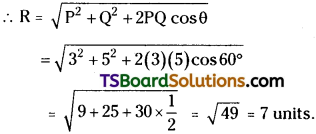
Two forces of magnitudes 3 units and 5 units act at 60° with each other. What is the magnitude of their resultant? [AP Mar. 17. 15; May 17, 16]
Answer:
Given \(\overline{\mathrm{P}}\) = 3 units, \(\overline{\mathrm{Q}}\) = 5 units and θ = 60°
TS Inter 1st Year Physics Study Material Chapter 4 Motion in a Plane 1

Question 5.
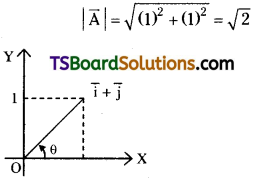
A = \(\overrightarrow{\mathrm{i}}+\overrightarrow{\mathrm{j}}\) What is the angle between the vector and x-axis? [TS Mar. ’17; AP Mar. ’14; May ’13]
Answer:
Given that, \(\overrightarrow{\mathrm{A}}=\overrightarrow{\mathrm{i}}+\overrightarrow{\mathrm{j}}\)
TS Inter 1st Year Physics Study Material Chapter 4 Motion in a Plane 2
If ‘θ’ is the angle made by the vector with x-axis then,

TS Inter 1st Year Physics Study Material Chapter 4 Motion in a Plane 3

Question 6.
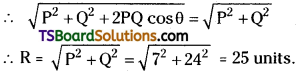
When two right angled vectors of magnitude 7 units and 24 units combine, what is the magnitude of their resultant? [AP Mar. 18, 16; May 18. 14]
Answer:
Given \(\overline{\mathrm{P}}\) = 7 units; \(\overline{\mathrm{Q}}\) = 24 units; 0 = 90°
TS Inter 1st Year Physics Study Material Chapter 4 Motion in a Plane 4

Question 7.
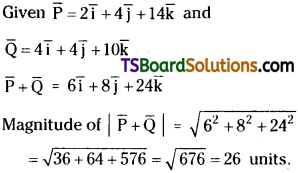
If \(\overline{\mathrm{P}}\) = 2i + 4j + 14k and \(\overline{\mathrm{Q}}\) = 4i + 4j + 10k, find the magnitude of \(\overline{\mathrm{P}}+\overline{\mathrm{Q}}\). [TS Mar. ’16, ’15]
Answer:
TS Inter 1st Year Physics Study Material Chapter 4 Motion in a Plane 5

Question 8.
Can a vector of magnitude zero have non-zero components?
Answer:
A vector with zero magnitude cannot have non-zero components. Because magnitude of given vector \(\overline{\mathrm{V}}\) = \(\sqrt{V^{2}_{x}+V^{2}_{y}}\) must be zero. This is possible only when V²x and V²y are zero.

Question 9.
What is the acceleration of a projectile at the top of its trajectory? [TS Mar. ’19]
Answer:
At highest point acceleration, a = g. In projectile, motion acceleration will always acts towards centre of earth. It is irrespective of its position, whether it is at highest point or somewhere.

TS Inter 1st Year Physics Study Material Chapter 4 Motion in a Plane

Question 10.
Can two vectors of unequal magnitude add up to give the zero vector? Can three unequal vectors add up to give the zero vector?
Answer:
No. Two unequal vectors can never give zero vector by addition. But three unequal vectors when added may give zero vector.

Short Answer Questions

Question 1.
State parallelogram law of vectors. Derive an expression for the magnitude and direction of the resultant vector. [TS Mar. ’17, ’16, May ’17; AP Mar. ’14, ’13]
Answer:
Parallelogram Law :
If two vectors are represented by the two adjacent sides of a parallelogram then the diagonal passing through the intersection of given vectors represents their resultant both in direction and magnitude.

Proof :
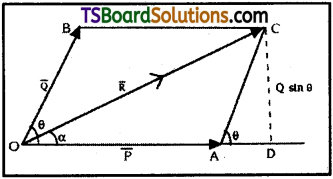
Let \(\overline{\mathrm{P}}\) and \(\overline{\mathrm{Q}}\) be two adjacent vectors ‘θ’ be angle between them. Construct a parallelogram OACB as shown in figure. Extend the line OA and draw a normal D from C. The diagonal OC = the resultant \(\overline{\mathrm{R}}\) both in direction and magnitude.
TS Inter 1st Year Physics Study Material Chapter 4 Motion in a Plane 6

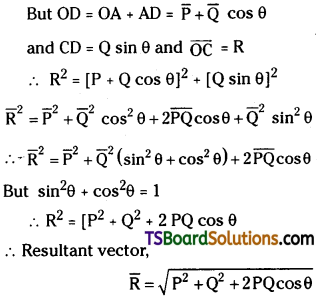
In figure OCD = right angle triangle
⇒ OC = OD² + DC²
TS Inter 1st Year Physics Study Material Chapter 4 Motion in a Plane 7
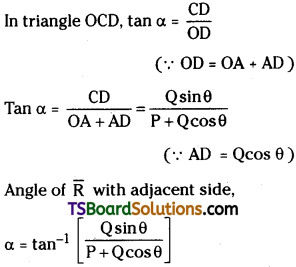
Angle of resultant with adjacent side ‘α’
TS Inter 1st Year Physics Study Material Chapter 4 Motion in a Plane 8

Question 2.
What is relative motion? Explain it.
Answer:
Relative velocity is the velocity of a body with respect to another moving body.

Relative velocity in two dimensional motion :
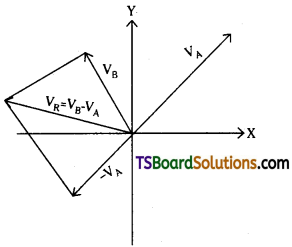
Let two bodies A and B are moving with velocities \(\overrightarrow{\mathrm{V}}_A\) and \(\overrightarrow{\mathrm{V}}_B\) then relative velocity of Aw.r.t B is \(\overrightarrow{\mathrm{V}}_{AB}=\overrightarrow{\mathrm{V}}_{A}+\overrightarrow{\mathrm{V}}_{B}\)
Relative velocity of B w.r.t. A is
\(\overrightarrow{\mathrm{V}}_{BA}=\overrightarrow{\mathrm{V}}_{B}-\overrightarrow{\mathrm{V}}_{A}\)
TS Inter 1st Year Physics Study Material Chapter 4 Motion in a Plane 9
Procedure to find resultant :
To find rela-tive velocity in two dimensional motion use vectorial subtraction of VA or VB. Generally to find relative velocity one vector \(\overrightarrow{\mathrm{V}}_A\) or \(\overrightarrow{\mathrm{V}}_B\) is reversed (as the case may be) and parallelogram is constructed. Now resultant of that parallelogram is equal to \(\overrightarrow{\mathrm{V}}_A-\overrightarrow{\mathrm{V}}_B\) or \(\overrightarrow{\mathrm{V}}_B-\overrightarrow{\mathrm{V}}_A\) (8° one vector is reversed VA is taken as –\(\overrightarrow{\mathrm{V}}_A\) or \(\overrightarrow{\mathrm{V}}_B\) is taken as –\(\overrightarrow{\mathrm{V}}_B\))
In figure relative velocity of B w.r.t A is VBA =VR = VB – VA.

Question 3.
Show that a boat must move at an angle with respect to river water in order to cross the river in minimum time.
Answer:
Motion of a boat in a river :
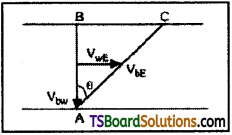
Let a boat can travel with a speed of VbE in still water w.r. to earth. It is used to cross a river which flows with a speed of VWE with respect to earth. Let width of river is W.
TS Inter 1st Year Physics Study Material Chapter 4 Motion in a Plane 10

We can cross the river in two different ways.
1) in shortest path 2) in shortest time.

To cross the river in shortest time :

TS Inter 1st Year Physics Study Material Chapter 4 Motion in a Plane 11

To cross the river in shortest time boat must be rowed along the width of river i.e., boat must be rowed perpendicular to the bank or 90° with the flow of water. Because width of river is the shortest distance. So velocity must be taken in that direction to obtain shortest time. In this case VbE and VWE are perpendicular and boat will travel along AC. The distance BC is called drift. So to cross the river in shortest time angle with flow of water = 90°.

TS Inter 1st Year Physics Study Material Chapter 4 Motion in a Plane

Question 4.
Define unit vector, null vector and position vector. [AP June ’15]
Answer:
Unit vector :
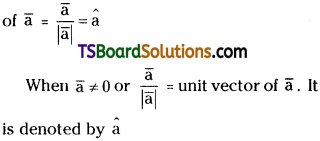
A vector whose magnitude is one unit is called unit vector.

Let a is \(\overline{\mathrm{a}}\) given vector then unit vector
TS Inter 1st Year Physics Study Material Chapter 4 Motion in a Plane 12

Null vector :
A vector whose magnitude is zero is called null vector. But it has direction.

For a null vector the origin and terminal point are same.
Ex : Let \(\overline{\mathrm{A}}\times\overline{\mathrm{B}}=\overline{\mathrm{0}}\) . Here magnitude of \(\overline{\mathrm{A}}\times\overline{\mathrm{B}}=\overline{\mathrm{0}}\) . But still it has direction perpendicular to the plane of \(\overline{\mathrm{A}}\) and \(\overline{\mathrm{B}}\).

Position vector :
Any vector in space can be represented by the linear combination
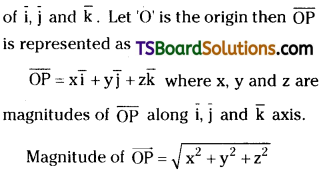
TS Inter 1st Year Physics Study Material Chapter 4 Motion in a Plane 13

Question 5.
If |\(\overrightarrow{\mathrm{a}}+\overrightarrow{\mathrm{b}}\)| = |\(\overrightarrow{\mathrm{a}}-\overrightarrow{\mathrm{b}}\)|, prove that the angle between \(\overrightarrow{\mathrm{a}}\) and \(\overrightarrow{\mathrm{b}}\) is 90°. [TS Mar., May ’18]
Answer:
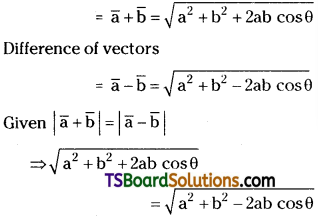
Let \(\overrightarrow{\mathrm{a}}\), \(\overrightarrow{\mathrm{b}}\) are the two vectors.
Sum of vectors
TS Inter 1st Year Physics Study Material Chapter 4 Motion in a Plane 14
by squaring on both sides,
a² + b² + 2ab cos θ = a² + b² – 2ab cos θ
∴ 4 ab cos θ = 0 or θ = 90°

TS Inter 1st Year Physics Study Material Chapter 4 Motion in a Plane 15

Question 6.
Show that the trajectory of an object thrown at certain angle with the horizontal is a parabola. [AP Mar. ’18, ’17. ’16. ’15, May ’18, ’17, ’14. ’13; June ’15; TS Mar. ’18, ’15, May ’16, June ’15]
Answer:
Projectile :
A body thrown into the air same angle with the horizontal, (other tan 90°) its motion under the influence of gravity is called projectile. The path followed by it is called trajectory.

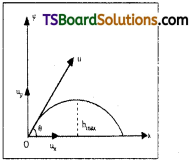
Let a body is projected from point O, with velocity ‘u’ at an angle θ with horizontal. The velocity u’ can be resolved into two rectangular components ux and uy along x-axis and y-axis.
ux = u cos θ and uy = u sin θ

After time t, Horizontal distance travelled x = u cos θ . t ……….. (1)
TS Inter 1st Year Physics Study Material Chapter 4 Motion in a Plane 16
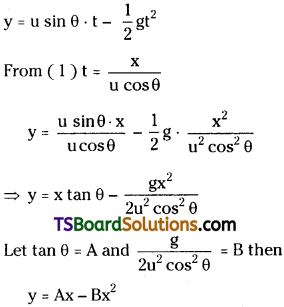
After a time t’ sec; vertical displacement
TS Inter 1st Year Physics Study Material Chapter 4 Motion in a Plane 17
The above equation represents “parabola”. Hence the path of a projectile is a parabola.

Question 7.
Explain the terms the average velocity and instantaneous velocity. When are they equal ?
Answer:
Average velocity :
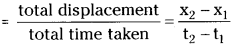
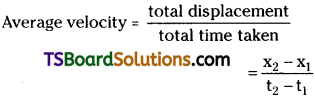
It is the ratio of total displacement to total time taken.
TS Inter 1st Year Physics Study Material Chapter 4 Motion in a Plane 18

Average velocity is independent of path followed by the particle. It just deals with initial and final positions of the body.

Instantaneous velocity :
Velocity of a body at any particular instant of time is defined as instantaneous velocity.

TS Inter 1st Year Physics Study Material Chapter 4 Motion in a Plane 19
as instantaneous velocity.
For a body moving with uniform velocity its average velocity = Instantaneous velocity.

Question 8.
Show that the maximum height and range

TS Inter 1st Year Physics Study Material Chapter 4 Motion in a Plane 20
respectively where the terms have their regular meanings.
Answer:
Let a body is projected with an initial velocity ‘u’ and with an angle θ to the horizontal. Initial velocity along x direction, ux = u cos θ Initial velocity along y direction, uy = u sin θ

Horizontal Range :
It is the distance covered by projectile along the horizontal between the point of projection to the point on ground, where the projectile returns again.

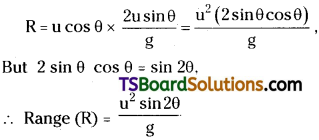
It is denoted by R. The horizontal distance covered by the projectile in the to time of flight is called horizontal range. Therefore, R = u cos θ × t.
TS Inter 1st Year Physics Study Material Chapter 4 Motion in a Plane 21

Angle of projection for maximum range:
For a given velocity of projection, the horizontal range will be maximum, when sin 2θ = 1.
∴ Angle of projection for maximum range is 2θ = 90° or θ = 45°
∴ Rmax = \(\frac{u^2}{g}\)

Maximum height :
The vertical distance covered by the projectile until its vertical component becomes zero.
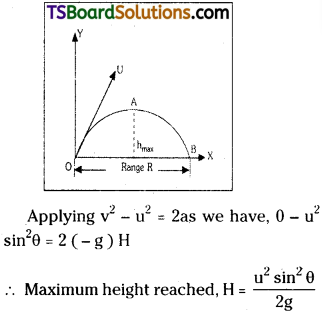
TS Inter 1st Year Physics Study Material Chapter 4 Motion in a Plane 22

Question 9.
If the trajectory of a body is parabolic in one reference frame, can it be parabolic in another reference frame that moves at constant velocity with respect to the first reference frame? If the trajectory can be other than parabolic, what else can it be?
Answer:
Yes. According to Newton’s first law, a body at rest or a body moving with uniform velocity are treated as same. Both of them belong to inertial frame of reference.

If a frame (say 1) is moving with uniform velocity with respect to other, then that second frame must be at rest or it maintains a constant velocity w.r.t the first. So both frames are inertial frames. So if trajectory of a body in one frame is a parabola, then trajectory of that body in another frame is also a parabola.

TS Inter 1st Year Physics Study Material Chapter 4 Motion in a Plane

Question 10.
A force 2i + j – k newton acts on a body which is initially at rest. At the end of 20 seconds the velocity of the body is 4i + 2j – 2k ms-1. What is the mass of the body? [AP May ’16]
Answer:
Force, F = 2i + j – k
time, t = 20
Initial velocity, u = 0
Final velocity, v = 4i + 2j – 2k = 2(2i + j – k)
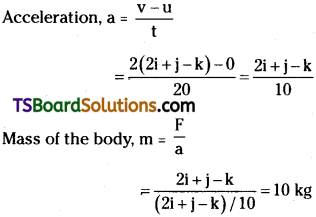
TS Inter 1st Year Physics Study Material Chapter 4 Motion in a Plane 23

Problems

Question 1.
Ship A is 10 km due west of ship B. Ship A is heading directly north at a speed of 30 km/h, while ship B is heading in a direction 60° west of north at a speed of 20 km/h.
(i) Determine the magnitude of the
(ii) What will be their distance of closest approach?
Answer:
Velocity of A = 30 kmph due North
∴ VA = 30\(\hat{\mathbf{j}}\)
Velocity of B = 20 kmph 60° west of North
∴ VB = -20sin60° + 20 cos60° = 10√3\(\hat{\mathbf{i}}\) + 10\(\hat{\mathbf{j}}\)
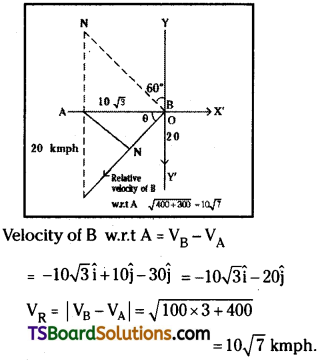
TS Inter 1st Year Physics Study Material Chapter 4 Motion in a Plane 24
Shortest distance :
In ∆le ANB shortest distance, AN = AB sin θ
But distance, AB = 10 km
∴ AN = 10 × \(\frac{20}{10\sqrt{7}}=\frac{20}{\sqrt{7}}\) = 7.56 km

Question 2.
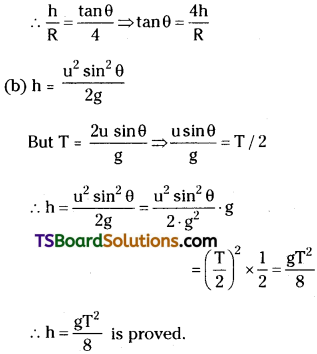
If θ is the angle of projection, R the range, h the maximum height, T the time of flight, then show that (a) tan θ = 4h/R and (b)h = gT²/8
Answer:
(a) Given angle of projection = θ,
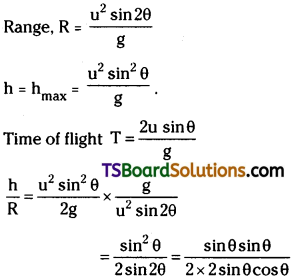
TS Inter 1st Year Physics Study Material Chapter 4 Motion in a Plane 25
TS Inter 1st Year Physics Study Material Chapter 4 Motion in a Plane 26

Question 3.
A projectile is fired at an angle of 60° to the horizontal with an initial velocity of 800 m/s:
(i) Find the time of flight of the projectile before it hits the ground.
(ii) Find the distance it travels before it hits the ground (range).
(iii) Find the time of flight for the projectile to reach its maximum height.
Answer:
Angle of projection, θ = 60°.
Initial velocity, u = 800 m/s
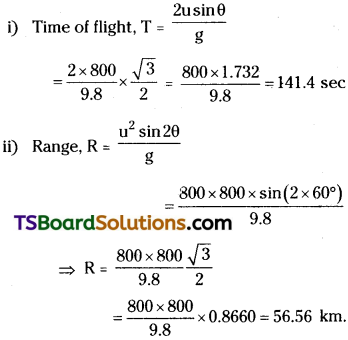
TS Inter 1st Year Physics Study Material Chapter 4 Motion in a Plane 27

iii) Time of flight to reach maximum height = \(\frac{T}{2}\)
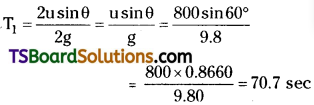
TS Inter 1st Year Physics Study Material Chapter 4 Motion in a Plane 28

Question 4.
For a particle projected slantwise from the ground, the magnitude of its position vector with respect to the point of projection, when it is at the highest point of the path is found to be √2 times the maximum height reached by it. Show that the angle of projection is tan-1 (2).
Answer:
Position vector of h (max point) from 0, is
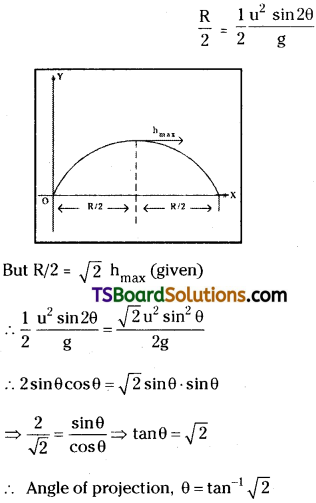
TS Inter 1st Year Physics Study Material Chapter 4 Motion in a Plane 29

Question 5.
An object is launched from a cliff 20. m above the ground at an angle of 30° above the horizontal with an initial speed of 30 m/s. How far horizontally does the object travel before landing on the ground? (g = 10 m/s²)
Answer:
Height of cliff = 20m
Angle of projection, θ = 30°
Velocity of projection, u = 30 m/s
Total horizontal distance travelled = OC = OB’ + B’C
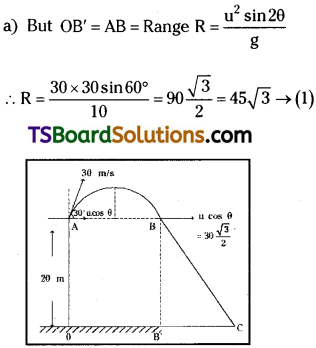
TS Inter 1st Year Physics Study Material Chapter 4 Motion in a Plane 30

b) Distance B’C = Range of a horizontal projectile.
∴ Range = u cos θ t
u. cos θ = 30.\(\frac{\sqrt{3}}{2}\) = 15√3 .
Time taken to reach the ground, t = ?
Given Sy = 20, uy = u sin θ = 30 sin 30° = 15 m/s
∴ Sy = 20 = 15t + \(\frac{10}{2}\)t² ⇒ 5t² + 15t – 20 = 0
or t² + 3t – 4 = 0 or (t + 4) (t – 1) = 0
∴ t = – 4 or t = 1 ∴ t is Not – ve use t = 1
∴ Range = 4 . cos θ . t = 15√3 → (2)
Total distance travelled before reaching the ground = 45√3 +15√3 = 60√3 m.

TS Inter 1st Year Physics Study Material Chapter 4 Motion in a Plane

Question 6.
‘O’ is a point on the ground chosen as origin. A body first suffers a displacement of 10√2 mm North-East, next 10 m North and finally 10√2 North-West. How far it is from origin? [TS Mar. ’19]
Answer:
a) 10√2 m North-East
b) 10m North
c) 10√2 m North-West
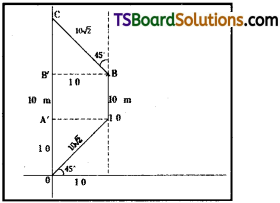
TS Inter 1st Year Physics Study Material Chapter 4 Motion in a Plane 31
From figure total displacement from origin ‘O’ is OC
ButOC = OA’ + A’B’ + B’C =10 + 10 + 10 = 30 m.

Question 7.
From a point on the ground a particle is projected with initial velocity u, such that its horizontal range is maximum. Find the magnitude of average velocity during its ascent.
Answer:
Velocity of projection = u.
Range is maximum ⇒ θ = 45°
During time of ascent ⇒ when h = hmax
⇒ ux = Vx = u . cos θ

Average velocity, VA = \(\sqrt{V^{2}_{x}+V^{2}_{y}}\)
Vx = Average velocity along x-axis
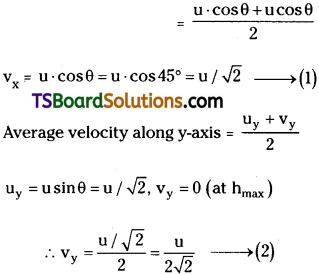
TS Inter 1st Year Physics Study Material Chapter 4 Motion in a Plane 32
Average velocity during time of ascent
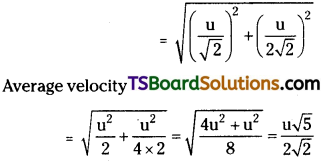
TS Inter 1st Year Physics Study Material Chapter 4 Motion in a Plane 33

Question 8.
A particle is projected from the ground with some initial velocity making an angle of 45° with the horizontal. It reaches a height of 7.5 m above the ground while it travels a horizontal distance of 10 m from the point of projection. Find the initial speed of projection (g = 10 m/s2).
Anwser:
Angle of projection = 45°
Vertical height, hy = 7.5 m
Horizontal distance, hx = 10 m
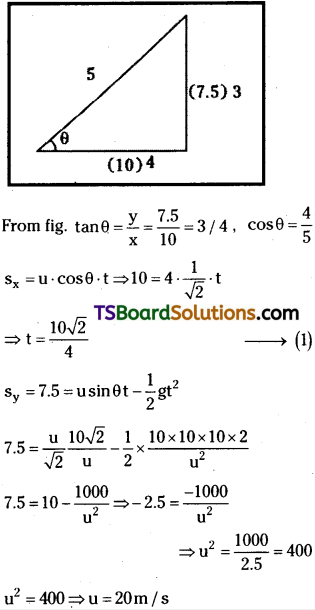
TS Inter 1st Year Physics Study Material Chapter 4 Motion in a Plane 34

Question 9.
Wind is blowing from the south at 5 ms-1. To a cyclist it appears to be blowing from the east at 5 ms-1. Show that the velocity of the cyclist is ms-1 towards north-east.
Answer:
Direction of wind South to North 5 m/s.

Apparent direction is from East to West 5 m/s.
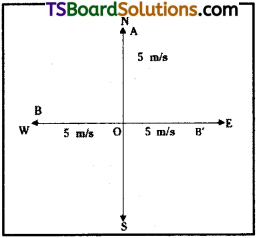
TS Inter 1st Year Physics Study Material Chapter 4 Motion in a Plane 35

This is relative velocity.
To find velocity of cyclist reverse the direction of resultant vector OB and find resultant
∴ Velocity of cyclist = \(\sqrt{5^2+^2+0}\) = 5√2 m/s

Question 10.
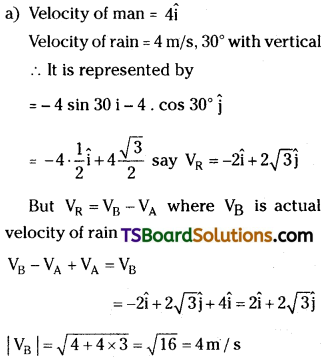
A person walking at 4 m/s finds rain drops falling slantwise into his face with a speed of 4 m/s at ah angle of 30° with the vertical. Show that the actual speed of the rain drops is 4 m/s.
Answer:
Velocity of man = 4 m/sec
Apparent velocity of rain drop = 4 m/sec with θ = 30° with vertical. This is relative velocity VB.
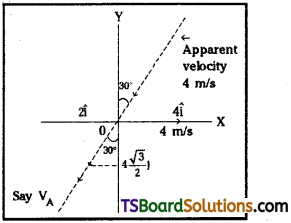
TS Inter 1st Year Physics Study Material Chapter 4 Motion in a Plane 36
TS Inter 1st Year Physics Study Material Chapter 4 Motion in a Plane 37

Additional Problems

Question 1.
The ceiling of a long hall is 25 m high. What is the maximum horizontal distance that a ball thrown with a speed of 40 ms-1 can go without hitting the ceiling of the hall?
Solution:
Here, u = 40 ms-1; H = 25m, R = ?
Let θ be the angle of projection with the horizontal direction to have the maximum range, with maximum height = 25 m.
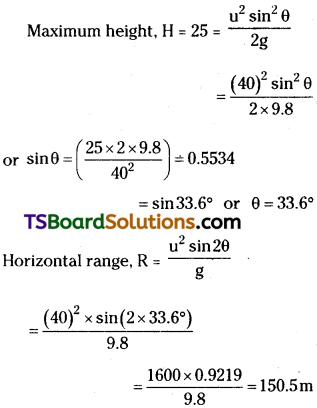
TS Inter 1st Year Physics Study Material Chapter 4 Motion in a Plane 38

Question 2.
A stone tied to the end of a string 80 cm long is whirled in a horizontal circle with a constant speed. If the stone makes 14 revolutions in 25 s, what is the magnitude and direction of acceleration of the stone?
Solution:
Here, r = 80 cm = 0.8 m; o = 14/25 s-1.

TS Inter 1st Year Physics Study Material Chapter 4 Motion in a Plane 39
The centripetal acceleration,
a = ω²r = (\(\frac{88}{25}\))² × 0.80 = 9.90m/s²
The direction of centripetal acceleration is along the string directed towards the centre of circular path.

TS Inter 1st Year Physics Study Material Chapter 4 Motion in a Plane

Question 3.
An aircraft executes a horizontal loop of radius 1 km with a steady speed of 900 km/h. Compare its centripetal acceleration with the acceleration due to gravity.
Solution:
Here, r = 1 km = 1000 m;
v = 900 km h-1 = 900 × (1000m) × (60 × 60s)-1
= 250 ms-1
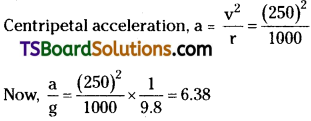
TS Inter 1st Year Physics Study Material Chapter 4 Motion in a Plane 40

Question 4.
An aircraft is flying at a height of 3400 m above the ground. If the angle subtended at a ground observation point by the air-craft positions 10.0 s apart is 30°, what is the speed of the aircraft?
Solution:
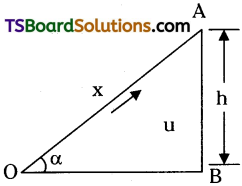
In Fig, O is the observation point at the ground. A and B are the positions of aircraft for which ∠AOB = 30°. Draw a perpendicular OC on AB. Here OC = 3400 m and ∠AOC = ∠COB = 15°. Time taken by aircraft from A to B is 10 s.
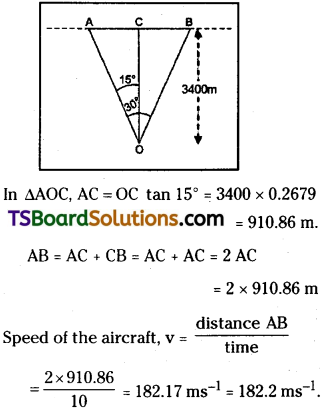
TS Inter 1st Year Physics Study Material Chapter 4 Motion in a Plane 41

TS Inter 1st Year Physics Study Material Chapter 4 Motion in a Plane

Question 5.
A bullet fired at an angle of 30° with the horizontal hits the ground 3.0 km away. By adjusting its angle of projection, can one hope to hit a target 5.0 km away? Assume the muzzle speed to be fixed, and neglect air resistance.
Solution:
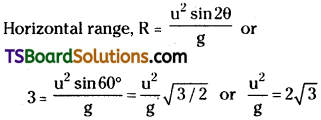
TS Inter 1st Year Physics Study Material Chapter 4 Motion in a Plane 42
Since the muzzle velocity is fixed, therefore, Max. horizontal range,
Rmax = \(\frac{u^2}{g}\) = 2√3 = 3.464 m.
So, the bullet cannot hit the target.

TS Inter 1st Year Physics Study Material Chapter 3 Motion in a Straight Line

Telangana TSBIE TS Inter 1st Year Physics Study Material 3rd Lesson Motion in a Straight Line Textbook Questions and Answers.

TS Inter 1st Year Physics Study Material 3rd Lesson Motion in a Straight Line

Very Short Answer Type Questions

Question 1.
The states of motion and rest are relative. Explain.
Answer:
REST :
If the position of a body does not change with respect to surroundings, it is said to be at “rest”.

MOTION :
If the position of a body changes with respect to surroundings, it is said to be in “motion”.

By definitions rest and motion are relative with respect to surroundings.

Question 2.
How is average velocity different from instantaneous velocity? [AP Mar. 19, 13, May 17]
Answer:
Average velocity :
It is the ratio of total displacement to total time taken. It is independent of path of the body.

∴ Average velocity = \(\frac{\mathrm{s}_2-\mathrm{s}_1}{\mathrm{t}_2-\mathrm{t}_1}\)

Velocity of a particle at a particular instant of time is known as instantaneous velocity. Here time interval is very small.

Only in uniform motion, instantaneous velocity = average velocity. For all other cases instantaneous velocity may differ from average velocity.

Question 3.
Give an example where the velocity of an object is zero but its acceleration is not zero. [AP May ’17, Mar. ’13]
Answer:
In case of VPB at maximum height its velocity v = 0. But acceleration due to gravity ‘g’ is not zero.

So even though velocity v = 0 ⇒ acceleration is not zero.

Question 4.
A vehicle travels half the distance L with speed v1 and the other half with speed v2. What is the average speed?
Answer:
The average speed of a vehicle for the two equal parts.
TS Inter 1st Year Physics Study Material Chapter 3 Motion in a Straight Line 1

Question 5.
A lift coming down is just about to reach the ground floor. Taking the ground floor as origin and positive direction upwards for all quantities, which one of the following is correct?
a) x < 0, v < 0, a > 0
b) x > 0, v < 0, a < 0
c) x > 0, v < 0, a > 0
d) x > 0, v > 0, a > 0
Answer:
As the lift is coming down, the value of x become less hence negative, i.e., x < 0.

Velocity is downwards (i.e., negative). So v < 0. Just before reaching ground floor, lift is retarded, i.e., acceleration is upwards. Hence a > 0.

We can conclude that x < 0, v < 0 and a > 0.
∴ (a) is correct.

TS Inter 1st Year Physics Study Material Chapter 3 Motion in a Straight Line

Question 6.
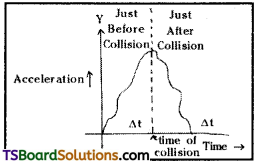
A uniformly moving cricket ball is hit with a bat for a very short time and is turned back. Show the variation of its acceleration with time taking the acceleration in the backward direction as positive.
Answer:
For a ball moving with uniform velocity acceleration is zero. But during time of contact between ball and bat acceleration is applied in opposite direction. The shape of acceleration – time graph is as shown.
TS Inter 1st Year Physics Study Material Chapter 3 Motion in a Straight Line 2

Question 7.
Give an example of one-dimensional motion where a particle moving along the positive x-direction comes to rest periodically and moves forward.
Answer:
When length of pendulum is high and amplitude is less then its motion is along a straight line. The pendulum will come to a stop at extreme position and moves back in forward direction (‘x’ + ve) periodically.

Question 8.
An object falling through a fluid is observed to have an acceleration given by a = g – bv, where g is the gravitational acceleration and b, is a constant. After a long time it is observed to fall with a constant velocity. What would be the value of this constant velocity?
Answer:
Acceleration, a = g – bv when moving with constant velocity, a = 0 ⇒ 0 = g – bv
∴ Constant velocity, v = \(\frac{g}{b}\) m/sec.

Question 9.
If the trajectory of a body is parabolic in one frame, can it be parabolic in another frame that moves with a constant velocity with respect to the first frame? If not, what can it be?
Answer:
If the trajectory of a body is parabolic with reference frames one and two then those two frames are of rest or moving with uniform velocity.

If they are not parabolic then for that reference frame it may be in straight line path.
Ex : When a body is dropped from a moving plane its path is parabolic for a person outside the plane. But for the pilot in the plane it is falling vertically downwards.

Question 10.
A spring with one end attached to a mass and the other to a rigid support is stretched and released. When is the magnitude of acceleration a maxium?
Answer:
Maximum restoring force setup in the spring, when stretched by a distance ’r’, is F = – kr

Potential energy of stretched spring = \(\frac{1}{2}\) kx²

As F ∝ r and this force is directed towards equilibrium position, hence if mass is left free, it will execute damped SHM due to gravity pull.

Magnitude of acceleration in the mass attached to one end of spring when just released is

a = \(\frac{F}{m}=\frac{-k}{m}\) r = (Maximum)

The magnitude of acceleration of the spring will be maximum when just released.

TS Inter 1st Year Physics Study Material Chapter 3 Motion in a Straight Line

Question 11.
Define average velocity and average speed. When does the magnitude of average velocity become equal to the average speed?
Answer:
Average velocity :
It is defined as the ratio of total displacement to total time taken.

Average velocity
TS Inter 1st Year Physics Study Material Chapter 3 Motion in a Straight Line 3

Average velocity is independent of path followed by the particle. It just deals with initial and final positions of the body. Average Speed: The ratio of total path length travelled to the total time taken is known as “average speed”.

Speed and average speed are scalar quantities so no direction for these quantities.
TS Inter 1st Year Physics Study Material Chapter 3 Motion in a Straight Line 4

When the body is along with the straight line its average velocity and average speed are equal.

Short Answer Questions

Question 1.
Can the equations of kinematics be used when the acceleration varies with time? If not, what form would these equations take?
Answer:
a) The equations of motion are
1) v =u + at
2) s = ut + \(\frac{1}{2}\) at² and 3) v² – u² = 2as. All these three equations applicable body moves with uniform acceleration ‘a’.

No, the equations of are not applicable when the acceleration varies with time.

Question 2.
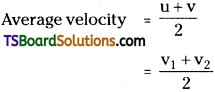
A particle moves in a straight line with uniform acceleration. Its velocity at time t = 0 is v1 and at time t2 = t is v2. The average velocity of the particle in this time interval is (v1 + v1)/ 2. Is this correct? Substantiate your answer.
Answer:
t1 = 0 ⇒ u = v1
t2 = t ⇒ v = v2

TS Inter 1st Year Physics Study Material Chapter 3 Motion in a Straight Line 5

Question 3.
Can the velocity of an object be in a direction other than the direction of acceleration of the object? If so, give an example.
Answer:
Yes. Velocity of a body and its acceleration may be in different directions.

Explanation:

  1. Incase of vertically projected body ⇒ velocity of body is in the upward direction and acceleration is in a downward direction.
  2. When brakes are applied the velocity of body before coming to rest is opposite to retarding acceleration.

Question 4.
A parachutist flying in an aeroplane jumps when it is ata height of 3 km above ground. He opens his parachute when he is about 1 km above ground. Describe his motion.
Answer:
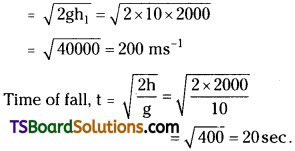
a) Height of fall before opening, h = 2 km
= 2000 m
∴ Velocity at a height of 1 km
TS Inter 1st Year Physics Study Material Chapter 3 Motion in a Straight Line 6

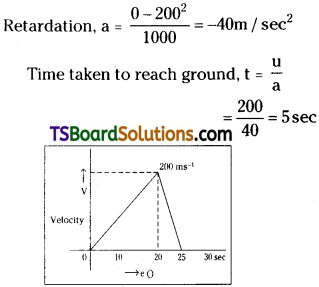
b) After parachute is opened it touches the ground with almost zero velocity.
∴ u = 200 m/sec, v = 0, S = h = 1000 m From v² – u² = 2as
TS Inter 1st Year Physics Study Material Chapter 3 Motion in a Straight Line 7
The Motion is as shown in figure.

Question 5.
A bird holds a fruit in its beak and flies parallel to the ground. It lets go of the fruit at some height. Describe the trajectory of the fruit as it falls to the ground as seen by (a) the bird (b) a person on the ground.
Answer:
a) As the bird is flying parallel to the ground, it possesses velocity in horizontal direction. Hence the fruit also possess velocity in horizontal direction and acceleration in downward direction. Hence the path of the fruit is a straight line with respect to the bird.

b) With respect to a person on the ground, the fruit seems to be in a parabolic path.

TS Inter 1st Year Physics Study Material Chapter 3 Motion in a Straight Line

Question 6.
A man runs across the roof of a tall building and jumps horizontally on to the (lower) roof of an adjacent building. If his speed is 9 ms-1 and the horizontal distance between the buildings is 10 m and the height difference between the roofs is 9 m, will he be able to land on the next building? (take g = 10 ms-2) [TS Mar. ’18]
Answer:
Given that,
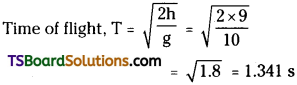
initial speed, u = 9 ms-1 ; g = 10m/s² height difference between the roofs, h = 9 m
horizontal distance between two buildings, d = 10 m
TS Inter 1st Year Physics Study Material Chapter 3 Motion in a Straight Line 8

Range of the man = R = u × T = 9 × 1.341
= 12.069 m

Since R > d, the man will be able to land on the next building.

Question 7.
A ball is dropped from the roof of a tall building and simultaneously another ball is thrown horizontally with some velocity from the same roof. Which ball lands first? Explain your answer. [TS June ’15]
Answer:
Let ‘h’ be the height of the tall building.

For dropped ball:
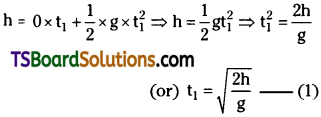
Let ‘t1‘ be the time taken by the dropped ball to reach the ground.

Initial velocity, u = 0 ; Acceleration, a = + g
Distance travelled, s = h; Time of travel, t = t1

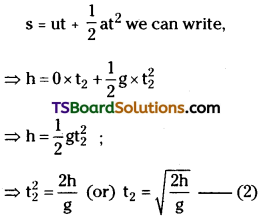
From the equation of motion, s = ut + \(\frac{1}{2}\) at²
we can write,
TS Inter 1st Year Physics Study Material Chapter 3 Motion in a Straight Line 9

For horizontally projected ball:
If the ball is thrown horizontally then its initial velocity along vertical direction is zero and in this case let ‘t2‘ be the time taken by the ball to reach the ground.
Again from the equation of motion,
TS Inter 1st Year Physics Study Material Chapter 3 Motion in a Straight Line 10

From equations (1) and (2) t1 = t2
i.e., both the balls reach the ground in the same time.

Question 8.
A ball is dropped from a building and simultaneously another ball is projected upward with some velocity. Describe the change in relative velocities of the balls as a function of time.
Answer:
a) For a body dropped from building its velocity, v1 = gt → (1) (∵ u1 = 0)

b) For a body thrown up with a velocity ‘u’ its velocity, v2 = u – gt → (2)
∵ The two balls are moving in opposite direction the relative velocity,
VR = v1 + v2
∴ vR =gt + u – gt = u

Here the relative velocity remains constant, but velocity of one body increases at a rate of g’ m/sec and velocity of another body decreases at a rate of ‘g’m/sec.

Question 9.
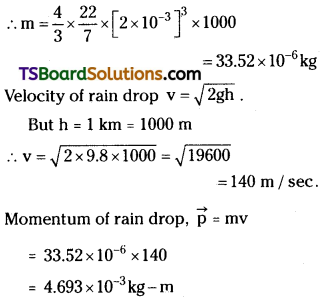
A typical raindrop is about 4 mm in diameter. If a raindrop falls from a cloud which is at 1 km above the ground, estimate its momentum when it hits the ground.
Answer:
Diameter, D = 4 m
⇒ radius, r = 2mm = 2 × 10⁻³ m
mass of rain drop = volume × density = \(\frac{4}{3}\)πr³ × 1000 m
(∵ mass of one m³ of water = 1000 kg)
TS Inter 1st Year Physics Study Material Chapter 3 Motion in a Straight Line 11

Question 10.
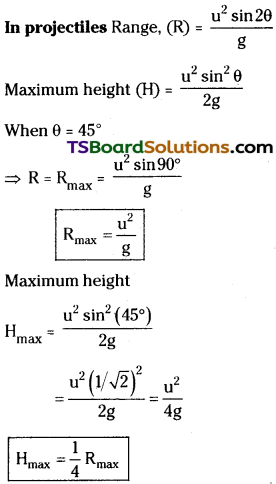
Show that the maximum height reached by a projectile launched at an angle of 45° is one quarter of its range. [AP May ’16, Mar. ’14]
Answer:
TS Inter 1st Year Physics Study Material Chapter 3 Motion in a Straight Line 12
∴ When θ = 45° maximum height reached is one quarter of maximum range.

Question 11.
Derive the. equation of motion x = v0t + \(\frac{1}{2}\) at² using appropriate graph. [TS Mar. ’19, May ’16]
Answer:
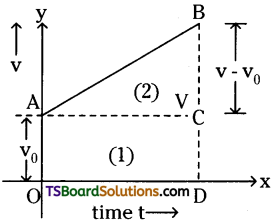
The velocity-time graph of a body moving with initial velocity u’ and with uniform acceleration a’ as shown. Let ‘v’ be the velocity of the body after a time t.

In v – t graph area of velocity-time graph = total displacement travelled by it. Area under velocity – time graph = area of OABCD
∴ Area of Rectangular part OACD = Area of OACD + Area of ABC.
A1 = OA × OD = v0.t. ……….. (1)
TS Inter 1st Year Physics Study Material Chapter 3 Motion in a Straight Line 13

2) Area of triangle ABC = A2
A2 = \(\frac{1}{2}\)Base × height
= \(\frac{1}{2}\)AC × BC
= \(\frac{1}{2}\) t(v – v0).
But v – v0 = at
A2 = \(\frac{1}{2}\)t.at = \(\frac{1}{2}\)at².
∴ Total area under graph = s = A1 + A2
s(n) = v0t + \(\frac{1}{2}\)at².
∴ s = ut + \(\frac{1}{2}\)at² is graphically proved.

Problems

Question 1.
A man walks on a straight road from his home to a market 2.5 km away with a speed of 5 km h-1. Finding the market closed, he instantly turns and walks back home with a speed of 7.5 km h-1. What is the (a) magnitude of average velocity and (b) average speed of the man over the time interval 0 to 50 minutes? [AP Mar. ’19. May ’18; TS Mar. ’18]
Solution:
Time taken by man to go from his home to
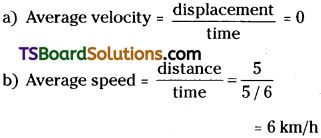
TS Inter 1st Year Physics Study Material Chapter 3 Motion in a Straight Line 14

Time take by man to go from market to his home, t2 = \(\frac{2.5}{7.5}=\frac{1}{3}\)h
∴ Total time taken = t, + to = \(\frac{1}{2}+\frac{1}{3}=\frac{5}{6}h\)
= 50 min.
In time interval 0 to 50 min,
Total distance travelled = 2.5 + 2.5 = 5 km.
Total displacement = zero.
TS Inter 1st Year Physics Study Material Chapter 3 Motion in a Straight Line 15

Question 2.
A stone is dropped from a height 300 in and at the same time another stone is projected vertically upwards with a velocity of 100 m/sec. Find when and where the two stones meet. [AP Mar. ’16]
Solution:
Height h = 300 m ;
Initial velocity U0 = 100 m/s
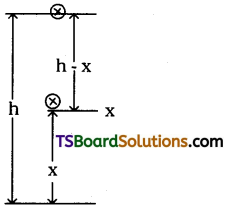
Let the two stones will meet at a height ‘x’ above the ground.
For 1st stone h – x = \(\frac{1}{2}\) gt² …………. (1)
For 2nd stone x = u0t – \(\frac{1}{2}\) gt²
⇒ \(\frac{1}{2}\) gt² = u0t – x ……….. (2)
TS Inter 1st Year Physics Study Material Chapter 3 Motion in a Straight Line 16
Since t is same for the two stones
From equations 1 & 2.
h – x = u0t – x
⇒ u0t = h or time t = \(\frac{h}{u_0}=\frac{300}{100}\) = 3 sec.
∴ The two stones will meet 3 seconds after the 1st stone is dropped or 2nd stone is thrown up.

TS Inter 1st Year Physics Study Material Chapter 3 Motion in a Straight Line

Question 3.
A car travels the first third of a distance with a speed of 10 kmph, the second third at 20 kmph and the last third at 60 kmph. What is its mean speed over the entire distance? [TS Mar. ’16; AP May ’14, AP Mar. ’18]
Solution:
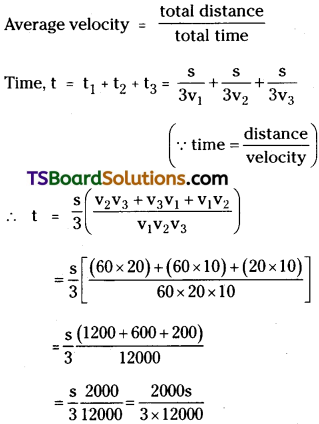
Total distance = s;
distance travelled, s1 = \(\frac{s}{3}\) ;
velocity, v1 = 10 kmph
distance, s2 = \(\frac{s}{3}\)
velocity, v2 = 20 kmph
distance, s3 = \(\frac{s}{3}\)
velocity, v3 = 60 kmph
TS Inter 1st Year Physics Study Material Chapter 3 Motion in a Straight Line 17
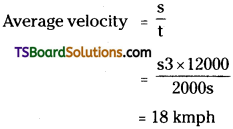
TS Inter 1st Year Physics Study Material Chapter 3 Motion in a Straight Line 18

Question 4.
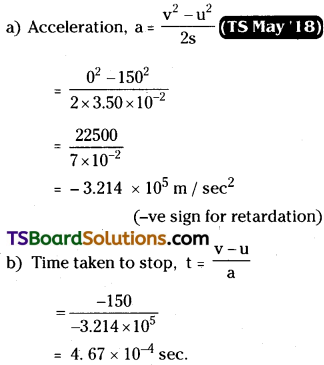
A bullet moving with a speed of 150 m s-1 strikes a tree and penetrates 3.5 cm before stopping. What is the magnitude of its retardation in the tree and the time taken for it to stop after striking the tree?
Solution:
Velocity of bullet, u = 150 m/s;
Final velocity, v = 0
Distance travelled, s = 3.5 cm = 3.5 × 10⁻² m,
TS Inter 1st Year Physics Study Material Chapter 3 Motion in a Straight Line 19

Question 5.
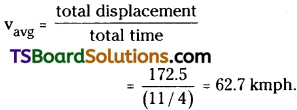
A motorist drives north for 30 min at 85 km/h and then stops for 15 min. He continues travelling north and covers 130 km in 2 hours. What is his total displacement and average velocity?
Solution:
In first part:
Velocity, v1 = 85 kmph
Time, t1 = 30 min
Distance travelled, s1 = v1 t1
= 85 × \(\frac{30}{60}\) = 42.5 km

In second part:
Distance travelled, s2 = 0 ;
Time, t2 = 15.0 min.

In third part:
Distance travelled, s3 = 130 km ;
Time, t3 = 120 min = 2 hours
a) Total distance of the motorist,
s = s1 + s2 + s3 = 42.5 + 0 + 130 = 172.5 km

b) Total time travelled,
t = t1 + t2 + t3 = 30 + 15 + 120
= 165 minutes
= 2 hrs 45 minutes
= 2\(\frac{3}{4}\)hrs. = \(\frac{11}{4}\) hrs.
∴ Average velocity,
TS Inter 1st Year Physics Study Material Chapter 3 Motion in a Straight Line 20

Question 6.
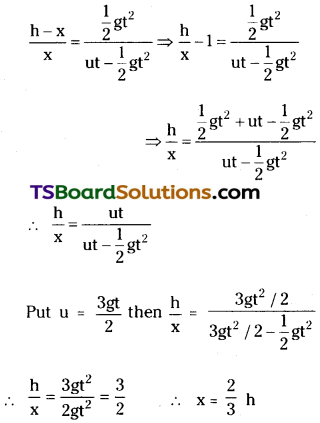
A ball A is dropped from the top of a building and at the same time an identical ball B is thrown vertically upward from the ground. When the balls collide the speed of A is twice that of B. At what frac¬tion of the height of the building did the collison occur?
Solution:
Given at time of collision velocity of A = VA
= 2 × VB (velocity of B)
Let the body be dropped from a height h’.
Let the two stones collide at x from ground.
For the body dropped,
s = h – x = \(\frac{1}{2}\)gt² → (1)
For the body thrown up,
x = ut – \(\frac{1}{2}\)gt² → (2)
For the body dropped,
v = u + at ⇒ VA = gt → (3)
For the body thrown up,
v = u – gt ⇒ VB = u – gt → (4)
Given VA = 2VB
⇒ gt = 2 (u – gt) or u = \(\frac{3gt}{2}\) → (5)
Divide equation (1) with equation (2)
TS Inter 1st Year Physics Study Material Chapter 3 Motion in a Straight Line 21
∴ Fraction of height of collision = \(\frac{2}{3}\)

TS Inter 1st Year Physics Study Material Chapter 3 Motion in a Straight Line

Question 7.
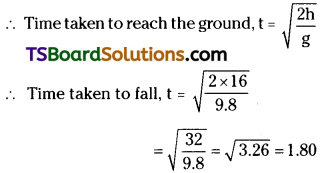
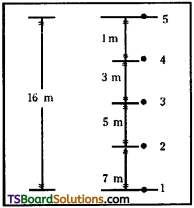
Drops of water fall at regular intervals from the roof of a building of height 16 m. The first drop strikes the ground at the same moment as the fifth drop leaves the roof. Find the distances between successive drops.
Solution:
Height of building, h = 16 m
TS Inter 1st Year Physics Study Material Chapter 3 Motion in a Straight Line 22
Number of drops, n = 5
∴ Number of intervals = n – 1 = 5 – 1 = 4
TS Inter 1st Year Physics Study Material Chapter 3 Motion in a Straight Line 23
Time interval between drops = \(\frac{1.8}{4}\)
= 0.45 sec
Time of travel of 1st drop, t1 = 4 × 0.45 = 1.8
∴ Distance travelled by
1st drop, S1 = \(\frac{1}{2}\)gt²1 = \(\frac{1}{2}\) × 9.8 × 1.8 × 1.8= 16 m

For 2nd drop, t2 = 3 × 0.45 = 1.35 sec.,
∴ S2 = \(\frac{1}{2}\) × 9.8 × 1.35²
= 4.9 × 1.822 ≅ 1.822 ≅ 9m

For 3rd drop, t3 = 2 × 0.45 = 0.9 sec.
Distance, S3 = \(\frac{1}{2}\)gt²3 = \(\frac{1}{2}\) × 9.8 × 0.9² = 3.97≅4 m

For 4th drop, t4 = 1 × 0.45 = 0.45 sec
Distance travelled, S4 = \(\frac{1}{2}\)gt²4 = \(\frac{1}{2}\) × 9.8 × (0.45)² = 1

For 5 th drop, t5 = 0 ⇒ S5 = 0
Distance between 1st and 2nd drop
S1, 2 = S1 – S2 = 16 – 9 = 7 m

Distance between 2nd and 3rd drop
S2, 3 = S2 – S<3 = 9 – 4 = 5m

Distance between 3rd and 4th drop
S3, 4 = S3 – S4 = 4 – 1= 3 m

Distance between 4th and 5th drop
S4, 5 = S4 – S5 = 1 – 0 = 1 m

∴ Distances between successive drops are 7m, 5m, 3m and lm.

Question 8.
Rain is falling vertically with a speed of 35 ms-1. A woman rides a bicycle with a speed of 12 ms-1 in east to west direction. What is the direction in which she should hold her umbrella? [TS June ’15]
Solution:
Velocity of rain VR = 35 m/s (vertically)
Velocity of women Vw = 12 m/s (towards east)
Resultant angle θ = tan-1 \(\frac{V_W}{V_R}=\frac{12}{35}\)
∴ θ = tan-1\(\frac{12}{35}\) = 0.343. or q = 19° (Nearly)
She should hold umbrella at an angle of 19c with east.

Question 9.
A hunter aims a gun at a monkey hanging from a tree some distance away. The monkey drops from the branch at the moment he fires the gun hoping to avoid the bullet. Explain why the monkey made a wrong move.
Solution:
Let the bullet is fired with an angle α and distance from hunter’s rifle to monkey = x
Vertical component of velocity vxy = v sin α
when exactly aimed at monkey sy = v sin α
t = h
TS Inter 1st Year Physics Study Material Chapter 3 Motion in a Straight Line 24

But due to acceleration due to gravity
h1 = u sin α t – \(\frac{1}{2}\)gt² = h – \(\frac{1}{2}\)gt² → (1)
So bullet passes through a height of \(\frac{1}{2}\)gt² below the monkey.
But when the monkey is falling freely height of fall during time t = \(\frac{1}{2}\)gt²
So new height is \(\frac{1}{2}\)gt² → (2)

From equations (1) & (2) h1 is same i.e., if the monkey is dropped from the branch bullet will hit it exactly.

Question 10.
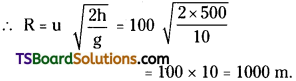
A food packet is dropped from an aero-plane, moving with a speed of 360 kmph in a horizontal direction, from a height of 500m. Find (i) its time of descent (ii) the horizontal distance between the point at which the food packet reaches the ground and the point above which it was dropped.
Solution:
Velocity of plane, V = 360 kmph
= 360 × \(\frac{5}{18}\) = 100 m/s

Height above ground, h = 500 m;
g = 10 m/s²

i) Time of descent,
TS Inter 1st Year Physics Study Material Chapter 3 Motion in a Straight Line 25
ii) Horizontal distance between point o{ dropping and point where it reaches the ground = Range R
TS Inter 1st Year Physics Study Material Chapter 3 Motion in a Straight Line 26

Question 11.
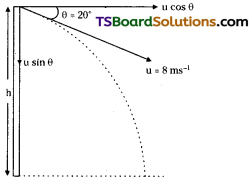
A ball is tossed from the window of a building with an initial velocity of 8 ms-1 at an angle of 20° below the horizontal. It strikes the ground 3 s later. From what height was the ball thrown? How far from the base of the building does the ball strike the ground?
Solution:
Initial velocity, u = 8 m/s;
Angle of projection, θ = 20°
Time taken to reach the ground, t = 3 sec
Horizontal component of initial velocity,
ux = u. cos θ = 8 cos 20°
= 8 × 0.94 = 7.52 m/s

Vertical component of initial velocity,
vy = u sin θ = 8 sin 20°
= 8 × 0.342 = 2.736 m/s

a) From equation of motion, s = ut + \(\frac{1}{2}\)at²
we can write
h = (u sin θ)t + \(\frac{1}{2}\)gt²
⇒ h = (2.736)3 + \(\frac{1}{2}\)9.8 × (3)²
⇒ h = 8.208+ 4.9 × 9
⇒ h = 8.208 + 44.1 or h = 52.308 m
TS Inter 1st Year Physics Study Material Chapter 3 Motion in a Straight Line 27

b) Horizontal distance travelled, sx = vx x t = 7.52 × 3 = 22.56 m

Question 12.
Two balls are projected from the same point in directions 30° and 60° with respect to the horizontal. What is the ratio of their initial velocities if they (a) attain the same height? (b) have the same range?
Solution:
Angle of projection of first ball, θ1 = 30°
Angle of projection of second ball, θ2 = 60°
Let u1 and u2 be the velocities of projections of the two balls.
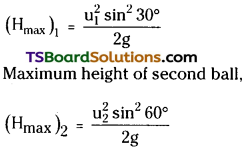
i) Maximum height of first ball,
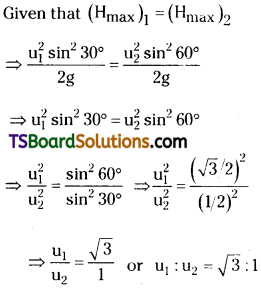
TS Inter 1st Year Physics Study Material Chapter 3 Motion in a Straight Line 28
TS Inter 1st Year Physics Study Material Chapter 3 Motion in a Straight Line 29

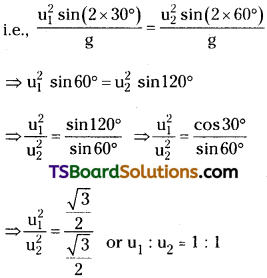
ii) If the balls have same range, then R1 = R2
TS Inter 1st Year Physics Study Material Chapter 3 Motion in a Straight Line 30

Question 13.
A ball is thrown vertically upwards with a velocity of 20 ins’1 from the top of a multistorey building. The height of the point from where the ball is thrown is 25.0 m from the ground. [TS May ’17; AP & TS Mar. ’15]
(a) How high will the ball rise?
(b) How long will it be before the ball hits the ground?
Take g = 10 ms-2 [Actual value of ‘g’ is 9.8 ms-2]
(OR)
When a ball is thrown vertically upwards with a velocity of 20 ms-1 from the top of a multistorey building, the height of the point from where the ball is thrown is 25.0 m from the ground. [TS Mar. ’15]
a) How high will the ball rise? and
b) How long will it be before the ball hits the ground?
Solution:
Initial velocity V0 = 20 m/s;
height above ground h0 = 2.50 m ;
g = 10 m/s²

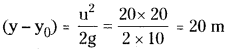
a) For a body thrown up vertically height of rise
TS Inter 1st Year Physics Study Material Chapter 3 Motion in a Straight Line 31

b) Time spent in air (t) is y1 – y0 = V0t + \(\frac{1}{2}\)gt²
Where y1 = Total displacement of the body from ground = 0
∴ 0 = y0 + V0t+ \(\frac{1}{2}\)gt² = 25 + 20t – \(\frac{1}{2}\). 10 . t²
[∵ g = – 10 m/s² while going up]
∴ 0 = – 5t² + 20t + 25 (or) t² – 4t – 5 = 0
i.e., (t – 5) (t + 1) = 0 ⇒ t = 5 (or) t = – 1
But time is not – ve.
∴ Time spent in air t = 5 sec

TS Inter 1st Year Physics Study Material Chapter 3 Motion in a Straight Line

Question 14.
A parachutist flying in an aeroplane jumps when it is at a height of 3 km above the ground. He opens his parachute when he is about 1 km above ground. Describe his motion.
Answer:
Initially the path is a parabola as seen by an observer on the ground. It is a vertical straight line as seen by the pilot. He opens his parachute, it is moving vertically downwards with decreasing velocity and finally it reaches the ground.

TS Inter 1st Year Maths 1B Applications of Derivatives Formulas

Learning these TS Inter 1st Year Maths 1B Formulas Chapter 10 Applications of Derivatives will help students to solve mathematical problems quickly.

TS Inter 1st Year Maths 1B Applications of Derivatives Formulas

→ If y = f(x) is a differentiable function of x and Δx is a small change in ‘x’ then the

  • actual change in y is Δy = f (x + Δx) – f(x)
  • the differential of y is dy = f'(x) Δx

→ The approximate value of f(x) in a neighbourhood of Δx is f(x + Δx) – f (x) + f'(x) Δx.

→ If error in x of y = f(x) is Δx then

  • Δy is the approximate error in y.
  • \(\frac{\Delta \mathrm{y}}{\mathrm{y}}\) is called the relative error in v and
  • \(\frac{\Delta \mathrm{y}}{\mathrm{y}}\) × 100 is the percentage error in y.

→ The slope of the curve y = f(x) at the point P(x1, y1) is \(\left(\frac{d y}{d x}\right)_{\left(x_1 \cdot y_1\right)}\) = m = f'(x1).

→ If θ is the angle between the curves at y = f(x) and y = g(x) at the point of intersection P(x1, y1) then tan θ = \(\frac{m_1-m_2}{1+m_1 m_2}\) where m1 = f'(x1) and m2 = g'(x)
If m1 = m2, then the two curves touch each other at (x1, y1) and if m1m2 = – 1, the two curves are said to be orthogonal.

TS Inter 1st Year Maths 1B Applications of Derivatives Formulas

→ If m = \(\left(\frac{d y}{d x}\right)_{\left.i x_1, y_1\right)}\) = f'(x,) is the slope of the curve at the point P(x1, y1) on y = f(x) then

  • The length of the tangent to the curve at P is \(\frac{y_1 \sqrt{1+\left[f^{\prime}\left(x_1\right)\right]^2}}{f^{\prime}\left(x_1\right)}\)
  • The length of the normal to the curve at P is y1\(\sqrt{1+\left[f\left(x_1\right)\right]^2}\)
  • The length of the subtangent to the curve at P = \(\left|\frac{y_1}{f^{\prime}\left(x_1\right)}\right|\)
  • The length of the subnormal to the curve at P is |y1f(x1)|.

→ The rate of change of the function y = f(x) with respect to ‘t’ is \(\frac{d y}{d x}\)

→ If s = f(t) is the functional relation between the distance ‘s’ and time ‘t’, then the velocity of the body at time ‘t’ is \(\frac{d s}{d x}\) = v and the acceleration of the body at time ‘t’ is \(\frac{d^2 s}{d t^2}=\frac{d v}{d t}\)

→ If a function ‘f’ is increasing and differentiable at a’ ⇔ f'(a) > 0.

  • A differentiable function is said to be decreasing at ‘a’ ⇔ f'(a) < 0.
  • A differentiable function is said to be stationary at ‘a’ ⇔ f'(a) = 0.

→ A differentiable function f(x) in the interval which has f'(x) and f”(x) at ‘a’ and if

  • f’(a) = 0, f”(a) < 0, then f(a) has local maxima.
  • f'(a) = 0. f”(a) > 0. then f(a) has local minima.

→ Rolle’s Mean Value Theorem : If a function ‘f defined over [a, b] is such that

  • f is continuous over [a, b]
  • f is differentiable on (a. b)
  • f(a) = f(b). Then ∃ a point c ∈ (a, b) such that f'(c) = 0.

→ Lagrange’s Mean Value Theorem : If a function f is defined over [a, b] is such that

  • f is continuous over [a, b] .
  • f is differentiable over (a. b) then ∃ a point c ∈ (a, b) such that f’(c) = \(\frac{f(b)-f(a)}{b-a}\)

TS Inter 1st Year Maths 1B Applications of Derivatives Formulas

→ Mensuration fundamentals:
1. If r is the radius, x is the diameter, P is the perimeter and A is the area of the circle then

  • A = πr or A = \(\frac{\pi x^2}{4}\).
  • P = 2πr = πx.

2. If ‘r’ is the radius, l is the length of the arc and 0 is the angle then

  • Area A = \(\frac{1}{2}\) lr = \(\frac{1}{2}\) r2θ
  • Perimeter P = l + 2r = r (θ + 2)

3. If r is the radius, h is the height of the cylinder then

  • Lateral surface area = 2πrh
  • Total surface area S = 2πrh + 2πr2
  • Volume V = πr2h

4. If r is the radius, l is the slant height, h is the height and α is the vertical angle of the cone, then

  • l2 = r2 + h2
  • Lateral surface area = πrl
  • Total surface area S = πrl + πr2
  • Volume V = \(\frac{1}{3}\)πr2H

5. If L is the length, T is the period of oscillation of a simple pendulum and g is the acceleration due to gravity then T = 2π\(\sqrt{\frac{l}{g}}\).

6. If r is the radius of sphere then

  • Surface area = S = 4 πr2
  • Volume V = \(\frac{4}{3}\)πr3

7. Let x be the side of a cube then surface area of the cube is 6x2 and volume of the cube is x3.

TS Inter 1st Year Maths 1B Differentiation Formulas

Learning these TS Inter 1st Year Maths 1B Formulas Chapter 9 Differentiation will help students to solve mathematical problems quickly.

TS Inter 1st Year Maths 1B Differentiation Formulas

→ Formula for finding derivative f'(x) of a function y = f(x) using the definition is
\(\frac{\mathrm{dy}}{\mathrm{dx}}\) = f'(x) = \({Lt}_{h \rightarrow 0} \frac{f(x+h)-f(x)}{h}\)
Derivative of a function at a point ‘a’ f'(a) = \({Lt}_{x \rightarrow a}\left[\frac{f(x)-f(a)}{x-a}\right]\)

→ \(\frac{\mathrm{d}}{\mathrm{dx}}\)(u ± v) = \(\frac{d u}{d x} \pm \frac{d v}{d x}\)

→ \(\frac{d}{d x}\)(uv) = u.\(\frac{d v}{d x}\) + v.\(\frac{d u}{d x}\)

→ \(\frac{d}{d x}\) (uvw) = uv \(\frac{d}{d x}\)(w) + uw\(\frac{d}{d x}\)(v) + vw\(\frac{d}{d x}\)(u)

→ \(\frac{d}{d x}\left(\frac{u}{v}\right)=\frac{v \frac{d u}{d x}-u \frac{d v}{d x}}{v^2}\)

→ \(\frac{d}{d x}\)(xn) = n.xn-1

→ \(\frac{d}{d x}\left(\frac{1}{x^n}\right)=\frac{-n}{x^{n+1}}\)

TS Inter 1st Year Maths 1B Differentiation Formulas

→ \(\frac{d}{d x}\)(log x) = \(\frac{1}{x}\), \(\frac{d}{d x}\)(loga x) = loga e

→ \(\frac{d}{d x}\)(ex) = ex, \(\frac{d}{d x}\)(ax) = ax loge a

→ \(\frac{d}{d x}\)(sin x) = cos x

→ \(\frac{d}{d x}\)(cos x) = -sin x

→ \(\frac{d}{d x}\)(tan x) = sec2 x

→ \(\frac{d}{d x}\)(cot x) = -cosec2 x

→ \(\frac{d}{d x}\)(sec x) = sec x tan x

→ \(\frac{d}{d x}\)(cosec x) = -cosec x cot x

→ \(\frac{d}{d x}\)(sin-1x) = \(\frac{1}{\sqrt{1-x^2}}\)

→ \(\frac{d}{d x}\)(cos-1x) = \(-\frac{1}{\sqrt{1-x^2}}\)

→ \(\frac{d}{d x}\)(tan-1x) = \(\frac{1}{1+x^2}\)

→ \(\frac{d}{d x}\)(cot-1x) = \(-\frac{1}{1+x^2}\)

→ \(\frac{d}{d x}\)(sec-1x) = \(\frac{1}{|x| \sqrt{x^2-1}}\)

→ \(\frac{d}{d x}\)(cosec-1x) = \(-\frac{1}{|x| \sqrt{x^2-1}}\)

→ \(\frac{d}{d x}\)(sinh-1x) = \(\frac{1}{\sqrt{1+x^2}}\)

→ \(\frac{d}{d x}\)(cosh-1x) = \(\frac{1}{\sqrt{x^2-1}}\)

TS Inter 1st Year Maths 1B Differentiation Formulas

→ \(\frac{d}{d x}\)(tanh-1x) = \(\frac{-1}{1-x^2}\)

→ \(\frac{d}{d x}\)(coth-1x) = \(\frac{1}{1-x^2}\)

→ \(\frac{d}{d x}\)(sech-1x) = \(-\frac{1}{|x| \sqrt{1-x^2}}\)

→ \(\frac{d}{d x}\)(cosech-1x) = \(\frac{1}{|x| \sqrt{x^2+1}}\)

→ Logarithmic differentiation: If y = f(x)g(x) > then log y = g(x) log f(x)
⇒ \(\frac{1}{y} \frac{d y}{d x}\) = g(x).\(\frac{1}{f(x)}\)f'(x) + log[f(x)]g'(x)

→ Derivative of one function w.r.t. another function: If y = f(x); z = g(x) then \(\frac{d y}{d z}=\frac{d f}{d g}=\frac{f^{\prime}(x)}{g^{\prime}(x)}\), It is called as chain rule.

→ Parametric differentiation: If x = f(t), y = g(t) then \(\frac{d y}{d x}=\frac{d y}{\frac{d t}{d t}}=\frac{g^{\prime}(t)}{f^{\prime}(t)}\), Itis called as chain rule.
\(\frac{d^2 y}{d x^2}=\frac{d}{d x}\left(\frac{d y}{d x}\right)=\left[\frac{d}{d t}\left(\frac{d y}{d x}\right)\right]\left(\frac{d t}{d x}\right)\)

TS Inter 1st Year Maths 1B Limits and Continuity Formulas

Learning these TS Inter 1st Year Maths 1B Formulas Chapter 8 Limits and Continuity will help students to solve mathematical problems quickly.

TS Inter 1st Year Maths 1B Limits and Continuity Formulas

→ If a variable x approaches a value a’ from the left i.e., through values just smaller than ’a’ than the limit of f defined is called the left limit of f(x) denoted by \(\lim _{x \rightarrow a^{-}}\)f(x)
\(\lim _{x \rightarrow a^{-}}\)f(x)= \(\lim _{h \rightarrow 0^{+}}\)f(a – h) = \(\lim _{x \rightarrow 0}\)f(a – x) (∵ x → a ⇒ x < a)

→ If x approaches a’ from the right i.e., through the values just greater than ‘a’ then the limit of f defined is called the right limit of f(x) denoted by \(\lim _{x \rightarrow a^{+}}\)(x).
\(\lim _{x \rightarrow a^{+}}\) f(x)= \(\lim _{h \rightarrow 0^{+}}\) f(a + h)= \(\lim _{x \rightarrow 0}\)f(a + x) (∵ x → a+ ⇒ x > a)

→ Suppose f is defined in a deleted neighbourhood of ‘a’ and l e R then
\(\lim _{x \rightarrow a}\)f(x) = l ⇒ \(\lim _{x \rightarrow a^{+}}\)f(x) = \(\lim _{x \rightarrow a^{-}}\)f(x) = l

TS Inter 1st Year Maths 1B Limits and Continuity Formulas

→ Standard limits:

  • \(\lim _{x \rightarrow a} \frac{x^n-a^n}{x-a}\) = nan-1 and \(\lim _{x \rightarrow a}\left(\frac{x^m-a^m}{x^n-a^n}\right)=\frac{m}{n}\)am-n
  • \(\lim _{x \rightarrow 0}\left(\frac{\sin x}{x}\right)\) = 1, \(\lim _{x \rightarrow 0}\left(\frac{\tan x}{x}\right)\) = 1
  • \(\lim _{x \rightarrow 0}\left(\frac{a^x-1}{x}\right)\) = logea
  • \(\lim _{x \rightarrow 0}\)(1 + x)\(\frac{1}{x}\) = e and \(\lim _{x \rightarrow \infty}\left(1+\frac{1}{x}\right)^x\) = e
  • \(\lim _{x \rightarrow 0}\left(\frac{e^x-1}{x}\right)\) = 1

Note:
For finding \(\lim _{x \rightarrow a}\)f(x), first verify f(a). If this is in indeterminate form like \(\frac{0}{0}, \frac{\infty}{\infty}\) etc., then reduce the given limit into standard form or rationalise numerator or denominator or factorise according to the problem.

TS Inter 1st Year Maths 1B The Plane Formulas

Learning these TS Inter 1st Year Maths 1B Formulas Chapter 7 The Plane will help students to solve mathematical problems quickly.

TS Inter 1st Year Maths 1B The Plane Formulas

→ A plane is a proper subset of R’* which has atleast three non-collinear points and is such that for any two points in it. the line joining them also lies in it.

→ The general equation of a plane in the first degree equation in x, y, z given by ax + by + cz + d = 0. the coefficients a, b, c represent direction ratios of normal to the plane.

→ The equation of a plane passing through (x1, y1, z1) and perpendicular to the line with direction ratios a, b, c is a (x – x1) + b (y – y1) + c (z – z1) = 0.

→ Normal form of the plane is lx + my + nz – p where /. rn. n are direction cosine’s of normal and p is the perpendicular distance from origin to the plane.

→ The perpendicular distance from (0, 0, 0) to ax + by + cz t d = 0 is \(\frac{|d|}{\sqrt{a^2+b^2+c^2}\)

→ The perpendicular distance from A (x1, y1, z1) to the plane ax + by + cz + d = 0 is \(\frac{\left|a x_1+b y_1+c z_1+d\right|}{\sqrt{a^2+b^2+c^2}}\)

TS Inter 1st Year Maths 1B The Plane Formulas

→ The distance between parallel planes ax + by + cz + d1 = 0 and ax + by + cz + d2 = 0 is \(\frac{\left|d_1-d_2\right|}{\sqrt{a^2+b^2+c^2}}\)

→ The equation of plane with x. y. z intercepts a. b. c is \(\frac{x}{a}+\frac{y}{b}+\frac{z}{c}\) = 1.

→ The equation of the plane passing through 3 non-collinear points A (x1, y1 z1). B (x2, y2, z2) and C (x3, y3 z3) is \(\left|\begin{array}{ccc}
x-x_1 & y-y_1 & z-z_1 \\
x_2-x_1 & y_2-y_1 & z_2-z_1 \\
x_3-x_1 & y_3-y_1 & z_3-z_1
\end{array}\right|\) = 0

→ If θ is the angle between planes a1x + b1y + c1z – d1 = 0 and a2x + b2y + c2z + d2 = 0 then cos θ = \(\)

→ The planes a1x + b1y + c1z + d1 = 0 and a2x + b2y – c2z + d = 0 are parallel if \(\frac{a_1}{a_2}=\frac{b_1}{b_2}=\frac{c_1}{c_2}\) and perpendicular if a1a2 + b1b2 + c1c2 = 0.

TS Inter 1st Year Maths 1B Direction Cosines and Direction Ratios Formulas

Learning these TS Inter 1st Year Maths 1B Formulas Chapter 6 Direction Cosines and Direction Ratios will help students to solve mathematical problems quickly.

TS Inter 1st Year Maths 1B Direction Cosines and Direction Ratios Formulas

→ If a line makes angles a, [3. y with the coordinate axes then cos α, cos β, cos γ are called ‘the direction cosines of the lines denoted by l, m, n.
The relation between l, in. n is l2 + m2 + n2 = 1

→ An ordered triple of numbers proportional to the direction cosines of a line are called as direction ratios of the line.

→ If a, b, c are the dirrc!ion ratios of a ray then the direction cosine are given by \(\left(\frac{a}{\sqrt{a^2+b^2}+c^2} \cdot \frac{b}{\sqrt{a^2+b^2+c^2}}, \frac{c}{\sqrt{a^2+b^2}+c^2}\right)\)

→ Direction ratios of the line joining A (x1, y1, z2) and B (x2, y2, z2) are (x2 – x1, y2 – y1, z2 – z1) (or) (x1 – x2, y1 – y2, z1 – z2)

→ Direction cosines of the above line = \(\left(\frac{x_2-x_1}{A B}, \frac{y_2-y_1}{A B}, \frac{z_2-z_1}{A B}\right)\)

TS Inter 1st Year Maths 1B Direction Cosines and Direction Ratios Formulas

→ If θ is the angle between two lines with direction ratio’s (a1, b1, c1) and (a2, b2, c2) then
cos θ = \(\frac{a_1 a_2+b_1 b_2+c_1 c_2}{\sqrt{\left(a_1^2+b_1^2+c_1^2\right)\left(a_2^2+b_2^2+c_2^2\right)}}\)

→ If the above lines are perpendicular then a1a2 + b1b2 + c1c2 = 0.

→ In terms of direction cosine’s cos θ = l1l2 + m1m2 + n1n2, and for perpendicular lines l1l2 + m1m2 + n1n2 = 0.

TS Inter 1st Year Maths 1B Three Dimensional Coordinates Formulas

Learning these TS Inter 1st Year Maths 1B Formulas Chapter 5 Three Dimensional Coordinates will help students to solve mathematical problems quickly.

TS Inter 1st Year Maths 1B Three Dimensional Coordinates Formulas

→ Perpendicular distances front the point P(x, y, z ) to yz, zx and xy planes are |x|, |y|, |z|.

→ The distance between points A (x1, y1, z1), B (x2, y2, z2) is AB = \(\sqrt{\left(x_1-x_2\right)^2+\left(y_1-y_2\right)^2+\left(z_1-z_2\right)^2}\)

→ The coordinates of a point which divides A = (x1, y1, z1) and B = (x2, y2, z2) internally in the ratio m1 m2 is = \(\left(\frac{m_1 x_2+m_2 x_1}{m_1+m_2}, \frac{m_1 y_2+m_2 y_1}{m_1+m_2}, \frac{m_1 z_2+m_2 z_1}{m_1+m_2}\right)\)

TS Inter 1st Year Maths 1B Three Dimensional Coordinates Formulas

→ Coordinates of midpoint of a line segment AB joining
A = (x1, y1, z1) and B = (x2, y2, z2) is = \(\left(\frac{\mathrm{x}_1+\mathrm{x}_2}{2}, \frac{\mathrm{y}_1+\mathrm{y}_2}{2}, \frac{\mathrm{z}_1+\mathrm{z}_2}{2}\right)\).

→ The centroid of the triangle formed by the points A (x1, y1, z1) , B (x2, y2, z2), C(x3, y3, z3) is
G = \(\left(\frac{\mathrm{x}_1+\mathrm{x}_2+\mathrm{x}_3}{3}, \frac{\mathrm{y}_1+\mathrm{y}_2+\mathrm{y}_3}{3}, \frac{\mathrm{z}_1+\mathrm{z}_2+\mathrm{z}_3}{3}\right)\)

→ The centroid of the tetrahedron formed by (x1, y1, z1), (x2, y2, z2), (x3, y3, z3) and (x4, y4, z4) is
G = \(\left(\frac{x_1+x_2+x_3+x_4}{4}, \frac{y_1+y_2+y_3+y_4}{4}, \frac{z_1+z_2+z_3+z_4}{4}\right)\)

TS Inter 1st Year Maths 1B Pair of Straight Lines Formulas

Learning these TS Inter 1st Year Maths 1B Formulas Chapter 4 Pair of Straight Lines will help students to solve mathematical problems quickly.

TS Inter 1st Year Maths 1B Pair of Straight Lines Formulas

→ If a b and h are not all zero then the equation H ≡ ax2 + 2hxy + by2 = 0 represents a pair of straight lines if and only if h2 ≥ ab.

→ If ax2 + 2hxy + by2 = 0 represent a pair of lines passing through the origin then the sum of the slopes of lines is \(\frac{-2h}{b}\) and product of the slopes is \(\frac{a}{b}\).
i.e.., if ax2 + 2hxy + by2 = (y – m1x) (y – m2x) then m1 + m2 = \(\frac{-2h}{b}\) and m1 m2 = \(\frac{a}{b}\).

→ If θ is the angle between the lines represented by ax2 + 2hxy + 2 = 0 then
cos θ = \(\frac{a+b}{\sqrt{(a-b)^2+4 h^2}}\) and tan θ = \(\frac{2 \sqrt{\mathrm{h}^2-a b}}{a+b}\)

  • If h2 = ab then ax2 + 2hxy + by2 = 0 represents coincident or parallel lines.
  • ax2 + 2hxy + by2 = 0 represents a pair of perpendicular lines ⇔ a + b = 0 i.e., coefficient of x2 + coefficient of y2 = 0.

→ (i) The equation of pair < >f lines passing! Iirough origin and perpendicular to ax2 + 2hxy + by2 = 0 is bx2 – 2hxy + ay2 = 0,
(ii) The equation of pair of lines passing through (x1, y1) and perpendicular to ax2 + 2hxy + by2 = 0 is b(x – x1)2 – 2h (x – x1) (y – y1) – a(y – y1)2 = 0.
(iii) The equation of pair of lines passing through (x1, y1) and parallel to ax2 + 2hxy + by2 = 0 is a(x – x1)2+ 2h (x – x1) (y – y1) + b(y – y1)2 = 0.

→ The equation of bisectors of angles between the lines a1x + b1y + c1 = 0, a2x + b2y + c2 = 0 is \(\frac{a_1 x+b_1 y+c_1}{\sqrt{a_1^2+b_1^2}}\) = \(\frac{(a_2 x+b_2 y+c_2)}{\sqrt{a_2^2+b_2^2}}\)

TS Inter 1st Year Maths 1B Pair of Straight Lines Formulas

→ The equation to the pair of bisectors of angles between the pair of lines ax2 + 2hxy + by2 = 0 is h(x2 – y2) – (a – b)xy

→ The area of the triangle formed by ax2 + 2hxy + by2 = 0 and lx + my + n = 0 is \(\frac{n^2 \sqrt{h^2-a b}}{\left|a m^2-2 h l m+b l^2\right|}\)

→ The product of the perpendiculars from (α, β) to the pair of lines ax2 + 2hxy + by2 = 0 is \(\frac{\left|a \alpha^2+2 h \alpha \beta+b \beta^2\right|}{\sqrt{(a-b)^2+4 h^2}}\)

→ The line ax + by + c – 0 and pair of lines (ax + by)2 – 3(bx – ay)2 = 0 form an equilateral triangle and the area is \(\frac{c^2}{\sqrt{3}\left(a^2+b^2\right)}\) units

→ If S = ax2 + 2hxy + by2 + 2gx + 2fy + c = 0 represent the equation of pair of lines then

  • Δ = abc + 2fgh – af2 – bg2 – ch2 = 0
  • h2 ≥ ab, g2 ≥ ac, f2 ≥ be

→ The point of intersection of the pair of lines S ≡ 0 is \(\left(\frac{h f-b g}{a b-h^2}, \frac{g h-a f}{a b-h^2}\right)\)

→ If S ≡ ax2 + 2hxy + by2 + 2gx + 2fy + c = 0 represent a pair of parallel lines then

  • h2 = ab
  • bg2 = af2
  • distance between them is 2\(\sqrt{\frac{g^2-a c}{a(a+b)}}\) (or) 2\(\sqrt{\frac{f^2-b c}{a(a+b)}}\)

→ The equation to the pair of lines joinmg the ongin to the points of intersection of the curve ax2 + 2hxy + by2 + 2gx + 2fy + c = 0 and the line lx + my + n = 0 is obtained by homogenisation ax2 + 2hxy + by2 + 2gx\(\left(\frac{l x+m y}{-n}\right)\) + 2fy\(\left(\frac{l x+m y}{-n}\right)\) + c\(\left(\frac{l x+m y}{-n}\right)^2\) = 0

TS Inter 1st Year Maths 1B The Straight Lines Formulas

Learning these TS Inter 1st Year Maths 1B Formulas Chapter 3 The Straight Lines will help students to solve mathematical problems quickly.

TS Inter 1st Year Maths 1B The Straight Lines Formulas

→ The equation of a horizontal line which is parallel to X – axis and at a distance of k’ from X – axis and lying above X – axis is given by y = k.

→ Similarly, y = -k is the equation of the horizontal line which is at a distance of k from X – axis and lying below X -axis.

→ The equation of X – axis is y = 0.

→ The equation of a vertical line which is parallel to Y – axis and at a distance of k from Y – axis and lying left of Y – axis is x = k.

→ Similarly, x = -k is the equation of the vertical line which is at a distance of k units from Y – axis and lying right of Y – axis is x = -k.

→ Equation of Y- axis is x = 0.

→ If a non vertical straight line L makes an angle θ with X – axis measured anti-clockwise from the positive direction of the X – axis then tan θ is called the slope or gradient of the line L denoted by ‘m’.

TS Inter 1st Year Maths 1B The Straight Lines Formulas

→ Slope of horizontal line is 0 since tan 0 – 0 and slope of vertical line is not defined.

→ If m1, m2, are slopes of two lines and θ is called the angle between them then tan θ = \(\left(\frac{m_1-m_2}{1+m_1 m_2}\right)\)

→ If two lines are parallel then slopes are equal, m1 = m2, and if two lines are perpendicular then m1. m1 = -1.

→ Equation of a line passing through (x1; y1) with slope m’ is y – y1 = m (x – x1).

→ Equation of a line passing through origin with slope in is y = mx.

→ Equation of a line passing through the points A (x1, y1) and B (x2, y2) is \(\frac{y-y_1}{y_1-y_2}=\frac{x-x_1}{x_1-x_2}\)

→ Equation of a line with Y – intercept ‘c’ and slope m is y = mx + c.

→ Equation of a line in intercept form is \(\frac{x}{a}+\frac{y}{b}\) = 1.

→ Reduction of a straight line ax + by + c = 0 in intercept form is \(\frac{x}{-\left(\frac{c}{a}\right)}+\frac{y}{-\left(\frac{c}{b}\right)}\) = 1

→ Area of the triangle formed by the line ax + by + c = 0 with coordinate axes is \(\frac{c^2}{2|a b|}\).

→ Equation of a line in normal form or perpendicular form is x cos α + y sin α = p where p is the length of the perpendicular from origin to line and a. is the angle made by the perpendicular with + ve X – axis.

→ Reduction of the equation ax + by + c = 0 of a line to the normal form is \(\pm\left(\frac{a}{\sqrt{a^2+b^2}}\right) x+\left(\pm \frac{b}{\sqrt{a^2+b^2}}\right)=\frac{\pm c}{\sqrt{a^2+b^2}}\)

→ Perpendicular distance from (x1; y1) to the line ax + by + c = 0 is \(\frac{\left|a x_1+b y_1+c\right|}{\sqrt{a^2+b^2}}\)

→ Perpendicular distance from origin to the line ax + by + c = 0 is points A (x1, y1) and B (x2, y2) is \(\frac{|c|}{\sqrt{a^2+b^2}}\)

→ The ratio in which the line L = ax + by + c = 0 (ab ≠ 0) divides the line segment AB joining points A(x1, y1) and B(x2, y2) is \(-\left(\frac{a x_1+b y_1+c}{a x_2+b y_2+c}\right)=-\frac{L_{11}}{L_{22}}\)
If L11 and L22 are having same sign or opposite sign then the points on same side or opposite sides of the line L = 0.

→ If (h, k) is the foot of the perpendicular from (x1, y1) to the line ax + by + c = 0. then \(\frac{h-x_1}{a}=\frac{k-y_1}{b}=-\left(\frac{a x_1+b y_1+c}{a^2+b^2}\right)\)

→ If (h, k) is the image of the point (x1, y1) with respect to the line ax + by + c = 0, then \(\frac{h-x_1}{a}=\frac{k-y_1}{b}=-2\left(\frac{a x_1+b y_1+c}{a^2+b^2}\right)\)

→ The point of intersection of lines a1x + b1y + c1 = 0 and a2x + b2y + c2 = 0 is \(\left(\frac{b_1 c_2-b_2 c_1}{a_1 b_2-a_2 b_1}, \frac{c_1 a_2-a_1 c_2}{a_1 b_2-a_2 b_1}\right)\)

TS Inter 1st Year Maths 1B The Straight Lines Formulas

→ If angle between lines a1x + b1y + c1 = 0 and a2x + b2y + c2 = 0 is 0 where (0 ≤ θ ≤ π), then
cos θ = \(\frac{a_1 a_2+b_1 b_2}{\sqrt{a_1^2+b_1^2} \sqrt{a_2^2+b_2^2}}\)
sin θ = \(\frac{a_1 b_2-a_2 b_1}{\sqrt{a_1^2+b_1^2} \sqrt{a_2^2+b_2^2}}\)
and tan θ = \(\frac{a_1 b_2-a_2 b_1}{a_1 a_2+b_1 b_2}\)

  • Lines are perpendicular ⇔ a1a2 + b1b2 = 0
  • Lines are parallel ⇔ \(\frac{a_1}{a_2}=\frac{b_1}{b_2}\)

→ The equation of a line passing through (x1, y1) and parallel to the line ax + by + c = 0 is a (x – x1) – b (y – y1) = 0.

→ The equation of a line passing through (x1, y1) and perpendicular to ax + by + c = 0 is b(x – x1) – a(y – y1) = 0.

→ If a1x + b1y + c1 = 0. a2x + b2y + c2 = 0, and a3x + b3y + c3 = 0 represent three lines, no two of which are parallel, then a necessary and sufficient condition for these lines to be concurrent is Σa1(b2c3 – b3c2) = 0 (0r) \(\left|\begin{array}{lll}
a_1 & b_1 & c_1 \\
a_2 & b_2 & c_2 \\
a_3 & b_3 & c_3
\end{array}\right|\) = 0

→ The distance between parallel lines a1x + b1y + c1 = 0 and a2x + b2y + c2 = 0 is \(\frac{\left|c_1-c_2\right|}{\sqrt{a^2+b^2}}\)

TS Inter 1st Year Maths 1B Transformation of Axes Formulas

Learning these TS Inter 1st Year Maths 1B Formulas Chapter 2 Transformation of Axes will help students to solve mathematical problems quickly.

TS Inter 1st Year Maths 1B Transformation of Axes Formulas

→ The transformation obtained, by shifting the origin to a given different point in the plane without changing the directions of coordinate axes therein is called a Translation of axes.
If the origin is shifted to (h, k) by translation of axes, then

  • The coordinates of a point P(x, y) are transformed as P(x – h, y – k) and
  • The equation f(x, y) = 0 of the curve is transformed as f(X + h. Y + k) = 0

→ The transformation obtained, by rotating both the coordinate axes in the plane by an equal angle, without changing the position of the origin is called a Rotation of axes.
x = X cos θ – Y sin θ, X = x cos θ – y sin θ
y = X sin θ + Y cos θ, Y = – x sin θ + y cos θ

TS Inter 1st Year Maths 1B Transformation of Axes Formulas

→ To make the first degree terms absent, origin should be shifted to \(\left(\frac{h f-b g}{a b-h^2}, \frac{g h-a f}{a b-h^2}\right)\)

→ To make xy term to be absent, axes should be rotated through an angle 0 given by tan 2θ = \(\frac{2 h}{a-b}\)
⇒ θ = \(\frac{1}{2}\)tan-1\(\left(\frac{2 h}{a-b}\right)\)

TS Inter 1st Year Maths 1B Locus Formulas

Learning these TS Inter 1st Year Maths 1B Formulas Chapter 1 Locus will help students to solve mathematical problems quickly.

TS Inter 1st Year Maths 1B Locus Formulas

→ Consider a pair of mutually perpendicular lines of reference X’ X, Y’ Y in a plane. These are called the coordinate axes and their point of intersection is called the origin denoted by ‘O’.

→ Consider a point P in the plane. Let x, denotes the perpendicular distance of P from Y – axis and yx denotes the perpendicular distance of P from X – axis. Then P is represented as ordered pair in the following quadrants.
1st Quadrant → P (x1, y1)
2ndQuadrant → P(-x1, y1)
3rd Quadrant → P (- x1, – y1)
4th Quadrant → P(x1, -y1)
The first element is called the x – coordinate (abscissa) and the second element is called the y- coordinate (ordinate).

  • The distance between the points P(x1, y1) and Q(x2, y2) in the plane denoted by
    PQ = \(\sqrt{\left(x_1-x_2\right)^2+\left(y_1-y_2\right)^2}=\sqrt{(\text { difference of } x \text {-coordinates })^2+(\text { difference of } y \text {-coordinates })^2}\)
  • The distance of P(x1, y1) from the origin (0, 0) is OP = \(\sqrt{\mathrm{x}_1^2+\mathrm{y}_1^2}\)
  • The distance between [joints A (x1, 0) and B (x2,0) is AB = \(\sqrt{\left(x_1-x_2\right)^2+(0-0)^2}\) = (x1 – x2).
  • The distance between points A (0, y1) and B (0, y2) is y1 – y2.

TS Inter 1st Year Maths 1B Locus Formulas

→ Section Formulae:

  • The coordinates of the point ‘P’ which divides the line segment joining points A(x1, y1) and B(x2, y2) internally in the ratio m1 : m2 is \(\left(\frac{m_1 x_2+m_2 x_1}{m_1+m_2}, \frac{m_1 y_2+m_2 y_1}{m_1+m_2}\right)\)
  • The coordinates of the point P’ which divides the line segment joining points A(x2, y2) and B(x2, y2)Externally in the ratio m1 : m2 is \(\left(\frac{m_1 x_2-m_2 x_1}{m_1-m_2}, \frac{m_1 y_2-m_2 y_1}{m_1-m_2}\right)\)
  • Coordinates of midpoint of the line segment \(\overline{\mathrm{AB}}\) is \(\left(\frac{x_1+x_2}{2}, \frac{y_1+y_2}{2}\right)\)
  • The points which divide a line segment in the ratio 1 : 2 or 2 : 1 are called the points of trisection.

→ (i) The area of the triangle with vertices A(x1, y1), B(x2, y2) and C(x3, y3) is given by
Δ = \(\frac{1}{2}\)|x1(y2 – y3) + x2(y3 – y1)+ x3(y1 – y2) = \(\frac{1}{2}\)Σx1(y2 – y3)
(ii) The area of the triangle OAB with vertices O (0, 0), A(x1, y1) and B(x2, y2) is given by
Δ = \(\frac{1}{2}\)|x1y2 – x2y1|

→ The area of the quadrilateral with vertices A(x1, y1), B(x2, y2) C(x3, y3) and D(x4, y4) is
= \(\frac{1}{2}\)|x1(y2 – y4) + x2(y3 – y1) + x3(y4 – y2) + x4(y1 – y3) = \(\frac{1}{2}\)Σx1(y2 – y4)

→ In a triangle the line segment joining a vertex to the midpoint of opposite side is called the median. Point of intersection of the 3 medians of the triangle is called the centroid of the triangle denoted by G. This point G divides every median internally in the ratio 2 : 1.

→ The coordinates of centroid of the triangle having vertices A (x1, y1), B ( x2, y2) and C (x3, y3) is G = \(\)

→ The bisectors of internal angles of a triangle are concurrent and the point of concurrence is called in center of the triangle denoted by 1.
This is equidistant from three sides and this distance is called the in radius denoted by r. The circle drawn with I as centre and r as radius touches all the three sides internally and this circle is called the in- circle.

→ If A (x1, y1), B ( x2, y2) and C (x3, y3) are the vertices and a,b, and c are respectively the sides BC, CA and AB of triangle ABC, then the coordinates of the in center are
I = \(\left(\frac{x_1+x_2+x_3}{3}, \frac{y_1+y_2+y_3}{3}\right)\)

→ In a triangle, one internal angular bisector and two externa! angular bisectors are concurrent j and the point of concurrence is called the Ex-centre of the triangie denoted by I1.
This is equidistant from one side and extensions of the other sides. This distance is called i the Ex-radius of the lriangie denoted by r1. The circle drawn with I1 as centre and r1 as radius touches these sides. This circle is called the Ex-circle of the triangle opposite to the vertex A. Similarly we have two more centres I2 and I3 with radii r2 r3. Coordinates of ex-centres of the triangle are given by
I1 = \(\left(\frac{-a x_1+b x_2+c x_3}{-a+b+c}, \frac{-a y_1+b y_2+c y_3}{-a+b+c}\right)\)
I2 = \(\left(\frac{a x_1-b x_2+c x_3}{a-b+c}, \frac{a y_1-b y_2+c y_3}{a-b+c}\right)\)
I3 = \(\left(\frac{a x_1+b x_2-c x_3}{a+b-c}, \frac{a y_1+b y_2-c y_3}{a+b-c}\right)\)
where A (x1, y1), B ( x2, y2), C (x3, y3) are vertices of the triangle.

→ A set of geometric conditions is said to be consistent if there exists atleast one point satisfying the set of conditions. As an example, if A = (1, 0) and B = (3, 0) then PA + PB = 2 represents the sum of the distances of a point P from A and B is equal to 2, is a consistent condition whereas the distances of a point Q from A and B. ie., QA + QB = 1 is not consistent (∵ AB = 2).

TS Inter 1st Year Maths 1B Locus Formulas

→ Locus is the set of points (and only those points) that satisfy the given consistent geometric conditions. Hence

  • Every point satisfying the given condition (s) is a point on the locus.
  • Every point on the locus satisfies the given conditions).

→ Equation of locus of a point is an algebraic equation in ‘x’ and y’ satisfied by the points (x, y) on the locus alone. To get the full description of the locus, the exact part of the curve, the points of which satisfy the given geometric description need to be specified.