TS Inter 1st Year Physics Study Material Chapter 2 Units and Measurements

Telangana TSBIE TS Inter 1st Year Physics Study Material 2nd Lesson Units and Measurements Textbook Questions and Answers.

TS Inter 1st Year Physics Study Material 2nd Lesson Units and Measurements

Very Short Answer Type Questions

Question 1.
Distinguish between accuracy and precision. [AP Mar. ’15, ’16, May 16, 13, June 15; TS May ’18, Mar. ’15]
Answer:
Accuracy :
It indicates the closeness of a measurement to the true value of given quantity.
→ If the measurement is nearer to true value then accuracy is more.

Precision :
Precision of a measuring instrument depends on the limit (or) resolution of the quantity measured with that instrument.
→ If the least measurable value is less, then precision is more for that instrument.

Question 2.
What are the different types of errors that can occur in a measurement?
Answer:
Types of errors 1) Systematic errors and 2) Random errors.

Systematic errors are again divided into 1) Imperfectional errors 2) Environmental errors and 3) Personal errors.

Question 3.
How can systematic errors be minimised or eliminated? [AP May ’17; TS Mar. ’17; AP May ’17; TS Mar. ’17]
Answer:
Systematic errors can be minimised

  1. by improving experimental techniques,
  2. by selecting better instruments,
  3. by taking mean value of number of readings and
  4. by removing personal errors as far as possible.

Question 4.
Illustrate how the result of a measurement is to be reported indicating the error involved.
Answer:
Suppose length of an object is measured with a metre rod with least count equal to 0.1 cm. If the measured length is 62.5 cm, it has to be recorded as (62.5 ± 0.1) cm, stating the limits of error. Similarly, suppose time period of a pendulum is measured to be 2.0 sec, using a stopwatch of least count 0.1 sec, it has to be recorded as (2.0 ± 0.1) sec. It indicates that time period is in the range of 1.9 sec and 2.1 sec.

TS Inter 1st Year Physics Study Material Chapter 2 Units and Measurements

Question 5.
What are significant figures and what do they represent when reporting the result of a measurement? [TS Mar. ’18]
Answer:
Significant figures represents all practically measured digits plus one uncertain digit at the end.

When a result is reported in this way we can know up to what extent the value is reliable and also the amount of uncertainty in that reported value.

Question 6.
Distinguish between fundamental units and derived units. [TS Mar. ’16 ; AP May ’14]
Answer:
1) Fundamental units are used to measure fundamental quantities. Derived units are used to measure derived quantities.

2) Fundamental units are independent. Derived units are obtained by the combination of Fundamental units.
Ex: Metre is fundamental unit of length L’. metre/sec is derived unit of velocity which is a combination of fundamental unit metre and second.

Question 7.
Why do we have different units for the same physical quantity? [TS May ’16. June ’15]
Answer:
To measure the same physical quantity we have different units by keeping magnitude of the quantity to be measured.
Example:

  1. The measure astronomical distances we will use light year.
    1 light year = 9.468 × 10¹⁵m.
  2. To measure atomic distances we will use Angstrom A (or) Fermi.

Question 8.
What is dimensional analysis?
Answer:
Dimensional analysis is a tool to check the relations among physical quantities by using their dimensions.
Dimensional analysis is generally used to check the correctness of derived equations.

Question 9.
How many orders of magnitude greater is the radius of the atom as compared to that of the nucleus?
Answer:
Size of atom = 10-10 m,
Size of atomic nucleus = 10-14m.
Size of atom ÷ size of nucleus is \(\frac{10^{-10}}{10^{-14}}\) = 104
∴ Size of atom is 104 times greater than size of nucleus.

Question 10.
Express unified atomic mass unit in kg. [TS Mar. ’19]
Answer:
By definition,
1 a.m.u. = \(\frac{1}{12}\) × mass of an atom of 126C
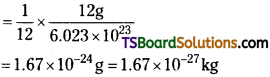
TS Inter 1st Year Physics Study Material Chapter 2 Units and Measurements 1

Short Answer Questions

Question 1.
The vernier scale of an instrument has 50 divisions which coincide with 49 main scale divisions. If each main scale division is 0.5 mm, then using this instrument what would be the minimum inaccuracy in the measurement of distance?
Answer:
Least count of Vernier Callipers = 1 MSD – 1 VSD
∴ L.C. = 1 MSD – \(\frac{49}{50}\)MSD = \(\frac{1}{50}\)MSD
= \(\frac{1}{50}\) × 0.5 = 0.01 m.m

Question 2.
In a system of units, the unit of force is 100N, unit of length is 10m and the unit of time is 100s. What is the unit of mass in this system?
Answer:
Here, F = MLT-2 = 100 N → (1) ;
L = 10 m ; T = 100s
∴ From equation (1)
M × (10) × (100)-2 = 100 ⇒ M × 10-3 = 100
⇒ M = \(\frac{100}{10^{-3}}\) ⇒ M = 105 kg.

TS Inter 1st Year Physics Study Material Chapter 2 Units and Measurements

Question 3.
The distance of a galaxy from Earth is of the order of 1025m. Calculate the order of magnitude of the time taken by light to reach us from the galaxy.
Answer:
Size of galaxy = 1025m,
Velocity of light, c = 3 × 10⁸ ms-1
Time taken by light to reach earth,

TS Inter 1st Year Physics Study Material Chapter 2 Units and Measurements 2

While calculating the order of magnitude we will consider the powers of Ten only.
So order of magnitude of time taken by light to reach earth from galaxy is 1017 seconds.

Question 4.
The Earth-Moon distance is about 60 Earth radius. What will be the approximate diameter of the Earth as seen from the Moon?
Answer:
Earth moon distance, D = 60r.
Diameter of earth, b = 2r
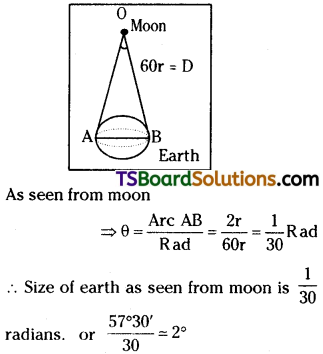
TS Inter 1st Year Physics Study Material Chapter 2 Units and Measurements 3

Question 5.
Three measurements of the time for 20 oscillations of a pendulum give t1 = 39.6 s, t2 = 39.9 s and t3 = 39.5 s. What is the precision in the measurements? What is the accuracy of the measurements?
Answer:
Precision is the least measurable value with that instrument in our case precision is ±0.1 sec.

Calculation of accuracy :
Average value of measurements

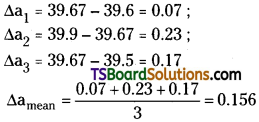
TS Inter 1st Year Physics Study Material Chapter 2 Units and Measurements 4

Error in each measurement =
TS Inter 1st Year Physics Study Material Chapter 2 Units and Measurements 5

Precision ± 1 sec. In these measurements only two significant figures are believable. 3rd one is uncertain.

Adjustment of ∆amean upto given significant figure = 0.156 adjusted to 0.2.

So our value is accurate upto ±0.2

So our result is 39.67 ± 0.2, when significant figures taken into account it is 39.7 ± 0.2 sec.

Question 6.
1 calorie = 4.2 J where 1J = 1 kg m²s-2. Suppose we employ a system of units in which the unit of mass is α kg, the unit of length is β m and the unit of time γ s, show that a calorie has a magnitude 4.2 α-1 β-2 γ² in the new system.
Answer:
Here, 1 calorie = 4.2 J = 4.2 kg m² / s² → (1)
As new unit of mass = α kg
∴ 1 kg = \(\frac{1}{\alpha}\) new unit of mass
⇒ α-1 new unit of mass

Similarly lm = β-1 new unit of length and 1s = γ-1 new unit of time

Putting these values in (1) we get
1 calorie = 4.2 (α-1 new unit of mass) (β-1 new unit of length)² (γ-1 new unit of time)-2
= 4.2 α-1 β-2 γ² new unit of energy, which was proved.

Question 7.
A new unit of length is chosen so that the speed of light in vacuum is 1 ms-2. If light takes 8 min and 20s to cover this distance, what is the distance between the Sun and Earth in terms of the new unit?
Answer:
Given that velocity of light in vacuum,
c = 1 new unit of length s-1
Time taken by light of Sun to reach Earth, t = 8 min 20s = 8 × 60 + 20 = 500 s
∴ Distance between the Sun and Earth, x = c × t
= 1 new unit of length s-1 × 500s
= 500 new units of length.

TS Inter 1st Year Physics Study Material Chapter 2 Units and Measurements

Question 8.
A student measures the thickness of a human hair using a microscope of magnification 100. He makes 20 observations and finds that the average thickness (as viewed in the microscope) is 3.5 mm. What is the estimate of the thickness of hair?
Answer:
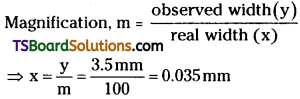
TS Inter 1st Year Physics Study Material Chapter 2 Units and Measurements 6
∴ Thickness of hair is 0.035 mm

Question 9.
A physical quantity X is related to four mea-surable quantities a, b, c and d as follows:
X = a²b³C5/2d-2
The percentage error in the measurement of a, b, c and d are 1%, 2%, 3% and 4% respectively. What is the percentage error in X?
Answer:
Here, X = a²b³C5/2d-2
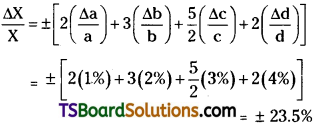
TS Inter 1st Year Physics Study Material Chapter 2 Units and Measurements 7
The percentage error in X is ± 23.5 %

Question 10.
The velocity of a body is given by v = At² + Bt + C. If v and t are expressed in SI, what are the units of A, B and C?
Answer:
From principle of Homogeneity the terms At², Bt and C must have same dimensional formula of velocity ‘v’.
v = Velocity = LT-1 ⇒ CT-1 = A [T²]
∴ A = \(\frac{LT^{-1}}{T^2}\) = LT-3 . So unit of A is m/sec³
LT-1 = BT ⇒ B = LT-2 So unit of B is m/sec²
LT-1 = C So unit of C is m/sec.

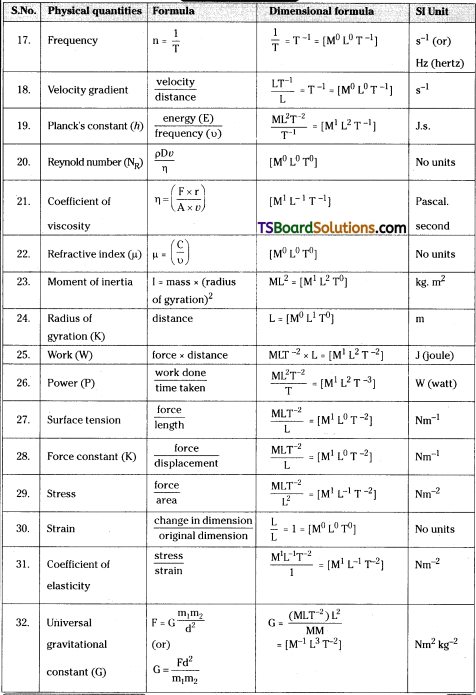
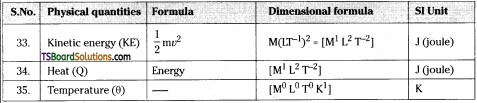
Dimensional formulae of physical quantities
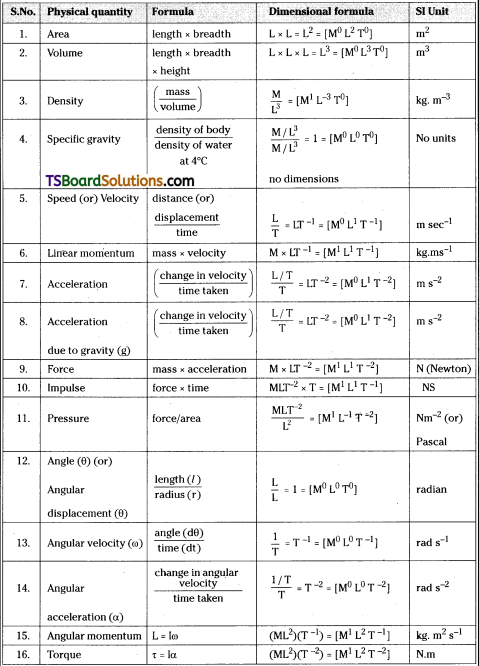
TS Inter 1st Year Physics Study Material Chapter 2 Units and Measurements 8 TS Inter 1st Year Physics Study Material Chapter 2 Units and Measurements 9
TS Inter 1st Year Physics Study Material Chapter 2 Units and Measurements 10

Problems

Question 1.
In the expression P = El² m-5 G-2 the quantities E, l, m and G denote energy, angular momentum, mass and gravitational constant respectively. Show that P is a dimensionless, quantity.
Solution:
Here, P = El² m-5 G-2
Here,
I = energy,
l = angular momentum
m = mass
G = gravitational constant
= [M L²T-2][ML²T-1]² [M]-5 [M-1L³T-2]-2
= M1+2+5+2 L2+4-6 T-2-2+4
P = [M° L° T°]
Hence, P is a dimensionless quantity.

TS Inter 1st Year Physics Study Material Chapter 2 Units and Measurements

Question 2.
If the velocity of light c, Planck’s constant, h and the gravitational constant G are taken as fundamental quantities; then express mass, length and time in terms of dimensions of these quantities.
Solution:
Here, c = [L T-1] ; h = [ML²T-1]
G = [M-1L³T-2]
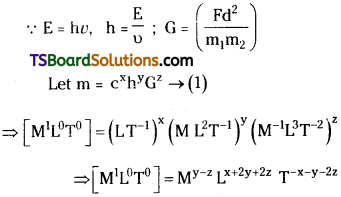
TS Inter 1st Year Physics Study Material Chapter 2 Units and Measurements 11
Applying the principle of homogeneity of dimensions, we get

y – z = 1 → (2) ; x + 2y + 3z = 0 → (3) ; – x – y – 2z = 0 → (4)
Adding eq. (2), eq. (3) and eq. (4),
2y – 1 ⇒ y = \(\frac{1}{2}\)
∴ From eq. (2) z = y – 1 = \(\frac{1}{2}\) – 1 = \(\frac{-1}{2}\)
From eq. (4) x = -y – 2z = \(\frac{-1}{2}\) + 1 = \(\frac{1}{2}\)
Substituting the values of x, y & z in eq. (1), we get
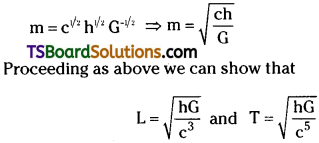
TS Inter 1st Year Physics Study Material Chapter 2 Units and Measurements 12

Question 3.
An artificial satellite is revolving around a planet of mass M and radius R, in a circular orbit of radius r. Using dimensional analysis show that the period of the satellite.
T = \(\frac{k}{R} \sqrt{\frac{r^3}{g}}\)
where k is a dimensionless constant and g is acceleration due to gravity.
Solution:
Given that
T² ∝ r³ or T ∝ r3/2 Also T is a function of g and R
Let T ∝ r3/2 ga Rb where a, b are the dimen¬sions of g and R.
(or) T = k r3/2 ga Rb → (1)
where k is dimensionless constant of proportionality
From equation (1)

TS Inter 1st Year Physics Study Material Chapter 2 Units and Measurements 13
Applying the principle of homogeneity of dimensions, we get

a + b + \(\frac{3}{2}\) = 0 → (2) ∴ -2a = 1 ⇒ a = \(\frac{-1}{2}\)
From eq (1), \(\frac{-1}{2}\) + b + \(\frac{3}{2}\) = 0 ⇒ b = -1
Substituting the values of a’ and b’ in eq. (1), we get
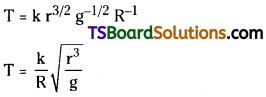
TS Inter 1st Year Physics Study Material Chapter 2 Units and Measurements 14
This is the required relation.

Question 4.
State the number of significant figures in the following
a) 6729 b) 0.024 c) 0,08240 d) 6.032 e) 4.57 x 10⁸
Solution:
a) In 6729 all are significant figures.
∴ Number of significant figures Four.

b) In 0.024 the zeroes to the left of 1st non-zero digit of a number less than one are not significant.
∴ Number of significant figures Two.

c) 0.08240 – Significant figures Four.

d) In 6.032 the zero between two non-zero digits is significant.
So, number of significant figures in 6.023 are 4.

e) 4.57 × 10⁸ – Significant figures Three. [In the representation of powers of Ten our rule is only significant figures must be given].

Question 5.
A stick has a length of 12.132 cm and another has a length of 12.4 cm. If the two sticks are placed end and to what is the total length? If the two sticks are placed side by side, what is the difference in their lengths?
Solution:
a) When placed end to end total length is l = l1 + l2
l1 = 12.132 cm and l2 = 12.4 cm.
∴ l1 + l2 = 12.132 + 12.4 = 24.532 cm.
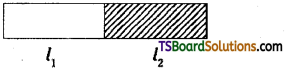
TS Inter 1st Year Physics Study Material Chapter 2 Units and Measurements 15

In addition final answer must have least number of significant numbers in that addition, i.e., one after decimal point.
So our answer is 24.5 cm. b) For difference use l1 – l2
i.e., 12.4- 12.132 = 0.268 cm.
In subtraction final answer must be adjusted to least number of significant figures in that operation.

Here least number is one digit after decimal. By applying round off procedure our answer is 0.3 cm.

TS Inter 1st Year Physics Study Material Chapter 2 Units and Measurements

Question 6.
Each side of a cube is measured to be 7.203 m. What is (i) the total surface area and (ii) the volume of the cube, to appropriate significant figures?
Solution:
Side of cube, a = 7.203 m.
So number of significant figures are Four.
i) Surface area of cube = 6a²
= 6x 7.203 × 7.203 = 311.299

But our final answer must be rounded to least number of significant figures is four digits.
So surface area of cube = 311.3 m²
ii) Volume of cube, V = a³ = (7.203)³
= 373.147
But the answer must be limited to Four significant figures.
∴ Volume of sphere, V = 373.1 m³.

Question 7.
The measured mass and volume of a body are 2.42 g and 4.7 cm³ respectively with possible errors 0.01 g and 0.1 cm³. Find the maximum error in density.
Solution:
Mass, m = 2.42 g ; Error, ∆m = 0.01 g.
Volume, V = 4.7 cm³, Error, ∆V = 0.1 cc.
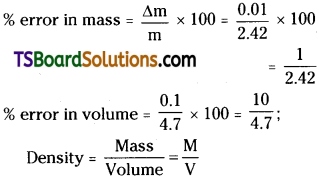
TS Inter 1st Year Physics Study Material Chapter 2 Units and Measurements 16
Maximum % error in density = % error in mass + % error in volume Maximum percentage error in density
= \(\frac{1}{2.42}+\frac{10}{4.7}\) = 0.413 + 2.127 = 2.54%

Question 8.
The error in measurement of radius of a sphere is 1%. What is the error in the measurement of volume? [AP Mar. ’19]
Solution:
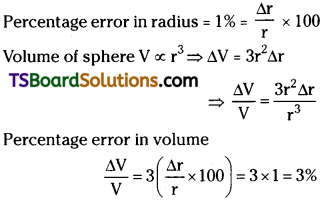
Question 9.
The percentage error in the mass and speed are 2% and 3% respectively. What is the maximum error in kinetic energy calculated using these quantities?
Solution:
Percentage change in mass = \(\frac{\Delta \mathrm{m}}{\mathrm{m}}\) × 100 = 2%
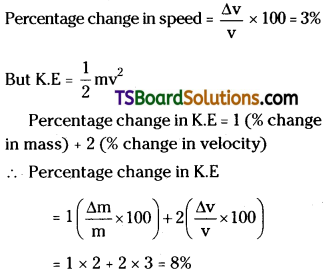
TS Inter 1st Year Physics Study Material Chapter 2 Units and Measurements 18

TS Inter 1st Year Physics Study Material Chapter 2 Units and Measurements

Question 10.
One mole of an ideal gas at standard temperature and pressure occupies 22.4 L (molar volume). If the size of the hydrogen molecule is about 1Å, what is the ratio of molar volume to the atomic volume of a mole of hydrogen?
Solution:
Size of Hydrogen atom ≈ 1Å = 10-10 m = 10-8cm
V1 = Atomic volume = number of atoms × volume of atom.
One mole gas contains n’ molecules.
Avogadro Number, n = 6.022 × 10²³
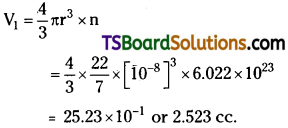
TS Inter 1st Year Physics Study Material Chapter 2 Units and Measurements 19
V2 = Molar volume of 1 mol. gas = 22.4 lit
= 2.24 × 10⁴C.C
∵ 1 lit = 1000 c.c.
∴ Ratio of molar volume to atomic volume = V2 : V1
= 2.24 × 10⁴ : 2.523 ≅ 104 m.
TS Inter 1st Year Physics Study Material Chapter 1 Physical World

Telangana TSBIE TS Inter 1st Year Physics Study Material 1st Lesson Physical World Textbook Questions and Answers.

TS Inter 1st Year Physics Study Material 1st Lesson Physical World

Very Short Answer Type Questions

Question 1.
What is Physics? [TS Mar. ’16]
Answer:
Physics is a branch of science which deals with the study of nature and natural phenomena.

Question 2.
What is the discovery of C.V. Raman? [AP Mar. ’18, 14; May 18, 16, 14; TS Mar. ’19, ’18, ’17]
Answer:
C.V. Raman’s contribution to physics is Raman effect. It deals with scattering of light by molecules of a medium when they are excited to vibrational energy levels.

Question 3.
What are the fundamental forces in nature? [TS May ’18]
Answer:
There are four fundamental forces in nature that govern the diverse phenomena of the macroscopic and the microscopic wu.m. These are the ‘gravitational force’, the ‘electromagnetic force’, the ‘strong nuclear force’, and the ‘weak nuclear force’.

Question 4.
Which of the following has symr etry?
a) Acceleration due to gravity.
b) Law of gravitation.
Answer:
Acceleration due to gravity varies from place to place. So it has no symmetry.
Law of gravitation has symmetry, because it does not depend on any physical quantity.

Question 5.
What is the contribution of S. Chandra Sekhar to Physics?
Answer:
S. Chandra Sekhar discovered the structure and evolution of stars. He defined “Chandra Sekhar limit” which is used in the study of black holes.

TS Inter 1st Year Physics Study Material Chapter 1 Physical World

Question 6.
What is beta (β) decay? Which force is a function of it?
Answer:
In β-decay the nucleus emits an electron and an uncharged particle called neutrino.

β – decay is due to weak nuclear forces.

❖ Some physicists and their major contributions

NameMajor contribution/ Discovery
1. ArchimedesPrinciple of buoyancy, Principle of the lever
2. Galileo GalileiLaw of inertia
3. Isaac NewtonUniversal law of gravitation; Laws of motion, Corpuscular theory of light; Reflecting telescope.
4. C.V.RamanInelastic scattering of light by molecules.
5. Edwin HubbleExpanding universe
6. Hideki YukawaTheory of nuclear forces
7. S. ChandrasekharChandrasekhar limit, structure and evolution of stars
8. Michael FaradayElectromagnetic induction laws
9. James Clark MaxwellElectromagnetic theory – light – electromagnetic waves
10. J.J.ThomsonElectron
11. Albert EinsteinExplanation of photoelectric effect and theory of relativity
12. R.A.MillikanMeasurement of charge of electron.
13. Ernest RutherfordNuclear model of atom
14. John BardeenTransistors; Theory of super conductivity.

TS Inter 1st Year Physics Study Material Chapter 1 Physical World

❖ Fundamental forces of nature

NameRelative strength (N)
1. Gravitational force10-39
2. Weak nuclear forces10-13
3. Electromagnetic forces10-2
4. Strong nuclear forces1


❖ Fundamental constants of Physics

Physical constantSymbolValue
1. Speed of light in vacuumC3 × 108 meter/sec
2. Planck’s constanth6.63 × 10-34 joule.sec
3. Molar gas constantR8.31 joule/mole.K
4. Avogadro’s numberNA6.02 × 1023/ mol
5. Boltzmann’s constantK1.38 × 10-23/mol
6. Gravitational constantG6.67  10-11 Newton.m2/kg2
7. Mechanical equivalent of heatJ4.185 joule/cal.
8. Triple point of waterTtr273.16 K
9. Density of water at 20° Cdω103kg/m3
10. Density of mercurydm13.6 × 103 kg/m3
11. Density of dry air at N.T.P.da1.293 kg /m3
12. Specific heat of watersω1 cal./gm/°C
13. Latent heat of iceLf80 cal./gm
14. Latent heat of steamLυ540 cal/gm (or 539)
15. √5 = 2.236, √3 = 1-732, √10 = 3.162, loge 10 = 2.3026
16. π = 3.14, π2 = 9.87, √π = 1.7772, √2 = 1.414

TS Inter 1st Year Physics Study Material Chapter 1 Physical World

❖ Conversion factors:
1 metre – 100 cm
1 millimeter – 10-3m
1 inch – 2.54 × 10⁻²m
1 micron (µ) – 10-4cm
1 Angstrom (A°) – 10-8cm
1 fermi (f) – 10-13 cm
1 kilometer – 10³ m
1 light year – 9.46 × 10¹⁵ m
1 litre – 10³cm³
1 kilogram – 1000 gm
1 metricton – 1000 kg
1 pound – 453.6 gm
1 atomic mass
unit (a.m.u) 1.66 × 10⁻²⁷ kg
1 a.m.u – 931 MeV
1 day – 8.640 × 10⁴ seconds
1 km/hour – \(\frac{5}{18}\) m/sec (or)
0.2778 meter/sec.
1 Newton – 105 dynes
1 gm wt – 980.7 dynes
1 kg.wt – 9.807 Newton
1 Newton/meter² – 1 pascal
TS Inter 1st Year Physics Study Material Chapter 1 Physical World 1
1 Pascal – 10 dyne/cm²
1 Joule – 107 erg
1 kilo watt hour – 3.6 × 10⁶ joule
1 electro volt (ev) – 1.602 × 10⁻¹⁹ joule
1 watt – 1 joule / sec
1 horse power (HP) – 746 watt
1 degree (° ) – 60 minute (‘)
1 Radian – 57.3 degree ( ° )
1 Poise – 1 dyne . sec / cm²
1 Poiseuille – 10 poise
(Newton, sec/m² (or) Pascal sec.)

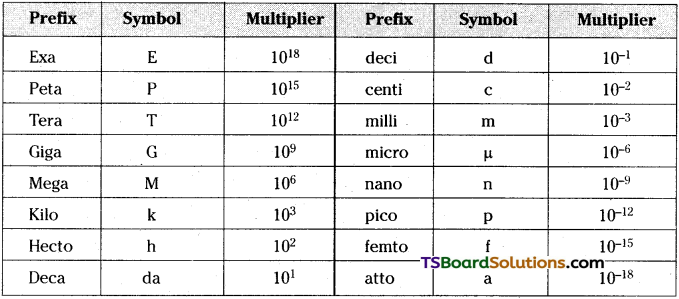
❖ Important Prefixes:
TS Inter 1st Year Physics Study Material Chapter 1 Physical World 2

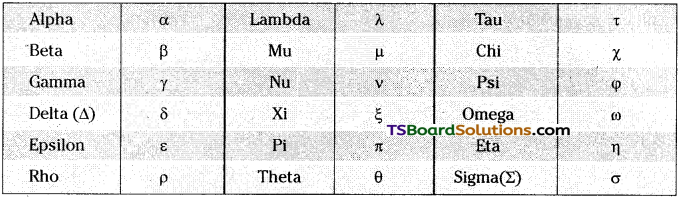
❖ The Greek Alphabet:
TS Inter 1st Year Physics Study Material Chapter 1 Physical World 3

❖ Formulae of geometry :
1. Area of triangle = \(\frac{1}{2}\) × base × height
2. Area of parallelogram = base × height
3. Area of square = (length of one side)²
4. Area of rectangle = length × breadth
5. Area of circle = πr² (r = radius of circle)
6. Surface area of sphere = 4πr² (r = radius of sphere)
7. Volume of cube = (length of one side of cube)³
8. Volume of parallelopiped = length × breadth × height
9. Volume of cylinder = πr²l
10. Volume of sphere = \(\frac{4}{3}\)πr³
Circumference of square = 4l
11. Volume of cone = \(\frac{1}{3}\) πr²h
12. Circumference of circle = 2πr

TS Inter 1st Year Physics Study Material Chapter 1 Physical World

❖ Formulae of algebra:
(a + b)² = a² + b² + 2ab
(a – b)² = a² + b² – 2ab
(a² – b²) = (a + b) (a – b)
(a + b)³ = a³ + b³ + 3ab (a + b)
(a – b)³ = a³ – b³ – 3ab (a – b)
(a + b)² – (a – b)² = 4ab
(a + b)² + (a – b)² = 2(a² + b²)

❖ Formulae of differentiation:
1. \(\frac{d}{dx}\) (constant) = 0
differentiation with respect to x = \(\frac{d}{dx}\)
2. \(\frac{d}{dx}\) (xn) = n xn – 1
3. \(\frac{d}{dx}\) (sin x) = cos x
4. \(\frac{d}{dx}\) (cos x) = – sin x dx

❖ Formulae of Integration:
Integration with respect to x = ∫dx
1. ∫dx = x
2. ∫xn dx = r n + 1
3. ∫sin x dx = cos x + c
4. ∫cos x dx = sin x + c

❖ Formulae of logarithm :
1. log mn = (log m + log n)
2. log\(\frac{m}{n}\) = (log m – log n)
3. log mn = n log m

❖ Value of trigonometric functions :
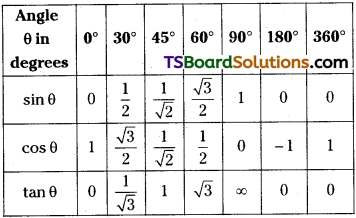
TS Inter 1st Year Physics Study Material Chapter 1 Physical World 4

TS Inter 1st Year Physics Study Material Chapter 1 Physical World

❖ Signs of trigonometrical ratios :
sin (90° – θ) = cos θ ; sin (180° – θ) = sin θ
cos (90° – θ) = sin θ ; cos (180° – θ) = – cos θ
tan (90° – θ) = cot θ ; tan (180° – θ) = – tan θ

❖ According to Binomial theorem :
(1 + x)n ≈ (1 + nx) if x < < 1

❖ Quadratic equation:
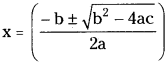
ax² + bx + c = 0
TS Inter 1st Year Physics Study Material Chapter 1 Physical World 5

TS Inter 1st Year Maths 1A Products of Vectors Formulas

Learning these TS Inter 1st Year Maths 1A Formulas Chapter 5 Products of Vectors will help students to solve mathematical problems quickly.

TS Inter 1st Year Maths 1A Products of Vectors Formulas

→ The dot or scalar product of two vectors which are non zero denoted by a̅. b̅ and defineci by a̅. b̅ = |a̅| |b̅| cos θ where θ is the angle between a̅ and b̅ which is geometrically equal to product of magnitude of one of the vectors and the projection of the other on the first vector.

→ Dot product is a scalar, if a̅ = 0 or b̅ = 0 then wre define a̅ . b̅ = 0; If we write (a, b) = 9 then a̅ . b̅ = |a̅| |b̅| cos θ if a ≠ 0. b ≠ 0. a̅ .b̅ ⇔ a̅ and b̅ are perpendicular.

  • Projection of b̅ on a̅ = \(\frac{|\bar{a} \cdot \bar{b}|}{|\bar{a}|}\)
  • Orthogonal projection b̅ on a̅ = \(\frac{(\bar{a} \cdot \bar{b}) \bar{a}}{|\bar{a}|^2}\); a̅ ≠ 0
    (or) \(\left(\frac{\overline{\mathrm{a}} \cdot \overline{\mathrm{b}}}{|\overline{\mathrm{a}}|^2}\right)\)a̅ and its magnitude = \(\frac{|\bar{a} \cdot \bar{b}|}{|\bar{a}|}\)
  • Component vector of b̅ along a̅ (or) parallel to a̅ is \(\left(\frac{\bar{a} \cdot \bar{b}}{|\bar{a}|^2}\right)\)a̅.
  • Component vector of b̅ along a̅ (or) parallel to a̅ is \(\left(\frac{\bar{a} \cdot \bar{b}}{|\bar{b}|^2}\right)\) b̅ and component vector of a̅ perpendicular to b̅ is b̅ = a̅ – \(\frac{(\bar{a} \cdot \bar{b}) \bar{b}}{|\bar{b}|^2}\)

→ If i̅, j̅, k̅ are orthogonal unit vectors then i̅. j̅ = j̅.k̅ = k̅.i̅ = 0 and i̅ . i̅ = j̅ . j̅ = k̅ . k̅ = 1

→ If a̅, b̅, c̅ are any three vectors then

  • (a̅ + b̅)2 = |a̅|2 + |b̅|2 + 2(a̅ . b̅)
  • (a̅ – b̅)2 = |a̅|2 – |b̅|2 + 2(a̅ . b̅)
  • (a̅ + b̅)2 + (a̅ – b̅)2 = 2(|a̅|2 + |b̅|2)

→ If a̅ = a1i̅ + a2j̅ + a3k̅ and b̅ = b1i̅ + b2j̅ + b3k̅ then

  • a̅.b̅ = a1b1 + a2b2 + a3b3
    a̅ is perpendicular to b̅ ⇔ a1b1 + a2b2 + a3b3 = 0
  • cos θ = \(\frac{\bar{a} \cdot \bar{b}}{|\bar{a}||\bar{b}|}=\frac{a_1 b_1+a_2 b_2+a_3 b_3}{\sqrt{\Sigma a_1^2} \sqrt{\Sigma b_1^2}}\)
  • a̅ is parallel to b̅ ⇔ \(\frac{a_1}{b_1}=\frac{a_2}{b_2}=\frac{a_3}{b_3}\)
  • a̅.a̅ ≥ 0; |a̅.b̅| ≤ |a̅||b̅|
    |a̅ + b̅| ≤ |a̅| + |b̅|; |a̅ – b̅| ≤ |a̅| + |b̅|

TS Inter 1st Year Maths 1A Products of Vectors Formulas

→ a̅ × b̅ = |a̅||b̅| sin θ n̂ is the vector product of two vectors a̅ and b̅ and n̂ is a unit vector perpendicular to the plane containing a̅ and b̅.
sin θ = \(\frac{|\bar{a} \times \bar{b}|}{|\bar{a}||\bar{b}|}\); n = \(\frac{\bar{a} \times \bar{b}}{|\bar{a} \times \bar{b}|}\)
Also a̅ × b̅ ≠ b̅ × a̅ and a̅ × b̅ = -(b̅ × a̅)

→ (i) a̅ × a̅ = 0̅ , a̅, b̅ are parallel ⇒ a̅ × b̅ = 0

  • i̅ × i̅ = j̅ × j̅ = k̅ × k̅ = 0̅
  • i̅ × j̅ = k̅; j̅ × k̅ = i̅ , k̅ × i̅ = j̅

(ii) If a̅ = a1i̅ + a2j̅ + a3k̅, b̅ = b1i̅ + b2j̅ + b3k̅ ⇒ a̅ × b̅ = \(\left|\begin{array}{ccc}
\overline{\mathrm{i}} & \overline{\mathrm{j}} & \overline{\mathrm{k}} \\
\mathrm{a}_1 & \mathrm{a}_2 & \mathrm{a}_3 \\
\mathrm{~b}_1 & \mathrm{~b}_2 & \mathrm{~b}_3
\end{array}\right|\)

→ (i) Vector area of parallelogram with adjacent sides a̅, b̅ = |a̅ x b̅|
(ii) Vector area of parallelogram with diagonals \(\overline{\mathrm{d}}_1, \overline{\mathrm{d}}_2=\frac{1}{2}\left|\overline{\mathrm{d}}_1 \times \overline{\mathrm{d}}_2\right|\)
(iii) Area of the quadrilateral with diagonals \(\overline{\mathrm{AC}}, \overline{\mathrm{BD}}=\frac{1}{2}|\overline{\mathrm{AC}} \times \overline{\mathrm{BD}}|\)
(iv) Area of ΔABC = \(\frac{1}{2}|\overline{\mathrm{AB}} \times \overline{\mathrm{AC}}|\)

→ The vector equation of a plane in the normal form is r̅.n̅ = p, where n̅ is a unit normal vector from the origin to the plane and p is the perpendicular distance from the origin to the plane.

→ The vector equation of a plane passing through the point A(a̅) and perpendicular to n̅ is (r̅ – a̅)n̅ = 0 or r̅.n̅ = a̅. n̅

→ The angle 0 between the planes r̅,n̅1 = p1 and r̅ . n̅2 = p2 is 0 = cos-1\(\frac{\bar{n}_1 \cdot \bar{n}_2}{\left|\bar{n}_1\right|\left|\bar{n}_2\right|}\)

→ The scalar triple product (STP) of the vectors a,b, c is (a̅ × b̅) . c̅ or a̅ . (b̅ × c̅) and is denoted by [a̅ b̅ c̅].

→ The magnitude |[a̅ b̅ c̅]| gives the volume of the parallelopiped with a̅, b̅, c̅ as its coterminus edges.

→ If a̅ = a1i̅ + a2 j̅ + a3k̅, b̅ = b1 i̅ + b2 j̅ + b3k̅, c̅ = c1 i̅ + c2 j̅ + c3k̅ then
[a̅ b̅ c̅] = \(\left|\begin{array}{lll}
a_1 & a_2 & a_3 \\
b_1 & b_2 & b_3 \\
c_1 & c_2 & c_3
\end{array}\right|\)

  • Volume of the tetrahedron with a, b,c as its coterminus edges is V = \(\frac{1}{6}\)| [a̅ b̅ c̅]|
  • Volume of tetrahedron ABCD is V = \(\frac{1}{6}|[\overline{\mathrm{AB}} \overline{\mathrm{AC}} \overline{\mathrm{AD}}]|\)

→ Three vectors a, b,c are coplanar ⇔ [a̅ b̅ c̅] = 0 and a, b,c are non – coplanar ⇔ [a̅ b̅ c̅] ≠ 0

→ The shortest distance between the skew lines r̅ = a̅ + tb̅ and r̅ = c̅ + sd̅ where s, t are scalars is \(\)

→ Vector triple product of three vectors a̅, b̅, c̅ is a vector defined by
(a̅ × b̅) × c̅ = (a̅. c̅)b̅ – (c̅ . b̅)a̅ (or) a̅ × (b̅ × c̅) = (a̅. c̅)b̅ – (a̅ . b̅)c̅

TS Inter 1st Year Maths 1A Products of Vectors Formulas

→ The vector equation of a plane passing through the point A(a̅) and parallel to two non – collinear vectors b̅ and c̅ is [r̅ b̅ c̅] = [a̅ b̅ c̅]

→ The vector equation of a plane passing through A(a̅), B(b̅) and parallel to the vector is [r̅ b̅ c̅] + [r̅ c̅ a̅] = [a̅ b̅ c̅]

→ The vector equation of a plane passing through three non colilnear points A(a̅), B(b̅) and C(c̅) is [r̅ b̅ c̅] + [r̅ c̅ a̅] + [r̅ a̅ b̅] = [a̅ b̅ c̅]

→ The vector equation of the plane containing the line r̅ = a̅ + tb̅; t ∈ R and perpendicular to the plane r̅.c̅ = q is [r̅ b̅ c̅] = [a̅ b̅ c̅]

  • If a̅, b̅ are two non zero and non parallel vectors then |a̅ × b̅|2 = a2b2 – (a̅ . b̅) = \(\left|\begin{array}{cc}
    \bar{a} \cdot \bar{a} & \bar{a} \cdot \bar{b} \\
    \bar{a} \cdot \bar{b} & \bar{b} \cdot \bar{b}
    \end{array}\right|\)
  • For any vector a̅, (a̅ × i̅) + (a̅ × j̅) + (a̅ × k̅) = 2|a̅|.
  • If a̅, b̅, c̅ are the position vectors of the points A, B, C then the perpendicular distance from C to the line AB is = \(\frac{|\overline{\mathrm{AC}} \times \overline{\mathrm{AB}}|}{|\overline{\mathrm{AB}}|}=\frac{|(\overline{\mathrm{b}} \times \overline{\mathrm{c}})+(\overline{\mathrm{c}} \times \overline{\mathrm{a}})+(\overline{\mathrm{a}} \times \overline{\mathrm{b}})|}{|\overline{\mathrm{b}}-\overline{\mathrm{a}}|}\).

TS Inter 1st Year Maths 1A Addition of Vectors Formulas

Learning these TS Inter 1st Year Maths 1A Formulas Chapter 4 Addition of Vectors will help students to solve mathematical problems quickly.

TS Inter 1st Year Maths 1A Addition of Vectors Formulas

→ Scalar : A physical quantity having magnitude is called a scalar.
E.g. : Length, mass, area, volume, temperature, speed etc.

→ Vector : A physical quantity having both magnitude and direction is called a vector.
Ex : Displacement, velocity, acceleration, force, angular momentum.

→ Modulus of a vector : If a vector \(\overline{\mathrm{AB}}\) is denoted by a̅ then |a̅|. denote the length oi the vector of a̅ also |a̅| is called the magnitude or modulus of a vector a .

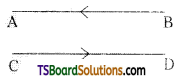
→ Collinear or parallel vectors : Vectors along the same line or along the parallel line are called collinear vectors. In figure \(\overline{\mathrm{AB}}, \overline{\mathrm{BC}}, \overline{\mathrm{CA}}\) are collinear vectors. Two vectors a̅ b̅ are parallel or collinear iff a̅ = tb̅ . t ∈ R.

→ Like vectors: Collinear or parallel vectors having the same direction are called like vectors.
TS Inter 1st Year Maths 1A Addition of Vectors Formulas 1

→ Unlike vectors:
Collinear or parallel vectors having opposite direction are called unlike vectors.
TS Inter 1st Year Maths 1A Addition of Vectors Formulas 2

TS Inter 1st Year Maths 1A Addition of Vectors Formulas

→ Unit vector:
A vector whose modulus is unity is called a unit vector. The unit vector in the direction of vector a̅ is denoted by a̅̂. Thus modulus of |a̅̂| = 1.

  • Unit vector in the direction of a̅ is \(\frac{\overline{\mathrm{a}}}{|\overline{\mathrm{a}}|}\).
  • Unit vector in the opposite direction of a̅ is \(\frac{-a}{|\bar{a}|}\).

→ Position vector : If a point ‘O’ is fixed as origin in the plane and ‘A’ is any point then \(\overline{\mathrm{OA}}\) is called the position vector of A’ with respect to ‘O’.

→ Triangle law of addition of vectors: In a triangle OAB, let \(\overline{\mathrm{OA}}\) = a̅, \(\overline{\mathrm{AB}}\) = b̅ then the resultant vector \(\overline{\mathrm{OB}}\) is defined as \(\overline{\mathrm{OB}}=\overline{\mathrm{OA}}+\overline{\mathrm{AB}}\) = a̅ + b̅.
This is known as triangle law of addition of vectors.

→ Section formula:

  • Let A and B be two points with position vectors a̅ and b̅ respectively. Let ‘C’ be a point dividing AB internally in the ratio m : n. The position of ‘C’ is \(\overline{O C}=\frac{m b+n a}{m+n}\)
  • Let A and B be two points with position vectors a̅ and b̅. Let be a point dividing the line segment AB externally in the ratio in : n then the position vector of C is given by \(\overline{\mathrm{OC}}=\frac{\mathrm{mb}-n \bar{a}}{m-n}\)

→ The position vector of the midpoint of the line segment joining two vectors with position vector is \(\frac{\bar{a}+\bar{b}}{2}\).

→ Coplanar vectors: Two or more vectors are said to be coplanar if they lie on the same plane.

  • The vectors a̅, b̅, c̅ are said to be coplanar iff [a̅ b̅ c̅] = 0.
  • Four points A, B. C. D are said to be coplanar iff \(\left[\begin{array}{lll}
    \overline{\mathrm{AB}} & \overline{\mathrm{AC}} & \overline{\mathrm{AD}}
    \end{array}\right]\) = 0.
  • Three vectors a̅, b̅, c̅ are said to be linearly dependent iff [a̅ b̅ c̅] = 0.
  • Three vectors a̅, b, c̅ are said to be linearly independent iff [a̅ b̅ c̅] = 0.

→ Vector equations of a straight line :

  • The vector equation of the straight line passing through the point A (a̅) and parallel to the vector b̅ is r̅ = a̅ + tb̅ , t ∈ R.
  • The vector of the line passing through origin ‘O’ and parallel to the vector b̅ is r̅ = tb̅, t ∈ R.
    Cartesian form : Cartesian equation for the line equation passing through A (x1, y1, z1) and parallel to the vector b̅ = li + mj + nk is \(\frac{x-x_1}{l}=\frac{y-y_1}{m}=\frac{z-z_1}{n}\)
  • The vector equat ion of the line passing through the points A (a) and B(b) is r = (1 – t) a̅ + tb̅. t ∈ R.
    Cartesian form : Cartesian equation for the line through A(x1, y1, z1) and B(x2, y2, z2) is \(\frac{\mathrm{x}-\mathrm{x}_1}{\mathrm{x}_2-\mathrm{x}_1}=\frac{\mathrm{y}-\mathrm{y}_1}{\mathrm{y}_2-\mathrm{y}_1}=\frac{\mathrm{z}-\mathrm{z}_1}{\mathrm{z}_2-\mathrm{z}_1}\)

TS Inter 1st Year Maths 1A Addition of Vectors Formulas

→ Vector equations of a plane :

  • The vector equation of the plane passing through the points A(a̅) and parallel to the vectors b̅ & c̅ is r̅ = a̅ + tb̅ + sc̅ : t. s ∈ R.
  • The equation of the plane passing through the points A(a̅).B(b̅) and parallel to the vector c is r̅ = (1 – t) a̅ + tb + sc̅ ; t, s ∈ R.
  • The equation of the plane passing through three non-collinear points A(a̅), B(b̅) and C(c̅) is r̅ = (1 – t – s)a̅ + tb̅ + sc̅ ; t, s ∈ R.

→ Linear combinations : Let \(\overline{a_1}, \overline{a_2}, \ldots \ldots, \overline{a_n}\) be n vectors and l1, l2, …………. ln be n scalars.
Then \(l_1 \overline{\mathrm{a}_1}+l_2 \overline{\mathrm{a}_2}, \ldots \ldots \ldots+l_{\mathrm{n}} \overline{\mathrm{a}_{\mathrm{n}}}\) is called a linear combination of \(\overline{\mathrm{a}_1}, \overline{\mathrm{a}_2}, \ldots \overline{\mathrm{a}_{\mathrm{n}}}\).

TS Inter 1st Year Maths 1A Trigonometric Ratios up to Transformations Formulas

Learning these TS Inter 1st Year Maths 1A Formulas Chapter 6 Trigonometric Ratios up to Transformations will help students to solve mathematical problems quickly.

TS Inter 1st Year Maths 1A Trigonometric Ratios up to Transformations Formulas

→ sin θ, cos θ, tan θ, cot θ, cosec θ and sec θ are called trigonometric functions. The reciprocals of sin θ, cos θ, tan θ are cosec θ, sec θ and cot θ respectively.

→ The main identities are sin2θ + cos2θ =1, sec2θ – tan2θ = 1 and cosec2θ – cot2θ = 1.

→ The bounds for sin θ, cos θ and sec θ are |sin θ| ≤ 1, |cosec θ| ≤ 1 and |sec θ| ≥ 1.

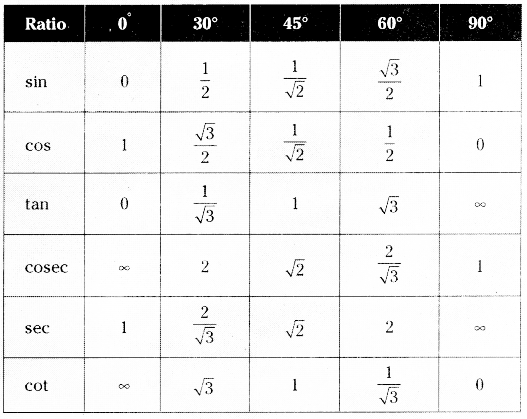
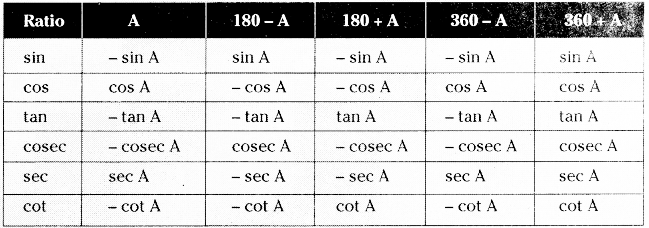
→ The three main tables are given by
Table 1 :
TS Inter 1st Year Maths 1A Trigonometric Ratios up to Transformations Formulas 1

TS Inter 1st Year Maths 1A Trigonometric Ratios up to Transformations Formulas

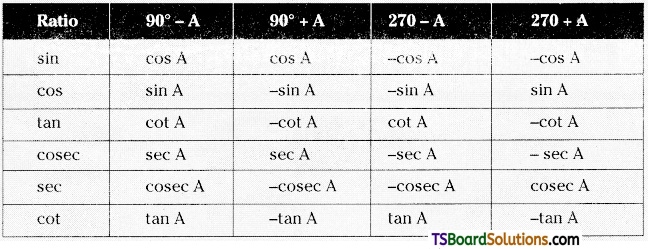
→ Using “All Silver Tea Cups”, the following tables may be comitted to memory.
Table 2:
TS Inter 1st Year Maths 1A Trigonometric Ratios up to Transformations Formulas 2

Table 3:
TS Inter 1st Year Maths 1A Trigonometric Ratios up to Transformations Formulas 3

→ sin 0° = 0 = cos 90°

  • sin 15° = \(\left(\frac{\sqrt{3}-1}{2 \sqrt{2}}\right)\) = cos 75°, sin 18° = \(\left(\frac{\sqrt{5}-1}{4}\right)\) = cos 72°
  • sin 36° = \(\left(\frac{\sqrt{10}-2 \sqrt{5}}{4}\right)\) = cos 54°, sin 54° = \(\left(\frac{\sqrt{5}+1}{4}\right)\) = cos 36°
  • sin 72° = \(\left(\frac{\sqrt{10+2 \sqrt{5}}}{4}\right)\) = cos 18°
  • sin 75° = \(\left(\frac{\sqrt{3}+1}{2 \sqrt{2}}\right)\) = cos 15°
  • tan 15° = 2 – √3 , tan 75° = 2 + √3

→ Any non constant function f: R → R is said to be Periodic” if there exists a real number p (* 0) such that f (x + p) = f(x) for each x e R. The least positive value of p with this period is called the “Period of f”.

→ (a) If f (x) is a periodic function with period p then f(ax +b) is also a periodic function with period \(\left(\frac{p}{|a|}\right)\)
(b) If y = f(x), y = g(x) are periodic functions with l, m as the periods respectively then h(x) = a f(x) + b g(x) where a, b R is a periodic function and LCM of {l, m} if exist is a period of h.
(c) The period of sin x, cosec x, cos x and sec x is 2π.
(d) The period of tan x and cot x is π.

→ (a) Range of a sin x + b cos x is \(\left[-\sqrt{a^2+b^2}, \sqrt{a^2+b^2}\right]\)
(b) Range of a sin x + b cos x + c is \(\left[c-\sqrt{a^2+b^2}, c+\sqrt{a^2+b^2}\right]\)

→ (a) sin(A ± B) = sin A cos B ± cos A sin B
(b) cos(A ± B) = cos A cos B ∓ sin A sin B
(c) tan (A ± B) = \(\frac{\tan A \pm \tan B}{1 \mp \tan A \tan B}\)
(d) cot (A ± B) = \(\frac{\cot A \cot B \pm 1}{\cot B \mp \cot A}\)
(e) sin (A + B) sin (A – B) = sin2A – sin2B = cos2B – cos2A
(f) cos (A + B) cos (A – B) = cos2A – sin’B = cos2B – sin2A

→ (a) sin (A + B + C) = sin A cos B cos C + cos A sin B cos C + cos A cos B sin C – sin A sin B sin C
(b) cos (A + B + C) = cos A cos B cos C + cos A sin B sin C – sin A cos B sin C – sin A sin B cos C
(c) tan (A + B + C) = \(\frac{\sum \tan A-\pi \tan A}{1-\sum \tan A \tan B}\)

TS Inter 1st Year Maths 1A Trigonometric Ratios up to Transformations Formulas

→ (a) sin 2A = 2 sinA cos A, sinA = 2 sin\(\frac{\mathrm{A}}{2}\) cos \(\frac{\mathrm{A}}{2}\)
(b) cos 2A = cos2A – sin2A = 1 – 2 sin2A = 2 cos2A – 1
cos A = cos2 \(\frac{\mathrm{A}}{2}\) – sin2 \(\frac{\mathrm{A}}{2}\) = 1 – 2 sin2\(\frac{\mathrm{A}}{2}\) = 2 cos2 \(\frac{\mathrm{A}}{2}\) – 1
(c) tan 2A = \(\frac{2 \tan A}{1-\tan ^2 A}\), tan A = \(\frac{2 \tan \frac{A}{2}}{1-\tan ^2 \frac{A}{2}}\) (\(\frac{A}{2}\), A are not odd multiples of \(\frac{\pi}{2}\))
(d) cot 2A = \(\frac{\cot ^2 A-1}{2 \cot A}\), cot A = \(\frac{\cot ^2 \frac{A}{2}-1}{2 \cot \frac{A}{2}}\) (A is not an integral multiple of π)
(e) sin 2A = \(\frac{2 \tan A}{1+\tan ^2 A}\), sin A = \(\frac{2 \tan \frac{A}{2}-1}{1+\tan ^2 \frac{A}{2}}\) (\(\frac{A}{2}\) is not an integral multiple of \(\frac{\pi}{2}\))
(f) cos 2A = \(\frac{1-\tan ^2 \mathrm{~A}}{1+\tan ^2 \mathrm{~A}}\), cos A = \(\frac{1-\tan ^2 \frac{A}{2}}{1+\tan ^2 \frac{A}{2}}\)

→ (a) sin 3A = 3 sin A – 4 sin3A
(b) cos 3A = 4cos3A – 3 cos A
(c) tan 3A = \(\frac{3 \tan A-\tan ^3 A}{1-3 \tan ^2 A}\)
(d) cot 3A = \(\frac{3 \cot A-\cot ^3 A}{1-3 \cot ^2 A}\)

→ Sums into formulae:
(a) sin (A + B) + sin (A – B) = 2 sin A cos B
(b) sin(A + B) – sin (A – B) = 2 cos A sin B
(c) cos (A + B) – cos (A – B) = 2 cos A cos B
(d) cos (A – B) – cos (A + B) = 2 sin A sin B

→ (a) sin C + sin D = 2 sin \(\left(\frac{C+D}{2}\right)\) cos \(\left(\frac{C-D}{2}\right)\)
(b) sin C – sin D = 2 cos\(\left(\frac{C+D}{2}\right)\) sin \(\left(\frac{C-D}{2}\right)\)
(c) cos C + cos D = 2 cos\(\left(\frac{C+D}{2}\right)\) cos \(\left(\frac{C-D}{2}\right)\)
(d) cos C – cos D = 2 sin \(\left(\frac{C+D}{2}\right)\) sin \(\left(\frac{D-C}{2}\right)\)

→ (a) sin A = ±\(\sqrt{\frac{1-\cos 2 A}{2}}\)
(b) cos A = ±\(\sqrt{\frac{1+\cos 2 A}{2}}\)
(c) tan A = ±\(\pm \sqrt{\frac{1-\cos 2 A}{1+\cos 2 A}}\), if A is not an odd multiple of \(\frac{\pi}{2}\)

→ (a) sin \(\frac{A}{2}=\pm \sqrt{\frac{1-\cos A}{2}}\)
(b) cos \(\frac{A}{2}=\pm \sqrt{\frac{1+\cos A}{2}}\)
(c) tan\(\frac{A}{2}=\pm \sqrt{\frac{1-\cos A}{1+\cos A}}\), if A is not an odd mutiple of π.

TS Inter 1st Year Maths 1A Trigonometric Ratios up to Transformations Formulas

→ (a) sin x and cos x are continuous functions on IR.
(b) tan x is discontinuous at x = (2n – 1) \(\frac{\pi}{2}\), n ∈ Z
(c) sec x is discontinuous at x = (2x + 1) \(\frac{\pi}{2}\), n ∈ Z
(d) cosec x is discontinuous at x = nπ, n ∈ Z

TS Inter 1st Year Maths 1A Inverse Trigonometric Equations Formulas

Learning these TS Inter 1st Year Maths 1A Formulas Chapter 7 Trigonometric Equations will help students to solve mathematical problems quickly.

TS Inter 1st Year Maths 1A Trigonometric Equations Formulas

→ Trigonometric equation :
An equation involving trigonometric functions is called a trigonometric equation.
Ex – 1 : a cos2 θ – b sin θ + c = 0
Ex – 2 : a cos θ + b sin θ + c = 0
Ex – 3 : a tan θ + b sec θ + c = 0

→ General solution (or) solution set:
The set of all values of θ which satisfy a trigonometric equation f(θ) = 0 is called general solution (or) solution set of f(θ) = 0.

→ Principle value:
1. There exists a unique value of θ in \(\left[\frac{-\pi}{2}, \frac{\pi}{2}\right]\) satisfying sin θ = k, k ∈ R. |k| ≤ 1. This value of θ is called principle value of θ (or) principle solution of sin θ = k.
Ex :

  • Principle solution of sin θ = \(\frac{1}{2}\) is \(\frac{\pi}{6}\).
  • Principle solution of sin θ = \(\frac{-1}{\sqrt{2}}\) is \(\frac{-\pi}{4}\).

2. There exists a unique value of θ in [0, n] satisfying cos θ = k. k ∈ R. |k| < 1. This value of θ is called principle value of θ (or) principle solution of cos θ = k.
Ex :

  • Principle solution of cos θ = \(\frac{1}{\sqrt{2}}\) is \(\frac{\pi}{4}\).
  • Principle solution of cos θ = \(\frac{-1}{2}\) is \(\frac{2 \pi}{3}\).

3. There exists a unique value of θ in \(\left(\frac{-\pi}{2}, \frac{\pi}{2}\right)\) satisfying tan θ = k, k ∈ R. This value of θ is called principle value of θ (or) principle solution of tan θ = k.
Ex :

  • Principle solution of tan θ = √3 is \(\frac{\pi}{3}\).
  • Principle solution of tan θ = \(\frac{-1}{\sqrt{3}}\) is \(\frac{-\pi}{6}\)

TS Inter 1st Year Maths 1A Trigonometric Equations Formulas

→ General solutions of trigonometric equations:

Trigonometric equationGeneral solution
1. sin θ = 0θ = n π, n ∈ Z
2. cos θ = 0θ = (2n + 1) \(\frac{\pi}{2}\) , n ∈ Z
3. tan θ = 0θ = nπ, n ∈ Z
4. sin θ = sin αθ = nπ + (- 1)n α, n ∈ Z
5. cos θ = cos αθ = 2nπ ± α, n ∈ Z
6. tan θ = tan αθ = nπ + α, n ∈ Z
7. sin2θ = sin2 αθ = nπ ± α, n ∈ Z
8. cos2θ = cos2 αθ = nπ ± α, n ∈ Z
9. tan2θ = tan2 αθ = nπ ± α, n ∈ Z

TS Inter 1st Year Maths 1A Inverse Trigonometric Functions Formulas

Learning these TS Inter 1st Year Maths 1A Formulas Chapter 8 Inverse Trigonometric Functions will help students to solve mathematical problems quickly.

TS Inter 1st Year Maths 1A Inverse Trigonometric Functions Formulas

→ sin-1(sin θ) = θ, if θ ∈ \(\left[\frac{-\pi}{2}, \frac{\pi}{2}\right]\)

→ sin (sin-1x) = x, if x ∈ [-1, 1]

→ cos-1(cos θ) = θ, if θ ∈ [0, π]

→ cos (cos-1x) = x, if x ∈ [-1, 1]

→ tan-1(tan θ) = θ, if θ ∈ \(\left[\frac{-\pi}{2}, \frac{\pi}{2}\right]\)

→ tan(tan-1x) = x, if x ∈ R

→ cot-1(cot θ) = θ, if θ ∈ (0, π)

→ cot(cot-1x) = x, if x ∈ R

→ sin-1 (- x) = – sin-1 x if x ∈ [-1, 1]

→ cos-1(- x) = π – cos-1 x if x ∈ [-1, 1]

→ tan-1 (- x) = – tan-1 x, if x ∈ R

→ cot-1 (- x) = π – cot-1 x if x ∈ R

→ sin-1 x – cos 1 x = \(\frac{\pi}{2}\) , if x ∈ [-1, 1]

→ tan-1x + cot-1x = \(\frac{\pi}{2}\), for any x ∈ R

→ sec-1x + cosec-1x = \(\frac{\pi}{2}\) , if x ∈ (-∞, -1] ∪ [1, ∞)

TS Inter 1st Year Maths 1A Inverse Trigonometric Functions Formulas

→ sin-1x = cosec-1\(\left(\frac{1}{x}\right)\) for x ∈ [-1, 0) ∪[1, ∞)

→ cos-1x = sec-1\(\left(\frac{1}{x}\right)\) for x ∈ [-1, 0) ∪(0, 1]

→ cot-1x = tan-1\(\frac{1}{x}\) if x > 0

→ cot-1x = + tan-1\(\frac{1}{x}\) , if x < 0

→ sin-1x + sin-1y = sin-1 (x\(\sqrt{1-y^2}\) + y\(\sqrt{1-x^2}\)) if x, y ∈ [0, 1] and x2 + y2 < 1

→ sin-1x + sin-1 y = π – sin-1 (x\(\sqrt{1-y^2}\) + y\(\sqrt{1-x^2}\)) if x, y ∈ [0, 1] and x2 + y2 > 1

→ sin-1x – sin-1y = sin-1(x\(\sqrt{1-y^2}\) – y\(\sqrt{1-x^2}\)) if x. y ∈ [0, 1]

→ cos-1x + cos-1y = cos-1(xy – \(\sqrt{1-x^2} \sqrt{1-y^2}\)) if x, y ∈ [0, 1 ]

→ cos-1x – cos-1y = cos-1(xy + \(\sqrt{1-x^2} \sqrt{1-y^2}\)) if 0 ≤ x ≤ y ≤ 1
TS Inter 1st Year Maths 1A Inverse Trigonometric Functions Formulas 1
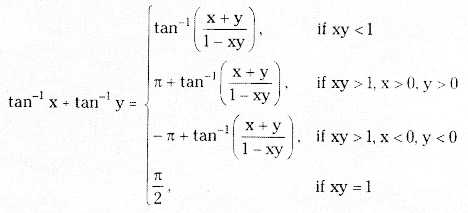
→ tan-1x – tan-1y = tan-1\(\left(\frac{x-y}{1+x y}\right)\) if x > 0, y >0 (or) x < 0, y < 0

→ 2sin-1x = sin-1 (2x\(\sqrt{1-\mathrm{x}^2}\))

→ 2cos-1x = cos-1(2x2 – 1)

TS Inter 1st Year Maths 1A Inverse Trigonometric Functions Formulas

→ 2tan-1x = tan-1\(\left(\frac{2 x}{1-x^2}\right)\)

→ 3sin-1x = sin-1(3x -4x3)

→ 3cos-1x = cos-1(4x3 – 3x)

→ 3tan-1x = tan-1\(\left(\frac{3 x-x^3}{1-3 x^2}\right)\)

TS Inter 1st Year Maths 1A Hyperbolic Functions Formulas

Learning these TS Inter 1st Year Maths 1A Formulas Chapter 9 Hyperbolic Functions will help students to solve mathematical problems quickly.

TS Inter 1st Year Maths 1A Hyperbolic Functions Formulas

→ Hyperbolic Functions:

Hyperbolic FunctionDefinitionDomainRange
1. sin hx\(\frac{e^x-e^{-x}}{2}\)RR
2. cos hx\(\frac{\mathrm{e}^{\mathrm{x}}+\mathrm{e}^{-\mathrm{x}}}{2}\)R[1, ∞)
3. tan hx\(\frac{e^x-e^{-x}}{e^x+e^{-x}}\)R(-1, 1)
4. cot hx\(\frac{e^x+e^{-x}}{e^x-e^{-x}}\)R – {0}(-∞, -1] ∪ [1, ∞)
5. sec hx\(\frac{2}{e^x+e^{-x}}\)R[0, 1]
6. cosec hx\(\frac{2}{e^x-e^{-x}}\)R – {0}R – {0}

→ Inverse Hyperbolic Functions:

Inverse Hyperbolic FunctionDefinitionDomainRange
1. sin h-1xloge(x + \(\sqrt{x^2+1} \))RR
2. cos h-1xloge(x + \(\sqrt{x^2-1} \))[1, ∞)[0, ∞)
3. tan h-1x\(\frac{1}{2}\)loge\( \left(\frac{1+x}{1-x}\right) \)(-1, 1)R
4. cot h-1x\(\frac{1}{2}\)loge\( \left(\frac{x+1}{x-1}\right) \)R – [-1, 1]R – {0}
5. sec h-1xloge\( \left(\frac{1+\sqrt{1-x^2}}{x}\right) \)(0, 1][0, ∞)
6. cosec h-1xloge\( \left(\frac{1 \pm \sqrt{1+x^2}}{x}\right) \)R – {0}R – {0}

→ Hyperbolic Identities:

  • cosh2x – slnh2x = 1
  • sech2x – tanh2x = 1
  • coth2x – cosech2x = 1
  • sinh(2x) = 2sinhx coshx
  • cosh(2x) = cosh2x + sinh2x = 1 + 2sinh2x = 2cosh2x – 1

TS Inter 1st Year Maths 1A Hyperbolic Functions Formulas

→ sinh (- x) = – sin hx

→ cosh (- x) = cosh x

→ tanh(-x)= -tanhx

→ coth(-x) = -coth x

→ cosech(-x) = -cosech x

→ sech(-x) = sech x

→ sinh (x + y) = shih x . cosh y + cosh x sin h y

→ cosh (x + y) = cosh x. cosh y + sin h x sinb y

→ sinh(x – y) sinhx.cosh y – cosh x sinh y

→ cosh(x – y)=coshx.coshy – sinhxsinhy

→ tanh (x + y) = \(\frac{\tanh x+\tanh y}{1+\tanh x \tanh y}\)

→ tanh (x – y) = \(\frac{\tanh x-\tanh y}{1-\tanh x \tanh y}\)

→ sinh3x = 3sinhx + 4sinh3x

→ cosh3x = 4cosh3x – 3coshx

→ tanh3x = \(\frac{3 \tanh x+\tanh ^3 x}{1+3 \tanh ^2 x}\)

TS Inter 1st Year Maths 1A Properties of Triangles Formulas

Learning these TS Inter 1st Year Maths 1A Formulas Chapter 10 Properties of Triangles will help students to solve mathematical problems quickly.

TS Inter 1st Year Maths 1A Properties of Triangles Formulas

→ In any ΔABC, \(\frac{a}{\sin A}=\frac{b}{\sin B}=\frac{c}{\sin C}\) = 2R where a, b, c are the lengths of sides BC, CA and AB of a triangle ABC. A, B, C are the angles at the vertices of ΔABC, and R is the circum radius of the ΔABC. This is called the SINE RULE.

→ In any ΔABC,

  • a2 = b2 + c2 – 2bc cos A
  • b2 = c2 + a2 – 2ca cos B
  • c2 = a2 + b2 – 2ab cos C is the COSINE RULE.

→ The angles A, B, C can be found by the formulae

  • cos A = \(\frac{b^2+c^2-a^2}{2 b c}\)
  • cos B = \(\frac{c^2+a^2-b^2}{2 c a}\)
  • cos C = \(\frac{a^2+b^2-c^2}{2 a b}\)

→ In any ΔABC,

  • a = b cos C + c cos C
  • b = a cos C + c cos A
  • c = a cos B + b cos A (projection formulae)

→ tan\(\left(\frac{B-C}{2}\right)=\frac{b-c}{b+c}\) cot\(\frac{A}{2}\) (or) tan\(\left(\frac{c-A}{2}\right)=\frac{c-a}{c+a}\)cot\(\frac{B}{2}\) (or)
tan\(\left(\frac{A-B}{2}\right)=\frac{a-b}{a+b}\) cot \(\frac{C}{2}\) is the Napier’s analogy

→ If a + b + c = 2s which is the perimeter of ΔABC then
sin\(\frac{A}{2}=\sqrt{\frac{(s-b)(s-c)}{b c}}\), sin\(\frac{B}{2}=\sqrt{\frac{(s-a)(s-c)}{a c}}\) and sin\(\frac{c}{2}=\sqrt{\frac{(s-a)(s-b)}{a b}}\)
cos\(\frac{A}{2}=\sqrt{\frac{s(s-a)}{b c}}\), cos\(\frac{\mathrm{B}}{2}=\sqrt{\frac{s(s-b)}{a c}}\), cos \(\frac{c}{2}=\sqrt{\frac{s(s-c)}{a b}}\) and
tan\(\frac{A}{2}=\sqrt{\frac{(s-b)(s-c)}{s(s-a)}}\), tan\(\frac{B}{2}=\sqrt{\frac{(s-a)(s-c)}{s(s-b)}}\), tan\(\frac{c}{2}=\sqrt{\frac{(s-a)(s-b)}{s(s-c)}}\)

TS Inter 1st Year Maths 1A Properties of Triangles Formulas

→ Area of ΔABC Δ = \(\frac{1}{2}\)bc sin A = \(\frac{1}{2}\)ca sin B = \(\frac{1}{2}\)ab sin C
= \(\sqrt{s(s-a)(s-b)(s-c)}=\frac{a b c}{4 R}\) = 2R sin A sin B sin C

→ If ‘r’ is the radius of incircle of ΔABC; r1, r2, r3 are the radii of excircle then
r = \(\frac{\Delta}{s}\), r1 = \(\frac{\Delta}{s-a}\), r2 = \(\frac{\Delta}{s-b}\) and r3 = \(\frac{\Delta}{s-c}\)

→ Also r = 4R sin\(\frac{A}{2}\)sin\(\frac{B}{2}\)sin\(\frac{C}{2}\)

  • r1 = 4R sin\(\frac{A}{2}\)cos\(\frac{B}{2}\)cos\(\frac{C}{2}\)
  • r2 = 4R sin\(\frac{B}{2}\) cos\(\frac{C}{2}\) cos\(\frac{A}{2}\)
  • r3 = 4R sin\(\frac{C}{2}\) cos\(\frac{A}{2}\) cos\(\frac{B}{2}\)

→ In any ΔABC, \(\frac{a+b}{c}=\frac{\cos \left(\frac{A-B}{2}\right)}{\sin \frac{C}{2}}\)
\(\frac{b+c}{a}=\frac{\cos \left(\frac{B-C}{2}\right)}{\sin \frac{A}{2}}\)
and \(\frac{c+a}{b}=\frac{\cos \left(\frac{C-A}{2}\right)}{\sin \frac{B}{2}}\)

TS Inter 1st Year Maths 1A Matrices Formulas

Learning these TS Inter 1st Year Maths 1A Formulas Chapter 3 Matrices will help students to solve mathematical problems quickly.

TS Inter 1st Year Maths 1A Matrices Formulas

→ Matrix: If the real or complex numbers are arranged in the form of a rectangular or square array consisting the complex numbers in horizontal and vertical lines, then that arrangement is called a matrix.
Ex: A = \(\left[\begin{array}{ccc}
1 & 2 & 4 \\
3 & 0 & -6
\end{array}\right]\), B = \(\left[\begin{array}{cc}
1 & 2 \\
4 & -3
\end{array}\right]\)

→ Order of a matrix: A matrix ‘A1 is said to be of type (or) order (or) size m × n (read as m by n), if the matrix A’ has m rows and n’ columns.

→ Square matrix: A matrix ‘A’ is said to be a square matrix if the number of rows in A is equal to the number of columns in A.
Ex: \(\left[\begin{array}{cc}
1 & -1 \\
0 & 4
\end{array}\right]\)2×2
\(\left[\begin{array}{ccc}
2 & 0 & 1 \\
4 & -1 & 2 \\
7 & 6 & 9
\end{array}\right]\)2×2

→ Trace of a matrix : If ‘A’ is a square matrix then the sum of elements in the principle diagonal of A’ is called trace of A’. It is denoted by tra A .
Ex: A = \(\left[\begin{array}{ccc}
2 & 0 & 1 \\
4 & -1 & 2 \\
7 & 6 & 9
\end{array}\right]\)
The elements of the principle diagonal = 2, – 1, 9
Tra (A) = 2 + (- 1) + 9 = 10.

→ Null matrix : A matrix ‘A’ is said to be a zero matrix or null matrix of every element of A is equal to zero.
Ex: O2 = \(\left[\begin{array}{ll}
0 & 0 \\
0 & 0
\end{array}\right]\)
O3×2 = \(\left[\begin{array}{ll}
0 & 0 \\
0 & 0 \\
0 & 0
\end{array}\right]\)

TS Inter 1st Year Maths 1A Matrices Formulas

→ Upper triangular matrix: A square matrix A = [aij]n×n is said to be an upper triangular matrix if aij, = 0, whenever i > i.
Ex: \(\left[\begin{array}{ccc}
2 & -1 & 5 \\
0 & 3 & 6 \\
0 & 0 & 1
\end{array}\right]_{3 \times 3}\)

→ Lower triangular matrix :
A square matrix A = [aij]n×n is said to he a lower triangular matrix if aij, = 0 whenever i < j .
Ex: \(\left[\begin{array}{ccc}
2 & 0 & 0 \\
1 & 3 & 0 \\
5 & 4 & 6
\end{array}\right]_{3 \times 3}\)

→ Triangular matrix : A square matrix. A is said to be a triangular matrix ifA is either an upper triangular matrix or a lower triangular matrix.
Ex: \(\left[\begin{array}{ccc}
-1 & 0 & 0 \\
0 & 3 & 0 \\
7 & 5 & 2
\end{array}\right]_{3 \times 3}\)

→ Diagonal matrIx : A square matrix, A is said to be a diagonal matrix if A is both upper triangnlar and lower triangular matrix. (or) A square matrix in which every element is equal to zero except those of principle diagonal of the matrix Is a diagonal matrix.
Ex: \(\left[\begin{array}{ccc}
2 & 0 & 0 \\
0 & 3 & 0 \\
0 & 0 & -1
\end{array}\right]_{3 \times 3}\)

→ Scalar matrix : A diagonal matrix, A is said to be a scalar matrix if all elements in the principle diagonal are equal.
Ex: \(\left[\begin{array}{ll}
2 & 0 \\
0 & 2
\end{array}\right]_{2 \times 2}\)
\(\left[\begin{array}{lll}
3 & 0 & 0 \\
0 & 3 & 0 \\
0 & 0 & 3
\end{array}\right]_{3 \times 3}\)

→ Unit matrix : A diagonal matrix is said to be a unit matrix if every element in the principle diagonal is equal to unity. It is denoted by 1.
Ex: I2 = \(\left[\begin{array}{ll}
1 & 0 \\
0 & 1
\end{array}\right]\)
I3 = \(\left[\begin{array}{lll}
1 & 0 & 0 \\
0 & 1 & 0 \\
0 & 0 & 1
\end{array}\right]\)

→ Transpose of a matrix: The matrix obtained by changing the rows of a given matrix, A into columns is called transpose of ‘A’. It is denoted by AT or A’.
Ex: A = \(\left[\begin{array}{ccc}
2 & 3 & -1 \\
1 & 2 & 3
\end{array}\right]\) then AT = \(\left[\begin{array}{cc}
2 & 1 \\
3 & 2 \\
-1 & 3
\end{array}\right]\)

→ Symmetric matrix : A square matrix, A is said to be a symmetric matrix, if AT = A.
Ex: If A = \(\left[\begin{array}{lll}
2 & 3 & 1 \\
3 & 4 & 5 \\
1 & 5 & 7
\end{array}\right]\), then AT = \(\left[\begin{array}{lll}
2 & 3 & 1 \\
3 & 4 & 5 \\
1 & 5 & 7
\end{array}\right]^{\mathrm{T}}=\left[\begin{array}{lll}
2 & 3 & 1 \\
3 & 4 & 5 \\
1 & 5 & 7
\end{array}\right]\) = A
A is a symmetric matrix.

→ Skew symmetric matrix : A square matrix A’ is said to be a skew symmetric matrix, if AT = – A.
Ex: A = \(\left[\begin{array}{ccc}
0 & 1 & -2 \\
-1 & 0 & 3 \\
2 & -3 & 0
\end{array}\right]\), then AT = \(\left[\begin{array}{ccc}
0 & 1 & -2 \\
-1 & 0 & 3 \\
2 & -3 & 0
\end{array}\right]^{\mathrm{T}}=\left[\begin{array}{ccc}
0 & -1 & 2 \\
1 & 0 & -3 \\
-2 & 3 & 0
\end{array}\right]=\left[\begin{array}{ccc}
0 & 1 & -2 \\
-1 & 0 & 3 \\
2 & -3 & 0
\end{array}\right]\) = -A
A is a skew symmetric matrix.

TS Inter 1st Year Maths 1A Matrices Formulas

→ Adjoint of a matrix : The transpose of the matrix obtained by replacing the elements of a square matrix. A by the corresponding cofactors is called the adjoint matrix of A. It is denoted by Adi A or adj A.

→ Inverse of a square matrix : A sqiictre matrix A is said to be an invertible matrix, if there exists a square matrix, B such that AB = BA = I. The matrix B is called inverse of A’.
If A is a non-singular matrix, then A is invertible and A-1 = \(\frac{{adj} A}{{det} A}\)

→ Sub matrix : A matrix obtained by deleting some rows or columns or both of a matrix is called a sub matrix of the given matrix.
Ex: If A = \(\left[\begin{array}{cc}
1 & 2 \\
-1 & 2
\end{array}\right] \cdot\left[\begin{array}{lll}
1 & 2 & 3 \\
2 & 3 & 1
\end{array}\right] \cdot\left[\begin{array}{ll}
2 & 3 \\
3 & 1 \\
2 & 0
\end{array}\right]\) then some matrices of A are \(\left[\begin{array}{cc}
1 & 2 \\
-1 & 2
\end{array}\right] \cdot\left[\begin{array}{lll}
1 & 2 & 3 \\
2 & 3 & 1
\end{array}\right] \cdot\left[\begin{array}{ll}
2 & 3 \\
3 & 1 \\
2 & 0
\end{array}\right]\), [0]

→ Rank of a matrix : Let ‘A’ be a non zero matrix. The rank of A is defined as the maximum of the orders of the non singular square sub-matrices of A. The rank of a null matrix is defined ^ as zero. The rank of a matrix A is denoted by rank [A].

→ Rank of 3 × 3 matrix : Suppose A is a non-zero 3 × 3 matrix, then

  • If A is a non – singular then its rank is 3.
  • If A is a singular matrix and if at least one of its 2 × 2 sub matrix is non-singular, then the rank of A is 2.
  • If A is a singular matrix and every 2×2, sub matrix is also singular, then the rank of ’A’ is 1.

→ Properties of matrices :

  • If A and B are two matrices of same type, then A + B = B + A.
  • If A, B and C are three matrices of same type then (A + B) + C = A + (B + C).
  • If confirmability is assured for the matrices A, B and C then A(BC) = (AB)C.
  • If confirmability is assured for the matrices A, B and C then
    (a) A(B + C) = AB + AC
    (b) (B + C) A = BA + CA.
  • If A is any matrix then (AT)T = A.
  • If A and B are two matrices of same type then (A + B)T = AT + BT.
  • If A and B are two matrices for which confirmability for multiplication is assured then (AB)T = BT. AT.
  • If I is the identity matrix of order n then for every square matrix A of order n. AI = IA = A.
  • If A is an invertible matrix then A-1 is also invertible and (A-1)-1 = A.
  • If A and B are two invertible matrices of same type then AB is also invertible and (AB)-1 = B-1. A-1.
  • If A is an invertible matrix then A is also invertible and (AT)-1 = (A-1)T

→ Methods of solving linear equations :
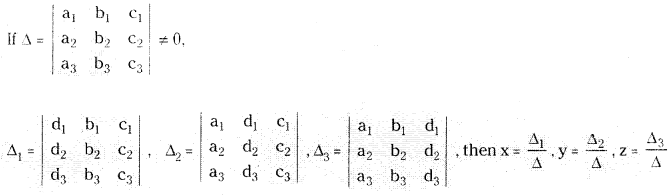
1. Cramer’s rule : Let a1x + b1y + c1z = d1
a2x + b2y + c2z = d2
a3x + b3y + c3z = d3
be a system of linear equations
TS Inter 1st Year Maths 1A Matrices Formulas 1

2. Matrix inversion method : If ‘A’ is a non-singular matrix then the solution of AX’ = B is X = A-1 B.

3. Gauss Jordan method : Let a1x + b1y + c1z = d1
a2x + b2y + c2z = d2
a3x + b3y + c3z = d3
be a system of linear equations. If the augmented matrix \(\left[\begin{array}{llll}
\mathrm{a}_1 & \mathrm{~b}_1 & \mathrm{c}_1 & \mathrm{~d}_1 \\
\mathrm{a}_2 & \mathrm{~b}_2 & \mathrm{c}_2 & \mathrm{~d}_2 \\
\mathrm{a}_3 & \mathrm{~b}_3 & \mathrm{c}_3 & \mathrm{~d}_3
\end{array}\right]\) can be reduced to the form \(\left[\begin{array}{llll}
1 & 0 & 0 & \alpha \\
0 & 1 & 0 & \beta \\
0 & 0 & 1 & \gamma
\end{array}\right]\) by using elementary row transformations then x = α, y = β, z = γ, i.e., unique solution is the solution.

i) In the above matrix \(\left[\begin{array}{llll}
1 & 0 & 0 & \alpha \\
0 & 1 & 0 & \beta \\
0 & 0 & 1 & \gamma
\end{array}\right]\) is called final matrix of the system of equations.

ii) In the final matrix, if ‘O’ is obtained in place of 1 and in the same rows last element α or β or γ is
a) ‘O’ then the system has infinite number of solutions.
b) non-zero then the system of equations has no solution.

TS Inter 1st Year Maths 1A Matrices Formulas

→ The system of non-homogeneous equations AX = D has

  • a unique solution if rank [A] = rank [AD] = 3
  • Infinitely many solutions if rank [A] = rank [AD] < 3
  • No solution if rank [A] * rank [AD],

→ The system of homogeneous equations AX = O has

  • The trivial solution only if Rank [A] = 3 = The number of unknowns (variables)
  • An infinite number of solutions (non-trivial solution), if Rank of A less than the number of unknowns (variables) < 3.

TS Inter 1st Year Maths 1A Mathematical Induction Formulas

Learning these TS Inter 1st Year Maths 1A Formulas Chapter 2 Mathematical Induction will help students to solve mathematical problems quickly.

TS Inter 1st Year Maths 1A Mathematical Induction Formulas

→ Principle of finite Mathematical Induction : Let S(n) be a statement of a result for each n ∈ N. If

  • S(1) is true
  • S(K) is true ⇒ S(K + 1) is also true then S(n) is true ∀ n ∈ N. (Set of natural numbers = N).

→ Principle of complete Mathematical Induction : Let S(n) be a statement for each n ∈ N. If

  • S(T) is true
  • S(1), S(2), S(3), ……….. S(K) are true ⇒ S(K + 1) is true, then S(n) is true, ∀ n ∈ N.

TS Inter 1st Year Maths 1A Mathematical Induction Formulas

→ Useful formulae:

  • 1 + 2 + 3 + ………. + n = \(\frac{n(n+1)}{2}\)
  • 12 + 22 + 32 + ……….. + n2 = \(\frac{n(n+1)(2 n+1)}{6}\)
  • 13 + 23 + 33 + ………… + n3 = \(\frac{n^2(n+1)^2}{4}\)
  • The nth term of the arithmetic progression (A.P.) is tn = a + (n – 1) d
  • The sum f n terms of the arithmetic progression (A.P.) is Sn = \(\frac{n}{2}\) [2a + (n – 1) d]
  • The nth term of the geometric progression (G.P.) is tn = a. rn-1
  • The sum of the n terms in G.P is Sn = \(\frac{a\left(r^n-1\right)}{r-1}\). r > 1
  • Sum of the first n’ odd natural numbers : 1 + 3 + 5 + ……………….. + (2n – 1) = n2
  • Sum of the first n’ even natural numbers : 2 + 4 + 6 + …………….. + (2n) = n (n + 1)

TS Inter 1st Year Maths 1A Functions Formulas

Learning these TS Inter 1st Year Maths 1A Formulas Chapter 1 Functions will help students to solve mathematical problems quickly.

TS Inter 1st Year Maths 1A Functions Formulas

→ Function: Let A and B be non-empty sets and f be a relation from A to B. If for each element as A there exists a unique be B such that (a, b) ∈ f. then f is called a function (or) mapping from A to B (or A into B). It is denoted by f: A → B.
Eg : If A = {1, 2, 3}, B = {p, q, r}, f = {(1. p), (2, p), (3, p)} then f is a function from A to B.
If f: A → B is a function ∀ a ∈ A such that f(a) = b. 3 b ∈ B.

→ One-one function (or) Injection: A function f: A → B is said to be one-one function or injection from A into B if different elements in A have different T images in B. (March ’93)
Eg : If A = {1, 2, 3}, B = {p,q, r, s}, f – {(1, r), (2, p). (3, s)} then f: A → B is one – one. f: A → B is an injection
⇔ a1, a2 ∈ A and a1 ≠ a2 ⇒ f(a1) * f(a2)
⇔ a1, a2 ∈ A and f(a1) = f(a2) ⇒ a1 = a2

→ Onto function (or) surjection : A function f: A → B is said to be function (or) surjection from A onto B is f(A) = B. (or) If f: A B is a function, if every element of B occurs as the image of atleast one element of A then we say that f is an onto function (or) surjection or that f from A onto B.
Eg : If A = {1, 2, 3}, B = {p,q}, f = {(1. q), (2, p), (3, q)}, then f: A → B is onto, f: A → B is a surjection
⇔ range f – f(A) = B(codomain)
⇔ B = {f(a) / a ∈ A}
⇔ For every b e B there exists atleast one as A such that f(a) = b.

→ Bijection (or) one – one and onto function : A function f: A B is said to be one – one and onto function (or) bijection from A onto B. If f: A B is both one – one function and onto function.
Eg : If A = {1, 2, 3}, B = (p,q, r}, f = {(1, q), (2, r), (3, p)}, then f: A → B is one-one and onto, f: A → B is a bijection f is both one – one and onto
⇔ (i) If aj, a, e A and f(a1) = f(a2) ⇒ a1 – a2
(ii) For every b e B there exists atleast one as A such that f(a) = b.

TS Inter 1st Year Maths 1A Functions Formulas

→ Equality of functions : Two functions f: A → B, g : A → B are said to be equal if f(x) = g(x). ∀ x ∈ A. It is denoted by f = g (or) let f and g be functions. We say f and g are equal and write f = g if domain of f equal to domain of g and f(x) = g(x),∀ x ∈ domain f.

→ Constant function: A function f: A → B is said to be a constant function if the range of T contains only one element i.e., f(x) = c ∀ x ∈ A where c is a fixed element of B.
Eg : A = {1, 2, 3, 4}, B = {a, b, c}, f = {(1, b), (2. b), (3, b), (4, b)}, then f is a constant function from A to B.

→ Identity function: If A is a non empty set then the function f: A A defined by f(x) = x, ∀ x ∈ A is eaiied the identity function on A and is denoted by IA.
Eg : A = {1, 2, 3}, IA = (1, 1), (2, 2), (3. 3)} The function on R defined as f(x) = x ∀ x ∈ R is the identity function on R.

→Inverse function : If f: A → B is a bijection then the function f’1 : B -4 A defined by f-1(y) = x. If f(x) = y, ∀ y ∈ B is called the inverse function of f.
Eg: Let A = {1, 2, 3}, B = {a, b, c} and f = {(1, a), (2. b), (3, c)} then the inverse function f-1 = {(a, 1), (b, 2), (c, 3)} and f-1: B → A is also a bijection.

→ Composite function : If f: A → B, g : B → C are two functions then the function gof: A C defined by gof(x) = g[f(x)]. ∀ x ∈ A is called composite function f and g.

→ Even function : A function f: A → R is said to be an even function if f(-x) = f(x), ∀ x ∈ A.
Eg : f(x) = x2, g(x) = cos x are even functions.

→ Odd function : A function f: A → R is said to be an odd function if f(-x) = – f(x), ∀ x ∈ A.
Eg : f(x)= x3, g(x) = sin x are odd functions.

→ To Vind the domains of a Real valued functions :

  • The domain of the real function is of the form \(\frac{1}{g(x)}\) (or) \(\frac{f(x)}{g(x)}\) is R – {x/g(x) = 0}
  • The domain of the real function is of the form \(\sqrt{f(x)}\) is {x/f(x) ≥ 0}
  • The domain of the real function is of the form \(\frac{1}{\sqrt{f(x)}}\) is {x/f(x) > 0}
  • The domain of the real function is of the form log [f(x)] is {x/f(x) > 0}.

TS Inter 1st Year Maths 1A Functions Formulas

→ (i) (x – α)(x – β) < 0 ⇒ x ∈ [α, β].
(ii) (x – α) (x – β) < 0 ⇒ x ∈ (α, β).
(iii) (x – α) (x – β) > 0 ⇒ x ∈ R – (α, β) (or) x ∈ (- ∞. α] ∪ [β, ∞)
(iv) (x – α) (x – β) > 0 ⇒ x ∈ R – [α, β] (or) x ∈ (- ∞, α) ∪ (β, ∞)