TS Inter 2nd Year Economics Study Material Chapter 3 National Income, Poverty and Unemployment

Telangana TSBIEĀ TS Inter 2nd Year Economics Study Material 3rd Lesson National Income, Poverty and Unemployment Textbook Questions and Answers.

TS Inter 2nd Year Economics Study Material 3rd Lesson National Income, Poverty and Unemployment

Essay Questions

Question 1.
Explain the trends in National Income of India.
Answer:
National income trends reflect the progress of the economy over time. The structural change in the composition of national income by industrial origin is the consequence of the process of economic growth initiated duripg the plans. At present, service sector is the pre-dominant source of the national income in India. National income is produced in public sector as well as private sector. Prior to 1951, the share of public sector was very small. Since the inception of planning, the share of public sector in national income has gradually increased.

A study of trends in national income is necessary to understand the impact On economic growth in India. It would be, therefore, better if the trends in national income and changes in the structure of national product are analysed over the last 68 years.

Trends in Net National Product and Per Capita Income :
National income figures at constant prices, become comparable, but they conceal the population effect. To eliminae the ‘ effect of growth of population, per capita national product or per capita income Is calculated. Whereas the growth of the net national product at constant prices is an index of the total productive effort on the part of the community and indicates the rate of growth of goods and services in the economy. The growth of per capita income at constant prices is an indicator of the change in the standard of living of the people.

Plan – wise study of growth of real income in India, however, does indicate an encourag-ing fact that although the annual rate of increase in national income was pretty low at 3.5 percent pere annum during the first three decades of economic planning, it has risen to 5.9 per cent per annum since 1980-81. The description of the national income trends during the past seven decades clearly highlights the main features of growth in this country. They are erratic growth, growth rate at best being modest, post-1991 reform growth being less fragile.

From the time India switched ovedr to economic planning, the net national product has continued to grow, despite erratic growth in agricultural produtin and shortfalls in the industrial output. There is no doubt that this is an encouraging development in an economy, which had suffered long spells of stagnation under the British. However, assessment of the performance of an economy can more accurately be made by examing the trends in per capita national income which is the same thing as per capita net national product at factor cost.

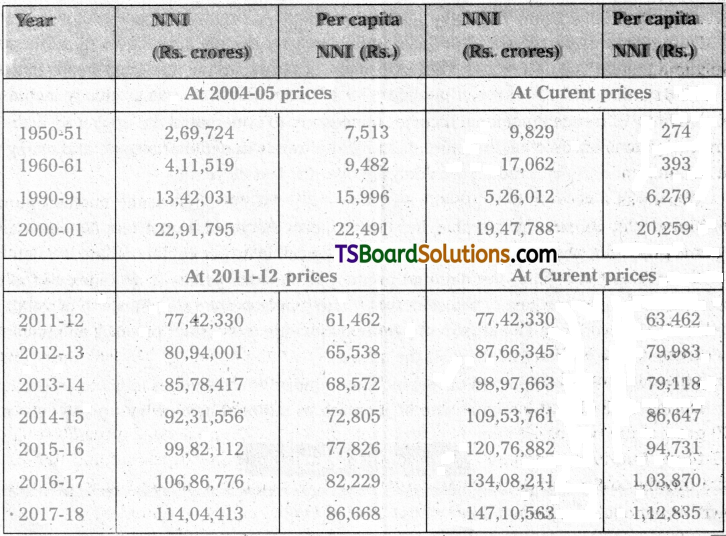
The data given in Table shows that during the 68 years (1950-51 to 2017-18), the Net National Income increased from Rs, 2,69,724 crore to Rs. 1,14,04,413 crore at coinstant prices, whereas at current prices the net national income increased from Rs. 9,829 crores to Rs. 1,47,10,563 crore in the same period. The per capita income also increased from 7,513 in 1950-51 to Rs/ 86,668 in 2017-18 at consan price. Even a current prices. It increased form Rs. 274. Rs. 274 to Rs. 1,12,835 in the same period. It can be said there is an increasing trend both in NNP and per capita NNP since the inception of planning.

Net National Income at Factor Cost and Per capita NNI
TS Inter 2nd Year Economics Study Material Chapter 3 National Income, Poverty and Unemployment 1

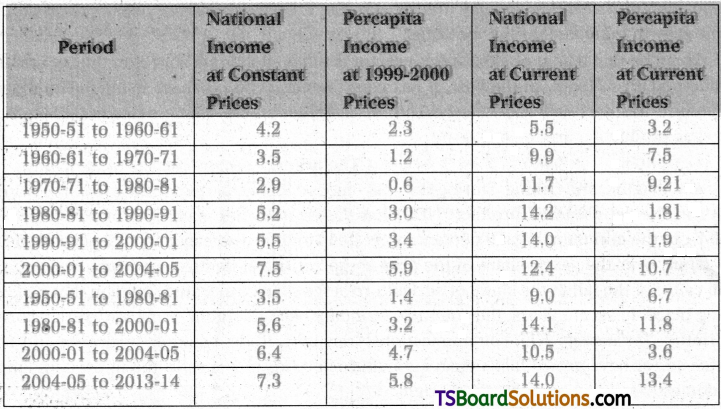
The growth rates of national income and per capita income are presented in Table. During the 30 – year period (1950-51) to 1980-81), the annual rae of growth of national income (1999-2000=100) was of the order of 3.5 per cent and that of per capita income was merely 1.4 percent. Calcualted at current prices, the annual rate of growth of net national product was of the order of 9.0 percent and that of per capita income was 6.7 percent.

Growth Rates Of National Income and Percapita Income (Percent)
TS Inter 2nd Year Economics Study Material Chapter 3 National Income, Poverty and Unemployment 2

During the first 10 years of planning (1950-51 to 1960-61), net national product increased at an annual rate of 4.2 percent and the performance of the economy declined thereafter. During 1960-61 and 1970-71, the rate of growth of NNP came down to 3.5 per cent and that per capita NNP to 1.2 per cent per annum. In the subsequent 10-year period (1970-71 to 9 1980-81), the rate of growth of NNP was 2.9 per cent and that of per capita NNP slumped down to 0.6 pet cent per annum.

There was a very perceptible improvement in growth rate during the eighties. During 1980-81 and 1990-91, net national product showed a growth rate of 5.2 per cent per annum and the per capita NNP (at 1999 – 2000 prices) improved on an average by 3.0 per cent per annum. This Hindu rate of growth, to use the phrase of late Prof. Raj Krishna. During 1990-91 to 2000 – the order of 5.5 percent per annum and that of NNP per capita was 3.4 percent. During the two decades (1980 – 81 and 2000 – 01), the average annual growth of NNP was 5.6 percent and tght of per capita NNP was 3.2 percent. It implies that the economy has performed better during these two decades as compared with the earlier three decades.

During 2000-01 and 2004-05, NNP growth rate accelerated to 6.4 per cent and per capita NNP grew at the rate of 4.7 per cent per annum (at 1999-2000 prixces). During 2004-05 and 2013-14 we find further acceleration in the NNP growth rate to 7.3 percent and that of per capita income to 5.8 percent (at 2004-05 oruces). This implies a further acceleration in the growth of national income at a higher level. This is a very healthy development.

TS Inter 2nd Year Economics Study Material Chapter 3 National Income, Poverty and Unemployment

Question 2.
Briefly examine the sectoral contributions to the National Income.
Answer:
National income is the value of all final goods and services produced in a year in a country. This concept is used as an indicator of economic development of a country.

Sectoral Contribution of National Income :
The study of national product by the sectoral contribution explains the anatomy of the economic structure. The analysis of sectoral contribution is equally important as of the trends in national income. The structural change in the composition of national income by industrial origin is the consequence of the process of eco-nomic growth initaiated during the plans.

It can be said that at present service sector is the predominant source of the net domestic product (NDP) in India. In the past, it has contributed about 1/3 share to NDP. The share of agriculture has declined enormously. The broad trends in the changing composition of the domestic production are the following :

1. Contribution of the Primary Sector :
The primary sector consists of agriculture, for-estry and logging, and fishing. During the post – independence period, the share of the primary sector in the net domestic product (NDP) has varied from the maximum of 57.2 percent in 1950-51 to the minimum of 13.9 percent in 2013 -14 and the increased to 16.1 percent in 2018 – 19, Thus, over the years, share of the, primary sector in net domestic product declined. The main cause of the fall in the share of agriculture is the structural transformation that had been taking place. In recent years, the country’s economy has undergone some structural changes. Informtion Technology (IT), communications, transport, trade, banking, insurance and other service sector have grown faster than agriculture and this fact is reflected in the estimates of net domestic product by industry of origin.

2. Contribution of the Secondary Sector :
The secondary sector comprises pf, miningn and quarrying, manufacturing, construction, electricity, gas and water supply has shown a steady increase from 15 percent in 1950-51 to 23 percent in 1980-81 and 29.6 percent in 2018-19.

3. Contribution of Tertiary Sector :
The share of tertiary sector which includes IT, trade, transport, storage, communications, banking insurance, real estate, communituy and personal services had improved from 25 percent in 1950-51 to about 54.3 percent in 2018-19. This can be attributed to the share of trade, transport and communications. The expansion of transport, especially road transport, IT and communications was the major contributor to this increase.

By and large, from the aforesaid analysis, it can be surmised that ther is a sudden jump of the Indian economy to pass on to the stage of a post-industrial service economy without com-pleting the phase of industrialization. The changing structure of national income needs to be further stmgthened by stepping up the programme of industrializaion. This does not imply a neglect of agricultue, industrialization of the economy with emphasis on agro-based industries and industries supplying inputs to agriculture is a sine-qua-non for a faster growth of the economy.

Question 3.
Discuss the growth rates of national income and percapita income during the five year plans.
Answer:
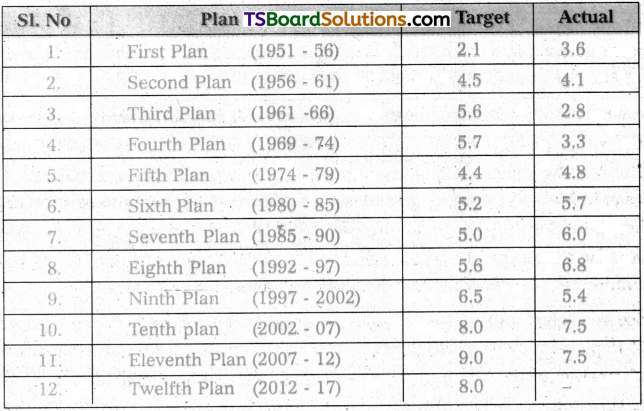
Annual growth rates of national income and percapita income during the plans have been presented in the following Table. During the First Plan, annual average growth rate of NNP was 4.4 percent (at 1999-2000 prices), which declined to 3.8 percent during the Second Plan. However, during the third plan, annual average increase in antional income slumped down to 2.6 per cent which was just sufficient to neutralize the growth of population. This is indicated by the fact that there was 0.4 percent of growth of per capia income during the Third plan.

This was largely the consequence of a serious drought in 1965-66 and thus the growth rate got depressed. This was followed by another drought year as also a business recession. After 1967-68 the economy started picking up and the growth rae showed signs of improvement. During the Fourth Plan (19679-74) period, the average annual rate of growth of national income declined to 3.1 percent and that of real per capita income to 0.8 percent per annum. The sharp increase in prices during 1972 – 73 and 1973 – 74 and the shortfalls in production on account of lower utilisation of capacity were the principal factors responsible for a lower growth rate during the Fourth Plan.

Annual Growth Rates in Various Plans
TS Inter 2nd Year Economics Study Material Chapter 3 National Income, Poverty and Unemployment 3

During the Fifth Plan (1974-79) the average annual increase in national income was of the order of 4.9 percent and that of per capita income was 2.6 percent. On the whole, the performance of the economy during the Fifth Plan can be considered very satisfactory. India’s national income registered a growth rate of 5.4 percent during the Sixth Plan (1980 – 85) wutg a oer caouta ubcine growth rate of 3.1 percent. During the Seventh Plan (1985 – 90), India’s NNP grew on the average at the rate of 5.5 percent per annum and the annual growth of per capita NNP was 3.3 per cent, Obviously, Seventh Plan achieved its objective of 5 percent growth rate of NNP along with 3 per cent targeted growth rae of per capita NNP.

During the Eighth Plan (1992 – 97) NNP growth rate of order of 6.7 percent has been achieved with a per capita growth of about 4.5 per cent. This healthy trend needs to be sustained. During the Ninth plan (1997 – 2002), NNP growth was 5.3 per cent with a per capita growth of about 3.3 per cent. During the Tenth Plan (2002 – 07), NNP growth was 7.8 percent-the highest recorded so far, During Eleventh Plan, rate of grwoth of NNP remained 7.6 percent and 6.2 percent in per capita NNP. During twelfth plan, rate of growth of NNP was 8 percent.

On viewing the performance of the economy between 1950 – 51 and 2012 -13 in the light of the goal set out in the First and Second Plans, it turns out to be desappointing. The rate of increase in per capita net national product has not only remained low but despite six decades of economic planning, is still unsteady and erratic. There were years of spurts in per capita net national product, but there were also some years in which it either declined or remained con-stant. Further, years of spurts in per capita net naional product were the same in which agricuF tural production had increased significantly, and the periods in which per capita net national product had either declined or fluctuated around the level achieved in the preceding year were, not different from those marked by bad weather resulting in crop failures.

TS Inter 2nd Year Economics Study Material Chapter 3 National Income, Poverty and Unemployment

Question 4.
How do you reduce inequalities in distribution of income and wealth.
Answer:
Unequal distribution of income and wealth in the economy among the people is knowii as Income and wealth inequalities. ‘
Remedial measured to reduce income and wealth inequalities : Reducing Income In-equalities :

1) Land Reforms and Redistribution of Agricultural Land :
It is a well – known fact that income inequalities in the rural sector emanate mainly from the concentration of agricultural land. Before the abolition of the zamindari system most of the land belonged to the absentee landlords who appropriated a large portion of the agricultural production while the tiller of the soil got hardly enough for subsistence. Thus, legislative measures were undertaken to abolish landlords and other intermediaries and ceilings on holdings were fixed. As a consequence, even now about 40 percent of the agricultural land belongs to top 5 percent of the rural house holds.

2) Control over Monopolies and Restrictive Trade Practices :
Control of monopoly tendencies is considered necessary of reducing income inequalities. The Monopolies and Re-strictive Trade Practices Act (MRTPA) was passed at late as 1969. Now with the increasing stress on liberalisation in the industrial sector.

3) Employment and wage policies :
Until the fourth five year plan, the employment objective was not taken seriously. However, since the beginning of the fourth plan some special programmes were undertaken such as the crash scheme for rural employment etc. These programmes were shortlived as they were undertaken in an adhoc manner The IRDP and allied programmes such as Training of Rural Youth for Self – Employment (TRYSEM) and Development of Women and Children in Rural Areas (DWACRA) have been restructured into a single self – employment programme called Swamajayanti Gram Swarozgar Yojapa (SGSY) from April 1999. This is the most ambitious scheme introduced in the post – independence period to alleviate poverty.

4) Social Security Measures :
Although the country does not have a comprehensive social security system, yet there are some social security provisions which are expected to help the workers in the organised sector. The most comprehensive social security measure, however, is the employees state insurance act which entitles the insured workers to medical benefits, disability benefits for the: period of sickness, maternity benefit and benefits to dependents.

5) Minimum Needs Programme :
Since the beginning of the 1970s a very influential section of development economists has started asking for the pursuit of the minimum needs programme in developing countries. Since the sixth five year plan, the government has been providing free or subsidised services through public agencies which are expected to improve the consumption levels of those living below the poverty line and thereby improve the productive efficiency of both the rural and urban workers.

6) Programmes for the uplift of the rural poor :
The hardcore of the poverty is to be found in the rural areas. The poorest sections in the rural areas belong to the families of landless agricultural labourers, small and marginal farmers, rural artisans, scheduled castes and scheduledtribes.

7) Taxation :
The taxation structure and the degree of progression in the rates of direct tastes one gets the impression that the Indian tax system is progressive and has been designed to prevent concentration of wealth in a few hands.

Question 5.
Explain the incidence of unemployent in India.
Answer:
Unemployment refers to the people those who are willing and able to work at the existing market wage rate are unable to find emloyment.

Unemployment in developing countries is both open and disguised. Like all other devel-oping countries, India presently suffers mainly form structural unemployment which exists in open and disguised forms. During the 1951-2011 period, population in this country increased at an alarming rate of around 2.1 per cent per annum and with it the numer of people coming to the labour market in search of jobs also rose rapidly, whereas employment opportunities did not increase most of the time correspondingly due to slow economic growth. Hence, there has been “an increase in the volume of unemployment from one plan period to another.” This un-employment, on account of its very nature, can be eliminaed only by introducing certain radical reforms in the structure of the economy.

Although the reforms were introduced in 1991, yet the year 1991 – 92 was particularly a depresed year and the reform process really got a going by 1993 – 94. Thus, 1993 – %4 to 2004 – 2005 – the 11 – year period can be considered as the period of liberalisation. It may be noted that all categories of unemployment showed a declining trend during the period 1977 – 78 to.1993 – 94, but the trend got reve rsed during 1993 – 94 and 2004 – 05.

Unemployment as measured by UPS criterion declined from 4.23 percent in 1977 – 78 to 2.56 percent in 1993 – 94, but indicated an increase to 3.06 percent in 2004 – 05, In 2011 – 12, unemployment on UPS criterion was estimated to be 2.7 percent. Even the most comprehensive measure of unemployment, viz., current daily status (CDS) unemployment rate declined from 8.18 percent in 1977 – 78 to 6.03 percent in 1993-94, but the declining trend was reversed and unemployment increased to 8.28 percent in 2004 – 05. In 20\11 – 12, rate of unemployment on same situation can be observed with respect to both urban, arid rural areas. However, it may be noted that whereas CDS rate for urban areas increased very slightly from 7.43 percent in 1993-94 to 8.28 per cent in 2004 – 05.

Though we notice a declline in unemployment rates in 66th Round of NSSO, it does not seem to be any deviation-front the earlier trend. This is so because between 2004 – 2005 and 2009 – 10 we find addition to labour force to be only 9.2 million which is much less than the earlier period. The same phenomenon could be observed in all measures of unemployment both in the rural and urban areas. This underlines the relative neglect of the rural economy in the first phase of economic reforms. Usual Principal Status (UPS) measures open unemployment throughout the year, but current daily status (CDS) besides taking into account open unemployment also measures under – employment. From the data it becomes obvious that whereas the UPS rates are modest, the CDS rates are quite high.

As against unemployment rate of 10.34 per cent in 1977 – 78 in urban areas, the rural unemployment rate 7.70 percent. There was a significant fall in therural unemployment rate, in 1987 – 88 to 5.3 per cent, but the urban unemployment rate was jof the order of 9.4 per cent, signigicatly higher. After 1993 – 94, in the period of liberalisation rural lunemployment rate again increased to 8.28 percent, signigicantly higher. After 1993 – 94, itn the period of liberalisation increased to 8.28 per cent during 1993 – 94 to 2004 – 05. High levols of unemployment in the urban areas could be explained by a larger proportion of organized s ector unemployment which forces people to either remain employed or unemployed, since the chances for getting engaged in low productive activities are relatively fewer.

As against this, the; rural areas indicat higher levels of disguised unemployment. Gradual and continuous decline of urban unemployment rates till 1993 – 94 and even a very Marginal increase in 2004 – 05 may be due’ to greater attention being given to urban areas in the development process, but (the increase in unemployment rates in rural areas may be due to the neglect of rural area in the post-reform period It may be also be due to a shift in the composition of employment from self – employment casual labour.

It can be said that in the usual status (PS + SS), unemployment rates were 5.8 percent among males and 3.8 percent among females in rural areas, while t he rates were 7.1 percent among males and 10.8 percent among females in urban areas. In the case of current wekly status, the unemployment rates were 8.8 percent among males and 7.7 percent among females in rural areas while the rates were 8.8 per cent among males and 7.7 percent among females and 12.8 per cent among females in urban areas.

TS Inter 2nd Year Economics Study Material Chapter 3 National Income, Poverty and Unemployment

Question 6.
Explain the remedial measures of poverty and unemployment in India.
Answer:
Remedial Measures of Poverty & Unemployment – Government Initiatives : Since poverty and unemployment are inseparable, the policy measures for reducing unemployment are equally applicable for the removal of poverty. In 1950s and 1960s Indian planners believed in the trickle – down theory. Accoriding to this view, poverty alleviation was a gradual and automatic process as the economy grew. Accordingly, employment generation was accepted as a goal of development planning. However, a faster growth with special emphasis on employ-ment-intensive sectors like the small – scale industry was considered adequate to generate, employment of the order required to take care of the problem.

Following the publication of the Bhagwati Committee report in 1973, the Government took various measures to provide em-ployment and alleviate under-employment. Unfortunately, the trickle – down theory failed to eradicate poverty and unemployment rather poverty and unemployment increased over the years. This led the planners to adopt four board categories of programmes in stages for poverty alleviatiqn.

  1. Resources and income development programmes for the rural poor.
  2. Special ara development programmes.
  3. Work programmes for the creation of supplementary employment opportunities and
  4. The minimum needs programme to improve the consumption levels’of the poor in order to raise their productive efficiency.

1. Resource and Income Development Programmes :
A number of programmes have been in operation in the country since 1970, and some are introduced recently. They aim at improving the economic conditions of the rural poor and to increase their income. Special programmes in this category such as Small Farmers and Development Agency (SFDA), Marginal Farmers and Agricultural Labour Agency (MFAL), Integrated Rural Development Programme (IRDP) etc. were introduced to develop the resources and incomes of the rural poor.

2. Special Area Development Programmes :
In this category are included such programmes as Drought Prone Area Programme (DPAP), Desert Development Programme (DDP), Hill Development Programme were aimed at developing areas with specific purposes, forestry, dairy development to raise the inicomes of the weaker sections of those areas.

3. Programmes for Creating Supplementary Employment:
The third category includes Employment Generation or National Rural Employment Generation Programmes such as National Rural Employment Programme (NREP) Rural Landless Employment Guarantee Programme and the Food for Work Programme (FWP), Prime Minister Inrtegrated Urban Poverty Eradication Programme (PMIUPEP) which am at creating supplementary employment to the poor. The NREP is rechristened as MGNREGP (Mahatma Gandhi National Rural Employment Generation Programme).

4. Mininum Needs Programmes :
The fourth category includes minimum needs programme, 20 poing programme which aim at improving the xonsumption levels of te poorer sections in order to raise their productive eficiency. This includes the elementary education, helath, water supply, roads, electrification, housing, and nutrition to both rural urban poor.

In recent years, a two pronged strategy was introduced by the government towards a solution to the problem of poverty in India viz;
a) the expansion of sectors which promise higher labour abosorption; and
b) empowering the poor with education, skill formation and health so that they can enter into the sectors which require higher competence and provide better remuneration which enable the poor to cross the poverty line.

Amartya Sen’s entitlement approach emphasises the above aspects. Various strategies have been utilized at the central and state leel to eradicate poverty. Some of the important strategies have been mentioned to indicate how the state countered the severity of existence of povrty in the country. They are:

  1. Adoption of a strategy of pro-poor growth instead ofemphasizing liberalisation and GDP growth,
  2. Stimulating agricultural growth,
  3. Increasing ghe productivity and job quality of the un-organised sector,
  4. improving the share of wages in the process of growth to achieve poverty reduction,
  5. Empowerment of the poor through education and skill formation,
  6. Empowerment through provision of better health facilities,
  7. Empowering the poor through provision of housing.
  8. Empowerment through skill formation for expanding IT sector, and
  9. Progjding employment through MGNREGP

Question 7.
Write a note on views of Abhijit Banerjee on poverty.
Answer:
Abhijit Vinayak Banerjee :
(Bom February 21,1961, Mumbai, India, Indian – born Am erican economist who, with Esther Duflo and Michael Kremer, was awarded the 2019 Nobel Pirize for Economics for helping to develop an innovative experimental approach to alleviate global poverty. Banerjee is a professor in Massachusetts Institue of Technology (MIT).

Banerjee, Duflo, and Kremer applied their experimental approach in many areas, includ-ing education, health and medicine, acces to credit and the adoption of new technologies to find the real causes behind poverty.

According to Benerji and Duflo, extremely poor are underfed and weak % and earn bairely enough to cover their basic needs which they always try to fulfill in the least expensive way. Historically, poverty lines in many countries were originally set to capture exactly. This definition of poverty at the budget needed to buy a certain amount of calories, plus some other indispensable purchases. A “poor” person was by definition someone without enough to eat.

1) Among productive assets, land is the one that many people in the rural surveys seem to own though there are enormous country-to-country variation. Apart from land, ex-tremely poor households in rural areas tend to own very little by way of durable goods, including productive assets.

2) The extremely poor spend very little on education. The expenditure on education gen-erally hovers around 2 percent of household budgets. The reason for spending low is that children in poor households typically attend public schools or other schools that do not charge a fee. In countries where poor households spend more on education, it is typically because government schools have fees.

3) Many poor households have multiple occupations. For instance, a person actually has more than one occupation like both a business and a labour’s job. This multiplicity of occupations in urban areas is found in many other countries as well, though not every-where. This pattern Of multiple occupations is stronger in rural areas.

4) Poor families do seek out economic opportunities, but they tend not to get too specialized. This lack of specialization has its costs. Many of these poor households receive most of their earnings from these outside jobs, despite only being away for 18 weeks of the year on average. As short – term migrants, they have little chance of learning their jobs better or ending up iin a job that suits their specific talents or being promoted. Even the non – agricultural businesses that the poor operate typically require relatively little specific skills.

5) The availability of physical infrastructure to the poor like electricity, tap water, and ‘ even basic sanitation varies enormously across countries. Some governments provide reasonable access to both electricity and tap water to the extremely poor. Generally, access to electricity and tap water is greater for the urban poor than the rural poor.

6) In most low-income countries, there has been some attempt to make sure that poor households have access to primary schools and basic health centers. For example, most Indian villages now have a school within a kilometer, and there is a health subcenter for every 10,000 people. However, the quality of the facilities that serve the poor tends to be low, even when they are available, and it is not clear how much they actually deliver.

The low quality of teaching in public schools has clear effect on learning levels as well. In India, despite the fact that 93.4 per cent of children aged between 6- 4 are enrolled in schools a recent nationwide survey found that 34.9 per cent of the children aged between 7-14 cannnot read a simple paragraph at second – grade level. Mvoeover, 41.1 percent cannot do subtraction, and 65.5 percent cannot do division. Even among children in grades 6 to 8 in government schools, 22 percent cannot read a second – grade text.

Short Answer Questions

Question 1.
Bring out the share of public and private sectors in GDP of India.
Answer:
The activities of the public sector were restricted to a limited field like irrigation, power, railways, communications and some departmental undertakings. After independence, the area of activities of the public sector expanded at a very rapid speed.

TS Inter 2nd Year Economics Study Material Chapter 3 National Income, Poverty and Unemployment 4

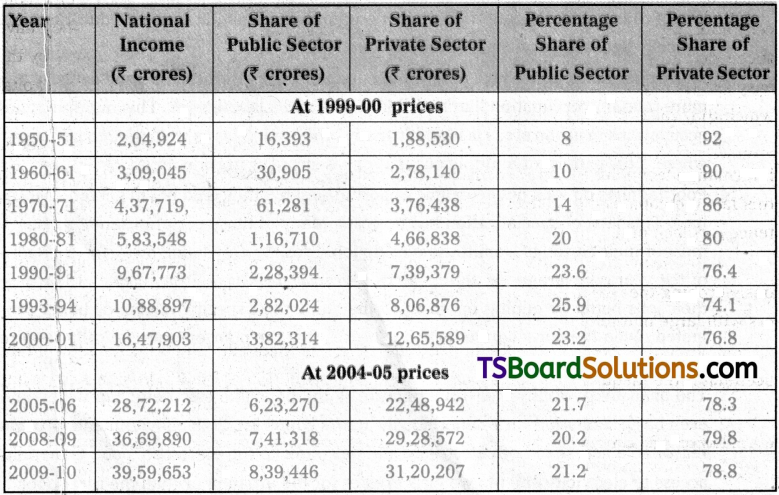
National income is produced in public sector as well as in private sector. Prior to 1951, the share of public sector was very small. With the introduction of five year plans there was; a gradual increase in the economic activities of the state. As a result, the share of public sector in national income has gradually increased.

The public sector accounted for 8 percent of the GDP in 1950-51, is share in 2000-01 had risen to 23.2 percent. However, it declined to 21.7 percent in 2005-06 and further to 20.2 per-cent in 2008-09 and again there is a slight increase to 21.2 percent in 2009-10. Thus, the publtic sector accounts about one – fifth of the national income. Though, this is largely due to a rapid expansion of the public sector enterprises, the private sector still occupies a dominant position in the economy.

After the introduction of economic reforms, the share of private sector in the national income increased to 76.8 percent in 2000-01, 79.8 percent in 2008-09 and reduce marginally to 78.8 percent in 2009-10.

TS Inter 2nd Year Economics Study Material Chapter 3 National Income, Poverty and Unemployment

Question 2.
Examine the causes for inequalities in the distribution of income and wealth.
Answer:
1) Inequalities in land ownership :
There was concentration of landed property in India during the British period on account of the zamindary system. The Zamindary system was; abolished immediately after independence, yet the concentration of land ownership could not be broken.

2) Concentration of Assets in the private corporate sector :
There is an extreme con -centration of economic wealth and power in the hands of large industrialists and they have succeeded in acquiring massive assets over time. They have been aided in their efforts by the; easy availability of finance from banks and other financial institutions, besides equity capital which they raise from the market.

3) Inequalities in Professional Training :
Incomes of business executives, engineers, information technologists, physicians, lawyers and other professionals are often high and from this fact it emanates the false notion that income inequalities arise from professional competence (or) lack of it.

4) Inflation and the price rise :
Since the mid – 1950s, prices have been rising continuously eroding the real income of the working class, while the industrialists, traders, and farmers with large marketable surplus have benefited a great deal from this inflationary process.

5) Inequity in credit facilities :
In India, there is inequality in credit facilities which acentuates the inequalities arising from an unequal distribution of wealth. Business firms and individuals having an access to the formal capital markets manage to obtain finance on very favourable terms, while vast mass of small and marginal farmers, agricultural labourers and artisans depend heavily on money lenders who charge an exorbitant rate of interest and also exploit these poor people in a number of ways.

6) Urban Bias in Private Investment :
While 70 percent of the population in this country lives in rural areas, about 70 percent of private investment goes to industries in urban areas. Therefore, there is a distinct urban bias in the pattern of private investment. This urban bias tsikes the form of highly mechanised projects in which the share of wages in value added is relatively low. This naturally leads to inequality in income distribution.

7) The Role of the Government :
Though the state is often proclaimed as a precursor and initiator of economic change in India, the fact is that the state investment essentially plays a supportive rote to private investment (especially the large and capital intensive enterprises). This is due to fact that the state depends for its support on the same social forces which own the wealth of the country and supply the technicians, administratory and the dominant political groups.

Question 3.
Examine the different types of unemployment.
Answer:
unemployment is a situation where the persons those who are willing and able to work at the current wage rate are unable to get work.

Types of unemployment :
1) Structural Unemployment :
This type of unemployment is associated with economic structure of the country. When demand for labour falls short to the supply of labour due to rapidly growing population and their immobility, the problem of unemployment appears in the , economy. Rate of capital formation which again limits the employment opportunities. This type of structural unemployment is of long run nature.

2) Under – Employment :
Those labourers are under – employed who obtain work but their efficiency and capability are not utilized at their optimum and as a result they contribute in the production upto a limited level. A country having this type of unemployment fails to exploit the efficiencies of their labourers.

3) Disguised Unemployment :
A person does not contribute anything in the production process if can be removed from the work without affecting the productivity adversely, he will be treated as disguisedly unemployed. The marginal productivity of such unemployed person is zero. Agriculture sector of under developed / developing economies possesses this type of unemployment on a large scale.

4) Open Unemployment :
when the labourers live without any work and they don’t find any work to do, they come under the category of open unemployment. Educated unemployment and unskilled labour unemployment are included in open unemployment. The migration from rural to urban areas in search of work is very often found in India which is an example of open unemployment.

5) Educated Unemployment :
Even when a person who is educated / trained and skilled fails to obtain a job suited to his qualifications, he is said to be educated unemployed. Presently this type of unemployment has become a problem for developing economies, particularly for India.

6) Frictional Unemployment :
The temporary unemployment which exists during the period of transfer of labour from one occupation to another is called frictional unemployment. It arises due to the imperfections of labour market. Imperfections in labour market are reflected in the ignorance of labour about job opportunities.

7) Seasonal unemployment :
It appears due to a change in demand based on seasonal variations. Labour do not get work round the year. They get employment only in some seasons in the year. Indian agriculture ensures employment for only 7-8 months and labourers remain unemployed in the remaining period. This temporary type of. employment gives birth to seasonal unemployment.

8) Cyclical unemployment :
The main cause of it is the slackness in business activities. This type of unemployment is generally witnessed in the developed countries.

9) Technological Unemployment :
When the introduction of new technology causes displacement of workers, it is called technological unemployment.

10) Non employment :
The people who are working in their household activities or unorganised sector in developing countries are treated as non – employment category persons.

Question 4.
Analyse the causes for unemployment in India.
Answer:
Causfis of Unemployment :
The foregoing analysis of enemployment in India has made it evidently clear that most of the unemployment in this country is structural. Some of the main causes ae mentioned hereunder:

Some of the main causes of unemployment are mentioned here under :
1) Jobless Growth :
During, the first decades of economic planning, the GDP growth rate was as low as 3.5 percent per annum. In this period, employment increased at a reasonable rate of 2 percent per annum. However, thereafter, while the GDP growth rate picked up considerably, employment growth rate registered a sharp fall. Infact, while employment growth was as high as 2.82 percent per annum over the five year period 1972-73 to 1977-78, it fell to only 1.02 percent per annum over the five year period 1993-94 to 1999-2000. The country witnessed a phenomenon of jobless growth in the period of 1990s.

2) Increase in Labour force :
Since independence, death rate has rapidly declined and the country has entered the second stage of demographic transition. The rate of population growth rose to 2.2 percent per annum during the 1960s, and as a consequence, rate of increase in labour force also rose to 1.9 percent per annum. During the period 1983 to 1993 – 94 both demographic and social factors further raised the rate of growth of labour force.

3) Inappropriate Technology :
In India, while capital is a scarce factor, labour is available in abundant quantity. Under these circumstances, if market forces operate freely and efficiently, the country would have labour – intensive techniques of production, However, not only in industries, but also in agriculture, producers are increasingly substituting capital for labour.

4) Inappropriate Educational System :
The Educational system in India is defective. It is in fact, the same educational system which Macaulay had introduced in this country during the colonial period. To Gunnar Myrdal, India’s educational policy does not aim at development of human resources. It merely produces clerks and lower cadre executives for government and private concerns. With the expansion in the number of institutions which impart this kind of education, increase unemployment is inevitable

5) Neo – Liberal Economic Policy :
With the introduction of neo-liberal structural reforms in India since the early 1990s, income inequalities have increased. Growing income inequalities generally lead to demand constraint recession and unemployment.

Consequences of Unemployment :
1) Loss of Human Resources :
The problem of unemployment causes loss of human resources. Labourers waste their maximum time in search of employment.

2) Increase in poverty :
Unemployment deprives a man of all sources of income. As a result he grows poor. Therefore, unemployment generates poverty

3) Social Problems :
Unemployment breeds many social problems and social security is jeopardized.

4) Political Instability :
Unemployment gives birth to political instability in a country. Unemployed persons can easily be enticed by anti social elements. They lose all faith in democratic values and peaceful means.

5) Exploitation of labour :
In the state of unemployment, labourers are exploited to the maximum possible extent. Those labourers who get work have to work under diverse conditions of low wages. All this tells upon efficiency of labourers.

6) Standard of living :
In times of unemployment, the competition of jobs and regotiation power of individual decreases and thus also the living standard of people with the salaries, packages and income reduced.

7) Employment Gaps :
To further complicate the situation, the longer the individual is out of job the more difficult it becomes of find one. Employers find employment gaps as negative aspect. No one wants to hire a person who has been out of work for some time even when there’s no fault of the individual persons.

8) Lose of skill’s usage :
The unemployed is not able to put his / her skills to use. And in a situation where it goes on for too long the person may have to lose some of his / her skills.

TS Inter 2nd Year Economics Study Material Chapter 3 National Income, Poverty and Unemployment

Question 5.
Explain the consequences of the problem of unemployment.
Answer:
Causes of Unemployment: The widespread unemployment in urban as well as in rural India is a complex problem caused by many factors. Unemployment affects not just the person himself but also his / her family apd in the long-run the society where he lives. Unemployment brings with it despair, unhappinelss and anguish. The major consequences of the problem of unemployment are as follows :

Consequences of Unemployment :
1) Loss of Human Resources :
The problem of unemployment causes loss of human resources. Labourers waste their maximum time in search of employment.

2) Increase in poverty :
Unemployment deprives a man of all sources of income. As a result he grows poor. Therefore, unemployment generates poverty

3) Social Problems :
Unemployment breeds many social problems and social security is jeopardized.

4) Political Instability :
Unemployment gives birth to political instability in a country. Unemployed persons can easily be enticed by anti social elements. They lose all faith in democratic values and peaceful means.

5) Exploitation of labour :
In the state of unemployment, labourers are exploited to the maximum possible extent. Those labourers who get work have to work under diverse conditions of low wages. All this tells upon efficiency of labourers.

6) Standard of living :
In times of unemployment, the competition of jobs and regotiation power of individual decreases.and thus also the living standard of people with the salaries, packages and income reduced.

7) Employment Gaps :
To further complicate the situation, the longer the individual is out of job the more difficult it becomes of find one. Employers find employment gaps as negative aspect. No one wants to hire a person who has been out of work for some time even when there’s no fault of the individual persons,

8) Lose of skill’s usage :
The unemployed is not able to put his / her skills to use. And in a situation where it goes on for too long the person may have to lose some of his / her skills.

Question 6.
Examine the causes for poverty in India.
Answer:
Poverty can be defined as a social phenomenon in which a section of the society is unable to fulfill even its basic necessities of life.

Causes for poverty :
The causes for poverty in India are as follows.
1) Concentration of Economic Power :
In India, the income gap has a significant urban – rural bias and these income differences have increased over the 1990’s. Consequently, the phenomenon observed in the Indian economy is : It has started growing, the rich are reaping the benefits of development. Thus, inequalities in income and wealth, concentration of economic power were the reasons for the rich becoming richer and poor becoming poorer.

2) Under – Exploitation of Natural Resources :
To improve the standard of living of the people in the country, it is essential that we should achieve higher rate of growth in national income. To increase the national income, the natural resources in the country must be fully and profitably exploited. In our country there is under – exploitation of natural resources. Therefore, inspite of 60 years of planning experience, still 19.3 pejrcent of the population live below the poverty line.

3) Heavy population pressure :
The main problem jin India is the high level of birth rates coupled with a falling level of death rates. The averageannual growth rate of population from 1951-2001 was 2.1 percent. The fast rate of growth of population necessitates a higher rate of economic growth in order to maintain the same standard of living of the population. To maintain a rapidly growing population, the requirements of food, clothing, shelter, medicine etc. rise. A high growth rate of population and low growth! rate of national income will bring down the percapita income, which means the percapita expenditure will also come down.

4) Unemployment :
In India, labour is an abundant, factor and consequently, it is very difficult to provide gainful employment to the entire working population. Unemployment is structural and results in deficiency of capital. This result in the unemployment and poverty in the country. With an increase in the number of unemployed persons, the incidence of poverty also increase.

5) Poor Education :
Another major cause of poverty is the low educational attainments of the poor. These educational differentials are one of the main factors for relatively lower levels of income among the poor. The earnings of arts, science, commerce graduates were nearly six times as compared with those of illiterates and 3.5 times as compared with those with primary level education.

6) Low consumption of Essentials :
Another important cause of the poverty in India is the low availability of essential commodities. The consumer goods shortage is responsible, for low level of standard of living. There is a wide disparity in the consumption levels of the top rich and the bottom poor.

7) Inflation :
Rising prices are another cause of poverty. When prices rise, the purchaging power of money falls and it leads to impoverishment of the lower middle and poorer sections of the society. Thus, the inflationary pressures further increase the poverty in the country.

8) Low Technology :
Low level of technology is also responsible for the poverty in India. Not only in manufacturing processes and agricultural production, techniques are far below the developed economies, but even making skills, the capacity to organize production units, and financial markets are low level. As a result of low technology, percapita productivity remains at a low level.

9) Capital Deficiency :
The development of the economy depends on capital information in the country. In India most of the poeple are illiterate and unskilled. They used outmoded capital equipment as methods of production. They practice subsistence farming, lack mobility and have little connections with the market sector of the economy.

10) Failure of five year plans :
The basic objective of planning is the provision of a national minimum of level of living. The garibi hatao (remove poverty) slogan of Mrs. Indira Gandhi could be provided a meaningful content only if measures were taken to remove poverty. The fact that even after 5 decades of planning, 19.3%. of population is living under the conditions of poverty is a sad commentary on our planning.

11) Liberalisation, privatisation and Globalisation model of development :
This model by passes agriculture and agro-based industries which are a major source of generation of employment for the masses. This strategy has less trickle -down effect on the economy, there fore, poverty may increase in the country.

12) Social Factors :
In India, people are caught in the vicious circle of the poverty due to the prevalent socio – cultural institutions. In order to fulfill social obligations and observe religious ceremonies form cradle to grave, people spend extravagantly. Besides, illiteracy, igarance, religious ideas, casteism and joint family system prevented people from adopting modem ideas and techniques where by they could increase their income and reduce poverty.

TS Inter 2nd Year Economics Study Material Chapter 3 National Income, Poverty and Unemployment

Question 7.
Discuss the consequences of the problem of poverty.
Answer:
When a substantial segment of a society is deprived of minimum level of living and con-tinues at a base subsistence level, that society is said to be plagued with mass poverty.

consequences of the problem of poverty : The adverse effects of the problem of poverty are mentioned here under.

1. Unequal opportunities :
Generally, haves avail all better opportunities with the aid of money arid supremacy of resources while the poor class always remained deprived off even the basic needs. Consequently, the poor are more severely effected.

2. Concentration of Economic Power :
Another far – reaching consequence of poverty is that it leads to the concentration of economic power in a few pockets. The rich people make use of their economic powers to attain the political power.

3. Inefficiency :
Due to the prevalence of the poverty. The poor do not get opportunities of education and other specialized training. Without proper understanding and skill, there is overall inefficiency in the production process.

4. Problem of Unemployment :
The problem of poverty leads to the problem of unem-ployment in the country as the poor do not have many opportunities to employment. A high unemployment rate can impede a country from progressing in all aspects.

5. Income Inequalities and Insecurity :
The problem of poverty leads to the growth of income inequalities. Ftirther, it creates the feeling of insecurity.

6. Society :
Poverty also has social effects. Many people living in poverty are homeless, which puts them on the streets. Homelessness and high crime rates impact a country’s people and can create many problems within a society.

7. Malnutrition :
The most common effect of poverty is malnutrition. This is especially seen in children of poor families. People living in poverty rarely have access to highly nutritions foods. Sometimes people in poverty are malnourished simply because they do not eat enough of anything.

8. Health :
One of the most severe effects of poverty is the health. This ranges from occurence of diseases to lesser life expectancy and a greater expenditure on medicine.

9. Education :
Education is largely affected by poverty. Many people living in poverty are unable to attend school from a very early age. Families may not be able to afford the necessary clothing or school supplies.

Question 8.
Bring out some of the poverty alleviation programes under taken by the government.
Answer:
Strategy of Poverty Alleviation and Employment Generation Programmes :
A careful examination of the poverty alleviation programmes reveals that the planners have made the assunption that the poor constitute a homogeneous category. The planners made no attempt to segment the group in terms of common characteristics and their requirements.

At present there seems to be littel integration in transfer to assets and skills approach and employment approach. It is suggested that in future there has to be greater coordination between these two elements of poverty alleviation programme. A major limitation of the existing poverty alleviation strategy is that it has no programmes for those households who neither have assets nor skills and in addition, do not have any able bodied adult memebr and thus cannot benefit from wage employment programmes. For such a category, separate policy measures would be required.- Obviously these destitutes are to be covered under social security schemes.

1) Under the Seventh Plan, the basic emphasis was on productive employment rather than the alleviation of poverty.

The programmes for poverty alleviation were viewed as supplementing the basic plan for overall growth. Therefore in the Seventh Plan poverty alleviation was not in focus. The planners claimed that the Seventh Plan policies were formulated after a careful analysis of lessons from performance of various poverty alleviation programmes. The Seventh Plan aimed at reducing the percentage of the population below the poverty line from 39.9 percent at the beginning of the Plan period to 28.2 percent by 1990.

2) Elimination of poverty was one of the major objectives of the Eighth Plan. The plan-ners had hoped to realise this objective by pursuing employment – oriented growth strategy. Hence, expansion of employment opportunities and augmentation of pro-ductivity and income levels of both the underemployed and unemployed poor were ade the principal instruments for achieving this goal during the Eighth Plan.

3) The Ninth Plan relied essentially on the trickle-down effects of economic growth for povrty alleviation. It nevertheless recognised the role of anti-poverty programmes.

4) The Tenth Five Year Plan sought to achieve a faster reduction in poverty rate by redressal of regional imbalances for which aggregate growth target was broken State-wise. Thus, the Tenth Plan also like the Ninth Plan relied on the tickle-down effect of economic growth for poverty alleviation.

5) The Eleventh Five Year Plan also emphasised rapid growth of the economy to achieve reduction an poverty. However, it emphasised that this growth must be better balanced to rapidly create jobs in the industrial and services sector.

6) The Twelfth Five Year Plan emphasises faster, sustainable and more inchlusive growth. According to the planners, while the objective of development is broad – based improvement in the economic and social conditions of our people, rapid growth of GDP is an essential requirement for achieving this objectie.

Two reasons are cited in support of this contention.

a) rapid growth of GDP produces a larger expansion in total income and production which, if the growth processes sufficiently inclusive, will directly raise living standards of a large section of the population by providing larger employment opportunities and other income enhancing activities.

b) rapid growth generates higher revenues which help to finance critical programmes of poverty alleviation and inclusiveness like Mahatma Gandhi National Rural Employ-ment Guarantee Scheme (MGNREGS). Sarva Shiksha Abhiyan (SSA), Mid – Day Meals (MDMs), integrated Child Development Services (ICDS), National Rural Health Mis-sion, (NRHM) etc.

Question 9.
Analyse the different concepts of poverty.
Answer:
Concept of Poverty :
Poverty can be defined as a social phenomenon in which a section of the society is unable to fulfill even its basic necessities of life. When a substantial segment of a society is deprived of minum level If living and continues at a bare subsistence level, that society is said to be plagued with mass poverty. The countries of the third world exhibit invariably the existence of mass poverty.

Types of Poverty
There are two types of poverty common in economic literature; the absolue poverty and the relative poverty. ,

1. Absolute Poverty :
In the absolute standard, minimum physical quantities of cereals, pulses, mik, butter etc are determined for a subsistence level and then the price quotations are converted into monetary terms for the physical quantities. Aggregating all the quantities in-cluded, a figure expressing percapita consumer expenditure is determined. The population whose level of income or expenditure is below the figure considered to be the absolute poverty.

2. Relative Poverty :
According to the relative standard, income distribution of the population in different fractile groups is estimated and a comparison of the levels of living of the top 5 to 10 percent with the bottom 5 to 10 percent of the population is called relative poverty, or It is the absolute poverty with which we are concerned when we talk of the problem of poverty in India. Advanced countrie such as the USA, UK, have succeeded in removing absolute poverty for their people, but relative poverty, prevails even in these countres because of uneven distribution of imcome.

3. The Poverty Gap Index :
The poverty gap index is defined by the mean distance below the poverty line expressed as a proportion of that line. The poverty gap .thus measures the transfer that would bring the income of every poor person exactly up to the povety line, therby eliminating the poverty. In this way the poverty gap relflects the depth of poverty, as well as is incidence, the povery gap index is claculated with the help of the following principle.

TS Inter 2nd Year Economics Study Material Chapter 3 National Income, Poverty and Unemployment 5

4. Human poverty Index :
Human Development Report 1997 introduced a Human Poverty Index (HPI) in an attempt to bring together in a comosite index the different features of deprivation in the quality of life to arrive at an agregate judgement on the extent of poverty in a community. Human Development Report 2010 introduced the concept of Mltidimensional Poverty Index (MPI) to replace HPI. The MPI is the product of the multidimensional poverty head – count and the average number of deprivations each multidimensionally poor household experiences. It has three dimensions mirroring the HDI – health, education and living standards-which are reflected in 10 indicators.

TS Inter 2nd Year Economics Study Material Chapter 3 National Income, Poverty and Unemployment

Question 10.
Briefly examine the incidence of poverty in India.
Answer:
Incidence of Poverty in India : The Planning Commission provided estimates of the incidence of poverty since the early 1970s. As stated earlier, it determined the poverty line for rural population at Rs. 49.63 per capita per month while for urban population, poverty line was fixed at Rs. 56.64 per capita per month. These poverty lines were updated over time keeping price changes in view.

Rangarajan panel suggested to the goernment that those spendig more than Rs. 972 a month in rural areas and Rs. 1,407 a month in urban areas in 2011-12 do not fall under the definition of poverty. Thus, for a family of five, the all-India poverty line in terms of consump-tion expenditure, as per the Rangarajan committee, would amount to Rs. 4,860 per month in rural areas and Rs. 7,035 per month in urban areas. If calculaed on a daily basis, this translates into a per capita expenditure of rs. 32 per day in ruaral areas and Rs. 47 in urban areas in 2011-12.

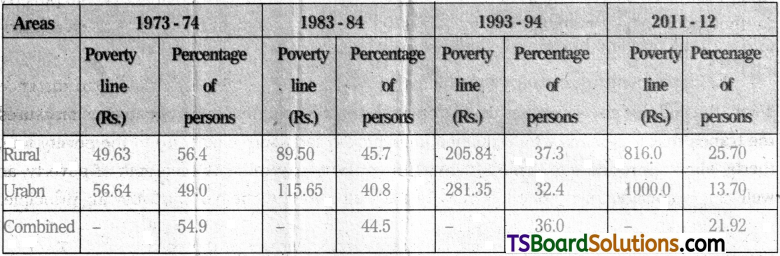
As per the Tendulkar methodology for 2011-12, the poverty line was Rs. 816 in rural areas and Rs. 1,000 in urban areas, which if calculated on a daily basis comes out at Rs. 27 per day in rural areas and Rs. 33 in urban areas. The Tendulkar Committee had pegged this at Rs. 4,080 and Rs. 5,000 respectively. Estimates for the years 1973-74, 1983-84, 1993-94 and 2011 – 12 are presented in the following Table along with poverty lines in these years.

Percentage of Population ISelow the Poverty Line
TS Inter 2nd Year Economics Study Material Chapter 3 National Income, Poverty and Unemployment 6

According to this table, more than half of the populatin was below the poverty line in 1973 – 74. Over the four decade period 1973-74 to 2011-12 there was a perceptible decline in the incidence of poverty – from 59.4 percent in 1973-74 to 21.92 percent in 2011 -12. However, in view of the fact that the populatin had increased considerably over the period, it can be safely concluded that the absolute number of poor people did not decline. This analysis is as per the data of Hand Book of statistics, RBI, Indian economy, 2018-19.

Very Short Answer Questions

Question 1.
National Income.
Answer:
The value of final goods and services produced in year in a country is known as national income. This concept is used as an indicator of economic development of a country.

Question 2.
Percepita income.
Answer:
If we divide National Income of a contry with countries population. We get per – capita – income. This can be explained as follows.
TS Inter 2nd Year Economics Study Material Chapter 3 National Income, Poverty and Unemployment 7
India’s per capita Income is Rs. 1,12,835 at current year prices.

Question 3.
Unemployment.
Answer:
Unemployment means when a labourer does not obtain employment opportunity despite his willingness to work on existing wage rate.

According to keynes unemployment in developed economics to be the result of an defi-ciency in effective demand, the nature of unemployment in developing countries like India is disguised unemployment in nature. These economies also face the problem of Inflation side by side with the problem of unemploymet.

Question 4.
Chromic under employment.
Answer:
This concept also known as usual principal status employment. It is measured in number of persons that is persons who remained unemployed for a major part ot the year. This measure is more appropriate to those in search of regular employment. This is also referred to as open unemployment.

TS Inter 2nd Year Economics Study Material Chapter 3 National Income, Poverty and Unemployment

Question 5.
Weekly status unemployment.
Answer:
Persons who did not find even an hour of work during the survey week.

Question 6.
Structural unemployment.
Answer:
When demand for labour falls short to the supply of labour due to rapidly growing populatin and their immbility, the problem of unemployment appears in the economy. This type of unemployment is of long run nature Indian unemployment is basically related to this category.

Question 7.
Seasonal unemployment.
Answer:
Seasonal unemployment is contipued to the agricultural sector because nature predomi-nates agriculture. The demand for agricultural labour increases at the time of sowing and harvesting which provides employment for six to eight months and for the remaining period most of the agricultural workers remain unemployed.

Question 8.
Open unemployment.
Answer:
When the labourers live without any work and they don’t find any work to do, they come under the category of open unemployment. Educated unemployment and unskilled labour unemployment are included in open unemployment.

Question 9.
Educated unemployment.
Answer:
Even when a person who is educated / trained and skilled fails to obtain a job suited to his qualifications, he is said to be educated unemployed. Presently this type of unemployment has become a problem for developing economies, particularly for India.

Question 10.
Cyclical unemployment.
Answer:
The main cause of cyclical unemployment is the slackness in business activities. This type of unemployment is generally witnessed in the developed countries.

TS Inter 2nd Year Economics Study Material Chapter 3 National Income, Poverty and Unemployment

Question 11.
Disguised unemployment.
Answer:
A person whose marginal productivity zero or when more people are engaged in a job than actually required. We find his type of unemployment in agriculture in developing countries.

Question 12.
Frictional unemployment.
Answer:
The temporary unemployment which exists during the period to transfer of labour from one occupation to another is called frictional unemployment.

Question 13.
Non – employment.
Answer:
The people, who are working in their house hold activities or unorganised sector in de-veloping countries are treated as non – employment category.

Question 14.
Under employment.
Answer:
Under utilisation of labour time of workers, some of the workers classified as usually employed do not have work throughout the year due to seasonality in work or their labour time is not fully utilised.

Question 15.
Technological unemployment.
Answer:
When the introduction of new technology causes displacement of workers. It is called technological unemployment.

Question 16.
Poverty line.
Answer:
It refers to cut – off level of annual income of the household, poverty line is estimated separately bhsed oh nutritional diet of rural and urban areas, average consumption extendition of the poor / poverty line in this way, the poverty gap reflects the depth of poverty as well as its incidence.

Question 17.
Poverty gap.
Answer:
poverty gap thus measures the transfer that would bring the income of every poor person exactly up to the poverty line, there by eleminating the poverty. In this way the poverty gap results the depth of poverty, as well as its incidence. The poverty gap index is calculated with the help of following principle.
Poverty line – Average consumption
poverty gap = Poverty line

Question 18.
Absolute poverty.
Answer:
A person whose income is so meagre (or) low. It means the person is living below the subsistance level is known as absolute poverty.

TS Inter 2nd Year Economics Study Material Chapter 3 National Income, Poverty and Unemployment

Question 19.
Relative poverty.
Answer:
The people with lower income are relativele poor compared to the people with higher income. Even though they may be living above the minimum level of subsi scheme.

Question 20.
Multi dimensional Poverty Index (MPI)
Answer:
This concept was introduced by human development report – 2010 by replacing the HPI. The MPI is the product of the multi poverty head court and average number of deprivations each multidimensionally poor household experiences. It has three dimensions mirroring the HDI they are health, education and living standards.

TS Inter 2nd Year Economics Study Material Chapter 7 Tertiary Sector

Telangana TSBIEĀ TS Inter 2nd Year Economics Study Material 7th Lesson Tertiary Sector Textbook Questions and Answers.

TS Inter 2nd Year Economics Study Material 7th Lesson Tertiary Sector

Essay Questions

Question 1.
What is tertiary sector? Explain the importance of tertiary sector in India economy.
Answer:
In traditional setting, providing skills to satisfy human wants by barber, dhobi, carpenter, goldsmith, blacksmith etc., was considered as service. In modem economy, services became highly skilled and attractive, so, services ar contributing a major share to national income and in many countries, services are providing- employment to the major portion of labour force.

In modem economy the tertiary sector includes the following sub-sectors: trade, repair seirvices, hotels and restaurants, transport, storage, communication and services related to broadcasting, financial services, real estate, ownership of dwellings and professional services,
public administration, etc.

The services sector’s significance in the Indian economy has continued to increase as this sector now (2019) accounting for around 55 percent of total size of the economy and gross value added (GVA) growth, two-thirds of total FDI (2019) inflows and about 38 percent of total exports. The share of services sector now exceeds 50 percent of gross state value added in 15 out of the 33 states and UTs.

1) Contribution of Gross Value Added (GVA) :
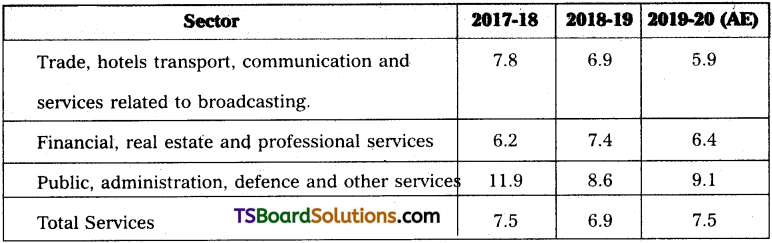
In India the service sector has emerged as the major growth inducing sector. The share of service sector in gross value added (GVA) increased significantly from 49.4 percent in 2013-14 to 57.8 percent in 2019-20 (AE). The tertiary sector is assuning greater importance over the years with an average contgribution of about 58 per cent to the GVA, followed by the secondary and primary sectors with about 28 percent and 14 percent, respectively. However, the contribution of secondary sector (28.3% in 2019-20) and primary sector (13.9% in 2019-20) is declining over the years. According to Economic Survey of India-2019, contribution of major components of service sector in 2019-20 is as follows: trade, hotel, transport, storage, communication and services related to broadcasting is 18.1%; financial, real estate and professional services is 24.5%; and public administration, defence and other services is 15.2%.

2) Contribution To Employment :
Employment in modem service sector is highly skilled and high ranged earning one, especially, after the IT (Information Technology) revolution Average per Capita earning of service sector employees is very high when compared to employees of other sectors. The share of service sector in employment has increased from 17.3 per cent in 1950-51 to 26.5 percent in 2010 and further to 31.45 percent by 2018.

3) Exports :
The value of total service exports is increased from US $ 195.1 billion in 2017- 18 fo US $ 205.8 Billion in 2018-19 of which, software exports account for about 40 percent,’travel and transportation 23 percent and business services 19 percent, financial services 2 percent, communications 1 percent and insurance 1 percent. After deducting the value of services imports from balance of trade, the value of India’s favourable balance in services trade is US $ 81.9 billion in 2018-19.

4) Foreign Direct Investment (FPJ) in Service Seetor :
Gross foreign direct investment (FDI) equity inflows into service sector in 2018-19 was US$ 28,264 million. The share of service sector in gross FDI equity inflows into India is 64.6 percent in 2017-18 and 63.7 in 2018-19. An increase in net foreign direct investment (FDI) improves the Balance of Payments (BoP) position. The impressive improvement in balance of payment (BoP) position from March, 2014 to March, 2019 is mainly attributed to almost doubling of net FDI into the country during 2009-19. Net FDI inflows have continued to be buoyant in 2019-20.

Increasing FDI inflows in service sector is vital as it contributes over 60 per cent to the gross domestic product. Total FDI inflows to India from April, 2000 to September, 2019 are US $ 4.46 lakh million (Rs. 25.61)-lakh crore), nearly 50 percent of which belong to service sector.

TS Inter 2nd Year Economics Study Material Chapter 7 Tertiary Sector

Question 2.
Write about Tourism sector services in India.
Answer:
World Travel Organization defines tourism as “the activities of tourists travelling and staying in places outside thier usual environment for not more than one consecutive year for leisure, business and other purposes”. Indian government defines tourism as” a foreign passport holddr visiting and staying in India for more than a day but not more than a year for leisure, entertainment, business, medical purposes, religious, sports, conferences, seminars etc.” Tourism is a set of socio-economic activities carried out for tourists. There are two forms of tourism.

1) Domestic Tourism :
Domestic tourists are the residents of the country who travel within the geographical boundaries of their country. Traditionally, people use their vacations to visit religious places, pilgrimage centeres and historicasl places. The modem generation spend their vacations visiting wildlife sanctuaries, beaches, hill statiions, entertainment parks and resorts in the country.

2) International Tourism :
International tourists are the foreign passport holder visiting another country for business, leisure, fitness, wellnes, medical religious, spiritual, archaeo-logical, sports, conferences, seminars etc. They need visa, emigration and customs clearance of the government of the government of the country they are visiting.

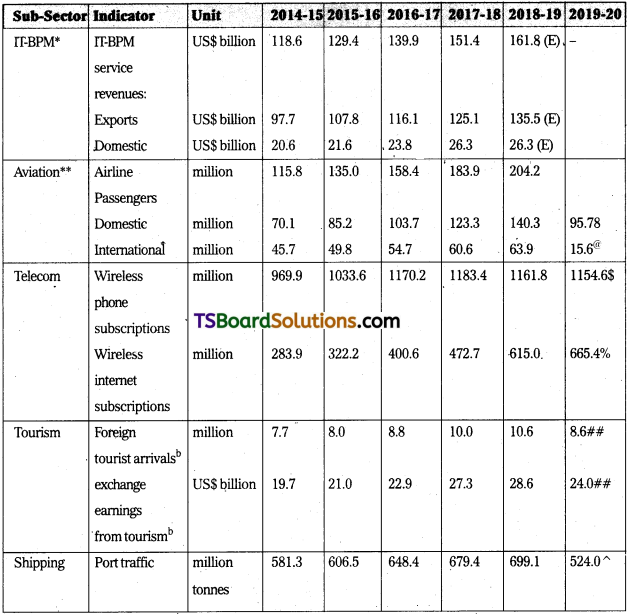
The tourism sector, a major engine of growth, contributes to GVA, foreign exchange earnings and employment. In India, the tourism sector witnessed a strong performance from 2015 to 2017, with high growth in foreign tourist arrivals. However, foreign tourist arrivals growth has decelerated since then to 5.2 percent in 2018 and 2.7 percent in January-October 2019. This trend, however, is not unique to India, as the growth i international tourist arrivals globally also slowed from 7.1 percent in 2017 to 5.4 percent in 2018. Correspondingly!!, growth in foreign exchange earnings from tourism sector has slowed in 2018 and 2019 after registering strong growth until 2017, India has earned a total of US $ 24 billion foreign exchange during January-October 2019, with a growth of 2 percent.

About 7.68 million foreigners have visited India in 2014 and it increased to 10.56 millions by the year 2018. During the same period the number of international tourist arrivals (ITAs) to India increased from 13,11 millions to 17.42 millions while international tourist arrivals around the world increased from 1137 millions to 1401 millions. The share of India’s ITAs in world ITAs increased from 1.15 per cent in 2014 to 1.24 per cent by 2018. India’s rank in World’s ITAs Increased from 20th to 22nd India’s share in Asia Pacific’s ITAs increased from 4.86 percent to 5.1 percent. India’s rank in Asia Pacific’s ITAs increased from 8th to 7th.

India’s share in world tourism receipts increased from 1.57 percent to 1.97 percent (PE) India’s rank in world tourism receipts increased from 15th to 13th. India’s share in Asia Pacific’s tourism receipts has increased from 5.49 percent to 6.54 percent (PE). However, India’s rank in Asia Pacific’s tourism receipts remained same at 7 in 2014 and 2018.

State Level Sham of Tourism in GVA and Employment :
Looking at trends in tourism at the state level, the top five states attracting domestic tourists are Tamil Nadu, Uttar Pradesh, Karnataka, Andhra Pradesh and Maharashtra which accounted for nearly 65 percent of the total domestic tourist visits in the country in 2018. The top five states attractig foreign tourists were Tamil Nadu, Maharashtra, Uttar Pradesh, Delhi and Rajasthan, accounting for about 67 per cent of the total foreign tourist visits in the country in 2018.

The Ministry of Tourism along with the Natinal Council of Applied Economic Researcch (NCAER) prepared a tourism satellite account (TSA) following the methodology recommended by the UN World Tourism Organization. The state-wise share of tourism gross value added (TGVA) in state GVA and share of tourism employment in total state employment have been estimated in the draft report of Ministry of Tourism and NCEAR.

Government s Initiatives :
To facilitate international tourism, India introduced the e- Tourist Visa regime in September 2014 for 46 Countries. Prior to the launch of the scheme, the e-Visa facility was available for only 12 countries. The government further liberalized the visa regime in 2016, renaming it to e-Visa scheme with five sub-categories i.e. ‘e-Tourist Visa’, ‘e-Business Visa’, ‘e-Medical Visa’, ‘e-Conference Visa’ and ‘e-Medical Attendant Visa’. The e-Visa scheme is now available for 169 countries with valid entry through 28 designagted airports and 5 designated seaports. With this, foreign tourist arrivals to India on e-visas have increased from 4.45 lakh in 2015 to 23.69 lakh in 2018 recording nearly 21 percent year-on-year growth from the previous year.

Question 3.
Explain about IT-BPM (Information Technology and Business Process Management) services.
Answer:
Information Technology and Business Process Management (IT-BPM) Services :
Business process management (BPM) is a discipline involving any combination of modeling, automation, execution, control, measurement and optimization of business activity flows, in support of enterprise goals, spanning systems, employees, customers and partners wihtin and beyond the enterprise boundaries. The Indian IT-BPM industry has been the flag-bearer of India’s exports for the past two decades, as per Economic Survey of India, 2019, the exports from this industry is reached to about US$ 177 billion in March 2019.

The sector contributes significantly to the economy via employment growth and value addition. IT services constituted 51 percent of the IT-BPM sector in 2018-19, followed by software and engineering services (20.6 percent share) and BPM services (19.7 per cent share). Within the IT-BPM sector, IT services remained the dominant segment with about US$ 91 billion in revelues in 2018-19. Out of the IT sevices, digital revenues grew (year on year-YOY) more than 30 percent to reach US$ 33 billion.

Further, the IT-BPM sector can be divided into four major sub-sector as :

  1. IT services,
  2. software products and engineering services,
  3. BPM,
  4. hardware.

As per National Association of Software and Service Companies (NASSCOM), IT services occupy a major share with 51.2 percent, followed by software products and engineering services with 20.6 percent, BPM with 19.7 percent and hardware 8.5 percent in total value of IT- BPM services in 2018-19.

Exports of IT-BPM Sector :
A significant part (about 83 percent) of the IT-BPM industry continues to be export driven, with export revenues in excess of US$ 135 billion in 2018-19. During 2018-19, the revenue growth (YoY) for IT-BPM sector (excluding hardware)sofened to 6.8 percent from 8.2 percent in 2017-18. Out of the total US$ 135.5 billion in exports of the IT- BPM sector in 2018-19, IT services accounted for 55 percent of the exports, and BPM and software products and engineering services accounted for the remaining 45 percent with each accounting for almost half of the share. All three sub-sectors witnessed a pickup in export revenues in 2018-19, with IT services growing (YoY) by 7.3 percent, BPM services by 8.3 per cent and software products and engineering services by 11.2 percent.

Looking at export revenues by destination, USA accounts for the bulk of exports, amounting to US$ 84 billion, which is 62 percent of total IT-BPM exports (excluding hardware) in 2018-19. This is much larger than the share of exports going to UK, which is the second largest export market for IT-BPM services, with a share of around 17 percent. Europe (excluding UK) and Asia-Pacific account for 11.4 percent and 7.6 percent of the export earnings, respectively.

Government’s Initiatives :
A number of policy initiatives have been undertaken to drive innovation and technology adoption in the IT-BPM sector, including Start-up India and National Software Product Policy and removal of issues related to Angel tax, According to NASSCOM study, the Indian start-up ecosystem has been progressing, and is now the third largest in the world with 24 unicorns, though the gap with the largest (China: 206) and second largest (USA: 203) markets remains significant. Cities such as Bengaluru, Delhi-NCR, and Mumbai account for around 55 percent of the total startups in India.

TS Inter 2nd Year Economics Study Material Chapter 7 Tertiary Sector

Question 4.
Explain various kinds of transport systems in India.
Answer:
Transport sector helps the economy as the blood circulation system of a human body. Various means of transport are discussed as under.

1. Road Transport :
Road transport is the dominant mode of transportation in terms of its contribution in gross value added (GVA) and traffic share. The share of transport sector in the GVA for 2017-18 was about 4.77 percent, of which the share of road transport was the largest at 3.06 percent, followed by the share of he railways (0.75 percent), air transport (0.15 percent) and water transport (0.06 percent). Similarly, as per the National Transport Development Pollicy Colmmittee Report, as of 2011-12, road transport is estimated to handle 69 percent and 90 percent of the countrywide freight and pasenger traffic, respectively.

The Ministry of Road Transport and Highways (MoRTH) is mandated with the development and maintenance of road networks especially the national highways as well as the implementation of the motor vehicle act under which it formulate broad policies relating to road transport. As on March 31, 2018, India had a road network of about 59.64 lakh km. The total length of national highways was 1.32 lakh km as on March 1, 2019.

2. Railways :
Railway was nationalized in 1950. Indian Railways (IR) with over 68,000 route km is the third largest network in the world under single management. During the year 2018-19, Indian Railways carried 120 crore tonnes of freight and 840 crore passengers making it the world’s largest passenger carrier and 4th largest freight carrier. Railway safety is accorded the highest priority by Indian railways and steps are being undertaken on a continuous basis to prevent accidents and to enhance safety of the passengers.

Cleanliness and environmental Initiatives by Indian Railway :
Indian railways cover over 8,700 stations and carry around 230 lakh passengers daily with clientele of varied socio-economic backgrounds. Cleanliness is a continuous process and every endeavour is made to keep the stations and coaches in properly maintained and clean condition. Special cleanliness campaigns under SwaChh Bharat Abhiyan were launched by Indian Railways on October 2, 2014 and regualr intensive campaigns/drives have been organized since then.

Modernization of Stations :
Modernization/upgradation of railway stations in Indian railways is a continuous and on-going process. 1,253 stations have been indentified for development under Adarsh Station Scheme and are planned to be developed by 2019-320.

3. Air Transport :
India is the third largest domestic market for civil aviation in the world. Indan has 136 commercially-managed airports by Airports Authority of India (AAI) and 6 under public private partnetships (PPP) for operation, maintenance and development of airports. Air transport in India was nationalized in 1953 and India Airlines and Air India were established. Internal air transport Services were allocated to Indian Airlines and international services to Air India. The airline operations in India have scaled up their aircraft seat capacity from an estimated 0.07 annual seats per capita in 2013 to 0.12 in 2018. The comparable estimates for china, the second largest domestic market in the world, over this period were 0.33 in 2013 and 0.49 in 2018, while those of the United States of America, the largest domestic market, were 2.59 in 2013 and 2.95 in 2018.

Indian aviation re-established its resilience in the year 2019-20. A total of 43 airports have been operationalized since the scheme for operationalizing unserved airports (Udan) was taken up, of which 4 were done in FY 2019-20. On airport connectivity, India stood first along with 7 others (USA, China, Japan, UK, etc.) in the Global Competitiveness Report 2019 of World Economic Forum.

To ease the strain on existing airport capacities, 100 more airports are to be made operational by FY 2023-24. Besides using 46 idle airstrips, 16 private greenfield airports, 15 AAI airports, 31 heliports, and 12 waterdrowmes would be develolped. To continue with the high growth trajectory, the Govenment has been providing a congenial tenvironment so that the Indian cariers double their fleet from about 680 aircraft in 2019 to over 1,200 by FY 2023-24.

4. Water Transport :
Water transport connects canals, lakes, rivers, and backwaters wihtin the country. Shipping connects major ports of the country and the world. India with 5,000 km of river and canals has a vast potential for inland water transport, it is the cheapest and least polluting mode of transport. The five year plans discussed about integration of the major rivers, modemizaion of the boats and small ships and training skilled labour to develop inland water transport services. India has a coastal line of 7,156 km with 13 major ports and about 200 non-major ports. The share of shipping in total transport sector is 29%. Shipping is basically used to transport bulk transport item like petroleum products, coal etc.

As per Economic Survey of India-2019, India has a 0.9 percent share in world fleet as of January 2019. The total cargo capacity of Indian ports stood at 1,452.64 million tonnes per annum (MTPA) at the end of March 2019, more than doubling from 628.03 MTPA at the end of March 2010. Ports such as Paradip, Chennai, Vishakhapatnam, Deendayal (Kandla) and Jawaharlal Nehru port. JNPT had the highest cargo capacities as of March 2019. The total numbers of ships ownded by Indian companies stood at 1,414 as of August 2019, up from 1,040 om 2010. Growth in overall port traffic witnessed an acceleration between 2013-14 and 2016-17, but has decelerated since 2017-18.

Question 5.
Write an essay on the sources of energy in India.
Answer:
Energy Sector :
Energy is one of the most important building blocks in human development, and as such, acts as a key factor in determining the economic development of all the countries. Energy is available in many forms which is used either in production process or in consumption process. As per Economic Survey, 2019-20. India is the third largest energy cosumer in the world after USA and China in 2017 with a share of 5.8 per cent of the world’s primary energy consumption.

Sources of Energy :
Energy resources are all forms of fuels, used in the modem world, either for heating, the generation of electrical energy, or for other forms of energy conversion processes. The sources of energy can be divided into two subgroups:

I. Renewable Energy Resources :
Renewable energy is an energy that is produced from natural processes and continuously replenished.

Types of Renewable Energy :
1. Solar Energy :
The radiant light and heat energy from the sun is harnessed with the use of solar collectors. This collected solar energy is then used to provide light, heat and different other forms of electricity.

2. Wind Energy :
The energy we get from winds is known as wind energy. For this, windmills have been used for hundreds of years to pump out water from the ground. We use large tall wind turbines that allow winds to generate electricity. The natural airflow on the surface of the earth is used to run the wind turbines.

3. Hydroelectricity :
The kinetic energy from the flowing water is used to run the turbines which generate electricity. A tidal power which converts the energy of tides and wave power which captures the energy from the surface of the ocean waves for power generatin are other two forms of hydropower also have huge potential in electric power generation.

4. Geothermal Energy :
It is generated from the thermal energy which is stored in the earth. The heat energy is captured on sources such as hot springs and volcanoes and this heat is directly used by industries for heating the water and other purposes.

5. Bio-Energy :
This is derived from the biomass which is a type of biological material derived from living organisms. Biomass can be directly used via combustion to produce heat and indirectly it can be used to convert to bio-fuels. Biomass can be converted to other usable forms of energy such as transportation fuels like ethanol, biodiesel and methane gas.

According to Energy Statistics, 2020 (Minisry of Statistics and Programme Implementation, Gol), the total potential for renewable power generation in the country as on 31.03.2019 is estimated at 1097465 MW. This includes 68.25 percent of solar power, 27.54 percent of wind power and remaining is in the form of small hydro-power, biomass power etc.

The geographic distribution of the estimated potential of renewable power as on 31.03.2019 reveals that Rajasthan has the highest share of about 15% (162223 MW), followed by Gujarat with 11% share (122086 MW) and Maharashtra and Jammu & Kashmir with 10% share (113925MW and 112800 MW respectively), mainly on account of solar power potential except Gujarat where the share of wind power is the highest.

II. Non-Renewable Energy :
Non-renewable energy is that which does not renew itself at a sufficient rate for sustainable economic extraction in meaningful human time-frames. The non-renewable energy is energy from fossil fuels such as coal, crude oil; natural gas and uranium.

(A) Fossil Fuels: Fossil fuels are formed by the remains of animals and plants. Fossil fuel is divided into three categories as shown below :

1. Coal :
Coal deposits are mainly confined to eastern and south central parts of the country. The states of Jharkhand, Odisha, Chhattisgarh, West Bengal, Madhya Pradesh, Telangana and Maharashtra account for 98.09% of the total coal reserves in the country. The state of Jharkhand had the maximum share (25.88%) in the overall reserves of caol in the country. The state of Jharkhand had the maximum share (25.88%) in the overall reserves of coal in the country as on 31st March 2019 followed by Odisha (24.76%). Overall production of raw coal in India during the eyar 2018-19 was 730.4 million tonnes (MT) displaying a growth of 8.1 percent.

2. Crude Oil :
Due to excessive pressure, smaller organisms like zooplankton and algae are decomposed into oil. The estimated reserves of crude oil in India as on 31.03.2019 stood at 618.95 million tonnes (MT) against 594.69 million tonnes as on 31.03.2018. Geographical dis-tribution of crude oil indicates that the maximum reserves are in the Western Offshore (38%) followed by Assam (25.6%), whereas the maximum reserves of natural gas are in the Eastern Offshore(41%) followed by Western Offshore(23.4%).

3. Natural Gas :
The estimated reserves of natural gas in India as on 31.03.2019 stood at 1380.63 Billion Cubic Meters (BCM) as against 1139.57 BCM as on 31.03.2018.

(B) Nuclear Fuels :
The use of nuclear technology relying on fission requires naturally occurring radioactive material as fuel. Nuclear power provides about 6% of the world’s energy and 13-14% of the world’s elecricity.

1. Advantages of Non-Renewable Energy :
a) The non-renewable source of energy is affordable, for instance diesel and oil.
b) It is easily accessible and more compatible; and
c) the non-renewable source of energy is easy to store.

2. Disadvantages of Non-Renewable Energy :
a) The non-renewable energy cannot be replaced once their energy source is used up,
b) The by products of non-renewable energy cause environmental damages,
c) It also increases greenhouse gases.

Conventional and Non-Conventional Sources of Energy :
Energy resources can also be classified as conventional and non-conventional energy resources. The conventional sources of energy include firewood, straw, dried dung, coal, crude oil and natural gas, Thermal energy and hydro-power are conventional energy resources. Where as non-conventional sources of energy include solar energy, wind energy, tidal energy, geothermal energy, nuclear energy and bio-energy.

TS Inter 2nd Year Economics Study Material Chapter 7 Tertiary Sector

Question 6.
Write about Telecom sector services.
Answer:
Telecom Sector :
The science and technology of communication at a distance by transmission of electrical impulses, electromagnetic waves, or optical pulses, as by telephone, radio, television, or computer network is called Telecom sector. Total telephone connections in India grew by 18.8 percent from 9,961 lakhs in 2014-2015 to 11,834 laksh in 2018-19. As on 30 September 2019, the total subscription stood at 11,943 lakhs of which 5,147 lakhs connections were in the rural areas and 6,796 lakhs in the urban areas. Landline telephone connections were at 206 lakh while the number of wireless telephone connections stood at 11,736 lakh at the end of September 2019. The wireless telephony now constitutes 98.27 percent of all subscriptions whereas share of landline telephones now stands at only 1.73 percent.

The overall teledensity in India sands at 90.45 percent, the rural teledensity being 57.35 per cent and urban teledensity being 160.71 percent at the end of September 2019. The private sector dominates with a share of 88.81 per cent (10,606 lakh connections) at the end of September, 2019 while the share of public sector was 11.19 per cent (1,336 lakhs connections). Internal and broadband penetration in India has kept a rapid pace. The number of internet subscribers (both broadband and narrowband put together) stood at 6,653 lakhs at the end of June 2019 as compared to 2,516 lakhs in 2014.

The number of mobile internet subscribers was 6,436 lakhs at the end of June 2019 while the number of wireline internet subscribers was 217 lakh. Total broadband connections increased by about ten times, from 610 lakhs in 2014 to 5,946 lakhs in June 2019. This has accelerated the growth in internet traffic; with a data usage touching the highest ever level of 462 lakhs tera bytes in the year 2018.

Challenges :
There are 4 major players in the sector-3 in the private sector and Bharat Sanchar Nigam Limited (BSNL) and Mahanagar Telephone Nigam Limited (MTNL) in the public sector, operating in mutually exclusive zones. Since, 2016, the sector has witnessed substantial competition and price cutting by the Telecom Service Providers (TSPs) creating financial stress in the sector. As a result, the sector is experiencing consolidation. While some operators have filed for bankruptcy, others have merged, in their quest to improve viability. The price of data in the country is among the lowest in the world.

The average revenue per user (ARPU) for GSM based mobile services has also gone down substantially from Rs. 126 in June 2016 to Rs.74.30 in June 2019. BSNL and MTNL are also affected by the tariff war that has impacted their cash flow resulting in mounting losses. The government has drawn up a plan to revive these PSUs. The revival plan consists of several measures including reduction of staff cost through Voluntary Retirement Scheme, allotment of spectrum for 4G services, monetization of land/building, tower and fiber assets of BSNL/MTNL, debt restructuring through sovereign guarantee bonds and ‘in-principle’ approval for merger of BSNL and MTNL.

Telecom Infrastructure and Connectivity :
1) Bharat Net :
For achieving the goal of developing broadband highways as part of the digital India campaign, the government is implementing the flagship Bharat Net programme in a phased manner for providing broadband connecivity to all the 2.5 lakh gram panchayats (GPs) in the country. The project envisages an optimal mix of optical fibre, radio and satellite media.

2) Public Wi-Fi Access :
Public Wi-Fi hotspots ensure last-mile delivery of broadband to users and are much easier to scale than adding new mobile towers.

3) Towers and BTS :
The number of Mobile Base Transceiver Stations (BTS) saw a rise from 7.9 lakh in 2014 to 21.8 lakh (in July 2019) while Optical Fibre Cable increased from 7 lakh km to around 14 lakh km during the same period.

4) Project for Left Wing Extremism (LWE) Areas and North East Region :
The Department of Telecom executed a project for providing Mobile Services in 2,335 locations in Andhra Pradesh, Bihar, Chattisgarh, Jharkhand, Maharashtra, Madhya Pradesh, Odisha, Telangana, Uttar Pradesh and West Bengal, which are affected by Left Wing Extremism (LWE) with an outlay of Rs. 4,781 crores.

Short Answer Questions

Question 1.
Write about growth of service sector in India.
Answer:
In traditional setting, providing skills to satisfy human wants by barber, dhobi, carpenter, goldsmith etc. was considered as service. In modern economy the tertiary sector includes the following subsectors trade, repairs, hotels, restaurants, transport storage communication, banking, insurance and growth.

Growth of Service Sector :
Increase in production of goods and services during a particular period is considered as growth. Here, we are dealing with the growth of services. Not with standing the recent underperformance, the service sector continues to outperform agriculture and industry sectors, contributing around 58 percent to the total GVA. The growth of service sector can be understood by looking at Table given below

Growth of Tertiary Sector in India in Constant Prices (2011-12 Prices) (%)
TS Inter 2nd Year Economics Study Material Chapter 7 Tertiary Sector 1

As per the above table it is evident that the annual growth of service sector in India is around 7 percent during the period from 2017-18 to 2019-20 in constant prices. Growth of service sector is 7.5 percent in 2017-18, 6.9 percent in 2018-19 and 7.5 percent in 2019-20. Within services, the growth of trade, hotels, transport, communication and services related to broadcasting decreased from 7.8 percent in 2017-18 to 5.9 percent in 2019-20. The growth rate of financial, real estate and professional services moderately increased from 6.2 per cent in 2017-18 to 6.4 per cent in 2019-20. The growth rate of public administration, defense and other services decreased from 11.9 percent in 2017-18 to 9.1 percent in 2019-20.

TS Inter 2nd Year Economics Study Material Chapter 7 Tertiary Sector

Question 2.
Analyse trends in growth rates and performance of key sub-sectors of services sector.
Answer:
Services Sector Performance at the State and UT Level :
The share of services sector in Gross State Value Added (GSVA) is highest in union territory Chandigarh followed by Delhi. In the case of states, we can see highest share of services sector in GSVA in Karnataka followed by Manipur, Telangana and Kerala. In contrast, the share of services in GSVA in 2018-19 is lowest in Sikkim followed by Gujarat, Madhya Pradesh and Chattisgarh.

With respect to growth rate of service sector, the average annual growth of service sector from 2014-15 to 2018-19 is highest in newly formed state of Telangana with 11.2 percent followed by Karnataka 10.5 percent and Andhra Pradesh 9.8 percent. The lowest annual average growth is recorded in Tripura at 3.0 percent followed by Sikkim 4.4 percent and Nagaland 4.9 percent. This was analysed in the following table.

Services Sector Performance at the State and Union Territory Level

StateServices Sector State Share in GSVA* in 2018-19 (percent)Services Sector 5-year Average Growth Ā (percent YoY)**
Chandigarh*86.77.3
Delhi84.18.8
Andaman and Nicobar Islands*68.18.6
Karnataka65.410.5
Manipur”65.16.3
Telangana64.711.2
Kerala*62.76.4
Bihar61.19.0
Jammu & Kashmir*58.35.5
Meghalaya*59.07.5
Maharashtra*57.68.1
West Bengal57.59.2
Tamil Nadu54.26.9
Nagaland*54.14.9
Haryana50.89.2
Uttar Pradesh48.87.7
Puducherry48.56.0
Assam*47.86.9
Mizoram*46.87.8
Punjab46.57.2
Rajasthan45.07.3
Jharkhand44.88.7
Andhra Pradesh43.09.8
Himachal Pradesh42.87.6
Arunachal Pradesh*42.59.0
Odisha41.88.4
Uttarakhand40.59.5
Tripura*39.73.0
Goa38.08.4
Chhattisgarh37.15.9
Madhya Pradesh35.96.7
Gujarat*35.78.6
Sikkim26.84.4

Performance of India’s Key Sub-Sectors of Services :
Most prominent sub-sectors of India’s services at present are business process management (BPM), aviation, telecom, tourism and shipping.

As per this table, revenue from BPM services increased from US$ 118.6 billion in 2014-15 to US$ 161.8 billion in 2018-19 of which value of exports increased from US$ 97.7 billion to 135.5 (estimated). During the same period number of airline passengers increased from 115.8 million to 135.5 million of which international passengers increased from 45.7 million to 63.9 million. The wireless phone subscriptions increased from 969.9 million to 1161.8 milion, wireless internet subscriptions increased from 283.3 million to 615 million. Foreign tourist arrivals increased the performance of these subsectors was analysed in the table given below

Performance of India’s Key Sub-Secotors of Services
TS Inter 2nd Year Economics Study Material Chapter 7 Tertiary Sector 2

Question 3.
Write about service sector contribution to GSVA (Gross State Value Added) and to employment in India.
Answer:
Tertiary Sector in a Modern Economy :
In modern economy the tertiary sector includes the following sub-sectors : trade, repair services, hotels and restaurants, transport (including railways, roadways, water, air ways and services incidental to transport), storage, communication and services related to broadcasting, financial services, real estate, ownership of dwellings and professional services, public administration, etc.

1) Contribution to Gross Value Added (GVA) :
In India the service sector has emerged as the major growth inducing sector. The share of service sector in gross value added (GVA) increased significantly from 49.4 percent in 2013-14 to 57.8 percent in 2019-20 (AE). The tertiary sector is assuming greater importance over the years with an average contribution of about 58 percent to the GVA, followed by the secondary and primary sectors with about 28 percent and 14 percent, respectively. However, the contribution of secondary sector (28.3% in 2019- 20) and primary sector (13.9% in 2019-20) is declining over the years. According to Economic Survey of India-2019, contribution of major components of service sector in 2019-20 is as follows: trade, hotel, transport, storage, communication and services related to broadcasting is 18.1%; financial, real estate and professional services is 24.5% ; and public administration, defence and other services is 15.2%.

2) Contribution to Employment :
Employment in modem service sector is highly skilled and high ranged earning one, especially, after the IT (Information Technology) revolution. Average per capita earning of service sector employees is very high when compared to employees of other sectors. The share of service sector in employment has increased from 17.3 percent in 1950-51 to 26.5 percent in 2010 and further to 31.45 percent by 2018.

Question 4.
What is national infrastructure pipeline 2020-25?
Answer:
Infrastructure :
The facilities which help for direct product activities are called infrastructure. E.g. : Transport, electricity, water, communication etc.ā€ž are called economic infrastructure while education and health facilities are called social infrastructure. Inadequate transport infrastructure leads to bottlenecks both in the supply of raw materials as well as movement of finished goods to the market place. The price that farmers get for their produce is depressed if there is no connectivity through good quality rural roads, which in turn keeps rural incomes, depressed negating the fruits of high overall growth performance. For all these reasons, provision of adequate infrastructure is essential for and for making growth inclusive. India recently launched the National Infrastructure Pipeline for the period FY 2020-25.

National Infrastructure Pipeline 2020-2025 :
Investment in infrastructure is necessary for growth. To achieve the GDP of $5 trillion by 2024-25, India needs to spend about $1.4 trillion (Rs. 100 lakh crore) over these years on infrastructure. The challenges is to step-up annual infrastructure investment so that lack of infrastructure does not become a binding constraint to the growth of the Indian economy. To implement an infrastructure programme of this scale, it is important that projects are adequately prepared and launched. To draw up the National Infrastructure Pipeline (NIP) for each of the years from financial year 2019-20 to financial year 2024-25, an inter-ministerial task force was setup in September 2019.

NIP is expected to enable well-prepared infrastructure projects which will create jobs, improve ease of living and provide equitable access to infrastructure for all, thereby making growth more inclusive. The NIP has projected total infrastructure investment of Rs. 102 lakh crore during the period FY 2020 to 2025 in India. As per the NIP, central government (39 percent) and state government (39 percent) are expected to have equal share in funding of the projects followed by the Private sector(22 percent).

The NIP captures the infrastructure vision of the country for the period financial year 2020-2025. This is the first-ever exercise undertaken in the country. However, it is recognized that financing of the NIP would be a challenge. It is hoped that a bouquet of well-prepared projects would attract invesment from central and state governments, urban local bodies, banks and financial institution and private investors, both local and foreign.

TS Inter 2nd Year Economics Study Material Chapter 7 Tertiary Sector

Question 5.
What are the types of renewable energy sources?
Answer:
Types of Renewable Energy :
1. Solar Energy :
The radiant light and heat energy from the sun is harnessed with the use of solar collectors. This collected solar energy is then used to provide light, heat and different other forms of electricity.

2. Wind Energy :
The energy we get from winds is known as wind energy. For this, windmills have been used for hundreds of years to pump out water from the ground. We use large tall wind turbines that allow winds to generate electricity. The natural airflow on the surface of the earth is used to run the wind turbines.

3. Hydroelectricity :
The kinetic energy from the flowing water is used to run the turbines which generate electricity. A tidal power which converts the energy of tides and wave power which captures the energy from the surface of the ocean waves for power generation are other two forms of hydropower also have huge potential in electric power generation.

4. Geothermal Energy :
It is generated from the thermal energy which is stored in the earth. The heat energy is captured on captured on sources such as hot springs and volcanoes and this heat is directly used by industries for heating the water and other purposes.

5. Bio-Energy :
This is derived from the biomass which is a type of biological material derived from living organisms. Biomass can be directly used via combustion to produce heat and indirectly it can be used to convert to bio-fuels. Biomass can be converted to other usable forms of energy such as transportation fuels like ethanol, biodiesel and methane gas.

Question 6.
What are the types of non-renewable energy sources?
Answer:
Fossil Fuels :
Fossil fuels are formed by the remains of animals and plants. Fossil fuel is divided into three categories as shown below :

1. Coal :
Coal deposits are mainly confined to eastern and south central parts of the country. The states of Jharkhand, Odisha, Chhattisgarh, West Bengal, Madhya Pradesh, Telangana and Maharashtra account for 98.09% of the total coal reserves in the country. The state of Jharkhand had the maximum share (25.88%) in the overall reserves of caol in the country. The state of Jharkhand bad the maximum share (25.88%) in the overall reserves of coal in the country as on 31st March 2019 followed by Odisha (24.76%). Overall production of raw coal in India during the eyar 2018-19 was 730.4 million tonnes (MT) displaying a growth of 8.1 percent.

2. Crude Oil :
Due to excessive pressure, smaller organisms like zooplankton and algae are decomposed into oil. The estimated reserves of crude oil in India as on 31.03.2019 stood at 618.95 million tonnes (MT) against 594.69 million tonnes as on 31.03.2018. Geographical dis-tribution of crude oil indicates that the maximum reserves are in the Western Offshore (38%) followed by Assam (25.6%), whereas the maximum reserves of natural gas are in the Eastern Offshore(4I%) followed by Western Offshore(23.4%).

3. Natural Gas :
The estimated reserves of natural gas in India as on 31.03.2019 stood at 1380.63 Billion Cubic Meters (BCM)f as against 1139.57 BCM as on 31.03.2018.

Nuclear Fuels :
The use of nuclear technology relyig on fission requires naturally occur-ring radioactive material as fuel. Nuclear power provides about 6% of the world’s energy and 13-14% of the world’s elecricity.
1. Advantages of Non-Renewable Energy :
a) The non-renewable source of energy is affordable, for instance diesel and oil.
b) It is easily accessible and more compatible; and
c) The non-renewable source of energy is easy to store.

2. Disavantages fo Non-Renewable Energy :
a) The non-renewable energy cannot be replaced once their energy source is used up,
b) The by products of non-renewable energy cause environmental damages; and
c) It also increases greenhouse gases. .

Question 7.
Describe the structure of banking in India.
Answer:
Banking India :
The organized banking system broadly comprises of Reserve Bank of India, the monetary authority of the country, scheduled commercial banks and scheduled co: operative banks. Scheduled commercial arjd co-operative banks are those banks with a paid up capital of not less than Rs. 5 lakhs and are entered in the schedule B of RBI. They work in the interest of their depositors. Commercial banks work on the principle of profit motive. Co-operative banks are based on the cooperative principle of serving their own members.

Commercial banks mobilise savings. They lend these savings as short term investments. All commercial banks were established as private banks. 20 private banks with large deposits were nationalized in two phases in 1969 and 1980. Regional Rural Banks (RRB’s) were established in 1975. They are commercial banks but their area of operation is confined to rural areas. Their objective is to mobilise deposits and provide credit to small and marginal farmers, agricultural labourers, small entrepreneurs and artisans in rural areas.

Co-operative banking system is hierarchical in functioning. Under the central co-operative ebank all the state co-operative banks function. Under the state co-operative bank, district co-operative banks function. Primary co-operative societies are located in villages and work under District Co-operative Banks in ech district.

1. Reserve Bank of India (RBI) :
Reserve Bank of India (RBI) was established in 1935 and nationalized in 1949. As central bank of the country, RBI acts as bank of issue, banker to the government, banker’s bank, controller of credit, custodian of foreign exchange reserves and controlling authority of all financial institutions. It also concentrates to control inflation.

2. Commercial Banks :
Inl950-51, there were 430. In 2007 there were 172 commercial banks of which 27 were in public sector. State Bank of India is the leading public sector bank and had 6 associate banks. In April 2017, State Bank of India (SBI) merged five of its subsidiaries and Bharatiya Mahila Bank (BMB) with itself. In April, 2020 government implemented the merger of 10 public sector banks into four.

Question 8.
What are the major objectives of LIC? (Life Insurance Corporation)
Answer:
Life Insurance Corporation of India (LIC) :
The Mission of LIC is to explore and enhance the quality of life of people through financial security. The products and services provided should give ‘competitive returns’ to the policy holders and also ‘supply resources’ for economic development. LIC insurance plans include pension plans, health insurance, group insurance, unit linked insurance, children growth fund, etc. The endownment policies and money back policies cover risk as well as provide attractive bonus.

Major Objectives of LIC :

  1. To spread life insurance to rural areas and socially, economically backward sections of population covering risk of life at reasonable cost.
  2. To maximise savings by making insurance linked savings attractive.
  3. To provide security to policy holders money with higher returns.
  4. To invest policy holders money keeping in view of the advantage to investors and community.
  5. To maintain economy in operation and full realization of investors money.

TS Inter 2nd Year Economics Study Material Chapter 7 Tertiary Sector

Question 9.
Assess the importance of space sector.
Answer:
Space Sector :
In the recent years both developed and developing countries are investing funds on R&D activities related to space sector and India is no exception in this respect. India’s expenditure on space programme activities include design and development of a series of launch vehicles and related technologies, satellites and related technologies for earth observation, telecommunication and broadband, navigation, meteorology and space science, R&D in space sciences, and most recently, planetary exploration. In 2018, India spent about US$ 1.5 billion on space programmes, but India’s expenditure on space sector when compared to USA (US$ 19.5 billion), China (US$ 11 billion) and Russia (US$ 3.3 billion) was much less.

India’s space sector programmes include (a) satellite communication-with INSAT (Indian National Satellite) System/GSAT (Geosynchronous Satellites) system it addresses the needs for telecommunication, broadcasting and satellite-based broadband infrastructure in the country, (b) earth observation by using space-based information for weather forecasting, disaster man-agement, national resource mapping and governance, and (c) satellite-aided navigation including GAGAN and NavIC (Navigation with Indian Constellation).

GAGAN, a join project between Indian Space Research Organisaion (ISRO) and the Air-ports Authority of India (AAI), augments GPS coverage of the region to improve accuracy and integrity for civil aviation applications and better air traffic management over Indian airspace. NavIC, a regional navigation system has also been established for providing Position, Navigation and Timing (PNT) services.

Globally space activity is undergoing tremendous changes. A marked shift has been ob-served in engagement of space activities by government and private agencies. The government agencies are pursuing national needs and national security with space explorations while private agencies are investing in space exploration materials. ISRO identified following areas for attracting private investments in the space sector.

  1. Production of polar satellite launch vehicle (PSLV).
  2. Satellite integratin and assembl.
  3. Production of composite materials.
  4. Production of solid, liquid, cryogenic and semi-cryogenic propellants; and ‘
  5. production of electronic packages, testing and evaluation for avionics and satellite subsystems.

Very Short Answer Questions

Question 1.
Tertiary sector.
Answer:
It is the third major sector of the economy. It is the fastest growing sector in the economy with largest share in GDP. It supplies the supportive service to the primary and secondary sectors. So, it is the provider of supportive services required for economic development. It is called tertiary sector.

Question 2.
Infrastructure.
Answer:
The services which require for the development of the economy are known as Infrastructure. An unbrella term for service activities in the economy. These are of two types :
a) Economic Infrastructure. (Transport, Banking, insurance, energy, communication)
b) Social infrastructure. (Health education, generation).

Question 3.
Water transport.
Answer:
Water transport is the another important means of transport system for passenger and freight. Water transport in India is of two types. They are : 1. Inland water transport 2. International water transport.

TS Inter 2nd Year Economics Study Material Chapter 7 Tertiary Sector

Question 4.
Source of energy.
Answer:
Economic growth depends on the availability and use of energy. The higher the percapita income the higher is the energy consumption. The sources of energy can be divided into two types they are:
a) renewable sources of energy (solar, wind, Hydal ISO thermal and Bio energy

b) non-renewable energy sources (fossil fuel-coal, crude oils, natural gas and nuclear fuels-radio active material. Energy resources can also be classified as conventional (wood, straw, dried dung, coal, crude oil and natural gas, thermal energy and hydro power) non-conventional energy sources (wind energy, solar energy, tidal energy and bio energy)

Question 5.
Fossil Fuels.
Answer:
Fossil fuels are formed by the remains of animals and plants fossil fuel divided into three categories. 1) Coal 2) Crude oil 3) Natural gas.
Tertiary sector. Water transport. Fossil Fuels.

Question 6.
What is Bharat Net?
Answer:
For achieving the goal of developing broadband highways as part of the digital Indian campaign, the government is implementing the flagship Bharat Net Programme in a phased manner for providing broadband connectivity to all the 2.5 lakhs Gram Panchayats in the country. The project envisages an optimal mix of optical fibre, radio and satellite media.

Question 7.
Commercial banks.
Answer:
Commercial Banks :
In 1950-51, there were 430 banks in 2007, there were 172 commercial banks of which 27 were in public sector. State Bank of India is the leading public sector bank and had 6 associate banks. In April 2017, State Bank of India (SBI) merged five of its subsidiaries and Bharatiya Mahila Bank (BMB) with itself. In April, 2020 government implemented the merger of 10 public sector banks into four.

Question 8.
IRDA.
Answer:
Insurance Regulatory Development Authority of India (IRDA) :
IRDA Act was passed in 1999. IRDA was constituted as an autonomous body. It was given statutory status in 2000 to regulate and develop the insurance industry. IRDA has the duty to regulate, promote and ensure orderly growth of insurance and reassurance business.

LIC and GIC are the investment institutions to that mobilize large public savings. They use part of the funds for long term investment in corporate sector. Because of their large mobilizaion of contractual dealings they are very powerful in stock exchange.

TS Inter 2nd Year Economics Study Material Chapter 7 Tertiary Sector

Question 9.
GIC.
Answer:
It means General Insurance Corporation of India. It was established in the year 1972. It provides fire, marine, motor, health and other Insurances. General Insurance is also known as non-Life Insurance.

TS Inter 2nd Year Political Science Study Material Chapter 4 State Government

Telangana TSBIEĀ TS Inter 2nd Year Political Science Study Material 4th Lesson State Government Textbook Questions and Answers.

TS Inter 2nd Year Political Science Study Material 4th Lesson State Government

Long Answer Questions

Question 1.
Write about the powers and functions of the State Governor.
Answer:
The Governor is the head of the State. The executive powers of a State are vested in the Governor. They are exercised by him either directly or through officers subordinate to him in accordance with the constitution. Like the President of India, the Governor is only a constitutional head and the real powers are exercised by the Council of Ministers headed by the Chief Minister. He is also called ‘Rajpal’.

Qualifications:
Article 157 of our constitution lays down the following qualifications for the appointment of a person as a Governor.

  1. He shall be a citizen of India.
  2. He should have completed the age of 35 years.
  3. He should not be a member of either House of Parliament or State Legislature.
  4. He should not hold any office of profit in Union or State or Local goverment

Appointment:
Article 155 lays down that Governor of a State shall be appointed by the president. The President appoints the Governor on the advice of the Prime Minister.

Salary and Allowances:
The salary and allowances of Governor are determined by an Act of Parliament. At present the Governor receives a monthly salary of Rs. 1,10,000/-. He resides in the official building “Rajbhavan”. Besides he is entitled to many other allowances and privileges. His pay and allowances shall not be reduced during his tenure. His pay and allowances are charged on the Consolidated Fund of the State.

Tenure :
The Governor continues in office for a period of five years. However, he holds office during the pleasure of the President. The President can remove or transfer him to any time. Further, even after the expiry of five years, the Governor may remain in office till the assumption of office by the new incumbent.

Powers and Functions of the Governor :
The Governor exercises important powers and functions. They are mentioned as follows:

  1. Executive Powers and Functions.
  2. Legislative Powers and Functions.
  3. Financial Powers and Functions.
  4. Judicial Powers and Functions.
  5. Miscellaneous Powers and Functions.
  6. Discretionary Powers and Functions.

1. Executive Powers :
The Governor is vested with the executive powers of the State Government as per Articlel 54 of our constitution. The Governor exercises these powers either directly or through officers subordinate to him.

  1. The Governor appoints the Chief Minister.
  2. He appoints the ministers on the advice of the Chief Minister. ‘
  3. He allocates portfolios among the ministers, reshuffles their portfolios.
  4. He removes the ministers on the advice of the Chief Minister.
  5. He also appoints the Vice-Chancellors of the universities in the state.
  6. He appoints the Chairman and Members of the :
    a. State Public Service Commission.
    b. Official Language Commission.
    c. Minorities Commission.
    d. Commission for Women and.
    e. State Government Undertakings.
  7. He regulates the postings and transfer of the All India Services Personnel working in the state.
  8. He formulates the rules and regulation for the smooth transaction of the business of the State Government.
  9. He promulgates ordinances during the recess of the State Legislature.
  10. He appoints the Chief Secretary and Advocate General of the State Government.
  11. The Governors of Bihar, Madhya Pradesh, Odissa, and Assam have a special responsibility of promoting the welfare of the tribal people.

2. Legislative Powers :
The Governor is an integral part of the State Legislature.

  1. The Governor convenes and prorogues the two Houses of the State Legislature. He dissolves the lower House of the State Legislature.
  2. He addresses the State Legislative Assembly in person or through messages.
  3. He nominates 1/6th of the members to the State Legislative Council.
  4. He nominates and Anglo-Indian member to the State Legislative Assembly if no one is elected to that House.
  5. He inaugurates the first session of the State Legislative Assembly every year or after the general elections are over.
  6. He accords permission to the bills sent by the State legislature or returns them suggesting alterations or modifications.
  7. He appoints the Pro-term Speaker of the State legislative Assembly,

3. Financial Powers :
The Governor accords permission to the members for moving money bills in the State legislature. He causes the annual budget of the state government to be placed before the state legislature. He maintains the contingency Fund of the State, He sees that the various financial reports are laid before the State legislative Assembly.

4. Judicial Powers:
The Governor has some judicial powers and functions. He can influence the appointments, postings and promotions of the district judges and other judicial officials. He can pant pardon, reprieve or remission of punishment or suspend, remit or cancel the sentence of a person convicted of any offence against law. He makes suggestions to the President in the matters concerning the appointment of High Court Judges. He appoints the judicial personnel of the subordinate courts in the state on the recommendations of the High Court.

5. Miscellaneous Powers :
The Governor receives the annual report of the State Public Service Commission and passes it on to the Council of Ministers for comments. Thereafter, he sends the report and comments to the Speaker of the Legislative Assembly for placing it before State Legislature.

6. Discretionary Powers :
The Governor exercises these powers without the aid and advice of the State Council of Ministers headed by the Chief Minister. The discretionary powers are listed as follows:

  1. Selection of the Chief Minister.
  2. Dismissal of the Ministry.
  3. Seeking information on the legislative and administrative matters from the Chief Minister.
  4. Dissolution of the Legislative Assembly.
  5. Asking the Chief Minister to place before him the matter on which a decision has been taken by a minister but which has not been considered by the State Council of Ministers.
  6. Advising the President to impose President’s Rule in the State.
  7. Refusing to give assent to a bill passed by the Legislative Assembly and sending it back for its reconsideration, and
  8. Seeking instructions from the President before promulgating Ordinances on some matters.

TS Inter 2nd Year Political Science Study Material Chapter 4 State Government

Question 2.
Explain Powers and Functions of the Chief Minister.
Answer:
Articles 163 and 164 of our constitution deals with the office of the Chief Minister. Article 163 states that the Chief Minister, along with other Ministers, renders advice to the Governor in the exercise of his functions.

The Chief Minister plays a prominent role and occupies a key position in the State Government He acts as the head of the (a) State Council of Ministers, (b) Party in power, and (c) the leader of the Assembly, (d) the people. He will have a decisive influence on political arena of the state. He influences the public opinion in the State.

Qualifications :
Usually, the qualifications prescribed for the members of the State Legislative Assembly are applicable to the Chief Minister. The only difference is that a person who is not a member of the State Legislative Assembly may also become the Chief Minister. In such a case, he should be get elected to the State Legislative Assembly within a period of six months from the date of assuming the office.

Appointment :
The Chief Minister is appointed by the Governor (Article 164). Normally the Governor appoints the majority party leader in the State Legislative Assembly as the Chief Minister after the general elections.

Tenure :
There is no fixed tenure for the Chief Minister, The Chief Minister and other Ministers shall hold office and exercise powers during the pleasure of the Governor. The Chief Minister and the Ministers are collectively responsible to the State Legislative Assembly, It implies that the Chief Minister holds his office during the (i) pleasure of Governor and (ii) confidence of the majority members in the State Legislative Assembly. So, the Chief Minister takes all measures to gain the pleasure of the Governor and the confidence of the majority members of the State Legislative Assembly. Normally the Chief Minister holds office for a period of five years.

Salaries & Allowances:
State legislature decides the salaries and allowences of various officer such as office of the chief minister’s council of minister and members of legislative assembly. Telangana Chief Minister recieves a monthly salary Rs. 51,000, constituent allowences of Rs. 2,30,000/- and office expenditure 1,40,000/-, Total Rs. 4,21,000/- Powers and Functions.

The Chief Minister exercises vast powers and carries out varied functions. They are explained as follows.

1. Formation of the Ministry :
Formation of the Ministry is the choice and responsibility of the Chief Minister. He chooses some members of his party or constituent parties in the case of a coalition and recommends their names to the Governor to be appointed as Ministers. He renders advice to the Governor in the matters of allocation of portfolios to the Ministers. He also renders advice to the Governor in dropping a Minister from the ministry.

2. Presides over the Cabinet Meetings :
The Chief Minister is the chairman of the State Cabinet. He presides over it meetings. He decides the agenda, initiates discussions and influences the policies of the Cabinet.

3. Link between the Governor and the Council of Ministers :
The Chief Minister is the main link between the Governor and the Council of Ministers. It is his duty to communicate to the Governor all the decisions of the Council of Ministers, relating to the administration of the state and proposals for legislation. He is the chief advisor of the Governor.

4. Leader of the Legislative Assembly :
The Chief Minister is the leader not only of his party, but also of the Legislative Assembly. He acts as a leader of the majority party in the State Legislative Assembly. He informs the party members about the programmes implemented by the State Government. He seeks the co-operation and support of the legislators for the successful and effective Implementation of the government policies. He brings co-ordination between the members of Assembly and the Government. It is his duty to help the Ministers on the floor of the House in case they are cornered by the opposition. He is the chief defender of the policies of the State Government.

5. Chief Spokesman :
The Chief Minister is the chief spokesman of the State Government. He makes important announcement on behalf of the State Government, His statement in and outside the State Legislature carry much legitimacy and influence in the State.

6. Leader of the Party in Power:
The Chief Minister is the leader of the party in power at the state level, He participates in the party meetings, He informs the various policies and programmes of the State Government in the party meetings. He seeks the cooperation of the party members for effective implementation of the State Government programmes. He brings coordination between the party in power and the government.

7. Leader of the people :
The Chief Minister acts as the prominent leader of the people in the state, He maintains rapport with the people by visiting frequently different places in the state. He consoles the affected people during natural calamities. He draws the attention of the people towards the developmental programmes taken up by the government by making them involved in such activities.

8. Chief Advisor to the Governor :
The Chief Minister renders advice on the matters of placements and promotions in public services. He also renders advice to the Governor in accepting the resignation of some Ministers. The Chief Minister acts as the Chief advisor to the Governor in the matter of composition of the Ministry, allotment of portpolios to the Ministers, reshuffling the Ministry, disolution of the Assembly, Appointment of Chairman and Members of State Government Undertakings, issue of ordinances etc.

9. Power of getting the State Legislative Assembly dissolved :
The Chief Minister has the privilege to advise the Governor to dissolve the State Legislative Assembly in case he finds that the Government cannot be carried on in accordance with the provisions of the constitution or in case he is likely to lose the majority in the Assembly. Such advice is given by the ChiefMinister alone on the basis of political considerations.

1o. Role in Union – State Relations :
As the real head of the state administration, it is the main responsibility of the Chief Minister to maintain good relations with the Union government. He has to use his position for securing financial grants and help required for carrying out the development works In the state. In case, he belongs to a party other than the one which is in power at the Union Government, he has to act as a good negotiator.

TS Inter 2nd Year Political Science Study Material Chapter 4 State Government

Question 3.
Point out powers of the State Council of Ministers.
Answer:
The constitution of the India provides for a parliamentary system of government at the state level. It lays down that the Governor of the state shall act as the constitutional and normal head of the state executive, The real executive powers shall be exercised by the State Council of Ministers with the Chief Minister as Its head. The State Council of Ministers is an important constituent of the state executive. lt consists of members belonging to one or more parties. It works as a team under the leadership of the Chief Minister,

Composition :
The State Council of Ministers includes (i) the Chief Minister, (ii)Ministers of cabinet rank, (iii)Ministers of state rank and some times deputy ministers.

Appointment :
All the ministers including the Chief Minister are appointed by the Governor. The Chief Minister enjoys the privilege to select a few legislators of his party and recommend their names to the Governor for appointment as ministers.

Powers and Functions :
The powers and functions of the State Council of Ministers are discussed as under,
1. Formation of State Government policies :
The State Council of Ministers has the responsibility of formulating and determining the policies of the state government it makes discussion and takes decisions on various matters of the State Government. In this regard, all matters are thoroughly discussed by the Cabinet Ministers by meeting frequently and in the name of the Council of Ministers.

2. Maintainence of administration :
The State Council of Ministers maintains the state administration, The ministers are held responsible for running the administration of the state in accordance with the policies of the government and the laws passed by the State Legislature. Each Minister has one or more departments under his control and is responsible for the administration of such departments.

3. Co-ordination function :
The State Council of Ministers is responsible for securing coordination in the functioning of the various governmental departments. Without coordination among the departments, the smooth sailing of the State Government cannot be ensured. All the ministers unanimously support decisions of the statecabinet.

4. Powers of Appointment :
The State Council of Ministers plays a key role in all important appointments to the various offices in the state. The appointment of the Advocate General, Vice Chancellors of the Universities in the state, Chairman and Members of the State Public Service Commission, etc., are all done by the Governor on the advice of the State Council of Ministers.

5. Role in Law-making :
The State Council of Ministers plays a key role in the legislative sphere. It is the Ministry which really decides the legislative programme. The cabinet plays a significant role in law making in the state. It carries out this role so long as it enjoys the support of majority members in the state Legislative Assembly. The Governor summons, prorogues and dissolves the State Legislative Assembly upon the advice of the Council of Ministers headed by the Chief Minister.

6. Financial Functions :
The State Council of Ministers yields control over the finances of the state. It determines the fiscal policy of the state. The Cabinet formulates and implements all development policies and plans. It manages the finances of the state in accordance with the policy and budget as passed by the State Legislature.

Question 4.
Explain the structure of the State Legislative Council.
Answer:
Composition of Legislative Council (Vidhana Parishad):
The Upper House of the State Legislature is known as Legislative Council. The Constitution lays down that a Legislative Council shall have not less than 40 members and not more than 1/3rd of the total membership of the State Assembly. The Legislative Council consists of both nominated arid elected members.

The election is conducted through indirect method by means of proportional representation with a single transferable vote.

Distribution of Seats:

  1. 1/3rd are elected by the members of the State Assembly.
  2. 1/3rd are elected by the members of local bodies.
  3. 1/12th are elected by teachers.
  4. 1/12th are elected by graduates.
  5. The remaining 1/6th members are nominated by the Governor from among persons who have distinguished themselves in the fields of Literature, Science, Arts, Social Services, etc.

Qualifications:
The members of the Council 1) must be citizens of India, 2) must have completed 30 years of age and 3) must possess such other qualifications as may be prescribed by the Legislature.

Term :
The members are elected for a period of 6 years. But 1 /3rd of them retire for every 2 years. The Council is a permanent body. It cannot be dissolved by the Governor.

Chairman and Deputy Chairman :
The Council has Chairman and a Deputy Chairman who are elected by the members of the Council from among themselves. The Chairman presides over the meetings of the Council.

Question 5.
Write a note on the State Legislative Assembly.
Answer:
Legislative Assembly is the popular, democratic, powerful and directly elected House of the State Legislature.

Composition :
There will be a Legislative Assembly for every state. The Legislative Assembly represents the people of the state. Its membership varies between 60 and 500. The members are directly elected by the voters of various constituencies in the state. The membership of the House is proportionate to the population of the state. Some of the seats are reserved for scheduled castes and scheduled tribes. The Governor has the power to nominate a member of the Anglo-Indian community in case he finds that the community has inadequate representation in the Legislative Assembly.

Qualifications :
A person who wishes to contest for the membership of the State Legislative Assembly must possess the following qualifications.

  1. He must be a citizen of India
  2. He must have completed the age of 25 years
  3. He must not hold any office of profit
  4. He must possess such other qualifications as prescribed by an Act of the Parliament.

Tenure:
The Normal tenure of Legislative Assembly is 5 years. It can be dissolved by the Governor at any time. It can be suspended or dissolved by the President under Article 356. The tenure of the Legislative Assembly may be extended for a period not exceeding six months by an Act of Parliament during the emergency. Later elections must be held without delay within six months duration.

Presiding Officers :
The Presiding Officer of Assembly is known as Speaker. He is elected by the members of the Assembly. The Assembly also elects a Deputy Speaker to conduct the business of the House in the absence of the Speaker.

Quorum :
According to Article 188, The quorum for conducting the State. Legislative Assembly meeting was fixed at 1/10th of the total membership.

TS Inter 2nd Year Political Science Study Material Chapter 4 State Government

Question 6.
Describe the powers and functions of the High Court.
Answer:
The high court has the following powers and functions :

Original Jurisdiction :

  1. The High Court original jurisdictions incases related to the laws and orders of state administration, marriage, divorce, succesion and contempt of court:
  2. Under Article 226, the High Court is empowered to issue writes like Habeas Corpos, Mondamus prohibition, certiorari, Quo-warranto and injuction for the protection of fundamental right of citizen.
  3. Settle election disputes of parliamentary members and state legislative members.

Appellate Jurisdiction :
1) Civil Cases :
An appeal to the High Court can be made on a decision of a District Court or subordinate courts, provided that the dispute involves a value of more than Rs. 5000/- or a question of fact or law.

2) Criminal Cases :
Cases of punishment for four years or more and all cases involving capital punishment awarded by the session court are appealled in the High Court. A death sentence by session’s court shall be approved by the High Court.

Court of Record :
High court’s decisions and judgements are recorded and taken as judicial precedence.

Judicial Review :
The High Court has the power to review and declare any law or ordinance ultravires if, it is in contradition with the Constitution. ’

Administrative Function :
Under Article 227 every high court has power to supervise its subordinate courts.

  1. It can issue general rules regulating the practices and proceedings of subordinate courts.
  2. It can ask for the details of the proceedings of the subordinate courts.
  3. It can transfer any case from one court to another (Article 228) and can even transfer the case to itself and decide on the same.
  4. It has the power to investigate or enquire into the records or other connected documents of any court subordinate to it.
  5. The High Court has the power to appoint its administrative staff and determine the salaries allowances and other conditions of the personnel working in subordinate courts.

Very Short Answer Questions

Question 1.
State Executive.
Answer:
Article 153 to 167 of Indian Constitution deal with the matters relating to the State Executive-The State Executive consists of the Governor and the Council of Ministers headed by a Chief Minister. Besides, there are some administrative personnel who assist the ministers in the functioning of state government.

The Governor is the constitutional head of the State Government where as the council of ministers is the real executive. The Council of Ministers is collectively responsible to the State Legislature.

Question 2.
Any two legislative powers of the Governor.
Answer:
i) The Governor convenes and prorogues the two Houses of the State Legislature. He dissolves the Lower House of the State Legislature, ii) He addresses the State Legislative Assembly in person or through messages.

TS Inter 2nd Year Political Science Study Material Chapter 4 State Government

Question 3.
Composition of State Council of Ministers.
Answer:
The State Council of Ministers include :

  1. The Chief Minister.
  2. Ministers of Cabinet rank.
  3. Ministers of State rank and some times deputy ministers. All the ministers including the Chief Minister are appointed by the Governor. The Chief Minister enjoys the privilege to select a few Legislators of his party and recommend their names to the Governor for appointment as ministers.

Question 4.
Discretionary powers of the Governor.
Answer:
The Governor exercises these powers without the aid and advice of the State Council of Ministers headed by the Chief Minister. The discretion any powers are listed as follows:

  1. Selection of the Chief Minister.
  2. Dismissal of the Ministry.
  3. Dissolution of the Legislative Assembly.
  4. Advising the President to impose President’s Rule in the State.
  5. Seeking instructions from the President before promulgating ordinances on some matters.

Question 5.
Appointment of the Chief Minister.
Answer:
The Chief Minister is appointed by the Governor. Normally, the Governor appoints the majority party leader in the Legislative Assembly as the Chief Minister, after every General election. When no single party is able to secure majority in the Legislative Assembly, the Governor explores all possibilities of installing a stable government. He invites such a leader, who is capable of earning the confidence and support of the majority Legislators of other parties in forming the Government.

Question 6.
Legislative Assembly.
Answer:
Legislative Assembly or Vidhana Sabha is the first house or popular chamber in state legislature. It consists of members directly elected by the registered voters of different constituencies in the state. All adult citizens cast their votes in the Assembly elections. The membership of the Legislative Assembly varies between 60 and 500. Some seats in the House are reserved for Scheduled castes and Scheduled tribes.

The Governor nominates an Anglo Indian member if no candidate of that community is elected to the House.

Question 7.
Legislative Council.
Answer:
Legislative Council or Vidhana Sabha is the upper house or second chamber of the State Legislature. At present 6 states – Andhra Pradesh, Bihar, Jammu-Kashmir, Karnataka, Maharastra and Uttar Pradesh have Legislative Councils. The total membership of the Legislative Council cannot be normally less than 40 and not more than 1/3rd of the total membership of the Legislative Assembly of that State.

TS Inter 2nd Year Political Science Study Material Chapter 4 State Government

Question 8.
Assembly Speaker.
Answer:
The Legislative Assembly will have an elected officer i.e., the Speaker for conducting its business. The position, powers and functions of the speaker In the conduct of the business of the House are respectively the same as those of the speaker of the Lok Sabha.

Question 9.
Composition of High Court.
Answer:
The High Court comprises of a chief Justice and such other judges as the President may prescribe and appoint from time to time. The constitution provides for the appointment of adhoc judge for a period not exceeding two years. Such judges are appointed to meet the urgency of work in a High Court.

TS Inter 2nd Year Political Science Study Material Chapter 3 Union Government

Telangana TSBIEĀ TS Inter 2nd Year Political Science Study Material 3rd Lesson Union Government Textbook Questions and Answers.

TS Inter 2nd Year Political Science Study Material 3rd Lesson Union Government

Long Answer Questions

Question 1.
Describe the powers and functions of President of India.
Answer:
The President of India is the Constitutional Head of the State. He preserves the Nation’s identity and upholds the Constitution and its values. He is the caretaker of the Nation as a whole and even a citizen in particular.

Qualifications :
To become eligible for the office of the President of India a person must possess the following qualifications.

  • He shall be a citizen of India.
  • He shall have completed 35. years of age.
  • He shall be qualified for election as a member of the House of the people i.e. Lok Sabha.
  • He shall not hold any office of profit under union, State and local governments.

Election :
The President of India is elected by an Electoral college which consists of elected members of

  • Both Houses of Parliament.
  • State Legislative Assemblies.
  • The Elected members of Legislative Assemblies of Delhi and Pondicheri.

The Election is conducted in the system of proportional representation by Single Transferable Vote.

Term of office :
The President holds the office for a term of Five years from the date of assumption of office. He is eligible for Re – election to the office.

Salary and Allowances :
The President receives ₹ 1,50,000 as monthly salary. He gets ₹ 9,00,000 per anqm as pension after retirement. He is provided accommodation at Rashtrapathi Bhavan at Delhi. He has two other accommodations i.e., Rashtrapathi Nilayam at Secunderabad and at Simla.

Removal or Impeachment:
The President may be removed from the office for violation of the constitution by a process of impeachment adopted by the Parliament.

Powers and Funtions :
The powers and functions of the President are studied under two heads – Ordinary powers and Emergency powers.

Ordinary Powers :
1. Legislative powers :
The President is an integral part of the Indian Parliament. In that capacity he performs the following legislative funtions.

  1. He summons and prorogues the meetings of the Parliament.
    He dissolves the Lok Sabha.
  2. He inaugurates the first session and annual session of the Parliament.
  3. He nominates two (2) Anglo-Indian members to the Lok Sabha and twelve (12) members to the Rajya Sabha.
  4. He convenes of joint sitting of the two houses in case of a disagreement on a bill.
  5. He proclaims ordinances during the interval of Parliament.

2. Executive powers :
The President enjoys all executive powers of the Union Government. He appoints.

  1. The Prime Minister.
  2. Members of the Union Council of Ministers on the advice of the Prime Minister.
  3. State governors, Leiutenant governors and Administrators of Union Territories.
  4. Chief Election Commissioner and other Election Commissioners.
  5. Chairman and Members of Union Public Service Commission etc.

The President can also remove them.

3. Financial powers :
The President ensures that the budget of the union’GoVernment is laid before the Parliament. He accords permission to the members for introducing money bills in Parliament. He appoints Chairman and Members of Finance Commission for every five years. He appoints the comptroller and Auditor General of India. He receives the reports from finance commission and comptroller and auditor general. He operates the contingency fund of India.

4. Judicial powers :

  1. The President appoints the Attorney General of India.
  2. He appoints the Chief justice and other Judges of the Supreme Court and High Courts.
  3. He is empowered to grant pardon, reprieves, respites or remission of punishments.
  4. The President can seek Judicial Advice on National importance according to article 143.

5. Military powers :
The President is the Supreme Commander of the armed forces in India. He apprints the chief of the staff and other officers of armed forces. He can declare war and conclude peace.

6. Diplomatic powers :
The President appoints the Ambassadors and other” diplomatic personnel abroad. He receives the credentials of Ambassadors of other countries appointed in India. He represents the Nation in International Forums. He concludes trades and agreements with the nations of the world.

Emergency Powers :
The Constitution of India empowers the President to prbdaim three kinds of emergencies.

  1. National Emergency, Article 352
  2. Constitutional Emergency, Article 356
  3. Financial Emergency, Article 360

1. National Emergency :
If the President is satisfied that a grave emergency exists in the country or any part of its territory and threatened by war or external aggressions or armed rebellion, he may impose National Emergency on the written advice of the Union Council of Ministers. Such proclamation has to be approved by the Parliament with a majority of not less than 2/3rd members present and voting in each House within a month.

Then the Proclamation shall be in force for six months, it can be extended with approval of Parliament for another six months. During this emergency Union Government can issue any direction to the states and the Parliament can make Legislation on any matters included in state list Except Article 20, 21 all or any of the fundamental rights can be suspended. This type of emergency was imposed in 1962, 1965, 1971 and 1975.

2. Constitutional Emergency (President Rule):
On the receipt of a report from the Governor of a State that a situation has arrived in which the Government of that State cannot function according to the Constitutional provisions, the President may proclaim emergency in that State. It is also called as President Rule or Constitutional emergency. The effects of such a proclamation may be as follows.

a. The President may assume to himself all or any of the function of the State Government.
b. The powers of State Legislature may be exercised by the Parliament.

This emergency proclamation shall be approved by the Parliament within two months. It will be in force for a period of six months. It can be extended for another six months by the approval of the Parliament so far, Presidents Rule has been imposed more than 100 times in different states in India.

3. Financial Emergency :
Article 360, deals with Financial emergency. The President can proclaim a such emergency if he is satisfied that a situation has arisen whereby the financial stability or credit of India is threateneded.

The effects of this emergency are :

  1. The President can reduce the salaries and allowances of all.
  2. All money bills passed by any State Legislature can be reserved for the consideration of the President So far this kind of emergency has not been proclaimed in our country.

TS Inter 2nd Year Political Science Study Material Chapter 3 Union Government

Question 2.
Describe the powers of Prime Minister of India.
Answer:
Introduction :
The Prime Minister is the real executive Head of the Union Government. He occupies an important position in the administration of our country. Since India has a Parliamentary form of Government the real powers rests with him. He is the ‘Uncrowned King’ and ‘The Keystone of the cabinet arch in the Union Government.

Qualifications :

  1. He should be citizen of India.
  2. He should have completed the age of 25 years.
  3. He should be qualified for election as a member of the Lok Sabha.
  4. He should not hold any office of Profit under the Union or State or Local Governments.

Appointment :
The President appoints the Prime Minister. Generally the President has to summon the Leader of the Majority party in the Lok Sabha to form the ministry. If no party gets an absolute majority the President can use his discretion and summon the leader of the party, who in his opinion can manage to form a ministry. After wards the Prime Minister will be asked to prove his majority in the Lok Sabha.

Oath of Office :
The President of India will administers the oath of office of the Prime Minister.

Term of Office :
The Prime Minister shall remain in office during the pleasure of the President. But actually he assumes his powers as long as he retains the confidence of the majority members In the Lok Sabha. He resigns when the Lok Sabha. Accepts a No. confidence motion against his ministry.

Salary and Allowances :
The salary and allowances of Prime Minister and decided by the Parliamet from time to time. He gets his salary and allowances that are payable to a member of Parliament. At present the Prime Minister gets a salary and allowances of ₹ 1,60,000/- per month.

Powers and Functions :
The Prime Minister is the head of the Union Government. He is the real executive. The council of ministers cannot exist without the Prime Minister. His powers are explained here under.

1. Leader of the Union Cabinet :
The Prime Minister is the leader of the union council of ministers. He selects some eminent members of his party in Parliament and sees that they are appointed as ministers by the President. He has a free choice of both allocating Portfolios and reshuffling the ministry. All the ministers are personally and politically loyal to the Prime Minister. He decides the agenda of the cabinet meetings. Further, he presides over the cabinet meetings.

2. Leader of the Union Government :
The Prime Minister acts as the Leader of the Union Government. The union executive (union council of ministers) initiates its business after the swearing in ceremony of the Prime Minister. All the ministers in the union ministry assume their office, owe their position and exercise their powers along with the Prime Minister. Infact, the Prime Minister influences the nature and working of the Union Government. He not only has a clear understanding but holds complete control over the affairs of the Union Government. All the high-level officers and the entire ministry in the Union Government behave and act according to the wishes of the Prime Minister.

3. Leader of the Parliament:
As the leader of the majority party in the house of people of Parliament and the head of the Government, the Prime Minister is treated as the leader of the Parliament. He informs the cabinet decisions to the Parliament. He communicates the major domestic and foreign policies of the Union Government to the members of the Parliament.

4. Link between the President and the Council of Minister :
The Prime Minister acts as the link between the President and the union council of ministers. It is his duty to communicate to the President about the decisions of the union council of Ministers. He furnishes every information required by the President concerning the affairs of the Union Government.

5. Leader of the Union Government:
The Prime Minister is the head of the Union Government. He along with his council of ministers formulates Policies and programmes and overseas planning and implementations of various projects of Government for the upliftment and development of the people and country. All the Govenment Machinery acts according to the wishes of the Prime Minister.

6. Leader of the Nation :
The Prime Minister dcts as the leader of the nation. Being the leader of Parliament and Head of the Government his statements in and outside of the Parliament are treated as important matters of the union. While touring foreign countries of the Prime Ministers represents the nation and his treatments are treated as the opionipn of the nation as a whole.

7. Maker of Foreign policy :
The Prirpe Miniser plays a dominant role in shaping the foreign policy of the nation. He keeps in touch withythe developments in all countries. He meets heads of the various countries and maintains friendly relations with them.

8. Chairman of NITI Aayog :
The Prime Miniser heads the NITI Aayog (National Institution for Transforming India) NITI Aayog means policy commssion. It is a policy think tank of Government of India that replaces planning commission which aims to involve the states in economic policy making in India. It will provide strategic and technical advice tc the Central and State Governments. It will have a governing council comprising chief ministers of all the states, and it governors of union territories. Union Government set up the NITI Aayog on January 1st 2015.

Question 3.
Explain the composition and functions of Union Council of Ministers.
Answer:
Article 74 (1) of the constitution provides for k Council of Ministers at the centre. Its main function is to aid and advice the President in the performance of his duties. It consists of Prime Minister and other minister. It is this body which runs the entire administration of our Country. It is the real executive authority of the country.

Formation of Council of Ministers :
The formation of Council of Ministers starts with appointment of the Prime Minister. The President appoints the^Prime Minister and on the advice of the Prime Minister, the other ministers and appointed by the President.

Composition of Council of Ministers :
Our constitutions did not mention the exact size of the Union Council of Ministers. But there are three kindsyaf ministers.
1. Cabinet Ministers
2. Ministers of State
3. Deputy Ministers

  1. The cabinet ministers are entrusted with the maintenance of some important ministries. They enjoy independence and decision making powers.
  2. The ministers of State act as the heads of sompjmoprtant sections in the ministry. They are directly responsible to the Prime Minister for tfUm activities.
  3. The Deputy ministers have no independent and tljflcretionary powers. They assist the cabinet ministers and perform the functions assigned to them.

Powers and Funtions :
1. Executive powers :
The union cabinet is deliberative and policy formulating body. It discusses and decides all National and International policies of the country. The policies decided by the cabinet are carried out by the ministers. It directs and leads the Parliament for action and gets its approval for all its policies.

2. Legislative powers :
The cabinet plans the legislatives programme of the Government at the beginnig of each session of Parliament. It drafts bills on all important matters and introduces them in the Parliament It also decides the time of summoning and propogation of Parliament

3. Financial powers :
It prepares the unton budgets It decides what taxes are to be imposed and how must of expenditure is to be incurred. Money bills are always introduced in the Lok Sabha by the finance minister.

4. Foreign Relation :
In the feild of forelfi relations also the cabinet palys an important role. It determines and formulates the foreign policy of the country and decides. India’s relations with other countries.

5. Collective Responsibility :
Article 75 (3) of Indian Constitution stated. That the union council of ministers shall be collectively responsible toj the L,ok sabha, for all their acts of ommisslons and commissions. They act as a team under the Leadership/ of the Prime Minister. They sail together, they swim together and they sink, together.

Conclusion :
It is thus clear than the council of; ministers (or) cabinet enjoys far reaching powers both with regard to the internal and external prides of the country. Internally it maintains law and order within the country and externally protect. The county from foreign aggression the progress of the country largely depends upon the ability of lit/cabinet.

TS Inter 2nd Year Political Science Study Material Chapter 3 Union Government

Question 4.
Explain the powers and functions of Indian Parliament.
Answer:
Indain Parliament is bicameral. It consists of two Houses – Rajy Sabha and Lok Sabha. The Rajya Sabha or ā€œThe Council of States’ is the Upper House. It contains the representatives of the States. The Lok Sabha or ‘The House of the People’ Is the Lower House. It is a popular House and contains representatives of the people. It is the pivot of all political activity. The Parliament is the highest law-making body in our country. It has extensive povvers and performs a variety of functions which are listed below.

1. Legislative Power :
The main function of the Indian Parliament is law making. It makes laws on all the subjects mentioned in the Union List and Concurrent List. Under, certain circumstances, it also makes laws on the subjects mentioned in the State List. Further it also makes laws on the matters that are not included in any of the three lists i.e., on residuary matters.

2. Executive Powers :
Another important function of the Indian Parliament is controlling the Executive (Union Council of Ministers). Parliament controls the Executive through various ways, such as by asking questions, supplementary quetions and by introducing adjournment motions and no confidence resolutions against the Ministry. Hence the survival of the Government depends upon the will of the members in the Lower House. The executive remains in office so long as it enjoys the confidence of the Lok Sabha.

3. Financial Powers :
The Parliament controls the financial resources of the nation. It accepts the budget and other money bills required by the Government. Its permission is needed for the Goveminent for imposing and collecting tax and for revising the existing tax rates. In this regard the Lok Sabha has more financial powers than the Rajya Sabha. All money, bills shall at first be introduced in the Lok Sabha. The Rajya Sabha has to accept all money bills sent by the Lok Sabha within 14 days. It approves the railway budget, appropriation bill and other money bills.

4. Constitutional Powers :
The Parliament takes initiative for changing the provisions of the Constitution according to the changing times. Bills relating to the Constitution amendments may be introduced in either House. There are three methods of amending the Constitution.

5. Judicial Powers :
The Parliament has certain judicial powers and functions. It has the power to remove the President and Vice President. The procedure is called impeachment. It has also the power to recommend to the President the removal of the higher officials of the country such as the Chief justice and judges of Supreme Court, High Court and the Chairman and other members of UPS C., Chief Election Commissioner etc., for violation certain principles.

6. Electoral Powers :
The Parliament also serves as an electoral college. It participates in the election of the President and Vice President. The Speaker and Deputy Speaker who act as the presiding officers are elected by the members of Lok Sabha. The Deputy Chairman is elected by the members of the Rajya Sabha.

7. Deliberative Powers :
The Parliament acts as the highest forum and direct agency of public opinion. Its members discuss various issues of national and international significance. They demand the Government to solve the people’s problems.

8. Miscellaneous Powers :
In addition to the above, the Indian Parliament has also the power to a) Create of abolish Legislative Councils b) Change the names and boundaries of the States etc.

Conclusion :
A look at the powers and functions of the Indian Parliament shows that it is the centre of legislative activity and political activity of our country.

Question 5.
Write about the functions of Supreme Court of India.
Answer:
Functions:
Jurisdiction of the Supreme Court may be categorized as original, appellate and advisory.

i. Original Jurisdiction :
Under the jurisdiction the Supreme Court can settle disputes a) between the Centre and one or more states, b) between the centre and any state or states on the one side and one or other states on the other or c) between two or more states.

ii. Appellate Jurisdiction :
Under the appellate jurisdiction the Supreme Court can hear appeals on the following cases:
a) Constitutional cases :
An appeal can be made to the Supreme Court in cases which relate to the interpretation of the Constitution.

b) Civil Cases :
In a civil case also, an appeal can be made to the Supreme Court against a decision of a High Court. In these cases, the High Court must certify that the case involves a substantial question of law as to the interpretatin of the Constitution.

c) Criminal Cases:
An appeal can be made in the Supreme Court against any Judgement. Final order to sentence is given by a high court. In criminal matters ordinarily, the high courts are the final courts of appeal. But, the supreme court has been given the special power by the constitution to hear appeal against the decisions of high courts in criminal matters.

iii) Advisory Juridiction :
The Supreme Court has some advisory powers also. The President of India can seek the opinion of the court, if there is a question of law or fact where the interpretation of the constitution is involved. The Supreme Court may give its opinion on the President’s reference with regard to any matter.

iv. Miscellaneous Functions :
a) Court of Record:
The Supreme Court also acts as the Court of records. The judgements of the Supreme Court are recorded and considered as authoritative and serves as case laws and proceedings. These records have great evidence value for future cases.

b) Directions, Orders or Writs:
The Supreme Court is regarded as the protector of the fundamental rights of the citizens. For this purpose, it has been given the power of issuing certain writs like that of habeas corpus, mandamus, prohibition, quo warranto and certiorari. It can also issue orders and directions.

c) Contempt of Court:
The Supreme Court can punish any one who is found to be indulged in contempt of the court. Contempt of court includes criticism of a judgement of the court Criticism of judges and the court, passing derogatory remarks against the court, refusing to abide by the decisions of the court etc.

d) Review of Judgement and Order:
The Supreme Court is empowered to review any judgement given by it earlier. It can do this if a) some new facts or evidences appear, b) a fault is found according to its own record and c) there are sufficient reasons for re-review.

e) Guardian of the Constitution :
The Supreme Court of India is regarded as the guardian of the Constitution. It is the supreme or final interpreter of the Constitution. The interpretation of the Constitution given by the Supreme Court is to be respected.

f) Judicial Review :
The Supreme Court has been given the power to decide whether a law passed by the Parliament or the State Legislatures and the executive decisions take by the central or state governments is constitutional or not If such a law or executive decision in found unconstitutional, then it can be declared as invalid. The Judiciary in India is armed with the power of judicial review not only to safeguard the provisions of constitution, but also ensures that all the organs of the government function within their jurisdiction as per the spirit of the Constitution. Further, it also upholds the fundamental rights in general and right to property in particular. The Supreme Court protected the property rights from violation in the context of Golaknath and Kesavananda Bharati cases. These two cases are extremely important from the point of view of Judicial Review.

g) Public Interest Litigation:
Even, if the victim or affected parties do not file cases any one from the general public, not involved in the case may file litigation (law suit), it is in the general public interest. It is the privilege of the court to entertain or not to entertain the application for public Interest litigation.

h) Independence of Judiciary :
The Constitution of India seeks out to guarante the independence of Supreme Court of India had High Court in various ways. The conditions of services and salaries of the judges of the High Court and Supreme Court cannot be altered to effect adversely during the tenure. A judge of the Indian Supreme Court cannot be removed from office until an order is passed by the Indian President following the due process in both Houses of the Parliament of India. The resolution of Parliament has to be passed by 2/3rd majority of members present and voting in both House of Parliament

Short Answer Questions

Question 1.
What are the emergency powers of the President of India?
Answer:
Emergency Powers :
The Constitution of India empowers the President to proclaim three kinds of emergencies.

  1. National Emergency, Article 352.
  2. Constitutional Emergency, Article 356.
  3. Financial Emergency, Article 360.

1. National Emergency :
If the President is satisfied that a grave emergency exists in the country or any part of its territory and threatened by war or external aggressions or armed rebelltion he may impose National Emergency on the written advice of the Union Council of Ministers. Such proclamation has to be approved by the Parliament with a majority of not less than 2/3rd members present and voting in each House within a month. Then the proclamation shall be in force for six months.

It can be extended with approval of Parliament for another six months. During this emergency Union Government can issue any direction to the states and the Parliament can make legislation on any matters included in State list. Except Article 20,21 all or any of the fundamental Rights can be suspended. This type of emergency was imposed in 1962, 1965, 1971 and 1975.

2. Constitutional Emergency (President Rule) :
On the, receipt of a report from the Governor of a State that a situation has arrived in which the Government of that State cannot function according to the Constitutional provisions, the President may proclaim emergency in that State. It is also called as President Rule or Constitutional Emergency.

The effects of such a proclamation may be as follows.
a) The President may assume to himself all or any of the function of the State Government.
b) The powers of State Legislature may be exercised by the Parliament.

This emergency proclamation shall be approved by the Parliament within two months. It will be in force for a period of six months. It can be extended for another six months by the approval of the Parliament. So far, Presidents Rule has been imposed more than 100 times in different states in India.

3. Financial Emergency :
Article 360, deals with Financial Emergency. The President can proclaim such emergency if he is satisfied that a situation has arisen whereby the financial stability or credit of India is threateneded.

The effect of this emergency are :
1)The President can reduce the salaries and allowances of all 2) All money bills passed by any State legislature can be reserved for the consideration of the President. So far this kind of emergency has not been proclaimed in our country.

TS Inter 2nd Year Political Science Study Material Chapter 3 Union Government

Question 2.
What is impeachment procedure of Indian President?
Answer:
The President may be removed from the office by following a procedure called Impeachment. The Impeachment procedure is exercised in ParliamentThe Impeachment of President has the following procedure.

The impeachment resolution has to be moved in with 14 days prior notice in writing signed by not less than 1/4th of the total members of that House. Such resolution has to be passed by not less than 2/3rd of the total members of the House.

The resolution is then sent to the other House for the consideration and approval. The second house investigates the allegations and constitutes a committee to enquire into the charges. At this stage the President has the right to present his views on the charges directly or through his representative.

If the charges are established and adopted by the second house with 2/3rd majority of the total members, from that moment the President stands removed from the office.

Question 3.
Write about election of Vice – President and his Functions.
Answer:
Introduction :
The Vice-President of India occupies the second highest position in the Union Government. Article 63 to 71 import five of the Indian Constitution deal with the provisions relating to the Vice – President.

Qualifications :

  1. He should be a citizen of India.
  2. He should have completed 35 years of age.
  3. He should be qualified for election as a member of the Rajya Sabha.
  4. He should not hold any office of profit under the Union, State, or Local Government.

Election :
The Vice President of India is eledW by the members of electoral college consisting of the members of both the houses of Parliamen. In accordance with the system of proportional representation by means of the single transferrable/iote system.

Term of office :
The Vice President holds office for a term of 5 years.

Removal:
The Vice President may be remoed from his office by a resolution of the counil of states. Passed by a majority of all the then membenof the council and agreed to by the house of the people, A resolution for this purpose may be moved only after a notice of atleast at minimum of 14 days has been given of such an intention.

Salary and Allowances :
The Vice President of India recevies a monthly salary of ₹ 1,25,000/ – in addition he is entitled, to daily allowance, fret furnished residence, medical, travel and other facilities.

Powers and functions of the Vice Presiden :
The powers and functions of Vice President are two fold. They are :

  1. Ex-officio chairman of the Rajya Sabha.
  2. Acting as the President.

1. Ex – Officio chairman of the Rajya Sabha:
The Vice President is the Ex-officio chairman of the Rajya Sabha. He presides over the meeting of the Rajy Sabha. He conducts the meetings of the Rajya Sabha. He conduct the meetings of the Rajya Sabha with dignity decency and decotum. He gives rulings in the meetings and allows the members to express their views on the bill and announces the results. He sends all those bills accepted by the Rajya Sabha to the Lok Sabha with his Signature. He Safeguards the privileges and amenities of the memb rs of Rajya Sabha.

2. Acting as the President :
The Vice President ats as the President in the event of a vacancy by reason of death, resignation, removal or otherwise the Vice-President act as the President for a period of not exceeding six months.

TS Inter 2nd Year Political Science Study Material Chapter 3 Union Government

Question 4.
What is collective responsibility? Explain.
Answer:
Collective Responsibility:
Article 75 (3) of Indin Constitution stated that the union council of ministers shall be collectively responsible to the Lok Sabha, Ur all their acts of ommissions and commissions.

They act as a team under the leadership of the Prime Minister. They Sail together, they swim together and they sink together.

Question 5.
Explain the functions of speaker of Lok Sabha.
Answer:
The office of the Speaker in India has been borrowed from the British Parliament. Articles 93 to 97 of the Constitution deal with the office of the Speaker o Lok Sabha. The Speaker acts as head of the Lok Sabha.

1. Qualification :
A person elected as the Speaker must be a member of the Lok Sabha.

2. Election :
The members of the Lok Sabha elected the Speaker from among themselves. No-mally there is a convention that the speakership is left to the party in power.

3. Term of office :
Speaker of the Lok Sabha normally hold his office for the term of 5 years. The Speaker continues in his office even, after the disolution of the House. He holds his office until the new Speaker is elected.

4. Salary and Allowances :
The Speakereceives a monthly salary of ₹ 1,25,000. Besides, he is provided with rent free residence, medical, traveling and communication facilities.

5. Removal:
The Speaker may be removd from office by a resolution of the House supported by the majority of members present and voting. Fourteen clear days notice must be given. During debate on a motion for the removal of the Speaker, he does not preside over the session of house. But, he may take part in its proceedings. No Speakerin India has ever been removed till now.

6. Powers and functions of the Speaker :
The constitution of India provided considerable powers to the Speaker in discharging functions properly and efficiently.
The Speaker performs various functions aid enjoys wide powers drawn partly form the Constitution, and partly from the rules, procedure and induct of bussiness Parliament -1950 functions are as follows.

  • The Speaker presides over the meetings of the Lok Sabha.
  • He allows members to ask questions, le has also the power to disallow in the case they are not in conformity with the rules of the house.
  • Adjournment motions are moved with his consent. He also prescribes the time limit for speeches on the motion.
  • The Speaker may allow the publicatioi of a bill in the gazette of India up on a request from a member initiating the bill even before the motion for leave to introduce the bill has been mode. In such a case it does not remin necessary to ask for leave of the house to introduce the bill.
  • He appoints the chairman of selectiol committee. He himself is Ex-officio chairman of some vital committees, such as rules comnittee the bussiness advisory committe and the general purpose committee.
  • He decides about the admissibility of a motion in this House.
  • No member can address the house without his permission. He also to see that the no mem ber makes an irrelevant speech and there by wastes the time of the House.
  • He preserves the order in the house. If the situation goes out of control he can adjournment and suspend the meeting of his house.
  • If a member disregards his authority in spite of warning he can name him for suspension in case a member does not leave the House on the order of the Speakers, the Speaker can ask the ward staff to him bodily and remove him from the House.
  • He exercise his vote in case of ape over a bill.
  • He presides over the joint session of the Parliament.
  • He has a privilege of determining whether a bill is money bill or not.

Question 6.
Write about judicial Review of Supreme Court.
Answer:
The Supreme Court has been given the power to decide whether a law passed by the Parliament or the State Legislatures and executive decisions taken by the Central or State Governments is constitutional or not. If such a Law or Executive decision is found unconstitutional, then it can be declared as invalid. The Judiciary in India is armed with the power of Judicial Review not only to safeguard the provisions of Constitution but also ensures that all the organs of the Government function within their Jurisdiction as per the spirit of the Constitution. Further it also upholds the Fundamental Rights in general and Right to property in particular. The Supreme Court protected the property Rights from violation in the Context of Golaknath and Kesavananda Bharathi cases. These two cases are extremely important from the point of View of Judicial Review.

Very Short Answer Questions

Question 1.
Composition of Electoral College.
Answer:
Electoral College is a body that elects the Indian President.
The Following are the members of Electoral College:
a) Elected members of both Houses of Parliament i.e., 238 from Rajya Sabha and 543 from Lok Sabha 781.
b) Elected members of State Legislative Assemblies and
c) Elected members of Legislative Assemblies of Delhi and Pondicheri.

TS Inter 2nd Year Political Science Study Material Chapter 3 Union Government

Question 2.
Difference between ordinary bill and money bill?
Answer:

Ordinary BillsMoney Bills
1. Ordinary bills pertain to non economic and administrative affairs of the Government.1. Money bills pertain to Financial affairs of the Government.
2. President’s prior permission is not required for introducing these bills in parliament.2. President prior permission is required to present the bills in Parliament.
3. Speakers certification is not required.3. Speaker certifies that the bill is a money bill before sending to the President.
4. These bills can be introduced in either house of the Parliament.4. These bills shall be introduced only in Lok Sabha.
5. If there is no unanimity between two houses in passing the bill, joint sitting of both houses will be summoned by the President of India.5. There will be no joint sitting of both houses. If die bill Is not passed by Rajya Sabha, the Lok Sabha has to pass it second time.

Question 3.
The composition of Union Council of Ministers.
Answer:
India has the three tier ministry consisting of

i) Cabinet Ministers,
ii) Ministers of State
iii) The Deputy Ministers.

  1. The cabinet ministers entrusted the maintenance of some important ministries. They enjoy independence and decision making power.
  2. The ministers of State acts as Heads of Some important Sections in the ministry. They are directly responsible to the Prime Minister for their activities.
  3. The Deputy ministers have no independent and discretionary powers. They assist the cabinet ministers and perform the functions assigned to them.

Question 4.
Legislative powers of President.
Answer:
The President of India performs the following Legislative powers.

  1. He summons and prorogues the meetings of the Parliament.
  2. He dissolves the Lok Sabha.
  3. He inaugurates the first session and annual session of the Parliament
  4. He nominates two (2) Anglo-Indian members to the Lok Sabha and twelve (12) members to the Rajya Sabha.
  5. He convenes of joint sitting of the two houses incase of a disagreement on a bill.
  6. He proclaims ordinances during the interval of Parliament

Question 5.
National Emergency.
Answer:
If the President is satisfied that a grave emergency exists in the country or any part of its territory and threatened by war or external aggression or armed rebillion, he may impose National Emergency as per Article 352 of the constitution on the written advice of the Union Council of Ministers. This type of emergency was imposed in 1962,1965,1971 and 1975.

Question 6.
Constitutional Emergency in a State.
Answer:
According to Article 356, the President can declare a Constitutional emergency in a State. This is known as “President’s Rule”. The President declares this type of emergency on the receipt of a report from the Governor or otherwise that a situation has arisen in which the Government of the State cannot be carried on in accordance with the Constitution. During the ‘President’s Rule, Parliament will make laws for the State and the Government in the State will be dismissed.

Question 7.
Powers of Lok Sabha Speaker
Answer:

  1. The Speaker presides over the meetings of the Lok Sabha.
  2. He exercises his vote in case of a tie over a bill.
  3. He presides over the joint session of the Parliament.
  4. He has a privilege of determining whether a bill is Money Bill or Not.

TS Inter 2nd Year Political Science Study Material Chapter 3 Union Government

Question 8.
Composition of Rajya Sabha.
Answer:
Article 80 of the Constitution lays down the maximum strength of Rajya Sabha as 250 out of which 12 members are nominated by the President and 238 are Representatives of the states and the Union Territories of Delhi and Pondicheri.

Question 9.
Composition of Lok Sabha.
Answer:
Lok Sabha is the Lower House or popular chamber in Indian Parliament. Its maximum strength is 550. It comprises members belonging to the i) states and ii) Union territories. At present there are 543 members. 524 represents the states and 19 members hail from the union territories. Nomination of two Anglo Indian members to the Lok Sabha done away through 104th Constitutional Amendment.

TS Inter 2nd Year Political Science Study Material Chapter 2 Fundamental Rights and Directive Principles of State Policy

Telangana TSBIEĀ TS Inter 2nd Year Political Science Study Material 2nd Lesson Fundamental Rights and Directive Principles of State Policy Textbook Questions and Answers.

TS Inter 2nd Year Political Science Study Material 2nd Lesson Fundamental Rights and Directive Principles of State Policy

Long Answer Questions

Question 1.
Explain the Fundamental Rights as incorporated in the Indian constitution.
Answer:
Fundamental Rights are one of the salient features of the Indian Constitution. They were borrowed from American Constitution. They are incorporated in our constitution under Part-IIl Articles from 12 to 35. They are six in number, which can be explained as follows.

  1. Right to Equality (Articles 14-18)
  2. Right to Freedom (Articles 19-22)
  3. Right to Against Exploitation (Articles 23 and 24)
  4. Right to Freedom of Religion (Articles 25 and 28)
  5. Cultural and Educational Rights (Articles 29 and 30)
  6. Right to Constitutional Remedies (Article 32)

The 44th Constitutional Amendment passed by the Parliament in 1978, has excluded the Right to Property from the list of Fundamental Rights. Hence, we have at present, only six Fundamental Rights. They are:

1) Right to Equality (Articles 14-18) :
Article 14 guarantees equality before law to all persons. There can be no special privilege to any individual. All those who violate laws are given the same punishment. Article 15prohibits discrimination on grounds of religion, race, caste, sex, place of birth or any of them. Article 16 provides equality of opportunity in the matter of public employment. Articlel 7 abolishes untouchability and makes its practice in any form an offence. Article 18 prohibits the State from conferring any title except a military or academic distinction.

2) Right to Freedom (Articles 19-22):
Article 19 is the most important part of the Constitution. It guarantees 6 freedoms to the citizens. They are :

  • Freedom of speech and expression.
  • Freedom to assemble peacefully and without arms.
  • Freedom to form associations or unions.
  • Freedom to move freely throughout the territory of India.
  • Freedom to reside and settle in any part of the territory of India.
  • Freedom to practice any profession or to carry on any occupation.

Article 20 says that a person shall be convicted only for violating an existing law.

Article 21 says that no person shall be deprived of his life and liberty except according to the procedure established by law.

Article 22 provides that every person should be informed the cause of his arrest.

3) Right to Against Exploitation (Articles 23 and 24):
Article 23 prohibits traffic in human beings and forced labour. Article 24 says that no child below the age of 14 years, shall be employed in any factory, mine or engaged in any other dangerous work.

4) Right to Freedom of Religion :
Article 25 gives all people freedom of conscience, and right to profess, practise and propagate any religion.

Article 26 permits religious denominations or organisations to manage their own affairs in matters of religion.

Article 27 lays down that no person shall be compelled to pay any tax for promotion or maintenance of any religion.

Article 28 says that no religious instruction shall be provided in any educational institution wholly maintained out of State funds.

5) Cultural and Educational Rights (Articles 29 and 30) :
Article 29 guarantees to every citizen to conserve his own language, script or culture. Article 30 provides that all minorities whether based on religion or language shall have the right to establish and administer educational institutions of their choice.

6) Right to Constitutional Remedies(Article 32):
Article 32 deals with the right to Constitutional remedies. The citizens of India can protect their Fundamental Rights through this right only. This right enables the individuals to approach a High Court under Article 226 or the Supreme Court under Article 32 to get any of the Fundamental Rights Restored in case of their violation. The Supreme Court and the State High Courts issue various writs for the implementation of Fundamental Rights. Dr.Ambedkar described this right as the Heart and Soul of the Constitution.

TS Inter 2nd Year Political Science Study Material Chapter 2 Fundamental Rights and Directive Principles of State Policy

Question 2.
Explain the Directive Principles of State Policy.
Answer:
Directive Principles of State Policy are enumerated in Articles from 36 to 51 in Part – IV of the Indian Constitution. They are borrowed from the Irish Constitution. They help in realizing the objectives mentioned in the preamble.

Types of Directive Principles of State Policy :
Directive principles can be classified into three broad categories namely., Socialistic, Liberal-intellectual and Gandhian principles.

Article 36 defines the term “State”.

Article 37 declares that the Directive principles shall not be enforceable by any court.

I. Socialist Principles :
Articles 38, 39, 41, 42, 43, and 47 explains about the socialistic ideology of the Directive Principles of State Policy.
1) Article 38 prescribes that the state shall strive to provide Justice and promote welfare of the people by veeating a proper economic, social and political atmosphere.

2) Article 39 directs the state to secure its citizens.

  • Adequate means of livelihood for all citizens.
  • Equitable distribution of wealth for subserving the common good.
  • Equal pay for equal work for all.
  • Protection of adult and child labour.
  • Decentralization of nation’s wealth.
  • Preserving the health and strength of workers, men and women.
  • Protecting childhood and youth against exploitation.

3) To secure right to work and education for all people, relief in the case of unemployment; old age, sickness and disablement and in other cases of underserved want(Article 41);

4) To make provision for just and human conditions of work and maternity relief (Article 42);

5) To secure living wage and decent standard of life so as to ensure to the workers sufficient leisure and enjoyment of social and cultural opportunities(Article 43).

6) Raising the level of.nutrition and standard of living of the people and the improvement of public health(Article 47).

2. Liberal-intellectual principles :
The principles represent the ideology of liberalism and certain objectives like provision of basic education, uniform civil code, independent judiciary and international peace. They are incorporated in Articles 44, 45, 50 and 51 of the Constitution.

  1. The State shall secure for the citizens uniform civil code throughout the country(Article 44).
  2. The State shall provide free and compulsory education for all the children below 14 years of age. The Constitution (Eighty Sixth Amendment) Act,2002 substituted the following words in Article 45. “The State shall endeavor to provide early childhood care and education for all children until they complete the age of six years”(Article 45).
  3. The State organize agriculture and animal husbandry on modern and scientific lines (Article 48).
  4. The State protect monuments which are declared to be of national importance (Article 49).
  5. The State protect and improve the environment and to safeguard forests and wild life (Article 48A).
  6. The State shall take steps to separate judiciary from executive in public services of the State (Article50).
  7. The State shall
    (a) Promote international peace, justice and security.
    (b) Maintain just and honorable relations with other nations.
    (c) Protection of monuments and place of historical and cultural interest.
    (d) Respect for international laws and treaty obligations; and
    (e) Encourage settlement of international dispute by arbitration (Article 51).

3. Gandhian Principles :
These Principles are based on gandhian ideology. They represent the programme of reconstruction enunciated by Mahatma Gandhi during the national movement. These principles provide ideal rule in India. They are reflected in Articles 40, 43, 46 and 47. They . may be enumerated as under.

  1. The State shall organize village Panchayats and endow them with adequate powers and authority so as to enable them to function as the units of self-government (Article 40).
  2. The State shall strive for the promotion of cottage industries on individual or cooperative basis in rural areas (Article 43).
  3. The State shall promote the educational and economic interests of the SCs, STs and BCs of society with special care (Article 46).
  4. The State shall endeavour to bring about prohibition of intoxicating drinks and of drugs which are injurious to health (Article 47).

Other Principles :
The Constitution (Forty Second and Forty Fourth Amendment) Acts of 1976 and 1978 added a few more subjects to the list of Directive Principles. While the Constitution (FortySecond Amendment) Act inserted Articles 39A, 43A and 48A, the Constitution (Forty Fourth Amendment) Act included Article 39 Clause (2). They comprise the following provisions.

  1. Providing opportunities for healthy development of children.
  2. Promotion of equal justice and legal aid to the poor.
  3. Securing participation of workers in the management of industries.
  4. Protecting the environment, forests and wild animals.

TS Inter 2nd Year Political Science Study Material Chapter 2 Fundamental Rights and Directive Principles of State Policy

Question 3.
What are the differences between Fundamental Rights and Directive Principles of State Policy?
Answer:
Fundamental rights and Directive principles of State Policy are two important features of the Indian constitution, both are important from the social perspective. They differ from one another as under.

Fundamental RightsDirective Principles of State Policy
1. Fundamental Rights are negative in nature. The State restrained from doing something detrimental to the individual.DPSP are positive in nature. The State’s activity to transform the socially and Economically.
2. These are Justifiable in courts. Courts issue writ orders for implementation of these FRs under Article 32.DPSP are not justifiable. Courts cannot compel the government of implement them.
3. Article 13 states that any law or order made violating the provisions of FRs become void.No law will be declared void on the ground that, it violated DPSR
4. FRs concerned about the citizens and protects the individual liberty and life.DPSP are aimed at development and welfare of the nation in social, political and economic aspects.
5. Whenever a conflict aris between FRs and DPSp, FRs override DPSP.DPSP cannot override Fundamental Rights of an individual.
6. These are enumerated in Part III of constitution Articles from 12 to 35.These are enumerated in Part IV of Constitution Articles from 36 to 51.
7. No Separate Legislation is required to enact or implement the Fundamental Rights.To implement the DPSP, separate Legislation is to be passed.
8. These are orders to the state and successive governments from the constitution.These are the advises for successive governments for implementation of the special and ideals of constitution makers.
9. Whoever be in the, government, FRs shall be implemented.DPSP can be implemented according to the will and wish of the persons in government Because there may be constraints in implementation like lack of resources, opposition from various groups etc.
10. The concept of Fundamental Rights was borrowed from the American Constitution.The concept of Directive principles of State Policy was borrowed from the Irish Constitution.


Very Short Answer Questions

Question 1.
Right to Equality.
Answer:
Articles 14 to 18 deals with this Right Article 14 guarantees equality before law to all persons. These can be no special privillege to any individual. All those who violate laws are given the same punishment. Article 15 prohibits discrimination on grounds of religion, race, caste, sex, place of birth or any of them. Article 16 provides equality of opportunity in the matter of public employment Article 17 abolishes untouchability and makes its practice in any form an offence. Article 18 prohibits the State from conferring any title except a military or academic distinction.

TS Inter 2nd Year Political Science Study Material Chapter 2 Fundamental Rights and Directive Principles of State Policy

Question 2.
Right to Freedom.
Answer:
Right to freedom (Articles 19 – 22): Articles 19 to 22 deals with this Right. Article 19 is the most important part of the Constitution. It guarantees 6 freedoms to the citizens. They are :

  1. Freedom of speech and expression.
  2. Freedom to assemble peacefully and without arms.
  3. Freedom to form associations or unions.
  4. Freedom to move freely throughout the territory of India.
  5. Freedom to reside and settle in any part of the territory of India.
  6. Freedom to practice any profession or to carry on any occupation.

Article 20 says that a person shall be convicted only for violating an existing law.

Article 21 says that no person shall be deprived of his life and liberty except according to the procedure established by law.

Article 22 provides that every person should be informed the cause of his arrest.

Question 3.
Right to Religion.
Answer:
This Rights denotes the Secular Nature of Indian Political System. It aims at transforming India into a secular state. Both the citizens and Aliens of India enjoy this Rights. Articles from 25 to 28 in Part – III of Indian constitution deals with Right to freedom of Religion. This Right enables the individuals to profess, practice and propagate any religion according to their conscience.

TS Inter 2nd Year Political Science Study Material Chapter 2 Fundamental Rights and Directive Principles of State Policy

Question 4.
Gandhian ideas in Directive principles.
Answer:

  1. The State shall organize village panchayats and endow them with adequate powers and au thority so as to enable them to function as the units of self-government (Article 40).
  2. The State shall strive for the promotion of cottage industries on individuals or cooperative basis in Rural areas (Article 45).
  3. The State shall promote the Educational and Economic interests of the SCs, STs and BCs of society with special care (Article 46).
  4. The State shall endeavour to bring about prohibition of intoxicating drinks and of drugs which are injurious to health (Article 47).

Question 5.
Socialistic Principles in directive principles.
Answer:
These are added in the Directive Principles for achieving the objective of establishing a welfare State in India. Articles38, 39, 41, 42, 43, 46 and 47 explains about the socialist ideology of the Directive Principles.
Ex: i) State shall strive; to promote the welfare of the people by protecting social order.
ii) State shall provide provisions of adequate means of. livelihood.
iii) Distribution of material resources for subserving the common good.

Question 6.
Any four Fundamental Duties.
Answer:

  1. To Abide by the Constitution, Respect its ideals and Institutions, the National Flag, and the National Anthem.
  2. To cherish and follow the noble ideals which inspired our national movement.
  3. To uphold and protect the sovereignty, unity, and integrity of India.
  4. To defend the country and render National Service when called upon to do so.

TS Inter 2nd Year Political Science Study Material Chapter 2 Fundamental Rights and Directive Principles of State Policy

Question 7.
Right to constitutional remedies.
Answer:
Article -32 states thievery citizen has the right to move the supreme court by appropriate proceedings for the enforcement of the rights conferred by this part is guaranteed.

The Supreme Court shall have the power to issue directions or orders or writs in the nature of Habeas Corpus. Mandamus, Prohibition, Quo Warranto, and Certiorari whichever may be appropriate for the enforcement of any of the rights conferred by this part.

TS Inter 2nd Year Political Science Study Material Chapter 11 India and the World

Telangana TSBIEĀ TS Inter 2nd Year Political Science Study Material 11th Lesson India and the World Textbook Questions and Answers.

TS Inter 2nd Year Political Science Study Material 11th Lesson India and the World

Short Answer Questions

Question 1
Explain any two features of Indian Foreign policy.
Answer:
Opposes Colonialism and Imperialism India’s foreign policy mainly opposes colonialism and imperialism. India expresed her solidarity with the people living in the colonies of Africa and Latin America. It strongly condemned the policy of suppression of the people in colonies. It rendered all types of asistance-political, diplomatic, and economic for achieving independence of these colonies. It also opposed the imperialist, strategy adopted by the super powers.

Opposes Racial Discrimination :
India since a long time has opposed all kinds of discrimination based on race, culture etc. It has aptly highlighted the problem of racial discrimination at international level. It has severely criticized the policy of racial segregation of the Governments of South Africa and Rhodesia (now Zimbabew).

TS Inter 2nd Year Political Science Study Material Chapter 11 India and the World

Question 2.
Write a note on the role of Non-Aligned Movement
Answer:
NAM can be explained as a policy of not aligning with any power bloc particularly the western or the communist bloc. Pandit Jawaharlal Nehru, M. Tito, K. Sukarno, K. Nkrumah and G. Abdul Nasser were the founding statesmen of this movement.

Objectives of NAM:

  • Peace and disarmament.
  • Right to Self-determination of all colonial people.
  • Racial Equality as a Right for everyone.
  • Attaining Economic Equality.
  • Opposing cultural domination or cultural imperialism.
  • Support to Internationalism.

NAM Summits :
The NAM group commands the largest membership next to the United Nation Organization. India advocated idealism by refusing to join either of two camps during the Cold War. As on today it has 120 member States. The first NAM Summit was held in 1961 at Belgrade and was attended by 25 member States. The recent 16th NAM Summit that was concluded at Teheran in 2012 saw a huge participation by 120 Countries. The upcoming 17th NAM Summit will be held on 2015 at Carcass. Venezuela.

Role of NAM :
The Non-aligned movement (NAM) made significant contributions during the course of its several decades functioning. Firstly, NAM demanded the total and unconditional abolition of colonialism and supported the people fighting for the right to national self determination and independence. This resulted in decolonization. Secondly, the proliferation of NAM helped ending cold war and bipolarism with mobilization of nations of Asia, Africa and Latin America against super power rivariy. Thirdly, the NAM made the world aware of the dangerous implications of arms race (both conventional and nuclear arms race) and contributed towards achieving disarmament. Fourthly, many underdeveloped countries who are members of NAM could able to receive economic aid and assistance from both the superpowers for their development.

Fifthly, the NAM brought the principles of equality and justice in the international system and helped democratization from Euro-centric international relations. Sixthly, NAM has successfully demanded for the establishment of a New International Economic Order (NIEO) based on Political and Economic equality among nations. It has initiated the process of dialogue between developed nations and developing nations (North-South Dialogue) and cooperation among developing nations (South-South Co-operation). NAM has also made efforts for the achievement of New World Information and Communication order (NWICO), Thus the NAM played a positive role in International relations and made itself relevant to International Relations.

Question 3.
What is SAARC? Explain.
Answer:
SAARC is an acronym that stands for South Asian Association for Regional Co-operation. President Zia-ur-Rehman of Bangladesh played an important role in creating the SAARC grouping. SAARC was formally launched on 8th December. 1985 by Bangladesh, Bhutan, Indian Maldives, Nepal, Pakistan and Sri Lanka, Afghanistan became a member State on 3rd April 2007. A present the SAARC club consists of eight member States.

SAARC Objectives:

  1. To promote the welfare of South Asian region population by improving their quality of life.
  2. Strengthen collective self reliance among the countries of South Asia.
  3. Accelerate economic growth, social progress and cultural development
  4. Appreciation of each other’s problems and creating mutual trust.
  5. Collaboration for promoting mutual assistance in the economic, social cultural, technical and scientific fields.

SAARC Million Developmental Goals :
They are Education, Connectivity, Food Security, En-ergy Security, Terrorism and Global Climate Change.

18th SAARC Summit (Nepal – 2014):
The Prime Minister of India Mr. Narendra Modi empha-sized on co-operation in every area. It means contacts between our people and all through seamless connectivity. India visualised Trade, Investment, Assistance, Co-operation in every area through the SAARC. The Kathmandu Declaration issued on November 27th, 2014 describes the need to intensity regional co-operation on connectivity. To renew their commitment to a South Asian Economic Union, strengthen the Social Window of the SAARC Development Fund, and reiterate their commitment to free South Asia from poverty.

The first SAARC Summit was held at Dhaka in 1985, India hosted 2nd, 8th and 14th Summits in the years 1986, 1995, and 2007 respectively.

SAARC emerged as an important association towards the realization of developmental goals. One of the greatest achievements was the continuation of the organizational work. Criticism about the future was raised to the political differences of the member states. In future, a better regional integration may be realized.

TS Inter 2nd Year Political Science Study Material Chapter 11 India and the World

Question 4.
Describe the powers and functions of General Assembly.
Answer:
General Assembly is the principal Legislative and deliberative organ of the United Nations Organization. It is called “meeting venue of the world towns”. At present it consists of 194 member States. Each member State can send five delegates, but enjoys the right of one vote on resolutions.

Functions :
General Assembly acts as a deliberate body on international affairs. It can discuss, investigate, review, supervise, recommend and criticize on the overall working of the united nations. Organizations. It performs the following functions.

  • To discuss and recommend on all matters relating to the international peace and security.
  • Directing and supervising the matters concerning the international social and economic co-operation.
  • It considers the reports and information on the administration of non-self governing territories.
  • It approves the annual budget and exercise exclusive control over the finances of the United Nations Organization.
  • It elects 10 non-permanent members of the Security Council, 54 members of the Economic, and social Council, 15 Judges of the International Court of Justice, and the Secretary General of the United Nations Organization.
  • It adopts all the international conventions.
  • General Assembly can make the necessary Amendments, if any to the charter of the UNO.
  • Takes steps to admit the states or to suspend or expel the existing member States.

Question 5.
What is the composition of the security council? Describe any TWO powers and func-tions.
Answer:
Security Council is the principal executive organ of the United Nations Organization. It consists of 15 members. Five members are known as big powers or they enjoy permanent status and veto Assembly. Of the 10 non-permanent members are elected for every two years by the General Assembly. Of the 10 non-permanent members, 5 belong to Afro-Asian Nations, I belong to East-Europe, 2 belong to Latin America and West Europe and the remaining 2 belong to other Nations.

Besides, any member State or non-member State who is party to a dispute or who is invited by the Security Council may also participate in its discussions. The Presidency of the council rotates among the member States according to their alphabetical order for a term of two months. The Security Council is assisted by three standing committees.

Powers and Functions :
Security Council enjoys considerable powers in the maintenance of international peace and security. Its powers and functions are mentioned here under:

  1. It strives to settle the international disputes peaceably.
  2. It takes preventive steps and enforces action to maintain international peace and security.
  3. It renders advice to the General Assembly for admitting new member States or expelling the existing member States.
  4. It elects the Judges of the International Court of justice and the Secretary General along with the General Assembly.
  5. It makes recommendations to the General Assembly on the amendment of the Charter as and when necessary.

TS Inter 2nd Year Political Science Study Material Chapter 11 India and the World

Question 6.
Briefly describe the Powers and Functions of the Secretary General.
Answer:
The Secretary-General is the Chief Administrative Officer of the United Nations Organisation UNO. The secretary General who is appointed for a term of fine year by the General Assembly on the recommendations of the Security Council. Its main function is to execute the decisions of the main organs and specialized agencies of the United Nations Organization. The Secretariat has a staff of about 8,900 under the budget drawn from some 170 countries.

Functions of the Secretary General :The Secretary General performs many function of the United Nations Organization within the ambit of the Charter.

  1. He brings to the attention of the General Assembly and Security Council all the maters which threaten the international peace and security.
  2. He prepares the annual budget and also annual report on the working of the United Nations ” Organizations.
  3. He summons the special sessions of the General Assembly on the request of Security.
  4. He acts as the registering authority of all treaties and international agreements.
  5. He supervises the operations of various peace keeping forces created by the United Nations Organization on different occasions.

Very Short Answer Questions

Question 1.
What is BIMSTEC?
Answer:
The Bay of Bengal Initiative for Multi sectoral Technical and Economic Co-operation (BIMSTEC) is an organisation set up in 1997 with some of the nations of South Asia and South East Asia. The members of this organisation are India, Bangladesh, Nepal, Bhutan, Srilanka Myanmar and Thailand. The Head Quarters of BIMSTEC are located at Bangladesh (Dhaka) and the first summit meeting was held in 2004. BIMSTEC seeks to identity core areas of co-operation among the members countries.

Among them six core priority areas which cover Trade and Investment, Transport and Communication, Energy, Tourism, Technology and Fisheries identified during the ministerial conference in 1998. Later in the 8th Ministerial meeting a number of new areas of cooperation emerged which include agriculture Public Health, Poverty Alleviation, Counter Terrorism and Transnational Crime. Environment and Natural Disaster Management, Culture people to people contact and climate change.

Question 2.
Explain the 18th SAARC Summit
Answer:
The Prime Minister of India Mr. Narendra Modi emphasized on cooperation in every area. It means contacts between our people and all through seamless connectivity. India visualised Trade, Investment, Assistance, Cooperation in every area through the SAARC. The Kathmandu declaration issued on November 27th, 2014 describes the need to intensity regional co-operation on connectivity. To renew their commitment to a South Asian Economic Union, Strengthen the social window of the SAARC development fund and reiterate the commitment to free South Asia from poverty.

TS Inter 2nd Year Political Science Study Material Chapter 11 India and the World

Question 3.
How many Countries took membership in the UN General Assembly.
Answer:
So far 194 Countries took membership in the UN General Assembly.

Question 4.
Who are the members of SAARC?
Answer:
Bangladesh, Bhutan, India, Maldives, Nepal, Pakistan, Sri Lanka, and Afganistan are the members of SAARC.

Question 5.
List the main organs of UNO.
Answer:
The United Nations Organization functions through six principal organs They are :

  1. General Assembly
  2. Security Council
  3. Economic and Social Council
  4. Trusteeship Council
  5. International Court of Justice, and
  6. Secretariate.

Question 6.
Who is the present Secretary General of UNO?
Answer:
Banki – moon is the present (8th) Secretary General of UNO.

Question 7.
Who are the members of BRICS?
Answer:
Brazil, Russia, India, China, and South Africa are members in BRICS.

TS Inter 2nd Year Political Science Study Material Chapter 11 India and the World

Question 8.
What is Panchasheei?
Answer:
Panchasheei is the most important feature of India’s foreign policy. India adopted this feature on 29th May 1954 through an alliance with China. Panchasheei means five principles of conduct. These Principles include :
a) Mutual respect for the territorial integrity and sovereignty of the States.
b) Non-aggression.
c) Non-interference in the internal affairs of other States
d) Equality and mutual benefits, and
e) Peaceful co-existence.

Panchasheei became very popular in several States of the World. It was considered the greatest contribution made by India to international relations.

TS Inter 2nd Year Political Science Study Material Chapter 10 Smart Governance

Telangana TSBIEĀ TS Inter 2nd Year Political Science Study Material 10th Lesson Smart Governance Textbook Questions and Answers.

TS Inter 2nd Year Political Science Study Material 10th Lesson Smart Governance

Short Answer Questions

Question 1.
What is E-Governance? Explain its merits.
Answer:
E-Governance means Electronic Governance. It can be also called as Paperless Governance. Under this, the government functions on the basis of utilization of Information Technology. This will enhance efficiency and effectiveness of services. Internet and other web-based telecommunication technologies are used. Speed & accuracy are the other additional features. Groups, institutions & citizens enjoy quality and continuous services.

E-Governance secures, Transparency, Efficiency, and Accountability. It is practiced in the state of Chhattisgarh. By 2017 it will move towards a Paperless administration.

Definition :
According to the former President of India. Late Dr. A.RJ. Abdul Kalam. E-Gover-nance in the Indian context means.

A transparent Smart E-Governance with seamless access, secure and authentic flow of information crossing the inter-departmental barrier and providing a fair and unbiased service to the citizen.

Further, the UNESCO started, that ā€œE-Governance is the public sector’s use of information and communication technologies with the aim of improving information and service delivery, encouraging citizen participation in the decision-making process and making government more accountable, transparent and effecitve”.

The above definitions & interpretations enlighten us about the elimination of the age old paperwork. Technology will connect and act as an interface between Citizen and Government. Hence, transparency can be seen. Presently, in India, National E-Governance Plan has been implemented (NEGP).

Merits of E-Governance :

  1. Informing & consulting the citizen
  2. Reforming the process of Governance
  3. Access to Information
  4. To improve quality services for citizens
  5. Simple rule
  6. Efficiency
  7. Accountability
  8. Transparency
  9. Quality service for more citizens

TS Inter 2nd Year Political Science Study Material Chapter 10 Smart Governance

Question 2.
Discuss the merits and demerits of E-Governance.
Answer:
E-Governance means Electronic Governance. It can also be called as Paperless Governance. Under this, the government functions on the basis of utilization of Information Technology.

Definition :
According to the former President of India, Late Dr. A.RJ. Abdul Kalam, E-Gover-nance in the Indian context means, ā€œA transparent Smart E-Governance with seamless access, secure and authentic flow of information crossing the inter-departmental barrier and providing a fair and unbiased service to the citizen”.

Merits of E-Governance :

  1. Informing consulting the citizen.
  2. Reforming the process of Governance.
  3. Access to information.
  4. To improve quality services for citizens.
  5. Simple rules.
  6. Efficiency.
  7. Accountability.
  8. Transparency.
  9. Quality service for more citizens.

Demerits of E-Governance :

  1. High cost of implementation and maintenance.
  2. Lack of integrated services.
  3. Poor infrastructure.
  4. A weak legal framework and poor laws.
  5. Need to reform legal, administrative, Police and Judiciary.
  6. Difficulty in understanding the citizen’s needs and linguistic barriers.
  7. Poor Public Financial Management System.
  8. Denial of role and participation by the civil society in public decision making.

Question 3.
What is Right to Information Act?
Answer:
The study of Right to Information Act is basic to relate the Citizen’ role in the modern administration.

  1. Can the citizens take part in Governance?
  2. How can the citizens gather information on public schemes?
  3. Is the government acting in a fair manner?
  4. Should the information be made open to the public?

The above raised issues need to be answered.

The Right to Information Act-2005 received the Presidential assent on 15th June 2005 and became fully operational by October 2005. The Act applies to all States and Union Territories except the State of Jammu & Kashmir which is dealt separately. Every citizen has a Right to Access Information. Since all information held by government ultimately belongs to the public, this Act recognizes the sharing of information by government with citizens as healthy and beneficial to the functioning of democracy. Lastly information leads to new awareness and empowerment.

Provisions :
The Right to Information is a fundamental human right. It includes rights as well as responsibilities.

They are explained below :

  1. Every person’s right to request information from the government and even the private bodies.
  2. The duty of the government is to provide the requested information unless exempted for special reasons.
  3. To disclose the information pro-actively by the government.
  4. Information belongs to the people and not the public body that holds it
  5. Within a period of 30 days the government should respond to the query.
  6. Computerization & Digitalization of Records for the dissemination of information.
  7. Information in the form of printouts, floppies, videocassettes or any other electronic form. Under the Act 2(f) all the above can be treated as information.

Appointment of PIO’s :
This Act recommends for the appointment of Public Information Officer for all the bodie/authorities/governmental departments etc. The PIO is responsible for providing information to all the citizens as requested. The RTI recommends for the appointment of Assistant Public Infirmation Officers (APIO’s) to receive RTI appeals. The request can be made through an online application form.

Merits of RTI:

  1. Citizens empowerment through Right to Information.
  2. To curtail corruption, inefficiency and misuse of power.
  3. The right to know about government & governance.
  4. The concerned officer can be punished or penalized if the information is not provided.
  5. It leads to transparency and improvement of services.
  6. Role of civil society groups in bringing the issues to the core.
  7. A report or complaint or demand of status of the details of the time delays by the public.
  8. It helps in the evaluation of the impact of public polices through Social Audit.
  9. Right to Information Act as an enforceable Act.

TS Inter 2nd Year Political Science Study Material Chapter 10 Smart Governance

Question 4.
Explain the provisions of the Right to Information Act.
Answer:
The Right to Information Act came into operation from 12th October, 2005.

Provisions :
The Right to Information is a fundamental human right. It includes rights as well as responsibilities.

They are explained below :

  1. Every Person’s Right to request information from the government and even the private bodies.
  2. The duty of the government is to provide the requested information unless exempted for special reasons.
  3. The disclose the information proactively by the government.
  4. Information belongs to the people and not the public body that holds it.
  5. Within a period of 30 days the government should respond to the query.
  6. Computerization and Digitalization of Records for the dissemination of information.
  7. Information in the form of printout, floppies, video cassettes or any other electronic form. Under the Act 2(f) all the above can be treated as Information.

Question 5.
What is SMART Governance?
Answer:
SMART stands for Simple, Moral, Accountable, Responsive and Transparent Components of Smart Governance :

  1. To improve the performance of the administration.
  2. Enhance accountability and transparency.
  3. To do away with petty politics.
  4. Successful implementation (Administration) of the public policy.
  5. Greater efficiency.
  6. Role of the Community Leadership.
  7. Future role and Innovation in Public Services.
  8. Focus on planning and decision making.
  9. Use of a wide range of services like internet, Mobile and other Web-based services.
  10. E-Governance.

The following institutions throw some light on the Governance process in India. To suggest ways and means for the enhancement of SMART Governance, the below institutions of excellence were created.

  • The National Institute for Smart Government (NISG), Hyderabad, India.
  • The Centre for Good Governance, Hyderabad, India.
  • The Centre for Law and Governance, New Delhi.
  • The Centre for Public Policy and Governance, New Delhi.

Question 6.
Explain the powers and functions of Lokpal.
Answer:
Powers and function of Lokpal :
The lokpal has the power to enquire into any matter connected with allegations of corruption against (a) Prime Minister (b) Minister of the Union (c) any Member of either House of Parliament (d) and Group A’, Group ‘B’ officers (e) Any group ‘C or group ‘D’ official of the Union (f) Any chair person or member of any corporation (g) Any society or trust or body that receives foreign contribution above 10 lakhs.

Present Lokpal :
The President of Indian appointed Justice Pinaki Chandra Bhose as the first Lokpal chairperson and Eight other members on 19th March 2019.

Based on the report made by the search committee under leadership of Justice Ranjana Desai, Prime Minister Narendra Modi and other committee members unanimously recommended names of the Chair Person and other members of the Lokpal system in India. Lokpal as a peoples friend is an anticorruption authority of body of Cmbudsman who represents the public interest in India. Minimum age of Lokpal (Chairperson or member). Should not be less than 45 years.

Lokayukta :
Based on the recommendations of the 1st Administrative Reforms Commission, many State Governments enacted legislations to constitute the Lokayukta to investigate allegations or grievances arising out of the conduct of public servants in utilising their power and administrative duties. These servants included political executives, legislators, officers of the State Government, local bodies and public enterprises.

Any citizen can file specific allegations with Lokayukta against any public servant for enquiry. It is also open to Lokayukta to initiate self enquiry into the conduct of the public servants. The institution of Lokayukta was established first in Maharashtra in 1971. After the formation Telangana State in 2014, the first Lokayukta of Telangana was formed on 20 December 2019. Telangana has became 27th state information of Lokayukta and upa-Lokayukta Act. Governor Tamilasai Soundarajan appointed Justice C.V Ramulu as Lokayukta and Niranjan Rao as upa-Lokayukta, Governor was advised by the Committee headed by C.M. K Chandra Sekhar Rao.

Every person appointed to be the Lokayukta or upa-Lokayukta shall hold office for a term of five years from the date on which he or she enters upon his/her office. The Lokayukta or upa lokayukta may be removed from their by the Governor on grounds of misbehavior or incapacity and on no other grounds.

Subject to the provisions of this Act, the Lokayukta may investigate any action taken by state ministers, secretaries, a member of either House of the Legislature, Mayor of the Municipal Corporation, Vice Cancellor or Registrar of a University or any public servants. Following the investigation the Lokayukta communicates the report to the competent authority, without any further delay.

Very Short Answer Questions

Question 1.
What is Accountability?
Answer:
Accountability means the officials (public servants or civil servants) are accountability for their decision and actions to the public. Henceforth, they are subjected to public security. In a wider sense it includes the bodies/civil society organization/stakeholders/organisations as well. Rule of law and transparency can ensure accountability.

TS Inter 2nd Year Political Science Study Material Chapter 10 Smart Governance

Question 2.
Write any two merits of E-Governance.
Answer:
Merits of E-Governance:

  1. Informing & consulting the citizen
  2. Reforming the process of Governance
  3. Access to Information
  4. To improve quality services for citizens
  5. Simple rules
  6. Efficiency
  7. Accountability
  8. Transparency.

Question 3.
List out the Stake holders In Governance.
Answer:
The following are the Stakeholders (participants or users) in Governance.

  • Ececutive
  • Legislature
  • Judiciary
  • Media
  • Private Sector
  • Social Organizations
  • Civil Society
  • Political Parties

Question 4.
What is Government to Citizens (G to C) Model?
Answer:
Government to Citizen (G to C):
Through this model an interface between Government and Citizen is created to provide a wide range of services. This will benefit the general public.

Question 5.
Explain Transparency in few words.
Answer:
Transparency refers to a free’ or ‘unfettered’ (unrestrained) access by the public to timely and reliable information on decisions and performance of the government in various sectors. It includes timely accessible and accurate information. The information given is easy to assimilate even by a Good Governance practices. Social Audit ensures transparency in the process of administration and decision making. Transparency improves efficiency in administration by the following methods :

  • The streamlining of service delivery system.
  • Recommended social audit to reduce corruption, deviation and malpractices.

Question 6.
In which year the RTI was enacted and enforced?
Answer:
The Right to Information Act was enacted and came into force in the year of 2005.

TS Inter 2nd Year Political Science Study Material Chapter 10 Smart Governance

Question 7.
Lokayukta.
Answer:
Any citizen can file specific allegations with Lokayukta against any public servant for enquiry. It is also open to Lokayukta to initiate self enquiry into the conduct of the public servants. The institution of Lokayukta was established first in Maharashtra in 1971. After the formation Telangana State in 2014, the first Lokayukta of Telangana was formed on 20 December 2019. Telangana has became 27th state in formation of Lokayukta and upa-Lokayukta Act. Governor Tamilasai Soundarajan appointed Justice C.V. Ramulu as Lokayukta and Niranjan Rao as upa-Lokayukta. Governor was advised by the Committee headed by C.M. K. Chandra Sekhar Rao.

TS Inter 2nd Year Political Science Study Material Chapter 9 Emergence of Telangana State

Telangana TSBIEĀ TS Inter 2nd Year Political Science Study Material 9th Lesson Emergence of Telangana State Textbook Questions and Answers.

TS Inter 2nd Year Political Science Study Material 9th Lesson Emergence of Telangana State

Long Answer Questions

Question 1.
Explain the various factors which led to the agitation for a separate Telangana State.
Answer:
Separate Telangana Agitation (1969):
The agitation for a separate Telangana State was started at the end of 1958 and continued in 1969. It was first started by the students and .employees as a protest against the injustice done to the Telangana area. Later, various political parties took advantage of the situation and led the agitation.

Causes :

  1. Non-implementation of rights and safeguards given to the Telangana region at the time of formation of Andhra Pradesh.
  2. Since the formation of Andhra Pradesh in 1956 no Telangana person was elected as the Chief Minister of the State.
  3. As stated in the Gentlemen’s Agreement the Deputy Chief Minister post was not given to the Telangana persons by the Andhra Chief Ministers with the exception of p.Sanjeevaiah.
  4. Dissatifaction among some Telangana leaders who had not position.
  5. A rumour was spread that the Abkari surplus funds of Telangana region were spend in Andhra area. In those days, there was prohibition in Andhra area and no prohibition in Telangana area.
  6. Telangana People were in the idea that many Andhra were in jobs in Telangana with false Mulki Certificates.
  7. Telangana people were also in the opinion that the Andhra were dominating in all the administrative departments.
  8. Unrest among students.
  9. Support give by the people of other states who settled in Hyderabad and the other Telangana towns for their selfish ends.

The separate Telangana agitation was prolonged in the year 1970 also. In December, 1970 Mrs.Gandhi recommended for the Lok Sabha and for a mid-term pole to the Lok Sabha. The Telangana Praja Samithi contested all the 14 seats from the Telangana region and secured 10 Lok Sabha seats. In September,1971 there were discussions between the Prime Minister Mrs.Gandhi and T.RS leaders. As a result T.RS. was emerged in the Rulling congress. The discussions also led to the proclamation of six point formula. It includes,

  1. Contunuation of Mulki Rules.
  2. Separate accounts and budget for Telangana.
  3. A Separate Congress Committee for Telangana.
  4. Resignation of Kasu Brahmananda Reddy in favour of a Chief Minister from Telangana region.
  5. To review the situation after 10 years.
  6. To provide legal status to the Telangana Regional Committee.

The Separate Telangana agitation failed to achieves it essential goal of separate Telangana State. But it secured assuraces and protections for the Telangana for the first time, a Chief Minister was chose from the Telangana region was the Education Minister RV.Narasimha Rao.

TS Inter 2nd Year Political Science Study Material Chapter 9 Emergence of Telangana State

Question 2.
Discuss the Formation of Telangana as the New State in the Indian Union.
Answer:
The emergence of Telangana state in 2014 is the result of long drown struggle. It has a history of sixty years of struggle and movements marked by agitations, negotiations, formation and merger of parties, agreement and violation of agreement.

Constitutional Process -A.P. Re organisation Act, 2014 :
The Parliament is empowered to create a new state by following a certain procedure prescribed under Article 3 of the Indain constitution. The Union Government followed the required steps prescribed by Article 3 of the constitution. The President of India referred the A.R reorganisation Bill, 2014 to the state legislature for its consideration. The A.R state legislature rejected the Bill. However, the Parliament had the power either to accept (or) reject the opinion of the state legislature, finally, the Bill was referred to parliament by President.

Both Rajya Sabha and Lok Sabha passed the Bill and President Pranad Mukerjee had signed the A.R Reorganisation Bill 2014 which become an Act on 1st March 2014. The Government of India declared that on 2nd June, 2014 the Act would come into force. By this, the Telangana state was formed on 2nd June, 2014 as the 29th State in the Union of India.

Emergence and formation of Telangana State :
The AP Reorganisation Act 2014 has the following sailent features.

A State of telangana:
A new Telangana state with 10 districts has emerged as the 29th State of the Indian Union.

A State of Andhra Pradesh :
The State of Andhra Pradesh has 13 districts after the division of the state.

Hyderabad as a common capital:
Hyderabad remains as the common capital for the states of Telangana and Andhra Pradesh for a period not exceeding 10 years.

Common Governor:
There shall be a common Governor for both the states of Telangana and Andhra Pradesh. The Governor is vested with same special duties.

Members of Rajya Sabha :
According to the Act there are 17 members from the state of Telangana in Lok Sabha while the state of Andhra Pradesh will have 25 members.

Legislative Assembly :
The following is the composition of members in the State Legislative Assembly.
a) Telangana -119
b) Andhra Pradesh -175

Legislative Council :
According to the Act the Telangana State shall have 40 members and Andhra Pradesh shall have 50 members respectively.

Other provisions :
The AP Reorganisation Act 2014 has provided various other provisions like Separate High Courts, provisions for SC’s and ST’s, distribution of revenues etc.

The long cherished demand for a separate statehood for Telangana was achieved after a long.

Struggle 2nd June 2014 is a memorable day for the people of Telangana who always maintain self-respect and cultural identity. Several leaders in the post struggled for more than six decades and contributed significantly to the cause. The dynamic role of K. Chandra Sekhar Rao in the Telangana Movement and emergence of Telangana State altered the course of Telanganites. The relentless efforts of Mrs. Sonia Gandhi and the support given by BJP and other Political parties cannot be ignored in this regard.

Let us hope that the newly created Telangana State would become a model state in Indian Federation. May the dream of Telangana people to realise ‘Bangaru Telangana1 become a reality. For this, the people of Telangana have to travel many miles to translate their aim into a reality.

TS Inter 2nd Year Political Science Study Material Chapter 9 Emergence of Telangana State

Question 3.
Describe the role of JAC’s in Telangana Movement.
Answe:
There are hundreds of political formation in the form of Joint Action Committees (JACs) that have exhibited the aspirations and spirit of the people of Telangana. These JACs have the potential to nurture various ways to articulate the demand for the formation of Telangana State. Both the formation and operation of these JACs is unprecedented in the history of Indian Politics in general and Telangana in particular.

These are various factors that contribute for the formation of hundreds of Joint Action Committees (JACs). The injustice meted out to Telangana in matters of river waters, employment and education, discrimination with regard to revenue sharing, land grabbing and encroachment in large scale, monopoly over the industrial sector, cultural invasion, disrespecting and belittling the Telangana dialect and so on compounded into major social economic and political problems in the Telangana region. This has motivated the people to undertake collective action with a determined goal of achieving Telangana State and formed as Joint Action Committees.

These JACs have formed as common platform for fighting the common cause, though the basis of their formation differ with caste, religion, profession etc. These Joint Action Committees (JACs) have manifested their collective interest with common desire and aspiration of Telangana with common modes of articulation. Mention may be made about some of JACs who have played a prominent role in sreading the Telangana Movement. These include, the political JAC, studnets JAC, advocates JAC, Kula Sangala JAC, Employees JAC and so on. While some of the JACs have independently taken up the cause and spread the movement, others undertook activities as per the directions of political JAC

Political Joint Action Committee :
The political Joint Action Committee was formed on 24th December 2009. Major political parties such as Telangana Rashtra Samithi (TRS), Bharatiya janata party (BJP), Communist Party of India (CPI), Congress party, Telugu Desam Party, CPI (ML), New Democracy, Employees associations and others associated with political JAC. The political JAC formed as the UPA Government had shown signs of deviation from the December 9, 2009 declaration of initiating the process of Telangana formation.

The political JAC is led by a political science professor from Osmania University m. Kodandarama Reddy popularly known as Kodandaram. The extensively undertook various protest programmes for fighting the cause of Telangana. These programmes include, the Non-cooperation. Million March, maanava haaram, Sakala Janula Samme. Sagara Haram, Jail Bharo, Rail Roko, Vanta Varpu etc.

Short Answer Questions

Question 1.
Explain the provisions of Gentlemen’s Agreement.
Answer:
In order to clear the doubts among the people of Telangana that the visalandhra may obstruct their interests, the Gentlemen’s Agreement took place on 20th February, 1956 at Delhi basing on the recommendations of Fazal Ali Commission. It was attended by Sri Bezawada Gopala Reddy the then chief minister of Andhra State, and his Colleagues Sarvasi Neelam, Sanjeeva Reddy, Goiithu lanchana, Alui Satyanarayan Raju from Andhra Region.

Sri Burgula Ramkrishna Rao the then chief minister of Hyderabad state and his colleagues savaging K.V.Ranga Reddy, Mari Channa Reddy, J.V. Narsinga Rao from Telangana Region. They had signed on the Agreement which contains the following aspects.

  1. The administrative expenditure of the state shall be contributed in proportion of both Andhra and Telangana should be confined for its development up to five years and it may be extended for another five years at the request of Telangana legislators.
  2. The educational opportunities which are in Telangana shall be provided for them only more development is.to be extended. Technical education and seats in Universities shall be allocated up 1/3 for Telangana students.
  3. The Vacancies arise in Future shall be allocated to both regions in proportion to their population.
  4. 12 Years of Residency is must for Andhra people to get job in Telangana.
  5. Regional Development council shall be constituted for over all development of Telangana.
  6. In Council of ministers there shall be 60% from Andhra and 40% from Telangana respectively there must be one muslim from Telangana part.
  7. If the Chief Minister is belongs to Andhra region, the deputy chief minister must be from Telangana region and vise-versa. At least 2 poof folios must be given to Telangana out of Home, Finance, Revenue, Planning, Development, Commerce and Industry.

Question 2.
Write a note on Telangana Agitation in 1969.
Answer:
Consequent to the violation of Gentlemen’s Agreement by the successive Governments in Andhra Pradesh, particularly the violation of Mulki Rules, cumulatively resulted in the emergence of eruption of separate Telangana agitation in 1969. It was reported that as many as 25,000 Government jobs were occupied by migrant Andhra’s in Telangana a region. Added to it large number of students and employees felt betrayed in view of violation of Mulki Rules. It is against this background that 1969 agitation for separation of Telangana from Andhra received impetus. Originally, the 1969 agitation was started in Khammam District by a student of Ostnania University who undertook fast unto death for the formation of Telangana. Subsequently, it spread all over the region.

The Government employees and opposition members of the State Legislative Assembly came out and threatened “Direct Action” in support of the students. Subsequently, their were protests all over the region, people from all walks of life including employees, teachers, students, intellectuals, women, and general public joined the movement. Even the political leaders like Konda Laxman Bapuji, the then minister, resigned and joined the movement. Prominent student leaders like Madan Mohan, Mallikarjun, V.B.Raju and Puli Veeranna etc., joined the agitation.

The students questioned the violation of Telangana safeguards and demanded the genuine implementation of these safeguards which were guaranteed by the Gentlemen’s Agreement. It was also recorded that as many as 370 students lost lives in police firing during the nine months agitation. As many as 70)000 people were arrested including 7,000 women. The Government led by Kasu Brahmananda Reddy adopted repressive policies through the deployment of police and military.

TS Inter 2nd Year Political Science Study Material Chapter 9 Emergence of Telangana State

Question 3.
Explain the provisions of A.P. Reorganisation Act, 2014.
Answer:
The parliament is empowered to create a New State by following a certain procedure prescribed ā€œunder Article 3 of the Indian Constitution. The Union Government followed the required steps prescribed by Article 3 of the constitution. The President of India referred the AP.

Recongnisation Bill, 2014 to the state legislature for its consideration. The A.R State Legislature rejected the Bill.

However, the parliament had the power either to accept or reject the opinion of the State Legislature. Finally, the Bill was referred to parliament by th president.

Both, Rajya Sabha and Lok Sabha passed the Bill and president Pranab Mukherjee had signed the A.R Reorganisation Bill, 2014 which became an Act on 1st March, 2014. The Government of India declared that on 2nd June, 2014 the Act Would come into force. By this the Telangana State was formed on 2nd June, 2014 as the 29th State in the Union of India.

Question 4.
Write a note on the Significance of June 2, 2014.
Answer:
2nd June, 2014 is a memorable day for the people of Telangana who always maintain self-respect and cultural identity. Several leaders in the past struggled for more than six decades and contributed significantly to the cause.

The dynamic role of K. Chandra Sekhar Rao in the Telangana movement and emergence of Telangana state altered the course of Telanganities. The relentless efforts of Mrs. Sonia Gandhi and the support given by BJP and other political parties cannot be ignored in this regard.

Let us hope that the newly created Telangana State would become a model state in Indian Federation. May the dream of Telangana people to realise ‘Bangaru Telangana’ become a reality. For this, the people of Telangana have to travel many miles to translate their aim into a reality.

TS Inter 2nd Year Political Science Study Material Chapter 9 Emergence of Telangana State

Question 5.
Write about Telangana Regional Co-ordination Committees (TRCC).
Answer:
Establishment of Telangana Regional Co-ordination Committee was a commitment made in the Gentlemen’s Agreement between the leaders of Andhra and Telangana. The advice rendered by the Regional Committee was to be accepted by the government and state legislature.

The Telangana Regional Co-ordination Committee was given power to deal :
a) Development and economic planning within the frame work of the general development, plans formulated by the state legislature.
b) Local self-government, that is to say, the constitutional powers of municipal co-operations, improvement trusts, districts boards, and district authorities for the purpose of local self-government or village administration.
c) Public health and sanitation, local hospitals, and dispensaries.
d) Primary and secondary education.
e) Regulation of admission to the educational institutions in the Telangana region.
f) Prohibition.
g) Sale of agricultural lands.
h) Cottage and small scale industries and agriculture, co-operative societies, markets and fairs Unless revised by agreement.

Very Short Answer Questions

Question 1.
Hyderabad State.
Answer:
The erstwhile princely State of Hyderabad was integrated into Indian Union in 1948 as a result of police action. In the ensuring election to the State Assembly, the congress party swept the polls and formed the Government with Burgula Ramakrishna Rao as the Chief Minister. The State of Hyderabad remained as trilingual state with Telugu speaking people forming the major demographic community along with Kannada and Maratha-speaking regions. The State of Hyderabad was an autonomous state with surplus revenues and efficient administration.

TS Inter 2nd Year Political Science Study Material Chapter 9 Emergence of Telangana State

Question 2.
Mulki Rules,
Answer:
i) The person who gets an employment in the Telangana, He must be a Resident of Telangana for not less than 15 Years.

ii) 80% of Jobs should be allocated for Telangana people in Telangana Region and remaining 20% jobs shall be allocated for Andhra Region people.

Question 3.
Visalandra.
Answer:
After formation of separate Andhra State, a demand was articulated by the political elite in Andhra region that why not merge the Telugu Speaking Telangana region of Hyderabad State with Telugus of Andhra State. In otherwords, the idea of “Visalandra” was advanced and popularised. The national congress leadership also hinted at the idea to the Telangana congressmen. Added to it the CPI had actively compaigned for one state for all Telugu speaking people. This compaigned of C.RI. spread in both regions (i.e), Andhra and Telangana. The popular slogan of C.RI.during this period was “visalandralo Praja Rajyam”. It means the need for formation of popular democratic government in an enlarged visalandra.

Question 4.
Telangana Agitation, 1969.
Answer:
Consequent to the violation of Gentlemen’s agreement by the successive government’s in Andhra Pradesh, particularly the violation of Mulki rules, cummulatively resulted in the emergence or eruption of separate Telangana agitation in 1969. It was reported that as many as 2500 Government jobs were occupied by migrant Andhra’s in Telangana a region. Added to it large number of students and employees felt betrayed in view of violation of Mulki rules. It is against this background that 1969 agitation for separation of Telangana from Andhra received impetus. Originally the 1969 agitation was started in Khammam district by the student of Osmania University who undertook fast into death for the formation of Telangana. Subsequently, it spread all over the region.

Question 5.
Srikrishna Committee report, 2010.
Answer:
The Srikrishna Committee which was appointed by the Government of India on 3rd February, 2010 has submitted its report on 16th December 2010. It had given six solutions to the problem.

  1. It gave preference to the State United with different Constitutional and Statutory measures for socio-economic development and political empowerment of Telangana Region through the creation of Telangana Regional Council.
  2. Maintaining the status quo.
  3. Separating the state of Andhra Pradesh into Seemandhra and Telangana regions while Hyderabad to be converted into a Union – Territory.
  4. Dividing Andhra Pradesh into two States. One of Rayal Telangana and Second – Coastal Andhra Pradesh.
  5. Dividing Andhra Pradesh into Seemandhra and Telangana with enlarged Hyderabad Metropolis as a separate Union Territory; and
  6. Bifurcation of the State into Telangana and Seemandhra as per the existing boundaries with Hyderabad as the capital of Telangana and Seemandhra to have a New Capital.

TS Inter 2nd Year Political Science Study Material Chapter 9 Emergence of Telangana State

Question 6.
Violation of safeguards on Telangana.
Answer:

  1. By amending the domicile rule, the residential qualification for public employment and education was reduced from 15 years to 4 years. With the result it is presumed that more . than 50 thousand Andhras are holding jobs meant for Telangana and this trend curbs the employment and educational opportunities of Telangana people.
  2. People below the poverty line are 40.78 percent in Telangana compared to a much less percentage in Andhra according to 1987-88 estimates of A.R State government (Mahabubnagar district account for high percentage of below poverty line families in the state.) But the contribution of Telangana region to the state’s revenues is always more than 40 percent
  3. After the Andhra Agitation of 1972, Mulki rules and Telangana Regional Committee were abolished thereby denying institutional mechanisms to check the injustices and backwardness and protect region’s interests.
  4. The educational facilities are poor for Telangana people. Telangana region continues to be the lowest in literacy rates at 37 percent. Very few professional colleges in Engineering, Medical streams were established. The number of Universities stand at a very low figure in Telangana region.
  5. The plans and designs of two major river valley projects on Krishna namely Nagarjuna Sagar and Srisailam, are catering to the needs of Andhra but not to the Telangana area. In fact, the Nalgonda district of Telangana which has sacrificed much of its areas for Nagarjuna Sagar was denied its rightful share.

Question 7.
Hyderabad as common capital.
Answer:
According to the A.R Reorganization Ac, 2014, Hyderabad remains as the common capital for the states of Telangana and Andhra Pradesh for a period not exceeding 10 years.

Question 8.
Sakala Janula Samme.
Answer:
The Sakala Janula Samme (All people’s strike) is a great highlight in Telangana Agitation. This movement led to the strike of all sections of people supporting “Telangana Statehood”. The government employees stayed out from the work. Lawyers boycotted the courts and many other government employees like members of the teaching community, electricity board etc., participated. This movement led to “Rail Roko and Road Blockade”.

Question 9.
Million March.
Answer:
The Million March Movement was organised by Telangana Joint Action Committee led by Prof. Kodanda Ram in Hyderabad on 10th March, 2011 demanding Separate State of Telangana.

Question 10.
Political JAC.
Answer:
Political Joint Action Committee :
The Political Joint Action Committee was formed on 24 December 2009. Major political parties such as Telangana Rashtra Samithi (TRS), Bharatiya Janata Party (BJP), Communist party of India (CPI), Congress Party, Telugu Desam Party, CPI (ML) New Democracy, Employees associations and others associated with political JAC. The political JAC formed as the UPA Government had shown signs of deviation from the December 9, 2009 declaration of initiating the process of Telangana formation.

The political JAC is led by a political science professor from Osmania University M. Kondandarama Reddy popularly known as Kondandaram. He, extensively undertook various protest programmes for fighting the cause of Telangana. These programmes include, the Non-cooperation, Million March, Maanava Haaram, Sakala Janula Samme, Sagara Haram, Jail Bharo, Rail Roko, Vanta Varpu etc.

TS Inter 2nd Year Political Science Study Material Chapter 9 Emergence of Telangana State

Question 11.
Students JAC.
Answer:
Telangana Movement was started and intensified with the active participation of students of different colleges and universities. Students belonging to different organisations with multiple ideological doctrines have come together to form the student joint Action Committees. Prominent among them were the Osmania University Students JAC (OUJAC) and Kakatiya University Students JAC (KUJAC).

TS Inter 2nd Year Political Science Study Material Chapter 8 Contemporary Issues in Indian Politics

Telangana TSBIEĀ TS Inter 2nd Year Political Science Study Material 8th Lesson Contemporary Issues in Indian Politics Textbook Questions and Answers.

TS Inter 2nd Year Political Science Study Material 8th Lesson Contemporary Issues in Indian Politics

Long Answer Questions

Question 1.
Define Corruption and describe its form.
Answer:
Corruption in India is a manor issue that is constantly debated in public forms and media as it adversely effects the moral foundations administration and economy. India has the dubious distinction of unearthiny. So many corruption scandals such as 2G Spectrum Scam, Common Wealth Games Scam, Adarsh Housing Society Scam and Coal Mining Scam from 2010 onwards. Many ministers of both Union and State have been facing charges of corruption.

Form of Corruption :
The World Bank defines corruption as using “Public office for private profit”. There are different forms of corruption which include bribery, extortion, embezzlement, favortism, nepotism, undue influence etc. The Prevention of Corruption Act 1988 declares the act of bribery, misappropriation, obtaining pecuniary advantages, abasing official position, possessing assets disproportionate to known sources of income etc. are corruption practices and punishable under law. The most recent phenomenon in the forms of corruption in India is “quid pro quo corruption”.

This means political leaders and high ranking officials take decisions in favour of corporate houses and high profile business people who in turn make inflated investments into the industrial units, business undertakings and NGOs owned and managed by the family members of concerned leaders and officials. In other words, it is an exchange of benefits by both the leaders-officials combine and corporate. The Central Bureau of Investigation (CBI) is investigating many cases of quid pro quo corruption scandals.

Corruption has become a major threat to Indian value system. It is spreading like a disease and makes mockery of administration, development, and democracy. Corruption is anti development and anti poor, in which politicians, bureaucrats, businessmen. Non-Government Organizations and criminals are the key players involved in these practices. Corruption arises due to scarcity of goods and services, delay tactics in administration (red tapisim), and lack of transparency in the system. Corruption leads to loss of trust on the system and rise of extremism and militancy in the society. Corruption leads to loss of trust on the system and rise of extremism and militancy in the society.

TS Inter 2nd Year Political Science Study Material Chapter 8 Contemporary Issues in Indian Politics

Question 2.
Narrate the meaning, features, and various phases of coalition politics.
Answer:
Coalition politics in a system in which political parties join hands with each other to capture the power or put up a combined opposition to democratize the political procure. Generally, the political parties make arrangements with Common Minimum Programme (CMP) to carryout an agreed agendaas part of coalition politics.

Phases of Coalition politics :
The roots of Coalition Politics in India can be traced from the late 1960’s. Started in 1967 with signs of decline of one party, i.e., the decline of Congress Party dominance, this pattern assumed its complete vigor in the later decades. The history of the evolution of Coalition Politics can be understood under different phases of their functioning. The First Phase of Coalition Politics (between 1967-1971) marked the emergence of regional parties in various States to challenge the dominance of the congress party. The Bhartiya Jan Sangh, Lok Dal, Socialist party, Samyuktha Vidhayak Dal, and so on emerged in some Nort Indian States and made coalitions during this phase.

During the Second Phase of coalition politics (between 1977-1980). Left Front Government were formed in Kerala’, Tripura and West Bengal with various parties based on Leftist ideology. Some consider the Janata experiment at centre is also part of coalition politics.

During the Third Phase of coalition politics (between 1989 – 1991) the coalition Governments were formed at National level and at many States. However, these coalitions experienced a new pattern of relationship among the coalition partners. Some of the political parties extended ‘outside support by not joining in the government and actively involving in coalition politics.

The Fourth Phase of Coalition Politics (between 1996 – 1999) mark instabiligy, political manoeuverability and frequent fall of Governments. During this phase, political parties frequently distanced from coalitions and this resulted in fall of Central Governments and many State Governments.

The Fifth Phase of coalition Governments (between 2004 – 2020) are formed on rational basis under Common Minimum Programme (CMP) among the coalition partners. Both the NDA coalition and UPA coalitions have evolved an agreeable agenda known as ‘Common Minimum Programme’ (CMP).

Short Answer Questions

Question 1.
Explain the reasons for the emergance of coalition politics in India.
Answer:
Coalition Politics means a system where, political parties join together with an aim to secure the power of government or put up a combined opposition to democratize the political process. Generally, the political parties make arrangements with a Common Minimum Programme (CMP) to carryout an agreed agenda.

Reasons for Coalition Politics :
There are many factors that contribute for the formation of Coalition Governments. The decline of Congress from the position of acquiring majority to managing electoral victories only in certain pockets led to the rise of other parties. Further, the emergence of Regional Political Parties to challenge the Congress in various States and attempts to forget alliance with regional parties by other national parties led to coalition politics.

The reasons for coalition politics may be summed up as following :

  1. The decline of one party dominance.
  2. The emergence of regional political parties to satisfy the regional aspirations of the people.
  3. Spread of social and political movements as a result of assertion of rights by various groups.
  4. Political compulsions to form a national level and state level alternative to congress.
  5. Cleavages in national parties due to ideological differences.

Phases of Coalition Politics :
Coalition Politics in India can be traced from the late 1960’s through various phases. Started in 1967 with signs of decline of one party, Congress party dominance, this pattern assumed its complete vigor in the later decades. The history of the evolution of Coalition Politics can be understood under different phases of their functioning. The First Phase of Coalition Politics between 1967-1971 marked the emergence of regional parties in various States to challenge the dominance of the Congress Party. The Bharatiya Jan Sangh, Lok Dal, Socialist Party, Samyuktha Vidhayak Dal are emerged in some North Indian States and made coalitions.

During the Second Phase of coalition politics between 1977-1980 Left Front Governments were formed in Kerala, Tripura and West Bengal with various parties based on Leftist ideology. Some consider the Janata experiment at centre is also part of coalition politics.

The Third Phase of coalition politics was between 1989 -1991 at the level of National Government and at various State Governments. However, these coalitions experienced a new pattern of relationship among the coalition partners. Some of the political parties extended ‘outside support’, by not joining in the government and actively involving in coalition politics.

The Fourth Phase of Coalition Politics between 1996-1999 mark instability, political manoeuverability and frequent fall of Governments. During this phase, political parties frequently distanced from coalitions and this resulted in fall of Central Governments and many State Governments.

The Fifth Phase of coalition Governments between 2004-2014 are formed on rational basis under Common Minimum Programme among the coalition partners. Both the NDA coalition and UPA coalitions have evolved an agenda known as ‘Common Minimum Programme’.

TS Inter 2nd Year Political Science Study Material Chapter 8 Contemporary Issues in Indian Politics

Question 2.
Elucidate various types of Terrorism in Indian Context.
Answer:
Terrorism is the systematic use of force or threat of use of force (Violence) to achieving political religious or ideological goals. Terrorism posed the greatest danger and threat to many countries in the world and created law and order problem. The temples, mosques, churches, markets, railway stations, multi storied buildings and other places where people densely move, are the targets of terrorism.

Types of Terrorisms :
The Second Administrative Reforms Commission in India, in its report in 2008 classified Terrorism into 5 types based on different goals and objectives of Terrorist groups. They are i) Ethno-Nationalist Terrorism ii) Religious Terrorism iii) Ideology oriented Terrorism iv) Statesponsored Terrorism v) Narco Terrorism. On the basis of the methods used by terrorists the other type also emerged such as (a)Environmental Terrorism (bio Terrorism) b) Cyber Terrorism c) Suicide Terrorism and so on.

i) Ethno – Nationalist Terrorism :
Terrorist groups resort to violence demanding secession
from Indian union or the creation of a new state in the Indian Federation. Demands for Khalistan, Jammu and Kashmir, Greater Nagaland are some of the examples. The insurgent tribal groups in North East India also indulge in this sort of terror.

ii) Religious Terrorism :
This terrorism is perpetuated in the name of religious fundamentalism. The terrorist attacks in Mumbai on 26 November 2008 and other attacks in different parts of the country by ISI of Pakistan are acts of Religious Terrorism. This is popularly known as Jehadi Terrorism.

iii) Ideology oriented Terrorism (Left wing extremism):
This form of Terrorism is also known as Left wing extremism which condemns the economically exploitative and socially suppressive nature of the society. It aims at revolutionary change through violence and terror. The ideology of Karl Marx, Mao Zedong, Lenin and others are considered as the basis for this type of extremism.

iv) State sponsored Terrorism (Cross border Terrorism):
This type of Terrorism is a type of ‘ warfare by proxy emanating from neighbouring countries. The terrorist groups are allowed to make frontal attach on nations across the border to create insecurity in neighbouring countries. India has been facing this problem from Pakistan since independence. Terrorist groups in India are supported by Pakisthan ISI and other agencies.

v) Narco Terrorism and Sandalwood Terrorism :
This form of Terrorism focuses on indulging in prohibited trade of narcotics and sandalwood. The attempts to make illegal traffic zones in North, West India and Jammu & Kashmir and ensuring Terrorism by illegal traders on officials is an example. Similarly, the sandalwood smugglers in reserve forest areas of Tamilnadu, Andhra Pradesh and Karnataka resort to Terrorism against forest officials and police.

Based on means employed by terrorists, terrorism can be further classified as :

a) Environmental Terrorism (Bio-terrorism):
Environmental terrorism is a premeditated damage caused to the nature and natural resources. Using weapons of mass destruction, chemical weapons and biological weapons to create insecurity and massacre in the society. Sometimes, the deliberate use of viruses, bacteria, or other germs (agents) to kill people, animals and plants and destroy natural resources is called bioterrorism. There are instances of Terrorists using these techniques unsuccessfully.

b) Cyber Terrorism :
The criminal activities perpetuated by the use of computers and telecommunications capabilities resulting in violence, destruction and disruption of services to create fear and confusion among people. Spreading misinformation and lies, harassing women, posting sensitive comments on individuals and incidents with Facebook, Twitter e-mail and so on (social media) come under their purview.

c) Suicide Terrorism :
Terrorist groups resort to this type of Terrorism by employing suicide bombers to create large scale massacre in the society. The first suicide attack by the Fedayeen was on July 13, 1991 on Border Security Post. The attacks on Jammu and Kashmir Assembly complex in October 2001, Indian Parliament in Dec 2001 and storming of Akshardham Temple in Gujarat in 2002 are some of the examples. In fact, the former Prime Minister of India, Rajiv Gandhi along with 18 others was assassinated in May 1991 by a suicide bomber employed by LTTE.

Though, the aims and objectives, means and methods differ, all the Terrorist groups have a unanimous intention of creating fear, violence, insecurity and confusion among Indians.

d) Terrorism and Insurgency :
There is a very little thin layer of difference between Terrorism and Insurgency. While Insurgency is confined within the National boundary and directed against one’s own Government, Terrorism can transcend the National boundary and may be directed against one’s own country as well as other countries.

Question 3.
What are the antiterrorism Acts initiated in India?
Answer:
The Government is enacting stringent laws to counter the trends of Terrorism. These include preventive Detention Act, Maintenance of Internal Security Act (MISA), Conservation of Foreign Exchange and prevention of SmugglyActivites Act (COFEPOSA). National Security Act (NSA). Precention of Black marketing and maintenance of Essential Commodities Act (PBMSECA). Terrorist and Disruptive Activites (Prevention ) Act (TADA). Promotion of Illicit Traffic in Narcotic Drugs and psychotropic Substances Act (PITNDPSA), Prevention of Terrorism Act (POTA), Essential services Maintenance Act (ESMA) and Unlawful Activities (Prevention) Act and so on.

Some of these Acts are repealed and others are still in force. These Acts provide strong legal frame work to punish the terrorists. Besides these Acts, the Indian Penal Code (IPC), Criminal Procedure Code (CrPC) and Defence of Indian rules (DIR) also suggest severe punishments to various acts of Terrosism. Some of the laws authorise the excutive to detain the persons involved in Terrorist activities without trial for several months. In all such cases, the executive can extend the period of detention of terrorists based on the suggestions made by Advisory Boards. Depending on the nature of the activity of Terrorism, the punishments vary from months long rigorous impoisonnnent to capital punishment (Death penalty).

Infact, the Indian constitution, unlike many other constitutions of the world, made provision ofr preventive detention as integral part in Article 22 of the constitution. Many civil rights groups in India criticise the provisions of Anti Terrorism Acts and term Tthem as draconian, as these Acts render excessive powers to the executive.

Question 4.
Describe various Anticorruption laws in India.
Answer:
Indian Government has taken several measures to check corruption at different levels. The Prevention of Corruption Act, 1988 is enacted to curb corruption in public life in India. The main thrust of this Act is to prohibit public servants from accepting or soliciting illegal Ratifications in the discharge of their official functions. In addition, bribe givers and intermediaries may also be held liable under this Act. However, filing cases of corruption against certain authorities requires prior approval of constitutional functionaries (Governor at state level and President of India at National level)

Various sections of Indian Penal Code (IPC) provide criminal punishment for public servants who indulge in corrupt practices. The prevention of Money Laundering Act 2002 and the Right to Information Act 2005 help in filing cases of corruption. The Central Vigilance Commission (CVC) was set up in 1964 to the public servants. The citizens guide is prepared by the Central Vigilance Commission on do’s and don’ts in matters of corruption.

Whistle Blowers

The activists who expose or disclose corruption in public offices and alert people against corruptions.

Protection for Whistleblowers :
Whistleblowers who exposed corruption need protection against corrupt officials and leaders. The murder of Sri Satyendra Dubey who exposed corruption in the National Highway Authority Scam and the murder of RTI Activist Sheila Masood forced the union government to introduce “Public Interest Disclosure Resolution (PIDR)” to undertake measures to protect the lives of whistleblowers.

The Lokpal and Lokayukta Act – 2013 :
The demand for an independent body to look into the cases of corruption against bureaucrats, ministers, Governors and Prime Minister of India came in Anna Hazare Movement. This movement was undertaken against the backdrop of many corruption scandals in India. The UPA Government in 2011 brought out the Lokpal Bill to constitute an independent Lokpal to investigate the charges of corruption against officials and politicians including Parliament Members and Ministers. Anna Hazare suggested Jan Lokpal Bill to constitute an independent body like the Election Commission which would have the power to prosecute and investigate corrupt politicians and bureaucrats without government permission.

The Act provides for the establishment of a body of Lokpal for the Union and Lakayukta for States. These institutions will inquire into the allegations of corruption against certain Public functionaries. The establishment of these institutions is in consonance with
(a) The Constitution of India, which established our State as a Democratic Republic and ensured justice to all the citizens,
(b) Since India ratified the UN convention against corruption
(c) That the Govt of India is determined on its commitment to clean and responsive Governance, and provide effective bodies to contain and punish acts of corruption.

Composition : The Lokpal consists of:
(a) A Chairperson, who is or has been a Chief Justice of India, or has been a Judge of the Supreme Court.
(b) Other members not exceeding eight, out of whom 50 present shall be Judicial members. It is also provided that 50 percent of the members shall be from SC, ST, OBC, minorities and women.

The Chairperson and members are appointed by the president on the recommendations of selection committee consisting of

  1. Prime Minister – Chairperson
  2. Speaker of Loksabha-Member
  3. Leader of Opposition in Loksabha – Member
  4. The Chief Justice of India, or a Judge of Supreme Court nominated by him – Member
  5. One eminent jurist as recommended by the Chairperson and member – to be nominated by the President – Member

Powers and functions of Lokpai:
The Lokpal has the power to inquire into any matter connected with allegations of corruption against (a) Prime Minister (b) A minister of the Union (c) Any member of either house of Parliament, (d) Any group ā€˜A1 or group *B* Officer of the Union Government (e) Any Group ‘c’ or Group ‘D’ official of the Union (f) Any person, who is or has been a Chairperson or member, or officer or employee of any corporation, company or any other institution of the Central Government.

The Central Government constitutes special Courts on the recommendation of Lokpal, to hear and decide the cases arisingout of this Act.These special Courts shall complete the trial within a period of one year from the date of filing the case. The special Courts may make assessment of loss done to the public exchequer and make arrangements for recovery of such loss from the convicted public servant or from any other beneficiary.

Very Short Answer Questions

Question 1.
Coalition politics at National Level.
Answer:
Many coalition governments were formed at the national level. The first coalition Government was formed at the Centre in 1977 with certain major political parties such as Bharatiya Lok Dal, Congress (O), Jan Sangh, Socialist Party and other smaller parties decided to form Janata Party. It is popularly known as Janata experiment. This Government was led by Morarji Desai. This is the first non Congress Government at the Centre. However, some critics did not consider this as coalition government as all parties merged into one Janata Party.

During its rule from 1977-79, government at the national level. Between 1996-98, two United Front Governments assumed office as coalition governments. Again coalition government with 13 political parties led by Bharatiya Janata Party (BJP) assumed office as National Democratic Alliance (NDA) Government between October 1999 and May 2004. Again in May 2004 and May 2009 the United Progressive Alliance led by the Indian National Congress (INC) assumed office. Again in 2014 General election, the BJP led National Democratic Alliance assumed office at the national level.

TS Inter 2nd Year Political Science Study Material Chapter 8 Contemporary Issues in Indian Politics

Question 2.
Merits and De-merits of coalition politics.
Answer:
Merits and Demerits of coalition politics: Coalition politics in India led to politics of accommodation and adjustments. Consequently, the nature of Indian federation is transformed to a cooperative federation with minimum instances of dispute between the Central Government and State Governments. Further, coalition politics in India have successfully brought an alternative to congress party at all levels. As the regional necessities and aspirations are well articulated and grievances are ventilated, Indian political system enhanced its capabilities to meet public demands.

There are also certain’demerits with the emergence of Coalition politics. Many a time, the Governments engaged the coalition partners in politics of bargain. At times, this has also resulted in manipulative politics and instability. Many of the parties have hidden agenda filled with vested interests and resulted in blackmail and mareover. Inspite of many limitations coalition politics have come to stay in India as no party enjoys the nationwide mandate for electoral victories. Due to the limitations and weakness, coalition poljtjcs are also evolving certain workable arrangement for stability. Devising the Common Minimum Programme (CMP), establishing art advisory body or co-ordination committee with all coalition partners and holding periodical consultations on important decisions and policy formulations are some of the initiatives for successful continuance of coalition politics.

Question 3.
Characteristics of Terrorism.
Answer:
Many studies on Terrorism pointed out certain similarities or patterns in the acts of terrorism.
They are:

  1. Terrorism is an organised, planned and deliberate act of violence carried out by a handful of people.
  2. Terrorism is directed against innocent civilians or a particular community, police officials, armed personnel or government employees of state or central.
  3. Terrorism is a motivated violence to challenge the social and political order of the society.
  4. Terrorism engages itself in an unofficial war with the Government and political system.
  5. Terrorism is a weapon of blackmail and coercion. It aims to highlight its demands with violence. •
  6. Terrorism is always unlawful, in human and anti-democratic.

Question 4.
Forms of corruption.
Answer:
The World Bank defines corruption as using “Public office for private profit”. There are different forms of corruption which include bribery, extortion, embezzlement, favouritism, nepotism, communalizer, undue influence etc. The Prevention of Corruption Act 1988 declares the act of bribery, misappropriation, obtaining pecuniary advantages, abasing official position, possessing assets, disproportionate to known sources of income etc., are corruption practices and punishable under law.

The most recent phenomenon in the form of corruption in India is “quid pro quo corruption”. This means political leaders and high-ranking officials take decisions in favour of corporate houses and high-profile business people who in turn make inflated investments into the industrial units, business undertaking and NGO’s owned and managed by the family members of concerned leaders and officials. In other words, it is an exchange of benefits by both the leaders officials combine and corporate. The Central Bureau of Investigation (CBI) is investigating many cases of quid pro quo corruption scandals.

TS Inter 2nd Year Political Science Study Material Chapter 8 Contemporary Issues in Indian Politics

Question 5.
Whistle-Blowers.
Answer:
The activists who expose or disclose corruption in Public Offices and alert people against corruption.

TS Inter 2nd Year Political Science Study Material Chapter 7 Election System in India

Telangana TSBIEĀ TS Inter 2nd Year Political Science Study Material 7th Lesson Election System in India Textbook Questions and Answers.

TS Inter 2nd Year Political Science Study Material 7th Lesson Election System in India

Long Answer Questions

Question 1.
Describe the composition, powers and Functions of Election Commission of India.
Answer:
Article 324(1) of the constitution provides the Election Commission to supervise and conduct the elections to parliament, state legislatures, the offices of the President and the Vice President of India.

Composition :
The Election Commission of India consists of the Chief Election Commissioner and two other commissioners. .
Appointment :
The Chief Election Commissioner and other commissioners are Oppointed by the president of India.

Tenure :
The Chief Election Commissioner and other commissioners hold office for a period of 6 years or until they attain the age of 65 years whichever is earlier.

Removal :
The Chief Election Commissioner and other commissioners can be removed by the president on the basis of a resolution passed to that effect by both the House of Parliament with special majority either on the ground of proved misbehavior or in capacity.

Salary and Allowances :
The Chief Election Commissioner and two other commissioners shall receive salary and Allowances which are similar to that of a judge of the supreme court.

Powers and Functions of Election Commission :
The constitution of India in its articles 324 – 328 enumerates the powers and functions of the Election Commission. These Can be mentioned here under.

  1. It prepares all periodically revised electoral rolls .
  2. It makes every effort to ensure that the voters list is free of errors like non-existence of names of registered voters or existence names of that non-eligible or non-existent
  3. It notifies the dates and schedules of election and scrutinizes nomination papers.
  4. During this entire process, the election Commission has the power to take decisions to ensure a free and fair poll.
  5. It Gan postpone or cancel the election in the entire country or a specific state or constituency on the grounds that the atmosphere is vitiated and therefore, a free and fair election may not be possible.
  6. The Commission also implements a model code of contact for parties and candidates. It can order a re-poll in a specific constituency.
  7. It can also order a recount of notes when it feels that the counting process has not been fully
    fair and just.
  8. The Election Commission accords recognition to political parties and allots symbols to each of them.
  9. It advises the President whether elections can be held in a state under president’s rule in order to extend the period of emergency after one year.
  10. It advises the Governor on matters relating to the disqualifications of the members of state legislature.

TS Inter 2nd Year Political Science Study Material Chapter 7 Election System in India

Question 2.
Explain the features of Indian Political Party System.
Answer:
Political parties in India can be broadly classified into national political parties and regional political parties. The Indian National Congress (INC), Bharatiya Janata Party (BJP), Bahujan Samaj Party (BSP), Communist Party of India (CPI), Communist Party of India (Marxist) also known as CPM and National Congress Party are recognized National Parties in India. Likewise, India also has regional political parties like DMK and AIADMK, Akali Dal, National Conference, Telugu Desam Party, YSRCR TRS and money others.

There are no permanent cadre for many of these parties. However, there are certain political parties like CPI, CPM, BJP TDP and others who have a strong cadre base and constantly engage their workers in normal times also.

1. Multiparty System :
For many decades after independence, India became a one party dominant system with Indian National Congress dominating the political system both at the union level and states. However, the political dynamics from 1990s onwards resulted in the emergence of a multiparty system with over 6 strong national political parties and 53 regional political parties.

2. Ideological spectrum :
Indian political parties can be classified into rightist, leftist and centrist based on their ideological position. The Bharatiya Janata party, Shiva Sena and others claim themselves as rightist as these parties bestow importance to culture, traditional symbols, glorified past, Hindustan etc., in their ideology. The communist parties, Forward Bloc and others consider themselves as proper with socialist orientation and hence are known as left parties. All other parties are a combination of all ideologies and are known as centrist parties.

3. Non cadre based and cadre based parties :
Many political parties in India recruit their political workers and other functionaries only during the times of Elections.

4. No internal democracy :
Indian political parties mostly lack internal democracy in their respective political organizations. Barring a few, all the functionaries from the level of grassroots to national level are nominated by the high command.

5. Constant splits and Factionalism:
Indian political parties constantly suffer from splits among leaders. These conflicts and differences of opinion among the leaders also result in the formation of others political parties. Major parties suffer from factionalism and groupism both at national and regional level.

6. Political coalitions :
Many political parties in India prefer to form coalitions with other parties. These coalition energe as pre poll allinaces and post poll alliances.

7. Charismatic leadership :
Many political parties in India depend on the personality factor of their leaders. This is called charismatic leadership. Leaders like Jawaharlal Nehru, Indira Gandhi, Rajiv Gandhi and others gave strong leadership to the congress Party. Likewise Atal Behari Vajpayee L.K. Advani, Narendra Modi and others provided vibrant leadership to BJR IN the same manner, Kanshiram (BSP), Mulayan Singh Yadav (SP) Lalu Prasad Yadav (RJD), NT Rama Rao (TDP) K. Chandrasekhar Rao (TRS) and others have millions of followers and led their parties to victories.

TS Inter 2nd Year Political Science Study Material Chapter 7 Election System in India

Question 3.
Examine the characteristics of Anti defection law.
Answer:
The 52nd Amendment Act (1985) provides for disqualification of public representatives (members of Parliament and state Legislatures) on the grounds of defection from one political party to another. This amendment Act is referred to and popularly known as Anti Defection Law. The Act is further strengthened by 91st Amendment Act of 2003. The constitution that explains the grounds and procedures for disqualification.

1. Disqualification of members belonging to political parties :
An elected member of any political party faces disqualification, if he joins in any other political party. Further, an elected member of parliament or state legislature belonging to any political party becomes disqualified.
a) If the member resigns from the political party; or
b) If the member either votes or abstains from voting on any matter in the house against the directions issued by political party through a whip.

2. Disqualification of Independent Members and Nominated members:
A member elected as independent to the House of Parliament or state Legislature becomes disqualified if he joins any political party after the election.

Likewise a nominated member to Parliament or State Legislature becomes disqualified if he joins any political party after six months of his nomination.

3. Anti defection Law – Exceptions :
If the members elected from a particular political party split from the party or prefer merger with other party, with 2/3 of the strength, provisions of anti defection law cannot be applied. Likewise, if any member is elected as presiding officer of the house (speaker or deputy speaker etc.) the member can voluntarily gives up the membership of the party to protect the dignity and impartiality of the office. In such cases, the law gives an exception to the member and it cannot be a ground for disqualification.

4. Anti defection Law-Not Applicable to Expulsions :
If any political party expels its elected member from the membership of the party, this Act does not disqualify the member for his term.

5. Anti defection law – Authorised Deciding Authority :
The presiding officer of the House (Speaker) becomes the deciding authority with regard to the matters of disqualification based on Anti defection law.

There are various advantages and short comings in Anti defection law. It was aimed to prevent political defections and corruption that lure the members with offices, material benefits and other considerations. It provides stability to the political system and prevents corrupt practices. This Act guards the policy against unprinciple and unethical political defections and strengthens the fabric of parliamentary democracy.

Short Answer Questions

Question 1.
Explain about Central Election Commission.
Answer:
In India, all elections are conducted under the control and supervision of an Election Commission According to Article 324 of the constitution, The Election Commission shall consist of the Chief Election commissioner and such number of other Election commissioners, if any, as the president may from time to time fix and the appointment of Chief election commissioner and other Election commissioners shall, subject to the provisions, if arty, be made in that behalf by the President’.

Thus, the Election Commission of India is an independent body. The constitution vested the Election Commission the powers to supervise, control and direct all elections in India. Presently, the Central Election Commission consists of a chief Election commissioner and two other Election Commissioners. The chief Election commissioner is the chairman of the Election commission.

He is appointed by the president of India and emainin office during his pleasure. Normally, he is appointed for a period of 6 years. He can resign on his own or can be removed from his position on grounds of misbehaver or incapacity to discharge his constitutional obligations. However, the removal process involves passing of a resolution in each house of Parliament by an absolute majority of not less than two-third members present and voting.

TS Inter 2nd Year Political Science Study Material Chapter 7 Election System in India

Question 2.
Briefly write about Electoral Reforms in India.
Answer:
The Electoral Reforms will ensure the free and fair elections in the country. The successful functioning of Indian democracy depends on the electorial reforms.

Some Electoral Reform proposed :

  1. The donation of companies to the political parties should be strtctiy banned.
  2. The accounts of the political parties are to be audited by the Election Commission periodically.
  3. The number of members of the Election Commission shall be raised.
  4. The limit on election expenditure of the candidates must be proper, practical and realistic.
  5. The announcement of new policies, projects and programmes by the party in power during elections should be banned.
  6. The members of the election commission should be appointed by the president president on the advice of the prime minister, leader of the opposition in the Lok Sabha and the chief justice of India.
  7. The government should meet the election expenditure of the candidates.
  8. The Election Commission should be authorised to invalidate the election of a candidate, if it was proved that he had used government machinery during elections.
  9. Notification should be issued to the voters and electronic voting machines should be introduced after fool proof arrangements.
  10. The candidate who secure 51 percent of the polled votes shall be declared as winner.

Question 3.
Narrate about Indian National Congress (INC).
Answer:
The INC was formed in the year 1885 and played a significant ro|e in Indian National Movement. Some historians have a equated the history of Indian National Movement with the history of Indian National Congress. In the post independence period, the congress party emerged as the single dominent party till 1980’s. It was in power at the center for over three decades and was led by charismatic leaders like Jawaharlal Nehru, Lai Bahadur Sastry and Indira Gandhi as Prime Ministers. The Congress party was also in power in most Indian states in India. During the general elections in 1977, the congress was defeated at the center.

But bounded back to power at the centre and in many of the states in 1980 elections. In the year 1984, the leader of Congress Party and the then Prime Minister SMT. Indira Gandhi was assassinated. In the general elections of 1984 the congress won with a huge majority and Rajiv Gandhi became the Prime Minister. However, during the 1991 election campaign trial Rajiv Gandhi was assassinated. Later a coalition government under the leadership of RV. Narasimha Rao as the strength of the Congress slowly declined coalitions were formed with many parties under united progressive Alliance (UPA). The congress at the center in 2004 and 2009. Election symbol of the congress Party is the hand. The Indian National Congress allowed itself to the ideals of socialism democracy, secularism and unity and integrity of India.

Question 4.
Discuss about Bharatiya Janata party.
Answer:
BJP was formally launched in February 1980 under the leadership of Atal Bihari Vajpayee. The election symbol of BJP is lotus. The party has strong links with the Rashtriya Swayam Sevak Sangh (RSS), a socio-cultural organisation that stands for Hindu Iva ideology. Since, the fomation of the BJFJ it has considerably increased its strength in Lok Sabha and captured power at the central level in 1998, 2014 and 2019 under the leadership of Atal Bihari Vajpayee and Narendra Modi. It has been forming the Government with its coalition, arrangement known as National Democratic Alliance (NDA).

These include SUraksha (security), shchita (clean and transparency), Swadeshi (Encouragement to domestic goods) and Samraksha (welfarism). The BJP believes in cultural nationalism of India. Construction of Ram Temple at Ayodhya, barring of foreign born persons to assume high offices in India. Reservation of 1/3 seats to women in Parliament and many others are part of its manifesto.

Question 5.
What is Model Code of Conduct (MCC)?
Answer:
Model code of conduct: The Election Commission of India Formulated certain guidelines to be followed by political parties and candidates during the electoral process. These guidlines are known as model code of conduct (MCC). These include, restrictions on the Government laying new projects or welfare programmes, prevention on government bodies undertaking recruitment, resonable restrictions on election campaign, so as to ensure normal public life without any disturbance, refrain from distribution of liquor, prevention of ruling party form using its seat of power for the campaign purposes and so on.

On the polling day all the parties and candidates should co-operate with poll duty officials. Candidates should not display their election symbols near and around the poll booths on the polling day. For the purpose of strict implementation of the model code of conduct, the Election Commission appoints Observers to whom any complaints can be reported or submitted.

Very Short Answer Questions

Question 1.
What are Electronic Voting machines?
Answer:
An Electronic voting machine is a simple electronic device used to record votes in place of ballot papers and boxes which were used earlier in conventional voting system. The advantage of the EVM over the traditional ballot paper system are given below.
a) It eliminates the possibility of invalid and doubtful votes.
b) It makes the process of counting of votes much faster that the conventional system.
c) It reduces to a great extent the quantity of paper used, thus saving a large number of trees.
d) It reduces cost printing as only one sheet of ballot papers required for each polling station.

TS Inter 2nd Year Political Science Study Material Chapter 7 Election System in India

Question 2.
When is National voters Day observed?
Answer:
The Election Commission of India is established on January 25, 1950. To mark the commissions foundation day, every year January 25 is celebrated as National voters day. The Government decided to celebrate this day to encourage more young voters to enroll and take part in the political process.

Question 3.
Explain the Growing Money Power in Elections.
Answer:
It is found that money has an increasingly important role in elections. Unaccounted black money is used by some candidates leading to corrupt practices during elections. Large amounts of money spent on campaigning by some candidates deprive other genuine candidates from winning in elections. Infact money is used by some leaders to buy votes, present gifts such as cricket bits, bribe leaders of caste associations and other groups and donate for community assets in particular area.

The Election Commission of India has taken various steps to curl the menace fo money power in elections. It appoints Election Observers and expenditure observers to each parliamentary or assembly constituency to supervise and prevent these malpractices. It is mandatory for all candidates to declare their assets and liabilities before the filling of nomination papers.

Question 4.
Write about Electoral Photo Identity Card (EPIC).
Answer:
Electoral Photo Identity cards :
The Election Commission of India issues electoral photo identity cards to the voters. The voters must bring this card or any other proof of identity at the time of voting to cast the vote. This system was introduced as a reform measure to prevent bogus voting.

Question 5.
Explain about Communist Party of India (Marxist).
Answer:
Communist party of India-Marxist (CPM) :
The split in Communist Party of India in 1964 resulted in the formation of Communist Party of India-Marxist (CPM). Within few years of its emergence, the CPM became stronger and important than the CPI. As a predominant party, of the coalition, the CPM established left front governments in Kerala, West Bengal and Tripura. The ideological stand of CPM include the establishment of people’s democracy in India, inclusion of Right to work in the Fundamental rights, Nationalisation of multinational companies protection of trade union rights, land reforms and so on.

Question 6.
Write a brief note on Shiva Sena.
Answer:
Shiva Sena :
This party was formed by Bal Thackeray in Maharashtra in 1964. Its aim was to preserve and promote Maratha pride. This party also adheres the Hindu Iva ideology and opposed to the appearement policy towards minorities. Presently the leader of shiva sena, Udhav Thackery is conducting the Government in Maharashtra a chief minister. It is also a coalition partner in NDA.

TS Inter 2nd Year Political Science Study Material Chapter 7 Election System in India

Question 7.
What is psephology?
Answer:
Different research organisations and Media units conduct opinion surveys during the election process to guage the attitudes of voters on contesting candidates. The study of voting behaviour of voters is called psephology. There are broadly three types of surveys to study the voting behavior of voters-(a) prepoll survey (b) Exit poll survey and (c) Post poll survey. The Election Commission prohibits the publication of results of exit polls till the date of counting of votes.

Question 8.
Write any two committees and commissions on Electoral reforms.
Answer:
The following important committees and commissions have made note worthy recommendations on electrol reforms in India in the post independence period.

  1. Joint Parliamentary committee (1972).
  2. Tarkemunde committee (1975).
  3. Dinesh Goswarni committee )1990).
  4. Vohra committee (1993).
  5. Indrajit Gupta Committtee (1998).
  6. Law comission Report (1999).
  7. National commission to review the working of the constitution (2001).
  8. Election Commission of India (2004).
  9. Second Administrative Reforms Commission (2008).
  10. Association for Democracy report on reforms (2013).

Question 9.
What are poll surveys?
Answer:
Different Research Organisations and print and Electronic Media units conduct opinion surveys during the election process to assets the pulse of voters on contesting candidates especially on the performance of ruling and opposition parties. There are broadly three types of surveys to study the voting behaviour of voters.

  1. Pre poll survey
  2. Exit poll survey, and
  3. Post poll survey

TS Inter 2nd Year Political Science Study Material Chapter 7 Election System in India

Question 10.
Write a note on Bahujan Samaj Party.
Answer:
Bahujan Samaj Party :
The Bahujan Samaj Party champions the cause of Backward classes. Scheduled castes, scheduled Tribes, and minorities. The party aims at uplifting the Dalits and downtrodden sections of society. The BSP was formed in 1985 by Kanshi Ram, later, the leadership changed into the hands of another leader Mayavati. The party has significant influence in states like Uttar Pradesh, Madhya Pradesh, Bihar, Punjab, Rajasthan, and Delhi. The BSP has also formed a government in Uttar Pradesh and was a coalition partner in the central government many times. The election symbol of BSP is an elephant.

TS Inter 2nd Year Political Science Study Material Chapter 6 Local Government

Telangana TSBIEĀ TS Inter 2nd Year Political Science Study Material 6th Lesson Local Government Textbook Questions and Answers.

TS Inter 2nd Year Political Science Study Material 6th Lesson Local Government

Short Answer Questions

Question 1.
Write about a brief historical background of local governments in India.
Answer:
Historical Background :
Local governments in India have a long historical background. The Rigveda the oldest of four Vedas, mentioned two institutions namenly. Sabha and Samithi which performed several administrative and political functions at community level. They were the effective administrative state structures at local levels in ancient period. They relate to village panchayats and caste panchayats. Which managed the administrative and judicial affairs of a village community. These institutions continued for several years even without the effective support of the ruling classes of the time. Many eminent writers like Megasthanes Kautilya and Fahieh have cited the existence of these bodies in their writings.

In medieval period, village panchayats flourished during the Chola Dynasty in South India. The Cholas were renowed for their patronage of the local bodies. However, the local governments of the present form is attributes to the efforts of some British Officers at higher levels. They developed these bodies to promote the colonial interests. Lord Mayo’s Resolution (1870) and Lord Rippon’s Resolution (1882) paved the way for the progress of these institutions in India; Earlier the East India Company established the Municipal Corporation of Madras in 1688 with the consent of Emperor George II. Some Mayor courts were setup in Madras in 1726 for collecting taxes and administering justice.

The Regulating Act of 1773 paved the way for the establishment of local governments, at Calcutta (Kolkota), Madras and Bombay (Mumbai). Lord Rippon, the Governor General of India moved the famous resolution for devolving financial and administrative powers to the local governments. His resolution is known as the Magna Carta of Local Governments in India. He was described as the father of local self-governments in India. Later on the successive British rulers in India have intiated many steps for providing more authority to the local bodies. Some of the notable legal enactments are Bengal Municipalities Act, 1884.

Bengal Local Governments Act 1885, Bengal village self-government Act, 1919 etc. The Royal Commission on Decentralizatin headed by Sir Charles Hobhouse up of village panchayats, constitution of district boards, entrusting primary obligations to municipalities etc. The Government of India Act 1919 introduced diarchy at state level. It gave impetus to the local governments. It empowered the Indian ministers to take decisions in regard to the maintenance of local bodies.

The Government of India Act 1935 assigned the provincial governments with the obligation of making the local bodies energetic and efficient. It placed the subject of Local Self Government under Entry 12 of the provincial governments. Consequently many provincial governments paused Acts delegating the local governments the powers of administration including criminal justice to the panchayats. Prominent leaders of national movements live Mahatma Gandhi suggested the cause of local governments. Gandhi supported the cause of local governemnts.

TS Inter 2nd Year Political Science Study Material Chapter 6 Local Government

Question 2.
Describe the main provisions of the 73rd Constitution Amendment Act, 1992.
Answer:
The Union Government headed by the Prime Minister RV. Narasimha Rao strongly felt the need for immediate grant of constitutional status to the Panchayat Raj Institutions. It introduced a Bill to that effect in the Parliament in September 1991. Later, the bill was referred to a joint select committee which studied the former and submitted its report in July 1992. The; bill was accepted by the Parliament and the same was referred to the state legislatures for their approval. As majority state legislative assemblies accepted the Bill, it became an Act in the name of the constitution (Seventy-Third Amendment) Act, 1992. The Act came into force April 24, 1993.

The Act reinserted Part IX which was deleted by the constitution (Seventh Amendment) Act, 1956 and added a new schedule, namely 11th Schedule. The Act deals with Articles 243 to 243(0) of the Indian Constitution.

Main provision of the act :
1. Gram Sabha :
Article 243 (A) deals with the Gram Sabha. Every village has to have a Gram Sabha consisting of all registered voters of a village. It shall meet atleast twice a year.

2. Constitution of Panchayat :
The Act envisages a uniform three tier system of Panchayats at Rural level throughout the Country.
They are : Gram panchayat at village level 2) Mandal Parishad or Pahchayat Samithi at Mjandal level and 3) Zilla Parishad at District level.

3. Reservation of Seats :
The Act provides reservations in Panchayat Raj institutions for SCs, STs and BCs proportion to thjeir population. It also provides 1/3 of seats reserved for women.

4. Duration of Panchayat :
The Duration of Panchayat is five years at every level. Incase of dissolution, election should be conducted within six months.

5. Composition of Panchayat:
Every Gram Panchayat comprises four organs, namely,
i) Panchayat
ii) Sarpanch,
iii) Panchayat Secretary and
iv) Gram Sabha.

6. Qualifications and Disqualifications :
The Act specified qualifications and disqualifications of the candidate to contest the Panchayats. i) He should be of 21 years of age ii) He should be voter in that area iii) He shall not hold any office of profit, iv) He should pay an amount as deposit specified by the State Legislature.

7) Powers and Functions :
Article 243 (G) explains the powers and functions of the Panchayats. It has powers on 29 items listed in the XIth schedule of the constitution. They are Agriculture,

Health and Sanitation, Drinking water, Fisheries, Social Foresty, Rural housing, Roads etc.

8) State Finance Commission :
Article 243(1) provides for the state finance commission. The governor of the state shall constitute a finance commission for every five years. It shall make the following recommendations to the Governor i) To review the financial position of the Panchayats ii) The distributioin of Funds between the state and Panchayats iii) The grants-in-aid to the Panchayats from the consolidated fund of the state. It consists of a chairman and four other members.

9) State Election Commission :
Article 243(K) explains how the state Election Commission is to ensure free and fair elections to the Panchayats. The State Election Commissioner is appointed by the governor to perform the following functions.

  1. To prepare and update the electoral rolls of the voters for Panchayat elections.
  2. To conduct free and fair elections to the Panchayats
  3. To allot symbols to the contesting candidate during the elections.

Question 3.
Mention the main provisions of the 74th Constitution Amendment Act, 1992.
Answer:
The constitution seventy-fourth Amendment Act, 1992 was approved by the parliament in December, 1992. It was regarded as a progressive step in strengthening the urban local bodies in India. It provided a common frame work for the effective functioning of these bodies. The Act came into force on June 1, 1993.

Main Provisions :
The main provisions of the Act are as follows :
1) Constitution of Municipalities :
The Act provides three kinds of urban local governments in every state. They are : i) Nagar Panchayat ii) Municipality and iii) Municipal Corporation.

2) Composition of Municipalities :
All members of urban local bodies shall be elected directly or indirectly by the people respective areas. They are councillors to Nagar Panchayat and municipalities and corporators to municipal corporations. Chairpersons, Vice-chairpersons, and Mayors and Deputy mayors should be elected by the members of the urban local bodies. MLAs, MPs, and MLCs are also exofficio members of their respective urban local bodies.

3) Reservation of Seats :
The Act provides reservations in urban local bodies for SCs, STs and BCs in proportion to their population. It provides 1/3 of seats reserved for women.

4) Duration of Municipality :
The duration of urban local bodies is five years at every level. In case of dissolution, election should be conducted within six months.

5) Qualifications and Disqualifications :
The Act specified qualifications and disqualifications of the candidate to contest in urban local bodies, i) He should have completed 21 years of age ii) He should be a voter in the area iii) He should not hold any office of profit iv) He should pay an amount as deposit specified by the state legislature.

6) Powers and Functions :
Article 243(W) explains the powers and functions of the urban local bodies. It has powers on 18 items listed in XIIth schedule of the constitution. They are urban planning, public health, sanitation, fire services, burial grounds, roads and bridges etc.

7) State Finance Commission :
State Finance Commission, which is constituted for the Panchayats under Article 243(l), shall also review the financial position of the urban local bodies and forward necessary recommendations to the governor.

8) State Election Commission :
State Election commission, which is constituted for the Panchayats under Article 243(K) is entitled to conduct elections to urban local bodies.

TS Inter 2nd Year Political Science Study Material Chapter 6 Local Government

Question 4.
Write a brief note on Telangana Panchayat Raj Act of 2018.
Answer:
On the basis of 73rd and 74th Constitutional Amendment Acts, erst while Andhra Pradesh Government enacted the Andhra Pradesh Panchayat Raj Act 1994 that came into existence on 30th May 1994. After the formation of Telangana as a separate State on 2nd June 2014 the old Act was continued in the State. Subsequently, the Telangana Government led by K. Chandra Shekar Rao, enacted a new law namely the Telangana Panchayat Raj Act 2018. This new Act was came into existence on 18th April 2018. The main objectives of the new Act are to strengthening the local governments in Telangana and fulfill the ambitions and aspirations of the new state. It consists of 297 sections, VIII schedules, and 9 parts.

Main Features of the Telangana Panchayat Raj Act :
1) Three-Tier System :
Provides for a three-tier Panchayat Raj system i.e., Grama Panchayat at village level. Mandal Praja Parishad at Mandal level and Zilla Praja Parishad at District level.

2) Qualifications and Disqualifications :
The Act specified grounds for qualifications and disqualifications of my candidate contesting for any Panchayat post
a) He/she should be completed the age of 21 years.
b) He/she shold be voter in the area.
c) He/she should not possess any profitable income post of the Government.
d) He/she should pay an amount as deposit specified by the state legislature.
e) He/she is not elibigle for having more than two children after 30 may, 1999.

Explanation :
A person having more than two children before 31st may, 1995 shall not be disqualified so long as the number of children does not increase.

3) Reservations :
This Act provides reservations in all tiers to SCs & STs on the basis of proportion their population 34% seats are reserved for BCs and 50% seats reserve for women. The reservations shall be rotated every two consecutive terms.

4) Duration of Panchayat :
The duration of Panchayat is five years at every level. Incase of dissolution, election should be conducted within six months. But, where the remaining of the period is less than six months for any vacancy, it shall not be necessary to hold any election fo rremaining period.

5) Powers and Functions :
This Act provides powers and functions of the Panchayats. It has power on 29 items listed in XIth schedule of the constitution. They are agriculture, health and sanitation, drinking water, social welfare etc.

6) State Election Commission :
The act provides for the constitution of the State Election Commission for preparation of eletoral rolls and conduct of elections to all Panchayat Raj Institutions. The Election Commission shall consist of a State Election Commissioner. The Governor on the recommendatin of the Government shall appoint the State Election Commissioner. The conditions of service and tenure of office of the State Election Commissioner shall be decided by the Governor V. Nagi Reddy is the present Telangana State Election Commissioner.

7) State Finance Commission :
A Finance Commission should be constituted once in every five years by the Governor on the recommendation of the Government. The Finance Commission shall consist of a chairman and four other members of whom one shall be the Member-Secretary. The Governor shall by order appoint on the recommendation of the government of the Chairman and other members of the commission. The Finance Commission shall review the financial position of the Gram Panhcayats, Mandal Praja Parishads and Zilla Praja Parishads and make recommendations to the Government. The State Finance Commission suggests ways to improve the Financial position of the local governments. G. Rajesham Goud is the present Chairperson of Telangana State Finance Commission.

8) Village Panchayat Tribunal :
Village Panchayat Tribunal should be established by the State Government. It consists of three members, that will enquire the appellate reagrding removal of Sarpanch and others matters.

Question 5.
Describe the composition and powers of Zilla Parishads in Telangana.
Answer:
The Zilla Praja Parishad is at the apex of the Panchayat Raj institution. It covers the entire rural area of the district and is the deliberative body. Each district shall have a Zilla Praja Parishad by its name. Except Hyderabad, each district have a Zilla Praja Parishad with the name of such district. Presently there are 32 Zilla Praja Parishads in Telangana.

Composition :
Zilla Praja Parishad comprises six organs, namely :

  1. Zilla Parishad
  2. Zilla Parishad Chairman
  3. Zilla Mahasabha
  4. Chief Executive Officer
  5. Standing Committees and
  6. District Collector.

1) Zilla Parishad :
It consists of three categories of members namely :
i) Elected members from Territorial constituencies in the district directly by the people.
ii) Ex-officio members :
Members of Rajya Sabha, members of Loksabha, members of State Legislative Council and numbers of State Legislative Assembly are the Ex-officio members of the Zilla Praja Parishad.

iii) Co-opt members :
Two persons belonging to Minority Communities to be co-opted in the prescribed manner by the members from among persons who are registered voters in the district.

2) Zilla Praja Parishad Chairperson :
Zilla Praja Parishad Chairperson is the political head and first person of the Zilla Praja Parishad. He is eiected by the elected members i.e., Z.RT.C. He presides over and conducts the meetings of the Zilla Praja Parishad. The progress of the rural areas of the district depends on the active initiative and role of te chairperson.

3) Chief Executive Officer(CEO) :
The Chief Executive Officer (CEO) is the Chief Executive Authority of the Zilla Praja Parishad. He is appointed by the state government. He shall be responsible for implementing the resolutions of the Zilla Praja Parishad. All employees of Zilla Praja Parishad shall be under the responsibility, administrative and supervision of the CEO.

4) Zilla Maha Sabha :
There will be a Zilla Mahasabha in every Zilla Praja Parishad. It comprises a chairman and some other members of Zilla Praja Parishad. It serves as an advisory body to the Zilla Parishad.

5) Standing Committees :
There are seven standing committees in Zilla Praja Parishad. They render advice to the Zilla Praja Parishad on several matters like planning, finance, agriculture, rural development, women, social welfare, education, health etc.

6) District Collector :
The District Collector participates in Zilla Praja Parishad and standing committee meetings as a permanent invitee powers and functions of the Zilla Praja Parishad.

The main powers and functions of the Zilla Praja Parishad are to took after various uses of mandal parishads and act as the co-ordination agency at various programme of Mandal Praja Parishads. The Zilla Praja Parishad shall also have the power to,

  • Examine and approve the budgets of Mandal Praja Parishads in the district.
  • Distribute the funds allotted to the district by the Central or State Government among the Mandal Praja Parishads and Mandals in the district.
  • Co-ordinate and consolidate the plans prepared with respect to the mandals in the district and prepare plans in for the entire district.
  • Supervise the activities of the Mandal Praja Parishads and Gram Panchayats in the district.
  • Exercise and perform such other powers and functions of the District Board including the powers to levy any tax or fees, as may be transferred to it under this Act.
  • Perform the responsibilities, functions and exercise such other powers in relation to any development programmes as the Government may be notification confer on or entrust to it.
  • Advise Government on all matters relating to development activities and service utilities in the district, whether undertaken by local authorities or Government.
  • Publish statistics or other information relating to the activities of the local authorities.
  • Establish, maintain’or expand secondary, vocational and industrial schools.
  • Supervision of adult education activities.
  • Supervision of self employment and livelihood schemes and bank linkages for self help groups.
  • Establishments and maintenance of parks, playgrounds and stadiums.
    Every Zilla Praja Parishad comprises Zilla Parishad territorial constituency member (ZPTC) Zilla Parishad President (ZPP), Chief Executive Officer (CEO).

Very Short Answer Questions

Question 1.
Balwant Rai Mehta Committee.
Answer:
The government of India had constituted Balwant Rai mehta Committee in 1957. The committee made several recommendations such s three tier structure of Panchayats and provision of adequate financial resources to rural local governments. The Recommendations of Balwant Rai Mehta Committee were accepted by the government of India. Rajasthan and Andhra Pradesh were the first states to implement the Panchayat Raj System.

TS Inter 2nd Year Political Science Study Material Chapter 6 Local Government

Question 2.
Ashok Mehta Committee.
Answer:
The Janata Government led by Morarji Desai appointed 13 members committee under the chairperson of Ashok Mehta in 1977 to give suggestions for strengthening of the Panchayat Raj institutions in India. This committee submitted its report in 1978 with 132 suggestions some of them as follows.

  1. The three-tier system of the Panchayat Raj should be replaced by the two-tier system, i.e., Zilla Parishad at District level and below it, the Mandal Parishad consisting of a group of villages.
  2. The Zilla Parishad should be the executive body and be made responsible for planning at the district level.
  3. Seats for SCs and STs should be reserved on the basis of this population.

Question 3.
L.M. Singhvi Committee.
Answer:
L.M. Singhvi Committee was constituted by the government of India in 1986. This committee recommended for the “Constitutional Recognition of Panchayats for strengthening their identify and integrity. It gave certain suggestions for the recognition of Local Self Governments. The Recommendations of L.M. Singhvi Committee were accepted by the government of India. It was during the Prime Ministership of RV. Narasimha Rao, the Constitutional Amendment Bills were passed by the Union Parliament and were ratified by the State legislatures. They received the assent of the President. Finally, the bills emerged as Amendment Act, 1992 and the constitution 73rd Amendment Act, 1992 and the constitution 74th Amendment Act, 1993.

Question 4.
State Election Commission.
Answer:
Article 243(K) explains how the State Election Commission is to ensure free and fair elections to the Panchayats. It calls for the appointment of a State Election Commissioner to be appointed by the State Governor. His conditions of service and tenure of office shall also be determined by the Governor. Powers and functions fo the Election Commission is as follows.

  1. To prepare and update the electoral rolls of the voters to Panchayat elections.
  2. To conduct free and fair elections to the Panchayats.
  3. To allot symbols to the contesting candidates during the elections.

Question 5.
State Finance Commission.
Answer:
Article 243(l) provides for the State Finance Commission. The Governor of the state shall constitute a finance commission for every five years. It shall make the following recommendations to the Governors.

  1. To review the financial position of the panchayats.
  2. The distribution of funds between the state and Panchayats.
  3. The Grants-in-aid to the Panchayats from the consolidated fund of the state. It consists of a Chairperson and four other members.

Question 6.
District Planning Committee.
Answer:
According to article 243(ZD), every state shall constitute a District Planning Committee at district level to consolidate the plans prepared by Panchayats and urban local bodies in the district. The Chairman of the Zilla Parishad also acts as the Chairman and District Collector acts as the convenor of the District Planning Committee in the Telangana State.

TS Inter 2nd Year Political Science Study Material Chapter 6 Local Government

Question 7.
Gram Panchayat.
Answer:
The base of the structure of the Panchayat Raj institutions is the Gram panchayat. It covers a village or a group of villages. Gram Panchayat is a legislative or deliberative body. Meetings of the Gram Panchayats shall be held atleast once in a month. Every meeting of a Gram Panchayat shall be presided by the Sarpanch & in his absence by the Upa-Sarpanch. All decisions and resolutions of the Gram panchayat shall be taken by majority of the members including Sarpanch. At present there are 12,751 Gram Panchayats in Telangana.

Question 8.
Gram Sabha.
Answer:
Every village shall have a Gram Sabha. The Gram Sabha consists of all registered voters in the village, It shall meet atleast twice a year. Every meeting of the Gram Sabha shall be presided over by the Sarpanch. It discusses and approves the administrative and audit reports. It identifies the beneficiaries of development schemes. It takes steps for mobilizing voluntary labour for community welfare and development programmes.

Question 9.
Sarpanch.
Answer:
Sarpanch is the first person of the village and political head of the Gram Panchayat. He is directly elected by registered votes of the village. He should also preside over meetings of the Gram Panchayat and Gram Sabha. He is held responsible for the implementation of the resolutions of Gram Panchayat and Gram Sabha.

Question 10.
Panchayat Secretary.
Answer:
Panchayat Secretary is a government employee apppointed by the State Government. He is subordinate to the Sarpanch and assist; the Gram Panchayat in Administrative affairs. He shall attend the meetings of he Gram Sabha and Gratti Panchayat and shall be entitled to take part in the discussions but shall not be entitled to vote or moves any resolution.

Question 11.
Mandal Parishad Teritorial Constituency Member (MPTC).
Answer:
Mandal Parishad Tentorial Constituency Member (MPTC) members are directly elected by the voters, whereas the mandal president is elected by the MPTC members. The members are elected for a term of five years. The election to MPTGs is done on a party basis. The elections are conducted by the state election commission.

TS Inter 2nd Year Political Science Study Material Chapter 6 Local Government

Question 12.
Mandal Praja Parishad President (MPP).
Answer:
Mandal Praja Parishad President acts as the political head of the mandal Parishad. He Presides over the meetings of the Mandal Parishad. hie determines the date and agenda of the said meeting in consultation with the Mandal Parishad Development Officer. He will have control over the Mandal Parishad Development Officer in the implementation of various resolutions of the Mandal Parishad. He takes suggestions from non-political/eminent/experienced persons for the effective functioning of the Mandal Parishad.

Question 13.
Mandal Parishad Development Officer (MPDD).
Answer:
Mandal Parishad Development Officer (MPDD) is the administrative head of Mandal Parishad the plays a crucial role in the administrative affairs of the Mandal Parishad. He prepares the agenda of the Parishad meetings and participates in the meeting and renders advice to the members on several matters of the Mandal Parishad. He prepares the annual budget of the Mandal Parishad. He takes steps for the effective working of the Mandal Parishad.

Question 14.
Zilla Parishad Territorial Constituency Member (ZPTC).
Answer:
Each Zilla Praja Parishad area is divided into as many mandals. Every mandal in the district shall be a territorial constituency, represented by one member known as ZPTC. He shall be elected by the method of secret ballot, by persons who are registered voters in the Zilla Praja Parishad concerned.

Question 15.
Chief Executive Officer (CEO).
Answer:
The Chief Executive Officer (CEO) is the Chief Executive Authority of the Ziila Praja Parishad and appointed by the State Government He shall be responsible for implementing the resolutions of the Ziila Praja Parishad and shall also perform such responsibilities and functions and exercise such powers as may be entrusted to him by the Government.

Question 16.
Mayor.
Answer:
The Mayor is the political head and first person of the Municipal Corporation. For every Municipal Corporation there shall be one ‘Mayor who shall be elected by and from among the elected councilors. The Mayor Presides over and convenues the meetings of the Municipal Corporation once in a month. He/she sets the agenda for the council meeting. He has fpil access to all records of the Municipal Corporation. He exercises administrative control over the Municipal Commissioner for the purposes of implementation of the resolution of the Municipal Corporation. The progress of the town of the Municipal Corporation area depends on the active initiative and role of die Mayor.

TS Inter 2nd Year Political Science Study Material Chapter 6 Local Government

Question 17.
Name of the Municipal Corporation in Telangana.
Answer:
The Municipal Corporation is at the apex of the urban local self-government instituted for a large urban area. At present, there are 13 Municipal Corporations in Telangana. They are 1. Hyderabad, 2. Warangal, 3. Karimnagar, 4. Khammam, 5. Nizamabad, 6. Ramagundam, 7. Boduppal, 8. Bandlaguda, 9. Badangpet, 10. Jawahar Nagar, 11. Meerpet, 12. Nizbmpet, 13. Peer Zadiguda.

TS Inter 2nd Year Political Science Study Material Chapter 5 Centre-State Relations

Telangana TSBIEĀ TS Inter 2nd Year Political Science Study Material 5th Lesson Centre-State Relations Textbook Questions and Answers.

TS Inter 2nd Year Political Science Study Material 5th Lesson Centre-State Relations

Short Answer Questions

Question 1.
Describe the Legislative Relations between union and states.
Answer:
Our constitution prescribed the legislative and administrative relations between the union and die states in a clear cut manner in Part XI, Articles 245 to 255. Both the union and state Governments formulate jaws for die peace, pleasure and progress of Indian citizens. While the Union Parliament can make laws in matters inducted in the union and concurrent list the state Legislatures were empowered to pass legislation on matters in the state list and concurrent list.

The makers of our constitution classified legislative powers of the Union and die states under three lists.

Union List:
The untonCovemmenthas exclusive powers to make laws with respect to any matter enumerated in the Union List Initially there were 97 subjects. At present there are 98 items in this list. Some of them are defence, citizenship, foreign affairs, railway, post and telegraphs telephones, currency coinage, banking, insurance, atomic energy and mineral, resources, income, tax, customs, taxes on stock exchange transactions etc.

State List:
There are 59 subjects in the state list of them, the more important are : police, local governments; public health, sanitation^ hospitals and dispensaries, land revenue, agriculture, state public services etc.

Concurrent List:
The union Parliament as well as the state legislatures have the power to make legislation dri the subjects listed in the concurrent list The main subjects Included in this list are criminal fdw, marriagaand divorce, transfer of property other than agriculture land, contracts, bankruptcy and insolvency, forests, education, iabouf welfare, trade union, stamp duties etc. Atpresentthereare

The peculiarity of this list is that both the union and the state legislatures can make legation OYef jtfe« items of this list- in an incident of conflict between the union parliament and state legislature on a par^arjim of this (ist, the jaw enacted by the Union Partiament prevails over that of the State legislature.

Residuary Items:
Accordingto 248 Article of Indian Constitution residuary powers are vested in Union Government. The Parliament has power to make legislation on residuary items. These Items are not mentioned in the above three lists.

Question 2.
Point out the administrative relations between Union and states.
Answer:
Articles 2S6 and 263 deal with the administrative relationship between the centre and the states. In normal conditions, the administrative authority of the states applies to all the subjects included in the state list. Under certain circumstances, the Central Government exercises control over the administrative affairs of the state. The following points show the administrative relations between the centre and the states.

  1. The state Governments shall exercise their executive authority without impeding the Union Governments executive power.
  2. The executive powers of every state should be exercised in such a way as to comply with the laws made by Parliament The Central Government is empowered to give such directions whenever necessary.
  3. The Union Government may also give directions to the states for the maintenance and construction of means of communication declared to be of national or military importance.
  4. The Union Government is empowered to give directions to the states regarding the steps to be taken for tire protection of railways in the state.
  5. The Union Government is also empowered to construct and maintain means of communication and information required for Army, Navy and Air Force.
  6. The Governors of the states are appointed and removed by the President on the advice of the union cabinet. They are supposed to act as the representatives of the Union Government in the exercise of their functions.
  7. The Union Government has the duty to protect every state from external aggression and internal disturbances.
  8. The Union Government by constituting an Inter-state Council can settle the disputes between the states etc.

TS Inter 2nd Year Political Science Study Material Chapter 5 Centre-State Relations

Question 3.
Mention the Financial relations between Union and States.
Answer:
Our constitution has clearly provided for the ways to impose, collect and distribute tax proceeds between Union and the states in order to avoid disputes between them in financial matters. These matters are indicated in Articles from 264 to 30oA of part XII of our constitution.

1. Taxes and Duties levied by the centre :
Certain revenue items are exclusively assigned to the Central Government These indude customs and export duties. Income tax, excise duty on tobacco, jute etc., corporate tax, taxes on the capital value of the assets, estate duty with respect to property other than agricultural land, railways, post and telegraphs, telephone, wireless sets, foreign exchange, coinage etc.

2. Taxes and Duties levied and used by the states :
Certain items of revenue fall under the exclusive jurisdiction of the states. There are land revenue, stamp duty except on documents included in the Union list, succession duty, estate duty, income tax on agricultural land, taxes on transport vehicles; taxes on advertisement; taxes on consumption of electricity etc.

3. Taxes levied by the union but collected and appropriated by the states :
Revenue from certain items is levied by the union, but collected and appropriated by the states. These include stamp duties, excise duty on medicinal and toilet materials; opium, stamp duties on bills of exchange, cheques, promissory notes, bills of lending, transfer of shares etc.

4. Taxes levied and collected by the union but assigned to the states :
These includes taxes on railway freight and fares; terminal taxes on goods or passengers carried by rail, sea or air; estate duty with respect to prosperity other than agricultural land.

5. Taxes levied and collected by the union and distributed among the union and the states. These are certain items o which taxes are levied and collected by the union. But they are given to the states. Such items.are tax on income other than agriculture, medicinal, and toilet preparations and soon.

6. Union Grants in-aid to the states :
The constitution makes special provisions for giving grants-in-aid to sphemes for prompting the welfare of Scheduled Tribes and Backward classes. The states of Assam, Bihar, Odissa and West Bengal receive grants in aid in lieve of export duty on jute and jute products.

7. Union’s power to borrow and raise loans :
The Union Government can borrow money on the security of the consolidated fund of India. States can borrow finances within the territory of India on the security of their consolidated funds.

During the proclamation of financial emergency the president can suspend the provisions relating to the division of revenue between the union and states and grants-in-aid to the states.

Question 4.
Examine the recommendations of the Sarkaria Commission.
Answer:
The Union Government set up a high level commission headed by Justice Ranjit Singh Sarkaria on June 9, 1983. The Sarkaria Commission was asked to examine and review the working of the existing arrangements between the union and the states with regard to powers, functions, and responsibility in all spheres and recommend necessary changes.

The commission prepared a report and submitted it to the union Government on October 27, 1987. The union Government, initiated measures on 179 recommendations out of 247 recommendations of the commission.’

Recommendations :
Some of the main recommendations of the Sarkaria Commission are explained as below’.
1. Strong Centre :
The commission favoured the retention of powers for a strong centre. It firmly rejected the1 demand for certaining the powers of the Centre in the larger interests of national unity and integrity.

2. Consultations :
The commission rejected the demand for the transfer of certain state subjects to the concurrent list. However, it has recommended that the union should invariable consult the states in all matters of enactments on concurrent list.

3. Co-operative Federalism:
The commission favoured greater co-operation between the centre and the states in the matter of formulation and implementation of plans.

4. Appointment of Governors :
The commission rejected the demand for the abolition of the office of the Governor. It opposed the idea of appointing active politicians as Governors. Instead, it suggested appointment of non-political, non-controversial and eminent persons as Governors, preferably from minority sections. Further, it suggested that the Governor on retirement should not be permitted to hold any office of profit.

5. Appointment of Chief Minister:
The commission suggested that the leader of the majority party in the state Legislative Assembly should be appointed as he Chief Minister. If no single party enjoys a clear-cut majority in the Assembly, the person who can Command majority in the Assembly should be appointed as chief minister by the governor.

6. Presidents Rule :
The Commission suggested that President’s Rule should be imposed on rare occasions only as a last resort.

7. Three-language formula :
The commission favoured the implementation of three-language formula throughout the country.

8. Allocation of Finances :
The commission did not agree with the demand for major changes in the scheme of distribution of financial resources as provided by the constitution. It agreed that more funds should be allotted to the state Governments.

9. Retention of All India Services :
The commission rejected the demand for disbanding All India Services on the ground that they would greatly undermine the unity and integrity of the country. On the contrary, it recommended a wide extension of these services.

10. Autonomy of Mass Media :
The Commission favoured relaxation of Union’s control over Radio & TV. It favoured greater decentralization of authority in routine matters. It suggested broadcast and telecast of national programs in regional languages for preserving India’s composite culture.

TS Inter 2nd Year Political Science Study Material Chapter 5 Centre-State Relations

Question 5.
Explain the main Recommendations of M.M. Punchhi Commission.
Answer:
The Second Commission on Centre-State Relations under the chairmanship of Justice Madan Mohan Punchhi was set up by UPA Government in 2007. The Commission submitted its report to the Government of India on 31st March 2010. The commission opined that “co-operative Federalism and integrity as well as for social and economic development” in future. The main recommendations of the commission are as follows.

1. Appointment of Governors :
While appointing the Governors, the Central Government should adopt strict guidelines as recommended in the Sarkaria Commission report. He should be an eminent person and also from outside of the state. He should not be an active politician. Governor should be given a fixed tenure of five years.

2. President’s Rule:
It sought to protect the interests of the states by trying to curb their misuse of provisions relating to presidents rule by the center. It recommended that the centre localize the emergency provisions under article 356 to only the specific troubled areas.

3. Appointment of Chief Ministers :
The commission suggested that the leader of the majority party in the state Legislative Assembly be appointed as the Chief Minister. In the case of hung Assembly, it is necessary to lay down certain clear guidelines to be followed as constitutional conventions.

4. All India Services :
The commission recommended that proper integration of All India Services with in the three tiers of government in necessary as the officers of these services can play a lead role.

5. Fiscal Relations :
The commission emphasized the importance of strengthening the fiscal transfers through finance commission to the states and also higher transfers to backward states to enable them to improve their fiscal positions.

6. Cooperative Federalism :
The commission favoured greater co-operative between the centre and the states in the matter of development and welfare of the people. Greater co-ordination and co-operation needed for implementation of plans effectively.

7. Inter-State Council:
The commission suggested that suitable amendments were required to make inter-state council a credible and fair mechanism for effective management of inter-state and centre state relations.

8. Constitutional Governance :
The commission recommended consultation with states while legislating on matters in concurrent list on which the union and states both can legislate. It is pointed out the necessity of some broad agreement is reached between the union and states before introducing bills in Parliament on matters in the concurrent list.

9. Local self Governments and decentralized Governance :
To assess the progress and devolution of powers the commission suggested that another commission be constituted to report on the status of local Government and Devolution of powers.

10. Socio-Economic Development and Local Governance :
It suggested that Civil society involvement in public polity and administration is the best strategy for good Governance and that social audit of the major policy initiatives of government at periodic intervals be made mandatory.

Very Short Answer Questions

Question 1.
What are the two elements that determine the union-state legislative relations?
Answer:
The Legislative sphere between the union and the states are determined on the basis of two Jurisdictions.

1) Territorial Jurisdiction

2) Subject-wise Jurisdiction. As regards the territorial jurisdiction our constitution clearly specifies the geographical boundaries of Legislation between the union and state governments. It enables every state legislature to formulate laws applicable to the while area of state or part there of. As regards the subject-wise Jurisdiction, our constitution has retained the three fold distribution of legislative powers. The three Legislative lists enumerated in the constitution relate to

  1. Union list
  2. state list
  3. The concurrent list.

TS Inter 2nd Year Political Science Study Material Chapter 5 Centre-State Relations

Question 2.
How are the Legislative matters divided between the union and the states?
Answer:
The constitution of India provides three lists in order to distribute the Legislative powers between the centre and the states. The three lists are

  1. union list
  2. state list
  3. concurrent list.

Question 3.
Write a note on the union list.
Answer:
The union list consists of 97 subjects. The union Parliament is empowered to make laws over the subjects included in the list. The subjects included in the list are of National Importance.
Example : Defence, Foreign Affairs, Railway, Banking, Currency and coinage, posts and telegraph, Insurance etc.

Question 4.
Write about the composition of Finance Commission.
Answer:
Articles 280 and 281 deal with the composition powers and functions of the Finance Commission for every 5 years. It consists of a chairman and four other members.’The chairman as well as the members are appointed by the president.

Question 5.
Write a brief note on the SarkariaCommission.
Answer:
In view of the growing demand from the various States, for the review of the centre-state relations then the Prime Minister Mrs. Indira Gandhi appointed a commission on 24rh March 1983 under the chairmanship of Ranjit singh Sarkaria, a retired Judge of Supreme Court. The commission consisted of R.S. Sarkaria (chairman), B. Siva Raman and S. Sen as its members. Mr. Subrahmanyam was its secretary.

This commission submitted its final report to the Prime Minister Mr. Rajiv Gandhi on 27th October, 1987.

Question 6.
NITI Aayog.
Answer:
The NITI Aayog (The National Institution of Transforming India Aayog) came into force on January 1, 2015. It has strengthened the centre. State relations by ensuring partnership of states in the vision of National Development priorities of fostering co-operative federalism, so that the state could become stronger and build a Nation.

The main objectives of NITI Aayog are :

  1. Elimination of poverty
  2. Redressal of inequality
  3. Integrate villages, institutionally development process ; and
  4. Safeguarding environmental and ecological areas.

The Prime Minister of India is the Chairperson of the NITI Aayog. It has a governing council comprising the Chief Minister of all the states and Lt. Governor of Union Territories. It has some Regional councils also.

With the establishment of the NITI Aayog the earlier Planning commission was abolished. It may be said that the NITI Aayog is the Institution which needs demands of the present globalization.

Question 7.
Concurrent List.
Answer:
This list contains 52 subject Both the Union Parliament and the state legislature can make laws on these subjects. However, incase of conflict between the laws of the central government and the state government the laws of the former will prevail. Criminal law and procedure, Civil law and procedure, preventive detention, ManrSage and Divorce, Population control, Forests etc., are included in the concurrent list.

TS Inter 2nd Year Political Science Study Material Chapter 5 Centre-State Relations

Question 8.
Inter-state council.
Answer:
The commission suggested that suitable amendments were required to make the interstate council a credible and fair mechanism for the effective management of inter-state and center-state relations.

Question 9.
Residuary Powers.
Answer:
The powers which are not included in any of the above lists are called residuary powers. They are assigned to the union government.
Ex: The powers of the Parliament to impose taxes on the services sector of the Economy.