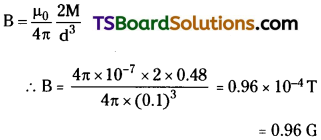
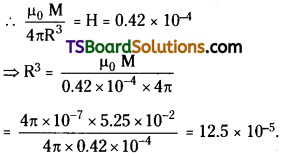
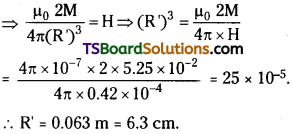
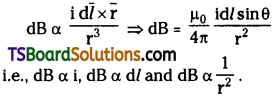
TS Inter 2nd Year Physics Study Material Chapter 5 Electrostatic Potential and Capacitance

Telangana TSBIE TS Inter 2nd Year Physics Study Material 5th Lesson Electrostatic Potential and Capacitance Textbook Questions and Answers.

TS Inter 2nd Year Physics Study Material 5th Lesson Electrostatic Potential and Capacitance

Very Short Answer Type Questions

Question 1.
Can there be electric potential at a point with zero electric intensity? Give an example.
Answer:
Yes. At the mid point of line joining two similar charges, electric field is zero but potential will exist. Ex : Inside a charged hallow spherical shell field is zero but potential is not zero.

Question 2.
Can there be electric intensity at a point with zero electric potential? Give an example.
Answer:
Yes. At the midpoint or on the equatorial line of an electric dipole potential is zero but eletric field is not zero.

Question 3.
What are meant by equipotential surfaces?
Answer:
An equipotential surface is a surface with constant value of potential at all points on the surface.

Question 4.
Why is the electric field always at right angles to the equipotential surface? Explain.
Answer:
If the electric field is not normal to the equipotential surface, then the work done in moving a charge from one point to the other will not be zero, which is a contradiction, thus the field is normal to equipotential surface.

Question 5.
Three capacitors of capacitances 1 µF, 2 µF, and 3 µF are Connected in parallel.
a) What is the ratio of charges?
b) What is the ratio of potential differences?
Answer:
Charge q = CV
a) ⇒ q ∝ C ⇒ q1 : q2 : q3 = C1 : C2 : C3 = 1 : 2 : 3
b) In parallel combination potential across combination is
Constant : V1 : V2 : V3 = 1 : 1 : 1

TS Inter 2nd Year Physics Study Material Chapter 5 Electrostatic Potential and Capacitance

Question 6.
Three capacitors of capacitances 1 µF, 2 µF, and 3 µF are connected in series
a) What is the ratio of charges?
b) What is the ratio of potential differences?
Answer:
q = CV, in series combination charge q’ is constant on each capacitor.
a) ⇒ q1 : q2 : q3 = 1 : 1 : 1
b) V ∝ \(\frac{1}{C}\) ⇒ V1 : V2 : V3 : \(\frac{1}{1}: \frac{1}{2} : \frac{1}{3}\) = 6 : 3 : 2

Question 7.
What happens to the capacitance of a parallel plate capacitor if the area of its plates is doubled?
Answer:
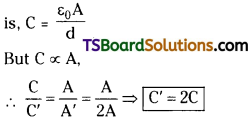
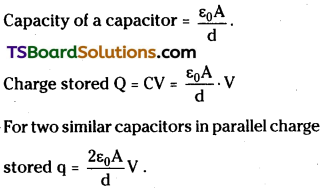
The capacity of a parallel plate capacitor
TS Inter 2nd Year Physics Study Material Chapter 5 Electrostatic Potential and Capacitance 1
when area is doubled (A’ = 2A) then capacity is also doubled.

Question 8.
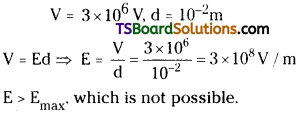
The dielectric strength of air is 3 × 10⁶ Vm-1 at certain pressure. A parallel plate capacitor with air in between the plates has a plate separation of 1 cm. Can you charge the capacitor to 3 × 10⁶ V?
Answer:
No ; The dielectric strength of air means the max. electric field that the medium will with-stand. Given Emax = 3 × 10⁶Vm-1,
TS Inter 2nd Year Physics Study Material Chapter 5 Electrostatic Potential and Capacitance 2

Short Answer Questions

Question 1.
Derive an expression for the electric potential due to a point charge. [Mar. ’16; TS Mar. ’16]
Answer:
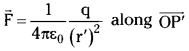
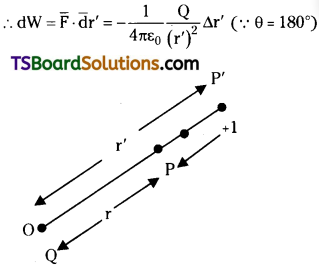
Consider a point charge Q at ‘O’ and a unit positive charge is placed at ‘P’, distance r’. The force acting on it is
TS Inter 2nd Year Physics Study Material Chapter 5 Electrostatic Potential and Capacitance 3
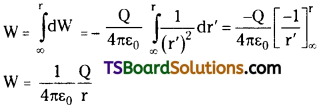
Let dW be the work done in moving this test charge through dr’ towards ‘O’.
TS Inter 2nd Year Physics Study Material Chapter 5 Electrostatic Potential and Capacitance 4

The total work done in bringing this test charge from r’ = ∞ to r’ = r is
TS Inter 2nd Year Physics Study Material Chapter 5 Electrostatic Potential and Capacitance 5
By the definition of potential this work- done is the electrostatic potential at that point.
∴ V = \(\frac{1}{4 \pi \varepsilon_0} \cdot \frac{Q}{r}\)

Question 2.
Derive an expression for the electrostatic potential energy of a system of two point charges and find its relation with electric potential of a charge.
Answer:
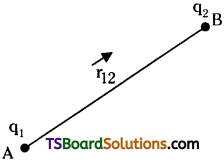
Consider a system of two charges q1 and q2 with position vectors \(\overline{\mathrm{r_1}}\) and \(\overline{\mathrm{r_2}}\) relative to origin at points A & B respectively. The electrostatic potential due to q1 at B is VB = \(\frac{1}{4 \pi \varepsilon_0} \frac{\mathrm{q}_1}{\mathrm{r}_2}\)
The work done in bringing q2 from infinity to the
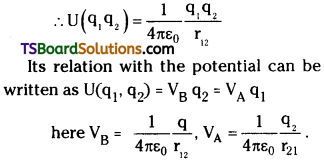
point B is W = q2 VB = \(\frac{1}{4 \pi \varepsilon_0} \frac{\mathrm{q}_1\mathrm{q}_2}{\mathrm{r}_{12}}\)
TS Inter 2nd Year Physics Study Material Chapter 5 Electrostatic Potential and Capacitance 6
As the electrostatic force is a conservative force, this work done will be stored as energy in the system.

Hence this work done is called electrostatic potential energy ‘U’ of the system of the charges q1 and q2.
TS Inter 2nd Year Physics Study Material Chapter 5 Electrostatic Potential and Capacitance 7

Question 3.
Derive an expression for the potential energy of an electric dipole placed in a uniform electric field.
Answer:
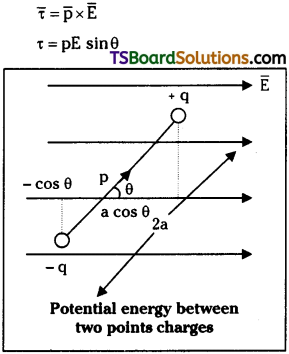
Consider a dipole with charges + q and – q placed in a uniform electric field E as shown.

Forces are F1 = qE and F2 = – qE but dipole experiences torque given by
TS Inter 2nd Year Physics Study Material Chapter 5 Electrostatic Potential and Capacitance 8

Let ‘dW’ be the small amount of work done in rotating the dipole through d0 without any angular acceleration.
dW = τdθ
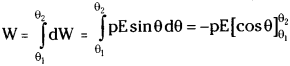
The toal work done to deflect from θ1 to θ2 is
TS Inter 2nd Year Physics Study Material Chapter 5 Electrostatic Potential and Capacitance 9
W = pE [cos θ1 – cos θ2]
This work done is stored as potential energy in the dipole.
If the dipole is intially parallel to \(\overline{\mathrm{E}}\) and now turned through an angle θ, the work- done is
W = pE [cosθ – cosθ] = pE [ 1 – cosθ]
Then the potential energy of the dipole in this displaced position is U = U0 + W = – pE + pE [ 1 – cos θ] = – pE cos θ = – \(\overline{\mathrm{E}}.\overline{\mathrm{E}}\)

TS Inter 2nd Year Physics Study Material Chapter 5 Electrostatic Potential and Capacitance

Question 4.
Derive an expression for the capacitance of a parallel plate capacitor. [AP Mar. 18, 16, May 17. 16; TS Mar. 18. May 18. 16]
Answer:
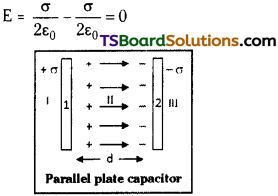
A parallel plate capacitor consists of two plane conducting plates of area A separated by a small distance d’. Let the medium between the plates is vacuum.
Let the surface charge densities of the plates (1) and (2) be + σ and – σ.
The electric fields in regions I and III will be
TS Inter 2nd Year Physics Study Material Chapter 5 Electrostatic Potential and Capacitance 10
In the inner region i.e., II the fields due to these plates will add up and given by
TS Inter 2nd Year Physics Study Material Chapter 5 Electrostatic Potential and Capacitance 11
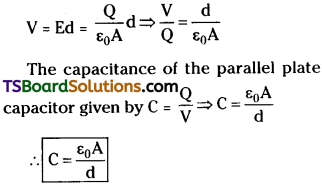
as ‘d’ is the separation between the plates, the potential difference between the plates given by
TS Inter 2nd Year Physics Study Material Chapter 5 Electrostatic Potential and Capacitance 12

Question 5.
Explain the behaviour of dielectrics in an external field. [AP Mar. ’19]
Answer:
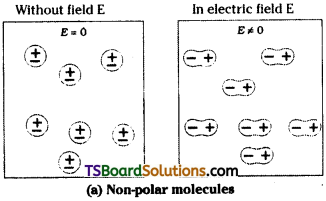
All dielectrics are two types 1) Non-polar dielectrics 2) Polar dielectrics.
a) For Non-polar dielectrics the centre of all positive and negative charges will coincide. Ex: O2 molecule. So net dipole moment of these molecules is zero.
TS Inter 2nd Year Physics Study Material Chapter 5 Electrostatic Potential and Capacitance 13

When these molecules are placed in an external electric field the positive and negative charges will be displaced in opposite directions. So they will develop induced dipolemoment. Total dipolemoment of these substances is the sum of all such dipolements and dielectrics are said to be polarised.

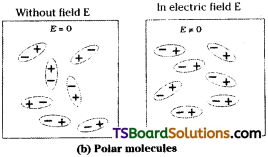
b) In case of polarised dielectrics in a molecule the centres of all positive charges and negative charges are separate. So they will develop some resultant dipolemoment. Under the absence of external electric field these dipole moments are random and resultant dipolemoment is zero.

TS Inter 2nd Year Physics Study Material Chapter 5 Electrostatic Potential and Capacitance 14
When they are placed in external electric field these dipoles are arranged in an order and the dipolemoments are polarised.
The dipole moment per unit volume (\(\overline{\mathrm{p}}\)) is called polarisation.
\(\overline{\mathrm{p}}\) = χ\(\overline{\mathrm{E}}\)
where χ is called electric susceptibility.

Long Answer Questions

Question 1.
Define electric potential. Derive an expression for the electric potential due to an electric dipole and hence the electric potential at a point (a) the axial line of electric dipole (b) on the equatorial line of electric dipole.
Answer:
Electric potential :
Work done to bring the unit positive charge from infinity to the point in the electric field is called potential.
Potential due to point charge q at a distance r (V) = \(\frac{1}{4 \pi \varepsilon_0} \frac{\mathrm{q}}{\mathrm{r}}\)

Electric dipole :
Two equal and opposite charges (q, -q) separated by a distance (say 2a) is called electric dipole.

Potential due to an electric dipole :
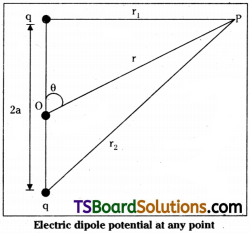
Consider an electric dipole with charge q, – q.

Let separation between them is 2a. Let P is a point at a distance r’ from centre of dipole.

Join qp, -qp and OP. Let the line OP makes an angle ‘θ’ with the dipole axis (q, – q).
Total potential at P is V =\(\frac{1}{4 \pi \varepsilon_0}\) \(\frac{q}{r_1}-\frac{q}{r_2}\)
TS Inter 2nd Year Physics Study Material Chapter 5 Electrostatic Potential and Capacitance 15
From geometry r²1 = r² + a² – 2a r cos θ and
2 = r² + a² + 2a r cos θ
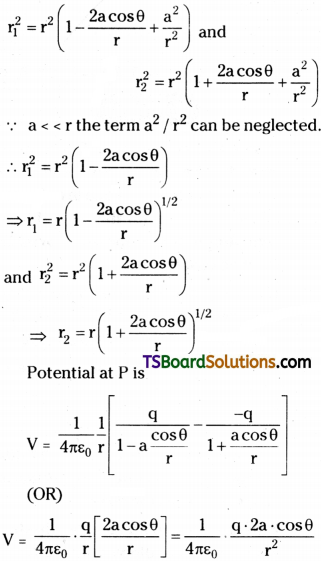
These equations are rearranged as
TS Inter 2nd Year Physics Study Material Chapter 5 Electrostatic Potential and Capacitance 16
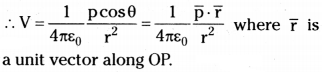
But 2aq = p. dipole moment
TS Inter 2nd Year Physics Study Material Chapter 5 Electrostatic Potential and Capacitance 17

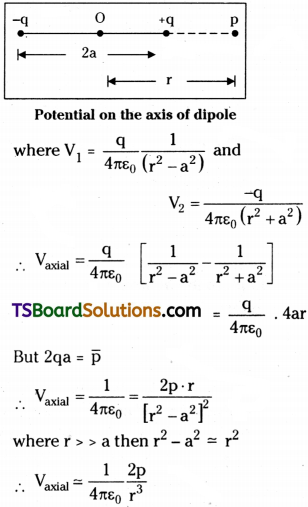
Potential at any point on axis of dipole :
Consider a dipole of charges q, – q with separation ‘2a’. At point p potential V is given by V = V1 + V2
TS Inter 2nd Year Physics Study Material Chapter 5 Electrostatic Potential and Capacitance 18

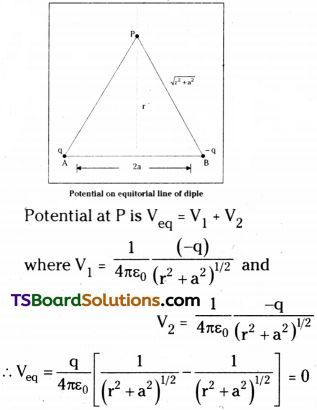
Potential at any point on equatorial line of dipole :
Let P is any point on equatorial line of a dipole at a distance r.
TS Inter 2nd Year Physics Study Material Chapter 5 Electrostatic Potential and Capacitance 19
∴ Potential on equatorial line of dipole is zero.

Question 2.
Explain series and parallel combination of capacitors. Derive the formula for equivalent capacitance in each combination. [TS Mar. 19, 17, 15; AP May 16, June 15, Mar. 15]
Answer:
Capacitors in series :
If number of capacitors are connected in such a way that the charge on the plates of every one of them is same, then the capacitors are said to be
“connected in series”.

Explanation :
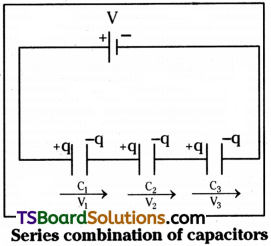
Let three capacitors C1, C2 and C3 are connected in series as shown.
TS Inter 2nd Year Physics Study Material Chapter 5 Electrostatic Potential and Capacitance 20

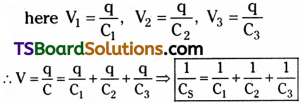
The charge q on the plates of the capacitors is same, let, V1, V2 and V3 be the potential differences across C1, C2 and C3 respectively. Let V be the p.d across the combination
then V = V1 + V2 + V3
TS Inter 2nd Year Physics Study Material Chapter 5 Electrostatic Potential and Capacitance 21

The reciprocal of equivalent capacity = the sum of reciprocal values of individual capacities of the combination.

Capacitors in parallel :
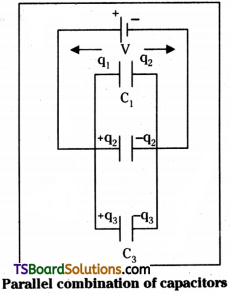
If a number of capacitors connected in such a way that the p. d between the plates of every one of them is same, then the capacitors are said to be “connected in parallel”.
TS Inter 2nd Year Physics Study Material Chapter 5 Electrostatic Potential and Capacitance 22

Explanation :
Let the capacitors of capacities C1, C2 and C3 connected in parallel as shown.

The potential difference across each condenser is same and is equal to V. Let q1 and q2 and q3 be the charges on the plates of the capacitors.
∴ q = q1 + q2 + q3. here q1 = C1V, q2 = C2V, q3 = C3V
If C is equivalent capacity of the combination, the C = \(\frac{p}{V}\) ⇒ q = CV
∴ CV = C1V + C2V + C3V
∴ C = C1 + C2 + C3
The equivalent capacity of the parallel combination = the sum of the capacities of the capacitors.

TS Inter 2nd Year Physics Study Material Chapter 5 Electrostatic Potential and Capacitance

Question 3.
Derive an expression for the energy stored in a capacitor. What is the energy stored when the space between the plates is filled with a dielectric.
a) With charging battery disconnected?
b) With charging battery connected in the circuit?
Answer:
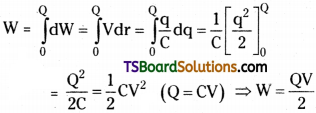
Let ‘q’ be the charge on the plates of a capacitor and V be the potential difference between plates. The work done dW in charging the capacitor with an additional charge dq.
dW = Vdq
⇒ dW = \(\frac{q}{C}\)dq (∵ q = CV)
The total work done in charging the plates it to a charge Q = W
TS Inter 2nd Year Physics Study Material Chapter 5 Electrostatic Potential and Capacitance 23
This work done in charging the capacitor stored as electrostatic potential energy.

Effect of dielectric :
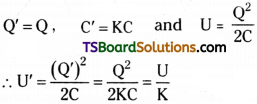
a) When charging battery is disconnected:
The charge on the plates remain constant, but capacity increases.
TS Inter 2nd Year Physics Study Material Chapter 5 Electrostatic Potential and Capacitance 24
∴ The energy stored will get reduced to \(\frac{1}{K}\) th of initial value.

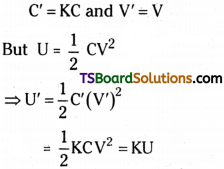
b) When charging battery remain connected the p.d across the capacitor remains same, but the capacity and the charge increases.
TS Inter 2nd Year Physics Study Material Chapter 5 Electrostatic Potential and Capacitance 25
∴ The energy stored will increases by K times initial value.

Problems

Question 1.
An elementary particle of mass in’ and charge + e initially at a very large distance is projected with velocity ‘v’ at a much more massive particle of charge + Ze at rest. The closest possible distance of approach of the incident particle is
Answer:
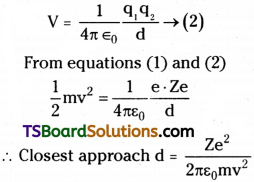
At closest approach kinetic energy of charged particle = electrostatic potential between them.

Given : Mass of particle = m; velocity = V
∴ KE = 1/2 mv² → (1)
Charge of particle q1 = e ; Charge on massive particle q2 = Ze
∴ Electrostatic potential
TS Inter 2nd Year Physics Study Material Chapter 5 Electrostatic Potential and Capacitance 26

Question 2.
In a hydrogen atom the electron and proton are at a distance of 0.5 Å. The dipole moment of the system is
Answer:
Distance between electron and proton = 0.5Å = 0.5 × 10¹⁰ m
Charge on proton = Charge on electron = 1.6 × 10⁻¹⁹ C
Dipole moment = charge × separation between charges
∴ Dipolemoment p = 1.6 × 10-19 × 0.5 × 10-10 = 0.8 × 10-29 = 8 × 10-30 Cm

Question 3.
There is a uniform electric field in the XOY plane represented by (\(\mathbf{40} \hat{\mathbf{i}}+\mathbf{30} \hat{\mathbf{j}}\)) Vm-1. If the electric potential at the origin is 200 V, the electric potential at the point with co-ordinates (2m, lm) is
Answer:
Intensity of electric field E = \(\mathbf{40} \hat{\mathbf{i}}+\mathbf{30} \hat{\mathbf{j}}\)
Position of the given point = 2 m, 1 m
i.e., 2m along \(\hat{\mathbf{i}}\) and lm along \(\hat{\mathbf{j}}\). Potential
= \(\overline{\mathrm{E}}.\overline{\mathrm{r}}\) =40 × 2 + 30 × 1 = 80 + 30 = 110V
Potential at origin = 200V.
Potential difference at point p = 200 – 110 = 90V.

Question 4.
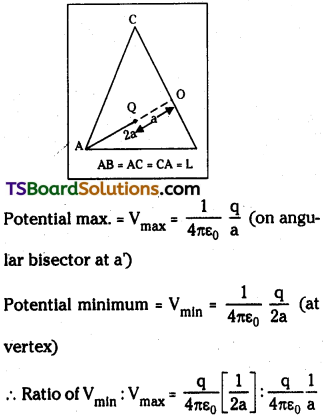
An equilateral triangle has a side length L. A charge + q is kept at the centroid of the triangle. P is a point on the perimeter of the triangle. The ratio of the minimum and maximum possible electric potentials for the point P is
Answer:
Length of side = L. Charge at centroid = + q
Let ‘O’ be the centroid.
Centroid will divide the angle bisector in the ratio 2 : 1.
∴ Maximum distance from centroid is say ‘2a’ then minimum distance from centroid is ‘a’.
TS Inter 2nd Year Physics Study Material Chapter 5 Electrostatic Potential and Capacitance 27
Ratio of minimum potential to maximum potential is 1 : 2.

Question 5.
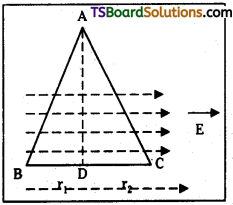
ABC is an equilateral triangle of side 2m. There is a uniform electric field of intensity 100 V/m in the plane of the triangle and parallel to BC as shown. If the electric potential at A is 200 V, then the electric potentials at B and C are respectively
Answer:
Side of triangle L = 2m
Intensity of electric field = 100 V/m
(parallel to BC)
TS Inter 2nd Year Physics Study Material Chapter 5 Electrostatic Potential and Capacitance 28
Potential at A = 200V.
Let D is the mid point of BC.
Now AD is an equipotential line with a potential of 200V.
Potential at B = 200 + E. r where r1 = BD = 1m.
∴ Potential at B = 200 + 100 × 1 = 300 V
∴ Potential at C = Pot. at D – E. r2 where
r2 = 1m
VD = 200 – 100 × 1 = 100v
Note : By definition potential is the work done against the field.

TS Inter 2nd Year Physics Study Material Chapter 5 Electrostatic Potential and Capacitance

Question 6.
An electric dipole of moment p is called in a uniform electric field E, with p parallel to E. It is then rotated by an angle q. The work done is
Answer:
Electric dipolemoment = p;
Intensity of electric field = E
p and E are parallel ⇒ θ = 0;
Angle rotated = q
Work done by external force to rotate the dipole without acceleration
W = PE (cos θ1 – cos θ2)
Here θ1 = 0 and θ2 = q
∴ Work done = PE (cos 0 – cos q) = pE (1 – cos q)

Question 7.
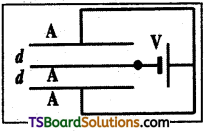
Three identical metal plates each of area ‘A’ are arranged parallel to each other, ‘d’ is the distance between the plates as shown. A battery of V volts is connected as shown. The charge stored in the system of plates is
TS Inter 2nd Year Physics Study Material Chapter 5 Electrostatic Potential and Capacitance 29
Answer:
Area of plates = A, Separation between the plates = d.
Potential supplied by battery = V.
From given arrangement it is a parallel combination of two identical capacitors.
TS Inter 2nd Year Physics Study Material Chapter 5 Electrostatic Potential and Capacitance 30

Question 8.
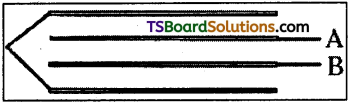
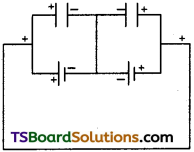
Four identical metal plates each of area A are separated mutually by a distance d and are connected as shown. Find the capacity of the system between the terminals A and B.
TS Inter 2nd Year Physics Study Material Chapter 5 Electrostatic Potential and Capacitance 31
Answer:
Area of each plate = A
Total separation between the plates = d
Separation between two adjacent plates = d1 = d/3
Capacity of each capacitor \(C_1=\frac{\varepsilon_0 A}{d_1}=\frac{\varepsilon_0 A}{d / 3}=\frac{3 \varepsilon_0 A}{d}\)
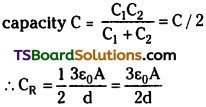
For two similar capacitors in series the resultant
TS Inter 2nd Year Physics Study Material Chapter 5 Electrostatic Potential and Capacitance 32

Question 9.
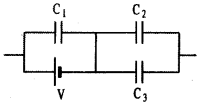
In the circuit shown the battery of’V’ volts has no internal resistance. All three con-densers are equal in capacity. Find the condenser that carries more charge.
TS Inter 2nd Year Physics Study Material Chapter 5 Electrostatic Potential and Capacitance 33
Answer:
In the diagram the battery polarities are as show.
TS Inter 2nd Year Physics Study Material Chapter 5 Electrostatic Potential and Capacitance 34

So all capacitors are connected in parallel. Since capacity ‘C’ is same and potential of battery V is same charge will exist on all the three capacitors.

Question 10.
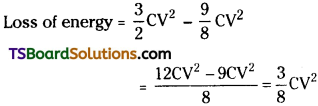
Two capacitors A and B of capacities C and 2C are connected in parallel and the combination is connected to a battery of volts. After the charging is over, the bat-tery is removed. Now a dielectric slab of K = 2 is inserted between the plates of A so as to fill file space completely. The energy lost by the system during the sharing of charges is
Answer:
Capacity C1 = C; Capacity C2 = 2C
Let the capacitors are charged to the potential V.
Charge on capacitor Q1 = CV
Charge on capacitor Q2 = 2CV
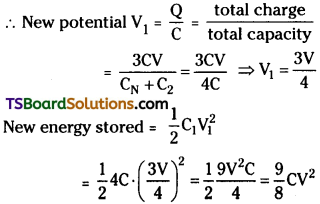
Total charge Q = Q1 + Q2 = 3CV → (1)
Energy stored U1 = \(\frac{1}{2}\)CV² +\(\frac{1}{2}\)(2C) V²
\(\frac{CV^2}{2}\) + CV² = \(\frac{3}{2}\)CV² → (2)
Now dielectric is introduced in C1
New capacity = KC1
Where K1 = 2 and C1 = C ∴ CN = 2C.
Cherge is not changed because battery is disconnected from circuit.
TS Inter 2nd Year Physics Study Material Chapter 5 Electrostatic Potential and Capacitance 35
TS Inter 2nd Year Physics Study Material Chapter 5 Electrostatic Potential and Capacitance 36

Question 11.
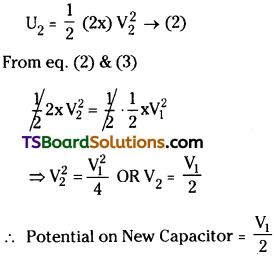
A condenser of certain capacity is charged to a potential V and stores some energy. A second condenser of twice the capacity is to stored half the energy of the first, find to what potential one must be charged?
Answer:
For 1st capacitor
Let capacity of capacitor = x; Potential = V
Energy stored U1 = \(\frac{1}{2}\)CV² = \(\frac{1}{2}\) × V²1 → (1)
For 2nd capacitor capacity C2 = 2x
Energy stored = \(\frac{1}{2}\)U1 = \(\frac{1}{2}.\frac{1}{2}\) × V²1 → (2)
But for 2nd capacitor energy stored
TS Inter 2nd Year Physics Study Material Chapter 5 Electrostatic Potential and Capacitance 37

Intext Question and Answers

Question 1.
Two charges 5 × 10⁻⁸ C and -3 × 10⁻⁸ C are located 16 cm apart. At what point(s) on the line joining the two charges is the electric potential zero? Take the potential at infinity to be zero.
Answer:
There are two charges,
q1 = 5 × 10⁻⁸C, q2 = -3 × 10⁻⁸C
Distance between the two charges, d = 16 cm = 0.16 m
Consider a point P on the line joining the two charges, as shown in the given figure.
TS Inter 2nd Year Physics Study Material Chapter 5 Electrostatic Potential and Capacitance 38
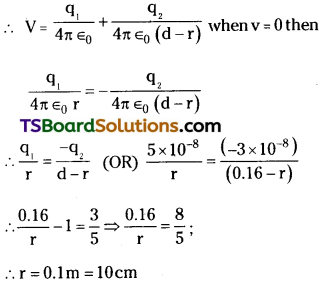
Let the electric potential (V) at point P be zero. It is at a distance r from q1
Potential at point P is the sum of potentials caused by charges q1 and q2 respectively.
TS Inter 2nd Year Physics Study Material Chapter 5 Electrostatic Potential and Capacitance 39
Therefore, the potential is zero at a distance of 10 cm from the positive charge between the charges.

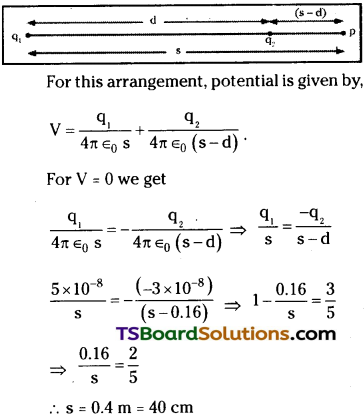
Suppose point P is outside the system of two charges at a distance s from the negative charge, where potential is zero, as shown in the following figure.
TS Inter 2nd Year Physics Study Material Chapter 5 Electrostatic Potential and Capacitance 40
Therefore, the potential is zero at a distance of 40 cm from the positive charge outside the system of charges.

TS Inter 2nd Year Physics Study Material Chapter 5 Electrostatic Potential and Capacitance

Question 2.
A regular hexagon of side 10 cm has a charge 5 µC at each of its vertices. Calculate the potential at the centre of the hexagon.
Answer:
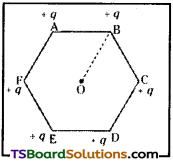
The given figure shows six equal amount of charges, q, at the vertices of a regular hexagon.
TS Inter 2nd Year Physics Study Material Chapter 5 Electrostatic Potential and Capacitance 41
Charge, q = 5 µC = 5 × 10⁻⁶C
Side of the hexagon, l = AB = BC = CD = DE
= EF = FA = 10 cm
Distance of each vertex from centre O, d = 10 cm
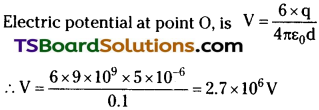
TS Inter 2nd Year Physics Study Material Chapter 5 Electrostatic Potential and Capacitance 42
Therefore, the potential at the centre of the hexagon is 2.7 × 10⁶ V.

Question 3.
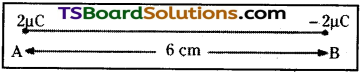
Two charges 2 µC and -2 µC are placed at points A and B 6 cm apart.
(a) Identify an equipotential surface of the system.
(b) What is the direction of the electric field at every point on this surface?
Answer:
(a) The situation is represented in the given figure.
TS Inter 2nd Year Physics Study Material Chapter 5 Electrostatic Potential and Capacitance 43
An equipotential surface is the plane on which total potential is zero everywhere. This plane is normal to line AB.

The plane is located at the mid-point of line AB because the magnitude of charges is the same.

(b) The direction of the electric field at every point on this surface is normal to the plane in the direction of AB.

Question 4.
A spherical conductor of radius 12 cm has a charge of 1.6 × 10⁻⁷C distributed uniformly on its surface. What is the electric field
(a) Inside the sphere?
(b) Just outside the sphere?
(c) At a point 18 cm from the centre of the sphere?
Answer:
(a) Radius of the spherical conductor, r = 12 cm = 0.12 m
Charge is uniformly distributed over the conductor, q = 1.6 × 10⁻⁷ C
Electric field inside a spherical conductor is zero. This is because if there is field inside the conductor, then charges will move to neutralize it.

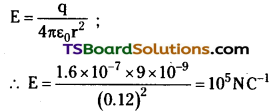
(b) Electric field E just outside the conductor is given by the relation,
TS Inter 2nd Year Physics Study Material Chapter 5 Electrostatic Potential and Capacitance 44
Therefore, the electric field just outside the sphere is 105 NC-1.

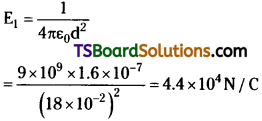
(c) Electric field at a point 18 m from the centre of the sphere = E1
Distance of the point from the centre, d = 18 cm = 0.18 m
TS Inter 2nd Year Physics Study Material Chapter 5 Electrostatic Potential and Capacitance 45
Therefore, the electric field at a point 18 cm from the centre of the sphere is 4.4 × 10⁴ N/C.

Question 5.
A parallel plate capacitor with air between the plates has a capacitance of 8 pF (lpF = 10-12 F). What will be the capacitance if the distance between the plates is reduced by half, and the space between them is filled with a substance of dielectric constant 6?
Answer:
Capacitance between the parallel plates of the capacitor, C = 8 pF
Initially, distance between the parallel plates was d and it was filled with air. Dielectric constant of air, k = 1
Capacitance, C, is given by the formula,
C = \(\frac{k\varepsilon_{0}A}{d}=\frac{\varepsilon_{0}A}{d}\) ………….. (i)
Where, A = Area of each plate; ∈0 = permittivity of free space
If distance between the plates is reduced to half, then new distance, d’ = \(\frac{d}{2}\).
Dielectric constant of the substance filled in between the plates, k’ = 6
Hence, capacitance of the capacitor
becomes C’ = = \(\frac{k\varepsilon_{0}A}{d}=\frac{6\varepsilon_{0}A}{d_2}\) ………… (ii)
From eqn (i) & (ii)
C’ = 2 × 6C = 12 C = 12 × 8 = 96 pF
Therefore, the capacitance between the plates is 96 pF.

TS Inter 2nd Year Physics Study Material Chapter 5 Electrostatic Potential and Capacitance

Question 6.
Three capacitors each of capacitance 9 pF are connected in series. [AP Mar ’14]
(a) What is the total capacitance of the combination?
(b) What is the potential difference across each capacitor if the combination is connected to a 120 V supply?
Answer:
(a) Capacitance of each of the three capacitors, C = 9 pF
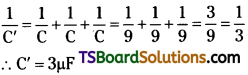
Equivalent capacitance (C’) of the combination of the capacitors is given by the relation,
TS Inter 2nd Year Physics Study Material Chapter 5 Electrostatic Potential and Capacitance 46
Therefore, total capacitance of the combination is 3µF.

(b) Supply voltage, V = 100 V
Potential difference (V’) across each capacitor is equal to one-third of the supply voltage.
∴ V’ = \(\frac{V}{3}=\frac{120}{3}\) = 40V
Therefore, the potential difference across each capacitor is 40 V.

Therefore, total capacitance of the combination is pµF.
(b) Supply voltage, V = 100 V

Question 7.
Three capacitors of capacitances 2µF, 3µF and 4µF are connected in parallel.
(i) What is the total capacitance of the combination?
(ii) Determine the charge on each capacitor, if the combination is connected to a 200V supply. [AP Mar. 1 7; TS May 1 7, June 15]
Answer:
(a) Capacitances of the given capacitors are
C1 = 2µF ; C2 = 3µF ; C3 = 4µF
For the parallel combination of the capacitors, equivalent capacitor C’ is given by the algebraic sum, C’ = 2 + 3 + 4 = 9
Therefore, total capacitance of the combination is pµF.

(b) Supply voltage, V = 100 V
The voltage through all the three capacitors is same = V = 100V
Charge on a capacitor of C and potential difference V is given by the relation,
q = CV … (i)
For C = 2µF, Charge = VC = 100 × 2 = 200µC = 2 × 10⁻⁴ C
For C = 3µF,
Charge = VC = 100 × 3 = 300 µC = 3 × 10⁻⁴ C
For C = 4µF,
Charge = VC = 100 × 4 = 200µC = 4 × 10⁻⁴ C

Question 8.
Three capacitors of capacitances 2 pF, 3 pF and 4 pF are connected in parallel.
(a) What is the total capacitance of the combination?
(b) Determine the charge on each capacitor if the combination is connected to a 100 V supply.
Answer:
(a) Capacitances of the given capacitors are
C1 = 2 pF ; C2 = 3 pF ; C3 = 4 pF
For the parallel combination of the capacitors, equivalent capacitor C’ is given by the algebraic sum, C’ = 2 + 3 + 4 = 9
Therefore, total capacitance of the combination is 9 pF.

(b) Supply voltage, V = 100 V
The voltage through all the three capacitors is same = V = 100 V
Charge on a capacitor of capacitance C and potential difference V is given by the relation,
q = VC … (i)
For C = 2 pF, Charge = VC = 100 × 2 = 200 pC = 2 × 10“10 C
For C = 3 pF,
Charge = VC = 100 × 3 = 300 pC = 3 × 10⁻¹⁰ C
For C = 4 pF,
Charge = VC = 100 × 4 = 200 pC = 4 × 10⁻¹⁰ C

Question 9.
In a parallel plate capacitor with air between the plates, each plate has an area of 6 × 10⁻³ m² and the distance between the plates is 3 mm. Calculate the capacitance of the capacitor. If this capacitor is connected to a 100 V supply, what is the charge on each plate of the capacitor?
Answer:
Area of each plate of the parallel plate capacitor, A = 6 × 10⁻³
Distance between the plates, d = 3 mm
= 3× 10⁻³ m; Supply voltage, V = 100 V
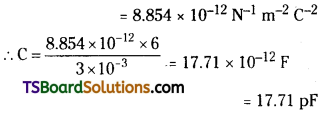
Capacitance C of a parallel plate capacitor is given by, C = \(\frac{\varepsilon_{0}A}{d}\)
Where, ε0 = Permittivity of free space
TS Inter 2nd Year Physics Study Material Chapter 5 Electrostatic Potential and Capacitance 47

Potential V is related with the charge q and capacitance C as V = \(\frac{q}{C}\)
∴ q = VC = 100 × 17.71 × 10-12 = 1.771 × 10⁻⁹C.
Therefore, capacitance of the capacitor is 17.71 pF and charge on each plate is 1.771 × 10⁻⁹C.

TS Inter 2nd Year Physics Study Material Chapter 5 Electrostatic Potential and Capacitance

Question 10.
Expalin what would happen if in the capacitor given in Exercise 8, a 3 mm thick mica sheet (of dielectric constant = 6) were inserted between the plates,
(a) while the voltage supply remained connected.
(b) after the supply was disconnected.
Answer:
(a) Dielectric constant of the mica sheet, k = 6;
Initial capacitance, C = 1.771 × 10⁻¹¹ F
New capacitance,
C’ = kc = 6 × 1.771 × 10-11 = 106 pF;
Supply voltage, V = 100 V
New charge,
q’ C’V = 6 × 1.771 × 10-9 = 1.06 × 10⁻⁸C
Potential across the plates remains 100 V.

(b) Dielectric constant, k = 6 ;
Initial capacitance, C = 1.771 × 10⁻¹¹ F
New capacitance,
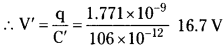
C’ = kC = 6 × 1.771 × 10-11 = 106 pF

If supply voltage is removed, then there will be no effect on the amount of charge in the plates.
∴ Charge = 1.771 × 10⁻⁹ C
Potential across the plates is gives by,
TS Inter 2nd Year Physics Study Material Chapter 5 Electrostatic Potential and Capacitance 48

Question 11.
A 12 pF capacitor is connected to a 50V battery. How much electrostatic energy is stored in the capacitor?
Answer:
Capacitor of the capacitance, C = 12 pF = 12 × 10-12 F ; Potential difference, V = 50 V
Electrostatic energy stored in the capacitor is given by the relation,
E = \(\frac{1}{2}\)CV² = \(\frac{1}{2}\) × 12 × 10-12 × (50)² = 1.5 × 10⁻⁸ J
Therefore, the electrostatic energy stored in the capacitor is 1.5 × 10⁻⁸ J.

Question 12.
A 600 pF capacitor is charged by a 200 V supply. It is then disconnected from the supply and is connected to another uncharged 600 pF capacitor. How much electrostatic energy is lost in the process?
Answer:
Capacitance of the capacitor, C = 600 pF ; Potential difference, V = 200 V Electrostatic energy stored in the capacitor is given by,
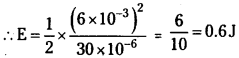
E = \(\frac{1}{2}\)cV² = \(\frac{1}{2}\) × (600 × 10-12) × (200)² = 1.2 × 10⁵ J
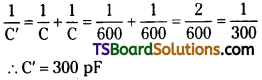
If supply is disconnected from the capacitor and another capacitor of capacitance C = 600 pF is connected to it, then equivalent capacitance (C’) of the combination is given by,
TS Inter 2nd Year Physics Study Material Chapter 5 Electrostatic Potential and Capacitance 49
New electrostatic energy can be calculated as
E’ = \(\frac{1}{2}\) × C’ × V² = \(\frac{1}{2}\) × 300 × (200)² = 0.6 × 10⁻⁶J
Loss in electrostatic energy = E – E’
= 1.2 × 10⁻⁵ -0.6 × 10-5 = 0.6 × 10-5 = 6 × 10⁻⁶ J
Therefore, the electrostatic energy lost in the process is 6 × 10⁻⁶ J.

Question 13.
In a Van de Graaff type generator, a spherical metal shell is to be a 15 × 106 V electrode. The dielectric strength of the gas surrounding the electrode is 5 × 10⁷ Vm-1. What is the minimum radius of the spherical shell required? (You will learn from this exercise why one cannot build an electrostatic generator using a very small shell which requires a small charge to acquire a high potential.)
Answer:
Potential difference, V = 15× 106V ;
Dielectric strength of the surrounding gas = 5 × 10⁷ V/m
Electric field intensity, E = Dielectric strength = 5 × 10⁷ V/m
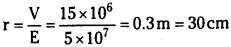
Minimum radius of the spherical shell required for the purpose is given by,
TS Inter 2nd Year Physics Study Material Chapter 5 Electrostatic Potential and Capacitance 50
Hence, the minimum radius of the spherical shell required is 30 cm.

TS Inter 2nd Year Physics Study Material Chapter 5 Electrostatic Potential and Capacitance

Question 14.
A small sphere of radius r1 and charge q1 is enclosed by a spherical shell of radius r2 and charge q2. Show that if q1 is positive, charge will necessarily flow from the sphere to the shell (when the two are connected by a wire) no matter what the charge q2 on the shell is.
Answer:
According to Gauss’s law, the electric field between a sphere and a shell is determined by the charge q1 on a small sphere. Hence, the potential difference, V, between the sphere and the shell is independent of charge q2. For positive charge q1, potential difference V is always positive.

TS Inter 2nd Year Physics Study Material Chapter 4 Electric Charges and Fields

Telangana TSBIE TS Inter 2nd Year Physics Study Material 4th Lesson Electric Charges and Fields Textbook Questions and Answers.

TS Inter 2nd Year Physics Study Material 4th Lesson Electric Charges and Fields

Very Short Answer Type Questions

Question 1.
What is meant by the statement ‘charge is quantized’?
Answer:
The minimum charge that can be transferred from one body to another is equal to the charge of an electron ‘e’.

So charge always exists as an integral multiple of charge of electron i.e., Q = ne. (1 e = 1.6 × 10⁻¹⁹ C). Therefore charge in quantized.

Question 2.
Repulsion is the sure test of charging than attraction. Why?
Answer:
A charged body can attract opposite charged body and also a neutral body. But repu¬lsion is only between two charged bodies of same polarity. Hence repulsion is sure test for charging than attraction.

Question 3.
How many electrons constitute 1 C of charge?
Answer:
Chargeq = ne; q = 1 C; e- 1.6 × 10⁻¹⁹ C.
TS Inter 2nd Year Physics Study Material Chapter 4 Electric Charges and Fields 1

Question 4.
What happens to the weight of a body when it is charged positively?
Answer:
When a body is positively charged it looses electrons, hence its weight decreases (or) it looses weight.

TS Inter 2nd Year Physics Study Material Chapter 4 Electric Charges and Fields

Question 5.
What happens to the force between two charges if the distance between them is a) halved b) doubled?
Answer:
TS Inter 2nd Year Physics Study Material Chapter 4 Electric Charges and Fields 2
‘F’ increases four times its initial value

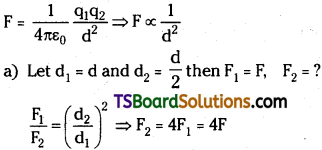
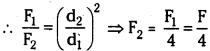
b) Let d1 = d and d2 = 2d and F1 = F, F2 = ?
TS Inter 2nd Year Physics Study Material Chapter 4 Electric Charges and Fields 3
Force between them reduces to 1/4 of initial value.

Question 6.
The electric lines of force do not intersect. Why?
Answer:
The tangent drawn at a point to the line of force gives direction of electric field. If two lines intersect at point of intersection field will be in two different directions, which is not possible. Therefore electric lines of force do not intersect.

Question 7.
Consider two charges + q and – q placed at B and C of an equilateral triangle ABC. For this system, the total charge is zero. But the electric field (intensity) at A which is equidistant from B and C is not zero. Why?
Answer:
Charge is a scalar so total charge Q = q + (- q) = 0. But electric field intensity is a vector and they must be add up vectorially at any given point. So at the point A of equilateral triangle

Question 8.
Electrostatic field lines of force do not form closed loops. If they form closed loops then the work done in moving a charge along a closed path will not be zero. From the above two statements can you guess the nature of electrostatic force?
Answer:
The electrostatic force is conservative force.

Question 9.
State Gauss’s law in electrostatics. Explain its importance. [AP June 15; TS Mar. 15, May 15]
Answer:
Def :
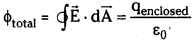
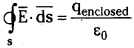
The total electrical flux through any closed surface is equal to \(\frac{1}{\varepsilon_0}\) times the charge enclosed by the surface.
TS Inter 2nd Year Physics Study Material Chapter 4 Electric Charges and Fields 4
ε0 = permittivity of free space.

Importance :
It is used to find the electric intensity due to various bodies due to charge distributions.

Question 10.
When is the electric flux negative and when is it positive?
Answer:
Electric flux, Φ = \(\overline{\mathrm{E}}.\overline{\mathrm{A}}\) = EA cos θ.
where θ = angle between \(\overline{\mathrm{E}}\) and \(\overline{\mathrm{A}}\).
If 0° < θ ≤ 90°. ⇒ Φ is positive.
When 90° < θ ≤ 180°. ⇒ Φ is negative.

Question 11.
Write the expression for electric intensity due to an infinite long charged wire at a distance radial distance r from the wire.
Answer:
The electric intensity at a point due to an infinitely long charged wire (E) = \(\frac{\lambda}{2 \pi \varepsilon_0 r}\), λ = the linear charge density of the wire.
r = the radial distance of the point from the axis of the wire.

Question 12.
Write the expression for electric intensity due to an infinite plane sheet of charge.
Answer:
The electric intensity due to an infinite plane sheet of charge is, E = \(\frac{\sigma}{2 \varepsilon_0}\), σ – is surface charge density of the sheet.

TS Inter 2nd Year Physics Study Material Chapter 4 Electric Charges and Fields

Question 13.
Write the expression for electric intensity due to a charged conducting spherical shell at points outside and inside the shell.
Answer:
Electric field intensity due to a charged conducting spherical shell
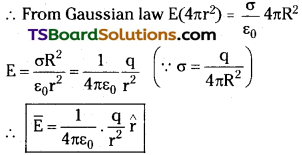
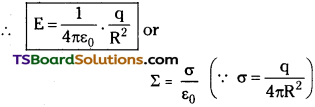
a) At a point outside the shell intensity of electric field E = \(\frac{1}{4 \pi \varepsilon_0} \frac{\mathrm{q}}{\mathrm{r}^2}=\frac{\sigma}{\varepsilon_0} \frac{\mathrm{R}^2}{\mathrm{r}^2}\)
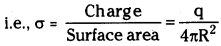
q = σA = σ 4πR²

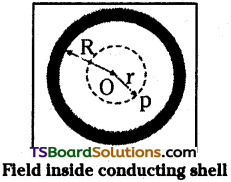
b) At a point inside the shell intensity of electric field E = 0.
Because potential inside a conducting shell is zero.

Short Answer Questions

Question 1.
State and explain Coulomb’s inverse square law in electricity. [AP May 18, 17; TS Mar. 17, ’14]
Answer:
Coulomb’s Law :
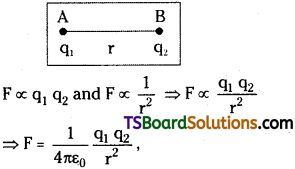
The force of attraction or repulsion between two charges is directly proportional to the product of the two charges and is inversely proportional to square of the distance between them. This force acts along the line joining the two charges.
Explanation:
TS Inter 2nd Year Physics Study Material Chapter 4 Electric Charges and Fields 5
ε0 = permittivity of free space.
ε0 = 8.85 × 10⁻¹²Nm²/C²

This electrostatic force between the charges depends on the nature of the medium between them.
In any medium F = \(\frac{1}{4 \pi \varepsilon} \frac{\mathrm{q_1q_2}}{\mathrm{r}^2}\)
ε = permittivity of that medium.
\(\frac{\mathrm{F_{vacuum}}}{\mathrm{F_{med}}}= \frac{\varepsilon}{\varepsilon_0} \) = εr = k

where εr (or) k is called relative permittivity or dielectric constant.

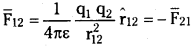
Note :- This force is an action and reaction pair i.e., \(\overline{\mathrm{F}}_{21}=-\overline{\mathrm{F}}_{21}\)
In vector form of Coulomb’s law is
TS Inter 2nd Year Physics Study Material Chapter 4 Electric Charges and Fields 6

Question 2.
Define intensity of electric field at a point. Derive an expression for the intensity due to a point charge. [AP Mar. ’16]
Answer:
Intensity of electric field: It is defined as the force on a unit positive charge when placed in the electric field.

Proof :-
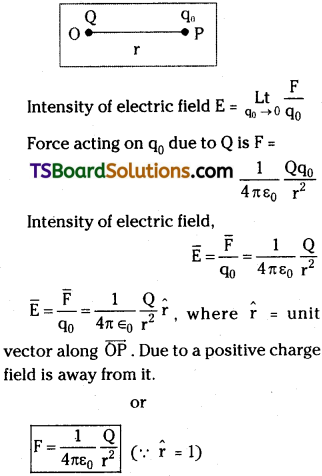
Consider a point charge ‘Q’ at O’, electric field will exist around that charge.
P = point at a distance r from the charge Q,
q0 = Test charge placed at that point.
TS Inter 2nd Year Physics Study Material Chapter 4 Electric Charges and Fields 7
Due to a negative charge field is towards it.
Note : The electric field due to a point charge is non-uniform.

Question 3.
Derive the equation for the couple acting on an electric dipole in a uniform electric field. [TS Mar. ’19, May ’18; AP May ’16, ’14]
Answer:
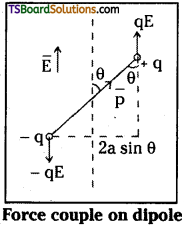
Consider electric dipole of moment ‘p’ in an uniform electric field ‘E’, situated at an angle θ with the field.

The positive charge experiences force “qE” in the direction of field and negative charge experiences as a force – qE opposite to the direction of field. Net force on the dipole is zero. But these two forces will constitute a couple, they will produce torque on the dipole.
TS Inter 2nd Year Physics Study Material Chapter 4 Electric Charges and Fields 8
Magnitude of torque (τ) = force × perpendicular distance
= qE (AC) = qE (2a sin θ) = q(2a) E sin θ = pE sin θ
\(\bar{\tau}=\overline{\mathrm{p}} \times \overline{\mathrm{E}}\)
When \(\overline{\mathrm{p}}\) and \(\overline{\mathrm{E}}\) are in the plane of the paper then direction of torque is normal to the plane of paper.
If θ = 90° ⇒ τmax = pE.
The electric dipole moment of a dipole is equal to the torque acting on it when placed in a uniform electric field.

TS Inter 2nd Year Physics Study Material Chapter 4 Electric Charges and Fields

Question 4.
Derive an expression for the intensity of the electric field at a point on the axial line of an electric dipole. [AP Mar. 19, 18, 17, 16, May 16; TS Mar. May 16]
Answer:
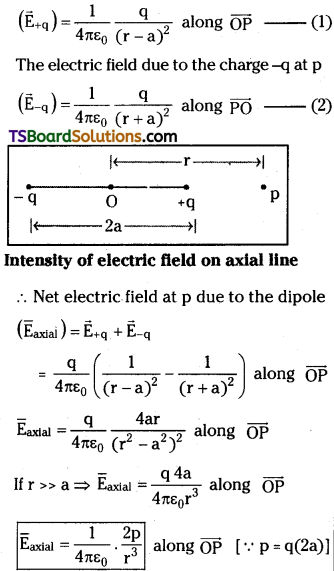
Consider an electric dipole with charges q, – q with separation ‘2a’ between them.
Let p = a point on its axial line at a distance r from the mid point of the dipole
Eaxial = intensity of electric field at p
Eaxial = E+q + E-q.
The electric field at p due to the charge + q
TS Inter 2nd Year Physics Study Material Chapter 4 Electric Charges and Fields 9

Question 5.
Derive an expression for the intensity of the electric field at a point on the equatorial plane of an electric dipole.
Answer:
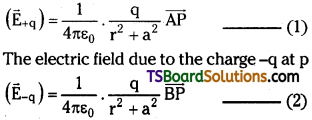
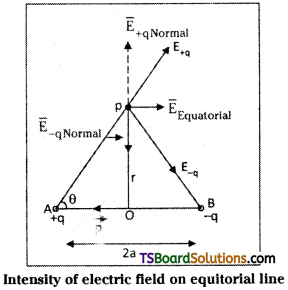
Consider an electric dipole with charges q, -q with a separation ‘2a’ between them. Consider a point p’ on the equatorial of the dipole at a distance r from the centre of the dipole. Electric field at p is the resultant of E+q and E-q.
The electric field due to the charge +q at p
TS Inter 2nd Year Physics Study Material Chapter 4 Electric Charges and Fields 10

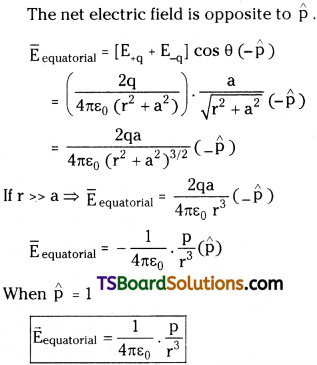
These are equal in magnitude. The components of E+q and E-q normal to the axis of the dipole cancel each other, the components along the axis will add up.
TS Inter 2nd Year Physics Study Material Chapter 4 Electric Charges and Fields 11
TS Inter 2nd Year Physics Study Material Chapter 4 Electric Charges and Fields 12

Question 6.
State Gauss’s law in electrostatics and explain its importance. [TS Mar. ’ 18,’ 15, May ‘ 17; AF June 15, Mar. 15]
Answer:
Gauss’s Law :
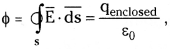
The total electric flux through any closed surface is equal to \(\frac{1}{\varepsilon_0}\) times the net charge enclosed by the surface.
TS Inter 2nd Year Physics Study Material Chapter 4 Electric Charges and Fields 13
where ε0 = permittivity of free space,
q = total cherge enclosed by the surface.

Importance:

  1. Using Gauss law we can find field due to a distribution of charge.
  2. Gauss’s law is often useful towards a much easier calculation of the electrostatic field when the system has symmetry.

Long Answer Questions

Question 1.
Define electric flux. Applying Gauss’s law and derive the expression for electric intensity due to an infinite long straight charged wire. (Assume that the electric field is everywhere radial and depends only on the radial distance r of the point from the wire.)
Answer:
Electric flux :
The number of electric lines of force passing normally through a given surface is called “electric flux” (Φ).

Expression for electric intensity :
Let us consider an infinitely long thin straight wire having linear charge density λ. (∵ λ= Q/L)

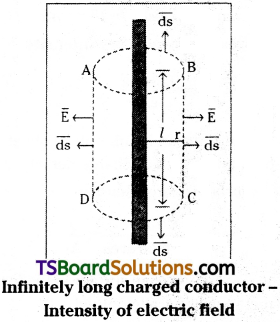
Consider a cylindrical Gaussian surface ABCD of length ‘l’ and radial distance r. The electric field \(\overline{\mathrm{E}}\) is radial and which perpendicular to the length of the wire.

The flux through the flat surfaces AB and CD are zero. (∵ \(\overrightarrow{E}\) ⊥ \(\overrightarrow{A}\))
TS Inter 2nd Year Physics Study Material Chapter 4 Electric Charges and Fields 14

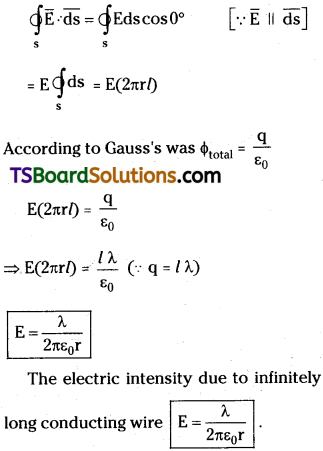
The flux through the curved surface ABCD is given by
TS Inter 2nd Year Physics Study Material Chapter 4 Electric Charges and Fields 15

λ is positive ⇒ direction will be radially outwards
λ is negative ⇒ direction will be radially inwards 2

Question 2.
State Gauss’s law in electrostatics. Applying Gauss’s law derive the expression for electric intensity due to an infinite plane sheet of charge.
Answer:
Gauss’s law :
The total electrical flux through any closed surface is equal to 1/ε0 times the net charge enclosed by that surface.

Expression for electric intensity:
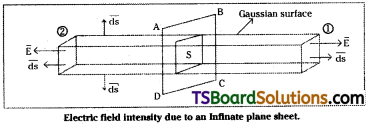
TS Inter 2nd Year Physics Study Material Chapter 4 Electric Charges and Fields 16
Consider an infinite plane sheet ABCD of uniform surface charge density ‘σ’.
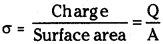
Surface charge density
TS Inter 2nd Year Physics Study Material Chapter 4 Electric Charges and Fields 17
Take a Gaussian surface in the form of a rectangular parallelopiped.
TS Inter 2nd Year Physics Study Material Chapter 4 Electric Charges and Fields 18
Assume the area of cross section of the two surfaces (1) and (2) be ‘S’. These two surfaces only will contribute to electric flux, since \(\overrightarrow{E}\) and area vector \(\overrightarrow{ds}\) are parallel. The remaining surfaces will give rise to zero flux as \(\overrightarrow{E}\) and \(\overrightarrow{ds}\) are perpendicular.
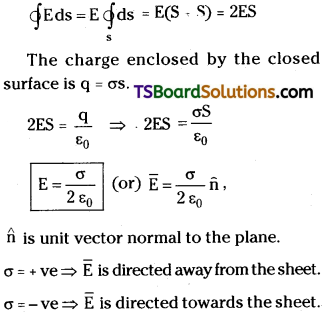
The total flux through the surface
TS Inter 2nd Year Physics Study Material Chapter 4 Electric Charges and Fields 19
This field is independent of distance of the point, this field is a uniform field.

Question 3.
Applying Gauss’s law derive the expression for electric intensity due to a charged conducting spherical shell at (i) a point outside the shell (ii) a point on the surface of the shell and (iu) a point inside the shell.
Answer:
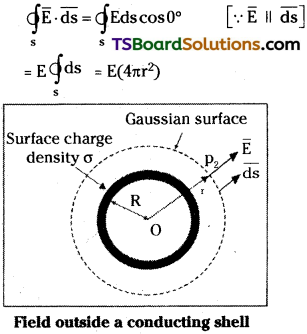
Consider a charged spherical shell of radius R and of uniform surface charge density σ.
TS Inter 2nd Year Physics Study Material Chapter 4 Electric Charges and Fields 20
1) Field out side the shell:
Consider a point P outside the shell with a radius vector \(\overrightarrow{r}\). (\(\overrightarrow{r}\) > \(\overrightarrow{R}\))
Now consider a Gaussian surface which is spherical of radius r.
As all the points on this surface are at same distance.
The flux through the Gaussian surface
TS Inter 2nd Year Physics Study Material Chapter 4 Electric Charges and Fields 21
The charge enclosed by the
Gaussian surface is q = σ.(4πr²)
TS Inter 2nd Year Physics Study Material Chapter 4 Electric Charges and Fields 22

2) Field at a point on the shell:
If the point lies on the surface of the shell
⇒ r = R.
TS Inter 2nd Year Physics Study Material Chapter 4 Electric Charges and Fields 23

3) Field at a point inside the shell:
Consider a spherical Gaussian surface passing through P inside the shell with centre as ’O’.
TS Inter 2nd Year Physics Study Material Chapter 4 Electric Charges and Fields 24
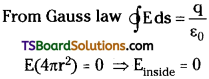
The flux through this surface is
TS Inter 2nd Year Physics Study Material Chapter 4 Electric Charges and Fields 25
But the there is no charge enclosed by the surface i.e., q = 0.
TS Inter 2nd Year Physics Study Material Chapter 4 Electric Charges and Fields 26
∴ The field inside a uniformly charged thin shell at all points inside is zero.

Intext Question and Answer

Question 1.
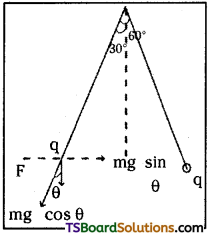
Two small identical balls, each of mass 0.20 g, carry identical charges and are suspended by two threads of equal lengths. The balls position themselves at equilibrium such that the angle between the threads is 60°. If the distance between the balls is 0.5m, find the charge on each ball.
Answer:
Mass of each ball = 0.20g = 20 × 10-4kg
Angle between them θ = 60°
Separation between balls = 0.5m
TS Inter 2nd Year Physics Study Material Chapter 4 Electric Charges and Fields 27
At equilibrium
Electrostatic force F is
balanced by component of weight mg sin θ.
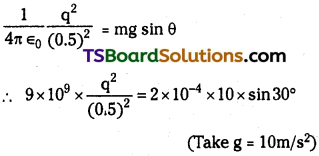
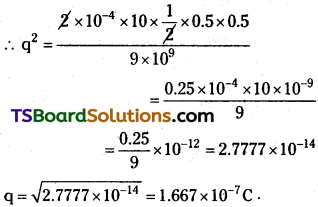
TS Inter 2nd Year Physics Study Material Chapter 4 Electric Charges and Fields 28
TS Inter 2nd Year Physics Study Material Chapter 4 Electric Charges and Fields 29

Question 2.
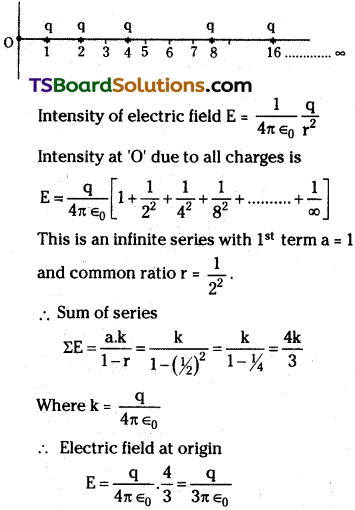
An infinite number of charges each of magnitude q are placed on x – axis at distances of 1, 2, 4,8, …………. meter from the origin respectively. Find intensity of the electric field at origin.
Answer:
The charges are as shown.
TS Inter 2nd Year Physics Study Material Chapter 4 Electric Charges and Fields 30

Question 3.
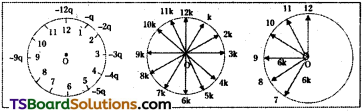
A clock face has negative charges-q, -2q, -3q, …….. – 12q fixed at the position of the corresponding numberals on the dial. The clock hands do not disturb the net field due to the point charges. At what time does the hour, hand point in the direction of the electric field at the centre of the dial?
Answer:
Negative charges are arranged on the clock as shown.
TS Inter 2nd Year Physics Study Material Chapter 4 Electric Charges and Fields 31
Charge arrangement
Electric field due to – q = \(\frac{1}{4 \pi \varepsilon_0} \frac{\mathrm{q}}{\mathrm{r}^2}\) = say k

Where r is distance from centre ‘O’ to the numbers on dial
Field due to- 2q = 2k; due to -3q = 3k ……….. Field due to -12q = 12k
Electric field is directed as shown in figure.
TS Inter 2nd Year Physics Study Material Chapter 4 Electric Charges and Fields 32
They are as shown in figure.
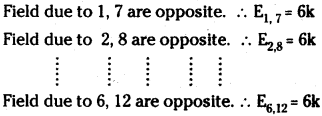
Consider E7 and E9 magnitude of each = 6k angle between them is 60°.
∴ Resultant of E7 & E9 is along E8.
Magnitude is
\(\sqrt{6 \mathrm{k}^2+6 \mathrm{k}^2+2 \times 6 \mathrm{k} \times 6 \mathrm{k} \times \cos \theta}\) say x.
Field along E8 = 6k + x …………. (1)
Consider E10 and E12 their magnitudes are 6k and 6k angle between them is 60°.
Resultant of E10, E12 is along E11.
Resultant field along
E11 = \(\sqrt{6 \mathrm{k}^2+6 \mathrm{k}^2+2 \times 6 \mathrm{k} \times 6 \mathrm{k} \cdot \cos 60^{\circ}}\) say y.
Now x, y are equal.
Total field along E11 = 6k + y ……….. (2)
From eq 1, 2 magnitudes of E8, E11 are equal and angle between them is 90°.
∴ Angle of resultant θ = 45° with E8.
In clock Anglb between each digit say 8 & 9 = 30°
9 & 10 = 30° i.e., 1 hour corresponds to 30° angle so angle 45° ⇒ 1\(\frac{1}{2}\) hour
Direction of resultant field = 8 + 1\(\frac{1}{2}\) = 9\(\frac{1}{2}\) hours = 9 hours 30 minutes.

TS Inter 2nd Year Physics Study Material Chapter 4 Electric Charges and Fields

Question 4.
Consider a uniform electric field E = 3 × 10³ N/C. (a) What is the flux of this field through a square of 10 cm on aside whose plane is parallel to the yz plane? (b) What is the flux through the same square if the normal to its plane makes a 60° angle with the x – axis?
Answer:
Intensity of electric field E = 3 × 10³ N/C along x-axis.
Area of Square = 1² = 10 × 10 = 100 cm²
= 100 × 10-4 m² = 10-2

(a) When plane of square is parallel to y – z plane it is perpendicular to x-axis
⇒ 0 = 90°
∴ Flux through square Φ = \(\overline{\mathrm{E}}.\overline{\mathrm{A}}\) (or)
Φ = EA cos θ
Φ = 3 × 10³ × 10-2 = 3 × 10 = 30 vm

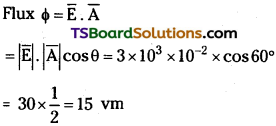
(b) When square makes an angle θ = 60°
with x- axis, θ =60°.
TS Inter 2nd Year Physics Study Material Chapter 4 Electric Charges and Fields 33

Question 5.
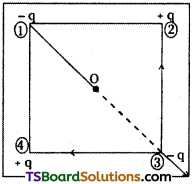
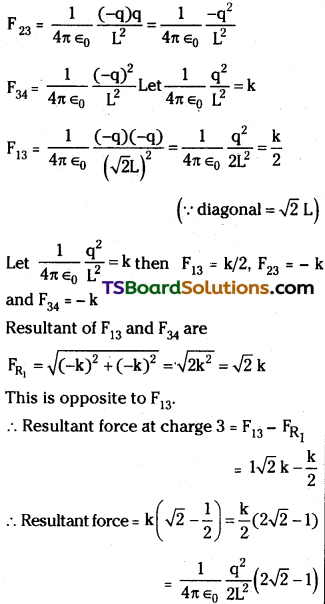
There are four charges, each with a magnitude Q. Two are positive and two are negative. The charges are fixed to the corners of a square of side ‘L’, one to each corner, in such a way that the force on any charge is directed toward the center of the square. Find the magnitude of the net electric force experienced by any charge?
Answer:
Given two charges are +ve and two charges are -ve.
TS Inter 2nd Year Physics Study Material Chapter 4 Electric Charges and Fields 34
Force on any charge is directed towards centre.
Side of square = L at point 3
Consider charge 3 total forces on it are
TS Inter 2nd Year Physics Study Material Chapter 4 Electric Charges and Fields 35

Question 6.
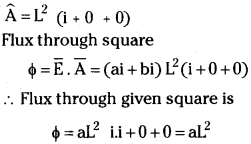
The electric field in a region is given by \(\overrightarrow{\mathbf{E}}=\mathbf{a} \hat{\mathbf{i}}+\mathbf{b} \hat{\mathbf{j}}\). Here a and b are constants. Find the net flux passing through a square area of side L parallel to y – z plane.
Answer:
Electric field \(\overrightarrow{\mathbf{E}}=\mathbf{a} \hat{\mathbf{i}}+\mathbf{b} \hat{\mathbf{j}}\)
Side of square = L
∴ Area of square = L²
Give square is parallel to y – z plane ⇒ it is perpendicular x – axis ⇒ Area vector
TS Inter 2nd Year Physics Study Material Chapter 4 Electric Charges and Fields 36

Question 7.
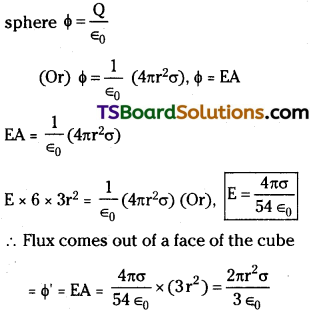
A hollow spherical shell of radius r has a uniform charge density σ. It is kept in a cube of edge 3r such that the center of the cube coincides with the center of the shell. Calculate the electric flux that comes out of a face of the cube.
Answer:
(Charge density on sphere = σ. But σ = \(\frac{Q}{A}\)
Area of spere A = 4πr²
⇒ Charge Q = 4πr²σ
For a point out side the sphere it seems to be concentrated at centre.
∴ Charge at centre of cube Q = 4πr²σ)
From gauss’s law total flux comming out of
TS Inter 2nd Year Physics Study Material Chapter 4 Electric Charges and Fields 37

Question 8.
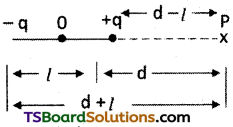
An electric dipole consists of two equal and opposite point charges + Q and – Q, separated by a distance 2l. P is a point collinear with the charges such that is distance from the positive charge is half of its distance from the negative charge.
Answer:
Each charge on dipole = q, -q
Separation between charges = 2l
TS Inter 2nd Year Physics Study Material Chapter 4 Electric Charges and Fields 38
P is on the line joining the charges ⇒ it is on axial line.
Given : distance from +ve’ charge = \(\frac{1}{2}\) distance from -ve’ charge.
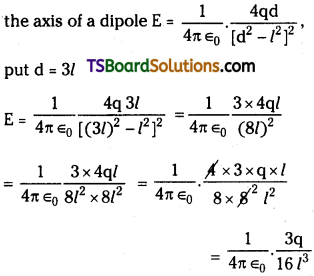
From given data d – l = \(\frac{1}{2}\) ( d + l) ⇒ 2d – 2l = d + l (or) d = 3l
Intensity of electric field at any point on
TS Inter 2nd Year Physics Study Material Chapter 4 Electric Charges and Fields 39

Question 9.
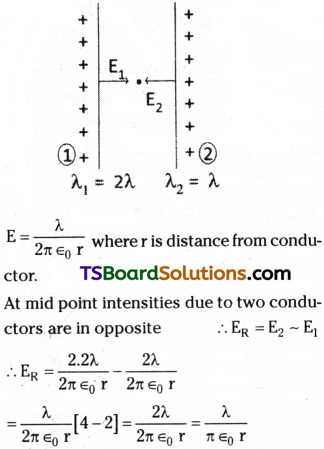
Two infinitely long thin straight wires having uniform linear charge densities λ and 2λ are arranged parallel to each other at a distance r apart. The intensity of the electric field at a point midway between them is
Answer:
Charge densities of infinitely long conductors = λ and 2λ
Distance between conductors = r
Intensity of electric field of mid point = ?
For mid point distance d = r/2
Intensity of electric field due to a long conductor.
TS Inter 2nd Year Physics Study Material Chapter 4 Electric Charges and Fields 40

Question 10.
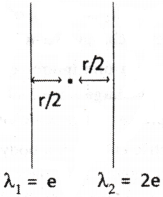
Two infinitely long thin straight wires having uniform linear charge densities \(\ddot{\mathrm{e}}\) and 2\(\ddot{\mathrm{e}}\) are arranged parallel to each other at a distance r apart. The intensity of the electric field at a point midway between them is
Answer:
Linear charge densities σ1 = σ2 and σ2 = 2e.
Separation between two parallel conductors d = r
For mid-way between them d = r/2
TS Inter 2nd Year Physics Study Material Chapter 4 Electric Charges and Fields 41
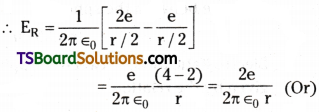
At midpoint intensities are in oppisite direction so resultant intensity ER = E1 ~ E2
Intensity of electric field from an infinitely long charged conductor E = \(\frac{\lambda}{2 \pi \varepsilon_0r}\)
TS Inter 2nd Year Physics Study Material Chapter 4 Electric Charges and Fields 42
Intensity of electric field at mid point E = \(\frac{e}{\pi \varepsilon_0r}\)

TS Inter 2nd Year Physics Study Material Chapter 4 Electric Charges and Fields

Question 11.
An electron of mass m and chargee is fired perpendicular to a uniform electric field of intensity E with an initial velocity u. If the electron traverses a distance x in the field in the direction of firing. Find the transverse displacement y it suffers.
Answer:
Mass of electron = m ;
Charge on electron = e
Intensity of electric field = E
∴ Force F = E . e
Initial velocity of electron = u; acceleration of electron a = F/m = E.e/m

Distance travelled S = x. along x-axis
⇒ time t = \(\frac{x}{4}\) …………. (1)
Distance travelled along y-axis = ?
Initial velocity along y-axis = u = 0
Vertical displacement y = ut + \(\frac{1}{2}\) at² = \(\frac{1}{2}\)at²
⇒ y = \(\frac{1}{2}\frac{Ee}{m}.\frac{x}{u^2}\)
∴ Vertical displacement after travelling a eEx2 distance x is y = \(\frac{eEx^2}{2mu^2}\)

Additional Exercises

Question 1.
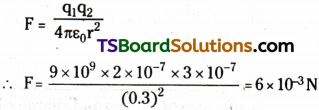
What is the force between two small charged spheres having charges of 2 × 10⁻⁷ C and 3 × 10⁻⁷ C placed 30 cm apart in air?
Answer:
Repulsive force of magnitude 6 × 10⁻³ N ;
Charge on the first sphere, q: = 2 × 10⁻⁷
C Charge on the second sphere, q² = 3 × 10⁻⁷ C ;
Distance between the spheres, r = 30 cm = 0.3 m
Electrostatic force between the spheres is given by the relation,
TS Inter 2nd Year Physics Study Material Chapter 4 Electric Charges and Fields 43
Hence, force between the two small charged spheres is 6 × 10⁻³ N. The charges are of same nature. Hence, force between them will be repulsive.

Question 2.
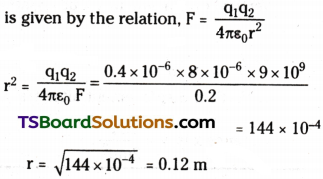
The electrostatic force on a small sphere of charge 0.4 µC due to another small sphere of charge – 0.8 µC in air is 0.2 N. (a) What is the distance between the two spheres? (b) What is the force on the second sphere due to the first?
Answer:
a) Electrostatic force on the first sphere, F = 0.2 N
Charge on this sphere, = 0.4 µC
= 0.4 × 10⁻⁶ C
Charge on the second sphere,
q2 = -0.8 µC = -0.8 × 10⁻⁶

Electrostatic force between the spheres
TS Inter 2nd Year Physics Study Material Chapter 4 Electric Charges and Fields 44

The distance between the two spheres is 0.12 m.

b) Both the spheres attract each other with the same force. Therefore, the force on the second sphere due to the first is 0.2 N.

TS Inter 2nd Year Physics Study Material Chapter 4 Electric Charges and Fields

Question 3.
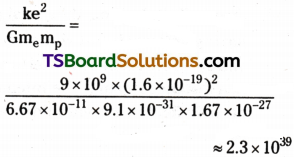
Check that the ratio ke²/G memp is dimensionless. Look up a Table of Physical Constants and determine the value of this ratio. What does the ratio signify?
Answer:
1) The given ratio is \(\frac{\mathrm{ke^2}}{\mathrm{Gm_em_p}}\)
Where, G = Gravitational constant
me and mp = Masses of electron and proton.; e = Electric charge is C.
k = A constant. = \(\frac{1}{4 \pi \varepsilon_0}\),
Where ε0 = Permittivity of free space
Therefore, unit of the given ratio
TS Inter 2nd Year Physics Study Material Chapter 4 Electric Charges and Fields 45
Hence, the given ratio is dimensionless,

ii) e = 1.6 × 10⁻¹⁹C; G = 6.67 × 10⁻¹¹ N m²kg-2; me = 9.1 × 10⁻³¹ kg ; mp = 1.66 × 10⁻²⁷kg
Hence, the numerical value of the given ratio is
TS Inter 2nd Year Physics Study Material Chapter 4 Electric Charges and Fields 46
This is the ratio of electric force to the gravitational force between a proton and an electron, keeping distance between them constant.

Question 4.
a) Explain the meaning of the statement ‘electric charge of a body is quantised’.
b) Why can one ignore quantisation of electric charge when dealing with macroscopic i.e., large scale charges?
Answer:
a) Electric charge of a body is quantized. This means that only integral (1, 2, …………, n) number of electrons can be transferred from one body to the other. Charges are not transferred in fraction. Hence, a body possesses total charge only in integral multiples of electric charge.

b) In macroscopic or large scale charges, the charges used are huge as compared to the magnitude of electric charge. Hence, quantization of electric charge is of no use on macroscopic scale. Therefore, it is ignored and it is considered that electric charge is continuous.

Question 5.
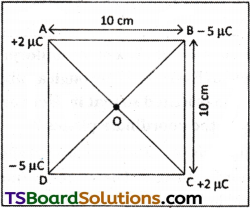
Four point charges qA = 2 µC, qB = – 5µC, qC = 2 µC, and qD = – 5 µC are located at thecomereofasquare ABCD of side 10cm. What is the force on a charge of 1 µC placed at the centre of the square?
Answer:
The given figure shows a square of side 10 cm with four charges placed at its corners. O is the centre of the square.
TS Inter 2nd Year Physics Study Material Chapter 4 Electric Charges and Fields 47
Where, (Sides) AB = BC = CD = AD = 10 cm
(Diagonals) AC = BD = 10√2 cm
AO = OC = DO = OB = 5√2 cm
A charge of amount 1 µC is placed at point O.

Force of repulsion between charges placed at corner A and centre O is equal in magnitude but opposite in direction relative to the force of repulsion between the charges placed at corner C and centre O. Hence, they will cancel each other. Similarly, force of attraction between charges placed at corner B and centre O is equal in magnitude but opposite in direction relative to the force of attraction between the charges placed at corner D and centre O. Hence, they will also cancel each other. Therefore, net force caused by the four charges placed at the corner of the square on 1 µC charge at centre O is zero.

TS Inter 2nd Year Physics Study Material Chapter 4 Electric Charges and Fields

Question6.
a) An electrostatic field line is a continuous curve. That is, a field line cannot have sudden breaks. Why not?
b) Explain why two field lines never cross each other at any point?
Answer:
a) An electrostatic field line is a continuous curve because a charge experiences a continuous force when traced in an electrostatic field. The field line cannot have sudden breaks because the charge moves continuously and does not jump from one point to the other.

b) If two field lines cross each other at a point, then electric field intensity will show two directions at that point. This is not possible. Hence, two field lines never crosr. each other.

Question 7.
An electric dipole with dipole moment 4 × 10⁻⁹ C m is aligned at 30° with the direction of a uniform electric field of magnitude 5 × 10⁴ N C-1. Calculate the magnitude of the torque acting on the dipole.
Answer:
Electric dipole moment, p = 4 × 10⁻⁹ C m ;
Electric field, E = 5 × 10⁴ N C-1
Angle made by p with a uniform electric field, θ = 30°

Torque acting on the dipole is given by the relation, τ = pE sin θ
= 4 × 10-9 × 5 × 104 × sin 30
= 20 × 10-5 × 1/2 = 10-4 Nm

Therefore, the magnitude of the torque acting on the dipole is 10-4 N m.

Question 8.
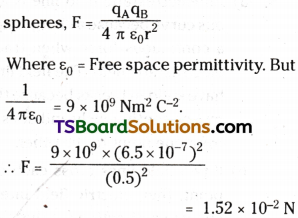
a) Two insulated charged copper spheres A and B have their centers separated by a distance of 50 cm. What is the mutual force of electrostatic repulsion if the charge on each is 6.5 × 10⁻⁷ C? The radii of A and B are negligible compared to the distance of separation.
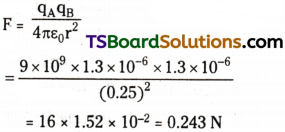
b) What is the force of repulsion if each sphere is charged double the above amount, and the distance between them is halved?
Answer:
a) Charge on sphere A, qA = Charge on sphere B, qB = 6.5 × 10⁻⁷ C
Distance between the spheres,
r = 50 cm = 0.5 m

Force of repulsion between the two
TS Inter 2nd Year Physics Study Material Chapter 4 Electric Charges and Fields 48

Therefore, the force between the two spheres is 1.52 × 10⁻² N.

b) After doubling the charge, charge on sphere A, qA = Charge on sphere B,
qB = 2 x 6.5 × 10-7C = 1.3 × 10⁻⁶C
The distance between the spheres is halved.
∴ r = \(\frac{0.5}{2}\) = 0.25 m
Force of repulsion between the two spheres,
TS Inter 2nd Year Physics Study Material Chapter 4 Electric Charges and Fields 49
Therefore, the force between the two spheres is 0.243 N.

Question 9.
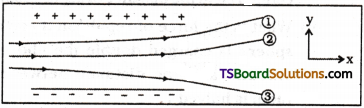
Figure shows tracks of three charged particles in a uniform electrostatic field. Give the signs of the three charges. Which particle has the highest charge to mass ratio?
TS Inter 2nd Year Physics Study Material Chapter 4 Electric Charges and Fields 50
Answer:
Opposite charges attract each other and same charges repel each other. It can be observed that particles 1 and 2 both move towards the positively charged plate and repel away from the negatively chargee plate. Hence, these two particles are negatively charged. It can also be observed that particle 3 moves towards the negatively charged plate and repels away from the positively charged plate. Hence, particle 3 is positively charged.

The charge to mass ratio (emf) is directly proportional to the displacement or amount of deflection for a given velocity. Since the deflection of particle 3 is the maximum, it has the highest charge to mass ratio.

Question 10.
What is the net flux of the uniform electric field of Exercise 15 through a cube of side 20 cm oriented so that its faces are parallel to the coordinate planes?
Answer:
All the faces of a cube are parallel to the coordinate axes. Therefore, the number of field lines entering the cube is equal to the number of field lines piercing out of the cube. As a result, net flux through the cube is zero.

TS Inter 2nd Year Physics Study Material Chapter 4 Electric Charges and Fields

Question 11.
Careful measurement of the electric field at the surface of a black box indicates that the net outward flux through the surface of the box is 8.0 × 10³ N m²/C.
a) What is the net charge inside the box?
b) If the net outward flux through the surface of the box were zero, could you conclude that there were no charges inside the box? Why or Why not?
Answer:
a) Net outward flux through the surface of the box, Φ = 8.0 × 10³ N m²/C
For a body containing net charge q, flux is given by the relation, Φ = \(\frac{q}{\varepsilon_0}\)
ε0 = Permittivity of free space = 8.854 × 10⁻¹² N-1C²m-2
q = ε0Φ = 8.854 × 10-12 × 8.0 × 10³
= 7.08 × 10-8 = 0.07 µC
Therefore, the net charge inside the box is 0.07 µC.

b) No
Net flux piercing out through a body depends on the net charge contained in the body. If net flux is zero, then it can be inferred that net charge inside the body is zero. The body may have equal amount of positive and negative charges.

Question 12.
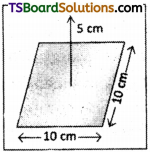
A point charge + 10 µC is a distance 5 cm directly above the centre of a square of side 10 cm, as shown in Figure. What is the magnitude of the electric flux through the square? (Hint: Think of the square as one face of a cube with edge 10 cm.)
TS Inter 2nd Year Physics Study Material Chapter 4 Electric Charges and Fields 51
Answer:
The square can be considered as one face of a cube of edge 10 cm with a centre where charge q is placed. According to Gauss’s theorem for a cube, total electric flux is through all its six faces.
Hence, electric flux through one face of the cube
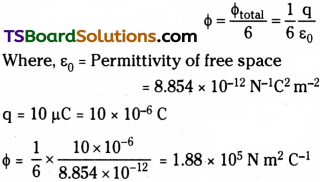
Φtotal = \(\frac{q}{\varepsilon_0}\)
Hence, electric flux through one fact of the cube i.e., through the square,
TS Inter 2nd Year Physics Study Material Chapter 4 Electric Charges and Fields 52
Therefore, electric flux through the square is 1.88 × 10⁵ Nm²C-1

Question 13.
A point charge of 2.0 µC is at the centre of a cubic Gaussian surface 9.0 cm on edge. What is the net electric flux through the surface?
Answer:
Net electric flux (Φnet) through the cubic surface is given by, Φnet = \(\frac{q}{\varepsilon_0}\)
Where, ε0 = Permittivity of free space = 8.854 × 10⁻¹²N-1C²m-2
q = Net charge contained inside the cube = 2.0 µC = 2 × 10⁻⁶ C
TS Inter 2nd Year Physics Study Material Chapter 4 Electric Charges and Fields 53
The net electric flux through the surface is 2.26 × 10⁵ Nm²C-1.

Question 14.
A point charge causes an electric flux of -1.0 × 10³ Nm²/C to pass through a sphe¬rical Gaussian surface of 10.0 cm radius centered on the charge.
a) If the radius of the Gaussian surface were doubled, how much flux would pass through the surface?
b) What is the value of the point charge?
Answer:
a) Electric flux, Φ = -1.0 × 10³ Nm²/C ;
Radius of the Gaussian surface, r = 10.0 cm
Electric flux piercing out through a surface depends on the net charge enclosed inside a body. It does not depend on the size of the body. If the radius of the Gaussian surface is doubled, then the flux passing through the surface remains the same i.e., – 10³ N m²/C.

b) Electric flux is given by the relation, Φ = \(\frac{q}{\varepsilon_0}\)
Where, q = Net charge enclosed by the spherical surface
ε0 = Permittivity of free space
= 8.854 × 10⁻¹² N-1C²m-2
∴ q = Φε0 = – 1.0 × 10³ × 8.854 × 10-12
= – 8.854 × 10⁻⁹ C = – 8.854 nC

Therefore, the value of the point charge is-8.854 nC.

Question 15.
A conducting sphere of radius 10 cm has an unknown charge. If the electric field 20 cm from the centre of the sphere is 1.5 × 10³ N/C and points radially inward, what is the net charge on the sphere?
Answer:
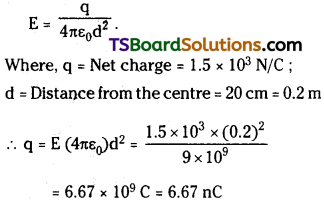
Electric field intensity (E) at a distance (d) from the centre of a sphere containing net charge q is given by the relation,
TS Inter 2nd Year Physics Study Material Chapter 4 Electric Charges and Fields 54
Therefore, the net charge on the sphere is 6.67 nC.

Question 16.
A uniformly charged conducting sphere of 2.4 m diameter has a surface charge density of 80.0 µC/m².
a) Find the charge on the sphere.
b) What is the total electric flux leaving the surface of the sphere?
Answer:
a) Diameter of the sphere, d = 2.4 m ;
Radius of the sphere, r = 1.2 m
Surface charge density σ = 80.0 µC/m²
= 80 × 10-6C/m²

Total charge on the surface of the sphere,
Q = Charge density × Surface area
Q = σ × 4πr² = 80 × 10-6 × 4 × 3.14 × (1.2)²
= 1.447 × 10⁻³C
Therefore, the charge on the sphere is 1.447 × 10⁻³ C.

b) Total electric flux (Φtotal) leaving out the surface of a sphere containing net charge
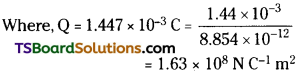
Q is given by the relation, Φtotal = \(\frac{Q}{\varepsilon_0}\)
TS Inter 2nd Year Physics Study Material Chapter 4 Electric Charges and Fields 55

Therefore, the total electric flux leaving the surface of the sphere is 1.63 × 10⁻⁸NC-1

TS Inter 2nd Year Physics Study Material Chapter 4 Electric Charges and Fields

Question 17.
An infinite line charge produces a field of 9 × 10⁴ N/C at a distance of 2 cm. Calculate the linear charge density.
Answer:
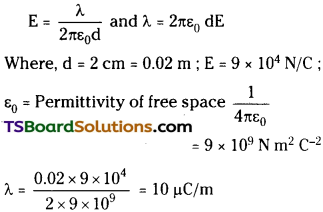
Electric field produced by the infinite line charges at a distance d having linear charge density λ is given by the relation,
TS Inter 2nd Year Physics Study Material Chapter 4 Electric Charges and Fields 56
Therefore, the linear charge density is 10 µC/m

TS Inter 2nd Year Physics Study Material Chapter 3 Wave Optics

Telangana TSBIE TS Inter 2nd Year Physics Study Material 3rd Lesson Wave Optics Textbook Questions and Answers.

TS Inter 2nd Year Physics Study Material 3rd Lesson Wave Optics

Very Short Answer Type Questions

Question 1.
What is Fresnel distance?
Answer:
Fresnel distance :
The term z = a²/λ is called “Fresnel distance”.

In explaining the spreading of beam due to diffraction we will use the equation z = a²/λ.

Where after travelling a distance zλ/a size of beam is comparable to size of slit (or) hole a’.

Question 2.
Give the justification for validity of ray optics.
Answer:
The wavelength of light is very small. For larger distances and objects of large size we will completely neglect the wave nature of light. In this case, we believe that light will travel in straight lines. Principles of geometry are used to explain various phenomena like reflection and refraction.

Fresnel distance z = a²/λ suggested that for distances far greater than ‘z’ ray optics is valid in the limit wavelength tends to zero.

Question 3.
What is polarisation of light?
Answer:
Polarisation :
It is a process in which vibrations of electric vectors of light are made to oscillate in a single direction.
Ex : Let a light wave is represented by y (x, t) = a sin (kx – ωt)
Here the displacement is in y – direction. So it is referred as y – polarised wave.

Question 4.
What is Malus’law? [TS May ’17]
Answer:
Mains’ Law :
Let two polaroids say P1 and P2 are arranged with some angle ‘0’ between their axes. Then intensity of light coming out of them is I = I0 cos² θ

Where I0 is intensity of polarised light after passing through 1st polaroid P1. This is known as Malus’ Law.

Question 5.
Explain Brewster’s law. [AP June 15; TS May 16]
Answer:
The angle of incidence iB for which the reflected ray is plane polarised is called Brewster angle.

Explanation:
At Brewster angle iB + r = \(\frac{\pi}{2}\)
TS Inter 2nd Year Physics Study Material Chapter 3 Wave Optics 1
∴ The tangent of Brewster’s angle tan (iB) is equals to refractive index. This is called “Brewster’s Law” i.e, µ = tan iB.

TS Inter 2nd Year Physics Study Material Chapter 3 Wave Optics

Question 6.
When does a monochromatic beam of light incident on a reflective surface get completely transmitted?
Answer:
Laser beam is a monochromatic light. Let a laser beam is passed through a polariser and made to fall on a prism with Brewster’s angle. Now rotate the polariser carefully, for a particular angle of incidence we can not get reflected ray from prism. Which implies that the total light is transmitted through prism.

Short Answer Questions

Question 1.
Explain Doppler effect in light. Distinguish between red shift and blue shift. [TS Mar. 19, 16; May 15; AP Mar. 16, June 15, May 18]
Answer:
Doppler’s effect in light :
When there is relative motion between source and observer then there is a change in frequency of light received by the observer.

Red shift :
If the source moves away from the observer then frequency measured by observer is less i.e., wavelength increases As a result wave length of received light moves towards red colour. This is known as “red shift”.

Blue shift :
When source of light is approaching the observer frequency of light received decreases, i.e., wavelength of light decreases. As a result wavelength of received light will move towards blue colour. This is known as “blue shift”.

Question 2.
What is total internal reflection? Explain the phenomenon using Huygens principle.
Answer:
Total internal reflection :
When light travels from denser medium to rarer medium then for angle of incidence i > ic i.e., (critical angle) light rays are not able to cross boundary layer between the media and simply come back into the same medium. This phenomena is known as “total internal reflection”.

Explanation :
From Huygens wave theory velocity of light in medium is high. So refracted ray will bend towards normal.

When light rays are travelling from denser medium to rarer medium they will bend away from normal.

As angle of incidence ‘i’ increases then angle of refraction ‘r’ will also increase.

For a particular value of i angle of refraction r will become 90° this angle of incidence in denser medium is called critical angle.

When angle of incidence i > ic (critical angle) the ‘r’ is more than 90° we cannot have any refracted ray. The incident ray will simply come back into the same medium. This is called total internal reflection.

Question 3.
Derive the expression for the intensity at a point where interference of light occurs. Arrive at the conditions for maximum and zero intensity. [AP Mar. 18, 16. 15; TS May 18, Mar. 15]
Answer:
In young’s experiment two pinholes (S1, S2) are made on a black card board with a separation’d’ between them. Light coming from a pinhole ‘S’ will fall on these two pinholes (S1, S2) and spherical waves are produced. A screen (G, G1) is placed at a distance D from the slits. This is as shown in fig.
TS Inter 2nd Year Physics Study Material Chapter 3 Wave Optics 2

From theory of interference when the two light waves are superposed at ‘P’. We will get bright band when path difference is nλ we will get dark band when path difference is (n + \(\frac{1}{2}\))λ.

Condition for maximum intensity :
For maximum intensity path difference S2P – S1P = nλ
From fig . [S2P]² – [S1P]² =
TS Inter 2nd Year Physics Study Material Chapter 3 Wave Optics 3
or S2P – S1P = 2xd /(S2P + S1P) …………. (1)
When D >> and D >> d then S2P + S1P ≅ 2D
∴ S2P – S1P = \(\frac{2xd}{2D}\)nλ (or) x = nλ\(\frac{D}{d}\) ………….. (2)
For dark band or zero intensity
S2P – S1P = (n + \(\frac{1}{2}\))λ
From eq. (1)
∴ S2P – S1P = 2xd/S2P + S1P use S2P + S1P = 2D
For zero intensity
S2P – S1P = \(\frac{2xd}{2D}\) = (n + \(\frac{1}{2}\))λ
∴ x = (n + \(\frac{1}{2}\))λ \(\frac{D}{d}\) For dark band.
Where x is distance from centre of screen and n is a ‘+Ve’ integer.

TS Inter 2nd Year Physics Study Material Chapter 3 Wave Optics

Question 4.
Does the principle of conservation of energy hold for interference and diffraction phenomena? Explain briefly. [AP May 16 ; Mar. 17. 14]
Answer:
In case of interference and diffraction we are getting a series of dark and bright bands. While forming these bands with maximum and minimum intensity law of conservation of energy holds good.

In interference and diffraction pattern energy is redistributed, i.e,, energy is reduced in one region (dark band). This energy is superposed on another region. Where it appears bright.

So in interference and diffraction pattern redistribution of energy in the regions of dark and bright bands takes place. But there is no loss of energy or creation of energy. Hence these two phenomena will obey Law of conservation of energy.

Question 5.
How do you determine the resolving power of your eye? [AP Mar. 19, 17, May 14; TS Mar. 18]
Answer:
To find resolving power of eye draw black bands of equal width say 5mm with a separation of 0.5mm between them. Gradually increase the width of gap (white strip) between to black bands form 0.5 to 1mm and 1 mm to 1.5 mm etc. after every two white bands.

Paste that paper on a wall. Wnen your distance from wall is very high – you will see only a dark band, i.e., all dark bands merged into a single band. When you are approaching the wall the bands seems to be separated into two groups with one white band between them. Now measure distance ‘D’ from wall and also spacing between black bands, (d) (i.e., width of white band)
TS Inter 2nd Year Physics Study Material Chapter 3 Wave Optics 4
Resolving power of eye = d/D
In this way we can find resolving power of our eye.

Question 6.
Explain polarisation of light by reflection and arrive at Brewster’s law from it. [Mar. ’15]
Answer:
Polarisation by reflection :
When unpolarised light falls on the boundary layer separating two transparent media the reflected light is found to be partially polarised. The amount of polarisation depends on angle of incidence i.

When reflected ray and refracted ray are perpendicular the reflected ray is found to be totally plane polarised. The angle of incidence at this stage is known as Brewster angle.

Brewster’s Law :
The particular angle of incidence (iB) for which the reflected ray is plane polarised is called “Brewster angle”.

Explanation :
At Brewster angle iB + r = \(\frac{\pi}{2}\)
TS Inter 2nd Year Physics Study Material Chapter 3 Wave Optics 6

The tangent of Brewster’s angle tan (iB) is equals to refractive index of the reflection medium. This is called “Breswter’s law”, i.e,

Question 7.
Explain polarisation by reflection with diagram and state Brewster’s law. [May ’16]
Answer:
When unpolarised light falls on the boundary of two transparent media then reflected light is found to be plane polarised. The electric vectors are vibrating perpendicular to plane of incidence.

The percentage of polarised light gradually increases with angle of incidence. For a particular angle of incidence the reflected light is totally plane polarised. This particular angle of incidence is called Brewester angle (iB).

Brewster angle :
The angle of incidence for which the reflected light is totally plane polarised is called Brewster angle (iB).
At Brewster angle
Refractive index n (or)
TS Inter 2nd Year Physics Study Material Chapter 3 Wave Optics 7

So the tangent of Brewster angle is numerically equals to refractive index of the medium on which light rays are falling. This is called “Brewster’s law”.
TS Inter 2nd Year Physics Study Material Chapter 3 Wave Optics 8

Question 8.
Discuss the intensity of transmitted light when a polaroid sheet is rotated between two crossed polaroids.
Answer:
Let two polaroids say P1 and P2 are arranged one at the back of other. Allow unpolarised light to fall on PF first. The transmitted light through P1 is made to fall on P2.
TS Inter 2nd Year Physics Study Material Chapter 3 Wave Optics 9

When polaroid P1 is rotated there is no change in the intensity of transmitted light. Intensity of unpolarised light after passing through P1 is reduced to half of initial value.

Let the pass axis of polaroid P2 makes on angle ‘θ’ with pass axis of polariod P1. When θ = 0 i.e., the two pass axes coincides the ail the light entered P2 will come out.

If polaroid P2 is gradually rotated the intensity of light coming out of P2 gradually decreases. It becomes zero when θ = \(\frac{\pi}{2}\) i.e., the two pass axes are perpendicular to each other.

Intensity of output light through polaroid P2 will fallow the equation I = I0 cos² θ.

Where I0 is intensity of light coming from P1

This equation I = I0 cos² θ is called Malus’Law.

Long Answer Questions

Question 1.
What is Huygens Principle? Explain the optical phenomenon of refraction using Huygens principle.
Answer:
Huygens principle :
Each point of the wave front is the source of a secondary disturbance and the wavelets emanating from these points spread out in all directions with the speed of the wave. These wavelets emanating from the wavefront are usually referred to as secondary wavelets.

From Huygens principle, every wave is a secondary wave to the preceding wave.

Wavefront :
The locus of points which oscillate in phase is called “wavefront”. (OR)
A wave front is defined as a surface of constant phase.

Refraction of a plane wave :
Let PP’ is the boundary layer between the medium 1 and 2. Let AB is a plane wave falling on the boundary layer. Draw a normal at A to the boundary. Angle between A’ A and normal angle of incidence ‘i’. Draw normal to wave-front from A. It will touch at B. Let time taken by BC to reach boundary is t. Then BC = v1t. Now draw a circle with radius R = v2t from A.

Draw a tangent from C on to this arc. Now CE represents the wavefront of refracted ray in the medium 2.
TS Inter 2nd Year Physics Study Material Chapter 3 Wave Optics 10

If r < i, then velocity v2 in the medium is less and refracted ray will bend towards normal.

Let c’ is velocity of light in vacuum then n1 = \(\frac{c}{v_1}\) and n2 = \(\frac{c}{v_2}\). Then n1 sin i = n2 sin r. This is known as Snell’s Law.

If λ1 and λ2 represent the wavelengths, then
TS Inter 2nd Year Physics Study Material Chapter 3 Wave Optics 11
Hence in refraction wavelength λ and velocity v will decrease. But frequency ‘v’ is constant.

TS Inter 2nd Year Physics Study Material Chapter 3 Wave Optics

Question 2.
Distinguish between Coherent and Incoherent addition of waves. Develop the theory of constructive and destructive interferences.
Answer:
Coherent waves :
In coherent waves at a particular point in the medium, the phase difference between the displacements produced by each wave is constant.

In case of Incoherent waves the phase difference between the two waves reaching a given point in medium changes with time.

Let two waves say y1 = a cos ωt and y2 = a cos ωt reaches a point ‘P’ in a medium.
Then resultant displacement y = y1 + y2 = 2a cos ωt

Intensity I = 4I0 (Intensity α amplitude)

Constructive interference :
For constructive interference the two waves reaching the point P must be in same phase i.e., Φ = 0 or phase difference Φ must be 2π, 4π, …………. 2πn (or) path difference must be
λ, 2λ ……….. nλ.

Let the distance travelled by the two waves in reaching a point Q is S1Q and S2Q
Now S2Q – S1Q = λ
Then y1 = a cos ωt and y2 = a cos (ωt – π)
= a cos ωt.
∴ Due to super position of waves y= y1 + y2 = a cos ωt + a cos ωt = 2 a cos ωt
Intensity I = 4a² = 4I0
But Intensity I0 = a² and intensity I ∝ amplitude² (a²)

Destructive interference :
For destructive interference the two waves must reach the given point with a phase of π. i.e., a path difference of λ/2.
At point Q, Path difference of the two waves is S2Q – S1Q = λ/2.
∴ y1 = a cos ωt and y2 = a cos (ωt – π)

Now the two waves will suffer destructive interference and resultant amplitude is zero.
∴ Intensity I = 0

Theory :
Let two coherent waves have a constant phase difference Φ between them.
Then y1 = a cos cot and y2 = a cos (ωt + Φ)
Due to super position y = y1 + y2 = a cos ωt + a cos (ωt + Φ)
= a [cos ωt + cos (ωt + Φ)] = 2a cos (Φ/2) cos (ωt + Φ/2)
Amplitude of new wave is 2a cos (Φ/2)

Intensity I = (2 a cos Φ/2)² = 4a² cos² (Φ/2)
When Φ = 0, 2π, 4π even multiples of π we will get I = 4a².
This is called bright band.
When Φ = π, 3π ………. odd multiples of π i.e., (2n + 1) π then I = 0
This is called dark band.
When Incoherent waves are used their phase difference changes with time i.e., Φ is not constant. So we will use average values = 4I0 < cos² Φ/2 >
cos Φ/2 oscillates between 0 to 1. So average value is 1/2
∴ Average value of intensity = 4I0 × \(\frac{1}{2}\) = 2I0
So intensities will just add up.

Question 3.
Describe Young’s experiment for observing interference and hence arrive at the expression for ‘fringe width’.
Answer:
In Young’s experiment light coming from a source is allowed to pass through a pin hole s’. The light coming form is made to fall on slits S1 and S2 made on a black card board. Separation between the slits is d’. Since S1 and S2 are illuminated from the same source light waves coming from S1 and S2 are coherent waves with some fixed phase difference.

Let a screen GG is placed at a distance ‘D’ from the black card board to observe interference pattern.
TS Inter 2nd Year Physics Study Material Chapter 3 Wave Optics 12

The spherical waves coming from S1 and S2 will interfere at a point ‘P’ on the screen. Let distance of ‘P’ from centre of screen is ‘x’.

Expression for fringe width :
To produce maximum intensity (bright band) the two light waves arriving at point P must be in phase, i.e., phase difference between them is ‘0’ or 2π, 4π ……….. This corresponds to a path difference of 0, λ, 2λ …………. nλ.
∴ Path difference = S2P – S1P = nλ ………… (1)
But from figure (S2P)² – (S1P)²
TS Inter 2nd Year Physics Study Material Chapter 3 Wave Optics 13
But x and d are very small when compared to distance between slit and screen D.
TS Inter 2nd Year Physics Study Material Chapter 3 Wave Optics 14
This is the condition for Bright Band.

Formation of dark band :
For formation of dark band the two light waves reaching the point ‘P’ must be out of phase i.e., Φ = π, 3π, 5π …………..
This corresponds to a path difference of λ/2, 3λ/2, 5λ/2 ………….
∴ For destructive interference path difference (\(\frac{n+1}{2}\))λ
TS Inter 2nd Year Physics Study Material Chapter 3 Wave Optics 15

Fringe width β :
It is defined as the separation between two consecutive dark or bright bands.
TS Inter 2nd Year Physics Study Material Chapter 3 Wave Optics 16

Question 4.
What is diffraction? Discuss diffraction pattern obtainable from a single slit.
Answer:
Diffraction :
Bending of light rays of sharp edges (say edge of a blade) is called “diffraction”.

Diffraction at single slit :
In young’s double slit experiment the double slit is replaced by a single narrow slit. Then on the screen a central maximum with alternate dark and bright bands of decreasing intensity are seen. These are called diffraction pattern.

Explantion :
Let LM is‘a narrow slit and a screen is placed at suitable distance. Draw a straight line through M on to the screen. It will touch the screen at C’.
TS Inter 2nd Year Physics Study Material Chapter 3 Wave Optics 17

The intensity of light at any point P on screen is due to the contributions from large number of coherent sources on the slit.

Let light waves reaches the point P’ from Land N
Path difference = NP – LP = NQ = a sin θ = aθ …………… (1)
(θ is very small sin θ = θ)
At central point ‘C’ on screen θ = 0. So path difference is zero. Hence all parts of slit will contribute in phase. As a result maximum intensity is produced.

Consider the first minima :
Minimum intensity is produced when a θ = λ or θ = λ/a.

Now divide the slit into two equal parts say LM and MN. For every point M1 in the region LM there is a point M2 in MN region. The phase difference between M1M2 is 180° or π radians. So light waves reaching the point P are out of phase and we will get minimum intensity.

Consider 1st maxima :
Maxima will occur when θ = (n + \(\frac{1}{2}\)) λ/2 For 1st maxima
n = 1
⇒ 0 = 3 λ/2 a. Let us imagine the space between MN is divided into three equal parts. Consider first two thirds of the slit. Path difference for the two ends of this region is
\(\frac{2}{3}\)a.θ = \(\frac{2}{3}\)a × \(\frac{3\lambda}{2a}\) = λ

Now divide this \(\frac{2}{3}\)rd region into two equal points. For ever wave coming form 1st \(\frac{1}{3}\)rd region on there is a wave coming from 2nd \(\frac{1}{3}\)rd region with a phase difference of 180°. So on reaching point P their vector sum of displacements is zero. Here intensity is zero. The only light received is from 3rd \(\frac{1}{3}\)rd part for intensity between two minima. So we will get weak bright region.

In this way we are able to explain maxima and minima formed in diffraction pattern.
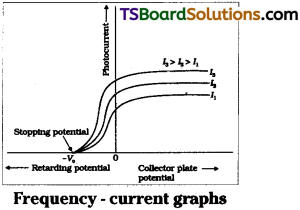
TS Inter 2nd Year Physics Study Material Chapter 3 Wave Optics

Question 5.
What is resolving power of Optical Instruments? Derive the condition under which images are resolved.
Answer:
Resolving power of optical instruments :
From principles of geometrical optics, a light beam will get focussed to a point. But due to diffraction effects we are getting a spot of finite size instead of a point.
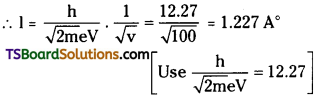

In diffraction radius of central bright region
TS Inter 2nd Year Physics Study Material Chapter 3 Wave Optics 18

This small value of r0 plays a vital role in fixing the resolving power of telescopes and microscopes.

Telescopes :
In telescopes if two stars are to be resolved clearly then
TS Inter 2nd Year Physics Study Material Chapter 3 Wave Optics 19

Where ‘λ’ is wavelength of light used and ‘a’ is the aperture or diameter of lens used. Due to this reason we are using object lens of large diameter for better resolution.

Microscopes :
In microscopes near point magnification m = D/f = 2 tan β
For two object points to be viewed clearly their image size must be v θ = v \(\frac{1.22\lambda}{D}\)
TS Inter 2nd Year Physics Study Material Chapter 3 Wave Optics 20

Objects with image size less than this can not be viewed clearly. So corresponding distances between them at object size
TS Inter 2nd Year Physics Study Material Chapter 3 Wave Optics 21
∴ Resolving power of microscope
TS Inter 2nd Year Physics Study Material Chapter 3 Wave Optics 22

Intext Question and Answer

Question 1.
Two slits are made 1 mm apart and the screen is placed 1 m away. What is the fringe separation when blue-green light of wavelength 500 nm is used?
Answer:
Fringe width β = \(\frac{D\lambda}{d}\). But distance of screen D = 1 m
Wave length λ = 500 nm = 5 × 10⁻⁷ m ;
Separation between slits d = 1 mm = 1 × 10⁻³ m
TS Inter 2nd Year Physics Study Material Chapter 3 Wave Optics 23

Question 2.
(a) The refractive index of glass is 1.5. What is the speed of light in glass? Speed of light in vacuum is 3.0 × 10⁸ m s-1)
(b) Is the speed of light in glass independent of the colour of light? If not, which of the two colours red and violet travels slower in a glass prism?
Answer:
(a) Refractive index of glass, p = 1.5; Speed of light, c = 3 × 10⁸ m/s
Speed of light’in glass is given by the relation.
TS Inter 2nd Year Physics Study Material Chapter 3 Wave Optics 24
Hence, the speed of light in glass is 2 × 10⁸ m/s.

(b) The speed of light in glass is not independent of the colour of light.
The refractive index of a violet component of white light is greater than the refractive index of a red component. Hence, the speed of violet light is less than the speed of red light in glass. Hence, violet light travels slower than red light in a glass prism.

TS Inter 2nd Year Physics Study Material Chapter 3 Wave Optics

Question 3.
In Young’s double slit experiment using monochromatic light of wavelength λ, the intensity of light at a point on the screen where path difference is λ, is K units. What is the intensity of light at a point where path difference is λ/3?
Answer:
Let I1 and I2 be the intensity of the two light waves. Their resultant intensities can be obtained as:
∴ I’ = I1 + I2 + 2 \(\sqrt I_1I_2\) cos Φ
Where, Φ = Phase difference between the two waves
For monochromatic light waves ; Ii = I2
I’ = I1 + I2 + 2\(\sqrt I_1I_2\) cos Φ = 2I1 + 2I1 cos Φ
Phase difference = \(\frac{2 \pi}{\lambda}\) × Path difference
Since path difference = λ,; phase difference Φ = 2π
∴ I’ = 2I1 + 2I1 = 4I1
Given, I = k ; ∴ I1 = \(\frac{k}{4}\)

Question 4.
What is the Brewster angle for air to glass transition? (Refractive index of glass = 1.5.)
Answer:
Refractive index of glass µ= 1.5 ; Brewster angle = θ
Brewster angle is related to refractive index as: tan θ = µ
∴ θ = tan-1(1.5) = 56.31°
Therefore, the Brewster angle for air to glass transition is 56.31°.

Question 5.
Estimate the distance for which ray optics is good approximation for an aperture of 4 mm and wavelength 400 nm.
Answer:
Fresnel’s distance (zF) is the distance for which the ray optics is a good approximation. It is given by the relation,

\(\mathrm{z}_{\mathrm{F}}=\frac{\mathrm{a}^2}{\lambda}\) ; Where, aperture width,
a = 4 mm = 4 × 10⁻³ m
Wavelength’ of light, λ = 400 nm = 400 × 10-9 m
TS Inter 2nd Year Physics Study Material Chapter 3 Wave Optics 25
Therefore, the distance for which the ray optics is a good approximation is 40 m.

Question 6.
In double-slit experiment using light of wavelength 600 nm, the angular width of a fringe formed on a distant screen is 0.1°. What is the spacing between the two slits?
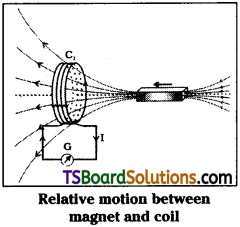
Answer:
Wavelength of light used, 1 = 6000 nm = 600 × 10-9 m
Angular width of a fringe θ = 0.1°
= 0.1 × \(\frac{\pi}{180}=\frac{3.14}{1800}\) rad
Angular width of a fringe is related to slit spacing (d) as:
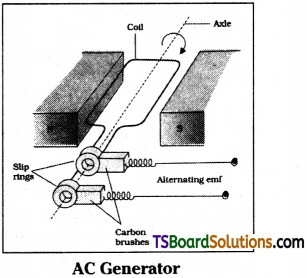
TS Inter 2nd Year Physics Study Material Chapter 3 Wave Optics 26
Therefore, the spacing between the slits is 3.44 × 10⁻⁴ m.

TS Inter 2nd Year Physics Study Material Chapter 3 Wave Optics

Question 7.
In deriving the single slit diffraction pattern, it was stated that the intensity is zero at angles of nλ/a. Justify this by suitably dividing the slit to bring out the cancellation.
Answer:
Consider that a single slit of width d is divided into n smaller slits.
Width of each slit, d’ = \(\frac{d}{n}\)
Angle of diffraction is given by the relation,
TS Inter 2nd Year Physics Study Material Chapter 3 Wave Optics 27
Now, each of these infinitesimally small slit sends zero intensity in direction θ. Hence, the combination of these slits will give zero intensity.

TS Inter 2nd Year Physics Study Material Chapter 2 Ray Optics and Optical Instruments

Telangana TSBIE TS Inter 2nd Year Physics Study Material 2nd Lesson Ray Optics and Optical Instruments Textbook Questions and Answers.

TS Inter 2nd Year Physics Study Material 2nd Lesson Ray Optics and Optical Instruments

Very Short Answer Type Questions

Question 1.
Define focal length and radius of curvature of a concave lens.
Answer:
Focal length (f) :
The distance between centre of lens and principle focus is called “focal length (f)”

Radius of curvature :
The distance between centre of lens to centre of curvature is called “Radius of curvature” (R).

Question 2.
What do you understand by the terms ‘focus’ and ‘principal focus’ in the context of lenses?
Answer:
Principal focus :
When a paraxial beam of light making small angle with principal axis falls on a lens, after refraction the refracted rays will converge at a point or they appear to diverge from a point on principal axis. This point is called “principal focus”.

Focus :
When parallel rays making some angle with principal axis passes through a lens then after refraction they will converge at a point in a plane passing through F and perpendicular to principal axis called focal plane.

This point of convergence or divergence in a focal plane is called focus. If the focus is on principal axis it is called principal focus.

Question 3.
What is optical density and how is it different from mass density?
Answer:
An optically denser medium is one in which velocity of light is less.

An optically rarer medium may have less mass density.
Ex: Mass density of turpentine is less than water but optical density of turpentine is more than water.

Question 4.
What are the laws of reflection through curved mirrors?
Answer:
Laws of reflection :

  1. Angle of reflection is equais to angle of incidence (∠r = ∠i).
  2. The incident ray, the reflected ray and normal to the reflecting surface lie in the same plane.

Question 5.
Define ‘power’ of a convex lens. What is [TS Mar., May 16; AP Mar. ’17, May 16]
Answer:
Power of a lens (P) :
Power of a lens is defined as the tangent of the angle by which it converges or diverges a beam of light falling at unit distance from the optical centre, i.e.
tan δ = \(\frac{h}{f}\), h = 1, δ = \(\frac{h}{f}\)
Power P = \(\frac{1}{f}\) unit: dioptre. Here f is in metre.

TS Inter 2nd Year Physics Study Material Chapter 2 Ray Optics and Optical Instruments

Question 6.
A concave mirror of focal length 10 cm is placed at a distance 35 cm from a wall. How far from the wall should an object be placed so that its real image is formed on the wall? [TS May ’19]
Answer:
Focal length (f) = 10 cm.
Image distance (v) = 35 cm
Position of object (u) = ?
TS Inter 2nd Year Physics Study Material Chapter 2 Ray Optics and Optical Instruments 1

Object distance is from pole of mirror.
From wall the distance of the object
d = 35 – 14 = 21 cm.

Question 7.
A concave mirror produces an image of a long vertical pin, placed 40 cm from the mirror at the position of the object. Find the focal length of the mirror.
Answer:
Given the object and image are at a distance of 40 cm i.e., v = u = 40 cm
In concave mirror when object is at 2f then image is also at 2f ⇒ 2f = 40 cm
∴ Focal length of concave mirror = 20 cm.

Question 8.
A small angled prism of 4° deviates a ray through 2.48°. Find the refractive index of the prism. [AP Mar. 19, 18, June 15]
Answer:
Angle of prism A = 4°.
Angle of deviation, d = 2.48°
Refractive index, n = 1 for small angled prism d = (n – 1) A
∴ 2.48 = (n – 1) 4
⇒ n – 1 = \(\frac{2.48}{4}\) n = \(\frac{2.48}{4}\) + 1 = 0.62 + 1 = 1.62
∴ n = 1.62.

Question 9.
What is ‘dispersion’? Which colour gets relatively more dispersed? [Mar., May ’14]
Answer:
Dispersion :
The phenomenon of splitting of light into its component colours is known as dispersion.

Dispersion takes place due to change in refractive index of medium for different wave lengths.

Bending of violet component of white light is maximum due to its short wavelength.

Question 10.
The focal length of a concave lens is 30 cm. Where should an object be placed so that its image is 1/10 of its size?
Answer:
Here f = – 30 cm, u = ? (For a concave lens)
m = \(\frac{v}{u}=\frac{1}{10}\)
v is – ve because virtual image is formed
TS Inter 2nd Year Physics Study Material Chapter 2 Ray Optics and Optical Instruments 2
∴ u = 9 × 30 = 270 cm

Question 11.
What is myopia? How can it be corrected? [TS May 17, Mar. 17, 15, June 15; AP Mar., June ’15]
Answer:
Hypermyopia :
It is an eye defect. Where light rays coming from distant object are converged at a point infront of retina. This defect is called “short sightendness or Hyper myopia”, This defect can be compensated by using a concave lens.

TS Inter 2nd Year Physics Study Material Chapter 2 Ray Optics and Optical Instruments

Question 12.
What is hypermetropia? How can it be corrected? [AP May 17, Mar.’ 16; TS Mar. 18]
Answer:
Hypermetropia :
It is an eye defect. In this defect, eye lens focuses the incoming light at a point behind the retina. This is called “far sightedness or Hypermetropia”. This defect can be compensated by using a convex lens.

Short Answer Questions

Question 1.
A light ray passes through a prism of angle A in a position of minimum deviation. Obtain an expression for (a) the angle of incidence in terms of the angle of the prism and the angle of minimum devia¬tion (b) the angle of refraction in terms of the refractive index of the prism.
Answer:
a) Let a light ray PQ enters the prism with angle of incidence i and emerges out with an angle ‘e’. When it is at minimum deviation position.
from quadrilateral AQNR
∠A + ∠QNR = 180° …………… (1)
In triangle QNR,
r1 + r2 + ∠QNR = 180° …………… (2)
From equation (1) and (2);
r1 + r2 = A ……………. (3)
TS Inter 2nd Year Physics Study Material Chapter 2 Ray Optics and Optical Instruments 3
Deviation δ = (i1 – r1) + (i2 – r2)
= (i1 + i2) – r1 + r2
At minimum deviation position
i1 = i2 = p and r1 = r2 = r
∴ δ = i1 + i2 – A ⇒ 2i = A + δ
∴ i = \(\frac{A+\delta}{2}\) ……….. (4)

b) From equation (3) r1 + r2 = A.
∴ r1 + r2 = 2r = A ⇒ r = \(\frac{A}{2}\)
TS Inter 2nd Year Physics Study Material Chapter 2 Ray Optics and Optical Instruments 4

Question 2.
Define focal length of a concave mirror. Prove that the radius of curvature of a concave mirror is double its focal length. [AP Mar. ’19, ’17. May ’18, ’16]
Answer:
Focal length (f) :
The distance between principal focus and pole of mirror is called “focal length” (f).
TS Inter 2nd Year Physics Study Material Chapter 2 Ray Optics and Optical Instruments 5

R = 2f proof:
Let ‘C’ be the centre of curvature of a concave mirror, ‘P’ be its pole and F be the principal focus. Line passing through P and F is called principal axis. Consider a ray parallel to principal axis falls on the mirror at ‘M’. After reflection, it passes through principal focus ‘F’. Join CM. It is perpendicular to mirror at M. Let angle of incidence is 0 and MD is the perpendicular at M. From principles of geometry

∠MCP = θ and ∠MFP = 2θ
Now tan θ = \(\frac{MD}{CD}\) = θ ………….. (1)
(∵ when θ is small tan θ = θ)
and tan 2θ = \(\frac{MD}{FD}\) = 2θ ………… (2)
From equation (1) and (2); FD = CD/2 ………….. (3)
But when D is very close to ‘P’
FD = FP & and CD = CP
∴ f = \(\frac{R}{2}\) ⇒ R = 2f
⇒ Radius of curvature R = 2 × focal length.

Question 3.
A mobile phone lies along the principal axis of a concave mirror longitudinally. Explain why the magnification is not uniform.
Answer:
Let a mobile phone is placed along the principal axis of a concave mirror longitudinally then magnification is not uniform.
Explanation :
Let the mobile phone is placed on principal axis as shown.
TS Inter 2nd Year Physics Study Material Chapter 2 Ray Optics and Optical Instruments 6

Let the points 1 and 2 will represent the two ends of mobile phone. For the end 1 object distance is PO1 = u1. For the end ‘2’ object distance is PO2 = u2. Light rays coming from nearer end will form more magnified image I1 and light rays coming from remote point will form less magnified image I2.

Because in mirrors \(\frac{1}{f}=\frac{1}{u}+\frac{1}{v}\)
Since f is same. When u increases v will decrease. So v1 > v2.

But linear magnification m = \(\frac{v}{u}\)
In first case m1 = \(\frac{v_1}{u_1}\) and
in second casern m<2 = \(\frac{v_2}{u_2}\)
Here v1 > v2 and u1 < u2 as a result m1 > m2.
So magnification of mobile phone placed longitudinally is not uniform.

TS Inter 2nd Year Physics Study Material Chapter 2 Ray Optics and Optical Instruments

Question 4.
Explain the Cartesian sign convention for mirrors.
Answer:
Cartesian sign convention :

  1. All distances must be measured from the pole of the mirror (centre of Jens).
  2. The distances measured along the direction of the incident ray are taken as positive and against the direction of incident ray are taken as negative.
  3. Distances (heights) above the principal axis of mirror or lens are taken as positive and below are taken as ve’.

Question 5.
Define critical angle. Explain total internal reflection using a neat diagram. [AP Mar. 15. May 14; TS Mar. ’18. ’15, May 17]
Answer:
Critical Angle :
When the light travels from denser to rarer medium, for which angle of incidence, the angle of refraction is 90° is called critical angle of denser medium.

Explanation :
Consider two transparent media say 1 and 2. Where medium 1 is denser medium and medium 2 is a rarer medium.

Let light rays are starting from point A in denser medium. For angle of incidence i1 they will strike the boundary layer say at ‘O1‘. Draw normal at ‘O1‘ when light rays are travelling from denser medium to they will bend away from normal so angle of refraction (r1) greater than i1.
TS Inter 2nd Year Physics Study Material Chapter 2 Ray Optics and Optical Instruments 7

When angle of incidence is gradually increased then angle of refraction r2 will also increase. For a particular angle of incidence ic angle of refraction r = 90° it is called critical angle.

For angle of incidence i > ic there is no refracted ray in medium two. At this stage light rays are not able to penetrate the boundary layer so they will come back into 1st medium. This is called total internal reflection.

Question 6.
Explain the formation of a mirage. [TS Mar. 19, May 18; AP Mar. 16]
Answer:
Mirage are formed on hot summer days. On a hot summer day earth is heated due to heat radiation from sun. So air near the earth is heated its density will decrease and hot air goes up density. In this process, we will get a special atmosphere where low density air is near earth and its density gradually increases while going up.

Now light rays coming from sun will travel from denser air layers to less dense region (rarer medium). So they will continuously bend away from normal and undergoes total internal reflection.

As a result we will get inverted images of tall objects and an illusion as if there are ponds on high ways even though there is no wet surface. This type of illusion is called mirages.

Question 7.
Explain the formation of a rainbow.
Answer:
Rainbow :
Rainbow is due to dispersion of white light through water drops.

Condition to set Rainbow are 1) Sun should be shining at one side and rain should be at the other side of sky. Formation of rainbow is at least a three step process i.e., refraction – reflection and refraction i.e., light rays entering the water drop should suffer total internal reflection and comes out of the drop through refraction.

Explanation :
Sun lightis first refracted as it enters a rain drop. This causes the different wave lengths of white light to separate. Longer wavelengths (red colour) will bend less and shorter wavelengths (blue and violet colours) will bend more. These component rays will suffer total internal reflection inside the water drop at water – air boundary and again they will travel in water drop and finally they will come out of water drop after refraction.

In this way we will get rainbow on a rainy day when sun is shining at other end.

Question 8.
Why does the setting sun appear red? [AP Mar.’ 14, June ‘ 15; TS Mar.’ 17; May 15]
Answer:
Setting sun appears red due to scattering.

The amount of scattering is inversely proportional to fourth power of the wavelength. i.e, Amount of scattering αλ4. This is called Rayleigh’s formula.

Light of shorter wavelengths will scatter much more than light of longer wavelength. Due to this reason, blue light will scatter more than red light.

Rayleigh formula will hold good when size of the particles << λ. For particles of large size i.e., at water droplets, large dust particles etc., visible light of all wavelengths will scatter equally.

At sun set or at sun rise light rays will pass through a longer distances through atmosphere. In this process light of shorter wavelength is removed and light of longer wave length (Red) will suffer less scattering reaches our eye. As a result at sunrise and of sunset sun will appear red.

Question 9.
With a neat labelled diagram explain the formation of image in a simple microscope. [AP Mar. 18, 16, 15. May ’16. June 15; TS Mar., May 16]
Answer:
A single convex lens is used in a simple microscope. Here object distance is adjusted to be less than focal length of the convex lens used i.e., u < f. By proper adjustment of object distance final virtual image is made to form either at near point or at infinity.
TS Inter 2nd Year Physics Study Material Chapter 2 Ray Optics and Optical Instruments 8
Angular magnification (m) = tan θ0 = \(\frac{h}{d}\)
Where h’ is say height of image and ‘d’ is ‘d’ near point distance.
For maximum clarity eye will form image of parallel rays at near point.

When image is at near point:
Linear magnification m = \(\frac{v}{u}\) = 1 + \(\frac{D}{f}\) because final image is at near point D.

TS Inter 2nd Year Physics Study Material Chapter 2 Ray Optics and Optical Instruments

Question 10.
What is the position of the object for a simple microscope? What is the maximum magnification of a simple micro-scope for a realistic focal length?
Answer:
In simple microscope, object is placed in between centre of lens (C) and its principal focus (f). As a result a magnified virtual image is made to form either at near point or at infinity with suitable object distance ‘u’.

In simple microscope near point magnification m = (1 + D/f) when image is at infinity magnification m = D/f.

Magnification – Limits :
Theoretically, we can achieve very high magnification m’ for simple microscope. But due to practical consideration, we can not increase magnification beyond a limit.
Ex : For a magnification of 5 at for point focal length of convex lens
f = \(\frac{D}{m}=\frac{25}{5}\) = 5 cm
with this focal length thickness of lens is high, so dispersion takes place and chromatic aberration will come into account.

Even with a very careful design of convex lens we can not get a magnification of more than ten with simple microscope. Magnification of m = 5 to 10 is the possible limit.

Long Answer Questions

Question 1.
a) What is the cartesian sign convention? Applying this convention and using a neat diagram, derive an expression for finding the image distance using the mirror equation.
b) An object of 5 cm height is placed at a distance of 15 cm from a concave mirror of radius of curvature 20 cm. Find the size of the image.
Answer:
a) Cartesian sign convention :

  1. All distances must be measured from the pole of the mirror (or) the optical centre of lens.
  2. The distances measured along the direction of the incident ray are taken as positive and against the direction of incident ray are taken as negative.
  3. The distances (heights) measured above the principal axis of mirror or lens are taken as positive and below are taken as ve’.

Mirror equation :
The relation \(\frac{1}{f}=\frac{1}{u}+\frac{1}{v}\) is known as “mirror equation”.

Derivation of equation for image distance :
TS Inter 2nd Year Physics Study Material Chapter 2 Ray Optics and Optical Instruments 9

Let an object is placed infront of a con-cave mirror beyond centre of curvature then a real image is formed between f and c as shown in figure.

As per sign convention all distances must be measured from pole of mirror P.

∴ Focal length f = PF it is against to direction of incident ray so f is – ve.

Image distance from pole of mirror is v = PB’. It is measured against direction of incident ray so image distance v is – ve.

By applying sign convention to mirror equation \(\frac{1}{f}=\frac{1}{u}+\frac{1}{v}\) becomes
TS Inter 2nd Year Physics Study Material Chapter 2 Ray Optics and Optical Instruments 10

b) Height of object (h) = 5 cm;
Object distance (u) = 15 cm
Radius of curvature (R) = 2f = 20 cm ⇒ f = 10 cm
TS Inter 2nd Year Physics Study Material Chapter 2 Ray Optics and Optical Instruments 11

Question 2.
a) Using a neat labelled diagram derive the mirror equation Define linear magnification.
b) An object is placed at 5 cm from a con¬vex is the position and nature of the image?
Answer:
a) Let an object AB is placed in front of a concave mirror beyond radius of curvature C’, The parallel ray comming from object after reflection at mirror (M) will pass through principal focus (F). The ray passing through centre of curvature falls normally on mirror at N. Intersection of these two rays will give position of image A’B’. This is as shown in figure.
TS Inter 2nd Year Physics Study Material Chapter 2 Ray Optics and Optical Instruments 12
In figure Triangle A’B’ P and MPF are similar triangles by comparing ratio of sides
TS Inter 2nd Year Physics Study Material Chapter 2 Ray Optics and Optical Instruments 13

But triangles A ‘ B’ P and BAP are also similar.
TS Inter 2nd Year Physics Study Material Chapter 2 Ray Optics and Optical Instruments 14
In this equation
B’P Image distance B’P = v, FP = Focal length and BP = object distance = u.
∵ These distances measured from pole ‘P’ are against to direction of incident ray v is – ve, f is – ve and u is – ve.
By using these values in equation (3),
TS Inter 2nd Year Physics Study Material Chapter 2 Ray Optics and Optical Instruments 15
This is known as “mirror equation”.

Linear magnification :
The ratio of height of image (h’) to height of object (h) is called “linear magnification”.

Linear magnification, m = \(\frac{h’}{h}=\frac{-v}{u}\).

b) Object distance u = 5 cm; Focal length of convex lens f = 15 cm
Image distance v = ?
TS Inter 2nd Year Physics Study Material Chapter 2 Ray Optics and Optical Instruments 16
– ve sign indicates image is virtual image.
∴ Position of image is 7.5 cm infront of the lens.

3. a) Derive an expression for a thin double convex lens. Can you apply the same to a double concave lens too?
b) An object is placed at a distance of 20 cm from a thin double convex iens of focal length 15 cm, Find the position and magnification of the image.
Answer:
a) Refraction through double convex lens :
Refraction through double convex lens is studied in two steps.
TS Inter 2nd Year Physics Study Material Chapter 2 Ray Optics and Optical Instruments 17

1st step :
Let the first surface will form the image of object ‘O’ at I1 for this case
\(\frac{\mathrm{n}_1}{\mathrm{OB}}+\frac{\mathrm{n}_2}{\mathrm{BI}_1}=\frac{\mathrm{n}_2-\mathrm{n}_1}{\mathrm{BC}_1}\) ………. (1)
In 2nd step the second surface will form image at I where 1st image Ij will act as virtual object for 2nd surface,
∴ \(-\frac{\mathrm{n}_2}{\mathrm{DI_1}}+\frac{\mathrm{n}_1}{\mathrm{DI}}=\frac{\mathrm{n}_2-\mathrm{n}_1}{\mathrm{DC_2}}\) ………. (2)
For thin lens thickness, BD is small
so BI = D1
By adding equaion (1) and (2)
\(\frac{n_1}{OB}+\frac{n_1}{DI}\) = (n2 – n1 [latex]\frac{1}{BC_1}+\frac{1}{DC_2}[/latex] …………… (3)
If point object is at infinity then OB = ∞ and DI = focal length f.

The distance BC1 = + R1 and DC2 = – R2 by using these values in equation (3)
\(\frac{n_1}{f}\) = (n2 – n1) (\(\frac{1}{R_1}-\frac{1}{R_2}\))

Here refraction is from air to glass so n1 = 1 and n2 = n21
∴ \(\frac{1}{f}\) = (n21 – 1) (\(\frac{1}{R_1}-\frac{1}{R_2}\))

This equation is known as lens makers formula.
The above equation is valid even for concave lens. In that case, R1 is – ve and R2 is positive and f is – ve.
So \(\frac{1}{f}\) = (n21 – 1) (\(\frac{1}{R_1}-\frac{1}{R_2}\)) is vaild even for concave lens.

b) Object distance u = 20 cm; focal length f = 15 cm. Image distance v = ?
TS Inter 2nd Year Physics Study Material Chapter 2 Ray Optics and Optical Instruments 18
∴ Image distance v = 60 cm.
Magnification m = \(\frac{v}{u}=-\frac{60}{20}\) = 3

TS Inter 2nd Year Physics Study Material Chapter 2 Ray Optics and Optical Instruments

Question 4.
Obtain an expression for the combined focal length for two thin convex lenses kept in contact and hence obtain an expression for the combined power of the combination of the lenses.
Answer:
Let two thin lenses A, B with focal lengths f1 and f2 are in contact. Let ‘O’ is a point object on the principal axis. The first lens will form the image I1 of the object
TS Inter 2nd Year Physics Study Material Chapter 2 Ray Optics and Optical Instruments 19

This first image I1 will act as an object to second lens and final image I is produced.
∴ \(\frac{1}{v}-\frac{1}{v_1}=\frac{1}{f_2}\) ………….. (2)
by adding equation (1) and (2)
\(\frac{1}{v}-\frac{1}{u}=\frac{1}{f_1}+\frac{1}{f_2}\).
But \(\frac{1}{v}-\frac{1}{u}=\frac{1}{f}\)
Here the lens system is regarded as equivalent to a single lens of focal length ‘f’.
∴ \(\frac{1}{f}=\frac{1}{f_1}+\frac{1}{f_2}\)
If there are n lenses in contact then equivalent focal length is given by
TS Inter 2nd Year Physics Study Material Chapter 2 Ray Optics and Optical Instruments 20

So interms of power,
P = P1 + P2 + P3 + …………. + Pn
Equivalent focal length of lenses in contact is \(\frac{1}{f}=\frac{1}{f_1}+\frac{1}{f_2}+\frac{1}{f_3}+………….+\frac{1}{f_n}\)

Equivalent power of lens combination is
P = P1 + P2 + …………. + Pn.

Question 5.
a) Define Snell’s Law. Using a neat la¬belled diagram derive an expression for the refractive index of the material of an equilateral prism.
b) A ray of light, after passing through a medium, meets the surface separating the medium from air to an angle of 45° and is just not refracted. What is the refractive index of the medium?
Answer:
a) Snell’s Law :
The ratio of sine of angle of incidence to sine of angle of refraction is constant for a given pair of media. i.e., sin i / sin r = n21.
where n21 is refractive index of 2nd medium w.r.to 1st medium.

Derivation of refractive index of prism :
Let ABC is the cross-section of a prism. AB and AC are refracting surfaces. ∠A is angle of prism. Let a light ray PQ falls on AB with angle of incidence i1. After refraction path of light ray QR is parallel to prism base. RS is emergent ray with angle of emergence ‘e’. When PQ and RS are extended they will meet at M. Angle of deviation is δ. They are as show in figure.
TS Inter 2nd Year Physics Study Material Chapter 2 Ray Optics and Optical Instruments 21

In figure, ∠A + ∠QNR = 180° …………. (1)
In triangle QNR,
r1 + r2 + ∠QNR = 180° ………….. (2)
From equation (1) and (2),
r1 + r2 = A ……………. I
Angle of deviation
δ = (i1 – r1) + (e – r2) …………. (3)
Or δ = i1 + e – A …………… (4)
At minimum deviation position i1 = e and r1 = r2
and δ = δm by using these values
r1 + r2 = A
⇒ 2r = A
⇒ r = A/2 ………….. (5)
δ = i1 + e – A = 2i1 – A
TS Inter 2nd Year Physics Study Material Chapter 2 Ray Optics and Optical Instruments 22

b) Angle of incidence, I = 45°
Angle of refraction, r = 90° ⇒ i = ic
Refractive index n21 = \(\frac{1}{\sin C}=\frac{1}{\frac{1}{\sqrt{2}}}=\sqrt{2}\) = 1.414

Question 6.
Draw a neat labelled diagram of a compound microscope and explain its working. Derive an expression for its magnification.
Answer:
A compound microscope consists of two convex lenses mounted coaxially. Lens near the object is called objective. Focal length of objective is less.

Object lens forms a real, magnified image of the object. It will work as an object to eyelens.

Lens near the eye is called eye lens its focal length is high. It will form a magnified virtual final image at near point or at infinity. Final image is inverted w.r.t the original.

Ray diagram is as shown in figure. Dis-tance between objective and eye lens is called tube length ‘L’.
TS Inter 2nd Year Physics Study Material Chapter 2 Ray Optics and Optical Instruments 23

Eye lens will form the final image at infinity or a virtual image at near point.
Near point magnification of eye lens
me = (1 + \(\frac{D}{f_e}\)) …………….. (2)
When final image is at infinity Magnifcation of eye lens me = \(\frac{D}{f_e}\) …………… (3)
Total magnification of compound microscope m = m0 . me.
∴ Total magnification
i) For final image at near point m = \(\frac{L}{f_0}\)(1+\(\frac{D}{f_e}\))
ii) For final image at infinity m = \(\frac{L}{f_0}.\frac{D}{f_e}\)
Magnification of compound microscope is very high.

Solved Problems

Question 1.
A light wave of frequency 4 × 10¹⁴ Hz and a wavelength of 5 × 10⁻⁷m passes through a medium. Estimate the refractive index of the medium.
Answer:
Frequency (u) = 4 × 10⁴ C/S,
Wavelength (λ) = 5 × 10⁻⁷ m, µ = ?
TS Inter 2nd Year Physics Study Material Chapter 2 Ray Optics and Optical Instruments 24

Question 2.
A ray of light is incident at an angle of 60 on the face of a prism of angle 30°. The emergent ray makes an angle of 30° with the incident ray. Calculate the refractive index of the material of the prism.
Answer:
Angle of incidence (i) = 60°;
Angle of prism (A) = 30°
Angle of deviation (d) = 30°
In prism i1 + i2 = A + d
⇒ 60 + i2 = 30 + 30
⇒ i2 = 0 ⇒ r2 = 0
But r1 + r2 = A ⇒ r1 + 0 = 30° or r1 = 30°
TS Inter 2nd Year Physics Study Material Chapter 2 Ray Optics and Optical Instruments 25

Question 3.
Two lenses of power – 1.75D and + 2.25D respectively are placed in contact. Calculate the focal length of the combination.
Answer:
Power of 1st lens (P1) = – 1.75 D;
Power of 2nd lens (P2) = + 2.25 D
When in contact total power
P = P1 + P2 = – 1.75 + 2.25 = 0.5
Focal length of combination
f = \(\frac{100}{P}=\frac{100}{0.5}\) = 200 cm

TS Inter 2nd Year Physics Study Material Chapter 2 Ray Optics and Optical Instruments

Question 4.
Some rays falling on a converging lens are focussed 20 cm from the lens. When a diverging lens is placed in contact with the converging lens, the rays are focussed 30 cm from the combination. What is the focal length of the diverging lens?
Answer:
fc = 20 cm
When combined with diverging lens light rays are focused at 30 cm
⇒ fcomb = 30 cm = F (say)
TS Inter 2nd Year Physics Study Material Chapter 2 Ray Optics and Optical Instruments 26

– ve sign indicates that it is a diverging lens.

Question 5.
A small angled prism of 4° deviates a ray through 2.48°. Find the refractive index of the prism. [June ’15]
Answer:
Angle of prism (A) = 4°.
Angle of deviation (d) = 2.48°
Refractive index, n = 1 for small angled prism
d = (n21 – 1) A
∴ 2.48 = (n21 – 1) 4 ⇒ n21 – 1 = \(\frac{2.48}{4}\)
n21 = \(\frac{2.48}{4}\) + 1 = 0.62 + 1 = 1.62

Question 6.
A double convex lens of focal length 15 cm is used as a magnifying glass in order to produce an erect image which is 3 times magnified. What is the distance between the object and the lens?
Answer:
Focal length (f) = 15 cm;
Magnification (m) = 3 = v/u ⇒ v = 34
TS Inter 2nd Year Physics Study Material Chapter 2 Ray Optics and Optical Instruments 27
TS Inter 2nd Year Physics Study Material Chapter 2 Ray Optics and Optical Instruments 28

Question 7.
A compound microscope consists of an object lens of focal length 2 cm and an eyepiece of focal length 5 cm. When an object is placed at 2.2 cm from the object lens, the final image is at 25 cm from the eye lens. What is the distance between the lenses? What is the total linear magnification?
Answer:
Focal length of object lens (f0) = 2 cm;
Object distance (u) = 2.2 cm
TS Inter 2nd Year Physics Study Material Chapter 2 Ray Optics and Optical Instruments 29

Question 8.
The distance between two point sources of light is 24 cm. Where should you place a converging lens, of focal length 9 cm, so that the images of both sources are formed at the same point?
Answer:
Given distance between sources = 24 cm;
Focal length of convex lens (f) = 9 cm
Both images are formed at same point i.e., image distance V is same. This will happen when one image is real and another is virtual.
TS Inter 2nd Year Physics Study Material Chapter 2 Ray Optics and Optical Instruments 30

Case – I: Real image let object distance
TS Inter 2nd Year Physics Study Material Chapter 2 Ray Optics and Optical Instruments 31

Case – II: Image is virtual then u2 = 24 – x
TS Inter 2nd Year Physics Study Material Chapter 2 Ray Optics and Optical Instruments 32
⇒ x (x – 15) = (24 – x) (x – 9)
⇒ x² – 15x = 24x – 9 × 24 – x² + 9x (or) x² – 15x = – x² + 33x – 24 × 9;
⇒ 2x² – 48x + 24 × 9 = 0
∴ x² – 24x – 108 = 0 (or)
(x – 6) (x – 18) = 0
∴ x = 6 cm or x = 18 cm.

Question 9.
Find two positions of an object, placed in front of a concave mirror of focal length 15 cm, so that the image formed is 3 times the size of the object.
Answer:
Focal length of lens (f) = 15 cm;
Magnification (m) = 3 = \(\frac{v}{u}\) ⇒ v = 3u
TS Inter 2nd Year Physics Study Material Chapter 2 Ray Optics and Optical Instruments 33
or 15 × 4 = 60 = 45 ⇒ u = 20 cm.

Case II: Image may be virtual then v is – ve.
TS Inter 2nd Year Physics Study Material Chapter 2 Ray Optics and Optical Instruments 34
∴ 15 × 2 = 2u ⇒ u = 10 cm
The two positions of object are 10 cm, 20 cm.

Question 10.
When using a concave mirror, the magnification is found to be 4 times as much when the object is 25 cm from the mirror as it is with the object at 40 cm from the mirror, the image being real in each case. What is the focal length of the mirror?
Answer:
From given data, u1 = 40 cm, u2 = 25 cm
TS Inter 2nd Year Physics Study Material Chapter 2 Ray Optics and Optical Instruments 35

u1v1 (u2 + v2) = u2v2 (u1 + v1) ………… (2)
Put v2 = 2.5 v1 in equation (2)
∴ 40 v1 (25 + 2.5 v1) = 25 × 2.5 v1 (40 + v1)
1000 + 100 v1 = 2500 + 62.5 v1
⇒ (100 – 62.5) 1 = 2500 – 1000
⇒ 37.5 1 = 1500 (or)
TS Inter 2nd Year Physics Study Material Chapter 2 Ray Optics and Optical Instruments 36
∴ Focal length of concave mirror f = 20 cm.

Question 11.
The focal length of the objective and eyepiece of a compound microscope are 4 cm and 6 cm respectively. If an object is placed at a distance of 6 cm from the objective, what is the magnification produced by the microscope?
Answer:
Focal length of objective (f0) = 4 cm,
Focal length of eye lens (fe) = 6 cm.
Object distance (u) = 6 cm.
TS Inter 2nd Year Physics Study Material Chapter 2 Ray Optics and Optical Instruments 37
In microscope generally final image is a virtual image at near point. So magnification of eye piece me = (l+D/fe)
Total magnification of microscope

Intext Question And Answer

Question 1.
A small candle, 2.5 cm in size is placed at 27 cm in front of a concave mirror of radius of curvature 36 cm. At what distance from the mirror should a screen be placed in order to obtain a sharp image? Describe the nature and size of the image. If the candle is moved closer to the mirror, how would the screen have to be moved?
Answer:
Size of the candle (h) = 2.5 cm ;
Image size = h’
Object distance (u)= – 27 cm
Radius of curvature of the concave mirror (R) = – 36 cm
Focal length of the concave mirror,
f = \(\frac{R}{2}\) = – 18 cm;
Image distance = v
The image distance can be obtained using the mirror formula : \(\frac{1}{u}+\frac{1}{v}=\frac{1}{f}\)
TS Inter 2nd Year Physics Study Material Chapter 2 Ray Optics and Optical Instruments 38
∴ v = -54 cm

Therefore, the screen should be placed 54 cm away from the mirror to obtain a sharp image.

The magnification of the image is given as:
TS Inter 2nd Year Physics Study Material Chapter 2 Ray Optics and Optical Instruments 39

The height of the candle’s image is 5 cm. The negative sign indicates that the image is inverted and real.

If the candle is moved closer to the mirror, then the screen will have to be moved away from the mirror in order to obtain the image.

TS Inter 2nd Year Physics Study Material Chapter 2 Ray Optics and Optical Instruments

Question 2.
Double-convex lenses are to be manufactured from a glass of refractive index 1.55, with both faces of the same radius of curvature. What is the radius of curvature required if the focal length is to be 20 cm?
Answer:
Refractive index of glass (µ) = 1.55; Focal length of the double-convex lens, (f) = 20 cm Radius of curvature of one face of the lens = R1
Radius of curvature of the other face of the lens = R2
Radius of curvature of the double-convex lens = R
∴ R1 = R and R2 = – R
The value of R can be calculated as:
TS Inter 2nd Year Physics Study Material Chapter 2 Ray Optics and Optical Instruments 40
∴ R = 0.55 × 2 × 20 = 22 cm.
Hence, the radius of curvature of the double-convex lens is 22 cm.

Question 3.
A beam of light converges at a point P. Now a lens is placed in the path of the convergent beam 12 cm from P. At what point does the beam converge if the lens is (a) a convex lens of focal length 20 cm, and (b) a concave lens of focal length 16cm?
Answer:
In the given situation, the object is virtual and the image formed is real.
Object distance (u) = +12 cm
(a) Focal length of the convex lens, (f) = 20 cm Image distance = v
According to the lens formula, we have the relation:
TS Inter 2nd Year Physics Study Material Chapter 2 Ray Optics and Optical Instruments 41
Hence the image is formed 7.5 cm away from the lens, toward its right.

(b) Focal length of the concave lens (f) = -16 cm Image distance = v
According to the lens formula, we have the relation:
TS Inter 2nd Year Physics Study Material Chapter 2 Ray Optics and Optical Instruments 42
Hence, the image is formed 48 cm away from the lens, toward its right.

Question 4.
An object of size 3,0 cm is placed 14 cm in front of a concave lens of focal length 21 cm. Describe the image produced by the lens. What happens if the object is moved further away from the lens?
Answer:
Size of the object (h1) = 3 cm;
Object distance (u) = – 14 cm
Focal length of the concave lens, (f) = – 21 cm;
Image distance = v
According to the lens formula, we have the relation :
TS Inter 2nd Year Physics Study Material Chapter 2 Ray Optics and Optical Instruments 43
Hence, the image is formed on the other side of the lens, 8.4 cm away from it. The negative sign shows that the image is erect and virtual.

The magnification of the image is given as:
TS Inter 2nd Year Physics Study Material Chapter 2 Ray Optics and Optical Instruments 44

Hence, the height of the image is 1.8 cm
If the object is moved further away from the lens, then the virtual image will move toward the focus of the lens, but not beyond it. The size of the image will decrease with the increase in the object distance.

Question 5.
What is the focal length of a convex lens of focal length 30 cm in contact with a concave lens of fqcal length 20 cm? Is the system a converging or a diverging lens? Ignore thickness of the lenses.
Answer:
Focal length of the convex lens (f1) = 30 cm;
Focal length of the concave lens (f2) = – 20 cm
Focal length of the system of lenses = f
The equivalent focal length of a system of two lenses in contact is given as :
TS Inter 2nd Year Physics Study Material Chapter 2 Ray Optics and Optical Instruments 45
Hence, the focal length of the combination of lenses is 60 cm. The negative sign indicates that the system of lenses acts as a diverging lens.

Question 6.
A small telescope has an objective lens of focal length 144 cm and an eyepiece of focal length 6.0 cm. What is the magnifying power of the telescope? What is the separation between the objective and the eyepiece?
Answer:
Focal length of the objective lens (f0) = 144 cm
Focal length of the eyepiece (fe) = 6.0 cm
The magnifying power of the telescope is given as : m = \(\frac{f_0}{f_e}=\frac{144}{6}\) = 24

The separation between the objective lens and the eyepiece is calculated as :
f0 + fe = 144 + 6 = 150 cm
Hence, the magnifying power of the telescope is 24 and the separation between the objective lens and the eyepiece is 150 cm.

TS Inter 2nd Year Physics Study Material Chapter 2 Ray Optics and Optical Instruments

Question 7.
A small pin fixed on a table top is viewed from above from a distance of 50 cm. By what distance would the pin appear to be raised if it is viewed from the same point through a 15 cm thick glass slab held parallel to the table? Refractive index of glass = 1.5. Does the answer depend on the location of the slab?
Answer:
Actual depth of the pin (d) = 15 cm
Apparent depth of the pin = d’
Refractive index of glass, (µ) = 1.5
Ratio of actual depth to the apparent depth is equal to the refractive index of glass, i.e.,
µ = \(\frac{d}{d’}\) ∴ d’ = \({\frac{d}{\mu}}=\frac{15}{1.5}\) = 10 cm.

The distance at which the pin appears to be raised = d’ – d = 15 – 10 = 5 cm.

For a small angle of incidence, this dis¬tance does not depend upon the location of the slab.

Question 8.
The image of a small electric bulb fixec on the wall of a room is to be obtained on the opposite wall 3 in away by means of a large convex lens. What is the maximum possible focal length of the lens required for the purpose?
Answer:
Distance between the object and the image (d) = 3 m
Maximum focal length of the convex lens = fmax
For real images, the maximum focal length is given as:
mmax = \(\frac{d}{4}=\frac{3}{4}\) = 0.75 m
Hence, for the required purpose, the maximum possible focal length of the convex lens is 0.75 m.

Question 9.
A screen is placed 90 cm from an object. The image of the object on the screen is formed by a convex lens at two different locations separated by 20 cm. Determine the focal length of the lens.
Answer:
Distance between the image (screen) and the object (D) = 90 cm
Distance between two locations of the convex lens (d) = 20 cm
Focal length of the lens = f
Focal length is related to d and D as :
TS Inter 2nd Year Physics Study Material Chapter 2 Ray Optics and Optical Instruments 46
Therefore, the focal length of the convex lens is 21.39 cm.

Question 10.
At what angle should a ray of light be incident on the face of a prism of refracting angle 60° so that it just suffers total internal reflection at the other face? The refractive index of the material of the prism is 1.524.
Answer:
The incident, refracted, and emergent rays associated with a glass prism ABC are shown in the given figure.
TS Inter 2nd Year Physics Study Material Chapter 2 Ray Optics and Optical Instruments 47
Angle of prism, ∠A = 60°;
Refractive index of the prism, µ = 1.524
i1 = Incident angle;
r1 = Refracted angle;
r2 = Angle of incidence at the face AC
e = Emergent angle = 90°
According to Snell’s law, for face AC, we can have:
TS Inter 2nd Year Physics Study Material Chapter 2 Ray Optics and Optical Instruments 48

It is clear from the figure that angle
A = r1 + r2
∴ r1 A – r2 = 60 – 41 = 19°
According to Snell’s law, we have the relation:
\(\frac{\sin i_1}{\sin r_1}\)
⇒ sin i1 = µ sin r1 = 1.524 × sin 19° = 0.496
∴ i1 = 29.75°
Hence, the angle of incidence is 29.75°.

Question 11.
You are given prisms made of crown glass and flint glass with a wide variety of angles. Suggest a combination of prisms which will
a) deviate a pencil of white light without much dispersion,
b) disperse (and displace) a pencil of white light without much deviation.
Answer:
a) Place the two prisms beside each other. Make sure that their bases are on the opposite sides of the incident white light, with their faces touching each other. When the white light is incident on the first prism, it will get dispersed. When this dispersed light is incident on the second prism, it will recombine and white light will emerge from the combination of the two prisms.

b) Take the system of the two prisms as suggested in answer (a). Adjust (increase) the angle of the flint-glass-prism so that the deviations due to the combination of the prisms become equal. This combination will disperse the pencil of white light without much deviation.

Question 12.
Does short sightedness (myopia) or long-sightedness (hypermetropia) imply necessarily that the eye has partially lost its ability of accommodation? If not, what might cause these defects of vision?
Answer:
A myopic or hypermetropic person can also possess the normal ability of accommodation of the eye-lens. Myopia occurs when the eye-balls get elongated from front to back. Hypermetropia occurs when the eye-balls get shortened. When the eye-lens loses its ability of accommodation, the defect is called presbyopia.

TS Inter 2nd Year Physics Study Material Chapter 2 Ray Optics and Optical Instruments

Question 13.
A myopic person has been using spectacles of power – 1.0 dioptre for distant vision. During old age he also needs to use separate reading glass of power + 2.0 dioptres. Explain what may have happened.
Answer:
The power of the spectacles used by the myopic person (P) = – 1.0 D
Focal length of the spectacles,
f = \(\frac{1}{P}=\frac{1}{-1 \times 10^{-2}}\) = – 100cm

Hence, the far point of the person is 100 cm. He might have a normal near point of 25 cm. When he uses the spectacles, the objects placed at infinity produce virtual images at 100 cm. He uses the ability of accommodation of the eye-lens to see the objects placed between 100 cm and 25 cm. During old age, the person uses reading glasses of power, P’ = + 2D.

The ability of accommodation is lost in old age. This defect is called presbyopia. As a result, he is unable to see clearly the objects placed at 25 cm.

Question 14.
A person looking at a person wearing a shirt with a pattern comprising vertical and horizontal lines is able to see the vertical lines more distinctly than the horizontal ones. What is this defect due to? How is such a defect of vision corrected?
Answer:
In the given case, the person is able to see vertical lines more distincfly than horizontal lines. This means that the refracting system (cornea and eye-lens) of the eye is not working in the same way in different planes. This defect is called astigmatism. The person’s eye has enough curvature in the vertical plane. However, the curvature in the horizontal plane is insufficient. Hence, sharp images of the vertical lines are formed on the retina, but horizontal lines appear blurred. This defect can be corrected by using cylindrical lenses.

TS Inter 2nd Year Physics Study Material Chapter 2 Ray Optics and Optical Instruments

Question 15.
a) At what distance should the lens be held from the figure in Exercise 2.29 in order to view the squares distinctly with the maximum possible magnifying power?
b) What is the magnification in this case?
c) Is the magnification equal to the magnifying power in this case? Explain.
Answer:
a) The maximum possible magnification is obtained when the image is formed at the near point (d = 25 cm).
Image distance, υ = – d = – 25 cm; Focal length, f= 10 cm; Object distance = u
According to the lens formula, we have:
TS Inter 2nd Year Physics Study Material Chapter 2 Ray Optics and Optical Instruments 49
Hence, to view the squares distinctly, the lens should be kept 7.14 cm away from them.
TS Inter 2nd Year Physics Study Material Chapter 2 Ray Optics and Optical Instruments 50
Since the image is formed at the near point (25 cm), the magnifying power is equal to the magnitude of magnification.

TS Inter 2nd Year Physics Study Material Chapter 1 Waves

Telangana TSBIE TS Inter 2nd Year Physics Study Material 1st Lesson Waves Textbook Questions and Answers.

TS Inter 2nd Year Physics Study Material 1st Lesson Waves

Very Short Answer Type Questions

Question 1.
What does a wave represent?
Answer:
A wave is a disturbance which moves through a medium.

Waves transmit energy without trans-mitting matter. So waves will carry energy from one place to another place.

Question 2.
Distinguish between longitudinal and transverse waves.
Answer:
Longitudinal wave :
If the particles of the medium vibrate parallel to the direction of propagation of the wave then that wave is called “longitudinal wave”.
Ex : Sound waves in air.

These waves can be produced in solids, liquids and gases.

Transverse wave :
If the particles of the medium vibrate perpendicular to the direction of propagation of the wave, then that wave is called “transverse wave”.
Ex : Waves on a stretched string.

These waves can be produced only in solids.

Question 3.
What are the parameters used to describe a progressive harmonic wave?
Answer:
For a progressive wave (y) = a sin (ωt – kx)
The parameters in the above equation
1) a = Amplitude
2) ω = Angular velocity
3) υ = Frequency
4) T = Time period
5) λ = Wavelength
6) v = Velocity (v)
7) Φ = Phase
8) K = Propagation constant.

Question 4.
Obtain an expression for the wave velocity in terms of these parameters.
Answer:
Wave velocity :
It is the distance travelled by the disturbance (energy) along the wave in one second. It is represented by V.
Wave Velocity ‘v’
TS Inter 2nd Year Physics Study Material Chapter 1 Waves 1

Question 5.
Using dimensional analysis obtain an expression for the speed of transverse waves in a stretched string.
Answer:
Speed of transverse wave in a stretched string depends on tension (T) and linear density (µ).
Let v ∝ Ta µb ;
Dimension of velocity (v) = LT-1
Dimension of tension (T) = MLT-2 ;
Linear density (p) = ML-1
∴ v = K Ta µb
Where k is a dimensionless constant.
LT-1 = K (MLT-2)a (ML-1)b
= Ma La T-2a Mb L-b
M°L1T-1 = Ma + b La-b T-2a
Equating the powers of mass, length and time,
a + b = 0, a – b = 1 ⇒ – 2a = – 1
TS Inter 2nd Year Physics Study Material Chapter 1 Waves 2

TS Inter 2nd Year Zoology Study Material Chapter 8 Applied Biology

Question 6.
Using dimensional analysis obtain an ex-pression for the speed of sound waves in a medium.
Answer:
Speed of sound depends on wavelength and time period. v ∝ λa Tb
Dimensions of Velocity (v) = LT-1;
Dimensions of Wavelength (λ) = L;
Dimensions of Time period (T) = T;
L¹T-1 = LaTb
a = 1, b = – 1 ; v = λ¹ T-1
v = \(\frac{\lambda}{\mathrm{T}}\)

Question 7.
What is the principle of superposition of waves?
Answer:
When two waves are pulses overlap at a point the resultant displacement is the al¬gebraic sum of displacements due to each wave. Their resultant is also a wave.
y = (y1+ y2)

Question 8.
Under what conditions will a wave be reflected?
nswer:
Wave well be reflected if it falls on a rigid surface. Because at rigid surface the particles of medium does not vibrate.

If a wave falls on the interface of two different elastic media, than a Part of two different elastic media, than a part of wave is reflected and a part of incident wave will be refracted. During refraction they obey Snell’s Law.

Question 9.
What is the phase difference between the incident and reflected waves when the wave is reflected by a rigid boundary?
Answer:
At rigid boundary phase difference between the incident and reflected wave = 180° (or) (π). Because at rigid boundary a node is formed.

Question 10.
What is a stationary (or) standing wave?
Answer:
When two progressive waves having same wavelength, amplitude and frequency travelling in the medium in opposite directions superposed stationary waves are formed.

TS Inter 2nd Year Zoology Study Material Chapter 8 Applied Biology

Question 11.
What do you understand by the terms ‘node’ and ‘antinode’?
Answer:
Node :
The point where the displacement is minimum (zero) of a wave is called Node.

Antinode :
The point where the displacement is maximum of a wave is called Antinode.

Question 12.
What is the distance between a node and an antinode in a stationary wave?
Answer:
The distance between a node and an antinode = \(\frac{\lambda}{\mathrm{4}}\)

Question 13.
What do you understand by ‘natural frequency’ or ‘normal mode of vibration’?
Answer:
Natural frequency :
Vibrations produced by a body with elastic properties due to application of a constant force are known as natural frequency.
Ex : For a tuning fork natural frequency depends on elastic nature of the material, the mass distribution and the dimensions of the prongs of the fork.

Question 14.
What are harmonics?
Answer:
A harmonic is defined as a ‘tone’ of sound having a frequency which is an integral multiple of the fundamental frequency.

Question 15.
A string is stretched between two rigid supports. What frequencies of vibration are possible in such a string?
Answer:
The fundamental frequency of vibration and their harmonics are possible if a string is stretched between two rigid supports. If T is the natural frequency of vibration of the string, then possible their harmonics are 2f, 3f, 4f so on.

Question 16.
The air column in a long tube, closed at one end, is set in vibration. What harmonics are possible in the vibrating air column?
Answer:
If the fundamental frequency of the air column is denoted by f, then the frequencies at which the second, third, fourth and later modes occur are 3f, 5f, 7f …………… (2n – 1) f. A closed pipe will support only odd Har-monics.

TS Inter 2nd Year Zoology Study Material Chapter 8 Applied Biology

Question 17.
If the air column in a tube, open at both ends, is set in vibration; what harmonics are possible?
Answer:
If the tube is open at both the ends is set in vibration, the frequencies of the harmonics present in an open pipe are integral multiples of fundamental frequency of the air column. Let f is fundamental frequency then possible harmonics are f, 2f, 3f…. etc.

Question 18.
What are ‘beats’?
Answer:
Beats :
When two sounds of nearly equal frequency are superposed, they will create a waxing and warning intensity of sounds. This affect is called “beats”. Beats are produced due to interference of sound waves.
Beat frequency υbeat = υ1 – υ2

Question 19.
Write down an expression for beat frequency and explain the terms therein.
Answer:
Beat frequency (υbeat) = υ1 – υ2
Where υ1 and υ2 are the frequencies is of the two sound waves.

Question 20.
What is ‘Doppler effect’? Give an example.
Answer:
The apparent change in the frequency of source of sound due to relative motion between the source and observer is known as doppler’s effect.
Ex : The whistle of an approaching train appears to have high pitch. When the train is moving away pitch of its whistle decreases.

Question 21.
Write down an expression for the observed frequency when both source and observer are moving relative to each other in the same direction.
Answer:
When source and observer are moving in the same direction equation for observed
(or) apparent frequency υ = υ0 (\(\frac{v+v_{0}}{v+v_{s}}\))

Short Answer Questions

Question 1.
What are transverse waves? Give illustrative examples of such waves.
Answer:
Transverse Waves :
In these waves, the particles of the medium vibrate perpendicular to the direction of propagation of the wave.

These waves can propagate through solids and liquids.

Let a rope or string fixed at one end. At the other end continuous periodic up and down jerks are given by a external agency then transverse waves are produced.
Example:
Vibrations in strings, ripples on water surface and electromagnetic waves.

TS Inter 2nd Year Zoology Study Material Chapter 8 Applied Biology

Question 2.
What are longitudinal waves? Give illustrative examples of such waves.
Answer:
Longitudinal waves :
In these waves particles of the medium vibrate parallel to the direction of propagation of the wave.

  • These waves can propagate through solids and liquids and gases.
  • A longitudinal wave travels in the form of compression and rarefaction.
  • These waves are also known as “Compression waves”.
  • In air sound waves are longitudinal waves.

Example :
Let a long pipe filled with air has a piston at one end. If the piston is pushed and pulled continuously then a series of compressions and rare fractions are produced. It represents a longitudinal wave.

Question 3.
Write an expression for a progressive harmonic wave and explain the various parameters used in the expression.
Answer:
Equation for progressive harmonic wave towards positive x-direction.
TS Inter 2nd Year Physics Study Material Chapter 1 Waves 3
where y = displacement at any given time
A = amplitude of wave;
ω = angular velocity
along negative x-direction
y = Asin(ωt + kx)
General expression for wave motion y = A sin (ωt ± kx)

Question 4.
Explain the modes of vibration of a stretched string with examples.
Answer:
Equation of fundamental frequency :
If the wire of length ‘l’ is stretched between points ‘A’ and ‘B’ with tension T vibrates as a single loop then the frequency of the vibrations is known as fundamental frequency and is denoted by ‘υ’.
TS Inter 2nd Year Physics Study Material Chapter 1 Waves 4

Than length of the wire (l) = \(\frac{\lambda}{\mathrm{2}}\) ⇒ λ = 2l.
But velocity of a wave (v) = υλ ……………. (1)
In case of stretched strings
v = \(\sqrt{\frac{T}{\mu}}\) …………. (2)
where v is the velocity of transverse vibrations in the string.
T = the tension.
µ = the linear density of the string,
υλ = \(\sqrt{\frac{T}{\mu}}\) (or) υ = \(\frac{1}{\lambda}\) \(\sqrt{\frac{T}{\mu}}\) From (1)
When one loop is formed
∴ υ = \(\frac{1}{2l}\)\(\sqrt{\frac{T}{\mu}}\) (∵ λ = 2l)
If the wire vibrates for p loops, then the frequency υp = \(\frac{p}{2l}\)\(\sqrt{\frac{T}{\mu}}\)

Laws of Transverse vibrations in a stretched string:

I. First Law (or) Law of length :
The fundamental frequency of a vibrating string is inversely proportional to the length of the string, when the tension (T) in the string and linear density p are constant.
υ ∝ \(\frac{1}{l}\) ⇒ υl = constant
when T and ‘µ’ are constant.

II. Second law (or) Law of Tension :
The fundamental frequency of a vibrating string is directly proportional to the square root of stretching force T (Tension), when the length of the string and linear density ‘µ’ are constant.
υ ∝ √T ⇒ \(\frac{υ}{\sqrt{T}}\) = constant
when T and ‘µ’ are constant.

III. Third law (or) Law of linear density (or) Law of mass :
The fundamental frequency of a vibrating string is inversely proportional to the square root of the linear density (µ) when the length (l) and tension (T) in the string are constant.
TS Inter 2nd Year Physics Study Material Chapter 1 Waves 5
when ‘l’ and ‘T’ are constant

Examples :
An exciting tuning fork, the plucked wire of a stringed instrument, a bell struck with a hammer, a vibrating air column in a trumpet are some of examples of stretched string.

Question 5.
Explain the modes of vibration of an air column in an open pipe.
Answer:
Harmonics in open pipe: In the fundamental mode of vibration, an antinode is formed at each end with a node formed between them.
If ‘l’ is the vibrating length and λ1 is the corresponding wavelength.
l = \(\frac{\lambda_{1}}{2}\),
The frequency of fundamental mode
(or) 1st harmonic υ1 = \(\frac{v}{\lambda_{1}}\) ∴ υ1 = \(\frac{v}{2l}\)
TS Inter 2nd Year Physics Study Material Chapter 1 Waves 6

Second Harmonic (or) first overtone :
It will have three antinodes and two nodes.
If λ2 is the corresponding wavelength
TS Inter 2nd Year Physics Study Material Chapter 1 Waves 7

Third harmonic (or) Second overtone :
It will have four antinodes and three nodes. If λ3 is the corresponding wavelength,
TS Inter 2nd Year Physics Study Material Chapter 1 Waves 8
In open pipe harmonics are in the ratio of 1 : 2 : 3 …………..

Question 6.
What do you understand by ‘resonance’? How would you use resonance to deter-mine the velocity of sound in air?
Answer:
Resonance :
If the natural frequency of the body coincides with frequency periodic force impressed on it, then the body is said to be at resonance.

At resonance, the body vibrates with increasing amplitude.

Determination of velocity of sound using Resonance :
Consider a closed tube where air column length can be changed.

For the First resonance :
Length of air column is equal to = l1 + e = \(\frac{\lambda}{4}\) → (1)
TS Inter 2nd Year Physics Study Material Chapter 1 Waves 9
where e is endcorrection

For the Second resonance :
Length of air column is equal to = l2 + e = \(\frac{3\lambda}{4}\) → (2)
TS Inter 2nd Year Physics Study Material Chapter 1 Waves 10

Length of the second resonating air column is approximately equal to three times the length of first resonating air column.
(2) – (1)
l2 – l1 = \(\frac{3\lambda}{4}-\frac{\lambda}{4}=\frac{\lambda}{2}\)
⇒ λ = 2(l2 – l1)

Velocity of sound in air
v = υλ
v = 2υ(l2 – l1)
where υ = the frequency of tuning fork, l1, l2 = first and second resonating lengths.

TS Inter 2nd Year Zoology Study Material Chapter 8 Applied Biology

Quetion 7.
What are standing waves? Explain how standing waves may be formed in a stretched string.
Answer:
Stationary waves (or) standing waves :
When a progressive wave and reflected wave superpose with suitable phase a steady wave pattern is set up on the string or in the medium.
A standing wave is represented by y (x, t) = 2a sin kx cos ωt.

Formation of standing waves in stretched strings :
Let a wire of length V and mass’m’ is fixed between two fixed supports with some tension T.
Let the wire is plucked at the mid point then it will vibrate with maximum amplitude. So antinode (A.N) is formed at centre of wire. At the fixed ends molecules of the wire are not free to vibrate. So nodes will be formed at fixed ends as shown in figure.
Now length of wire l = \(\frac{\lambda}{2}\).
If two loops are formed,
TS Inter 2nd Year Physics Study Material Chapter 1 Waves 11

Quetion 8.
Describe a procedure for measuring the velocity of sound in a stretched string.
Answer:
Let a wire of length ‘l’ and mass M is fixed between two rigid supports.
TS Inter 2nd Year Physics Study Material Chapter 1 Waves 12

Practical method :
To measure velocity of sound in stretched strings we will adjust length of wire until stationary waves are formed in the given string by means of the tuning fork in the sonometer expt.. When
length of string (l) is equals to \(\frac{\lambda}{2}\)
l = \(\frac{\lambda}{2}\)
But υ = nλ or υ = n × 2l

Question 9.
Explain, using suitable diagrams, the formation of standing waves in a closed pipe. How may of this can be used to determine the frequency of a source of sound?
Answer:
Stationary waves formed in a closed pipe :
If one end is closed and the other end is open, then it is called a ‘Closed pipe’.

Let a longitudinal wave be sent through a closed pipe. It gets reflected at the closed end. These incident and reflected waves which are of same frequency, travelling in opposite directions gets superposed along the length of the pipe. As a result of it, longitudinal stationary waves are formed. In a closed pipe
υn = \(\frac{(2n+1)υ}{4l}\)
For 1st harmonic, when n = 0, υ1 = \(\frac{υ}{4l}\)
For 2nd harmonic, when n = 1, υ2 = 3\(\frac{υ}{4l}\)
For 3rd harmonic, when n = 2, υ2 = 5\(\frac{υ}{4l}\)
From resonating air column expt. the frequency of sound can be found by using the formula
TS Inter 2nd Year Physics Study Material Chapter 1 Waves 13
TS Inter 2nd Year Physics Study Material Chapter 1 Waves 14

Where l1 ansd l2 1st and 2nd resonating lengths and n is the frequency of the tuning fork.

Question 10.
What are ‘beats’? When do they occur? Explain their use, if any.
Answer:
Beats :
When two sounds of nearly equal frequency are superposed, they will create a waxing and warning intensity of sounds. This effect is called “beats”.
Beats are produced due to interference of sound waves.
Beat frequency υbeat = υ1 – υ2

Uses of Beats:

  1. To know the frequency of an unknown tuning fork.
  2. Harmful gases in a mine can be detected by using beats.

TS Inter 2nd Year Zoology Study Material Chapter 8 Applied Biology

Question 11.
What is ‘Doppler effect’? Give illustrative examples.
Answer:
Doppler effect :
The apparent change in frequency heard by the observer due to the relative motion between source and the observer is called “Doppler’s effect”.

Examples of Doppler effect:

  1. The frequency of sound increases as the source moves closer to the observer. Ex: Pitch of the whistle of an approaching train appears to be increased and that of a train going away decreases.
  2. In astronomy, the Doppler effect was originally studied in the visible part of the electromagnetic spectrum.

Because of the inverse relationship between frequency and wavelength, we can describe the Doppler shift in terms of wavelengths. Radiation is redshifted when its wavelength increases. It indicates that the stars are moving away and universe is expanding.

Long Answer Questions

Question 1.
Explain the formation of stationary waves in stretched strings and hence deduce the equations for first, second and third harmonics and also deduce the laws of transverse waves is stretched strings. [TS Mar. 19; AP & TS May 18, 16]
Answer:
Stationary wave :
When two progressive waves of same wavelength, amplitude and frequency travelling in opposite directions and superimpose over each other stationary waves (or) standing waves are formed.

Formation of stationary wave in a stretched string:
TS Inter 2nd Year Physics Study Material Chapter 1 Waves 15

  • Let us consider a string of length ‘l’ stretched at the two fixed ends ‘A’ and ‘B’.
  • Now pluck the string perpendicular to its length.
  • The transverse wave travel along the length of the string and get reflected at fixed ends.
  • Due to superimposition of these reflected waves, stationary waves are formed in the string.

Equation of Stationary Wave :
Let two transverse progressive waves having same amplitude ‘A’, wavelength λ and frequency ‘n’; travelling in opposite direction along a stretched string be given by
y1 = A sin (kx – ωt) and y2 = A sin (kx + ωt)
where ω = 2πn and k = \(\frac{2 \pi}{\lambda}\)
Applying the principle of superposition of waves, the resultant wave is given by
y = y1 + y2
y = A sin (kx – ωt) + A sin (kx + ωt)
y = 2A sin kx cos ωt

Amplitude of resultant wave (2A sin kx) is no more constant. It depends on the
value of kx. When x = 0, \(\frac{\lambda}{2},\frac{2\lambda}{2}.\frac{3\lambda}{2}\), …………… etc.

The amplitude becomes zero.
These positions of zero amplitude are
known as “Nodes”, when x = \(\frac{\lambda}{4},\frac{3\lambda}{4}.\frac{5\lambda}{4}\), ……………. etc. The amplitude becomes 2A (Maximum).
These positions of maximum amplitude are known as “Antinodes”.

Equation of fundamental frequency :
If the wire of length ‘l’ is stretched between points ‘A’ and ‘B’ with tension T vibrates as a single loop then the frequency of the vibrations is known as fundamental frequency and is denoted by ‘υ’.
l = \(\frac{\lambda}{2}\)
But velocity of a wave v = υλ – (1)
In case of stretched strings v = \(\sqrt{\frac{T}{\mu}}\) – (2)
From (1) and (2)
υ = \(\frac{1}{\lambda}\sqrt{\frac{T}{\mu}}\)
∴ υ = \(\frac{1}{2l}\sqrt{\frac{T}{\mu}}\) (∵ λ= 2l)
If the wire vibrates for ‘p’ loops _P If
The frequency = υp = \(\frac{p{2l}\sqrt{\frac{T}{\mu}}\)

Formation of harmonics in stretched strings :
From above equation if the wire vibrates with one loop then p =1
Frequency of 1st harmonic υ1 = \(\frac{1}{2l}\sqrt{\frac{T}{\mu}}\)
TS Inter 2nd Year Physics Study Material Chapter 1 Waves 16

Laws of Transverse vibrations in a stretched string :
I. First Law (or) Law of length :
The fundamental frequency of a vibrating string is inversely proportional to the length of the string, when the tension (T) and its
linear density µ are constant.
υ ∝ \(\frac{1}{l}\) ⇒ υl = constant ⇒ υ1l1 = υ2l2 (∵ T, µ are constant)

II. Second law (or) Law of Tension :
The fundamental frequency of a vibrating string is directly proportional to the square root of stretching force T (Tension), when the length of the string l and linear density ‘µ’ are constant.
TS Inter 2nd Year Physics Study Material Chapter 1 Waves 17

III. Third law (or) Law of linear density :
The fundamental frequency of a vibrating string is inversely proportional to the square root of the linear density (m) when the length (l) and tension (T) in the string are constant.
TS Inter 2nd Year Physics Study Material Chapter 1 Waves 18

Question 2.
Explain the formation of stationary waves in an air column enclosed in open pipe. Derive the equation for the frequencies of harmonics produced. [(TS May 17, Mar. 16; AP Mar. 18, 17, 16, May 17, 14)]
Answer:
Formation of stationary wave in open pipe :
An open pipe is a cylindrical tube having air inside with both ends open.

Let a longitudinal wave pass through the organ pipe. It gets reflected at the end of the pipe. These incident and reflected waves which are of same frequency, travelling in opposite directions, get superposed along the length of the pipe.

As a result of it, longitudinal stationary waves are formed.

At the open end, the particles of the medium are free to vibrate and the incident and reflected waves will be in phase, so particles have maximum displacement, forming antinode. Thus the air column in- side a open pipe is set into vibration due to stationary waves formed in it with anti- node at each open end.

Harmonics in open pipe :
Fundamental :
In the fundamental mode of vibration, an antinode is formed at each end and a node is formed between them. The note produced is called first harmonic.

If ‘l’ is the vibrating length and λ1 is the corresponding wavelength.
TS Inter 2nd Year Physics Study Material Chapter 1 Waves 19
TS Inter 2nd Year Physics Study Material Chapter 1 Waves 20

Second Harmonic (or) first overtone :
2nd harmonic consists of three antinodes and two nodes.

If λ2 is the corresponding wavelength
TS Inter 2nd Year Physics Study Material Chapter 1 Waves 21

Third harmonic or Second overtone :
3rd harmonic consists of four antinodes and three nodes. If λ3 is the corresponding wavelength,
TS Inter 2nd Year Physics Study Material Chapter 1 Waves 22

The ratio of harmonics in open pipes υ1 : υ2 : υ2 : = 1 : 2 : 3 …………

TS Inter 2nd Year Zoology Study Material Chapter 8 Applied Biology

Question 3.
How are stationary waves formed in closed pipes? Explain the various modes of vibrations and obtain relations for their frequencies. [T.S. Mar. ’19, ’15, May, June ’15; AP Mar. June ’15, May ’17, ’16]
Answer:
A closed pipe is a cylindrical tube having air inside, one end closed and the other is open.

Let a longitudinal wave be sent through a closed pipe. It gets reflected at the closed end of the pipe. These incident and reflected waves, which are of same frequency, trav-elling in opposite directions gets superposed as a result longitudinal stationary waves are formed.

At the closed end reflection is on a rigid surface a node is formed at closed end, at the open end antinode is formed.

I. Harmonics in a closed pipe :
Fundamental mode (or) First Harmonic :
In this one node and one antinode is formed. If ‘l’ is the vibrating length and λ1 is the corresponding wavelength.
TS Inter 2nd Year Physics Study Material Chapter 1 Waves 23

II. First overtone or Third Harmonic :
TS Inter 2nd Year Physics Study Material Chapter 1 Waves 24
1st overtone consists of two nodes and two antinodes. If ‘l’ is the vibrating length and λ3 is the corresponding wavelength,
TS Inter 2nd Year Physics Study Material Chapter 1 Waves 25
as third Harmonic or first overtone.

III. Fifth Harmonic or Second overtone :
2nd overtone consists of three nodes and three antinodes.

If ‘l’ is the vibrating length, λ5 is the corresponding wavelength,
TS Inter 2nd Year Physics Study Material Chapter 1 Waves 26

υ5 is called fifth Harmonic.

The ratio of harmonics in closed pipe is υ1 : υ3 : υ5 : = 1 : 3 : 5 : ………….

From the above, in closed pipe only odd Harmonics are formed.

Question 4.
What are beats? Obtain an expression for the beat frequency. Where and how are beats made use of?
Answer:
When two sounds of nearly (or) slightly equal frequency are superposed they will create a waxing and warning intensity of sounds. This effect is called “beats”.

Beats are produced due to interference of sound waves.

Beat frequency ubeat υbeat = υ1 ~ υ2

Expression for beat frequency:
TS Inter 2nd Year Physics Study Material Chapter 1 Waves 27

Let us consider two sound waves y1 and y2 of nearly equal frequency ‘υ1‘ and ‘υ2‘ each of amplitude a’ superpose each other then the resultant wave is given by
y = y1 + y2 = a sin ω1t + a sin ω2t.
where ω1 = 2πυ1 and ω2 = 2πυ2;
∴ y = a sin 2πυ1t + a sin 2πυ2t
TS Inter 2nd Year Physics Study Material Chapter 1 Waves 28

The frequency of the resultant wave is \(\frac{υ_1+υ_2}{2}\)
The frequency of the amplitude is \(\frac{υ_1-υ_2}{2}\)

The intensity of the sound will be maximum when 2a cos 2π(\(\frac{υ_1-υ_2}{2}\)) is maximum.
TS Inter 2nd Year Physics Study Material Chapter 1 Waves 29

Where k = 0, 1, 2, …………. maximum sound will be heard at interval
0, \(\frac{1}{υ_1-υ_2},\frac{2}{υ_1-υ_2},\frac{3}{υ_1-υ_2}\)
The time interval between two consecutive maxima = \(\frac{1}{υ_1-υ_2}\)
or, Beat frequency = υ1 – υ2
The intensity of sound will be minimum when cos 2π(\(\frac{υ_1-υ_2}{2}\))t is minimum i.e., zero.
The time interval between two consecutive minima = \(\frac{1}{υ_1-υ_2}\)
The number of minima heard per second = υ1 ~ υ2

Importance of Beats: Beats can be used

  1. in tuning musical instruments.
  2. to detect dangerous gases in mines.
  3. to produce special effects in cinematography.
  4. to determine unknown frequency of a tuning fork.
  5. in heterodyne receivers range.

Question 5.
What is Doppler effect? Obtain an expression for the apparent frequency of sound heard when the source is in motion with respect to an observer at rest. [(AP Mar. 16, 14; TS Mar. 18, 17]
Answer:
Doppler effect :
The apparent change in the frequency heard by the observer due to relative motion between the observer and the source of sound is called “Doppler effect”.

Expression for apparent frequency when source is in motion and observer at rest:
Let ‘s’ be a source of sound moving with a velocity vs away from a stationary observer. Let the source produces a sound of frequency υ0 and its time period is T0.
At time t = 0 the source produces a crest.

Let the distance between source and observer is ‘L’ and velocity of sound is ‘v’.
Then time taken by observer to detect crest = t1 = \(\frac{L}{v}\) ……… (1)
The second crest is produced after a time interval T0.

Distance travelled by source during this time = vsT0. So total distance from observer = L + vsT0
Time taken to detect 2nd crest
TS Inter 2nd Year Physics Study Material Chapter 1 Waves 30

Let the source produced (n + 1)th crest at time nT0.
Now time taken to detect that crest =
TS Inter 2nd Year Physics Study Material Chapter 1 Waves 31
TS Inter 2nd Year Physics Study Material Chapter 1 Waves 32

So apparent frequency υ < υ0.
If source is moving towards observer, then vs is -ve (as per sign convension).
∴ apparent frequency υ = υ0 [1 – \(\frac{(-v_s)}{v}\)]
= υ0 [1 + \(\frac{v_s}{v}\)]
When source is approaching the observer frequency heard υ = υ0(\(\frac{v+v_s}{v}\)) OR
υ = υ0 [1 + \(\frac{v_s}{v}\)]. In this case apparent frequency heard υ > υ0.

Question 6.
What is Doppler shift? Obtain an expression for the apparent frequency of sound heard when the observer is in motion with respect to a source at rest. [AP June ’15]
Answer:
Doppler shift :
The difference between apparent frequency heard by observer and actual frequency produced by the source is called as “Doppler’s shift”.

Derivation of apparent frequency when source at rest and observer in motion :
Let s’ is a source at rest produces a sound of constant frequency ‘υ0‘ Let Time Period of wave is ‘T0‘. Let an observer is moving away from source with a velocity ‘v0‘.

Carries a device that can count the num-ber of crests / compressions produced by source.

At time t = 0 source produces a crest. Let the distance between source and observer is L’ and velocity of sound is ‘v’.
TS Inter 2nd Year Physics Study Material Chapter 1 Waves 33
Now time taken by the observer to detect the crest t1 = \(\frac{L}{v}\) → 1

2nd crest is produced after a time period T0.
During this time observer moves a distance v0T0
time taken by observer to detect t2 = T0 + (\(\frac{L+T_{0}v_{0}}{v}\)) → 2
Let source produces (n + 1) th crest after a time nT0
Time taken to detect this crest
TS Inter 2nd Year Physics Study Material Chapter 1 Waves 34

TS Inter 2nd Year Physics Study Material Chapter 1 Waves 35

TS Inter 2nd Year Physics Study Material Chapter 1 Waves 36

Solved Problems

Question 1.
A stretched wire of length 0.6 m is observed to vibrate with a frequency of 30 Hz in the fundamental mode. If the string has a linear mass of 0.05 kg/m find (a) the velocity of propagation of transverse waves in the string (b) the tension in the string. [AP May 18; TS May 16]
Answer:
Vibrating length (l) = 0.6 m
For fundamental mode l = \(\frac{\lambda}{2}\)
⇒ λ = 2l = 2 × 0.6 ⇒ λ = 1.2 m
Fundamental frequency n = 30 Hz
a) Velocity of transverse wave v = nλ ;
v = 30 × 1.2 ⇒ v = 36 ms-1

b) Linear density of the string
µ = 0.05 kg m-1
But, v = \(\sqrt{\frac{T}{\mu}}\) (T is the tension)
T = v²µ = 36 × 36 × 0.05 = 64.8 N.

TS Inter 2nd Year Zoology Study Material Chapter 8 Applied Biology

Question 2.
A steel cable of diameter 3 cm is kept under a tension of 10 kN. The density of steel is 7.8g/cm³. With what speed would transverse waves propagate along the cable?
Answer:
The density of steel is
ρ = 7.8 gm cm-3 ⇒ 7.8 × 10³ kgm-3
Diameter of cable D = 3 cm
⇒ r = 1.5 × 10⁻² m
Tension (T) = 10 × 10³ N.
TS Inter 2nd Year Physics Study Material Chapter 1 Waves 37

Question 3.
Two progressive transverse waves given by y1 = 0.07 sin π (12x – 500t) and y2 = 0.07 sin π (12x + 500t) travelling along a stretched string form nodes and antinodes. What is the displacement at the (a) nodes (b) antinodes? (c) What is the wavelength of the standing wave?
Answer:
Equation of progressive wave is
y1 = 0.07 sin (12πx – 500 πt) ;
y2 = 0.07 sin (12πx + 500 πt)
a) Displacement at node = 0
b) Displacement at Antinode = 2A = 2 × 0.07 = 0.14 m.
c) Propagation constant k = 12π
TS Inter 2nd Year Physics Study Material Chapter 1 Waves 38

Question 4.
A string has a length of 0.4 m and a mass of 0.16 g. If the tension in the string is 70 N, what are the three lowest frequencies it produces when plucked?
Answer:
Length of string (l) = 0.4 m
Mass of the string (m) = 0.16 × 10⁻³kg ;
Linear density (µ) = \(\frac{0.16}{0.4}\) = 4 × 10⁻⁴ kg m-1
Tension (T) = 70 N.
Fundamental frequency υ1 = \(\frac{1}{2l}\sqrt{\frac{T}{\mu}}\) ;
TS Inter 2nd Year Physics Study Material Chapter 1 Waves 39
Next frequency is υ2 = 2υ1
= 2 × 523 = 1046 Hz

Next frequency is υ3 = 3υ1
= 3 × 523 = 1569 Hz

Question 5.
A metal bar when clamped at its centre, resonates in its fundamental frequency with longitudinal waves of frequency 4 kHz. If the clamp is moved to one end, what will be its fundamental resonance frequency?
Answer:
Fundamental frequency (υ) = 4 × 10³ Hz
a) If metal bar is clamped at its centre
TS Inter 2nd Year Physics Study Material Chapter 1 Waves 40

b) If metal is clamped at one end
TS Inter 2nd Year Physics Study Material Chapter 1 Waves 41

Question 6.
A closed organ pipe 70 cm long is sounded. If the velocity of sound is 331 m/s, what is the fundamental frequency of vibration of the air column? [TS Mar. ’19; AP Mar. 18, I 7, May 1 7, 14]
Answer:
Length of closed organ pipe l = 70 cm
Velocity of sound (v) = 331 ms-1
Fundamental frequency of closed pipe
TS Inter 2nd Year Physics Study Material Chapter 1 Waves 42

Question 7.
A vertical tube is made to stand in water so that the water level can be adjusted. Sound waves of frequency 320 Hz are sent into the top the tube. If standing waves are produced at two successive water lev-els of 20 cm and 73 cm, what is the speed of sound waves in the air in the tube?
Answer:
Frequency of sound wave (n) = 320 Hz
1st resonating length l1 = 20 cm
2nd resonating length l2 = 73 m
Speed of sound wave (v) = 2n (l2 – l1)
= 2 × 320 (73 – 20)
∴ v = 640 × 53 × 10-2
= 33920 cm s-1 = 339 ms-1

Question 8.
Two organ pipes of lengths 65 cm and 70 cm respectively, are sounded simultaneously. How many beats per second will be produced between the fundamental frequencies of the two pipes? (Velocity of sound = 330 m/s).
Answer:
First open organ pipe of length (l1) = 65 cm
Second open organ pipe of length (l2) = 70 cm
TS Inter 2nd Year Physics Study Material Chapter 1 Waves 43

Question 9.
A train sounds its whistle as it approaches and crosses a level-crossing. An observer at the crossing measures a frequency of 219 Hz as the train approaches and a frequency of 184 Hz as it leaves. If the speed of sound is taken to be 340 m/s, in the speed of the train and the frequency of its whistle.
Answer:
a) Speed of sound (v) = 340 ms-1 ;
Apparent frequency heard by observer when train approaches υ’ = 219 Hz
TS Inter 2nd Year Physics Study Material Chapter 1 Waves 44
When train leaves the observer ap-parent frequency n” = 184 Hz
TS Inter 2nd Year Physics Study Material Chapter 1 Waves 45

Question 10.
Two trucks heading in opposite directions with speeds of 60 kmph and 70 kmph respectively, approach each other. The ckiver of the first truck sounds his horn of frequency 400 Hz. What frequency does the driver of the second truck hear? (Velocity of sound = 330 m/s). After the two trucks have passed each other, what frequency does of the second truck hear?
Answer:
Speed of first truck = 60 × \(\frac{5}{18}\) = vs
Speed of second truck = 70 × \(\frac{5}{18}\) = v0
Frequency of first truck n = 400 Hz ;
Velocity of sound = 330 ms-1

a) When they approach each other, frequency heard by second truck driver is
TS Inter 2nd Year Physics Study Material Chapter 1 Waves 46
∴ Apparent frequency (n’) = 600 Hz b)

b) When they move away from each other, the frequency heard by second truck driver
TS Inter 2nd Year Physics Study Material Chapter 1 Waves 47
∴ Apparent frequency υ” = 270 Hz

TS Inter 2nd Year Zoology Study Material Chapter 8 Applied Biology

Question 11.
A rocket is moving at a speed of 200 ms-1 towards a stationary target. While moving, it emits a wave of frequency 1000 Hz. Calculate the frequency of the sound as detected by the target. (Velocity of sound in air is 330 ms-1) [AP Mar. ’16]
Answer:
Velocity of source (Rocket) (Vs) = 200 m/s
Velocity of sound (V) = 330 m/s.
Frequency of sound emitted (υ0) = 1000 Hz
TS Inter 2nd Year Physics Study Material Chapter 1 Waves 48
Frequency of sound heard by observer υ = 2540 Hz.

Question 12.
A open organ pipe 85 cm long is sounded. If the velocity of sound is 340 m/s, what is the fundamental frequency of vibration of the air column? [TS Mar. ’16]
Answer:
Length of pipe (l) = 85 cm,
Velocity of sound (V) = 340 m/s.
Fundamental frequency of open pipe = n
= \(\frac{V}{2l}\)
n = \(\frac{340 \times 100}{2 \times 85}\) = 200Hz
∴ Fundamental frequency (n) = 200 Hz.

Question 13.
A pipe 30 cm long is open at both ends. Find the fundamental frequency. Velocity of sound in air is 330 ms-1.
Answer:
Length of open pipe (l) = 30 cm;
Velocity of sound (V) = 330 ms-1
At fundamental frequency λ = 2l.
⇒ λ = 30 × 2 = 60 cm = 0.6 m
Fundamental frequency
v = \(\frac{V}{\lambda}=\frac{330}{0.6}\) = 550 Hz.

Question 14.
If the fundamental frequency in a closed pipe is 300Hz, find the value of third har¬monic in it. [TS June ’15]
Answer:
Fundamental frequencies (v1) = 300Hz
Frequencies of 3rd Harmonic (v3) = 3v1
= 300 × 3 = 900Hz
Note: In closed pipes, the harmonics are in the ratio 1:3:5 even harmonic does not exist.

Intext Question and Answer

Question 1.
A string of mass 2.50 kg is under a tension of 200 N. Then length of the stretched string is 20.0 m. If the transverse jerk is caused at one end of the string, how long does the disturbance take to reach the other end?
Answer:
Mass of the string, (M) = 2.5 kg
Tension in the string, (T) = 200 N
Length of the string (l) = 20 m
Linear density (µ) = mass per unit length = \(\frac{M}{l}=\frac{2.5}{20}\) = 0.125 kgm-1
Velocity of transverse wave in the string is
TS Inter 2nd Year Physics Study Material Chapter 1 Waves 49
∴ Time taken by the disturbance to reach the other end, t = \(\frac{l}{v}=\frac{20}{40}\) = 0.5 s.

Question 2.
A stone dropped from the top of a tower of height 300 m splashes into the a pond of water near the base of the tower. When is the splash heard at the top given that the speed of sound in air is 340 ms-1? (g = 9.8 ms-2)
Answer:
Height of the tower (n) = 300 m
Initial velocity (u) = 0
Acceleration due to gravity, g = 9.8 m/s²
Speed of sound = 340 ms-1
The time (t1) taken by the stone to strike the water in the pond can be calculated using
TS Inter 2nd Year Physics Study Material Chapter 1 Waves 50

Time taken (t2) by the sound to reach the top of the tower, t2 = \(\frac{h}{u}=\frac{300}{340}\) = 0.88 s
∴ Total time after the splash is heard,
t = t1 + t2 = 7.82 + 0.88 = 8.7 s.

TS Inter 2nd Year Zoology Study Material Chapter 8 Applied Biology

Question 3.
A steel wire has a length of 12 in and a mass of 2.1 kg. What should be the tension in the wire so that speed of a transverse wave on the wire equals the speed of sound in dry air at 20°C = 343 ms-1.
Answer:
Length of the wire (l) = 12 m ;
Mass of the wire (M) = 2.1 kg
Linear density (µ) = mass per unit length
= \(\frac{M}{l}=\frac{2.1kg}{12m}\) = 0.175 kgm-1
We know that velocity of a transverse wave in a stretched string is given by
v = \(\sqrt{\frac{T}{\mu}}\) ⇒ v²µ = (343)² × 0.175
= 20588 × 575 N ≅ 2.06 × 10⁴ N.

Question 4.
A bat emits ultrasonic sound of frequency 1000 kHz in air. If the sound meets a water surface, what is the wavelength of (a) the reflected sound, (b) the transmitted sound? Speed of sound in air is 340 ms-1 and in water 1486 ms-1.
Answer
a) Frequency of ultrasonic sound,
n = 1000 kHz = 106 Hz
Speed of sound (va) = 340 ms-1
The wavelength (λr) of the reflected sound is given by
λr = \(\frac{υ_{a}}{n}=\frac{340}{10^{6}}\) = 3.4 × 10⁻⁴ m

b) Frequency of the ultrasonic sound,
n = 1000 kHz = 106 Hz
Speed of sound in water, υw = 1486 ms-1.
The wavelength (λr) of the reflected sound is given by
λr = \(\frac{υ_{w}}{n}=\frac{1486}{10^{6}}\) = 1.49 × 10⁻³ m

Question 5.
A hospital uses an ultrasonic scanner to locate tumours in a tissue. What is the wavelength of sound is 1.7 kms-1? The operating frequency of the scanner is 4.2 MHz.
Answer:
Speed of sound in the tissue,
v = 1.7 km s-1 = 1.7 × 10³ ms-1
Operating frequency of the scanner,
n = 4.2 MHz = 4.2 × 10⁶ Hz
The wavelength of sound in the tissue is
λ = \(\frac{\mathrm{v}}{\mathrm{n}}=\frac{1.7 \times 10^3}{4.2 \times 10^6}\) = 4.1 × 10⁻⁴ m

Question 6.
A wire stretched between two rigid supports vibrates in its fundamental mode with a frequency of 45 Hz. The mass of the wire is 3.5 × 10⁻² kg and its linear mass density is 4.0 × 10⁻² kg m-1. What is (a) the speed of a transverse wave on the string, and (b) the tension in the string?
Answer:
a) Mass of the wire, M = 3.5 × 10⁻² kg m-1
TS Inter 2nd Year Physics Study Material Chapter 1 Waves 51

The wavelength (λ) of the stationary wave is related to the length of the wire by the relation
λ = \(\frac{2l}{n}\)
where n → no. of nodes in the wire
For fundamental node, n = 1
λ = 2l = 2 × 0.875 = 1650 m.
The speed of the transverse wave is given by
v = nλ = 4.5 × 1.75
= 78.75 ms-1

b) The tension produced in the string is given by the formula
T = v²m = (78.75)² × 4 × 10-2
= 248.06 N.

Question 7.
A steel rod 100 cm long is clamped at its middle. The fundamental frequency of longitudinal vibrations of the rod is given to be 2.53 kHz. What is the speed of sound in steel?
Answer:
Length of the steel rod, l = 100 cm = 1 m.
Fundamental frequency of vibration,
n = 2.53 kHz = 2.53 × 10³ Hz
TS Inter 2nd Year Physics Study Material Chapter 1 Waves 52
When the rod is plucked at its middle, an antinode is formed at its centre and nodes (N) are formed at its two ends as shown in the given figure.
The distance between two successive nodes is \(\frac{\lambda}{2}\).
∴ l = \(\frac{\lambda}{2}\)
⇒ λ = 2l = 2 × l = 2m
The speed of sound in steel is given by the relation:
v = nλ= 2.53 × 10³ × 2
= 5.06 × 10³ ms-1
= 5.06 kms-1

TS Inter 2nd Year Zoology Study Material Chapter 8 Applied Biology

Question 8.
A train, standing at the outer signal of a railway station blows a whistle of freq-uency 400 Hz in still air.
i) What is the frequency of the whistle for a platform observer when the train
a) approaches the platform with a speed of 10 ms-1,
b) recedes from the platform with a speed of 10 ms-1?
ii) What is the speed of sound in each case? The speed of sound in still air can be taken as 340 ms-1.
Answer:
i) a) Frequency of the whistle (n) = 400 Hz
Speed of the train (vt) = 10 ms-1
Speed of sound (v) = 340 ms-1
The apparent frequency (n’) of the whistle as the train approaches the platform is given by the relation
TS Inter 2nd Year Physics Study Material Chapter 1 Waves 53

b) The apparent frequency (n’) of the whistle as the train recedes from the platform is given by the relation :
TS Inter 2nd Year Physics Study Material Chapter 1 Waves 54

ii) The apparent change in frequency of sound is caused by the relative motions of the source and the observer. These relative motions produce no effect on the speed of sound. Therefore, the speed of sound in air in both the cases remains the same i.e., 340 ms-1.

TS Inter 2nd Year Zoology Study Material Chapter 8 Applied Biology

Telangana TSBIE TS Inter 2nd Year Zoology Study Material 8th Lesson Applied Biology Textbook Questions and Answers.

TS Inter 2nd Year Zoology Study Material 8th Lesson Applied Biology

Very Short Answer Type Questions

Question 1.
What factors constitute dairying?
Answer:
Breeding, feeding and management of milch animals, production, processing and marketing of their milk and milk products on economic basis constitute dairying.

Question 2.
Mention any two advantages of inbreeding.
Answer:
Two advantages of inbreeding :

  1. Inbreeding increases homozygosity.
  2. It helps in the accumulation of superior genes and elimination of less desirable genes.

Question 3.
Distinguish betwen out-cross and cross-breed.
Answer:
Outcrossing is the crossing of unrelated pure breeding animals of different traits with in the same breed whereas cross-breeding is the mating of animals of different breeds.

Question 4.
Define the terms layer and broiler. [Mar. ’17,’15 (A.P.)]
Answer:

  1. The birds which are raised exclusively for the production of eggs are called Layers.
  2. The birds which are raised only for their meat are called Broilers.

Question 5.
What is apiculture? [Mar. ’20, 17, May 17 (A.P); Mar. ’15 (T.S); Mar. ’14]
Answer:
Apiculture or Beekeeping is the maintenance of hives of honey bees for the production of honey and wax. Beekeeping is an age old cottage industry.

TS Inter 2nd Year Zoology Study Material Chapter 8 Applied Biology

Question 6.
Distinguish between a drone and worker in a honey bee colony.
Answer:

  1. Drones are robust, large winged small numbered, short lived and fed with bee bread by nurse workers. They are developed from unfertilized ova by arrhenotoky (male parthenogenesis).
  2. Worker bees are multifaceted sterile females which develop from the fertilised eggs and peform diverse functions. They live for two or three months. They are very small in size.

Question 7.
Define the term Fishery.
Answer:
Exploitation of fish and other related aquatic organisms is called Fishery.

Question 8.
Differentiate aquaculture and pisciculture.
Answer:

  1. Aquaculture or culture fishery involves rearing and management of selected aquatic organisms under regulated conditions and their subsequent harvesting after the stipulated time.
  2. The term PISCICULTURE is used when the organisms cultured and exclusively fin fishes.

Question 9.
Explain the term hypophysation. [March 2015 (T.S.)]
Answer:
Hypophysation or induced breeding is followed in artificial breeding. Pituitary extracts containing FSH and LH or ovaprim are injected into brood fish to induce release of spawn for seed production.

Question 10.
List out any two Indian carps and two exotic carps. [March 2018 (A.P.); May / June 2014]
Answer:

  1. Two Indian carps are catla Catla (catla) and Cirrhinus mrigala (mrigai).
  2. Two exotic carps are Cyprinus carpio (Chinese carp), Tilapia (grass carp).

TS Inter 2nd Year Zoology Study Material Chapter 8 Applied Biology

Question 11.
Mention any four fish by-products. [March 2019]
Answer:
Four fish by products are

  1. Shark and cod liver oils containing vit A and vit D.
  2. Oil from Sardine and Salmon – good source of omega – 3 fatty acids.
    (prevent cancer cel! growth, lowers blood cholesterol)
  3. Fish guano – Fertiliser prepared from scrap fish.
  4. Shagreen.

Question 12.
How many amino acids and polypeptide chains are present in insulin? [March 2019]
Answer:
Human insulin is made up of 51 aminoacids arranged in two polypeptide chains chain A (21 amino adds) and chian B (30 – amino acids).

Question 13.
Define the term ’vaccine’.
Answer:
The term vaccine was coined by Edward Jenner. A vaccine is a biological preparation that improves immunity to a particular disease.

Question 14.
Mention any two features of PCR.
Answer:

  1. Polymerase Chain Reaction (PCR) is a powerful technique to identify many other genetic disorders such as haemophilia, phenylketonuria etc.
  2. PCR helps to detect very Sow amounts of DNA by amplification of the small DNA fragment.

Question 15.
What does ADA stand for? Deficiency of ADA causes which disease?
Answer:
ADA stands for Adenosine De Aminase. ADA deficiency causes severe combined immune deficiency (SCID). It is caused by the deletion or dysfunction of the gene encoding for the enzyme ADA.

Question 16.
Define the term transgenic animal.
Answer:
Animals that have their own geneome and had their DNA manipulated to possess and express an extra gene are known as transgenic animals.

Question 17.
What is popularly called ‘Guardian Angel of Cell’s Genome’? [March 2020]
Answer:
The protein p53 plays an important role with reference to the G1 check point in the regulation of cell division cycle. It guards the integrity of the DNA. Hence it is often called the Guardian Angel of Cell’s Genome.

TS Inter 2nd Year Zoology Study Material Chapter 8 Applied Biology

Question 18.
List out any four features of cancer cells. [May 2007 (A.P.)]
Answer:
Characters of cancer cells :

  1. These cells are characterised by indefinite growth.
  2. These cells are with out contact inhibition.
  3. These cells are characterised by evading apoptosis (no death).
  4. These cells a typical of parent autonomons and aggressive.

Question 19.
How do we obtain radiographs?
Answer:
A beam of X-rays is produced by an X-ray generator and is projected on the body parts. X-rays that pass through the body parts are recorded on a photographic film or observed on a fluorescent screen. Photographs developed using X-rays are known as radiographs or skiagraphs.

Question 20.
What is tomogram?
Answer:
The X-ray detector of the CT-scanner can see hundreds of different levels of density and tissues in a solid organ. The data is transmitted to a computer which builds up 3-D cross sectional picture of the part of the body and displays the picture on the screen. This recorded image is called tomogram.

Question 21.
MRI scan in harmless-justify. [March 2018 (A.P.); May/June 2014]
Answer:
MRI (Magnetic Resonance Imaging) scan is harmless because MRI does not use ionizing radiation as involved in X-rays and is generally a very safe procedure.

Question 22.
What is electrocardiography and what are the normal components of ECG? [March 2015 (A.P.)]
Answer:
Electrocardiography (ECG) is a commonly used, non invasive procedure for recording electrical changes in the heart.
A normal ECG consists 1) Waves 2) Intervals 3) Segments and 4) Complexes.

Question 23.
What does prolonged P-R interval indicate?
Answer:
Prolonged P-R interval indicates delay in conduction of impulses from S-A node to the A-V node. P-R interval is prolonged in bradycardia (slow beating of heart) and shortened in tachycardia (fast beating of heart).

Question 24.
Differentiate between primary and secondary antibodies.
Answer:

  1. Primary antibodies react with the antigens of interest.
  2. Secondary antibodies react with primary antibodies.

TS Inter 2nd Year Zoology Study Material Chapter 8 Applied Biology

Question 25.
Which substances in a sample are detected by direct and indirect ELISA respectively? [March 2014]
Answer:
Direct ELISA – ELISA used to detect antigens.
Indirect ELISA – ELISA done to detect antibodies.

Short Answer type Questions

Question 1.
What are the various methods employed in animal breeding to improve livestock?
Answer:
Methods of animal breeding : There are broadly two methods of breeding :

  1. INBREEDING
  2. OUTBREEDING.

1) Inbreeding :
When crossing is done between animals of the same breed it is called inbreeding. It refers to mating of more closely related individuals within the same breed of individuals in a lineage. The breeding strategy is the identification and mating of superior males and superior females of the same breed.

Inbreeding is of two types :
1) Close breeding,
2) Line breeding.,
Close breeding is mating between male parent (sire) and female offspring and / or female (dam) with male offspring. Line breeding (cousin mating) is the selective breeding of animals for a desired feature by mating them within a closely related line (but not as close as close breeding). It leads to upgrading (to improve the quality of livestock by selective breeding for desired characteristics) of a desired commerical character.

2) Outbreeding :
Out-breeding is the breeding of the unrelated animals; it is the cross between different breeds. Out-breeding is of three types

  1. Out-crossing
  2. Cross-breeding
  3. Interspecific hybridisation.

1. Out-crossing :
It is the practice of mating of animals within the same breed, but having no common ancestors on either side of the pedigree for 4-6 generations. The offspring of such a mating is known as an out-cross. It is the best breeding method for animals that are below average in milk production, growth rate (in beef cattle) etc. At times a single out-cross often helps to overcome inbreeding depression.

2. Cross-breeding :
In this method, superior males of one breed are mated with superior females of another breed. The offspring of such a mating is said to be a cross-breed. Cross-breeding allows the desirable qualities of two different breeds to be combined. The progeny (cross breeds) are not only used for commercial production but also inbreeding and selection to develop stable breeds which may be superior to existing breeds.

3. Interspecific hybridisation :
In this method, male and female animals of two different related species are mated. The progeny may combine desirable features of both the parents and is different from both the parents. For example when a male donkey (jack / ass) is crossed with a female horse (mare), it leads to the production of a mule.

Question 2.
Define the term ‘breed’. What are the objectives of animal breeding?
Answer:
Animal Breeding :
Animal breeding is an important aspect of animal husbandry which aims at increasing the yield of animals and improving the desirable qualities of the produce. A breed is a group of animals related by descent and similar in most characters like appearance, features, size, configuration, etc. The following are the desirable qualities for which we breed animals :

  1. Disease resistance,
  2. Increase in the quality and quantity of milk, meat, wool, etc.
  3. Fast growth rate,
  4. Enhanced productive life by improving the genetic merit of livestock,
  5. Early maturity and
  6. Economy of feed.

TS Inter 2nd Year Zoology Study Material Chapter 8 Applied Biology

Question 3.
Explain the role of animal husbandry in human welfare.
Answer:
Animal Husbandry :
The strategies adopted for enhancing food production are bound to play a major role in meeting the requirement of food for the ever increasing world’s population in the near future. The biological principles that are applied to animal husbandry will become crucial in our efforts to increase the food production.

Animal husbandry is the agricultural practice of breeding and raising livestock (all domesticated animals reared for the benefit of man). It includes buffaloes, cows, pigs, horses, cattle, sheep, camels, goats etc. However the term livestock is often used for farm animals. If extended, it also includes poultry farming and fisheries.

Even though the estimated world’s livestock population in India and China together is more than 70%, their contribution to world’s farm produce is only 25%, i.e., the productivity per unit is very low. The average annual milk yield is about 170 liters per cow in India. Contrary to it, the average annual milk yield is about 4,100 liters per cow in Netherlands.

Because of its low productivity the Indian cow is known as ‘teacup cow’. So, newer technologies have to be applied to achieve improvement in quality and productivity. Modern methods of breeding, MOET (multiple ovulation and embryo transfer) and production of transgenic animals must be taken up on a large scale in addition to conventional practices and care.

Question 4.
List out the various steps involved in MOET.
Answer:
Multiple Ovulation and Embryo Transfer (MOET) :
The following are the steps invovled in MOET.

  1. A cow is administered hormones, with FSH-like activity.
  2. This induces follicular maturation and super ovulation (In super ovulation- instead of one egg, which they normally produce per cycle, they produce 6-8 eggs).
  3. The animal (cow) is either mated with an elite buli or artificially inseminated.
  4. The embroys are at 8-32 celled stages are recovered non-surgically and transferred to surrogate mother (an animal that develops the offspring of another animal in its womb).

Now the genetic mother is ready for another round of super ovulation.

Question 5.
Write short notes on controlled breeding experiments.
Answer:
Controlled Breeding Experiments :
They are carried out using artificial insemination and multiple ovulation and embryo transfer technology (MOET).

Artificial insemination (Al) is the technique in which semen is collected from superior bulls and introduced into the famale reproductive tract when the female is in ‘heat’. This semen can be used immediately or can be frozen and used at a later period. It can be transported in a forzen form to the place where a female is housed. In this way desirable crosses can be made. The major advantage of Al over natural mating is that it permits the dairy farmer to use top proven sires (males) for genetic improvement of his herd and control of venereal diseases. Al is also tremendous value in making optimal use of different sires and enables dairy farmer to breed individual cows to selected sires according to their breeding goals.

The breeding centre at SALON in Rae Bareli is at present the breeder and producer of top quality frozen semen of pure exotic breeds.

Multiple Ovulation and Embryo Transfer (MOET) :
The following are the steps invovled in MOET.

  1. A cow is administered hormones, with FSH-like activity.
  2. This induces follicular maturation and super ovulation (In super ovulation-instead of one egg, which they normally produce per cycle, they produce 6-8 eggs).
  3. The animal (cow) is either mated with an elite bull or artificially inseminated.
  4. The embroys are at 8-32 celled stages are recovered non-surgically and transferred to surrogate mother (an animal that develops the offspring of another animal in its womb).

Now the genetic mother is ready for another round of super ovulation.

Question 6.
Explain the important components of poultry management.
Answer:
Important Components of Poultry Management:
1) Selection of disease free and suitable breeds :
The selected breed should get acclimatised to a wide range of climatic conditions. Hybrid layers used in India are BV-300, Hyline, Poona pearls, etc. Commercial broiler strains used in India include Hubbard, Vencobb, etc.

2) Feed management (proper feed and water) :
Balanced diet is a must to maximise the yield. Brooder / chick mash, grower mash, prelayer mash and layer mash are fed to layers at different ages. Likewise pre starter mash, starter mash and finish mash are the feed given to broilers. ‘Safe water’ should be supplied through waterers at all times.

3) Health care :
Vaccination against viral diseases (Ranikhet, Marek’s, and Gumboro) and using antibiotics to treat bacterial diseases {Fowl cholera, Infectious coryza, Chronic Respiratory Disease (CRD)} make the poultry birds disease free. Fungal diseases affecting poultry are Brooder’s pneumonia. Aflatoxicosis and Thrush.

4) In addition to the above, hygiene, proper and safe farm conditions ensure better produce.

TS Inter 2nd Year Zoology Study Material Chapter 8 Applied Biology

Question 7.
Discuss in brief about ‘Avian Flu’. [March 2020]
Answer:
AVIAN FLU (BIRD FLU) is an important disease affecting poultry birds and man has to be very watchful about this disease as it is very dangerous to him too. Causative organism : Bird flu is caused by an ‘avian flu virus’, the H5N1. The virus that causes the bird infection infects human too. It can start a worldwide epidemic (Pandemic disease).

Mode of infection : Infection may be spread simply by touching contaminated surfaces. Birds infected by this type of influenza, continue to release the virus as in their faeces and saliva for as long as 10 days.

Symptoms :
Infection by the avian influenza virus H5N1 in humans causes typical flu-like symptoms, which might include : cough (dry or with phlegm), diarrhoea, difficulty in breathing, fever, headache, malaise, muscle aches and sore throat.

Prevention:

  1. Avoiding consumption of undercooked chicken meat reduces the risk of exposure to avian flu.
  2. People who work with birds should use protective clothing and special breathing masks.
  3. Complete culling of infected flock by burying or burning them.

Question 8.
Explain in brief about queen bee. [May/June 2014]
Answer:
QUEEN :
It is the individual in the colony; It is a fertile, diploid female, one per bee hive and the egg layer of the colony. She lives for about five years and her only function is to lay eggs. The queen bee during its nuptial flight receives sperms from a drone and stores in the spermatecae and lays two types of eggs, the fertilised and unfertilised. All fertilised eggs develop into females. All the larvae developing from the fertilised eggs are fed with the royal jelly (vitamin and nutrient rich secretion from the glands in the hypopharynx of the nurse workers) for the first 4 days only. Afterwards royal jelly is fed only to the bee that is bound to develop into next queen, whereas the other larvae fed on bee bread (honey and pollen) become workers (sterile females).

Question 9.
Honey bees are economically important-justify.
Answer:
Economic importance of Honey bees; The bee products like Honey, wax, propolis and bee venom are used in various ways.

  1. Honey is a rich source of fructose, water, glucose, minerals and vitamins.
  2. Bee’s wax is used in the preparation of cosmetics, polishes of various kinds and candles.
  3. Propolis is used in the treament of inflammation and superficial burns.
  4. Bee’s venom, which is extracted from the sting of worker bees, is used in the treatment of rheumatoid arthritis.
  5. Pollination : Bees are the pollinators of our crop plants such as sunflower, brassica, apple and pear.

Question 10.
What are the various factors required for bee keeping?
Answer:
Factors / requirements for successful Beekeeping :

  1. Knowledge of nature and habits of honey bees.
  2. Selection of suitable location (termed Apiary or Bee yard) for keeping the beehives.
  3. Raising a hive with the help of a queen and small group of worker bees.
  4. Management of beehives during different seasons.
  5. Handling and collection of honey and bee wax.

TS Inter 2nd Year Zoology Study Material Chapter 8 Applied Biology

Question 11.
Fisheries have carved a niche in Indian economy-explain.
Answer:
Economic Importance of Fishery :
1. As Food :
Fish meat, in general, is a good source of proteins, vitamins (A and D), minerals and rich in iodine. Tunas, shrimps and crabs are not only edible but have export value also.

2. By-products:
A) Shark and cod liver oils are good sources of vitamins A and D. Oil from Sardine and Salmon are good sources of omega 3 fatty acids, which have multiple functions (reduce cholesterol, help prevent cancer cell growth etc.)
B) Fish guano : Fertilizer prepared from ‘scrap fish’.
C) Other fish by-products are shagreen, Isinglass (substance obtained from dried swim bladders of mostly cat fish, used in clarification of wines) etc.

Fisheries have carved a niche in the Indian economy. We now talk about ‘Blue Revolution’ as being implemented on lines similar to ‘Green Revolution’.

In addition to pisciculture, the culture of prawns, crabs and pear! oysters enable us earn foreign exchange worth millions of dollars from their exports.

Question 12.
Explain in brief structure of Insulin. [March 2015 (A.P.)]
Answer:
TS Inter 2nd Year Zoology Study Material Chapter 8 Applied Biology 1
Structure of insulin :
Human insulin is made up of 51 amino acids arranged in two polypeptide chains – chain A (21 amino acids) and chain B (30 amino acids), which are linked together by disulphide linkages. In mammals, including humans, insulin is synthesised as a prohormone (like a pro-enzyme, which needs to be processed before it becomes fully mature and functional hormone) which contains an extra stretch called the c peptide. This c peptide is not present in the mature insulin and is removed during maturation into insulin.

The main challenge for the production of insulin in the laboratory using rDNA technique was getting insulin assembled into its mature form.

Question 13.
Define vaccine and discuss about types of vaccines.
Answer:
Vaccines :
The term ‘vaccine’ was coined by Edward Jenner. He immunised a boy against small pox by inoculating him with a relatively less dangerous cow pox virus. The technique of attenuating or weakening of a microbe was developed by Pasteur.

A vaccine is a biological preparation that improves immunity to a particular disease. A vaccine typically contains the disease causing microorganism and is often made from weakened of killed forms of the microbe. The toxins or one of the surface proteins of the microorganisms are also used in preparing vaccines.

The following are some important Biotechnologically produced vaccines.
1. Attenuated Whole Agent Vaccines :
They contain disabled (made iess virulent) live microorganisms. Mostly they are antiviral. Examples: Vaccines against yellow fever, measles, rubella, and mumps and the bacterial disease such as typhoid.

2. Inactivated Whole Agent Vaccines :
They contain “killed microbes’ (virulent before killing). Examples : Vaccines against influenza, cholera, bubonic plague, polio, hepatitis A, rabies and Sabin’s oral polio vaccine.

3. Toxoids :
They contain ‘toxoids’ which are inactivated ‘exotoxins’ of certain microbes. Examples : The vaccines against Diphtheria and Tetanus.

Thus, vaccines are used in the prevention of diseases as they induce artificially acquired active immunity.

Question 14.
Write in brief the types of gene therapy.
Answer:
Gene therapy is the insertion of genes into an individual’s cells and tissues to treat a disease such as a heriditary disease in which a deleterious mutant allele is replaced with a functional one.

Types of Gene Therapy :
Two basic types of gene therapy can be applied to humans, germ line and somatic line.

Germ line gene therapy :
In this type of therapy, functional genes (normal genes) are introduced into sperms or ova and are thus integrated into their genomes. Therefore the change or modification becomes heritable. Due to various technical and ethical reasons, the germ line gene therapy remained at the ‘infant stage’ for the time being.

Somatic line therapy :
In this type of therapy, functional genes are introduced into somatic cells of a patient. The approach is to correct a disease phenotype by treating some somatic cells in the affected person. The changes effected in this type of GT are non-heritable.

Somatic line therapy can be either ex-vivo or in vivo. In ex-vivo, cells are modified outside the body and then transplanted back. In in-vivo, genes are changed in cells, while they are still inside the body.

Question 15.
List out any four salient features of cancer cells.
Answer:
Salient features of Cancer cells :

  1. These cells are characterised by indefinite growth.
  2. These cells are without contact inhibition.
  3. Divide eratically, with increased cell division rate.
  4. These cells are characterised by evading apoptosis (no death).
  5. These cells are with mutated genes.
  6. These cells are atypical of parent autonomous and aggressive.
  7. Antigens on the surface are abnormal.
  8. These are with unusual number of chromosomes.
  9. These cells are spherical due to less number of microfilaments.
  10. The cells detach and exhibit metastasis as cadherins either partly or entirely missing.
  11. Unlimited growth potential due to over abundance of telomerase, enzyme. [Note : You can select any 4 salient features from the given 11 points.]

TS Inter 2nd Year Zoology Study Material Chapter 8 Applied Biology

Question 16.
Explain the different types of cancers. [Mar. ’18(A.P.); Mar. ’15 (T.S.); Mar. ’14]
Answer:
Types of cancers :
There are different types of cancers such as carcinomas (cancers of epithelial tissues / cells which are most common as epithelial cells divide more often), sarcomas (cancers of connective tissues), leukemias (cancers of bone marrow cells resulting in understrained production of WBC – a liquid tumor), lymphomas (cancers of the lymphatic system). Certain types of cancers are called ‘familial cancers’ (cancer that occurs in families; genetic based) and others ‘sporadic cancers’ (non-hereditary cancers occurring without any family history). Some types of cancers are caused by ‘tumor forming RNA viruses’ (oncoviruses), e.g. Rous sarcoma virus which causes ‘avian sarcoma’.

Question 17.
Write about the procedure involved in MRI. [Mar. 2017, May ’17 (A.P.)]
Answer:
MRI scan (Magnetic Resonance Imaging) is a diagnostic Radiology Technique. MRI is a non invasive medical imaging technique that helps physicians diagnose certain anatomical abnormalities or pathological conditions.

MRI scanner and procedure :
MRI scanner is a giant circular magnetic tube. The patient is placed on a movable bed that is inserted into the magnet. Human body is mainly composed of water molecules which contain two hydrogen nuclei /protons, each. The magnet creates a strong ‘magnetic field’ that makes these protons align with the direction of the magnetic field (protons are not aligned under normal conditions). A second radiofrequency electromagnetic field is then turned on for a ‘brief period’. The ‘protons’ absorb some energy from these ‘radio waves’. When this ‘second radio frequency emitting field’ is turned off, the protons release energy at a radiofrequency which can be detected by the MRI scanner (the protons return to their ‘equilibrium state’ from the ‘energized state’ at different ‘relaxation’ rates).

Question 18.
Write briefly about different waves and intervals in an ECG. [March 2019]
Answer:
Waves :
The waves in a normal record are named: P, Q, R, S, and T, in that order. A typical ECG tracing of a normal heartbeat (or cardiac cycle) consists of I. a ‘P’ wave, II. a ‘QRS complex’ of ‘waves’, III. a T wave.

P wave :
It represents the ‘atrial depolarization or atrial systole’. P wave shows that the impulse is passing through the atria. The normal duration of a P wave is -0.1 sec.

QRS complex of ‘waves’:
(Ventricular depolarization / ventricular systole) i) Q wave is a small negative wave, ii) R wave is a tall positive wave, iii) S wave is a negative wave. The normal duration of QRS complex of waves is about 0.08 – 0.1 sec.

T wave is a positive wave. It represents the ventricular repolarisation. Its duration is 0.2 sec.

Intervals:

  1. P-R interval is the interval between the onset of P wave and the onset of Q wave. P-R interval is normally 0.12 – 02 sec.
  2. Q-T interval is the interval between the onset of Q wave and the end of the T wave. It represents the electrical activity in the muscle of the ventricles (ventricular depolarisation). ‘QT Interval’ is dependent on the ‘heart rate’ (the ‘faster’ the ‘heart rate’ – the ‘shorter’ the interval). It lasts for about 0.4 sec.
  3. R-R interval signifies the duration of one ‘cardiac cycle’ and it lasts for about 0. 8 sec. (60/72 = 0.8 sec.).

Question 19.
Discuss briefly the process of indirect ELISA.
Answer:
Indirect ELISA :
It is used to detect antibodies. The blood of the person undergoing the ‘assay’ (for example the HIV test) is allowed to clot and the cells are centrifuged out to obtain the clear serum with antibodies (called primary antibodies).

Protocol:

  1. It is used to detect antibodies.
  2. A known ‘antigen’ is added to the ‘well’ (adsorbed).
  3. Patient’s antiserum (serum with specific antibodies) is added.
  4. The ‘antibodies’ in the patient’s ‘antiserum’ (primary / complementary antibodies) bind to the antigens coated on the surface of the ‘well’.
  5. Enzyme linked antihuman serum globulins (anti HISGs) are added. They bind to the antibody which is already bound to the antigen.
  6. Enzyme’s substrate is added and the reaction produces a visible colour change which can be measured by a spectrophotometer.

TS Inter 2nd Year Zoology Study Material Chapter 8 Applied Biology

Question 20.
Write short note on EEG.
Answer:
EEG :
Electroencephalography is the process of recording the electrical activity of the brain (graphical recording called electroencephalogram) with the help of an EEG machine and some ‘electrodes’ placed all over the scalp. Electro¬encephalograph is a very useful tool in diagnosing neurological and sleep disorders. The changed EEG patterns in the case of ‘epilepsy’ are conveniently studied with the help of an EEG. Brain shows continuous electrical activity of innumerable neurons.

The intensity and pattern of electrical activity depends on wakefulness, sleep, coma, certain pathological and phychological conditions. The main diagnostic application of EEG in neurological studies is the diagnosis of epilepsy (seizures). EEG shows distinct abnormal pattern in the case of epilepsy. EEG is also useful in the diagnosis of ‘coma’ and ‘brain death’. EEG studies are useful in analyzing sleep disorders (such as insomnia).

Waves of EEG :
The waves recorded by an EEG consist of

  1. Synchronized waves which are common in normal healthy people and
  2. In certain neurological conditions the waves are desynchronized (irregular wave pattern). The wave pattern can be broadly classified into ALPHA, BETA, THETA and DELTA wave patterns. The nature of the waves depends on the intensity of activity of the different parts of the cerebral cortex.

Long Answer Type Questions

Question 1.
Write in detail about out breeding.
Answer:
Out breeding :
Out-breeding is the breeding of the unrelated animals; it is the cross between different breeds. Out-breeding is of three types

  1. Out-crossing
  2. Cross-breeding
  3. Interspecific hybridisation.

1. Out-crossing :
It is the practice of mating of animals within the same breed, but having no common ancestors on either side of the pedigree for 4-6 generations. The offspring of such a matting is known as an out-cross. It is the best breeding method for animals that are below average in milk production, growth rate (in beef cattle) etc. At times a single out-cross often helps to overcome inbreeding depression.

2. Cross-breeding :
In this method, superior males of one breed are mated with superior females of another breed. The offspring of such a mating is said to be a cross-breed. Cross-breeding allows the desirable qualities of two different breeds to be combined. The progeny (cross breeds) are not only used for commercial production but also inbreeding and selection to develoop stable breeds which may be superior to existing breeds. For example, Hisardale is a new breed of sheep developed in Punjab by crossing ‘Bikaneri ewes’ and ‘Marino rams’.

3. Interspecific hybridisation :
In this method, male and female animals of two different related species are mated. The progeny may combine desirable features of both the parents and is different from both the parents. For example when a male donkey (jack / ass) is crossed with a female horse (mare), it leads to the production of a mule (sterile). Similarly when a male horse (stallion) is crossed with a female donkey (jennet), hinny (sterile) is produced. Mules have considerable economic value.
Jack / ass X mare = mule; Stallion X Jenne thinny.

TS Inter 2nd Year Zoology Study Material Chapter 8 Applied Biology

Question 2.
Explain in detail clinical inferences from ECG.
Answer:
ECG may mean electrocardiogram / electrocardiograph, but most commonly used for electrocardiogram. Electrocardiography is a commonly used, non-invasive procedure for recording electrical changes in the heart. The graphic record, which is called an electrocardiogram (ECG or EKG), shows the series of waves that relate to the electrical impulses which occur during each cardiac cycle. An electrocardiograph is a device which records the electrical activity of the heart muscle (depolarisations and repolarisations).

TS Inter 2nd Year Zoology Study Material Chapter 8 Applied Biology 2
What is electrocardiography?
Electrocardiography is the technique by which the electrical activities of the heart are studied. Sensors (electrodes) are placed at specific parts of the body and linked to the ECG machine. ECG is recorded using 12 ‘LEADS’ (sensors from limbs and chest). Obtaining an electrocardiogram typically takes a few minutes, after which the electrodes are removed.

Clinical Inferences from ECG :

  1. Enlarged P wave, indicates enlarged atria.
  2. Variations in the duration, amplitude and morphology of the QRS complex indicate disorders such as bundle branch block (block of conduction of impulses through the branches of the bundle of His).
  3. If the duration of the P-R interval is prolonged, it indicates delay in conduction of impulses from S-A node (pace maker) to the A-V node. P-R interval is prolonged in ‘bradycardia’ (slow beating of the heart) and shortened in ‘tachycardia’ (fast beating of the heart).
  4. Prolonged Q-Tinterval indicates myocardial infarction (Ml) and hypothyroidism. Shortened Q-T interval indicates ‘hypercalcemia’.
  5. Elevated S-Tsegment indicates myocardial infarction.
  6. Tall T wave indicates hyperkalemia; small, flat or inverted T wave indicates hypokalemia.

TS Inter 2nd Year Zoology Study Material Chapter 7 Organic Evolution

Telangana TSBIE TS Inter 2nd Year Zoology Study Material 7th Lesson Organic Evolution Textbook Questions and Answers.

TS Inter 2nd Year Zoology Study Material 7th Lesson Organic Evolution

Very Short Answer Type Questions

Question 1.
What are panspermia?
Answer:
According to Cosmozoic theory or Panspermia, life might have existed all over the universe in the form of resistant spores called cosmozoa or panspermia. They might have reached the earth accidentally.

Question 2.
Define prebiotic soup. Who coined this term?
Answer:
The molecules of ammonia, hydrocarbons and water underwent condensation, oxidation, reduction and polymerisation due to energy sources to produce complex molecules like sugars, amino acids, fatty acids, purines, pyramidines and later nucleosides and nucleotides. All these reactions occurred in the ocean, which was described as the hot dilute soup or prebiotic soup by Haldane.

Question 3.
How did eukaryotes evolve?
Answer:
Eukaryotes evolved probably by two processes, a) Prokaryotes lived in the ancestral eukaryotes symbiotically and evolved into organelles such as mitochondria and plastids. b) The endomembrane system of eukaryotes might have evolved by the infolding of plasma membrane of the ancestral prokaryotes.

Question 4.
What are the components of the mixture used by Urey & Miller in their experiments to simulate the primitive atmosphere?
Answer:
The components used by Urey and Miller for their simulation experiment are water vapour, methane, ammonia and hydrogen.

Question 5.
Mention the names of any four connecting links that you have studied.
Answer:
The four connecting links are :

  1. Eusthenopteron between fishes and amphibians.
  2. Seymouria between amphibians and reptiles.
  3. Archaeopteryx between reptiles and birds.
  4. Cynognathus between reptiles and mammals.

TS Inter 2nd Year Zoology Study Material Chapter 7 Organic Evolution

Question 6.
Define Biogenetic Law, giving an example. [March 2020]
Answer:
Biogenetic law or Theory of recapitulation was proposed by Ernst Haeckel. It states that Ontogeny repeats phylogeny which means the developmental history of an organism repeats the evolutionary history of its ancestor, e.g. : Tad pole larva of frog resembles fish both externally and internally. It possesses a tail, gills and 2 chambered heart like that of a fish. Later is metamorphoses into adult frog.

Question 7.
Define atavism with an example. [March 2020]
Answer:
Sudden appearance of some vestigial organs in a better developed condition as in the case of the tailed human baby is called atavism. .

Question 8.
Cite two examples to disprove Lamarck’s inheritance of acquired characters.
Answer:

  1. Well developed muscles of athletes are not inherited to their children.
  2. Making perforations to pinna for wearing ornaments has been in practice in India for the past several centuries. However no girl child is born with ready made perforations in their pinna.

Question 9.
Who influenced Darwin much in formulating the idea of Natural Selection?
Answer:

  1. Thomas Malthus (An essay on the principles of populations)
  2. Sir Charles Lyell (Principles of Geology)
  3. Alfred Russel Wallace (On the tendency of varieties to depart from original types)

Question 10.
What is common between Darwinism and Lamarckism?
Answer:
Lamarckism is the first scientific assumption that recognised the “adoption to the environment as a primary product of evolution. Darwinism also says that during struggle for existence, the organisms with beneficial variations alone will survive.

Question 11.
What is meant by genetic load? Give an example.
Answer:
The existence of deleterious genes within the populations is called genetic load, e.g.: Gene for sickle cell anaemia, (homozygenes individuals for sickle cell gene (Hbs Hbs) usually die early due to anaemia. Those heterozygous (HbA Hbs) can live reasonably healthy and exhibit resistance to malaria. So this disadvantageous gene is carried).

TS Inter 2nd Year Zoology Study Material Chapter 7 Organic Evolution

Question 12.
Distinguish between allopatric and sympatric speciations.
Answer:

  1. If speciation takes place due to geographical isolation, it is called allopatric speciation.
  2. If speciation takes place in the organisms which live in the same habitat, capable of interbreeding, but do not interbreed due to some isolation mechanisms is called sympatric speciation.

Question 13.
Mention the scientific names of ape like and man like earlier primates. Which man like primate first used hides to cover the bodies?
Answer:

  1. Ape like earlier primate – Dryopthecus Man like earlier primate – Ramapithecus
  2. Man like primate first used hides to cover their bodies is Homoneanderthalensis.

Short Answer Type Questions

Question 1.
Distinguish between homologous and analogous organs. [Mar. 18, 17; May 17 (A.P); Mar. 15 (A.P & T.S) May/June; Mar. 14]
Answer:
Homologous organs :
The organs which have similar structure and origin but not necessarily the same function are called homologous organs. The evolutionary pattern that describes the occurrence of similarity in origin and internal structure is called homology. Such organs show adaptive radiation, hence ‘divergent evolution’, e.g. the appendages of vertebrates such as the flippers of whale, wings of bat, forelimbs of horse, paw of cat and hand of man, have a common pattern in arrangement of bones eventhough their external form and function may vary to suit their mode of life. It explains that all vertebrates might have had a common ancestor.

Analogous organs :
The organs which have dissimilar structure and origin but perform the same function are called analogous organs. Analogous organs suggest ‘convergent evolution’, e.g. wings of a butterfly and wings of a bird.

Question 2.
Write a short note on the theory of mutations. [Mar. ’15 (A.P.); May/June ’14]
Answer:
Mutation theory :
It was proposed by Hugo de Vries, a Dutch botanist who coined the term ‘mutation’. Mutations are sudden, random inheritable changes that occur in organisms. He found four different forms in Oenothera lamarckiana (commonly called ‘evening primrose’) such as O. brevistylis-smaW style, O. levifolia-smooth leaves. O. gigas- the giant form, O. nanella- the dwarf form (mutant varieties). T.H. Morgan studied the inheritance pattern of mutations in Drosophila melanogaster. Darwin called mutations (large variations) sports of nature or saltations, whereas Bateson called them discontinuous variations.

Salient Features of Mutation theory:

  1. Mutations occur from time to time in naturally breeding populations.
  2. They are discontinuous and are not accumulated over generations.
  3. They are full-fledged, and so there are no ‘intermediate forms’.
  4. They are subjected to Natural Selection.

TS Inter 2nd Year Zoology Study Material Chapter 7 Organic Evolution

Question 3.
Explain Darwin’s theory of Natural Selection with industrial melanism as an experimental proof. [Mar. ’18, 17; May ’17 (A.P.); Mar. ’15 (T.S.) Mar. ’14)]
Answer:
Experimental verification of Natural Selection – Industrial melanism :
An important practical proof for the operation of Natural Selection is the classical case of industrial melanism, exhibited by peppered moth – Biston betularia. These moths were available in two colours, grey and black. Prior to industrial revolution, the grey moths were abundant. During the industrial revolution, the black forms were more and the grey forms were less in the industrial cities like Birmingham. Biologists proposed that with the industrial revolution, more soot was released due to the burning of coal, which resulted in the darkening of the barks of trees.

Grey moths on the dark bark were easily identified and predated more by birds. Hence the number of grey moths decreased and that of the black moths increased in the population. It means Nature offered ‘positive selection’ pressure to the black (melanic) forms. Bernard Kettlewell, a British ecologist, tested this hypothesis experimentally. He collected both the grey and the black forms of Biston betularia for his experiment.

He released them in two sets of equal numbers; one set in Birmingham, a polluted urban area, and the other set in Dorset, an unpolluted rural area. After a few days he recaptured them. Of those moths recaptured from Birmingham, there were more black forms. Among those recaptured from Dorset there were more grey forms. The reason for such a difference is: the melanic forms could not be easily spotted by predator birds as their body colour merged with the dark colour of the bark of trees in Birmingham area. In the rural areas (Dorset) the grey forms had better survival chance as their body colour merged with the light coloured surroundings. This explains the differential survival of the moths due to Natural Selection. It will be interesting to know that there was a reversal in the selection process after the introduction of pollution check laws in the urban areas.

Question 4.
Discuss the role of different patterns of selections in evolution.
Answer:
Selection is a process by which the organisms that are physically. Physiologically and behaviourally better adapted to the environment, survive and reproduce. Selection is an operative process. Selections are 3 types.
a) Stabilising or Centripetal selection :
It is the selective elimination of phenotypically extreme individuals from the two ends of the phenotypic distribution and preserving those that are in the mean of the phenotypic distribution.

b) Directional selection :
It operates in response to gradual changes in environmental conditions. Directional selection works by constantly removing individuals from one end of the phenotypic distribution.

c) Disruptive or Centrifugal selection :
It is a rarest form of selection and is very important in bringing about evolutionary change. As a result of increased competition, selection pressure acting within the population may push the phenotypes away from the population mean towards the ends of the population. This can split the population into two or more sub-population called species populations. Each population may give rise to a new species. It is also called as adaptive radiation.

Question 5.
Write a short note on Neo-Darwinism. [March 2020]
Answer:
Modern synthetic theory of Evolution or Neo-Darwinism :
Weismann’s germplasm theory, de Vries’ mutation theory and Mendel’s laws of inheritance helped a lot in understanding the origin and inheritance of variations. The scientists such as Huxley, Haeckel, Simpson, etc., supported Darwinism. Later Fisher, Sewall Wright, Mayr explained Natural Selection in the light of post-Darwinian discoveries (Synthetic theory / Genetical theory / Neo-Darwinism). According to this theory, five basic factors are involved in the process of organic evolution. They are (i) Gene mutations, (ii) Chromosomal mutations, (iii) Genetic recombinations, (iv) Natural Selection and (v) Reproductive isolation.

i) Gene mutations :
Changes in the structure of a gene (DNA molecule).are called gene mutations or point mutations. They alter the phenotypic characters of the individuals. Thus, gene mutations tend to produce ‘variations’ in the offspring.

ii) Chromosomal mutations :
Changes in the structure of chromosomes (due to deletion, addition, duplication, inversion or translocation) are called chromosomal mutations. They also bring about variations in the phenotype of organisms which lead to the occurrence of variations in the offspring.

iii) Genetic recombinations :
Recombinations of genes due to crossing over during meiosis are also responsible for bringing about genetic variability among the individuals of the same species, thus, contributing to the occurrence of heritable variations.

iv) Natural Selection :
Natural selection does not produce any genetic changes but once genetic changes occurred, it favours some genetic changes while rejecting others. Hence it is considered the driving force of evolution.

v) Reproductive isolation :
The absence of gene exchange between populations is called the reproductive isolation. It plays a great role in giving rise to new species and preserving the species integrity.

Question 6.
In a population of 100 rabbits which is in Hardy-Weinberg equilibrium, 24 are homozygous long-eared. Short ears are recessive to Along ears. There are only two alleles for this gene. Find out the frequency of recessive allele in the population.
Answer:
Number of rabbits in the population with H.W. equilibrium = 100
Number of dominant homozygous long eared rabbits = 24
Frequency of homozygous dominant long eared rabbits, p² = \(\frac{1}{100}\) × 24 = 0.24
Frequency of dominant allele, p = 0.49
Frequency of recessive allele, q = 1 – 0.49 = 0.51

TS Inter 2nd Year Zoology Study Material Chapter 7 Organic Evolution

Question 7.
What is meant by genetic drift? Explain genetic drift citing the example of Founder Effect. [March 2019]
Answer:
TS Inter 2nd Year Zoology Study Material Chapter 7 Organic Evolution 1
Genetic Drift :
The change in the frequency of a gene that occurs merely by chance and not by selection, in small populations, is called genetic drift or Sewall Wright effect. Suppose, for a gene with two alleles, the frequency of a particular allele is 1% (q = 0.01), the probability of losing that allele by chance from the small population is more. The end result is either Fixation (p or q = 1) or Loss (p or q = 0) of that allele. The probability of reaching the end point depends on the size of the population. Genetic drift tends to reduce the amount of genetic variation within the population mainly by removing the alleles with low frequencies. It can be exemplified by the Founder Effect and Bottleneck Effect.

Founder effect :
If a small group of individuals from a population start a new colony in an isolated region, those individuals are called the founders of the new population. The allelic frequencies of their descendants are similar to those of the founders rather than to their ancestral parent population, e.g. presence of O+ ve blood group in nearly 100% of the Red-lndians. It means the forefathers of the Red Indian tribe were predominantly O+ ve and they isolated themselves reproductively from other populations.
TS Inter 2nd Year Zoology Study Material Chapter 7 Organic Evolution 2

TS Inter 2nd Year Zoology Study Material Chapter 6 Genetics

Telangana TSBIE TS Inter 2nd Year Zoology Study Material 6th Lesson Genetics Textbook Questions and Answers.

TS Inter 2nd Year Zoology Study Material 6th Lesson Genetics

Very Short Answer Type Questions

Question 1.
What is pleiotropy?
Answer:
The phenomenon of multiple effects of a single gene is called pleiotropy i.e., the same gene is activated in several different tissues producing different phenotypic effects.

Question 2.
What are the antigens causing ‘ABO’ blood grouping? Where are they present?
Answer:
Antigens are present on the plasma membrane of the RBCs. They are also called iso agglutinogens. They are antigen A antigen B are responsible for ABO blood grouping.

Question 3.
What are the antibodies of ‘ABO’ blood grouping? Where are they present?
Answer:
Isoagglutinins (or) Antibodies are present in the blood plasm. Iso aggulutinin A and Iso agglutinin B are the antibodies of ABO blood grouping.

Question 4.
What are multiple alleles?
Answer:
When more than two allelic forms occur at a same locus on the homologous chromosomes of an organism, they are called multiple alleles. When more than two alleles exist in a population of specific organism, the phenomenon is called multiple allelism.

Question 5.
What is erythroblastosis foetalis?
Answer:
When father is Rh+ and mother is Rh in the second Rh+ baby onwards, due to immunological in compatibility between mother and growing foetus, the RBC of Rh+ foetus are destroyed. This is called erythroblastosis foetalis.

TS Inter 2nd Year Zoology Study Material Chapter 6 Genetics

Question 6.
A child has blood group ‘O’. If the father has blood group ‘A’ and mother blood group ‘B’. Work out the genotypes of the parents and the possible genotypes of the other offspring.
Answer:
Child blood group is ‘O’ i.e., the genotype will be ‘OO’. Father blood group phenotype A hence it must AO genotype. Mother blood group phenotype B hence it must BO genotype. Possible genotypes of other offsprings are AB, BO, AO phenotypes are AB, B, A.
TS Inter 2nd Year Zoology Study Material Chapter 6 Genetics 1

Question 7.
What is the genetic basis of blood types in ABO system in man?
Answer:
ABO blood group phenotypes are specified by Isoagglutinogen (I) gene with three alleles IA, IB and I° located on chromosome 9 (nine). IA IA and IA I° genotypes specify group. IB IB and IB I° genotype specify B group. IA IB genotype specified AB group and I°I° specifies ‘O’ group phenotypes.

Question 8.
What is polygenic inheritance?
Answer:
Many characters, such as human skin colour and height, an either – or classification is impossible because the characters vary in the population in gradations along a continuum. These are called quantitative characters. Quantitative variation usually indicates polygenic inheritance, an additive/ cumulative effect of two or more genes on a single phenotypic character.

Question 9.
Compare the importance of Y – chromosome in human being and Drosophila.
Answer:

  1. In human beings XX – XY type is seen. A pair of X chromosomes is present in female and XY is present in male. During spermatogenesis among males, two types of gametes 50% sperms with X and 50% with ‘Y’- chromosomes. It is evident that Y – chromosome decides the sex of child (if XX female if Xy male).
  2. In sex determination of Drosophila the sex of an individual is determined by the ratio of number of its chromosomes and that of its autosomal sets, the ‘Y’ chromosome taking no part in the determination of sex. The ratio is termed as sex index.

Question 10.
Distinguish between heterogametic and homogametic sex determination systems.
Answer:
If the two sex chromosomes / allosomes are different (XY or ZW) or it contains only one allosome (XO or ZO) the individual is heterogametic and if the two sex chromosomes / allosomes are similar (XX or ZZ) the individual is homogametic.

Question 11.
What is haplo – diploidy?
Answer:
In Hymenopterous insects like honey bees, sex is determined by the number of sets of chromosomes (haploid or diploid) in a bee, the fertilized eggs (diploid) develop into females and the unfertilized eggs (haploid) develop into males. This method of sex determination is haplodiploidy.

TS Inter 2nd Year Zoology Study Material Chapter 6 Genetics

Question 12.
What are Barr bodies?
Answer:
Darkly stained, highly condensed and heterochromatinized X-chromosome present in the somatic cells like buccal mucosa, fibroblasts of female human beings is called Barrbody or Sex chromatin body.

Question 13.
What is Klinefelter’s syndrome?
Answer:
This genetic disorder is caused by trisomy of 23rd pair. The karyotype is 47, XXY. A Klinefelter male possesses an additional X – chromosome along with normal XY. At the same time, feminine sexual development is not entirely suppressed. Slight enlargement of breast (gynecomastia) and hips are often rounded.

Question 14.
What is Turner’s syndrome?
Answer:
The karyotype is 45, X is due to monosomy 23rd pair where one X – chromosome is last. A turner female does not show Barr bodies in her somatic cells. The symptoms are short stature, gonadal dysgenesis, webbed neck and broad shield like chest with widely spaced nipples.

Question 15.
What is Down syndrome?
Answer:
Down syndrome is a genetic condition that causes delays in physical and intellectual development. The cause of this genetic disorder is the presence of an additional copy of the chromosome numbered 21 (Trisomy of 21st set). The Karyotype is designated as TRISOMY 21 (47, XX, + 21). Characters are short statured, round head, furrowed tongue and partially opened mouth. Mental development and physical development is retarded.

Question 16.
What is Lyonisation?
Answer:
X – chromosome inactivation is also called Lyonisation. (It is proposed by Mary Lyon and Liane Russell). It is a process by which one of the two copies of the X – chromosome present in the body cells of female mammals is activated.

Question 17.
What is sex – linked inheritance?
Answer:
The inheritance of a trait that is determined by a gene located on one of the sex chromosomes is called sex – linked inheritance.

TS Inter 2nd Year Zoology Study Material Chapter 6 Genetics

Question 18.
Define hemizygous condition.
Answer:
Genes that are present on the X or Y chromosome are called sex linked genes. The genes located on X – chromosome, whose alleles are absent on the Y – chromosome are called X – linked genes. Male human beings are hemizygons that is genes alleles are not present on Y-chromosome. Sometimes alleles are absent on X – chromosome of male. They are called holandric genes or Y – linked genes.

Question 19.
What is crisscross inheritance?
Answer:
The criss cross pattern or inheritance (skip gene – ration in heritance) in which a gene responsible for the white eyes is transmitted from a male parent to a male grandchild through carrier female of the first generation.

Question 20.
Why are sex – linked recessive characters more common in the male human beings?
Answer:
Sex linked recessive characters more common in male human beings because a mutation in a gene on the chromosome causes the phenotype to be expressed in males who are necessarily hemizygous for the recessive allele and they have only one X – chromosomes.

Question 21.
Why are sex – linked dominant characters more common in the female human beings ?
Answer:
X – linked dominant inheritance is a mode of genetic inheritance by which a dominant gene is carried on the X – chromosome. X linked dominant inheritance indicates that a gene responsible for a genetic disorder is located on the chromosome, and only one copy of the allele is sufficient to cause the disorder when inherited from a parent who has the disorder X – linked dominant traits are more prominent in woman.

Question 22.
What are sex limited characters?
Answer:
Sex limited genes are autosomal genes present in both males and female. Their phenotypic expression is limited to only one sex due to internal hormonal environment, e.g.: Beard in man, development of breast and secretion of milk in woman etc., are sex limited traits.

TS Inter 2nd Year Zoology Study Material Chapter 6 Genetics

Question 23.
What are sex influenced characters?
Answer:
Sex influenced genes are the autosomal genes present in both males and females. In sex influenced inheritance, the genes behave differently in the two sexes, probably because of sex hormones providing different cellular environments in males and females. Cases of sex influenced inheritance include pattern baldness in humans, horn formation in certain breeds of sheep. (Dorset Horn Sheep)

Question 24.
How many base pairs are observed in human genome? What is the average number of base pairs in a human gene?
Answer:
The human genome contains 3164.7 million nucleotide bases. The average gene consists of 3000 bases, but sizes vary greatly with the largest known human gene being the one that codes for the protein called dystrophin.

Question 25.
What is ‘junk DNA’?
Answer:
Some DNA is involved in regulating the expressions of the genes that code for specific proteins. The remaining non-functional DNA is called Junk DNA.

Question 26.
What are VNTRs?
Answer:
No two people (other than identical twins) have exactly the same sequence of bases in their DNA. Restriction Fragment Length Polymorphism RFLPs-(pronounced riflips) are characteristic to every person’s DNA. They are called Variable Number Tandem Repeats (VNTRs) and are useful as Genetic markers.

TS Inter 2nd Year Zoology Study Material Chapter 6 Genetics

Question 27.
List out any two applications of DNA finger printing technology.
Answer:

  1. DNA finger printing is a technique by which the DNA of an individual can be compared with that found in a sample or another individual (a suspect in a crime)
  2. DNA finger printing is used particularly paternity / maternity testing and for forensic work.
  3. Taxonomical applications – to study of phylogeny.

Short Answer Type Questions

Question 1.
Briefly mention the contribution of T.H. Morgan to genetics.
Answer:
Experimental verification of the “Chromosomal theory of inheritance” by Thomas Hunt Morgan and his colleagues, led to discovering the basis for the variation that sexual reproduction produced. For his work, Morgan selected a species for fruit fly, Drosophila melanogaster, which can be grown on simple synthetic medium in the laboratory. It completes its life cycle in about two weeks, and a single mating could produce a large number of progeny.

Further, it has many types of morphological, hereditary variations that can be seen under a low power microscope. Another advantage of the fruit fly is that it has only four pairs of chromosomes, which are easily distinguishable under a light microscope. There are three pairs of autosomes and one pair of sex chromosomes. Female fruit flies have a pair of homologous X – chromosomes, and males have one X – chromosome and one Y – chromosome.

Question 2.
What is pedigree analysis? Suggest how such can analysis, can be useful.
Answer:
Pedigree analysis is useful in many ways like it helps to work out the possible genotypes from the knowledge of the respective phenotypes. It helps to study the pattern of inheritance of a dominant or a recessive trait. The possible genetic makeup of a person for a trait can also be known with the help of the pedigree chart. Some of the important standard symbols used in the pedigree analysis are shown in the figure.
TS Inter 2nd Year Zoology Study Material Chapter 6 Genetics 2

Question 3.
How is sex determined in human beings? [March 2020, 2018 (A.P.); March 2015 (T.S.)]
Answer:
Sex determination in Humans : It has already been mentioned that the sex determining mechanism in case of humans is XX – XY type. Out of 23 pairs of chromosomes present, 22 pairs are exactly same in both males and females; these are the autosomes. A pair of X- chromosomes is present in the female, where as the presence of an X and Y – chromosome are determinant of the male characteristic. During spermatogenesis among males, two types of gametes are produced. 50 percent of the total sperm produced carry the X – chromosome and the rest 50 percent has Y – chromosome besides the autosomes. Females, however, produce only one type of ovum with an X – chromosome.

There is an equal probability of fertilisation of the ovum by the sperm carrying either X or Y chromosome. In case the ovum is fertilised by a sperm carrying X – chromosome, the zygote develops into a female and the fertilisation of ovum with Y – chromosome carrying sperm results into a male offspring. Thus, it is evident that it is the genetic makeup of the sperm that determines the sex of the child. It is also evident that in each pregnancy there is always 50 percent probability of either a male or a female child.

Question 4.
Describe erythroblastosis foetolis. [March 2019, ’17, May ’17 (A.P.); Mar. ’14]
Answer:
Destruction of RBC of Rh positive foetus by anti Rh antibodies produced by Rh negative mother due to immunological incompatibility is called Erythroblastosis foetalis or Haemolytic disorder of newborn (HDNB). This is due to genetically incompatible marriage involving Rh positive father and Rh negative mother. At the time of birth the Rh positive foetal blood mixes with the Rh negative blood of mother, through the ruptured placenta.

The Rh antigens sensitize the mother to produce anti Rh antibodies (IgG antibodies) and memory cells. This first Rh positive by is unaffected because it is delivered by the time mother is sensitized. During the next pregnancy bearing Rh positive foetus these antibodies increase in concentration due to memory cells and cross the placenta, enter the blood of baby and destroy the RBC. Haemolytic anaemia is the symptom in this disorder.

TS Inter 2nd Year Zoology Study Material Chapter 6 Genetics

Question 5.
Mention any two autosomal genetic disorders with their symptoms.
Answer:
Autosomal disorders are two types.
1) Sex – Limited inheritance :
in contrast to X – linked inheritance, patterns of gene expression may be affected by the sex of an individual even when the genes are not on the X – chromosome. Sex – limited genes are autosomal genes present in both males and females. Their phenotypic expression is limited to only one sex due to internal hormonal environment, e.g. beard in man, development of breast and secretion of milk in woman etc., are sex limited traits.

2) Sex – influenced Inheritance :
Sex – influenced genes are the autosomal genes present in both males and females. In sex -influenced inheritance, the genes behave differently in the two sexes, probably because the sex hormones provide different cellular environments in males and females. Thus, the heterozygous genotype may exhibit one phenotype in males and the contrasting one in females. Cases of sex – influenced inheritance include pattern baldness in humans, horn formation in certain breeds of sheep (e.g. Dorset Horn sheep).

Question 6.
Describe the genetic basis of ABO blood grouping.
Answer:
Bernstein discovered that these blood group phenotypes were inherited by the interaction of three ‘autosomal alleles’ of the gene named I, located on chromosome 9. IA, IB and i (or I°) are the three alleles of the gene I. The antibodies ‘anti – A’ and ‘anti – B’ are called isoagglutinins (also called isohaemagglutinins) which are usually IgM type. The isoagglutinins of an individual cause agglutination reactions with the antigens of another individual. The alleles IA and IB are responsible for the production of the respective antigens ‘A’ and ‘B’. The allele i does not produce any antigen. The alleles lA and lB are dominant to the allele i, but co-dominant to each other (IA = IB > i). A child receives one of the three alleles from each parent, giving rise to six possible genotypes
Table : Genetic control of the human ABO blood groups
TS Inter 2nd Year Zoology Study Material Chapter 6 Genetics 3

and four possible blood types (phenotypes). The genotypes are IAIA, IAi, IBIB, IBi, IAIB and ii. The phenotypic expressions of IAIA and IAi are ‘A’ – type blood, the phenotypic expressions of IAIA and IBi are ‘B’ – type blood, and that of IAIB is ‘AB’ – type blood. The phenotype of ii (I°I°) is ‘O’ – type blood.

Question 7.
Describe male heterogamety.
Answer:
Male Heterogamety : In this method of sex determination, the males (heterogametic) produce dissimilar gametes while females (homogametic) produce similar gametes. Male heterogamety is of two kinds, XX – XO type and XX – XY type.

TS Inter 2nd Year Zoology Study Material Chapter 6 Genetics 4
i) XX – XO type :
In some insects such as bugs, grasshoppers and cockroaches, females are with two X – chromosomes and males are with one X – chromosome in each somatic cell. McClung discovered this type in grasshoppers. The unpaired X – chromosome determines the male sex. The karyotype of the female (homogametic) is AAXX and that of the male (heterogametic) is AAXO. All the ova contain ‘AX’ complement of chromosomes and the sperms are of two types. One half of the sperms have ‘AX’ complement and the other half have ‘A1 complement of chromosomes. The sex of the offspring depends on the type of sperm that fertilizes the ovum.

ii) XX – XY type :
In human beings and some insects such as Drosophila, both females and males have the same number of chromosomes. The karyotype of the female is AAXX and that of the male is AAXY. Females are ‘homogametic’ with ‘XX’ chromosomes.
TS Inter 2nd Year Zoology Study Material Chapter 6 Genetics 5

They produce similar ova having one X – chromosome each. Males are ‘heterogametic’ with X and Y – chromosomes. They produce two kinds of sperms; one half of them with X – chromosome and tbe other half with Y – chromosome. The sex of the offspring depends on the fertilizing sperm. The XX – XY type is also found in most other mammals.

TS Inter 2nd Year Zoology Study Material Chapter 6 Genetics

Question 8.
Describe female heterogamety.
Answer:
TS Inter 2nd Year Zoology Study Material Chapter 6 Genetics 6
Female Heterogamety :
In this method of sex determination, the males produce ‘similar gametes’ while females produce ‘dissimilar gametes’. Female heterogamety is of two kinds, ZO – ZZ type and ZW – ZZ type.

TS Inter 2nd Year Zoology Study Material Chapter 6 Genetics 7
i) ZO – ZZ type : In moths and some butterflies, female is heterogametic with one z – chromosome (ZO) and male is homogametic with two Z – chromosomes (ZZ). The karyotype of female is AAZO and male is AAZZ. Females produce two kinds of ova, half of them with a Z – chromosome and the other half with no sex chromosome. Males produce similar type of sperms. The sex of the offspring depends on the type of ovum that is fertilized.

ZW – ZZ type :
In birds, reptiles, some fishes, etc., the females are heterogametic with ZW – allosomes and males are homogametic with ZZ – allosomes. The karyotype of the female is AAZW and that of the male is AAZZ. All sperms are similar with the allosome – Z. Ova are of two different kinds; one half of the ova are with the allosome – Z and the other half with the allosome – W. The sex of the offspring depends on the typ£of ovum that is fertilized.

Question 9.
Describe the Genic Balance Theory of sex determination. [March 2015 (A.P.)]
Answer:
Genic balance theory of sex determination was proposed by Calvin Bridges with reference to sex determination in Drosophila. He proposed that both the X- chromosomes and autosomes together play a role in sex determination in Drosophila, where as Y-chromosome has no role. This theory explains that genes for maleness are located on autosome and for femaleness on X-chrombsorne in Drosophila. Y-chromosome in lacks male – determining factor but contains gametic information essential to male fertility. Sex in Drosophila is determined by ratio of X-chromosome to the number of haploid sets of autosomes.
TS Inter 2nd Year Zoology Study Material Chapter 6 Genetics 8

The chromosomal complement, X/A ratio and sex of Drosophila are tabulated below.

Chromosomal complementX/A ratioSex
AAX0.5Male
AAXX1.0Female
AA XXX1.5Metafemale
AAA XX0.67Intersex
AAA X0.33Metamale

Question 10.
Explain the inheritance of sex linked recessive character in human being.
Answer:
TS Inter 2nd Year Zoology Study Material Chapter 6 Genetics 9
Colour Blindness :
It is a sex -linked recessive disorder. Retina of the eye in man contains the cells sensitive to red and green colours, this phenotypic trait is genetically controlled. Its alleles are located on the X-chromosome. When a woman with normal vision (homozygous) marries a colour – blind man, all the sons and daughters are normal, but daughters are carriers (heterozygous),. If a carrier woman marries a man with normal vision, all the daughters and half of the sons have normal vision and another half of sons are colour – blind. Colour – blind trait is inherited from a male parent to his grand sons through carrier daughter, which is an example of crisscross pattern of inheritance.

Question 11.
Describe the experiment conducted by Morgan to explain sex linkage.
Answer:
Thomas H. Morgan (Father of Modern Genetics ) discovered sex linkage in Drosophila melanogaster. Morgan wanted to analyze the behavior of the two alleles of a fruit fly’s eye – colour gene. When he crossed a white eyed (mutant) male to a normal (wild) red eyed female, in the F1 generation all the males and females were red eyed. When the F1 generation ‘red eyed female’ was crossed to a ‘red eyed male’, in the F2 generation all the females were red eyed and 50 percent of the males were ‘white eyed’.

The white eyed trait from the male is inherited to the male of the F2 generation through the ‘carrier daughter’ of the F1 generation. This pattern of inheritance is called crisscross pattern of inheritance (skip generation inheritance) in which a gene responsible for the white eyes is transmitted from a male parent to a male grandchild through carrier female of the first generation.

In a reciprocal cross (to test the role of parental sex on inheritance pattern), in which a white eyed female was crossed to a red eyed male, the results were different. The first generation male offspring had white eyes while the female offspring had red eyes. The reason was that the allele responsible for the white eye is sex – linked (more specifically X – linked, as it occurs on the X – chromosome) and recessive. Males always inherit the X – linked recessive traits from the female parents.
TS Inter 2nd Year Zoology Study Material Chapter 6 Genetics 10

Morgan’s discovery that transmission of the X – chromosome in Drosophila correlates with the inheritance of an eye – colour trait was the first solid evidence indicating that a specific gene is associated with a specific chromosome.

TS Inter 2nd Year Zoology Study Material Chapter 6 Genetics

Question 12.
Explain the inheritance of sex influenced characters in human beings.
Answer:
Sex influenced genes are autosomal genes in both males and females, whose phenotypic expression is different in different sexes, dominant in one sex and recessive in the other.

Pattern baldness is a sex influenced trait in human being, in which a fringe of hair is present low on the head. The gene for baldness ‘B’ is dominant in males and recessive in females in heterozygous condition.
TS Inter 2nd Year Zoology Study Material Chapter 6 Genetics 11

When mother is homozygous bald and father is homozygous nonbald in the progeny all the daughters are nonbald and all sons are bald.
TS Inter 2nd Year Zoology Study Material Chapter 6 Genetics 12

If both the parents are heterozygous bald, nonbald daughters are 1 : 3, and sons are 3 : 1. In the progeny bald, non-bald ratio is 1 : 1.
TS Inter 2nd Year Zoology Study Material Chapter 6 Genetics 13

Question 13.
A man and woman of normal vision have one son and one daughter. Son is colour – blind and his son is with normal vision. Daughter is with normal vision, but one of her sons is colour – blind and the other is normal. What are the genotypes of the father, mother, son and daughter?
Answer:
Color blindness in human being is because of recessive X – linked gene, and show criss – cross inheritance.
TS Inter 2nd Year Zoology Study Material Chapter 6 Genetics 14

Question 14.
A colour – blind man married a woman who is the daughter of a colour – blind father and mother homozygous normal vision. What is the probability of their daughters being colour – blind?
Answer:
The woman he married is a carrier (heterozygous) since her father is color blind but mother is homozygous normal. When a color-blind man marries a carrier woman in the progeny half daughters are carriers and half daughter are color blind.
TS Inter 2nd Year Zoology Study Material Chapter 6 Genetics 15

So the probability of their daughters being color blind is 50%.

Question 15.
A heterozygous bald man who is non – haemophilic, married a woman who is homozygous for the non – bald trait and is haemophilic. What is the probability of her male children becoming bald and haemophilic?
Answer:
TS Inter 2nd Year Zoology Study Material Chapter 6 Genetics 16

When these two marry they produce two kinds of sons, half heterozygous bald and haemophilic and half nonbald and haemophilic.
TS Inter 2nd Year Zoology Study Material Chapter 6 Genetics 17

So the probability of their male children being bald and haemophilic is 50%.

Question 16.
A woman’s father shows ‘IP’but her mother and husband are normally pigmented. What will be the phenotypic ratio of her children?
Answer:
In continentia pigmentii is ‘X’ linked dominant truit. It is more in females than in males, because they have two chances to inherit this allele.

As that womans, mother is normal and father is incontinentia pigmenti, she is heterozygous for incontinentia pigmentii. As her husband is normal in their progeny half daughters are heterozygous incontinentia pigmentii, half daughters are normal, half sons are incontinentia pigmentii and half sons are normal, so the phenotype ratio is 1 : 1 : 1 : 1.
TS Inter 2nd Year Zoology Study Material Chapter 6 Genetics 18

Question 17.
Write the salient features of ‘HGP’.
Answer:
Salient Features of Human Genome: Some of the salient observations drawn from human genome project are as follows :

  1. The human genome contains 3164.7 million nucleotide bases.
  2. The average gene consists of 3000 bases, but sizes vary greatly, with the largest known human gene being the one that codes for the protein called dystrophin.
  3. The total number of genes is estimated at 30,000. Almost all (99.9%) nucleotide bases are exactly the same in the people.
  4. The functions are unknown for over 50% of the genes discovered.
  5. Less than 2 percent of the genome codes for proteins.
  6. Repeated sequences make up very large portion of the human genome.
  7. Repetitive sequences are stretches of DNA sequences that are repeated many times. They are thought to have no direct coding functions, but they shed light on chromosome structure, dynamics and evolution.
  8. Chromosome 1 has the highest number of genes (2,968), and the Y – chromosome has the fewest genes (231).
  9. Scientists have identified about 1.4 million locations where single base DNA differences (SNPs – single nucleotide polymorphism, pronounced as snips) occur in humans. This information promises to revolutionise the processes of finding chromosomal locations for disease – associated sequences and tracing human history.

TS Inter 2nd Year Zoology Study Material Chapter 6 Genetics

Question 18.
Describe the steps involved in DNA finger printing technology.
Answer:
The following is the process (protocoJ) of DNA (genetic) fingerprinting.

  1. First step is obtaining DNA sample from substances like blood, semen, hair roots, bone or saliva.
  2. The DNA is cut at specific sites into small fragments using restriction enzymes and then amplified by rDNA or PCR methods.
  3. Double stranded DNA is split into single stranded DNA using alkaline chemicals.
  4. The DNA fragments are applied to one end of thin agarose gel and separated into individual bands, with fragments in each one progressively smaller in size, by electrophoresis.
  5. A thin dylon membrane covered by paper towels is placed over the gel, as the
    paper towels absorb the moisture from gel, DNA is transferred into nylon membrane, this process is blotting.
  6. A radio active DNA probe is introduced, which binds with specific complemental DNA sequences on nylon membrane. The excess DNA probe is washed away.
  7. When a photographic / X – ray film is placed on the nylon membrane radio active probes will expose the film producing a pattern of thick and thin bands. This pattern of bars is DNA (genetic) fingerprint.

Long Answer Type Questions

Question 1.
What are multiple alleles ? Describe multiple alleles with the help of ABO blood groups in man. [March 2020, 2018 (A.P.); March 2014; May/June ’14]
Answer:
Multiple alleles and human blood groups :
Generally a gene has two alternative forms / versions called alleles. They are present at the same locus in a pair of homologous chromosomes. Two alleles of a gene can form three genotypes in a diploid organism. Sometimes a gene may have more than two alleles. When more than two allelic forms occur at the same locus on the homologous chromosomes of an organism, they are called mutiple alleles when more than two alleles exist in a population of a specific organism, the phenomenon is called mutiple allelism.

As mentioned above ‘multiple alleles’ cannot be observed in the genotype of a diploid individual, but can be observed in a population. The number of genotypes that can occur for multiple alleles is given by the expression n (n + 1) /2 where, n = number of alleles. A well known example of multiple allelism in man is the expression of ABO blood types by three alleles of a single gene which can produce six genotypes.

ABO Blood Types :
The ABO blood group system was proposed by Karl Landsteiner. He was awarded the Nobel Prize in Physiology or Medicine in 1930 for his work. The phenotypes (blood types) A, B, AB and O types are characterized by the presence or absence of ‘antigens’ on the plasma membrane of the RBCs. The A and B antigens are actually carbohydrate groups (sugar polymers) that are bound to lipid molecules (fatty acids) protruding from the membrane of the red blood cell. They are also called isoagglutinogens because they cause blood cell agglutination in the case of incompatible blood transfusions.

‘Blood type A’ persons have antigen A on their RBCs and anti – B antibodies in the plasma. ‘Blood type B’ persons have antigen B on their RBCs and anti – A antibodies in the plasma. ‘Blood type AB’ person have antigens ‘A’ and ‘B’ on theRBCs and no antibodies in the plasma. ‘Blood type O’ persons have no antigens on their RBCs and both ‘anti – A, and ‘anti – B’ antibodies are present in the plasma.

Bernstein discovered that these phenotypes were inherited by the interaction of three ‘autosomal alleles’ of the gene named I, located on chromosome 9. IA, lB and i (or I°) are the three alleles of the gene I. The antibodies ‘anti – A’ and ‘anti – B’ are called isoagglutinins (also called isohaemagglutinins) which are usually IgM type. The isoagglutinins of an individual cause agglutination reactions with the antigens of another individual. The alleles lA and lB are responsible for the production of the respective antigens ‘A’ and’B’. The allele i does nto produce any antigen. The alleles lA and lB are dominant to the allele i, but co-dominant to each other (lA = lB > i). A child receives one of the three alleles from each parent, giving rise to six possible
Table: Genetic control of the human ABO blood groups
TS Inter 2nd Year Zoology Study Material Chapter 6 Genetics 19

genotypes and four possible blood types (phenotypes). The genotypes are IAIA, IAi, IBIB, IBi, IAIB and ii. The phenotypic expressions of IAIA and IAi are ‘A’ – type blood, the phenotypic expressions of IBIb and IBi are ‘B’ – type blood, and that of IAIB is ‘AB’ – type blood. The phenotype of ii (I°I°) is ‘O’ – type blood.

TS Inter 2nd Year Zoology Study Material Chapter 6 Genetics

Question 2.
Describe chromosomal theory of sex determination.
Answer:
Sex Determination :
The mechanism of sex determination has always been a puzzle to geneticists. In fact, the cytological observations made in a number of insects led to the development of the concept of genetic / chromosomal basis of sex determination.

Sex Chromosomes :
In most of the animals a pair of chromosomes is responsible for the determination of sex. These two chromosomes are called sex chromosomes or allosomes. The chromosomes other than the sex chromosomes are called autosomes. The first indication that sex chromosomes were distinct from the other chromosomes came from the experiments conducted by Henking. He could trace a specific nuclear structure all through spermatogenesis in wasps, and it was also observed by him that 50 percent of the spermatozoa received this structure after spermatogenesis, whereas the other 50 percent did not receive it.

Henking gave the name X – body to this structure, but he could not explain its significance. Further investigations by other scientists led to the conclusion that the X – body of Henking was in fact a chromosome and that is why it was given the name X – chromosome. Stevens and Wilson first identified Y – chromosome as a sex determining chromosome in the mealworm, Tenebrio molitor. The revealed that the chromosomal basis of sex depended on the presence or absence of the Y – chromosome.

Heterogametic Sex Determination :
Heterogametic sex refers to the sex of a species in which the sex chromosomes are not similar.’The process of sex determination by allosomes is called genetic or chromosomal sex determination. In the heterogametic sex determination, one of the sexes produces ‘similar’ gametes and the other sex (heterogametic sex) produces ‘dissimilar / unlike gametes. The sex of the young one is determined at the time of syngamy (fertilization). It depends on which gamete of the two dissimilar gametes unites with the other gamete produced by the ‘homogametic parent’.

Male Heterogamety :
In this method of sex determination, the males (heterogametic) produce dissimilar gametes while females (homogametic) produce similar gametes. Male heterogamety is of two kinds, XX – XO^type and XX – XY type.

TS Inter 2nd Year Zoology Study Material Chapter 6 Genetics 4
XX – XO type :
In some insects such as bugs, grasshoppers and cockroaches, females are with two X – chromosomes and males are with one X – chromosome in each somatic cell. McClung discovered this type in grasshoppers. The unpaired X – chromosome determines the male sex. The karyotype of the female (homogametic) is AAXX and that of the male (heterogametic) is AAXO. All the ova contain ‘AX’ complement of chromosomes and the sperms are of two types. One half of the sperms have ‘AX’ complement and the other half have ‘A’ complement of chromosomes. The sex of the offspring depends on the types of sperm that fertilizes the ovum.

XX – XY type :
In human beings and some insects such as Drosophila, both females and males have the same number of chromosomes. The karyotype of the female is AAXX and that of the male is AAXY. Females are ‘homogametic’ with ‘XX’ chromosomes.
TS Inter 2nd Year Zoology Study Material Chapter 6 Genetics 5

They produce similar ova having one X – chromosome each. Males are ‘heterogametic’ with X and Y – chromosomes. They produce two kinds of sperms; one half of them with X – chromosome and the other half with Y – chromosome. The sex of the offspring depends on the fertilizing sperm. The XX – XY type is also found in most other mammals.

Female Heterogamety :
In this method of sex determination, the males produce ‘similar gametes’ while females produce ‘dissimilar gametes’. Female heterogamety is of two kinds, ZO – ZZ type and ZW – ZZ type.

TS Inter 2nd Year Zoology Study Material Chapter 6 Genetics 6
ZO – ZZ type :
In moths and some butterflies, female is heterogametic with one Z-chromosome (ZO) and male is homogametic with two Z – chromosomes (ZZ). The karyotype of female is AAZO and male is AAZZ. Females produce two kinds of ova, half of them with a Z – chromosome and the other half with no sex chromosome. Males produce similar type of sperms. The sex of he offspring depends on the type of ovum that is fertilized.

TS Inter 2nd Year Zoology Study Material Chapter 6 Genetics 7
ZW – ZZ type :
In birds, reptiles, some fishes, etc., the females are heterogametic with ZW – allosomes and males are homogametic with ZZ – allosomes. The karyotype of the female is AAZW and that of the male is AAZZ. All sperms are similar with the allosome – Z. Ova are of two different kinds; one half of the ova are with the allosome – Z and the other half with the allosome – W. The sex of the offspring depends on the type of ovum that is fertilized.

Sex Determination in Humans :
It has already been mentioned that the sex determining mechanism in case of human is XX – XY type. Out of 23 pairs of chromosomes present, 22 pairs are exactly same in both males and females; these are the autosomes. A pair of X- chromosome is present in the female, whereas the presence of an X and Y – chromosome are determinant of the male characteristic. During spermatogenesis among males, two types of gametes are produced. 50 percent of the total sperm produced carry the X – chromosbme and the rest 50 percent has Y – chromosome besides the autosomes. Females, however, produce produce only one type of ovum with an X – chromosome.

There is an equal probability of fertilisation of the ovum by the sperm carrying either X or Y- chromosome. In case the ovum js fertilised by a sperm carrying X – chromosome, the zygote develops into a female and the fertilisation of ovum with Y – chromosome carrying sperm results into a male offspring. Thus, it is evident that it is the genetic makeup of the sperm that determines the sex of the child. It is also evident that in each pregnancy there is always 50 percent probability of either a male or a female child.

Question 3.
What is crisscross inheritance? Explain the inheritance of one sex linked recessive character in human beings. [Mar. ’19, 17, May ’17 (A.P.); Mar. ’15 (A.P. & T.S.)]
Answer:
The crisscross pattern of inheritance (skip generation inheritance) is one in which a gene responsible for the sex linked recessive character is transmitted from a male parent to a male grand child through a carrier female of the first generation. Colour blindness is the best example for criss – cross inheritance in human being.

Colour blindness :
It is a sex-linked recessive disorder. Retina of the eye in man contains the cells sensitive to red and green colours. This phenotypic trait is genetically controlled. Its alleles are located on the X – chromosome; When a woman with normal vision (homozygous) marries a colour – blind man, all the sons and daughters are normal, but daughters are carriers (heterozygous). If a carrier woman marries a man with normal vision, all the daughters and half of the sons have normal vision and another half of sons are colour – blind. Colour – blind trait is inherited from a male parent to his grandsons through carrier daughter, which is an example of crisscross pattern of inheritance.

Haemophilia :
Haemophilia A is recessive X – linked genetic disorder involving lack of the functional clotting Factor – VIII and represents 80% of haemophilia cases. Haemophilia B is also a recessive X – linked genetic disorder involving lack of the functional clotting Factor IX. When a person with hemophilia is injured, bleeding is prolonged because a firm clot is slow to form. Haemophilia follows the characteristic crisscross pattern of inheritance like that of colour – blindness.

TS Inter 2nd Year Zoology Study Material Chapter 6 Genetics 9
Duchenne Muscular dystrophy :
Duchenne muscular dystrophy (DMD) is a recessive X – linked form of muscular dystrophy, affecting around 1 in 3,600 boys. The disease is characterized by a progressive weakening of the muscles and loss of coordination. Affected individuals rarely live past their early 20s. The disorder is caused by a mutation in the dystrophin gene (the largest known gene in humans) located on the X – chromosome, which codes for the protein dystrophin, an important structural component within muscle tissue (connects sarcolemma and the outer most layer of muscle filaments and supports muscle fiber strength).

If the mother is known to be a carrier of this gene, about X – linked recessive inheritance half of her male children are expected to Colour blindness be affected. All female children born to a carrier mother are expected to be normal, since the possibility of their being homozygous for this sex – linked recessive gene is virtually non – existent.

TS Inter 2nd Year Zoology Study Material Chapter 6 Genetics

Question 4.
Write an essay on common genetic disorders.
Answer:
Genetic disorders :
A number of disorders in human beings have been found to be associated with the inheritance of changed “or altered genes or chromosomes. Genetic disorders may broadly be grouped into two categories – Mendelian disorders and Chromosomal disorders.

Mendelian disorders :
Medelian disorders are genetic diseases showing Mendelian pattern of inheritance, caused by a single mutation in the structure of DNA, which causes a single basic defect with pathologic consequences, in some cases. Mendelian disorders are also called monogenic diseases. Monogenic diseases run in families and can be dominant or recessive and autosomal or sex linked (allosomic). The pattern of inheritance of Mendelian disorders can be traced in a family with the help of pedigree charts and their analyses. The most common and prevalent Mendelian disorders are Haemophilia, Cystic fibrosis, Sickle – cell anaemia, Colour blindness, phenylketonuria, Thalassemia, DMD, Albinism, etc.

Haemophilia:
Haemophilia A (caused by deficiency of clotting factor VIII) and Haemophilia B (caused by deficiency of clotting factor IX) are X – linked recessive disorders that impair the body’s ability to control clotting or coagulation of blood. Haemophilia C is an autosomal recessive disorder involving lack of the functional clotting ‘factor XI’. Haemophilia is also called bleeder’s disease. Haemophilia A and B follow the characteristic crisscross pattern of inheritance like that of colour – blindness. In this disease, a single protein that is a part of the cascade of reactions involved in the clotting of blood is affected.

Haemophilia is more likely to occur in males than in females. This is because female have two X -chromosomes while males have only one, and so the defective gene on the X will certainly express in the male who carries it. As it is caused by a recessive allele on the X chromosome, a female human being has to be ‘double recessive’ to express haemophilia. Because the chance of a female having two defective copies of the gene (alleles) is very remote, the females are mostly asymptomatic carriers of the disorder. The ‘allele’ is typically passed on from an affected father to 50% of his grand sons through his ‘carrier daughters’. The family pedigree of Queen Victoria shows a number of haemophilic descendents, as she was a carrier for the disease.

Sickle – cell anaemia :
Sickle – cell anaemia is an autosomal recessive genetic blood disorder characterized by red blood cells that assume an abnormal, rigid, sickle-shape in hypoxia conditions (at high altitudes or under physical stress, for instance). Sickled cells may clump and clog small blood vessels, often leading to other symptoms throughout the body, including physical weakness, pain, organ damage, and even paralysis.

This disease is controlled by a single pair of alleles, HbA and Hbs found on the chromosome 11. The homozygous individuals for sickle – cell anaemia (HbA Hbs) express the diseased phenotype. Heterozygous individuals (HbA Hbs) appear ‘unaffected’ but they are still, carriers of the disease. Even though two sickle cell alleles are necessary to cause sickle cell anaemia, one dose can affect the phenotype. Persons ‘heterozygous’ to sickle cell trait can usually lead a healthy life but in prolonged periods of reduced oxygen content in the blood may suffer from symptoms of SCD as both normal and sickle cell haemoglobin are formed in them.

TS Inter 2nd Year Zoology Study Material Chapter 6 Genetics 20
Micrograph of the red blood cells and the amino acid composition of the relevent portion of β – chain of haemoglobin; (a) From a normal individual; (b) From an individual with sickle – cell anaemia.

Sickle cell anaemia is caused by a point mutation in the DIMA that codes for the beta globin polypeptide chains of the haemoglobin molecule, causing the replacement of the glutamic acid in the sixth position by valine. The heterozygous individuals are relatively resistant to the most severe effects of malaria such as those of ‘falciparum malaria’ also (although they are not resistant to malaria infection) – an effect called heterozygote advantage. The heterozygous individuals carry the deleterious alleles in their genomes (genetic load).

Phenylketonuria (PKU) :
Phenylketonuria was discovered by A. Foiling. This is an autosomal recessive, metabolic genetic disorder caused by a mutation in the gene (PAH. Phenylalanine hydroxylase gene) located on the chromosome 12 for the hepatic enzyme ‘phenylalanine hydroxylase’, rendering it nonfunctional. The affected individual lacks the above mentioned enzyme that converts the amino acid phenylalanine into tyrosine. When phenylalanine hydroxylase’s activity is reduced, phenylalanine accumulates and is converted into phenylpyruvate and other derivatives. Accumulation of these substances in the brain causes mental retardation. Adherence to a low phenylalanine diet prevents major mental retardation.

Colour blindness :
Colour blindness (colour vision deficiency) is a sex – linked recessive disorder. It is the inability or decreased ability to see certain colours or perceive differences between some colours. This phenotypic trait is due to mutation in certain genes located on X – chromosome. The most common inherited forms of colour blindness are Protanopia (red colour blindness), Deuteranopia (green colour blindness) and Tritanopia (blue colour blindness – autosomal).

The son of a woman who carries the allele has a 50 percent chance of being colour – blind. The mother herself is not colour – blind because the allele is recessive. That means its effect is suppressed by her matching dominant normal allele. A daughter will not normally be colour blind, unless her mother is ‘colour – blind’ or a ‘carrier’ and her father is colour – blind. The Ishihara colour test, which consists of a series of pictures of coloured spots, is most often.used to diagnose red – green colour blindness.

Thalassemia :
Thalassemia is an autosome linked recessive blood disroder. This disease is caused by the excessive destruction or degradation of red blood cells due to formation of abnormal haemoglobin molecules, because of a defect through a genetic mutation or deletion (a type of chromosomal mutation). Normally, haemoglobin is composed of four polypeptide chains, two alpha and two beta globin chains arranged into a hetero tetramer. In the case of thalassemia, patients have defects in either the alpha or beta globin chain (unlike sickle cell anaemia, which is caused due to a specific change in the beta chain), causing production of abnormal haemoglobin molecules resulting in anaemia which is characteristic of the disease. The effected people make less haemoglobin and fewer RBC in the circulating blood, hence anaemia.

Thalassemias are classified based on which chain of haemoglobin molecule is affected. In Alpha thalassemia, the production of alpha globin chain is affected. Alpha thalassemia is controlled by two closely linked genes HBAI and HBA2 on chromosome 16 of each parent and it is caused due to mutation or deletion of one or more of the four alpha gene “alleles”. The more genes affected, the less alpha globin molecules are produced. In Beta thalassemia (Cooley’s Anaemia) production of beta globin chain is affected. The Beta thalassemia is controlled by single gene HBB on chromosome 11 of each parent and occurs due to mutation of one or both alleles. It is the most common type of thalassemia. In this disorder the alpha chains which are produced in excess bind to RBCs and damage them.

Cystic fibrosis :
Cystic fibrosis is an autosomal recessive genetic disorder. CF is the result of mutations affecting a gene on the long arm of chromosome 7 that influences salt and water movement across epithelial cell membranes. The genetic defect causes increased sodium and chloride content in sweat and increased resorption of sodium and water from respiratory eptihelium. The extracellular chloride causes the mucus that coats certain cells to become more viscous and sticky. The mucus builds up in organs such as lungs, pancrias, Gl tract etc., and leads to further complications and may lead to death by the age five, if untreated.

Chromosomal disorders :
Chromosomal disorders are caused by errors in the ‘number’ or ‘structure’ of chromosomes. Chromosomal anomalies usually occur when there is an error in cell division. Aneuploidy is a chromosomal aberration where there is again or loss of one or more chromosomes in a ‘set’. It is caused by non-disjunction of chromosomes. The result of this error is origin of cells with a deviation from the normal number of chromosomes – aneuploidy.

A) Allosomal disorders :
Klinefelter’s syndrome :
This genetic disorder is caused by trisomy 23rd pair. The karyotype is 47, XXY. A Klinefelter male possesses an additional X – chromosome along with the normal XY. The principal effects include hypogonadism and reduced fertility. At the same time, feminine sexual development is not entirely suppressed. Slight enlargement of the breasts (gynecomastia) is common, and the hips are often rounded. The somatic cells of a Klinefelter male exhibit Barr bodies in their nuclei.

Turner’s syndrome :
The Karyotype is 45, X. It is due to monosomy 23rd pair, where one X – chromosome is lost. A Turner female does not show Barr bodies in her somatic cells. The symptoms are short stature, gonadal dysgenesis, webbed neck and broad shield like chest with widely spaced nipples.

B) Autosomal disorders :
Most of the following disorders are common in children born to woman who conceive babies rather late in their reproductive phase.

Down syndrome (Trisomy 21) :
Down syndrome is a genetic condition that causes delays in physical and intellectual development. The cause of this genetic disorder is the presence of an additional copy of the chromosome numbered 21 (trisomy of 21st set). The karyotype is designated as Trisomy 21 (47, XX, + 21).The affected individual is short statured with small round head, furrowed tongue and partially open mouth. Physical, psychomotor and mental development is retarded.

Edwards syndrome (Trisomy 18) :
Edwards syndrome (47, XX, + 18) is a chromosomal abnormality characterized by the presence of an extra copy of the genetic material on the 18th chromosome, either in whole (trisomy 18) or in part (such as due to translocations). Edwards syndrome occurs in all human populations but is more prevalent in the female offspring. The majority of people with the syndrome die during the foetal stage; infants who survive experience serious defects (cardiac abnormalities and kidney malfunction) and commonly live for short periods of time.

Patau syndrome (Trisomy 13) :
Patau syndrome, is a chromosomal condition associated with severe intellectual disability and physical abnormalities in many parts of the body. Most cases of trisomy 13 (47, XX, +13) result from having three copies of chromosome 13 in each cell in the body instead of the usual two copies. Individuals with trisomy 13 often have heart and kidney defects, brain or spinal cord abnormalities, very small or poorly developed eyes (microphthalmia), cleft palate etc. Due to the presence of several life threatening medical problems, many infants with trisomy 13 die within their first days or weeks of life.

Cri-du-Chat syndrome (5p minus syndrome):
Cri – du – chat syndrome (cat – cry) is due to a partial deletion of the short arm of chromosome 5, also called 5p monosomy. It might be considered a case of partial monosomy, but since the region that is missing is so small, it is better referred to as 5p segmental deletion. The karyotype is 46, XX, 5p“. It is a French term referring to the characteristic cat – like cry of the affected children due to problems with the larynx and nervous system. Such infants are mentally retarded, have a small head with unusual facial features. They die in infancy or early childhood.

Chronic Myelogenous (Myeloid) Leukemia (CML) :
In certain cancers such as Chronic myelogenous leukemia (also called Chronic granulocytic leukemia), a piece of the chromosome 9 and a piece of the chromosome 22 break off and ‘switch places’ (exchange places) with each other (reciprocal translocation). This results in the formation of an abnormally short chromosome 22 and abnormally long chromosome 9. The short 22nd chromosome is called Philadelphia chromosome produced by translocation which is also called Philadelphia translocation. The karyotype is 46, XXt(9; 22). The Philadelphia chromosome results in the production of an abnormal enzyme called a tyrosine kinase. Along with other abnormalities, this enzyme causes uncontrolled cell cycle progression leading to the cancer called chronic myelogenous leukemia.

TS Inter 2nd Year Zoology Study Material Chapter 6 Genetics

Question 5.
Why is the Human Genome project called a mega project?
Answer:
Human Genome Project (HGP) was called a mega project. It was an international effort formally begun in October, 1990. The HGP was a 13 – year project coordinated by the U.S. Department of Energy and the National Institute of Health. During the early years of the HGP, the Wellcome Trust (U.K.) became a major partner, and additional contributions came from Japan, France, Germany, China and others. The project was almost completed in 2003. Knowledge about the effects of DNA variations among individuals can lead to revolutionary new ways to diagnose, treat and someday prevent the thousands of disorders that affect human beings.

HGP was closely associated with the rapid development of a new area in biology called Bioinformatics. Besides providing clues to understanding human biology, learning about non – human organisms’ DNA sequences can lead to an understanding of their natural capabilities that can be applied toward solving challenges in health care, agriculture, energy production, environmental remediation. Genomes of many non – human model organisms, such as bacteria, yeast, Caenorhabditis elegans (a free living non – pathogenic nematode), Drosophila, plants (rice and Arabidopsis), etc. have also been sequenced. In a way they helped the progress of HGP.

Goals of HGP :
Some of the important goals of HGP were as follows :

  1. Identify all the approximately 20,000 – 25,000 genes in human DNA.
  2. Determine the sequences of the 3 billion chemical base pairs that make up human DNA.
  3. Improve tools for data analysis.
  4. Address the ethical, legal, and social issues (ELSI) that may arise from the project.

Methodologies :
The methods involved two major approaches. One approach focused on identifying all the genes that expressed as RNA (referred to as Expressed Sequence Tags (ESTs). The other took the blind approach of simply sequencing the whole set of genome that contained all the coding and non-coding sequence, and later assigning different regions in the sequence with functions (a term referred to as Sequence Annotation).

What is DNA sequencing?
DNA sequencing, the process of determining the exact order of the 3 billion paired chemical building blocks (called ‘bases’ – A, T, C, and G) that make up the DNA of the 24 different human chromosomes (23 + Y in a male), was the greatest technical challenge in the Human Genome Project.

For sequencing, the total DNA from a cell is isolated and converted into random fragments of relatively smaller size and cloned in a suitable host using specialized vectors. The cloning results in the amplification of DNA fragments which are used for sequencing the bases. The commonly used hosts are bacteria and yeast, and the vectors are called BAC (bacterial artificial chromosomes), and YAC (yeast artificial chromosomes). The fragments were sequenced using automated DNA sequencers that worked on the principle of a method developed by Frederick Sanger.

Alignment of these sequences was humanly not possible. Therefore, specialized computer based programs were developed. These sequences were subsequently annotated and were assigned to each chromosome. The latest method of sequencing even longer fragments, by a method called Shotgun sequencing using super computers, replaced the traditional sequencing methods.

Salient Features of Human Genome :
Some of the salient observations drawn from human genome project are as follows :

  1. The human genome contains 3164.7 million nucleotide bases.
  2. The average gene consists of 3000 bases, but sizes vary greatly, with the largest known human gene being the one that codes for the protein called dystrophin.
  3. The total number of genes is estimated at 30,000. Almost all (99.9%) nucleotide bases are exactly the same in all people.
  4. The functions are unknown for over 50% of the genes discovered.
  5. Less than 2 per cent of the genome codes for proteins.
  6. Repeated sequences make up very large portion of the human genome.
  7. Repetitive sequences are stretches of DNA sequences that are repeated many times. They are thought to have no direct coding functions, but they shed light on chromosome structure, dynamics and evolution.
  8. Chromosome 1 has the highest number of genes (2,968), and the Y – chromosome has the fewest genes (231).
  9. Scientists have identified about 1.4 million locations where single base DNA differences (SNPs – single nucleotide polymorphism, pronounced as snips) occur in humans. This information promises to revolutionise the processes of finding chromosomal locations for disease – associated sequences and tracing human history.

Advantages of HGP:

  1. In the area of health care, identification and mapping of the genes responsible for genetic diseases helps in diagnosis, treatment and prevention of these diseases.
  2. Detailed knowledge of the genomes of humans and other species will give a clearer picture of Gene expression, Cellular growth and differentiation and evolutionary biology.
  3. Earlier detection of genetic predispositions to disease, rational drug design, Gene therapy is going to be easy with more knowledge on human genome.
  4. A new era of Molecular Medicine, characterized by looking into the most fundamental causes of disease than treating the symptoms will be an important advantage.

TS Inter 2nd Year Zoology Study Material Chapter 6 Genetics

Question 6.
What is DNA finger printing? Mention its applications.
Answer:
DNA Finger Printing :
Over 99% of the 3 billion nucleotide pairs in human DNA are identical among all individuals. No two people (other than identical twins) have exactly the same sequence of bases in their DNA. Restriction Fragment Length Polymorphisms (RFLPs – pronounced riflips) are characteristic to every person’s DNA. They are called Variable Number Tandem Repeats (VNTRs) and are useful as Genetic markers. The VNTRs of two persons generally show variations. DNA fingerprinting involves identifying differences in some specific regions in DNA sequence called repetitive DNA, because in these sequences, a small stretch of DNA is repeated many times. These sequences show high degree of polymorphism and form the basis of DNA fingerprinting. They are bits of chromosomes that can be cut by restriction endonucleases.

The ‘fundamental techniq’ue’ involved in DNA Finger Printing was pioneered and perfected byJeffrys of Great Britain. He observed that the gene pertaining to myoglobin of muscles contains many segments that vary in size and composition, from one person to another. For example in the following hypothetical example nucleotide base sequence, there are 6 Tandem Repeats of 16 bases each (count the first 16 and note how they are repeated). 5’GACTGCCTGCTAAGATGACTGCCTGCTAAGATGACTGCCTGCTAAGATGA CTGCCTGCTA AG ATG ACTGCCTGCTAAG ATG ACTGCCTGCTAAG AT3′

Such clusters of 10 – 100 nucleotides are called mini satellites. Such tandem repeats are characteristic of every person’s DNA. The VNTRs of two persons differ in the number of tandem repeats or the sequence of bases. Such changes are caused due to mutations and gene recombinations. For example a child might inherit a chromosome with 6 tandem repeats from the mother and the same tandem repeated 4 times from the father in a homologous chromosome. It means half of the VNTR alleles of the child resemble those of the mother and the other half those of the father. This is a ‘heterozygous condition with reference to VNTR alleles’. These tandem repeats serve as basis of a technique called DNA fingerprinting.

DNA Fingerprinting – Protocol :
1. Obtaining DNA (Isolation /Extraction) :
The first step is to obtain a sample of DNA from blood, saliva, hair roots, semen etc. If needed many copies of the DNA can be produced by PCR (cloning / DNA amplification).

2. Fragmenting DNA (Restriction Digestion) :
Treating DNA with Restriction Enzymes (Restriction endonucleases) which cut the DNA into smaller fragments by cutting it at specific sites.

3. Separation of DNA fragments by electrophoresis :
DNA fragments are applied at one end of agarose gel plate. When an electric current is applied to the gel, the DNA fragments (which are slightly negatively charged) travel across the gel (smaller and more mobile pieces travel farther). This technique of separation of DNA fragments into individual bands is called Gel Electrophoresis.

4. Denaturing DNA :
The DNA on the gel is ‘denatured’ using alkaline chemicals or by heating, (denaturing means separation / splitting of the double helix into ‘single strands’ by breaking hydrogen bonds between the two strands.)

5. Blotting :
A thin nylon membrane is placed over the ‘size fractionated DNA strands’ and covered by paper towels. As the towels draw moisture the DNA strands are transferred on to the nylon membrane by capillary action. This process is called ‘Blotting’ – more precisely Southern blotting, after the name of its inventor E.M. Southern.

6. Using probes to identify specific DNA :
A radioactive probe (DNA is labeled with a radioactive substance) is added to the DNA bands. The Probe is a single stranded DNA molecule that is ‘complementary1 to the gene of interest in the sample under study. The probe attaches by base pairing to those restriction fragments that are complementary to its sequence. The probes can be prepared by using either ‘fluorescent substances’ or ‘radioactive isotopes’.

7. Hybridisation with probe :
After the probe hybridises and the excess prob washed off, a photographic film is placed on the membrane containing ‘DNA hybrids’.

8. Exposure on film to make a Genetic / DNA Finger Print :
The radioactive label exposes the film to form an image (image of bands) corresponding to specific DNA bands. The thick and thin dark bands form a pattern of bars which constitute a Genetic fingerprint.
TS Inter 2nd Year Zoology Study Material Chapter 6 Genetics 21

A given person can never have a VNTR which his parents do not have. Obtaining hybrid with radioactive probe and matching DNAs of different members of a family with biological children and adopted children, gives us an idea of how DNA Finger Prints help identification of paternity/maternity, by studying the ‘DNA Finger Prints’ of members of a Family – Biological and non-biological relationships.

The illustrations given below are the VNTR patterns for, Mrs. Rose (blue), Mr. Rao (yellow), and their four children : D1 (Mr. Rao’s biological daughter), D2 (Mr. Rao’s step -daughter, child of Mrs. Rose and her former husband (red), SI (Mr, Rao’s biological son), and S2 (Mr. Rao’s adopted son not biologically related, his parents’ DNA marked in light and dark green bands).
TS Inter 2nd Year Zoology Study Material Chapter 6 Genetics 22

Applications of DNA Finger Printing :

  1. Conservation of wild life – protection of endangered species. By maintaining their DNA records for identification of tissues of the dead endangered organisms.
  2. Taxonomica! applications – study of phylogeny.
  3. Pedigree analysis – inheritance pattern of gene through generations.
  4. Anthropological studies-charting of origin and migration of human population.
  5. Medico – legal cases – establishing paternity and / or maternity more accurately.
  6. Forensic analysis – positive identification of a suspect in a crime.

TS Inter 2nd Year Zoology Study Material Chapter 5(b) Reproductive Health

Telangana TSBIE TS Inter 2nd Year Zoology Study Material Lesson 5(b) Reproductive Health Textbook Questions and Answers.

TS Inter 2nd Year Zoology Study Material Lesson 5(b) Reproductive Health

Very Short Answer Type Questions

Question 1.
What are the measures one has to take to prevent contracting STDs? [March 2018,17; May 17 (A.P.)]
Answer:

  1. Avoiding sex with unknown partners/ multiple partners.
  2. Using condoms compulsorily during coitus.
  3. Consulting qualified doctor for early detection of STDs and getting complete treatment in case of infections.

Question 2.
What in your view are the reasons for population explosion, especially in India? [Mar. ’14; May/June ’14; Mar. ’15 (T.S.)]
Answer:
Reasons for population growth explosion are :

  1. Increase of growth rate due to increased health care facilities.
  2. Decline in death rate, maternal mortality rate (MMR) and infant mortality rate (IMR).
  3. Better living conditions protecting the people from illness or disease attack.

Question 3.
It is true that ‘MTP is not meant for population control’. Then why did the Government of India legalize MTP? [March 2019]
Answer:
MTP – Medical Termination of Pregnancy.
Government of India made an act in 1971 legalizing MTP with certain restrictions and conditions to avoid its misuse. It is because in cases where continuation of pregnancy could be harmful or even fatal either to the mother or to the foetus or for both, MTP is the inevitable solution.

Question 4.
What is ‘amniocentesis’? Name any two disorders that can be detected by amniocentesis. [March 2020, 2018, ’17; May ’17 (A.P.)]
Answer:
Amniocentesis is a diagnostic procedure to detect genetic defects in the unborn baby. The most common abnormalities that can be detected by amniocentesis are Down syndrome, Edward syndrome and Turner’s syndrome.

TS Inter 2nd Year Zoology Study Material Chapter 5(b) Reproductive Health

Question 5.
Mention the advantages of ‘lactational amenorrhea method’. [March 2019]
Answer:
Ovulation generally will not occur during the period of intense lactation by the mother following parturition (delivery). This is known as Lactational amenorrhea. Some couples utilize the contraceptive benefit of this method.

As long as the mother fully breast feeds her child, chances of conception are almost zero. In addition breast feeding offers many benefits to the infant such as enhanced immunity, protection against allergies.

Short Answer Type Questions

Question 1.
Briefly describe the common sexually transmitted diseases in human beings.
Answer:
Sexually Transmitted Diseases (STDs) :
Diseases or infections which are transmitted through sexual contact (intercourse) are collectively called sexually transmitted diseases (STDs) or venereal diseases (VDs) or reproductive tract infections (RTI). Most common STDs and their causative organisms are shown in the table below.

Name of the DiseaseCausative organism
1. GonorrheaNeisseria gonorrhoeae (bacteria)
2. SyphilisTreponema pallidum (spirochete bacterium)
3. Genital herpesHerpes simplex virus (HSV)
4. Genital warts, cervical cancerHuman Papilloma virus (HPV)
5. TrichomoniasisTrichomonas vaginalis (a protozoan parasite)
6. ChlamydiasisChlamydia trachomatis (bacteria)
7. Hepatitis – BHBV
8. HIV infection / AIDSHIV (Human immunodeficiency virus)

Question 2.
Describe the surgical methods of contraception.
Answer:
Surgical procedure to prevent pregnancy is also known as sterilization. Sterilization procedure in the male is called vasectomy and that in the female tubectomy.
i) Vasectomy :
A small part of the vas deferens on either side is removed or tied up through a small incision on the scrotum. Thus the sperms are prevented from reaching seminal vesicle and so the ‘semen’ in ’vasectomised’ males do not contain sperms.

ii) Tubectomy :
A small part of the fallopian tube on both sides is removed or tied up through a small incision made in the abdomen or through vagina. This will block the entry of ova into the fallopian tubes and thus pregnancy is prevented.

TS Inter 2nd Year Zoology Study Material Chapter 5(b) Reproductive Health

Question 3.
Write short notes on any two of the following.
a) IVF b) ICSI c) lUDs
Answer:
a) IVF :
In Vitro Fertilization and Embryo Transfer (IVF – ET) Fertilization of ovum by sperm done outside the body of a woman is called in vitro fertilization. The resultant early embryonic stage (with generally 8 biastomeres) is transferred into the mother’s uterus for further development (Embryo Transfer or Intra Uterine Transfer IUT). In this method, which is popularly known as Test Tube Baby Procedure, ova from the wife / female donor and sperms from the husband / male donor are collected, mixed and induced to form zygote under simulated conditions (almost similar conditions as that in the female body) in the laboratory. If the mother’s uterus is not medically fit to receive the embryo produced in vitro, it can be implanted in the uterus of another woman (surrogate mother) willing to carry this embryo.

b) Intracytoplasmic Sperm Injection (ICSI) :
This is another specialized procedure in which a sperm is directly injected into the ovum with the help of a microscopic needle to form an embryo in the laboratory. Later the embryo is transferred to the uterus or fallopian tube for further development. This method is employed to assist the couple where there are problems with the sperms such as decrease in sperm count.

c) Intra Uterine Devices (lUDs) :
These devices are inserted into the uterus by doctors or trained nurses through vagina. Different types of lUDs such as Nonmedicated lUDs (e.g. lippes loop), Copper releasing lUDs (Lu T, Cu 7, Multiload 375) and hormone releasing lUDs (Progestasert, LNG – 20) are available for contraception. lUDs promote ‘phagocytosis’ of sperms by white blood corpuscles within the uterus and the copper ions released suppress the motility, viability and fertilizing capacity of the spermatozoa. The hormone releasing lUDs, in addition, make the uterus unsuitable for implantation and the cervix hostile / antagonistic to the sperms. lUDs are ideal contraceptives to females who want to delay and / or have space between children. This is a widely accepted method of contraception in India.

Question 4.
Suggest some methods to assist infertile couples to have children.
Answer:
Infertility is biological inability of a person to contribute to conception. A large number of couples in the conceivable age all over the world is childless. Infertility clinics and specialized health care units could help in diagnosis and corrective treatment of some of these disorders and enable the couples to have children. Assisted Reproductive Technology (ART) offers a wide range of techniques listed below can help the childless couple. They are

1) In vitro Fertilization and Embryo Transfer (1VF – ET) 2) Zygote Intrafallopian Transfer (ZIFT) 3) Gamete intrafallopian Transfer (GIFT) 4) intracytoplasmic sperm injection (ICSI) 5) Artificial insemination (Al).

TS Inter 2nd Year Zoology Study Material Chapter 5(b) Reproductive Health

Question 5.
Is sex education necessary in schools? Why?
Answer:
Governmental and non – governmental agencies have taken various steps to educate people on reproduction – related issues using audio-visual and print media. Introduction of sex education, in schools will provide right information to the young on sex and other related issues. Proper information about the reproductive organs, adolescence and related changes, safe and hygienic sexual practices, sexually tansmitted diseases such as HIV/AIDS, etc., would help people, especially those in the adolescent age group to lead a reproductively healthy life. Awareness should be created in the society on problems caused by uncontrolled population growth and social evils like sex abuse and sex related crimes etc.

TS Inter 2nd Year Zoology Study Material Chapter 5(a) Human Reproductive System

Telangana TSBIE TS Inter 2nd Year Zoology Study Material Lesson 5(a) Human Reproductive System Textbook Questions and Answers.

TS Inter 2nd Year Zoology Study Material Lesson 5(a) Human Reproductive System

Very Short Answer Type Questions

Question 1.
Where are the testes located in man? Name the protective coverings of each testis.
Answer:
Testes are located outside the abdomen with in a pouch called scrotum. Each testis is enclosed in a fibrous envelope, the tunica albuginea.

Question 2.
Name the canals that connect the cavities of scrotal sac and abdominal cavity. Name the structures that keep the testes in their position.
Answer:
The cavity of scrotal sac is connected to the abdominal cavity through the inguinal canal. Structure that keeps testis in their position is guberhaculum.

Question 3.
What are the functions of Sertoli cells of the seminiferous tubules and the Leydig cells in man? [Mar. ’15 (A.P. & T.S.)]
Answer:
Sertoli cells :
Nourishes the growing sperms and also produce a hormone called inhibin.

Leidig cells :
Present in seminiferous tubules produce and rogens, the most important of which is testosterone.

Question 4.
Name the copulatory structure of man. What are the three columns of tissues in it?
Answer:
The copulatory structure of man is penis. Three columns of tissues are two upper corpora cavernosa and one lower (ventral) corpora spongiosum.

Question 5.
Define spermiogenesis and spermiation.
Answer:
Development of spermatozoa from sperm mother cells in male is called spermiogenesis. After spermiogenesis sperm heads become embedded in the Sertoli cells and are finally released from the seminiferous tubules by the process called spermiation.

TS Inter 2nd Year Zoology Study Material Chapter 5(a) Human Reproductive System

Question 6.
Name the yellow mass of cells accumulated in the empty follicle after ovulation. Name the hormone secreted by it and what is its function? [March 2020]
Answer:
After ovulation, the granulosa cells in the follicle proliferate and are transformed into a yellowish glandular mass called corpus luteum. It secretes progesterone hormone. This hormone is essential for maintenance of pregnancy in first few months.

Question 7.
Define gestation period. What is the duration of gestation period in the human beings?
Answer:
Intra uterine development of the embryo or foetus is called gestation period. In human being gestation period is 266 days or 38 weeks.

Question 8.
What is implantation; with reference to embryo?
Answer:
Attachment of blastocyst to the uterine mucosa till the whole of it comes to lie with in the thickness of the endometrium. This is called interstitial implantation. In human the implantation beings on the 6th day after fertilization.

Question 9.
Distinguish between epiblast and hypoblast
Answer:
The mature oocyte lies eccentrically in the follicle surrounded by some surface facing the cavity. This cells layer develops into the hypoblast, which is the future extra embryonic endoderm. The remaining part of the embryonic disc is called epiblast.

Question 10.
Write two major functions, each of testis and ovary.
Answer:
Major functions of Produce
a) Testes :
Produce spermatozoa for fertilisation produce hormones which induce secondary sexual characters of males.

b) Ovary :
Produce mature ova for fertilisation. Produce before and after fertilisation estrogens and progesterone hormones.

TS Inter 2nd Year Zoology Study Material Chapter 5(a) Human Reproductive System

Question 11.
Draw a labelled diagram of a sperm.
Answer:
TS Inter 2nd Year Zoology Study Material Chapter 5(a) Human Reproductive System 1

Question 12.
What are the major components of the seminal fluid?
Answer:
Seminal fluid is alkaline, viscous fluid. 60% of the volume of seminal fluid is constituted by secretion of the seminal vesicle. Seminal fluid contains fructose, proteins, citric acid, inorganic phosphorus, potassium and prostaglandins. Prostate secretion contributes 15 – 30 percent of semen.

Question 13.
What is menstrual cycle? Which hormones regulate menstrual cycle?
Answer:
The reproductive cycle in the female primates is called menstrual cycle. The cyclic changes that occur in the endometrium every month are together called menstrual cycle.

LH and FSH (Gonadotropic) from pituitary, estrogens from ovarian follicle, progesterone from corpus luteum regulate menstrual cycle.

Question 14.
What is parturition? Which homones are involved in inducing parturition?
Answer:
The process of delivery of the foetus (child birth) is called parturition. Parturition is induced by oxytocin.

Question 15.
How many eggs do you think were released by the ovary of a female dog which gave birth to six puppies?
Answer:
Only six (6) ova or eggs are released by the ovary of a femaleidog which gave birth to six puppies.

TS Inter 2nd Year Zoology Study Material Chapter 5(a) Human Reproductive System

Question 16.
What is neurulation?
Answer:
The neural plate invaginates towards the notochord to form a neural groove, which deepens progressively to form a tube by fusion of the lateral neural folds. The process of formation of neural tube is referred to as NEURULATION.

Question 17.
What is capacitation of sperms?
Answer:
Spermatozoa acquire the ability to fertilize the ovum only after they undergo some changes in the female genital tract. These changes are called capacitation.

Question 18.
What is compaction in the human development? [March 2015 (A.P.)]
Answer:
In the morula due to unequal cleavage smaller and larger blastomeres are formed. The morula passes through a process called compaction. Now the embryo has a superficial flat cell layer and inner cell mass. Inner cell mass gives rise to the embryo proper. This is the first sign of cell differentiation in the human embryo.

Question 19.
Distinguish between involution and ingression in the human development.
Answer:
a) Involution :
The inward growth and curling inward of a group of cells (prospective mesodermal cells), as in the formation of a gastrula from a blastula is called involution.

b) Ingression :
The inward migration of future endodermal cells from the epiblast during gastrulation is called ingression.

TS Inter 2nd Year Zoology Study Material Chapter 5(a) Human Reproductive System

Question 20.
What are the four extra embryonic membranes?
Answer:
The four extra embryonic membranes are Amnion, Chorion, Allantois and Yolk Sac.

Short Answer Type Questions

Question 1.
Describe microscopic structure of testis of man.
Answer:
Each testis is enclosed in a fibrous envelope the tunica albuginea which extends inward to form septa that partition the testis into lobules. There are about 250 testicular lobules in each testes. Each lobule contains 1-3 highly coiled seminiferous tubules. A pouch of serous membrane (peritoneal layer) called tunica vaginalis covers the testis.
TS Inter 2nd Year Zoology Study Material Chapter 5(a) Human Reproductive System 2

Each seminiferous tubule is lined by the germinal epithelium which consists of undifferentiated male germ cells called spermatogonial mother cells and it also bears ‘nourishing cells’ called Sertoli cells. The spermatogonia produce the primary spermatocytes which undergo meiotic division, finally leading to the formation of spermatozoa or sperms (spermatogenesis). Sertoli cells provide nutrition to the spermatozoa and also produce a hormone called inhibin, which inhibits the secretion of FSH.

The regions outside the seminiferous tubules, called interstitial spaces, contain interstitial cells of Leydig or leydig cells. Leydig cells produce androgens, the most important of which is testosterone. Testosterone controls the development of secondary sexual characters and spermatogenesis. Other immunologically competent cells are also present. The seminiferous tubules open into the vasa efferentia through the rete testis (a network of tubules in of the testis carrying spermatozoaTrom the seminiferous tubules to the vasa efferentia).

Question 2.
Describe the microscopic structure of ovary of woman.
Answer:
The ovaries are covered on the outside by a layer of simple cuboidal epithelium called germinal (ovarian) epithelium. This is actually the visceral peritoneum that envelops the ovaries. Underneath this layer there is a dense connective tissue capsule, the tunica albuginea. The ovarian stroma is distinctly divided into an outer cortex and an inner medulla. The cortex appears more dense and granular due to the presence of numerous ovarian follicles in various stages of development. The medulla is a loose connective tissue with abundant blood vessels, lymphatic vessels, and nerve fibers.

TS Inter 2nd Year Zoology Study Material Chapter 5(a) Human Reproductive System

Question 3.
Describe the Graafian follicle in woman.
Answer:
A homogenous membrane, the zona pellucida, appears between the primary oocyte and granulosa cells. The innermost layer of granulosa cells are firmly attached to zona pellucida forming the corona radiata.

A cavity (antrum) appears within the membrana granulosa. The follicular cavity increases in size. As a result, the wall of the follicle becomes relatively thin. The oocyte now lies eccentrically in the follicle surrounded by some granulosa cells. It is called cumulus oophorus. As the follicle expands the stromal cells surrounding the membrana granulosa become condensed to form a covering called the theca interna. Outside the theca interna some fibrous tissue becomes condensed to form another covering called theca externa. Now these follicles are called secondary follicles.

The cells of theca interna later secrete a hormone called oestrogen. At this stage, the primary oocyte within the secondary follicle grows in size and completes Meiosis (.It is an unequal division resulting in the formation of a large haploid secondary oocyte and a tiny first polar body (haploid). The secondary oocyte retains bulk of the cytoplasm (nutrient rich) of the primary oocyte. Then the second meiotic division begins, but stops at metaphase. The secondary follicle further changes into the mature follicle called Graafian follicle.

Question 4.
Draw a labelled diagram of the female reproductive system.
Answer:
TS Inter 2nd Year Zoology Study Material Chapter 5(a) Human Reproductive System 3

Question 5.
Diagrammatic sectional view of the female reproductive system
Answer:
TS Inter 2nd Year Zoology Study Material Chapter 5(a) Human Reproductive System 4

Question 6.
Describe the structure of seminiferous tubule.
Answer:

Each testis is enclosed in a fibrous envelope the tunica albuginea which extends inward to form septa that partition the testis into lobules. There are about 250 testicular lobules in each testes. Each lobule contains 1-3 highly coiled seminiferous tubules. A pouch of serous membrane (peritoneal layer) called tunica vaginalis covers the testis.
TS Inter 2nd Year Zoology Study Material Chapter 5(a) Human Reproductive System 2

Each seminiferous tubule is lined by the germinal epithelium which consists of undifferentiated male germ cells called spermatogonial mother cells and it also bears ‘nourishing cells’ called Sertoli cells. The spermatogonia produce the primary spermatocytes which undergo meiotic division, finally leading to the formation of spermatozoa or sperms (spermatogenesis). Sertoli cells provide nutrition to the spermatozoa and also produce a hormone called inhibin, which inhibits the secretion of FSH.

The regions outside the seminiferous tubules, called interstitial spaces, contain interstitial cells of Leydig or leydig cells. Leydig cells produce androgens, the most important of which is testosterone. Testosterone controls the development of secondary sexual characters and spermatogenesis. Other immunologically competent cells are also present. The seminiferous tubules open into the vasa efferentia through the rete testis (a network of tubules in of the testis carrying spermatozoaTrom the seminiferous tubules to the vasa efferentia).

TS Inter 2nd Year Zoology Study Material Chapter 5(a) Human Reproductive System

Question 7.
What is spermatogenesis? Briefly describe the process of spermatogenesis in man.
Answer:
Spermatogenesis :
In the testis, the immature male germ cells, spermatogonia produce sperms by spermatogenesis that begins at puberty. The spermatogonial stem cells (present in the seminiferous tubules) multiply by mitotic divisions and increase in numbers. Each spermatogonial stem cells is diploid and contains 46 chromosomes. Some of the spermatogonial stem cells develop into primary spermatocytes which undergo meiosis periodically. A primary spermatocyte completes the first meiotic division (Meiosis -1) leading to formation of two equal sized, haploid cells called secondary spermatocytes, Which have only 23 chromosomes each. The secondary spermatocytes undergo the second meiotic division (Meiosis – II) to produce four equal sized haploid spermatids.

The spermatids are transformed in to spermatozoa (sperms) by the process called spermiogenesis. After spermiogenesis, sperm heads become embedded in the Sertoli cells, and are finally released from the seminiferous tubules by the process called spermiation. Spermatogenesis starts at the age of puberty due to significant increase in the secretion of gonadotropin releasing hormone (GnRH). LH acts on the Leydig cells and stimulates secretion of androgens. Androgens, in turn, stimulate the process of spermatogenesis.
TS Inter 2nd Year Zoology Study Material Chapter 5(a) Human Reproductive System 5

Question 8.
What is oogenesis? Give a brief account of oogenesis in a woman.
Answer:
TS Inter 2nd Year Zoology Study Material Chapter 5(a) Human Reproductive System 6
Oogenesis :
The process of formation of a mature female gamete is called oogenesis. Oogenesis is initiated during the embryonic development stage when a couple of million gamete mother cells (oogonia) are formed within each foetal ovary and do not multiply thereafter. These cells start division and stop the process at prophase -1 of the meiosis – I At this stage these are called primary oocytes.

Question 9.
Draw a labelled diagram of a Graafian follicle.
Answer:
TS Inter 2nd Year Zoology Study Material Chapter 5(a) Human Reproductive System 7

Question 10.
In our society women are often blamed for giving birth to daughters. Can you explain why this is not correct?
Answer:
One has to remember that the sex of the baby has been decided at the time of fertilization itself. Let us see how? As we know the chromosome pattern in the human female is XX and that in the male is XY. Therefore, all the haploid gametes produced by the female (ova) have the sex chromosome X, whereas the male gametes (sperms) have either X- chromosome or Y-chromosome (50 percent of sperms carry the X-chromosome while the other 50 percent carry the Y chromosome).

After fusion of the male and female gametes the zygote would carry either XX or XY depending on what type of sperm fertilised the ovum. The zygote carrying ‘XX’ would develop into a female child and that with ‘XY’ would form a male child. So, the sex of a child depends on the male parent, (heterogametic parent). So it is not correct to blame women for giving birth to daughter very often.

Question 11.
Describe the accessory glands associated with male reproductive system of man.
Answer:
Male accessory genital glands :
The male accessory glands include paired seminal vesicles, a prostate and bulbourethal glands.

Seminal vesicles :
The seminal vesicles are a pair of simple tubular glands present postero inferior to the urinary bladder in the pelvis. Each seminal vesicle opens into the corresponding vas deferens, as the vas deferens enters the prostate gland. The secretion of the seminal vesicles constitutes about 60 percent of «.ne volume of seminal fluid. It is an alkaline, viscous fluid that contains fructose, proteins, citric acid, inorganic phosphorous, potassium, and prostaglandins. Once this fluid joins the sperm in the ejaculatory duct, fructose acts as the main energy source for the sperm outside the body. Prostaglandins are believed to aid fertilization by causing the mucous lining of the cervix to be more receptive to sperm as well as by aiding the movement of the sperm towards the ovum with peristaltic contractions of the uterus and fallopian tubes.

Prostate gland :
Prostate gland is located directly beneath the urinary bladder. The gland surrounds the prostatic urethra, and sends its secretions through several prostatic ducts. In man, the prostate contributes 15 – 30 percent of the semen. The fluid from the prostate is clear and slightly acidic. The prostatic secretion ‘activates’ the spermatozoa and provides nutrition.

Bulbourethral Glands :
Bulbourethral glands, also called Cowper’s glands, are located beneath the prostate gland at the beginning of the internal portion of the penis. They add an alkaline fluid to semen during the process of ejaculation. The fluid secreted by these glands lubricates the urethra. It is also throught to function as a ‘flushing agent’ that washes out the acidic urinary residues that remain in the urethra, before the semen is ejaculated.

TS Inter 2nd Year Zoology Study Material Chapter 5(a) Human Reproductive System

Question 12.
Describe the placenta in a woman.
Answer:
Placenta :
After implantation, finger – like projections appear on the trophoblast called chorionic villi which are surrounded by the uterine tissue. The chorionic villi and uterine tissue become interdigitated with each other and jointly form a structural and functional unit called placenta between the developing embryo (foetus) and the mother. The maternal and foetal blood do not mix with each other. They are separated by the placental membranes.

The placenta consists of two essential portions :
a maternal part of the placenta derived from the endometrium of the uterus, and foetal membranes of the foetal part of the placenta. The maternal components of the placenta are : Uterine epithelium, Uterine connective tissue and Uterine capillary endothelium. The foetal components of the placenta are foetal capillary endothelium, foetal connective tissue and foetal chorionic epithelium.

The placenta of humans is called chorioallantoic placenta as allantois also fuses with he chorion in the nrocess of vascularisation. Placenta is discoidal as the villi are restricted to the dorsal surface of the blastodisc. Placenta is haemochorial as the maternal blood comes into direct contact with the foetal chorion. During parturition the placenta is cast of with loss of embryonic membranes and the encapsulating maternal tissues (decidua) causing extensive haemorrhage and thereby bleeding. So, it is also called as deciduate placenta.

Functions of Placenta :
The placenta facilitates the supply of oxygen and nutrients to the embryo and also removal of carbon dioxide and excretory / waste materials produced by the embryo. The placenta is connected to thl embryo through an umbilical cord which helps in the transport of substances to and from the embryo.

Long Answer Type Questions

Question 1.
Describe female reproductive system of a woman with the help of a labelled diagram. [May 2017 (A.P.): Mar. ’15 (A.P. & T.S.)]
Answer:
The female reproductive system consists of a pair of ovaries along with a pair of oviducts, uterus, vagina and the extemaPgenitalia located in the pelvic region. These parts of the system along with a pair of the mammary glajids are integrated structurally and functionally to support the processes of ovulation, fertilization, pregnancy, birth and child care.

Ovaries :
Ovaries are the primary female sex organs that produce the female gametes (ova) and several steroid hormones (ovarian hormones). A pair of ovaries is located one on each side of the lower abdomen. The double layered fold of peritoneum connecting the ovary with the wall of the abdominal cavity is known as the mesovarium.

The ovaries are covered on the outside by a layer of simple cuboidal epithelium called germinal (ovarian) epithelium. This is actually the visceral peritoneum that envelops the ovaries. Underneath this layer there is a dense connective tissue capsule, the tunica albuginea. The ovarian stroma is distinctly divided into an outer cortex and an inner medulla. The cortex appears more dense and granular due to the presence of numerous ovarian follicle in various stages of development. The medulla is a loose connective tissue with abundant blood vessels, lymphatic vessels, and nerve fibers.

Fallopian tubes (Oviducts) :
Each fallopian tube extends from the periphery of each ovary to the uterus, and it bears a funnel shaped infundibulum. The edges of the infundibulum possess finger like projections called fimbriae, which help in collection of the ovum after ‘ovulation1. The infundibulum leads to a wider part of the oviduct called ampulla. The last part of the oviduct, isthmus has a narrow lumen and it joins the uterus. Fallopian tube is the site of fertilization. It conducts the ovum or zygote towards the uterus by peristalsis. The fallopian tube is attached to the abdominal wall by a peritoneal fold called mesosalpinx.

Uterus :
The uterus is single and it is also called womb. It is a large, muscular, highly vascular and inverted pear shaped structure present‘in the pelvis between the bladder and the rectum. The uterus is connected to the abdominal wall by the peritoneal fold called mesometrium. The lower, narrow part through which the uterus opens into the vagina is called the cervix. The cavity of the cervix is called cervical canal which along with vagina forms the birth canal.
TS Inter 2nd Year Zoology Study Material Chapter 5(a) Human Reproductive System 4

The wall of the uterus has three layers of tissue. The external thin membranous perimetrium, the middle thick layer of smooth muscle called myometrium and inner glandular lining layer called endometrium. The endometrium undergoes cyclic changes during menstrual cycle while the myometrium exhibits strong contractions during parturition.

Vagina :
The vagina is a large, median, fibro – muscular tube that extends from the cervix to the vestibule (the space between the labia minora). It is lined by non – keratinised stratified squamous epithelium. It is highly vascular, and opens into the vestibule by the vaginal orifice.

Vulva :
The term vulva (vulva – to wrap around) or pudendum refers to the external genitals of the female. The vestibule has two apertures – the upper external urethral orifice of the urethra and the lower vaginal orifice of vagina. Vaginal orifice is often covered partially by a membrane called hymen which is a mucous membrane. Vestibule is bound by two pairs of fleshy folds of tissue called labia minora (inner) and larger pair called labia majora (outer). Clitoris is a sensitive , erectile structure, which lies at the upper junction of the two labia minora above the urethral opening. The clitoris is homologous to the penis of a male as both are supported by corpora cavernosa internally. There is a cushion of fatty tissue covered by skin and public hair present above the labia majora. It is known as mons pubis.

Accessory reproductive glands of female :
These glands include Bartholin’s glands, Skene’s glands and Mammary glands.

Bartholin’s glands :
The Bartholin’s glands (Greater vestibular glands) are two glands located slightly posterior and to the left and right of the opening of the vagina. They secrete mucus to lubricate the vagina and are homologous to the bulbourethral glands of the male reproductive system.

Skene’s glands :
The Skene’s glands (Lesser vestibular glands) are located on the anterior wall of the vagina, around the lower end of the urethra. They secrete a lubricating fluid when stimulated. The Skene’s glands are homologous to the prostate glands, of the male reproductive system.

TS Inter 2nd Year Zoology Study Material Chapter 5(a) Human Reproductive System 8
Mammary glands :
A functional mammary gland is characteristic of all female mammals. The mammary glands are paired structures ( breasts) that contain glandular tissue and variable amount of fat. The glandular tissue of each breast is divided into 15-20 mammary lobes containing clusters of cells called alveoli. The cells of the alveoli secrete milk, which is stored in the cavities (lumens) of the alveoli. The alveoli open into mammary tubules. The tubules of each lobe join to form a mammary duct. Several mammary ducts join to form a wider mammary ampulla which is connected to lactiferous duct through which milk is sucked out by the baby.

TS Inter 2nd Year Zoology Study Material Chapter 5(a) Human Reproductive System

Question 2.
Describe the male reproductive system of a man. Draw a labelled diagram of it. [Mar. 2020, 2019, 18,’17 (A.P.); May/.June; Mar. 14]
Answer:
The Male Reproductive System :
The male reproductive system (male genital system) consists of a number of sex organs that are a part of the human reproductive process. The sex organs which are located in the pelvic region include a pair of testes (sing : testis) along with accessory ducts, glands and the external genitalia.
TS Inter 2nd Year Zoology Study Material Chapter 5(a) Human Reproductive System 3

Testes :
The testes (testicles) are a pair of oval pinkish male primary sex organs suspended outside the abdominal cavity with in a pouch called scrotum. The scrotum helps in maintaining the low temperature of the testes (2 – 2.5°C lower than the normal internal body temperature) necessary for spermatogenesis. The cavity of the scrotal sac is connected to the abdominal cavity through the inguinal canal. Testis is held in position in the scrotum by the gubernaculum, a fibrous cord that connects the testis with the bottom of the scrotum and a spermatic cord, formed by the vas deferens, nerves, blood vessels and other tissues that run from the abdomen down to each testicle, through the inguinal canal.

Each testis is enclosed in a fibrous envelope, the tunica albuginea, which extends inward to form septa that partition the testis into lobules. There are about 250 testicular lobules in each testis. Each lobule contains 1 to 3 highly coiled seminiferous tubules. A pouch of serous membrane (peritoneal layer) called tunica vaginalis covers the testis.

Each seminiferous tubule is lined by the germinal epithelium which consists of undifferentiated male germ cells called spermatogonial mother cells and it also bears ‘nourishing cells’ called Sertoli cells. The spermatogonia produce the primary spermatocytes which undergo meiotic division, finally leading to the formation of spermatozoa or sperms (spermatogenesis). Sertoli cells provide nutrition to the spermatozoa and also produce a hormone called inhibin, which inhibits the secretion of FSH. The regions outside the seminiferous tubules, called interstitial spaces, contain interstitial cells of Leydig or Leydig cells.

Leydig cells produce androgens, the most important of which is testosterone. Testosterone controls the development of secondary sexual characters and spermatogenesis. Other immunologically competent cells are also present. The seminiferous tubules open into the vasa efferentia through the rete testis (a network of tubules in of the testis carrying spermatozoa from the seminiferous tubules to the vasa efferentia).

Epididymis :
The vasa efferentia leave the testis and open into a narrow, tightly coiled tube called epididymis located along the posterior surface of each testis. The epididymis provides a storage space for the sperms and gives the Sperms time to mature. It is differentiated into three regions – caput epididymis, corpus epididymis and cauda epididymis. The caput epididymis receives spermatozoa via the vasa efferentia t)f the mediastinum testis (a mass of connective tissue at the back of the testis that encloses the rate testis).

Vasa deferentia :
The vas deferens or ductus deferens is a long, narrow, muscular tube. The mucosa of the ductus deferens consists of pseudostratified columnar epithelium and lamina propria (areolar connective tissue). It starts from the tail of the epididymis, passes through the inguinal canal into the abdomen and loops over the urinary bladder. It receives a duct from the seminal vesicle. The vas deferens and the duct of the seminal vesicle unite to form a short ejaculatory duct / ductus ejaculatorius. The two ejaculatory ducts, carrying spermatozoa and the fluid secreted by the seminal vesicles, converge in the centre of the prostate and open into the urethra, which transports the sperms to outside.

Urethra :
In males, the urethra is the shared terminal duct of the reproductive and urinary systems. The urethra originates from the urinary bladder and extends through the penis to its external opening called urethral meatus. The urethra provides an exit for urine as well as semen during ejaculation.

Penis :
The penis and the scrotum constitute the male external genitalia. The penis serves as urinal duct and also intromittent organ that transfers spermatozoa to the vagina of a female. The human penis is made up of three columns of tissue; two upper corpora cavernosa on the dorsal aspect and one corpus spongiosum on the ventral side. Skin and a subcutaneous layer enclose all three columns, which consist of special tissue that helps in erection of the penis to facilitate insemination. The enlarged and bulbous end of penis called glans penis is covered by a loose fold of skin (foreskin) called prepuce. The urethra traverses the corpus spongiosum, and its opening lies at the tip of the glans penis (urethral meatus).

Male accessory genital glands :
The male accessory glands include paired seminal vesicles, a prostate and bulbourethral glands.

Seminal vesicles :
The seminal vesicles are a pair of simple tubular glands present postero- inferior to the urinary bladder in the pelvis. Each seminal vesicle opens into the corresponding vas deferens, as the vas deferens enters the prostate gland. The secretion of the seminal vesicles constitutes about 60 percent of the volume of seminal fluid. It is an alkaline, viscous fluid that contains fructose, proteins, citric acid, inorganic phosphorus, potassium, and prostaglandins. Once this fluid joins the sperm in the ejaculatory duct, fructose acts as the main energy source for the sperm outside the body. Prostaglandins are believed to aid fertilization by causing the mucous lining of the cervix to be more receptive to sperm as well as by aiding the movement of the sperm towards the ovum with peristaltic contractions of the uterus and fallopian tubes.

Prostate gland :
Prostate gland is located directly beneath the urinary bladder. The gland surrounds the prostatic urethra, and sends its secretions through several prostatic ducts. In man, the prostate contributes 15 – 30 percent of the semen. The fluid from the prostate is clear and slightly acidic. The prostatic secretion ‘activates’ the spermatozoa and provides nutrition.

Bulbourethral Glands :
Bulbourethral glands, also called Cowper’s glands, are located beneath the prostate gland at the beginning of the internal portion of the penis. They add an alkaline fluid to semen during the process of ejaculation. The fluid secreted by these glands lubricates the urethra. It is also thought to function as a ‘flushing agent’ that washes out the acidic urinary residues that remain in the urethra, before the semen is ejaculated.

TS Inter 2nd Year Zoology Study Material Chapter 5(a) Human Reproductive System

Question 3.
Write an essay on different events that occur during development of a human.
Answer:
Cleavage :
The first phase of embryonic development, the cleavage is holoblastic (because of microlecithal condition of egg), radial, indeterminate and unequal. The mitotic division (cleavage) starts as the zygote moves through the isthmus of the oviduct towards the uterus. The daughter cells are called blastomeres.

Morula :
The embryo with 8 -16 blastomeres looks like a ‘mulberry’ and is called the morula. Morula is a solid mass of cells. The morula develops in the fallopian tube and reaches the uterus for further development. It is still surrounded by the zona pellucida. Due to unequal cleavage smaller and larger blastomeres are formed. The morula passes through a process called compaction. Now the embryo has a superficial flat cell layer and inner cell mass. The outer/supeficial layer becomes the trophoblast or trophectoderm. The trophoblast serves to attach the embryo to the uterine wall by forming trophoblastic villi. The inner cell mass constitutes formative cells. The inner cell mass gives rise to the embryo proper and is, therefore, also called the embryoblast. This is the first sign of cell differentiation (cells becoming different) in the human embryo.

Blastocyst :
Some fluid now passes into the morula from the uterine cavity, and partially separates the cells of the inner cell mass from those of the trophoblast. As the quantity of the fluid increases, the morula acquires the shape of a cyst. The cells of the trophoblast become flattened, and the inner cell mass comes to be attached to the inner side of the trophoblast on one side only. The morula now becomes a blastocyst.

The cavity of the blastocyst is the blastocoel or segmentation cavity or primary body cavity. The side of the blastocyst to which the inner cell mass is attached is called the embryonic or animal pole, while the opposite side is the bembryonic •pole. The cells of the trophoblast above the region of inner cell mass are called cells of Rauber.

Implantation :
The zona pellucida present around the blastocyst gradually disappears and the cells of the trophoblast stick to the uterine endometrium. The trophoblast invades the endometrium of the uterus. The blastocyst gets implanted into the uterine mucosa till the whole of it comes to lie within the thickness of the endometrium. This is called interstitial implantation. In humans, implantation begins on the 6th day after fertilisation. The process of implantation is aided by proteolitic enzymes produced by the trophoblast. The uterine mucosa also aids the process.

After the implantation of the embryo, the uterine endometrium is differentiated into what is called decidua. The portion of the decidua where the placenta is to be formed (i.e., deep to the developing blastocyst) is called the decidua basalis. The part of the decidua that separates the embryo from the uterine lumen is called the decidua capsularis. The part lining the rest of the uterine cavity is called the decidua parietalis. At the end of pregnancy the decidua is shed off, along with the placenta and membranes.

Formation of Bilaminar Embryonic Disc :
Implantation of the blastocyst is completed by the end of the second week. The inner cell mass forms into a disc called embryonic disc. Soon, the ‘cells of Rauber’ disappear exposing the embryonic disc. From the lower part of inner embryonic disc, some cells get separated by delamination and eventually form a layer of cells on the inner surface of the embryonic disc i.e., on the surface facing the cavity. This cell layer develops into the hypoblast, which is the future extra embryonic endoderm. The remaining part of the embryonic disc is called epiblast. Now the embryonic disc is called bilaminar embryonic disc.

TS Inter 2nd Year Zoology Study Material Chapter 5(a) Human Reproductive System 9

The cells of the hypoblast increase in number and spread along the inner surface of the trophoblast. This hypoblast layer below the trophoblast finally encloses a cavity called yolk sac or umbilical vesicle. Meanwhile, the thickness of the embryonic disc increases towards the caudal end. Gradually the embryonic disc becomes oval.

Gastrulation :
Gastrulation involves proliferation, differentiation and movement of cells within the embryo. Along the longitudinal axis of the embryonic disc, a primitive streak is formed. A longitudinal furrow known as primitive groove forms along the middle of the primitive streak. On either side of it are the primitive folds. Anteriorly primitive streak has a shallow primitive pit. The anterior end of the primitive streak becomes thickened. This thickened part of the streak is called the primitive knot or primitive node or Hensen’s node.

Trilaminar Embryo – Formation of Primary Germ Layers :
Ingression, the future endodermal cells from the epiblast, replaces the hypoblast and forms the endoderm of the embryo. The future mesodermal cells converge towards the primitive folds, involute through the primitive groove and reach between epiblast and endoderm. The remaining epiblast is now known as the ectoderm. This invasion of the epiblast cells into the space between the epiblast and hypoblast is called gastrulation. Thus, the ectoderm, mesoderm and endoderm are all derived from the epiblast. The process of gastrulation converts the bilaminar embryonic disc into a trilaminar embryonic disc.

Extraembryonic Membranes :
During the development of the human embryo, as in all other amniotes four extraembryonic or foetal membranes are formed. They are chorion, amnion, allantois, and yolk sac. From the blastodisc, amniotic folds called head fold, tail fold and lateral fold are developed as somatopleure. As the folds fuse they are differentiated into outer chorion and inner amnion. Between the amnion and the embryo, there is an amniotic cavity filled with amniotic fluid. Amnion protects the embryo as the amniotic fluid acts as a shock absorber and also prevents the embryo form desiccation. The chorion develops a rich supply of blood vessels and forms an intimate association with the endometrium of the uterus.

Allantois and yolk sac are derived from the splanchnopleure. Allantois is formed from the hind gut as an evagination. It stores the waste materials. Allantois and chorion are fused to form chorio allantoic membrane which constitutes the placenta. Yolk sac encloses a fluid filled cavity. It is connected to the mid gut. It has no nutritive role.

After gastrulation is complete and any extra embryonic membranes are formed, the next stage of embryonic development begins with organ formation. Organogenesis: During organogenesis, regions of the three embryonic germ layers develop into the rudiments of organs. Whereas gastrulation involves mass movements of cells, organogenesis involves more localized changes.

Formation of the Notochord and Neural Tube :
The chorda mesodermal cells converge and involute through the Hensen’s node and extend forwards as notochordal process. This is later transformed into a solid rod – the notochord, the embryonic axial skeleton which is replaced by the vertebral column. The notochordal mesoderm induces the overlying ectodermal cells to form the neural plate. This is a good example of induction. At first the neural plate is oval but later elongates oves the underlying notochord along the longitudinal axis of the embryo. The plate invaginates towards the notochord to form a neural groove, which deepens progressively to form a tube by fusion of the lateral neural folds. The process of formation of neural tube is referred to as neurulation.

Differentiation of Mesoderm and Formation of Coelom :
The intra embryonic mesoderm spreads in all directions between the outer ectoderm and inner endoderm. The longitudinal column of mesoderm adjacent to the notochord and neural tube on either side is called epimere. The mesoderm around the gut is the hypomere. The mesoderm in between these two is the mesomere. The epimere becomes segmented into cubical blocks called somites or metameres. Each somite differentiates into myotome, sclerotome and dermatome.

The sclerotome forms the vertebral column. The dermatome forms the dermis of the skin and other connective tissues. The myotome forms the voluntary muscles of the body. The mesomere forms the urinogenital organs and their ducts. The hypomere splits into outer somatic and inner splanchnic mesodermal layers. Intra embryonic coelom is formed between these two layers. It gives rise to pericardial, pleural, peritoneal cavities etc.

TS Inter 2nd Year Zoology Study Material Chapter 4(b) Immune System

Telangana TSBIE TS Inter 2nd Year Zoology Study Material Lesson 4(b) Immune System Textbook Questions and Answers.

TS Inter 2nd Year Zoology Study Material Lesson 4(b) Immune System

Very Short Answer Type Questions

Question 1.
Define the terms immunity and immune system.
Answer:
The over all ability of an individual to fight against the disease causing organisms is called immunity. The network of organs, cells and proteins that protect the body from harmful, infectious agents such as bacteria, viruses, animal parasites, fungi etc., is called the immune system.

Question 2.
Define the non-specific lines of defence in the body.
Answer:
The inborn resistance to diseases, possessed by all the living organisms is called innate immunity. It is a non specific type of defence and does not depend on prior contact with the micro – organisms. This is executed by providing different types of barriers.

Question 3.
Differentiate between mature B – cells and functional B – cells.
Answer:
Mature B – cells synthesize various types of antibodies which are displayed on their membrane surfaces. As these antibodies can take antigens, the mature B – cells are also called immuno – competent B cells.

These mature immuno – competent B cells reach the secondary lymphoid organs and develop into functional immune cells which later differentiate into long lived memory cells and effector plasma cells.

Question 4.
Write the names of any four mononuclear phagocytes. [March 2020, May 2017 (A.P.)]
Answer:
Mono nuclear phagocytes are 1) histocytes 2) Kupffer cells 3) microglia 4) osteoclasts 5) synovial cells.

Question 5.
What are complement proteins? [March 2017 (A.P.)]
Answer:
These are a group of inactive plasma proteins and cell surface proteins when activated, they form a membrane attack complex (MAC). Complement proteins and their activities are together called complement system.

TS Inter 2nd Year Zoology Study Material Chapter 4(b) Immune System

Question 6.
“Colostrum is very much essential for the new born infants”. Justify. [May 2017 (A.P.)]
Answer:
The colostrum secreted by the mother during the initial days of lactation has abundant Ig A antibodies, to protect the infant. It is called natural passive acquired immunity.

Question 7.
Differentiate between perforins and granzymes. [Mar. ’17 (A.P.); Mar. ’15 (T.S.)]
Answer:
Cytotoxic T lymphocytes attach to the infected cells and release certain enzymes called perforins and granzymes.

Perforins form pores in the cell membrane of the infected cells. Then granzymes enter the infected cells through these perforations and activate certain proteins which help in the destruction of the infected cell.

Question 8.
Explain the mechanism of vaccination or immunization.
Answer:
The principle of vaccination or immunization is based on the property of the memory of the immune system. During vaccination, inactivated pathogens or antigenic proteins of pathogen are introduced into the body of host. They initiate the production of appropriate antibodies in the host and also generate memory B cells and memory T cells.

Question 9.
Mention various types of immunological disorders.
Answer:
Various types of immunological disorders are

  1. Acquired immuno deficiency syndrome (AIDS)
  2. Hyper sensitivity disorders (Allergies)
  3. Auto immune disorders (Graves disease, Rheumatoid arthritis)
  4. Graft rejections.

Question 10.
“More and more people in metrocities of India are prone to allergies Justify.
Answer:
More and more children in metro cities of India suffer front allergies leading to asthmatic attacks due to environmental pollutants. This could be mostly due to exposure to various types of pollutants in the urban atmosphere.

Question 11.
What are autoimmune disorders? Give any two examples.
Answer:
In some cases our immune system fails to recognise some of our own body proteins and treats them as foreign antigens that results in attacks on our own tissues. This leads to some very serious diseases collectively known as auto – immune diseases, e.g: Graves’ disease, Rheumatoid arthritis.

TS Inter 2nd Year Zoology Study Material Chapter 4(b) Immune System

Question 12.
How can the graft rejections be avoided in patients?
Answer:
Graft reactions can be avoided in patients by tissue matching and blood group matching. Even after this, the patient has to take immuno – suppressant drugs throughout their life.

Short Answer Type Questions

Question 1.
Write short notes on B – cells. [March 2020, March 2014; May/June ’14]
Answer:
B – cells (B – Lymphocytes): The lymphocytes capable of producing antibodies and can capture circulating antigens are called B – cells. They are produced from the ‘stem cells’ in the bone marrow of adult mammals, liver of foetus and bursa of Fabricius in birds. Mature B – cells synthesize various types of antibodies which are displayed on their membrane surfaces. As these antibodies can take antigens, the mature B – cells are also called immuno – competent B – cells.

These mature immuno – competent B – cells reach the secondary lymphoid organs and develop into functional immune cells which later differentiate into ‘long lived’ memory cells and ‘effector’ plasma cells. The plasma cells produce antibodies specific to the antigen to which they are exposed. Memory cells store information about the specific antigens and show quick response, when the same type of antigen invades the body later.

Question 2.
Write short notes on immunoglobulins. [March 2019 (A.P.) March 2015 (T.S.)]
Answer:
TS Inter 2nd Year Zoology Study Material Chapter 4(a) Endocrine System and Chemical Coordination 2
Antibodies (Immunoglobulins) :
Whenever pathogens enter our body, the B – lymphocytes produce an army of proteins called antibodies to fight with them. They are highly specialized for binding with specific antigens. The part of an antibody that recognizes an antigen is called the paratope (antigen binding site). Based on their mobility, antibodies are of two types, namely circulating or free antibodies and surface antibodies. The circulating or free antibodies are present in the body fluids whereas the surface antibodies are present on the surface of the mature B – cells as well as the memory cells.

Structure :
The basic structure of an antibody was proposed by Rodney Porter. It is a Y shaped molecule with four polypeptide chains of which two are long, identical heavy chains (H) and two are small, identical light chains (L). Hence, an antibody is represented as H2L2. The two chains are linked by disulphide bonds. One end of the antibody molecule is called Fab end (Fragmentantigen binding) and the other end is called Fc end (Fragment – crystallizable or Fragment – cell binding). Based on the structure, the antibodies are of five types, namely IgD, IgE, IgG, IgA and IgM.

TS Inter 2nd Year Zoology Study Material Chapter 4(b) Immune System

Question 3.
Describe various types of barriers of innate immunity.
Answer:
The inborn resistance to diseases, possessed by all the living organisms is called innate immunity. It is a non – specific type of defence and does not depend on prior contact with the micro – organisms. This is executed by providing different types of barriers like :
a) Physical barriers :
Skin and mucous membranes are the main physical barriers. Skin prevents the entry of micro – organisms whereas the mucus membranes help in trapping the microbes entering our body.

b) Physiological barriers :
Secretions of the body like HCI in the stomach, saliva in the mouth, tears from the eyes are the main physiological barriers against microbes.

c) Cellular barriers :
Certain types of cells like polymorpho – nuclear leukocytes (PMN – neutrophils), monocytes and natural killer cells in the blood as well as macrophages in the tissues are the main cellular barriers. They phagocytose and destroy the microbes.

d) Cytokine barriers :
The cytokines secreted by the immune cells are involved in differentiation of the cells of immune system and protect the non – infected cells from further infection.

Question 4.
Explain the mechanism of humoral immunity.
Answer:
TS Inter 2nd Year Zoology Study Material Chapter 4(a) Endocrine System and Chemical Coordination 3
Mechanism of Humoral immunity (HI) :
In the secondary lymphoid organs, the free antigens bind to the Fab end of the antibodies that are present on the surface of mature B – cells. They engulf and process the antigens. Then they display the antigenic fragments on their membrane with the help of Class-IIMHC molecules. Then appropriate TH cells recognize them and interact with the antigen – MHC – II complex and release a type of interleukin, which stimulates the B – cells to proliferate and differentiate into memory cells and plasma cells. The plasma cells release specific antibodies into the plasma or extra cellular fluids. These antibodies help in opsonising and immobolising the bacteria, neutralising and cross linking of antigens leading to agglutination of insoluble antigens and precipitation of soluble antigens. They also activate the phagocytes and complement system.

Question 5.
Explain the mechanism of cell mediated immunity.
Answer:
Mechanism of cell mediated immunity (CMI) :
Antigen presenting cells process the exogenous antigens whereas the altered self – cells process endogenous antigens. Then, the processed antigenic fragments are displayed on their (APCs or ASCs) membranes. They are recognised byT -cells. Binding of T -cells to the APCs or ASCs causes the production of activated T cells and memory T cells. The activated TH cells secrete various types of interleukins which transform activated Tc cells into effector cytotoxic T – Lymphocytes (CTLs / Killer cells). They attach to the infected cells and release certain enzymes called perforins and granzymes.

Perforins form pores in the cell membrane of the infected cells. Then granzymes enter the infected cells through these perforations and activate certain proteins (e.g. caspases) which help irt the destruction of the infected cell (apoptosis). The NK cells are similar in their action to CTLs. However NK cells destroy the infected cells in an antibody independent manner where as the CTLs destroy the infected cells in an antibody dependent manner.
TS Inter 2nd Year Zoology Study Material Chapter 4(a) Endocrine System and Chemical Coordination 4

TS Inter 2nd Year Zoology Study Material Chapter 4(b) Immune System

Question 6.
Explain the mechanism by which HIV multiplies and leads td AIDS.
Answer:
TS Inter 2nd Year Zoology Study Material Chapter 4(a) Endocrine System and Chemical Coordination 5
After getting into the body of a person, the HIV enters the TH cells, macrophages or dendritic cells. In these cells the ssRNA of HIV synthesizes a DNA strand ‘complementary’ to the viral RNA, using the enzyme reverse transcriptase. The reverse transcriptase also catalyses the formation of the second DNA strand ‘complementary’ to the first strand forming the double stranded viral DNA. This viral DNA gets incorporated into the DNA of the host cells DNA by a viral enzyme (integrase) and it is in the form of a ‘provirus’. Transcription of DNA results in the production of RNA, which can act as the ‘genome’ for the new viruses or it can be translated into viral proteins. The various components of the viral particles are ‘assembled’ and the HIV are produced.

The infected human cells continue to produce virus particles and in this way they act like HIV generating factories. New viruses ‘bud off’ from the host cell. This leads to a progressive decrease in the number of TH cells in the body of an infected person leading to the immunodeficiency in him. Even though HIV attacks cells with CD4 marker, for reasons not known, only TH cells are destroyed and not the ‘macrophages’. The gp 120 molecules on the surface of HIV attach to CD4 receptors of human cells, mostly the TH cells (gpl20 fits the CD4 marker). Attack on certain types of cells/ tissues only by viruses such as HIV is refered to as ’tissue tropism’.

TS Inter 2nd Year Zoology Study Material Chapter 4(a) Endocrine System and Chemical Coordination

Telangana TSBIE TS Inter 2nd Year Zoology Study Material Lesson 4(a) Endocrine System and Chemical Coordination Textbook Questions and Answers.

TS Inter 2nd Year Zoology Study Material Lesson 4(a) Endocrine System and Chemical Coordination

Very Short Answer Type Questions

Question 1.
What is acromegaly? Name the hormone responsible for this disorder. [March 2015 (A.P.)]
Answer:
Hyper secretion of growth stimulating hormone (somatotropin) in adults results in an abnormality called acromegaly. It is characterized by enlargement of bones of Jaw, hand and feet, thickened nose, lips and eyelids and gorilla like appearance of the person affected.

Question 2.
Which hormone is called anti-diuretic hormone ? Write the name of the gland that secretes it. [May/ June 2014]
Answer:
Vasopressin is called anti – diuretic hormone (ADH). It is secreted by posterior lobe of pituitary gland.

Question 3.
Name the gland that increases in size during childhood and decreases in size during adulthood. What important role does it play in case of infection? [March 2019]
Answer:
Thymus gland increases in size during childhood and decreases in size during adulthood. The secretion is thymosin plays a major role in the differentiation of T – lymphocytes, which provide cell mediated immunity. It also promote production of antibodies.

Question 4.
Distinguish between diabetes insipidus and diabetes mellitus. [March 2020, 2018 (A.P.); March 2014]
Answer:
a) Diabetes insipidus: Deficiency of vasopressin causes diabetes insipidus in which the patient excretes large volumes of urine, resulting in dehydration and thirst.
b) Diabetes mellitus: A condition resulting from lack of insulin as a result of which, the body cannot store or oxidise sugar efficiently (and sugar is lost through urine).

Question 5.
What are Islets of Langerhans?
Answer:
The endocrine portion of pancreas is just 1 to 2% and consists of 1 to 2 millions of Islets of Langerhans which are having α – cells and β – cells, α – cells produce hormone glucagon. β cells produce insulin.

Question 6.
What is ‘insulin shock’? [March 2018, ’15 (A.P.)]
Answer:
Hyper secretion of insulin leads to decreased level of glucose in the blood (hypoglycemia) resulting in insulin shock.

TS Inter 2nd Year Zoology Study Material Chapter 4(a) Endocrine System and Chemical Coordination

Question 7.
Which hormone is commonly known as fight and flight hormone? [March 2015 (T.S.)]
Answer:
Fight or flight hormone is the common name adrenaline or epinephrine. This hormone enhances alertness, dilation of pupils, piloerection, sweating. Increase heart beat to face emergency situation.

Question 8.
What are androgens? Which cells secrete them?
Answer:
Androgens are secreted by leiding cells or interstitial cells of testes in males. Androgens stimulate the secondary sexual characters in males and also enhance the process of spermatogenesis.

Question 9.
What is erythropoietin? What is its function? [Mar. 2019, ’14; May/June ’14]
Answer:
Kidneys produce a hormone called erythropoietin. It stimulates erythropoiesis (formation of RBC). The role of this hormone is to control the formation of red blood cells by regulating the differentiation and proliferation of erythroid progenitor cells in bone marrow.

Short Answer Questions

Question 1.
List out the names of endocrine glands present in human beings and mention the hormones they secrete.
Answer:
Endocrine glands of Man – Their Secretion

  1. Hypothalamus – Growth hormone releasing hormone (GHRH)
  2. Pituitary. – a) Anterior pituitary : Growth hormone, Prolactin, Thyroid stimulating hormone. (TSH)
    Andreno corticotropic hormone (ACTH), Follicle stimulating hormone (FSH), Lutenizing hormone (LH).
    b) Pars intermedia: Melanocyte stimulating Hormone (MSH)
    c) Posterior pituitary: Vasopressin, oxytocin.
  3. Pineal gland – Melatonin
  4. Thyroid gland – Thyroxine, calcitonin.
  5. Parathyroid glands – Parathormone
  6. Thymus gland – Thymosins
  7. Adrenal gland – Cortex – Gluco corticoids, mineral corticoids.
    Medulla – Adrenaline, Noradrenaline.
  8. Pancreas – Islets of langerhans – Insulin, Glucagon.
  9. Testes – Androgens
  10. Ovaries – Estrogen, Progesterone.

TS Inter 2nd Year Zoology Study Material Chapter 4(a) Endocrine System and Chemical Coordination

Question 2.
Describe the role of hypothalamus as a neuroendocrine organ.
Answer:
The hypothalamus is located below the thalamus, constituting the floor of the diencephalon, a part of the fore brain. It connects the neural and endocrine systems as it is closely tied to the pituitary gland. It responds to the sensory impulses received from different receptors by sending out appropriate neural or endocrine signals.

It regulates a wide range of body functions. It contains several groups of neurosecretory cells called ‘nuclei’ which produce hormones called neurohormones. They are transported to the neurohypophysis through the axons of the hypothalamo – hypophysial tract. The two types of hormones produced by the hypothalamus are 1) the releasing hormones (which stimulate secretion of pituitary hormones), and 2) the inhibiting hormones (which inhibit secretions of pituitary hormones.

Question 3.
Give an account of the secretions of pituitary gland.
Answer:
Previously, pituitary gland was called the “master” endocrine gland, because it controls several endocrine glands. Release of hormones by adenohypophysis is stimulated by releasing hormones and suppressed by inhibiting hormones of the hypothalamus.

Growth Hormone or Somatotropin: In response to human growth hormone, cells in the liver, skeletal muscle, cartilage, bone, and other tissues secrete insulin – like growth factors that cause cells to grow and multiply. These factors accelerate protein synthesis and decrease catabolism of proteins.

Thyroid – Stimulating Hormone :
It stimulates the synthesis and secretion of thyroid hormones by the thyroid gland.

Adrenocorticotropic Hormone (AGTH) :
It controls the secretion of glucocorticoids by the adrenal cortex.

Follicle – Stimulating Hormone :
In females FSH initiates the development of ovarian follicles. In males FSH stimulates spermatogenesis.

Luteinizing Hormone :
In females, LH stimulates ovulation, formation of the corpus luteum and the secretion of progesterone by the corpus luteum. In males, this hormone is called interstitial cell stimulating hormone. It stimulates leydig cells in the testis to secrete testosterone. FSH and LH are termed gonadotropins because their target organs are gonads.

Prolactin :
Prolactin, together with other hormones, initiates and maintains milk secretion by the mammary glands. The function of prolactin is not known in males.

Melanocyte – Stimulating Hormone (MSH) :
MSH increases skin pigmentation in lower vertebrates by stimulating the dispersion of melanin granules in melanocytes.

Neurohypophysis :
It does not synthesize hormones. It stores and releases oxytocin and vasopressin.

Oxytocin :
During delivery, oxytein enhances contraction of smooth muscle cells in the wall of uterus. After delivery, it stimulates milk ejection.

Vasopressin or Antidiuritic Hormone :
ADH causes the kidneys to absorb more water into the blood. In the absence of ADH, urine output increases from the normal 1 to 2 litres about 20 litres a day. ADH causes constriction of arterioles, which increases blood pressure. The amount of ADH secreted is regulated.

Question 4.
Compare a ‘pituitary dwarf’ and a ‘thyroid dwarf’ in respect of similarities and dissimilarities they possess.
Answer:
1. Pituitary dwarf :
Hypo secretion of growth harmone (STH) during childhood retards growth, resulting in a pituitary dwarf / midget. The pituitary dwarf is sexually and intellectually a normal individual.

2. Thyroid dwarf :
During pregnancy, due to hypothyroidism, defective development of the growing baby leads to a disorder called cretinism. Physical and mental growth get severely stunted and is called thyroid dwarf. This is due to untreated congenital hypothyroidism. Stunted growth, mental retardation, low intelligent quotient, abnormal skin, deafness and mutism are some of the characters of this disease.

TS Inter 2nd Year Zoology Study Material Chapter 4(a) Endocrine System and Chemical Coordination

Question 5.
Explain how hypothyroidism and hyperthyroidism can affect the body. [March 2017, May ’17 (A.P.)]
Answer:
Over activity of the thyroid, cancer of the gland or development of nodules of thyroid lead to hyperthyroidism. In adults, abnormal growth causes a disease called exophthalamic goiter, with characteristically protruded eyeballs. Hyperthyroidism also affects the physiology of the body (increased metabolic rate). Inadequate supply of iodine in the diet results in hypothyroidism and enlargement of the thyroid gland. This condition is called simple goiter.

During pregnancy, due to hypothyroidism, defective development of the growing baby leads to a disorder called cretinism. Physical and mental growth gets severely stunted (Thyroid dwarf) due to untreated ‘congenital hypothyroidism’ (deficiency of thyroid hormones by birth). Stunted growth, mental retardation, low intelligence quotient, abnormal skin, deafness and mutism are some of the characteristic features of the this disease. In adult women, hypothyroidism may cause irregular menstrual cycles. In adults the hypothyroidism results in a condition called myxedema, Lethargy, mental impairment, intolerance to cold, puffiness of face and dry skin and some of the symptoms of myxedema.

Question 6.
Write a note on Addison’s disease and Cushing’s syndrome.
Answer:
Addison’s disease is caused due to hyposecretion of glucocorticoids by the adrenal cortex. This disease is characterised by loss of weight, muscle weakness, fatigue and reduced blood pressure. Sometimes darkening of the skin in both exposed and nonexposed parts of the body occurs in this disorder. This disorder does not allow an individual to respond to stress.

Cushing’s syndrome :
It results due to over production of glucocorticoids. This condition is characterized by breakdown of muscle proteins and redistribution of body fat resulting in spindly arms and legs accompanied by a round moon face, buffalo hump on the back and pendulous abdomen. Wound healing is poor. The elevated level of cortisols causes hyperglycemia, over deposition of glycogen in liver and rapid gain of weight.

Question 7.
Why does sugar appear in the urine of a diabetic?
Answer:
Insulin secreted by a – cells of Islets of langerhans promotes conversion of glucose into glycogen in the target cells. Both glucagon and insulin maintain the homeostasis of glucose in the blood. Persistent hyperglycemia leads to a complex disorder called diabetes mellitus prolonged hyperglycemia leads to diabetes mellitus associated with loss of glucose through urine. It is called glycosuria and formation of harmful compounds called ‘Ketone bodies’. Insulin therapy is used to treat diabetic patients.

TS Inter 2nd Year Zoology Study Material Chapter 4(a) Endocrine System and Chemical Coordination

Question 8.
Describe the male and female sex hormones and their actions.
Answer:
Male sex hormones or Androgens are required for the development, maturation and functioning of the male accessory sex organs such as epididymis, vas deferens, seminal vesicles, prostate gland, urethra etc. These hormones control muscular growth, growth of facial and axillary hair, aggressiveness, low pitch voice (masculine voice) etc. Androgens stimulate the process of spermatogenesis. Androgens affect tbe central neural system, controlling the male sexual behavior (libido / sex drive / sexual urge) and also have an effect on protein and carbohydrate anabolism.

Ovaries act as endocrine glands too producing the female hormones chiefly: estrogen and progesterone. Ovarian follicles and stromal tissues are present in the ovary. The hormone estrogen is produced by the growing follicles of the ovary. After ovulation, the ruptured follicle becomes a ‘yellow body’ called corpus Juteum (which acts as a temporary endocrine gland) and secretes progesterone. After a few days, in the absence of pregnancy, the corpus luteum stops functioning and becomes the’corpus albicans’.

Estrogen is responsible for the development and the activity of the female secondary sex organs, development of the growing ovarian follicles, high pitch of voice etc., and the development of the mammary glands. Estrogen also controls the female sexual behaviour.

Progesterone has an important role in preparing the uterus for the implantation of the blastocyst in the wall of the uterus. It inhibits contraction of the uterus. Thus it supports pregnancy. In case of deficiency of this hormone, pregnancy fails to maintain. It stimulates the formation of alveoli (sac like structures which store milk) in the mammary glands and secretion of milk.

Question 9.
Write a note on the mechanism of action of hormones.
Answer:
Hormones stimulate or inhibit the target cells’ activities. Hence they are called regulators. Hormones play a vital role in regulating the functions of the body.

Hormones produce their effects on target tissue by binding to specific proteins called hormone receptors located in the target tissues only. Hormone receptors present on the cells membranes of the target cells are called membrane bound – receptors and the hormone receptors present inside the target cells are called intracellular receptors. Intracellular receptors are mostly nuclear receptors (present in the nucleus). Hormone receptors are specific, as each receptor is specific to a certain hormone only. A hormone and its receptor protein together form a hormone – receptor complex.

This hormone – receptor complex generates biochemical changes in the target cells. Hormones interacting with membrane bond receptors do not enter the target cell, but they generate ‘second messengers’ (e.g. Cyclic AMP produced from ATP by the action of the enzyme adenylate cyclase / Adenyl cyclase, IP3, Ca++ etc). These second messengers regulate cellular metabolism in the target cells in a cascading action amplifying the final effect. In this way even a very small quantity of the hormone can cause a series of enzymatic actions, each step having a multiplication effect, bringing a powerful cascading effect.

We can take an example to understand the action of hydrophilic hormone, such as Epinephrine, which cannot enter a cell. In the liver cells 1) Epinephrine attaches to cell membrane receptor 2) G protein of cell membrane binds to GTP and activates adenylate cyclase, a membrane enzyme 3) activated Adenylate cyclase forms cAMP from ATP 4) cAMP activates Protein Kinase – A, which activates the enzyme ‘phosphorylase’ 5) Phosphorylase ‘ phosphorylates” Glycogen to Glucose – 6 – phosphate and it, in turn produces glucose. Thus the liver cell is able to produce several molecules of glucose needed to the cell under the action of epinephrine (one of the fight and flight responses of the body).

TS Inter 2nd Year Zoology Study Material Chapter 4(a) Endocrine System and Chemical Coordination 1

(a) Membrane bound – receptor mechanism (b) Intracellular receptor mechanism
Hormones which interact with intracellular receptors (e.g. steroid hormones, iodothyronines, etc.) are lipid soluble and they diffuse through the plasma membrane into the cytoplasm. They bind to certain internal receptors, enter the nucleus and regulate gene expression. The hormonal mechanism of steroid hormones is called mobile -receptor mechanism (as the receptors are not fixed in the cell membrane). Cumulative biochemical actions result in physiological and developmental effects.

Mechanism of action of lipid soluble hormone : Aldosterone is a lipid soluble hormone which can easily diffuse through the cell membrane. It binds to a specific receptor in the cytoplasm forming an aldosterone – receptor complex molecule. This complex molecule enters the nucleus and binds to the DNA and stimulates the production of a specific mRNA molecule. The mRNA passes into the cytoplasm and attaches to ribosomes making them produce the specific protein. These proteins are produced by the cell as a response to aldosterone.

Thus hormones play a major role in maintaining homeostasis by their integrated actions and feedback mechanisms.