TS Inter 2nd Year Commerce Study Material Chapter 6 Setting up a Business

Telangana TSBIE TS Inter 2nd Year Commerce Study Material 6th Lesson Setting up a Business Textbook Questions and Answers.

TS Inter 2nd Year Commerce Study Material 6th Lesson Setting up a Business

Long Answer Type Questions

Question 1.
Explain the steps involved in the preliminary stage of setting up of a business.
Answer:
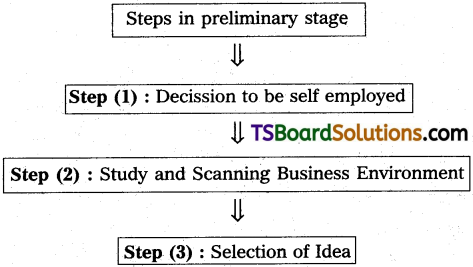
For setting up a business, certain procedures are to be followed. These procedures are governed by the current rules and regulations of the state and central Governments. The following steps involved in the preliminary stage of setting up of a business.
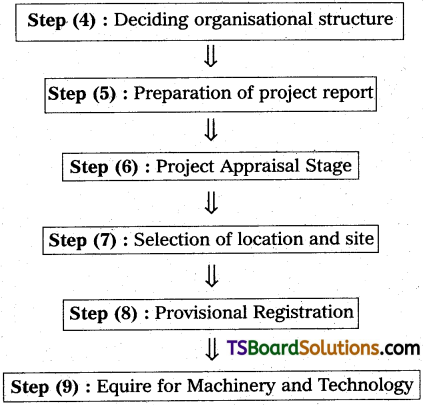
TS Inter 2nd Year Commerce Study Material Chapter 6 Setting up a Business 1
TS Inter 2nd Year Commerce Study Material Chapter 6 Setting up a Business 2

Step (1): Decision to be self – employed
1. The decision to become entrepreneur is influenced by a number of factors. All the factors are divided into two types i.e. (A) Internal Factors & (B) External factors.

2. The internal factors like Education back ground, occupational experience, desire to work independently, family background etc are motivated the person to fruitify his proposition to become entrepreneur when external factors such as financial assistance, technology anjd raw materials and infrastructural facilities are available.

Step (2) : Study and Scanning Business Environment
1. After taking a decision to be self-employed, the entrepreneur should study following business environment prevailing with respect to the proposed industrial unit:

  1. Administrative Framework.
  2. Policy Guidelines.
  3. Rules and Regulations.

2. Administrative framework constitutes sources of ideas to the enterpreneurs which are provided by (a) Development commissions (b) Associated institution and (c) State governments. The policy guidelines and rules and Regulations are provided by the government concerned.

Step (3) : Selection of Idea :

  1. After selecting the suitable project to manufacture certain product or to provide any service, an entrepreneur should undertake market survey of the product line chosen by him.
  2. This would help him to gain in sight into the “Existing Market conditions” and “Market Reactions” for the product. He can also ascertain the advantages and disadvantages of launching the new product.

Step (4) : Deciding Organisational Structure :
1. The options for the organisational patterns of the business unit are as follows :
(i) Proprietary, (ii) Partnership Firm, (iii) Co-operative Society, (iv) HUF and (v) Company.

2. The following factors are to be considered while choosing a firm of organisation.
Size of Business, Capital Investment, Nature of Business,. Degree of Control, Tax incidence and Government Stipulation.

Step (5) : Preparation of Project Report

  1. After decided the product and organisation, the entrepreneur has to put his ideas and other information is black and white.
  2. This should be so well presented that it provides all relevant information in refeence to the project.

Step (6) : Project Appraisal Stage

  1. The velocity of a project depends on the technical feasibility, marketability of a profitable price and management of the unit.
  2. Project Appraisal is the process of examining the viability of a project which is based on technical feasibility, and marketability of the products.

Step (7) : Selection of Location and Site

  1. For any Industrial project, selection of a suitable industrial site is very important decision and it is based on several considerations like, Nearness to market and nearness to raw material, availability of power and water, availability of transporting system and skilled workers etc.
  2. A plot can be obtained from (a) State Government Industrial Development, (b) Industrial Cooperative Societies (c) Private Parties.

Step (8) : Provisional Registration

  1. Provisional Registration enables a party to take the necessary steps to bring the unit into existence.
  2. Application for Provisional Registration is submitted to the District Industries Centre (DIG).
  3. The issue of provisional registration! is normally automatic and is given within seven days on the receipt of the Application.
  4. The initial validity of the provisional registratioin is Six months, it may be renewed for a further period Of six months on submission of satisfactory proof that the party has taken effective steps to establish the unit but could not complete the same.

Step (9) : Enquire for Machinery and Tocimology :

  1. The requirement of machinery/equipmen, spare parts, tools, etc., should be properly assessed and the proper size of plant and machinery should be decided upon.
  2. The names of various manufactures of the required machinery may be ascertained and quotations obtained. After careful comparison of machinery specifications, quality, delivery time and price, decision is to be taken for purchase of a particular machinery. Availability of after sales service is an important point to be kept in mind.
  3. In case the Plant and Machinery are to be obtained from the Hire Purchase Scheme of National Small Industries Corporation (N.S.I.C.) the quotations are to be obtained from the suppliers approved by N.S.I.C.

TS Inter 2nd Year Commerce Study Material Chapter 6 Setting up a Business

Question 2.
Explain the steps involved in the implementation stage of setting up of a business.
Answer:
The second stage in the setting up of a business is the implementation stage. It involves 12 steps which are given below :

Step (1) : Statutory Licences / Clearance :

  1. Various administrative bodies have been set up to consider requests for the issue of industrial licence, import of capital equipment, foreign collaboration etc. These bodies are expected to decide the requests within the stipulated time limit.
  2. The industrial licence is issued on furnishing evidence that the prescribed conditions are fulfilled.
  3. A licence from Government of India is necessary for the manufacture of any article included in the schedule to the IDR Act, 1951. Such a few industries are metallurgical industries, fuels, boilers and steam generating plants, electrical equipments, telecommunications, transportation, industrial machinery, fertilizers, chemicals etc.

Step (2) : Arrangement of Finance :
Business units can obtain finance for their projects under three main categories :
1. Term Loan :
Long term requirements for acquiring fixed assets like land and building, plant and machinery and for security deposit and working capital margin.

2. Bridge Loans :
This loan is granted for a short duration to enable the entrepreneur to continue with the implementation of the project till the term loan, applied for and sanctioned is disbursed by the financial institution.

3. Working Capital :
Short – term advances for working capital in the form of pledge / hypothecation / cash / credit / bills facility.

Step (3) : Application for Financial Assistance :
1. After the project is finalized, provisional registration and other formalities are completed, the entrepreneur has to submit an appliation for financial assistance along with the Project Report to the financial institution / bank for a term loan.

Encloseres with Application for term Loan :
2. Along with the appliation submitteu ! – the Financial Institution / Bank, the following documents have to be enclosed :
a) Copy of the Project Report
b) Copy of the partnership deed / memorandum and articles of assocaition
c) Quotations in respect of plant and machinery
d) Income – tax assessment order or incometax clearance relating to partners/ directors.
e) Architect’s estimates in respect of factory building.
f) Copies of balance sheet and profit and loss account for the previous years relating to the associate concerns, if any, of the promoters.

Step (4) : Building Construction and Civil Works :
1. After the sanction and disbursement of first installment of loan from financial institution Building Construction activities are started. If the pre-built factory is obtained from State Government. Industrial Estate, this activity is already completed by taking the possession of the shed. If the plot is already acquired the civil work follow.

2. Before commencing construction activities, the entrepreneur should obtain necessary licence from the Corporation or Municipal authorities other local authorities and should also ensure that the plan of the building conform to the norms stipulated by the Inspector of Factories.

Step (5) : Placement of Order and Procurement of Fixed Assets and Plant and Machinery
The orders are placed with selected suppliers. The timings of placing the order are decided on the delivery of suppliers so that the procurement of Plant and Machinery should synchronise with the completion of the building construction.

Step (6) : Power and Water Connection :
As the application for power and water connection has already been made, the required formalities are completed and water and electrical connections are obtains.

Step (7) : Procurement of Personnel and their Training

  1. Two of the most critical points to be considered in terms of employees are productivity and Trust.
  2. Untrained and unmotivated employees can cause a business to fail just as surely as strong competition or economic downtowns.
  3. Before hiring process is started, careful analysis of business needs and specific duties of each new employee are required to be written very clearly. Determine the pay in terms of salary and benefits.
  4. It enables to clarify and prioritise the‘skills, experience and qualities the enterprise seeking. The enterprise has to determikne the need to hire new and full time employees. This is also the time to formulate the Personnel Policy. An optimum balance between technical and commercial staff must be maintained.

Step (8) : Procurement of Raw Material :

  1. The new enterpreneur will have to ensure timely flow of raw materials in anticipation of actual requirement before launching his hew product into the market.
  2. He has to keep more sources of supply of the required raw materials, instead of depending on a single source of supply.

Step (9) : Installation and Commissioning of Plant and Machinery

  1. The new entrepreneur should formulate a suitable layout which would facilitate production operations in the best possible manner.
  2. The prospective entrepreneur should formulate a blue print covering the actual layout of factory and segregate the areas allocated for carrying out different operations in systematic manner.
  3. Normally the suppliers of Plant and Equipment provide the services of installation and commissioning of their Plant and Equipment. However the entrepreneur along with his technical staff should co-ordinate the installations of different Plant and Equipment for perfect machinery and synchronisation.

Step (10) : Marketing

  1. Marketing is the complex process of creating customers for products and services;
  2. Effective marketing planning and promotion begin with gathering factual information about the market place.
  3. A very important part of marketing plan should be overall promotional objectives : to communicate message, create an awareness of product or service, motivate customers to buy and increase sales.

Step (11) : Permanent Registration

  1. Permanent Registration is obtained from District Industry Centres (DIC),. When the entrepreneur has taken all the steps to establish the unit i.e. where the factory building is ready, power connectioni is given, the machinery is installed etc., they may apply for Permanent Registration of a unit.
  2. Within seven days of the receipt of appliation, the District Industries Officer or other designated officer informs the party, of the date and time for inspection of unit
  3. On being satisfied that the unit is capable of production activity, a permanent registration Certificate will be issued by the Directorate of Industries.

Step (12) : Profit Generation and Repayment of Loan :

  1. A successful entrepreneur should be ever vigilant about his cost of production and profit generation. If profits are not generated, he should find out the reasons and try to minimize his costs and adjust his production volume.
  2. If, for any unforeseen reasons he is not able to make profits at a reasonable level of production, he should immediately take steps to remedy the situation.
  3. Regarding the repayment of loan amount, normally banks and financial institutions insist on its payment along with interest charges by the borrower as per repayment schedule formulated in respect of the project. Normally permitted for repaying the instalments of the principal amount varies from 12 months to 24 months from the date of the first release of the loan.

Question 3.
Discuss the entrepreneurial opportunities provided by the state of Telangana.
Answer:
The opportunities provided by the government are very important environmental factor which induce the entrepreneurs to setup their enterprise. The Industrial policy framework for the state of Telangana has provided a grafti – free, hassle – free environment in which the entrepreneurial spirit of local, domestic and international investors will thrive to takeup their industrial units in the State of Telangana as the preferred investment destination. The various opportunities provided by Government of Telangana are detailed below :

1. An online and help desk grievance redressal system is available in place where entrepreneur is encouraged to report instances as corruption of any delays in performing timely tasks by Telangana state government departments.

2. The departments have developed a Minimum Inspection System where each industrial unit is inspected only once the 3/4 years and the cycle of inspections to be fixed in advance.

3. Self certification is encouraged and automatic renewals are implemented. There is a web based E – helpline facilities as well as physical help-desks at Hyderabad and District Head quarters.

4. The government introduced a Telangana State Industrial Project Approval and Self – Certification System (TS – iPASS) whereby a right to single window clearance, on the lines of the right to information, is bestowed for all applicants.

5. The Telangana State Government recognized 14 sectors as thrust areas, investments in which will be accorded a higher priority over others.

6. The special provision for the micro, small and medium enterprises are as follows :
(a) Adequate number fo smaller plots in industrial parks for SMEs and developed sheds for Micro units.
(b) Special fund for IP registrations assistance.
(c) Special fund for technology transfer and modernization of MSME sector.
(d) Marketing assistance to participate in national and international trade shows and buyer seller meets.
(e) Separate state level Bankers Committee for industries, particularly small and medium enterprises.

7. The government crated a corpus fund jointly with the industries and their associations which will act as a safety net for SMEs that face any crisis and run the risk of imminent sickness.

8. Each of districts of the state excluding Hyderabad have one or more industrial parks exclusively for women.

9. Special support to SC/ST entrepreneurs is offered through TS-PRIDE i.e., Telangana State Programme for Rapid Incubation of Dalit Entrepreneurs Some of the activities are as follows :
(a) A special direct funding programme for financing SC/ST entrepreneurs.
(b) Payment of Margin money on behalf of SC/ST entrepreneurs by the government and creation of Rs 5 crores for Margin Money Refund Scheme.
(c) State departmental procurement policy in tune with GDI’s SME procurement policy of 20%.
(d) Organising Intensive entrepreneur and skill development programmes.
(e) Subsidy eligibility if funded by CRISIL rated NBFCs.

10. To improve the productivity and income of Traditional Arts and Handicrafts like Nirmal Paintings. Dokra metal work, Bidriware, Pembarthy Brassware as well as textiles like Pochampally Ikat, Gadwal sarees and Warangal carpets, the Government of Telangana provides various programmes under T – HART Telangana State Handicrafts and Artisans Revival with Technology Program.

11. About 20 lakh acres of land is identified as unfit for cultivation in Telangana, which is transferred to the Telangana State Industrial Infrstructure Corporation for establishing industrial parks.

12. The TS IIC develops all required infrastructure in the industrial parks like approach roads, water supply, industrial tower, and common effluent treatment facilities and thereby the investor can begin the construction of his unit from the day of getting sanction letter.

13. The details of land in the industrial parks are made avilable on the website of TSIIC and the department of Industries and commerce. All required information like distance of the industrial park from nearest highway/railway station / airport / town, size of individual plots, photographs of the lands, google maps etc., are displayed.

14. Every Industrial park have plots earmarked for common facilities like electricity sub-stations, police outposts, five stations, e-seva centres, banks, petrol stations, canteens, local shopping etc.

15. The skill development programmes which are aimed to train the young entrepreneurs are undertaken by Telangana State Accelerated SSI sikns Training Centres of the Industries and Commerce Department.

16. The Telangana State Industrial Development and Entrepreneur Advancement Incentive Scheme is offering the following incentive^ to the entrepreneurs.
(a) Stamp duty reimbursement
(b) Land cost rebate
(c) Power cost reimbursement
(d) Power cost reimbursement
(e) Interest subsidy etc.

17. A conductive State taxation structure is devised for industrial growth and finance resource augmentation by the Telangana State Government. This helps in bringing inter-state tax rationalization on industrial inputs and outputs with neighbouring states.

Thus, the new industrial policy of government of Telangana provides many . opportunities to the industrislists, investors and entrepreneurs in the new state and promises to fulfill their aspirations.

TS Inter 2nd Year Commerce Study Material Chapter 6 Setting up a Business

Question 4.
Define startup and explain its prerequisites.
Answer:
I. 1) Meaning :

  1. A startup is a company that is in the first stage of its operations.
  2. Startup companies attempt to capitalise on developing a product or service for which the entrepreneurs believe that there is demand in the market.
  3. The start ups are founded by one or more entrepreneurs with high costs and limited revenue. Hence, they require capital from different sources to meet their new venture requirements.

2) Definition :
The purpose of the government schemes startups are defined as an entities of private limited company under the Companies Act, 2013 Or a registered partnership firm under Indian Partnership Act 1932 or limited liability partnership under the Limited Partnership Act, 2008. They should work towards innovation or registered in India not prior to ten years, with annual turnover not exceeding Rs. 100 crores in any preceding financial year. They should work towards innovation, development, deployment of commercialization of new products, processes or services driven by technology or intellectual property.

3) Pre-requisites :
The pre-requisites of startups are as follows :
1. Company Age :
Period of existence and operations should not be exceeding 10 years from the Date of Incorporation.

2. Company Type :
Incorporated as a Private Limited Company, a Registered Partnership Firm or a Limited Liability Partnership.

3. Annual Turnover :
Should have an annual turnover not exceeding Rs. 100 crore for any of the financial years since its incorporation

4. Original Entity :
Entity should not have been formed by splitting up or reconstructing an already existing business.

5. Innovative and Scalable :
Should work towards development or improvement of a product, process or service and/or have scalable business model with high potential for creation of wealth & employment.

Question 5.
Explain the success of any two Indian enterpreneurs.
Answer:
India is a highly populated country with a population of morethan 130 crores. Every year on an average 1.2 crore are graduating from the universities. It is not.possible for any economy to provide employment to all of them. The successful entrepreneurs stories shall help them to become self employed. With this background view, an attempt is made to study the stories of some of the successful entrepreneurs of India and the state of Telangana.

1) Lakshmi Niwas Mittal :
Lakshmi Niwas Mittal is an Indian – bom steel magnet who is currently in the U.K. He is known as king of steel. He was bom on 15th June, 1950 at Sadulapur town in Rajasthan State. After graduating he served as a trainee at the mill, and in 1976 he opened his own steel mill in Indonesia. He spent more than a decade learning how to run it efficiently.

In 1989 Mittal purchased the state owned steel works in Trinidad and Tobago, which had been losing huge sums of money. A year later that facility had doubled its output and had become profitable. He used a similar formula for success in a series of acquisitions all around the world, purchasing failing outfits and sending in special management teams to recognize the business.

Mittal’s company controlled about’ 40% of American Market for the flat rolled steel used to make cars. In 2004 Mittal merged his companies, Ispat International and LNM Holdings and acquired Ohio-based International steel Group.

Status of Mittal:

  1. Lakshmi Mittal serves as chairman & CEO of Arcelor Mittal, the world’s biggest steel maker whose revenue is $ 70.6 billion.
  2. The Newly created Mittal steel Co, NV, emerged from the deal as world’s largest steel maker and oversaw another merger when mittal steel joined with Arcelor to form Arcelor Mittal.
  3. Mittal has donated Rs. 3300 crores in July, 2020 to Oxford University to develop Covid-19 vaccine.

2) Sahitya Raj :
Sahitya Raj is young and successful woman entrepreneur from Hyderabad. She is an Electronics Engineer with an MBA degree. Sahitya Raj was working as a SAP-BI consultant at IBM, till 2017. As an employee of IBM, she got the opportunity to travel across the world. But her passion to become an entrepreneur made her to start the firm “Sweetooth” in the year 2018 as a small production unit at Madhapur in Hyderabad. She started a small kitchen in her rented apartment and delivered the products to the people known to her. The response received gave her confidence to carry on the business on a large scale. She is chose as one of the top fire entrepreneurs of 2020 by we Hub, Govt, of Telangana.

The product offered by Sahitya Raj are Gulabjamin, Cheese Cakes, butter scotch, rasmalai, burger buns, chocolates, etc. The Swertooth produces around 250 products which are available at popular cafes and restaurants across Hyderabad. Some of the clients are Barista Cafe, cream stone, zee left etc.

Sahita Raj’s Startup :

  1. Sweetooth has grown from the home kitchen to a large production unit which employees more than 30 people.
  2. It’s turnover is around Rs. 32 lakh a month business in the short span of time.
  3. Decently, it has setup its retail outlets in IT Tech parks across Hyderabad.
  4. Luring COVID period, she took under online business to serve the needs of the customers of sweetooth.
  5. She is chosen as one of the top 5 women entrepreneurs for the year 2019-20 by WE HUB Govt, of Telangana.

Question 6.
Explain how the funds required for the startups can be generated?
Answer:
I. Funding of Startups :
Funding of the Startups may come from one or more sources. The following are the various sources for mobilizing the required finance for the Startups.

1. Organic Growth :
Grow the business Slowly based on its own sales, without the need to raise any external funds. Thus, the ned for funds depends on sales volume and new fund generated is used for expansion of the business.

2. Startup Loan :
The enterpreneur who starts a new business or he has been trading for longer than two, years, he is eligible for government backed startup loan. This loan is unsecured personal loan for business and repayable at fixed rate of interest.

3. Friends and Family :
The entrepreneurs of startups can also raise funds from friends and relatives. They may pay a fair rate of interest, sign a legal promissory note and repay the money as agreed.

4. Personal Savings :
Personal savings are commonly used funds to pay for startup costs. Since these funds are owners funds, they won’t incur any interest expense and financing startup becomes a easy task.

5. Supplier Credit :
The suppliers with whom startup company do business can be a source of funds if they extend favourable credit terms to startup. Normally a credit period of 30 days is extended to the company.

6. Leasing :
Leasing is a rental arrangement that gives startup the use of an asset. This will reduce the amount of initial investment required for the business unit.

7. Term Loans :
These loans are granted for a specific purpose and repayable at a regular intervals over a specified length of time. Term loan may range from short term to long term.

8. Factoring :
It is a transaction in which business sells its accounts receivable or invoices to a third party commercial financial company. Here, the entrepreneurs receive cash more quickly instead of waiting for customers payment.

9. Community Schemes :
These schemes are available to help individuals and business- denied credit by banks and lending companies. These schemes provide help with everything from bridging loans and working capital to funds for purchasing property and equipment.

10. Credit Cards :
The starts ups can also use business or personal credit card to pay business startup costs. The interest rate is lower but he has to repay the amount at regular intervals, otherwise it may attract penal interest also.

11. Venture Capitalists :
Venture capitalists invest their funds in the startups along with angle investors. They may refer to invest funds in such startups which are making revenues. Hence, many startups resent venture capital companies for failing to invest in a new venture or risky venture.

12. Government – Assisted Loans :
There are several loan programms in which government either directly lends to small business owners or provide a guarantee or repayment for other small business lenders.

Thus, we find different sources for mobilising the funds for financing the startups. These startups can also avail a number of benefits from government schemes with which the companies will have growth and prosperity.

Short Answer Type Questions

Question 1.
How a Startup is. Registered?
Answer:
Registration of Startup :
The process of registering Startup is detailed below :
1. Incorporating the Business :
The entrepreneurs have to firstly incorporate their business as a Private Limited Company or a partnership firm or a Limited Liability Partnership.

2. Registering as a Startup :
The entrepreneurs have to register their startups as Startups. For this they have to fillup the form online – log on the startup India website and the Telangana state Website. The application form is to be filled up with details of business.

TS Inter 2nd Year Commerce Study Material Chapter 6 Setting up a Business

Question 2.
How the startups are funded?
Answer:
Funding of the Startups may come from one or more sources. The following are the various sources for mobilizing the required finance for the Startups.

1. Organic Growth :
Grow the business slowly based on its own sales, without the need to raise any external funds. Thus, the ned for funds depends on sales volume and new fund generated is used for expansion of the business.

2. Startup Loan :
The enterpreneur who starts a new business or he has been trading for longer than two years, he is eligible for government backed startup loan. This loan is unsecured personal loan for business and repayable at fixed rate of interest.

3. Friends and Family :
The entrepreneurs of startups can also raise funds from friends and relatives. They may pay a fair rate of interest, sign a legal promissory note and repay the money as agreed.

4. Personal Savings :
Personal savings are commonly used funds to pay for startup costs. Since these funds are owners funds, they won’t incur any interest expense and financing startup becomes a easy task.

5. Term Loans :
These loans are granted for a specific purpose and repayable at a regular intervals over a specified length of time. Term loan may range from short term to long term.

6. Government – Assisted Loans :
There are several loan programms in which government either directly lends to small business owners or provide a guarantee or repayment for other small business lenders.

Question 3.
What factors influence a person to become an entrepreneur?
Answer:
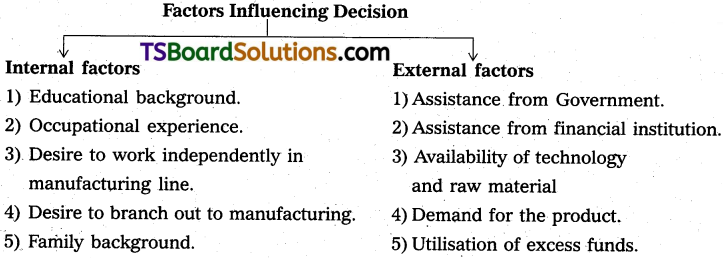
The decision to become entrepreneur is influenced by a number of factors which are presented in the following chart.
TS Inter 2nd Year Commerce Study Material Chapter 6 Setting up a Business 3
6. Other factors.

All these internal and external factors are highly necessary for entrepreneurial activity to take place. The small entrepreneur motivated by internal factors, can fruitify his proposition to become entrepreneur when external factors such as financial assitance, technology and raw materials and infrastructural facilities are available. These facilities or assitance serve as a park in the lightening of the entrepreneurial idea.

Question 4.
What factors to be considered in the selection of an idea?
Answer:
For selecting suitable project to manufacture certain product or to provide any service following factors should be considered.

  1. Is it an Innovative idea?
  2. Whether competition in the area is less?
  3. Whether raw material is easily available.
  4. Whether infrastreatural facilities viz. Industrial land, power, water etc., are available?
  5. Whether the entrepreneur has relevant experience and reasonable knowledge in the field?
  6. If the product is being manufactured already, whether the demand-supply gap is large?
  7. Whether Government policy encourages production of product ?
  8. What is the profit margin available?

Question 5.
List out the various aspects to be covered in preparing a project report.
Answer:
1. According the task of project report preparation encompasses information under various heads. Necessary documents, quotations and enquiry should be attached . with the details under given heads to herm a project report.

2. It may not be out of place to emphasise that the project report should be prepared by entrepreneur himself. This not only would save his money but also clarify many doubts thereby making him more optimistic of the success of the project report.

3. A project report should normally cover brief introduction of the proposed project, constitution and nature of the unit, the details and promoters and products, marketing 1 and competitions, manufacturing process, machinery and plant capacity, raw materials availability, land and building, general management and technical staff involved, cost of the project means of finance, working capital requirements, cost of production and profitability, project schedule, repayment schedule, security offered etc.

Question 6.
What are the important confederations to be made in the selection of location and site of business enterprise.
Answer:
For any industrial project, selection of a suitable industrial site is vey important decision. The followiong are the importance consideration to be made in the selection of location site :

  1. Nearness to market and nearness to raw materials.
  2. Availability is power and water.
  3. Availability of modem transporting system.
  4. Taking an industrial shed with essential services such as water and power.
  5. Availability of required skills.
  6. Climatic conditions.
  7. Concessions applicable for industrially backward areas.
  8. Availability of freight, express and parcel delivery services.
  9. Insured that the site allow for future extension.

TS Inter 2nd Year Commerce Study Material Chapter 6 Setting up a Business

Question 7.
Under which categories, the business units obtain their finances?
Answer:
Business units can obtain finance for their projects under force main categories.
1) Term loan :
Long term requirements for acquiring fixed assets like land and building, plant, machinery and for security deposits and working capital margin.

2) Bridge loan :
This loan is granted for a short duration to enable the entrepreneur to continue with implementation of the project till the term loan, applied for and sanctioned is disbursed by the financial institution.

3) Working capital :
Short term advances for working capital in the form or pledge/ hypothecation/cash/credit facility.

Question 8.
What are the formalities pertaining to permanent registration of a business unit?
Answer:

  1. Permanent registration is obtained from district industry centres.
  2. When the entrepreneur has taken all the steps to establish the unit i.e, where the factory building is ready, power connection is given, the machinery is installed etc., they may apply for permanent registration of unit.
  3. Within seven days of the receipt of application, the district industries officer designated officer informs the party of the date and time for inspection of unit. The inspection includes an assessment of installed capacity of the unit.
  4. On being satisfied that the unit is capable of production activity, a permanent registration certificate will be issued by the directorate of industries.

Question 9.
What are the thrust areas of investment indefined by the Government of Telangana?
Answer:
The Telangana State Government recognised 14 sectors as thrust areas, investments in
which will be accorded a higher priority over others. The thrust areas are

  1. Life sciences including bulk drugs, formulations, vaccines, nutracenticals, biological, R & D facilities.
  2. IT hardware including bio-medical device, electronics, cellular communications.
  3. Precision engineering including aviation, aero-space, defence.
  4. Food processing and nutrition products including dairy, poultry, meat and fisheries,
  5. Automobiles, transport vehicles, Auto components, tractors and farm equipments.
  6. Textiles and apparel, leather and leather value added products.
  7. FMCG and domestic appliances.
  8. Engineering and capital goods.
  9. Gems and jewellery.
  10. Waste management arid green technologies.
  11. Solar parks and renewable energy.
  12. Woodland mineral based industry.
  13. Transportation.
  14. Plastic, chemicals and petro chemicals.

Question 10.
What are the special provisions enacted by the Telangana State for the MSMCs?
Answer:
The special provision for the micro, small and medium enterprises (MSMEs) are as follows:

  1. Adequate number of smaller plots in industrial parks for SMEs and developed sheds for micro units.
  2. Special funds for addressing incipient sickness.
  3. Special fund for IP registrations assistance.
  4. Special fund for anti-pirating assistance.
  5. Special fund for technology transfer and modernization of MSME sector.
  6. Reimbursement of land conversion charges for units in own land.
  7. Marketing assistance to participate in national and international trade shows.
  8. Consultant panel to respond to MSME entrepreneur needs.
  9. Separate state level bankers committee for industries Of SME’S. “

Question 11.
How the special support is extended by the government of Telangana to the SC/ST entrepreneurs in our state?
Answer:
Special support to SC/ST entrepreneurs is offered through TS-PRIDE. Some of the activities are as follows :

  1. A special direct funding programme for financing SC/ST entrepreneurs.
  2. Payment of margin money on behalf of SC/ST entrepreneurs by the Gcvemmenf and creation of ₹ 5 crores for margin money refund scheme.
  3. Preferential allotment of plots in industrial parks and reservation of 22% land in Industrial Estates.
  4. Supplier diversity opportunities in large industries.
  5. State departmental procurement policy in tune with GOI’s SME procurement policy of 20%.
  6. Organising intensive entrepreneur and skill development programmes programmes.
  7. Subsidy eligibility if funded by CRISIL rated NBFCs.
  8. Representation in all the districts and state level committee.
  9. Interest subsidy for service sector units, other than transport sector.

Question 12.
What are the steps initiated by Telangana Government for improving the productivity and income of traditional arts and handicrafts of our region?
Answer:
To improve the productivity and income of Traditional arts and Handicrafts like Nirmal paintings, Dokra metal work, Bidriware, Pembarthy Brassware as well as textiles, like Pochampally Ikat, Gadwal sarees and Warangal carpets, the Government of Telangana provide various programmes under T-HART Telangana State Handicarfts and Artisans Revival with technology program.

  1. Cluster approach for specific arts and crafts.
  2. Identification and documentation of arts and crafts.
  3. Technology upgradation and design support centres.
  4. Skill upgradation and quality improvement.
  5. Common facility centres.
  6. Registration support.
  7. Niche product development.
  8. Marketing assistance and marketing events participation.

TS Inter 2nd Year Commerce Study Material Chapter 6 Setting up a Business

Question 13.
What are the incentives offered by Telangana State Industrial Development and Entrepreneurs Advancement Incentive Scheme to the entrepreneurs.
Answer:
The Telangana State Industrial Development and Entrepreneur Advancement Incentive Scheme is offered by the State Government under which the following incentives are offered to the entrepreneurs :

  1. Stamp duty reimbursement
  2. Land cost rebate
  3. Land conversion cost
  4. Power cost reimbursement
  5. Investment subsidy
  6. VAT reimbursement
  7. Interest subsidy
  8. Training and skill development cost reimbursement
  9. Quality and patent support
  10. Reimbursement of infrastructure development costs

Very Short Answer Type Questions

Question 1.
Startup:
Answer:

  1. A startup is a company that is in the first stage of its operations.
  2. Startup companies attempt to capitalise on developing a productor service for which the entrepreneurs believe that there is demand in the market.
  3. They should work towards innovation, development of a new products, processes or services driven by technology or intellectual proverty.

Question 2.
Project Report.
Answer:
It is the document prepared by the entrepreneur where he has to put his ideas and other information in black and white.

Question 3.
Project Appraisal
Answer:
It is the process of examining the viability of a project which is based on technical feasibility, and marketability of the products.

TS Inter 2nd Year Commerce Study Material Chapter 6 Setting up a Business

Question 4.
Provisional Registration.
Answer:
Provisional registration enables a party to take the necessary steps to bring the unit into existence. After providing satisfactoy proof of the unit having come into existence, it can be converted into a regular registration later. Application for provisional registration is submitted to the district industries centre.

Question 5.
Industrial Licence.
Answer:

  1. Various administrative bodies have been set upto consider requests for the issue of industrial licence.
  2. The industrial licence is issued on furnishing evidence that the prescribed conditions are fulfilled.
  3. Under the IDRAct 1951 an industrial licence is necessary for manufacturing of fuels, electronical equipments, telecommunications, transportations, chemicals etc.

Question 6.
Term Loans.
Answer:
It is the loan required for long term needs for acquiring fixed assets like land & buildings plant and machinery etc.

Question 7.
Bridge Loans.
Answer:
It is short term loan which enable the entreprenour to continue with the impl%nentation of the project till the term loan is applied and obtained.

Question 8.
Working Capital
Answer:

  1. Working capital is the capital that is required by a business to run its day-to-day operations.
  2. Short-term advance for working capital in the form of pledge/cash/credit/bills facility.

TS Inter 2nd Year Commerce Study Material Chapter 6 Setting up a Business

Question 9.
Uploading Documents :
Answer:
After duly filling, out the application form, the following documents are required to be uploaded.

  1. Letter of recommendation/support.
  2. Certificate of incorporation of the company.
  3. Registration certificate in case of the partnership firm.
  4. Description of the business and innovative nature of their products and services.
TS Inter 2nd Year Commerce Study Material Chapter 5 Entrepreneurship

Telangana TSBIE TS Inter 2nd Year Commerce Study Material 5th Lesson Entrepreneurship Textbook Questions and Answers.

TS Inter 2nd Year Commerce Study Material 5th Lesson Entrepreneurship

Long Answer Type Questions

Question 1.
Define entrepreneur and explain the characteristics.
Answer:
Meaning :

  1. The word entrepreneur is derived from from the French word “Entrepredre” which mean “Undertake i.e. individual who undertake the risk of new enterprise.
  2. An entrepreneur should be one who bears, innovates and organises the business.
  3. Entrepreneur is an economic agent who unites all means of production to maximize his profits by Innovations.

Definitions :

  1. According to F.Dc Bolidar, entrepreneur is a person who performs the task of bringing labour and material at certain price and selling the resultant product at a contracted price.
  2. The American heritage dictionary defines an entrepreneur as “a person who organise, operate and assumes the risk for a business venture”.

Characteristics of an Entrepreneur :
1. Innovation :

  1. Innovation means doing newthings. or doing of things that are already being done in a new way
  2. Entrepreneurs deals with the changes. He does not countinue with the old ideas. Entrepreneurs tend to tackle the unknown.

2. Risk Taking :
Any new business poses risk for enterpreneurs. They may succeed or fail. Thus entrepreneur main characteristic is bearing the risk.

3. Self confidence :
Entrepreneurs beliyes in themselves. They have the confidence that they can change the existing position.

4. Hard work :
Entrepreneurs are hard workers to get the desire results entrepreneurs put in longer hours of work. They are not depend on others.

5. Goal setting :
Entrepreneur get happiness by setting and striving for goals. Reaching one goals set by entrepreneur will lead to the setting up of another goal.

6. Accountability :
Entrepreneurs take success or failure to their stride. Credit for success, balance for the failure will go to entrepreneurs they are responsible and accountable for results.

7. Leadership :
Leadership represents an abstract quality of a man it is the process of directing, guiding and influencing the people to do their best for the attainment of a specified god. The entrepreneur’s leadership acts like a motive power to group efforts. Hence, the entrepreneur must possess good leadership qualities to become on successful entrepreneur.

8. Managerial skills :
The managerial skills of an entrepreneur refer to ability to formulate a clear policy, ensuring proper balance between the duties, responsibilities, rights and authority of different personnel. Hence the entrepreneur required the managerial skills, for achieving he goals of the enterprises.

TS Inter 2nd Year Commerce Study Material Chapter 5 Entrepreneurship

Question 2.
Explain the functions of an entrepreneur.
Answer:
Modem writers have emphasised that an entrepreneur is supposed to perform the following functions:

1. Innovation :

  1. The word entrepreneur is associated with innovation. Innovation means doing new things, or the doing of things that are already being done in a new way.
  2. Innovation includes production of new products, creation of new markets, introduction of new method of production, discovery of new and better channels of supply of raw materials and creation of new organisational structure.
  3. According to Schumpeter, the basic function of an entrepreneur is to innovate.

2. Risk Bearing :

  1. Due to unforeseen contingencies like changes in consumer tastes, techniques of production, government policies and new inventions, there may be losses which are bom by the entrepreneur.
  2. He is an enterprising person willing to assume the risks involved in inventions, new ventures and expansions.
  3. J.B. Say and others stressed risk taking as the specific function of the entrepreneur.

3. Organisation and Management :

  1. The entrepreneur has to decide, the nature and type of goods and services to be produced. He brings together the various factors of production, such as land, labour, capital.
  2. In order to minimicse the losses, entrepreneur allocatges resourcees more judiciously. He makes required alternation in the size of the business, its location, techniques of production etc.
  3. Entrepreneur also undertakes the managerial functions like formulation of production plans, organisation of sales and personnel management.
  4. Alfred morshasll, organisation and management of the enterprise is main function of an enterprineur.

4. Business Planning :

  1. The entrepreneur must provide a logical and scientific basis for planning the business operations like need of raw materials, and men, production schedules, sales, inventory, advertising, budgetary allocation etc.
  2. For a systematic business planning, the entrepreneur must be able to formulate goals, policies, procedures, programmes and budgets.
  3. Proper planning minimises the cost, activities are taken up in an orderly manner, guides the business along predetermined channel and highly helpful in performance of other managerial functions.
  4. Hence, the entrepreneurs have to give utmost importance to this function as it pervades all other managerial functions.

5. Decision Making :

  1. Another important function discharged by entrepeneur is the decision making. He has to take decisions regarding the activities of the enterprise.
  2. He is expected to make a number of decisions to run and maintain business concern. The function of decision making is considered as vital for the success and growth of any business entiry.

Question 3.
Explain the functions of an entrepreneur.
Answer:
I. Danhof classification of Entrepreneurs :
Danhof has classified entrepreneurs into four categories
1) Innovating entrepreneurs,
2) Adoptive (or) -imitative entrepreneurs,
3) Fabian entrepreneurs,
4) Drone entrepreneurs.

1) Innovating entrepreneurs :
He introduces new products, new methods of production and opens new market. Innovating entrepreneur experiments.

2) Adoptive (or) imitative entrepreneurs :
This type of entrepreneurs instead of innovating new things they just adopt the successful innovations innovated by others. In such cases the imitative innovations may make some changes in the innovations made by the innovative entrepreneur so as to suit their requirements.

3) Fabian entrepreneurs :
These are entrepreneurs rigid and fundamental in approach. They follow the foot steps of their successors. They are shy to introduce new methods and ideas. Fabian entrepreneurs are no risk takers.

4) Drone entrepreneurs :
They resist changes. They are laggards. They may close down their business but they don’t accept for changes.

II. Other catetories of Entrepreneurs :
1) Individual entrepreneurs :
There are found in small scale business firms. When an individual setup an enterprise, arrange finance, bear the risk and adopt the latest techniques in the business with an intention to earn profits, he is called as an individual entrepreneur.

2) Institutional entrepreneurs :
In the case of business organisations where complex decisions are required to be taken, group entrepreneurs or institutional entrepreneurs emerge to arrange finance, bear the risk and adopt latest technological changes with an intention to earn profits.

3) Entrepreneurs by inheritance :
This type of entrepreneurs are found in India, where a person inherit the bustiness of the family through succession. They ae also called as second generation entrepreneurs since they inherit the family business firms and pass it from one generation to another.

4) Forced entrepreneurs :
Force people to become entrepreneurs. Rich people from agriculture sector, unemployed youth, non-resident indians may belong to this group.

5) Industrial entrepreneurs :
Industrial entrepreneur through research or otherwise estimate customer needs and wants manufacture the products to cater to their needs.

6) Agricultural Entrepreneurs :
Agricultural entrepreneurs are normallyh engaged in the activity of raising crops and marketing crops, fertilisers and ohter inputs of agriculture. They are also engaged in allied agricultural activity.

7) Spontaneous entrepreneurs :
This type of entrepreneurs are in quite contrast with induced entrepreneurs. They commerce their business out of their confidence and talent. They are not induced by other agencies.

8) Pure entrepreneurs :
Pure entrepreneurs is one who undertakes any activity to satisfy his ego. He is motivated to achieve or prove his excellence.

9) Motivated entrepreneurs :
These are induced or motivated government or non-government agencies which may be providing financial and other assistance, concessions, subsidies, training etc.

10) Professional entrepreneurs :
Professional entrepreneurs make it as a profession in commencing a business. They develop a business and sell it to somebody and start another business to sell its to others.

TS Inter 2nd Year Commerce Study Material Chapter 5 Entrepreneurship

Question 4.
Distinguish entrepreneur and entrepreneurship.
Answer:
The following table may help us to understand the distinction between entrepreneur and entrepreneurship.

EntrepreneurEntrepreneurship
1) He is a person.1) It is a plan of action.
2) He is an administrator.2) It is an administration.
3) He is a risk bearer.3) It is a risk bearing activity.
4) He is an innovator.4) It is a process of innovation.
5) He combines factors of production.5) It is the process of use of factors of production.
6) He is an initiator.6) It is taking an initiative.
7) He is a leader.7) It is nothing but leadership.


Short Answer Type Questions

Question 1.
What is Business Planning?
Answer:
Business Planning :

  1. The entrepreneur must provide a logical and scientific basis for planning the business operations like need of raw materials, and men, production schedules, sales, inventory, advertising, budgetary allocation etc.
  2. For a systematic business planning, the entrepreneur must be able to formulate goals, policies, procedures, programmes and budgets.
  3. Proper planning minimises the cost, activities are taken up in an orderly manner, guides the business along predetermined channel and highly helpful in performance of other managerial functions.

Question 2.
What are the risk bearing function of entrepreneurs?
Answer:

  1. Due to unforeseen contingencies like changes in consumer tastes, techniques of production, government policies and new inventions, there may be losses which are born by the entrepreneurs.
  2. Entrepreneurs, in the game of business wherein risks and rewards are a plenty will be ready to accept them.
  3. He is an enterprising person willing to assume the risks involved in inventions, new ventures and expansions.

Question 3.
How innovation function is different fro invention functions of an entrepreneur?
Answer:
1) Innovation means doing new things that are already being done in a new way. Innovation includes production of new products creation of new market, introduction of new, method of production discovery of new and better channels of supply of raw materials and creation of new organisational structure.

2) Innovation is also different from invention. Invention implies discovery of new ideas, new articles and new methods whereas, innovations means the application of inventions and discovery to make a new and desired products and services that can be successfully sold in market.

3) Invention in creation of a new product, where as innovation mean adding value to that product.

TS Inter 2nd Year Commerce Study Material Chapter 5 Entrepreneurship

Question 4.
How danhof classified the entrepreneurs?
Answer:
Danhof has classified entrepreneurs into four categories 1) Innovating entrepreneurs, 2) Adoptive (or) imitative entrepreneurs, 3) Fabian entrepreneurs, 4) Drone entrepreneurs.
1) Innovating entrepreneurs :

  1. He introduces new products, new methods of production and opens new market.
  2. Innovating entrepreneur experiments and converts the attractive possibilities into practice.

2) Adoptive (or) imitative entrepreneurs :

  1. This type of entrepreneurs instead of innovating new things they just adopt the successful innovations innovated by others.
  2. In such cases the imitative innovations may make some changes in the innovations made by the innovative entrepreneur so as to suit their requirements.

3) Fabian entrepreneurs :

  1. These are entrepreneurs rigid and fundamental in approach. They follow the foot steps of their successors.
  2. They are shy to introduce new methods and ideas. Fabian entrepreneurs are no risk takers.

4) Drone entrepreneurs :

  1. They resist changes. They are laggards. They may close down their business but they don’t accept for changes.
  2. Drone enterpreneurs are refuse to adopt changes.

Very Short Answer Type Questions

Question 1.
Entrepreneurs.
Answer:
He is an economic agent who unites all means of production, to maximize his profit by innovations.

Question 2.
EnterpMrise.
Answer:
It is unit of economic organisation. An organisation created for business venture.

Question 3.
Entrepreneurship.
Answer:
It is a purposeful activity of an individual or a group of associated individuals under – taken to initiate, maintain and to earn profit by production or distribution of economic goods and services.

Question 4.
Balanced Regional Develolpment.
Answer:
Entrepreneurs in the public and private sectors help to remove regional disparties by setting up industries in the backward areas. Government give to various concessions and subsidies to the entrepreneurs.

TS Inter 2nd Year Commerce Study Material Chapter 5 Entrepreneurship

Question 5.
Leadership.
Answer:
Leadership represents an abstract quality of a man it is the process of directing, guiding and influencing the people to do their best for the attainment of a specified god. The entrepreneur’s leadership acts like a motive power to group efforts. Hence, the entrepreneur must possess good leadership qualities to become on successful! entrepreneur.

Question 6.
Innovation.
Answer:

  1. Innovation means doing newthings. or doing of things that are already being done in a new way
  2. Entrepreneurs deals with the changes. He does not countinue with the old ideas. En-trepreneurs tend to tackle the unknown.

Question 7.
Adoptive Entrepreneur.
Answer:

  1. This type of entrepreneurs instead of innovating new things they just adopt the successful innovations innovated by others.
  2. In such cases the imitative innovations may make some changes in the innovations made by the innovative entrepreneur so as to suit their requirements.

Question 8.
Fabian Entrepreneur.
Answer:

  1. These are entrepreneurs rigid and fundamental in approach. They follow the foot steps of their successors.
  2. They are shy to introduce new methods and ideas. Fabian entrepreneurs are no risk takers.

Question 9.
Drone entrepreneur.
Answer:

  1. They resist changes. They are laggards. They may close down their business but they don’t accept for Changes.
  2. Drone enterpreneur are refuse to adopt charges.

Question 10.
Forced entrepreneurs.
Answer:
Some circumstances force people to become entrepreneurs. Rich people from agriculture sector, unemployed youth, non-resident indians may belong to this group.

Question 11.
Industrial entrepreneurs.
Answer:
Industrial entrepreneur through research or otherwise estimate customer needs and wants manufacture the products to cater to their needs. He is essentially a manufacturer.

TS Inter 2nd Year Commerce Study Material Chapter 5 Entrepreneurship

Question 12.
Spontaneous entrepreneurs.
Answer:
spontaneous entrepreneurs are in quite contrast with induced entrepreneurs. They commerce their business out of their confidence and talent. They are not induced by other agencies.

Question 13.
Pure entrepreneurs.
Answer:
Pure entrepreneurs is one who undertakes any activity to satisfy his ego. He is motivated to achieve or prove his excellence.

Question 14.
Corporate entrepreneurs.
Answer:
Corporate entrepreneur is one who promotes a corporation. A corporate undertaking is formed and registered under a statute which gives a separate legal entity.

Question 15.
Motivated entrepreneurs.
Answer:
These ace induced or motivated government or non-government agencies which may be providing financial and other assistance, concessions, subsidies, training etc.

Question 16.
Professional entrepreneurs.
Answer:
Professional entrepreneurs make it as a profession in commencing a business. They develop a business and sell it to somebody and start another business to sell its to others. They are not interested in managing or operating a business with is established by them.

Question 17.
Classical entrepreneurs.
Answer:
He is a sterotype entrepreneur whose main aim is to maximise his economic returns at a level consistent with the survival of the unit but with or without an element of growths.

TS Inter 2nd Year Commerce Study Material Chapter 5 Entrepreneurship

Question 18.
Small scale entrepreneurs.
Answer:
On the basis of scale of operation of the unit entrepreneurs may be classified as large scale, medium scale and small scale industry entrepreneur. He is essentially a manufacturer. He manufactures the products in small scale and tiny industry. Government given many facilities to these small scale industry entrepreneurs.

TS Inter 2nd Year Commerce Study Material Chapter 10 Functions of Management

Telangana TSBIE TS Inter 2nd Year Commerce Study Material 10th Lesson Functions of Management Textbook Questions and Answers.

TS Inter 2nd Year Commerce Study Material 10th Lesson Functions of Management

Long Answer Type Questions

Question 1.
What are the main points in the definition of planning?
Answer:
Planning is deciding in advance what to do and how to do. It is one of the basic managerial functions. Before doing something, the manager must formulate an idea of how to work on a particular task. Thus planning is closely connected with creativity and innovation. But the manager would first have to set objectives, only then will a manager know where he has to go. Planning seeks to bridge the gap between where we are and where we want to go. It requires taking decision since it involves making a choice from alternative course of action.

Planning involves setting objectives and developing appropriate courses of action to achieve these objectives. Objectives provide direction for all managerial decisions and actions. All members need to work towards achieving organizational goal. These goals set the targets which need to be achieved. This plan should be forecasting the future course of events. There are many steps in planning.
a) Determination of objectives for whole organization.
b) Laying down policies to be followed.
c) Laying down the standards of performance.
d) Preparation of budgets for whole organization.

TS Inter 2nd Year Commerce Study Material Chapter 10 Functions of Management

Question 2.
Do you think planning can work in a changing environment?
Answer:
Planning can work in changing environment explained below.
1) Focus on objectives :
Planning determines the objectives of the enterprise and also various departments, for devises the ways for achieving the objectives, good plan is required. Planning compels the managers to consider the future and make them to recognize the need for revising and extending plans in the light of dynamic business environment,

2) Economical operation :
The working of the enterprise will be systematic a*.., purposeful. Under planning, there will be jointly directed effort instead of uncoordinated decisions are made on the .basis of facts. The resources are utilized in the best possible way.

3) Reduces uncertainty and change :
An enterprise works in a dynamic world. The future is uncertain. Changes take place in business environment, economic policies and supply of resources. There may be changes in technology. Planning can work in changing environment.

4) Facilitates control :
Planning helps the managers to exercise proper and effective control over the subordinates. In planned organization, the work to be done is determined in advance. This enables the management to check on the performance of subordinates.

Question 3.
If planning involves looking ahead, why does it not ensure success?
Answer:
Planning involves looking ahead why does it not ensure success are.
1) Uncertain future :
Planning is made on the basis of estimate of the conditions in future. Forecasting is done on the basis of information and facts collected. Even if the collected information is reliable. The future is uncertain and cannot be predicted accurately.

2) Rigid :
In planning, policies, procedures and programmes are determined in advance. They have to be followed by the employees. This restricts personal freedom. Individual initiative is suppressed. Thus, planning leads to inflexibilities and rigidities.

3) Expensive :
Planning requires more time and money for preparation. It involves heavy expenditure. Large organizations must consider the benefits of planning in relation to the expenditure. Small organizations cannot afford planning as it is time consuming and costly process.

4) Investment :
Changes in the environment requires over locking aspect of capital already invested in the business in the form of equipment. Managers develop a strong feeling so that committed managers to recovery of captial sunk as a result of some earlier decision that future planning is constrained and limited to its recovery, and very often capital so invested itself becomes a planning premise.

5) External factors :
These are external factors of planning which has no control at all by the internal agencies. Personnel policies and decisions may be limited aspects of labour union pressure specifically when union is conducting its activities at national level. The rules framed by governments, its rules, directives, and legal provisions also results in setting for planning.

TS Inter 2nd Year Commerce Study Material Chapter 10 Functions of Management

Question 4.
What are the types of planning?
Answer:
1) Strategic planning :
Strategic planning means the process of formulating an integrated plan related to strategic benefits of the enterprises to meet the challenges of the business environment. It consists of identifying the strategy, the objectives to be achieved in future.

Strategic planning is a periodic in nature. It facilitates to coordination between departments in the organization.

2) Operational planning :
It is a short term practice designed to implement the strategy made under strategic planning. To carry on this plan the firm should prepare short term plan regarding the policy to make in the organization.

Question 5.
Dose organizing and explain the steps in organising?
Answer:

  1. Organising in the process of defining and grouping activities and establihing authority and relationships among them.
  2. Organising essentially implies a process which co-ordinates human efforts, assembles resources and integrates both into a unified whole to be utilized for achieving specified objectives.

Prof. Urwick defines “organization as determining what activities are necessary to any purpose and arranging them in groups which may be assigned to individuals”.

The process of organization consists of the following steps :
a) Identification and division of work.
b) Departmentalization.
c) Assigning the responsibilities. .
d) Establishing reporting relationships.

A process of organising are following steps.

1) Identification and division of work :
The first step in the process of organising involves identifying and dividing the work that has to be done in accordance with previously determined plans. The burden work can be shared among the employees.

2) Departmentalization :
Once work has been divided into small and manageable activities then those activities which are similar in nature are grouped together. Such sets facilitate specialization. This grouping process is called departmentalization.

3) Assignment of duties :
It is necessary to define the work of different job positions and accordingly allocate work to various employees. Jobs are then allocated to the members of each department in accordance to their skill and competencies.

4) Establishing reporting relationships :
Merely allocating work is not enough. Each individual should also know who has to take orders from and to whom he is accountable. The establishment of such clear relationships helps to create a hierarchical structure and helps in coordination among various departments.

Question 6.
Explain the meaning of controlling and explain its importance?
Answer:
Meaning of Controlling :

  1. Control means seeing that everythig is taking place with the established rules and expressed commands.
  2. Controlling is the process of ensuring that actual activities conform to planned activities.
  3. Controlling also helps in judging accuracy of standards, ensuring efficient utilization of resources, boosting employeee morale, creating an atmosphere of order and discipline in the organization and coordinating different activites so that they all work together in one direction to meet targets.

Importance of controlling :
Control is an indispensable function of management Without control the best of plans can be misleading. A control system helps an organization in the following ways.

1. Accomplishing organizatinal goals :
The controlling function measures progress towards the organizational goal and bring to light the deviations indicating corrective action. It guides the organization on the right track so that organizational goals may be achieved.

2. Judging accuracy of standards :
A good control system enables management to verify whether the standards set are accurate and objective. An efficient control system keeps a careful check on the changes taking place in the organization to review the standards.

3. Making efficient use of resources :
By use of control a manager reduces wastages and spoilage of resouces. Each activity is performed in accordance with predetermined standdards and norms. These ensure that resources are used in the most effective and efficient manner.

4. Improving employee motivation :
A good control system ensures that employees know well in advance what they are expected to do and what are their standards of performances based on which they are appraised.

5. Ensuring order and discipline :
Controlling creates an atmosphere of order and discipline in the organization. It helps to minimize dishonest behavior on the part of the employees by keeping a close check on heir activities.

Question 7.
What is POSDCORB? What are its uses and limitations?
Answer:

  1. As per “Luther Gullick” the functions of management are “POSDCORB”.
  2. “POSDCORB” means planning, organising, staffing, Directing, co-ordinating, reporting and budgeting.
  3. ‘POSDCORB’ represents the initial words of management functions.

Uses and Application of POSDCORB :

  1. POSDCORB is used as a good starting point to analyze management functions and activities in a structural way to achieve organizational goal.
  2. If benefits the organizations in structuring and analysing the management activities.

Limitations :

  1. Mark Mopre believed that POSDCORB is too inward looking. In his view, the single most important job of a manager is understanding and shapint the environment of the organization, by means of the services it delivers to its customers and clients.
  2. According to Dr. Lewis Meriam, the most important thing has been omitted in the fascinating world POSDCORB is knowledge of a subject matter. Because managers have to plan something, managers have to organize something, and managers have to direct something, Compare the training facility within the industry but do not pay any attention to what managers should achieve.

TS Inter 2nd Year Commerce Study Material Chapter 10 Functions of Management

Question 8.
Explain the importance of organising in an enterprise?
Answer:
Importance of Organising :
In order for any business enterprise to perform tasks and successfully meet goals, the organising function must be properly performed. The following points highlight the crucial role that roganising plays in any business enterprise.

1) Benefits of specialization :
Organising leads to a systematic allocation of jobs amongst the work force, this reduces the workload as well as enhances productivity because of the specific workers performing a specific job on a reguiar basis. Repetitive performance of a particular task allows a worker to gain experience in that area and leads to specialization.

2) Clarity in Working Relationships :
The establishment of working relationships clarifies lines of communication and specifies who is to report to whom. It helps in fixation of responsibility and specification of the extent of authority to be exercised.

3) Optimum Utilization of Resources :
Organising leads to the proper usage of all maerial, financial and human resources. The proper assignment of jobs avoids overlapping of work and also makes possible the best use of resources. Avoidance of duplication of work helps in preventing confusion and minimizing the wastage of resources and efforts.

4) Adaptation to Change :
The process of organising allows a business enterprise to account moderate changes in the business environment. It provides much needed stability to the enterprise as it can then continue to survive and grow inspite of changes.

5) Effective Administration :
Organising provides a clear description of jobs and related duties. This helps to avoid confusion and duplication. Clarity in working relationships enables proper execution of work. Management of an enterprise thereby becomes easy and this brings effectiveness in administration.

6) Development of Personnel :
Organising stimulates creativity amongst the managers. Effective delegation allows the managers to reduce their workload by assigning routine jobs to their subordinates. It gives them the time to explore areas for growth and the opportunity to innovate thereby stengthening the company’s competitive position.

Short Answer Type Questions

Question 1.
What are the main features to be considered by the management while planning?
Answer:
1) Planning is an intellectual process :
In thinking of the objectives the manager goes through the intellectual process. The quality of planning will vary according to the quality of the mind of the manager.

2) Planning is goal oriented :
All planning is linked up with certain goals and objectives.

3) Planning is a primary function of management :
Planning has been described as the most basic of all managerial functions. Manager decides upon the policies, procedures, programms and projects.

4) Planning is directed towards efficiency :
The concept efficiency is implicit in planning. In planning, the manager evaluates the alternatives on the basis of efficiency.

TS Inter 2nd Year Commerce Study Material Chapter 10 Functions of Management

Question 2.
What are the steps taken by management in the planning process?
Answer:
1) Awareness of business opportunity :
There will be many business opportunities. The management must be made aware of an opportunity.

2) Determination of objectives :
Objectives clearly state the results to be achieved by the management. They indicate what is to be done and on which greater emphasis should be placed.

3) Determining planning premises :
The management must makes assumptions about the future behaviour of various factors and forces which influence business.

4) Determining alternative course of action :
After evaluating the various alternatives the most suitable course of action is selected as the plan.

5) Formulating the derivative plans :
Once proper course of action is selected it is necessary to prepare derivative plans to support the basic plan.

Question 3.
Define staffing process and the various steps involved in it.
Answer:
Staffing is putting people to jobs. It begins with work force planning and includes different other functions like recruitment, selection, training, development, promotion, compensation and performance appraisal of work force.

Various steps involved in staffing following are :
1) Estimating the man power requirement :
Each job position requires the appointment of a person with a specific set of educational qualifications, skills, experience and so on. Thus understanding manpower requirement is not only a matter of knowing how many persons we need but also of what type.

2) Recruitment :
Recruitment is the process of searching for prospective employee and stimulating to apply for jobs in the organization.

3) Selection :
Selection is the process choosing from among the prospective job candidates developed at the stage of recruitment.

4) Placement and Orientation :
After submitting the joining report by the employee at work place, the employee is given brief presentation about the company.

5) Training and Development :
Organizations either have in – house training centers or have alliances with training institutes to ensure continuing learning. If the employee motivation is high, their competencies are strengthened.

Question 4.
Explain the procedure for selection of employees.
Answer:
Selection is the process of choosing from among the prospective job candidates developed at the stage of recruitment. Selection serves two important purposes. Firstly, it ensures that the organization gets the best among the available and secondly, it enhances the self esteem and prestage of those selected and conveys them seriousness with which the things are done in the organization.

Those who are able to successfully negotiate the test and interviews are offered an employment, a written document containing the offer of employment, the terms and conditions and date of joining.

Question 5.
Explain the principles of directing.
Answer:
The principles are explained below.
i) Maximum individual contribution :
This principle emphasizes that directing techniques must help every individual in the organization to contribute to his maximum potential for achievement of organizational objectives.

ii) Harmony of objectives :
Good directing provides harmony by convincing that employee rewards and work efficiency are complimentary to each other.

iii) Appropriateness of direction technique :
According to this people, appropriate motivational and leadership technique should be used while directing the people based on the needs of subordinates capabilities, attitudes and other situational variables.

iv) Unity of command :
This principle insists that a person in the organization should receive instructions from one superior only.

v) Managerial communication :
Effective managerial communication across all the levels in the organization makes direction effective. Directing should convey clear instructions to create total understanding subordinates.

vi) Use of informal organization :
A manager should realize that informal groups or organization exist within every formal organization.

vii) Leadership :
Managers should exercise good leadership as it influence the subordinates positively while directing the subordinates without causing dissatisfaction among them.

TS Inter 2nd Year Commerce Study Material Chapter 10 Functions of Management

Question 6.
“Plainning is looking ahead and controlling is looking back” comment.
Answer:
Planning is deciding in advance what to do and how to do planning involves setting objectives and developing appropriate course of action to achieve these objectives.

Control means seeing that everything is taking place with the established rules and expressed commands. Controlling is the process of ensuring that actual activities conform to planned activities.

Planning provides rules and standards where controlling compared the actual work with the standards laid in the planning.

Thus, we can says that, “planning is looking ahead and controlling is looking back”.

Very Short Answer Type Questions

Question 1.
Features of Planning.
Answer:
The following are the features of planning :

  1. Planning is an intellectual process.
  2. Planning is goal oriented.
  3. Planning is a primary function of management.
  4. Planning is directed towards efficiency.

Question 2.
Process of organising.
Answer:
The following are the process of organising :

  1. Identification and division of work.
  2. Departmentalization.
  3. Assignment duties.
  4. Establishing reporting relationships.

Question 3.
Organization Structure.
Answer:
It is the process which co-ordinates human efforts, assembles resourses and integrates both into a unified whole to be utilized for achieving specified objectives.

Question 4.
Staffing.
Answer:
It is the process of management which is concerned with obtaining, utilizing and maintaining a satisfactory and satisfied work.

TS Inter 2nd Year Commerce Study Material Chapter 10 Functions of Management

Question 5.
Need for staffing.
Answer:

  1. Helps in discovering and obtaining for various jobs.
  2. Puttings right person on the right job.
  3. Optimum utilization of human resources.
  4. Improve job satisfaction.

Question 6.
Importance of Directing.
Answer:

  1. The importance of directing can be understood by the fact that every action in the organization is initiated through directing only.
  2. Directing guides employees to fully realize their potential,
  3. Directing guides towards achieving of common objectives.

Question 7.
Meaning of control.
Answer:

  1. Controlling in the process of entering that actual activities conform to planned activities.
  2. To control means seeing that everything is taking place in conformity with the established rules and expressed commands.

Question 8.
Relationship between planning and control.
Answer:

  1. Planning is deciding in advance what to do and how to do planning involves setting objectives and developing an appropriate cause of action.
  2. Controlling is the process of ensuring that actual activities conform the planned activities.
  3. planning provides rules and standards where controlling compared the actual work the standards laid in planning, thus, “planning is looking a head and controlling is looking back”.

TS Inter 2nd Year Commerce Study Material Chapter 10 Functions of Management

Question 9.
POSTCORB.
Answer:

  1. As per “Luther gullick” the functions of management are “POSDCORB”.
  2. “POSDCORB” means planning, organising, staffing, Directing, co-ordinating, reporting.and budgeting.
  3. ‘POSDCORB’represents the initial words of management functions.

TS Inter 2nd Year Commerce Study Material Chapter 4 Insurance Services

Telangana TSBIE TS Inter 2nd Year Commerce Study Material 4th Lesson Insurance Services Textbook Questions and Answers.

TS Inter 2nd Year Commerce Study Material 4th Lesson Insurance Services

Long Answer Type Questions

Question 1.
Define Insurance. What are the principles of Insurance?
Answer:
Meaning :

  1. Insurance is a social device for spreading the chance of financial loss among a large number of people.
  2. Insurance is “a contracct where by, for specified consideration, one party undertakes to compensate the other for a loss relating to a particvular subject as a result of the occurrence of designated hazards”.

Definition :
According to Oxford Dictionary, insurance is “an arrangement by which a company or the state undertakes to provide a guarantee of compensation for specified loss, damage, illness, or death in return for payment of a specified premium”.

Principles of Insurance
Utmost Good Faith
Insurabhle Interest
Indemnity
Subrogation
Contribution
Mitigation of lose
causa proxima

I. Utmost Good Faith :

  1. The contracts- of insurance are included in the category of contracts those contracts . which requiere absolute and utmost faith on the part of the parties concerned.
  2. Insurance contracts of any kind, each one of the parties is under an obligation to make the fullest disclosure all such facts which may some bearing on the decision of the other party to enter into such contract.

II. Insurable Interest:

  1. No person can enter into a valid contract of insurance unless he has insurable interest in the object or life insured. Insurable interest is in the nature of financial interest in a life or thing.
  2. If there is no insurable interest such conditions, insurance contracts would be wager- mg contracts which are not valid and therefore, cannot be enforced at law.

III. Indemnity :

  1. According to this principle, the insured may not collect more than actual loss.
  2. All contracts of insurance, expect for life insurance contracts, are contracts of indemnity the principle of indemnity does not apply to life and other kinds of personal insurance.

IV. Subrogation :

  1. According to the principle the insurer becomes entitled to all ‘rights of the insured regarding the subject – matter of insurance after the claim of the insured has been fully and finally settled’.
  2. If the goods may have been partially damaged or the property may not have been fully destroyd. In such cases, the insured may try to obtain the value of scrap in addition to the money received in settlement of the claim.

V. Contribution :

  1. Sometimes a person may get his goods insured with more than one insurer. In the event of loss the companies concerned will follow the principle of contribution.
  2. Each company will contribute that proportion of the loss which the policy issued by it bears to the total amount for which insurance has been effected with all the companies.

VI. Mitigation of lose :

  1. According to this principle it is the duty of the insured to take all such steps to mitigae or minimize the loss.
  2. The idea behind this principle is that the insured should not become careless and inactive in the event of the mishap merely because the property which is getting dam-aged is insured, he must, instead, act like any uninsured prudent man. ,

VII. Causa proxima :

  1. If loss is caused by series of events the insurance company will meet the losses only if it is definitely established that the said loss was caused directly by an event covered by the policy
  2. The maxim in this regard is ‘Causa Proxima non remota optima’ i.e. the nearest or the direct cause and not the remote cause is to be looked to.

TS Inter 2nd Year Commerce Study Material Chapter 4 Insurance Services

Question 2.
Explain the functions of Insurance. .
Answer:
The functions of insurance can be divided in two parts :
i) Primary Functions
ii) Secondary Functions

I. Primary Functions :
a) Insurance provides certainty :
Insurance provides certainty of payment at the un-certainty of loss, there are uncertainty of happening of time and amount of loss. Insurance removes all these uncertainty and the assured is given certainty of payment loss. The insurer charges premium for providing the said certainty.

b) Insurance provides protection :
The main function of the insurance is to provide protection against the probable chances of loss. The insurance guarantees the payment of loss and thus protects the assured from sufferings.

c) Risk – Sharing :
When risk takes place, the loss is shared by all the persons who ae exposed to the risk. The share is obtained from each and every insured in the shape of premium

II. Secondary Functions :
a) It Prevents Loss :
The insurance joins hands with those institutions which are
engaged in preventing the losses of the assured and so more saving is possible which will assist in reducing the premium. .

b) It Provides Capital :
The insurance provides capital to the society. The accumulated funds are invested in productive channel. The industry, the business and the individual are benefited by the investment and loans of the insurers.

c) It Improves Efficiency :
The insurance eliminates worries and miseries of losses at death and destruction of property. It improves not only his efficiency, but the efficiencies of the masses are also advanced.

d) It helps in Economic Progress :
The insurance by protecting the sociey from huge losses of damage, destruction and death provides an initiative to work hdnd for the betterment of the masses.

Question 3.
Describe the Life Insurance. Explain the different types of policies.
Answer:
Meaning :
“A life insurance contract may be defined as a contract where by the insurer, in consideration of a premium, paid either in lump – sum or in periodical installments undertakes to pay an annuity or a certain sum of money, either on the death of the insured or on the expiry of a certain number of years”.

Types of Life Insurance Policies :
Most of the life insumce policies are variations of the two basic types of policy, namely, ‘
i) Whole, life policiy and
ii) Endowment policy.

i) Whole life policy :

  1. This policy run for the whole term of life of the assured. It is also called an ordinary policy.
  2. The assured sum under such a policy becomes due forpayment to the beneficiary only after the death of the assured person. This means that the assured has to pay premia on such a policy throughout his life – time.
  3. The premium on this type of life policy is, low. It is meant for the protection of family.

ii) Endowment Life Policy :

  1. This policy runs only for a iimited period or up to a particular age. The policy money becomes due at the end of the period specified in the policy.
  2. Incase, however, the assured dies before the specified time, the policy money is paid at the time of death. The premia have to be paid till the date of maturity, i.e. the time when the policy becomes payable. This type of live policy combines the advantage of investment for oldage with that of protection for the assured’s family in the event of his premature death.
  3. Under pure endowment policies, he policy money becomes payable only if assured survives the endowment term; If he dies before th endowment term, nothing is payable. Under a double endowment assurance, the insurer agrees to pay to the assured double the amount of the insured sum if he lives on beyond the date of maturity of policy.

The details of various life insurance policies offered by Insurance companies are given below:
a) Annuity Policy :
In this policy, the amount of the policy is paid in the form of annuities for a specified number of years or till the death of the assured.

b) Sinking Fund Policy :
Such a policy is taken with a view to providing for the payment of a liability or replacement of an asset.

c) Term Assurance Policy :
The amount of this policy is made payable only when a person dies before a certain date or age. In such a policy, generally the premium is low at the starting but rises gradually with the passage of years. It also called as “Ascending Scale Policy.

d) Doubel Accident Indemnity Policy :
This policy provides that if the insured dies because of an accident, his survivors will get double the amount of policy.

e) Joint Life Policy :
This type of policy is taken upon the joint lives of two or more persons. Its amount can be claimed by the survivor whenever one of them dies.

f) Group Insurance Policy :
Such a policy may be taken on the lives of the members of a family or of the employees of a business concern.

g) Janata Policy Scheme :
A Janata Policy issued for terms of 10, 15 or 25 years provided that the policy should not mature beyond 60 years of age. It can be issued only up to the age of 45 years for a person. ‘No medical examination is required in regard to persons aged 35 or below at the time of taking out the policy.

TS Inter 2nd Year Commerce Study Material Chapter 4 Insurance Services

Question 4.
What is the marine Insurance? What are the kinds of polices covered under Marine insurance?
Answer:
This type of insurance it is an arrangement by which the insurance company agree to indemnify the owner of a ship cargo against risks which are incidental to marine adventure.

Types of Marine Insurance :
i) Time policy :
This is a policy where by the subject matter is insured for a specific period of time. It is suitable mainly for hull insurance though it may be taken out also for movables and other goods when small quantities are involved.

ii) Voyage policy :
This policy is meant to insurance the subject matter in transit from one place to another. The subject matter insured under such a policy is generally cargo which is exposed to marine risks in the course of transit.

iii) Mixed policy :
It is also known as time and voyage policy. It seeks to insure the subject matter on particular voyage for a specific period of time.

iv) Floating policy :
It is used by the cargo owners who make regular shipments of cargo’s to insure the shipments expected to be* made during a certain period by one policy.

v) Blanket policy :
It is taken for a certain amount but the premium is paidtm the whole of it in the beginning of the policy and is read justed at the end of the term of the policy in accordance with the actual amount and risks as shown by records of the insured.

vi) Fleet insurance policy :
It is designed to insurance a whole fleet of liners or steamers.

vii) Valued policy :
In this policy the value of the subject matter is agreed between the under writers and the insured at the time of taking the insurance and is specified in the policy itself.

viii) Miscellaneous Insurance policies :
A number of insurance policies meant to cover a variety of other risks are also issued by general insurance companies.

Question 5.
What is Fire Insurance Explain various types of Fire Insurance?
Answer:
Fire Insurance Meaning :
Fire Insurance is an agreement where by one party, in return for a consideration, undertakes to indemnity the other party against financial loss or damage or goods destroyed by fire or other defined perils upto an agreed amount.

The following types of fife policies are commonly used :
I. Types Fire Insurance Policies :

  1. Valued Policy
  2. Average Policy
  3. Specific policy
  4. Floating Policy
  5. Excess Policy
  6. Blanket Policy
  7. Comprehensive Policy
  8. Consequential Policy
  9. Re-instayrmmy Policy

1) Valued Policy :
It is a policy in which the value of the property is ascertained and / or agreed upon and the insurer undertakes to pay his agreed value in the event of the destruction of property by fire.

2) Average Policy :
a) An average policy is that which contains the average clause. The average clause in such a policy lays down that if the property is under insured, the insurer shall bear only that proportion of the actual loss as his insurance bears to the actual value of property at the time of loss.

For example :
If a person insures his property for Rs. 15,000 while the loss is assessed at Rs. 8,000 and the market value of the property at the time of loww is Rs. 20,000, the claim will be settled Rs 6,000. i.e., [\(\frac{15,000}{20,000}\) × 8000]

3) Specific policy :
A specific policy is that which insures a risk for specific sum. In case of any loss to the property insured under such a policy, the insurer will pay the whole loss of the insured provided that it does not exceed the specified sum mentioned in the policy. The value of the whole property is not considered for, this purpose.

4) Floating Policy :
A floating policy is that which covers one or several kinds of goods lying in different localities under one sum and for one premium.

5) Excess Policy :
a) When the stock of a merchant fluctuates, he may take out a policy for an amount below which his stocks do not fall and another policy to cover the maximum additional amount by which the stock may rise at times for example : If a merchant’s stock varies between Rs. 1,00,000 and Rs. 1,50,000, he may take the first loss polity for Rs. 1,00,000 and an Excess Policy for Rs. 50,000.

6) Blanket Policy :
It is issued to cover al assets – fixed as well as current, Of the insured under one insurance.

7) Comprehensive Policy :
Such Policies are generally issued to cover such risks as fire, explosion, lightning, thunderbolt, riot, civil, commotion, strikes, burglary, loss of rent oipto a certain limit, etc. These are also called ‘AH Insurance Policies.

8) Consequential Policy :
The purpose of this type of policy is to indemnify the insured against the loss of profit caused by any interruption of business by fire. It is also caUed ‘Loss of Profit Policy’.

9) Reinstalment Polity :
Under such a policy, the insurer pays the amount which is required to reinstate the asset or property destroyed. Thus, in calculating the amount of claim, depreciation is not deducted from the original value of the asset.

TS Inter 2nd Year Commerce Study Material Chapter 4 Insurance Services

Question 6.
What is IRDA? Explain the powers and functions of IRDA?
Answer:

  1. IRDA means Insurance Regulatory and Development Authority. On the recommendation of Malhotra Committee, the Government of India set up the IRDA as regulatory body to regulate and control the insurance business in India and to protect the interests of the policy holders.
  2. IRDA was established by an act in indian Parliament known as IRDA Act, 1999, and it was amended in 2002.

Powers and functions of IRDA :
a) Protection of interests of policy holders in matters concerning assigning of policy nomination by policy holders, insurable interest, settlement of insurance claim, surrender value of policy and other terms and conditions of contract of insurance.
b) Specifying-the requisite qualifications and practical training for insurance intermediaries or agents.
c) Specifying in the code of conduct for surveyors and loss assessors.
d) Promoting efficiency in the conduct of insurance business.
e) Promoting and regulating professional organizations connected with insurance, reinsurance business, levying fees and other charges for carrying out the purpose of IRDA Act.
f) Calling for information from undertaking inspection of conducting enquiries and litigations, including audit of insurers, insurance, intermediaries and other organizations connected with the insurance business.
g) Regulating investment of funds by insurance companies, regulating maintenance of margin of solvency.
h) Adjudication of disputes between insurers and intermediaries.
i) Supervising the functioning of the tariff advisory committee.
j) Excercising such other powers as may be prescribed.

Short Answer type Questions

Question 1.
State the features of Insurance.
Answer:
The following all the characteristic features of insurance :

I. Risk sharing device :
The basic function of insurance is to provide protection against certain or uncertain losses. The financial loss on the happening of certain events like death, fire, theft, accident etc. which an individual entity alone cannot bear it. This risk is equitably distributed over many through insurance. Thus, risk sharing forms the core featue of insurance.

II. Co-operative device :
The peculiar featue of an insurance contract is that a alarge number of persons, who are subject to similar losses come forward and agree to share the loss, arising due to a certain risk which is insured. Thus, it is a cooperative endeavor.

III. Protective device :
Insurance provides protection against all risks of loss. In absence of insurance, all losses have to be borne by the insured himself which is humanly impossible, Thus insurance serves as a tool of protection.

IV. Risk measurement device :
The insurance contract presupposes the evaluation of risk before insuring so that the amount of share of each insured towards the probable loss can be determined.

V. Payment device :
In an insurance contract, the insurer agrees to pay a certain sum on the happening of a certain event, which may or may not occur.

Question 2.
Differentiate Insurance and Assurance.
Answer:
The two terms “insurance” and Assurance are frequently used to mean one and the same thing. But the terms insurance and assurance are not synonymous.

InsuranceAssurance
1. Insurance is a contract for paying compensation for any damage or loss that may o r may not occur1. Assurance is a contract under which the sum assured is bound to be payable.
2. Insurance amount is paid when damage or loss is occur if there is no such loss, the claim does not arise.2. The amount assured by a life policy becomes payable on death of the policy holder, if the policy holder survives, he will get the sum assured along with bonus and other benefits.

TS Inter 2nd Year Commerce Study Material Chapter 4 Insurance Services

Question 3.
What is the composition of IRDA?
Answer:
The IRDA would consist of a chairperson and not more than nine members of whom not more than five would be full-time members, to be appointed by the Government from amongst persons of ability, intergrity and standing who have knowledge or experience of life insurance or general insurance or actuarial service, finance, economics, law, accountancy, administration or any other discipline which can be extended upto the age of 62 for full-time members. However, the chairman can hold office upto the age of 65.

Question 4.
Explain the endowment policies offered under life insurance.
Answer:

  1. This policy runs only for a limited period or up to a particular age. The policy money becomes due at the end of the period specified in the policy.
  2. In case, however, the asured dies before the specified time, the policy money is paid at the time of death. The premia have to be paid til the date of maturity, i.e the time when the policy becomes payable.
  3. Under pure endowment policies, the policy money becomes payable only if assured survives the endowment term; if he dies before the endowment term, nothing is payable. Under a double endowment assurance, the insurer agrees to pay to the assured double the amount of the insured sum if he lives on beyond the date of maturity of policy.

Very Short Answer type Questions

Question 1.
Fire Insurance.
Answer:
It is an agreement where by one party in return for a consideration, undertakes to indemnify the other party against financial loss or damage or goods destroyed by fire or other defined perils upto an agreed amount.

Question 2.
Role of IRDA.
Answer:

  1. To protect the interest of the policy holders.
  2. To promote, regulate and ensure orderly growth of the insurance industry.
  3. Conduct insurance business across India in an ethical manner.

Question 3.
Mixed policy.
Answer:
It is also known a time and voyage policy. It seeks to insurance the subject matter on a particular voyage for a specific period of time.

TS Inter 2nd Year Commerce Study Material Chapter 4 Insurance Services

Question 4.
Endowment policy.
Answer:
It runs only for a limited period or upto a particular age. The policy money becomes due at the end of the period specified in the policy. In case however, the assured dies before the specified time the policy money is paid at the time of death.

Question 5.
Insurance
Answer:
Insurance is a contract where by, for specified consideration, one party undertakes to compensate the other for a loss relating to aparticular subject as a result of the occurence of designated hazards.

Question 6.
Surrender value.
Answer:
It is the value at which policy holder devides to surrender his policy before its maturity. A policy acquires surrender value after it has run for at least 3 years.

Question 7.
Valued policy.
Answer:
It is a policy in which the value of the property is ascertained and / or agreed upon and the insurer undertakes to pay his agreed value in the event of the destruction of property by fire.

TS Inter 2nd Year Commerce Study Material Chapter 4 Insurance Services

Question 8.
Floating policy.
Answer:
It is used by the cargo owners who make regular shipments of cargo’s to insure the shipments expected to be made during a certain period by one policy.

Question 9.
Average policy.
Answer:
a) An average policy is that which contains the average clause. The average clause in such a policy lays down tht if the property is under insured, the insurer shall bear only that proportion of the actual loss as his insurance bears to the actual value of property at the time of loss.

b) For example :
If a person insures his property for Rs. 15,000 while the loss is assessed at Rs. 8,000 and the market value of the property at the time of loss is Rs. 20,000, the claim will settled at Rs 6,000 i.e [\(\frac{15,000}{20,000}\) × 8000]

Question 10.
Comprehensive policy.
Answer:
Such Policies are’ generally issued to cover such risks as fire, explosion, lightning, thunderbolt, riot, civil, commotion, strikes, burglary, loss of rent upto a certain limit, etc. These are also called ‘All Insurance Policies.

Question 11.
Marine policy.
Answer:
Marine insurance policy is an arrangement by which the insurance company or the under writer, agree to idemntify the owner of a ship or cargo against risks which are incidental to marine adventure.

Question 12.
Time policy.
Answer:
This is a policy where by the subject matter is insured for a specific period of time. It is suitable mainly for hull insurance though it may be taken out also for movables and other goods when small quantities are involved.

TS Inter 2nd Year Commerce Study Material Chapter 4 Insurance Services

Question 13.
Voyage policy.
Answer:
This policy is meant to insure the subject matter is in transit from one place to another. The subject matter insured under such a policy is general cargo that is exposed to marine risks in the course of transit.

Question 14.
Whole life policy.
Answer:

  1. This policy runs for the whole term of life of the assured. It is also called an ordinary policy.
  2. The assured sum under such a policy becomes due for payment to the beneficiary only after the death of the assured person. This means that the assured has to pay premia on such a policy throughout his lifetime.
  3. The premium on this type of life policy is low. It is meant for the protection of the family.

TS Inter 2nd Year Commerce Study Material Chapter 9 Principles of Management

Telangana TSBIE TS Inter 2nd Year Commerce Study Material 9th Lesson Principles of Management Textbook Questions and Answers.

TS Inter 2nd Year Commerce Study Material 9th Lesson Principles of Management

Long Answer Type Questions

Question 1.
What are the principls of management?
Answer:
Principles of Management :
Henry Fayol is known for the general principles of management formulated by him in the 20th century. Hence, he is called as ‘Father of Management’. Fayol’s principles of management are as follows :

Fayol’s principles of management are as follows :

1. Division of Labour :

  1. Division of labour leads to specialization which increases the efficiency of individual employees.
  2. Fayol recommended that work of all kinds must be subdivided and allocated to number of persons. Sub division makes each task simpler and results in greater efficiency, by repeating a small’part of work the individual acqires speed and accuracy in his performance. This principle is applicable to both technical as well as managerial work.

2. Parity of Authority and Responsibility :

  1. Authority refers to the right of a superior to give order to subordinate, take decision on specified matters, use resources of the organization, and guide and regulate the behavior of subordinates.
  2. Responsibility includes with respect to performance of functions and achieving goals in the satisfactory manner.
  3. The principle of parity suggests that there must be parity between authority and responsibility. Giving authority without corresponding responsibility can lead to arbitrary and unmindful use of authority.
  4. Similarly, if a person is given some responsibility he must also be given adequate authority. Lack of necessary authority makes the individual ineffective.

3. Discipline :

  1. Discipline in the context of management means obedience, proper conduct in relation to others and complying with the rules and regulations of the organization.
  2. Discipline is required not only on the part of workers but also on the part of management, It is facilitated if there are good supervisors at all levels, rules are clear, and penalties ae imposed with fairness.

4. Unity of Command :

  1. The principle states that a subordinate should receive orders and be accountable to one and only, one superior.
  2. No employee, therefore, should receive instructions from more than one person. The principle is necessary to avoid confusion and conflict.

5. Unity of Direction :

  1. According to this principle, the efforts of all the members of the organization should be directed towards common goals. A group of activities having the same objective must have one head and one plan.
  2. For this purpose there should be one hed and one plan for a group of activities having the same objectives.
  3. The principle seeks to ensure unity of action, co-ordination of strength and focusing of effort.

6. Subordination of individual to general interest:

  1. The interest of one employee or group of employees should not prevail over that of the company organization.
  2. The interest of the firm as a whole is more important than the interest of an individual or group of person.
    3) Individual interest must be subordinaed to the general interest or the interest of the whole firm.

7. Remuneration of personnel :

  1. To maintain the loyalty and support of workers, they must receive full and fair wage for services rendered.
  2. Remuneration should provide maximum possible satisfaction to employees and em-ployer. They should put in their best effors to improve productivity.

8. Centralization :

  1. It refers to the extent to which authority is concentrated or dispersed.
  2. The appropriate degree of centralization will vary with different concerns.
  3. Under centralization managers or executives play an important role.

9. Scalar Chain :

  1. The scalar chain is the chain of superiors ranging from the ultimate authority to the lowest ranks.
  2. It shows the line of authority from the highest executive to the lowest one for the purpose of communication.
  3. This will help an employee to know the person whom he sould contact for advice and guidance.

10. Order :

  1. Order requires that there is a place for everything and everything in its place.
  2. Social order requires the employment of ‘the right man in the right place’.

11. Equity :

  1. Equity is a combination of kindliness and justice. It seeks to elicit loyalty and devo-tion from personnel.
  2. The managers should show kindness and justice in dealing with their subordinaes.
  3. The application of the principle equity leads to successful working of the firm.

12. Stability of tenure of personnel :

  1. Every employes must feel that he enjoys security of the job. If he knows that he has to work at one place only, he will take interest in the give his best performance.
  2. If there is no stability of tenue, he loses interest in the job and wits for an opportunity to quit the firm. It is said instability, of tenure is an evidence of bad running of affairs.

13. Initiative :

  1. Initiative involves thinking out and execution of a plan and ensuring its success. This gives zeal and energy to an organization.
  2. Fayol advised managers to allow employees. Show initiative as much as possible. The freedom to propose a plan and to execute it is known as initiative.
  3. It will enable employees to experience the keenest satisfaction from their jobs.

14. Esperit de crops :

  1. It implies that union is strength, which comes from the harmony of the personnel.
  2. It emphasizes the importance of teamwork and group endeavors,
  3. The management should never adopt divide and rule policy. It should encourage team spirit and team work. This ensures smooth working of the organization.

TS Inter 2nd Year Commerce Study Material Chapter 9 Principles of Management

Question 2.
Management is considered to be both on art and science. Explain.
Answer:
Management is considered both an art and science, because it is systematized knowledge which Provides laws capable of universal application and has a cause and effect relationship.

Management is an art :

  1. The application of management skills is governed by the type of aptitudes and ability possessed by the manager, which are highly personalized blending of imagination, creativity and insight.
  2. This permits management being described as an art. Management cannot be compared with sciences like physics, chemistry or mathematics so far the degree of precision is concerned.
  3. No doubt, mangement is a science, but not as exact in its results as in the case of physics or chemistry. This is for the simple reason that management science deals with human beings who are more widely influenced by a number of material factors.
  4. Management as science is still in the evolutionary stage and management is practiced as yet largely as an art like the earlier period. But the growing needs of management service have evolved it as a profession.

Management is science :

  1. Science is a systematized body of knowledge pertaining to a specific field of study and contains general facts that explain a phenomenon. It establishes the cause and effect relationship between two or more factors and ascertains the underlying principle governing the relationship.
  2. Theories are being continuously formulated as an aid to a more systematic analysis of managerial behavior thus resulting in the study of management moving into the man-agement science.
  3. This expression stresses the constant search for evolving and verifying principles and rules as well as for further knowledge resulting.in the emergence of managerial tech-niques effective universally.
  4. Scientific method or attitude has been increasingly adopted by good managers towards performance of their job of managing.
  5. They have developed inquiring minds which first attempt to identify the problem, for hypothesis or tentative solutions, then investigate in terms of current knowledge and even controlled experiments, classify the data so obtained and develop it into alternative courses of action.

Question 3.
What are the contributions of Henry Fayol in the field of management?
Answer:
Henry Fayol is known for the general principles of management formulated by him in the 20th century. Fayol graduated in 1860 as a mining engineer. Henry Fayol, an engineer; industrial magnate and he was a successful cheif executive with a large experience in the field of general Administration and Management.

Fayol developed general theory of organization, and administration to all organizations. He wrote “to manage is to forecast and plan, to organize, to command to coordinate and to control”.

Fayol’s contribution to the science of management may be summerised as follows :
a) Classification of industrial activities.
b) Classification of managerial functions.
c) Universal principles of management.
d) Significance of management function.
e) Managerial qualities and training.
f) Macro approach to management.
g) Human aspect of management.

Henry Fayol has been rightly called “The father of the management”. He has identified 14 principles of management those are division of labour, authority and responsibility, discipline, unity of command; unify of direction; subordination; remuneration; centralisation, scalar chain, order, equity, stability of tenure; initiative; esperit-de-corps etc.

TS Inter 2nd Year Commerce Study Material Chapter 9 Principles of Management

Question 4.
Explain the nature of management.
Answer:
1. Science as well as an Art :
Managemen is considered both a science and an art, because it is systematized knowledge which provides laws capable fo universal application and has a cause and efffect relationship.

2. Social Responsibility :
Management has been accepted as a profession in the area of discipline and its responsibilities have increased. A manager is not only answerble to his employer but equally to the society. He is considered to be .the representative of the society also and has to care for the interests of the consumers as well.

3. Mamagement has a Distinct Entiry :
Managers at the higher level do not work at the operative level. They get the work done by others. Organisation get success in maximum output of work at minimum imput in the form of man power, materials and time. Management is a process of universal application and it is required at each and every level of organization.

4. Purposive Activity :
Management is always aimed at achieving certain specified objecives. It is a tool which helps efficient use of human and physical resources to accomplish the predetermined goals. Management has no justification to exist without objectives.

5. Management is Pervasive :
Management is relevant for all types of organizations- economic political and political. Wherever more than one person is engaged in working for a common goal, management is necessary. That is why it is asserted that management is an essential element of organized activity irrespective of the type or size of the activity.

6. Management is a Group Activity :
Management is concerned with a group activity. It involves the use of group efforts in the achieving predetermined objectives.

Question 5.
What are the objectives of management?
Answer:
In any organisation there are different objectives and management has to achieve the objectives in an effective and efficient manner. Objectives of any business entity can be classified into Organizational objectives, Social objectives and Personal or individual objectives.

i) Organizational Objectives :

  1. Management of a business is responsible for setting and achieving objectives for it ssuccess.
  2. It has to achieve a variety of objectives in all areas considering the interest of all stakeholders including shareholders, employees, customers and government.
  3. The main objective of any organization should be to utilize human and material resources to the maximum possible advantage i.e, to fulfil the economic objectives of a business. These are survived, profit and growth.

ii) Social Objectives :

  1. It involves the creation of benefit for society. As a part of society, every organization whether it is business or non-business, has a social obligation to fulfill.
  2. This includes using environmental friendly methods of production, giving employment opoortunities to the disadvantaged sections of society and providing basic amenities like schools and creches to employees.

iii) Peraonal Objectives :

  1. Organizations are made up of person who have different personalities, backgrounds, experiences and objectives.
  2. They all become part of the organization to satisfy their diverse needs. These vary form financial needs social needs growth and development.
  3. Management has to reconcile personal goals with organizational objectives for har-mony in the organization.

Question 6.
Explain the significance of Management.
Answer:
Management plays an important and crucial role in a changing and complex society, whatever is the political philosophy, or structue of a society.

  1. Management assembles and organizes available resources for achieving of the goals of an enterprise.
  2. Management helps in improving the quality of lives of the people in the society by developing the human as well as non-human resources of production.
  3. Management has to face and solve numerous labour problems which arise almost every day in society and industrial organizaion.
  4. Management has to accomplish the objectives set forth in the beginning by any industrial organization.
  5. Management ability is put to test when it helps organization to survive in the market under free cut-throat competition.
  6. Management provides stability in the society by changing and modifying the resources or production in the fast changing economic and social environment.
  7. Various factors of production are inter-related and interdependent each contributing to the efficiency of others. Management strikes proper balance among them by securing maximum efficiency.
  8. Management provides maximum utilization of scarce resources by selecting its best possible alternative use in industry from out of various uses to which it can be put.
  9. Management helps an organization to survive in its dynamic environment. Good management enables an enterprise to adjust to the complex and every changing external environment.

TS Inter 2nd Year Commerce Study Material Chapter 9 Principles of Management

Question 7.
What are the characteristics of Management?
Answer:

  1. Management is the process of planning organizing, staffing, directing and controlling the enterprise resources efficeintly and effectively for achieving the goals of the organization.
  2. According to RF. Drucker, “Management is a multipurpose organ that manages a business and manages managers, and manages workers and work”.

CHARACTERISTICS :
The following are the important characteristics of management.
1. It is an Economic Activity :
Management is part and parcel of every economic activity of man who struggles for better living in his existing society moulded under different management aspects like planning, coordianting, controlling etc.

2. It is a creative activity :
Management is creative, purposeful, group, motivating, economy oriented and delegating activity, and above all decision-making activity.

3. It gets things done through others :
It is its purpose that management gets the things done through other people. It does not perform the work itself but helps others to do. It coordinaes individual actions into a team.

4. It coordinates efforts :
In any organization a group of people is involved in working. The management activity brings about a co-ordinated efforts of many individuals and small groups towards organisational objective.

5. It is a process :
Management is the process which managers create, direct, maintain and operate purposive organizations through systematic, Coordinative human efforts.

6. Its goal oriented :
The purpose of management is to achieve certain goals. If the objective of a comp is to maximize profit, steps may be taken to reduce the cost or production and add new line of product or replace the existing machine with automated machine to provide maximum output which results in attaining the aim of maximum profits.

7. If acts as a group :
Management refers to a group of people who together carryout various managerial activities. All the managers from the chief executive to the first line supurvisors are collectively addressed as management.

8. It is a discipline :
Management is recognized as formal discipline having an organized body of knowledge which can be learnt through instructions and teaching. All over world scholars are doing research on the principles and practices of management.

Question 8.
Explain the levels of Management?
Answer:
There are threee levels of management which are explained here under :
TS Inter 2nd Year Commerce Study Material Chapter 9 Principles of Management 1

A. Top level :
1) According to of E.F.L Brech, the functions of top level, which actually are board of directors, Managing Director, Chief Executive and General Manager, who establishes policies, plans and objecives.
2) It needs more human skills, innovative decision making conceptual clarity to compare the technical skills.

3) The functions include :
i) Fixing the objectives of the enterprise and protecting the interests of the enterprises’ as its trustees;
ii) Evaluating the achievements of the enterprises
iii) Selecting the chief executive, allocating the incomes, discussing the complicated and serious matters.

B. Middle Level:

  1. Middle level management bridges gap between Top level management and Lower level management.
  2. Departmental heads of various departments are finance manager, personnel manager, production or marketing manager etc.
  3. Their main function is to implement the policies and programs formulated by the top management for the execution and to render valuable services for the successful operation of their deparments.

C. Lower Lelvel:

  1. Lower level management consist of superintendents, supervisors and foremen who are in touch with direct arrangement of workers.
  2. Supervisors are those having authority to exercise independent judgement in hearing, discharging, disciplining, rewarding and taking other actions of a similar nature with respect to employees. In offices they are known as supervisors and in factories as foremen.
  3. In the present age, supervisors have an important place in the management hierarchy and they are considered as ‘friends, guides and well wishers of labour.

Question 9.
Is management science or Art? Explain.
Answer:
Management is considered both an art and science, because it is systematized knowledge which Provides laws capable of univerwsal application and has a cause and effect relationship.

Management is an art:

  1. The application of management skills is governed by the type of aptitudes and ability possessed by the manager, which are highly personalized blending of imagination, creativity and insight.
  2. This permits management being described as an art. Management cannot be compared with sciences like physics, chemistry or mathematics so far the degree of precision is concerned.
  3. No doubt, mangement is a science, but not as exact in its results as in the case of physics or chemistry. This is for the simple reason that management science deals1 with human beings who are more widely influenced by a number of material factors.
  4. Management as science is still in the evolutionary stage and management is practiced as yet largely as an art like the earlier period. But the growing needs of management service have evolved it as a profession.

Management is science :

  1. Science is a systematized body of knowledge pertaining to a specific field of study and contains general facts that explain a phenomenon. It establishes the cause and effect relationship between two or more factors and ascertains the underlying principle governing the relationship.
  2. Theories are being continuously formulated as an aid to a more systematic analysis of managerial behavior thus resulting in the study of management moving into the management science.
  3. This expression stresses the constant search for evolving and verifying principles and rules as well as for further knowledge resulting in the emergence of managerial techniques effective universally.
  4. Scientific method or attitude has been increasingly adopted by good managers towards performance of their job of managing.
  5. They have developed inquiring minds which first attempt to identify the problem, for hypothesis or tentative solutions, then investigate in terms of current knowledge and even controlled experiments, classify the data, so obtained and develop it into altemative courses of action.

Short Answer Type Questions

Question 1.
Define Management.
Answer:
Generally mangement has been defined as “getting things done through others”.

Definitions :

  1. Management is a multipurpose organ that manges a business and manages managers and manages workers and work. – Peter F. Drucker.
  2. Management is the art of knowing what you want to do and then seeing that it is done in the best and cheapest way”. – F.W. Taylor.
  3. “To manage is to forecast and to plan, to organize, to*command, to co-ordinate and to control.” – Henry Fayol.

TS Inter 2nd Year Commerce Study Material Chapter 9 Principles of Management

Question 2.
Name any two important dcharacteristics of management.
Answer:
The following are the important characteristics of management.

  1. It is an economic activity.
  2. It gets things done through others.
  3. It is a creative activity.
  4. It co-ordinates efforts.
  5. It is a process.
  6. It is goal oriented.
  7. It acts as a group.
  8. It is a discipline.

1) It is an economic activity :
Management is part and parcel of every economic activity of man who struggles for better living in his existing society, the fate of which is rather moulded by management under different aspects like planning, co-ordinating, controlling etc., It is the sum total of those activities.

2) It gets things done through others :
It is its purpose that management gets the things done through other people. It does not perform the work itself but helps to do. It co-ordinates individual actions into a team. In any organization a group of people is involved in working towards a common objective. Whatever the managers do they have some purpose in it. Managers motivate people to get things done through them.

3) It is a creative activity :
Management is creative activity-purposeful activity-group activity – motivating activity – economy oriented activity – delegating activity and above all, a decision – making activity.

Question 3.
What is the meant by unit of Direction.
Answer:
Unity of Direction :

  1. According to this principle, the efforts of all the members of the organization should be directed towards common goals. A group of activities having the same objective must have one head and one plan.
  2. For this purpose there should be one hed and one plan for a group of activities having the same objectives.
  3. The principle seeks to ensure “unity of action, co-ordination of strength and focusing of effort.

Question 4.
What are the basic features of management as a profession?
Answer:

  1. Profession refers to an occupation, which is supported a well-defined of knowledge that can be learnt through instruction, in which entry is restricted by examination or education and which is associated with service to others above self interest.
  2. The view of management is progressively changing. Managers must receive training in management and possess requisite educational qualifications.
  3. In the field of management does not any professional association as that of Bar Council of India for practicing lawyers, chartered accountants, cost accountants and company secretaries and so on.
  4. In some respects management qualify as a profession but it does not have certain features which generally are recognized as profession.
  5. We may say that the management is emerging as a profession backed by a number of principles, techniques and tools have developed which need proper training, education and learning.

Question 5.
Is Management Art?
Answer:
Management is an art :
The application of management skills is governed by the type of aptitudes and ability possessed by the manager, which are highly personalized blending of imagination, creativity and insight. This permits management being described as an art. Management cannot be compared with sciences like physics, chemistry or mathematics so far the degree of precision is concerned. No doubt, mangement is a science, but not as exact in its results as in the case of physics or chemistry.

This is for the simple reason that management science deals with human beings who are more widely influenced by a number of material factors. Management as science is still in the evolutionary stage and management is practiced as yet largely as an art like the earlier period. But the growing needs of management service have evolved it as a profession.

Question 6.
Is Management Profession.
Answer:

  1. Profession refers to an occupation, which is supported a well-defined of knowledge that can be learnt through instruction, in which entry is restricted by examination or education and which is associated with service to others above self interest.
  2. The view of management is progressively changing. Managers must receive training in management and possess requisite educational qualifications.
  3. In the field of management does not any professional association as that of Bar Council of India for practicing lawyers, chartered accountants, cost accountants and company secretaries and so on.
  4. In some respects management qualify as a profession but it does not have certain features which generally are recognized as profession.
  5. We may say that the management is emerging as a profession backed by a number of principles, techniques and tools have developed which need proper training, education and learning.

TS Inter 2nd Year Commerce Study Material Chapter 9 Principles of Management

Question 7.
Is management a science?
Answer:
Management as science :
Science is a systematized body of knowledge pertaining to a specific field of study and contains general facts that explain a phenomenon. It establishes the cause and effect relationship between two or more factors and ascertains the underlying principle governing the relationship. Theories are being continuously formulated as an aid to a more systematic analysis of managerial behavior thus resulting in the study of management moving into the management science.

This expression stresses the constant search for evolving and verifying principles and rules as well as for further knowledge resulting in the emergence of managerial techniques effective universally. Scientific method or attitude has been increasingly adopted by good managers towards performance of their job of managing. They have developed inquiring minds which first attempt to identify the problem, for hypothesis or tentative solutions, then investigate in terms of current knowledge and even controlled experiments, classify the data so obtained and develop it into alternative courses of action.

Question 8.
What are the organisational objectives of Management?
Answer:
Organizational Objectives :

  1. Management of a business is responsible for setting and achieving objectives for it ssuccess.
  2. It has to achieve a variety of objectives in all areas considering the interest of all stakeholders including shareholders, employees, customers and government.
  3. The main objective of any organization should be to utilize human and material resources to the maximum possible advantage i.e., to fulfil the economic objectives of a business. These are survival, profit and growth.

Question 9.
What is top level management.
Answer:
Top level:
1) According to of E.F.L Brech, the functions of top level, which actually are board of directors, Managing Director, Chief Executive and General Manager, who establishes policies, plans and objecives.

2) It needs more human skills, innovative decision making conceptual clarity to compare the technical skills.

3) The functions include :
i) Fixing the objectives of the enterprise and protecting the interests of the enterprises’ as its trustees;
ii) Evaluating the achievements of the enterprises :
iii) Selecting the chief executive, allocating the incomes, discussing the complicated and serious matters.

Question 10.
Distinguish management and administration.
Answer:
Management and Administration :
Administration is considered as wider in scope in comparison with management. Administration is concerned with policy making for achieving objectives whereas management is considered as executing the policy.
TS Inter 2nd Year Commerce Study Material Chapter 9 Principles of Management 2

Distinction between Management and Administration :

  1. Administration lays down broad goals and objectives for which the industrial enterprises have been set up. Management formulates plans which would lead to the fulfillmen of the enterprise objectives.
  2. Administration lays down broad policies and principles for guidance. Management execute these policies into practice.
  3. Administration draws out the outline and framework for the execution of its policies. Management controls and supervises the activities concerned to execution of policies.
  4. Administration provides directon, guidance and leadership in all the activities of the enterprise. Management co-ordinates the various activities within a particular department and co-ordinates the activities of the various departments.

Question 11.
Distinguish Unity of command and unity of Direction.
Answer:

BasisUnity of CommandUnity of Direction
MeaningOne subordinate should receive orders from and should be responsible to only one superiorEach group of activities having same objectives must have one head and one plan.
AimIt prevents dual subordination.It prevents overlapping of activities.
ImplicationsIt affects an individual employeeIt affects the entire organization.

TS Inter 2nd Year Commerce Study Material Chapter 9 Principles of Management

Question 12.
What is parity of authority and responsibility.
Answer:
Partiy of Authority and Responsibility

  1. Authority refers to the right of a superior to give order to subordinage, take decision on specified matters, use resources of the organization, and guide and regulate the behaviour of subordinaes.
  2. Responsibility includes obligation with respect to perforance of functions and achieving goals in the satisfactory manner.
  3. The principle of parity suggests that there must be parity between authority and responsibility. Giving authority without corresponding responsibility can lead to arbitrary and unmindful use of authority.
  4. Similarly, if a person is given some responsibility he must also be given adequate authority. Lack of necessary authority makes the individual ineffective.

Very Short Answer Type Questions

Question 1.
Scalar chain.
Answer:

  1. The scalar chain is the chain of superiors ranging from the ultimate authority to the lowest ranks.
  2. It shows the line of authority from the highest executive to the lowest one for the purpose of communication.
  3. This will help an employee to know the person whom he sould contact for advice and guidance.

Question 2.
Administration.
Answer:

  1. Administration is concerned with policy making.
  2. Administration is considered as wider in scope in comparision with management.
  3. According to Haimann, administration is overall; determination of policies, the setting of major objectives, layingout of broad programmes, major projects so forth.

Question 3.
List out the principles of management.
Answer:
Henry Fayol contributed 14 principles. He is a ‘Father of Management’ The important principles are division of labour, parity of authority and responsibility, discipline, unity of com-mand, esperit-de-corps etc.

TS Inter 2nd Year Commerce Study Material Chapter 9 Principles of Management

Question 4.
Unit of command.
Answer:

  1. The principle states that a subordinate should receive orders and be accountable to one and only one superior.
  2. No employee, therefore, should receive instructions from more than one persoji. The principle is necessary to avoid confusion and conflict.

Question 5.
Esperit de corps.
Answer:

  1. It implies tht union is strength, which comes from the harmony of the personnel.
  2. It emphasizes the importance of teamwork and group endeavors.
  3. The management should never adopt ‘divide and rule’ policy. It should encourage team spirit and team work. This ensures smooth working of the organization.

Question 6.
Unity of Direction.
Answer:

  1. According to this principle, the efforts of all the members of the organization should be directed towards common goals. A group of activities having the same objective must have one head and one plan.
  2. For this purpose there should be one hed and one plan for a group of activities having the same objectives.
  3. The principle seeks to ensure “unity of action, co ordination of strength and focusing of effort.

Question 7.
Authority and responsibility.
Answer:

  1. Authority refers to the right of a superior to give order to subordinate, take decision on specified matters, use resources of the organization, and guide and regulate the behavior of subordinates.
  2. Responsibility includes with respect to performance of functions and achieving goals in the satisfactory manner.
  3. The principle of parity suggests that there must be parity between authority and re-sponsibility. Giving authority without corresponding responsibility can lead to arbitary and unmindful use of authority.

Question 8.
centralization.
Answer:

  1. It refers to the extent to which authority is concentrated or dispersed.
  2. The appropriate degree of centralization will vary with different concerns.
  3. Under centralization managers or executives play an important role.

Question 9.
Principle of Inititative.
Answer:

  1. The freedom to propose a plan and to execute it is known as initiative. Initiative involves thinking out and execution of a plan and ensuring its success. This gives zeal and energy to an organization.
  2. Fayol advised managers to allow employees.
  3. It will enable employees to experience the keenest satisfaction from their jobs.

TS Inter 2nd Year Commerce Study Material Chapter 9 Principles of Management

Question 10.
Middle level management.
Answer:

  1. Middle level management bridges gap between Top level management and Lower level management.
  2. Departmental heads of various departments are finance manager, personnel rpanager, production or marketing manager etc.
  3. Their main function is to implement the policies and programs formulated by the top management for the execution and to render valuable services for the successful operation of their deparments.

Question 11.
Principle of Discipline.
Answer:

  1. Discipline in the context of management means obedience, proper conduct in relation to others and complying with the rules and regulations of the organization.
  2. Discipline is required not only on the part of workers but also on the part of management, It is facilitated if there are good supervisors at all levels, rules are clear, and penalties are imposed with fairness.

TS Inter 2nd Year Commerce Study Material Chapter 3 Banking Services

Telangana TSBIE TS Inter 2nd Year Commerce Study Material 3rd Lesson Banking Services Textbook Questions and Answers.

TS Inter 2nd Year Commerce Study Material 3rd Lesson Banking Services

Long Answer Type Questions

Question 1.
Define banking and explain its functions.
Answer:
Banking is derived rom French word “Bance” means a “Bench”. A bank is regarded as an institution which attracts deposits for the purpose of lending to business (or) other.

According to Banking Regulation Act 1949, Banking is defined as “accepting for the pur-! pose of lending or investment of deposits of money from the public, repayable on demand or otherwise and withdrawable by cheque, draft, order or otherwise.

Function of Banking :
Banking functions are divided into two categories.
A) Primary functions
B) Secondary functions
TS Inter 2nd Year Commerce Study Material Chapter 3 Banking Services 1

A) Primary functions :
The primary functions of Banks are divided into
I. Acceptance of deposits and
II. Advancing Loans

I. Acceptance deposits :
Accepting deposit is the primary functions of a commercial bank. The bank accept deposits from the customers in the forms such as fixed deposits, current deposits savings deposits and recurring deposits accounts.

II. Advancing Loans :
The second primary function of a commercial Bank is to make loans and advances to all types of persons particularly to business men, and entrepreneurs. Loans are made against personal security, gold and silver, stocks of goods and other assets.

Banks offers loans in the form of overdraft, cash credit, term loans, consumer credit money at call, retail loans etc.

B) Secondary Functions :
Secondary functions of a bank includes
I. Agency Services and
II. General utility services .

I. Agency Services :
Banks perform certain agency functions / services on the behalf of their customers.

The various agency services rendered by banks are as follows.

  1. Collection and payment of credit instruments like cheques, bills of exchange, promissory note. etc.
  2. Purchase and sale of securities on behalf of their customers.
  3. Collection of dividends on shares and credit to their accounts.
  4. To work as correspondent, representative of their customers.
  5. Banks also prepare income tax returns for their customers and help them to get refund of Income Tax.

II. General Utility Services :
In addition to agency services, banks provides many general utility services which are given belows.

  1. Bank provides locker facility.
  2. Bank issue traveller’s cheques to help their customers to travel without fear of theft or loss of money.
  3. Banks issue letters of credit to their customers certifying their credit worthiness.
  4. Banks accept and collect foreign bills of exchange on behalf of their customers.
  5. Banks underwrite the shares and debentures issued by the Govement, public or privage companies.

TS Inter 2nd Year Commerce Study Material Chapter 3 Banking Services

Question 2.
Explain the various types of deposit accounts in bank.
Answer:
Banks generally accept four types of deposits viz., Current Deposits, Savings Deposits, Fixed Deposits and Recurring Deposits.

a) Current Deposits :

  1. These deposits are also known as demand deposits. These deposits can be withdrawn at any time.
  2. These deposits are kept by businessmen and industrialists who receive and make large payments through banks.
  3. Generally, no interest is allowed on current deposits.

b) Savings Deposits :

  1. This is meant mainly for professional men and middle-class people to help them deposit their small savings.
  2. There is a restriction on the amount that can be withdrawn at a particular time or during a week.
  3. Interest is allowed on the credit balance of this account. The rate of interest is less than that on fixed deposit. The present rate of interest offered by SBI is 2.75% p.a.

c) Fixed Deposits :

  1. These deposits are also known as time deposits. Thews deposits cannnot be with-drawn before the expiry of he period for which they are deposited.
  2. Fixed deposits are liked by depositors both for their safety and as well as for their interest.
  3. The present rates of interest offered by SBI ranges between 4.5% and 6.10% p.a.

d) Recurring Deposits :

  1. This type of deposit allows the account holder to deposit a fixed amount once a month for a certain period.
  2. The total deposit along with interest is payable on maturity.
  3. The present rates of interest offered by SBI ranges between 5,8% and 6.25% p.a.

Question 3.
Discuss the different forma of lending by a banker.
Answer:
Types of Deposits :
Bank lending can be classified into
I. Cash credit.
II. Loans (Demand loans & Term loans),
III. Overdraft.
IV. Purchasing and Discounting of bills.

I. Cash credit :
Bank agrees to lend money to the borrower upto a certain limit. The amount so agreed upon will be credited to the account of the borrower. The borrower draws the money as and when he needs and interest will be charged only on the amount actually drawn by the borrower.

II. Loans :
Loan is a specified amount sanctioned by a bank to the customer. It is granted for a fixed period. Loans are classified into A) Demand Loan B) Term Loan.
A) Demand Loan :
Demand loan is a loan which is repayable on demand. In other words, these are repayable at short notice.

B) Term Loan :
Medium and long term loans are called ‘Term Loans”. Term loans are granted for more than one year.

III. Overdraft :
The account holder is allowed to draw an amount in excess of the balance held in the account. OD facility provides on current accounts only.

IV. Purchasing and Discounting of Bills :
Bills are negotiable instruments, banker purchasing the bills. If the discounted bill is dishonoured on the due date, the banker can recover the amount from the customer who had discounted thebill.

Question 4.
How the banks in India are classified? Explain.
Answer:
Classification of Banks :
TS Inter 2nd Year Commerce Study Material Chapter 3 Banking Services 2
All the banks in India are governed by RBI and classified as scheduled and non scheduled banks .

A) Scheduled Bank :
1) Scheduled Banks ae banks which are included in the Second Schedule of the Banking Regulation Act, 1965. According to this schedule, a scheduled Bank :
i) Must have paid-up capital and reserve of not less than Rs. 5,00,000.
ii) Must also satisfy the RBI that its affairs arer not conducted in a manner detrimental to the interests of is depositors.

2) scheduled banks include all commercial banks like nationalised, foreign, development, co-operative and regional rural banks. There are 202 scheduled banks as on 8th October 2018)

Scheduled banks types :
1) State Co-operative Banks :
These are co-operatives owned and managed by the State.

2) Commercial Banks :
These are business entities whose main business is accepting deposits and exending loans. Their main objective is profit maximization and adding shareholder value.

Commercial Banks further sub-divided as :
1) Indian Banks :
These banks are companies registered in India under the Companies Act, 1956. Their place of origin is in India.

2) Foreign Banks :
These are banks that were registered outside India and had originated in a foreign country.

A) Non Scheduled Banks :

  1. These are banks which are not included in the Second Schedule of the Banking Regulation Act, 1965. It means they do not satisfy the conditions laid down by that schedule.
  2. These banks are not allowed to borrow money from RBI for regular banking purposes. Periodic returns need not be submitted wih RBI and cannnot become memeber of clearing house.

TS Inter 2nd Year Commerce Study Material Chapter 3 Banking Services

Question 5.
Explain the features of Internet Banking.
Answer:

  1. It could reach out to customer spread across the countries. It removes geographical barriers.
  2. Traditional risks in bank transactions are eliminated.
  3. It enables the customers to pay electricity bills, insurance premiums etc.
  4. Internet is a public domain which is not subject to control of any single authority or group.
  5. Railway tickets air tickets are booked through E – system.
  6. It facilitates payment of direct taxes online.
  7. It enables Real Time Gross Settlement (RTGS) i.e., inter-bank funds transfer.
  8. It should continuously update their technology, as when a new technology is developed.
  9. New technology is developed for future period.
  10. It leads to establishment of an efficient and effective cost and control system.

Question 6.
Explain the primary functions of Banks.
Answer:
1) Primary functions of Banks are divided into two types.
A) Accepting Deposits and
B) Advancing loans

A) Accepting deposits:
Accepting deposits is the primary function of a commercial Bank. Banks accept deposita from the customers in the form of Fixed Deposits, current deposits, savings deposits and Recurring Deposits accounts.

a) Current Deposits :

  1. These deposits are also known as demand deposits. These deposits can be withdrawn at any time.
  2. These deposits are kept by businessmen and industrialists who receive and make large payments through banks.
  3. Generally, no interest is allowed on current deposits.

b) Savings Deposits :

  1. This is meant mainly for professional men and middle-class people to help them deposit their small savings.
  2. There is a restriction on the amount that can be withdrawn at a particular time or during a week.
  3. Interest is allowed on the credit balance of this account. The rate of interest is less than that on fixed deposit. This system greatly encourages the habit of thrift or savings. The present rate of interest offered by SBI is 2.75% p.a.

c) Fixed Deposits :

  1. These deposits are also known as time deposits. These deposits cannnot be with-drawn before the expiry of he period for which they are deposited.
  2. Fixed deposits are liked by depositors both for their safety and as well as for their interest which is higher.
  3. The present rates of interest offered by SBI ranges between 4.5% and 6.10% p.a.

d) Recurring Deposits :

  1. This type of deposit allows the account holder to deposit a fixed amount once a month for a certain period.
  2. The total deposit along with interest is payable on maturity.
  3. The present rates of interest offered by SBI ranges between 5.8% and 6.25% p.a.

B) Advancing Loans :
The second primary fucntion of commercial bank is to make loans and advances to businessmen, and entrepreneurs. Loans are made against personal security, gold and silver, stocks of goods and other assets.

Bank tendering can be classified into
I. Cash credit.
II. Loans (Demand loans & Term loans).
III. Overdraft.
IV. Purchasing and Discounting of bills.

I. Cash credit :
Bank agrees to tend money to the borrower upto a certain limit. The amount so agreed upon will be credited to the account of the borrower. The borrower draws the money as and when he needs and interest will be charged only on the amount actually drawn by the borrower.

II. Loans i Loan is a specified amount sanctioned by a bank to the customer. It is granted for a fixed period. Loans are classified into
A) Demand Loan
B) Term Loan.

A) Demand Loan:
Demand loan is a loan which is repayable on demand. In other words, these are repayable at short notice.

B) Term Loan :
Medium and long term loans are called “Term Loans”. Term loans are granted for more than one year.

III. Overdraft :
The account holder is allowed to draw an amount in excess of the balance held in the account. OD facility provides on current accounts only.

IV. Purchasing and Discounting of Bills :
Bills are negotiable instruments, banker purchasing the bills. If the discounted bill is dishonoured on the due date, the banker can recover the amount from the customer who had discounted the bill.

TS Inter 2nd Year Commerce Study Material Chapter 3 Banking Services

Question 7.
Discuss the secondary functions of banks.
Answer:
Secondary Functions :
Secondary functions of a bank include A) Agency services and B) General utility services

A. Agency Services :
Banks also perform cerain agency functions for and on behalf of heir customers. The various agency services rendered by banks are as follows:
1. Collection and Payment of Credit Instruments :
Banks collect and pay various credit instrumets like cheqes, bills of exchange, promissory notes etc., on behalf of their customers.

2. Purchase and Sale of securities :
Banks purchase and sell various securities like shares, stocks, bonds, debentures on behalf of their customers.

3. Collection of Dividends on Shares :
Banks collect dividends and interet on shares and debentures of their customers and credit them to their accounts.

4. Acts as Correspondent :
Sometimes banks act as representative and correspondents of their customers. They get passports, traveller’ stickets and even secure air and sea passages for their customers.

5. Income-tax Consultancy :
Banks may also employ income tax experts to prepare income tax returns for their customers and to help them to get refund of income tax.

6. Execution of Standing Orders :
Banks execute the standing instructions of their cus-tomers for making various periodic payments. They pay subscriptions, rents, insurance premium etc., on behalf of their customers.

7. Acts as Trustee and Executor :
Banks preserve the “will’s of their customers and execute them after their death.

B. General Utility Services :
In addition to agency services, the modern banks provide many general utility services for the community given as under :

1. Locker facility :
Bank provides locker facility to their customers. The customers can keep their valuables, such as gold and silver ornaments, imporant documents; shares and de-bentures in these lockers for safe custody.

2. Traveller’s Cheques and Credit Cards :
Banks issue travller’s cheques to help their customers to travel without the fear of theft or loss of money.

3. Letter of Credit :
Letters of credit are issued by the banks to their customers certifying their credit worthiness. Letters of credit are very useful in foreign trade.

4. Collection of Statistics :
Banks collect statistics giving important information relating to trade, commerce, industries, money and banking. They also publish valuable journals and bulletins containing articles on economic and financial maters.

5. Acting Referee :
Banks may act as referees with respect to the financial standing, business reputation and respecability of customers.

6. Underwriting Securities :
Banks underwrite the shares and debentures issued by the Government, public or private companies.

7. Gift Cheques :
Some banks issue cheques of various denominations to be used on auspicious occasions.

8. Accepting Bills of Exchange on Behalf of Customers :
Sometimes, banks accept bills of exchange, internal as well as foreign, on behalf of their customers. It enables customers to import goods.

Question 8.
Explain the different types of bank payments.
Answer:
Different types of bank payments are given below
1. Cheque :
1) A cheque is document which orders a bank to apy a particular amount of money from a person’s account to another individual or company’s account in whose name the cheque has been made or issued.

2) The cheque is utilized to make safe, secure and convenient paymens. It serves as a secure option since hard cash is not involved during the transfer process; hence the fear of loss or theft is minimized.

2. National Electronic Funds Transfer (NEFT) :

  1. Naional Elecronic Fund Transfer (NEFT) is a country-wide electronic fund transfer system for sending money from one bank account to another in a safe and hassle-free manner.
  2. All NEFT settlements are made in a batch-wise format. Money can be sent using this system to all NEFT-enabled banks in India on an individual basis.

3. Real Time Gross Settlement (RTGS) :

  1. ‘RTGS’ or Real Time Gross Settlement is a fund transfer method through which money is sent in ‘real time’ basis without any delays.
  2. RTGS is typically meant for larger value transactions and the minimum amount that can be sent via this mode is Rs. 2 lakh.
  3. Money can be sent using RTGS through net banking. To inititate such a transaction, it is important to collect some details from the payee such as account number, bank name, IFSC code, and account holder name.

4. Immediate Payment Service (IMPS) :

  1. Immediate Payment Service (IMPS) is a real-time electronic fund transfer method through which money is credited immediately to the payee/beneficiary account.
  2. IMPS transfers can be done at any time on a 24/7 basis and on all 365 days in a year, including on Sundays and other bank holidays.
  3. Through IMPS, interbank transfers can be inititate through multiple channels such as mobile banking, internet banking, SMS, ATMs, etc.
  4. The IMPS services are managed by the National Payments Corporation of India (NPCI) and cone under the purview of the Reserve Bank of India.

5. Payment Wallets :

  1. A waller is a small software program used for online purchase transactions. E-wallet is a type of electronic card which is used for transactions made online through a computer or a smartphone.
  2. In E-wallet needs to be linked with the individual’s bank account to make paymets. E-wallet is a type of pre-paid account in which a user can store his money for any future online transaction. An E-wallet is protected with a password.
  3. Some of the popular Mobile Wallet companies in India are : PayTM, Google Pay, BHIM Axis Pay, PhonePey, Mobikwik, SBI’s Yono, Citi MasterPass, ICICI Pockets, HDFC PayZapp, Amazon Pay, etc.

Question 9.
What are the various types of Retail loans? Explain.
Answer:
Retail Loans :
1. Meaning :
Retail Loans are the loans acquired to buy an asset or property. Retail loans are offered by financial institutions in wide variety of forms. They are Home Loan, Car Loan, Education Loan, Personal Loan and Credit Card.

2. Types :
a) Home Loans :

  1. Housing being one of the fundamental needs of life. Housing Loans are provided by the financial institutions for the purpose of construction or purchase of a new home.
  2. National, Housing Bank (NHB) was set up with the support of RBI for coordinating and development of housing finance schemes. Housing Loans are provided by LIC, SBI, UTI and other financial Institutions.
  3. The Central Government has taken steps towards “Housing for All”, in this connection it has startd The Pradhan Mantri Awas Yojana (PMAY). This scheme covers housing for weaker sections and middle-imcome section people.

b) Car Loans

  1. Car Loan or Vehicle loan is the f ;nity provided by the banks to the customers allowing them to pay the value of the car in instalments.
  2. The payment of instalments includes interst amount determined by the abnk officials from time to time.
  3. These loans are granted to the salaried employees and self-employed individuals after providing necessary documents.

c) Education Loan :

  1. Education loan is a student friendly designed loan. These loans are given to the students who are unable to continue higher education in India and abroad due to lack of cash.
  2. These loans aim at providing financial support to meritorious students for pursuing higher education, such as Graduation, Post-Graduation, Professional Courses.
  3. Financial support is granted to the extent of Rs. 10 lakhs for studies in India and Rs. 25 lakhs for studies in abroad respectively.

d) Perosnal Loans :

  1. Personal loan is an unsecured loan granted by the banks to meet personal needs.
  2. Personal loans can also be granted for the purpose fo house repairs, renovations,wedding, on the basis of loan eligibility with a minimal document on the prevailing rages of interest.
  3. Personal loans are provided with a term between 1 to 3 years repayment period.

e) Credit Card :

  1. Credit Card is a magnetic Strip Card issued by the bank authorizing the customer to purchase the items now and pay the amount with in the prescribed period.
  2. Credit cards can be domestic cards and International cards. These cards are issued to individual customers and business firms operating an acccount in the banks.
  3. Credit Cards are generally issued based upon the individual’s credit worthiness.

TS Inter 2nd Year Commerce Study Material Chapter 3 Banking Services

Question 10.
What is E-Banking? What are its advantages and limitations.
Answer:
E-Banking :
E-Banking is a system 6f banking which is carried out with the use of elec-tronic tolls and facilitated through electronic delivery channels.

Advantages of E-Banking :

  1. Round the clock services will be available to the customer for all 7 days a week i.e, 24 x 7.
  2. Fastness and flexibility in the transactions.
  3. Lower operating cost for banks.
  4. A higher degree of personalization.
  5. Increased speed and accuracy of information exchange.
  6. Bank account can be easily accessed from anywhere and at any time.
  7. Leads of greater customer satisfaction.
  8. Internet banking help banks in reducing the workload of their branches, such as generation of statement, balance enquiry etc.
  9. NRI’S can monitor their bank accounts in the bank in India from wherever they are stationed. They can operate their accounts in anywhere in the world.

Disadvantages or limitations of E-Banking :

  1. Problems may crop up regarding security and reliability.
  2. Imparting training to banking staff is a big challenge.
  3. Non – availability of internet connection with highspeed band width in the rural areas.
  4. High illiteracy rate in India, is a hindrance to E-banking..
  5. Resistance to paperless transaction by the customer, as they may prefer evidence for their transactions on paper.
  6. The technology is advancing, our legal environment is not in a position to keep pace with the technology.

Short Answer Type Questions

Question 1.
What is Cash Credit?
Answer:

  1. Under cash credit the bank gives loans to the borrowers against certain security.
  2. The entire loan is not given at one particular time. He will be allowed to withdraw small sums of money according to his requiremetns through cheques, but he can not exceed the credit limit allowed to him.
  3. The borrower is required to pay interest only on the amount of credit availed by him.

Question 2.
What is fixed deposit?
Answer:

  1. These deposits are also know as time deposits.
  2. These deposits can not be withdrawn before the expiry of the period for which they are deposited.
  3. Fixed deposits are liked by depositors both for their safety and as well as for interest which is higher.
  4. In India, they are accepted between seven days to five years.
  5. The present rates of interest offered by SBI ranges between 4.5% and 6.10% p.a.

TS Inter 2nd Year Commerce Study Material Chapter 3 Banking Services

Question 3.
What is Credit Card?
Answer:
Credit Card :

  1. Credit Card is a magnetic Strip’ Card issued by the bank authorizing the customer to purchase the items now and pay the amount with in the prescribed period.
  2. Credit cards can be domestic cards and International cards. These cards are issued to individual customers and business firms operating an acccount in the banks.
  3. Credit Cards are generally issued based upon the individual’s credit worthiness.

Question 4.
What is any where banking?
Answer:

  1. The banking services to the customer of a bank have undergone a change with the further advancement of technology.
  2. A customer can operate his account from any branch of his bank situated in India. This is called “Core Banking’.
  3. The various services provided under anywhere banking are
    A) Telebanking
    B) Internet Banking
    C) Real Time Gross Settlement (RTGS)
    D) Electronic Clearance Service (ECS)
    E) Mobile banking
    F) E-cheque and
    G) National Electronic Fund Transfer (NEFT)

Question 5.
What do you know abot ATM service in Banking?
Answer:
Automatic Teller Machine (ATM) :

  1. ATM is one of the methods of electronic fund transfer. It have removed the time limitations of customer services.
  2. ATM is an unattended or unmanned device usually located on or off the bank premises.
  3. The operation mechanism begins when the card is inserted into ATM, the terminal reads and transmits the tape data to processor, which activates the account.
  4. It works for 24 hours a day, 7 days a week (24 x 7).
  5. ATM’s were used only for withdrawal, electronic transfer of funds etc. But now they are used for recharging cell phones, bill payments etc.

Question 6.
What services are offered by banker under Internet Banking?
Answer:

  1. Internet Banking is one of the popular modes of E-Banking.
  2. It enables to obtain general purpose information by a customer through banks websites, Electronic Fund Transfer (EFT), Electronic payment such as E-cheque, E-Card based payments.
  3. The various internet banking services ae given below :
    a) Real Time Gross Settlement (RTGS),
    b) Electronic Clearance Service (ECS)
    c) Natinal Electronic Fund Transfer (NEFT)
    d) Mobile Banking
    e) E-cheque.

Very Short Answer Type Questions

Question 1.
Money at call.
Answer:
Money at Call:
Bank also grant loans for a very short period, generally not exceeding 7 days to the borrowers, usually dealers or brokers in stock exchange markets against collateral securities like stock or equity shares, debentures, etc., offered by them. Such advances are repayable immediately at short notice. Hence, They are described as money at call or call money.

TS Inter 2nd Year Commerce Study Material Chapter 3 Banking Services

Question 2.
Recurring Deposit.
Answer:

  1. This type of deposit allows the account holder to deposit a fixed amount once a month for a certain period.
  2. The total deposit along with interest is payable on maturity.
  3. The present rates of interest offered by SBI ranges between 5.8% and 6.25% p.a.

Question 3.
Cash credit.
Answer:

  1. It is an arrangement between a bank and its customer where by the bank agrees to lend money to the borrower upto a certain limit.
  2. The borrower is required to pay interest only on the amount of credit availed by him.

Question 4.
Car loan.
Answer:

  1. Car Loan or Vehicle loan is the facility provided by the banks to the customers allowing them to pay the value of the car in instalments.
  2. The payment of instalments includes interst amount determined by the abnk officials from time to time.
  3. These loans are granted to the salaried employees and self-employed individuals after providing necessary documents.

Question 5.
Credit card.
Answer:

  1. Credit Card is a magnetic Strip Card issued by the bank authorizing the customer to purchase the items now and pay the amount with in the prescribed period.
  2. Credit cards can be domestic cards and International cards. These cards are issued to individual customers and business firm operating an acccount in the banks.
  3. Credit Cards are generally issued based upon the individual’s credit worthiness.

Question 6.
Savings account.
Answer:

  1. This is meant mainly for professional men and middle-class people to help them deposit their small sayings.
  2. There is a restriction on the amount that can be withdrawn at a particular time or during a week.
  3. Interest is allowed on the credit balance of this account. The rate of interest is less than that on fixed deposit. The present rate of interest offered by SBI is 2.75% p.a.

Question 7.
Fixed Deposit.
Answer:

  1. These deposits are also known as time deposits. These deposits cannnot be withdrawn before the expiry of he period for which they are deposited.
  2. Fixed deposits are liked by depositors both for their safety and as well as for their interest they which is higher.
  3. The present rates of interest offered by SBI ranges between 4.5% and 6.10% p.a.

Question 8.
Foreign Bank.
Answer:

  1. Foreign Bank are the banks that were registered outside India and had originated in a foreign country.
  2. At pesent there are 45 foreign banks in India.

TS Inter 2nd Year Commerce Study Material Chapter 3 Banking Services

Question 9.
Term loan.
Answer:

  1. It is the loan required for long term needs for acquiring fixed assets.
  2. Term loans ae granged for moe than one year.

Question 10.
Demand loan.
Answer:

  1. Demand loan is a loan which is repayable on demand.
  2. These loans are repayable at short notice. .

Question 11.
Over draft.
Answer:

  1. It is an arrangement where in the account holders is allowed to draw an amount in excess of the balance held is the account.
  2. This overdraft is allowed to current account holidays only.

Question 12.
Scheduled Bank.
Answer:
1) Scheduled Banks ae banks which are included in the Second Schedule of the Banking Regulation Act, 1965. According to this schedule, a scheduled Bank :
i) Must have paid-up capital and reserve of not less than Rs. 5,00,000.
ii) Must also satisfy the RBI that its affairs are not conducted in a manner detrimental to the interests of is depositors.

2) scheduled banks include all commercial banks like nationalised, foreign, development, co-operative and regional rural banks. There are 202 scheduled banks as on 8th October 2018)

Question 13.
Non-scheduled Bank.
Answer:

  1. These are banks which are not included in the Second Schedule of the Banking Regulation Act, 1965. It means they do not satisfy the conditions laid down by that schedule.
  2. These banks are not allowed to borrow money from RBI for regular banking purposes. Periodic returns need not be submitted with RBI and cannnot become memeber of clearing hose.

Question 14.
ATM
Answer:
ATM (Automatic Teller Machine) is an unattended or unmanned device usually located on or off the bank premises. The operation mechanism beings when the card is inserted into ATM, the terminal reads and transmits the tape data to a processor, which activates the account. It works for 24 hours a day, 7 days a week (24 x 7).

Question 15.
Tele Banking
Answer:
“Tele banking refers to banking on telephone”. The customer can dial the branch’s designated telephone number which is connected to computer, by dialing his identification number, the software provided in the machine will become interactive with customer asking him to dial the code number of the service required by him and gives suitable answer. The customer can enquire about his balance, previous transactions or fund transfer between the accounts.

Question 16.
RTGS.
Answer:

  1. RTGS means Real Time Gross Settlement.
  2. RTGS is a fund transfer method through which money is sent in “real time” basis without any delays.
  3. This electronic fund transfer system allows the money sent by the remittens to immediately reacy the payee when the money transfer transaction is initiated.

Question 17.
ECS.
Answer:

  1. ECS means Electronic clearance Service.
  2. This scheme provides an alternative method of effecting bulk payent transactions peridically.
  3. At present, this service is available in the department of posts at 15 RBI locations and 21 SBI locations.

TS Inter 2nd Year Commerce Study Material Chapter 3 Banking Services

Question 18.
NEFT
Answer:

  1. NEFT means National Electronic Fund Transfer.
  2. NEFT is a country wide electronic fund transfer system for sending money from one bank to another in safe and hassle free manner.
  3. There is no ceiling on the minimum or maximum, that can be transfered through NEFT.

Question 19.
Mobile Banking.
Answer:

  1. The delivery of Banking services to a customer through mobile phone is called “Mobile Banking”.
  2. This service is provided free of Cost to all customers of the bank, irrespective of their mobile service network provider and make of the hand set owned by the customer.
  3. Customer to know his account balance and debit, crdit transactions of his account etc., through alerts.

TS Inter 2nd Year Commerce Study Material Chapter 8 International Trade

Telangana TSBIE TS Inter 2nd Year Commerce Study Material 8th Lesson International Trade Textbook Questions and Answers.

TS Inter 2nd Year Commerce Study Material 8th Lesson International Trade

Long Answer Type Questions

Question 1.
What is International Trade? How it differs from Internal Trade.
Answer:

  1. International Trade refers to buying and selling of goods and services between nationals of different countries.
  2. International Trade is also called as “Foreign Trade” or “External Trade”. .
  3. How International Trade is different from internal Trade is explained below :
Internal TradeInternational Trade
1. Refers to the trade within the country.1. Refers to trade with other countries.
2. Does not involve any exchange of currencies.2. Involves exchange of currencies.
3. There will be no restrictions.3. Subjected to many restrictions.
4. There is scope for operation of demand and supply forces.4. The scope for operation of demand and supply forces is restricted.
5. Transport costs and risks are less.5. Transport costs and risks are more.
6. It facilities movement of goods from points of production to areas whre they are consumed in the home country, the globe.6. It facilitates countries to specialize in manufacturing a particular line of products which enable them to sell those products across.
7. It helps to derive the benefits of specialization within country.7. It helps all trading countries derive the benefits of specialization.
8. The movement of goods depends upon the development of internal transport system, especially road and rail.8. The movement of goods take usually by road, rail, air and water transport.
9. The volume of trade depends upon the size of poplation, volume of production, development of banking and other supporting facilities.9. There are restrictions imposed on free entry of goods and duties and taxes are to be paid. The volume of trade depends on this factor.

TS Inter 2nd Year Commerce Study Material Chapter 8 International Trade

Question 2.
Explain the scope and importance of International Trade.
Answer:
Scope :
International Trade has a very wide scope.

The following aspects fall under the scope of International trade

  1. International economics and trade theories.
  2. Quantitative techniques for foreign trade.
  3. Global business communication and public relatins.
  4. Computer application in foreign trade.
  5. Insurance and risk management is foreign trade.
  6. International business loans.
  7. Export and Import finance.
  8. Foreign exchange and exchange control.
  9. Export incentives.
  10. Export pricing.

Importance of International Trade :

  1. No country in the world is self sufficient, no country can produce all the goods it requires. This situation where one country is dependent on another country has created the need for international trade.
  2. Nature endows each country with different types of natural resources. Therefore one country has to depend on some other country for natureal resources which result in need of foreign trade.
  3. some countries are more suitabe placed to produce certain goods in large numbers more economically due to availability of raw material, labour, etc,. In such case foreign trade is needed to export its surplus prodction to other countries.
  4. International trade is the back bone of our modem commercial world. International
    trade promotes increased international understanding, exchange of ideas, cultures, and world peace.
  5. International trade has lowers the prices of goods and services all over the world.
  6. Globalisation and liberalization policies of the governments across the globe with specific reference to international trade have made it possible.

Thus all the countries in the world have to depend upon another for meeting all their requirements it created the need for international trade.

Question 3.
Discuss the benefits of International trade.
Answer:
The benefits of international trade are discussed below :

  1. It leads to better use of available resources.
  2. It reduces wastage of resource. .
  3. It equalizes the prices of goods throughout the world.
  4. It helps countries to sell those goods which they have in surplus, and buy goods which are in short supply.
  5. It create healthy competition.
  6. It creates cordial relation ship between the people of different countries and leads to cultural advancement and International peace.
  7. It brings about international division of labour and specialization.
  8. It increase employment opportunities.
  9. It increase foreign exchange reserves.

TS Inter 2nd Year Commerce Study Material Chapter 8 International Trade

Question 4.
Explain the procedure to be followed in export trade.
Answer:
As per the Export Control Rules which ae in force in India, an export transaction has to pass through the following stages.
1. Enquiries and Qauotations :

  1. The export trade starts with the receipt of enquiry from the buyers. An enquiry is a written request from him seeking information regarding the price and other services.
  2. Quotations are a reply to such an enquiry. In quotations, all the details asked for in enquiries are to be furnished. Price, time, method of delivery, method of packing are indicated in them.

2. Orders or Indents :

  1. If the buyer is satisfied with regard to the details supplied in quotations, he places an indent. An indent is an offer made by a foreign buyer to buy goods.
  2. If that is accepted by the exporter, then it becomes an order. The indent contains all the details in respect of the goods required as well as various other instructions with regard to shipping, packing etc.

3. Securing the Licence :

  1. Export of goods from India is controlled under the Import and Export Control Act, Goods covered by controls cannot be exported without an export licence.
  2. Certain commodities are kept on the Open General License (OGL) List. The exporters are permitted to export these commodities freely during a definite period. If the goods do not fall under OGL, then he has to apply for an export license to an appropriate authority by paying the prescribed fees.
  3. Along with the export licence, a quota permit should also to be obtained by the exporter n the case of commodities which are short supply.

4. Fulfulling Exchange Regulations :
Under the Foreign Exchange Regulations Act, the exporter has to submit a declaration that he will surrender foreign exchange to the Reserve Bank of India within the prescribed time in the prescribed forms and submit them in the customs office and also with the foreign exchange bank.

5. Letter of Credit:

  1. before sending the goods, the exporter must be satisfied with the credit worthiness of the importer.
  2. In some cases, only a bank reference may be considered sufficient. In the case of new buyers, the deposit of full price in advance may be demanded by the exporter.

6. Shipping Order :

  1. After satisfying with the credit worthiness of the importer, the exporter enters into an agreement with a shipping company for hiring space in a ship for sending the goods to the port of the importers choice.
  2. The shipping company issues shipping order giving instructions to the captain of the ship to receive on board the vessel, the specified quantity of goods from the exporter.

7. Exchange Rate :

  1. The rate at which the currency of one country is exchanged for currency of another country is known as exchange rate.
  2. The exporter must fix with his bank the rate at which importer’s payment will be converted into the currrency of the exporting country with a view to avoid losses arising on account of fluctuations in foreign Exchange rates.

8. Packing and Forwarding :

  1. Packing should be done in such a way that it ensures safety as well as economy.
  2. Special instructions given by the importer, should be followed in this regard.
  3. After the goods are packed, distinctive marks showing the name of the importer and the port of destination should be printed on each bundle for the purpose of easy identification.

9. Customs Formalities :
exporter has to observe certain customs formalities; the exporter has to fill the Shipoing Bill in triplicae. The other forms are to be attached to the shipping bill.

10. Mate’s Receipt :
When the goods ae directly handed over to the captain of the ship or his assisant called Mate, he issues a mate’s receipt.

11. Bill of Lading :

  1. Tile Bill of Lading is art official receipt of the shipping company acknowledging the receipt Of the goods oh board.
  2. It is a document of title as to goods. The importer cannot take delivery of the goods without producing the Bill of Lading.

12. Insurance of Goods :

  1. As goods entering into the international trade are exposed to perils of sea, they should be properly insured.
  2. This has to be done by purchasing a marine insurance policy form an insurance company. The policy has to be sent to the importer along with Bill of Lading and other documents.

13. Certificate of Origin :

  1. This certificate is the declaration testifying the origin of exports.
  2. This certificate is issued by an authorized Chamber of Commerce of Trade Council.
  3. In order to enable the importer to get the benefit of lower tariff, Certificate of Origin has to be sent to him.

14. Consular Invoice :
To avoid this delay the exporter gets a consular invoice which enables the importer to obtain prompt clearance of goods after they reach the port of destination.

15. Preparation of Invoice :
After all the formalities are compiled with, the exporter hs to prepare an invoice. This irivoice is prepared in triplicate and must be based on the price and terms previously agreed upon.

16. Securing Payment :

  1. The final step in the export procedure is to secure payment in settlement of the transaction.
  2. The exporter can receive the payment in three different ways :
    A) Drawing a bill on the importer: This bill of exchange is to be sent to the importer along with other documents.
    B) If the exporter wants to receive the amount iinmdiately, he can discount the bill drawn on the importer with his bank.
    C) A Letter of Credit is issued in favour of exporter by the importer’s bank. Strength of this Letter of Credit, the exporter draws a bill and gets the payment from the bank issuing the Letter of Credit.

TS Inter 2nd Year Commerce Study Material Chapter 8 International Trade

Question 5.
What procedure and foimalities are adhered in import Trade? Explain.
Answer:
When goods are purchased from a foreign country; and brought down to fhe country of the buyers, it is Import Trade. There is a procedure for importing goods from a foreign country.

1. Procurement of Licence :

  1. An importer is not free to import whatever he wants. No goods can be imported into our couiltry withoug vallid licence.
  2. An importer can import goods under a general licence or an individual licence. General licence is one which is used for imports from any country whereas individual licence applies to specific countries.
  3. For obtaining an import Licence, the importer has to make an application in the prescribed from. A quota certificate is also issued be licensing authority on the basis of applicants past imports.

2. Obtaining Exchange :

  1. After obtaining the import Licence Control authorities to release the necessary foreign exchange.
  2. The application has to be endorsed by a foreign exchange bank. ‘

3. Indent or Order :

  1. The importer places an order for the goods that he requires. This order is called Indent.
  2. The indent contains instructions to the exporter with regard to the quality and quantity of goods, the method of forwarding of goods, nature of packing, method of payment, grage I price etc.

4. Letter of Credit:

  1. The importer has to prove has creditworthiness to the exporer. For this, he has to send a letter of Credit to the exporter.
  2. A letter of Credit is issued by the bank in the importer’s country in favour of the exporter. The bank gives an undertaking that the bills of exchange drawn bn importer by the exporter will be honoured.

5. Procuring Shipping Documents :

  1. After the goods are shipped by the exporter, he sends an advice notice to the importer.
  2. The exporter also drawsa a bill of exchange on the importer. Other documents such as invoice, insurance policy, bill of loading, consular invoice are attached to the bill of exchange. Therefore, this is called Documentary Bill and it is forwarded to the importer through the exporter’s bank.

6. Clearing of goods :
After taking possession of shipping documents, the importer can take delivery of goods after complying with the following formalities :

  1. First the importer has to obtain the Delivery Order from the shipping company.
  2. After obtaining the delivery order the importer has to submit three copies of Bill of Entry.
  3. When the importer has not received particulares of the goods in order to fill up the bill of entry, he ahs to fill a document called Bill of Sight.
  4. Then he has to pay certain dock dues etc., to the Port Trust Office. Then they issue . Port Trust Dues Receipt.

7. Delivery of goods :

  1. After examining the bill of entry the custoks office permits the importer to take possession of imported goods.
  2. If any duties are levied, the importer is required to pay duty as calculated by the customs authorities.

8. Warehouse :

  1. For the convenience of the mporters who do not has own godowns, port authorities maintain large warehouses. They charge a reasonable rent!
  2. If the importer is not in immediate need of goods or wants to re – export them or pending payment of the customs of excise duties, he can store the goods in the warehouses. Such a warehouse is described as a “Bonded Warehouse”.
  3. In this case, he importer is required to execute a bond, wherin he undertakes to pay the duty on goods on taking delivery.

Question 6.
Explain the features and advantages of EPZ’s.
Answer:
Features : Features of the EPZ’s are as follows :

  1. The activities that are carried out in the EPZs are not liable to be licensed.
  2. The units setup in the EPZ can select their desired locations by following certain parameters as prescribed by the State Government.
  3. The EPZ’s rigorously follow the active export import policy.
  4. The units in EPZ are totally custom bonded.
  5. The proposals for starting up units in EPZ’s in India are entitled to follow the automatic route for approval as enforced by the State Governments.

Advantages of EPZ’s are as follows :

  1. EPZ’s have given a major boost to the economic growth and industrialization of the country.
  2. The EPZs are specialized areas in the country where quotas and tariffs are eliminated.
  3. EPZ’s are the production centres where large number of workers is employed.
  4. The EPZ units involve the import of raw materials and the export of finished goods with a view to increase foreign exchange earnings and exports.
  5. Various incentives such as income-tax holidays are introduced and exemptions are provided in respect of VAT, Import duty and also other taxes.
  6. 100% Foreign Direct Investment (FDI) are allowed for all the manufacturing activities in EPZ’s.

TS Inter 2nd Year Commerce Study Material Chapter 8 International Trade

Question 7.
What is EPZ? Explain the reasons for their setup in India.
Answer:

  1. EPZ means export processing zones.
  2. EPZ’s are teh zones, which have minimum bureaucratic setup.
  3. They are set up in underdeveloped parts of a host counting, aiming to reduce poverty and unemployment and stimulate the area’s economy.

The reasons for EPZ’s setup in India :

  1. Ensuring better infrastructural facilities in industrial units that were set up in the EPZ’s.
  2. Introducing the privilege of tax holidays.
  3. Establishing 100 percent export-oriented system in the EPZ.
  4. EPZ’s are entirely devoid of all kinds of duties levies and taxes.
  5. The units in EPZ’s follow the automatic route set by the Government of India which offers 100% foreign direct investment in the zone.

Short Answer Type Questions

Question 1.
What is the significance of international trade?
Answer:
Scope : International Trade has a very wide scope.

The following aspecs fall under the scope of International trade :

  1. International economics and trade theories.
  2. Quantitative techniques for foreign trade.
  3. Global business communication and public relatins.
  4. Computer application in foreign trade.
  5. Insurance and risk management is foreign trade.
  6. International business loans.
  7. Export and Import finance.
  8. Foreign exchange and exchange control.
  9. Export incentives.
  10. Export pricing.

Importance of International Trade :

  1. No country in the world is self sufficient, no country can produce all the goods it requires. This situation where one country is dependent on another country hads created the need for international trade.
  2. Nature endows each country with different types of natural resources. Therefore one country has to depend on some other country for natureal resources which result in need of foreign trade.
  3. some countries are more suitable placed to produce certain goods in large numbers more economically due to availability of raw material, labour, etc,. In such case foreign trade is needed to export its surplus prodction to other countries.
  4. International trade is the back bone of our modem commercial world. International trade promotes increased international understanding, exchange of ideas, cultures, and world peace.
  5. International trade has lowers the prices of goods and services all over the world.
  6. Globalisation and liberalization policies of the governments across the globe with specific reference to international trade have made it possible.

Thus all the countries in the world have to depend upon another for meeting all their requirements it created the need for international trade.

Question 2.
How internal Trade and international trade differ?
Answer:

Internal tradeInternational trade
1) Refers to the trade within the country.1) Refers to trade with other countries.
2) There will be no restrictions.2) Subjected to many restrictions.
3) Does not involve any exchange of currencies.3) Involves exchange of currencies.
4) There is scope for operation of demand and supply forces.4) The scope for operation of demand and supply forces is restricted.
5) Transport costs and risks are less.5) Transport costs one more and risks are more.
6) The movement of goods depends upon the development of internal transport systems, especially road and rail.6) The movement of goods takes usually by road, rail, air and water transport.

TS Inter 2nd Year Commerce Study Material Chapter 8 International Trade

Question 3.
What are the four important benefits of International Trade.
Answer:
The benefits of international trade are discussed below :

  1. It leads to better use of available resources.
  2. It reduces wastage of resource.
  3. It equalizes the prices of goods throughout the world.
  4. It helps countries to sell those goods which they have in surplus.
  5. It create healthy competition.
  6. It brings about international division of labour and specialization.
  7. It increase employment opportunities.
  8. It increase foreign exchange reserves.

Question 4.
What is shipping order?
Answer:

  1. After satisfying with credit worthiness of the importer, the exporter enters into an agreement with a shipping company for hiring space in a ship for sending the goods to the port of the importers choice.
  2. The shipping company issues shipping order giving instructions to the captain of the ship receive on board the vessel, the specified quantity of goods from the exporter.
  3. If the entire space of a ship is hired by an exporter, the agreement reached to this effect between the exporter and ship owner is known as charter party agreement. This charter party agreement which binds the captain of the ship to receive on board the vessel, a specified quantity of goods from the exporter.
  4. Charter party is an agreement which binds the ship owner to transport the goods to a particular place. The person whose goods are carried under such an agreement is known as charter. Charter party may be a voyage charter party or a time charter party.

Question 5.
What is packing and forwarding in international trade?
Answer:

  1. packing is the perparation of a product for storage or transportation.
  2. For export the goods, packing should be compact and should be such cargo which occupies minimum space in the ship to save foreight charges.
  3. Packing should be done in such a way that it ensures safety as well as economy. Special instructions given by the importer should be followed.
  4. After the goods are packed, distinctive marks showing the name of the importer, and part of destination should be printed an each bundle for easy identification.

Question 6.
How licence is procured in import trade?
Answer:
Procurement of licence :

  1. An importer can import goods under a general licence or on individual licence.
  2. An importer is not free to import whatever he wants. No goods can be imported into our country without valid licence.
  3. External licence is which is used for import from any country where as individual licence applies to specific countries.
  4. For obtaining an import licence, the importer has to make an application in the prescribed form.
  5. A quota certificate also issued by licencing authority on the basis of applicants past imports.

Question 7.
Why EPZ’s are setup?
Answer:

  1. EPZ means export processing zones.
  2. EPZ’s are teh zones, which have minimum bureaucratic setup.
  3. They are set up in underdeveloped parts of a host counting, aiming to reduce poverty and unemployment and stimulate the area’s economy.

The reasons for EPZ’s setup in India :

  1. Ensuring better infrastructural facilities in industrial units that were set up in the EPZ’s.
  2. Introducing the privilege of tax holidays.
  3. Establishing 100 percent export-oriented system in the EPZ.
  4. EPZ’s are entirely devoid of all kinds of duties levies and taxes.
  5. The units in EPZ’s follow the automatic route set by the Government of India which offers 100% foreign direct investment in the zone.

TS Inter 2nd Year Commerce Study Material Chapter 8 International Trade

Question 8.
What is the scope of International trade?
Answer:
The following aspects fall under the scope of international trade.

  1. International economic and trade theories.
  2. Quantitative techniques for foreign trade.
  3. Computer application in foreign trade.
  4. Export and import finance.
  5. Foreign exchange and exchange control.
  6. Export incentives.
  7. Export pricing.
  8. International business law.

Question 9.
What are the features of EPZ’s in India?
Answer:
Features of the EPZ’s are as follows :

  1. The activities that are carried out in the EPZs are not liable to be licensed.
  2. The units set up in the EPZ can select their desired locations by following certain parameters as prescribed by the State Government.
  3. The EPZ’s rigorously follow the active export import policy.
  4. The units in EPZ are totally custom bonded.
  5. The proposals for starting up units in EPZ’s in India are entitled to follow the automatic route for approval as enforced by the State Governments.

Very Short Answer Type Questions

Question 1.
Quotations and enquiries.
Answer:

  1. The quotations are a reply to such an enquiry. In quotations, all the details asked for in enquiries are to be finished.
  2. An enquiry is a written request from him seeking information regarding the price and other service.

Question 2.
Letter of credit.
Answer:

  1. It is a letter which is obtained by an exporter to satisfy himself about the credit worthiness of an importer.
  2. Letter of credit is issued by the banking imports country in the favers of the exports.

Question 3.
Bill of loading.
Answer:

  1. The Bill of Lading is an official receipt of the shipping company acknowledging the receipt of the goods on board.
  2. It is a document of title as to goods. The importer cannot take delivery of the goods without producing the Bill of Lading.

TS Inter 2nd Year Commerce Study Material Chapter 8 International Trade

Question 4.
Bill of Entry.
Answer:

  1. The bill of entry is a statement declaring and describing the goods that are imported.
  2. The importer has to submit 3 copies of bill of entry to the customs authories.

Question 5.
Closed Indent.
Answer:

  1. The importer places an order for the goods he required, this order is called indent.
  2. When the indent specifies the details of goods required, it is called “closed Indent”.

Question 6.
Four stages of EPZ policy in India.
Answer:
Following are the four stages of EPZ policy in India.

  1. Initial phase (1964 – 1985)
  2. The expansionary phase (1985 – 1991).
  3. The consolidating phase (1991 – 2000)
  4. The emergence phase (2000 on wards)

Question 7.
Rounded warehouses.
Answer:

  1. if the importer is not in immediate need of goods or wants to re – export them or pending payment of the customs or excise duties, he can store the goods in the warehouse called “Bonded warehouse”.
  2. The importer is required to execute a bond, where in he undertakes to pay the duty on goods an taking delivery.

Question 8.
Exchange rate.
Answer:

  1. The rate at which the currency of one country is exchanged for currency of another country is known as exchange rate.
  2. The exporter must fix with his bank the rate at which importer’s payment will be converted into the currrency of the exporting country with a view to avoid losses arising on account of fluctuations in foreign Exchange rates.

Question 9.
Certificate or origin.
Answer:

  1. This certificate is the declaration testifying the origin of exports.
  2. This certificate is issued by an authorized Chamber of Commerce of Trade Council.
  3. In order to enable the importer to get the benefit of lower tariff, Certificate of Origin has to be sent to him.

Question 10.
Consualr invoice.
Answer:
To avoid this delay the exporter gets a consular invoice which enables the importer to obtain prompt clearance of goods after they reach the port of destination.

Question 11.
Warehouse.
Answer:

  1. Ware house refers to a facility created for the storage of goods.
  2. For the convenience of the importers who do not have own godowns, the port authorities maintain large warehouses. They charege reasonable rent.

TS Inter 2nd Year Commerce Study Material Chapter 8 International Trade

Question 12.
Therory of Comparative cost advantage.
Answer:
The theory that explains the basis of foreign trade is called “Theory of comparative cost advantage”. The resources like land, raw materials, minerals, water, labour skills determine the capacity of a country to produce. Country which has more resources, their cost will be less than the other countries. The country has cost advantage in production of those goods which use more of these resources. Therefore country can be able to export these goods and import those goods which will cost more to produce.

TS Inter 2nd Year Botany Notes

Students can make use of TSBIE Telangana TS Inter 2nd Year Botany Notes Pdf Download in English Medium and Telugu Medium to revise the chapters easily without having to worry about reading the textbooks. To understand all the crucial topics and concepts, nothing can be better than TS Intermediate 2nd Year Botany Notes made by expert teachers as per the latest syllabus.

Students can also check the TS Inter 2nd Year Botany Study Material and TS Inter 2nd Year Botany Important Questions for strong academic preparation.

TS Intermediate 2nd Year Botany Notes

TS Inter 2nd Year Botany Weightage Blue Print

Students can study the TS Intermediate 2nd Year Botany Notes to improve their knowledge about all the important topics and concepts in their curriculum. By strictly following TS Inter 2nd Year Botany Notes students can clear all their doubts and proceed with their preparation process for the exam.

TS Inter 2nd Year Commerce Study Material Chapter 2 Stock Exchange

Telangana TSBIE TS Inter 2nd Year Commerce Study Material 2nd Lesson Stock Exchange Textbook Questions and Answers.

TS Inter 2nd Year Commerce Study Material 2nd Lesson Stock Exchange

Long Answer Type Questions

Question 1.
What is stock exchange? Explain its functions.
Answer:
Introduction :
Stock exchange is an organized secondary market, where the listed secu-rities are bought and sold by the investors.

Definition :
“Stock exchange is an association, organization or body of individuals, whether incorporated or not, established for the purpose of assisting, regulating and controlling business in buying, selling and dealing in securities”. – The Securities Contracts Act 1956

“Security exchanges are market places where securities that have been listed thereon may be bought and sold either for investment or speculation”. – “Pyle”

Functions of Stock Exchange :
1) Provides infrastructure for trading :
In the stock exchange, instantaneously trading gets executed. It draws investment by providing ready and continuous market for securities.

2) Provides information regarding prices :
It gives sensible information through reliable sources and publishers to investors about the prices of securities. The proposed investor knows the quotation and the investor knows the price of his holdings.

3) Protects investors wealth :
It protect the interests and wealth of investors through the enforcement of its rules and regulations.

4) Clearing House :
Without clearing house one will find lot of trades mismatched. It act on behalf of both buyer and seller and helps in trading of securities.

5) Provides liquidity :
The holder of securities can easily encash the securities by selling them to the buyer whenever he wants.

6) Helps to raise new capital :
The requirement of additional capital of an existing company can be raised by issuing the rights shares, through stock exchange.

7) Acts as a Barometer :
An efficient stock exchange acts as a Barometer of business conditions in the country.

8) Increases credit worthiness of company :
A company which got its shares to be listed in the stock exchange enjoys good reputation.

9) Minimises the dangers of speculation :
By following rules and regulations of the Acts, it minimises the dangers of speculative dealings and price manipulations.

10) Facilitates speculation :
Stock exchange facilitates speculation thereby businessman can speculate and earn profits from fluctuations in security prices.

TS Inter 2nd Year Commerce Study Material Chapter 2 Stock Exchange

Question 2.
Explain he significance of stock exchange.
Answer:
Introduction :
The stock exchange is a market for the purchase and sale of second hand securities. It is the central place where industrial and financial securities are brought and sold. It is the place where a buyer of a security can find a seller or a seller can find a buyer.

Significance of Stock Exchange :
The importance and need of stock exchange can be identified through its benefits to the investors, company and society.

A) To the Investors :

  1. Helps the investor in finding an opportunity to invest surplus funds in a reputed company.
  2. Reduces the risk of investro by providing continuous information market with correct evaluation of securities.
  3. Investors can change their investments to different companies according to their gaining.
  4. Continuously available for the conversion of securities thereby providing liquidity to the securities.
  5. Safeguards the interests of investors by the strict enforcement of rules and regulations.
  6. The holdlers of securities can use them as collateral securities for procuring loans.
  7. Investors able to know the activities of company and its credit worthiness.
  8. Investors earn not only good returns but they know the security prices from time to time and this promotes saving, investing and risk-taking among them.

B) To the company :

  1. The stock exchange provieds an opportunity to the companies to raise capital by sale of shares. So, the rapid progress of companies is largely facilitated by stock exchanges. The listing facilities provided by the stock exchange make the securities .attractive. The listing of securities gives an impression that the company is sound.
  2. A listed company generally enjoys better reputation and credit.
  3. As a listed company furnishes its financial statements, it wins the faith of investor and proves itself to be sound company.
  4. Stock exchange promotes the primary market for new issues as it engages ready and continuous market of securities.
  5. A well-organised stock exchange minimises price fluctuations and maintains steadiness of prices of securities.
  6. It will have wider market for its scurities.
  7. It can have maximum funds for expansion and modernisation sthrough ‘Rights Issue’.

C) To the society :

  1. By pooling up all the interested investors towards investment, it contributes to the economic developed of the nation.
  2. It provides opportunities to utilize the scarce financial resources to its maximum.
  3. It enables the government to establish successful companies for the progress of nation. A good company can keep up its status by trading its securities in stock exchange.
  4. It develops savings habit among the public and these savings are turned into capital for the growth of industries.
  5. The stock exchange acts as a mirror of society’s economy.

Question 3.
What is the procedure of listing securities?
Answer:
Introduction :
A company with minimum issued capital of ₹ 3 crores of which at least ₹ 1.8 crore (60%) is offered to the public can apply for listing in the prescribed preforma along with the following documents.

  1. Copies of Memorandum of Association and Articles of Association, Prospectus, Directors Reports, Balance sheets and agreements with underwriters and brokers etc.
  2. Specimen copies of shares and debentures certificates, letters of allotments, acceptance renunciation etc.
  3. Particulars regarding capital structure.
  4. A statement showing the distribution of shares.
  5. Particulars of dividends and bonus declared and or paid during the last 10 years.
  6. Particulars of shares of debentures for which permission to deal is applied for.
  7. Brief report on company’s activities since its incorporation,
  8. Listing agreement with required initial and annual listing fee.

A new company may not able to submit some of the above documents and it will not be an objecion for enlisting.

After submission of application along with the above documents by the company, the stock exchange scrutinizes the application, if stock exchange is statisfied with the particulars field, it may inform the company to execute a listing agreement. The agreement contains the obligations and restrictions which listing entail.

The central iisting authority has been set up in the year 2003 by’SBI for ensuring unifrom and standard practices for listing the securities in all India stock exchanges. It will have a check on the operators in small stock exchanges that have lenient listing norms.

TS Inter 2nd Year Commerce Study Material Chapter 2 Stock Exchange

Question 4.
What is SEBI? What are its functions and powers?
Answer:
SEBI means securities and Exchanges Board of India. SEBI come into existence through the SEBI Act, 1992 by the Indian Parliament and was given statutory powers, to overcome the undesivable practices in the stock exchange. In the year 1995, SEBI was given additional statutory powers by Government of India through an amendment to SEBI Actg 1992.

SEBI is managed by its members which consists of
a) The chairman who is nominated by Government of India.
b) Two members i.e. officers from Union Finance Ministry.
c) One member from the RBI.
d) The remaining 5 members (nominatged by Union Government of India.

Functtions of SEBI:
SEBI has three functions rolled into one body i.e.,

  1. quasi legislative
  2. quasi judicial and
  3. quasi executive

It drafts regulations in its legislative capacity (quasi legislative), it conducts investigation and enforcement action in its executive function (quasi judicial) and it passes rulings and orders in its judicial capacity (quasi executive). These functions may be summarised as :

  1. Educate investors and imparting training to the intermediaries of securities.
  2. Controls the working of stock exchanges.
  3. Register and regulate the working of intermediaries such as stock brokers, merchant bankers, underwriters etc. ,
  4. Regulate working of collective investment schemes including mutual funds.
  5. Conducts audits and inspections
  6. Restrocts insider trading of securities.

Powers :
For the discharging of its functions efficienctly, SEBI is vested with the following powers.

  1. to approve and amend the by-laws of stock exchange.
  2. to inspec the books of accounts of financial intermediaries.
  3. to inspect the books of accounts and call for periodical returns from recognised stock exchanges.
  4. to mandate the companies to list their shares in one or more stock exchanges.

Question 5.
Explain the various types of stock exchange speculators.
Answer:
A) Stock Exchange Speculators :
Persons who make profits by trading securities for short term purpose are known as stock exchange speculators. They accept high risk and do not take or give delivery of securities. The difference between buying and selling is their profit.

Types of speculators :
Depending upon the nature of speculation, the speculators may be called as bulls, bears, stag and lameduck.

1. Bull :

  1. A bull is a speculator who expects a rise in the price of certain security in future. He buys that security to sell it at the expected higher price.
  2. A bull in general throws its vicitm upwards. As the speculator expects a rise in the price of securities, his tendency is compared to that of bull.
  3. In technical terms he is said to be “on the long side of the market.” He is also known as tejiwala.

2. Bear :

  1. He is also known as mondiwala. A bear is a speculator, who expecs a fall in the price of certain securities and agrees to sell the securities at a fixed date in future, which he may or may not possess.
  2. If the price of that security falls before the date of sale, he purchases the security at a lower rate and sells it for higher rate as agreed earlier.
  3. The different between the purchase price and selling price is the profit earned by him.
  4. A bear usually presses its victim down to the ground. As the pessimistic tendency of the speculator, he expects a fall in price of security and therefore, he is named after bear.

3. Stag :

  1. A stag is a cautious speculator. He neither buys nor sells the shares. He, applies for the shares of a new company for face value and he expects they are sold at a premium i.e., more than its face valued.
  2. The difference between the price paid by him and the selling price is his profit.

4. Lameduck :

  1. When the expectations of bear does not become true and the price of security does not fall, he cannnot fulfil his commitment, and he is said to be lameduck.
  2. Bear may agree to sell certain security on a certain date and may not be able to deliver the security as it may not be available in the market.
  3. On the agreed date if the other party does not agree to oblige him, he suffers like a lameduck.

TS Inter 2nd Year Commerce Study Material Chapter 2 Stock Exchange

Question 6.
Explain the features of BSE and NSE.
Answer:
The Bombay Stock Exchange (BSE) is formerly known as “Native Stock and Share Bro-kers Association”, which was established in the year 1877. The aim of association was to support and protect the character and status of brokers, to promote fair practices and to discourage malpractices.

Features of BSE :

  1. It has online trading system introduced in 1995, which is called BOLT(BSE online trading). This helps in active trading and safeguards market integrity.
  2. It provides other services like risk management, clearing, settlement, market, data and education to capital market participants.
  3. It provides a trading platform for equities of small and medium enterprises.
  4. It conforms international standards.
  5. It provides on efficient and transparent market for trading in equity, debt instruments and mutual funds.
  6. It has global reach helping customers around the world.

The National Stock Exchange (NSE) was incorporated in November, 1992. It is a “country wide screen based online trading system” and has international standards.

Features of NSE :

  1. It is a computerized national wide stock exchange where NSE members all over India are linked via statellite and cable system.
  2. The automated quotation system makes it convenient to the brokers to buy and sell electronically and need not shout in the trading ring about prices.
  3. It deals with the wholesale debt market like government securities, units by UTI etc.
  4. Price data will be broadcasted by the Press Trust of India (RT.I)
  5. It improves the settlement system, arid minimizes the risk therein. NSE has setup a subsidiary national securities clearing corporation, which guarantees the settlement of trade executed.
  6. It operates dealings in the corporate equity and debt instruments.

Question 7.
Who is a stock broker? Explain the role played by him in the financial market?
Answer:
Stock Broker – Meaning :

  1. A Stock Broker is a professional who executes buy and sell orders for stocks and other securities on behalf of clients.
  2. A stock broker may also be known as a registered representative, investment adviser or simply, Broker.
  3. Stock Brokers are usually associated with a brokerage firm and handle transactions for retail and institutional customers alike Stock Brokers often receive commissions for their services.

Role played by stock brokers in financial markets :
TS Inter 2nd Year Commerce Study Material Chapter 2 Stock Exchange 1

I. Buying :

  1. One of the most basic reponsibilities of a Stock Broker is to buy stock on behalf of his client; he may do this in different ways, depending on the type of account the client has.
  2. In a discretionary account, he Stock Broker buys stock for a client based on some prearranged guidelines.
  3. An advisory account, however, the stockbroker only advises a client on what stock to buy, while in an execution account, the Stock Broker only buys stock that the client hs specifically indicated.

2. Selling :

  1. The other responsibility a Stock Broker has is selling stock on behalf of a client.
  2. The Stock Broker can only sell stocks of a client based on the account that a client signed up for.
  3. If a client has an execution only account, the Stock Broker can only sell a client’s stock when asked to do so. If a client has an advisory account, a Stock Broker can only advise the client to sell his stocks, while if a client has a discretionary account, a Stock Broker has some leeway on selling the stocks based on a prearranged guideline.

3. Research and Adivce :

  1. Most of the broking house have set up in-house research team that scans companies and stocks as well as analyze the macro-economic scenario that impactgs the stock market.
  2. With the inputs from the research team, brokerage house puts buy or sell recommendation on stocks.
  3. Brokers also conduct investor education programmes to help improve their clients’ knowledge about investing in the markets.

4. Personalized Service :

  1. Most Broking Houses assign a relationship manager to interact with the client who would act as an advisor.
  2. Relationship managers advise their clients about when to make transactions and guide them about what to look for in the market dealings.
  3. They monitor client’s portfolio and provide timely advices to them.

5. Margin Financing :

  1. Stock exchanges monitor the extent to which brokers are lending in line with their net worth. As a result, many large Broking Houses provide financing facilities to clients who are looking to take leverage positions.
  2. Clients are allowed to take a position in the market after paying the margin amount. In most cases, investors are allowed to trade with a 50% margin.

6. Invest in other Asset Class :
A part from investing in stocks, Brokers also help the investors to invest in other assets classes like commodities, gold exchange traded fuds (ETFs) and mutual fund products. They also help their clients in investment in initial public offerings (IPO) of companies.

7. Marketing :
A Stock Broker finds prospective clients and builds a customer base. He may do this by writing articles in newspapers and magazines, hosting radio and television or taking time to clal prospective clients. A Stock Broker can also receive new clients through referrals from other individuals and organizations or by.attending social events where he can market his services.

TS Inter 2nd Year Commerce Study Material Chapter 2 Stock Exchange

Question 8.
Discuss the need for services of stock broker in the financial market.
Answer:
For a common man, it’s not possible to buy the stocks directly from the exchange. They need middlemen to execute the trade; such middlemen are known as ‘Stock Brokers’.

The Stock Broker services are needed to facilitate the buying and selling of stocks at the stock markets, on behalf of irivesors. A part from facilitating the buying selling of stocks from the stock market, Stock Brokers also offer a gamut of services to their clients such as :

1. To Provide Advisory Services :
Stock Market Brokers possess expertise related to the working of stock market, performance of stocks, market trends, and so on. Besides, they have access to the data base and research findings of Brokerage Firms that they are associated with. Hence, they can provide excellent investment advice to their clients.

2. To Offer Limited Banking Services :
Stock Market Brokers are authorized to provide limited banking services such as interest-bearing accounts, electronic deposits, and withdrawals. The clients can avail such banking-related services from the stock brokers by paying them a nominal brokerage charge.

3. To Support Other Investment Services :
A part from stokes, many stock brokers also deal in other securities such as mutual funds, bonds, exchange tradded funds, futures, options and commodity trading. They also provide investment advice related to all these products, to their clients.

4. To maintain Email Support Services :
Replying of email within a few hours during business time is considered reasonable in this matter. It’s depending on the severity of the incident.

5. To communicate through Phone/Toll Free Numbers :
Broker can provide excellent customer care through phone and toll free number.

6. To Offer Live Chat Support :
As far as live chat goes, the response should be immediae but is only possible during working days and for certain time.

7. To Leave a Message on their Website :
This can also help a clien in getting assisted fast and directed to the specific representative.

8. To Educate through Discussion forums :
This is a new and popular concept these days wher you can ask questions directly to the Broker related to any particular topic or issue.

9. To Offer Knowledge Base and. Video Tutorials :
Quick presentation of recurring issue in the knowledge base is one of the effective ways for he online community. Training and features about the tools are best to demonstrate in video tutorials to reduce traffic on ohter support features.

Thus, the services of stock broker are quite essential in trading the stock of joint stock companies.

Short Answer Type Questions

Question 1.
What do you know about NSE?
Answer:
The National Stock Exchange (NSE) was incorporated in November, 1992. It is a “country wide screen based online trading system” and has international standards.

Features of NSE :

  1. It is a computerized national wide stock exchange where NSE members all over India are linked via satellite and cable system.
  2. The automated quotation system makes it convenient to the brokers to buy and sell electronically and need not shout in the trading ring about prices.
  3. It deals with the wholesale debt market like government securities, units by UTI etc.
  4. Price data will be broadcasted by the Press Trust of India (P.T.I)
  5. It improves the settlement system and minimizes the risk therein. NSE has setup a subsidiary national securities clearing corporation, which guarantees the settlement of trade executed.
  6. It operates dealings in the corporate equity and debt instruments. .

Question 2.
What is BSE?
Answer:
The Bombay Stock Exchange (BSE) is formerly known as “Native Stock and Share Brokers Association”, which was established in the year 1877. The aim of association was to support and protect the character and status of brokers, to promote fair practices and to discourage malpractices.

Features of BSE :

  1. It has on-line trading system introduced in 1995, which is called BOLT(BSE on line trading). This helps in active trading and safeguards market integrity.
  2. It provides other services like risk management, clearing, settlement, market, data and education to capital market participants.
  3. It provides a trading platform for equities of small and medium enterprises.
  4. It conforms international standards.
  5. It provides on efficient and transparent market for trading in equity, debt instruments and mutual funds.
  6. It has global reach helping customers around the world.

TS Inter 2nd Year Commerce Study Material Chapter 2 Stock Exchange

Question 3.
What do you mean by Bulls and Bears?
Answer:
Bull :
A Bull or Tejawalla is an operator who expects a rise in prices of securities in the future. In anticipation of price rise he makes purchases of shares and debentures with the intention to sell at higher prices in future. He being a speculator has no intention of taking delivery of securities but deals only in difference of prices. Such a speculator is called ‘Bull’ because of resemblance of his behaviour with bulb A bull tends to throw his victims up in the air. Similarly, a bull speculator tries to raise the prices of securities by placing big purchase orders.

Bears :
Bear or Mandiwala speculator expects prices to fall in future and sells securities at present with a view to purchase them at lower prices in future. A bear does not have securities at present but sells them at higher prices in anticipation that he will supply them by purchasing at lower prices in future. If the prices move down as per expectations of the bear, he will earn profits out of these transactions. A bear does not take the delivery of securities but takes the * difference if prices fall down, In case the prices are not falling as expected by the bears then they may start speculator rumours to pressurise price downwards, it is known as ‘bear said’.

Question 4.
What are the aims of listing securities?
Answer:
Listing of securities means the inclusion of securities in the official list of stock exchange for the purpose of trading.

Aims of listing the securities :

  1. To have control over the dealings of securities and to have proper supervision.
  2. To decentralise the economic power.
  3. To safe guard the interests *}# promoters.
  4. To protect the interests of investors and shareholders.

Question 5.
What is Demutualisation?
Answer:
The concept of demutualisation of stock exchange had originated in India, where two exchanges called OTCEI in 1990 and NSE in 1992 adopted a pure demutualisation structure from their birth. Demutualised stock exchanges are generally ‘for profit’ and tax paying entities.

In a demutualised stock exchange, three separate sets of people own the exchange, manage it and use its services, The owners usually appoint Board of Directors to manage the exchange, by professionals. The brokers or members are totally different from ownership and management. The ownership rights are freely transferable. Trading rights are acquired surrendered transparently.

Under this organisation structure, membership cards do not exist. Demutualisation of exchanges means segregating the ownership from management. This move was necessitated by the fact that brokers in the management of the stock exchange were misusing their position for personal gains.

Question 6.
What are the top ten stock broking firms in India?
Answer:

Name of Stock BrokerNumber of Active Clients% Share
1. Zerodha Broking Limited15,98,94814.28
2. ICICI Securities Limited10,81,9609.66
3. HDFC Securities Ltd.7,26,1976.48
4. RKSV Securities India Private Limited6,75,5516.03
5. ANGEL Broking Limited6,29,2605.62
6. Kotak Securities Ltd.5,83,4825.21
7. Sharekhan Ltd.5,47,9504.89
8. Paisa Capital Limied4,89,6614.37
9. Motial Oswal Financial Services Limited3,85,5353.44
10. Axis securities Limited2,71,9902.45


Very Short Answer Type Questions

Question 1.
Stock Exchange.
Answer:
It is an association, organization or body of Individuals, whether incorporated or not, established for the purpose of assisting, regulating, and controlling business in buying, selling and dealing in securities.

TS Inter 2nd Year Commerce Study Material Chapter 2 Stock Exchange

Question 2.
Listing of securites.
Answer:
The inclusion of securities in the official list of stock exchange for the purpose of trading.

Question 3.
Lameduck.
Answer:
He is a speculator when the expectations of Bear does not become true and the price of security does not fall, he cannot fulfil his commitment, and he is said to be lameduck.

Question 4.
Stag.
Answer:
A stag is a cautious speculator. He applies for the shares of a new company at face value and he expects they are sold at a premium.

Question 5.
Jobber.
Answer:
He is a speculator who deals with securities independently and purchases and sells the securities in his own name.

Question 6.
Stock Broker.
Answer:
Broker is a link between a Jobber and general public who deals with a large variety of securities and works for commission. He contracts the Jabbr to buyer sell the securities an behalf of the general public. ’

Question 7.
SEBI.
Answer:
Securities and Exchanges Board of India(SEBI) helps to over come the undesirable practices in the stock exchange. It is controller of capital issues. Its head quarters is located in Mumbai.

Question 8.
Permitted securities.
Answer:
A stock exchange sometimes permits trading in certain securities, which are not listed at the stock exchange but are actively traded in other stock exchanges. Such securities are known as permitted securities.

TS Inter 2nd Year Commerce Study Material Chapter 2 Stock Exchange

Question 9.
Stock Exchange Speculators.
Answer:
The persons who make profits by trading securities for shorterm purpose, are known as stock exchange speculators.

Question 10.
Stock Exchange operators.
Answer:

  1. Stock Exchange operators are the participants in stock exchange market.
  2. Business transactions in a stock exchange are allowed only by a member of the exchange.
  3. There are two categories of members who transact, the business on stock exchange. They are A) Jobbers B) Broker.

TS Inter 2nd Year Commerce Study Material Chapter 7 Internal Trade

Telangana TSBIE TS Inter 2nd Year Commerce Study Material 7th Lesson Internal Trade Textbook Questions and Answers.

TS Inter 2nd Year Commerce Study Material 7th Lesson Internal Trade

Long Answer Type Questions

Question 1.
Define trade and explain its features.
Answer:

  • Trade means buying and selling of goods and services for money or money’s worth.
  • It involves exchange or transfer of goods & services.

Features :

  1. Trade os a branch of commerce. It connects with buying and selling activities.
  2. Trade creates possession utility.
  3. Trade involves sales or transfer of the ownership of goods and services from producer to the consumer.
  4. Trade includes home trade and foreign trade.
  5. Trading activities ae performed in market place.
  6. Trade involved low risk and limited capial investment.

Question 2.
Explain the services of wholesaler to manufactures.
Answer:
Wholesale trade involves purchasing goods in large quantities from producers or manu-facturers and selling in smaller lots to retailers.

Services to Manufactures :

  1. Enabling large scale production, by purchasing large quantities.
  2. Sharing / transfer of risk.
  3. Financial assistance in the form of advance payments.
  4. Advice regarding the market conditions.
  5. Removing the place barrier.
  6. Facilitating continuous production.
  7. Discharging the distribution function and thereby allowing the manufacturer to concentrate on production.
  8. Reducing the burden of storing the goods in a warehouse.

TS Inter 2nd Year Commerce Study Material Chapter 7 Internal Trade

Question 3.
Explain the services of a retailer to manufacturer.
Answer:
Retailer purchase goods from the wholesale and selling them in very small qauantitite sto the customers.
Services of Retailer to Manufacturer :

  1. Preparing a ready market for goods.
  2. Providing useful information to the market researchers and the producer.
  3. Risk bearing and risk sharing.
  4. Distribution of goods to different segments of the market and at different places.

Question 4.
Explain the objective of SEZ’s.
Answer:
SEZ means special Economic Zone.

SEZ’s are areas that offer incentives to resident busines. SEZ concept is introduced with a view to attract foreign investment and adapt latest technology.

Objectives of SEZ :
The following are the main objectives of SEZs.

  1. Generation of additional economic activity.
  2. Promotion of exports of goods and services.
  3. Promotion of investment from domestic and foreign sources.
  4. Creation of employment opportunities.
  5. Development of infrastructure facilities.
    i) SEZ the exim policy 2000 envisaged that units would be able to import capital goods and raw materials duty free.
    ii) SEZ units should be deemed to foreign territory for the purpose of trade operations < and tariffs. Question

Question 5.
Explain the advantages of SEZ’s.
Answer:
The following are the major benefits of SEZs.
i) Employment generation :
SEZs are viewed as highly effective tools for job creation.

ii) Economic development :
SEZs are viewed as the engines for economic development.

iii) Growth of labour-intensive manufacturing industry :
Establishment of SEZs would lead to fast growth of labour intensive manufacturing and service industries in the country.

iv) Balanced regional development :
SEZs are beautiful crafted initiatives for achieving the balanced regional development. v) Capacity building : SEZs are important for stronger capacity building.

vi) Export performance :
SEZ s create dynamism in the export performance if a country by eliminating false resulting from tariffs, other trade barriers and Corporate tax system.

Question 6.
Discuss the adyjzfipages and disadvantages of departmental stores.
Answer:
Advantages :

  1. It is established in a central location.
  2. It sells different types of products under a single roof in a specialised manner. It is thus convenient for the buyer.
  3. It facilitates economies of large scale distribution.
  4. It helps in eliminating middle men.

Disadvantages :

  1. The operating costs of departmental stores are high.
  2. As the size of the stores is large, it may at times be difficult for the departments to draw personal attention.
  3. The prices are usually high due to the large establishment costs and large working, capital requirements.
  4. It requires huge capital.
  5. Usually departmental stores are not situated in far off posh locaities which may cause difficulty for those living in middle segment residential localities in reaching the stores.

TS Inter 2nd Year Commerce Study Material Chapter 7 Internal Trade

Question 7.
Discuss the advantages and disadvantages of multiple shops.
Answer:
Multiple shops are identical shops which sell standardised products in different parts of a particular place or city or town.
For example :
Baskin Robins, Bombay dyeing. The multiple shops have the following advantages and disadvantages.

Advantages :

  1. They are in the reach of one and all.
  2. They sell standardised products.
  3. Customers repose lot of confidence in these establishments as these. Identical establishments are seen everywhere.
  4. They help in eliminating middlemen.
  5. They help in division of work and specialisation.

Disadvantages :

  1. The operating costs are high.
  2. They sell limited variety of products.
  3. They lack storage facilities.
  4. They require huge capital.

Question 8.
Explain the merits and demerits of mail order business.
Answer:
In mail order business, the trader sends a mail to the prospective buyer regarding the product. If the consumer is statisfied he will place the order by mail. The seller on receipt of the required of the required sum from the buyer, shall send the product by mail or post.

Advantages :

  1. The capital required is relatively less.
  2. There is convenience, both in buying and selling.
  3. The goods are reasonably priced.
  4. Operating costes are less.
  5. Middlemen are eliminated.

Disadvantages :

  1. It is very difficult to convince the buyer as the buyer will be able to check the goods. only after buying the goods.
  2. They lack efficient management.
  3. The lack storage facility.
  4. E-tailing, which is a form of e-commerce overtook mail order retail business.

Short Answer Type Questions

Question 1.
What services are offered by wholesaler to retailer?
Answer:
Wholesaler purchase goods in large quantities from products and selling them in smaller lots to retailers.

Services to Retailer :

  1. Wholesaler making the goods available to retailers as time.
  2. Wholesaler gives marketing support to the relailers.
  3. He also gives credit facilities to retailers.
  4. sharing of specialised knowledge.
  5. Risk bearing and risk sharing.

Question 2.
How do you classify the trade?
Answer:

  1. Trade means buying and selling of goods and services for money or money’s worth.
  2. Depending upon the geographical limits with in which trade is carried on, the trade in classify into two types.
    a) Home trade / Internal trade / Domestic Trade.
    b) External Trade / Foreign trade / International trade.
  3. Internal trade is take place with in the geographicla boundaries of a particular country Internal trade is further divided into.
    A) whole sale Trade
    B) Retail Tsade.
  4. External trade is take place between the countries. External trade is further divided into
    a) Export trade
    b) Import trade
    c) Entrepet trade

TS Inter 2nd Year Commerce Study Material Chapter 7 Internal Trade 1

Question 3.
What services are refers by retailer to the, consumers?
Answer:
Retailer purchase goods from the wholesaler in bulk quantities and sell them in very small quantities to the consumers for their personal consumption or use

Services of Retailer to consumers :

  1. Retailer provides wide variety of goods available to consumers.
  2. Retailer supply goods quickly and timely.
  3. Retailer, provides expert guidance and demonstrations of the product to the customers.
  4. He provides after sales service to customers for their purchases.
  5. Sometimes retailers provides home delivery service.
  6. Retailers provides credit facilities for consumer.
  7. Retailors make available goods to consumers convenient location.

TS Inter 2nd Year Commerce Study Material Chapter 7 Internal Trade

Question 4.
What are the features of Internal Trade?
Answer:

  1. The trade which take place within the geographical boundaries of a country is called Internal Trade.
  2. Internal trade is also called as “Home trade” (or) “Domestic Trade”.

Features of Internal Trade :
Internal trade has the following features

  1. The selling and buying of goods take place within the boundaries of the same country.
  2. The payment are made by the purchaser to the seller in the home country in the domestic currency.
  3. Only a few formalities are requited to be completed by the trade.
  4. Risk is more becaus fo changes in demand from widely spread localised domestic markets.
  5. The influence of political, legal social, cultural and economic environment of the country is less when compared with the foreign trade.
  6. The goods are manufactured according to the requirements of domestic consumers and no specifications are received from the buyers.
  7. For physical flow of goods from manufacturing point to the consumeses point, only domestic transportation system is used, like Railways and roadways.

Question 5.
Who are the It itinerant Retailers?
Answer:

  1. Itinerant Retailes are those retailers who do not have a fixed place with sale of goods.
  2. For example : Hawkers & pedlars, street stalls, cheap jacks etc.
  3. Some of Itinerant Retailers are explained below.

A) Hawkers and pedlars :
The itinerats move from place to place with a view to search their customers. They sell low cost and unbranded products, at doorsteps of the customers.

B) Street stalls :
Street traders display their products on pavements, street comers of different localities in urban area. They usually operate their business near public places like railway sations, bus stands and street corners.

C) Cheap Jacks :
Cheap Jacks operat their business in small hired or rented shops for a specified period. When it is felt that the trade is not going on well at a particular place, they shift to another place.

D) Periodic Itinerants :
The periodic Itinerants deals with products which suit certain occasions like Deepawali, kites during Sankranthi etc. In local language, periodic market is called “Santha” or a “weekly market”.

Question 6.
What are the advantages and disadvantages of consumer co-operatives?
Answer:

  1. A consumer cooperative store is defined as “a voluntary association of persons based on co-operative principles for buying in common and selling in common”.
  2. Consmer cooperative store has the following advanages and disadvantages.

I. Advantages :

  1. The capital required is relatively less.
  2. There is convenience, both in buying and selling.
  3. The goods are reasonably priced.
  4. Operating costa are less.
  5. Middlement afe eliminaed.
  6. There are economies of large scale distribution.
  7. Co-operative societies enjoy certain benefits and incentives from the government.

II. Disadvantages :

  1. Capital is limied.
  2. They lack efficient management.
  3. The lack storage facility.

Question 7.
What are the zones covered by SEZ’s?
Answer:
SEZ means special economic zone. SEZ’s are areas that offer incentive to resident busi-ness. SEZ concept is introduced with a view to attract foreign investment and adopt latest technology.

SEZ implies the following Zones :

  1. Free Trade Zones (FTZ)
  2. Export Processing Zones (EPZ)
  3. Free Zones (FZ)
  4. Industrial Parks
  5. Free Ports
  6. Urban Enterprise Zones

At present there are eight functional SEZs are located at Maharashtra, Kerala, Gujarat, Tamil Nadu, Telangana, Andhra Pradesh, West Bengal and Uttar Pradesh.

Question 8.
What incentives are offered by Telangana government for the SEZ’s?
Answer:
In Telangana state there are 29 SEZs in opetation in fields of Bio – technologys. IT, IT enabled services, Gems, Jewellery, Pharmaceutical, electronic software and handware, etc.

Incentives offered by Telangana government for the SEZ’s :
Some of the incentives offered by Central and State governments for setting up SEZs are as follows :

  1. Duty free import and domestic procurement of goods for the development, operation and maintenance of he company.
  2. 100% IT exemption on export income for the first 5 years, 50% for next 5 years and . 50% of the export profit reinvested in business for the next five years.
  3. Exemption of GST and levies imposed by state government.
  4. Single window clearances for all state governments approvals. Thus, the SEZs in Telangana State are being given special treatment for the development of industrial sector in the state.

Additional Questions

Question 1.
What is External Trade and Explain its’ types?
Answer:

  1. The trade refers to buying and selling between traders of two or more countries is called “External Trade”,
  2. External Trade is also called “Foreign Trade” or “International Trade”.
  3. External Trade s divided into 3 types.
    A) Export Trade
    B) Import Trade snf
    C) Intrepot Trade.

A) Export Trade :

  1. When a trader of home country sells his goods to traader or customer of another countries, it is called Export Trade.
  2. For Eg.: A Trader from India maysells his goods to a customer in Iran.

B) Import Trade :

  1. When a trader of home country purchase goods from trader of another country, it is called import trade.
  2. For example: A trader from India may purchase goods from a trader from Singapore.

C) Entrepot Trade :

  1. When goods are imported from one country and later exported them to another country, it is called entrepot trade. It is also called “Re – export trade”.
  2. For Example: An India trader purchase raw material from a Srilankan trader and convert rawmaterial into finished goods and sell them to British trader. Here indian trader involved in Entrepot Trade.

TS Inter 2nd Year Commerce Study Material Chapter 7 Internal Trade

Question 2.
What is Distribution chain, and explain the types of Distribution chain?
Answer:

  1. A Distribution chain is a chain of business or intermediaries through which goods or services are passes until it reaches the final buyer or consumer.
  2. Distribution chain can include producers, wholesalers, retailers and consuers.
  3. On the combination of producer, wholesaler; retailer and consumer, the distribution chain is divided into 3 channels they are
    A) The first channel of distribution
    B) The second channel of distribution and
    C) The third and find channel of distribution.

A) The first channel / chain :
1) The first channel is the longest because it includes producer, wholesaler, retailer and consumer.
2) In this chain, producer sell product to whole saler who sells to a retailer, and then retailer sells to the consumer.
Producer ⇒ Wholesaler ⇒ Retailer ⇒ Consumer

B) The second channel / chain :
1) In this chain producer sells directly to a retailer who sells the product to the consumer.
2) In this channel, there is no wholesaler, only one intermediary i.e. retailer.
Producer ⇒ Wholesaler ⇒ Retailer ⇒ Consumer

C) The third and find channel / chain :
1) In this channel, the producer sells his products directly to the consumers.
2) This is shortest distribution channel, because cutting out both wholesaler and the retailer.
Producer ⇒ Consumer

Very Short Answer Type Questions

Question 1.
Internal Trade.
Answer:
Internal trade :

  1. Internal trade is conducted within the political and geographical boundaries of a particular country.
  2. It can take place at local or regional or national level.
  3. Internal Trade in also called “Domestic Trade or Home track.

Question 2.
Wholesale Trade.
Answer:
Wholesale trade :

  1. Wholesale trade involves purchasing goods in large quantities from producers or manufacturers and selling in smaller lots to retailers for resale to ultimate consumers.
  2. Wholesaler is importance between producer and retailor.

Question 3.
Retail Trade.
Answer:
Retail trade involves buying goods from the wholesaler and selling them in very small quantities to the consumers for their personal use.

Question 4.
Itinerants.
Answer:

  1. Itinerants retailers are those retailers who do not have a fixed place for sale of goods.
  2. Hawkers and pedlans, street stalls, cheap jacks are examples of itinerants.

TS Inter 2nd Year Commerce Study Material Chapter 7 Internal Trade

Question 5.
Hawkers and Pedlars.
Answer:
Hawkers and Pedlars These itinerants move from place to place with a view to search their customers.

Features are :

  1. They sell low cost products.
  2. They usually sell unbranded products.

Question 6.
Periodic Itinerants.
Answer:
Periodic Itinerants :

  1. The periodic market traders deal with regular products and products which suit certain occasions.
  2. In local language, it is cailed Santha or a weekly market.

Question 7.
Street Stalls.
Answer:

  1. Street traders display their products on pavements, street comers of different localities in urban areas.
  2. They usually operate their business near public places like Railway station, bus stands, parks etc.

Question 8.
Cheap Jacks.
Answer:
Cheap Jacks :

  1. Cheap jacks, the other form of itinerant traders operate their business from small hired shops for a specified period.
  2. They keep moving from place to place. When they felt, trade in not going on wells.

Question 9.
Fixed Shop Retailers.
Answer:

  1. Fixed shop retailer Fixed shop retailers are those retailers who have a fixed place for sale of goods.
  2. Fixed shbp retailers divided into small scale fixed retail shops and large scale fixed retail shows.

TS Inter 2nd Year Commerce Study Material Chapter 7 Internal Trade

Question 10.
General Stores.
Answer:
General stores :

  1. These are usually small shops and establishment located in residential area.
  2. They usually sell essential commodities on cash or credit basis.

Question 11.
Single Line Stores.
Answer:
Single line stores :
The retailers deal with a single /one line of products such as vegetables, bakery products, plastic goods are spld by single time stones, footwear.

Question 12.
Speciality Stores.
Answer:

  1. A speciality store deals in a particular type of product.
  2. They selling one type of product only (all brands).

Question 13.
Street Shops.
Answer:

  1. These are called street stalls because these types of retailers display their goods on tables or under the tent.
  2. These shops are also called “street stalls”.

Question 14.
Second Hand Goods Shops.
Answer:

  1. Second – hand goods shop deals in used articles or second hand goods such as old furniture and old books.
  2. In these shops goods price is low.

Question 15.
Second’s Shops.
Answer:
Second’s shops :

  1. “seconds shops deals in defective goods”.
  2. Goods are sold at a discounted rate in seconds shop,

Question 16.
Large Scale Fixed Retail Shops.
Answer:

  1. The large scale fixed retailers operate on a large scale and they are established with heavy investment.
  2. They deals in a large bulk of goods.

Question 17.
Multiple Shops.
Answer:
Multiple shops are identical shops which sell standardised products in different parts of a particular place or city or town. Eg : Bombay dyeing.

TS Inter 2nd Year Commerce Study Material Chapter 7 Internal Trade

Question 18.
Consumer Co-operative Store.
Answer:

  1. A consumer co-operative store is defined as a voluntary association of persons based on co-operative principle for buying in common and selling in common.
  2. They sold goods at reasonable price and enjoy benefits and incentives from the government.

Question 19.
SEZ.
Answer:

  1. SEZ means special economic zones.
  2. SEZ’s are introduced with a view to attract foreign investment and adopt the latest technology.

TS Inter 2nd Year Commerce Study Material Chapter 1 Financial Markets

Telangana TSBIE TS Inter 2nd Year Commerce Study Material 1st Lesson Financial Markets Textbook Questions and Answers.

TS Inter 2nd Year Commerce Study Material 1st Lesson Financial Markets

Long Answer Type Questions

Question 1.
What is money market? Explain it s functions.
Answer:
Meaning :

  1. Money market is market for short term funds which deals with monetary assets whoes period of maturity is upto one year.
  2. Money market is a credit market, where short term debt instruments, having high liquidity, .unsecured and at low risk are traded between the parties.
  3. The sort term funds are raised to manage temporary shortage of cash and obligations, that the savers are to invest on them to earn returns.

Introduction :
Money market is a credit market, where short-term debt instruments, having high liquidity, unsecured and at low risk are being traded actively between the parties. In other words money market supply short-term funds to the industry.

Definitions. :
“The centre for dealing mainly of a short-term character, in monetary assets, it meets the short-term requirements of borrowers and provides liquidity or cash to the. lenders.

Functions of Money Market : (Main functions) :

  1. It is an equilibrating mechanism to even out demand for the supply of short-term funds.
  2. It provides a focal point for central bank intervention and influencing liquidity and the general level of interest rates in the economy.
  3. It enables a reasonable access to providers and users of short-term funds.
  4. Money market fulfill providers and users borrowing and investment requirements at an efficient and market clearing price.

Other functions :

  1. It provides short-term credit to the business to meet the working capital requirements.
  2. It funds the Government by issuing shor-term instruments to the savers.
  3. It deals with credit instruments.
  4. It enables the savers of the funds and investors to transact with each other.
  5. It helps trade and commerce to develop in a better manner, by issue of bills.
  6. It helps in promoting the saving habit in the people.
  7. It provides valuable and accurate information to the transacting parties to save money time and efforts.

TS Inter 2nd Year Commerce Study Material Chapter 1 Financial Markets

Question 2.
Explain the functions of capial market.
Answer:
Introduction :

  1. Capital market means, it is the market where long-term finance is provided to the business firms through the sale of securities.
  2. The capital market participants are private sector manufacturing industries, government, specialised financial institutions and individual savers.
  3. The capital market is classified as primary market and secondary market.

Functions of Capital Market :
1. Mobilisation of the resources :
It mobilizes the resources from surplus areas to deficit and productive areas, it increasing the productivity and economic growth of the country.

2. Encourages savings :
It encourages savings motive among the people as they get returns in the form of interest, dividends and bohus.

3. Encourages investments :
It encourages investment by mobilising more capital through financial institutions.

4. Reduces the fluctuation in prices :
It stabilises the prices of securities and reduces the fluctuation in prices to the minimum.

5. Reduce unproductive activities :
It facilitates the reduction in speculation and unproductive activities.

6. Economic development :
It promotes the economic growth and development of the country.

7. Proper allocation of surplus funds :
It helps proper allocation of funds in public and private sectors. Improve the growth of the economy.

Question 3.
What are the differences between money market and capital market?
Answer:
Introduction :
Money Market :
The centre for dealing mainly of a short term character, in monetary assets, it meets the short term requirements of funds.

Capital Market :
It is the market where long term finance is provided to the business firms through the sale of securities.

Differences :

ConceptMoney MarketCapital Market
1. NatureIt deals with the short term credit instruments not exceeding one year.It deals with long term finance more than one year.
2. Participants.The major players are Commercial Banks, RBI, LIC, GIC and UTI etc.The major players are merchant bankers, financial institutions, foreign investors and individual investors.
3. Dealing InstrumentIt deals with the credit instruments like Treasury bills, Commercial papers, Call money etc.It deals with shares, debentures,, bonds and Government securities.
4. ObjectIt is engaged in the supply of working capital requirement for short period.It is engaged on the supply of fixed capital requirements of business and Government.
5. LiquidityIts instruments enjoy high liquidity.Its instruments enjoy low liquidity when compared to the money market.
6. Risk levelIts instruments are much safer and the risk level is low.Its instruments are not safe with regard to returns and repayment of principal amount.
7. ReturnsInvestor cannot expect higher returns.Investors can have higher returns in the form of dividends.
8. Value of instrumentsInstruments are of high value.The face value of securities may be low.
9. Location of TransactionsTransactions will take place over phone, internet etc.Initial and secondary issues are done through a market.
10. RegulatorRBI regulates the market.SEBI regulates the market.

TS Inter 2nd Year Commerce Study Material Chapter 1 Financial Markets

Question 4.
Explain the different money market instrumetns?
Answer:
The various money market instruments ae tresury bill, commercial paper, call money, certificate of deposit and commercial bill.
1. Treasury Bill :

  1. A Treasury Bill, or zero-coupon bond, is a promissory note issued by RBI, on behalf of central government, to meet the requirement of short – term funds.
  2. Treasury bills are issued at a lower price than their face value and repaid at par. The difference between the purchase price and the amount paid on maturity is the interest earned and called as “discount”.
  3. At present the Government of India issues three types of treasury bills thorugh auctions namely 91 days, 182 days and 364 days. Treasury bills are avilable for a minimum amount of rs. 10,000 and in multiples there of. Banks, individuals, HUF, financial institutions and corporations normally participate in the treasury bill market.

2. Commercial paper :

  1. Commercial paper is a short-term unsecured promissory note issued by creditworthy companies and are negotiable by endoursement at a discount value.
  2. A commercial paper tenure ranges from 1 day to 270 days. Commercial papers are issued for the purpose of financing of accounts receivable, inventory and meeting short-term liabilities.
  3. The returns on commercial paper are high when compared to Treasury Bills but less secured.

3. Call Money :

  1. Call money is an inter-bank transaction for short-term funds repayable with interest called as call rate to meet their cash reserve requirements on demand.
  2. The maturity call money is of 1 day to 14 days.
  3. Commercial banks require to maintain minimum cash balance known as Cash Reserve Ratio. The banks with cash reserve below the statutory requirement borow from such banks having surplus cash reserves. For the services rendered by the lending bank, interest is paid which is known as call rate. The call rate varies from day to day and even hour to hour.

4. Certificate of Deposit :

  1. Certificate of Deposit is an unsecured promisssory note, negotiable short-term in-strument issued by the commercial banks in the form of a certificate authorising the bearer to receive interest along with the face value.
  2. Certificate of Deposits can be issued to individuals, NRI’s corporations and compa-nies.
  3. These certificates are available for the term of 3 ,pmtjs to 5 years.

5. Commercial Bill :

  1. Commercial Bill is a negotiable instrument drawn by the drawer (seller) on the drawee (buyer) for acceptance to pay the amount of credit sales indebted to him at a future date.
  2. Once it is accepted by the drawer it becomes a legal document and it can be discounted with a bank when the drawer is in need of cash.
  3. The bank receives the face value from drawee on the due date. These trade bills can be rediscounted by the banks with RBI and can be considered as liquid assets.

Question 5.
What is Derivative? Explain the various products of Derivatgives.
Answer:

  1. Derivative is a financial contract whose value is dependent on an underlying asset or group of assets.
  2. The commonly used assets are stocks, bonds, currencies commodities and market indices, the value of the underlying asset keeps changing according to market conditions.
  3. According to John C.Hall “A derivative can be defined as a financial instrument who value depends on the values of other, mole basic underlying variables”.

Derivative Products :
The most common types of derivatives are given below :
A) Forwards
B) Futures
C) Options and
D) Swaps

TS Inter 2nd Year Commerce Study Material Chapter 1 Financial Markets 1

A) Forwards contracts :

  1. A forward contract is a customized contract (Non standardized contract) between two parties to buy or sell an asset at a specified date in future at a price agreed upon today.
  2. Forward contracts are self-regulated and no collecteral is required for the same.

B) Futures contracts :

  1. A futures contracts is a standardized contract between two parties to buy or sell an asset at a certain time in the future at a certain price.
  2. Futures contracts ae special type of forward contracts which are regulated by the stock exchange and being standard in nature, these contracts can not be modified.

C) Optipm contracts :

  1. Option contracs are those contracts that give the right but not the obligation to buy or sell on underlying asset.
  2. There are two types of options call and put in call option, the buyer has the right but not the obligation to buy an underlying asset at a price determined while entering the contract.
  3. In put option, the buyer has the right but not the obligation to sell an underlying asset at a price determined while entering the contract.

D) Swaps contracts :

  1. Swaps contracts are private agreements between two parties to exchange their cash flows in the future according to pre-arranged formula.
  2. Swap contracts are risky and they can be regulated as port folios of forward con-tracts.

Question 6.
Discuss the various debt market instruments.
Answer:
The following ae the important debt market instruments that are issued by the Central and State Governments, Municipal Corporations, Government bodies and commercial entities like Financial Institutions, Banks, Public Sector Units and Public Ltd. companies.

1. Debentures :
1) It is a type of Debt instrument which offers a fixed rate of interest for a specified tenure. Companies or governments use debentures to borrow money.

2) Debentures are simply loans taken by he companies and do not provide the ownerwhip in the company.

2. Bonds :

  1. Bonds are the fixed-income securities that are issued by corporations and governments to raise capital. The bond issuer borrows capital frim the bondholder and makes fixed payments to them at a fixed interest rate for a specified period.
  2. The different types of bonds that are traded in the debt market includes Zero Coupon Bonds, Coupon Bearing Bonds, Government Guaranteed Bonds, Public Sector Units (PSUs) Bonds, Private Sector Bonds, Floating Rate Bonds, etc.

3. Government Securities :
1) Government Securities or G-Secs are issued by the Reserve Bank of India on behalf of the Government of India.
2) These securities have a maturity period of 1 to 30 years. Securitites offer fixed interest rate, where interests are payable semi annually.

4. Treasury Bills :
Treasury Bills or T-Bills, which are issued by the RBI for 91 days, 182 days and 364 days. They are also called zero coupon bonds.

5. Certificate of Deposit :

  1. Certificate of Deposits (CDs) is issued by the bank to depositors of funds that remain with the bank for a specified period of time.
  2. CDs are similar to the traditional term deposits but are negotiable and tradable in the short-term money market.

6. Commercial Papers :

  1. Commercial paper, also called CP. It is a short-term debt instrument issueb by companis to raise funds.
  2. It is an unsecured money market instrument issued in the form of a promissory note and was introduced in India for the first time in 1990.

TS Inter 2nd Year Commerce Study Material Chapter 1 Financial Markets

Question 7.
Explain the equity market instruments.
Answer:
The different equity market instruments are common shares, preferred shares, private equity, mutual funds and derivatives.

1. Common shares :

  1. Common stock shares respresent ownership capital, and holders of common shares are receive dividends out of the company’s profits.
  2. Common shareholders have a residual claim to the company’s income and assets.
  3. They are entitled to a claim in the company’s profits only after the preferred shareholdes and bondholders have been paid.

2. Preferred Shares :

  1. Preferred shares are a hybrid security because they combine some features of com-mon equity stock and debentures.
  2. They are like debentures as they have a fixed rae of dividend, have a claim to the company’s income and assets before equity.
  3. They do not have a claim in the company’s residual income, and do not confer voting rights to shareholders.

3. Private Equity :

  1. Equity investments made through private placements are known as private equity.
  2. Private equity is raised by private limited enterprises and partnerships, as they cannot trade theri shares publicly. Typically, start-up and small/medium-sized companies raise capital through this route from institutional investors and wealthy individuals.

4. Mutual Funds :

  1. Mutual funds are an investment tool that pools money from several investors and invests it in company stocks, bonds, government instruments, etc. in order to generate a profit for investors.
  2. This profit may be paid out as dividends to investors or reinvested by the fund for capital appreciation.

5. Derivatives :

  1. These are financial contracts whose value is dependent on an underlying asset or group of assets.
  2. The commonly used assets ae stocks, bonds, currencies, commodities and market indices. The value of the underlying assets keeps changing according to market condidtions.

Question 8.
Define Mutual Fund and explain its objectives.
Answer:
Meanings :
1) A Mutual Fund is a Financial Service Organisation that pools the savings of a number of investors who share a common financial goal. The money collected from investors is then invested by the fund manager in different types of securities; these could range from shares to debentures based upon the scheme’s stated objectives.

2) The income earned through these investments and the capital appreciation realised is shared by its unit holders in proportion to the number of units owned by them.

Objectives of Mutual Fund Investments :
a) Goal-Based Investing :
This is the top investment objective of Mutaul funds. It offers different types of mutual funds in order to suit the needs of the various investors. The fund manager invests according to target asset mix suitable for investors after looking at his/her risk profile and liabilities etc.

b) Investment Growth :
Investors who are looking for aggressive returns can do so by taking some extra risk. Mutual Funds on this objective invest money in fast-growing companies.

c) Tax Savings :
Tax Savings is also one of the important investment objectives of Mutual fund. Mostly wealthy clients, Institutional investors, and corporates have an objective to minimize the tax burdern. Mutual funds offer investors with a variety of funds which will reduce the tax.

Question 9.
What are the different types of mutaul funds? Explain.
Answer:
Mutual Fund schemes may be classified on the basis of its structure and investment objective.
TS Inter 2nd Year Commerce Study Material Chapter 1 Financial Markets 2

I. Based on Structure :

a) Open – ended Funds :

  1. An open-ended fund is one that is available for subscription and repurchase on a continuous basis i.e. throughout the year.
  2. These funds do not have a fixed maturity period.
  3. Investors can conveniently buy and sell units at Net Asset Value (NAV) related prices. The key feature of open-end schemes is liquidity.

b) Close-ended Funds :

  1. closed-ended funds have a stipulated maturity period which generally ranges from 3-15 years.
  2. These funds are open for subscription only during a specified period.
  3. Investors can invest in the scheme at the time of the initial public issue and thereafter they can buy or sell the units of the scheme on the stock exchanges where they are lised.

c) Internal Funds :
Internal funds combine the features of open-ended and close- ended schemes. They are open for sale or redemption during pre-determined intervals at NAV related prices.

II. Based on Investment Objectives :
a) Growth Funds :

  1. The funds which are aimed at appreciation in the value of the underlyhing in-vestments through capital appreciation are called growth funds.
  2. Grwoth funds invest in growth oriented securities i.e., in shares of companies which can appreciage in long run.
  3. Growth funds are also known as Nest Eggs or Long Haul Investments.

b) Income Funds :

  1. The aim of income funds is to provide regulare and steady income to investors.
  2. Such schemes generally invest in fixed income securities such as bonds, corporate debentures and Government securities.
  3. Income Funds are ideal for capital stability and regular income.

c) Balanced Funds :

  1. The aim of balanced funds is to provide both growth and regular income.
  2. Such schemes periodically distribute a part of their earning and invest both in equities and fixed income securities in the proportion indicated in their offer documents.

d) Money Market Funds :

  1. The aim of money market funds is to provide easy liquidity, preservation of capital and moderate income.
  2. These schemes generally invest in safer short term instruments such as treasury bills, certificates of deposit, commercial paper and interbank call money.
  3. The returns on these schemes may fluctuate depending upon the interest rates prevailing in the market.

III. Others :
a) Tax Savings Funds :
These schemes offer tax rebates to the investors under specific provisions of the Indian Income Tax laws, as the Government offers tax incentives for investment in specified avenues to encourage the investors.

b) Industry Specific Funds :

  1. Industry Specific Schemes invest only in the industries specified in the offer document.
  2. The investment of these funds is limited to specific industries like Info Tech, Fast Moving Consumer Goods (FMCG), Pharmaceuticals, etc.

c) Index Funds :
Index Funds attempt to replicate the performance of a particular index such as the BSE Sensex or the NSE.

d) Exchange Traded Funds :
Exchange Traded Funds (EFT) provide investors with combined benefits of a closed-end and open-end mutual fund. Exchange traded funds follow stock market indices and are traded on stock exchanges like a single stock at index linked prices.

Short Answer Type Questions

Question 1.
Differentiate between indigeneous bankers and money lenders.
Answer:

ConceptIndigenous BankersMoney Lenders
1. MeaningIndigenous bankers are part of unorganised money market in rural area.Money lender is also part of unorganised money market spread through out the country.
2. FinancingIndigenous bankers finance the trade and commerce.Money lenders are finance for consumption rather than trade.
3. Interest rateIndigenous bankers charge interest rate lower than money lenders.Money lender charge interest rate more than indigenous bankers.
4. SecurityIndigenous bankers require security for giving loans.Money lenders donot insist on securities for giving loans.

TS Inter 2nd Year Commerce Study Material Chapter 1 Financial Markets

Question 2.
What is the role of organised money market?
Answer:
The institutions functioning under this organized money market are regulaed by RBI and other regulating agency like NABARD.

Commercial banks, Indian and foreign, public sector and privae sectors are treated as organized sector. All these institutions participate on the demand side along with central government business entities and individuals.

The role of organised Money market:
Organised money market fulfil the requirement of finance

  1. for the government arise because of deficit.
  2. For the firms to meet their working capital needs.
  3. For the banks to maintain cash reserve ratio.

This money market deals with credit instrument like treasury bills, commercial paper, call money, certificae of deposits, and mutual funds.

Question 3.
What are the differences between primary market and secondary market.
Answer:

ConceptPrimary MarketSecondary Market
1. NatureIt is concerned with issue of new shares.It is concerned with marketing of existing shares.
2. Sale of SecuritiesIt enables the company to sell securities to the investors directly or through intermediaries.It helps the holders of securities to exchange their securities.
3. Capital formationIt is directly connected with the promotion of capital formation.It is indirectly connected with the promotion of capital formation.
4. Securities dealingIt deals with the buying of securities.It enables both buying and selling of securities.
5. Value of securitiesIt enables the management of the company to decide the value of the securities.It enables the demand and supply to determine the price of securities.
6. LocationIt has no fixed geographical location.It is located at specific places.

TS Inter 2nd Year Commerce Study Material Chapter 1 Financial Markets

Question 4.
What is Treasury bill?
Answer:

  1. A Treasury bill is also called zero coupon bond, it is a promissory note issued by RBI, on behalf of Central Government, for a discount to meet the requirement of short term funds. Treasury bills were first issued by the Government of India in 1917.
  2. It is one of the safe money market instruments and the returns are not that attractive. But they are zero risk instruments having assured earnings.
  3. Treasury bills are issued at a lower price than their face value and repaid at par (face value). The difference between these two are called as discount.
  4. These are circulated in primary market and secondary markets. At present the Government of India issues three type of treasury bills. They are
    a) 91 days treasury bills
    b) 182 days treasury bills
    c) 364 days treasury bills
  5. Treasury bills are available for a minimum amount of ₹ 25,000 and in multiples there of. Banks and financial institutions are participate in the treasury bill market.

Question 5.
How financial markets are classified?
Answer:
Financial market is the market in which financial assets are created and transferred. On the basis of tenure of credit needs, the financial markets are classified into money market and capital market.
TS Inter 2nd Year Commerce Study Material Chapter 1 Financial Markets 3
A) Money market is the market where shorterm debt instruments are traded and money market is divided as organised money market and unorganised money market.
B) Capital market is the market where long term finance is provided to the business firm with new issues of shares.

Capital market is divided into primary market and secondary market.

Question 6.
What do you mean by Certificate of Deposit?
Answer:

  1. Certificate of deposit is an “unsecured promissory note”, negotiable short – term instrument issued by the commercial banks in the form of a certificate authorising the bearer to receive interest along with the face value.
  2. Certificate of deposits can be issued to individuals, NRI’s, corporations and companies.
  3. They are issued during the period of high liquidity when the percentage of deposits are low compared to demand for loans. These certificates are available for the term of 3 months to 5 years.
  4. The return on certificate of deposit are higher than the T – Bill as the rate of risk is high.

Question 7.
What is meant by commercial paper?
Answer:

  1. Commercial paper is a short – term unsecured promissory note issued by credit worthy companies and are negotiable by endorsement at a discount value.
  2. A commercial paper tenure ranges from T day to 270 days. Commercial papers are issued for the purpose of financing of accounts receivable inventory and meeting short-term liabilities.
  3. The returns on commercial paper are high when compared to treasury bills but less secured. These securities are actively traded in secondary market also. A non-resident can also invest in commercial paper on non – repartition basis.

Question 8.
What is call money?
Answer:
Call Money :

  1. Call money is an inter-bank transaction for short-term funds repayable with interest called as call rate to meet their cash reserve requirements on demand.
  2. The maturity of call money is of 1 day to 14 days.
  3. Commercial banks require to maintain minimum cash balance known as Cash Reserve Ratio. The banks with cash reserve below the statutory requirement borow from such banks having surplus cash reserves. For the services rendered by the lending bank, interest is paid which is known as call rate. The call rate varies from day to day and even hour to hour.

Question 9.
What is Bond market?
Answer:
Bond Market :

  1. The bond market is a market place where investors buy debt securities that are brought to the market by either governmental entitie or publicly-traded corporations.
  2. This is also called as Fixed-income Market, or Credit Market.
  3. Governments typically issue bonds in order to raise captial to pay down debts or fund infrastructural improvements. Publicly traded companies issue bonds when they need to finance business expansion projecs or maintain on going operations.
  4. The general bond market can be segmented into Corporae bonds, Government bonds, Municipal bonds, Mortgaged backed bonds and Emerging market bonds.

TS Inter 2nd Year Commerce Study Material Chapter 1 Financial Markets

Question 10.
What is Debit Market?
Answer:

  1. Debit market deals with those securities which yield fixed income. The debt market is any market situation wherer trading of debt instruments takes place.
  2. The debit instruments include mortages, promissory notes, bonds, and Certificates of Deposit.
  3. A debt market establishes a structured environment where these types, of debt can be traded with case between interested parties.
  4. Debt market provides greater funding avenues to both public sector and private sector projects and reduces the pressure on institutional financing.

Question 11.
What is equity market?
Answer:

  1. It is the place where buyers and sellers meet to trade in listed companies shares.
  2. An Equity Market also known as the Stock Market or Share Market, is a platform for trading in company shares.
  3. An equity market is not a physical facility or discrete entity. A stock exchange is a physical entity and a designated place. Two major Indian Stock exchanges BSE (Bomnay Stock Exchange) and NSE (National Stock Exchange) provide real-time trading information on the listed securities.
  4. In simple terms, an equity market can be viewed as a market where the buyer and sellet of a stock meet.

Question 12.
What is Forex Market?
Answer:

  1. The foreign exchange market or the ‘forex market’ is a system which establishes an international network allowing the buyers and sellers to carry out trade or exchange of currencies of different countries. It simply means buying one currency and selling the other.
  2. The objective of forex trader is to make profits from these fluctuations in prices, speculating on which way the foreign exchange rates ae likely to move in the future.
  3. The forex market is made up of banks, commercial companies, central banks, investment management firms, hedge funds, and retail forex brokers and investors.
  4. The forex market is a network of institutions, allowing for trading 24 hours a day, five days per week, with the exception of when all markets are closed because of a holiday.
  5. Forex transactions are generally quoted in pairs because when one currency is bought, the other is sold. The first currency is called the ‘base currency’ and the second currency called he ‘quote currency’.

Question 13.
What is close ended fund?
Answer:
Close-ended Funds :

  1. closed-ended funds have a stipulatd maturity period which generally ranges from 3-15 years.
  2. These funds are open for subscription only during a specified period.
  3. Investors can invest in the scheme at the time of the initial public issue and thereafter they can buy or sell the units of the scheme on the stock exchanges where they are listed.

TS Inter 2nd Year Commerce Study Material Chapter 1 Financial Markets

Question 14.
What is convertible bond.
Answer:

  1. A convertible bond is a regular corporate bond that has the added feature of being convertible into a fixed number of shares of common stock.
  2. Convertible bonds are debt instruments because they pay interest and have a fixed maturity date.
  3. The conversion ratio is determined at the time of issuance, and typically can be acted upon by the holder at any time.

Very Short Answer Type Questions

Question 1.
Financial Market.
Answer:

  1. Financial market is the market in which financial assets are creaed and transferred.
  2. Financial market facilitate the transfer of savings to investment.
  3. On the basis of tenure of credit needs, the financial markets are classified into money market and capital market.

Question 2.
Money Market.
Answer:

  1. Money market is a market for short term funds which deals with monetary assets whose period of maturity is upto one year.
  2. Money market is a credit market, where short-term debt instrument, having high liquidity unsecured and at low risk are traded between the parties.

Question 3.
Capital Market.
Answer:

  1. Capital market denotes the market where long-term finance is provided to the business firms through the sale of securities.
  2. The capital market participants are private sector manufacturing industries, government, specialized financial institutions, and individual savers.
  3. Capital market is divided as primary market and secondary market.

Question 4.
Organised money market?
Answer:

  1. Financial institutions functioning under this organized money market are regulated by eithe the RBI or other regulating agency like NABARD.
  2. Comercial banks, Indian, foreign, public, private government entities are participate in organised money market.
  3. Organised money market deals with creditg instruments like treasury bills, commercial paper, call money etc.

Question 5.
Unganised money market?
Answer:

  1. Unorganised money market is not regulated by any specific authority.
  2. It is continuing in the country inspite of development of banking system in rural ayeas through indigenous bankes and money lenders.

Question 6.
Primary market.
Answer:

  1. Primary market is also known as “new issues market”.
  2. The company issuing securities may be new or old in the primary market.

TS Inter 2nd Year Commerce Study Material Chapter 1 Financial Markets

Question 7.
Secondary market.
Answer:

  1. Secondary market is also called as stock exchange
  2. The listed securities (shares) are bought and sold in the secondary market.

Question 8.
Price in Financial Markets.
Answer:

  1. For financial asset or securities, the most recent price at which it was traded is considered as financial market price.
  2. In primary market, management decide the price / value of the securities, and in secondary market, the demand and supply determine the price of securities.

Question 9.
Business Finance.
Answer:

  1. The requirement of funds to carryout its various activities is called business finance.
  2. Finance is needed for the business for fixed capital reqirements and for working capital require.

Question 10.
Instruments of money market.
Answer:
Instruments of money market are

  1. Treasury Bill
  2. Commercial paper
  3. call money
  4. certificate of deposit
  5. commercial bill

Question 11.
Terms of certificate of Deposit.
Answer:

  1. certificate of Deposit is an unsecured promissory note, negotiate short-term instrument issued by the commercial banks in the form of a certificae authorising the bearer to receive interest along with the face value.
  2. Certificate of deposits can be issued to individuals, NRIs, corporations and companies
  3. These certificates are available for the trm of 3 months to 5 years.

Question 12.
Commercial bill.
Answer:

  1. Commercial Bill is negotiable instrument drawn by the drawer (seller) on the drawee (buyer) for acceptance to pay the amount of credit sales indebted to him at a future date.
  2. Once it is accepted by the drawer it becomes a legal document and it can be discounted with a bank when the drawer is in need of cash.
  3. The bank receives the face value from drawee on the due date. These trade bills can be rediscounted by the banks with RBI and can be considerd as liquid assets.

TS Inter 2nd Year Commerce Study Material Chapter 1 Financial Markets

Question 13.
Discount on T-Bill.
Answer:
Treasury bills are issued at a lowe price than their face value and repaid at par. The difference between the purchase price and maturity value is the interest earned and it is called as discount on T – Bill.

Question 14.
call rate.
Answer:

  1. commercial banks require to maintain minimum cash balance the banks with cash reserve below he statutory requirement it borrows from such banks having surplus cash reserve.
  2. For the services rendered by the lending bank, interest is paid which is known as “call rate”.

Question 15.
Derivates.
Answer:

  1. These ae financial contracts whose is dependent on an underlying asset or group of assets.
  2. The commonly used assets are stocks, bonds, currencies, commondities and market indices. The value of the underlying assets keeps changing secording to market conditions.

Question 16.
Forwards.
Answer:

  1. A forward contract is a customized contract (Non standardized contract) between two parties to buy or sell an asset at a specified date in future at a price agreed upon today.
  2. Forward contracts are self regulated and no collecteral is required for the same.

Question 17.
Features.
Answer:

  1. A futures contracts is a standardized contract between two parties to buy or sell an air et at a certain time in the future at a certain price.
  2. Futures contracts ae special type of forward contracts which are regulated by the stock exchange and being standard in nature, these contracts can not be modified.

Question 18.
Option.
Answer:

  1. Option contracs are those contracts that give the right but not the obligation to buy or sell on underlying asset.
  2. There are two types of options call and put in call option, the buyer has the right but , not the obligation to buy an underlying asset at a price determined while entering the contract.
  3. In put option, the buyer has the right but not the obligation to sell an underlying asset at a price determined while entering the contract.

Question 19.
Swap.
Answer:

  1. Swaps contracts are private agreements between two parties to exchange their cash flows in the future according to pre-arranged formula.
  2. Swap contracts are risky and they can be regulated as portfolios of forward contracts.

Question 20.
Structured product
Answer:

  1. A standard product is tailored investment solution, using a combination of traditional financial instruments, and derivatives.
  2. This combination allows investors to adjust the level of risk to their optimal acceptable leel, while benefiting from movements in the underlier (for example, a stock, an exchange rate, etc.
  3. These products are usually long-term in nature requiring a lock-in of at least year and an investment horizon of 2-3 years to gain maximum return.

Question 21.
Mutual fund.
Answer:

  1. Mutual funds are an investment tool that pools money from several investors and invests it in company stocks, bonds, government instruments, etc. in order to generate a profit for investor.
  2. This profit may be paid out as dividends to investors (dividend plans) or reinvested by the fund for capial appreciation (growth plan).

Question 22.
Open ended fund.
Answer:

  1. An open-ended fund is one that is available for subscription and repurchase on a continuous basis i.e. throughout the year.
  2. These funds do not have a fixed maturity period.
  3. Investors can conveniently buy and sell units at Net Asset Value (NAV) related prices. The key feature of open-end schemes is liquidity.

TS Inter 2nd Year Commerce Study Material Chapter 1 Financial Markets

Question 23.
Grwoth fund.
Answer:

  1. The funds which are aimed at appreciation in the value of the underlying investments through capital appreciation are called growth funds.
  2. Growth funds invest in growth-oriented securities i.e., in shares of companies that can appreciate in long run.
  3. Growth funds are also known as Nest Eggs or Long Haul Investments.

Question 24.
Industry-specific fund
Answer:

  1. Industry Specific Schemes invest only in the industries specified in the offer document.
  2. The investment of these funds is limited to specific industries like info Tech, Fast Moving Consumer Goods (FMCG), Pharmaceuticals, etc.)

TS Inter 2nd Year Economics Study Material Chapter 6 Industrial Sector

Telangana TSBIE TS Inter 2nd Year Economics Study Material 6th Lesson Industrial Sector Textbook Questions and Answers.

TS Inter 2nd Year Economics Study Material 6th Lesson Industrial Sector

Essay Questions

Question 1.
Explain the pattern of Industrial development in India.
Answer:
Pattern of Industrial Development in India :
The pattern of industrial development in India was determined by the state of economy in which the British left us. The British had used India as a source of cheap raw materials and a lucrative market for their finished products and they had not made any effort to develop the infrastructure. After getting independence, India immediately felt the need for capital goods and it was decided to promote the rapid growth of capital goods industries.

Almost till the end of the Third Five Year Plan, India had to import a variety of capital goods including iron and steel, transport equipment and Various kinds of machinery. But, the situation has radically changed now. India is now in a position to export these capital goods even to the technologically advanced countries of western Europe, America and Russia.

A significant feature of industrial development in India has been the phenomenal growth of the public sector. This sector comprises public utility services like the railways, road transport, post and telegraph, power and irrigation projects, departmental under takings of the central and state governments including the defense production establishments, and a number of other industrial undertakings which are wholly supported by the central government.

The public sector now contributes about one-fifth of the share of industrial sector in the national income knd the surpluses earned by it form an important source of non-tax revene of the government. It also offers job opportunities to large number of people.

With the initiation of the Indian five year plans in 1951, it was imperative that the perspective change in favour of industrial development of India as well as simultaneous development of agriculture. Development of agroindustries, village industries and small scale enterprises form an essential part of industrial development process.

According to the state-wise analysis of the absolute figures of working capital, employment and number of factories, Maharashtra continues to remain at the top. Next fo it Tamil Nadu followed by Gujarat, erstwhile Andhra Pradesh and Uttar Pradesh in respect of number of factories and workers employed. However, in terms of working capital, Gujarat occupies second place followed by Tamil Nadu, Uttar Pradesh, Karnataka, erstwhile Andhra Pradesh and Haryana.

It is heartening that due to the concerted effors made by the government for industrial development, India became the 6th industrialized country of the world having achieved a re-markable distinction in production of a variety of products and generation of employment. But unplanned efforts by the central and state governments did not control the emergence of uneven industrial development in the country.

TS Inter 2nd Year Economics Study Material Chapter 6 Industrial Sector

Question 2.
Analyse the nature of Industrial growth in India.
Answer:
Industrial Growth in India :
It is a well-known fact that British government never intended to develop the industries in our country during pre-independence period. After independence, the people of this country expected high hopes from the government for the betterment of their life. It is the industrial development which provides basic infrastructure necessary for the development of the economy as a whole. Industrial Policy Resolution, 1948 and the Industries (Development and Regulation) Act, 1957 gave an idea of the attitude’ of the government with regard to the development of industries. But, it was only the adoption of planning in 1951 which created a favourable atmosphere for the development of industries in India.

A large number of industries have been established in the post-independehce Ihdia in private, public and joint sectors. There are a lot of industrial resources afnd raw ihateiials avilable in India. For instance, Bhilai, Bokaro, Rourkela, Ranchi, Jamshedpur, RenUkoot emerged as major centers during the first one and a half decades of independence.

However, later on, industrialization at medium and small scale was taken up in all the states. The main sectors of industrialization today are electronics, transport and telecommunications. Compared to advanced countires, industrialization in India has to develop at a much faster rate. About 10 percent of the total workers are employed in the organized industrial sector. Both private and public sectors have grown side by side since independence.

The state enterprises and public sector undertakings rate into heavy losses, and this puts a question mark on the capabilities of the Indian state and its approaches in managing its own establishment. A debate started on private-public sector partnership. The debate titled in favour of die private sector. Many of the government enterprises were handed over to private entrepreneurs and industrialists. Privatization has entered in a selected way in the transport sector, including roads, railways and airways.

Large-scale industries started in the first fifteen years of planning in India. Rate of industrial growth was fluctuating between 2 and 12 percent. However, India has observed a steady industrial progress after 1967. The enduring factors which have contributed to the growth are vast natural resources, economic surplus, large labour force, high urban concentration, and concentration of surplus within a small social group, availability of trained personnel, a stable political structure and powerful means of state economic control. Today, India is one of the top developing countries compared to the countries of Africa and South America.

However, production of luxury goods, control of monopolies, sluggish rate of agricultural development have come as obstacles in industrial development. Despite these factors, investments in private sector have been increasing.

Collaborations with industrially advanced countries like the USA the UK, Russia, France, Germany, Italy, Japan are a clear testimony of India’s industrial porgress. A boost has been given to the development of small-scale industries too during various plans. India today is a global market, India and China are considered as the fast developing countrie in the world.

In twentieth century when science and technology have gained unquestionable supremacy, the level of the industrial development of a country has become the yardstick to be applied to judge i,ts actual development.

The development of the economy can be measured with the help of different criteria such as, the growth rate in industrial output, industry’s contribution to national income and two employment. A close application of these criteria divides the planned period into two distinct phases, the first upto 1965-66 and the second from 1965-66. The economy took rapid strides during the first three five year plans, but slowed down later. Since, industry’s contribution to national, income and its capacity to generate employment have displayed similar trends, we cannot describe our industrial development as spectacular though there has been a spurt of new industrial complexes all over the country.

Question 3.
Comment on the Industrial development during the Five year plans in India.
Answer:
Industrial Growth in India: The real growth and development of the industrial sector in India started during the period of five year plans.

First Five Year Plan (1951-56) :
The main thrust of the first five year plan Was on agricultural development. Therefore, the emphasis was on increasing capacity of the then existing industries rather than the establishment of new industries. Cotton, woollen and jute textiles, cement, paper, news – print, power – looms, medicines, paints, sugar, vanaspati (vegetable oil), chemical and engineering goods and transport equipment show some progress.

Second Five Year Plan (1956-61) :
Great emphasis was laid on the establishment of heavy industries during the second five year plan. The main thrust of industrial development was on iron and steel, heavy engineering, lignite projects and fertilizer industries, Three new iron and steel plants were located in Bhilai, Durgapur and Rurkela.

Third Five Year Plan (1961-66) :
There Was emphasis on the expansion of basic industries like iron and steel, fossil – fuel and machine building. The Ranchi Machine Tool and three more HMT units were established. Machine building, locomotive and railway coach making, ship-building, air – craft manufacturing, chemicals, drugs and fertilizer industries also made steady progress. .

Annual Plans (1966-69) :
The period between 1966 and 1969 was the period of annual plans. The industrial period could not make much progress during the annual plans period.

Fourth Five Year plan (1969-74) :
During this plan, there was much emphasis on the agro – based industries such as sugar, cotton, jute, vanaspati, metal based and chemical industries. It was during this plan, much progress was made in alloys, aluminium, automobile tyres, electronic goods, machine tools, tractors and special steel. Efforts were also made to accelerate the process of industrial dispersal.

Fifth Five Year Plan (1974-79) :
The main stress in this plan was on rapid growth of steel plants, export-oriented articles and goods of mass consumption. The steel plants at Salem. Vijayanagar and Visakhapatnam were proposed to create additional capacity. The Steel Authority of India Ltd. (SAIL) was constituted. Moreover, drug Manufacturing, oil refining, chemical fertilisers and heavy engineering industries made steady progress.

Sixth Five Year Plan (1980-85) :
The main emphasis in the sixth five year plan was on producting goods to exploit the domestic and international markets. To achieve this objective industries like aluminium, automobiles, electric equipment, thermostats were given the priority. Production targets were achieved in industries like commercial vehicles, drugs, TV receivers, automobiles, cement, coal, jute industry, non – ferrous metals, textiles, railway wagons, sugar industry etc.

Seventh Five Year Plan (1985-90) :
The main thrust of the seventh five year plan was on high – techand electronic industries. Industrial dispersal, self employment, exploitation of local resources and proper training were the preference areas of the plan.

Eight Five Year Plan (1992-97) :
The period between 1990 and 1992 was the period of annual plans. There was a major change in the industrial policy of the government of India which was initiated in 1991. The policy of liberalization was adopted for the investment of foreign multinationals. Emphasis was given on the removal of regional imbalances and encouraging the growth of employment in small and tiny sectors.

Ninth Five Year Plan (1997-2002) :
The main emphasis during this plan was on cement, coal, crude oil, consumer goods, electricity, infrastructure, refinery and quality steel products.

Tenth five year plan (2002-07) :
During this plan, the main emphasis was on ;

  1. The modernization, technology, upgradation, reducing transaction costs and increasing exports;
  2. To enhance exports and to increase global competitiveness; and
  3. To achieve balanced regional development.

Eleventh Five Year Plan (2007-12) :
This plan document entitled “Towards faster and more inclusive growth” gave priority to industry, infrastructure and employment. The plan recognized that there should be rapid industrial development that brings faster reduction in poverty, generates employment and ensures essential services such as health and education to all sections of the society.

Twelfth Five Year Plan (2012-17) :
The planning commission’s focus on instilling ‘incluSive growth1 is making headway. The plan is expected to create employment through developing India’s manufacturing sector and move the nation higher up the value chain is a boon for industry, the planning commission indicated that it aims to have industry & manufacturing related activities grow by 11% during this plan period, contrasted to 8% over the previous 11th five year plan.

However in 2014, the 65 years old planning commission was dissolved and a think tank, NITI (National Institution for transforming India). Aayog took in its place.

TS Inter 2nd Year Economics Study Material Chapter 6 Industrial Sector

Question 4.
What are the reasons for industrial backwardness in India.
Answer:
Industrial Backwardness :
The industrial development is the indicator of economic development. The industrial backwardness results in economic backwardness. Consequently the quality of life of people is very bad and poverty level is very high.

The most backward districts lie in eastern Uttar Pradesh, Assam, Western Rajasthan, Central Plateau region of Telangana, Western ghat region and adjacent plateau region of Kerala.

Causes of Industrial Backwardness :
1. British Rule policy :
It rulers utilized the natural resources of India for their own economic development. They did not establish the industries in India. This policy affected industrial development badly. They used the raw material of this area in their own countries, which caused a huge loss to India.

2. Lack of Mineral Resources :
There is a lack of mineral resources like oil and coal which are necessary for industrial development. So, the rate of industrial development is very slow in India because it is facing the problem of mineral shortage.

3. Lack of Capital :
The rate of savings is low due to low percapita income in India. Due to low savings, rate of investment is very low. It is the main obstacle for industrialization.

4. Lack of Credit Facilities :
There is a shortage of credit facility by financial institutions which provide credit to the industries according to the needs of the industry.

5. Lack of Foreign Exchange :
There is a lack of foreign exchange which is the most important factor for the import of modem technology for industrial sector. It is the main problem for industrial development that India has to pay the debts and also to import the technology.

6. Lack of Technical Experts :
It is unfortunate that there is lack of skilled persons in India. It is the major drawback for the industries, A heavy amount is paid to the foreign experts and Indian skilled persons are working abroad for a higher return.

7. Lack of Transport Facility :
The transport system is less developed in India. The available facilities are costly and inadequate. Roads and railway transport conditions are miserable.

8. Lack of Industrial Research :
Due to lack of research and development facilities, invention did not take place in the production techniques which has increased the cost of production and reduced the demand for production.

9. Energy Crisis :
These is a shortage of electricity for industries because the sources of power are limited in the country.

10. Increase in Taxes :
Heavy taxes have been imposed on the industrial production. Heavy import and export duties have also discouraged the industrial production.

11. Limited Market :
Our domestic market has been limited. On the other hand, the quality of product is very poor and Indian products are unable to compete in the international market. So, the limited nature of domestic and international markets is also one impediment for faster rate of industrial development.

12. Attitude of the Labour :
The quality of labour is poor and the spirit of work is absent. Political parties also use them for their own benefits. It has discouraged the industrial prpduction.

13. Defective Planning :
There is a lack of effective planning in industrial sector. There is no c-ordination among the different wings of industrial sector. It increases the cost of production.

Question 5.
Discuss the features of Industrial Policy Resolutions 1948 and 1956.
Answer:
Industrial Policy Resolution :
Industrial policy is a statement which defines the role of government in industrial development, the place of the public and private sectors in industrialization of the country, the relative role of large and small industries and the role of foreign capital.

Industrial Policy Resolution, 1948 :
The Industrial Policy Resolution, 1948 was passed when our constitution was not adopted ahd there was no legal frame work.

The Government of India announced its Industrial policy Resolution (IPR) on April 6,1948 where by both public and private sectors were involved towards industrial development. Accordingly the industries were divided into four broad categories.

a) Exclusive state monopoly :
This includes the manufacture of arms and ammunition, production and control of atomic energy and the ownership and management of railway transport. These industries were the exclusive monopoly of the Central Government.

b) State monopoly for new units :
This category includes coal, iron and steel, aircraft manufacture, ship building, manufacture of telephone, telegraphs and wireless apparatus (ex-cluding radio receiving sets) and mineral oils. New undertakings in this category could hence forth be undertaken only by the State.

c) State Regulation :
This category included industries of such basic, importance like machine tools, chemicals, fertilizers, non-ferrous metals, rubber manufactures, cement, paper, newsprint, automobiles, electric engineering etc, which the central government would feel nec-essary to plan and regulate.

d) Unregulated Private Enterprise :
The industries in this category were left open to the private sector, individuals as well as to co-operatives.

Industrial Policy Resolution, 1956 :
Further, in December 1954, the Parliament adopted the, ‘Socialistic Pattern of Society’ as the goal of economic policy which called for the state or the public sector to increase its sphere of activity in industrial sector and thus prevent concen-tration of economic power in private hands. In view of all these developments, a new industrial policy was announced on 30th April, 1956. The main features of this industrial policy resolution of 1956 were as follows.
1) Classification of Industries :
Industries were classified into three types which are indicated below. .

i) Schedule A contained 17 industries :
All new units in these industries, where their establishment in the private sector has already been approved, would be setup only by the state.

ii) Schedule B contained 12 industries :
Such industries would be progressively state owned, but private enterprise is expected to supplement the efforts of the state in . these fields.

iii) The remaining industries fell in Schedule category. The future development of these industries had been left to the initiative and enterprise of the private sector.

2) Assistance to private sector :
while the industrial policy of 1956 sought to give domi-nant role to public sector, at the same time it assured a fair treatment to the private sector. The policy said that the state would continue to strengthen and expand financial institutions that extend financial assistance to private industries and co-operative enterprises. The state would also strengthen infrastructure to help private sector.

3) Expanded role of cottage and small scale industries :
The industrial policy laid stress on the role of cottage and small scale industries for generating larger employment opportunities making use of local man power and resources and reducing regional inequalities in industrial development. It stated that the government would continue pursuing a policy of supporting such industries through tax concessions and subsidies.

4) Balanced industrial growth among various regions :
The industrial policy helped to reduce regional disparities in industrial development. The policy stated that facilities for development will be made available to industrially backward areas. The state, apart from setting up more public sector industries in these backward areas, will provide incentives such as tax concessions, subsidized loans etc. To the private sector to start industries in these backward regions.

5) Role of. foreign capital :
The industrial policy of 1956 recognized the important role of foreign capital in country’s development. The foreign capital supplements domestic savings. It provides more resources for investment and relieves pressure on balance of payments.

6) Development of managerial and technical cadres :
The industrial policy noted that the program of rapid industrilization in India will create large demand for managerial and technical personnel.

7) Incentives to Labour :
The industrial policy recognized the important role of labour as a partner in the task of development. The policy therefore, put emphasis on the provision of adequate incentives to workers and improvement in their working and service conditions.

The industrial policy 1956, thus, provide a comprehensive framework for industrial de-velopment in India. However, this policy has been criticized on the grounds that by enormously expanding the field of public sector, it had drastically reduced the area of activity for the private sector.

Question 6.
Critically examine the Industrial Policy Resolution, 1991.
Answer:
The Government of India announced a sensational industrial policy in parliament on 24 July, 1991. Later this was come to known as new economic policy. The architect of this policy was then Finance Minister and the present Prime Minister of the country, Dr. Manmohan singh.

1991 Industrial Policy is also known as the liberalised economic policy or Rao – Manmohan model or the LPG model.

Objective :

  1. Liberalising the industrial sector from all kinds.of legal and administrative controls.
  2. Mediating the indian economy with the global economy known as globalisation.
  3. Generation of more employment opportunities by enlarging and strengthening the private sector.
  4. Increase in the capacity of the Indian economy to compete and face the competition at the international level.
  5. Reduction in the economic inequalities.
  6. To increase the economic growth rate.
  7. To enhance the industrial production capacity.

Important Elements :
The following are the important elements in the industrial policy 1991.

1. industrial licensing policy :
The 1991, industrial policy abolished industrial licensing for all, but for 18 industries. Again in 2002, licensing is compulsory for only 5 industries.

2. Gradual dilution of public sector :
The 1956 resolution had reserved 17 industries for the public sector. The 1991 industrial policy reduced this number to 8. Now, only 3 industries are reserved exclusively for the public sector.

3. Foreign investment :
Foreign direct investment is permitted upto 100 percent on the automatic route in 34 most important industries. The new industrial policy resolution prepared a specified list of high technology and high investment priority industries.

4. Foreign technology :
In the case of 34 important industries mentioned to have direct foreign investment, where in technology can also be imported, which was made easy. The amount is limited to one crore for importing the technology. Government permission is not required to import the managerial expertise.

5. Amendment to MRTP Act :
The new industrial policy scrapped the threshold limit of assets in respect of MRTP and dominant undertakings. On the recommendations of the S.VS Raghavan committee in 2002, MRTP Act was abolished and in its place competition act was declared.

6. Wider Extensive Licensing :
In 1985 the wider extensive licensing policy permitted the industries to use now machinery without obtaining the Government permission. The industrial units need not obtain separate licenses when there is close resemblance in production process.

7. Wider definition to industry :
The definition of industry is widened under the 1991 industrial policy. The services related to industry and trade units are also brought under the purview of industry.

8. Special package to small, tiny and village industry :
The Government announced a special package to the small, .tiny and village industry. The investment limit to the tiny sector was increased from ₹ 2 lakh to ₹ 5 lakh. Because of this reason many small industries in big cities got recognition as the tiny sector.

9. Medium scale industries :
The maximum investment limit to the medium scale industries is ₹ 10 lakh.

10. Liberalised industrial location policy :
As a departure from the earlier locational policy for industries, the new industrial policy provided that in locations other than cities of more than 10 lakhs population, there will be no requirement of obtaining industrial approvals from the centre, except for industries subject to compulsory licensing.

Critical Analysis :
I. Positive Impact :

  1. Creativity and innovation have become the order of the day. Industries started concent rating on research and development to bring out creativity.
  2. The focus is on total equality which is to be maintained at all levels right from the manufacture of goods till it reaches the customer.
  3. Free flow of foreign capital on account.
  4. Employment opportunities in MNCs.
  5. Increase in standard of giving.

II. Negative impact:

  1. Though competition for domestic industries.
  2. Opposition from trade unions.
  3. Unemployment.
  4. Indiscriminate use of natural resources of domestic country by MNCs.
  5. Distortions in production structure.

TS Inter 2nd Year Economics Study Material Chapter 6 Industrial Sector

Question 7.
Explain the economic reforms introduced in India since 1991.
Answer:
Liberalization, Privatization and Globalizatio (LPG) :
The important features of the economic reforms were as follows.

I. Liberalization :
The new economic policy introduced a number of liberalization measures to remove the unnecessary controls a’nd regulations on the industrial sector. Liberalization refers to the removal of restrictions on trade and industry. The main objective of liberalization was to unshackle the industrial sector from the cobwebs of unnecessary bureaucratic controls.

The main features of liberalization policy were as follows :

I. Abolition of Industrial Licensing :
The new industrial policy of 1991 abolished the industrial licensing for all the industries except for a selected 18 industries due to security and strategic concerns. These included industries manufacturing hazardous chemicals and industries that could cause environmental pollution.

2. Removal of Restrictions :
All industries, other than those 18, could setup and sell shares without any restrictions; they could expand their business and start a new product line without the need of obtaining any license.

3. Relaxation of MRTP Restrictions :
The MRTP Act aimed at controlling monopoly practices to pevent concentration of economic power. It also aimed at preventing unfair and re-strictive trade practices to protect consumer’s interest. Prior to introduction of reforms, a number of restrictions were imposed on industries with an investment of Rs. 100 crore or more under the Monopolies and Restrictive Trade Practices (MRTP) ACt.

The MRTP Act has now t?een replaced by the Competition Act, 2002, which came into effect from 2009. The Competition Act checks all anti-competitive practices and prohibits abuse of dominance. In order to protect consumer interest at large, it aims at promoting and sustaining competition in the market.

4. Foreign Investment :
The 1991 reforms reduced a number of procedural bottle necks for foreign investments. Approval was given for foreign direct investment upto 51 percent of equity in high priority industries. The liberalization measures enhanced the investment ceiling on small scale industries. Industries were also allowed to raise invesments from abroad with simple procedures.

5. Foreign Technology :
Automatic approval was provided to Indian industries with respect to foreign technology agreements, especially in the case of high priority industries, Permissions were not required for hiring foreign technicians and experts and for foreign testing of indigenously developed technologies.

II. Privatization :
Privatization refers to the introduction of private ownership in public sector enterprises. The privatization measures introduced during the economic reforms reduced the number of industries reserved exclusively for public sector from 17 to 18. The government’s holding in public sector enterprises was sold to increase private participation.

Many public-sector units were incurring losses due to inefficiencies in management and lack of innovation and investments in research and development. Privatization measures enabled the use of modem technology and improved the quality of service and led to efficient utilization of resources.

Various privatization measures introduced in India included :

  1. Transfer of ownership of public sector units, either fully or partly, to private hands through denationalization.
  2. Transfer of control to the private sector through disinvestment policies.
  3. Opening of areas that were exclusively reserved for public sector.
  4. Transfer of management to the private sector through franchising, contracting and leasing.
  5. Limiting the scope of the public sector.

III. Globalization :
Globalization may be defind as the integration of the domestic economy with the world economy with the objective of facilitating free movement of goods, services, people, ideas, technology etc. It refers to the opening up of the economy to international competition.
The major features of globalization measures as undertaken in 1991 were :

1. Reduction of Trade Barriers :
Trade barriers restrict free flow of goods and services between countries. With the introduction of globalization measures, these restrictions were reduced. Globalization created an environment for smooth exchange of goods and services between India and other nations.

2. Promotion of Foreign Direct Investment :
With the introduction of globalization, many Indian industries were opened to foreign direct investment. India became a favourable investment destination for foreign investors due to the low cost of production and availability of cheap labour resources. The efficiency of the banking sector also improved because of the competition from foreign banks.

The government of India further initiated a series of measures to promote foreign technical collaborations incase of high priority industries and for import of foreign technology. Foreign Investment Promotion Board (FIPB) was set upto facilitate foreign direct investments in India.

3. To Encourage Efficiency :
Globalization encouraged domestic industries to become more competitive and efficient to face competition at the global level. The domestic industries had to produce quality goods at low cost to compete with the cheaper and superior quality goods of he foreign producers.

4. Diffusion of Technology :
Globalization provided an opportunity to India to have an access to global technology. It made diffusion of knowledge faster. India could utilize the tech-nologies of developed countries without much investment in research and development.

Question 8.
What do you mean by privatisation ? Discuss the reasons for its implementation in India.
Answer:
The privatization wave in India, which was a part of the economic reforms of 1991, in-creased the role of private sector and restricted the public sector to priority areas which included

  1. Physical and social infrastructure
  2. Mining and oil exploration
  3. Manufacture of producs that were of strategic importance and where security concerns were involved like in the case of manufacture of defense equipment, and
  4. Investments in technologies that required huge outlay and where private sector investment was inadequate.

Privatization measures were introduced in India as part of the economic reforms in 1991 for the following reasons :
1. To Reduce the Burden of the Government :
The public sector companies created the base for industrial growth in India. However, a number of public sector companies were incurring continuous losses due to delay in completion of projects and rise in the cost of production. Many public sector units were only functioning to protect the interests of the labourers. Privatization offloaded this burden from the government and reduced the strain on resources.

2. To Promote Efficiency :
Many public sector companies were also struggling due to inefficient management, lack of transparency and corruptive practices. Poor industrial relations and over staffing reduced the productivity, causing losses to these units. The measures got rid of these problems and enabled the public sector units to achieve optimum productivity.

3. To Enhance Investment Opportunities :
Privatization helped in reducing the incon-sistencies in management and improved the economic status of many public sector units. This brought in good returns and attracted investments.

4. To facilitate Growth of infrastructure :
Privatization of industries led to the growth of industrial sector on modem lines. The private enterprises, to provide competitive products and services, initiated and facilitated improvement of the infrastructure.

5. To Reduce Unnecessary Bureaucratic Interventions :
Privatization reduced unnecesssary government intervention in the management, thereby giving the private enterpries more autonomy in management and operations. This enhanced their efficiency and profitability. Elimination of restrictions effectively reduced corruption and improved productivity.

Question 9.
What are small and cottage industries? State the characteristics of small scale industries.
Answer:
Small scale industries are the industrial units having fixed investment in plant and machinery, whether held on ownership basis (or) lease basis (or) hire purchase basis and the investment is more than ₹ 25 lakhs, but not exceeding ₹ 1 crore.

Characteristics of Small Scale Industries :
i) Ownership :
Ownership of small scale unit is with one individual in sole proprietorship (or) it can be with a few individuals in partnership.

ii) Management and Control :
A small scale unit is normally a one man show and even in case of partnership the activities are mainly carried out by the active partner and the rest are generally sleeping partners. These units are managed in personalized fashion. The owner is actively involved in all decisions concerning business.

iii) Area of operation :
The area of operation of small units is generally localized catering to the local (or) regional demand. The overall resources at the disposal of small scale units are limited and as a result of this, it is forced to confine its activities to the local level.

iv) Technology :
Small industries are fairly labour intensive with comparatively smaller capital investment than the larger units, Therefore, these units are more suited for economies where capital is scarce and there is abundant supply of labour.

v) Gestation period :
Gestation period is that period after which teething problems are over and return on investment starts. Gestation period of small scale unit is less when compared to large scale unit.

vi) Flexibility :
Small scale industries are highly reactive and responsive to socio-economic conditions. They are more flexible to adopt changes like new method of production, introduction of new products.

vii) Resources :
Small scale units are use local (or) indigenous resources and such can be located any where subject to the availability of these resources like labour and raw materials.

viii) Dispersal of units :
Small scale units use local resources and can be dispersed over a wide territory. The development of small scale Units in rural and backward areas promotes more balanced regional development and can prevent the migration of job seeks from rural areas.

TS Inter 2nd Year Economics Study Material Chapter 6 Industrial Sector

Question 10.
Describe the role of small scale industries in Indian Economy.
Answer:
In a developing country like India, the role and importance of small scale industries is very significant in terms of poverty eradication, employment generation, rural development and creating regional balance in promotion and growth of various development activities.

It is estimated that this sector has been contributing at present about 40% of the gross value of output produced in the manufacturing sector and the generation of employment by the small scale sector is more than five tijnes to that of the large scale sector.

1) Small Scale Industries Generate Employment Opportunities :
The basic problem that is confronting the Indian economy is increasing pressure of population on the land and the need to create massive employment opportunities.

2) Enhance Mobilization of Resources and Entrepreneurial Skill :
Small scale industries can mobilize a good amount of savings and entrepreneurial skills from rural and semiurban areas remain untouched from clutches of large industries and put them into productive use by investing in small scale units.

3) Facilitate Equitable Distribution of Income :
The small scale industries ensure equitable distribution of income and wealth as the Indian society is largely characterised by more concentration of income and wealth in the organized sector keeping unorganized sector undeveloped. This is mainly due to the fact that small industries are wide spread and are having large employment potential.

4) Regional Dispersal of Industries :
People migrate from rural and semi urban areas to the urban areas and highly developed centers in search of employment and sometimes to earn a better living which ultimately leads to many evil consequences of over-crowding, pollution, creation of slums, etc. This problem of Indian economy is better solved by small scale industries which utilize local resources and brings about dispersion of industries in the various parts of the country, thus promotes balanced regional development.

5) Provide Opportunities for Development of Technology :
Small scale industries have tremendous capacity to generate (or) Absorb innovations. They provide ample opportunities for the development of technology and technology in return creates an environment conductive to the development of small units. It also facilitates the transfer of technology from one to other. As a result, economy reaps the benefits of improved technology.

6) Utilize Indigenous Organizational and Management Capabilities :
Small scale industries make better use of indigenous organizational and management capabilities by drawing a pool of entrepreneurial talent that is limited in the early stages of economic development. They provide productive Outlets for enterprising independent people. They also provide a seed bed for entrepreneurial talent and a testing ground for new ventures.

7) Promote Exports :
Small scale industries have registered phenomenal growth in their exports over the years. They contribute about 40% of India’s total exports. Thus, they help in increasing the country’s foreign exchange reserves there by reducing the pressure on country’s balance of payment.

8) Support the Growth of Large Industries :
The small scale industries play an important role in assisting bigger industries and projects, so that the planned activity of development work is timely attended. They support the growth of large industries by providing components, accessories and semifinished goods required by them. Infact, small industries can breathe vitality into the life of large industries.

9) Maintain Better Industrial Relations :
Better industrial relations between employer and employees help in increasing efficiency of employees and reducing the frequency of industrial disputes. The loss of production and man – days are comparatively less in small scale industries. There are hardly any strikes and lock outs in these industries due to good employee -employer relationship.

Question 11.
Examine the problems of small scale industries in India.
Answer:
Problems faced by the small scale industries in India :
The various constraints and problems faced by the small scale industries are explained below.

1) Finance :
It is the lifeblood of an organization and non organization can function effectively in the. absence of adequate funds. Small scale industries are facing acute shortage of finance in India. The scarcity of capital and inadequate availability of credit facilities are the major causes of this problem.

2) Raw Material :
It is important to note that small scale industries normally tap local sources for meeting raw material requirements. These units have been facing numerous problems like availability of inadequate quantity, poor quality and even supply of raw material is not on regular basis. All these factors adversely affect the functioning of these units.

3) Idle capacity :
It is a fact that there is under utilization of installed capacity to the extent of 40 to 50 percent incase of small scale industries. Various causes of this under utilization are shortage of raw material problem associated with funds and even availability of power. Small scale units are not fully equipped to overcome all these problems as is the case with the rivals in the large scale sector.

4) Technology :
Indian small scale entrepreneurs are not fully exposed to the latest technology. Moreover, they lack requisite resources to update or modernize their plant and machinery. Due to obsolute methods of production, they are confronted with the problems of less production in’inferior quality and that too at higher cost. They are in no position to compete with their better equipped rivals operating modern large scale units.

5) Marketing :
Small scale industries are also exposed to marketing problems in Our country. They are not in a position to get first – hand information about the market i.e., about the competition, tastes, liking, disliking of the consumers and prevalent fashion. With the result, they are not in a position to upgrade their products keeping in mind market requirements.

6) Infrastructure :
infrastructure aspects adversely affect the functioning of small scale units. There is inadequate availability of transportation, communication, power and other facilities in the backward areas. Inadequate and inappropriate transportation and communication network will make the working of various units all the more difficult All the factors are going to adversely affect the quantity, quality and production schedule of the enterprises operating in these areas. Thus, the operations will become uneconomical and unviable.

7) Project Planning :
Another important problem faced by small scale entrepreneurs is poor project planning in India. These entrepreneurs do not attach much significance to viability studies. They do not bother to study the demand aspect, marketing problems, sources of raw materials and even availability of proper infrastructure before starting their enterprises. Project feasibility analysis, covering all these aspects in addition to technical and financial viability of the projects, is not at all given due weightage.

8) Skilled Manpower :
A small scale unit located in a remote backward area may not have problem with respect to unskilled workers, but skilled workers may not be available there. The reasons are; firstly, skilled workers may be reluctant to work in these areas and secondly, enterprise may not afford to pay the wages and other facilities demanded by these workers.

9) Managerial Competence :
Many small scale units have turned sick due to lack of managerial competence on the part of the entrepreneurs. An entrepreneur is required to undergo training and counseling for developing his managerial skills.

Question 12.
What is Industrial finance? What are the major sources of Industrial finance in India?
Answer:
Finance is the life and blood of any industry. The amount of finance required by industrial establishments to carry out their production activity is known as industrial finance. The finance can be mobilized by the industrial concerns for investing in fixed and working capital from different sources.

a) Internal Self – Finance :
One source, quantitatively of big importance, is the saving of the unit itself. It may be the household, the business or the government. Normally the household not only invests out of its own savings, but it also has surplus which it lends to other units via, financial institutions, like banks, capital market etc.

b) Equity, Debentures and Bonds :
A large part of finance for fixed assets comes from different types of equity or shares such as ordinary cumulative and non – cumulative preference shares. These shares bear risks of different degrees and are tailored to suit the temperament of different investors. Often industrial companies also get long – term finance through the issues of debentures and bonds.

c) Public Deposits :
Another source is public deposits. It is also a debt – instrument, mostly for short – term finance. Under this system people keep their money as deposit with these companies or managing authorities for a period of six months, a year, two years, three years or so. Depositors receive a fixed interest.

d) Loans from Banks :
Commercial banks can also provide funds for meeting Short – term needs or for meeting working capital. Loans are given against the guarantee of government securities and stocks with companies. Loans are advanced in the form of overdraft and cash credit. Commercial banks are generally reluctant to put their money in the purchase of shares.

e) Indigenous Bankers :
Inspite of the establishment of new financial institutions, indigenous bankers also provide financial help to a few large scale industries, particularly during the time of stress, both for fixed capital and working capital.

f) Foreign capital :
As a supplement to domestic finance, external capital too has been made use of in meeting the needs of industrial finance, mostly for long – term needs. This has taken several foreign institutions dike the World Bank) extended to the government.

g) Development Finance Institutions :
Established with the help of the government to fill in the gap in industrial finance and to promote the objective of planning, these institutions cater to the needs of large and small industries. These institutions provide huge quantity of finances for setting up of new industries, for meeting their several needs and in several forms. These institutions also ensure and monitor the use of finance in pre-planned directions. As such, they fit well with the modem scenario of industrial development. The following are the most important development banks in india.

i) Industrial Development Bank of India (IDBI) :
IDBI provides credit and other facilities for industrial development in the country. It provides long term finance for green field projects, as also for modernization, expansion and diversification. It has structured various products such as equipment finance, asset credit and corporate loans in order to cater to the needs of its corporate clients.

ii) Industrial Finance Corporation of India (IFCI) :
IFCI’s operations principally comprise project finance, financial services and corporate advisory services. Through, its subsidiaries or companies, IFCI provides custodial and investor services, rating and venture capital services.

iii) Industrial Credit and Investment Corporation of India (ICICI) :
ICICI plays a facilitating role in consolidation in various sectors of the Indian industry, by financing mergers and acquisitions. The ICICI groups financing and banking operations, both wholesale and retail, have been integrated into a single company effective to from May 2002.

iv) Industrial Investment Bank of India (IIBI) :
UBI offers a variety of financial products such as project finance, short duration non – project asset-backed financing and working capital, other short term loans to companies.

v) Infrastructure Development Finance Company Limited (IDFC) :
IDFC Ltd. was incorporated in 1997, conceived as a specialized institution to facilitate the flow of private finance to commercially viable infrastructure projects through innovative products and processes. Energy, telecommunications, information technology, integrated transportation, urban infrastructure and food and agribusiness infrastructure constitute the current areas of operation measures for IDFC Ltd.

vi) Small Industries Development Bank of India ( SIDBI) :
SIDBI offers refinance, bill re-discounting, lines of credit and resource support mechanism to route assistance to SSI sector through a work of banks and state level financial institutions. SIDBI also offers direct finance for meeting specific requirements of SSI sectors. It underates a wide range of promotional and developmental measures for rural poor.

Short Answer Questions

Question 1.
Explain the structure of Indian Industry.
Answer:
Structure Of Indian Industry :
In India, industries can be structured on the following basis.

Structure in terms of usage :
a) Basic Industries :
These industries produce capital goods i.e, heavy engineering and machine building industries.

b) Industries producing consumer goods :
These industries produce consumer goods such as cotton textiles, leather goods, salt, sugar, paper, and other industries.

c) Industries producing intermediate goods :
These industries produce coal, cement, steel, power, alcohol, chemicals, and other industries.

Structure by type of ownership :
a) Public sector undertakings :
These are the undertakings owned, managed, and controlled by government. Ex : Air India Ltd, ONG.C, HPCL.

b) Private sector undertakings :
These are the undertakings owned, managed and controlled by private individuals or firms. Ex : Reliance industries Ltd.

c) Joint sector undertakings :
Joint sector consists of business undertakings wherein the ownership, control and management are shared jointly by the government, the private entrepreneurs and the public at a large. Ex : Cochin refineries.

Structure by size of the capital :
a) Large Industries :
The investment is more than ₹ 10 crores, but less than ₹ 100 crores in these industries.

b) Medium Industries :
The industry whose investment is more than ₹ 5 crores, but less than ₹ 10 crores in manufacturing units is called medium industry. This limit is ₹ 2 crores to ₹ 5 crores in service enterprises.

c) Mega Industries :
In these industries, the investment limit is more than ₹ 100 crores.

d) Micro Industries :
The industry whose investment is less than ₹ 25 lakhs in manufacturing units is called micro industry. This limit is ₹ 10 lakhs in service enterprises.

TS Inter 2nd Year Economics Study Material Chapter 6 Industrial Sector

Question 2.
Identify the major industries in India.
Answer:
Major Industries in India.
The major industries in India are described as follows :

1. Textile Industry :
The textiles and apparel industry in India is the second largest employer in the country providing employment to about 45 million people. The domestic textiles and apparel industry contributes 2.3% to India’s GDR accounts for 13% of industrial production and 12% of the country’s export earnings (2018 – 2019). Although cotton textile mills are located in over 80 towns and cities of India, yet its larger concentration is found in Maharashtra, Gujarat, West Bengal, and Uttar Pradesh.

2. Sugar Industry :
Sugarcane is most important commercial crop and it is occupying about 5.0 million hectares in area in India: Sugar industries in India remain regulated and are a source of livelihood for about 50 million farmers and their families. It provides direct employment to over 5 lakhs not only for skilled labour, but also to semi-skilled labour in sugar mills and allied industries across the nation.

3. Cement Industry :
India is the second largest cement producer in the world and accounted for over 8 percent of the global installed capacity as of 2019. Cement production reached 337.32 million tonnes (MT) in 2018-19. The cement production capacity is estimated to touch 550 MT by 2020. Of the total capacity, 98 percent lies with the private sector and the rest with public sector. The top 20 companies account for around 70 percent of the total cement production in India. There are 210 large cement plants in the century. Of these 77 are located in the states of Andhra Pradesh, Rajasthan and Tamil Nadu.

4. Iron and Steel Industry :
Iron and steel industry is one of the most important industries in India. This is a feeder industry whose products are used as raw material for other industries. In 2018 and 2019, India became the 2nd largest producer of crude steel in the world after China. The iron and steel industry in India contributes around 2 percent of the Gross Domestic Product (GDP) and its weight in the index of industrial production (IIP) is 6.2 per cent.

5. Indian Pharmaceuticals Industry :
India is the largest provider of generic drugs globally. Indian pharmaceutical sector industry supplies over 50 percent of global demand for various vaccines, 40 percent of generic demand in the US and 25 percent of all medicines in UK. Presently over 80 percent of the antiretroviral drugs used globally to combat AIDS (Acquired Immune Deficiency Syndrome) are supplied by Indian pharmaceutical firms.

Indian pharmaceutical sector is expected to grow to US $ 100 billion and medical device, market expected to grow US $ 25 billion by 2025.

The drugs and pharmaceuticals sector attracted Cumulatiwe FDI inflows worth US$ 16.50 billion between April 2019 and March 2000, according to data released by the Department for Promotion of Industry and Internal Trade (DPIIT).

6. Mining Industry :
India ranks fourth in terms of iron ore production globally. Production of iron re in 2018 – 19 stood at 229 million tons. India has around eight percent of world’s deposits of iron ore. India became the world second largest, crude steel producer, in 2018-19 with production 111.2 million tons. According to Ministry of Mines, India and the 7th largest bauxite reserves around 2,908.85 million tons in 2017-18. Aluminium production stood at 2,43 MT in 2018-19.

7. Indian Automobile Industry :
India became the fourth largest auto market in 2018-19 with sales increasing 8.3 percent year-on-year to 3.99 million units. It was the seventh largest manufacturer of commercial vehicles in 2018-19. The two wheelers segment dominates the market in terms of volume owing to a growing middle class and a young population. Moreover, the growing interest of the companies in exploring the rural markets further aided the growth of the sector. The industry saw a 25.5 percent jump in Foreing Direct Invesment (FDI) from 2017-18 to 2018-19.

8. Indian Oil and Gas Industry :
India’s economic growth is closely related to energy demand. Therefore, the need for oil and gas is projected to grow more, thereby making the sector quite conductive for investment. The government of India has adopted several policies to fulfill the increasing demand. The government has allowed 100 percent foreign direct investment (FDI) in many segments of the sector, including natural gas, petroleum products and refineries, among others. Today, it attracts both domestic arid foreign investment, as attested by the presence of Reliance Industries Ltd (RIL) and Cairn India. India had 4.5 thousand million barrels of proven oil reserves at the end of 2018 and produced 39.5 million tons in 2018.

Question 3.
State the elements of Industrial Policy Resolution-1977.
Answer:
Industrial Policy Resolution, 1977 :
In March 1977, the Janata Party assumed power at the Centre. On 23rd December 1977, the Janata Government announced its new industrial policy by way of a statement in the Parliament.

The main elements of this new policy were :

  1. Small scale sector was classified into three categories viz :
    a) cottage and household industries,
    b) tiny unit with less than Rs. 1 lakh investment, and
    c) small scale industrial unit with an investment upto Rs. 10 lakhs.
  2. District Industrial Centres were to be setup in each district to beep in the development of small scale and cotage industries.
  3. Handloom sector was given preference over power loom and mill sectors.
  4. For reduction in regional imbalance, shifting of industries to backward areas was to be assisted and establishment of new industries in urban areas was to be avoided.
  5. Special fiscal concessions were proposed for export oriented units.
  6. Takeover of sick units would be on a selective basis.
  7. Special attention was to be given to the promotion of tiny sector, namely units with investment of Rs. 1 lakh and situated in towns / villages with a population not exceeding Rs. 50,000/-.
  8. Large house would have to rely on their own internally generated resources for financing new projects or expansion of the existing ones.
  9. The public sector would be strengthened with the responsibility of encouraging the development of a wide range of ancillary industries, and contributing to the growth of decentralized production by making available its expertise in technology and management to small scale and cottage industry sectors.
  10. In order to promote technological self-reliance, the policy recognized the necessity for continued inflow of technology in sophisticated and high priority areas where Indian skills and technology were not adequately developed.

Question 4.
What are the major features of Industrial Policy Resolution, 1991?
Answer:
In June 1991, congress government took over charge and the wave of reforms and liberalization were observed in the economy. In this new atmosphere of economic reforms, the government announced a new industrial policy on July 24, 1991. This new policy deregulates the industrial economy in a substantial manner. The government announced a series of initiatives in the new industrial policy as outlined below :

Features of Policy :
The features of the policy are as follows.
1. Abolition of Industrial Licensing :
In a major move to liberalize the economy, the new industrial policy abolished all industrial licensing irrespective of the level of investment except for certain industries related to security and strategic concerns, and social reasons.

Now, there are only 6 industries for Which licensing are compulsory as amended in February 1999. These are alcohol, cigarettes, hazardous chemicals, drugs and pharmaceuticals, electronics, aerospace and defense enquipment, and industrial explosives.

2. Public Sector’s Role Diluted :
Seventeen industries were reserved for the public sector since 1956. This number has now been reduced to three. They are: i) arms and ammunition and allied items of defense equipment, ii) atomic energy and iii) rail transport.

3. MRTP Actg 1969 :
This Act has been amended to remove the threshold limits of assets in respect of Monopolies restrictive trade practices (MRTP) companies and dominant un-dertakings. The new industrial policy also states that the government will undertake review of the existing public enterprises in low technology, small scale and non-strategic areas. Sick units will be referred to the Board for Industrial and Financial Reconstruction (BIFR) for advice about rehabilitation and reconstruction.

4. Free Entry to Foreign Investment and Technology :
The government is committed to promote increased flow of Foreign Direct Investment (FDI) for better technology, modernization, exports and for providing products and services of international standards. Therefore, the policy of the government has been aimed at encouraging foreign investment particularly in core infrastructure sectors, so as to supplement national efforts.

5. Liberalized Industrial Location Policy :
The new industrial policy provides that in locations other than Cities of more than 1 million population, there will be no requirement of Obtaining industrial approvals from the center, except for industries subject to compulsory licensing.

6. Removal of Mandatory Convertibility Clause :
A large part of industrial investment in India is financed by loans from banks and financial institutions. These institutions have followed a mandatory practice of including a convertibility clause in their lending operations for new projects. This has provided them an option of converting part of their loans into equity, if felt necessary by their managements. The new industrial policy has provided that henceforth financial institutions Will not impose this mandatory convertibility clause.

TS Inter 2nd Year Economics Study Material Chapter 6 Industrial Sector

Question 5.
Write a note on the National Manufacturing policy.
Answer:
National Manufacturing Policy (NMP), 2011 of India :
The contribution of the manufacturing sector in Indian GDP was about 16-17% during 2011-12, which is much below its potential and in comparison of other big economies of the Asian continent. In order to bring about a quantitative and qualitative change and to give necessary impetus to the manufacturing sector, the Department of Industrial Policy and Promotion (DIPP) under the Ministry of Commerce and Industry notified the National Manufacturing Policy (NMP) in November 2011 with the objective of enhancing the share of manufacturing in GDP to 25% and creating 100 million jobs over a decade or so.

Objectives of National Manufacturing Policy (NMP) :
Following are the main objectives of NMP:

  1. The share of manufacturing sector in GDP to rise by 25% in 2022,
  2. Increase in the rate of employment creation in manufacturing sector for creation of 100 million additional jobs by 2022.
  3. Enhanced global competitiveness of Indian manufacturing sector through efficient policy support.
  4. Launch of the Make in India program in 2014 with the aim of attracting business to make investments in manufacturing sector in India.,
  5. To setup national investment and manufacturing zones (NIMZ) using clean energy efficient technology.
  6. Industrial townships ae proposed to be self-governing and autonomous bodies under the constitution,
  7. Infrastructure will be financed appropriately by the central government through viability gap funding, and
  8. To improve access to finance for SMEs in manufacturing sector.

Question 6.
Discuss the major features of globalisation measures as initiated in 1991.
Answer:
National Manufacturing Policy (NMP), 2011 of India :

Globalization :
Globalization may be defind as the integration of the domestic economy with the world economy with the objective of facilitating free movement of goods, services, people, ideas, technology etc. It refers to the opening up of the economy to international competition.

The major features of globalization measures as undertaken in 1991 were :
1. Reduction of Trade Barriers :
Trade barriers restrict free flow of goods and services between countries. With the introduction of globalization measures, these restrictions were reduced. Globalization created an environment for smooth exchange of goods and services between India and other nations.

2. promotion of Fbreign Direct Investment :
With the introduction of globalization, many Indian industries were opened to foreign direct investment. India became a favourable investment destination for foreign investors due to the low cost of production and availability of cheap labour resources. The efficiency of the banking sector also improved because of the competition from foreign banks.

The government of India further initiated a series of measures to promote foreign technical collaborations incase of high priority industries and for import of foreign technology. Foreign Investment Promotion Board (FIPB) was set upto facilitate foreign direct investments in India.

3. To Encourage Efficiency :
Globalization encouraged domestic industries to become more competitive and efficient to face competition at the glpbal level. The domestic industries had to produce quality goods at low cost to compete with the cheaper and superior quality goods of he foreign producers.

4. Diffusion of Technology :
Globalization provided an opportunity to India to have an access to global technology. It made diffusion of knowledge faster. India could utilize the technologies of developed countries without much investment in research and development.

Question 7.
Write a note on demonetization in India.
Answer:
Demonetization :
Demonetization is a situation where the Central Bank of the country (Reserve Bank of India) withdraws the old currency notes of certain denomination as an official mode of payment.

On November 8, 2016, the central government announced that the existing higher denomination currency (Rs. 500 and Rs. 1,000)would cease to be legal tenders. It said this is government biggest push to fight black money and end corruption.

The government also introduced new Rs. 500 and Rs. 2,000 notes and urged people to move towards cash-less economy. This is not the first time that demonetization has been implemented in India. In 1936, Rs. 10,000, which was the highest denomination note, was introduced, but demonetized in 1946. Though, it was re-introduced in 1954 but later, in 1978, the then government in its intensive move to counter the black money, introduced the High Denomination Banks Act (Demonetization) and declared Rs. 500, Rs. 1,000, and Rs. 10,000 notes illegal.

A lot of analysis in India and abroad claimed that demonetization of November 2016 failed to do what it was supposed to do and its impact turned out to be more protracted than initial expected.

Even from the point of view of promoting digital money, the government need not 86 ‘ percent of all currency out of circulation. Further studies pointed out that very little black money was caught.

The Reserve Bank of India on August 30, 2017 released its report on demonetization. In the report, it said 99 percent of the banned notes came back into the banking sysem which trashes all claims of the central government that the move will flush out the black money and counterfeit currency. With 99 percent currency back in the system, the failure of demonetization hints two things: either the black money held in cash was very low or the government failed to implement the demonetization efficiently and all the black money held in Rs. 500 and Rs. 1,000 bank notes laundered back to the banking sysem.

Question 8.
Why is (QST) introduced in Indio? state its impact of Indian economy.
Answer:
Goods and Services T&x (GST) :
Goods and Services Tax (GST) is an indirect tax which has replaced many indirect taxes in India. The GST Act was passed in the Parliament on 29th March 2017. The act came into effect on 1st July 2017. The goods and services tax in India is a comprehensive, multistage, destination-based tax that is levied on every value addition. In simple words, GST is an indirect tax levied on the supply of goods and services. This law has replaced many indirect tax laws that previously existed in India. GST is one indirect tax for the entire country.

Impact of GST OP Indian Economy :
This impact of GST on Indian economy is explained below:

  1. GST reduces tax burden pn producers and fosters growth through more production. The earlier taxation structure, pumped with myriad tax clauses, prevents manufacturers from producing to their optimum capacity and retards growth. GST takes care of this problem by providing tax credit to the manufacturers.
  2. Different tax barriers, such as check posts and toll plazas, lead to wastage of unpreserved items being transported. This penalty transforms into major costs due to higher needs of buffer stock and warehousing costs. A single taxation system eliminates this roadblock.
  3. There is more transparency in the system as the customers will know exactly how much taxes they are being charged and on what base.
  4. GST adds to the government revenues by extending the tax base.
  5. GST provides credit for the taxes paid by producers in the goods or services chain. This is expected to encourage producers to buy raw material from different registered dealers and its hoped to bring in more vendors and suppliers under the purview of taxation.
  6. GST removes the custom duties applicable on exports. The nation’s competitiveness, in foreign markets will increase on account of lower costs of transaction.

TS Inter 2nd Year Economics Study Material Chapter 6 Industrial Sector

Question 9.
Indicate the measure to solve the problem of smull scale industries,
Answer:
Goods and Sendees Tax (GST) :
The important measures to solve the problems of cottage and small scale industries :
1) Credit facilities :
The government should provide the credit to small and cottage industries at lower rate interest. Further, commercial banks should also provide lays to develop the industries.

2) Industrial Estates :
The government has setup number of industrial estates in different cities and towns. These areas have been provided Various facilities like roads, banking, marketing and transport to encourage the small scale industries.

3) Testing laboratories :
The government has established the testing laboratories to maintain the prescribed standard of product of cottage industries.

4) Supply of Designs :
The government is also providing the new models and designs to the producers to improve the quality of cottage industry.

5) Publicity :
The government has setup the display centres and showrooms inside and outside the country to increase the sales of cottage industry products.

6) Facilities of Raw material :
The government imports raw material for cottage Industries from abroad and provides them at lower price to encourage them.

7) Purchase of cottage industry prnduct :
The government also purchases finished products from them and sells the same in showrooms display centres inside and outside the countiy for creations demand.

8) Protection Against Foreign competitions :
The government has also provide protection to have industry by imposing, heavy duties on the imports still there is a need for further protection smuggling should be controlled.

9) Established of training institutions :
The government has set by various situations like industrial, vocational commercial and polytechnic institutions to provide qualified technical workers to the cottage and small scale industries.

10) Handicrafts centres :
Handicrafts, development centres have been setup to promote the handicrafts.

Question 10.
Suggest the. measures for survival and growth of small seals industries.
Answer:
Suggestions for Survival and Growth of Small Seale Industries :
Small scale iridustries are occupying a very important place in the industrial structure of the Indian economy.

Following remedial measures are suggested for the sustainable growth of small scale industries in India :

  1. The government should conduct detailed survey of the existing small scale industries and draw up productive program for them.
  2. The government has to make necessary arrangements for imparting proper training to workers engaged in small scale units.
  3. The government should make provision for making available of proper and sufficient quantity of raw material at reasonable rates.
  4. It is necessary to further liberalize the rules and practices of banking and other financial institutions supplying credit to small scale industries, so that they can arrange adequate credit required for the purpose.
  5. The government should take adequate measures for the development of infrastructure in terms of roads, electricity, drainage and water supply particularly in the unorganized sector where the small scale industries are poorly served.
  6. The government should establish effective marketing organizations to remove the comparative disadvantages vis-a-vis large scale units in the field of marketing.
  7. The small scale industries should conduct research on the techniques of production and thus try to improve the techniques of production and make the industries to adopt mod* em and sophisticated technology in their units.
  8. The entrepreneurs should maintain the quality and standard of their output produced on par with similar products of large units.
  9. The government should take measures in lowering the rates of duty and provide export incentives to small entrepreneurs.

Thus, if all these steps are taken at proper time and spirit, small scale industries will come out successfully from the problems and continue their stay in the economy.

Very Short Answer Questions

Question 1.
Extractive industry.
Answer:
It concerned with extraction out goods from the soil, air, water. Products of extractive industries come in raw from and they are Used by manufacturing and construction industries for producing finished products. Ex : Coal, mineral, oil industry etc.

TS Inter 2nd Year Economics Study Material Chapter 6 Industrial Sector

Question 2.
Construction Industry.
Answer:
This industry is different from all other types of industry because incase of other goods industries can be produced at place and sold at another place. This industries take up the work of construction of buildings.

Question 3.
Index of Industrial production.
Answer:
The index of industrial production (IIP) comprises three components of industry, i.e., mining, manufacturing and electricity. It also categorized by ‘use based classification’.

Question 4.
Textile Industry.
Answer:
This industry covers a wide range of activities ranging from generation of raw materials such as jute, wool; silk and cotton to greater value added goods such as readymade garments prepared from different types of man made or natural fibers. It provides job opportunity to over 45 million individuals thus playing a major role in the nation economy.

Question 5.
Iron and steel industry.
Answer:
Indian steel industry is a 400 years old. It is the fourth largest in the world. It provide employment opportunities to more than 0.6 million people. The key players in steel industry are Steel Authority of India (SAIL), Bokaro Steel Plant, TISGO etc.

Question 6.
Industrial backwardness.
Answer:
The industrial backwardness results in economic backwardness. The most backward districts lie in eastern U.P, Assam, Western Rajasthan Telangana etc.

Question 7.
Industrial policy resolution-1956.
Answer:
The 2nd plan gave high priority to industrial development aimed at setting up a number of heavy industries such as steel plant capital goods industries etc. Inview of all these developments a new industrial policy was announced on 30th April 1956.

TS Inter 2nd Year Economics Study Material Chapter 6 Industrial Sector

Question 8.
Industrial, policy resolution -1977.
Answer:
The industrial policy 1956, failed expanding the field of public sector, it had drastically reduced the area of activity for the private sector. This was adversely affect the industrial growth of India by reducing private initiative and enterprises. So in March 1977, the Janata Party government anounced it new industrial policy by way of a statement in the parliament.

Question 9.
Industrial policy resolution – 1980.
Answer:
The congress govt in 1980 was announced a new industrial policy. The main features of this policy is revitalization of the public sector, economic federalism, promotion of rural industries, removed of regional imbalances etc.

Question 10.
Liberalisation.
Answer:
It refers to relaxation of previous government restrictions usually in area of social and economic policies thus, when government liberalised trade it means it has removed the tariff, subsidies and other under employment restrictions on the flow of goods and services between the countries.

Question 11.
Small industries development bank of India (SIDBI).
Answer:
SIDBI offers refinance, bill re-discounting, lines of credit arid resource support mechanism to route assistance to SSI sector through a Work of banks and state level financial institutions. SIDBI also offers direct finance for meeting specific requirements of SSI sectors. It underates a wide range of promotional and developmental measures for rural poor.

Question 12.
Industrial Finance.
Answer:
The amount of finance required by industrial establishments to carryout their production activity is known as industrial finance. The finance can be mobilised by the industrial concerns for investing in fixed and working capital from different sources. Finance is the life and blood of any industry.

Question 13.
Global market.
Answer:
The market in which the goods arid services of one counry are traded (purchased and solve to people of other countries. It is the activity of buying or selling goods and services in all countries of the world or the value of the goods and services sold. The explosive growth of the online company is forcing businesses of all sizes to compete in a global market.

Question 14.
Public and private sector.
Answer:
Public sector is usually comprised of organisations that are owned and operated by the government and exist to provide services for its citizens, organisations in the public sector do not seek to generate profit.

Private sector is the part of the economy, sometimes reffered to as the citizeji sector, which is owned by private individuals or groups, usually as a means of enterprise for profit, rather than being owned by the state.

TS Inter 2nd Year Economics Study Material Chapter 6 Industrial Sector

Question 15.
Make in India.
Answer:
The ‘Make in India’ initiative was launched in September 2014 as a part of a wider set of nation-building 2014 as part of a wider set of nation-building’initiatives. Devised to transform India into a global design and manufacturing hub. In this programme, companies are boosted to set up their plans in India. Make in India was a timely response to a critical situation.