TS Inter 2nd Year Botany Study Material Chapter 8 Viruses

Telangana TSBIE TS Inter 2nd Year Botany Study Material 8th Lesson Viruses Textbook Questions and Answers.

TS Inter 2nd Year Botany Study Material 8th Lesson Viruses

Very Short Answer Type Questions

Question 1.
Mention the living and non-living characters of viruses.
Answer:
Living characters:

  1. They contain nucleic acid.
  2. They maintain genetic continuity through multiplication and undergo mutations.
  3. The live as obligate intracellular parasites.

Non-living characters:

  1. They do not exhibit most of the life processes like growth, irritability.
  2. They are inert life less molecules.
  3. They are acellular.
  4. They do not have metabolic system.

Question 2.
What is the shape of T4 phage? What is its genetic material?
Answer:

  1. T4 phage is tadpole shaped with a large head and a tail.
  2. Genetic material is double stranded DNA.

Question 3.
What are virulent phages? Give an example.
Answer:

  1. The viruses that attack the bacterium E.coli, causes lysis of the cells are called virulent phages.
  2. Eg: T – even phages.

Question 4.
What is lysozyme and what is its function?
Answer:

  1. The viral enzyme which dissolves the plasma membrane of the host cell (bacterial cell) is called lysozyme.
  2. Lysozyme is synthesized within the cell and the bacterial cell wall breaks releasing the newly produced phage particles / virions.

Question 5.
Define ‘lysis’ and ‘burst size’ with reference to viruses and their effects on host cells.
Answer:
1. Lysis :
It is the final stage of lytic cycle, the host cell wall bursts during this phase and all the newly produced virions are released. This is known as lysis.

2. Burst size :
The number of newly synthesized phage particles released from a single host cell.

TS Inter 2nd Year Botany Study Material Chapter 8 Viruses

Question 6.
What is a prophage?
Answer:

  1. Prophase : It is the phage DNA that is incorporated into bacterial DNA and remains latent during lysogenic cycle.
  2. It is found in temperate phages and the prophase also undergoes replication.

Question 7.
What are temperate phages? Give one example.
Answer:

  1. Temperate phage: A bacteriophage whose DNA is incorporated into the host DNA to form prophase during lysogenic cycle.
  2. It does not cause immediate lysis and death of host, when they multiply Eg: Coliphase-λ.

Question 8.
Mention the differences between virulent phages and temperate phages.
Answer:
1. Virulent phages :
Bacteriophages that cause lysis of host at the end of replication (lytic cycle) Eg: T-even phages.

2. Temperate phages :
Bacteriophages, whose DNA is incorporated into host DNA to form prophases (lysogenic cycle) and do not cause immediate lysis of host. Eg: Coliphase-λ,.

Short Answer Type Questions

Question 1.
What is ICTV? How are viruses named?
Answer:
ICTV means International Committee on Taxonomy of Viruses. It regulates the norms of classification and nomenclature of viruses.

The ICTV scheme has only three hierarchial levels
– Family (including some sub – families)
– Genus
– Species

The family names end with the suffix ‘viridae’ while the genus names with ‘virus’ and the species names are common English expressions describing their nature.

Viruses are named after the disease they cause. Eg : Polio virus

Using the ICTV system, the virus that causes Acquired Immune Deficiency Syndrome (AIDS) in human beings is classified as :
Family : Retroviridae Genus : Lentivirus
Species : Human Immune Deficiency Virus (HIV).

TS Inter 2nd Year Botany Study Material Chapter 8 Viruses

Question 2.
Explain the chemical structure of viruses. [Mar. 2020]
Answer:

  1. All viruses consists of two basic components 1) core 2) capsid.
  2. Core is the nucleic acid that forms the genome. Capsid is the surrounding protein coat.
  3. Capsid gives shape and protection. It is made up of protein subunits called capsomeres. The no. of capsomeres is characteristic for each type of virus.
  4. Virus contains its genetic information in either double stranded (ds) DNA or single stranded (ss) DNA.
  5. Generally, viruses that infect plants have single stranded RNA and viruses that infect animals have double stranded DNA.
  6. Bacteriophages are usually ds DNA.
  7. Viral nucleic acid molecules are either circular or linear.
  8. Most viruses have a single nucleic acid molecule, but a few have more than one (Eg : HIV which has two identical molecules of RNA).

Question 3.
Write briefly about the symmetry of viruses.
Answer:
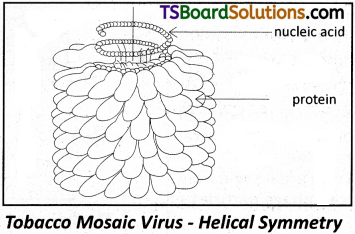
Helical virus are helical symmetry. They resemble long rods. Eg: RSbies virus and Tobacco mosaic virus.

Polyhedral symmetry :
Many plants and animals has polyhedral symmetry (many sides). Eg : Herpes simplex and polio viruses.

Binal symmetry :
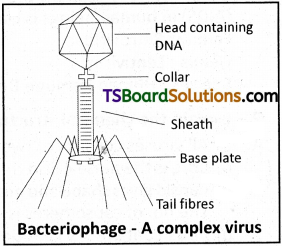
Bacteriophage have both polyhedral symmetry in the head and helical symmetry in the tail sheath.
Spherical virus are enveloped virus. Eg : Influenza virus.

Question 4.
Explain the structure of TMV. [Mar. ’18 ’14; May ’17]
Answer:

  1. TMV was the first virus to be crystallized by Stanley.
  2. Fraenkel described the structure of TMV.
  3. Tobacco Mosaic Virus is a rod shaped virus. It is about 300 nm long and 18 nm in diameter, with a molecular weight of 39 x 106 Daltons.
  4. The capsid is made up of 2,130 subunits called capsomeres.
  5. Capsomeres are arranged in a helical manner around a central core of 4 nm.
  6. Each protein subunit is made up of a single polypeptide chain with 158 amino acids.
  7. Single stranded RNA is present inside the capsid and is also spirally coiled.
  8. RNA of TMV consists of 6,500 nucleotides.

TS Inter 2nd Year Botany Study Material Chapter 8 Viruses 1

Question 5.
Explain the structure of T – even bacteriophages. [Mar. 17, May’14]
Answer:
TS Inter 2nd Year Botany Study Material Chapter 8 Viruses 2

  1. The body of T-even bacteriophage can be distinguished into head and tail regions joined by a collar.
  2. The tail region includes a tail sheath, a base plate, pins and tail fibres which help the virus attach to host cell.
  3. The tail sheath aids in injecting viral DNA into the host cell.

Question 6.
Explain the lytic cycle with reference to certain viruses. [Mar. 2019]
Answer:
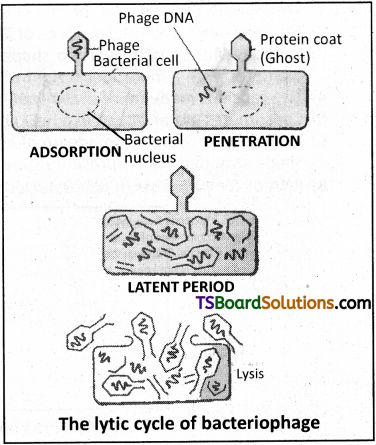
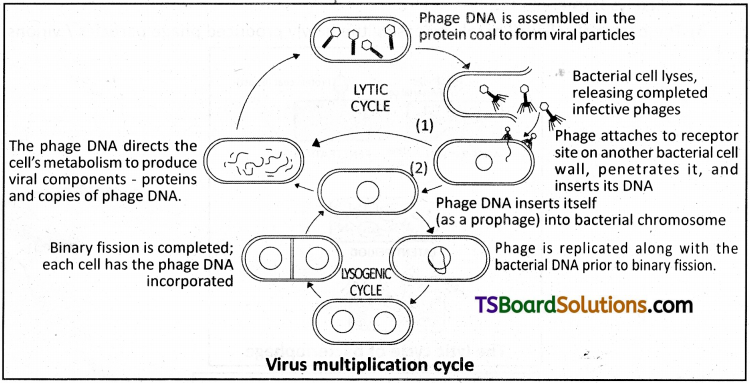
T – even phages that attack the bacterium E.coli cause lysis of the cells and are called virulent phages. They show lytic cycle. It involves 5 step process. They are 1. attachment 2. penetration 3. biosynthesis 4. maturation and 5. release.
TS Inter 2nd Year Botany Study Material Chapter 8 Viruses 3

1. Attachment:

  1. Contact of the virion to the surface of host bacterium is called attachment or adsorption.
  2. The phages use tail fibres for attachment to the complementary receptor sites on the bacterial cell wall.

2. Penetration :

  1. The injection of phage nucleic acid into the host cell is called penetration.
  2. The phage DNA is injected into the bacterium through the tail core like a hypodermal syringe.
  3. The capsid remains outside the bacterial cell and is referred to as ghost.

3. Biosynthesis :

  1. Once the phage DNA reaches the cytoplasm of the host cell, many copies of phage DNA, enzymes and capsid proteins are synthesized, using the cellular machinery of the host cell.
  2. Host cell do not contain any complete infective viruses.

4. Maturation :

  1. In this process bacteriophage DNA and capsids are assembled into complete virions.
  2. This period of time between the infection by a virus and the appearance of the mature virus within the cell is called the eclipse period.

5. Release :

  1. The final stage of viral multiplication is the lysis phase of the host cell and the release of virions from the host cell.
  2. The plasma membrane of the host cell gets dissolved or lysed due to viral enzyme called lysozyme.
  3. The bacterial cell wall breaks releasing the newly produced phage particles /virions.

TS Inter 2nd Year Botany Study Material Chapter 8 Viruses

Question 7.
Explain how temperate phages play a role in transduction.
Answer:
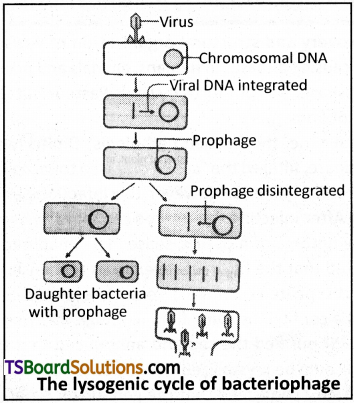
TS Inter 2nd Year Botany Study Material Chapter 8 Viruses 4

  1. In lysogenic cycle, some bacteriophages such as X (Lambda) phages do not cause lysis
    during multiplication.
  2. Instead, the phage DNA upon penetration into the E.coli gets integrated in to the circular bacterial DNA, becomes part of it and remains latent (inactive). Such phages are called temperate phages. This inserted phage DNA is now called prophage.
  3. Every time the bacterial genetic material replicates, the prophage also gets replication. The prophage remains latent in the progeny cells.
  4. However, rarely prophage gets disintegrated when they are exposed to UV light or some chemicals and enter into lytic cycle.
  5. Thus temperate phase plays a role of transduction by the transfer of genetic material from one bacterium to another through bacteriophage.

Question 8.
Mention the differences between lytic and lysogenic cycles.
Answer:

Lytic cycleLysogenic cycle
1. At the end of lytic cycle, bacterial cell undergoes lysis.1. Bacterial cell does not undergo immediate lysis.
2. The entry of viral DNA brings about the degradation of bacterial DNA.2. Bacterial DNA is not destroyed and viral DNA gets incorporated.
3. Prophages are not formed and the virulent phages do not allow bacteria to survive.3. Prophages persists in close relationship for long period even when bacterial cell undergoes many division cycles.
4. The viruses are called virulent phages. Eg : T – even phages4. The viruses are called temperate phages. Eg : Coliphage – λ

Long Answer Type Questions

Question 1.
Write about the discovery and structural organization of viruses.
Answer:

  1. Viruses have been causing diseases in humans, animals and plants from the ancient time.
  2. ‘Germ theory of disease’ was put forth by Louis Pasteur but the agent responsible for the diseases are not known.
  3. In 1892 for the first time, the Russian pathologist Dmitri Iwanowski, while studying tobacco mosaic disease, filtered the “sap of diseased tobacco leaf” through filter which was designed to retain bacteria. However the infectious agent passed through the pores of the filter. After injecting the filtered sap into the healthy plant, he found the development of symptoms of mosaic disease in it. Unable to see any microorganism in a sap, he reported that the filterable agent was responsible for the disease.
  4. Martinus Beijerinck repeated Iwanowski’s experiments and concluded that the disease causing agent was a contagious living fluid (contagium vivum fluidum).
  5. W.M. Stanley (1935) purified the sap and announced that the virus causing mosaic disease in tobacco could be crystallized. It was named as Tobacco Mosaic Virus (TMV).
  6. Fraenkel Conrat (1956) confirmed that the genetic material of the TMV is RNA.

TS Inter 2nd Year Botany Study Material Chapter 8 Viruses

Question 2.
Describe the process of multiplication of viruses.
Answer:
The process of multiplication of viruses is done by two alternative mechanisms.
a) Lytic cycle b) Lysogenic cycle

a) Lytic cycle :
T – even phages that attack the bacterium E.coli cause lysis of the cells and are called virulent phages. They show lytic cycle. It involves 5 step process. They are 1. attachment 2. penetration 3. biosynthesis 4. maturation and 5. release.

1. Attachment:

  1. Contact of the virion to the surface of host bacterium is called attachment or adsorption.
  2. The phages use tail fibres for attachment to the complementary receptor sites on the bacterial cell wall.

2. Penetration :

  1. The injection of phage nucleic acid into the host cell is called penetration.
  2. The phage DNA is injected into the bacterium through the tail core like a hypodermal syringe.
  3. The capsid remains outside the bacterial cell and is referred to as ghost.

3. Biosynthesis :

  1. Once the phage DNA reaches the cytoplasm of the host cell, many copies of phage DNA, enzymes and capsid proteins are synthesized, using the cellular machinery of the host cell.
  2. Host cell do not contain any complete infective viruses.

4. Maturation :

  1. In this process bacteriophage DNA and capsids are assembled into complete virions.
  2. This period of time between the infection by a virus and the appearance of the mature virus within the cell is called the eclipse period.

5. Release :

  1. The final stage of viral multiplication is the lysis phase of the host cell and the release of virions from the host cell.
  2. The plasma membrane of the host cell gets dissolved or lysed due to the viral enzyme called lysozyme.
  3. The bacterial cell wall breaks releasing the newly produced phage particles / virions.

TS Inter 2nd Year Botany Study Material Chapter 8 Viruses 3

b) Lysogenic cycle :
TS Inter 2nd Year Botany Study Material Chapter 8 Viruses 4

  1. In lysogenic cycle, some bacteriophages such as X (Lambda) phages do not cause lysis during multiplication.
  2. Instead the phage DNA upon penetration into the E.coli gets integrated in to the circular bacterial DNA, becomes part of it and remains latent (inactive). Such phages are called temperate phages. This inserted phage DNA is now called prophage.
  3. Every time the bacterial genetic material replicates, the prophase also gets replication. The prophage remains latent in the progeny cells.
  4. However, rarely prophage gets disintegrated when they are exposed to UV light or some chemicals and enter into lytic cycle.
  5. Thus temperate phase plays a role of transduction by the transfer of genetic material from one bacterium to another through bacteriophage.

TS Inter 2nd Year Botany Study Material Chapter 8 Viruses 5

Intext Question Answers

Question 1.
When discussing the multiplication of viruses, Virologists prefer to call the process as replication, rather than reproduction. Why?
Answer:

  1. Viral reproduction requires a living cell to takes place. Virus do not go through mitosis
    or cytogenesis nor do they have any mitotic machinery to produce new virus.
  2. Virus cannot reproduce without a host cell or infect whereas a reproductive cell are show independent replication.
  3. The cell infected by virus die immediately (lytic cycle) or after sometime (lysogenic cycle). Hence virologist prefer to call the multiplication of viruses as replication rather than reproduction.

TS Inter 2nd Year Botany Study Material Chapter 8 Viruses

Question 2.
In dealing with public health, the approach to deal with bacterial diseases is treatment. Can you guess the nature of the general public health approach to viral diseases ? What example do you cite to support your answer?
Answer:
The most effective medical approaches to viral diseases are vaccinations to provide immunity to infection and antiviral therapy to overcome drug resistance. Antibiotics have no effect on viruses. Ex : AIDS, Viral hepatitis and many more.

TS Inter 2nd Year Botany Study Material Chapter 7 Bacteria

Telangana TSBIE TS Inter 2nd Year Botany Study Material 7th Lesson Bacteria Textbook Questions and Answers.

TS Inter 2nd Year Botany Study Material 7th Lesson Bacteria

Very Short Answer Type Questions

Question 1.
Write briefly on the occurrence of micro-organisms.
Answer:

  1. Microorganisms are ubiquitous. They are found in soil, water, air, and inside living beings.
  2. They occur in a variety of foods and can withstand extreme cold, heat, and drought conditions.

Question 2.
Define Microbiology.
Answer:

  1. Microbiology is a branch of biological science that deals with the study of microorganisms like protozoa, microscopic algae, fungi (yeasts and molds) bacteria and viruses.
  2. It is concerned with structure, function, classification, ways to control and using the activities of microorganisms.

Question 3.
Name the bacteria which is a common inhabitant of human intestine. How is it used in biotechnology? [May 2014]
Answer:

  1. Escherichia coli (E.coli) is a common inhabitant of human intestine.
  2. It is used in Recombinant DNA technology for the production of insulin harmone.

Question 4.
What are pleomorphic bacteria? Give an example. [May ’17, Mar. ’14]
Answer:

  1. The bacteria that keep on changing their shape depending upon the type of environment and nutrients available are called pleomorphic bacteria.
  2. Eg : Acetobacter.

Question 5.
What is sex pilus? What is its function?
Answer:

  1. The process of conjugation requires a special conjugation apparatus called the conjugation tube or pilus or sex pilus.
  2. Its function is to transfer F plasmid from F+ donor to F recipient.

TS Inter 2nd Year Botany Study Material Chapter 7 Bacteria

Question 6.
What is a genophore? [Mar. 2019]
Answer:

  1. Bacterial chromosome is also called as genophore.
  2. It is the main genetic material of bacteria.

Question 7.
What is a plasmid? What is its significance?
Answer:

  1. Plasmids : Small circular, double stranded DNA molecules present is addition to the bacterial chromosome (genophore) in Bacteria.
  2. Plasmids contain genes, for resistance to drugs, production of toxins and enzymes. These are used as tools (vectors) in modern genetic engineering technique.

Question 8.
What is conjugation? Who discovered it and in which organism? [Mar. 2017]
Answer:

  1. Conjugation is a process, in which two live bacteria come together and the donor cell directly transfers DNA to the recipient cell.
  2. This process was first observed by Lederberg and Tatum (1946) in Escherichia coli.

Question 9.
What is transformation? Who discovered it and in which organism? [Mar. 2020]
Answer:

  1. Transformation is uptake of naked DNA fragments from the surrounding environment and the expression of that genetic information in the recipient cell.
  2. Frederick Griffith (1928) discovered it in Streptococcus pneumoniae.

Question 10.
What is transduction? Who discovered it and in which organism? [March 2010]
Answer:

  1. The transfer of genetic material from one bacterium to anotherthrough bacteriophage is known as transduction,
  2. It was discovered by Lederberg and Zinder (1951) in Salmonella typhimurium.

Short Answer Type Questions

Question 1.
Explain the importance of Microbiology.
Answer:
Microbiology is a branch of biological science that deals with the study of micro-organisms. Micro-organisms are useful in several ways for the welfare of human society.
1. Soil fertility :
Micro-organisms decompose dead plants and animals thereby enrich the soil with nutrients which are utilized by plants. Microbes also play vital role in recycling of elements like C, N, O, S, and P.

2. Antibiotics :
Alexander Fleming isolated an antibiotic Penicillin from a fungus, Penicillium notatum. Waksman isolated an antibiotic Streptomycin from a bacterium, Streptomyces griseus.

3. Industrial products :
Industrial products like enzymes, amino acids, vitamins, organic acids and alcohols are commercially produced using microbes.

4. Dairy products :
Lactobacillus, commonly known as Lactic Acid Bacteria (LAB) grows in milk and convert it to curd, which also improves its natural quality by increasing vitamin B12, food stuff, like cheese, yogurt are the byproducts of microbial growth.

5. Mining :
Metals like Uranium can be extracted with 50% reduced cost by using microbes.

6. Tools in Genetic Engineering :
Microbes are used as tools in altering the genetic make up of organisms.

7. Biocontrol agents :
Micro-organisms like Bacillus thuringiensis are used to control plant diseases and pests.,

8. Production of Biogas :
Biogas, a mixture of gases (predominantly methane) produced by the microbial activity. It may be used as fuel.

9. Exomicrobiology :
Microbes are used for the exploration of life in the outer space.

10. Sewage disposal :
Bacteria and fungi are also used in sewage disposal.

TS Inter 2nd Year Botany Study Material Chapter 7 Bacteria

Question 2.
How are bacteria classified on the basis of morphology?
Answer:
Based on their shape bacteria are classified into following types.
1. Cocci :
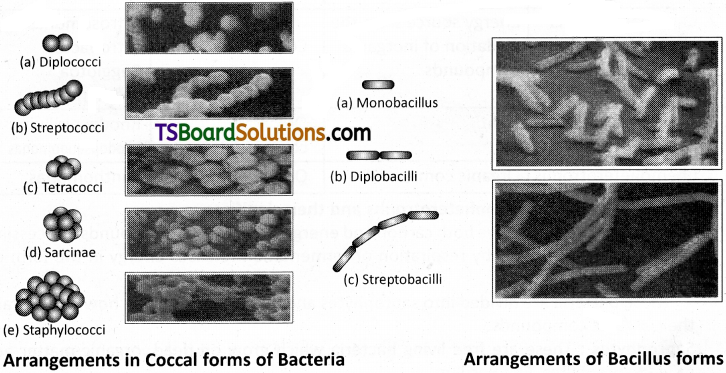
Spherical bacteria are called cocci. They are 6 types.
a) Monococcus : A single spherical bacterium.
b) Diplococcus : A pair of spherical bacterium.
c) Tetracocci : A group of four spherical bacteria.
d) Streptococcus : A linear chain of spherical bacteria arranged in a single row.
e) Sarcinae : Cocci arranged in cubes of eight.
f) Staphylococci : A group of cocci bacteria forming irregular shapes producing bunches.

2. Bacillus :
Elongated rod shaped bacteria are called bacillus. They are 3 types.
a) Monobacillus : A single elongated rod shaped bacterium.
b) Diplobacillus : Paired cells of bacilli.
c) Streptobacillus : Chains of bacilli appearing like straws.

TS Inter 2nd Year Botany Study Material Chapter 7 Bacteria 1

3. Spiral forms :
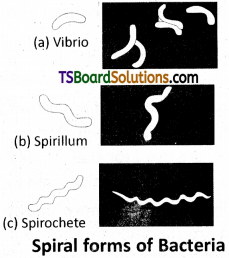
Vibrioid : Cells having less than one complete twist.
Spirillum : Cells that have more than one complete twist – a distinct helical shape. Spirochete : Cells are slender, long and cork-screw shaped.

4. Pleomorphic :
These bacteria change their shape depending upon the type of environment and nutrients available. This phenomenon is called pleomorphism.
Eg : Acetobacter.

Question 3.
How are bacteria classified on the basis of number and distribution of flagella?
Answer:
Based on the number and distribution of flagella bacteria are classified into 4 types.

  1. Monotrichous : A single flagellum is present on one side of the cell.
  2. Lophotrichous : A tuft of flagella are present on one side of the cell.
  3. Amphitrichous : Tufts of flagella or a single flagellum on either end of the cell.
  4. Peritrichous : Many flagella are distributed all over the cell surface.

Question 4.
What are the nutritional groups of bacteria based on their source of energy and carbon?
Answer:
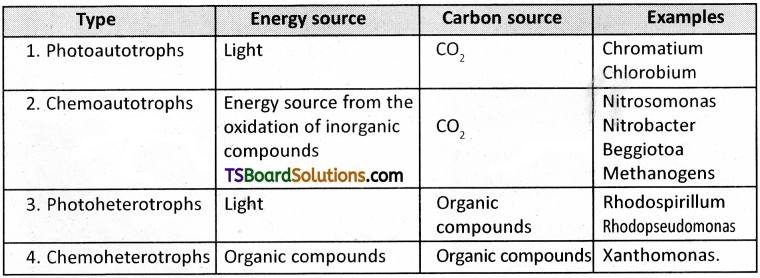
Four major nutritional groups of bacteria based on the source of energy and carbon are described below.
TS Inter 2nd Year Botany Study Material Chapter 7 Bacteria 3

Question 5.
Write briefly about chemoheterotrophs and their significance.
Answer:
Chemoheterotrophs derive both carbon and energy from organic compounds. Processing these organic molecules by respiration or fermentation releases energy in the form of ATP.

These bacteria are divided into saprophytes and parasites basing on how they obtain their organic compounds.

Saprophytes :
These are free living bacteria which grow on dead, organic matter are called Saprophytes. Eg : Bacillus

Parasites :
The bacteria which grow on or in living host and cause diseases are called parasites.
Eg : Xanthomonas, Salmonella.

Significance :
Most microbes of biomedical importance belong to these two categories. Bdellovibrio bacteriovorous grows as a parasite on some harmful bacteria and their abundance is supposed to be responsible for the microbial purity of Ganges waters.

TS Inter 2nd Year Botany Study Material Chapter 7 Bacteria

Question 6.
Explain the conjugation in bacteria.
Answer:
Conjugation :

  1. The transfer of genetic material (DNA) through direct cell to cell contact is known as conjugation.
  2. It was first reported by Lederberg and Tatum in 1946 in Escherichia coli.
  3. In E.coli, in addition to the bacterial chromosome or genophore which is the main genetic material, bacteria contain small circular, double stranded DNA molecules called plasmids or ‘F’ factor.
  4. E.coli having F factor are called F+ cells or donor cells and the cells without F factor are called F cells or acceptor cells.
  5. F+ cells have pilus or sex pilus. During conjugation the F+ and F strains come close together. Once contact is established, the pilus shortens to bring the two bacteria close together.
  6. A conjugation.tube is established. The plasmid in F+ replicates and forms a copy of it, which moves to the acceptor cell (F). Thus donor bacterium generally retain a copy of genetic material that is being transferred.

Long Answer Type Questions

Question 1.
Explain different methods of sexual reproduction in Bacteria.
Answer:
Sexual reproduction :
True sexual reproduction is absent in bacteria. However the exchange of genetic material is reported through other methods.

Three types of genetic recombinations are reported in different species of bacteria. They are

  1. Conjugation
  2. Transformation and
  3. Transduction.

1. Conjugation :

  1. The transfer of genetic material (DNA) through direct cell to cell contact is known as conjugation.
  2. It was first reported by Lederberg and Tatum in 1946 in Escherichia coli.
  3. In E.coli, in addition to the bacterial chromosome or genophore which is the main genetic material, bacteria contain small circular, double stranded DNA molecules called plasmids or ‘F’ factor.
  4. E.coli having F factor are called F+ cells or donor cells and the cells without F factor are called F cells or acceptor cells.
  5. F+ cells have pilus or sex pilus. During conjugation the F+ and F strains come close together. Once contact is established, the pilus shortens to bring the two bacteria close together.
  6. A conjugation tube is established, The plasmid in F+ replicates and forms a copy of it, which moves to the acceptor cell (F). Thus donor bacterium generally retain a copy of genetic material that is being transferred.

2. Transformation :
Transformation is uptake of naked DNA fragments from the surrounding environment and the expression of that genetic information in the
recipient cell. That is, the recipient cell has now acquired a characteristic that is previously lacked. This mode of bacterial genetic recombination was discovered by Frederick Griffith in streptococcus pneumoniae.

TS Inter 2nd Year Botany Study Material Chapter 7 Bacteria

3. Transduction :
The transfer of genetic material from one bacterium to another through bacteriophage is known as transduction.

Question 2.
“Bacteria are friends and foes of man” – discuss.
Answer:
Bacteria are known to be the casual agents of plant, animal and human diseases. At the same time there are many bacteria which are directly or indirectly beneficial to man. Thus, these organisms can be considered both as ‘friends and foes of man’.

Beneficial activities:

  1. Microbes are now used in extracting valuable metals like uranium from rocks. The process is known as Bio-mining. The use of microbes in mining reduces the cost of production by more than 50%.
  2. DNA components from bacteria are used as Biosensors that can detect biologically active toxic pollutants.
  3. Microbes also find application in medical diagnostics, food and fermentation operations.
  4. The most important development in Biotechnology depends on the possibility of altering the genetic makeup of bacteria through genetic engineering.
  5. Microbes in household products :
    a) A common example is the production of curd from milk micro-organisms such as Lactobacillus and others, commonly called lactic acid bacteria (LAB), grow in milk and convert into curd. It also improves its nutritional quality by increasing vitamin B12.
    b) Some of our food stuffs like cheese, yogurt are also actually the by- products of microbial growth.
  6. Microbes are used as biocontrol agents. Biocontrol refers to the use of biological methods for controlling plant diseases and pests.
  7. Many industrial products like enzymes, amino acids, vitamins, organic acid and alcohols are commercially produced by micro organisms.
  8. Microorganism decompose dead plants and animals and enrich the soil nutrients which can be used by plants. They play an important role in recycling of elements.
  9. Microbes cause diseases in plants and human beings. On the other hand, they help in creating disease free world by producing antibiotics and vaccinations. Penicillin was the antibiotic discovered by Alexander Fleming from a fungus, penicillin notatum. The antibiotic obtained from bacteria streptomyces griseus is known as streptomycin.
  10. Biogas is a mixture of gases (containing predominantly methane) produced by the microbial activity and which may be used as fuel.

Harmful activities:
Some bacteria that cause human diseases are

BacteriumDiseases
Clostridium tetaniTetanus
Clostridium botulinumBotulism
Vibrio choleraCholera
Salmonella typhiTyphoid
Corynebacterium diphtheriaeDiphtheria
Mycobacterium tuberculosisTuberculosis
Diplococcus pneumoniaPneumonia
Mycobacterium lepraeLeprosy
Neisseria gonorrhoeaGonorrhoea
Treponema pallidumSyphilis

Bacteria causes plant diseases :

DiseaseBacterium
Blight of riceXanthomonas oryzae
Citrus cankerX. axonopodis pv. citri
Crown gall of apples and pearsAgrobacterium tumefaciens

Bacteria also cause animal diseases :

DiseaseBacterium
Anthrax of sheepBacillus anthracis
Tuberculosis of dogs, cattle etc.Mycobacterium tuberculosis
Actinomycosis of cattleMycobacterium boris
VibriosisVibrio tetus

Intext Question Answers

Question 1.
Many people believe that bacteria do little more than cause human illness and infectious diseases. How does the information in this chapter help you correct that misconception?
Answer:
Most of the bacteria are beneficial activities than harmful activities.

Bacteria are known to be the casual agents of plant, animal and human diseases. At the same time there are many bacteria which are directly or indirectly beneficial to humans. Thus, these organisms can be considered both as ‘friends and foes of man’.”

Beneficial activities:

  1. Microbes are now used in extracting valuable metals like uranium from rocks. The process is known as Bio-mining. The use of microbes in mining reduces the cost of production by more than 50%.
  2. DNA components from bacteria are used as Biosensors that can detect biologically active toxic pollutants.
  3. Microbes also find application in medical diagnostics, food and fermentation operations.
  4. The most important development in Biotechnology depends on the possibility of altering the genetic makeup of bacteria through genetic engineering.
  5. Microbes in household products :
    a) A common example is the production of curd from milk micro-organisms such as Lactobacillus and others, commonly called lactic acid bacteria (LAB), grow in milk and convert into curd. It also improves its nutritional quality by increasing vitamin Bir
    b) Some of our food stuffs like cheese, yogurt are also actually the by-products of microbial growth.
  6. Microbes are used as biocontrol agents. Biocontrol refers to the use of biological methods for controlling plant diseases and pests.
  7. Many industrial products like enzymes, amino acids, vitamins, organic acid and alcohols are commercially produced by microorganisms.
  8. Microorganism decompose dead plants and animals and enrich the soil nutrients which can be used by plants. They play an important role in recycling of elements.
  9. Microbes cause diseases in plants and human being. On the other hand, they help in creating disease free world by producing antibiotics and vaccinations. Penicillin was antibiotic obtained from bacteria streptomyces griseus is known as streptomycin.
  10. Biogas is a mixture of gases (containing predominantly methane) produced by the microbial activity and which may be used as fuel.

Harmful activities:
Some bacteria that cause human diseases are

BacteriumDiseases
Clostridium tetaniTetanus
Clostridium botulinumBotulism
Vibrio choleraCholera
Salmonella typhiTyphoid
Corynebacterium diphtheriaeDiphtheria
Mycobacterium tuberculosisTuberculosis
Diplococcus pneumoniaPneumonia
Mycobacterium lepraeLeprosy
Neisseria gonorrhoeaGonorrhoea
Treponema pallidumSyphilis

Bacteria causes plant diseases ;

DiseaseBacterium
Blight of riceXanthomonas oryzae
Citrus cankerX. axonopodis pv. citri
Crown gall of apples and pearsAgrobacterium tumefaciens

Bacteria also cause animal diseases :

DiseaseBacterium
Anthrax of sheepBacillus anthracis
Tuberculosis of dogs, cattle etc.Mycobacterium tuberculosis
Actinomycosis of cattleMycobacterium boris
VibriosisVibrio tetus

TS Inter 2nd Year Botany Study Material Chapter 7 Bacteria

Question 2.
Humans produce about 50 grams of feces per day. Scientists estimated in broad terms about one -third of human feces is composed of bacteria. If one E.coli cell weighs 1 × 10-12 g, how many bacteria are there in a day’s feces? How can this be possible?
Answer:
Feces per day = 50 gram
Bacteria present = \(\frac{1}{3}\) × 50 gm
Each bacteria weight = 1 × 10-12 gm
Bacteria in a day’s feces = \(\frac{1}{3}\) × 50 × 1 × 10-12 gm
i.e., 16.66 × 10⁻¹²(approx)

Question 3.
An organism is described as a peritrichous bacillus. How might you translate this bacteriological language into a description of the organism?
Answer:
Bacillus indicates that bacteria are rod elongated in shape. Peritrichous indicates that bacteria is having many flagella distributed all over the cell surface flagella are locomotory in function.

TS Inter 2nd Year Botany Study Material Chapter 6 Plant Growth and Development

Telangana TSBIE TS Inter 2nd Year Botany Study Material 6th Lesson Plant Growth and Development Textbook Questions and Answers.

TS Inter 2nd Year Botany Study Material 6th Lesson Plant Growth and Development

Very Short Answer Type Questions

Question 1.
Define plasticity. Give an example.
Answer:

  1. Plasticity is the ability of plants to follow different pathways in response to the environment or phases of life to form different kinds of structures.
  2. Heterophylly is an example of plasticity.

Question 2.
What is the disease that formed the basis for the identification of gibberellins in plants? Name the causative fungus of the disease.
Answer:

  1. “Bakane” (foolish seedling) disease of rice seedlings.
  2. It is caused by a fungal pathogen Gibberella fujikuroi.

Question 3.
What is apical dominance? Name the growth hormone that causes it.
Answer:

  1. Apical dominance : The growing apical bud inhibits the growth of lateral (axillary) buds.
  2. It is caused by Auxins.

Question 4.
What is meant by bolting ? Which hormone causes bolting?
Answer:

  1. Bolting : Elongation of internodes just prior of flowering in plants with rosette habit (Eg : Beat, Cabbage).
  2. Gibberellins are responsible for bolting.

Question 5.
Define respiratory climactic. Name the PGR associated with it.
Answer:

  1. The rise in the rate of respiration during the ripening of the fruits is known as respiratory climatic.
  2. Ethylene is responsible for it.

TS Inter 2nd Year Botany Study Material Chapter 6 Plant Growth and Development

Question 6.
What is ethephon? Write its role in agricultural practices.
Answer:

  1. Ethephon in an aqueous solution. It is readily absorbed and transported within the plant and releases ethylene slowly.
  2. Ethephon hastens fruit ripening in tomatoes and apples and accelerates abscission in flowers and fruits. It also promotes female flowers in cucumbers and thereby increasing the yield.

Question 7.
Which of the PGR (Plant Growth Regulator) is called stress hormone and why?
Answer:

  1. Abscisic acid (ABA) is called as the stress hormone.
  2. It stimulates the closure of stomata in the epidermis and increases the tolerance of plants to various kinds of stresses.

Question 8.
What do you understand by vernalisation? Write its significance.
Answer:

  1. Vernalisation is the method of inducing early flowering in plants by pre-chilling treatment of their seeds or young shoots.
  2. Vernalization of winter varieties of wheat, barley and rye useful to early harvesting of crop.

Question 9.
Define the terms quiescence and dormancy.
Answer:

  1. Quiescence is the condition of a seed which is unable to germinate only because favourable external conditions normally required for growth are not present.
  2. Dormancy is the condition of a seed when it fails to germinate because of internal conditions, even though external conditions are suitable.

Short Answer Type Questions

Question 1.
Write a note on agricultural/horticultural applications of auxins. [Mar. ’17,’14; May ’14]
Answer:

  1. Auxins help to initiate rooting in stem cuttings, an application widely used for plant propagation in horticulture.
  2. Auxins promote flowering e.g. in pineapples.
  3. Auxins help to prevent fruit and leaf drop at early stages but promote the abscission of older mature leaves and fruits.
  4. Removal of shoot tips usually results in the growth of lateral buds. This is widely applied in tea plantations.
  5. Auxins also induce parthenocarpy. e.g. in tomatoes.
  6. Auxins (2, 4D) are widely used as herbicides.
  7. Auxins control xylem differentiation and help in growth.

TS Inter 2nd Year Botany Study Material Chapter 6 Plant Growth and Development

Question 2.
Write the physiological responses of gibberellins in plants. [Mar. 2019]
Answer:

  1. Gibberellins promote bolting (internode elongation just before flowering) in beet, cabbages and many plants with rosette habit.
  2. The ability to cause an increase in the length of axis is used to increase the length of grapes stalks.
  3. Gibberellins cause fruits like apple to elongate and improve their shape.
  4. Gibberellins delay senescence. Thus, fruits can be left on the tree longer so as to extend the market period.
  5. GA3 is used to speed up the malting process in brewing industry.
  6. Spraying Gibberellins on sugarcane crop increases the length of the stem, thus increasing the yield by as much as 20 tonnes per acre.
  7. Spraying juvenile conifers with Gibberellins fastens the maturity period, thus leading to early seed production.

Question 3.
Write any four physiological effects of cytokinins in plants. [Mar. ’18, May ’17]
Answer:

  1. Cytokinins have specific effects on cytokinesis (that means division of cytoplasm during cell division). It helps in occuring rapid cell division for example: root apices, developing shoot buds, young fruits etc.
  2. Cytokinins help to produce new leaves, chloroplasts in leaves, lateral shoot growth and adventitious shoot formation.
  3. Cytokinins help to overcome the apical dominance.
  4. Cytokinins promote nutrient mobilisation which helps in the delay of leaf senescence.

Question 4.
What are the physiological processes that are regulated by ethylene in plants? [Mar. 2020]
Answer:

  1. Ethylene accelerates the ripening of fruits. It is regarded as fruit ripening hormone.
  2. Effects of ethylene on plants include horizontal growth of seedlings, swelling of the axis and apical hook formation in dicot seedlings.
  3. Ethylene promotes senescence and abscission of plant organs, especially of leaves and flowers.
  4. Ethylene breaks seed and bud dormancy. It initiates germination in peanut seeds and sprouting of potato tubers.
  5. Ethylene promotes rapid internode/petiole elongation in deep water rice plants.
  6. Ethylene helps leaves/upper parts of the shoot to remain above water.
  7. Ethylene promotes root growth and root hair formation, thus helping plants to increase their absorption surface.
  8. Ethylene is used to initiate flowering and for synchronising fruit – set in pineapples. It also induces flowering in mango.

Question 5.
Write short notes on seed dormancy.
Answer:

  1. Dormancy is the condition of seed when it fails to germinate because of internal conditions, even though external conditions (e.g. temperature, moisture) are suitable.
  2. The dormancy may be caused by hard seed coats that prevents uptake of oxygen or water (e.g. fabaceae).
  3. Dormancy caused by hard seed coats can be broken by scarification.
  4. Seeds of certain plants (e.g.: tomato) contain chemical compounds, which inhibit their germination.
  5. Many seeds (e.g.: Polygonum) will not germinate untill they have been exposed to low temperatures in moist conditions in the presence of oxygen for weeks to months.
  6. Motet seeds respond to high temperatures and several seeds respond best when daily temperatures alternate between high and low.

TS Inter 2nd Year Botany Study Material Chapter 6 Plant Growth and Development

Question 6.
Which one of the plant growth regulators would you use if you are asked to
a) Induce rooting in a twig
b) QCiickly ripen a fruit
c) Delay leaf senescence
d) Induce growth in axillary buds
e) ‘Bolt’ a rosette plant
f) Induce immediate stomatal closure in leaves
g) Overcome apical dominance
h) Kill dicotyledonous weeds.
Answer:
a) Auxins like IBA, NAA
b) Ethylene
c) Cytokinin
d) Cytokinins
e) Gibberellins
f) Abscisic acid (ABA)
g) Cytokinins
h) Auxins (2-4 D)

Long Answer Type Questions

Question 1.
Define growth, differentiation, development, dedifferentiation, redifferentiation, determinate growth, meristem and growth rate.
Answer:
1) Growth :
Growth is defined as a permanent or irreversible increase in dry weight, size, mass or volume of a cell, organ or organism.

2) Differentiation :
The cells derived from root apical and shoot-apical meristems and cambium differentiate and mature to perform specific functions. This act leading to maturation is termed as differentiation.

3) Dedifferentiation :
The living differentiated cells, that have lost the capacity to divide, can regain the capacity of division under certain conditions. This phenomenon is called dedifferentiation, e.g.: Formation of meristems – interfascicular cambium and cork cambium from parenchyma cells.

4) Redifferentiation :
In the process of redifferentiation meristems/tissues are able to divide and produce cells that once again lose the capacity to divide but mature to perform specific functions. That means they get redifferentiation.

5) Determinate growth :
Leaves are specialised organs characterised by defined developmental destiny and determinate growth.

6) Meristem :
It is located at root and shoot tips. The meristem refers to the cells that remain dividing.

7) Growth rate :
Increased growth per unit time is termed as growth rate.

TS Inter 2nd Year Botany Study Material Chapter 6 Plant Growth and Development

Question 2.
Describe briefly
a) Arithmetic growth
b) Geometric growth
c) Sigmoid growth curve
d) Absolute and relative growth rates
Answer:
a) Arithmetic growth :
In arithmetic growth, following mitotic cell division, only one daughter cell continues to divide while the other differentiates and matures.

The simplest expression of arithmetic growth is exemplified by a root elongating at a constant rate. On plotting the length of the organ against time, a linear curve is obtained. Mathematically, it is expressed as

TS Inter 2nd Year Botany Study Material Chapter 6 Plant Growth and Development 1
Constant linear growth, a plot of length L against time t
L1 = L0 + rt
L1 = Length at time’t’
L0 = Length at time ‘zero’
r = growth rate/elongation per unit time.

b) Geometric growth :
In several systems, the initial growth is slow (lag phase). Growth increases rapidly thereafter at an exponential rate (log or exponential phase) S – curve is observed

TS Inter 2nd Year Botany Study Material Chapter 6 Plant Growth and Development 2
Diagrammatic representation of: (a) Arithmetic (b) Geometric growth and (c) Stages during embryo development showing geometric and arithmetic phases

c) Sigmoid curve growth :
A sigmoid curve is a characteristic of living organism growing in a natural environment. It is typical for all cells, tissues and organs of a plant.

TS Inter 2nd Year Botany Study Material Chapter 6 Plant Growth and Development 3
An idealised sigmoid growth curve typical of cells in culture, and many higher plants and plant organs

It consists of 3 phases namely
(a) Lag phase
(b) log phase
(c) Stationary phase

d) Absolute and relative growth rate :
Measurement and comparison of the total growth per unit time is called the absolute growth rate.

The growth of the given system per unit time expressed on a common basis e.g. per unit initial parameter is called the relative growth rate.

Question 3.
List five natural plant growth regulators. Write a note on discovery, physiological functions an agricultural/horticultural applications of any one of them.
Answer:

Plant Growth regulatorsDiscoveryPhysiological function and agricultural/horticultural application
1. Auxins
e.g.: 2AA, 2BA NAA, 2-4D.
Discovered by F.W. Went from coleoptile of Avena sativa.They promote stem growth by cell elongation. They stimulate root growth at very low concentration and are involved in apical dominance and tropism Auxins promote flowering.
e.g.: in pineapples.
2. Gibberillins
e.g.: GA, GA2 &GA3
Yabuta and Sumiki isolated crystalline gibberellin from the fungus.They promote stem growth of the internodes by cell elongation and break seed dormancy. They are involved in germination of seeds. GA3 is used to speed up malting in brewing industry.
3. Cytokinins
e.g. Zeatin
Letham (1963) isolated naturally occurring cytokinin in pure crystalline form from immature Maize seeds.They interact with auxins in apical meristem but promote lateral bud growth. It is necessary for cytokinesis. It retards senescence. It induces femaleness in flowers.
4. Abscisic acid (ABA)
e.g.:Dormin
Carns, Addicott and co-workers isolated abscisic acid from immature cotton fruits.It inhibits cell division and growth in stem and root. It promotes dormancy in both buds and seeds also. It induces parthenocarpy in rose.
5. Ethylene, a gaseous hormone (CH2 = CH2)Ethylene is a fruit ripening hormone. Ethylene is used to initiate flowering and for synchronising fruit-set in pineapples. It also induces flowering in Mango.

Note : Write any one of the above.

Intext Question Answers

Question 1.
Fill in the blanks with appropriate word/words.
a) The phase in which growth is most rapid is …………… .
b) Apical dominance as expressed in dicotyledonous plants is due to the presence of more …………… in the apical bud than in the lateral ones.
c) In addition to auxin, a ………….. must be supplied to the culture medium to obtain a good callus in plant tissue culture.
d) …………… of vegetative plants are the sites of photoperiodic perception.
Answer:
a) Log phase
b) Auxins
c) Cytokinins
d) Shoot apex of plant

TS Inter 2nd Year Botany Study Material Chapter 6 Plant Growth and Development

Question 2.
A primary root grows from 5 cm to 19 cm in a week. Calculate the growth rate and relative growth rate over the period.
Answer:
Growth rate is = \(\frac{19-5}{7}=\frac{14}{7}\) = 2 cm

Question 3.
Gibberellins promote the formation of ………….. flowers on genetically …………… plants in Cannabis whereas ethylene promotes formation of …………. flowers on genetically …………… plants.
Answer:
a) male
b) dwarf
c) female
d) dwarf

Question 4.
Classify the following plants into Long day plants (LDP), Short day plants (SDP) and Day neutral plants (DNP)
Xanthium, Spinach, Henbane (Hyoscyamus niger), Rice, Strawberry, Bryophyllum, Sunflower, Tomato, Maize.
Answer:
Xanthium – Short day plant
Spinach – Long day plant
Henbane – Short day plant
Rice – Short day plant
Strawberry – Short day plant
Bryophyllum – Short day plant
Sunflower – Day neutral plant
Tomato – Day neutral plant
Maize – Long day plant

Question 5.
A farmer grows cucumber plants in his field. He wants to increase the number of female flowers. Which plant growth regulator can be applied to achieve this?
Answer:
Auxins.

Question 6.
Where are the following hormones synthesized in plants?
a) IAA
b) Gibberellins
c) Cytokinins
Answer:
a) Shoot apex and to some extent root apex also contribute to the synthesis of auxins.

b) Gibberellins are synthesised from Acetyl co enzyme A. They are mostly synthesized in apical tissues. They also synthesised in developing seeds, fruits, young leaves of developing apical bud, and elongation shoots.

c) Natural cytokinin are synthesised in the regions where rapid cell division occurs for example root apices, developing shoot buds, young fruits, etc.

Question 7.
Light plays an important role in the life of all organisms. Name any three physiological processes in plants which are influenced by light.
Answer:

  1. Photosynthesis
  2. Photoperiodism
  3. Growth

TS Inter 2nd Year Botany Study Material Chapter 6 Plant Growth and Development

Question 8.
Growth is one of the characteristics of all living organisms. Do unicellular organisms also grow? If so, what are the parameters?
Answer:
Yes. If we plot the parameter of growth against time, we get a typical sigmoid or . S-curve.

Question 9.
Rice seedlings infected with fungus Gibberella fujikuroi are called foolish seedlings. What is the reason?
Answer:
The reason is the rice plants grew excessively tall and very little grain production. The plants were taller, thinner, and paler with little tillering as compared to healthy plants.

Question 10.
Why isn’t any one parameter good enough to demonstrate growth throughout the life of a flowering plant?
Answer:
Because growth depends upon cell division, nutrient supply, time, etc.

Question 11.
‘Both growth and differentiation in higher plants are open.’ Comment.
Answer:
Plants retain the capacity for unlimited growth throughout the life due to the presence of meristems at certain locations of their body. The cells of such meristems have the capacity to divide and self perpetite. The product, however, soon loses the capacity to divide and such cells make up plant body.

This form of growth where in new cells are always being added to the plant body by the activity of the meristem is called the open form of growth.

The cells divided from root apical and shoot apical meristems and cambium differentiate the nature to perform specific functions. It is called differentiation.

Differentiation in plants is open because cells/tissues arising out of the same meristems have different structures at maturity. The final structure at maturity of cell tissue is also determined by the location of the cell with in.

Question 12.
‘Both a short day plant and a long day plant can produce flowers simultaneously in a given place.’ Explain.
Answer:
A long day plant required the exposure to light for a period exceeding well defined critical duration while short day plant must be exposed to light for a period less than this critical duration before the flowering is initiated in them. It means that not only the duration of light but also the duration of dark period is of equal importance. Hence flowering depends not only a combination of light and dark exposure but also their relative durations.

That is why, both a short day and a long day plant produce flowering simultaneously in a given place when they are exposed to necessary inductive photoperiod required by them in artificial condition.

Question 13.
Would a defoliated plant respond to photoperiodic cycle? Why?
Answer:
No, a defoliated plant would not respond to photoperiodic cycle. Because the site of perception of light/dark duration is the leaves. In defoliated plants leaves are absent.

It has been hypothesised that there is a hormonal substances that is responsible for flowering. This hormonal substance migrates from leaves to shoot apices for inducing flowering only when the plants are exposed to the necessary inductive photoperiod.

TS Inter 2nd Year Botany Study Material Chapter 6 Plant Growth and Development

Question 14.
What would be expected to happen if
(1) GA3 is applied to rice seedlings.
(2) Dividing cells stop differentiating.
(3) A rotten fruit gets mixed with unripe fruits
(4) You forget to add cytokinin to the culture medium
Answer:
(1) Elongation of coleoptile occurs quickly.
(2) Undifferentiated mass of cells are formed.
(3) All the fruits will be mature.
(4) Shoot growth is inhibited.

TS Inter 2nd Year Botany Study Material Chapter 5 Respiration in Plants

Telangana TSBIE TS Inter 2nd Year Botany Study Material 5th Lesson Respiration in Plants Textbook Questions and Answers.

TS Inter 2nd Year Botany Study Material 5th Lesson Respiration in Plants

Very Short Answer Type Questions

Question 1.
Energy is released during the oxidation of compounds in respiration. How is this energy stored and released as and when it is needed?
Answer:

  1. Energy contained in respiratory substrates is released in a series of slow step wise reactions controlled by enzymes and stored as ATP.
  2. ATP is broken down whenever and wherever energy needs to be utilised.

Question 2.
Explain the term ‘Energy currency’. Which substance acts as energy currency in plants and animals?
Answer:

  1. ATP is broken down whenever and wherever energy needs to be utilised is cells of living organisms.
  2. ATP acts as energy currency in plants and animals.

Question 3.
Different substrates get oxidised during respiration. How does respiratory quotient (RQ) indicate which type of substrate i.e., carbohydrate, fat or protein is getting oxidised?
RQ = A/B
What do A and B stand for?
What type of substrates have RQ of 1, <1, >1?
Answer:
1. RQ is an index for type of substrate being used in respiration RQ = A/B, in which A stands for volume of CO2 evolved and B stands for volume of O2 consumed. Thus RQ = volume of CO2 evolved/Volume of O2 consumed.

2. RQ is 1, when carbohydrates are used as substrate. It is less than 1, when fats or proteins are used as substrate.

Question 4.
What is the specific role of F0 – F1 particles in respiration?
Answer:

  1. F0 is the integral membrane protein complex that forms the channel through which protons cross enter into matrix by crossing the inner membrane.
  2. F1 head piece is the peripheral membrane protein complex and contains the site for synthesis of ATP from ADP and inorganic phosphate.

Question 5.
When does anaerobic respiration occur in man and yeast?
Answer:

  1. Anaerobic respiration occurs during exercise in the muscles of man when oxygen is inadequate for cellular respiration.
  2. In yeast, anaerobic respiration occurs during fermentation.

TS Inter 2nd Year Botany Study Material Chapter 5 Respiration in Plants

Question 6.
Distinguish between obligate anaerobes and facultative anaerobes.
Answer:
1) Obligate anaerobe :
An organism that cannot grow in the presence of oxygen. It neither requires O2 to grow nor does it tolerate it.

2) Facultative anaerobe :
An organism can grow in either the presence or absence of oxygen. It does not require oxygen to grow but it does tolerate its presence.

Question 7.
Explain the economic importance of fermentation.
Answer:

  1. Fermentation is useful in making bread.
  2. It is useful for industrial production of organic acids and alcohol.

Question 8.
What is the common pathway for aerobic and anaerobic respirations? Where does it take place?
Answer:

  1. Glycolysis (EMP pathway) is the common pathway for both aerobic and anaerobic respirations.
  2. It occurs in cytoplasm of the cell and takes place is all living organisms.

Question 9.
Why are mitochondria termed as the power houses of the cell?
Answer:

  1. Mitochondria are found in eukaryotic cells and are seat of Krebs cycle and oxidative phosphorylation.
  2. They produce energy currency of the cell (ATP).

Question 10.
What is the reason for describing ATP synthesis in FQ – Fx particles of mitochondria as oxidative phosphorylation?
Answer:

  1. Oxygen acts as the final Hydrogen acceptor is ETS of aerobic respiration.
  2. Production of proton gradient and synthesis of ATP by ATP synthase in respiration are oxygen driven, hence it is called oxidative phosphorylation.

Question 11.
Which substance is known as the connecting link between glycolysis and Krebs cycle? How many carbons does it have?
Answer:

  1. Acetyl CoA is the connecting link between glycolysis and Krebs cycle.
  2. It consists of 2 carbon atoms.

TS Inter 2nd Year Botany Study Material Chapter 5 Respiration in Plants

Question 12.
What cellular organic substances are never used as respiratory substrates?
Answer:
Pure proteins or fats are never used as respiratory substrates.

Question 13.
Why is the RQ of fats less than that of carbohydrates?
Answer:
1. It requires more oxygen for complete oxidation, since C : O ratio in fats in very high.
TS Inter 2nd Year Botany Study Material Chapter 5 Respiration in Plants 1

Question 14.
What is meant by ‘Amphibolic pathway’?
Answer:

  1. The pathway involved both in catabolism and anabolism is termed as Amphibolic pathway.
  2. Eg. Respiratory pathway.

Question 15.
Name the mobile electron carriers of the respiratory electron transport chain in the inner mitochondrial membrane.
Answer:

  1. Cytochrome C that transfer electrons between complex III and IV of ETS.
  2. U biquinone that acts as electron carries in between complex II and III of ETS.

Question 16.
What is the final acceptor of electrons in aerobic respiration? From which complex does it receive electrons?
Answer:

  1. Oxygen is the final acceptor of electrons in aerobic respiration.
  2. It receives electrons from complex IV (cytochrome ‘c’ oxidase).

Short Answer Type Questions

Question 1.
What is meant by the statement ‘Aerobic respiration is more efficient’?
Answer:

  1. Aerobic respiration is the process that leads to a complete oxidation of organic substance in the presence of oxygen.
  2. It releases CO2, water and a large amount of energy present in the substrate.
  3. 686 k.cal of energy is released where as in anaerobic respiration only 56 k.Cal. is released.
  4. In aerobic respiration 36 ATP molecules are formed. Where as in anaerobic respiration only 2 ATP molecules are formed.

Question 2.
Pyruvic acid is the end product of glycolysis. What are the three metabolic fates of pyruvic acid under aerobic and anaerobic conditions?
Answer:
The fate of pyruvate depends upon the availability of O2 and the type of organism. The three metabolic fates of pyruvic acid are

  1. lactic acid fermentation
  2. alcoholic fermentation under anaerobic condition and
  3. aerobic respiration under aerobic condition.

TS Inter 2nd Year Botany Study Material Chapter 5 Respiration in Plants

Question 3.
The energy yield in terms of ATP is higher in aerobic respiration than during anaerobic respiration. Why is there anaerobic respiration even in organisms that live in aerobic condition like human beings and angiosperms?
Answer:

  1. Under the conditions of oxygen scarcity anaerobic respiration takes place in organism that live in aerobic conditions.
  2. For example because Muscle tissue under intense use muscle demands too much energy (ATP) and consume much more Oxygen to produce that energy. This high consumption leads to oxygen scarcity and the muscle cells begin to make lactic acid by anaerobic respiration to fulfill their energy needs.
  3. The first cells on this planet lived in an atmosphere that lacked O2. Even today all living organisms retain the enzymatic machinery to partially oxidise glucose without the help of oxygen during glycolysis.

Question 4.
Oxygen is an essential requirement for aerobic respiration but it enters the respiratory process at the end. Discuss.
Answer:

  1. Although the aerobic process of respiration takes place only in the presence of oxygen, the role of oxygen is limited to the terminal stage of the process.
  2. The presence of oxygen is vital, since it drives the whole process by removing hydrogen from the system.
  3. Oxygen acts as the final hydrogen acceptor.
  4. In respiration, it is the energy of oxidation-reduction utilised for Phosphorylation. It is for this reason that the process is called oxidative phosphorylation.

Question 5.
Respiration is an energy releasing and enzymatically controlled catabolic process which involves a stepwise oxidative breakdown of organic substances? Inside living cells.
In this statement about respiration, explain the meaning of i) step wise oxidative breakdown ii) organic substance (used as substrates).
Answer:
i) a) Respiration involves a stepwise oxidative breakdown of organic substances.
b) In the process of aerobic respiration it is divided into 4 phases. They are Glycolysis, TCA cycle, Electron Transport System and Oxidative Phosphorylation.
c) It is generally assumed that the process of respiration and production of ATP in each phase takes place in a stepwise manner.
d) The product of one pathway forms the substrate of the other pathway.
e) Various molecules produced during respiration are involved in other biochemical processes.
f) The respiratory substrate enters and withdraws from pathway.
g) ATP gets utilised whenever required and enzymatic rates are generally controlled.
h) Stepwise breakdown of organic substances makes the system more efficient in extracting and storing energy.

ii) Usually carbohydrates, glucose are oxidised to release energy but proteins, fats and even organic acids can be used as respiratory substrates in some plants under certain conditions.

Question 6.
Comment on the statement – Respiration is an energy producing process but ATP is used in some steps of the process.
Answer:

  1. Though respiration is an energy producing process ATP is utilised in two steps during glycolysis.
  2. First in the conversion of glucose into glucose 6 phosphate.
    Glucose + ATP → Glucose 6 phosphate + ADP.
  3. Second in the conversion of fructose 6 phosphate into Fructose 1-6 bisphosphate.
    Fructose 6 phosphate + ATP → fructose 1, 6 bisphosphate + ADP.

TS Inter 2nd Year Botany Study Material Chapter 5 Respiration in Plants

Question 7.
Explain briefly the process of glycolysis.
Answer:
Glycolysis occurs in the cytoplasm of all living organisms. In this process, glucose undergoes partial oxidation to form two molecules of pyruvic acid. The scheme of glycolysis was given by Gustav Embden, Meyerhof and J. Parnas and is often referred to as the EMP pathway.

In glycolysis, a chain of ten reactions, under the control of different enzymes takes place to produce pyruvate from glucose. They are

1) Phosphorylation :
Glucose is phosphorylated to give rise to glucose 6-phosphate one ATP is utilised.
TS Inter 2nd Year Botany Study Material Chapter 5 Respiration in Plants 2

2) Isomerisation :
Glucose 6 phosphate converts into isomer fructose 6 phosphate in the presence of phosphohexose isomerase.
TS Inter 2nd Year Botany Study Material Chapter 5 Respiration in Plants 3

3) Phosphorylation :
The enzyme phosphofructokinase uses another ATP molecule to transfer a phosphate group to fructose 1, 6 biphosphate.
TS Inter 2nd Year Botany Study Material Chapter 5 Respiration in Plants 4

4) Cleavage :
The enzyme aldolase splits fructose 1,6 bisphosphate into two sugars that are isomers to each other. They are Glyceraldehyde 3 phosphate & Dihydroxy acetone phosphate (DHAP).
TS Inter 2nd Year Botany Study Material Chapter 5 Respiration in Plants 5

5) Isomerisation :
Enzyme Triose phosphate isomerase rapidly inter-converts the molecules of DHAP and G3P.
TS Inter 2nd Year Botany Study Material Chapter 5 Respiration in Plants 6

6) Oxidation :
Glyceraldehyde-3-phosphate undergoes oxidation and phosphorylation in the presence of Glyceraldehyde dehydrogenase resulting in the dehydrogenase formation of 1, 3 bisphosphoglyceric acid and NADH.
TS Inter 2nd Year Botany Study Material Chapter 5 Respiration in Plants 7

7) Dephosphorylation :
Enzyme phosphoglycerokinase catalyses the dephosphorylation of 1, 3 bisphosphoglyceric add resulting 3 PGA. ATP is formed.
TS Inter 2nd Year Botany Study Material Chapter 5 Respiration in Plants 8

8) Intramolecular shift (Isomerisation) :
Enzyme phosphoglyceromutase transfers phosphate group from 3-carbon position to 2-carbon position resulting 2 PGA.
TS Inter 2nd Year Botany Study Material Chapter 5 Respiration in Plants 9

9) Dehydration :
The enzyme enolase catalyses the removal of one water molecule from 2 PGA resulting in PEP.
TS Inter 2nd Year Botany Study Material Chapter 5 Respiration in Plants 10

10) Dephosphorylation :
Phosphoenol pyruvic acid undergoes dephosphorylation in the presence of enzyme pyruvic kinase and results in the formation of pyruvic acid ATP is formed.
TS Inter 2nd Year Botany Study Material Chapter 5 Respiration in Plants 11
TS Inter 2nd Year Botany Study Material Chapter 5 Respiration in Plants 12

Question 8.
Why is the respiratory pathway referred to as an amphibolic pathway? Explain.
Answer:
a) Fatty acids would be broken down to acetyl CoA before entering the respiratory pathway when it is used as a substrate. But when the organism needs to synthesise fatty acids, acetyi CoA would be withdrawn from the respiratory pathway for it. Hence the respiratory pathway acts as both breakdown and the synthesis of fatty acids.

b) Similarly during the breakdown and the synthesis of protein too, respiratory intermediates forms the link.

c) The breaking down process within the living organism constitute catabolism, which synthesis is anabolism.

d) Because the respiratory pathway is involved in both anabolism and catabolism, it would be better to consider the respiratory pathway as an amphibolic pathway rather than as a catabolic one.

Question 9.
We commonly call ATP the energy currency of the cell. Can you think of some other energy carriers present in the cell? Name any two.
Answer:

  1. NADH and FADH2
  2. Oxidation of one molecule of NADH gives rise to 3 molecules of ATP.
  3. Oxidation of one molecule of FADH2 give rise to 2 molecules of ATP.
  4. This takes place in electron transport system for mitochondria.

Question 10.
ATP produced during glycolysis is a result of substrate level phosphorylation. Explain.
Answer:
Substrate level phosphorylation is a type of metabolic reaction that results in the formation of ATP by the direct transfer and donation of phosphate group to ADP. This occurs twice in Glycolysis.

  1. 1, 3 bis phospho glyceric acid form 3 phosphoglyceric acid. The enzyme phosphoglycero kinase, catalyses the phosphorylation. ADP molecule accepts the phosphate released in this reaction and gets converted into ATP.
  2. Phosphoenol pyruvic acid undergo dephosphorylation in the presence of the enzyme pyruvic kinase and results in the formation of pyruvic acid. ADP is converted to ATP.

Question 11.
Do you know of any step in Krebs cycle where there is a substrate level phosphorylation? Explain.
Answer:
In Krebs cycle, Succinyl coenzyme A splits into succinic acid and co-enzyme A by the catalytic activity of ‘Succinic acid thiokinase’. The energy released in this reaction is utilized to form ATP from ADP and inorganic phosphate (Pi). Because ATP formation is linked directly to conversion of substrate, this reaction is an example of substrate level phosphorylation.
TS Inter 2nd Year Botany Study Material Chapter 5 Respiration in Plants 13

TS Inter 2nd Year Botany Study Material Chapter 5 Respiration in Plants

Question 12.
When a substrate is being metabolised. Why doesn’t all the energy that is produced get released in one step ? Instead it is released in multiple steps. What is the advantage of step wise release of energy?
Answer:

  1. The stepwise release of chemical bond energy enables the cell to utilize that energy in ATP synthesis.
  2. It minimises the wastage of energy.
  3. It keeps the temperature of the cell low to prevent its burning.
  4. The activities of enzymes for different steps of respiration can be controlled.
  5. The intermediates of respiratory pathway can be used for the synthesis of other biomolecules.
    Thus stepwise release of energy makes the system more efficient in extracting and storing energy.

Question 13.
Respiration requires O2. How did the first cells on earth manage to survive in an atmosphere that lacked oxygen?
Answer:
The first cells on earth manage to survive in an atmosphere that lack oxygen are anaerobic bacteria. The facultative anaerobic organism is an organism usually bacterium, that makes ATP by aerobic respiration if oxygen is present but is also capable of switching to fermentation under anaerobic conditions. Thus facultative anaerobes is an organism that can grow in either the presence or absence of oxygen. It does not require O2 to grow but it does tolerate its presence. An obligate anaerobe is an organism that cannot grow in the presence of organism. It neither require O2 to grow nor does it tolerate it.

In any case, all living organisms remain the enzymatic machinery to partially oxidise glucose without the help of oxygen.

Question 14.
The energy yield in terms of ATP is higher in aerobic respiration than during anaerobic respiration. Explain.
Answer:

  1. The energy yield in terms of ATP during aerobic respiration is 38 ATP molecules.
  2. Glucose molecule gets completely oxidised in the presence of Oxygen.
    C6H12O6 + 6O2 → 6 CO2 + 6 H2O + energy
  3. Aerobic respiration involves Glycolysis, Krebs cycle and electron transport. 2 ATP molecules are utilised during Glycolysis. Hence net gain in aerobic respiration is 36 ATP molecules.
  4. The energy yield in terms of ATP during an aerobic respiration is only 2 ATP molecules. It involves Glycolysis and Fermentation Glucose molecule gets incomplete oxidation in the absence of oxygen.
    C6H12O6 → CO2 + Ethyl alcohol + Energy

Question 15.
RUBP carboxylase, PEPase, pyruvate dehydrogenase ATPase, cytochrome oxidase, Hexokinase, Lactic dehydrogenase.
Select the enzymes from the list above which are involved in
a) Photosynthesis
b) Respiration
c) Both photosynthesis and respiration.
Answer:
a) Enzymes in Photosynthesis : RUBP caboxylase, PEPase.

b) Enzymes in Respiration : Lactic dehydrogenase, Pyruvic dehydrogenase, Hexokinase, Cytochrome oxidase.

c) Enzymes in both photosynthesis and respiration : ATPase.

Question 16.
How does a tree trunk exchange gases with the environment although it lacks stomata?
Answer:
In stems, the living cells are organised in thin layers inside and beneath the bark. They also have openings called lenticels. The cells in the interior are dead and provide only mechanical support. Thus, most cells of a plant have at least a part of their surface in contact with air. This is also facilitated by the loose packing of parenchyma cells in leaves, stems and roots, which provide an interconnected network of air spaces.

Question 17.
Write about two energy yielding reactions of glycolysis.
Answer:
1) Phosphoglycerokinase enzyme catalyses the 1, 3 – bisphosphoglyceric acid resulting in the formation of 3-phosphoglyceric acid. ADP molecule accepts the phosphate released in this reaction and get converted into ATP. This process of ATP is known as substrate level phosphorylation.
phosphoglycerokinase
TS Inter 2nd Year Botany Study Material Chapter 5 Respiration in Plants 14

2) In the final step of glycolysis, phosphoenol pyruvic acid undergoes dephosphorylation in the presence of enzyme ‘pyruvic kinase’ and results in the formation of pyruvic acid. ADP is converted into ATP. This is also substrate level phosphorylation.
TS Inter 2nd Year Botany Study Material Chapter 5 Respiration in Plants 15

Question 18.
Name the site(s) of pyruvate synthesis. Also write the chemical reaction wherein pyruvic acid dehydrogenase acts as a catalyst.
Answer:
Sites of pyruvate are Cytosol
Pyruvate which is formed by the glycolytic catabolism of carbohydrates in the cytosol, after entering into mitochondrial matrix, undergoes oxidative decarboxylation by a complex set of reactions catalysed by pyruvic dehydrogenase. The reactions catalysed by pyruvate dehydrogenase require the participation of several coenzymes, including NAD+ and coenzyme A.
TS Inter 2nd Year Botany Study Material Chapter 5 Respiration in Plants 16

Question 19.
Mention the important series of events of aerobic respiration that occur in the matrix of the mitochondrion as well as the one that takes place in the inner membrane of the mitochondrion.
Answer:

  1. The important events that occur in the matrix of mitochondrion is TCA cycle or Krebs cycle or citric acid cycle.
  2. During citric acid cycle complete oxidation of pyruvate by the stepwise removal of all the hydrogen atoms leavings three molecules of CO2, Eight molecules of NADH + H+ and two molecules of ATP are formed.
  3. The important events that takes place in the inner membrane of the mitochondrion is Electron Transport System (ETS) and Oxidative Phosphorylation.
  4. During electron transport system the passing one of the electrons removed as part of the hydrogen atoms to molecules O2 with simultaneous synthesis of ATP takes place.

TS Inter 2nd Year Botany Study Material Chapter 5 Respiration in Plants

Question 20.
The respiratory pathway is believed to be a catabolic pathway. However, the nature of TCA cycle is amphibolic. Explain.
Answer

  1. Respiration has been considered as catabolic process and the respiratory pathway as a catobolic pathway.
  2. Fatty acids would be broken down to acetyl CoA before entering the respiratory pathway when it is used as a substrate. But when the organism needs fatty acids, acetyl CoA would be withdrawn from the respiratory pathway for it. Thus the respiratory pathway comes into the picture for both during the breakdown and synthesis of fatty acids.
  3. Similarly during the breakdown and synthesis of proteins too, respiratory intermediates form the link.
  4. The breakdown process within the living organism is called catabolism. The synthesis of his process is called anabolism.
  5. Thus the respiratory pathway includes both anabolism and catabolism. Hence it is better to consider respiration as an amphibolic pathway rather than catabolic one.

Question 21.
The net gain of ATP for the complete aerobic oxidation of glucose is 36. Explain.
Answer:
ATP produced during complete aerobic oxidation of one molecule of glucose is as follows.

I) Glycolysis:
i) ATP produced by substrate level phosphorylation
TS Inter 2nd Year Botany Study Material Chapter 5 Respiration in Plants 17

ii) From NADH generated in glycolysis
TS Inter 2nd Year Botany Study Material Chapter 5 Respiration in Plants 18

II) Oxidative decarboxylation of Pyruvic acid
TS Inter 2nd Year Botany Study Material Chapter 5 Respiration in Plants 19

III) Krebs’s Cycle
TS Inter 2nd Year Botany Study Material Chapter 5 Respiration in Plants 20

Long Answer Type Questions

Question 1.
In the following flow chart, replace the symbols a, b, c and d with appropriate terms. Briefly explain the process and give any two applications of it.
TS Inter 2nd Year Botany Study Material Chapter 5 Respiration in Plants 21
Answer:
TS Inter 2nd Year Botany Study Material Chapter 5 Respiration in Plants 22 TS Inter 2nd Year Botany Study Material Chapter 5 Respiration in Plants 23
This process is Fermentation.
In fermentation, the pyruvic acid the incomplete oxidation of glucose is achieved under anaerobic conditions by sets of reactions, where pyruvic acid is converted to C02 and ethanol. In some bacteria lactic acid is formed from pyruvic acid.

Applications :

  1. Fermentation is used for preparing alcohol by using yeast cell.
  2. In animal cells, like muscles during exercise when oxygen is inadequate for cellular respiration, pyruvic acid.is reduced to lactic acid by lactate dehydrogenase.

Question 2.
Explain Mitchell’s chemiosmosis in relation to oxidative phosphorylation.
Answer:
The synthesis of ATP in respiration is associated with the consumption of oxygen, hence it is referred as oxidative phosphorylation. The mechanism of mitochondrial ATP synthesis can be explained by Mitchell’s chemiosmosis. The transfer of electrons from NADH or FADH to oxygen through electron transport system results in proton transfer from matrix to inner membrane space of mitochondria. Due to this, proton concentration gradient is established across the inner mitochondrial membrane (more number of H+ on inner membrane space side and less on the matrix side).

The inner membrane Of mitochondria is virtually impermeable to protons and thus prevents the return of proton into the matrix.

However the ATP synthase (complex V) consists of the major components F1 and F0 .

F0 is the integral membrane protein complex that forms the channel through which protons cross the inner membrane.

F1 head piece is a peripheral membrane protein complex and contains the site for the synthesis of ATP from ADP and inorganic phosphate.

When H+ move down the gradient, energy is released some amount of energy helps in combining ADP and iP leading to the form of ATP. The energy of 3H+ moving down the potential gradient is sufficient to form one ATP molecule.
TS Inter 2nd Year Botany Study Material Chapter 5 Respiration in Plants 24
Diagramatic presentation of ATP synthesis in mitochondria

TS Inter 2nd Year Botany Study Material Chapter 5 Respiration in Plants

Question 3.
Oxygen is critical for aerobic respiration. Explain its role with respect to ETS.
Answer:
The energy stored in NADH + H+ and FADH2 are oxidised through electron transport system. The electrons are passed on to O2 resulting in the formation of H2O.

The metabolic pathway through which an electron passes from one carrier to another is called the Electron Transport System (ETS). It is present in the inner mitochondrial membrane.

  1. Electrons from NADH produced in the mitochondrial matrix during the citric acid cycle are oxidised by an NADH dehydrogenase (complex I) and the electrons are transferred to ubiquinone located within the inner membrane.
  2. Ubiquinone also receives reducing equivalents via FADH2 (complex II) that is generated during oxidation of succinate in the citric acid cycle.
  3. The reduced ubiquinone is then oxidised with the transfer of electrons to cytochrome c via cytochrome bcx complex (Complex III).
  4. Cytochrome c is a small protein attached to the outer surface of the inner membrane and acts as a mobile carrier for the transfer of electrons between complex III and IV.
  5. Complex IV refers to cytochrome c oxidase complex containing cytochromes a and a3 and two copper centres.

When the electrons pass from one carrier to another via complex I to IV in the electron transport chain, they are coupled to ATP synthase (complex V) for the production of ATP from ADP and inorganic phosphate.

The number of ATP molecules synthesised depends upon the nature of electron donor. Oxidation of one molecule of NADH gives rise to 3 molecules of ATP, while that of one molecule of FADH2 produces 2 molecules of ATP. Although the aerobic process of respiration takes place only in the presence of oxygen, the role of oxygen is limited to the terminal stage of the process. The presence of oxygen is vital, since it drives the whole process by removing hydrogen from the system.

Oxygen acts as the final hydrogen acceptor. Unlike photophosphorylation where it is the light energy that is utilised for the production of proton gradient required for phosphorylation.

In respiration it is the energy of oxidation – reduction utilised for the same process. It is for this reason that the process is called oxidative phosphorylation.
TS Inter 2nd Year Botany Study Material Chapter 5 Respiration in Plants 25

Question 4.
Enumerate the assumptions that we undertake in making the respiratory balance sheet. Are these assumptions valid for a living system ? Compare fermentation and aerobic respiration in this context.
Answer:
It is possible to make calculations of the net gain of ATP for every glucose molecule oxidised; but in reality this can remain only a theoretical exercise. These calculations can be made only on certain assumptions. These assumptions are :

  1. There is a sequential, orderly pathway functioning, with one substrate forming the next and with glycolysis, TCA cycle and ETS pathway following one after another.
  2. The NADH synthesised in glycolysis is transferred into the mitochondria and undergoes oxidative phosphorylation.
  3. None of the intermediates in the pathway are utilised to synthesise any other compound.
  4. Only glucose is being respired – no other alternative substrates are entering in the pathway at any of the intermediary stages.

These kinds of assumptions are not really valid in a living system because (1) all pathway work simultaneously and do not take place one after another. (2) Substrates enter the pathways and are withdrawn from it as and when necessary. (3) ATP is utilised as and when needed. (4) Enzymatic rates are controlled by multiple means.

Comparison of fermentation and aerobic respiration :

  1. Fermentation accounts for only a partial breakdown of glucose whereas in aerobic respiration glucose completely degraded to CO2 and H2O.
  2. In fermentation there is a net gain of only two molecules of ATP for each molecule of glucose degraded to pyruvic acid whereas many more molecules of ATP are generated under aerobic conditions.
  3. NADH is oxidised to NAD+ rather slowly in fermentation; however the reaction is very vigorous in the case of aerobic respiration.

Question 5.
Give an account of glycolysis. Where does it occur? What are the end products? Trace the fate of these products in both aerobic and anaerobic respiration. [Mar. ’20, 18, May ’17]
Answer:
Glycolysis occurs in the cytoplasm. The end product of glycolysis is pyruvic acid.

Glycolysis is the process in which glucose undergoes partial oxidation to form two molecules of pyruvic acid. It is as follows.
1) In the first of glycolysis, a phosphate group is added to glucose molecule in the formation of glucose-6-phosphate. ATP is utilised. This reaction is catalysed by hexokinase enzyme.
TS Inter 2nd Year Botany Study Material Chapter 5 Respiration in Plants 26

2) Phosphohexokinase enzyme catalyses the conversion of glucose-6-phosphate to its isomer fructose-6-phosphate.
TS Inter 2nd Year Botany Study Material Chapter 5 Respiration in Plants 27

3) Fructose-6-phosphate undergoes phosphorylation resulting Fructose-1, 6 bisphosphate. In this step ATP is utilised. This reaction is done by enzyme phosphofructokinase.
TS Inter 2nd Year Botany Study Material Chapter 5 Respiration in Plants 28

4) Fructose 1-6 bisphosphate with the help of enzyme aldolase splits into 2 molecules. They are glyceraldehyde 3 phosphate and dihydroxyacetone phosphate (DHAP).
TS Inter 2nd Year Botany Study Material Chapter 5 Respiration in Plants 29

5) Among the two trioses, only Glyceraldehyde 3 phosphate directly participates in the subsequent reactions.

On the other hand, dihydroxyacetone phosphate gets converted into glyceraldehyde- 3-phosphate in the presence of triose phosphate isomerase and can participate in the next reaction of glycolysis.
TS Inter 2nd Year Botany Study Material Chapter 5 Respiration in Plants 30

6) Glyceraidehyde-3-phosphate undergoes oxidation as well as phosphorylation in the presence of glyceraldehyde 3 phosphate dehychoganase resulting in the formation of 1-3-bisphospho glyceric acid and NADH.
TS Inter 2nd Year Botany Study Material Chapter 5 Respiration in Plants 31

7) Phosphoglycerokinase enzyme catalyses the dephosphorylation of 1,3 bisphosphoglyceric acid resulting in the formation of 3 phosphoglyceric acid. ADP molecule accepts the phosphate released in this reaction and gets converted into high energy compound ATP. This process of formation is known as substrate level phosphorylation.
TS Inter 2nd Year Botany Study Material Chapter 5 Respiration in Plants 32

8) Phosphoglyceromutase enzyme catalyses the transfer of phosphate group from 3-carbon position of 3 PGA to 2-carbon position leading to the formation of 2PGA.
TS Inter 2nd Year Botany Study Material Chapter 5 Respiration in Plants 33

9) The enzyme enolase catalyses the removal of one water molecule from 2-phospho- glyceric acid resulting in the formation of phosphoenol pyruvic acid.
TS Inter 2nd Year Botany Study Material Chapter 5 Respiration in Plants 34

10) Phosphoenol pyruvic acid undergoes dephosphorylation in the presence of the enzyme pyruvic kinase and results in the formation of pyruvic acid. ADP is converted to ATP. This is substrate level of TS Inter 2nd Year Botany Study Material Chapter 5 Respiration in Plants 35

Fate of Pyruvic acid :
The ultimate fate of pyruvic acid which is an end product of glycolysis depends upon the availability of oxygen. In the presence of oxygen it is completely oxidized into C02 and H20. If oxygen is not available, the pyruvic acid is converted to ethyl alcohol or other organic substances by fermentation during anaerobic respiration.
TS Inter 2nd Year Botany Study Material Chapter 5 Respiration in Plants 36

Question 6.
Explain the reactions of Kreb’s cycle.
Answer:
The reaction sequence of Kreb’s cycle is as below.
1. Condensation :
Acetyl co-enzyme A condenses with oxaloacetic acid and results in the formation of citric acid and co-enzyme A. This condensation reaction is catalysed by the enzyme ‘citric synthetase.’
TS Inter 2nd Year Botany Study Material Chapter 5 Respiration in Plants 37

2. Dehydration :
The enzyme ‘aconitase’ catalyses the removal of one molecule of water from citric acid leading to the formation of cis-aconitic acid.
TS Inter 2nd Year Botany Study Material Chapter 5 Respiration in Plants 38

3. Hydration :
Addition of one molecule of water is done in the presence of aconitase. Cis-aconitic acid forms Isocitric acid.
TS Inter 2nd Year Botany Study Material Chapter 5 Respiration in Plants 39

4. Oxidation -1 :
Isocitric acid undergoes dehydrogenation (oxidation) in the presence of ‘isocitric dehydrogenase’ enzyme, leading to the formation of oxalosuccinic acid. In this reaction NAD is reduced to NADH + H+.
TS Inter 2nd Year Botany Study Material Chapter 5 Respiration in Plants 40

5. Decarboxylation :
Oxalosuccinic acid releases one molecule of CO2 in the presence of oxalosuccinic decarboxylase enzyme and forms a – Ketoglutaric acid.
TS Inter 2nd Year Botany Study Material Chapter 5 Respiration in Plants 41

6. Oxidation – II :
α-ketoglutaric acid undergoes oxidation (dehydrogenase) decarboxylation and condensation with one molecule of CoA leading to the formation of succinyl coenzyme A.
TS Inter 2nd Year Botany Study Material Chapter 5 Respiration in Plants 42

7. Cleavage :
Succinyl coenzyme A splits into succinic acid and coenzyme A by the enzyme activity of succinic acid thiokinase. Energy released in this reaction is utilised to form ATP from ADP and inorganic phosphate.
TS Inter 2nd Year Botany Study Material Chapter 5 Respiration in Plants 43

8. Oxidation III :
Succinic acid then undergoes oxidation and forms Fumeric acid. Instead of NAD+, FAD serves as hydrogen acceptor in this reaction. Therefore FAD is reduced to FADH2. The enzyme which catalyses this reaction is known as succinic dehydrogenase.
TS Inter 2nd Year Botany Study Material Chapter 5 Respiration in Plants 44

9. Hydration :
The enzyme Fumerase mediates the addition of one water molecule to fumaric acid and leads to the formation of malic acid.
TS Inter 2nd Year Botany Study Material Chapter 5 Respiration in Plants 45

10. Oxidation IV :
In the presence of Malic dehydrogenase, Malic acid releases two hydrogen atoms and gives rise to oxaloacetic acid. In this step NAD+ acts as hydrogen acceptor and is converted into NADH + H+.
TS Inter 2nd Year Botany Study Material Chapter 5 Respiration in Plants 46
TS Inter 2nd Year Botany Study Material Chapter 5 Respiration in Plants 47

Intext Question Answers

Question 1.
Differentiate between
a) Respiration and Combustion
b) Glycolysis and Krebs cycle
c) Aerobic respiration and Fermentation
Answer:

a) Differences between Respiration and combustion :

RespirationCombustion
1. Respiration occurs in living cells.1. Combustion does not occur in living cells.
2. Energy is liberated in small quantities.2. Unlimited energy in liberated once during combustion.
3. The liberated energy is stored in ATP molecules.3. No energy is stored during combustion. So lot of it is wasted.

b) Differences between Glycolysis and Kreb’s cycle :

GlycolysisKrebs Cycle
1. Glycolysis occurs in cytoplasm of the cell.1. Krebs cycle occurs in mitochondria.
2. No generation of CO2 but consump-tion of 2 ATP under aerobic and anaerobic condition.2. Generation of C02 and no consumption of ATP under aerobic condition.
3. End product is 2 molecules of pyruvic acid.3. End products are CO2 and H2O with release of more energy.
4. Net gain of 8 ATP molecules per glucose molecule.4. Net gain of 30 ATP molecules per glucose molecule.

c) Differences between Aerobic respiration and Fermentation.

Aerobic respirationFermentation
1. Occurs in majority of organisms.1. Occurs in yeast & bacteria.
2. Occurs in the presence of O22. No need of O2
3. Complete oxidation of glucose occurs.3. Incomplete oxidation of glucose occurs under anaerobic condition.
4. End products are energy CO2 and water.4. End products are CO2 and ethanol alcohol.
5. Several enzymes are required.5. Few enzymes are required.

TS Inter 2nd Year Botany Study Material Chapter 5 Respiration in Plants

Question 2.
What are respiratory substrates? Name the most common respiratory substrate.
Answer:
The compounds that are oxidised during respiration are known as respiratory substrate. The most common respiratory substrate is glucose. Usually carbohydrates are oxidised to release energy but proteins, fats and even organic acids can be used as respiratory substrate.

Question 3.
Give the schematic representation of glycolysis.
Answer:
TS Inter 2nd Year Botany Study Material Chapter 5 Respiration in Plants 48

Question 4.
What are the main steps in aerobic respiration ? Where does it take place?
Answer:
The main steps in aerobic respiration are glycolysis, Krebs cycle, electron transport system and oxidative phosphorylation.

Glycolysis occurs in the cytosol of the cell, Krebs cycle occurs in the matrix of mitochondrion. Electron transport system and oxidative phosphorylation takes palce in the inner membrane of mitochondria.

Question 5.
Give the schematic representation of an overall view of Krebs cycle.
Answer:
TS Inter 2nd Year Botany Study Material Chapter 5 Respiration in Plants 49

Question 6.
Explain ETS.
Answer:
The metabolic pathway through which an electron passes from one carrier to another is called the electron transport system. It is present in the inner mitochondrial membrane.

  1. Electrons from NADH produced in the mitochondrial matrix during the citric acid cycle are oxidised by an NADH dehydrogenase (Complex – I)
  2. The electrons are then transferred to ubiquinone located within the inner membrane. Ubiquinone also receives reducing equivalents via FADH2 (complex II) that is generated during oxidation of succinate in the citric acid cycle.
  3. The reduced ubiquinone (ubiquinol) is then oxidised with the transfer of electrons to cytochrome c via cytochrome bc1 complex (complex III).
  4. Cytochrome c is a small protein attached to the outer surface of the inner membrane and acts as a mobile carrier for the transfer of electrons between complex III and IV.
  5. Complex IV refers to cytochrome c oxidase complex containing cytochrome a and a3 and two copper centres.

When the electrons passes from one carrier to another via complex I to IV in the electron transport chain, they are coupled to ATP synthase (Complex V) for the production of ATP from ADP and inorganic phosphate.

The number of ATP molecules synthesised depends on the nature of the electron donor. Oxidation of one molecule of NADH gives rise to 3 molecules of ATP, while the molecule of FADH2 produces 2 molecules of ATP.

Aerobic respiration takes place in the presence of oxygen. Oxygen drives the whole process by removing hydrogen from the system. Oxygen acts as a final hydrogen acceptor. Synthesis of ATP from ADP and ip coupled to electron transport from substrate to molecular oxygen is called oxidative phosphorylation.

Question 7.
Distinguish between the following :
a) Aerobic respiration and Anaerobic respiration.
b) Glycolysis and Fermentation.
c) Glycolysis and Citric acid cycle.
Answer:
a) Differences between Aerobic respiration and Anaerobic respiration :

Aerobic respirationAnaerobic respiration
1) It takes place in the presence of oxygen.1) It takes place in the absence of oxygen.
2) It involved two steps. The first step is glycolysis which is carried out in cyto-plasm and the second step in Krebs cycle which takes place in mitochondria.2) The complete process takes place outside the cytoplasm.
3) Complete oxidation of glucose takes place. C6H12O6 + 6O2 → 6CO2 + 6H2O + energy3) Incomplete oxidation of glucose takes place C6H12O6 → CO2 + Ethyl alcohol + energy
4) During this process 38 ATP per one gram mole of glucose are formed.4) During this process 2ATP molecules per one gram mole of glucose are formed.

b) Differences between Glycolysis and Fermentation.

GlycolysisFermentation
1) Glycolysis occurs in the cytoplasm of the cell and is present in all living organisms.1) In fermentation, the yeast, the incomplete oxidation of glucose is achieved under anaerobic conditions where pyruvic acid is converted to CO2 and ethanol.
2) In this process, glucose undergoes partial oxidation to form two molecules of pyruvic acid.2) The enzymes pyruvic acid decarboxylase and alocohol dehydrogenase Catalyse these reactions.
3) In plants, this glucose is derived from sucrose, which is the end product of photosynthesis or from storage carbohydrates.3) In both lactic acid and alcohol fermentation not much energy is released less than seven percent of the energy in glucose is released.
4) Sucrose is converted into glucose and fructose by the enzyme invertase and these two monosaccharides can readily enter the glycolytic pathway.4) Yeast poison themselves to death when the concentration of alcohol reaches about 13 percent.

c) Differences between Glycolysis and C trie acid cycle:

GlycolysisCitric acid cycle
1) It occurs inside the cytoplasm.1) Krebs cycle operates inside mitochondria.
2) It is straight or linear-oath wav.2) It is a cvclic pathway.
3) Glycolysis is the first step of respiration in which glucose is broken down to the level of pyruvate.3) Krebs cycle is the second step where an active acetyl group is broken down completely.
4) It is common both in aerobic and anaerobic respiration.4) It occurs only in aerobic respiration.
5) It degrades a molecule of glucose into two molecules of an organic substance, pyruvate.5) It degrades pyruvate completely into organic substances. (CO2 + H2O)

TS Inter 2nd Year Botany Study Material Chapter 5 Respiration in Plants

Question 8.
What are the assumptions made during the calculation of net gain of ATP?
Answer:
The assumptions are

  1. There is a sequential, orderly pathway functioning with one substrate forming the next and with glycolysis, TCA cycle and ETS pathway following one after another.
  2. The NADH synthesised in glycolysis is transferred into the mitochondria and undergoes oxidative phosphorylation.
  3. None of the intermediates in the pathway are utilised to synthesise any other compound.
  4. Only glucose is being respired – no other alternative substrates are entering in the pathway at any of the intermediary stages.

Question 9.
Discuss “The respiratory pathway is an amphibolic pathway.”
Answer:
The respiratory pathway is involved in both anabolism and catabolism. So it is considered as amphibolic pathway rather than as a catabolic one.
e.g. : Fatty acids would be broken down to acetyl CoA before entering the respiratory pathway when it is used as a substrate. But when the organism needs to synthesise fatty acids, acetyl CoA would be withdrawn from the respiratory pathway for it. Hence the respiratory pathway shows break down and synthesis of fatty acids.
e.g.: Similarly during the breakdown and the synthesis of proteins too, respiratory intermediate form the link. Thus the breaking down process with in the living organisms constitute catabolism while synthesis is anabolism.

Question 10.
Define RQ. What is its value for fats?
Answer:
The ratio of the volume of CO2 evolved to the volume of O2 consumed in respiration is called the Respiratory Quotient (RQ) or respiratory ratio.
TS Inter 2nd Year Botany Study Material Chapter 5 Respiration in Plants 50

Question 11.
What is oxidative phosphorylation?
Answer:
Synthesis of ATP from ADP and iP coupled to electron transport from substrate to molecular oxygen is called oxidative phosphorylation.

Question 12.
What is the significance of stepwise release of energy in respiration?
Answer:

Question 13.
Find the correct ascending sequence of the following, on the basis of energy released in respiratory oxidation.
a) 1 gm of fat
b) 1 gm of protein
c) 1 gm of glucose
d) 0.5 gm of protein + 0.5 gm of glucose
Answer:
Ascending order
a) 1 gm of fat
b) 1 gm of protein
c) 0.5 gm of protein + 0.5 gm of glucose
d) 1 gm of glucose

Question 14.
Name the products, respectively, in aerobic glycolysis in skeletal muscle and anaerobic fermentation in yeast.
Answer:
The product of glycolysis in aerobic skeleton muscle is — The product of anaerobic fermentation in yeast is C02 and ethanol.

Question 15.
If a person is feeling dizzy, glucose or fruit juice is given immediately but not a cheese, sandwich, which might have more energy. Why?
Answer:
Energy is released quickly in case of glucose or fruit juice, it is a quick process.

Question 16.
In a way green plants and cyanobacteria have synthesised ail the food on earth. Comment.
Answer:
Green plants and cyanobacteria prepare food materials by photosynthesis. They are producers. Consumers depend on them directly or indirectly. Thus green plants and cyanobacteria prepare food materials but not all the food on earth.

TS Inter 2nd Year Botany Study Material Chapter 5 Respiration in Plants

Question 17.
It is known that red muscle fibres in animals can work for longer periods of time continuously. How is this possible?
Answer:
Red muscle fibres are striated muscle. They contain large number of mitochondria which release energy. They work very speed and active for longer period but with little force. As they work, they are well developed according to Lamark’s theory. Smooth muscle fibres works more longer periods than red muscle fibres.

TS Inter 2nd Year Botany Study Material Chapter 4 Photosynthesis in Higher Plants

Telangana TSBIE TS Inter 2nd Year Botany Study Material 4th Lesson Photosynthesis in Higher Plants Textbook Questions and Answers.

TS Inter 2nd Year Botany Study Material 4th Lesson Photosynthesis in Higher Plants

Very Short Answer Type Questions

Question 1.
Name the processes which take place in the grana and stroma regions of chloroplasts.
Answer:
1. Grana :
Light reactions – trapping the light energy by membrane systems and synthesis of ATP and NADPH.

2. Stroma :
Dark reactions – carbon fixation leading to synthesis of sugars.

Question 2.
Can chloroplasts be passed on to progeny? How?
Answer:

  1. Yes, nearly equal number of chloroplasts among 2 daughter cells formed from a mother cell during mitosis.
  2. Maternal inheritance (cytoplasm of egg) in a sexually reproducing plant.

Question 3.
Where does the photolysis of H2O occur? What is its significance? [Mar. ’20, 17; May ’14]
Answer:

  1. Membrane of grana thylakoid and is associated with PSII.
  2. Oxygen liberated by splitting of H2Ois the main source of atmospheric O2, electrons released during photolysis replace those removed for PSI.

Question 4.
Where is the enzyme NADP reductase located? What is released if the proton gradient breaksdown?
Answer:

  1. The enzyme NADP reductase is located on the stroma side of the grana thylakoid membrane.
  2. Energy is released if the proton gradient breaks down and is stored in ATP.

Question 5.
Which tissue transports photosynthates ? What experiments prove this?
Answer:

  1. Phloem
  2. Ringing experiment

TS Inter 2nd Year Botany Study Material Chapter 4 Photosynthesis in Higher Plants

Question 6.
How many molecules of ATP and NADPH are needed to fix a molecule of CO2 in C3 plants? Where does this process occur?
Answer:

  1. In C3 plants, 3 molecules of ATP and 2 molecules of NADPH are required to fix one CO2 molecule.
  2. This process occurs by Calvin cycle in the stroma of chloroplast.

Question 7.
Explain the terms:
a) Hatch-Slack pathway
b) Calvin cycle
c) PEP carboxylase
d) Bundle sheath cells
Answer:
a) Hatch-Slack pathway :
It is also called as C4 cycle because the first stable compound in this cycle is a four carbon compound OAA (Oxalo Acetic Acid).

b) Calvin cycle :
It is also called as C3 pathway, because the first stable compound is this cycle is a three carbon compound PGA (phosphoglyceric acid)

c) PEP carboxylase :
The enzyme responsible for primary fixation of CO2 in C4 plants. It mediates the formation of C4 acids by reaction of CO2 with phosphoenolpyruvate.

d) Bundle sheath cells :
The large cells with thick walls impervious to gaseous exchange and no intercelliilo spaces present around the vascular bundles of the C4 pathway plants. These cells are characterised by a large number of agranular chloroplasts.

Question 8.
What is the role of NADP reductase in the development of proton gradient?
Answer:

  1. The NADP reductase enzyme is located on the stroma side of the membrane.
  2. It mediates the reduction of NADP+ to NADH + H+, creates protos gradient across the granathylakoid membrane.

Question 9.
Mention the components of ATPase enzyme. What is their location? Which part of the enzyme shows conformational change?
Answer:

  1. The ATPase enzyme consists of two parts : a) F0 (stalk) is embedded in thylakoid membrane and b) F1 (head) that protrudes into the stroma.
  2. F1 particle of the ATPase undergoes conformational changes to synthesize ATP molecules.

Question 10.
What products drive Calvin Cycle? What process regenerates them?
Answer:

  1. ATP and NADPH
  2. Light reaction – phostophosphorylation.

Question 11.
What is the basis for designating. C3 and C4 pathway of photosynthesis?
Answer:
1. C3 Pathway :
In plants with this pathway, the first product of CO2 fixation is a 3 Carbon containing acid (3 – phosphoglyceric acid / 3 – PGA).

2. C4 Pathway :
In plants with this pathway, the first product of CO2 fixation is a 4 Carbon containing acid (oxaloacetic acid / OAA).

Question 12.
Distinguish between action spectrum and absorption spectrum.
Answer:

  1. Action spectrum is the graph showing rate of photosynthesis as a function of different wavelengths of light.
  2. Absorption spectrum is the graph shows the absorption of different wavelengths of light by photosynthetic pigments.

TS Inter 2nd Year Botany Study Material Chapter 4 Photosynthesis in Higher Plants

Question 13.
Of the basic raw materials of photosynthesis, what is reduced? What is oxidised?
Answer:

  1. CO2 and H2O are the two raw materials of photosynthesis.
  2. CO2 is reduced and H2O is oxidized during photosynthesis.

Question 14.
Define the law of limiting factors proposed by Blackman. [Mar. 2019, May 2017]
Answer:
If a process (like photosynthesis) is conditioned as to its rapidity by a number of separate factors, the rate of the process is limited by the factor that is present in a relative minimal value.

Question 15.
What is Joseph Priestley’s contribution to the study of photosynthesis?
Answer:

  1. Plants restore to the air whatever breathing animals and burning candles remove, i.e., O2 is evolved during photosynthesis.
  2. His experiments revealed the essential role of air in the growth of green plants.

Question 16.
Comment on the contribution of Van Niel to the understanding of photosynthesis.
Answer:

  1. Experiments by Van Niel, on purple and green bacteria demonstrated that photosynthesis is essentially a light – dependent reaction.
  2. Niel inferred that the O2 evolved by the green plant comes from H2O, not from CO2.
    TS Inter 2nd Year Botany Study Material Chapter 4 Photosynthesis in Higher Plants 1

Question 17.
With reference to photosystem, bring out the meaning of the terms a) antennae b) reaction centre.
Answer:
a) Antennae :
All the pigments of a photosynten that form a light harvesting system. Those pigments absorb different wavelengths of light,

b) Reaction centre :
A special chlorophyll a in a photosystem forms. It converts light energy into chemical energy. In PS I, the reaction centre is P700 that has an absorption peak at 700 nm. In PS II, the reaction centre is P680 that has an absorption maximum at 680nm.

Question 18.
Why is photosynthetic electron transport from H2O to NADP+, named as Z-scheme?
Answer:

  1. The electrons released by photolysis are transported to NADP+ via PS II, electron carriers, PS I and electron carriers in non cyclic manner.
  2. In this, when all the carriers are placed in a sequence on a redox potential scale it appears like ‘Z’ and hence called as z – scheme.

Question 19.
What is the primary acceptor of CO2 in C3 plants? What is the first stable compound formed in a Calvin cycle?
Answer:

  1. The primary acceptor of CO2 in C3 plants is RuBP (Rubilose bi phosphate).
  2. The first stable compound formed in a Calvin cycle is PGA (phosphoglyceric acid).

TS Inter 2nd Year Botany Study Material Chapter 4 Photosynthesis in Higher Plants

Question 20.
What is the primary acceptor of CO2 in C4 plants? What is the first compound formed as a result of primary carboxylation in the C4 pathway? [Mar. 2018]
Answer:

  1. The primary acceptor of CO2 in C4 plants is PEP (phosphoenol pyruvate).
  2. The first compound formed due to primary carboxylation in the C4 pathway is OAA (oxaloacetic acid).

Short Answer Type Questions

Question 1.
Succulents are known to keep their stomata closed during the day to check transpiration. How do they meet their photosynthetic CO2 requirements?
Answer:

  1. Succulent plants have only one kind of photosynthetic cell in which CO2 is fixed during night and used to make glucose during day.
  2. In succulent plants there is an alternative pathway of CO2 fixatibn called Crassulacean Acid Metabolism (CAM). E.g.: Cacti Crassulaceae is one family of succulent plants.
  3. CAM pathway is similar to C4 pathway in that CO2 is trapped by highly efficient PEP carboxylase during night time.
  4. During day time, the malic acid undergoes oxidative carboxylation to form Pyruvic acid & CO2. CO2 is used for photosynthesis.

Question 2.
Chlorophyll ‘a’ is the primary pigment for light reaction. What are accessory pigments? What is their role in photosynthesis?
Answer:

  1. Chlorophyll ‘a’ is the primary pigment for light reaction other thylakoid pigments like chlorophyll b, xanthophylls and carotenoids are accessory pigments.
  2. Accessory pigments also absorb light and transferthe energy to chlorophyll a.
  3. They utilise wider range of wavelength of incoming light for photosynthesis.
  4. They also protect chlorophyll a from photo oxidation.

Question 3.
Does ‘dark reaction’ of photosynthesis require light? Explain.
Answer:

  1. No. Dark reaction does not depend on the presence of light but is dependent on the products of the light reaction i.e., ATP and NADPH besides H2O and CO2.
  2. ATP and NADPH are used to drive the process leading to the synthesis of food, sugars. This is called biosynthetic phase of photosynthesis.
  3. By convention, it is called dark reaction. However this should not be taken to mean that they occur in darkness.
  4. This could be verified. It is simple. Immediately after light becomes unavailable, the biosynthetic process continues for sometime and then stops. If then, light is made available, the synthesis starts again.

Question 4.
How are photosynthesis and respiration related to each other?
Answer:

  1. Photosynthesis is an anabolic process. Simple substances like carbondioxide and water combine and yield complex carbohydrates. E.g.: Glucose
    Respiration is an catabolic process. Complex carbohydrates (food materials) are broken into simpler substances like CO2 and H2O.
  2. Photosynthesis is a reductive process where as respiration is a oxidative process.
  3. Photosynthesis is an endogonic process where as respiration is endergonic process.
  4. In photosynthesis O2 is a by product. In Respiration O2 is utilised.
  5. Thus photosynthesis is opposite to respiration Photosynthesis equation is
    TS Inter 2nd Year Botany Study Material Chapter 4 Photosynthesis in Higher Plants 2
    Respiration equation is
    C6H120, + 6O2 → 6CO2 + 6H2O + 686 k.Cal

TS Inter 2nd Year Botany Study Material Chapter 4 Photosynthesis in Higher Plants

Question 5.
What conditions enable “RuBisCO” to function as oxygenase? Explain the ensuing process.
Answer:
RuBisCO is characterised by the fact that its active site can bind tb both CO2 and O2. It is the relative concentration of O2 and CO2 that determines which of the two will bind to the enzyme. If O2 concentration is more, RuBisCO function as Oxygenase, it binds with O2 and instead of forming 2 molecules of PGA, it forms one molecule of phosphoglycerate and phosphoglycolate. This pathway is called photorespiration.

In photorespiration pathway, sugars or ATP are not formed, moreover, there is a release of CO2 with the utilisation of ATP. Therefore photorespiration is a wasteful process.

Question 6.
Why does the rate of photosynthesis decrease at higher temperatures?
Answer:

  1. The effect of temperature is linked with the optimum range of enzymatic activity.
  2. The dark reactions, being enzymatic, they are temperature controlled. Though the light reactions are also temperature sensitive they are affected to a much lesser extent.
  3. Tropical plants (C4 plants) respond to higher temperatures than temperate plants (C3 plants).
  4. As enzymes gets denatured at higher temperatures the rate of photosynthesis decreases.

Question 7.
Explain how, during light reaction of photosynthesis, ATP synthesis is a chemiosmotic phenomenon.
Answer:

  1. ATP synthesis in the chloroplast is a chemiosmotic phenomenon.
  2. Like in respiration, in photosynthesis also ATP synthesis is linked to development of a proton gradient across the membrane.
  3. During splitting of water and also during oxidation of PQ. (plastoquinol) protons are released into the lumen of thylakoid.
  4. Hence the concentration of protons is many times greater than that of stroma, thus leading to proton concentration gradient.

Because of the concentration difference the protons try to move into the stroma, but thylakoids are impermeable to protons (H+).

However an enzyme complex ATPase enzyme is present in the membrane. It allows th’e movement of H+ through it into the stroma.

The ATPase enzyme consists of two parts.

  1. F0 is embeded in the membrane and forms a transmembrane channel that carries out facilitated diffusion of protons across the membrane.
  2. F1 that comes out of the stroma.
  3. The breakdown of the gradient provides enough energy to cause a conformational change in the F1 particle of the ATPase, which makes the enzyme synthesis several molecules of energy – packed ATP.

TS Inter 2nd Year Botany Study Material Chapter 4 Photosynthesis in Higher Plants 3

Question 8.
Explain how Calvin worked out the complete biosynthetic pathway for the synthesis of sugar.
Answer:

  1. The process leading to the synthesis of sugars is called biosynthetic phase of photosynthesis.
  2. ATP and NADPH are used in biosynthetic phase CO2 combines with H2O toTorm (CH2O) or sugar.
  3. The use of radioactive 14C by him in algal photosynthesis led to the discovery that the first CO2 fixation product was a 3 – carbon organic acid.
  4. Calvin also contributed to working out the complete biosynthetic pathway. Hence it is called Calvin cycle.
  5. Calvin cycle occurs in all photosynthetic plants.
  6. Calvin cycle can be described in three stages.

TS Inter 2nd Year Botany Study Material Chapter 4 Photosynthesis in Higher Plants 4

a) Carboxylation :
During which CO2 combines with ribulose 1, 5 bisphosphate and form 3 phosphoglyceric acid.

b) Reduction :
During which carbohydrate is formed at the expense of the photochemically made ATP and NADPH.

c) Regeneration :
During which the CO2 acceptor ribulose-1, 5 bisphosphate is formed again so that the cycle continues.

Question 9.
Six turns of Calvin cycle are required to generate one molecule of glucose. Explain.
Answer:

  1. With each turn of Calvin cycle, one CO2 molecule enters the system.
  2. With three turns, uptake of 3 molecules of CO2 and one triose (G – 3P) is available.
  3. Hence six turns, results in the uptake of six molecules of CO2 accounts for two triose (G – 3P), ultimately forms a glucose molecule.
  4. Thus the fixation of six molecules of CO2 and 6 turns of the cycle are required for the removal (net gain) of two molecules of triose (= one glucose molecule) from the pathway.
  5. For every CO2 molecule entering the Calvin cycle 3 molecules of ATP and 2 of NADPH are required. To make one molecule of glucose 6 turns of the cycle are required. Then for 6CO2, 18 ATP and 12 NADPH are required.

TS Inter 2nd Year Botany Study Material Chapter 4 Photosynthesis in Higher Plants

Question 10.
With the help of diagram, explain briefly the process of cyclic photo – phosphorylation. [May 2014]
Answer:

  1. In cyclic photo phosphorylation only PS I is functional, the electron is circulated within the photosystem and the phosphorylation occurs due to the cyclic flow of electrons.
  2. This takes place in stroma lamellae.
  3. Electrons in the reaction centre of PS I gets excited when they receive red light of wavelength 700 nm.
  4. In this process, the electrons from the reaction centre of P700 are conveyed to e- acceptor.
  5. The excited electron is cycled back to PS I complex through electron transport system.
  6. The cyclic flow results in the synthesis of ATP.
  7. Cyclic photo phosphorylation also occurs when only light of wavelength beyond 680 nm is available.
  8. In green plants, cyclic photo phosphorylation is an additional source of ATP required for chloroplast activities over and above that is required in the Calvin cycle.

TS Inter 2nd Year Botany Study Material Chapter 4 Photosynthesis in Higher Plants 5

Question 11.
In what type of plants do you come across ‘Kranz’ anatomy? To which conditions are those plants better adapted? How are these plants better adapted than the plants, which lack this anatomy?
Answer:
a) C4 plants.
b) C4 plants are better adapted to dry tropical regions, they tolerate high temperatures.
c) C4 plants are special. They have a special type of leaf anatomy.
They tolerate higher temperatures.
They show a response to high light intensities.
They lack a process called photorespiration.
They have greater productivity of biomass.

Question 12.
Explain the structure of the chloroplast. Draw a neat labelled diagram.
Answer:
Chloroplasts are double membrane bound. The space limited by the inner membrane of the chloroplast is called stroma. In the stroma, flattened membrane sacs called Thylakoids are present. Thylakoids are arranged in stacks like a piles of coins called grana. In addition there are flat membranous tubules called the stroma lamellae connecting the thylakoids of the different grana. The space in the thylakoids is called lumen. The stroma contains enzymes for the synthesis of carbohydrates and protein Dark reaction takes place in stroma. It also contain circular DNA and ribosomes. Thylakoids contain photosynthetic pigment. In it light reaction occurs.

TS Inter 2nd Year Botany Study Material Chapter 4 Photosynthesis in Higher Plants 6
Diagrammatic representation of an electron micrograph of a section of chloroplast

Question 13.
Explain why 12 molecules of water are used as substrate, instead of 6 molecules of water, in the following equation.
TS Inter 2nd Year Botany Study Material Chapter 4 Photosynthesis in Higher Plants 7
Answer:
By the middle of nineteenth century the key features of plant photosynthesis were know, namely, that plants could use light energy to make carbohydrates from CO2 and water.
TS Inter 2nd Year Botany Study Material Chapter 4 Photosynthesis in Higher Plants 8

In the equation when 6 molecules of water is used it denotes that O2 is evolved from CO2.
TS Inter 2nd Year Botany Study Material Chapter 4 Photosynthesis in Higher Plants 9

But Cornelius Van Neil of based on his studies (1897 -1985) purple and green bacteria demonstrated that photosynthesis is – light essentially a dependent reaction in which hydrogen from a suitable oxidisable compound reduces CO2 to carbohydrates. This is expressed as
TS Inter 2nd Year Botany Study Material Chapter 4 Photosynthesis in Higher Plants 10

In green plants H2O is the hydrogen donor and is oxidised to O2. Some organisms do not release O2 during photosynthesis. When H2S is the hydrogen donor for purple and green sulphur bacteria, the ‘oxidation’ product is sulphur or sulphate depending on the arganism and not O2. Hence Niel inferred that the O2 evolved by the green plant comes from H2O, not from CO2. This was later proved by using isotopic techniques. The correct equation is
TS Inter 2nd Year Botany Study Material Chapter 4 Photosynthesis in Higher Plants 11

Question 14.
Compare and contrast the absorption spectrum of chlorophylls and carotenoids.
Answer:
Absorption spectrum is a graph showing the absorption of light by pigments at different wavelengths. Chlorophyll a shows the maximum absorption of light and also shows higher rate of photosynthesis in the blue and red regions. Hence we can conclude that chlorophyll a is the chief pigment associated with photosynthesis.

Carotenoid is an accessory pigment. It also absorbs light and transfer the energy to chlorophyll a.

Question 15.
Which group of plants exhibits two types of photosynthetic cells? What is the first product of carboxylation? What carboxylating enzyme is present in bundle sheath cells and mesophyll cells?
Answer:

  1. C4 plants exhibit two types of photosynthetic cells.
  2. OAA (oxaloacetic acid) is the first product of carboxylation.
  3. PEP carboxylase is present in mesophyll cells Ribulose biphosphate carboxylase- oxygenase (RuBisCO) is present in bundle sheath cells.

TS Inter 2nd Year Botany Study Material Chapter 4 Photosynthesis in Higher Plants

Question 16.
A cyclic process is occurring in a C3 plant, which is light dependent and needs O2. This process does not produce energy rather it consumes energy.
a) Can you name the given process?
b) Is it essential for survival?
c) What are the end products of this process?
d) Where does it occur?
Answer:
a) Yes, it is photorespiration.
b) Yes, though it is wasteful process, it is essential, as it protects from photo oxidative damage.
c) CO2 is the end product.
d) It occurs in chloroplast, peroxysomes and mitochondria.

Question 17.
Suppose Euphorbia and Maize are grown in the tropical area.
a) Which one of them do you think will be able to survive under such conditions?
b) Which one of them is more efficient in terms of photosynthetic activity?
c) What differences do you think are there in the leaf?
Answer:
a) Euphorbia (C4 plants grown in tropical area)
b) Maize CO2 fixation is done both in Mesophyll cell and Bundle sheath cell.
c) Kranz anatomy in Maize leaf.

Long Answer Type Questions

Question 1.
The entire process of photosynthesis consists of a number of reactions. Where in the cell do each of these take place?
a) Synthesis of ATP and NADPH
b) Photolysis of water
c) Fixation of CO2
d) Synthesis of sugar molecule
e) Synthesis of starch
Answer:
a) This occur in Grana thylakoid.
b) PS II – Oxygen Evolving Complex (OEC) is associated with the PS II, which itself is physically located on the inner side of the membrane of the thylakoid.
c) Stroma of chloroplast.
d) Cytoplasm
e) Cytoplasm

Question 2.
Which property of pigments is responsible for its ability to initiate the process of photosynthesis? Why is the rate of photosynthesis higher in red and blue regions of the spectrum of light?
Answer:

  1. Ability to absorb light at specific wavelength initiates the process of photosynthesis.
  2. Absorption spectrum of chlorophyll a show maximum absorption of light at blue and red regions.
  3. Action spectrum shows the rate of photosynthesis it is maximum at blue and red region.
  4. Absorption spectrum and action spectrum clearly indicate that chlorophyll a is the chief pigment associated with photosynthesis. The rate of photosynthesis is higher in red and blue regions of the spectrum due to it absorption of light wavelengths.

Question 3.
Under what conditions are C4 plants superior to C3?
Answer:

C3 plantsC4 plants
1. In C3 plants chloroplast dimorphism is not present. Cells participating will have only one type of chloroplast.1. In C4 plants chloroplasts show dimorphism. Cell participating will have two types of chloroplasts (agranal and granal).
2. Only Calvin cycle occurs.2. C4 pathway in mesophyll cells and Calvin cycle in bundle sheath cells takes place.
3. C3 plants are less efficient in utilizing the atmospheric CO2.3. Move efficient in utilizingthe atmospheric CO2.
4. Photorespiration (a waste process) is very high.4. Photorespiration is not detectable.
5. Photosynthetic yield is low to average.5. Photosynthetic yield is very high.
6. Water use efficiency is low.6. Water use efficiency is high.
7. C O2 compensation point is very high.7. C O2 compensation point is low.

Because of these above differences C4 plants are considered to be superior than C3 plants.

TS Inter 2nd Year Botany Study Material Chapter 4 Photosynthesis in Higher Plants

4. a) How can we plot an action spectrum? What does the action spectrum indicate? Explain with an example.
b) How can we derive an absorption spectrum for any substance?
c) If chlorophyll ‘a’ is responsible for light reaction of photosynthesis, why do the action spectrum and absorption spectrum not overlap?
Answer:
a) Rate of photosynthesis is measured by O2 released. By drawing a graph between the rate of photosynthesis on x-axis and the wavelength of light on y – axis we can plot an action spectrum.

It indicates the wavelengths at which maximum photosynthesis occurs in plants. Graph shows that chlorophyll a show maximum rate of photosynthesis in the blue and the red regions. Hence chlorophyll ‘a’ is considered as chief pigment associated with photosynthesis.

b) The absorption spectrum for any substance is the ability of the substance to absorb lights at different wavelength.

c) The action spectrum and absorption spectrum does not overlap because the rate of photosynthesis at different wave length is not uniform. Accessory pigment absorbs light at different wavelengths.

Question 5.
What are the important events and end products of light reactions?
Answer:
In light reaction, important events are light absorption, water splitting, oxygen release and the end products are ATP and NADPH.

Light absorption :
The molecules that absorb light are called pigments. The pigments are organised into two discrete photochemical light harvesting complexes (LHC) within the photosystem I (PS I) and photosystem II (PS II). Each photosystem has all the pigments forming a light harvesting system called antennae. The antennae serves to absorb radiant energy. They supply this energy finally to reaction centre. Reaction centre is chlorophyll ‘a’ molecule. It converts light energy into chemical energy. The reaction centre in PS I is P700. The reaction centre in PS II is P680.

Cyclic and Non-cyclic Photo phosphorylation :
The process of forming ATP by cells is named phosphorylation. As it is done in the presence of light, it is called photo phosphorylation. It is of two types.

  1. Cyclic photo phosphorylation
  2. Non-cyclic photo phosphorylation.

1) Cyclic photo – phosphorylation :

  1. In cyclic photo phosphorylation only PS I is functional. The electron is circulated within the photosystem and the phosphorylation occurs due to cyclic flow of electrons.
  2. It takes place in stroma lamellae.
  3. The electrons in the reaction centre of PS I gets excited when they receive red light of wave length 700 nm.
  4. In this process, the electrons from the reaction centre of PS I are conveyed to e“ acceptor.
  5. The excited electron is cycled back to PS I through electron transport system.
  6. The cyclic flow results in the synthesis of ATP.

2) Non-cyclic photo phosphorylation :

  1. When the two photosystems work in a series, first PS I! and then PS I a process called non-cyclic photo phosphorylation occurs.
  2. In PS II, the reaction centre chlorophyll a absorbs 680 nm wavelength of red light causing electrons to become excited and jump.
  3. The electrons are picked up by an electron acceptor.
  4. From there it passes through electron transport system consists of cytochrome and reaches PS I.
  5. Simultaneously electrons in the reaction centre PS I also gets excited when they receive red light of 700 nm wavelength.
  6. The electrons from the PS i are conveyed to e acceptor.
  7. These electrons then are moved downhill again, to a molecule of energy rich NADP+.
  8. The addition of these electrons reduces NADP+ to NADPH + H+.
    Non-cyclic photo phosphorylation is also called Z-scheme.

Splitting of water:

  1. The electrons that are moved from PS II are supplied with electrons continuously by splitting of water.
  2. The electrons removed from PS I are provided by PS II.
  3. Water splitting complex (oxygen evolving complex) is responsible for photolysis of water.
    2H2O → 4H+ + O2 + 4e

Thus oxygen released is one of the net products of photosynthesis.
The end products of light reaction are ATP, NADPH and O2.
TS Inter 2nd Year Botany Study Material Chapter 4 Photosynthesis in Higher Plants 12

Question 6.
Explain various aspects of Mitchell chemiosmotic hypothesis, with the help of diagrams.
Answer:
Mitchell proposed chemiosmotic hypothesis to explain ATP synthesis.
ATP synthesis is linked to development of proton gradient across the membrane.

a) Since splitting of the water molecule takes place on the inner side of the membrane, the protons or hydrogen ions that are produced by the splitting of water accumulate within the lumen of the thylakoids.

b) As electrons move through the transport chain, protons are transported across the membrane. This happens because the primary acceptor of electrons which are located towards the outer side of the membrane transfers its electron not to electron carrier, but to (H+) proton carrier (PQ). Hence it removes protons, from the stroma which transporting an electron. When this molecule passes its electron, to the electron carrier on the inner side of the membrane, the proton is released into the inner side or lumen of the membrane. Then proton gradient across the membrane increases due to quinones.

c) The NADP reductase enzyme is located on the stroma side of the membrane. Along with the electrons that come from the acceptor of electrons of PS I, protons are necessary for the reduction of NADP+ to N ADPH + H+. These protons are also removed from the stroma. Thus protons in the stroma decrease in number. Where as in lumen protons are accumulated. This creates a proton gradient across the thylakoid membrane and the pH in the lumen decreases.
TS Inter 2nd Year Botany Study Material Chapter 4 Photosynthesis in Higher Plants 13

The proton gradient is broken down due to the movement of protons across the membrane to the stroma through the transmembrane channel of ATPase. ATPase consists of two parts.

  1. One is F0. F0 is embeded in the membrane that forms transmembrane channel it carries facilitated diffusion of protons across the membrane.
  2. Other one is F1 It protrudes on the outer surface of the thylakoid membrane.

Diffusion of protons across the membrane releases enough energy to activate ATPase enzyme that catalyses the formation of ATP.

TS Inter 2nd Year Botany Study Material Chapter 4 Photosynthesis in Higher Plants

Question 7.
Comment on the dual role of RuBisCO. What is the basis for its oxygenation activity? Why is this activity absent or negligible in C4 plants?
Answer:
RuBisCO is the most abundant enzyme in the world. It is characterised by the fact that its active site can bind to both CO2 and O2. Thus it shows dual role. It is written a Ribulose bisphosphate carboxylase – oxygenase. Generally, RuBisCo has greater affinity for CO2 than O2. This binding is competitive. It is the relative concentration of O2 and CO2 that determines which of the two will bind to the enzyme.

In C3 plants some O2 does bind to RuBisCO and hence CO2 fixation is reduced. Here RuBP instead of forming 2 molecules of PGA forms one molecule of phosphoglycerate and phosphoglycelate. This pathway is called photorespiration. In this photorespiration sugar or ATP or NADP are not formed. Moreover, CO2 is released with the utilisation of ATP molecule. Hence it is wasteful process.

In C4 plants photorespiration is negligible or absent because mechanism that increases the concentration of CO2 at the enzyme site. C4 acid from the mesophyll is broken down in the bundle sheath cells to release CO2. This results in increasing the intracellular concentration of CO2. This makes RuBisCO function as carboxylase, minimising oxygenase activity.

Intext Question Answers

Question 1.
By looking at a plant externally, can you tell whether a plant is C3 or C4? Why and how?
Answer:
In C3 plants photorespiration occurs. In C3 plants transpiration is more. They occur in all types climates. They have much lower temperature optimum. C3 plants respond to increased CO2 concentration. C4 plants are found in dry tropical and subtropical regions. E.g. : Sugarcane, maize, sorghum, amaranthus etc. They tolerate higher temperatures. They show a response to high light intensities. They lack photorespiration. They have greater productivity of biomass. They transpire less.

Question 2.
By looking at which internal structure of a plant can you tell whether a plant is C3 or C4? Explain.
Answer:
By looking at the vertical section of leaf we can tell whether a plant is C3 or C4. The C4 plant leaves have Kranz anatomy. Large cells around the vascular bundle called bundle sheath cells are present. The bundle sheath cells have a large number of chloroplasts, thick walls impervious to gaseous exchange and no intercellular spaces.
E.g.: Maize, sorghum etc.

In C3 plants, chloroplast dimorphism is not present, cells participating will have only one type of chloroplast. In C4 plants, chloroplast dimorphism is present. Cells participating will have two types of chloroplasts (agranal and granal).

Question 3.
Even though a very few cells in a C4 plant carry out the biosynthetic – Calvin pathway, yet they are highly productive. Can you discuss why?
Answer:
RuBisCO has an active site which can bind to both CO2 and O2. RuBisCO has greater affinity for CO2 than for O2. It is the relative concentration of 02 and C02 that determine which of the two will bind to the enzyme. In C4 cycle, RuBisCO is present in bundle sheath cells, C02 concentration is more in bundle sheath cells. Hence productivity is high. In C3 cycle some O2 does bind to RuBisCO, leading to photorespiration. So CO2 fixation is decreased.

Question 4.
RuBisCO is an enzyme that acts both as a carboxylase and oxygenase. Why do you think RuBisCO carries out more carboxylation in C4 plants?
Answer:
RuBisCO is an enzyme that acts both as a carboxylase and oxygenase. In C4 plants RuBisCO is present only in bundle sheath cells. So oxygenation of RuBisCO is avoided. These plants have CO2 concentrating mechanism. That is why RuBisCO carries more carboxylation in C4 plants.

Question 5.
Suppose there were plants that had a high concentration of chlorophyll b, but lacked chlorophyll a, would it carry out photosynthesis? Then why do plants have chlorophyll b and other accessory pigments?
Answer:
Plants having high concentration of chlorophyll b, but lacked chlorophyll a would not carry photosynthesis. Chlorophyll a shows maximum absorption in the blue and red regions where maximum photosynthesis occurs. Hence chlorophyll a is the chief pigment of photosynthesis. Plants have chlorophyll b and other accessory pigments to absorb light and transfer the energy to chlorophyll a and protect chlorophyll a from photo oxidation.

TS Inter 2nd Year Botany Study Material Chapter 4 Photosynthesis in Higher Plants

Question 6.
Why is the colour of a leaf kept in the dark frequently yellow, or pale green? Which pigment do you think is more stable?
Answer:
Colour of the leaf is not due to single pigment but due to four pigments. We can separate these pigments by chromatographic separation.

  1. Chlorophyll a – bright or blue green
  2. Chlorophyll b – yellow green
  3. Xanthophylls – yellow
  4. Carotenoids – yellow to yellow orange
    Chlorophyll a is the most stable pigment.

Question 7.
Look at leaves of the same plant on the shady side and compare it with the leaves on the sunny side. Or, compare the potted plants kept in the sunlight with those in the shade. Which of them has leaves that are darker green? Why?
Answer:
The leaves of the plant potted in the sunlight will be more green as compared to the leaves of the plant potted in the shade. This is because the amount of chlorophyll in a leaf has a direct relationship with the rate of photosynthesis. In dark, the photosynthesis decreases. So it appears pale.

Question 8.
Figure shows the effect of light on the rate of photosynthesis. Based on the graph, answer the following questions :
a) At which point/s (A, B or C) in the curve is light a limiting factor?
b) What could be the limiting factor/s in region A?
c) What do C and D represent on the curve?
TS Inter 2nd Year Botany Study Material Chapter 4 Photosynthesis in Higher Plants 14
Answer:
a) At higher light intensities the rate of photosynthesis become limiting factor – A/B.

b) Light

c) Saturation of light (C).
The rate of photosynthesis is not increased by increasing intensity of light (D).

Question 9.
Give comparison between the following :
a) C3 and C4 pathways.
b) Cyclic and non-cyclic photophosphorylation,
c) Anatomy of leaf in C3 and C4 paints.
Answer:

a)

C3 pathwayC4 pathway
1. C3 pathway is in C3 plants. Which are mostly temperature. Some are tropical.1. C4 pathway is found in C4 plants which are mostly found subtropical and tropical region.
2. Leaves do not show Kranz anatomy.2. Leaves show Kranz anatomy.
3. Chloroplasts are similar and do not exhibit dimorphism.3. Chloroplast exhibit dimorphism. They are agranular and granular chloroplast.
4. CO2 is fixed and reduced through Calvin cycle.4. CO2 is fixed through C4 pathway.
5. In C3 plants, RuBP is the primary acceptor of CO2.5. In C4 plants, PEP is the primary acceptor of CO2.
6. In C3 plants, the first stable product is phosphoglyceric acid.6. In C4 plants, the first stable product is oxaloacetic acid.
7. C3 plants are less efficient in utilising CO2.7. C4 plants are more’efficient in utilising CO2.
8. Photorespiration is very high.8. Photorespiration is not detectable.
9. The optimum temperature for C3 pathway is 15 – 25°C.9. The optimum temperature for C4 pathway is 30 – 45°C.
10. Photosynthetic yield is low to average.10. Photosynthetic yield is very high.
11. C3 plants utilise 18 ATP molecules for synthesis of one glucose molecule.11. C4 plants utilise 30 ATP molecules for the synthesis of one glucose molecule.
12. CO2 compensation is very high.12. CO2 compensation point is low.
13. C3 plants utilise water less efficiency.13. C4 plants utilise water more efficiency.

b)

Cyclic photophosphorylationNon-cyclic photophosphorylation
1. Only one photosystem (PS 1) is involved.1. Two photosystems (PS 1 & PS II) operates simultaneously in series.
2. Utilises only longer wavelength of light.2. Uses both longer and shorter wavelengths of light.
3. Electrons move in a closed circle.3. Electrons move in a zig-zag manner. (Z – scheme)
4. Photolysis of water does not occur, hence O2 is not evolved.4. Water is oxidised, thus oxygen is evolved.
5. Process is not inhibited by DCMU.5. Process is inhibited by DCMU.
6. Only one ATP is formed without NADPH.6. Two ATP molecules are formed along with one NADPH.

c)

Anatomy of C3 leafAnatomy of C4 leaf
1. Kranz anatomy is not shown.1. Leaves show Kranz anatomy.
2. Chloroplast does not show dimorphism.2. Chloroplast shows dimorphism.

TS Inter 2nd Year Botany Study Material Chapter 4 Photosynthesis in Higher Plants

Question 10.
Cyanobacteria and some other photosynthetic bacteria do not have chioroplasts. How do they conduct photosynthesis?
Answer:
Due to presence of chlorophyll pigments bacteria xanthophyll, phycobillins. They conduct photosynthesis in cyanobacteria. In xanthophyll, photosynthetic bacteria have bacterial chlorophyll, chlorobial chlorophyll conducts photosynthesis.

Question 11.
Does moonlight support photosynthesis?
Answer:
Yes, at very low rate.

Question 12.
Why does photorespiration not occur in C4 plants?
Answer:
In C4 plants RuBisCO is present only in bundle sheath cells. So oxygenation of RuBisCO is avoided. So photorespiration does not occur.

Question 13.
Tomatoes, chillis and carrots are red in colour due to the presence of one pigment. Name the pigment. Is it a photosynthetic pigment?
Answer:

  1. Carotenoids.
  2. It absorbs light of different wavelength and also protect of photo-oxidation.

Question 14.
If a green plant is kept in dark with proper ventilation, can this plant carry out photosynthesis? Can anything be given as supplement to maintain its growth or survival?
Answer:
No, it cannot carry photosynthesis.
Yes, artificial light.

Question 15.
Photosynthetic organisms occur at different depths in the ocean. Do they receive qualitatively and quantitatively the same light? How do they adapt to carry out photosynthesis under these conditions?
Answer:
No, they don’t receive same light.
Diffuse light.

Question 16.
In tropical rain forests, the canopy is thick and shorter plants growing below it, receive filtered light. How are they able to carry out photosynthesis?
Answer:
They get modified into epiphytes.

Question 17.
Why do you believe chloroplast and mitochondria to be semi-autonomous organelle.
Answer:
Due to the presence of circular double stranded DNA.

TS Inter 2nd Year Botany Study Material Chapter 4 Photosynthesis in Higher Plants

Question 18.
Is it correct to say that photosynthesis occurs only in the leaves of a plant ? Besides leaves, what are the other parts that may be capable of carrying out photosynthesis ? Justify.
Answer:
Young plants which are green in colour Herbs.
Herbs contain green colour stem.
Photosynthetic roots. E.g.: Taeniophyllum.

Question 19.
What can we conclude from the statement that the action and absorption spectrum of photosynthesis overlap? At which wavelength do they show peaks?
Answer:
Maximum absorption by chlorophyll a and the rate of photosynthesis is highest in the blue and the red regions. It is at its peak in blue and red wavelengths.

TS Inter 2nd Year Botany Study Material Chapter 3 Enzymes

Telangana TSBIE TS Inter 2nd Year Botany Study Material 3rd Lesson Enzymes Textbook Questions and Answers.

TS Inter 2nd Year Botany Study Material 3rd Lesson Enzymes

Very Short Answer Type Questions

Question 1.
How are prosthetic groups different from co-factors?
Answer:
1. Prosthetic group :
An organic co-factor that is tightly bound to the apoenzyme.
Eg. Hemee in peroxidase enzyme.

2. Cofactor :
Non protein part of a holo enzyme. It may be a metal ion or orgain compound.
Eg. Zinc in carboxy peptidase.

Question 2.
What is meant by ‘feedback inhibition’?
Answer:

  1. Feedback inhibition: The end product of a chain of enzyme catalysed reactions inhibits the enzyme of the first reaction as part of homeostatic control of metabolism.
  2. Eg. Pyruvic acid in Glycolysis.

Question 3.
Why are ‘oxido reductases’, so named?
Answer:
Oxido reductases are the enzymes which catalyse oxido reduction between two substrates S and S.
E.g.: S reduced + S’ oxidised → S oxidised + S’
TS Inter 2nd Year Botany Study Material Chapter 3 Enzymes 1

Question 4.
Distinguish between apoenzyme and cofactor. [March 2014]
Answer:

  1. The protein part of a holoenzyme is called apoenzyme.
  2. The non-protein part of a holoenzyme is called cofactor, it may be a metal ion or an organic compound.

TS Inter 2nd Year Botany Study Material Chapter 3 Enzymes

Question 5.
What are competitive enzyme inhibitors? Mention one example. [May 2014]
Answer:

  1. Competetive inhibitor: An inhibitor closely resembles the substrate in its molecular structure and inhibits the activity of the enzyme
  2. E.g.: Inhibition of succinic dehydrogenase by malonate which closely resembles the substrate succinate in structure.

Question 6.
What are non-competitive enzyme inhibitors? Mention one example.
Answer:

  1. Non-competitive enzyme inhibitor has no structural similarity with the substrate and forms an enzyme inhibitor complex at a point other than its active site, So that the globular structure of the enzyme is changed and catalysis cannot take place.
  2. E.g.: Metal ions of copper, mercury, silver, etc.

Question 7.
What do the four digits of an enzyme code indicate?
Answer:

  1. The four digits of an enzyme code helps to identify individual enzyme.
  2. For example : Glucose-6- phosphotransferase has the enzyme code (E.C.) 2.7.I.2. The first, second, third and fourth of the code indicate the major class, subclass, sub-sub class and serial number of the enzyme respectively.

Question 8.
Who proposed ‘Lock and Key hypothesis’ and Induced fit hypothesis?
Answer:

  1. ‘Lock and Key’hypothesis was proposed by Emil frsher. (1884)
  2. ‘Induced – Fit’ hypothesis was proposed by Daniel E. Koshland. (1973)

Short Answer Type Questions

Question 1.
Explain how pH affects enzyme activity with the help of a graphical representation.
Answer:
TS Inter 2nd Year Botany Study Material Chapter 3 Enzymes 2

  1. Generally enzymes function in a narrow range of pH value.
  2. Each enzyme shows its highest activity at a particular pH called optimum pH.
  3. Activity declines both below and above the optimum value.

TS Inter 2nd Year Botany Study Material Chapter 3 Enzymes

Question 2.
Explain the importance of (ES) complex formation.
Answer:
The formation of (ES) complex is essential for catalysis.
TS Inter 2nd Year Botany Study Material Chapter 3 Enzymes 3

  1. First, the substrate binds to the active site of the enzyme, fitting into the active site.
  2. The binding of the substrate induces the enzyme to alter its shape; fitting more tightly around the substrate.
  3. The active site of the enzyme, now in close proximity to the substrate, breaks the chemical bonds of the substrate and the new enzyme product complex is formed.
  4. The enzyme releases the products of the reaction and the free enzyme is ready to bind to another molecule of the substrate and runs through the catalytic cycle once again.

Question 3.
Write briefly about enzyme inhibitors. [Mar. 2019, ’18, ’17 ; May ’17]
Answer:
a) The chemicals that block the enzyme activity are called inhibitors. The process is called inhibition.
b) Inhibitors are three types. They are
i) Competitive inhibitors
ii) Non-competitive inhibitors
iii) Feedback inhibitors

i) Competitive inhibitors :
These are the substances which are structurally similar to substrate molecules and compete for the. active sites of an enzyme. E.g : Inhibition of succinic dehydrogenase by malonate which closely resembles the substrate succinate in structure.

ii) Non-competitive inhibitors :
These chemicals do not resemble the substrate in structure. They bind to an enzyme at locations other than the active sites and makes it inactive. So no new products are formed. E.g: Metal ions of copper, mercury, silver etc.

iii) Feedback inhibitors :
In many biochemical reactions, the accumulation of end products of reactions will inhibit the first step of reaction. It is a part of homeostatic control of metabolism.

Question 4.
Explain different types of cofactors.
Answer:
a) Enzymes having non-protein part along with protein part is called Holoenzyme. The non-protein part is called co-factor and protein part is called apoenzyme.
Co-factor + Apoenzyme = Holoenzyme
b) Co-factors are of three kinds. They are
i) Prosthetic groups
ii) Co-enzymes
iii) Metal ions

i) Prosthetic groups :
Prosthetic groups are the organic co-factors which are tightly bound to the apoenzyme. For example : In peroxidase and catalase, which catalyse the breakdown of hydrogen peroxide to water and oxygen, haem is the prosthetic group and it is the active part of enzyme.

ii) Co-enzymes :
Coenzymes are the organic molecules which are loosely associated with the apoenzyme. These co-enzymes are derived from wajer soluble vitamins. Eg: Coenzyme NAD and NADP contain vitamin niacin.

iii) Metal ions :
Mostly enzymes require metal ions for their activity which form coordinate bonds with side chains at the active site and at the same time form one or more coordination bonds with the substrate. E.g. : Zinc is a cofactor for the proteolytic enzyme carboxypeptidase.

Long Answer Type Questions

Question 1.
Write an account of the classification of enzyme.
Answer:
Enzymes have been classified into different groups based on the type of reactions they catalyse. Enzymes are divided into 6 classes. Each class is again divided into sub-class and sub-subclasses. They are

1) Oxidoreductases / dehydrogenases :
Enzymes which catalyse oxidoreduction between two substrates S and S’.
E.g.: S.reduced + S’ oxidised → S oxidised + S’ reduced
TS Inter 2nd Year Botany Study Material Chapter 3 Enzymes 4

2) Transferases :
Enzymes catalysing a transfer of a group G (other than hydrogen) between a pair of substrate S and S’.
E.g.: S — G + S’ → S + S’ — G
TS Inter 2nd Year Botany Study Material Chapter 3 Enzymes 5

3) Hydrolases :
Enzymes catalysing hydrolysis of ester, ether, peptide, glycosidic, C – C, C – halide or P – N bonds.
TS Inter 2nd Year Botany Study Material Chapter 3 Enzymes 6

4) Lyases :
Enzymes that catalyse removal of groups from substrates by mechanisms other than hydrolysis leaving double bonds.
TS Inter 2nd Year Botany Study Material Chapter 3 Enzymes 7

5) Isomerases :
Includes all enzymes catalysing inter – conversion of optical, geometric or positional isomers.
TS Inter 2nd Year Botany Study Material Chapter 3 Enzymes 8

6) Ligases :
Enzymes catalysing the linking together of 2 compounds. E.g.: enzymes which catalyse joining of C – O, C – S, C – N, P – O etc., bonds.
TS Inter 2nd Year Botany Study Material Chapter 3 Enzymes 9

The above classification provides for a four digit code to identify individual enzymes. For E.g.: Glucose – 6 – Phosphotransferase has the enzyme code (E.C.) 2,7.1.2
The first digit of code indicates the major class.
The second digit of code indicates the subclass.
The third digit of code indicates the sub-subclass.
The fourth digit indicates the serial number of the enzyme in a particular sub-subclass.

TS Inter 2nd Year Botany Study Material Chapter 3 Enzymes

Question 2.
Explain the mechanism of enzyme action. [Mar. 2020]
Answer:

  1. During the enzyme action the enzyme (E) combines with its specific substrates (S) to form a enzyme – substrate complex (E – S) which is short – lived.
  2. Energy that is required for a substrate to react inorder to get converted into end product is called “activation energy”.
  3. This activation energy is available in different forms like heat, ATP etc.
  4. The activation energy of the formation of this E – S complex is low, hence many molecules can react and participate in the reaction, leading to the formation of products (P).
  5. The E – S complex dissociates into its products P and the unchanged enzyme E with an intermediate formation of the enzyme – product complex (EP).
  6. The formation of the ES complex is essential for catalysis. E + S → (ES) → (EP) → E + P
  7. Formation of (ES) complex has been explained with ‘Lock and Key’ hypothesis by Emil Fisher and later with “Induced Fit” hypothesis by Daniel E. Koshland (1973).
  8. According to this theory every enzyme possess “Active sites”.
  9. The substrate (S) gets attached to the active site of the enzyme (E) and forms an enzyme substrate (ES) complex.
  10. The enzyme remains unchanged while the substrate is broken into products (P).

TS Inter 2nd Year Botany Study Material Chapter 3 Enzymes 10

Intext Question Answers

Question 1.
Enumerate the properties of enzymes.
Answer:
Enzymes show following properties :
a) Catalytic property :
An enzyme is organic catalyst. It does not undergo any change during a reaction, catalysed by it. It only speeds up a rate of a reaction.

b) Specificity :
Enzymes are specific and act only on specific substances. For example, sucrase acts only on sucrose.

c) Active in minute quantity :
Enzymes are active in small quantities. The number of substrate molecules to be converted into products by one molecule of enzyme per minute is called turn over number.

d) Reversibility :
Most of the enzymes are reversible in their action. They can speed up a particular reaction either in forward or in backward direction.

e) Thermolability :
Enzymes are heat sensitive. At high temperature, enzymes are denatured and at low temperature, they are inactive because enzymes are Chemically proteins.

f) Sensitivity of pH :
The enzyme activity is by pH controlled by pH concentration. Most of the enzymes work at neutral pH.

g) Proteinaceous nature :
All enzymes are chemically proteins, having high molecular weights, ranging from 10,000 to several million deltron. Based on the composition enzymes are of two types. 1) Simple enzymes 2) Conjugated or Holoenzymes.

Question 2.
What is Michaelis constant?
Answer:
a) The Michaelis constant Km. is very important in determining enzyme substrate interaction.
b) The value of enzyme range widely and often dependent on environmental conditions such as pH, temperature and ionic strength.
c) The Michaelis constant is able to detect two factors.

One is the concentration of the substrate when the reaction velocity is half that of the maximal velocity, thus Michaelis constant measures the concentration of substrate required for a significant catalysis to take place.

Second is the Michaelis constant is able to detect the strength of the enzyme-substrate complex (ES).

Question 3.
Distinguish between feedback inhibition and allosteric inhibition.
Answer:
In many biochemical reactions, the accumulation of end products of reactions will inhibit the first step of reaction. This is called Feedback inhibition.

Allosteric inhibition :
Some enzymes, possess allosteric (alios = other; steros = site) sites. The enzymes which possess allosteric sites are known as allosteric enzymes. The binding of substance to allosteric site may stimulate or inhibit enzyme action. The substances that reduce the activity of an enzyme by binding at allosteric site are known as allosteric inhibitors.

Question 4.
What are isoenzymes?
Answer:
Isoenzymes are proteins with different structure which catalyze the same reaction.

TS Inter 2nd Year Botany Study Material Chapter 3 Enzymes

Question 5.
What is turnover number? What is the fastest acting enzyme?
Answer:
The number of substrate molecules converted into products by one molecule of an enzyme in one minute time is called turn over number (TON). The fastest acting enzyme is carbonic- anhydrase.

TS Inter 2nd Year Botany Study Material Chapter 2 Mineral Nutrition

Telangana TSBIE TS Inter 2nd Year Botany Study Material 2nd Lesson Mineral Nutrition Textbook Questions and Answers.

TS Inter 2nd Year Botany Study Material 2nd Lesson Mineral Nutrition

Very Short Answer Type Questions

Question 1.
Define hydroponics.
Answer:

  1. The technique of growing plants in a specified nutrient solution is known as hydroponics.
  2. Julius Von Sachs (1860) demonstrated this technique for the first time.

Question 2.
How do you categorize a particular essential element as a macro or micronutrient?
Answer:
1. Macronutients :
Elements needed in high quantities and are present is large amounts (in excess of lOmmole Kg-1 of dry matter) in plant tissues.

2. Micronutrients :
Trace elements that are needed in very small amounts and present is less than lOmmole Kg-1 of dry matter in plants.

Question 3.
Give two examples of essential elements that act as activators for enzymes.
Answer:
1. Mg 2+ is an activator of RuBp carboxylase oxygenase.
2. Zn 2+ is an activator of alcohol dehydrogenase.

Question 4.
Name the essential mineral elements that play an important role in photolysis of water.
Answer:
Calcium, Manganese and chlorine are the mineral elements that help is splitting of water molecules to liberate O2 during photosynthesis.

Question 5.
Out of the 17 essential elements which elements are called non-mineral essential elements?
Answer:

  1. Carbon, Hydrogen and Oxygen obtained from CO2 and H2O are called non – mineral essential elements.
  2. These frame work elements are not absorbed from the soil as mineral nutrients. Name two amino acids in which sulphur is present.

TS Inter 2nd Year Botany Study Material Chapter 1 Transport in Plants

Question 6.
Name two amino acids in which sulphur is present.
Answer:

  1. Cysteine and methionine are sulphur containing amino acids.
  2. They help in formation of disulphide bridges and stabilizing the protein structure.

Question 7.
When is an essential element said to be deficient?
Answer:

  1. The concentration of an essential element below which plant growth is retarded is called critical concentration.
  2. The element is said to be deficient when present below the critical concentration.

Question 8.
Name two elements whose symptoms of deficiency first appear in younger leaves.
Answer:

  1. Sulphur and Iron.
  2. Deficiency symptoms of immobile elements first appear in young leaves.

Question 9.
Explain the role of the pink colour pigment in the root nodule of legume plants. What is it called?
Answer:

  1. The pink colour pigment in root nodule of legume plant is Leg-haemoglobin.
  2. Enzyme nitrogenase is highly sensitive to the molecular oxygen and requires anaerobic condition. Leg haemoglobin which is an oxygen scavenger protects enzyme nitrogenase from oxygen.

Question 10.
Excess Mn in soils leads to deficiency of Ca, Mg and Fe. Justify.
Answer:

  1. Manganese competes with iron and Mg for uptake and with magnesium for binding with enzymes. It also inhibits calcium translocation in the shoot apex.
  2. Therefore, excess of manganese induce deficiencies of iron, magnesium and calcium.

Question 11.
What acts as a reservoir of essential elements for plants? By what process is it formed?
Answer:

  1. Soil acts as a reservoir of essential elements for plants.
  2. It is formed due to weathering and breakdown of rocks.

TS Inter 2nd Year Botany Study Material Chapter 1 Transport in Plants

Question 12.
Which element is regarded as the 17th essential element? Name a disease caused by its deficiency.
Answer:

  1. Nickel is regarded as the 17th essential element.
  2. Its deficiency causes mouse ear in pecan.

Question 13.
Nitrogen fixation is shown by prokaryotes only. Why not by eukaryotes?
Answer:

  1. Nitrogenase enzyme, which is capable of nitrogen reduction is present exclusively in prokaryotes.
  2. In eukaryotes, nitrogenase enzyme is absent and so they cannot fix Nitrogen.

Question 14.
Give an example for each of the aerobic and anaerobic nitrogen fixing prokaryotes.
Answer:

  1. Aerobic nitrogen fixing prokaryotes. Eg: Azotobacter, Beijernickia.
  2. Anaerobic nitrogen fixing prokaryotes. Eg: Rhodospirillum.

Question 15.
Non-legume plants also form root nodules. Justify.
Answer:

  1. The microbe Frankia, produces nitrogen fixing nodules on the roots of non-leguminous plants Eg: Alnus.
  2. Frankia is free living in soil, but as a symbiont can fix atmospheric nitrogen.

Question 16.
Name the essential elements present in nitrogenase enzyme. What type of essential elements are they?
Answer:

  1. Nitrogenase enzyme consists of 2 essential elements Molybdenum and Iron.
  2. They are micronutrients.

Question 17.
Write the balanced equation of nitrogen fixation.
Answer:
N2 + 8H+ + 8e + 16 ATP → 2NH3 + H2 + 16 ADP + 16 Pi

Question 18.
How many ATPs of energy is required to fix one molecule of atmospheric nitrogen by biological mode? What is the source of that energy?
Answer:

  1. 16 ATP molecules, are required to fix one N2 molecule and to produce 2 NH3 molecules.
  2. Source of that energy is obtained from the respiration of the host cells.

Question 19.
Why are amides transported through xylem?
Answer:

  1. Amides contain more nitrogen than amino acids and are highly toxic to living cells.
  2. Hence, they are transported to other parts of the plant through non living xylem vessels. Name any two essential elements and the deficiency diseases caused by them.

Question 20.
Name any two essential elements and the deficiency diseases caused by them.
Answer:

  1. Zinc deficiency – mottled leaf in citrus.
  2. Molybdenum deficiency – whip tail in cauliflower.

Short Answer Type Questions

Question 1.
“All elements that are present in a plant need not be essential for its survival.” Justify.
Answer:
Most of the elements present in the soil enter plants through roots. All the elements that are present in a plant need not be essential for its survival. The criteria for essentiality of elements are given below :

  1. The element must be absolutely necessary for supporting normal growth and reproduction. In the absence of the element the plant do not complete their life cycle or set the seeds.
  2. The requirement of the element must be specific and not replaceable by another element. In other words, deficiency of any one element cannot be met by supplying some other element.
  3. The element must be directly involved in the metabolism of the plant.

Question 2.
Name at least five different deficiency symptoms in plants. Describe them and correlate them with the concerned mineral deficiency.
Answer:
Deficiency symptoms in plants are chlorosis, necrosis, inhibition of cell division, delay flowering.

Chlorosis :
Chlorosis is the loss of chlorophyll leading to yellowing in leaves. This symptom is caused by the deficiency of elements N, K, Mg, S, Fe, Mn, Zn and Mo.

Necrosis :
It is the death of tissue, particularly leaf tissue. It is due to the deficiency of Ca, Mg, Cu, K.

Inhibition of cell division :
Cell division stops. It is due to the deficiency of lack or low level of N, K, S, Mo.

Delay flowering :
Flowering is delayed due to low concentration of N, S, Mo.

Mottled leaf in citrus :
It is due to deficiency of Zn,

Question 3.
Explain the steps involved in the formation of root nodule. [Mar. 2019, 18, 17, ’14]
Answer:
Steps involved in the formation of root nodule :

  1. Rhizobia attracted by the sugars, amino acids etc., released by the host legume, multiply and colonise the surroundings of roots and get attached to epidermal and root hair cells.
  2. The root hairs curl and the bacteria invade the root hair.
  3. An infection thread is produced, carrying the bacteria into the cortex of the root.
  4. Bacteria initiate nodule formation in the cortex of the root.
  5. Then the bacteria released from the thread into the cortical cells of the host stimulate the host cells to divide. Thus leads to the differentiation of specialised nitrogen fixing cells.
  6. The nodule thus formed establishes a direct vascular connection with the host for the exchange of nutrients.

TS Inter 2nd Year Botany Study Material Chapter 2 Mineral Nutrition 1
Development of root nodules in soyabean :
(a) Rhizobium bacteria contact a susceptible root hair, divide near it. (b) Successful infection of the root hair causes it to curl, (c) Infected thread carries the bacteria to the inner cortex. The bacteria get modified into rod-shaped bacteroids and cause inner cortical and pericycle cells to divide. Division and growth of cortical and pericycle cells lead to nodule formation, (d) A mature nodule is complete with vascular tissues continuous with those of the root.

TS Inter 2nd Year Botany Study Material Chapter 1 Transport in Plants

Question 4.
Some angiospermic plants have adapted to absorb molecular nitrogen from atmosphere. Explain, citing two examples.
Answer:

  1. Plants cannot use atmospheric nitrogen directly. But some of the plants in association with N2 – fixing bacteria, especially roots of legumes, can fix atmospheric nitrogen.
  2. Leguminous plants (Eg : alfalfa, sweet clover, sweet pea etc.,) are associated with Rhizobium bacteria in nodular roots. Non-leguminous plants (Eg: Alnus) are associated with Frankia in nodula roots.
  3. Both Rhizobium and Frankia are free – living in soil but as symbionts can fix atmospheric nitrogen.
  4. Molecular nitrogen (N2) is available abundant in air. Only prokaryotic species are capable of nitrogen fixation.
    Reduction of nitrogen to ammonia by living organisms is called biological nitrogen fixation.
  5. The enzyme nitrogenase is capable of nitrogen reduction. It is present only in prokaryotes. Such microbes are called N2 – fixers.
    TS Inter 2nd Year Botany Study Material Chapter 2 Mineral Nutrition 2

Question 5.
Write in brief how plants synthesize amino acids.
Answer:
NH4+ is used to synthesize amino acids in plants. There are two main ways in which this can take place :
1) Reductive amination
2) Transamination.

1) Reductive amination :
In these processes, ammonia reacts with α-ketoglutaric acid and forms glutamic acid as indicated in the equation given below
TS Inter 2nd Year Botany Study Material Chapter 2 Mineral Nutrition 3

2) Transamination :
It involves the transfer of an amino group from an amino acid to the keto group of a keto acid. Glutamic acid is the main amino acid from which the transfer of NH2, the amino group, takes place and other amino acids are formed through transamination. The enzyme transaminase catalyses all such reactions. For example
TS Inter 2nd Year Botany Study Material Chapter 2 Mineral Nutrition 4

Question 6.
What will happen if a healthy plant is supplied with excess essential elements? Explain.
Answer:

  1. Excess essential element may inhibit the uptake of another element.
  2. For example, the prominent symptom of manganese toxicity is the appearance of brown spots surrounded by chlorotic veins.
  3. Manganese competes with iron and magnesium for uptake and with magnesium for binding with enzymes.
  4. Manganese also inhibits calcium translocation in the shoot apex.
  5. Therefore, excess of manganese induce deficiencies of iron, magnesium and calcium.

Question 7.
Explain in brief how plants absorb essential elements.
Answer:
1. The process of absorption of elements can be demarcated into two main phases. In the first phase, there is an initial rapid up take of ions into the free space or outer space of cells – the apoplast. It is a passive process. In the second phase of uptake, the ions are taken in slowly into the ‘inner space’ – the symplast of the cells.

2. The movement of ions into the apoplast along the concentration gradient is passive process. The movement of ions to and from the symplast against the concentration gradient requires the expenditure of metabolic energy. It is an active process.

TS Inter 2nd Year Botany Study Material Chapter 1 Transport in Plants

Question 8.
Nitrogen is fixed into the soil not only by biological processes. Elaborate. [May 2014]
Answer:
Nitrogen is fixed into the soil not only by biological processes, it is also done by abiological processes.

a) In nature, due to thunders and lightening dinitrogen is converted into nitrogen oxides.
N2 + O2 → 2NO (nitric oxide)
2NO + O2 → 2NO2 (nitrogen dioxide)
2NO2 + H2O → HNO2 / HNO3 (nitrous/nitric acid)
HNO3 + Ca/K salts → Ca/K nitrates
When nitrous/nitric acid reach the soil reacts with the alkali radical to form nitrates.

b) Industrial combustions, forest fires, automobile exhausts and power-generating stations are also the sources of atmospheric nitrogen oxides.

Long Answer Type Questions

Question 1.
Explain the nitrogen cycle, giving relevant examples. [Mar. 2020]
Answer:
The cyclic movement of nitrogen from the atmosphere to soil and from soil back into the atmosphere through plants, animals and micro-organisms is termed as nitrogen cycle. Nitrogen cycle involves five steps :

  1. Nitrogen fixation
  2. Nitrogen assimilation
  3. Ammonification
  4. Nitrification
  5. Denitrification

1) Nitrogen fixation :
The process of conversion of molecular nitrogen (N2) to ammonia or nitrogen oxides, nitrites and nitrates is termed as nitrogen – fixation. It occurs both by biological and physical method.

Biological method :
Conversion of molecular nitrogen into ammonia by prokaryotes is called biological methed.
TS Inter 2nd Year Botany Study Material Chapter 2 Mineral Nutrition 5
Eg : Free – living nitrogen – fixing aerobic microbes – Azotobacter – Beijernickia.
Free living nitrogen – fixing anaerobic microbes – Rhodospirillum
Cyanobacteria (blue green algae) – Nostoc & Anabaena
Symbiotic bacteria – Rhizobium (roots of leguminous plant)
Symbiotic bacteria – Frankia (roots of non – leguminous plant)

Physical or abiological method :
In nature lightning and ultraviolet radiation provide enough energy to convert nitrogen to nitrogen oxides (NO, NO2, NO3). Industrial combustions, forest fires, automobile exhausts and power – generating stations are also sources of atmospheric nitrogen oxides.
N2 + O2 → 2NO
2NO + O2 → 2NO2
2NO2 + H2O → HNO2 + HNO3
HNO3 + Ca/K salts → Ca or K nitrates

2) Nitrogen assimilation :

  1. The process of absorbing nitrates, ammonia to produce organic nitrogen constitutes is called nitrogen assimilation.
  2. Nitrates and ammonia formed in 1st step are absorbed by plants and converted into organic nitrogen constitute like proteins, enzymes, nucleic acid etc.
  3. When plants are eaten by animats, this organic nitrogen is passed into animal body.

3) Ammonification :

  1. Decomposition of organic nitrogen of dead plants and animals into ammonia is called ammonification.
  2. Bacteria responsible for this are called ammonifying bacteria.

4) Nitrification :
The conversion of ammonia into nitrites and nitrates by bacteria is called nitrification. Such bacteria are called nitrifying bacteria (chemo auto trophs). It occurs in two steps.

  1. Ammonia is first oxidised to nitrite by the bacteria Nitrosomonas and Nitrococcus.
    2NH3 + 3O2 → 2NO2 + 2H+ + 2H2O
  2. The nitrite is further oxidised to nitrate with the help of the bacterium Nitrobacter.
    2NO2 + O2 → 2NO3

The nitrate thus formed is absorbed by plants and is transported to the leaves. In leaves, it is reduced to form ammonia that finally forms the amine group of amino acids.

5) Denitrification :
Conversion of nitrates from soil into molecular nitrogen is called denitrification. Denitrification is done by bacteria like Pseudomonas and Thiobacillus.
TS Inter 2nd Year Botany Study Material Chapter 2 Mineral Nutrition 6

Question 2.
Trace the events starting from the coming in contact of Rhizobiurri with a leguminous root till nodule formation. Add a note on the importance of leg haemoglobin.
Answer:
Various stages of nodule formation :

  1. Roots of legume plant secrete sugars, amino acids etc.
  2. Attracted by this, Rhizobium bacteria move to the root. It multiply and colonise the surroundings of roots and get attached to epidermal and root hair cells.
  3. The root – hairs curl and the bacteria invade the root – hair.
  4. An infection thread is produced, carrying the bacteria into the cortex of the root.
  5. Bacteria initiate nodule formation in the cortex of the root.
  6. Then the bacteria released from the thread into the cortical cells of the host stimulate the host cells to divide. Thus leads to the differentiation of specialised nitrogen fixing cells.
  7. The nodule thus formed establishes a direct vascular connection with the host for exchange of nutrients.

TS Inter 2nd Year Botany Study Material Chapter 2 Mineral Nutrition 1
Development of root nodules in soyabean :
(a) Rhizobium bacteria contact a susceptible root hair, divide near it. (b) Successful infection of the root hair causes it to curl, (c) Infected thread carries the bacteria to the inner cortex. The bacteria get modified into rod-shaped bacteroids and cause inner cortical and pericycle cells to divide. Division and growth of cortical and pericycle cells lead to nodule formation, (d) A mature nodule is complete with vascular tissues continuous with those of the root.

The nodule contains all the necessary biochemical components, such as the enzyme nitrogenase and leg-haemoglobin. The enzyme nitrogenase is a Mo-Fe protein and catalyses the conversion of atmospheric nitrogen to ammonia, the first stable product of nitrogen fixation.
N2 + 8H+ + 8e + 16 ATP → 2NH3 + H2 + 16 ADP + 16 Pi

The enzyme nitrogenase is highly sensitive to the molecular oxygen, it requires anaerobic conditions. To protect these enzymes, the nodule contains an oxygen scavenger called leg -haemoglobin. These microbes live as aerobes under free living conditions but during nitrogen – fixing events, they adapt to anaerobic conditions, thus protecting the nitrogenase enzyme.

Intext Question Answers

Question 1.
Who should be credited for initiation of hydroponics?
Answer:
Julius von Sachs

Question 2.
Are all the essential elements required by plants mineral elements? Explain.
Answer:
Yes. Whenever the supply of an essential element becomes limited plant growth is retarded.

Question 3.
Which essential element is needed to activate the enzymes required for CO2 fixation?
Answer:
Magnesium and Manganese.

TS Inter 2nd Year Botany Study Material Chapter 1 Transport in Plants

Question 4.
Name a cation and an anion that maintain osmotic balance in cells.
Answer:
Potassium K+ and Chlorine Cl

Question 5.
Which element is required for the formation of mitotic spindle?
Answer:
Calcium

Question 6.
What is the role of sulphur in plant life?
Answer:
Sulphur is obtained in the form of sulphate SO42- ions. Sulphur is present in two amino acids – cysteine and methionine and is the main constituent of several coenzymes, vitamins (thiamine, biotin, coenzyme A) and Ferredoxin. Sulphur forms disulphide bridges which help in stabilizing the protein structure.

Question 7.
Which microelement is required in more quantity than the other micronutrients ?
Answer:
Iron

Question 8.
Which element is necessary for the synthesis of the chief photosynthetic pigment without being its structural component?
Answer:
Iron and Mg

Question 9.
Which micronutrient necessary for photolysis of water is absorbed by plants in anionic form?
Answer:
Cl

Question 10.
Which enzyme is activated by the 17th essential element?
Answer:
Nickel is the 17th essential element which acts as an activator for Urease.

Question 11.
When is an element considered to be toxic?
Answer:
Any mineral ion concentration in tissues that reduces the dry weight of tissues by about 10 percent is considered to toxic.

Question 12.
Which element when supplied in excess leads to appearance of brown spots surrounded by chlorotic veins?
Answer:
Magnesium

Question 13.
Name an anaerobic, free living, photo-heterotrophic nitrogen fixing bacterium.
Answer:
Rhodospirillum

Question 14.
Which microorganism produces nitrogen-fixing nodules in Alnus?
Answer:
Frankia

TS Inter 2nd Year Botany Study Material Chapter 1 Transport in Plants

Question 15.
When the cross section of root nodules of ground – nut plants are observed under microscope, they appear pinkish. Why?
Answer:
Due to presence of leg haemoglobin or leguminous haemoglobin.

Question 16.
Apart from the cortical cells, which other cells are stimulated to divide by the bacteroids inside the root nodules?
Answer:
Pericycle cells.

Question 17.
What is the ratio of electrons and protons required for the fixation of atmospheric mplecular nitrogen through biological mode?
Answer:
8 protons and 8 electrons i.e., 1:1 ratio.

Question 18.
What acts as oxygen scavenger in the legume-root nodule combination?
Answer:
Leg-haemoglobin

Question 19.
In what way does asparagine differ from aspartic acid?
Answer:
Asparagine is an amide found in plants as a structural part of protein. It is formed from aspartic acid by additional of another amino group.

Question 20.
Through which tissue the amino acids are transported inside the plant body?
Answer:
Amino acids are transported to other parts of the plant body via xylem vessels.

TS Inter 2nd Year Botany Study Material Chapter 1 Transport in Plants

Question 21.
Plants like the Pitcher and Venus fly trap have special nutritional adaptations. Name the essential element and its source for which they show such adaptations.
Answer:

  1. N2 (Nitrogen)
  2. Nitrogen is absorbed from the insect body.

TS Inter 2nd Year Botany Study Material Chapter 1 Transport in Plants

Telangana TSBIE TS Inter 2nd Year Botany Study Material 1st Lesson Transport in Plants Textbook Questions and Answers.

TS Inter 2nd Year Botany Study Material 1st Lesson Transport in Plants

Very Short Answer Type Questions

Question 1.
What are porins? What role do they play in diffusion? [March 2018]
Answer:

  1. Porins are proteins that form huge pores in the outer membranes of the plastids, mitochondria and some bacteria.
  2. Molecules upto the size of small proteins to pass through the channels formed by porins due to facilitated diffusion.

Question 2.
Define water potential. What is the value of water potential of pure water?
Answer:

  1. Water potential is a relative term, which refers to the chemical potential of pure water to that of chemical potential of water in a solution.
  2. Water potential of pure water not under pressure is zero (0) at standard temperature.

Question 3.
Differentiate osmosis from diffusion. [March 2017]
Answer:
1. Osmosis :
Movement of water (solvent) from a region of its higher concentration to a region of lower concentration through a selectively permeable membrane, due to pressure and concentration gradient.

2. Diffusion :
Movement of gases and liquids from a region of thejr higher concentration to the region of lower concentration due to concentration gradient.

Question 4.
Compare transpiration and evaporation.
Answer:

  1. Transpiration is a physiological process, in which water is lost as vapour from the plant surface.
  2. Evaporation is a physical process, in which water is lost from any free surface in the form of vapour.

Question 5.
What are apoplast and symplast? [March 2019]
Answer:

  1. Apoplast is the continuous system (network) of cell walls and intercellular spaces in a plant body. This allows movement of water molecules without crossing the cell membranes,
  2. Symplast is the system of interconnected protoplasts by means of plasmodesmata. This allows movement of water from one cell to another through their cytoplasm.

TS Inter 2nd Year Botany Study Material Chapter 1 Transport in Plants

Question 6.
How does guttation differ from transpiration?
Answer:
1. Guttations :
The loss of water from the leaves of grasses and many herbaceous plants In liquid form.

2. Transpirations :
The loss of water from the plant surface in the form of vapour.

Question 7.
What happens when a pressure greater than the atmospheric pressure is applied to pure water or a solution?
Answer:

  1. Water potential increases, if a pressure greater than atmospheric pressure is applied to pure water or a solution.
  2. It is equivalent to pumping water from one place to another.

Question 8.
Explain what will happen to a plant cell if it is kept in a solution having higher water potential?
Answer:

  1. Endosmosis occurs when a plant cell is placed in a solution having higher water potential (hypotonic solution)
  2. Hence, the cytoplasm build up a pressure against the cell wall, which is called turgor pressure.

Question 9.
What are the physical factors responsible for the ascent Of sap through xylem in plants?
Answer:
1. Cohesion :
Mutual attraction between water molecules.

2. Adhesion :
Attraction of water molecules to polar surfaces (such as the surface of tracheary elements)

3. Transpiration pull :
Driving force for upward movement of water.

Question 10.
Explain why xylem transport is unidirectional while that in phloem is bidirectional.
Answer:

  1. Xylem transport is unidirectional due to one way flow of water in transpiration.
  2. Food in phloem sap can be transported bidirectionally so long as there is a source of sugar and a sink which is able to use, store or remove the sugar.

Question 11.
With reference to transportation within plant cells, what are source and sink?
Answer:

  1. Source is understood to be that part of the plant which prepare food i.e., the leaf.
  2. Sink is the part that needs or store of food i.e., root, stem or fruits.

TS Inter 2nd Year Botany Study Material Chapter 1 Transport in Plants

Question 12.
Does transpiration occur at night? Give an example.
Answer:

  1. Yes, transpiration occurs at night is succulent plants (E.g.: Cacti, Bryophyllum)
  2. Guard cells is those plants become turgid and open at night due to accumulation of organic acids.

Question 13.
Compare the pH of guard cells during the opening and closing of stomata.
Answer:

  1. The pH of guard cells increases during the opening of stomata due to influx of K+ ions and efflux of H+ ions.
  2. The pH of guard cells decreases during closing of stomata due to effux of K+ and influx of H+ ions.

Question 14.
In the wake of transpirational loss, why do the C4 plants are more efficient than C3 plants?
Answer:

  1. C4 plant loses only half as much water as a C3 plant for the same amount of CO2 fixed.
  2. C4 plants are more efficient than C3 plants in minimizing water loss.

Question 15.
What is meant by transport saturation? How does it influence facilitated diffusion?
Answer:

  1. Transport saturation : A protein transporters are being used (saturation) and so transport rate reaches maximum.
  2. During transport saturation all the active sites of carrier proteins are occupied with transporting molecules.

Question 16.
Pressure potential in plant systems can be negative. Elaborate.
Answer:

  1. Pressure potential in xylem is negative and plays a major role is upward water transport in stem.
  2. The tension in water column in the xylem is negative (- Ψp) dute to transpirational pull.

TS Inter 2nd Year Botany Study Material Chapter 1 Transport in Plants

Question 17.
How does ABA bring about the closure of stomata under water stress conditions? [Mar. 2020]
Answer:

  1. Abscisic acid (ABA) is a natural anti-transpirant.
  2. This drives the K+ ions out of guard cells under water stress conditions making them close.

Short Answer Type Questions

Question 1.
Define and explain water potential. [Mar. 2019, ’18]
Answer:
Water potential (Ψw) is a relative term to understand water movement. It represents the difference between chemical potential of water in a system and that of a pure water. Water molecules possess kinetic energy. The greater the concentration of water in a system, the greater is its kinetic energy or water potential. Hence, pure water will have greatest water potential. The water potential of pure water at standard temperatures which are not under any pressure, is taken to be zero. Solute potential (Ψs ) and pressure potential (Ψp) are the two main components that determine water potential.

Solute potential :
All solutions have a lower water potential than pure water. The magnitude of this lowering due to dissolution of a solute is called solute potential denoted by Ψs. It is always negative. The more the solute molecules, the lower is the Ψs. For a solution at atmospheric pressure water potential Ψw = solute potential Ψs.

Pressure potential :
The pressure which developed due to entry of water in a cell is called pressure potential. It is always positive, it is denoted as Ψp.

Water potential Ψw of a cell is affected by both solute potential and pressure potential.
Ψw = Ψs + Ψp

Question 2.
Write short notes on facilitated diffusion.
Answer:

  1. Membrane protein provides sites at which certain molecules can cross the membrane. This process is called facilitated diffusion.
  2. Porins are proteins that form huge pores in the outer membranes of the plastids, mitochondria and some bacteria, allowing molecules up to the size of small proteins to pass through.
  3. Concentration gradient must already be present for molecules to diffuse even if facilitated by the proteins.
  4. In’facilitated diffusion, special proteins help to move substance across the membrane without expenditure of ATP energy.
  5. Facilitated diffusion cannot cause net transport of molecules from a low to a high concentration this would require input of energy.
  6. Transport rate reaches a maximum when all of the protein transporters are being used.
  7. Facilitated diffusion is very specific, it allows cell to select substance for uptake.
  8. It is sensitive to inhibitors which react with protein side chain.

Question 3.
What is meant by plasmolysis? How is it practically useful to us?
Answer:
Shrinkage of protoplast when the cell is placed in hypertonic solution is called plasmolysis. It occurs when water moves out of the cell and the cell membrane of the cell shrinks away from the cell wall.

The salting of pickles and preserving of fish and meat in salt are good examples of practical application of this phenomenon.

TS Inter 2nd Year Botany Study Material Chapter 1 Transport in Plants

Question 4.
How does ascent of sap occur in tall trees?
Answer:
In tall trees ascent of sap occurs due to transpiration. It depends mainly on the following physical properties of water.

  1. Cohesion – mutual attraction between water molecules.
  2. Adhesion – attraction of water molecules to polar surfaces (such as the surface of tracheary elements)
  3. Transpiration pull – driving force for upward movement of water.

These properties give water high tensile strength i.e., an ability to resist a pulling force and high capillarity i.e-., the ability to rise in thin tubes.

Photosynthesis needs water and it is supplied by xylem vessels from roots to leaf veins. Transpiration pull is created due to evaporation of water through the stomata.

Question 5.
Stomata are turgor operated valves. Explain.
Answer:
TS Inter 2nd Year Botany Study Material Chapter 1 Transport in Plants 1

  1. The cause of opening or closing of the stomata is a change in the turgidity of the guard cells.
  2. Guard cells are thick towards inner side and thin towards outer side.
  3. When turgidity increases within the two guard cells, the thin outer walls bulge out and force the inner walls into a crescent shape, stoma opens.
  4. When the guard cells lose turgor due to water loss (or water stress) the elastic inner walls regain their original shape, the guard cells becomes flaccid and the stoma closes.

Question 6.
Explain pressure flow hypothesis of translocation of sugars in plants.
Answer:
Translocation of sugars from source to sink can be explained by pressure flow or mass flow hypothesis. As glucose is prepared at the source (by photosynthesis) it is converted to sucrose.

The sugar is then moved in the form of sucrose into the companion cells and then into the living phloem sieve tube cells by active transport. This process of loading at the source produces a hypertonic condition in the phloem. Water in the adjacent xylem moves into the phloem by osmosis. it into the energy starch or cellulose. As sugars are removed, the osmotic pressure decreases and water moves out of the phloem and reaches xytem.

This can be shown by following illustration.
TS Inter 2nd Year Botany Study Material Chapter 1 Transport in Plants 2

Question 7.
“Transpiration is a necessary evil” – Explain. [Mar. 2020, May, Mar. 2017, ’14]
Answer:
Beneficial and harmful effects of transpiration are below :

Beneficial effects of transpiration :

  1. It creates transpiration pull for absorption and transportation in plants.
  2. It supplies water for photosynthesis.
  3. It transports minerals from the soil to all parts of the plant.
  4. It cools leaf surfaces, sometimes 10 to 15 degrees, by evaporative cooling.
  5. It maintains the shape and structure of the plants by keeping cells turgid.

Harmful effects of transpiration :

  1. Photosynthesis is limited by available water which is depleted by transpiration.
  2. The humidity of rain forests is largely due to cycling of water from the root to the leaf to the atmosphere and back to the soil.

Even though large amount of water absorbed is lost during transpiration, it is beneficial to plant in many ways. Hence it is considered as “necessary evil”.

Question 8.
A gardener forgot to water a potted plant for a day in summer. What will happen to the plant? Do you think it is reversible? Explain.
Answer:
Plants show wilting.

Yes, it is reversible by watering.
As the potted plant was not water for a day, it will show incipient wilting or temporary wilting. During incipient wilting there is no external symptoms of wilting but the mesophyll cells have lost sufficient water due to transpiration being higher“than the availability of water.

Temporary wilting is the temporary drooping down of leaves and young shoots due to loss of turgidity during noon. It can be corrected only after rate of transpiration decreases accompanied by replenishment of water around root hairs.

Question 9.
Explain the type of molecular movement which is highly selective and requires special membrane proteins, but does not require any metabolic energy.
Answer:
Facilitated diffusion is the type of molecular movement membrane which is highly selective and requires special membrane protein but does not require any metabolic energy.

The random movement of molecules takes place from high concentration to low concentration till equilibrium reaches is called simple diffusion. Membrane provides special proteins to move substances across the membrane by diffusion. This process is called Facilitated diffusion. When all these protein transporters are used transport rate reaches maximum.

Facilitated diffusion is very specific, it allows the cell to select substances for uptake. It is sensitive to inhibitors which react with protein side chain. These special proteins form channels which may be always open or controlled.

Porins are proteins that form huge pores in the outer membranes of the plastids, mitochondria, and some bacteria allowing molecules.

Extra cellular molecules are bound to the transport protein. The transport protein then rotates and releases the molecules inside the cell.
TS Inter 2nd Year Botany Study Material Chapter 1 Transport in Plants 3

Question 10.
How does most of the water move within a healthy plant body and by which path? [May 2014]
Answer:
Water is absorbed along with mineral solutes by the root hairs purely by diffusion. Once water is absorbed by the root hair, it moves by two distinct path ways.
a) Apoplast pathway
b) Symplast pathway

a) Apoplast pathway :
Apoplast is the continuous system of cell walls and intercellular spaces in plant tissues. In apoplast pathway, water movement is through the cell wall without crossing membranes.

b) Symplast pathway :
Symplast comprises of network of cytoplasm of all cells inter-connected by plasmodesmata. The movement of water occurs from one cell to another through plasmodesmata.

Most of the water flows in the cortex occurs via the apoplast. Since the cortical cells are loosely packed and hence offer no resistance. Endodermis radial walls are thickened with casparian strip. Passage cells allows water by symplast, through pericycle it reaches xylem.
TS Inter 2nd Year Botany Study Material Chapter 1 Transport in Plants 4

Question 11.
Transpiration and photosynthesis – a compromise. Explain.
Answer:

  1. Transpiration has more than one purpose : it
    a) creates transpiration pull for absorption and transportation in plants.
    b) supplies water for photosynthesis.
    c) transports minerals from the soil to ail parts of the plant.
    d) cools leaf surfaces, sometimes 10 to 15 degrees, by evaporative cooling.
    e) maintains the shape and structure of the plants by keeping cells turgid.
  2. An actively photosynthesising plant has an insatiable need for water.
  3. Photosynthesis is limited by available water which can be swifty depleted by transpiration.

TS Inter 2nd Year Botany Study Material Chapter 1 Transport in Plants

Question 12.
Do different species of plants growing in the same area show the same rate of transpiration at a particular time? Justify your answer.
Answer:
No. Different species of plant growing in the same area does not show the same rate of transpiration at a particular time. Plants take up huge amount of water daily but most of it is lost to the air through evaporation from the leaves he., transpiration.

A mature corn plant absorbs almost three litres of water in a day while a mustard plant absorbs water equal to its own weight in about 5 hours.

Long Answer Type Questions

Question 1.
Explain how plants absorb water.
Answer:
Water is absorbed along with mineral solutes by the root hairs purely by diffusion. Once water is absorbed by the root hair, it moves by two distinct pathways.
a) Apoplast pathway
b) Symplast pathway

a) Apoplast pathway :
it is “the system of adjacent cell walls that is continuous throughout plant, except at the casparian strips of endodermis in roots.” Apoplastic movement of water takes place through intercellular spaces and cell walls. Movement through apoplast does not include crossing cell membrane. It is dependent on the gradient. It does not provide any barrier to water movement. The water movement is through mass flow. When the water evaporates into intercellular spaces or atmosphere, a tension develops in continuous stream of water in apoplast. Therefore mass flow of water takes place as a result of adhesive and cohesive properties of water.

b) Symplast system :
It is “the system of interconnected protoplasts.” The adjacent cells are connected through cytoplasmic strands that extend through plasmodesmata. In it, water travels through the cells – their cytoplasm; intercellular movement is through plasmodesmata. Water enters the cells only through the cell membrane, so the movement is relatively slower. The movement is again down a potential gradient. It may cytoplasmic streaming.

Most of the water flow in roots takes place by apoplast as cortical cells are loosely packed. They offer no resistance to water movement. Endodermis is impervious to water due to casparian strip. Water moves through symplast and again crosses a membrane to reach the cells of the xylem. In the endodermis, the movement of water is symplastic. This is the only way water and other solutes can enter the vascular cylinder.
TS Inter 2nd Year Botany Study Material Chapter 1 Transport in Plants 5

Question 2.
Define transpiration. Explain the structure and mechanism of opening and closing of stomata.
Answer:
Transpiration is defined as the loss of water in the form of vapour from the living tissues of aerial parts of the plants.

TS Inter 2nd Year Botany Study Material Chapter 1 Transport in Plants 6
Structure of Stomata :
Each stoma is composed of two bean shaped cells known as guard cells. In grasses, the guard cells are dumb-bell shaped. The outer walls of guard cells are thin and inner walls are thickened. The guard cells possess chloroplasts and regulate the opening and closing of stomata. Sometimes, a few epidermal cells, in the vicinity of the guard cells become specialised in their shape and size and are known as subsidiary cells. The stomatal aperture, guard cells and the surrounding subsidiary cells are together called stomatal apparatus.

Opening and closing of stomata :
The stoma is the turgor operated valve in the epidermis.

  1. The immediate cause of opening or closing of the stomata is a change in the turgidity of the guard cells.
  2. The inner wall of each guard cell towards the pore or stomatal aperture is thick and elastic.
  3. When turgidity increases within the two guard cells flanking each stomatal aperture or pore, the thin outer walls bulge out and force the inner walls into a crescent shape,
  4. The opening of the stoma is also aided by the orientation of the microfibrils in the cell walls of the guard cells.
  5. Cellulose microfibrils are oriented radially rather than longitudinally, making it easier for the stoma to open.
  6. When the guard cells lose turgor due to water loss the elastic inner walls regain their original shape, the guard cells becomes flaccid and the stoma closes.

Levitt proposed K+ pump theory to explain the mechanism of opening and closing of photoactive stomata.

Opening of stomata :

  1. According to this theory accumulation of K+ ions into the guard cells from the subsidiary cells occurs in the presence of light.
  2. This coupled with efflux of protons leads to increase in pH of the guard cells.
  3. Accumulation of K+ ions into the guard cells is associated with passive influx of Cl ions thereby decreasing the water potential of the guard cells.
  4. Water thereby enters the guard cells making them turgid.
  5. As the outer walls are thin and elastic, the guard cells expand outwardly, leaving a minute pore at the centre open.

Closing of stomata :

  1. At night, in the absence of light, the K+ and Clions move out of the guard cells due to which the water potential of guard cells increases and water starts moving out of them leading to closure of stomata.
  2. Under water stress conditions, abscisic acid (ABA) a natural anti-transpirant drives the K+ ions out of guard cells making them close.
  3. In Succulent plants, the water potential gradient established due to accumulation of organic acids at night makes the guard cells become turgid, hence stomata opens at night.

TS Inter 2nd Year Botany Study Material Chapter 1 Transport in Plants 7

Intext Question Answers

Question 1.
Differentiate uphill and downhill transport.
Answer:
Active transport uses energy to pump molecules against a concentration gradient. That means from a low concentration to a high concentration. It is called uphill.

Passive transport does not use energy. It transport from high concentration to low concentration. It is called downhill.

TS Inter 2nd Year Botany Study Material Chapter 1 Transport in Plants

Question 2.
Compare facilitated diffusion and simple diffusion.
Answer:
The random movement of individual molecules from a region of higher concentration to a region of lower concentration is called simple diffusion. Facilitated diffusion is a type of molecular movement which is highly selective and required special membrane proteins. These proteins form channels in the membrane for molecules to pass through. These channels may be open always or controlled.

Question 3.
What happens when two solutions of different concentrations are separated by egg membrane? State the reason.
Answer:
When two solutions of different concentrations are separated by egg membrane osmosis takes place. Osmosis occurs spontaneously in response to a driving force. The net direction and rate of osmosis depends on both the pressure gradient and concentration gradient.

Question 4.
Compare imbibing capacities of pea and wheat seeds.
Answer:
Proteins have a very high imbibing capacities followed by starch and cellulose the least. That is why proteinaceous pea seeds swell move on imbibition than starchy wheat seeds.

Question 5.
In general in a plant which path of water movement is more and why?
Answer:
Major proportion of water flow in the root cortex occurs via the apoplast since the cortical cells are loosely packed and hence offer no resistance to water movement. However, the inner boundary of the cortex, the endodermis, is impervious to water because of a band of suberised matrix called the casparian strip. Water flow is by symplast, through pericycle and ultimately reaches xylem.

Question 6.
Why do Pinus seeds fail to germinate in the absence of mycorrhiza?
Answer:
A mycorrhizae is a symbiotic association of a fungus with a root system. The fungus provides minerals and water to the roots, in turn the roots provide sugars and N – containing compounds to the mycorrhizae. Some plants have an obligate association with the mycorrhizae. So pinus seeds fail to germinate in the absence of mycorrhizae.

Question 7.
Which structures do you think the Pinus plant does not possess due to which its seeds fail to germinate?
Answer:
Mycorrhizae.

Question 8.
What do you think is the driving force for ascent of sap?
Answer:
Transpiration pull.

Question 9.
Why do stomata close under water stress conditions?
Answer:
Under water stress conditions, abscisic acid (ABA) a natural anti-transpirant drives the K+ ions out of guard cells making them close.

Question 10.
How are stomata distributed in a typical monocot plant?
Answer:
Stomata are distributed .equally, both in upper epidermis and lower epidermis in typical monocot plant.

Question 11.
In what form the sugars are transported through phloem?
Answer:
Sucrose

Question 12.
The inward movement of water into a plant begins either as symplast or apoplast. How does it conclude before entering into xylem?
Answer:
Symplast

Question 13.
Why does the root endodermis transports ions in one direction only?
Answer:
Endodermis have casparian strips on their radial walls. Hence the movement of water through the root layers is symplastic in endodermis. This is the only way water and other solutes can enter vascular cylinder. So in endodermis transportation of ions occurs in one direction.

Question 14.
If a ring of bark is removed from an actively growing plant, what will happen and why?
Answer:
In the absence of downward movement of food the portion of the bark above the ring on the stem becomes swollen after a few weeks. This shows that phloem is the tissue responsible for translocation of food and that transport takes place in one direction i.e., towards the roots.

TS Inter 2nd Year Botany Study Material Chapter 1 Transport in Plants

Question 15.
A flowering plant is planted in an earthen pot and watered. Urea is added to make the plant grow faster, but after some time the plant dies. Why?
Answer:
As urea is added the concentration of water in the pot increases. Instead of root hairs absorbing water, the water in the plant comes out due to exosmosis. The cells get plasmolyzed. After some time the plant dies.

TS Inter 1st Year Zoology Study Material Chapter 8 Ecology and Environment

Telangana TSBIE TS Inter 1st Year Zoology Study Material 8th Lesson Ecology and Environment Textbook Questions and Answers.

TS Inter 1st Year Zoology Study Material 8th Lesson Ecology and Environment

Very Short Answer Type Questions

Question 1.
Define the term ecology. (T.Q.)
Answer:
Ecology was defined as “the study of the relationship of organisms with their environment”.

Question 2.
What is autecology?
Answer:
Autecology is the ecology of a single species/population in relation to its environment. It is also known as species (population) ecology.

Question 3.
What do you call the study of interactions of organisms of a community?
Answer:
Synecology is a branch of ecology that deals with the structure, development and distribution of ecological communities.

Question 4.
What is an ecological population? (T.Q.)
Answer:
Population is a group of organisms of the same species, living in a specific area at a specific time.

Question 5.
Define a community. (T.Q.)
Answer:
Community is an association of the interacting members of populations of different autotrophic and heterotrophic species in a particular area.

Question 6.
What is an ecosystem? (T.Q.)
Answer:
Ecosystem is the next level of organisation above the level of biological community. An ecosystem is a functional unit of the biosphere in which members of the community interact among themselves and with surrounding environment.

TS Inter 1st Year Zoology Study Material Chapter 8 Ecology and Environment

Question 7.
Distinguish between ecosystem and biome.
Answer:

  1. Ecosystem is a functional unit of biosphere in which members of the community interact among themselves and with surrounding environment.
  2. A biome is a large community of plants and animals that occupies a vast region.

Question 8.
What is a biome? Name any two biomes you studied. (T.Q.)
Answer:
A biome is a large community of plants and animals that occupies a vast region.
eg : Tropical rain forest, desert, coniferous forest, tundra etc.

Question 9.
What is meant by ecosphere? (T.Q.)
Answer:
All the habitable zones on the Earth constitute the ecosphere or biosphere. It is the part of the Earth that supports life.

Question 10.
Define the term habitat.
Answer:
Habitat is the place in which an organism lives. It is comparable to the address of an organism.

Question 11.
Explain the difference between the ‘niche* of an organism and its ‘habitat’. (T.Q.)
Answer:

  1. Niche : With in a community, each organism occupies a particular biological role or Niche. Niche is the functional role of an organism in an ecosystem.
  2. Habitat is the place in which an organism lives.

Question 12.
A population has more genetically similar organisms than those on biotic community. Justify the statement. (T.Q.)
Answer:

  1. Population is a group of organisms of the same species, living in a specific area at a specific time.
  2. Community is an association of the interacting members of populations of different autotrophic and heterotrophic species in a particular area.

TS Inter 1st Year Zoology Study Material Chapter 8 Ecology and Environment

Question 13.
Among the red, green and brown algae that inhabit the sea, which is likely to be found in the deepest waters? Why?
Answer:
There are microbes like archaebacteria that flourish in hotsprings and in some parts of deep seas, where temperatures far exceed 100°C. Brown algae is likely to be found in the deepest waters as it is an alchea bacterium.

Question 14.
What is the source of energy for deep sea inhabitants?
Answer:
The source of energy for deep sea inhabitants is by the action of brown algae releasing energy during synthesis of their food. The spectral quality of solar radiation is also important in life. Also detritus food of sea bottom.

Question 15.
How do the fish living in Antarctic waters manage to keep their body fluids from freezing? (T.Q.)
Answer:
Many fish thrive in Antarctic waters where the temperature is always below zero. Many species have evolved a relatively constant internal environment. It permits all biochemical reactions and physiological functions to proceed with maximal efficiency and thus, enhance the overall fitness of the species.

Question 16.
How does your body solve the problem of altitude sickness, when you ascend tall mountains? (T.Q.)
Answer:
Altitude also causes variations in temperature. For instance, the temperature decreases gradually as we move to the top of the mountains we experience altitude sickness if we ever been to any high altitude place. Its symptoms include nausea, fatigue and heart palpitations. We can solve the problem because the body compensates low oxygen availability by increasing red blood cell production and increasing the rate of breathing.

Question 17.
Name the structural components of an ecosystem.
Answer:
The structural components of ecosystem are of two types: Abiotic and biotic factors. Abiotic factors are two types : physical and chemical.
Physical are light, temperature, soil, pressure etc.
Chemical are oxygen, carbondioxide, minerals of soil / water.

Question 18.
What is the effect of light on body pigmentation? (T.Q.)
Answer:
Light influences the colour of the skin. The animals which live in regions of low intensity of light have less pigmentation than that of the animals exposed to light.

TS Inter 1st Year Zoology Study Material Chapter 8 Ecology and Environment

Question 19.
Distinguish the terms phototaxis and photokinesis. (T.Q.)
Answer:

  1. Phototaxis is oriented locomotor movement of an organism towards or away from the direction of light.
  2. Photokinesis is the influence of light on non-directional movement of organisms as seen in the larvae of Pinnotheres macculatus-the mussel crab. Intensity of light influences the velocity of the movement of organism.

Question 20.
What is the primardial source of energy for all living organisms?
Answer:
The primardial source of energy for all living organisms is Sunlight.

Question 21.
What are biological rhythms?
Answer:
In the bodies of organisms, many behavioural activities are repeated at regular intervals and these are called biological rhythms.

Question 22.
What are circadian rhythms?
Answer:
Biological rhythms that occur in a time period of 24 hours are circadian rhythms.

Question 23.
What is photoperiodism? (T.Q.)
Answer:
The duration of the light hours / exposure to light in a day is known as photoperiod. The response of organisms for the photoperiod is called Photoperiodism.

Question 24.
Distinguish between photoperiod and critical photoperiod. (T.Q.)
Answer:
The duration of the light hours / exposure to light in a day is known as Photoperiod. The specific day length which is essential for the initiation of seasonal events is called ‘Critical Photoperiod’.

Question 25.
Explain Bioluminescence.
Answer:
Production of light by certain living organisms is called Bioluminestence. The light emitted by living organisms is devoid of infrared rays and so it is called cold light.

TS Inter 1st Year Zoology Study Material Chapter 8 Ecology and Environment

Question 26.
Mention the advantages of some UV rays to us. [March 2014] (T.Q.)
Answer:
UV radiation helps in the conversion of sterols present in the skin into vitamin D in mammals.

Question 27.
Distinguish between the terms heat and temperature.
Answer:
Temperature is a measure of the intensity of heat.

Question 28.
Distinguish between minimum effective temperature and maximum effective temperature.
Answer:

  1. The lowest temperature at which an organism can live indefinitely is called minimum effective temperature.
  2. The maximum temperature at which a species can live indefinitely in an active state is called maximum effective temperature.

Question 29.
What is optimum temperature?
Answer:
The temperature at which the metabolic activities occur at the climax level is called “optimum temperature”.

Question 30.
What is cyclomorphosis? Explain its importance in Daphnia. [March 2019] (T.Q.)
Answer:
The cyclic seasonal morphological variations among certain organisms is called cyclomorphosis. In Daphnia (water flea) the body may become elongated with hood or short with out hood depending upon seasons. Cyclomorphosis is a seasonal adaptation to changing densities of water in lakes based on seasons.

Question 31.
What are “regulators”? (T.Q.)
Answer:
Some organisms are able to maintain homeostasis by physiological (sometimes behavioural) means which ensures constant body temperature constant osmotic concentration. These are called regulators.

There are no perfect regulators. (Eg : Birds and Mammals)

Question 32.
What are ‘conformers’? (T.Q.)
Answer:
In aquatic animals, the osmotic concentration of the body fluids changes along with that of the surrounding water. Such animals are described as conformers. There are no perfect conformers.

TS Inter 1st Year Zoology Study Material Chapter 8 Ecology and Environment

Question 33.
Define commensalism. Give one example. [May 2017 – A.P.] (T. Q.)
Answer:
The interaction where one species is benefited and the other is neither benefited nor harmed is called “commensalism”.
Example : Barnacles growing on the back of a whale benefit while the whale derives no noticeable benefit.

Question 34.
Define mutualism. Give one example. [March 2015 – A.P.] (T. Q.)
Answer:
This type of interaction benefits both the interacting species.
Example: Lichens represent an intimate mutualistic relationship between a fungus and photosynthetic algae.

Question 35.
Define parasitism. Give one example.
Answer:
In parasitism only one species benefits and the interaction is detrimental to the other species. Parasite generally harms ho’st. Malarial parasite causes harm to the host man by causing malaria.

Question 36.
Define amensalism. Give one example. (T.Q.)
Answer:
In amensalism one species is harmed whereas the other is unaffected.

Question 37.
What is predation? Give one example.
Answer:
Predation :
Only one species benefits and the interaction is detrimental to the other species. Tiger predates upon a deer.

Question 38.
What is meant by interspecific competition? Give one example. (T.Q.)
Answer:
Interspecific competition is a potent force in the process of organic evolution, involving natural selection.
Example : In intertidal communities of the American Pacific Coast, the Starfish Pisaster is an important predator. In a field experiment, when all the starfish were removed from an enclosed intertidal area, more than 10 species of invertebrates became extinct within a year, because of increased inter-specific competition.

TS Inter 1st Year Zoology Study Material Chapter 8 Ecology and Environment

Question 39.
Distinguish between predation and parasitism.
Answer:
In both parasitism and predation only one species benefits (parasite and predator, respectively) and the interaction is detrimental to the other species (Host and Prey respectively). Sometimes predator controls over population of prey. Majority of parasites harm the host.

Question 40.
Distinguish between the interactions commensalism and amensalism.
Answer:
The interaction where one species is benefited and the other is neither benefited nor harmed is called “commensalism”.
Example: Barnacles growing on the back of a whale benefit while the whale derives no noticeable benefit.

In amensalism on the other hand one species is harmed whereas the other is unaffected.

Question 41.
In an ecological food chain, what types of interactions exist between trophic levels?
Answer:
Types of interactions exist between trophic levels are mutualism, commensalism, parasitism, amensalism, parasitism and predation.

Question 42.
What is camouflage? Give its significance. (T.Q.)
Answer:
Some species of insects and frogs are cryptically coloured (camouflaged) to avoid being detected easily by the predator.
Example : Stick insect.

Question 43.
What is Gause’s principle ? When is it applicable? (T.O.)
Answer:
Gause’s principle of competitive exclusion states that two closely related species competing for the same resources cannot co-exist indefinitely and the competitively inferior one will be eliminated in due course of time.

TS Inter 1st Year Zoology Study Material Chapter 8 Ecology and Environment

Question 44.
Name the association that exist in micorrhiza. (T.O.)
Answer:
Mycorrhizae are associations between fungi and the roots of higher plants. The fungi help the plant in the absorption of essential nutrients from the soil while the plant in turn provides the fungi with energy yielding carbohydrates. It is mutualism.

Question 45.
What are lichens?
Answer:
Lichens represent an intimate mutualistic relationship between a fungus and photosynthesising algae or cyanobacteria.

Question 46.
Name the major types of ecosystems.
Answer:
Major types of ecosystems are basically two types : Natural and Artificial. Natural ecosystems are aquatic and terrestrial ecosystems. Artificial ecosystems are agro-ecosystems like cropland ecosystems, aquaculture ponds and aquaria.

Question 47.
Distinguish between natural ecosystem and an artificial ecosystem.
Answer:
Natural Ecosystems :
These are naturally occurring ecosystems and these is no role of humans in the formation of such types of ecosystems.

Artificial ecosystems :
These are man made ecosystems such as agricultural or agro ecosystems. They include cropland ecosystems, aquaculture ponds and aquaria.

Question 48.
What is an estuary?
Answer:
Estuary is the zone where river joins the sea. Sea water ascends up into the river twice a day.

Question 49.
How does an estuarine ecosysterri differ from freshwater ecosystem?
Answer:
The Freshwater Ecosystem :
Is the smallest aquatic ecosystem. It includes rivers, lakes, ponds etc. Fresh water ecosystem is studied under Limnology.

Estuarine Ecosystem :
Estuary is the zone where river joins the sea. Sea water ascends up into the river twice a day. Estuarine organisms are capable of with standing the fluctuations in salinity.

TS Inter 1st Year Zoology Study Material Chapter 8 Ecology and Environment

Question 50.
Distinguish between lotic and lentic habitats. [March 2018 – A.P.] (T.Q.)
Answer:

  1. The still water bodies like ponds, lakes, reservoirs, etc., fall under the category of lentic ecosystems.
  2. Streams, rivers and flowing water bodies are called lotic ecosystems.

Question 51.
What is limnology?
Answer:
The study of freshwater ecosystem is called as Limnology.

Question 52.
What is euphotic zone?
Answer:
It is the shallow part of the lake closer to the shore. Light penetrates up to the bottom. It is Euphotic zone. It has rich vegetation and higher rate of photosynthesis, hence rich in oxygen.

Question 53.
What is zone of compensation in an aquatic ecosystem? (T.Q.)
Answer:
The imaginary line that separates the limnetic zone from the profundal zone is known as zone of compensation / compensation point / light compensation level.

Question 54.
Distinguish between phytoplankton and zooplankton. (T.Q.)
Answer:

  1. Chlorophyll bearing floating micro organisms present in the water form the phytoplankton, eg : diatoms, volvox.
  2. Small microscopic floating animals present in the surface waters form the zooplankton, eg: rotifers, copepods, Daphnia.

Question 55.
Distinguish between neuston and nekton. (T.Q.)
Answer:

  1. The animals living at the air – water interface constitute the neuston.
  2. The animals such as fishes, amphibians, water snakes which are capable of swimming constitute the nekton.

Question 56.
What is periphyton? (T.Q.)
Answer:
The animals that are attached to / creeping on the aquatic plants, such as the water snails, nymphs of insects, bryozoans, hydras constitute the periphyton.

TS Inter 1st Year Zoology Study Material Chapter 8 Ecology and Environment

Question 57.
What is benthos?
Answer:
The animals that rest on or move on the bottom of the lake constitute the ‘benthos’ eg: red annelids, chironomid larvae, crayfishes, some isopods, amphipods, clams, etc.

Question 58.
Write three examples for man-made ecosystems. (T.Q.)
Answer:
Examples for man-made ecosystems are 1) Cropland ecosystems 2) Aquaculture ponds 3) Aquaria.

Question 59.
What is meant by osmotrophic nutrition?
Answer:
Intake of pre-digested food material through the body surface is called osmotrophic nutrition.

Question 60.
Explain the process of ‘leaching’.
Answer:
By the process of leaching, water soluble inorganic nutrients go down into the soil and get precipitated as unavailable salts.

Question 61.
What is catabolism?
Answer:
Bacterial and fungal enzymes degrade detritus into simpler inorganic substances. This process is called as catabolism.

Question 62.
What is humification? Name the organisms which act on it.
Answer:
Humification and mineralization occur during decomposition in the soil. Humification leads to accumulation of a dark coloured amorphous substance called humus. Microbes work on humus and make it further degraded.

TS Inter 1st Year Zoology Study Material Chapter 8 Ecology and Environment

Question 63.
What is PAR? (T.Q.)
Answer:
Sun is the only source of energy for all ecosystems on earth. Of the incident solar radiation less than 50 percent of it is photosynthetically active radiation(PAR). Plants capture only 2-10 percent of the PAR and this small amount of energy sustains the entire living world.

Question 64.
What is the percentage of PAR, in the incident solar radiation? (T.Q.)
Answer:
Of the incident solar radiation less than 50 percent of it is photosynthetically active radiation (PAR).

Question 65.
Define entropy. (T.Q.)
Answer:
Energy lost or not available for work in a system is called ENTROPY.

Question 66.
What is standing crop? (T.Q.)
Answer:
Each trophic level has a certain mass of living material at a particular time, and it is called the standing crop. The standing crop is measured as the mass of living organisms or the number of organisms per unit area.

Question 67.
If you were to count the number of insects feeding on a big tree, and asked to graphically represent the relation of structure and function between the tree and insects, what kind of pyramid does it form ?
Answer:
It forms an inverted pyramid of Numbers.

Question 68.
Explain the terms GPP, NPP. (T.Q.)
Answer:
1) Gross primary productivity (GPP) of an ecosystem is the rate of production of organic matter during photosynthesis.

2) Net primary productivity (NPP) :
Gross primary productivity minus respiratory loss (R) is the net primary productivity (NPP). On average about 20 – 25 percent of GPP is used for the catabolic (respiratory) activity.

TS Inter 1st Year Zoology Study Material Chapter 8 Ecology and Environment

Question 69.
Distinguish between GFC and DFC.
Answer:
a) GFC :
Grazing Food Chain also known as predatory food chain.

b) DFC :
Detritus Food Chain which begins with dead organic matter.
Some of the organisms of DFC may form the prey of GFC animals.

Question 70.
Name the trophic level(s) at which ‘decomposers’ feed.
Answer:
Decomposers break down complex organic matter into simple inorganic substances like CO2, water and nutrients and the process is called decomposition. It occupies first trophic level.

Question 71.
Distinguish between production and decomposition.
Answer:
a) The green paints in the ecosystem terminology are called producers. They synthesize the food by using solar energy. They form main source of food for the organisms.

b) Breaking down of complex organic matter into simple inorganic substances like carbondioxide, water and nutrients by decomposess (microbes) and this process is called decomposition.

Question 72.
Distinguish between upright and inverted ecological pyramids. (T.Q.)
Answer:

  1. In most ecosystems, all the pyramids of numbers, energy and biomass are upright i.e., produces are more in number and biomass than the herbivores, herbivores more in number and biomass than the carnivores.
  2. In case of a parasitic food chain, the pyramid of numbers is inverted. Here in each trophic level from the bottom to the top, th’e numbers of organisms increase and form an inverted pyramid of numbers.

Question 73.
Distinguish between food chain and food web.
Answer:

  1. When the path of food energy is ‘linear’ the components resemble the links of a chain and it is called food chain.
  2. The natural interconnections of food chains form a network called food web.

Question 74.
Distinguish between litter and detritus. (T.Q.)
Answer:

  1. Plant parts such as leaves, bark, flowers and dead remains of animals, including their faecal matter, constitute the detritus.
  2. Litter contains only dead decayed plant material mixed with mud and soil.

TS Inter 1st Year Zoology Study Material Chapter 8 Ecology and Environment

Question 75.
Distinguish between primary and secondary productivity. (T.Q.)
Answer:

  1. Primary productivity is defined as the amount of biomass or organic matter produced per unit area over a period of time by plants, during photosynthesis.
  2. Secondary productivity is defined as the rate of formation of new organic matter by consumers.

Question 76.
What is the effect of Carbon monoxide pollution on human beings?
Answer:
CO interferes with O2 transport. CO causes symptoms such as headache and blurred vision at lower concentrations. In higher concentrations. It leads to coma and death.

Question 77.
What is ‘Green House Effect’?
Answer:
The green house effect is a naturally occurring phenomenon that is responsible for heating of the Earth’s surface and atmosphere.

Question 78.
Which air pollutants are chiefly responsible for acid rains? (T.Q.)
Answer:
Sulphur dioxide and nitrogen oxides are the major causes of acid rains.

Question 79.
What is BOD? (T.Q.)
Answer:
BOD (biological oxygen demand) is a measure of the content of biologically degradable substances in sewage. Micro organisms involved in biodegradation of organic matter in water bodies consume a lot of oxygen, and as a result there is a sharp decline in dissolved oxygen causing death offish and other aquatic animals.

Question 80.
What is biological magnification? [March 2020, ’13] (T.Q.)
Answer:
Increase in the concentration of the pollutant or toxicant at successive trophic levels in an aquatic food chain is called Biological Magnification or Bio-magnification.

Question 81.
Distinguish between ‘Global warming’ and ‘Thermal pollution’?
Answer:

  1. Increase in the level of green house gases has led to considerable heating of the earth leads to Global warming. Global warming is causing climatic changes.
  2. Water pollution caused by hot water coming out from industries, thermal power plants which is harmful to aquatic organisms is called thermal pollution.

TS Inter 1st Year Zoology Study Material Chapter 8 Ecology and Environment

Question 82.
Why are incinerators used in hospitals? [May/June 2014] (T. Q.)
Answer:
Hospitals generate hazardous wastes that contain disinfectants, harmful chemicals and also pathogenic micro- organisms. Such wastes also require careful treatment and disposal. The use of incinerators (to burn wastes) is essential for disposal of hospital waste.

Question 83.
Why are catalytic converters used in automobiles?
Answer:
Fitting catalytic converters to the automobiles having expensive metals namely platinum, palladium and rhodium as catalysts which reduce emission of poisonous gases.

Short Answer Type Questions

Question 1.
Write about ecological hierarchy.
Answer:
Ecological Hierarchy :
Hierarchy means arrangement into a ‘graded series’. Ecological organization consists of eleven integrative levels, ranging from Cell to Ecosphere – cell, tissue, organ, organ – system, organism, population, community, ecosystem, landscape, biome and ecosphere (also called Biosphere).

Population :
Population is a group of organisms of the same species, living in a specific area at a specific time.

Community :
It is an association of the interacting members of populations of different autotrophic and heterotrophic species in a particular area. In a community, generally one or a few species dominate with reference to their numbers or size.

Ecosystem :
It is the next level of organization above the level of biological community. An ecosystem is a functional unit of the biosphere in which members of the community interact among themselves and with the surrounding environment, involving ‘flow of energy’ forming a well defined trophic structure.

Landscape :
It is the unit of land containing different ecosystems (mosaic of ecosystems) surrounded by natural boundaries. It is the level of organization higher than ‘ecosystem’.

Biome :
A ‘biome’ is a large community of plants and animals that occupies a vast region. There are ‘terrestrial biomes’ and ‘aquatic biomes’.

Ecosphere (Biosphere) :
All the habitable zones on the Earth constitute the ecosphere or biosphere. It is the part of the Earth that supports ‘life’.

Question 2.
Write a note on habitat and medium.
Answer:
Habitat and Medium: Ecologically, habitat is the place in which an organism lives. It is comparable to the ‘address’ of a person (as mentioned in the introduction page to ecology). For instance, the habitat of fish is a pond, lake, sea etc., the habitat of a lion is forest, the habitat of Ascaris is the ‘small intestine’ of man, and so on. The water surrounding the body of a fish is called the medium and the medium of a lion is the air around its body.

TS Inter 1st Year Zoology Study Material Chapter 8 Ecology and Environment

Question 3.
Considering the benefits of a constant internal environment to the organism, we tend to ask ourselves ‘why the conformers had not evolved to become regulators’? (T.Q.)
Answer:
Majority (99 percent) of animals cannot maintain a constant internal environment. Their body temperature changes with the ambient (surrounding) temperature. In aquatic animals the osmotic concentration of the body fluids changes along with that of the surrounding water. Such animals are described as conformers. Conformer means adapt from one condition to a new or different conditions.

Thermoregulation is energetically expensive for many organisms. (Animals such as camels can be conformers upto a particular range of temperature and regulator afterwards). Heat loss or heat gain is a function of the surface area.

During the course of evolution, the costs and benefits of maintaining a constant internal environment are taken into consideration.

Question 4.
The individuals who have fallen through the ice and been submerged under cold water for long periods can sometimes be revived – explain. (T.Q.)
Answer:
Many fish thrive in Antarctic waters where the temperature is always below zero. Having realized that the abiotic conditions of many habitats may vary over a time period. One would expect that during the course of millions of years of their existence, many species would have evolved a relatively constant internal environment. It permits all biochemical reactions and physiological functions to proceed with maximal efficiency and thus, enhance the overall fitness of the species. The familiar case of polar bears going into hibernation during winter is an example of escape in time. Some snails and fish go into aestivation to avoid summer related problems- heat and desiccation.

Question 5.
What is summer stratification? Explain. [March 2020] (T.Q.)
Answer:
Summer stratification :
During summer in temperate lakes, the density of the surface water decreases because of increase in its temperature (21-25°C). This ‘upper more warm layer’ of a lake is called epilimnion. Below the epilimnion there is a zone in which the temperature decreases at the rate of 1° C per meter in depth, and it is called thermocline or metalimnion. The bottom layer is the hypolimnion, where water is relatively cool, stagnant and with low oxygen content (due to absence of photosynthetic activity).
TS Inter 1st Year Zoology Study Material Chapter 8 Ecology and Environment 1

During autumn (also called Fall), the epilimnion cools down, and the surface water becomes heavy when the temperature is 4°C, and sinks to the bottom of the lake. Overturns bring about ‘uniform temperature’ in lakes during that period. This circulation during the autumn is known as the fall or autumn overturn. The upper oxygen rich water reaches the hypoliminion and the nutrient rich bottom water comes to the surface. Thus there is uniform distribution of nutrients and oxygen in the lake.

Question 6.
What is the significance of stratification in lakes? (T.Q.)
Answer:
Temperature variations occur with seasonal changes in the temperate regions. These differences in the temperature form ‘thermal layers’ in water. These phenomena are called thermal stratifications.
TS Inter 1st Year Zoology Study Material Chapter 8 Ecology and Environment 2

Water shows maximum density at 4°C. Rise or faII of temperatures above or below 4°C decreases its density. This anomalous property of water and the seasonal variations in temperature are responsible for the thermal stratification in temperate lakes.

Due to overturns, there is uniform distribution of nutrients and oxygen in the lake.

Question 7.
Explain van’t Hoff rule. (T.Q.)
Answer:
van’t Hoff’s rule :
van’t Hoff, a Nobel Laureate in thermochemistry, proposed that, with the increase of every 10°C, the rate of metabolic activities doubles. This rule is referred to as the van’t Hoff’s rule, van’t Hoff’s rule can also be stated in reverse saying that the reaction rate is halved with the decrease of every 10°C. The effect of temperature on the rate of a reaction is expressed in terms of temperature coefficient or Q10 value. Q10 values are estimated taking the ratio between the rate of a reaction at X°C and rate of reaction at (X – 10°C). In the ‘living systems’ the Q10 value is about 2.0. If the Q10 value is 2.0, it means, for every 10°C increase, the rate of metabolism doubles.

Question 8.
Unlike mammals the reptiles cannot tolerate environmental fluctuations in temperature. How do they adapt to survive in desert conditions? (T.Q.)
Answer:
Some organisms show behavioural responses to cope with variations in their environment. Desert lizards manage to keep their body temperature fairly constant by behavioural means. They ‘bask’ (staying in the warmth of sunlight) in the sun and absorb heat when their body temperature drops below the comfort zone, but move into shade when the temperature starts increasing. Some species are capable of burrowing into the soil to escape from the excessive heat above the ground level.

TS Inter 1st Year Zoology Study Material Chapter 8 Ecology and Environment

Question 9.
Write a short note on soil as an ecological abiotic factor.
Answer:
Soil :
The nature and properties of soil in different places vary depending on the climate, and the ‘weathering’ processes involved. Various characteristics of the soil such as soil composition, grain size and aggregation determine the percolation and water-holding capacity of the soils. These characteristics, along with the parameters such as pH, mineral composition etc., determine to a large extent the vegetation in any area. This in turn dictates the type of aninmals that can be supported. Similarly, in the aquatic environment, the sediment-characteristics often determine the type of benthic animals that can live there. ‘

Question 10.
How do terrestrial animals protect themselves from, the danger of dehydration of bodies? (T.Q.)
Answer:
In the absence of an external source of water, the kangaroo rat of the North American deserts is capable of meeting all its water requirements through oxidation of its internal fat (in which water is a by product – metabolic water). It also has the ability to concentrate its urine, so that minimal volume of water is lost in the process of removal of their excretory products.

Question 11.
How do marine animals adapt to hypertonic seawater? (T.Q.)
Answer:
Seawater is high in salt content compared to that of the body fluids. So, the marine animals continuously tend to lose water from their bodies by exosmosis and face the problem of dehydration. To overcome the problem of water loss, marine fishes have aglomerular kidneys with less numbers of nephrons. Such kidneys minimize the loss of water through urine. To compensate water loss the marine fish drink more water, and along with this water, salts are added to the body fluids and disturb the internal equilibrium.

To maintain salt balance (salt homeostasis) in the body, they have salt secreting chloride cells in their gills. Marine birds like sea gulls and penguins eliminate salts in the form of salty fluid that drips through their nostrils. In turtles the ducts of chloride secreting glands open near the eyes. Some cartilaginous fishes retain urea and trimethylamine oxide (TMO) in their blood to keep the body fluid isotonic to the sea water and avoid dehydration of the body due to exosmosis.

Question 12.
Discuss the various types of adaptations in freshwater animals. (T.Q.)
Answer:
Adaptations in freshwater habitat :
Animals living in freshwaters have to tackle the problem of endosmosis. The osmotic pressure of freshwater is very low and that of the body fluids of freshwater organisms is much higher. So water tends to enter into bodies by endosmosis. To maintain the balance of water in the bodies, the freshwater organisms acquired several adaptations such as, contractile vacuoles in the freshwater protozoans, large glomerular kidneys in fishes, etc. They send out large quantities of urine, along which some salts are also lost.

To compensate the ‘salt loss’ through urine, freshwater fishes have salt absorbing ‘chloride cells’ in their gills. The major problem in freshwater ponds is – in summer most of the ponds dry up. To overcome this problem most of the freshwater protists undergo encystment. The freshwater sponges produce asexual reproductive bodies, called gemmules, to tide over the unfavourable conditions of the summer. The ‘African lungfish’, Protopterus, burrows into the mud and forms a ‘gelatinous cocoon’ around it, to survive, in summer.

Question 13.
Compare the adaptations of animals with freshwater and seawater mode of life. (T.Q.)
Answer:
Seawater is high in salt content compared to that of the body fluids. So, the marine animals continuously tend to lose water from their bodies by exosmosis and face the problem of dehydration. To overcome the problem of water loss, marine fishes have aglomerular kidneys with less numbers of nephrons. Such kidneys minimize the loss of water through urine. To compensate water loss the marine fish drink more water, and along with this water, salts are added to the body fluids and disturb the internal equilibrium. To maintain salt balance (salt homeostasis) in the body, they have salt secreting chloride cells in their gills.

Marine birds like sea gulls and penguins eliminate salts in the form of salty fluid that drips through their nostrils. In turtles the ducts of chloride secreting glands open near the eyes. Some cartilaginous fishes retain urea and trimethylamine oxide (TMO) in their blood to keep the body fluid isotonic to the sea water and avoid dehydration of the body due to exosmosis.

Adaptations in freshwater habitat :
Animals living in freshwaters have to tackle the problem of endosmosis. The osmotic pressure of freshwater is very low and that of the body fluids of freshwater organisms is much higher. So water tends to enter into bodies by endosmosis. To maintain the balance of water in the bodies, the freshwater organisms acquired several adaptations such as, contractile vacuoles in the freshwater protozoans, large glomerular kidneys in fishes, etc. They send out large quantities of urine, along which some salts are also lost. To compensate the ‘salt loss’ through urine, freshwater fishes have salt absorbing ‘chloride cells’ in their gills.

The major problem in freshwater ponds is – in summer most of the ponds dry up. To overcome this problem most of the freshwater protists undergo encystment. The freshwater sponges produce asexual reproductive bodies, called gemmules, to tide over the unfavourable conditions of the summer. The ‘African lungfish’, Protopterus, burrows into the mud and forms a ‘gelatinous cocoon’ around it, to survive, in summer.

TS Inter 1st Year Zoology Study Material Chapter 8 Ecology and Environment

Question 14.
Distinguish between euryhaline and stenohaline animals. (T.Q.)
Answer:
For aquatic organisms the quality (chemical composition, pHr etc.,) of water becomes important. The salt concentration is less than 5 percent in inland, waters, and 30 – 35 percent in the sea water. Some organisms are tolerant to a wide range of salinities (euryhaline), but others are restricted to a narrow range (stenohaline). Many freshwater animals cannot live for long in sea water and vice versa because of the osmotic problems, they would face.

The animals of brackish water are adapted to withstand wide fluctuations in salinity. Such organisms are called euryhaline animals and those that can’t withstand are known as stenohaline.

Question 15.
How do the non migratory animals overcome the unfavourable climatic conditions?
Answer:
In bacteria, fungi and lower plants, various kinds of thick-walled spores are formed which help them survive unfavourable conditions. They germinate (come out of the spore wall and produce a normal active organism) on the return of suitable environmental conditions.

Some animals can avoid the stress by escaping in ‘time’ (migration is escaping in ‘space’). The familiar case of ‘polar bears’ going into hibernation during winter is an example of escape in time. Some snails and fish go into aestivation to avoid summer-related problems – heat and desiccation.

Diapause :
Certain organisms show delay in development, during periods of unfavourable environmental conditions and spend some period in a state of ‘inactiveness’ called ‘diapause’. This dormant period in animals is a mechanism to survive extremes of temperature, drought, etc. It is seen mostly in insects and embryos of some fish. Under unfavourable conditions many zooplankton species in lakes and ponds are known to enter diapause.

Question 16.
Many tribes living in high altitude of Himalayas normally have higher red blood cell count (or) total haemoglobin that the people living in the plains. Explain. (T.Q.)
Answer:
Pressure is another factor that changes dramatically with depth in the ocean. Organisms on land face less than one ‘atmosphere’ of pressure at the sea level. Since water is much heavier than air, marine organisms are under much more pressure than those pn land. The pressure in water increases at the rate of 1 atmosphere per 10m depth. The organisms living in such extreme environments show a wide range of biochemical adaptations. Some organisms possess adaptations that are physiological and allow them to respond quickly to a stressful situation. If you had ever been to any high altitude place (e.g. > 3,500m Rohtang Pass near Manali and Manasarovar, in Tibet) you must have experienced what is called altitude sickness.

Its symptoms include nausea (vomiting sense), fatigue (tiredness) and heart palpitations (abnormality in heart beat). This is because in the low atmospheric pressure of high altitudes, the body does not get enough oxygen. But, you gradually get acclimatized and overcome the altitude sickness. How did your body solve this problem ? The body compensates low oxygen availability by increasing red blood cell production and increasing the rate of breathing. (Note : decreasing the binding capacity of haemoglobin).

Question 17.
An orchid plant is growing on the branch of mango tree. How do you describe this interaction between the orchid and mango tree? (T.Q.)
Answer:
This is an interaction called commensalism in which one species benefits and the other is neither harmed nor benefited. An orchid growing as an epiphyte on mango branch, gets the benefit of exposure to hight, while the mango tree does not derive any noticeable benefit.

Question 18.
Do you believe that an ideal parasite should be able to thrive within the host without harming it? Then why didn’t natural selection lead to the evolution of such totally harmless parasites?
Answer:
No. I don’t believe that an ideal parasite should be able to thrive within the host without harming it. It is not possible.

Considering that the parasitic mode of life ensures free ‘lodging’ and ‘meals’, it is not surprising that parasitism has evolved in so many taxonomic groups from plants to higher vertebrates. Many parasites have evolved to be host – specific (they can parasitize only a specific species of host) in such a way that both host and the parasite tend to co – evolve; that is, if the host evolves special mechanisms for rejecting or resisting the parasite, the parasite has to evolve mechanisms to ‘counteract’ and ‘neutralize1 them, in order to continue successful parasitic relationship with the same host species. In order to lead successful parasitic life, parasites evolved special adaptations, such as.

a) loss of sense organs b) loss of digestive system and presence of high reproductive capacity c) presence of adhesive organs such as suckers and hooks d) complex life cycle.

TS Inter 1st Year Zoology Study Material Chapter 8 Ecology and Environment

Question 19.
The female mosquito is not considered completely a parasite, although it needs our blood for reproduction. Can you explain why?
Answer:
Considering that the parasitic made of life ensures free lodging and meals, it is not surprising that parasitism has evolved in so many taxonomic groups from plants to higher vertebrates. Many parasites have evolved to be host specific (they can parasitize only a specific species of host) in such a way that both host and the parasite tend to co-evolve, that is, if the host evolves special mechanism for rejecting or resisting the parasite, the parasite has to evolve mechanism to counteract and neutralise them, in order to continue successful parasitic relationship with the same host species.

The female mosquito is not considered completely a parasite although it needs our blood for reproduction as warm conditions are necessary to stimulate the production of eggs, because it otherwise had a semi independent and free life as it is a temporary ecto parasite. It needs no shelter, no anaerobic respiration.

Question 20.
Predation is not an association. Support the statement. (T.Q.)
Answer:
Predation :
We think of predation as nature’s way of transferring the energy fixed by plants to higher trophic levels. When we think of predatorand prey, most probably it is the tiger and the deer that readily come to our mind, but a sparrow eating any seed is also a type of predator (a seed predator also called granivore). Although animals eating plants are categorized separately as herbivores, they are, in a broad ecological context, not very different from predators.

Besides acting as ‘conduits’ / ‘pipelines’ for energy transfer across trophic levels, predators play other important roles. They keep the prey populations under control. In the absence of predators, the prey species could achieve very high population densities and cause instability in the ecosystem. Predators have different types of functions to play in nature. They include :

a) Predator as ‘a biological control b) Predators maintain species diversity c) Predators are prudent pertaining to preys.

Question 21.
Assigning the sign ‘+’ for beneficial, for detrimental, and ‘O’ for neutral interactions. Explain the different types of interspecific interactions in an ecosystem.
Answer:
Inter-specific interactions arise from the interaction of populations of two different species. They could be beneficial, detrimental or neutral (neither harmful nor beneficial) to one of the species or both. Assigning a ‘+’ sign for beneficial interaction,’-‘ sign for detrimental and ‘O’ for neutral interaction, let us look at all the possible outcomes of inter-specific interactions.

Population Interactions – Types

Name of InteractionSpecies ASpecies B
Mutualism++
Competition
Predation+
Parasitism+
Commensalism +0
Amensalism_0

TS Inter 1st Year Zoology Study Material Chapter 8 Ecology and Environment

Question 22.
Predation has a significant role in maintaining of species diversity – discuss.
Answer:
Predators maintain ‘species diversity’: Predators also help in maintaining species diversity in a community, by reducing the intensity of competition among competing prey species. In the rocky intertidal communities of the American Pacific Coast, the starfish Pisaster is an important predator. In a field experiment, when all the starfish were removed from an enclosed intertidal area, more than 10 species of invertebrates became extinct within a year, because of increased inter-specific competition.

Question 23.
What is the biological principle behind the biologiqal control method of managing pest insects? (T.Q.)
Answer:
Predator as a biological control: The prickly pear cactus introduced intcTAustralia in the early 1920s caused havoc by spreading rapidly into millions of hectares of rangeland (vast natural grass lands). Finally, the invasive cactus was brought under control only after a cactus feeding predator (a moth) was introduced into the country. Biological control methods adopted in agricultural pest control are based on the ability of the predators to regulate prey populations.

Question 24.
Name important defence mechanisms in plants against herbivory.
Answer:
For plants, herbivores are the predators. Nearly 25 percent of all insects are known to be phytophagous (feeding on plant sap and other parts of plants). The problem is particularly severe for plants because, unlike animals, they cannot escape from their predators. Plants therefore have evolved a variety of morphological and chemical defences against herbivores.

  1. Thoms (Acacia, Cactus, etc.,) are the most common morphological means of defense. Many plants produce and store chemicals that make the herbivore sick when they are eaten, inhibit feeding or digestion, disrupt its reproduction or even kill it.
  2. You must have seen the weed Calotropis growing in abandoned fields. The plant produces highly poisonous cardiac glycosides and that is why you never see any cattle or goats browsing on this plant.
  3. A wide variety of chemical substances that we extract from plants on a commercial scale (nicotine, caffeine, quinine, strychnine, opium, etc.,) are produced by them actually as defences against grazers and browsers.

Question 25.
Discuss competitive release. (T.Q.)
Answer:
Competitive release :
Another evidence for the occurrence of competition in nature comes from what is called ‘competitive release’. Competitive release occurs when one of the two competing species is removed from an area, thereby releasing the remaining species from one of the factors that limited its population size. A species, whose distribution is restricted to a small geographical area because of the presence of a competitively superior species, is found to expand its distributional range dramatically when the competing species is experimentally removed. This is due to the phenomenon called ‘competitive release’.

Connell’s ‘field experiments’ showed that, on the rocky sea coasts of Scotland, the larger and competitively superior barnacle Balanus dominates the intertidal area, and excludes the smaller barnacle Chathamalus from that zone. When the dominant one is experimentally removed, the populations of the smaller ones increased. In general, herbivores and plants appear to be more adversely affected by competition than the carnivores.

Question 26.
Write a short note on the parasitic adaptations. (T.Q.)
Answer:
In order to lead successful parasitic life, parasites evolved special adaptations such as

  1. Loss of sense organs (which are not necessary for most parasites).
  2. Presence of adhesive organs such as suckers, hooks to cling on to the host’s body parts.
  3. Loss of digestive system and presence of high reproductive capacity.
  4. The life cycles of parasites are often complex, involving one or two intermediate hosts or vectors to facilitate parasitisation of their primary hosts.
    eg : 1 : The human liver fluke depends on two intermediate (secondary ) hosts (a snail and fish) to complete its life cycle.
    e.g. – 2 : The malaria parasite needs a vector (mosquito) to spread to other hosts.

TS Inter 1st Year Zoology Study Material Chapter 8 Ecology and Environment

Question 27.
Explain brood parasitism with a suitable example. (T.Q.)
Answer:
Brood parasitism :
Certain birds are fascinating examples of a special type of parasitism, in which the parasitic bird lays its eggs in the nest of its host and lets / allows the host incubates them. During the coruse of evolution, the eggs of the parasitic bird have evolved to resemble the host’s egg in size and colour to reduce the chances of the host bird detecting the foreign eggs and ejecting them from the nest, eg: Cuckoo (Koel) laying its eggs in crow’s nest.

Question 28.
How do predators act as biological control? (T.Q.)
Answer:
Predator as a biological control: The prickly pear cactus introduced into Australia in the early 1920s caused havoc by spreading rapdily into millions of hectares of rangeland (vast natural grass lands). Finally, the invasive cactus was brought under control only after a cactus feeding predator (a moth) was introduced into the country. Biological controlmethods adopted in agricultural pest control are based on the ability of the predators to regulate prey populations.

Question 29.
Explain the interaction mechanism between fig trees and wasps.
Answer:
In many species of fig trees, there is a one-to-one relationship with the pollinator species of wasp. It means that a given fig species can be pollinated only by its ‘partner’ wasp species and no other species. The female wasp uses the fruit not only as a site for oviposition (egg-laying site), but also uses the developing seeds within the fruit for nourishing its larvae. The wasp pollinates the flowers of the fig plant while searching for suitable egg-laying sites. In return for the favour of pollination the fig offers the wasp some of its developing seeds, as food for the developing wasp larvae.

Question 30.
Write notes on the structure and functioning of an ecosystem. (T.Q.)
Answer:
An ‘ecosystem’ is a functional unit of nature, where living organisms interact among themselves and also with the surrounding physical environment. Ecosystem varies greatly in size from a small pond to a large forest or a sea. Many ecologists regard the entire biosphere as a ‘global ecosystem’, as a composite of all local ecosystems on Earth. Since this system is too big and complex to be studied at one time, it is convenient to divide it into two basic categories, namely natural and artificial. The natural ecosystems include aquatic ecosystems of water and terrestrial ecosystems of the land. Both types of natural and artificial ecosystems have several subdivisions.

Question 31.
Explain the different types of aquatic ecosystems.
Answer:
Aquatic Ecosystems :
Based on the salinity of water, three types of aquatic ecosystems are identified marine, freshwater, and estuarine.

i) The Marine Ecosystem :
It is the largest of all the aquatic ecosystems. It is the most stable ecosystem.

ii) Estuarine Ecosystem :
Estuary is the zone where river joins the sea. Sea water ascends up into the river twice a day (effect of high tides and low tides). The salinity of water in an estuary also depends on the seasons. During the rainy season out flow of river water makes the estuary less saline and the opposite occurs during the summer. Estuarine organisms are capable of withstanding the ‘fluctuations’ in salinity.

iii) The Freshwater Ecosystem :
The freshwater ecosystem is the smallest aquatic ecosystem. It includes rivers, lakes, ponds, etc. It is divided into two groups – the lentic and lotic. The still water bodies like ponds, lakes, reservoirs, etc., fall under the category of lentic ecosystems. The communities of the above two types are called lentic and lotic communities respectively. The study of freshwater ecosystem is called as limnology.

Question 32.
Explain the different types of terrestrial ecosystems. (T.Q.)
Answer:
The Terrestrial Ecosystems: The ecosystems of land are known as terrestrial ecosystems.

Some examples of terrestrial ecosystems are the forest, grassland and desert.
i) The Forest Ecosystems :
The two important types of forests seen in India are i) tropical rain forest and ii) tropical deciduous forests.

ii) The Grassland Ecosystems :
These are present in the Himalayan region in India. They occupy large areas of sandy and saline soils in Western Rajasthan.

iii) Desert Ecosystems :
The areas having less than 25 cm rainfall per year are called deserts. They have characteristics flora and fauna. The deserts can be divided into two types – hot type and cold type deserts. Thar Desert in Rajasthan is the example for hot type of desert. Cold type desert is seen in Ladakh.

TS Inter 1st Year Zoology Study Material Chapter 8 Ecology and Environment

Question 33.
Draw a diagram of the lake ecosystem and its physical or ecological divisions.
Answer:
TS Inter 1st Year Zoology Study Material Chapter 8 Ecology and Environment 3

Question 34.
Write about the producers of the littoral zone with suitable examples.
Answer:
Producers of the littoral zone :
Littoral zone is rich with pedonic flora (especially up to the depth of the effective light penetration). At the shore proper emergent vegetation is abundant with firmly fixed roots in the bottom of the lake and shoots and leaves are exposed above the level of water. These are amphibious plants. Certain emergent rooted plants of littoral zone are the cattails (Typha), bulrushes (Scirpus), arrowheads (Sagittaria). Slightly deeper are the rooted plants with floating leaves, such as the water lilies (Nymphaea), Nelumbo, Trapa, etc. Still deeper are the submerged plants such as Hydrilla, Chara, Potamogeton, etc. The free floating vegetation includes Pistia, Wolffia, Lemna (duckweed), Azolla, Eichhornia, etc.

The phytoplankton of the littoral zone composed of diatoms (Coscinodiscus, Nitzschia, etc.), green algae (Volvox, Spirogyra, etc.), euglenoids (Euglena, Phacus, etc.), and dinoflagellates (Gymnodinium, Cystodinium, etc.).

Question 35.
Write a short note on the limnetic zone of a lake ecosystem.
Answer:
Limnetic zone :
It is the open water zone away from the shore. It extends up to the effective light penetration level, vertically. The imaginary line that separates the limnetic zone from the profundal zone is known as zone of compensation/ compensation point / light compensation level. It is the zone of effective light penetration. Here the rate of photosynthesis is equal to the rate of respiration. Limnetic zone has no contact with the bottom of the lake.

Biota of the limnetic zone :
Limnetic zone is the largest zone of a lake. It is the region of rapid variations of the level of the water, temperature, oxygen availability, etc., from time to time. The chief autotrophs of this region are the phytoplankton such as the euglenoids, diatoms, cyanobacteria, dinoflagellates and green algae. The consumers of the limnetic zone are the zooplanktonic organisms such as the copepods. Fishes, frogs, water snakes, etc., form the limnetic nekton.

Question 36.
Write a short note on the profundal zone of a lake ecosystem.
Answer:
Profundal zone :
It is the deep water area present below the limnetic zone and beyond the depth of effective light penetration. Light is absent. Photosynthetic organisms are absent and so the water is poor in oxygen content. It includes mostly the anaerobic organisms which feed on detritus.

The organisms living in lentic habitat are classified into pedonic forms, which live at the bottom of the lake and those living in the open waters of lakes, away from the shore vegetation are known as limnetic forms.

Biota of the profundal zone :
It includes the organisms such as decomposers (bacteria), chironomid larvae, Chaoborus (phantom larva), red annelids, clams, etc., that are capable of living in low oxygen levels. The decomposers of this zone decompose the dead plants and animals and release nutrients which are used by the biotic communities of both littoral and limnetic zones.

Question 37.
Give a brief account of a lake ecosystem.
Answer:
The lake ecosystem performs all the functions of any ecosystem and of the biosphere as a whole, i.e., conversion of inorganic substances into organic material, with the help of the radiant solar.energy by the autotrophs; consumption of the autotrophs by the heterotrophs; decomposition and mineralization of the dead matter to release them back for reuse by the autotrohs (recycling of minerals).

Question 38.
How is a lake ecosystem described as a ‘micro-model’ for the entire biosphere?
Answer:
Lake Ecosystem :
To understand the fundamentals of an aquatic ecosystem, let us take a ‘lake’ as an example. This is fairly a self-sustainable unit and rather a simple, example that explains even the complex interactions that exist in an aquatic ecosystem.

Lakes are large inland water bodies containing standing/still water (Recall: Lentic community). They are deeper than ponds (pond is not an ideal example as it is very shallow). Most lakes contain water throughout the year. In deep lakes, light cannot penetrate more than 200 meters, in depth. They are vertically stratified in relation to light intensity, temperature, pressure, etc., Deep water lakes contain three distinct zones namely, i) littoral zone, ii) limnetic zone, and iii) profundal zone. Hence lake ecosystem is described as a micro model for the entire biosphere.
TS Inter 1st Year Zoology Study Material Chapter 8 Ecology and Environment 4

Question 39.
In GFCs the number of trophic levels is restricted. Give reason.
Answer:
I. Grazing Food Chain (GFC) :
It is also known as predatory food chain. It begins with the green plants (producers) and the second, third and fourth trophic levels are occupied by the herbivores, primary carnivores and secondary carnivores respectively. In some food chains there is yet another trophic level – the climax carnivores. The number of trophic levels in food chains varies from 3 to 5 generally. Some examples for grazing food chain (GFC) are given below.
TS Inter 1st Year Zoology Study Material Chapter 8 Ecology and Environment 5 TS Inter 1st Year Zoology Study Material Chapter 8 Ecology and Environment 6

II. Parasitic food chain :
Some authors included the ‘Parasitic Food Chains’ as a part of the GFC. As in the case of GFCs, it also begins with the producers, the plants (directly or indirectly). However, the food energy passes from large organisms to small organisms in the parasitic chains. For instance, a tree which occupies the 1st trophic level provides shelter and food for many birds. These birds host many ectoparasites and endo-parasites. Thus, unlike in the predator food chain, the path of the flow of energy includes fewer, l^rge sized organisms in the lower trophic levels, and numerous, small sized organisms in the successive higher trophic levels.

Question 40.
What are the ecological limitations for ecological pyramids?
Answer:
Limitations of Ecological Pyramids :
There are certain limitations of ecological pyramids, such as-

  1. It does not take into account the same species belonging to two or more trophic levels,
  2. It assumes a simple food chain, something that almost never exists in nature,
  3. It does not accommodate a food web,
  4. moreover, saprophytes are not given any place in ecological pyramids even though they play a vital role in the ecosystem.

Question 41.
How is the second law of thermodynamics applicable to the functional part of an ecosystem?
Answer:
The ecosystems are not exempted from the Second Law of thermodynamics. It states that no process involving energy transformation will spontaneously occur unless there is degradation of energy. As per the second law of thermodynamics – the energy dispersed is in the form of unavailable heat energy, and constitutes the entropy (energy lost or not available for work in a system). The organisms need a constant supply of energy to synthesize the molecules they require. The transfer of energy through a food chain is known as energy flow.

A constant input of mostly solar energy is the basic requirement for any ecosystem to function. The important point to note is that the amount of energy available decreases at successive trophic levels. When an organism dies, it is converted to detritus or dead biomas that serves as a source of energy for the decomposers. Organisms at each trophic level depend on those at the lower trophic level, for their energy demands.

TS Inter 1st Year Zoology Study Material Chapter 8 Ecology and Environment

Question 42.
Discuss the main reason for the low productivity of ocean. (T.Q.)
Answer:
The element carbon constitutes 49 percent of the dry weight of organisms and is next only to water. Among the total carbon quantity present on the Earth, 71 percent is found dissolved in oceans. This ‘oceanic reservoir’ regulates the amount of carbon dioxide in the atmosphere. It will be interesting to know that the atmosphere only contains about 1 percent of the total global carbon. This is the main reason for the low productivity of ocean.

Question 43.
Explain the terms saprotrophs, detritivores, and mineralizers. (T.Q.)
Answer:
a) Saprotrophs :
The detritus food chain (DFC) begins with dead organic matter (such as leaf litter, bodies of dead organisms). It is made up of decomposers which are heterotrophic organisms, mainly the fungi and bacteria. They meet their energy and nutrient requirements by degrading dead organic matter or detritus. These are also known as saprotrophs.

b) Detritivores :
Plant parts such as leaves, bark, flowers and dead remains of animals, including their faecal matter, constitute the detritus. Detritus is the raw material for the decomposition.

Detritivores (eg : earthworm) break down detritus into smaller particles and this process is called fragmentation. Bacterial and fungal enzymes degrade detritus into simpler inorganic substances. This process is called as catabolism.

c) Mineralizers :
It is important to note that all the steps in decomposition operate simultaneously on the detritus. Humification and mineralization occur during decompositon in the soil. Humification leads to accumulation of a dark coloured amorphous substance called humus that is highly resistant to microbial action and undergoes decompositon at an extremely slow rate. Being colloidal in nature it serves as a reservoir of nutrients. The humus is further degraded by some microbes and release of inorganic nutrients occurs by the process known as mineralization. Hence the microbes are called mineralizers.

Question 44.
Discuss the factors that influence the process of decomposition.
(OR)
Question 45.
Define decomposition and describe the process and products of decomposition. (T.Q.)
Answer:
Decomposition :
Decomposition is largely an oxygen-requiring process. The rate of decomposition is controlled by chemical composition of the detritus and climatic factors. In a particular climatic condition, decomposition rate is slower if detritus is rich in lignin and chitin, and quicker, if detritus is rich in nitrogen and water-soluble substances like sugars. Temperature and soil moisture are the most important climatic factors that regulate decomposition through their effects on the activities of soil microbes.

Warm and moist environment favours decomposition whereas low temperature and anaerobic environment ‘inhibit’ the decomposition resulting in build up of organic materials. As most of the decomposers are very small microscopic forms, they are also called ‘micro-consumers’.

Question 46.
Explain GFC.
Answer:

Question 47.
Write a short notes on the various trophic levels in a typical ecosystem. [March 2013]
Answer:
Energy flows into biological systems (ecosystems) from the Sun. The biological systems of environment include several food levels called trophic levels. A trophic level is composed of those organisms which have the same source of energy and having the same number of steps away from the sun. Thus a plant’s trophic level is one, while that of a herbivore – two, and that of the first level carnivore – three.

The second and third levels of the carnivores occupy fourth and fifth trophic levels respectively.
TS Inter 1st Year Zoology Study Material Chapter 8 Ecology and Environment 7

A given organism may occupy more than one trophic level simultaneously. One must remember that the trophic level represents a functional level. A given species may occupy more than one trophic level in the same ecosystem at the same time; for example, a sparrow is a primary consumer when it eats seeds, fruits, and a secondary consumer when it eats insects and worms.
Trophic levels in an ecosystem

Question 48.
Give examples for GFCs with three, four and five trophic levels from your locality. Explain the parasitic food chain. How does it differ from GFC?
Answer:
Grazing food chain :
TS Inter 1st Year Zoology Study Material Chapter 8 Ecology and Environment 8

Question 49.
Write a note on DFC. Give its significance in a terrestrial ecosystem. (T.Q.) [March 2018 – A.P.]
Answer:
Detritus Food Chain (DFC): Dead organisms of the grazing food chain form a source of energy for other organisms. Similarly, waste materials passed from the bodies of living organisms are also a source of energy for some organisms called decomposers like saprotrophs, detritivores and mineralizers. Saprotrophs are microorganisms such as fungi and bacteria, which live on dead organic matter. Detritivores ingest small fragments of decomposing organic materials, termed detritus. Mineralisers effect the mineralisation of humus.

Detritivores may be eaten by the carnivores, which may then be consumed by other carnivores, thus building up a food chain based on detritus. This is termed detritus food chain. Those feeding directly on the dead bodies or detritus are primary detritus feeders and those preying on these organisms are secondary detritus feeders.

Two typical detritus food chains of the woodland ecosystem are :
TS Inter 1st Year Zoology Study Material Chapter 8 Ecology and Environment 9

Question 50.
What is primary productivity? Give a brief description of the factors that affect primary productivity. (T.Q.)
Answer:
The rate of production of biomass is called productivity. It can be divided into primary and secondary productivities.

I. Primary productivity is defined as the amount of biomass or organic matter produced per unit area over a period of time by plants, during photosynthesis. It can be divided into gross primary productivity (GPP) and net primary productivity (NPP).

a) Gross primary productivity of an ecosystem is the rate of production of organic matter during photosynthesis. A considerable amount of GPP is utilized by plants for their catabolic process (respiration).

b) Net primary productivity Gross primary productivity minus respiratory loss (R), is the net primary productivity (NPP). On average about 20 – 25 percent of GPP is used for the catabolic (respiratory) activity.
GPP-R = NPP

The net primary productivity is the biomass available for the consumption of the heterotrophs (herbivores and decomposers).

II. Secondary productivity is defined as the rate of formation of new organic matter by consumers.

TS Inter 1st Year Zoology Study Material Chapter 8 Ecology and Environment

Question 51.
Define ecological pyramids and describe with examples, pyramids of numbers and biomass. (T.Q.)
Answer:
Ecological Pyramids (Eltonian pyramids) :
You must be familiar with the shape of a pyramid. The base of a pyramid is broad and it narrows down towards the apex. The trophic relationship is expressed in terms of numbers; biomass or energy arranged one on the top of its lower trophic level, resulting in a pyramidal shape. It is a graphical representation of the trophic structure and function of an ecosystem.

The base of each pyramid represents the producers or the first trophic level, while the apex represents the tertiary or top level / top order consumer. The three types of ecological pyramids that are usually studied are (a) pyramid of number, (b) pyramid of biomass and (c) pyramid of energy. These pyramids were first represented by Elton, hence the name ELTONIAN pyramids / Ecological pyramids.

Any calculations of energy content, biomass, or numbers has to include all organisms at that trophical evel. No generalizations we make will be true if we take only a few individuals of any trophic level into account. In most ecosystems, all the pyramids – of numbers, energy and biomass are upright i.e., producers are more in number and biomass than the herbivores, and herbivores are more in number and biomass than the carnivores. Also energy (available) at a lower trophic level is always more than that at a higher level.

There are exceptions to this generalization. In the case of a parasitic food chain, the pyramid of numbers is inverted.

Question 52.
Can you work out the number of trophic levels at which human beings can function in a food chain?
Answer:
Man occupies 3rd trophic level being represented by secondary consumer. Some times man also occupies 2nd tropic level as he becomes primary consumer feeding only on producers.

If he feeds on animals like fish, goat, prawns etc., he becomes secondary consumer in a food chain. But never goes to 4th trophic level of tertiary consumer.

So total number of trophic levels at which human beings can function in a food chain are two or three levels.

Question 53.
Measurement of biomass in terms of dry weight is more accurate. Justify.
Answer:
Each trophic level has a certain mass of living material at a particular time, and it is called the standing crop. The standing crop is measured as the “mass” of living organisms (biomass) or the number of organisms per unit area. The biomass of a species is expressed in terms of fresh or dry weight (dry weight) is more accurate because water contains no usable energy.

Question 54.
What are the deleterious effects of depletion of ozone in the stratosphere? [March 2020, ’19, May/June 2014] (T.Q.)
Answer:
The depletion of ozone is particularly marked over the Antarctic region. This has resulted in the formation of a large area of thinned ozone layer, commonly called as the ‘ozone hole’.

UV radiation with wavelengths shorter than that of UV-B, are almost completely absorbed by Earth’s atmosphere, provided that the ozone layer is intact. But UV-B damages DNA and may induce mutations. It causes ageing of skin, damage to skin cells and various types of skin cancers. In human eye, cornea absorbs UV-B radiation, and a high dose of UV-B causes inflammation of cornea, called snow blindness, cataract, etc. Such exposure may permanently damage the cornea.

Question 55.
Write a note on ‘algal blooms’.
Answer:
Algal blooms: Presence of large amounts of nutrients in waters also causes excessive growth of planktonic algae and the phenomenon is commonly called ‘algal blooms’. Algal blooms impart distinct colour to the water bodies and deteriorate the quality of water. It also causes mortality of fish. Some algae which are involved in algal blooms are toxic to human beings and animals.

Excessive growth of aquatic plants such as the common water hyacinth (Eichhornia crassipes), the world’s most problematic aquatic weed which is also called ‘Terror of Bengal’ causes blocks in our water ways. They grow faster than our ability to remove them. They grow abundantly in eutrophic water bodies (water bodies rich in nutrients) and lead to imbalance in the ecosystem dynamics of the water body.

Question 56.
Describe ‘Greenhouse Effect’. [May 17; Mar. 2020, 17, 14] (T.Q)
Answer:
The greenhouse effect is a naturally occurring phenomenon that is responsible for heating of the Earth’s surface and atmosphere. It would be surprising to know that without greenhouse effect the average temperature of the Earth’s surface would have been a chilly – 18° C rather than the present average of 15° C.

When sunlight reaches the outermost layer of the atmosphere, clouds and gases reflect about one-fourth of the incoming solar radiation, and absorb some of it. Almost half of the incoming solar radiation falls on the Earth’s surface and heats it up, while a small proportion is reflected back. The Earth’s surface re-emits heat in the form of infrared radiation but part of this does not escape into space as atmospheric gases (e.g., carbondioxide, methane, etc.,) absorb a major fraction of it. The molecules of these gases radiate heat energy, and a major part of which again comes back to the Earth’s surface, thus heating it up once again.The above – mentioned gases – carbon dioxide and methane – are commonly known as greenhouse gases, because they are responsible for the greenhouse effect.

Increase in the level of greenhouse gases has led to considerable heating of the Earth leading to global warming.

Question 57.
Write notes on the following.
a) Radioactive waste disposal
b) e-wastes management
Answer:
Radioactive wastes :
Initially, nuclear energy was hailed as a non-polluting way for generating electricity. Later on, it was realised that the use of nuclear energy has two very serious inherent problems. The first is accidental leakages, as occurred in the Three Mile Island (USA) and Chernobyl (Russia) and the second is the safe disposal of radioactive wastes.

Radiation, that is released from nuclear waste is extremely dangerous to biological organisms, because it induces mutations. Exposure to high doses of nuclear radiation is lethal as it can lead to cancers (e.g. leukemia). Therefore, nuclear waste is an extremely potent pollutant and has to be dealt with utmost caution. Storage of nuclear wastes should be done in suitably shielded containers and buried deep in the soil or oceans (about 500 meters). Even when done so, geological upheavals can bring them up, some day and cause radiation.

Electronic wastes (e-wastes) :
Irreparable computers and other electronic goods constitute the modern day pollutants called electronic wastes (e-wastes), wases). E-wastes are buried in landfills or incinerated. Over half of the e-wastes generated in the developed world are exported to developing countries, mainly to China, India and Pakistan, where metals like copper, iron, silicon, nickel and gold are recovered during recycling process.

Unlike developed countries, which have specifically built facilities for recycling of e-wastes, recycling in developing countries often invovles manual participation thus exposing workers to toxic substances present in e-wastes. Eventually recycling is the only solution for the treatment of e-wastes provided it is carried out in an environmental friendly manner.

Question 58.
Discuss the role of women and communities in protection and conservation of forests in India.
Answer:
People’s participation in ‘protecting forests’ has a long history in India. In 1731, the king of Jodhpur in Rajasthan asked one of his ministers to arrange wood for constructing a new palace. The minister and workers went to a forest near a village, inhabited by Bishnois, to cut down trees. The Bishnoi community is known for its peaceful co-existence with nature. The effort to cut down trees by the king was thwarted by the Bishnois. A Bishnoi woman Amrita Devi showed exemplary courage lost their lives in their effort to save trees.

Nowhere in history do we find a commitment of this magnitude when human beings sacrificed their lives for the cause of the environment. The Government of India has recently instituted the “Amrita Devi Bishnoi Wildlife Protection Award” for individuals or communities from rural areas that have shown extraordinary courage and dedication in protecting wildlife.

The Chipko Movement of Garhwal Himalayas :
In 1974, local women showed enormous bravery in protecting trees from the axe of contractors by hugging the trees. People all over the world have acclaimed the Chipko movement. Realising the significance of participation by local communities the Governemnt of India in 1980s has introduced the concept of Joint Forest Management (JFM) so as to work closely with the local communities for protecting and managing forests. In return for their services to the forest, the communities get benefit of various forest products (e.g. frutis, gum, rubber, medicine, etc.).

Question 59.
Discuss briefly the following : (T.Q.)
a) Greenhouse gases
b) Noise pollution
c) Organic farming
d) Municipal solid wastes
Answer:
a) Greenhouse gases :
Carbon dioxide and methane are commonly known as greenhouse gases, because they are responsible for the greenhouse effect.

b) Noise pollution :
In India, Air (Prevention and control of pollution) Act came into force in 1981. In 1987 it was amended to include noise also as an air pollutant. Undesirably high sound constitute NOISE POLLUTION. Sound is measured in units called decibels (dB). The human ear is sensitive to sounds ranging from 0 to 180 dB. 0 dB is threshold limit of hearing and 120 dB is threshold limit for sensation of pain in the ear. Any noise above 120 dB is considered to be a noise pollution.

A brief exposure to extremely high sound level, 150 dB or more generated by jet planes while taking-off may damage eardrums causing permanent hearing impairment. Even long term exposure to a relatively lower level of noise of cities may also cause hearing impariment. Noise also causes auditory fatigue, anxiety, sleeplessness (insomnia), increased heart beat, altered breathing pattern thus causing considerable stress to humans.

c) Organic farming :
Integrated organic farming is a zero-waste procedure, where recycling of waste products is efficiently carried out. Wastes originated from one process are used as nutrients for other processes. This allows the maximum utilisation of resource and increases the efficiency of production. A method practised by Ramesh Chandra Dagar, a farmer in Sonipat, Haryana, is a very good example for this. He integrated bee-keeping, dairy management, water harvesting, composting and agriculture in a chain of processes.

All these processes support one another and allow an extremely economical and substainable venture. Crop waste and cattle excreta (dung) are used to create compost, which can be used as a natural fertilizer. Natural bio-gas generated in the process can be used for meeting the energy needs of the farm. Enthusiastic about spreading information and helping in the practice of integrated organic farming, Dagar has created by Haryana Kisan Welfare Club.

d) Municipal solid wastes :
Any thing (substance/ material / articles / goods) that is thrown out as waste in solid form is referred to as solid waste. Municipal solid wastes are wastes from homes, offices, institutions, shops, hotels, restaurants etc., in towns and cities.

The municipal solid wastes generally consist of paper, food wastes, plastics, glass, metals, rubber, leather, textile, etc. The wastes are burnt to reduce the volume of the wastes. But generally wastes are not completely burnt and left as open dumps which often serve as the breeding grounds for rats and flies. As the substitute for open-burning dumps, sanitary landfills are adopted. In a sanitary landfill, wastes are dumped in a depression or trench after compaction, and covered with dirt everyday. These is a danger of seepage of chemicals and pollutants from these landfills, which may contaminate the underground water resources.

Question 60.
Discuss the causes and effects of global warming. What measures need to be taken to control ‘Global Warming’? [March 2015 – T.S. & A.P.] (T.Q.)
Answer:
Increase in the level of greenhouse gases has led to considerable heating of the earth leading to global warming. During the past century, the temperature of the earth has increased by 0.6°C. Most of it during the last three decades. Scientists believe, that this rise in temperature is leading to severe changes in the environment. Global warming is causing climate changes and is also responsible for the melting of polar ice. caps and other snow caps of mountains such as the Himalayas. Over many years, this will result in a rise in sea levels all over the world that can sub-merge many coastal areas. The total spectrum of changes that gldbal warming can bring about is a subject that is still under active research.

Global warming – Control measures :

  1. The measures include cutting down use of fossil fuels
  2. Improving efficiency of energy usage
  3. Planting of trees, and avoiding deforestation
  4. Slowing down the growth of human population.

TS Inter 1st Year Zoology Study Material Chapter 8 Ecology and Environment

Question 61.
Write critical notes on the following : (T.Q.)
a) Eutrophication
b) Biological magnification
c) Ground water depletion and ways for its replenishment.
Answer:
a) Eutrophication :
Natural ageing of a lake by nutrient enrichment of its water is known as eutrophication. In a young lake, the water is cold and clear, supporting little life. Gradually nutrients, such as nitrates and phosphates are carried into the lake via streams, in course of time. This encourages the growth of aquatic algae and other plants. Consequently, the animal life proliferates, and organic matter gets deposited on the bottom of the lake. Over centuries, as silt and organic debris piles up, the lake grows shallower and warmer. As a result, the aquatic organisms thriving in the cold environment are gradually replaced by warm-water organisms.

Marsh plants appear by taking root in the shallow regions of the lake. Eventually, the lake gives way to large masses of floating plants (bog) and finally converted into land.
TS Inter 1st Year Zoology Study Material Chapter 8 Ecology and Environment 10

b) Biomagnification :
Increase in the concentration of the pollutant or toxicant at successive trophic levels in an aquatic food chain is called Biological Magnification or Biomagnification. This happens in the instances where a toxic substance accumulated by an organism is not metabolized or excreted and thus passes on to the next higher trophic level. This phenomenon is well known regarding DDT and mercury pollution.

As shown in the above example, the concentration of DDT is increased at successive trophic levels starting at a very low concentration of 0.003 ppb (ppb = parts per billion) in water, which ultimately reached an alarmingly high concentration of 25 ppm (ppm = parts per million) in fish-eating birds, through biomagnification. High concentrations of DDT disturb calcium metabolism in birds, which causes thinning of egg shell and their premature breaking, eventually causing decline in bird populations.

c) Ground water depletion and ways for its replenishment :
Sewage arising from homes and hospitals may contain undesirable pathogenic microorganisms. If it is released untreated into water courses, there is a likelihood of outbreak of serious diseases, such as dysentery, typhoid, jaundice, cholera etc.

Untreated industrial effluents released into water bodies pollute most of the rivers, fresh water streams, etc. Effluents contain a wide variety of both inorganic and organic pollutants such as oils, greases, plastics, metallic wastes, suspended solids and toxins. Most of them are non-degradable. Arsenic, Cadmium, Copper, Chromium, Mercury, Zinc, and Nickel are the common heavy metals discharged from industries.

Effects :
Orgnic substanes present in the water deplete the dissolved oxygen content in water by increasing the BOD (Biological Oxygen Demand) and COD (Chemical Oxygen Demand). Most of the inorganic substances render the water unfit for drinking.

Removal of dissolved salts such as nitrates, phosphates and other nutrients and toxic metal ions and organic compounds is much more difficult. Domestic sewage primarily contains biodegradable organic matter, which will be readily decomposed by the action of bacteria and other microorganisms.

Water-logging and soil salinity :
Irrigation without proper drainage of water leads to water-logging in the soil. Besides affecting the crops, water-logging draws salt to the surface of the soil (salinisation of the top soil). The salt then is deposited as a thin crust on the land surface or starts collecting at the roots of the plants. This increased salt content is inimical (unfavourable) to the growth of crops and is extremely damaging to agriculture. Water-logging and soil salinity are some of the problems that have come in the wake of the Green Revolution.

Essay Answer Type Questions

Question 1.
Write an essay on temperature as an ecological factor. (T.Q.)
Answer:
Temperature :
Temperature is a measure of the intensity of heat. The temperature on land or in water is not uniform. On land the temperature variations are more pronounced when compared to the aquatic medium, because land absorbs or loses heat much quicker than water. The temperature on land depends on seasons and the geographical area on this planet. Temperature decreases progressively when we move from the equator to the poles. Altitude also causes variations in temperature. For instance, the temperature decreases gradually as we move to the top of the mountains.

The Effects of Temperature in Lakes :
Thermal Stratification :
Temperature variations occur with seasonal changes in the temperature regions. These differences in the temperature form ‘thermal layers’ in water. These phenomena are called thermal stratifications.

Water shows maximum density at 4°C. Rise or fall of temperatures above or below 4°C decreases its density. This anomalous property of water and the seasonal variations in temperature are responsible for the thermal stratification in temperate lakes.
TS Inter 1st Year Zoology Study Material Chapter 8 Ecology and Environment 2

Summer stratification :
During summer in temperate lakes, the density of the surface water decreases because of increase in its temperature (21-25° C). This ‘upper more warm layer’ of a lake is called epilimnion. Below the epilimnion there is a zone in which the temperature decreases at the rate rate of 1°C per meter in depth, and it is called thermocline or metalimnion. The bottom layer is the hypolimnion, where water is relatively cool, stagnant and with low oxygen content (due to absence of photosynthetic activity).

TS Inter 1st Year Zoology Study Material Chapter 8 Ecology and Environment 1
During autumn (also called fall), the epilimnion cools down, and the surface water becomes heavy when the temperature is 4° C, and sinks to the bottom of the lake. Overturns bring about ‘uniform temperature’ in lakes during that period. This circulation during the autumn is known as the fall or autumn overturn. The upper oxygen rich water reaches the hypoliminion and the nutrient rich bottom water comes to the surface. Thus there is uniform distribution of nutrients and oxygen in the lake.

Winter stratification / stagnation :
The ‘Fall’ is followed by ‘Winter’. In this season the surface water cools down. The upper water freezes when the temperature reaches 0°C. Below the upper icy layer, the cool (4° C) water occupies the lake. The aquatic animals continue their life below the icy layer. At lower temperatures the activity of bacteria and the rate of oxygen consumption by aquatic animals decrease. Hence, organisms can survive below the frozen upper water without being subjected to ‘hypoxia’ (low oxygen availability).

In the ‘Spring season’ the temperatures start rising. When it reaches 4°C, the water becomes more dense and heavy and sinks to the bottom, taking ‘oxygen rich water’ to the bottom. The upper oxygen rich water sinks down and the bottom ‘nutrient rich water’ reaches the surface. It is called ‘spring overturn’. The lakes which show overturns twice a year are called ‘dfmictic lakes’. Thus ‘stratifications’ and ‘overturns’ help survival of organisms at all levels in deep lakes.
TS Inter 1st Year Zoology Study Material Chapter 8 Ecology and Environment 11

Biological effects of Temperature :
Temperature Tolerance :
A few organisms can tolerate and thrive in a wide range of temperatures they are called eurythermal, but, a vast majority of organisms are restricted to a narrow range of temperatures (such organisms are called stenotherma. The levels of thermal tolerance of different species determine their geographical distribution.

Temperature and Metabolism :
Temperature affects the working of enzymes and through it, the basal metabolism, and other physiological functions of organism. The temperature at which the metabolic activities occur at the climax level is called the ‘optimum temperature. The lowest temperature at which an organism can live indefinitely is called minimum effective temperature. If an animal or plant is subjected to a temperature below the minimum effective limit, it enters into a condition of inactiveness called chilLcoma. The metabolic rate increases with the rise of temperature from the minimum effective temperature to optimum temperature.

The maximum temperature at which a species can live indefinitely in an active state is called maximum effective temperature. If the temperature is raised above the maximum effective temperature, the animals enter into ‘heat coma’. The maximum temperature varies much in different animals.

van’t Hoff’s rule :
van’t Hoff, a Nobel Laureate in thermochemistry, proposed that, with the increase of every 10°C, the rate of metabolic activities doubles. This rule is referred to as the van’t Hoff’s rule, van’t Hoffs rule can also be stated in reverse saying that the reaction rate is halved with the decrease of every 10°C. The effect of temperature on the rate of a reaction is expressed in terms of temperature coefficient or Q10 value. Q10 values are estimated taking the ratio between the rate of a reaction at X°C and rate of reaction at (X – 10°C). In the ‘living systems’ the Q10 value is about 2.0. If the Q10 value is 2.0, it means, for every 10° C increase, the rate of metabolism doubles.

Cyclomorphosis :
The cyclic seasonal morphological variations among certain organisms is called cyclomorphosis. This phenomenon has been demonstrated in the cladoceran (a sub group of Crustacea) Daphnia (water flea). In the winter season the head of Daphnia is ’round’ in shape (typical or non-helmet morph). With the onset of the spring season, a small ‘helmet’/ ‘hood’ starts developing on it. The helmet attains the maximum size in summer. In ‘autumn’ the helmet starts receding. By the winter season, the head becomes round. Some scientists are of the opinion that cylomorphosis is a seasonal adaptation to changing densities of the water in
TS Inter 1st Year Zoology Study Material Chapter 8 Ecology and Environment 12

lakes – in summer as the water is less dense Daphnia requires a larger body surface to keep floating easily. During winter the water is more dense, and so it does not require a larger surface area of the body to keep floating. Others believe that these cyclic changes are adaptations to ‘stabilize the movement’ in water. Compared to the ’typical morphs’, the ‘helmeted morphs’ can resist the water currents better to stay in the water rich in food materials.

Temperature adaptations :
Temperature adaptations in animals can be dealt under three heads a) Behavioural adaptations, b) Morphological and Anatomical adaptations and c) Physiological adaptations.

a) Behavioural adaptations :
Some organisms show behavioural responses to cope with variations in their environment. Desert lizards manage to keep their body temperature fairly constant by behavioural means. They ‘bask’ (staying in the warmth of sunlight) in the sun and absorb heat when their body temperature drops below the comfort zone^ but move into shade when the temperature starts increasing. Some species are capable of burrowing into the soil to escape from the excessive heat above the ground level.

b) Morphological and anatomical adaptations :
In the polar seas, aquatic mammals such as the seals have a thick layer of fat (blubber) that acts as an insulatpr and reduces the loss of body heat, underneath their skin.

The animals which inhabit the colder regions have larger body size with greater mass. The body mass is useful to generate more heat. As per Bergmann’s rule mammals and other warm blooded animals living in colder regions have less surface area to body volume ratio’, than their counterparts living in the tropical regions.

The small surface area helps to conserve heat. For instance, the body size of American moose/Eurasian elk (Alces alces), increases with the latitudes in which they live. Moose of northern part of Sweden shows 15-20% more body mass than the same species (counterparts) living in the southern Sweden.

Mammals from colder climates generally have shorter earlobes and limbs (extremities of the body) to minimize heat loss. Large earlobes and long limbs increase the surface.area without changing the body volume. This is known as Allen’s rule. For instance, the polar fox, Vulpes lagopus (formerly called Alopex lagopus), has short extremities to minimize the heat loss from the body. In contrast, the desert fox, Vulpes zerda, has large earlobes and limbs to facilitate better ‘heat loss’ from the body.

c) Physiological adaptations :
In most animals, all the physiological functions proceed ‘optimally’ in a narrow temperature range (in humans, it is 37° C). But there are microbes (archaebacteria) that flourish in hot springs and in some parts of deep seas, where temperatures far exceed 100° C. Many fish thrive in Antarctic waters where the temperature is always below zero. Having realized that the abiotic conditions of many habitats may vary over a time period, we now ask – How do the organisms living in such habitats manage with stressful conditions? One would expect that during the course of millions of years of their existence, many species would have evolved a relatively constant internal (within the body) environment.

It permits all biochemical reactions and physiological functions to proceed with maximal efficiency and thus, enhance the over all’ fitness’ of the species. This constancy, could be chiefly in terms of optimal temperature and osmotic concentration of body fluids. So the organism should try to maintain the constancy of its internal environment (homeostasis) despite varying external environmental conditions that tend to upset its homeostasis. This is achieved by the processes described below.

(i) Regulate :
Some organisms are able to maintain homeostasis by physiological (sometimes behavioural also ) means which ensures constant body temperature, constant osmotic concentration, etc. All birds and mammals, and a very few lower vertebrate and invertebrate species are indeed capable of such regulation (thermoregulation and osmoregulation). Evolutionary biologists believe that the ‘success’ of mammals is largely due to their ability to maintain a constant body temperature and thrive whether they live in Antarctica or in the Sahara desert.

The mechanisms used by most mammals to regulate their body temperature are similar to the one that we, the humans use. We maintain a constant body temperature of 37°C. In summer, when outside temperature is more than our body temperature, v.e sweat profusely. The resulting ‘evaporative cooling’ brings down the body temperature. In winter when the temperature is much lower than 37°C, we start to shiver (a kind of exercise which produces heat and raises the body temperature – a type of body’s own defence mechanism against low temperature). Plants, on the other hand, do rvot have such mechanisms to maintain internal temperatures.
TS Inter 1st Year Zoology Study Material Chapter 8 Ecology and Environment 13

ii) Conform :
Majority (99 percent) of animals cannot maintain a constant internal environment. Their body temperature changes with the ambient (surrounding) temperature. In aquatic animals, the osmotic concentration of the body fluids changes along with that of the surrounding water. Such animals are described as ‘conformers’.

(iii) Partially regulate :
Animals such as ‘camels’ can be ‘conformers’ up to a particular range of temperature and ‘regulator’ afterwards. So, they are described as ‘partial regulators’ or ‘partial conformers’.

Thermoregulation is energetically ‘expensive’ for many organisms. This is particularly true in small animals like shrews and humming birds. Heat loss or heat gain is a function of the surface area. Since small animals have a larger surface area relative to their volume, they tend to lose body heat very fast when it is cold outside; then they have to spend much energy to generate Body heat through metabolism. This is the main reason why very small animals are rarely found in the ‘polar regions’. During the course of evolution, the costs and benefits of maintaining a constant internal environment are taken into consideration. Some species have evolved the ability to regulate, but only over a limited range of environmental conditions, beyond which they simply conform.

If the stressful external conditions are localized or remain only for as short duration, the organism has two other alternatives.

(iv) Migrate :
The organism can move away temporarily from the ‘stressful habitat’ to a more ‘hospitable’ (comfortable) area and return when the stressful period is over. In human analogy (comparison), this strategy is comparable a person moving from Delhi to Shimla for the duration of summer. Many animals, particularly birds, during winter undertake long-distance migrations to more hospitable areas. Every winter, many places in India including the famous Keoladeo or Keoladeo Ghana National park (Formerly – Bharatpur bird sanctuary) in Rajasthan and Pulicat Lake in Andhra Pradesh host thousands of ‘migratory birds’ coming from Siberia and other extremely cold northern regions.

(v) Suspend life activities :
In bacteria, fungi and lower plants, various kinds of thick-walled spores are formed which help them survive unfavoruable conditions. They germinate (come out of the spore wall and produce a normal active organisms) on the return of suitable environmental conditions.

Some animals can avoid the stress by escaping in ‘time’ (migration is – escaping in space’). The familiar case of ‘Polar bears’ going into hibernation during winter is an example of escape in time. Some snails and fish go into aestivation to avoid summer-related problems – heat and desiccation.

Diapause :
Certain organisms show delay in development, during periods of unfavourable environmental conditions and spend some period in a state of ‘inactiveness’ called ‘diapause’. This dormant period in animals is a mechanism to survive extremes of temperature, drought, etc. It is seen mostly in insects and embryos of some fish. Under unfavourable conditions many zooplankton species in lakes and ponds are known to enter diapause.

TS Inter 1st Year Zoology Study Material Chapter 8 Ecology and Environment

Question 2.
Write an essay on water as an ecological factor. (T.Q.)
Answer:
Water :
Water is another important factor influencing the life of organisms. Life is unsustainable without water. Its availability is so limited in deserts that only certain special adaptations make it possible for them to live there. You might think that organisms living in oceans, lakes and rivers should not face any water-related problems, but it is not true. For aquatic organisms the quality (chemical composition, pH, etc.,) of water becomes important.

The salt concentration is less than 5 percent in inland waters, and 30 – 35 percent in the seawater. Some organisms are tolerant to a wide range of salinities (euryhaline), but others arerestricted to a narrow range (stenohaline). Many freshwater animals cannot live for long in sea water and vice versa because of the osmotic problems, they would face.

Adaptations in freshwater habitat: Animals living in freshwaters have to tackle the problem of endosmosis. The osmotic pressure of freshwater is very low and that of the body fluids of freshwater organisms is much higher. So water tends to enter into bodies by endosmosis. To maintain the balance of water in the bodies, the freshwater organisms acquired several adaptation such as, contractile vacuoles in the freshwater protozoans, large glomerular kidneys in fishes, etc. They send out large quantities of urine, along which some salts are also lost.

To compensate the ‘salt loss’ through urine, freshwater fishes have ‘salt absorbing’ ‘chloride cells’ in their gills. The major problem in freshwater ponds is – in summer most of the ponds dry up. To overcome this problem most of the freshwater protists undergo encystment. The freshwater sponges produce asexual reproductive bodies, called gemmules, to tide over the unfavourable conditions of the summer. The ‘African lungfish’, Protopterus, burrows into the mud and forms a ‘gelatinous cocoon’ around it, to survive, in summer.

Adaptations in marine habitat :
Seawater is high in salt content compared to that of the body fluids. So, the marine animals continuously tend to lose water from their bodies by exosmosis and face the problem of dehydration. To overcome the problem of water loss, marine fishes have aglomerular kidneys with less number of nephrons. Such kidneys minimize the loss of water through urine. To compensate water loss the marine fish drink more water, and along with this water, salts are added to the body fluids and disturb the internal equilibrium.

To maintain salt balance (salt homeostasis) in the body, they have salt secreting chloride cells in their gills. Marine birds like sea gulls and penguins eliminate salts in the form of salty fluid that drips through their nostrils. In turtles the ducts of chloride secreting glands open near the eyes. Some cartilaginous fishes retain urea and trimethylamine oxide (TMO) in their blood to keep the body fluid isotonic to the sea water and avoid dehydration of the body due to exosmosis.

Water related adaptations in brackish water animals :
The animals of brackish water are adapted to withstand wide fluctuations in salinity. Such organisms are called euryhaline animals and those that can’t withstand are known as stenohaline. The migratory fishes such as salmon and Hilsa are anadromous fishes i.e., they migrate from the sea to freshwater, for breeding; Anguilla bengalensis is a catadromous fish i.e., it migrates from the river to sea, for breeding. In these fishes their glomerular kidneys are adjusted to changing salinities.

The chloride cells are adapted to excrete or absorb salts depending on the situation. On entering the river salmon drinks more freshwater to maintain the concentration of body fluids equal to that of the surround water.

Water related adaptations for terrestrial life :
In the absence of an external source of water, the kangaroo rat of the North American deserts is capable of meeting all its water requirements through oxidation of its internal fat (in which water is a by product – metabolic water). It also has the ability to concentrate its urine, so that minimal volume of water is lost in the process of removal of their excretory products.

Question 3.
Give an account of various types of interactions among the animal species of an ecosystem.
Answer:
Inter – specific Interactions :
Inter – specific interactions arise from the interaction of populations of two different species. They could be beneficial, detrimental or neutral (neither harmful nor beneficial) to one of the species or both. Assigning a V sign for beneficial interaction, sign for detrimental and ‘O’ for neutral interaction, let us look at all the possible outcomes of inter-specific interactions.

The interactions between species are grouped into four types. They are mutualism, commensalism, parasitism and amensalism. Both the species benefit in mutualism and both lose in competition in their interactions with each other. The interaction where one species is benefited and the other is neither benefited nor harmed is called commensalism. In amensalism on the other hand one species is harmed whereas the other is unaffected. In both parasitism and ‘predation’only one species benefits (parasite and predator, respectively) and the interaction is detrimental to the other species (host and prey, respectively). Predation, parasitism and commensalisms share a common characteristic – the interacting species live closely together.

Population Interactions – Types

Name of InteractionSpecies ASpecies B
Mutualism++
Competition
Predation+
Parasitism+
Commensalism+0
Amensalism_0

Predation :
What would happen to all the energy fixed by autotrophic organisms if the community has no animals to eat the plants? We can think Of predation as nature’s way of transferring the energy fixed by plants to higher trophic levels. When we think of predator and prey, most probably it is the tiger and the deer that readily come to our mind, but a sparrow eating any seed is also a type of predator (a seed predator also called granivore). Although animals eating plants are categorized separately as herbivores, they are, in a broad ecological context, not very different from predators.

Besides acting as ‘conduits’ / ‘pipelines’ for energy transfer across trophic levels, predators play other important roles. They keep the prey populations under control. In the absence of predators, the prey species could achieve very high population densities and cause instability in the ecosystem. Predators have different types of functions to play in nature. They include :

A. Predator as a biological control :
The prickly pear cactus introduced into Australia in the early 1920s caused havoc by spreading rapidly into millions of hectares of rangeland (vast natural grass lands). Finally, the invasive cactus was brought under control only after a cactus feeding predator (a moth) was introduced into the country. Biological control methods adopted in agricultural pest control are based on the ability of the predators to regulate prey populations.

B. Predators maintain ‘species diversity’ :
Predators also help in maintaining species diversity in a community, by reducing the intensity of competition among competing prey species. In the rocky intertidal communities of the American Pacific Coast, the starfish Pisaster is an important predator. In a field experiemnt, when all the starfish were removed from an enclosed intertidal area, more than 10 species of invertebrates became extinct within a year, because of increased inter-specific competition.

C. Predators are prudent (practical) pertaining to preys :
If a predator is too efficient and overexploits its prey, then the prey might become extinct and following it, the predator will also become extinct due to lack of food. This is the reason why predators in nature are ‘prudent’.

Prey species have evolved various defenses to lessen the impact of predation they include :

a) Preys fool (deceive) or avoid their predators :
Some species of insects and frogs are cryptically – coloured (camouflaged) to avoid being detected easily by the predator. Some are poisonous and therefore avoided by the predators.

b) Preys defend by becoming distasteful to predators :
The Monarch butterfly is highly distasteful to its predator (bird) because of a special chemical present in its body. Interestingly, the butterfly acquires this chemical during its caterpillar stage by feeding on a poisonous weed.

c) Plants too have their defensive mechanisms :
For plants, herbivores are the predators. Nearly 25 percent of all insects are known to be phytophagous (feeding on plant sap and other parts of plants). The problem is particularly severe for plants because, unlike animals, they cannot escape from their predators. Plants therefore have evolved a variety of morphological and chemical defences against herbivores.

i) Thorns (Acacia, Cactus, etc.,) are the most common morphological means of defense. Many plants produce and store chemicals that make the herbivore sick when they are eaten, inhibit feeding or digestion, disrupt its reproduction or even kill it.

ii) We must have seen the weed Calotropis growing in abandoned fields. The plant produces highly poisonous cardiac glycosides and that is why we never see any cattle or goats browsing on this plant.

iii) A wide variety of chemical substances that we extract from plants on a commercial scale (nicotine, caffeine, quinine, strychnine, opium, etc.,) are produced by them actually as defences against grazers and browsers. Competition: When Darwin spoke of the struggle for existence and survival of the fittest in nature, he was convinced that interspecific competition is a ’potent force’ in the process of organic evolution, involving Nature Selection. It is generally believed that competition occurs when closely related species compete for the same resources that are limited, but this is not entirely true.

Parasitism :
Considering that the parasitic mode of life ensures free ‘lodging’ and ‘meals’, it is not surprising that parasitism has evolved in so many taxonomic groups from plants to higher vertebrates. Many parasites have evolved to be host-specific (they can parasitize only a specific species of host) in such a way that both host and the parasite tend to co-evolve; that is, if the host evolves special mechanisms for rejecting or resisting the parasite, the parasite has to evolve mechanisms to ‘counteract’ and ‘neutralize’ them, in order to continue successful parasitic relationship with the same host species. In order to leacl successful parasitic life, parasites evolved special adaptations, such as :
In order to lead successful parasitic life, parasites evolved special adaptations such as.

  1. Loss of sense organs (which are not necessary for most parasites).
  2. Presence of adhesive organs such as suckers, hooks tq cling on to the host’s body parts.
  3. Loss of digestive system and presence of high reproductive capacity.
  4. The life cycles of parasites are often complex, involving one or two intermediate hosts or vectors to facilitate parasitisation of their primary hosts.

e.g : 1: The human liver fluke depends on two intermediate (secondary ) hosts (a snail anda fish)to complete its life cycle.

e.g : 2 : The malaria parasite needs a vector (mosquito) to spread to otehr hosts. Majority of the parasites harm the host. They may reduce the survival, growth and reproduction of the host and reduce its population density. They might render the host more vulnerable to predation by making it physically weak.
TS Inter 1st Year Zoology Study Material Chapter 8 Ecology and Environment 14

Commmensalism :
This is the interaction in which one species benefits and the other is neither harmed nor benefited. Barnacles growing on the back of a whale benefit while the whale derives no noticeable benefit.

Mutualism :
This type of interaction benefits both the interacting species.

The most common examples of mutualism are found in plant-animal relationships. Plants need the help of animals for pollinating their flowers and dispersing their seeds. Animals obviously have to be paid ‘fees’ for the services that plants derive from them. Plants offer rewards in the form of pollen and nectar for pollinators and juicy and nutritious fruits for seed dispersing animals.

TS Inter 1st Year Zoology Study Material Chapter 8 Ecology and Environment

Question 4.
Describe lake as an ecosystem giving examples for the various zones and the biotic components in it. [March 2015 – T.S ; March 2013] (T.Q.)
Answer:
Lake Ecosystem :
To understand the fundamentals of an aquatic ecosystem, let us take a ‘lake’ as an example. This is fairly a self-sustainable unit and rather a simple example that explains even the complex interactions that exist in an aquatic ecosystem.

Lakes are large inland water bodies containing standing/still water (Recall: Lentic community). They are deeper than ponds (pond is not an ideal example as it is very shallow). Most lakes contain water throughout the year. In deep lakes, light cannot penetrate more than 200 meters, in depth. They are vertically stratified in relation to light intensity, temperature, pressure, etc. Deep water lakes contain three distinct zones namely, i) littoral zone, ii) limnetic zone, and iii) profundal zone.
TS Inter 1st Year Zoology Study Material Chapter 8 Ecology and Environment 4

Littoral zone :
It is the shallow part of the lake closer to the shore. Light penetrates up to the bottom. It is ‘euphoric’ (having good light), has rich vegetation and higher rate of photosynthesis, hence rich in oxygen.

Limnetic zone :
It is the open water zone away from the shore. It extends up to the effective light penetration level, vertically. The imaginary line that separates the limnetic zone from the profundal zone is known as zone of compensation/ compensation point / light compensation level. It is the zone of effective light penetration. Here the rate of photosynthesis is equal to the rate of respiration. Limnetic zone has no contact with the bottom of the lake.

Profundal zone :
It is the deep water area present below the limnetic zone and beyond the depth of effective light penetration. Light is absent. Photosynthetic organisms are absent and so the water is poor in oxygen content. It includes mostly the anaerobic organisms which feed on detritus.

The organisms living in lentic habitat are classified into pedonic forms, which live at the bottom of the lake and those living in the open waters of lakes, away from the shore vegetation are known as limnetic forms.

Biota (animal and plant life of a particular region) of the littoral zone :
Littoral zone is rich with pedonic flora (especially up to the depth of the effective light penetration.) At the shore proper emergent vegetation is a abundant with firmly fixed roots in the bottom of the lake and shoots and leaves are exposed above the level of water. These are amphibious plants. Certain emergent rooted plants of littoral zone are the cattails (Typha), bulrushes (Scirpus), arrowheads (Sagittaria). Slightly deeper are the rooted plants with floating leaves, such as the water lilies (Nymphaea), Nelumbo, Trapa, etc. Still deeper are the submerged plants such as Hydrilla, Chara, Potamogeton, etc. The free floating vegetation includes Pistia, Wolffia, Lemna (duckweed), Azolla, Eichhornia, etc.

The phytoplankton of the littoral zone composed of diatoms (Coscinodiscus, Nitzschia, etc.), green algae (Volvox, Spirogyra, etc.), euglenoids (Euglena, Phacus, etc.), and dinoflagellaes (Gymnodinium, Cystodinium, etc.)

Animals, the consumers of the littoral zone, are abundant in this zone of the lake. These are categorized into zooplankton, neuston, nekton, periphyton, and benthos. The zooplankton of the littoral zone consists of ‘water fleas’ such as Daphnia rotifers and ostracods.

The animals living at the air – water interface constitute the ‘neuston’. They are of two types, the epineuston and hyponeuston. Water striders (Gerris), beetles, water bugs (Dineutes) form the epineustone / supraneuston and the hyponeuston/ infraneuston includes the ‘larvae of mosquitoes’.

The animals such as fishes, amphibians, water snakes, terrapins, insects like ‘water scorpion’ (Ranatra), ‘back swimmer’ (Notonecta), ‘dividing beetles’ (Dytiscus), capable of swimming constitute the nekton.

The animals that are attached to / creeping on the aquatic plants such as the ‘water snails’, ‘nymphs of insects’, ‘bryozoans’, ‘turbellarians’, etc., constitute the ‘periphyton’.

The animals that rest on or move on the bottom of the lake constitute the ‘benthos’ e.g. red annelids, chironomid larvae, cray fishes, some isopods, amphipods, clams, etc.

Biota of the limnetic zone :
Limnetic zone is the largest zone of a lake. It is the region of rapid variations of the level of the water, temperature, oxygen availability, etc., from time to time. The limnetic zone has autotrophs (photosynthetic plants) in abundance. The chief autotrophs of this region are the phytoplankton such as the euglenoids, diatoms, cyanobacteria, dinoflagellates and green algae. The consumers of the limnetic zone are the zooplanktonic organisms such as the copepods. Fishes, frogs, water snakes, etc., form the limnetic nekton.

Biota of the profundal zone :
It includes the organisms such as decomposers (bacteria), chironomid larvae, Chaoborus (Phantom larva), red annelids, clams, etc., that are capable of living in low oxygen levels. The decomposers of this zone decompose the dead plants and animals and release nutrients which are used by the biotic communities of both littoral and limnetic zones.

The lake ecosystem performs all the functions of any ecosystem and of the biosphere as a whole, i.e., conversion of inorganic substances into organic material, with the help of the radiant solar energy by the autotrophs; consumption of the autotrophs by the heterotrophs; decomposition and mineralization of the dead matter to release them back for reuse by the autotrophs (recycling of minerals).

Question 5.
Give an account of the various types of ecosystems on the Earth.
Answer:
An ‘ecosystem’ is a functional unit of nature, where living organisms interact among themselves and also with the surrounding physical environment. Ecosystem varies greatly in size from a small pond to a large forest or a sea. Many ecologists regard the entire biosphere as a ‘global ecosystem’, as a composite of all local ecosystems on Earth. Since this system is too big and complex to be studied at one time, it is convenient to divide it into two basic categories, namely natural and artificial. The natural ecosystems include aquatic ecosystems of water and terrestrial ecosystems of the land. Both types of natural and artificial ecosystems have several subdivisions.

The Natural Ecosystems :
These are naturally occurring ecosystems and there is no role of humans in the formation of such types of ecosystems. These are categorized mainly into two types – aquatic and terrestrial ecosystems.

Aquatic Ecosystems :
Based on the salinity of water, three types of aquatic ecosystems are identified marine, freshwater, and estuarine.

i. The Marine Ecosystem :
It is the largest of all the aquatic ecosystems. It is the most stable ecosystems.

ii. Estuarine Ecosystem :
Estuary is the zone where river joins the sea. Sea water ascends up into the river twice a day (effect of high tides and low tides). The salinity of water in an estuary also depends on the seasons. During the rainy season out flow of river water makes the estuary less saline and the opposite occurs during the summer. Estuarine organisms are capable of withstanding the ‘fluctuations’ in salinity.

iii. The Freshwater Ecosystem :
The freshwater ecosystem is the smallest aquatic ecosystem. It includes rivers, lakes, ponds, etc. It is divided into two groups – the lentic and lotic. The still water bodies like ponds, lakes, reservoirs, etc., fall under the category of lentic ecosystems, whereas, streams, rivers and flowing water bodies are called lotic ecosystems. The communities of the above two types are called lentic and lotic communities respectively. The study of freshwater ecosystem is called as limnology.

The Terrestrial Ecosystems :
The ecosystems of land are known as terrestrial ecosystems. Some examples of terrestrial ecosystems are the forest, grassland and desert.

i. The forest Ecosystems :
The two important types of forests seen in India are i) tropical rain forest and ii) tropical deciduous forests.

ii. The Grassland Ecosystems :
These are present the Himalayan region in India. They occupy large areas of sandy and saline soils in Western Rajasthan.

iii. Desert Ecosystems :
The areas having less than 25 cm rainfall per year are called desert. They have characteristics flora and fauna. The deserts can be divided into two types – hot type and cold type deserts. Thar Desert in Rajasthan is the example for hot type of desert. Cold type desert is seen in Ladakh.

Artificial Ecosystems :
These are man-made ecosystems such as agricultural or agro-ecosystems. They include cropland ecosystems, aquaculture ponds and aquaria.

Question 6.
Describe different types of food chains that exist in an ecosystem. [March 2019, May 2017 – A.P.; May/June, Mar. 2014] (T.Q.)
Answer:
Energy flows into biological systems (ecosystems) from the Sun. The biological systems of environment include several food levels called trophic levels. A trophic level is composed of those organisms which have the same source of energy and having the same number of steps away from the sun. Thus a plant’s trophic level is one, while that of a herbivore – two, and that of the first level carnivore – three. The second and third levels of the carnivores occupy fourth and fifth trophic levels respectively.

A given organism may occupy more than one trophic level simultaneously. One must remember that the trophic level represents a functional level. A given species may occupy more than one trophic level in the same ecosystem at the same time; for example, a sparrow is a primary consumer when it eats seeds, fruits, and a secondary consumer when it eats insects and worms.
TS Inter 1st Year Zoology Study Material Chapter 8 Ecology and Environment 15

The food energy passes from one trophic level to another trophic level mostly from the lower to higher trophic leves. When the ‘path of food energy is ‘linear’, the components resemble the ‘links’ of a chain, and it is called ‘food chain’. Generally a food chain ends with decomposers. The three major types of food chains in an ecosystem are Grazing Food Ghain, Parasitic Food Chain and Detritus Food Chain.

I. Grazing Food Chain (GFC) :
It is also known as predatory food chain. It begins with the green plants (producers) and the second, third and fourth trophic levels are occupied by the herbivores, primary carnivores and secondary carnivores respectively. In some food chains there is yet another trophic level – the climax carnivores. The number of trophic levels in food chains varies from 3 to 5 generally. Some examples for grazing food chain (GFC) are given below.
TS Inter 1st Year Zoology Study Material Chapter 8 Ecology and Environment 5 TS Inter 1st Year Zoology Study Material Chapter 8 Ecology and Environment 6

II. Parasitic food chain :
Some authors included the ‘parasitic Food Chains’ as a part of the GFC. As in the case of GFCs, it also begins with the producers, the plants (directly or indirectly). However, the food energy passes from large organisms to small organisms in the parasitic chains. For instance, a tree which occupies the 1st trophic level provides shelter and food for many birds. These birds host many ecto-parasites and endo-parasites. Thus, unlike in the predator food chain, the path of the flow of energy includes fewer, large sized organisms in the lower trophic levels, and numerous, small sized organisms in the successive higher trophic levels.

III. Detritus Food Chain :
The detritus food chain (DFC) begins with dead organic matter (such as leaf litter, bodies of dead organisms). It is made up of Decomposers which are heterotrophic organisms, mainly the ‘fungi’ and ‘bacteria’. They meet their energy and nutrient requirements by degrading dead organic matter or detritus. These are also known as saprotrophs (sapro : to decompose)

Decomposers secrete digestive enzyme that breakdown dead and waste materials (such as faeces) into simple absorbable substances. Some examples of detritus food chains are :

  1. Detritus (formed from leaf litter) – Earthworms – Frogs – Snakes.
    Dead animals – Flies and maggots – Frogs – Snakes.

In an aquatic ecosystem, GFC is the major ‘conduit’ for the energy flow. As against this, in a terrestrial ecosystem, a much larger fraction of energy flows through the detritus food chain than through the GFC. Detritus food chain may be connected with the grazing food chain at some levels. Some of the organisms of DFC may form the prey of the GFC animals. For example, in the detritus food chain given above, the earthworms of the DFC may become the food of the birds of the GFC. It is to be understood that food chains are not ‘isolated’ always.

TS Inter 1st Year Zoology Study Material Chapter 8 Ecology and Environment

Question 7.
Write an essay on productivity of an ecosystem.
Answer:
The rate of production of biomass is called productivity. It can be divided into primary and secondary productivities.

I. Primary productivity is defined as the amount of biomass or organic matter produced per unit area over a period of time by plants, during photosynthesis. It can be divided into gross primary productivity (GPP) and net primary productivity (NPP).

a) Gross primary productivity of an ecosystem is the rate of production of organic matter during photosynthesis. A considerable amount of GPP is utilized by plants for their catabolic process (respiration).

b) Net primary productivity Gross primary productivity minus respiratory loss (R), is the net primary productivity (NPP). On average about 20 – 25 percent of GPP is used for the catabolic (respiratory) activity.

GPP – R = NPP
The net primary productivity is the biomass available for the consumption of the heterotrophs (herbivores and decomposers).

II. Secondary productivity is defined as the rate of formation of new organic matter by consumers.

Question 8.
Give an account of flow of energy in an ecosystem. [March 2015 – A.P.] (T.Q.)
Answer:
Energy Flow :
Except for the deep sea hydro-thermal ecosystem, sun is the only source of energy for all ecosystems on Earth. Of the incident solar radiation less than 50 per cent of it is photosynthetically active radiation (PAR). We know that plants and photosynthetic bacteria (autotrophs), fix Sun’s radiant energy to synthesise food from simple inorganic materials. Plants capture only 2-10 percent of the PAR and this small amount of energy sustains the entire living world. So, it is very important to know how the solar energy captured by plants flows through different organisms of an ecosystem.

All heterotrophs are dependent on the producers for their food, either directly or indirectly. The law of conservation of energy is the first law of thermodynamics. It states that energy may transform from one form into another form, but it is neither created nor destroyed. The energy that reaches earth is balanced by the energy that leaves the surface of the earth as invisible heart radiation.

The energy transfers in an ecosystem are essential for sustaining life. Without energy transfers there could be no life and ecosystems. Living beings are the natural proliferations that depend on the continuous inflow of concentrated energy.

Further, ecosystems are not exempted from the Second Law of thermodynamics. It states that no process involving energy transformation will spontaneously occur unless there is degradation of energy. As per the second law of thermodynamics – the energy dispersed is in the form of unavailable heat energy, and constitutes the entropy (energy lost or not available for work in a system). The organisms need a constant supply of energy to synthesize the molecules they require. The transfer of energy through a food chain is known as energy flow.

A constant input of mostly solar energy is the basic requirement for any ecosystem to function. The important point to note is that the amount of energy available decreases at successive trophic levels. When an organism dies, it is converted to detritus or dead biomass that serves as a source of energy for the decomposers. Organisms at each trophic level depend on those at the lower trophic level, for their energy demands.

Each trophic level has a certain mass of living material at a particular time, and it is called the standing crop. The standing crop is measured as the mass of living organisms (biomass) or the number of organisms per unit area. The biomass of a species is expressed in terms of fresh or dry weight (dry weight is more accurate because water contains no usable energy).
TS Inter 1st Year Zoology Study Material Chapter 8 Ecology and Environment 16

The 10 percent Law :
The 10 percent law for the transfer of energy from one trophic level to the next was introduced by Lindeman (the Founder of the modern Ecosystem Ecology).

According to this law, during the transfer of energy from one trophic level to the next, only about 10 percent of the energy is stored / converted as body mass / biomass. The remaining is lost during the transfer or broken down in catabolic activities (Respiration).

Lindeman’s rule of trophic efficiency /Gross ecological efficiency is one of the earliest and most widely used measures of ecological efficiency. For example, if the NPP (Net primary production) in a plant is 100 kJ, the organic substance converted into body mass of the herbivores which feeds on it is 10 kJ only. Similarly the body mass of the carnivore -1 is 1 kJ only.

Question 9.
List out the major air pollutants and describe their effects on human beings. [March 2018, 17 – A.P.] (T.Q.)
Answer:
The major air pollutants :
1. Carbon monoxide (CO) :
It is produced mainly due to incomplete combustion of fossil fuels. Automobiles are a major cause of CO pollution in larger cities and towns. Automobile exhausts, fumes from factories, emissions from power plants, forest fires and even burning of fire-wood contribute to CO pollution. Haemoglobin has greater affinity for CO and so CO competitively interferes with oxygen transport. Co causes symptoms such as headache and blurred vision at lower concentrations. In higher concentrations, it leads to coma and death.

2. Carbon Dioxide (CO2) :
Carbon dioxide is the main pollutant that is leading to global warming. Plants utilize CO2 for photosynthesis and all living organisms emit carbon dioxide in the process of respiration. With rapid urbanization, automobiles, aeroplanes, power plants, and other human activities that involve the burning of fossil fuels such as gasoline, carbon dioxide is turning out to be an important pollutant of concern.

3. Sulphur Dioxide (SO2) :
TS Inter 1st Year Zoology Study Material Chapter 8 Ecology and Environment 17
It is mainly produced by burning of fossil fuels. Melting of sulphur ores is another important source for SO2 pollution. Metal smelting and other industrial processes also contribute to SO2 pollution. Sulphur dioxide and nitrogen oxides are the major causes of acid rains, which cause acidification of soils, lakes and streams, and also accelerated corrosion of buildings and monuments. High concentrations of sulphur dioxide (SO2) can result in breathing problems in asthmatic children and adults. Other effects associated with long – term exposure to sulphur dioxide, include respiratory illness, alterations in the lungs’ defenses and aggravation of existing cardiovascular problems.

To control SO2 pollution, the emissions are filtered through scrubbers. Scrubbers are devices that are used to clean the impurities in exhaust gases. Gaseous pollutants such as SO2 are removed by scrubbers.

4. Nitrogen Oxides :
Nitrogen oxides are considered to to be major primary pollutants. The source is mainly automobile exhaust. The air polluted by nitrogen oxides is not only harmful to humans and animals, but also dangerous for the life of plants. Nitrogen oxide pollution also results in acid rains and formation of photochemical smog. The effect of nitrogen oxides on plants include the occurrence of necrotic spots on the surface of leaves. Photosynthesis is affected in crop plants and they yield is reduced. Nitrogen oxides combine with volatile organic compounds by the action of sunlight to form secondary pollutants called Peroxyacetyl nitrate (PAN) which are found especially in photochemical smog. They are powerful irritants to eyes and respiratory tract.

5. Particulate matter/Aerosols :
Tiny particles of solid matter suspended in a gas or liquid constitute the ‘particulate matter’. ‘Aerosols’ refer to particles and / or liquid droplets and the gas together (a system of colloidal particles dispersed in a gas). Combustion of ‘fossil fuels’ (petrol, diesel, etc.,), fly ash produced in thermal plants, forest fires, cement factories, asbestos mining and manufacturing units, spinning and ginning mills etc., are the main sources of particulate matter pollution. According to the Central Pollution Control Board (CPCB) particles of 2.5 micrometers or less in diameter are highly harmful to man and other air breathing organisms.

Question 10.
What are the causes of water pollution and suggest measures for control of water pollution?
Answer:
TS Inter 1st Year Zoology Study Material Chapter 8 Ecology and Environment 18
Inferior quality of water, caused by pollution of natural waters is a major problem world is facing today. It is posing all the rivers in India are grossly polluted either by sewage or discharge of industrial effluents.

The major water pollutants :
1. Domestic Sewage :
Sewage is the major source of water pollution in large cities and towns. It mainly consists of human and animal excreta and other waste materials. It is usually released into freshwater bodies or sea directly. As per the regulations the sewage has to be passed through treatment plants before it is released into the water courses. Only 0.1 percent of impurities from domestic sewage are making these water sources unfit for human consumption. In the treatment of sewage, solids are easy to remove. Removal of dissolved salts such as nitrates, phosphates and other nutrients and toxic metal ions and organic compounds is much more difficult. Domestic sewage primarily contains biodegradable organic matter, which will be readily decomposed by the action of bacteria and other microorganisms.
TS Inter 1st Year Zoology Study Material Chapter 8 Ecology and Environment 19

Effect of sewage discharge on some important characteristics of a river
Biological Oxygen Demand (BOD) :
BOD is measure of the content of biologically degradable substances in sewage. The organic degradable substances are broken-down by microorganisms using oxygen. The demand of oxygen is measured in terms of the oxygen consumed by microorganisms over a period of 5 days (BOD 5) or seven days (BOD 7). BOD forms an index for measuring pollution load in the sewage. Microorganisms involved in biodegradation of organic matter in water bodies consume a lot of oxygen, and as a result there is a sharp decline in dissolved oxygen causing death offish and other aquatic animals.

Algal blooms :
Presence of large amounts of nutrients in waters also causes excessive growth of planktonic algae and the phenomenon is commonly called ‘algal blooms’. Algal blooms impart distinct colour to the water bodies and deteriorate the quality of water. It also causes mortality of fish. Some algae which are involved in algal blooms are toxic to human beings and animals.

Excessive growth of aquatic plants such as the common water hyacinth (Eichhornia crassipes), the world’s most problematic aquatic weed which is also called ‘Terror of Bengal’ causes blocks in our water ways. They grow faster than our ability to remove them. They grow abundantly in eutrophic water bodies (water bodies rich in nutrients) and lead to imbalance in the ecosystem dynamics of the water body.

Sewage arising from homes and hospitals may contain undesirable pathogenic microorganisms. If it is released untreated into water resources, there is a likelihood of outbreak of serious diseases, such as dysentery, typhoid, jaundice, cholera etc.

2. Industrial Effluents :
Untreated industrial effluents released into water bodies pollute most of the rivers, fresh water streams, etc. Effluents contain a wide variety of both inorganic and organic pollutants such as oils, greases, plastics, metallic wastes, suspended solids and toxins. Most of them are non-degradable. Arsenic, Cadmium, Copper, Chromium, Mercury, Zinc, and Nickel are the common heavy metals discharged from industries.

Effects :
Organic substances present in the water deplete the dissolved oxygen content in water by increasing the BOD (Biological oxygen demand) and COD (Chemical oxygen demand). Most of the inorganic substances render the water unfit for drinking. Outbreaks of dysentery, typhoid, jaundice, cholera etc., are caused by sewage pollution.
TS Inter 1st Year Zoology Study Material Chapter 8 Ecology and Environment 10

b) Biomagnification :
Increase in the concentration of the pollutant or toxicant at successive trophic levels in an aquatic food chain is called Biological Magnification or Bio – magnification. This happens in the instances where a toxic substance accumulated by an organism is not metabolized or excreted and thus passes on to the next higher trophic level. This phenomenon is well known regarding DDT and mercury pollution.

As shown in the above example, the concentration of DDT is increased at successive trophic levels starting at a very low concentration of 0.003 ppb (ppb – parts per billion) in water, which ultimately reached an alarmingly high concentration of 25 ppm (ppm – parts per million) in fish-eating birds, through bio-magnification. High concentrations of DDT disturb calcium metabolism in birds, which causes thinning of egg shell and their premature breaking, eventually causing decline in bird populations.

Eutrophication :
Natural ageing of a lake by nutrient enrichment of its water is known as eutrophication. In a young lake, the water is cold and clear, supporting little life. Gradually nutrients such as nitrates and phosphates are carried into the lake via streams, in course of time. This encourages the growth of aquatic algae and other plants. Consequently the animal life proliferates, and organic matter gets deposited on the bottom of the lake. Over centuries, as silt and organic debris piles up, the lake grows shallower and warmer. As a result, the aquatic organisms thriving in the cold environment are gradually replaced by warm-water organisms. Marsh plants appear by taking root in the shallow regions of the lake. Eventually, the lake gives way to large masses of floating plants (bog) and finally converted into land.

Depending upon the climatic conditions, size of the lake and other factors, the natural ageing of a lake may span thousands of years. However, pollutants from human ativity (anthropogenic) radically accelerate the aging process. This phenomenon is called ‘Cultural or Accelerated eutrophication’.

During the past century, lakes in many parts of the earth have been severey eutrophied by sewage, agricultural and industrial wastes. The prime contaminants are nitrates and phosphates, which are the ’chief plant nutrients’. The dissolved oxygen which is vital to other aquatic clife is depleted. At the same time, other pollutants flowing into the lake may poison the whole population of fish, whose decomposing remains further deplete the dissolved oxygen content in the water.

Thermal pollution :
Water is used as a coolant in Thermal power plants and other industries. Hot water flowing out of industries also constitute an important category of pollutants. Thermal waste water eliminates sensitive organisms (Stenothermal organisms such as fish – especially the juveniles) downstream and may enhance the growth of plants and fish in extremely cold areas but, only after causing damage to the indigenous flora and fauna.

Ecological Sanitation – ’Ecosan Toilets’ :
Generally it is assumed that removal of wastes requires water, which means creation of sewage. If water is not used to dispose off human waste like excreta, and if one didn’t have to flush the tiolet after its use, a large amount of water can be saved. This is already a reality. Ecological sanitation is a substainable system for handling human excreta, using ‘dry composting toilets’. This is a practical, hygienic, efficient and cost-effective solution to human waste disposal. The key point to note here is that, with this composting method, human excreta can be recycled into a resource (as natural fertiliser), which reduces the need for chemical fertilizers. ‘EcoSan’ toilets are in use in many parts of Kerala and Sri Lanka.

TS Inter 1st Year Zoology Study Material Chapter 8 Ecology and Environment

Question 11.
Write an essay on soil pollution and measures to control soil pollution.
Answer:
Solid Wastes :
Any thing (substance/ material / articles / goods) that is thrown out as waste in solid form is referred to as solid waste. Municipal solid wastes are wastes from homes, offices, institutions, shops, hotels, restaurants etc., in towns and cities.

The municipal solid wastes generally consist of paper, food wastes, plastics, glass, metals, rubber, leather, textile, etc. The wastes are burnt to reduce the volume of the wastes. But generally wastes are not completely burnt and left as open dumps which often serve as the breeding grounds for rats and flies. As the substitute for open-burning dumps, sanitary landfills are adopted. In a sanitary landfill, wastes are dumped in a depression or trench after compaction, and covered landfill, wastes are dumped in a depression or trench after compaction, and covered with dirt everyday. These is a danger of seepage of chemicals and pollutants from these landfills, which may contaminate the underground water resources.

The best solution is to develop awareness in the society on these environmental issues. All wastes that we generate can be categorized into three types (a) biodegradable, (b) recyclable and (c) non-biodegradable. It is important that all garbage generated should be sorted out category wise. The reusable or recyclable material has to be separated out and utilised. (Rag-pickers in the streets are doing a great job of separation of materials for recycling.) The biodegradable materials can be put into deep pits in the ground and be left for natural breakdown. The remaining non-biodegradable waste left over is to be disposed off properly.

The prime goal should be to reduce our garbage generation. But we are increasing the use of non-biodegradable products. We are packaging products of our daily use such as milk and water also in polythene bags. In cities and towns, many purchased things are packed in polystyrene and plastic packets. Thus we are contributing heavily to environmental pollution. State Governments across the country are trying to educate people on the reduction in use of plastic and use of eco-friendly packaging. We can do our bit by using carry-bags made of cloth or other natural fibres when we go for shopping and by refusing polythene bags.

i) Hospital wastes :
Hospitals generate hazardous wastes that contain disinfectants, harmful chemicals and also pathogenic micro-organisms. Such wastes also require careful treatment and disposal. The use of incinerators (to burn wastes) is essential for disposal of hospital waste.

ii) Electronic wastes (e-wastes) :
Irreparable computers and other electronic goods constitute the modern day pollutants called electronic wastes (e-wastes), e – wastes are buried in landfills or incinerated. Over half of the e-wastes generated in the developed world are exported to developing countries, mainly to China, India and Pakistan, where metals like copper, iron, silicon, nickel and gold are recovered during recycling process.

Unlike developed countries, which have specifically built facilities for recycling of e-wastes, recycling in developing countries often involves manual participation thus exposing workers to toxic substances present in e – wastes. Eventually recycling is the only solution for the treatment of e – wastes provided it is carried out in an environmental friendly manner.

iii) Agro – chemicals and their effects :
In the wake of the Green Revoltuion, use of inorganic fertilisers and pesticides has increased many times, for enhancing crop production. Pesticides, herbicides, fungicides, etc., are being increasingly used. They are also toxic to non-target organisms such as earthworms, nitrogen fixing bacteria, etc., that are important components of soil eco-system. Moreover due to bio-magnification, the harmful chemicals pose a great threat to human health. Indiscriminate use of fertilizers will lead to increased drain of nutrients into the nearby aquatic ecosystems causing eutrophication and the consequent effects.

iv) Radioactive wastes :
Initially, nuclear energy was hailed as a non-polluting way for generating electricity. Later on, it was realised that the use of nuclear energy has two very serious inherent problems. The first is accidental leakages, as occurred in the Three Mile Island (USA) and Chernobyl (Russia) and the second is the safe disposal of radioactive wastes.

Radiation, that is released from nuclear waste is extremely dangerous to biological organisms, because it induces mutations. Exposure to high doses of nuclear radiation is lethal as it can lead to cancers (e.g. leukemia). Therefore, nuclear waste is an extremely potent pollutant and has to be dealt with utmost caution. Storage of nuclear wastes should be done in suitably shielded containers and buried deep in the soil or oceans (about 500 meters). Even when done so, geological upheavals can bring them up, some day and cause radiation.

TS Inter 1st Year Zoology Study Material Chapter 7 Type Study of Periplaneta Americana (Cockroach)

Telangana TSBIE TS Inter 1st Year Zoology Study Material 7th Lesson Type Study of Periplaneta Americana (Cockroach) Textbook Questions and Answers.

TS Inter 1st Year Zoology Study Material 7th Lesson Type Study of Periplaneta Americana (Cockroach)

Very Short Answer Type Questions

Question 1.
Why do you call cockroach a pest? (U).
Answer:
Cockroach is commonly found in kitchen and contaminates our food with its excreta. It can transmit a number of bacterial diseases by contaminating food. Hence it is called a pest.

Question 2.
Name the terga of thoracic segments of cockroach. (K)
Answer:
The terga of thoracic segments are one large pronotum covering prothorax. The terga on the mesothorax and metathorax are called mesonotum and metanotum.

Question 3.
What are the structures with which cockroach walks on smooth surfaces and on rough surfaces respectively? (U)
Answer:
The claws and the arolium help in locomotion on rough surfaces whereas plantulae are useful on smooth surfaces.

Question 4.
Name the chitinous tubes that support the wings of cockroach. (K)
Answer:
The wings of cockroach contain a network of hollow veins or nervures.

Question 5.
What is tegmen? What is its function? (KJ
Answer:
The fore wings are thick, opaque and leathery. They donot help in flight, but cover and protect the hind wings when they are not in use. They are called tegmina (singular: tegmen).

TS Inter 1st Year Zoology Study Material Chapter 7 Type Study of Periplaneta Americana (Cockroach)

Question 6.
Why is the head in cockroach called hypognathous? (U)
Answer:
The head of cockroach is called hypognathous because it lies hanging almost at right angles to the body with the posterior wider part upwards and the mouth parts directed downwards.

Question 7.
How is a tripod formed with reference to locomotion in cockroach? (U)
Answer:
Each tripod is formed by fore leg and hind leg of one side and the middle leg of the other side in cockroach.

Question 8.
Name the muscles that help in elevating and depressing the wings of a cockroach. (K)
Answer:
Wings are elevated by the contraction of dorsoventral muscles. Contraction of the dorso – longitudinal muscles depresses the wings.

Question 9.
Name the different blood sinuses in cockroach. (K)
Answer:
The blood sinuses are a) Pericardial haemocoel or the dorsal sinus b) Perivisceral haemocoel or the middle sinus, c) Sternal haemocoel or ventral sinus.

Question 10.
How are the fat bodies similar to the liver of the vertebrates? (A)
Answer:
The haemocoel of cockroach contains many large sized fat bodies called corpora adiposa. These are similar to the liver of the vertebrates in certain function like storing of food, secrete lipids, store uric acid and contain symbiotic bacteria.

Question 11.
What are the three regions of the alimentary canal in cockroach? (K)
Answer:
The three regions are foregut or stomodaeum, midgut or mesenteron and hindgut or proctodaeum.

Question 12.
How many denticulate plates are present in the gizzard of cockroach? (K)
Answer:
The chitinous inner lining of the gizzard of cockroach has six powerful teeth, which form an efficient grinding apparatus.

TS Inter 1st Year Zoology Study Material Chapter 7 Type Study of Periplaneta Americana (Cockroach)

Question 13.
Which part of the gut secretes the peritrophic membrane in cockroach? (U)
Answer:
The ‘bolus’ of food in the mesenteron is enveloped by a chitinous and porous membrane called peritrophic membrane, which is secreted by the funnel like stomodeal valve of the gizzard.

Question 14.
Which parts of cockroach help in locating the food? (U)
Answer:
Cockroach locates the food by the olfactory sensillae of antenna, labial palps and maxillary palps.

Question 15.
In which part of the gut of cockroach, water is reabsorbed? (K)
Answer:
The undigested food is passed into the ileum, colon and then reaches the rectum, where water is reabsorbed by rectal papillae.

Question 16.
Write the names of mouthparts in cockroach that help in biting and tasting the food. (K).
Answer:
Mandibles help in biting and chewing of food. Labrum helps in tasting the food.

Question 17.
What are alary muscles? [K)
Answer:
There is a series of paired triangular muscles, called “Alary muscles.” Every segment has one pair of these muscles. These are attached to the pericardial septum by their broad bases and to the terga by their pointed ends.

Question 18.
What is haemocoel? (K)
Answer:
The body cavity of an arthropod or a mollusk filled with haemolymph : derived from the blastocoels of the embryo, also called the “Primary body cavity.”

TS Inter 1st Year Zoology Study Material Chapter 7 Type Study of Periplaneta Americana (Cockroach)

Question 19.
The three sinuses in a cockroach are not equal in size. Why? (U)
Answer:
The middle sinus is very large as it contains most of the viscera. The dorsal and ventral sinuses are small as they have only heart and nerve cord, respectively.

Question 20.
Why is the blood of Periplaneta called haemolymph? (U)
Answer:
The blood of periplaneta is colourless and is called haemolymph. It consists of a fluid called plasma and free blood corpuscles or haemocytes which are phagocytic.

Question 21.
What is the function of haemocytes found in the blood of Periplaneta? (K)
Answer:
Haemocytes are phagocytic. They are large in size and can ingest foreign particles such as bacteria. Hence defensive in function.

Question 22.
Why does not the blood of Periplaneta help in respiration ? (A)
Answer:
There is no respiratory pigment in the blood and so it plays no major role in respiration.

Question 23.
Write important functions of blood in Periplaneta. (K)
Answer:
Blood functions

  1. It absorbs digested food from alimentary canal and distributes it to the rest of the body.
  2. It brings nitrogenous wastes from all parts of the body to the excretory organs for their elimination.
  3. Phagocytes of blood are defensive in function.
  4. It transports secretions of the ductless glands to the target organs.

Question 24.
The blood of Periplaneta is not red. Which pigment, do you think, is absent in it? (U)
Answer:
The blood of periplaneta is not red. There is no respiratory pigment called haemoglobin in the blood and so it plays no major role in respiration.

Question 25.
How many spiracles are present in cockroach? Mention their locations. (K)
Answer:
There are ten pairs of openings called stigmata or spiracles. The first two pairs of spiracles are present in the thoracic segments (2nd and 3rd). Remaining eight pairs are present in the first eight abdominal segments.

TS Inter 1st Year Zoology Study Material Chapter 7 Type Study of Periplaneta Americana (Cockroach)

Question 26.
What are trichomes? Write their functions. (K)
Answer:
All spiracles bear small hair like structures called ‘trichomes’ to filter the dust particles.

Question 27.
Why is the respiratory system of cockroach called polypneustic and holopneustic system? (U)
Answer:
The spiracles of cockroach are polypneustic (as they are more than 3 pairs) and holopneustic (as all of them are functional).

Question 28.
Name the chitinous ring that encircles the spiracle of cockroach. (K)
Answer:
All spiracles are valvular and each of them is surrounded by a chitinous ring called peritreme.

Question 29.
What is intima? (K)
Answer:
Trachea in cockroach is made up of three layers, outer basement membrane, a middle one cell thick epithelium and an inner layer of cuticle called intima. The intima is produced into spiral thickenings called taenidia.

Question 30.
Name the protein that lines the tracheole of the cockroach. (K)
Answer:
Tracheoles are formed of a protein called trachein.

TS Inter 1st Year Zoology Study Material Chapter 7 Type Study of Periplaneta Americana (Cockroach)

Question 31.
During inspiration which spiracles are kept open and which are kept closed? (K)
Answer:
During inspiration the thoracic spiracles are kept open and the abdominal spiracles are kept closed.

Question 32.
Which factors regulate the opening of the spiracles? (U)
Answer:
Opening and closing or spiracles is influenced by C02 tension in haemolymph and oxygen tension in the tracheae.

Question 33.
Inspiration in cockroach is a passive process and expiration is an active process. Justify. (U)
Answer:
During inspiration air is drawn in due to the relaxation of the muscles, the process is a “passive process”. Expiration involves the contraction of muscles, hence is described as ‘active process.’

Question 34.
The nitrogenous wastes in Periplaneta are removed from the body through alimentary canal. Why? (U)
Answer:
The removal of nitrogenous waste material through the alimentary canal helps in complete reabsorption of water from the wastes and formation of dry uric acid. It is an adaptation for conservation of water.

Question 35.
How does the cuticle of a cockroach help in excretion? (A)
Answer:
Some nitrogenous waste materials are deposited on the cuticle and eliminated during moulting.

Question 36.
How do fat bodies help in excretion? (A)
Answer:
Fat bodies absorb and store uric acid throughout the life. This is called storage excretion as they remain stored in the cells of the corpora adiposa.

Question 37.
What is ‘storage excretion’? (U)
Answer:
Fat bodies absorb and store uric acid throughout the life. This is called storage excretion as they remain stored in the cells of the corpora adiposa.

TS Inter 1st Year Zoology Study Material Chapter 7 Type Study of Periplaneta Americana (Cockroach)

Question 38.
In which part of the alimentary canal of Periplaneta more water is reabsorbed? (K)
Answer:
The part of the alimentary canal of Periplaneta more water is reabsorbed in rectum containing rectal papillae.

Question 39.
List out the organs associated with excretion in Periplaneta. (K)
Answer:
The organs associated with excretion are
1) Malpighian tubules of anterior end of hind gut 2) Fat bodies 3) Uricose glands 4) Cuticle.

Question 40.
Which part of malpighian tubules extract water, salts and nitrogenous wastes from the haemolymph? (K)
Answer:
The distal portion of malpighian tubules containing glandular cells absorb salts, water and nitrogenous wastes from the haemolymph.

Question 41.
Which structure of cockroach acts as sensory and endocrine centre? (K)
Answer:
Brain or cerebral ganglia is mainly a sensory and an endocrine centre.

Question 42.
Distinguish between scolopidia and sensillae. (U)
Answer:

  1. Sensillae are the units of cuticular receptors and chemoreceptors.
  2. Scolopidia are the subcuticular units of mechanoreceptors of chordo-tonal organs.

Question 43.
How is the ommatidium of cockroach different from that of a diurnal insect? (A]
Answer:
In cockroach a nocturnal insect ommatidia form superposition image in which overlapping of images occur and it is a blurred image.

In diurnal insects the image is called apposition image as it is formed by the juxtaposition of small parts of the visual field. This type of vision is called mosaic vision.

TS Inter 1st Year Zoology Study Material Chapter 7 Type Study of Periplaneta Americana (Cockroach)

Question 44.
How many segmental ganglia are present on the ventral nerve cord of cockroach? (K)
Answer:
On the ventral nerve cord segmental ganglia show 3 + 6 arrangement. 3 thoracic ganglia and 6 abdominal ganglia in first 7 segments except 5th segment.

Question 45.
Which of the abdominal ganglia is the largest and why? (U)
Answer:
The last or the 6th abdominal ganglion is the largest of all the abdominal ganglia. It is formed by the fusion of the ganglia of the 7th, 8th, 9th and 10th abdominal segments.

Question 46.
Name the structural and functional unit of compound eye of cockroach. How many such units are present in a single compound eye ? (K)
Answer:
Structural and functional unit of compound eye is ommatidium. In a single compound eye of cockroach 2000 ommatidia are present.

Question 47.
Why is the brain called the principal sensory centre in cockroach? (U)
Answer:
In brain protocerebrum receives sensory impulses from compound eyes through optic nerves, deutero cerebrum receives sensory impulses from antennae through antennel nerves and tritocerebrum receives sensory impulses from the labrum. Hence brain in principally sensory in nature.

Question 48.
Which parts of an ommatidium constitute dioptric region? (K)
Answer:
The region containing the cornea and crystalline cone constitute the dioptrical or focussing region of the ommatidium. ,

Question 49.
Distinguish between apposition image and superposition image. (U)
Answer:
In cockroach a nocturnal insect ommatidia form superposition image in which overlapping of images occur and it is a blurred image. In diurnal inserts the image is called apposition image as it is formed by the juxtaposition of small parts of the visual field. This type of vision is called mosaic vision.

Question 50.
List out the characters that help in understanding the difference between male and female cockroaches. (K)
Answer:
The female is different from the male in respect of short and broad abdomen, presence of brood pouches and absence of anal styles.

Question 51.
What is the function of mushroom gland in cockroach? (K)
Answer:
A characteristic mushroom shaped gland is present in the 6th and 7th abdominal segments which functions as an accessory reproductive gland.

Question 52.
Compare the utriculi majores and utriculi breviores of the mushroom gland functionally. (U)
Answer:
Secretion of utriculi majores forms the inner layer of the spermatophore while that of utriculi breviores nourishes the sperms.

TS Inter 1st Year Zoology Study Material Chapter 7 Type Study of Periplaneta Americana (Cockroach)

Question 53.
How many ovarioles are present in a single ovary of Periplaneta and what are the two parts of a single ovariole? (U)
Answer:
Each ovary consists of eight tubules called ovarioles. Each ovariole consists of a tapering anterior filament called germarium and a posterior wider vitellarium.

Question 54.
What are phallomeres? (K)
Answer:
Surrounding the male genital opening there are chitinous and asymmetrical structures called phallic organs or gonapophyses or phallomeres which help in copulation. These are the male external genitalia.

Question 55.
What are gonapophyses? (K)
Answer:
Three pairs of plate like chitinous structures called gonapophyses are present around the female genital aperture. These gonapophyses guide the ova into ootheca as ovipositors. These are female external genitalia.

Question 56.
How is colleterial gland helpful in reproduction of Periplaneta? (A)
Answer:
Secretion of the two collateral glands forms a hard egg case called ootheca around the eggs.

TS Inter 1st Year Zoology Study Material Chapter 7 Type Study of Periplaneta Americana (Cockroach)

Question 57.
What is paurometabolous development ? (U)
Answer:
Cockroach is paurometabolous, which means the development is gradual through nymphal stages.

Short Answer Type Questions

Question 1.
Draw a neat labelled diagram of the mouth parts of cockroach. (S)
Answer:
TS Inter 1st Year Zoology Study Material Chapter 7 Type Study of Periplaneta Americana (Cockroach) 1

Question 2.
Describe the physiology of digestion in cockroach. (K)
Answer:
Digestion :
After swallowing, the food passes through the pharynx and oesophagus, and reaches the crop. In the crop, food is mixed with digestive juices that are regurgitated into it through the grooves of the gizzard. Hence, most of the food is digested in the crop. The partly digested food is filtered by the bristles of the gizzard and later it passes through the stomodeal valve into the ventriculus.

The enzyme amylase of the salivary juice converts starches into disaccharides. Invertase or sucrase digests sucrose into glucose and fructose. Maltase converts maltose into glucose. The enzyme lipase digests lipids into fatty acids and glycerol. Proteases digest proteins into amino acids. Cellulose of the food is digested by the enzyme cellulase secreted by the microorganisms present in the hindgut of cockroach. Cellulose in converted into glucose.

In the ventriculus, the digested food is absorbed. The undigested food is passed into the ileum, colon, and then reaches the rectum, where water is reabsorbed by rectal papillae. Then the remaining material is finally defaecated as dry pellets, through the anus.

Question 3.
Draw a neat labelled diagram of the salivaary apparatus of cock roach. (S)
Answer:
TS Inter 1st Year Zoology Study Material Chapter 7 Type Study of Periplaneta Americana (Cockroach) 2

Question 4.
What is haemocoel? Describe it with reference to Periplaneta. (U)
Answer:
The blood filled body cavity of an organism is called Haemocoel.
Haemocoel in Periplaneta :
The haemocoel of cockroach is divided in to three sinuses by two muscular, horizontal membranes, called dorsal diaphragm or ‘pericardial septum’ and ventral diaphragm. Both the diaphragms have pores. There is a series of paired triangular muscles, called alary muscles. Every segment has one pair of these muscles situated on the lateral sides of the body.

These are attached to the pericardial septum by their broad bases and to the terga by their pointed ends or apices. The three sinuses of the haemocoel are known as pericardial haemocoel or the ‘dorsal sinus’, the perivisceral haemocoel or the ‘middle sinus’ and sternal haemocoel or ‘venral sinus’ or ‘perineural sinus’. The middle sinus is very large as it contains most of the viscera. The dorsal and ventral sinuses are small as they have only heart and nerve cord, respectively.

TS Inter 1st Year Zoology Study Material Chapter 7 Type Study of Periplaneta Americana (Cockroach)

Question 5.
Describe the structure and function of the heart in Periplaneta. (K)
Answer:
Heart :
The heart lies in the pericardial haemocoel or dorsal sinus. It is a long, muscular, contractile tube found along the mid dorsal line, beneath the terga of the thorax and abdomen. It consists of 13 chambers. Every chamber opens into the other present in front of it. Three of the thirteen chambers are situated in the thorax and ten in the abdomen. Its posterior end is closed while the anterior end is continued forward as the anterior aorta. At the posterior side of each chamber, except the last, there is a pair of small apertures called ‘ostia’ one on each side. Ostia have valves which allow the blood to pass only into the heart from the dorsal sinus.

Question 6.
Describe the process of blood circulation in Periplaneta. (K)
Answer:
Circulation of blood :
The blood flows forward in the heart by the contractions of its chambers. At the anterior end of the heart, the blood flows into the aorta and from there it enters the sinus of the head. From the head sinus, the blood flows into the perivisceral and sternal sinuses. On contraction of the alary muscles the pericardial septum is pulled down. This increases the volume of the pericardial sinus.

Hence blood flows from the perivisceral sinus into the pericardial sinus through the appertures of the pericardial septum. On relaxation of the alary muscles, the pericardial septum moves upwards to its original position. This forces the blood, to enter the chambers of the heart through the ostia from the pericardial sinus.
TS Inter 1st Year Zoology Study Material Chapter 7 Type Study of Periplaneta Americana (Cockroach) 3

Question 7.
How do contraction and relaxation of alary muscles help in circulation? (A)
Answer:
On contraction of the alary muscles the pericardial septum is pulled down. This increases the volume of the pericardial sinus. Hence blood flows from the perivisceral sinus into the pericardial sinus through the appertures of the pericardial septum. On relaxation of the alary muscles, the pericardial septum moves upwards to its original position. This forces the blood, to enter the chambers of the heart through the ostia from the pericardial sinus.

Question 8.
Describe the structure of trachea of cockroach. (K)
Answer:
Structure of Trachea :
The wall of the tracheae is made of three layers. They are an outer basement membrane, a middle one cell thick epithelium and an inner layer of cuticle called intima. It has protein / chitin layer and epicuticle towards lumen. The intima is produced into spiral thickenings called taenidia. In taenidia, protein / chitin layer is differentiated as exocuticle. The taenidia keep the tracheae always open.

TS Inter 1st Year Zoology Study Material Chapter 7 Type Study of Periplaneta Americana (Cockroach)

Question 9.
Explain the structure of malpighian tubules. (U)
Answer:
Malpighian tubule :
The malpighian tubules are long, unbranched yellowish tubules, attached at the extreme anterior end of the hindgut, lying freely in the haemolymph, but do not open into it, being blind at the free ends. They are 100 – 150 in number arranged in 6 – 8 bundles, each bundle having 15-25 tubules. Marcello Malpighi, described these tubules and called them vasa varicosa Meckel called them Malpighian tubules. Each tubule is lined by a single layer of glandular epithelium with a brush border on the inner surface. The ‘distal portion’ of the tubule is secretory and the ‘proximal part’ is absorptive in nature.

Question 10.
What are different excretory organs in Periplaneta? Describe the process of excretion in detail. (K)
Answer:
The structures associated with excretory function are
a) Malpighian tubules b) Fat bodies c) Uricose glands d) Cuticle.

Malpighian tubules :
The glandular cells of the malpighian tubules absorb water, salts, CO2 and nitrogenous wastes from the haemohymph and secrete them into the lumen of the tubules. The cells of the proximal part of the tubules reabsorb water and certain inorganic salts. By the contraction of the tubules urine is pushed into the ileum. More water is reabsorbed from it, when it moves in to the rectum and almost solid uric acid is excreted along with faecal matter.

The removal of nitrogenous waste material through the alimentary canal helps in complete reabsorption of water from the wastes and formation of dry uric acid. It is an adaptation for conservation of water as it is very important in terrestrial organisms.

Fat bodies :
Fat body is a lobed white structure. Urate cells present in these bodies are associated with excretion in a way. These cells absorb and store uric acid throughout the life. This is called storage excretion as they remain stored in the cells of the corpora adiposa.

Uricose glands :
Uric acid is stored in uricose gland or utriculi majores of the mushroom gland in male cockroach. It is discharged during copulation.

Cuticle :
Some nitrogenous waste materials are deposited on the cuticle and eliminated during moulting.
TS Inter 1st Year Zoology Study Material Chapter 7 Type Study of Periplaneta Americana (Cockroach) 4

Question 11.
How does Periplaneta conserve water? Explain it with the help of excretion in it. (A)
Answer:
The removal of nitrogenous waste material through the alimentary canal helps in complete reabsorption of water from the wastes and formation of dry uric acid. It is an adaptation for conservation of water as it is very important in terristrial organisms.

Fat bodies :
Fat body is a lobed white structure. Urate cells present in these bodies are associated with excretion in a way. These cells absorb and store uric acid throughout the life. This is called storage excretion as they remain stored in the cells of the corpora adiposa.

TS Inter 1st Year Zoology Study Material Chapter 7 Type Study of Periplaneta Americana (Cockroach)

Question 12.
Describe the structure of an ommatidium and label its parts. (K)
Answer:
Structure of an Ommatidium :
Each typical ommatidium is an elongated sub unit of the compound eye, consisting of the following parts.
TS Inter 1st Year Zoology Study Material Chapter 7 Type Study of Periplaneta Americana (Cockroach) 5

1. Cornea :
It is the outermost part of an ommatidium and corresponds to a ‘hexagonal facet’ of the compound eye. It is a biconvex, transparent part of the cuticle and allows light to pass through it. Cornea is secreted by specialized cells of epidermis. Cornea is the ‘refractive* 1 2 3 region of ommatidium.

2. Corneagen cells or lenticular cells :
These are two transparent specialized epidermal cells that secrete cornea. These cells later form the ‘primary pigment sheath’ or iris pigment sheath.

3. Vitrellae or cone cells (Semper cells) :
These are four transparent more or less conical cells that lie below the corneagen cells. They surround the transparent crystalline cone. Crystalline cone is secreted by the cone cells.

4. Crystalline cone :
It is the transparent conical structure that is secreted by the vitrellae and is surrounded by them. Light absorbing dark primary pigment cells surround the vitrellae. The region containing the cornea and crystalline cone constitute the dioptrical or focussing region of the ommatidium. Crystalline cone focuses the light on to the next part of the ommatidium.

5. Retinulae :
These are the innermost and elongated cell of an ommatidium. They are seven in number. They rest on the basement membrane. Each cell bears microvilli towards the inner surface. Microvilli of each retinular cell collectively form a rhabdomere that contains photoreceptor pigments. These rhabdomeres fuse along the axis of the ommatidium to form the rhabdome in the centre. Retinulae are the nerve cells from which sensory nerve fibres leave as the optic nerve to the protocerebrum. They are the photoreceptor cells of the ommatidium. Rhabdome and retinulae form the retinal or receptor region. Receptor region is surrounded by seven secondary pigment cells, which absorb light and serve to isolate each ommatidium from the rest (retinal pigment sheath).

Question 13.
Draw a neat and labelled diagram of ommatidium. (S)
Answer:
TS Inter 1st Year Zoology Study Material Chapter 7 Type Study of Periplaneta Americana (Cockroach) 5

Question 14.
How can you identify the male and female cockroaches? Explain it describing the chief features of the external and internal genetalia. (U)
Answer:
The sexual dimorphism is evident both externally and internally. The female is different from the male in respect of short and broad abdomen, presence of brood pouches and absence of anal styles.

Male :
Internally male reproductive system contains a pair of testes, vas deferens, ductus ejaculatorius, mushroom shaped gland, conglobate gland.

Surrounding the male genital opening there are chitinous and asymmetrical structures called phallic organs or phallomeres which help in copulation. These are the male external genitalia.

Female :
Internally female reproductive system consists of a pair of ovaries, a pair of oviducts, vagina, spermathecae, spermathecal papilla and colleteral glands.

Three pairs of plate like chitinous structures called gonopophyses are present around the female genital aperture. These gonopophyses guide the ova into ootheca as ovipositors. These are the female external genitalia.

Question 15.
Describe the male reproductive system of cockroach. (K)
Answer:
Male Reproductive System :
The male reproductive system .consists of a pair of testes. These are elongated and lobed structures lying one on each lateral side in the fourth to sixth abdominal segments. They are embedded in the fat bodies. From the posterior end of each testis, there starts a thin duct, the vas deferens. The two vasa deferntia run backwards and inwards to open into a wide median duct, the ductus ejaculatorius in the seventh segment.

A characteristic mushroom shaped gland is present in the 6th and 7th abdominal segments which functions as an accessory reproductive gland. The gland consists of two types of tubules, i) long slendertubules, the utriculi majores or ‘peripheral tubules’ ii) Short tubules, the utriculi breviores. Secretion of utriculi majores forms the inner layer of the spermatophore while that of utriculi breviores nourishes the sperms. These tubules open into the anterior part of the ejaculatory duct.
TS Inter 1st Year Zoology Study Material Chapter 7 Type Study of Periplaneta Americana (Cockroach) 6

The seminal vesicles are present on the ventral surface cf the ejaculatory duct. These sacs store the sperms in the form of bundles called spermatophores. The ejaculatory duct is a muscular tube that extends posteriorly and opens at the gonopore or the ‘male genital pore’. The duct of phallic or conglobate gland also opens near the gonopore. Its function is still not known. Surrounding the male genital opening there are chitinous and asymmetrical structures called phallic organs or gonapophyses or phallomeres which help in copulation. These are the male external genitalia.

TS Inter 1st Year Zoology Study Material Chapter 7 Type Study of Periplaneta Americana (Cockroach)

Question 16.
Describe the female reproductive system of cockroach. (K)
Answer:
Female Reproductive System :
The female reproductive system of Periplaneta consists of a pair of ovaries, a pair of oviducts, vagina, spermathecae, spermathecal papilla, and colleterial glands.

Ovaries :
A pair of large ovaries lies laterally in 2 to 6 abdominal segments. They are light yellow in colour surrounded by fat bodies. Each ovary consists of eight tubules called ovarian tubules or ovarioles. Each ovariole consists of a tapering anterior filament called germarium and a posterior wider vitellarium. The germarium contains various stages of developing ova, and the vitellarium contains mature ova with yolk. The tapering ends of the ovarioles of each ovary unite to form a single thread which attaches to the dorsal body wall. The ovarioles, at their posterior end unite to form a short wide oviduct.

The oviducts unite to form a very short median vagina. The vertical opening of the vagina is called female genital pore. It opens into a large genital pouch on the eighth sternum. A spermatheca or ‘receptaculium seminis’. consisting of a left-sac like and a right filamentous caecum, is present in the 6th segment which opens by a median aperture on a small spermathecal papilla in the dorsal wall of the genital pouch on the ninth sternum. In a fertile female, the spermatheca contains spermatophores, obtained during copulation.
TS Inter 1st Year Zoology Study Material Chapter 7 Type Study of Periplaneta Americana (Cockroach) 7

A pair of branched colleterial glands is present behind the ovaries. These glands open into the genital pouch separately, just above the spermathecal aperture. Secretion of the two collaterial glands forms a hard egg case called ootheca around the eggs.

Genital pouch is formed by 7th, 8th, and 9th abdominal sterna. The sternum of the seventh segment is boat shaped and forms the floor and side walls of the genital pouch. The sterna of the eighth and ninth segments, which are tucked into the seventh segment, constitute the anterior wall and the roof of the genital pouch, respectively. The genital pouch has two chambers the anterior ‘gynatrium’ or genital chamber and posterior ‘vestibulum’ or oothecal chamber.

Three pairs of plate like chitinous structures called gonapophyses are present around the female genital aperture. These gonapophyses guide the ova into ootheca as ovipositors. These are the female external genitalia.

Essay Answer Type Questions

Question 1.
Descirbe the structure of the head of cockroach, with the help of a neat labelled diagram. (K & S)
Answer:
Heat :
The head of cockroach is small and triangular. It is called hypognathous because it lies hanging almost at right angles to the body with the posterior wider part upwards, and the mouthparts directed downwards.
TS Inter 1st Year Zoology Study Material Chapter 7 Type Study of Periplaneta Americana (Cockroach) 8

The head of cockroach is formed by the fusion of six embryonic segments. It is movably attached to the thorax by a short neck or cervicum. it is covered by a number of sclerites which fuse to form a capsule. The top of the head between the eyes is called vertex. The vertex has two sclerites called ‘epicranial plates’ connected by an ‘epicranial suture’. Below the vertex, the sclerites covering the’ head in front are a large frons, a narrow rectangular clypeus and a movable labrum. Covering the sides of the head, below the compound eyes are.the ‘cheek sclerities’ or ‘genae. At the back of the head capsule there is a large opening called occipital foramen.

It is bordered by a sclerite called occiput. The occipital foramen forms a passage for the oesophagus, aorta; nerve cord and tracheae. At the base of each antenna, a small whitish speck called fenestra or ‘ocellar spot’ or ‘simple eye’ is present. Appendages are absent in the first and third segments of the head. The second segment bears a pair of long, slenife^ and segmented antennae, one on each side of the head. The antennae are tactile and olfactory in function. The fourth segment bears a pair of mandibles. The fifth segment has a pair of ‘first maxillae’. The sixth segment bears a pair of ‘second maxillae’, which fuse to form the labium (also called ‘lower lip’)

TS Inter 1st Year Zoology Study Material Chapter 7 Type Study of Periplaneta Americana (Cockroach)

Question 2.
Describe the abdomen of cockroach. (K)
Answer:
Abdomen :
The abdomen consists of ten segments. Each segment is covered by the dorsal tergum, the ventral sternum and the two lateral pleura or pleurites. There are ten terga but only nine sterna as the tenth sternum is absent. The eighth tergum in the male and both eighth and ninth terga in the female are not visible as they are overlapped by the seventh tergum. The tenth tergum extends beyond the posterior end of the body and has a deep notch/groove in the middle of its free end. In the male nine sterna are visible whereas in the female, only seven sterna are visible. The seventh, eighth and ninth sterna together form a brood pouch. The brood pouch has two parts the anterior genital chamber or gynatrium and posterior oothecal chamber.

The posterior end of the abdomen has a pair of anal cerci, a pair of anal styles and gonapophyses in the males. Anal cerci are jointed and arise from the lateral sides of the tenth tergum and are found in both the sexes. The anal styles are without joints and arise from the ninth sternum (seen only in the males). The gonapophyses are small chitinous processes arising from the ninth sternum in the males and eighth and ninth sterna in the females. They are the external genital organs. The anus is at the posterior end of the abdomen. The genital aperture in male is present just below the anus on one of the gonapophyses and in female it is located on the eighth sternum.

TS Inter 1st Year Zoology Study Material Chapter 7 Type Study of Periplaneta Americana (Cockroach)

Question 3.
Describe the digestive system of cockroach with the help of a neat labelled diagram. (K & S)
Answer:
The digestive system of cockroach consists of an alimentary canal and the associated glands. The preoral cavity, surrounded by the mouth parts, is present in front of the mouth. The hypopharynx divides it into two chambers called cibarium (anterior) and salivarium (posterior)

Alimentary canal :
The alimentary canal of cockroach is a long tube and is coiled at some places. It extends between the mouth and the anus. It is divided into three regions, namely, foregut or stomodaeum, midgut or mesenteron and hindgut or proctodaeum. The foregut and hindgut are internally lined by ectoderm. The mesenteron is lined by the endodermal cells.

Foregut of stomodaeum :
The foregut includes pharynx, oesophagus, crop, and gizzard. It is internally lined by a chitinous cuticle. Mouth opens into the pharynx, which in turn leads into a narrow tubular oesophagus. The oesophagus opens behind into a thin walled distensible sac called crop. The crop serves as a reservoir for storing food. Its outer surface is covered by a network of tracheae.
TS Inter 1st Year Zoology Study Material Chapter 7 Type Study of Periplaneta Americana (Cockroach) 9

Behind the crop there is a thick walled muscular proventriculus, or gizzard. The chitinous inner lining of the gizzard has six powerful teeth, which form an efficient grinding apparatus. Behind each tooth is a hairy pad, which bears backwardly directed bristles. Among these plates, food is thoroughly ground into fine particles. These food particles are filtered by the bristles. The gizzard thus acts both as a grinding mill and also as a sieve. There is a membranous projection of the gizzard into the mesenteron in the form of a funnel called stomodeal valve. This valve prevents the entry (regurgitation) of food from the mesenteron back into the gizzard.

Midgut (mesenteron or ventriculus) :
The midgut is a short and narrow tube behind the gizzard. It is also called mesenteron or ventriculus. Between the ventriculus and the gizzard, arising from ventriculus, there are six to eight finger like diverticula called hepatic caecae. They are helpful in digestion and absorption of the digested t food materials. Ventriculus is functionally divided into an anterior secretory part and a posterior absorptive part.

The secretory part of the ventriculus has many gland cells and it secretes several enzymes. The ‘bolus’ of food in the mesenteron is enveloped by a chitinous and porous membrane called peritrophic membrane, which is secreted by the funnel like stomodeal valve of the gizzard.

Digested food is absorbed into the blood through the peritrophic membrane in the posterior absorptive region of the ventriculus. The peritrophic membrane protects the wall of the ventriculus from hard food particles in the food. The opening of the ventriculus into the hindgut is controlled by a sphincter muscle. It prevents entry of undigested food and uric acid from the hindgut into the midgut.

Hindgut or proctodaeum :
The hindgut is a long coiled tube, consisting of three regions namely ileum, colon and rectum, it is internally lined by chitinous cuticle. The ileum that lies behind the mesenteron is a short tube. Six bundles of fine yellow, blind tubules called malpighiari tubules open into the ileum near the junction of mesenteron and ileum. Malpighian tubules are excretory in function.

Ileum collects uric acid from the malpighian tubules and undigested food from the mesenteron. Ileum opens behind into a long coiled tube called colon. Colon leads into a short and wide rectum, which opens out through the anus. Rectum bears on its inner side six longitudinal chitinous folds called rectal papillae. They are concerned with the reabsorption of water from the undigested food.

Digestive glands :
The digestive glands associated with the alimentary canal of cockroach are salivary glands, hepatic caecae and glandular cells of the mesenteron. Salivary glands : There is a pair of salivary glands attached to the ventrolateral sides of the crop, one on each side. Each salivary gland has two lobes. Each lobe of salivary gland has many lobules called acini. Each acinus is a group of secretory cells called zymogen cells with a small ductule. The ductules of both the lobes of a salivary gland unite to form a common salivary duct on each side.
TS Inter 1st Year Zoology Study Material Chapter 7 Type Study of Periplaneta Americana (Cockroach) 10

The two common salivary ducts are joined to form the median salivary duct. Between the two lobes of a salivary gland of each side is a sac called salivary receptacle that stores saliva. It leads into a receptacular duct, or ‘reservoir duct’. The receptacular ducts of both the sides are united to form a common receptacular duct, or ‘common reservoir duct’. The median salivary duct opens into the common receptacular duct. Later these two form an efferent salivary duct. The efferent salivary duct opens at the base of the hypopharynx. Acinar cells secrete saliva, which contains starch digesting enzymes such as amylase.

Question 4.
Describe the blood circulatory system of Periplaneta in detail and draw a neat labelled diagram of it. (K & S)
Answer:
Circulatory system of Periplaneta :
The circulatory system helps in the transportation of digested food, hormones etc., from one part to another in the body. Periplaneta has an open type of circulatory system as the blood, or haemohymph, flows freely within the body cavity or haemocoel. Blood vessels are poorly developed and open into spaces. Visceral organs located in the haemocoel are bathed in the blood. The three main parts associated with the blood circulatory system of Periplaneta are the haemocoel, heart, and blood.
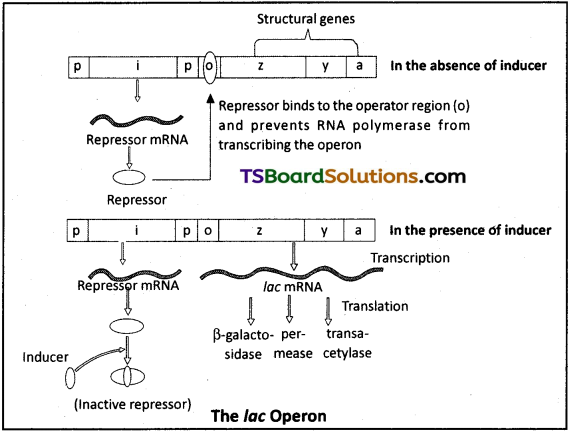
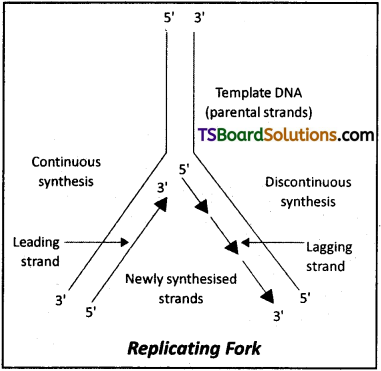
TS Inter 1st Year Zoology Study Material Chapter 7 Type Study of Periplaneta Americana (Cockroach) 11

Haemocoel :
The haemocoel of cockroach is divided into three sinuses by two muscular, horizontal membranes, called dorsal diaphragm or ‘pericardial septum1 and ventral diaphragm. Both the diaphragms have pores. There is a series of paired triangular muscles, called alary muscles. Every segment has one pair of these muscles situated on the lateral sides of the body. These are attached to the pericardial septum by their broad bases and to the terga by their pointed ends or apices.

The three sinuses of the haemocoel are known as pericardial haemocoel or the ‘dorsal sinus’, the perivisceral haemocoel or the ‘middle sinus’ and sternal haemocoel or ‘vental sinus’ or ‘perineural sinus’. The middle sinus is very large as it contains most of the viscera. The dorsal and ventral sinuses are small as they have only heart and nerve cord, respectively.

Heart :
The heart lies in the pericardial haemocoel or dorsal sinus. It is along, muscular, contractile tube found along the mid dorsal line, beneath the terga of the thorax and abdomen. It consists of 13 chambers. Every chamber opens into the other present in front of it. Three of the thirteen chambers are situated in the thorax and ten in the abdomen. Its posterior end is closed while the anterior end is continued forward as the anterior aorta. At the posterior side of each chamber, except the labt, there a pair of small apertures called ostia’ one on each side. Ostia have valves which allow the blood to pass only into the heart from the dorsal sinus.

Blood :
The blood of Periplaneta is colourless and is called haemolymph. it consists of a fluid called plasma, and free blood corpuscles or haemocytes, which are ‘phagocytic1. The phagocytes are large in size and can’ingest1 foreign particles such as bacteria. There is no respiratory pigment in the blood and so it plays no major role in respiration. The important functions of the blood are :

  1. It absorbs digested food from the alimentary canal and distributes it to the rest of the body.
  2. It brings nitrogenous wastes from all parts of the body to the excretory organs for their elimination.
  3. It carries defensive phagocytes to the places of infection where they engulf the germs and disintegrating tissue parts.
  4. It transports secretions of the ductless glands to the target organs.

Circulation of blood :
The blood flows forward in the heart by the contractions of its chambers. At the anterior end of the heart, the blood flows into the aorta and from there it enters the sinus of the head. From the head sinus, the blood flows into the perivisceral and sternal sinuses. On contraction of the alary muscles, the pericardial septum is pulled down. This increases the volume of the pericardial sinus. Hence blood flows from the perivisceral sinus into the pericardial sinus through the appertures of the pericardial septum. On relaxation of the alary muscles, the pericardial septum moves upwards to its original position. This forces the blood, to enter the chambers of the heart through the ostia from the pericardial sinus.
TS Inter 1st Year Zoology Study Material Chapter 7 Type Study of Periplaneta Americana (Cockroach) 3

Question 5.
The blood circulatory system of Periplaneta is of open type. Illustrate the statement describing the course of circulation in it. (U)
Answer:
The circulatory system helps in the transportation of digested food, hormones etc. from one part to another in the body. Periplaneta has an open type of circulatory system as blood or haemolymph flows freely with in the body cavity or haemocoel.

Circulation of blood :
The blood flows forward in the heart by the contraction of its chambers. At the anterior end of the heart, the blood flows into the aorta and from there it enters the sinus of the head. From the head sinus, the blood flows into the perivisceral and sternal sinuses. On contraction of the alary muscles the pericardial septum is pulled down. This increases the volume of the pericardial sinus. Hence blood flows from the perivisceral sinus into the pericardial sinus through the appertures of the pericardial septum. On relaxation of the alary muscles, the pericardial septum moves upwards to its original position. This forces the blood, to enter the chambers of the heart through the ostia from the pericardial sinus.
TS Inter 1st Year Zoology Study Material Chapter 7 Type Study of Periplaneta Americana (Cockroach) 3

Question 6.
Describe the respiratory system of cockroach with the help of neat and labelled diagrams. (K & S)
Answer:
Respiratory System of Periplaneta :
Due to the absence of respiratory pigment, the blood of cockroach is colourless and it cannot carry oxygen to different tissues. Therefore a tracheal system is developed to carry the air directly to the tissues. The respiratory system of cockroach consists of stigmata, tracheae and tracheoles.
TS Inter 1st Year Zoology Study Material Chapter 7 Type Study of Periplaneta Americana (Cockroach) 12

Stigmata or spiracles :
The tracheal system communicates with the exterior by ten pairs of openings called stigmata or spiracles. The first two pairs of spiracles are present in the thoracic segments, one pair in mesothorax and one pair in the metathorax. The remaining eight pairs are present in the first eight abdominal segments. Spiracles are located in the pleura of their respective segments. The respiratory system in insects is classified on the basis of number and nature of spiracles.

The spiracles of cockroach are polypneustic (as they are more than 3 pairs) and holopneustic (as all of them are functional). All spiracles are valvular and each of them is surrounded by a chitinous ring called peritreme. All spiracles bear small hair like structures called trichomes to filter the dust particles. Each spiracle opens into a small chamber called atrium.

Tracheae :
From the atrium of each thoracic spiracle several horizontal tracheae run inside. They join with each other in the thorax to form many tracheal trunks like dorsal cephalic, ventral cephalic trunks and their branches. These branches enter all organs of the head. The thoracic region also contains lateral longitudinal trunks. The abdominal spiracles lead into atria. From the atrium of each abdominal spiracle three tracheal tubes arise. All these tracheal tubes of one side open into three separate longitudinal tracheal trunks.

They are lateral, dorsal and ventral longitudinal trunks. Lateral longitudinal trunks are the longest tracheal trunks. The three pairs of longitudinal tracheal trunks of both the sides are interconnected by many commissural tracheae. From all the tracheal trunks several branches are given out, which enter different organs. All tracheal branches entering into an organ end in a special cell called tracheole cell.

The wall of the tracheae is made of three layers. They are an outer basement membrane, a middle one cell thick epithelium and an inner layer of cuticle called intima. The intima is produced into spiral thickenings called taenidia. The taenidia keep the tracheae always open and prevent it from collapsing.

Tracheoles :
The terminal cell of trachea is called tracheoblast or tracheole cell. It has several intracellular tubular extensions called tracheoles. Tracheoles are devoid of intima and taenidia. They are formed of a protein called trachein. Tracheolar fluid is present inside the tracheoles. The level of the tracheolar fluid varies with the metabolic activity of the insect. It is more when the insect is inactive and completely reabsorbed into the tissues, when the insect is more active. Tracheoles penetrate the cell and are intimately associated with mitochondria (to supply oxygen to them).

Mechanism of respriation :
Respiration includes two events, viz., inspiration and expiration. The muscles helpful are dorsoventral muscles and ventral longitudinal musdes. Dorsoventral muscles are the principal muscles of respriation.

TS Inter 1st Year Zoology Study Material Chapter 7 Type Study of Periplaneta Americana (Cockroach) 13

Inspiration :
Taking in of air is inspiration. lifts effected by the relaxation of the dorsoventral muscles and ventral longitudinal muscles. Due to the relaxation of the dorsoventral muscles, tergal plates are elevated and the volume of the body cavity increases. Due to the relaxation of the ventral longitudinal muscles, the telescoped segments come to the normal position. So the volume of the body cavity increases in the longitudinal axis. As air is drawn in due to the relaxation of the muscles, the process is a ‘passive’ process. During inspiration the thoracic spiracles are kept open and the abdominal spiracles are kept closed.

Expiration :
Sending out air from the body is called expiration. On contraction the dorsoventral muscles depress the tergal plates. Body cavity decreases in size and pressure increases. Due to the contraction of the ventral longitudinal muscles, the segments are telescoped and the volume of the body cavity decreases in the longitudinal axis increasing the pressure further. As this process involves the contraction of muscles, expiration is described as active process. During expiration thoracic spiracles are closed and abdominal spiracles are kept open.

Exchange of gases :
As air enters the tracheoles, oxygen from the air is taken into the cells and CO2 is released into haemolymph. The CO2 from the haemolymph mostly goes out through the inter-segmental membranes of the body wall. Cockroach and some other insects such as grasshoppers and beetles exhibit the phenomenon of discontinuous ventilation. In this mode of respiration continuous exchange of gases is interrupted by extended periods during which spiracles remain closed. The expulsion of CO2 from the body occurs in bursts, when the spiracles are open.

The exchange of gases depends on the metabolic rate and temperature. When air enters the tracheoles, oxygen diffuses faster into the tissues due to its high partial pressure. At the same time the carbon dioxide of tissues, instead of passing into the tracheal system, goes into the haemolymph. Carbon dioxide is carried more quickly into the haemolymph due to its greater solubility in it. This CO2 accumulates near the spiracles and diffuses into the artial chambers near the spiracles and goes o.ut in bursts through the abdominal spiracles. Opening and closing of spiracles is influenced by CO2 tension in haemolymph and oxygen tension in the trachea.

TS Inter 1st Year Zoology Study Material Chapter 7 Type Study of Periplaneta Americana (Cockroach)

Question 7.
Describe the nervous system of Periplaneta and draw a labelled diagram of it. (K & S)
Answer:
The nervous sytem of cockroach consists of central nervous system, peripheral nervous system and autonomous nervous system.

Central Nervous System :
It consists of a nerve ring, and a ganglionated double ventral nerve cord.

Nerve ring :
The nerve ring, which is present around the oesophagus, is formed by the following.

Brain :
Brain lies above the oesophagus. The brain is mainly a sensory and an endocrine centre. Three lobes of the brain are protocerebrum,deutocerebrum and tritocerebrum. the protocerebrum receives sensory impulses from the compound eyes through optic nerves; deutocerebrum receives sensory impulses from antennae through antennal nerves; and tritocerebrum receives sensory impulses from the labrum. Hence brain is principally ‘sensory’ in nature.
TS Inter 1st Year Zoology Study Material Chapter 7 Type Study of Periplaneta Americana (Cockroach) 14

Sub-oesophageal ganglion :
It lies below the oesophagus. It is the motor center that controls the movements of mouthparts, legs and wings, it is formed by the fusion of paired ganglia of mandibular, maxillary and labial segments of the head. Circum-oesophageal connectives : A pair of circum-oesophageal connectives is present around the oesophagus, connecting the tritocerebrum with the sub – oesophageal ganglion/ sub oesophageal ganglia.

Ventral nerve cord :
The two ventral nerve cords are solid and ganglionated. They arise from the sub-oesophageal ganglion and extend upto the 7th abdominal segment. The two nerve cords remain separate except at the ganglia. Three thoracic ganglia are present, one in each thoracic segment. In addition, there are six abdominal ganglia. The first to the fourth abdominal segments have one abdominal ganglion each. The 5th abdominal segment has no ganglion . The serially 5th abdominal ganglion is present in the 6th segment. The serially 6th abdominal ganglion is present in the 7th segment. The last or the 6th abdominal ganglion is the largest of all the abdominal ganglia. It is formed by the fusion of the ganglia of the 7th, 8th, 9th, and 10th abdominal segments.

Peripheral Nervous System :
It consists of nerves arising from the central nervous system. It receives a pair of optic nerves, from the compound eyes, a pair of antennal nerves, from the antennae and a pair of labral nerves from the labrum. Motor neurons of the frontal nerve to the frontal ganglion join the sensory neurons of the labral nerve to form the larbro frontal nerve arising from the tritocerebrum. Sub – oesophageal ganglion gives off motor nerves to the mandibles, maxillae, labium, wings and legs. It is the principal ‘motor centre’ in the body. Thoracic ganglia supply nerves to the parts of their respective segments. Metathoracic ganglia send nerves to the first abdominal segment also.

Nerves from the first four abdominal ganglia supply to the organs of the segments 2 – 6 serially (the 1st to the 4th ganglia innervate segments 2nd to 5th respectively). The 5th ganglion present in the 6th segment innervates the organs of the 6th segment. All organs present in 7th to 10th segments receive nerves from the last abdominal ganglion (present in the 7th segment.) The organs include the reproductive organs, copulatory appendages besides anal cerci.

Autonomous Nervous System :
This system is also called stomatogastric nervous system or ‘visceral nervous system’. It controls the visceral organs, particularly the muscles of the alimentary canal, and the heart. Autonomous nervous system includes four ganglia, a frontal ganglion on the dorsal wall of the pharynx, in front of the brain, hypocerebral ganglion or occipital ganglion above the oesophagus, behind the brain, a visceral ganglion or ingluvial ganglion on the wall of the crop and a proventricular ganglion on the gizzard.

These ganglia contain the ‘somata’ of the post ganglionic motor neurons. Pregaglionic motor neurons of tritocerebrum go to the frontal ganglion as labrofrontal and frontal nerve. Frontal ganglion is connected to the hypocerebral ganglion by a ‘recurrent nerve’. Hypocerebral ganglion is connected to the visceral ganglion and in turn the visceral ganglion is connected to proventricular ganglion.

TS Inter 1st Year Zoology Study Material Chapter 7 Type Study of Periplaneta Americana (Cockroach)

Question 8.
Describe the reproductive system of Periplaneta and draw neat and labelled diagrams of it. (K & S)
Answer:
Reproductive System of Periplaneta :
Periplaneta is dioecious, or unisexual, and both the sexes have well developed reproductive organs. The sexual dimorphism is evident both externally and internally. The female is different from the male in respect of short and broad abdomen, presence of brood pouches and absence of anal styles.

Male Reproductive System :
The male reproductive system consists of a pair of testes. These are elongated and lobed structures lying one on each lateral side in the fourth to sixth abdominal segments. They are embedded in the fat bodies. From the posterior end of each testis, there starts a thin duct, the vas deferens. The two vasa deferentia run backwards and inwards to open into a wide median duct, the ductus ejaculatorius ip the seventh segment. A characteristic mushroom shaped gland is present in the 6th and 7th abdominal segments which functions as an accessory reproductive gland. The gland consists of two types of tubules, i) long slender tubules. The utriculi majores or ‘peripheral tubules’ ii) Short tubules, the utriculi breviores. Secretion of utriculi majores forms the inner layer of the spermatophore while that of utriculi breviores nourishes the sperms. These tubules open into the anterior part of the ejaculatory duct.
TS Inter 1st Year Zoology Study Material Chapter 7 Type Study of Periplaneta Americana (Cockroach) 6

The seminal vesicles are present on the ventral surface of the ejaculatory duct. These sacs store the sperms in the form of bundles called spermatophores. The ejaculatory duct is a muscular tube that extends posteriorly and opens at the gonopore or the ‘male genital ‘pore’. The duct of phallic or conglobate gland also opens near the gonopore. Its function is still not known. Surrounding the male genital opening there are chitinous and asymmetrical structures called phallic organs or gonapophyses or phallomeres which help in copulation. These are the male external genitalia.

Female Reproductive System :
The female reproductive system of Periplaneta consists of a pair of ovaries, a pair of oviducts, vagina, spermathecae, spermathecal papilla, and colleterial glands.

Ovaries :
A pair of large ovaries lies laterally in 2 to 6 abdominal segments. They are light yellow in colour surrounded by fat bodies. Each ovary consists of eight tubules called ovarian tubules or ovarioles. Each ovariole consists of a tapering anterior filament called germarium, and a posterior wider vitellarium. The germarium contains various stages of developing ova, and the vitellarium contains mature ova with yolk. The tapering ends of the ovarioles of each ovary unite to form a single thread which attaches to the dorsal body wall. The ovarioles, at their posterior end unite to form a short wide oviduct. The oviducts unite to form a very short median vagina.

The vertical opening of the vagina is called female genital pore. It opens into a large genital pouch on the eighth sternum. A spermatheca or receptaculum seminis, consisting of a left-sac like and a right filamentous caecum, is present in the 6th segment which opens by a median aperture on a small spermathecal papilla in the dorsal wall of the genital pouch on the ninth sternum. In a fertile female, the spermatheca contains spermatophores, obtained during copulation.

A pair of branched colleterial glands is present behind the ovaries. These glands open into the genital pouch separately, just above the spermathecal aperture. Secretion of the two collaterial glands forms a hard egg case called ootheca around the eggs.

Genital pouch is formed by 7th, 8th, and 9th abdominal sterna. The sternum of the seventh segment is boat shaped and forms the floor and side walls of the genital pouch. The sterna of the eighth and ninth segments, which are tucked into the seventh segment, constitute the anterior wall and the roof of the genital pouch, respectively. The genital pouch has two chambers the anterior ‘gynatrium’ or genital chamber and posterior ‘vestibuium’ or oothecal chamber.

Three pairs of plate like chitinous structures called gonapophyses are present around the female genital aperture. These gonapophyses guide the ova into ootheca as ovipositors. These are the female external genitalia.
TS Inter 1st Year Zoology Study Material Chapter 7 Type Study of Periplaneta Americana (Cockroach) 15

TS Inter 1st Year Zoology Study Material Chapter 6 Biology in Human Welfare

Telangana TSBIE TS Inter 1st Year Zoology Study Material 6th Lesson Biology in Human Welfare Textbook Questions and Answers.

TS Inter 1st Year Zoology Study Material 6th Lesson Biology in Human Welfare

Very Short Answer Type Questions

Question 1.
Define parasitism and justify this term.
Answer:
An intimate association between two organisms of different species in which, one is benefited and the other one is often adversely affected is called parasitism. The organism that obtains nourishment is called parasite and the organism from which the nourishment is obtained is called host.

Question 2.
Distinguish between facultative parasite and obligatory parasite.
Answer:
a) Facultative Parasite :
They lead parasitic life on host if available or may lead free living life in its absence.
Example : (Mycobacterium tuberculosus), Ascaris lumbricoides is facultative anaerobe.

b) Obligatory parasite :
They lead total parasitic life on host and in its absence, they die.
Example : (Blood fluke) Taenia solium is an obligatory anaerobe.

Question 3.
Distinguish between definitive host and intermediate host.
Answer:
Definitive host :
It is the host that harbours the adult stage or sexually mature stage of a parasite or the host in which the parasite undergoes sexual reproduction.

Intermediate host :
It is the host that harbours the developing larval or immature or asexual stages of a parasite or the host in which the parasite undergoes asexual reproduction.

Question 4.
Distinguish between vector and a reservoir host.
Answer:
a) Reservoir host :
It is the host that lodges the infective stages of a parasite in its body when the main host is not available. In the reservoir host, the parasite neither undergoes development nor causes any disease.

b) Vector :
It is an organism which transfers the infective stages of a parasite from one main host to another.

Question 5.
Distinguish between mechanical vector and biological vector.
Answer:
a) Mechanical vector :
It is the vector, which merely transfers the infective stages of a parasite but no part of the parasitic development takes place in it.

b) Biological vector :
It is the vector in which the parasite undergoes a part of the development before it gets transferred to another host.

TS Inter 1st Year Zoology Study Material Chapter 6 Biology in Human Welfare

Question 6.
What is a hyper-parasite? Mention the name of one hyper-parasite.
Answer:
Hyperparasite :
It is a parasite which lives in /on the body of another parasite.
eg : Nosema notabilis (cnidosporan parasite) lives in Sphaerospora polymorpha (also a cnidosporan parasite) which lives in the urinary bladder of toad fish.

Question 7.
What do you mean by parasitic castration? Give one example. [March 2020, 17]
Answer:
Parasitic castration :
Some parasites cause the degeneration of gonads of the host, making it sterile. This effect is called parasitic castration, eg : Sacculina (a crustacean) causes degeneration of ovaries in the crab carcinus.

Question 8.
What are the parasitic adaptations observed in Ascaris lumbricoides?
Answer:

  1. Developed protective cuticle to withstand the action of digestive enzymes of the host.
  2. Reproductive potential is high due to risky lifecycle. Ascaris female lays 2 lakhs of eggs per day.
  3. It is a facultative anaerobe.

Question 9.
What are the endo-parasitic adaptations observed in Fasciola hepatica?
Answer:
Life cycle of Fasciola hepatica is very complex involving many developmental stages and two intermediate hosts to increase the chances of reaching a new definitive host.

Question 10.
Define neoplasia. Give one example.
Answer:
Neoplasia :
Some cause an abnormal growth of the host cells in a tissue to form . new structures. This effect is called Neoplasia which leads to cancers, eg : Some viruses.

Question 11.
Define the most accurate definition of the term ‘health’ and write any two factors that affect the health.
Answer:
Health is a state of complete physical, mental and social well-being and not merely ‘absence of any disease’ or ‘absence of physical fitness’. Two factors that affect the health are 1) contaminated water 2) pollution of air.

Question 12.
Distinguish between infectious and non-infectious diseases. Give two examples each.
Answer:
a) Infectious diseases :
The diseases which are easily transmitted from one person to another are called infectious diseases. Eg. Amoebic dysentery, Malaria,

b) Non – infectious diseases :
The diseases which are not transmitted from one person to another and are not caused by pathogens are called non-infectious diseases.
eg : Kidney problems, genetic disorders, heart problems.

TS Inter 1st Year Zoology Study Material Chapter 6 Biology in Human Welfare

Question 13.
When can you diagnose a healthy person as unhealthy?
Answer:
When the functioning of one or more organs or systems of the body is adversely affected characterized by various signs and symptoms, we say that we are not healthy or we are unhealthy.

Question 14.
Write any two diagnostic features of trophozoite of Entamoeba histolytica.
Answer:
a) Cartwheel shaped nucleus.
b) Single blunt finger like pseudopodium called lobopodium.
c) Presence of RBC in food vacuole.

Question 15.
‘Entamoeba histolytica is an obligatory anaerobe.’ Justify.
Answer:
The absence of mitochondria indicates the obligate anaerobic nature of Entamoeba histolytica.

Question 16.
Distinguish between precystic stage and cystic stage of E. histolytica.
Answer:
Precystic stage :
It is the non-feeding and non-pathogenic stage of Entamoeba histolytica. It is a small, spherical or oval, non-motile form.

Cystic stage :
It is round in shape and is surrounded by a thin, delicate, and highly resistant cyst wall. This is infective stage.

Question 17.
What is the reserve food in the precystic and early cyst stages of Entamoeba histolytica?
Answer:
The reserve food in the precystic and early cyst stages of Entamoeba histolytica are glycogen granules and chromatoid bars (made up of ribonucleo protein).

TS Inter 1st Year Zoology Study Material Chapter 6 Biology in Human Welfare

Question 18.
What is a metacystic form with reference to Entamoeba histolytica?
Answer:
When the tetranucleate cysts of entamoeba histolytica enter a new human host, they pass into small intestine where the cyst wall gets ruptured by the action of the enzyme trypsin, releasing the tetranucleate amoebae. Such tetranucleate excystic amoebae are called metacysts.

Question 19.
A person is suffering from bowel irregularity, abdominal pain, blood and mucus in stool /etc. Based on these symptoms, name the disease and its causative organism.
Answer:
The disease is Amoebic dysentery or Amoebiasis. The causative organism is Entamoeba histolytica.

Question 20.
On the advice of a doctor, a patient has gone to a clinical laboratory for the examination of a sample of faeces. The lab technician, on observing the stool of the patient diagnosed that the patient was suffering from amoebiasis. Write any two characteristic features based on which the technician came to that conclusion.
Answer:

  1. Stools with blood and mucous.
  2. Stools containing the tetranucleate cysts.

Question 21.
Define ‘asymptomatic cyst passers’ with reference to Entamoeba histolytica.
Answer:
Some people do not exhibit any symptoms of amoebic dysentery or intestinal amoebiasis or tropical amoebiasis. Such people are called carriers or ‘asymptomatic cyst passers’ as their stool contains the tetranucleate cysts.

Question 22.
Distinguish between primary amoebiasis and secondary amoebiasis.
Answer:

  1. Stools with blood and mucous with acute abdominal pair is generally referred to as primary amoebiasis.
  2. When trophozoites rupture the wall of capillaries, enter the blood stream, and primarily reach the liver where they may cause abscesses – some call it secondary amoebiasis.

Question 23.
What are the stages of Plasmodium vivax that infect the hepatocytes of man?
Answer:
The stages of plasmodium vivax that infect the hepatocytes of man are

  1. Sporozoites primarily
  2. Cryptozoites Secondarily (They are also referred to as I generation merozoites)

Question 24.
What are the stages of Plasmodium vivax that infect the RBC of the intermediate host?
Answer:
The stages of Plasmodium vivax that infect the RBc of the intermediate host are a) Cryptozoites b) Micro-metacryptozoites.

Question 25.
Define prepatent period. What is its duration in the life cycle of Plasmodium vivax?
Answer:
The interval between the first entry of plasmodium into the blood in the form of sporozoites and the second entry of plasmodium into the blood in the form of cryptozoites is called “Prepatent period”. In Plasmodium vivax it is 8 days.

Question 26.
Define incubation period. What is its duration in the life cycle of Plasmodium vivax? [March 2018 – A.P.]
Answer:
The period between the entry of plasmodium into the blood in the form of sporozoites and the first appearance of symptoms of malaria in man is called incubation period. It is approximately 10 to 14 days in Plasmodium vivax.

Question 27.
What are Schuffner’s dots? What is their significance?
Answer:
In the signet ring stage’of malarial parasite small red coloured dots appear in the cytoplasm of the RBC known as Schuffner’s dots. These are believed to be the antigens released by the parasite.

TS Inter 1st Year Zoology Study Material Chapter 6 Biology in Human Welfare

Question 28.
What are haemozoin granules ? What is their significance?
Answer:
The malaria parasite digests the globin part of the ingested haemoglobin and converts the soluble haem into an insoluble crystalline haemozoin granules. It is called the malaria pigment which is a disposable product.

Question 29.
Distinguish between schizogony and sporogony.
Answer:

  1. In man the plasmodium reproduces by asexual reproduction called Schizogony. It occurs in liver cells as well as in RBC.
  2. The formation of sporozoites in the oocysts seen in the stomach wall of female Anopheles mosquito is called SPOROGONY.

Question 30.
What is exflagellation and what are the resultant products called?
Answer:
The formation of male gametes or microgametes by lashing movements like flagella from micro gametocyte is called exflagellation.

Question 31.
Why is the syngamy found in Plasmodium called anisogamy?
Answer:
In plasmodium the male and female gametes are dissimilar in size, the process of union or syngamy is called Anisogamy.

Question 32.
What is ookinete? Based on the ‘sets of chromosomes’ how do you describe it?
Answer:
The zygote remains inactive for some time and then transforms into a long, slender, motile, vermiform ookinete or vermicule within 18 – 24 hours. The ookinete is diploid.

Question 33.
What is tertian fever, with reference to the types of malaria you have learnt about? Give the name of the causative species of the pathogen concerned.
Answer:
Four species of Plasmodium cause four types of malaria in man. They are
a) Plasmodium vivax – benign tertian malaria.
b) Plasmodium falciparum – malignant tertian malaria or cerebral malaria.
c) Plasmodium ovale – mild tertian malaria.
d) Plasmodium malariae-quartan malaria.
Recurrent fever of Malaria is called tertian fever.

TS Inter 1st Year Zoology Study Material Chapter 6 Biology in Human Welfare

Question 34.
What is the significance of hypnozoites, with reference to malaria fever?
Answer:
Some of the stages of macro-metacryptozoites may survive for a long period in liver as dormant stages called HYPNOZOITES. Reactivation of these hypnozoites leads to the initiation of fresh erythrocytic cycles resulting in the new attacks of malaria. This is referred to as relapse of malaria.

Question 35.
A person is suffering from chills and shivering and high temperature. These symptoms arp cyclically followed by profuse sweating and return to normal body temperature. Based on these symptoms, name the disease and its causative organism.
Answer:
a) Malaria is the disease; b) Causative organism Plasmodium.

Question 36.
Describe the methods of biological control of mosquitoes.
Answer:
Biological control of mosquitoes :
Introduction of larvivorous fishes like Gambusia, insectivorous plants like utricularia into the places where mosquitoes breed.

Question 37.
The eggs of Ascaris are called ‘mammillated eggs’. Justify.
Answer:
In Ascaris each egg is surrounded by a protein coat with rippled surface. Hence the eggs of Ascaris are described as “mammillated eggs”.

Question 38.
Write the route of extra intestinal migration followed by the juveniles of Ascaris lumbricoides.
Answer:
Extra intestinal migration exhibited by 2nd stage larva of Ascaris.
TS Inter 1st Year Zoology Study Material Chapter 6 Biology in Human Welfare 1

Question 39.
Write any two differences between male and female worms of Wuchereria bancrofti.
Answer:
Wuchereria bancrofti male and female differences.
a) Male worm :
Its posterior end is curved with a cloacal aperture. A pair of unequal, chitinous pineal spicules or copulatory spicules is present in the cloacal region.

b) Female worm :
Its posterior end is straight. Anus is present near the posterior end. The female genital pore or vulva is present mid ventrally at about one third the length from the mouth. It is ovi viviparous.

Question 40.
What is meant by nocturnal periodicity with reference to the life history of a nematode parasite you have studied?
Answer:
The microfilaria larvae of Wuchereria bancrofti in man move in the peripheral blood circulation during the night time between 10 pm and 4 am. This tendency is referred to as NOCTURNAL PERIODICITY.

TS Inter 1st Year Zoology Study Material Chapter 6 Biology in Human Welfare

Question 41.
Distinguish between lymphadenitis and lymphangitis.
Answer:

  1. Inflammation in the lymph vessels is called lymphangitis.
  2. Inflammation in the lymph glands is called lymphadenitis. Both are caused by filarial worm injection.

Question 42.
‘Elephantiasis is the terminal condition of filariasis.’ Justify.
Answer:
Fibroblasts accumulate in these tissues and form the fibrous tissue. In severe cases, the sweat glands of the skin in the affected regions disintegrate and the skin becomes rough. This terminal condition is referred to as Elephantiasis.

Question 43.
Mention the pathogens that cause ringworm.
Answer:
Ringworm is one of the most common infectious diseases in man. It is caused by many fungi belonging to the genera Microsporum, Trichophyton and Epidermophyton.

Question 44.
Explain any three preventive measures to control microbial infections.
Answer:

  1. The immunization programmes by the use of vaccines have enabled us to completely eradicate a deadly disease like smallpox.
  2. Biotechnology is at the verge of making available newer and safer vaccines.
  3. Discovery of antibiotics and various other drugs has also enabled us to treat infectious diseases effectively.

Question 45.
“Maintenance of personal and public hygiene is necessary for prevention and control of many infectious diseases.” Justify the statement giving suitable examples.
Answer:
The following hygienic habits help prevent spread of this disease.
a) Using boiled and filtered water
b) Washing hands, fruits and vegetables properly
c) Using septic tank toilets
These habits prevent diseases like Amoebiasis and Ascariasis.

TS Inter 1st Year Zoology Study Material Chapter 6 Biology in Human Welfare

Question 46.
Diseases like amoebic dysentery, ascariasis, typhoid etc., are more common in overcrowded human settlements. Why?
Answer:
In overcrowded human settlements, poor sanitation facilities are seen. No septic toilets for defecation. Drinking water is only from available water sources like tanks, lakes and ponds where cleaning of cattle, washing of clothes is also done. Due to these conditions the contaminated water, food and air spread the diseases like typhoid, amoebic dysentery and ascariasis.

Question 47.
In which way does tobacco affect the respiration? Name the alkaloid found in tobacco : [May 2017 – A.P.]
Answer:
Tobacco is smoked or chewed as gutkha or used in the form of snuff. Smoking increases the carbon monoxide level and reduces the oxygen level in the blood. Alkaloid found in tobacco is NICOTINE.
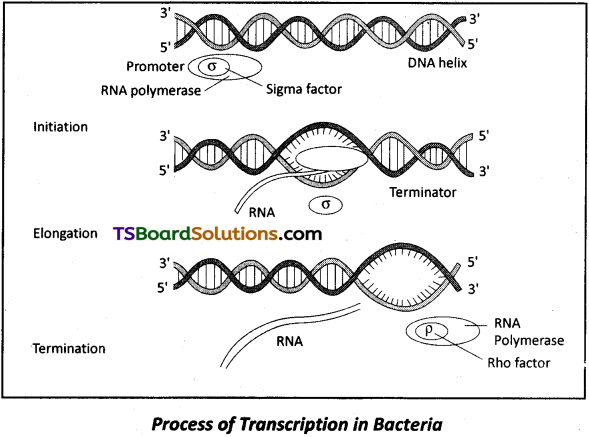
Question 48.
Define drug abuse.
Answer:
When drugs are taken for a purpose other than the medicinal use or in excess amounts that impair one’s physical or psychological functions, it constitutes “drug abuse”.

Question 49.
From which substances ‘Smack’ and ‘Coke’ are obtained?
Answer:
Smack and coke are obtained from :
Smack is chemically diacetylmorphine obtained by the acetylation of morphine extracted from dried latex of unripe seed capsule of poppy plant. Coke or crack is obtained from coca plant Erythroxylum coca, commonly called cocaine.

Question 50.
‘Many secondary metabolites of plants have medicinal properties. It is their misuse that creates problems.’ Justify the statement with an example.
Answer:
Benzodiazepines (tranquilizers), Lysergic acid diethyl amides (LSD) and other similar drugs, normally used as medicines to treat patients with mental illnesses like depression are often abused.

Question 51.
Write the scientific names of any two plants with hallucinogenic properties.
Answer:
TS Inter 1st Year Zoology Study Material Chapter 6 Biology in Human Welfare 2

Question 52.
Why are cannabinoids and anabolic steroids banned in sports and games?
Answer:
Cannabinoids and anabolic steroids (AAS) increase protein synthesis within cells which result in the build up of cellular tissues, especially in muscles. Cannabinoids show their effects on cardio-vascular system of the body. Hence they are banned in sports and games (DOPING TEST). They give tremendous energy temporarily.

TS Inter 1st Year Zoology Study Material Chapter 6 Biology in Human Welfare

Question 53.
Mention the names of any four drugs which are used as medicines to treat patients with mental illness like depression, insomnia, etc.’ that are often abused.
Answer:

  1. Lysergic acid diethyl amides (LSD)
  2. Barbiturates (sleeping pills)
  3. Amphetamines
  4. Benzodiazepines (tranquilizers)

Short Answer Type Questions

Question 1.
What is the need for parasites to develop special adaptations? Mention some special adaptations developed by the parasites. [May 2017 – A.P.]
Answer:
Parasites have evolved special adaptations to meet the requirements and lead successful life in the hosts.

  1. In order to live in the host, some parasites have developed structures like hooks, suckers, rostellum, etc., for anchoring, e.g. Taenia solium.
  2. Some intestinal parasites have developed protective cuticle to withstand the action of the digestive enzymes of the host. e.g. Ascaris lumbricoides.
  3. Some intestinal parasites produce anti enzymes to neutralize the effect of host’s digestive enzymes, e.g. Taenia solium.
  4. Some parasites live as obligatory anaerobes as the availability of oxygen is very rare for them. e.g. Entamoeba histolytica, Taenia solium, etc.
  5. Some intestinal parasites live as facultative anaerobes i.e., if oxygen is not available, they live anaerobically and if oxygen is available, they respire aerobically, e.g. Ascaris lumbricoides.
  6. The morphological and anatomical features are greatly simplified while emphasizing their reproductive potential. For example, an Ascaris lays nearly two lakh eggs per day. In Taenia solium the body is divided into 700 to 900 proglottids of which each proglottid acts as a unit of reproductive system and releases approximately 35,000 eggs.
  7. The life cycles of endoparasites are more complex because of their extreme specialization. For example, life cycle of certain parasites like Fasciola hepatica (sheep liver fluke) is very complex involving many developmental stages and two intermediate hosts to increase the chances of reaching a new definitive host.
  8. Certain parasites like Entamoeba develop cysts to tide over the unfavourable conditions like desiccation while reaching the new host.
  9. Some parasites elude production of vaccines against them (smart parasites!) as they keep changing their surface antigens form time to time.
    e.g. Plasmodium, HIV, etc.

Question 2.
Describe the effects of parasites on the host.
Answer:
Effects of parasites on hosts :
In general, the parasites cause weakening of the body of their hosts by causing the deprivation of nutrients, fluids and metabolites as they compete with their hosts for the same. They may also cause pathological effects in their hosts suchas

1) Parasitic castration :
Some parasites cause the degeneration of gonads of the host, making it sterile. This effect is called parasitic castration.
e.g. Sacculina (root headed barnacle, a crustacean) causes the degeneration of ovaries in the crab Carcinus maenas.

2) Neoplasia :
Some cause an abnormal growth of the host cells in a tissue to form new structures. This effect is called neoplasia which leads to cancers, e.g. Some viruses

3) Gigantism :
Some parasites cause an abnormal increase in the size of the host. This effect is called gigantism, e.g. The larval stages of Fasciola hepatica cause gigantism in snail (an intermediate host).

4) Hyperplasia :
Some parasites cause an increase in the number of cells. This effect is called hyperplasia, e.g. Fasciola hepatica in the bile ducts of sheep.

5) Hypertrophy :
Some parasites cause an abnormal increase in the volume / size of the infected host cells. This effect is called hypertrophy, e.g. RBC of man infected by Plasmodium.

6) Most of the parasites cause various types of diseases like

  1. African sleeping sickness by Trypanosoma gambiense
  2. Delhi boils / Tashkent ulcers / Oriental sores by Leishmania tropica
  3. Kala azar/ Dum dum fever/Visceral leishmaniasis by Leishmania donovani
  4. Malaria by Plasmodium sps
  5. Elephantiasis by Wuchereria bancrofti.

Question 3.
Distinguish between hypertrophy and hyperplasia with an example [March 2020]
Answer:
Hyperplasia :
Some parasites cause an increase in the number of cells. This effect is called hyperplasia, e.g. Fasaola hepatica in the bile ducts of sheep Hypertrophy: Some parasites cause an abnormal increase in the volume / size of the infected host cells. This effect is called hypertrophy, e.g. RBC of man infected by Plasmodium

TS Inter 1st Year Zoology Study Material Chapter 6 Biology in Human Welfare

Question 4.
Write any four types of parasitic diseases. Mention the primary and secondary hosts of these parasites.
Answer:

  1. Malaria caused by Plasmodium. Primary host – female Anopheles mosquito. Secondary host-man.
  2. Elephantiasis caused by wuchereria bancrofti. Primary host – man. Secondary host – female culex mosquito.
  3. Amoebic dysentery or Anoebiasis caused by Entamoeba histolytica. Single host -man.
  4. Ascariasis caused by Ascaris lumbricoides. Single host – man.

Question 5.
Describe the structure of a trophozoite of Entamoeba histolytica.
Answer:
TS Inter 1st Year Zoology Study Material Chapter 6 Biology in Human Welfare 3
Trophozoite stage :
It is the most active, motile, feeding and pathogenic stage that lives in the mucosa and sub-mucosa membranes of the large intestine. It moves with the help of a single blunt finger like pseudopodium called lobopodium which is produced anteriorly. The body of the trophozoite is surrounded by plas- malemma. Its cytoplasm is differentiated into an outer clear, viscous, non-granular ectoplasm and the inner fluid like, granular endoplasm. Ribosomes, food vacuoles and a vesicular, cartwheel shaped nucleus are present in the endoplasm. However contractile vacuoles, endoplasmic reticulum, Golgi apparatus and mitochondria are absent.

The absence of mitochondria indicates the ‘obligate anaerobic nature’ of Entamoeba histolytica. It produces the proteolytic enzyme called histolysin due to which the species name histolytica’ was assigned to it. Due to the effect of this enzyme, the mucosa and sub-mucosa of the gut wall are dissolved releasing some amount of blood, tissue debris which are ingested by the trophozoites. Hence, the food vacuoles are with erythrocytes, fragments of epithelial cells and bacteria. The mode of nutrition is holozoic. Presence of ‘RBC in food vacuoles’ and cartwheel shaped nucleus are the characteristic features of the trophozoites of Entamoeba histolytica.

Question 6.
Explain the life cycle of Entamoeba histolytica.
Answer:
Life cycle :
The trophozoites undergo binary fissions in the wall of the large intestine and produce a number of daughter entamoebae. They feed upon the bacteria and the host’s tissue elements, grow in size and again multiply. After repeated binary fissions, when the trophozoites increase in number, some of the young ones enter the lumen of the large intestine and transform into precystic stages. Here, the precystic stages transform into cystic stages which in turn develop into tetranucleate cysts.

The entire process is completed only in a few hours. These tetranucleate cysts come out along with the faecal matter and can remain alive for about 10 days. These cysts reach new host through contaminated food and water. They pass into the small intestine of a new human host where the cyst wall gets ruptured by the action of the enzyme trypsin, releasing the tetranucleate amoebae. Such tetranucleate excystic amoebae are called metacysts.

The four nuclei of the metacyst undergo mitotic divisions and produce eight nuclei. Each nucleus gets a bit of the cytoplasm and thus eight daughter entamoebae or ‘metacystic trophozoites’ are produced. These young ones develop into feeding stages called trophozoites. They invade the mucous membrane of the large intestine and grow into mature trophozoites.

Question 7.
Write a short note on the pathogenicity of Entamoeba histolytica.
Answer:
The trophozoites ‘dissolve’ the mucosal lining by histolysin, go deep into sub¬mucosa and cause ulcers. These ulcers contain cellular debris, lymphocytes, blood corpuscles and bacteria. It leads to the formation of abscesses in the wall of large intestine. Ultimately it results in stool with blood and mucous. This condition is called amoebic dysentery or intestinal amoebiasisor tropical amoebiasis. Some people do not exhibit any symptoms. Such people are called ‘carriers or asymptomatic cyst passers’ as their stool contains the tetranucleate cysts. They help in spreading the parasites to other persons.

Extra-intestinal amoebiasis:
Sometimes, the trophozoites may rupture the wall of capillaries, enter the blood stream and primarily reach the liver where they may cause ‘abscesses’ (some call it ‘secondary amoebiasis’). From there, they may go to lungs, heart, brain, kidneys, gonads, etc., and cause abscesses in those parts leading to severe pathological conditions.

TS Inter 1st Year Zoology Study Material Chapter 6 Biology in Human Welfare

Question 8.
Describe the structure of sporozoite of Plasmodium vivax.
Answer:
TS Inter 1st Year Zoology Study Material Chapter 6 Biology in Human Welfare 4
Structure of sporozoite :
It is sickle shaped with a swollen middle part and pointed at both ends of its body. It measures about 15 microns in length and one micron in width. The body is covered by an elastic pellicle with microtubules which help in the wriggling movements of the sporozoite. The cytoplasm contains cell organelles such as Golgi complex, endoplasmic reticulum, mitochondria and a nucleus. Cytoplasm also shows many convoluted tubules of unknown function throughout the length of the body. It contains a cup like depression called apical cup at the anterior end into which a pair of secretory organelles opens. They secrete a cytolytic enzyme, which helps in the penetration of sporozoite into the liver cells.

Question 9.
What do you know about the exo-erythrocytic cycle of plasmodium vivax?
Answer:
This is a part of the life cycle of Plasmodium taking place in the liver of man. This starts after the liberation of cryptozoites from ruptured liver cells. Exo-erythrocytic cycle: If the cryptozoites enter the fresh liver cells, they undergo the changes similar to that of the pre-erythrocytic cycle and produce the second generation merozoites called metacryptozoites. These are of two types – the smaller micro-metacryptozoites and larger macro-metacryptozoites. This entire process is completed approximately in two days. The macro-metacryptozoites attack fresh liver cells and continue another exo-erythrocytic cycle, whereas the micro- metacryptozoites always enter blood stream and attack fresh RBC to continue erythrocytic cycle.

Question 10.
Describe the cycle of Golgi in the life history of Plasmodium vivax.
Answer:
Erythrocytic cycle :
Itwas first described by Camillo Golgi. Hence it is also called Golgi cycle. This cycle is initiated either by the cryptozoites of pre-erythrocytic cycle or the micro-metacryptozoites of exo-erythrocytic cycle. In the fresh RBC, these stages assume spherical shape and transform into trophozoites. It develops a small vacuole which gradually enlarges in size, pushing the cytoplasm and nucleus to the periphery. Now the Plasmodium looks like a finger ring. Hence this stage is called signet ring stage. Soon it loses the vacuole, develops pseudopodia and becomes amoeboid stage. With the help of pseudopodia, it actively feeds on the contents of the RBC and increases in size. As a result, the RBC grows almost double the size, this process is called hypertrophy.

The malaria parasite digests the globin part of the ingested haemoglobin and converts the soluble haem into an insoluble crystalline haemozoin. It is called the ‘malaria pigment’ which is a disposable product. During this stage, small red coloured dots appear in the cytoplasm of the RBC known as Schuffner s dots. These are believed to be the antigens released by the parasite. Now the Plasmodium loses the pseudopodia, further increases in size, occupies the entire RBC and becomes a schizont. It undergoes schizogony similar to that of the pre-erythrocytic cycle and produces 12 to 24 erythrocytic merozoites. They are arranged in the form of the petals of a rose in the RBC. Hence, this stage is called the rosette stage. Finally the erythrocyte bursts and releases the merozoites along with haemozoin into the blood. This cycle is completed approximately in 48 hours.
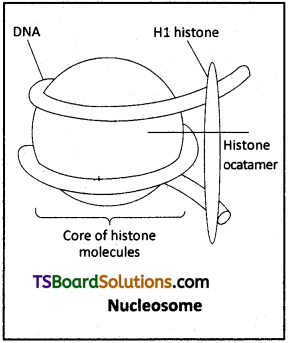
TS Inter 1st Year Zoology Study Material Chapter 6 Biology in Human Welfare 5

Question 11.
Describe the process of sporogony in the life cycle of Plasmodium vivax. What is the significance of sporozoites?
Answer:
TS Inter 1st Year Zoology Study Material Chapter 6 Biology in Human Welfare 6
Sporogony :
The formation of sporozoites in the oocysts is called sporogony. According to Bano, the nucleus of the oocyst first undergoes reduction division followed by repeated mitotic divisions resulting in the formation of about 1,000 daughter nuclei. Each bit of nucleus is surrounded by a little bit of the cytoplasm and transforms into a sickle shaped sporozoite. Oocyst with such sporozoites is called sporocyst. When this sporocyst ruptures, the sporozoites are liberated into the haemocoel of the mosquito. From there, they travel into the salivary glands and are ready for infection. The life cycle of Plasmodium in mosquito is completed in about 10 to 24 days.

TS Inter 1st Year Zoology Study Material Chapter 6 Biology in Human Welfare

Question 12.
Explain the pathogenicity of Wuchereria bancrofti in man.
Answer:
Pathogenicity of Wuchereria bancrofti in man :
Light infection causes filarial fever which is characterised by headache, mental depression and increase in the body temperature. In general, the infection of filarial worm causes inflammatory effect in lymph vessels and lymph glands. Inflammation in the lymph vessels is called lymphangitis and that of lymph glands is called lymphadenitis.

In the case of heavy infection, the accumulation of dead worms blocks the lymph vessels and lymph glands resulting in immense swelling. This condition is called lymphoedema which is noticed in the extremities of limbs, scrotum of males and mammary glands in females. Fibroblasts accumulate in these tissues and form the fibrous tissue. In severe cases, the sweat glands of the skin in the affected regions disintegrate and the skin becomes rough. This terminal condition is referred to as elephantiasis.

Question 13.
Write short notes on typhoid fever and its prophylaxis.
Answer:
Typhoid fever :
It is caused by Salmonella typhi which is a Gram negative bacterium. It mainly lives in the small intestine of man and then migrates to other organs through blood. It can be confirmed by Widal test.
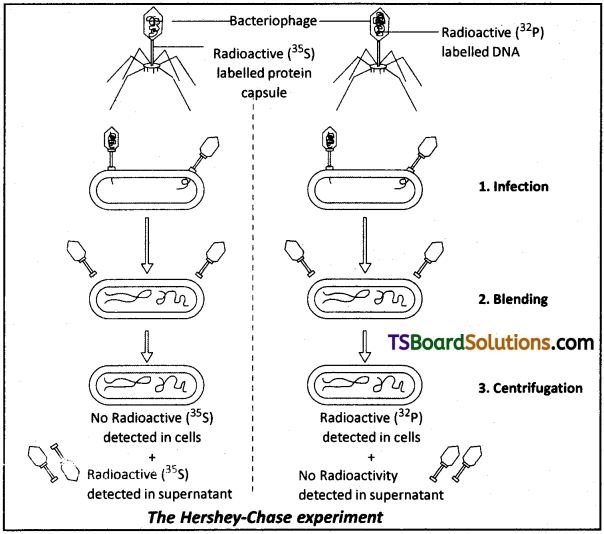
Mode of infection :
Contamination through food and water.

Symptoms :
Sustained fever with high temperature upto 104 F, weakness, stomach pain, constipation, headache and loss of appetite. Intestinal perforation and death may also occur in severe cases.

Prophylaxis :
The immunization programmes by the use of vaccines have enabled us to completely eradicate a deadly disease like smallpox. Biotechnology is at the verge of making available newer and safer vaccines. Discovery of antibiotics and various other drugs has also enabled us to treat infectious diseases effectively.

Question 14.
Write short notes on pneumonia and its prophylaxis.
Answer:
Pneumonia :
It is caused by Gram positive bacteria such as streptococcus pneumoniae and Haemophilus influenzae. They infect the alveoli of lungs in human beings.

Mode of infection :
Contamination by inhaling the droplets / aerosols released by an infected person or even by sharing the utensils with an infected person.

Symptoms :
The alveoli get filled with fluid leading to severe problems in respiration. In severe cases, the lips and finger nails may turn gray to bluish in colour.

Prophylaxis :
The immunization programmes by the use of vaccines have enabled us to completely eradicate a deadly disease like smallpox. Biotechnology is at the verge of making available newer and safer vaccines. Discovery of antibiotics and various other drugs has also enabled us to treat infectious diseases effectively.

TS Inter 1st Year Zoology Study Material Chapter 6 Biology in Human Welfare

Question 15.
Write short notes on common cold and its prophylaxis.
Answer:
Common cold :
It is caused by Rhino virus group of viruses. They infect nose and respiratory passage but not lungs.

Mode of infection :
Contamination by direct inhalation of the droplets resulting from cough or sneezes of an infected person or indirectly through contaminated objects such as pens, books, cups, door-knobs, computer keyboard or mouse etc. Generally all the medicines that are used against cold cause drowsiness.

Symptoms :
Nasal congestion, discharge from nose, sore throat, hoarseness, cough, headache, tiredness, etc., which usually last for 3 – 7 days.

Prophylaxis :
The immunization programmes by the use of vaccines have enabled us to completely eradicate a deadly disease like smallpox. Biotechnology is at the verge of making available newer and safer vaccines. Discovery of antibiotics and various other drugs has also enabled us to treat infectious diseases effectively.

Question 16.
Write short notes on ‘ringworm’ and its prophylaxis.
Answer:
Ringworm :
It is one of the most common infectious diseases in man. It is caused by many fungi belonging to the genera Microsporum, Trichophyton, and Epidermophyton. Heat and moisture help these fungi grow in the skin folds such as those in the groin or between the toes.

Mode of infection :
Contamination by using towels, clothes or combs of the infected persons or even from soil.

Symptoms :
Appearance of dry, scaly, usually round lesions accompanied by intense itching on various parts of the body such as skin, nails and scalp.

Prophylaxis :
Using of antifungal drugs like Griesoven orally, and antifungal creams like Zole, Itchguard. Ring guard for external tise’cures the disease. Hygiene habits prevent the disease.
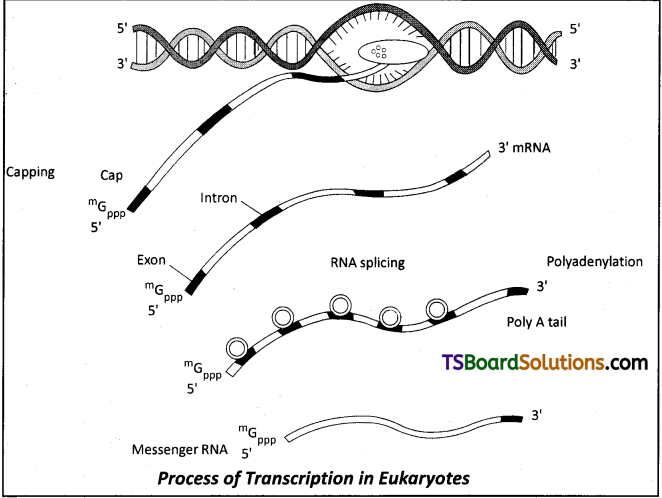
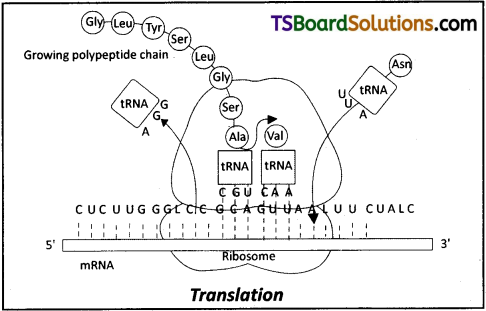
Question 17.
What are the adverse effects of tobacco?
Answer:
Tobacco has been used by human beings for more than 400 years. It contains a large number of chemical substances including nicotine, an alkaloid. While buying cigarettes one cannot miss the statutory warning present on the packet Smoking is injurious to health.

Mode of abuse :
It is smoked or chewed as gutkha or used in the form of snuff.

Effect :
Smoking increases the carbon monixide (CO) level and reduces the oxygen level in the blood. Nicotine stimulates the adrenal gland to release adrenaline and nor-adrenaline into blood. These hormones raise the blood pressure and increase the heart rate. Smoking is associated with bronchitis, emphysema, coronary heart disease, gastric ulcer and increases the incidence of cancers of throat, lungs, urinary bladder etc. Smoking also paves the way to hard drugs. Yet, smoking is very prevalent in society, both among young and old. Tobacco chewing is associated with increased risk of cancer of the oral cavity.

TS Inter 1st Year Zoology Study Material Chapter 6 Biology in Human Welfare

Question 18.
Write short notes on opioids.
Answer:
Opioids :
These are the drugs obtained from opium poppy plant Papaver somniferum (vernacular name : Nallamandu mokka).

They bind to specific opioid receptors present in our central nervous system and gastrointestinal tract. Some of them are morphine, heroin, etc.

i) Morphine :
It is extracted from the dried latex of the unripe seed capsule (pod) of poppy plant. It occurs as colourless crystals or a white crystalline powder.

Mode of abuse :
Generally it is taken orally or by injection.

Effect :
It is a very effective sedative and painkiller. It is very useful in patients who have undergone surgery.

ii) Heroin :
It is a white, bitter, odourless and crystalline compound, obtained by the acetylation of morphine. Chemically it is diacetylmorphine. It is commonly called ‘smack’.

Mode of abuse :
Generally it is taken by snorting and injection.

Effect :
Heroin is a depressant and slows down the body functions.

Question 19.
Write short notes on Cannabinoids.
Answer:
Cannabinoids :
These are a group of chemicals obtained from Indian hemp plant Cannabis sativa (vernacular name: Ganjai mokka). They interact with cannabinoid receptors present in the brain. The flower tops, leaves and the resin of this plant are used in various combinations to produce marijuana, hashish, charas and ganja. These days, cannabinoids are being abused by even some sports-persons (doping).

Mode of abuse :
These are generally taken by inhalation and oral ingestion.

Effect :
Show their effects on cardiovascular system of the body.

Question 20.
Write short notes on Cocaine.
Answer:
Coca alkaloid or Cocaine :
It is a white, crystalline alkaloid that is obtained from the leaves of Coca plant Erythroxylum coca, native to South America. It is commonly called coke or crack.

Mode of abuse :
It is usually snorted.

Effect :
It has a potent stimulating action on the central nervous system as it interferes with the transport of the neuro transmitter dopamine. Hence it produces a sense of euphoria and increased energy. Its excessive dosage causes hallucinations. Other well-known plants with hallucinogenic properties are Atropa belladonna and Datura. Certain drugs like ‘Barbiturates (sleeping pills), Amphetamines (cause sleeplessness), Benzodiazepines (tranquilizers), Lysergic acid diethyl amides (LSD) and other similar drugs, normally used as medicines to treat patients with mental illnesses like depression, insomnia, etc.,1 are often abused.

Question 21.
Why is adolescence considered vulnerable phase?
Answer:
Adolescence :
It is the time period between the beginning of puberty and the beginning of adulthood. In other words, it is the bridge linking childhood and adulthood. The age between 12 -18 years is considered adolescence period. It is both ‘a period and a process’ during which a child becomes mature. It is accompanied by several biological and behavioural changes. Thus, adolescence is a very vulnerable phase of mental and psychological development of an individual.

TS Inter 1st Year Zoology Study Material Chapter 6 Biology in Human Welfare

Question 22.
Why do some adolescents start taking drugs? How can this be avoided?
Answer:
Curiosity, desire for adventure and excitement, experimentation, are the common causes for the motivation of youngsters towards the use of tobacco, drugs. The first use of drugs or alcohol may be out of curiosity or experimentation, but later the person starts using them to escape facing problems. Recently ‘stress from the pressure to excel in academics or examination’s has played a significant role in alluring the youngsters to try certain drugs. Television, movies, newspapers and internet also help promoting this wrong perception. Other factors that are associated with tobacco, drug and alcohol abuse among adolescents are unstable or unsupportive family structures and peer pressure.

A lot of help is available in the form of highly qualified psychologists, psychiatrists and de-addiction and rehabilitation programmers. Educating and counselling the adolescents to face problems, stress and failures as a part of life.

Question 23.
Distinguish between addiction and dependence. [March 2017 -A.P.]
Answer:
Addiction :
It is a psychological attachment to certain effects such as euphoria. The most important thing one fails to realise is, the inherent addictive nature of tobacco, drugs and alcohol. With the repeated use of TDA, the tolerance level of the receptors present in our body increases. Consequently the receptors respond only to higher doses leading to greater intake and addiction.

However it should be clearly borne in mind that use of TDA even once, can be a fore-runner to addiction. Thus, the addictive potential of tobacco, drugs’and alcohol pull the users into a vicious circle leading to their regular use (abuse) from which they may not be able to get out. In the absence of any guidance or counseling, people get addicted and become dependent on them.

Dependence :
It is the tendency of the body to manifest a characteristic and unpleasant condition (withdrawal syndrome) if the regular dose of drugs or alcohol is abruptly discontinued. The withdrawal syndrome is characterised by anxiety, shakiness (tremors), nausea and sweating which may be relieved when the regular use is resumed again. Dependence leads the patients to ignore all social norms.

Question 24.
“Prevention is better than cure.” Justify with regard to TDA abuse. [March 2018 – A.P.]
Answer:
Prevention and Control: The age-old adage of Prevention is better than cure holds true here also. Some of the measures useful for prevention and control of TDA abuse among the adolescents are :

i) Avoid undue parental pressure :
Every child has his / her own choice, capacity and personality. The parents should not force their children to perform beyond their capacity by comparing them with others in studies, games, etc.

ii) Responsibility of parents and teachers :
They should look for the danger signs and counsel such students who are likely to get into the ‘trap’.

iii) Seeking help from peers :
If peers find some one abusing drugs or alcohol, immediately it should be brought to the notice of their parents or teachers so that they can guide them appropriately.

iv) Education and counselling :
Educating and counselling the children to face problems, stress and failures as a part of life.

v) Seeking professional and medical help :
A lot of help is available in the form of highly qualified psychologists, psychiatrists and de-addiction and rehabilitation programmers.

Essay Answer Type Questions

Question 1.
Explain the structure and life cycle of Entamoeba histolytica with the help of neat and labelled diagrams.
Answer:
Structure: Entamoeba histolytica passes through three distinct stages in its life cycle, namely:

  1. Trophozoite stage
  2. Precystic stage and
  3. Cystic stage

TS Inter 1st Year Zoology Study Material Chapter 6 Biology in Human Welfare 3
Trophozoite stage :
It is the most active, motile, feeding and pathogenic stage that lives in the mucosa and sub-mucosa membranes of the large intestine. It moves with the help of a single blunt finger like pseudopodium called lobopodium which is produced anteriorly. The body of the trophozoite is surrounded by plasmalemma. Its cytoplasm is differentiated into an outer clear, viscous, non-granular ectoplasm and the inner fluid like, granular endoplasm. Ribosomes, food vacuoles and a vesicular, cartwheel shaped nucleus are present in the endoplasm. However contractile vacuoles, endoplasmic reticulum, Golgi apparatus and mitochondria are absent.

The absence of mitochondria indicates the ‘obligate anaerobic nature’ of Entamoeba histolytica. It produces the proteolytic enzyme called histolysin due to which the species name histolytica’ was assigned to it. Due to the effect of this enzyme, the mucosa and sub-mucosa of the gut wall are dissolved releasing some amount of blood, tissue debris which are ingested by the trophozoites. Hence, the food vacuoles are with erythrocytes, fragments of epithelial cells and bacteria. The mode of nutrition is holozoic. Presence of ‘RBC in food vacuoles’ and cartwheel shaped nucleus are the characteristic features of the trophozoites of Entamoeba histolytica.

Precysticstage :
TS Inter 1st Year Zoology Study Material Chapter 6 Biology in Human Welfare 7
It is the non-feeding and non-pathogenic stage of Entamoeba histolytica that is found in the lumen of the large intestine. It is a small, spherical or oval, non- motile form. The cytoplasm of the precystic stage stores glycogen granules and chromatoid bars (made of ribonucleo protein) which act as reserve food.

Cystic stage :
TS Inter 1st Year Zoology Study Material Chapter 6 Biology in Human Welfare 8
It is round in shape and is surrounded by a thin, delicate and highly resistant cyst wall. It is found in the lumen of the large intestine. The process of development of cyst wall is called encystation which is a means to tide over the unfavourable conditions that the parasite is going to encounter while passing to a new host. Soon after the encystation, the nucleus undergoes two successive mitotic divisions to form four daughter nuclei. This type of cystic stage is called tetra nucleate cyst or mature cyst which is ‘the stage infective to man’.

Life cycle :
The trophozoites undergo binary fissions in the wall of the large intestine and produce a number of daughter entamoebae. They feed upon the bacteria and the host’s tissue elements, grow in size and again multiply. After repeated binary fissions, when the trophozoites increase in number, some of the young ones enter the lumen of the large intestine and transform into precystic stages. Here, the precystic stages transform into cystic stages which in turn develop into the tetranucleate cysts.

The entire process is compelted only in a few hours. These tetranucleate cysts come out along with the faecal matter and can remain alive for about 10 days. These cysts reach new host through contaminated food and water. They pass into the small intestine of a new human host where the cyst wall gets ruptured by the action of the enzyme trypsin, releasing the tetranucleate amoebae. Such tetranucleate excystic amoebae are called metacysts.

The four nuclei of the metacyst undergo mitotic divisions and produce eight nuclei. Each nucleus gets a bit of the cytoplasm and thus eight daughter entamoebae or ‘metacystic trophozoites’ are produced. These young ones develop into feeding stages called trophozoites. They invade the mucous membrane of the large intestine and grow into mature trophozoites.

Pathogenicity :
The trophozoites ‘dissolve’ the mucosal lining by histolysin, go deep into sub¬mucosa and cause ulcers. These ulcers contain cellular debris, lymphocytes, blood corpuscles and bacteria. It leads to the formatjon of abscesses in the wall of large intestine . Ultimately it results in stool with blood and mucous. This condition is called amoebic dysentery or intestinal amoebiasis or tropical amoebiasis. Some people do not exhibit any symptoms. Such people are called ‘carriers or asymptomatic cyst passers’ as their stool contains the tetranucleate cysts. They help in spreading the parasites to other persons.

Extra-intestinal amoebiasis :
Sometimes, the trophozoites may rupture the wall of capillaries, enter the blood stream, and primarily reach the liver where they may cause ‘abscesses’ (some call it ‘secondary amoebiasis’). From there, they may go to lungs, heart, brain, kidneys, gonads, etc., cause abscesses in those parts leading to severe pathological conditions.

TS Inter 1st Year Zoology Study Material Chapter 6 Biology in Human Welfare

Question 2.
Describe the life cycle of Plasmodium vivax in man. [March 2017 – A.P.]
Answer:
Life cycle of Plasmodium in man (The human phase): In man, the Plasmodium reproduces by asexual reproduction called schizogony. It occurs in liver cells (hepatocytes) as well as in RBC. In liver cells, it is called hepatic schizogony and in RBC it is called erythrocytic schizogony.

Hepatic schizogony :
This was discovered by Shortt and Garnham. Whenever, a mosquito infected by Plasmodium bites a man, nearly 2000 sporozoites are released into the blood of man through its saliva. Within half an hour, they reach the hepatocytes where they undergo pre-erythrocytic and exo-erythrocytic cycles.

Pre-erythrocytic cycle :
Whenever the sporozoites reach the liver cells, they transform into trophozoites. They feed on the contents of the hepatic cells, assume spherical shape and attain the maximum size. This stage is called schizont stage. Its nucleus divides several times mitotically, followed by the cytoplasmic divisions resulting in approximately 12,000 daughter individuals called cryptozoites or the regeneration merozoites. They enter the sinusoids of the liver by rupturing the cell membrane of the schizont and the liver cells. This entire process is completed approximately in 8 days. Now these first generation merozoites have two options i.e., they can enter either fresh liver cells and continue exo-erythrocytic cycle or they can enter RBC and continue erythrocytic cycle.

Exo-erythrocytic cycle :
If the cryptozoites enter the fresh liver cells, they undergo the changes similar to that of the pre-erythrocytic cycle and produce the second generation merozoites called metacryptozoites. These are of two types -the smaller micro-metacryptozoites and larger macro-metacryptozoites. This entire process is completed approximately in two days. The macro-metacryptozoites attack fresh liver cells and continue another exo – erythrocytic cycle, whereas the micro- metacryptozoites always enter blood stream and attack fresh RBC to continue erythrocytic cycle.

Prepatent period :
The interval between ‘the first entry of Plasmodium into the blood in the form of sporozoites and the second entry of Plasmodium into the blood in the form of cryptozoites is called prepatent period. It lasts approximately 8 days. During this period, the host does not show any clinical symptoms of the disease. It is only a means of multiplication.

Erythrocytic cycle :
It was first described by Camillo Golgi. Hence it is also called Golgi cycle. This cycle is initiated either by the cryptozoites of pre-erythrocytic cycle or the micro-metacryptozoites of exo – erythrocytic cycle. In the fresh RBC, these stages assume spherical shape and transform into trophozoites. It develops a small vacuole which gradually enlarges in size, pushing the cytoplasm and nucleus to the periphery. Now the Plasmodium looks like a finger ring. Hence this stage is-” called signet ring stage. Soon it loses the vacuole, develops pseudopodia and becomes amoeboid stage.

With the help of pseudopodia, it actively feeds on the contents of the RBC and increases in size. As a result, the RBC grows almost double the size. This process is called hypertrophy. The malaria parasite digests the globin part of the ingested haemoglobin and converts the soluble haem into an insoluble crystalline haemozoin. It is called the ‘malaria pigment’ which is a disposable product. During this stage, small red coloured dots appear in the cytoplasm of the RBC known as Schuffner s dots.

These are believed to be the antigens released by the parasite. Now the Plasmodium loses the pseudopodia, further increases in size, occupies the entire RBC and becomes a schizont. It undergoes schizogony similar to that of the pre-erythrocytic cycle and produces 12 to 24 erythrocytic merozoites. They are arranged in the form of the petals of a rose in the RBC. Hence, this stage is called the rosette stage. Finally the erythrocyte bursts and releases the merozoites along with haemozoin into the blood. This cycle is completed approximately in 48 hours.

Incubation Period :
The period between ‘the entry of Plasmodium into the blood in the form of sporozoite and the first appearance of symptoms of malaria in man’ is called incubation period. It is approximately 10 to 14 days.

Formation of gametocytes :
After repeated cycles of erythrocytic schizogony, when the number of fresh RBC decreases, some merozoites enter the RBC and transform into gametocytes instead of continuing the erythrocytic cycle. This process generally takes place when the RBCs are present in spleen and bone marrow.

The gametocytes are of two types namely, smaller microgametocytes or male gametocytes and larger macrogametocytes or female gametocytes. The gametocytes cannot undergo further development in man as the temperature and pH of the blood of man are not suitable for further development. These gametocytes reach the blood circulation and wait to reach the next host. They degenerate and die if they are not transferred to mosquito within a week.
TS Inter 1st Year Zoology Study Material Chapter 6 Biology in Human Welfare 9

Question 3.
Describe the life cycle of Plasmodium vivax in mosquito.
Answer:
Life cycle of Plasmodium in mosquito (The mosquito phase)- Ross cycle: When a female Anopheles mosquito bites and sucks the blood of a malaria patient, the gametocytes along with the other stages of the erythrocytic cycle reach the crop of mosquito. Here all the stages are digested except the gametocytes. Further part of the life cycle consists of:

  1. Gametogony
  2. Fertilization
  3. Formation of Ookinete & Oocysts
  4. Sporogony

i) Gametogony :
The formation of male and female gametes from the gametocytes is called gametogony. It occurs in the lumen of the crop of mosquito.

Formation of male gametes :
During this process, the nucleus of microgametocyte divides into eight daughter nuclei called pronuclei which reach the periphery. The cytoplasm is pushed out in the form of eight flagella like processes. Into each flagellum like process, one pronucleus enters and forms a micro gamete or male gamete. These male gametes show lashing movements like flagella and get separated from the cytoplasm of microgametocyte. This process is called exflagellation.

Formation of female gamete :
The female gametocyte undergoes a few changes and transforms into a female gamete. This process is called maturation. The nucleus of the female gamete moves towards the periphery and the cytoplasm at that point forms a projection. This projected region is called the fertilization cone.

ii) Fertilization :
The fusion of male and female gametes is called fertilization. It also occurs in the lumen of the crop of the mosquito. When an actively moving male gamete comes into contact with the fertilization cone of the female gamete, it enters it. The pronuclei and cytoplasm of these two gametes fuse with each other, resulting in the formation of a synkaryon. Since the two gametes are dissimilar in size, this process is known as anisogamy. The female gamete that bears the synkaryon is called the zygote which is round and non – motile.
TS Inter 1st Year Zoology Study Material Chapter 6 Biology in Human Welfare 10

iii) Formation of ookinete and oocysts :
The zygote remains inactive for some time and then transforms into a long, slender, motile, vermiform ookinete or vermicide within 18 to 24 hours. It pierces the wall of the crop and settles beneath the basement membrane. It becomes round and secretes a cyst around its body. This encysted ookinete is now called oocyst. About 50 to 500 oocysts are formed on the wall of the crop and appear in the form of small nodules. (Sir Ronald Ross identified these oocysts for the first time).

iv) Sporogony :
TS Inter 1st Year Zoology Study Material Chapter 6 Biology in Human Welfare 6
The formation of sporozoites in the oocysts is called sporogony. According to Bano, the nucleus of the oocyst first undergoes reduction division followed by repeated mitotic divisions resulting in the formation of about 1,000 daughter nuclei. Each bit of nucleus is surrounded by a little bit of the cytoplasm and transforms into a sickle shaped sporozoite. Oocyst with such sporozoites is called sporocyst. When this sporocyst ruptures, the sporozoites are liberated into the haemocoel of the mosquito. From there, they travel into the salivary glands and are ready for infection. The life cycle of Plasmodium in mosquito is completed in about 10 to 24 days.

TS Inter 1st Year Zoology Study Material Chapter 6 Biology in Human Welfare

Question 4.
Describe the structure and life cycle of Ascaris lumbricoides with the help of a neat and labelled diagram.
Answer:
TS Inter 1st Year Zoology Study Material Chapter 6 Biology in Human Welfare 11
Structure :
Sexes are separate and the sexual dimorphism is distinct. In both males and females, the body is elongated and cylindrical. Mouth is present at the extreme anterior end and is surrounded by three chitinous lips. Close to the mouth mid ventrally, there is a small aperture called excretory pore.

Male :
It has a curved posterior end which is considered the tail. The posterior end possesses a cloacal aperture and a pair of equal sized chitinous ‘pineal spicules or ‘pineal setae which serve to transfer the sperms during copulation.

Female :
It has a straight posterior end, the tail. The female genital pore or vulva is present mid ventrally at about one third the length from mouth. The anus is present a little in front of the tail end.

Life history :
Copulation takes place in the small intestine of man. After copulation, the female releases approximately two lakh eggs per day. Each egg is surrounded by ‘a protein coat with rippled surface. Hence the eggs of Ascaris are described as mammillated eggs. The protein coat is followed by a chitinous shell and a lipid layer internally. These eggs come out along with faecal matter. In the moist soil, development takes place inside the egg so that the 1st stage rhabditiform larva is produced. It undergoes the 1st moulting and becomes the 2nd stage rhabditiform larva which is considered ‘the stage infective to man’. They reach the alimentary canal of man through contaminated food and water.
TS Inter 1st Year Zoology Study Material Chapter 6 Biology in Human Welfare 12

In the small intestine, the shell gets dissolved so that the 2nd stage larva is released. Now it undergoes extra intestinal migration. First it reaches the liver through the hepatic portal vein. From there it reaches the heart through the post caval vein. It goes to the lungs through the pulmonary arteries. In the alveoli of lungs it undergoes the 2nd moulting to produce the 3rd stage larva. It undergoes the 3rd moulting so that the 4th stage larva is produced in the alveoli only. It leaves the alveoli and reaches the small intestine again, through bronchi, trachea, larynx, glottis, pharynx, oesophagus and stomach. In the small intestine, it undergoes the 4th and final moulting to become a young one which attains sexual maturity within 8 to 10 weeks.

Pathogenicity :
The disease caused by Ascaris lumbricoides is called ascariasis. The disease is asymptomatic if the number of worms is less. A heavy infection causes nutritional deficiency and severe abdominal pain. It also causes stunted growth in children.
TS Inter 1st Year Zoology Study Material Chapter 6 Biology in Human Welfare 13

Question 5.
Describe the life cycle of Wuchereria bancrofti.
Answer:
Life Cycle :
Wuchereria bancrofti completes its life cycle in two hosts namely man and female culex mosquito.

In man :
Both male and female worms are found coiled together in the lymphatic vessels of man. After copulation the female releases the sheathed microfilaria larvae into the lymph of man. Each sheathed microfilaria larva measures 0.2 to 0.3 mm in length. It is surrounded by a loose cuticular sheath which is supposed to be the modified shell. They migrate to the blood circulation and reside in the deeper blood vessels during the day time. They move to the peripheral blood circulation during the night time between 10.00 pm and 4.00 am. This tendency is referred to as nocturnal periodicity. When a female Culex mosquito sucks the blood of an infected person, they enter the gut of mosquito. They die if they are not transferred to mosquito with in 70 days.

In mosquito :
In the mid gut of mosquito, the sheath of the larva is dissolved within 2 to 6 hours of the infection. The ex-sheathed microfilaria larva penetrates the gut wall and reaches the haernocoel of mosquito. From there, it reaches the thoracic muscles and transforms into a ‘sausage shaped larva within two days. It is called the first stage larva or first stage microfilaria. This undergoes two moultings within 10 to 20 days and transforms into a long, infective 3rd stage microfilaria. It reaches the labium of the mosquito.
TS Inter 1st Year Zoology Study Material Chapter 6 Biology in Human Welfare 14

In man after the infection :
When an infected mosquito bites a man, the 3rd stage microfilaria larvae enter the blood circulation of man and finally reach the lymphatic vessels. Here they undergo the 3rdand the 4th moultings to produce young filarial worms. They attain sexual maturity within 5 to 18 months.

TS Inter 1st Year Zoology Study Material Chapter 6 Biology in Human Welfare

Question 6.
Write an essay on adolescence and TDA abuse.
Answer:
Adolescence and TDA abuse:
Adolescence :
It is the time period between the beginning of puberty and the beginning of adulthood. In other words, it is the bridge linking childhood and adulthood. The age between 12 -18 years is considered adolescence period. It is both ‘a period and a process’ during which a child becomes mature. It is accompanied by several biological and behavioural changes. Thus, adolescence is a very vulnerable phase of mental and psychological development of an individual.

TDA abuse :
Curiosity, desire for adventure and excitement, experimentation, are the common causes for the motivation of youngsters towards the use of tobacco, drugs and alcohol. The first use of drugs or alcohol may be out of curiosity or experimentation, but later the person starts using them to escape facing problems. Recently ‘stress from the pressure to excel in academics or examinations’ has played a significant role in alluring the youngsters to try certain drugs. Television, movies, newspapers and internet also help promoting this wrong perception. Other factors that are associated with tobacco, drug and alcohol abuse among adolescents are unstable or unsupportive family structures and peer pressure.

Addiction and Dependence :
The TDA abuse leads to addiction and dependence.

Addiction :
It is a psychological attachment to certain effects such as euphoria. The most important thing one fails to realise is, the inherent addictive nature of tobacco, drugs and alcohol. With the repeated use of TDA, the tolerance level of the receptors present in our body increases. Consequently the receptors respond only to higher doses leading to greater intake and addiction. However it should be clearly borne in mind that use of TDA even once, can be a fore-runner to addiction. Thus, the addictive potential of tobacco, drugs and alcohol pull the users into a vicious circle leading to their regular use (abuse) from which they may not be able to get out. In the absence of any guidance or counselling, people get addicted and become dependent on them.

Dependence :
It is the tendency of the body to manifest a characteristic and unpleasant condition (withdrawal syndrome) if the regular dose of drugs or alcohol is abruptly discontinued. The withdrawal syndrome is characterised by anxiety, shakiness (tremors), nausea and sweating which may be relieved when the regular use is resumed again. Dependence leads the patients to ignore all social norms.

Adverse effects of drugs and alcohol abuse :
The immediate adverse effects of drugs and alcohol abuse are manifested in the form of reluctant behaviour, vandalism and violence. Excessive doses of drugs may lead to coma and death due to respiratory or heart failure or cerebral haemorrhage. A combination of drugs or their intake along with alcohol generally results in overdosing and even death. The most common warning signs of drug and alcohol abuse among the youth include drop in academic performance, lack of interest in personal hygiene, depression, fatigue, aggressive behaviour, loss of interest in hobbies, change in sleeping and eating habits, fluctuations in weight, appetite, etc.

Those who take drugs intravenously are much more likely to acquire serious infections such as HIV, HBV (Hepatitis – B virus) etc., as the viruses are transferred from one person to another by the sharing of infected needles and syringes. The chronic use of drugs and alcohol damages nervous system and liver. The use of drugs and alcohol during pregnancy is also known to affect the foetus adversely.

Some sports-persorTs take drugs such as anabolic steroids to enhance their performance. The side-effects of the use of these drugs in females include masculinisation, increased aggressiveness, mood swings, depression, abnormal menstrual cycles, excessive hair growth on the face and body and the enlargement of clitoris. In males it includes acne (pimples), increased aggressiveness, mood swings, depression, reduction in the size of testicles, decreased sperm production, kidney and liver dysfunction, enlargement of breasts, premature baldness and the enlargement of the prostate gland.

Prevention and Control :
The age-old adage of Prevention is better than cure holds true here also. Some of the measures useful for prevention and control of TDA abuse among the adolescents are :
i) Avoid undue parental pressure :
Every child has his / her own choice, capacity and personality. The parents should not force their children to perform beyond their capacity by comparing them with others in studies, games, etc.

ii) Responsibility of parents and teachers :
They should look for the danger signs and counsel such students who are likely to get into the ‘trap’.

iii) Seeking help from peers :
If peers find someone abusing drugs or alcohol, immediately it should be brought to the notice of their parents or teachers so that they can guide them appropriately.

iv) Education and counselling :
Educating and counselling the children to face problems, stress and failures as a part of life.

v) Seeking professional and medical help:
A lot of help is available in the form of highly qualified psychologists, psychiatrists and de-addiction and rehabilitation programmers.

TS Inter 1st Year Zoology Study Material Chapter 5 Locomotion and Reproduction in Protozoa

Telangana TSBIE TS Inter 1st Year Zoology Study Material 5th Lesson Locomotion and Reproduction in Protozoa Textbook Questions and Answers.

TS Inter 1st Year Zoology Study Material 5th Lesson Locomotion and Reproduction in Protozoa

Very Short Answer Type Questions

Question 1.
Draw a labelled diagram of T.S. of flagellum. [March 2018-A.P.]
Answer:
TS Inter 1st Year Zoology Study Material Chapter 5 Locomotion and Reproduction in Protozoa 1

Question 2.
List any two differences between a flagellum and a cilium. [Mar. 2020, ’19, 17 – A.P ; May/June, Mar. 2014]
Answer:

FlagellumCilium
1) The long whip-like locomotor organelles are called flagella. Found in Mastigophoran Protozoans.1) These are small hair-like structures found in ciliate protists, genital ducts, respiratory tract.
2) Flagellum helps only in locomotion.2) Cilia serve as organelles or locomotion, food collection and also act as Sensory structures.
3) Flagella perform undular movement.3) Cilia perform pendular movement.

TS Inter 1st Year Zoology Study Material Chapter 5 Locomotion and Reproduction in Protozoa

Question 3.
What are dynein arms? What is their significance? [May 2017 – A.P.]
Answer:
In cross section of flagellum / cilium Dynein arms are seen. The ‘A’ tubule of flagellum/ cilium of each peripheral doublet bears paired arms along its length, called dynein arms

Bending movement of a flagellum is brought about by the sliding of microtubules past each other due to the functioning of ‘dynein arms’.

Question 4.
What is a Kinety? [March 2014]
Answer:
A longitudinal row of kinetosomes together with Kinetodesmata constitute a unit called ‘Kinety’.

Question 5.
Distinguish between synchronous and metachronous movements.
Answer:
1) Synchronous movement :
Cilia in a transverse row beat simultaneously in one direction. It is called synchronous movement.

2) Metachronous movement :
The sequential movement of Cilia, in a longitudinal row, one after the other in one direction is called metachronous movement.

Question 6.
Why do we refer to the offspring, formed by asexual method of reproduction, a clone? [March 2020, 19]
Answer:
The term clone is used to describe morphologically and genetically similar daughter individuals formed from single parent by asexual reproduction. They are not only identical to one another but also exact copies of their parent.

Question 7.
Distinguish between proter and opisthe. [Mar. 2017, 13 – A.P ; Mar. 2015 A.P & T.S]
Answer:
During Transverse binary fission of paramecium, two daughter paramecia are formed. The upper or anterior one is proter which receive upper contractile vacuole, cytopharynx and cytostome of its parent. The lower or posterior daughter is opisthe which receives the posterior contractile vacuole only.

Question 8.
How is sexual reproduction advantageous in evolution?
Answer:
Because of the fusion of male and female gametes, sexual reproduction results in offspring that are not identical to the parents or amongst themselves. This leads gradually to origin of new species in course of evolution.

TS Inter 1st Year Zoology Study Material Chapter 5 Locomotion and Reproduction in Protozoa

Question 9.
Distinguish between lobopodium and filopodium. Give an example to each of them. [May ’17 ; March 2015 – A.P.]
Answer:
a) Blunt finger like pseudopodia are called lobopodium and are seen in Amoeba and Entamoeba.
b) Fibre like pseudopodia are called filopodiurn and are seen in Euglypha.

Question 10.
Define conjugation with reference to ciliates. Give two examples. [March 2018 – A.P.; March 2015 – T.S ; May/June 2014]
A. Conjugation is a temporary union between two senile ciliates that belong to two different mating types for the exchange of nuclear material and its reorganization. This is observed in Paramecium and Vorticella.

Short Answer Type Questions

Question 1.
Name the system that controls the fastest swimming movement of protozoans and write its components.
Answer:
The system that controls the fastest swimming movement of protozoans is infraciliary system.

It is located just below the pellicle in the ectoplasm of a ciliate. It includes kinetosomes, kinetodesmal fibrils and kinetodesmata. The kinetosomes are present at the bases of cilia in transverse and longitudinal rows. The kinetodesmal fibrils are connected to the kinetosomes and run along the right side of each row of kinetosomes as a ‘cord of fibres’ called kinetodesmata. A longitudinal row of kinetosomes together with kinetodesmata constitute a unit called ‘kinety’.

All the kineties together form an infraciliary system, which is connected to a ‘motorium’, located near the cytopharynx. The infraciliary system and motorium form the ‘neuromotor system’ that controls and coordinates the movement of cilia.

Question 2.
Write the mechanism of bending of flagellum and explain effective and recovery strokes.
Answer:
Bending movement of flagella: Dynein arms show a complex cycle of movements using energy provided by ATP (dynein arms are the sites of ATPase activity in the cilia and flagella). The dynein arms of each doublet attach to an adjacent doublet and pull the neighbouring doublet. So the doublets slide past each other in opposite directions. The arms release and reattach a little farther on the adjacent doublet and again ‘puli’. As the doublets of a flagellum or cilium are physically held in place by the radial spokes, the doublets cannot slide past much. Instead they curve and cause bending of flagellum or cilium. Such bending movements of flagella and cilia play an important role in the flagellar and ciliary locomotion.
TS Inter 1st Year Zoology Study Material Chapter 5 Locomotion and Reproduction in Protozoa 2

i) Effective stroke :
Flagellum becomes rigid and starts bending to one side beating against the water. This beating against water is at right angles to the body axis and the organism moves forwards.

ii) Recovery stroke :
Flagellum becomes comparatively soft so as to offer least resistance to water and moves backwards to its original position. It is called ‘recovery stroke’.

TS Inter 1st Year Zoology Study Material Chapter 5 Locomotion and Reproduction in Protozoa

Question 3.
What are lateral appendages? Based on their presence and absence, write the various types of flagella giving at least one example for each type. [Mar. 17 – A.P ; Mar. 15 – A.P & T.S]
Answer:
Lateral appendages :
Some flagella bear one or two or many rows of short, lateral hair like fibrils called lateral appendages. They are of two types namely ‘mastigonemes’ and ‘flimmers’.

Types of Flagella :
Based on the presence or absence and / or the number of rows of lateral appendages, five types of flagella are recognised.

a. Stichonematic :
This flagellum bears one row of lateral appendages on the axoneme. Eg : Euglena and Astasia.

b. Pantonematic :
This flagellum has two or more rows of lateral appendages on the axoneme. Eg: Peranema and Monas.

c. Acronematic :
This type of flagellum does not bear lateral appendages and the terminal part of the axoneme is naked without the outer sheath at its tip.
Eg: Chlamydomonas and Polytoma.
TS Inter 1st Year Zoology Study Material Chapter 5 Locomotion and Reproduction in Protozoa 3

d. Pantacronematic :
This type of flagellum is provided with two or more rows of lateral appendages and the axoneme ends in a terminal naked filament.
Eg. Urceolus.

e. Anematic or simple :
In this type of flagellum, lateral appendages and terminal filament are absent. Hence, it is called anematic (a – no; nematic – threads).
Eg: Chilomonas and Cryptomonas.

Question 4.
Describe the process of transverse binary fission in paramecium. [May 2017 – A.P.; May/June 2014]
Answer:
TS Inter 1st Year Zoology Study Material Chapter 5 Locomotion and Reproduction in Protozoa 4
During favourable conditions, Paramecium stops feeding after attaining its maximum growth. At first the micronucleus divides by mitosis and the macronucleus divides into two daughter nuclei by amitosis. The oral groove disappears. After karyokinesis, a transverse constriction appears in the middle of the body, which deepens and divides the parent cell into two daughter individuals, the anterior proter and the posterior opisthe. The proter receives the anterior contractile vacuole, cytopharynx and cytosome from its parent individual.

It develops posterior contractile vacuole and a new oral groove. The opisthe receives the posterior contractile vacuole of its parent. It develops a new anterior contractile vacuole, cytopharynx, cytostome and a new oral groove. Binary fission is completed in almost two hours, in favourable conditions and paramecium can produce four generations of daughter individuals by binary fission in a day.

The transverse binary fission is also called homothetogenic fission, because the plane of fission is at right angles to the longitudinal axis of the body. As it occurs at right angles to the kineties, it is also called perkinetai fission.

Question 5.
Describe the process of longitudinal binary fission in Euglena. [March 2018 – A.P.; March 2014]
Answer:
During the process of binary fission, the nucleus, basal granules, chromatophores, cytoplasm undergo division. The nucleus divides by mitosis into two daughter nuclei. Then the kinetosomes and the chromatophores also divide. At first, a longitudinal groove develops in the middle of the anterior end. This groove extends gradually towards the posterior end until the two daughter individuals are separated.

One daughter Euglena retains the parental flagella. The other daughter individual develops new flagella from the newly formed basal granules. The stigma, paraflagellar body and contractile vacuole of the parent disappear. They develop afresh in both the daughter euglenae. The longitudinal binary fission is known as symmetrogenic division, because the two daughter euglenae resemble each other like ‘mirror images’.
TS Inter 1st Year Zoology Study Material Chapter 5 Locomotion and Reproduction in Protozoa 5

Question 6.
Write a short note on multiple fission.
Answer:
Multiple Fission :
It is the division of the parent body into many smaller individuals (Multi – many; Fission – splitting). Normally multiple fission occurs during unfavourable conditions. During the multiple fission, the nucleus first undergoes repeated mitotic divisions without cytokinesis. This causes the formation of many daughter nuclei. Then the cytoplasm also divides into as many-number of bits as there are nuclei. Each cytoplasmic bit encircles one daughter nucleus. This results in the formation of many smaller individuals from a single parent organism.

There are different types of multiple fissions in protozoans such as schizogony, male gametogony, sporogony in Plasmodium, sporulation in Amoeba, etc.

TS Inter 1st Year Zoology Study Material Chapter 5 Locomotion and Reproduction in Protozoa

Question 7.
Give an account of pseudopodia.
Answer:
Pseudopodia :
These are found in rhizopods. The pseudopodia are temporary extensions of cytoplasm that develop in the direction of the movement. These temporary structures are useful to move on the substratum as our legs do, hence the name ‘pseudopodia’. There are four kinds of pseudopodia namely lobopodia (blunt finger-like) as in Amoeba and Entamoeba, filopodia (fibre-like) as in Euglypha, reticulopodia (net-like) as in Elphidium and axopodia or heliopodia (sun ray-like) as in Actionophrys.
TS Inter 1st Year Zoology Study Material Chapter 5 Locomotion and Reproduction in Protozoa 6

The Pseudopodium is formed by the conversion of gel (viscous outer endoplasmic part) to sol (fluid-like inner endoplasmic part) and vice-versa. There are different theories on the formation of pseudopodium. The sol-gel transformation theory is the most accepted theory. Pseudopodial movement is performed by Amoeba, Polystomella, Actionophrys.

Question 8.
Give an account of the ultra structure of an axoneme.
Answer:
The structural components of a typical flagellum include axoneme, microtubules, dynein arms, inner sheath, outer sheath, radial spokes, lateral appendages (such as mastigonemes or flimmers) and a basal granule (kinetosome).
i) Axoneme / axial filament :
It is the central, longitudinal, microtubular structure of cilium and flagellum. It is surrounded by a membrane which is continuous with plasma membrane. All the components of the axoneme are embedded within the matrix.

ii) Microtubules :
An axoneme is made up of 2 central ‘singlets’ and 9 peripheral ‘doublets (9+2 array)’. These are formed by the protein, tubulin. Each peripheral doublet consists of an outer ‘A’ (alpha) and the inner ‘B’ (beta) tubules, so, the peripheral tubules are actually 9 microtubular doublets. (The microtubule ‘A’ is smaller but complete whereas ‘B’ is larger and incomplete). The peripheral doublets are interconnected by linkers called nexins.

iii) Dynein arms :
The ‘A’ tubule of each peripheral doublet bears paired arms along its length, called dynein arms (Dyne – pulling like a dynamo). The dynein arms of ‘A’ tubule face the tubule ‘B’ of the adjacent doublet. They are oriented in the same direction (clockwise) in all microtubules, when the axoneme is viewed from the base to the top. The dynein arms are considered ‘protein motor molecules’. They are made of the protein, dynein.

iv) Inner and outer sheaths :
The two central singlets are enclosed by a fibrous inner sheath and the peripheral doublets are enclosed by an outer sheath (an extension of plasma membrane). The central singlets do not reach below the level of the pellicle or plasmalemma.
TS Inter 1st Year Zoology Study Material Chapter 5 Locomotion and Reproduction in Protozoa 1

v) Radial spokes :
They are elastic fibres that connect the inner sheath, with the ‘A’ tubule of each doublet. They resemble the spokes that connect the rim of a bicycle wheel with the centre, hence the name ‘radial spokes / radial bridges’. The nine radial spokes limit the extent of sliding past of the doublets, during bending movements.

Question 9.
Draw a neat labelled diagram of Euglena.
Answer:
TS Inter 1st Year Zoology Study Material Chapter 5 Locomotion and Reproduction in Protozoa 7

TS Inter 1st Year Zoology Study Material Chapter 5 Locomotion and Reproduction in Protozoa

Question 10.
Draw a neat diagram of Paramecium and label its important structures/components.
Answer:
TS Inter 1st Year Zoology Study Material Chapter 5 Locomotion and Reproduction in Protozoa 8